
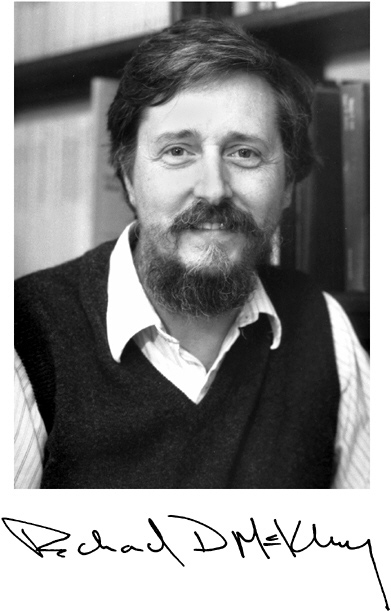
RICHARD DRUMMOND MCKELVEY
April 27, 1944–April 22, 2002
BY THOMAS R. PALFREY
RICHARD MCKELVEY DIED TOO young, on April 22, 2002, at the age of 57, and the social sciences lost a great scholar. He was a deep, creative thinker who set the standard for mathematical rigor in political science and also contributed in major ways to other fields. He was a central intellectual figure in the first generation of formal political theorists and was on board at the embarkation of the exciting new field of positive political theory. Positive political theory applied and further developed the sophisticated tools of game theory and social choice theory to the analysis of politics and political phenomena. Like several others, that generation was largely a product of the Rochester school, the great legacy of Bill Riker. McKelvey helped spread that legacy.
He was best known for a series of pathbreaking papers on the mathematical theory of voting in the 1970s, but he also made significant contributions to the application of statistical techniques to the analysis of political science data, social choice theory, computational techniques in economics, experimental economics and political science, and game theory. He was a scientist in the true sense of the word, developing intricate theoretical models of politics, testing his and others’ theoretical models in the laboratory, learn-
ing from his experimental findings, and building new theories and models based on these findings. While his early theoretical papers on voting are what most political scientists associate with McKelvey, the rigorous interchange of theory and data was the true hallmark of McKelvey’s career.
FAMILY BACKGROUND AND FORMATIVE YEARS
Richard McKelvey, or Dick, as some of his friends called him, was born in Geneva, New York, on April 27, 1944. The second of four sons of John McKelvey Jr. and Josephine (“Jo”) McKelvey, he was raised in a family that valued and nurtured intellectual and scientific pursuits. Whether a result of genetic structure or simply from growing up in a close family environment where knowledge and understanding were cherished, it is not surprising that Richard developed into the great scientist he was.
John was an agronomist specializing in plant pathology. He and Jo attended Oberlin (class of 1939). John went straight to graduate school, writing a master’s thesis at the Virginia Polytechnic Institute under the soon-to-become-distinguished agronomist J. George Harrar, with whom he later worked as an assistant. He obtained his Ph.D. in economic entomology from Cornell in 1945, shortly after Richard was born—perhaps a sign of things to come from the next generation. Jo received her degree in Classics and later earned a master’s degree in library science (Columbia, 1971). She enjoyed a second career for two decades at the Chappaqua public library, following her successful first career raising the four boys.
The intellectual heritage goes back at least a generation further, to his paternal grandfather, John Sr., who graduated from Oberlin in 1884 and was cofounder of the Harvard Law Review in 1886, becoming its first editor in chief. He authored McKelvey on Evidence, among other influential
law texts. How apropos, given his grandson’s later passion for confronting theories with data. Richard’s maternal grandfather, Edward Faulkner, wrote extensively on the economics of soil management and was best known for the classic Ploughman’s Folly.
The family moved to Mexico City in 1945 when John took a position with the Rockefeller Foundation to study how to control pests that damaged such grain crops as corn and wheat. These were very exciting times in agronomy, and the Rockefeller Foundation project in Mexico produced pathbreaking developments in hybrid wheat and corn, leading to Norman Borlaug’s 1970 Nobel Peace Prize. Richard spent the first seven years of his life there, before the family moved back to New York, this time in Chappaqua, where he lived until college.
Richard achieved success despite difficulties early in his school life. His academic performance in Mexico was less than stellar. This continued throughout grade school, where he also suffered socially as the smallest kid in the class.
In junior high school Richard’s scholastic interests drifted toward mathematics, and in high school he found a mentor. He wanted to take an advanced high school math class taught by an eccentric but brilliant and dedicated math teacher, Edwin Barlow, but his grades didn’t qualify him. So he spent the summer boning up on math and was accepted in the fall of his junior year. Barlow was so impressed with Richard’s math skills that several years later he urged him to return to Chappaqua and teach math.
Richard was involved in an array of extracurricular activities. He rose to the rank of life scout, played trombone in the band, and even pole-vaulted for the track and field team. The latter activity didn’t earn any medals but did produce a broken arm in a crash to the ground, possibly the cause of a subsequent collapsed lung.
But what Richard liked to do most in his spare time growing up was to solve puzzles and games, sometimes inventing them. He also engaged in pranks. In one that became a family legend, he swiped Girl Scout cookies from a box being sent to his older brother in college, substituting macaroni, a substance carefully selected for weight and the noise it made when shaken.
HIGHER EDUCATION
Following in the footsteps of his parents, grandparents, and several aunts and uncles, Richard enrolled at Oberlin College in 1961. His interest in mathematics continued to focus his studies. His inventiveness apparently did not let up either. He either invented or heard about an exciting gaming adventure in the form of a human random walk (literally), which he called a “penny hike.” At every intersection, he or his friend flipped a coin, turning left on heads and right on tails. This was probably his first experiment in decision making under uncertainty, and clearly an early indicator of his budding interest in stochastic processes (and mixed strategies). Eventually the experiment had to be abandoned when the coin appeared to be sending them to Alaska. It is perhaps worth noting that in his laboratory experiments Richard frequently preferred to randomize using dice, coins, and bingo cages, even after the advent of computers.
A second creation was a light-switch device designed to ensure that the lights in a room were always on when there was at least one person in the room and always off when the room was empty. This invention, which used electric eyes connected to counters, went through several phases with borderline success.
Following his graduation from Oberlin (in 1966), and a year obtaining a master’s degree in mathematics at Wash-
ington University (in 1967), Richard enrolled in the Ph.D. program in political science at the University of Rochester. Great things were happening under the direction of Bill Riker, and it was at Rochester where Richard found his calling in science. Kenneth Shepsle (one year ahead of Richard in the Ph.D. program) recalled how Riker had expressed great enthusiasm about McKelvey’s decision to enter the program, and the graduate students were all very excited about meeting this new hotshot. When Richard arrived in the fall and they finally met him, they were surprised at his modest, unassuming demeanor and wondered whether he could really be that good. Indeed he was, as they quickly discovered.
A revolution was under way, and some of the best minds in political science were perpetrating it. In fact, the list of students and faculty during Richard’s seven years there is a virtual who’s who in positive political theory and the positivist approach to substantive subfields of political science: Peter Ordeshook, McKelvey, Bill Riker, Ken Shepsle, Mo Fiorina, Dick Fenno, Bruce Bueno de Mesquita, John Aldrich, David Rhode, Bing Powell, Jerry Kramer, and others.
CARRYING THE TORCH FROM ROCHESTER TO CARNEGIE TO CALTECH
Before receiving his Ph.D. in 1973, Richard took a position at Rochester first as an instructor and later as an assistant professor. In his brief tenure there, Richard mentored several students who went on to distinguished careers, including John Aldrich and Keith Poole.
McKelvey moved to Carnegie Mellon in 1974, which at the time was second only to Rochester as a hotbed of positive political theory. Ordeshook, Howard Rosenthal, Toby Davis, and Melvin Hinich were the principal actors, and it was a different sort of place than Rochester. For one thing, a number of economists at Carnegie’s Graduate School of
Industrial Administration and School for Urban and Public Affairs were excited about positive political theory and joined in the fun. Modern political economy was more or less created at Carnegie during the 1960s and 1970s. It was during this period that McKelvey and Ordeshook began their pioneering collaboration in laboratory experimentation, a collaboration that lasted for more than a decade. At the same time, McKelvey was busy proving and publishing his fundamental theorems about the instability of majority rule.
Richard arrived at Caltech in 1978 and spent his first year there as a Fairchild distinguished scholar. Positive political theory now had another outpost in sunny Southern California. I know from my own experience there as a graduate student how exciting those times were. Charlie Plott, John Ferejohn, Mo Fiorina, Roger Noll, Gary Miller, Bob Forsythe, and McKelvey were doing positive political theory and laboratory experiments. As students, several of us had the good fortune to collaborate with them and learn this new methodology alongside them.
Except for that year as a Fairchild scholar, Richard never took a sabbatical from teaching during his entire 31-year career. He was a completely dedicated teacher and scholar. He taught classes until one week before he died in spite of a long and serious illness, which had become debilitating in the last two months. One year at Caltech, he gave up a month of summer salary in order to have money in his grant to pay for a graduate student. At Caltech, Richard produced some of the most talented graduate students in political science of the next generation, including Jeff Banks and Gary Cox.
From Oberlin to Washington University, to Rochester, to Carnegie, and finally to Caltech, Richard had finally found the place that was ideal for him. He could work without much to sidetrack him administratively (except for a one-
year stint as executive officer, which he really disliked), and he was surrounded by colleagues who spent their days the same way he did, having tremendous fun coming up with brilliant ideas.
DISTINCTIONS AND RECOGNITION
It seems odd to talk about the honors and distinctions that were bestowed on Richard for his many scholarly accomplishments. When he received such honors, the initial reaction was typically a combination of surprise and embarrassment. Of course he was very happy to be elected to the National Academy of Sciences in 1993, but I’m sure he never spent a minute of his time beforehand wondering whether it ever would be. The same is undoubtedly true for his election to the American Academy of Arts and Sciences in 1992 and fellowship in the Econometric Society in 1994. He was honored as a Rochester distinguished scholar at the Rochester commencement ceremonies in 1999.
He was surely delighted to be awarded a Fairchild Fellowship at Caltech in 1978, not for its prestige but because it meant he could spend the whole year doing research in a fertile intellectual environment. Caltech later awarded him the Edie and Lew Wasserman chair. He was also invited as a fellow at the Center for Advanced Study in the Behavioral Sciences, and surely would have accepted the invitation in due time, had health problems not intervened. Sadly, there are no awards for simply being a humble, unselfish, unassuming, and absolutely sincere and honest human being.
RICHARD’S CHILDREN
His children were a great joy to him, partly I guess because kids enjoy playing games so much more than most adults. The early years at Caltech were a difficult time personally, because of a divorce. His two young sons, Christopher and
Kirk, lived apart from him. Religious differences between him and his wife, and the pursuant implications over the next 10 years about how the boys were to be raised and schooled, were a source of conflict and family tension. Fortunately, this did not derail Richard either professionally or personally. He soon met and married his second wife, Stephenie Frederick, and they raised a daughter, Holly, as he continued to develop his relationship with his two sons. Holly is an outstanding student in high school. Both sons carried on the family tradition of higher education and professional careers. Kirk graduated from Oberlin College and became a computer scientist. Christopher obtained a Ph.D. in economics at the University of California, Los Angeles, and recently accepted an assistant professor position at University of Maryland. Richard was justifiably proud of all three children.
Christopher recounted to me many pleasant childhood memories, including games that Richard would invent for them to play. Of course, Richard believed in game theory and created incentives. For example the winner of the game would earn the right to order “anything” at a local ice cream shop, provided he could eat it on the spot. Christopher recalled some outrageously huge sundaes that he and his brother indulged in. He also recalled longer-term projects, such as building a glider, which went through cycles of crashing and patching.
Richard used a scheme on family vacations to decide where to eat each night. Each person was given a fixed number of otherwise worthless tokens at the beginning of the vacation. Every time a decision had to be made, each family member could use the tokens to bid for the right to be dictator on that decision.
He also proposed a fundraising scheme for his daughter’s school based on incentives. Under his scheme, the school
would ask all the families to state how much money they were willing to donate that year to the school. Then the school would announce the minimum stated donation, and each family would donate that amount. The idea behind Richard’s “public good mechanism” was that if a family’s donation was the minimum one, and there were 1,000 parents, then that family could raise an extra $1,000 simply by increasing its donation by $1. With this huge multiplier effect, one would expect a very high minimum donation. And of course, if a family’s stated donation was not the minimum, then raising it wouldn’t cost a cent. The school apparently rejected the scheme because it seemed too complicated and risky.
McKelvey also had a longstanding academic interest in the design of mechanisms for efficient, fair, and stable committee decision making. To Richard a mechanism is a useful gadget, and gadgets are fun to design (especially when they work). His academic research on jury voting mechanisms (2000), bargaining mechanisms (2002), implementation theory, and convergence of beliefs to common knowledge (1986) reflect several different dimensions of this interest.
As a final personal note, Richard’s favorite holiday of the year was April Fool’s Day, a day for which he would plan and orchestrate elaborate stunts and pranks on his friends and family. In fact, to celebrate his pranksterism, there were a number of pranks set up at his house after his memorial service: an upside-down jar filled with hundreds of marbles as well as examples of his esoteric projects. This included a mock up of the light-switch counter and his huge credit card collection: When he traveled around the world to conferences, he would seek out stores that offered free credit cards. He managed to amass thousands of them.
MCKELVEY’S SCIENTIFIC CONTRIBUTIONS
McKelvey’s influential series of papers in the 1970s revealed in stark mathematical terms the instability of majority rule. The McKelvey chaos theorem shows that under very general conditions, majority rule exhibits global cycling. Condorcet had noticed almost 200 years ago that there exist majority rule cycles of three alternatives. That is, in some committees it may be possible that alternative A beats alternative B by majority rule, B beats C, and C beats A. This apparent voting paradox hardly seems likely to happen on the face of it, so for years it remained more of a curiosity than a fundamental result. What McKelvey (1976, 1979) showed is that it is not just an example but a pervasive phenomenon that almost always happens. For almost all committees, if the set of possible alternatives is rich enough, there exists an agenda (i.e., a sequence of majority votes between pairs of alternatives) that winds its way through the entire set of alternatives and ends up at the initial proposal.1
He proved this result constructively, so his results also had implications for agenda manipulation. His proof contained a recipe according to which a clever agenda setter could manipulate any committee in any desired way (1983). The proof itself sheds light on how McKelvey approached theoretical problems. He thought in a very detailed, algorithmic way and sought a physical or mechanical understanding of the model.2 This may seem odd to some who saw Richard as esoteric and theoretical, a guy who wrote papers mired in notation, in complex argument, and who sometimes lectured to the board as he wrote down this entire notation.
At this same time in his career, he began his long collaboration with Peter Ordeshook, a collaboration best
remembered for its pioneering work in laboratory experimentation, including some of the first tests of game theoretic models of voting in committees and game theoretic models of candidate competition. The most influential of the experimental projects with Ordeshook investigated the extent to which voter ignorance and informational barriers impede competitive (median voter) political outcomes. Through an ingenious series of experiments on spatial competition, McKelvey and Ordeshook (1984, 1985) pursued this issue from different angles. How much information is required of voters and candidates in order for median voter outcomes to arise? Not much. In a striking experiment, candidates knew nothing about voter preferences, and only a handful of voters in the experiment knew where the candidates had located in a single left-right policy dimension. Still, with polls and interest group endorsements voters were able to vote rationally. In a theoretical model of information aggregation adapted from the rational expectations theory of markets, they proved that this information alone is sufficient to reveal enough to voters that even uninformed voters behave as if they were fully informed. This is exactly what they observed in the experiment.
A later experiment (1987) explored whether median outcomes can arise purely from retrospective voting. Voters observe only the payoff they receive from the winning candidate after the fact—not even the platform adopted by the winning candidate or the platform of the losing candidate. There are no campaigns or polls. Voters either reelect the incumbent or elect an unknown challenger. Candidates are better informed: They observe all the platforms that their opponent has adopted in the past, as well as the past election results. But candidates are given no information about the distribution of voter ideal points. Even with such limited information, median voter outcomes tend to occur.
Laboratory experimentation became a huge part of McKelvey’s career, and he helped found and later became director of the Hacker Social Science Experimental Laboratory at Caltech. (Richard was delighted to be associated with a computer lab named “Hacker.”) He branched out to study a wide variety of political phenomena in the laboratory, including bargaining and negotiation, different voting rules for juries, information aggregation, political models of economic growth, and many abstract games—some invented by him.
Among his many significant contributions to game theory, two stand out. One is the computational project called “Gambit” (http://econweb.tamu.edu/gambit/), a computer program to compute Nash equilibria in games, later extended to compute sequential equilibrium in games. That project began in the early 1990s in collaboration with Andrew McLennan and Ted Turocy, and the program is widely used today. It represents the state of the art in computer programs to solve for equilibrium points games.
In keeping with Richard’s inventive spirit, he believed that game theory really needed a tool to find all the equilibria to any game. In the late 1980s Richard contemplated a mid-career switch to computer science. He loved programming (just as he loved anything algorithmic) and actually spent a lot of time writing various programs to explore examples that he could not solve. Basic research in computer science had a certain appeal to him, and I have no doubt he could have succeeded in that field, too. Instead, he undertook a gigantic programming project. As the examples and applications (and programs) for computing equilibria grew more and more elaborate, such as the numerical solution to perturbed equilibria in repeated centipede games (1992, 1993), it was clear to him that a general game-solving program would be a valuable addition to the game theorist’s toolkit.
Ted Turocy was a Caltech undergraduate student at the time and took a year off before graduate school (Northwestern) to work full time on the project, together with Eugene Grayver, a Caltech undergraduate.3 Andy McLennan shared Richard’s interest in the mathematical properties of the set of Nash equilibria as well as his interest in designing efficient algorithms to compute that set. They also wrote some theoretical papers on the number of mixed Nash equilibria, but the most important product of their collaboration was Gambit. Once the first phase of the project was done, which is a graphical interface for entering and solving specific games, the team developed a programming language (Gambit Command Language) so that one could solve for equilibrium correspondences in families of games.
The second fundamental contribution was the development of Quantal Response Equilibrium (QRE), a statistical model of equilibrium in games that significantly generalizes Nash equilibrium, and a tool for the statistical analysis of game theoretic data. Many of Richard’s later experimental papers explored the theoretical properties of quantal response equilibrium and the testing of that theory in experimental games where the Nash equilibrium made starkly different comparative static predictions compared with QRE. In most of these games it was clear that the quantal response approach was describing the qualitative features (and obviously fitting better, too) better than the Nash equilibrium. The approach is now used widely in the analysis of experimental data and to analyze game theoretic data from the field in both political science (crisis bargaining) and economics (auctions).
(The next 10 paragraphs are adapted from a chapter I wrote for a book tentatively titled Positive Changes in Political Science: The Legacy of Richard D. McKelvey’s Most Influential Writings, eds. J. Aldrich, J.
Alt, and A. Lupia. Used with permission from the University of Michigan Press, Ann Arbor.)
Giving a statistical facelift to traditional noncooperative game theory was a very McKelveyish idea. Specific ideas about how to formalize it emerged about 1990 and evolved over the span of a few years into QRE. This approach became a central node in McKelvey’s complex network of interrelated research topics. It lies at the junction of econometrics, game theory, laboratory experiments, and numerical computation—four of McKelvey’s greatest interests.
One interpretation of QRE also places the concept in the category of behavioral economics, as it is often referred to as a boundedly rational version of Nash equilibrium. In spite of Richard’s strong, almost visceral negative reaction to any use of the term “bounded rationality,” he also clearly saw it as a rigorous way to try to bring in behavioral factors to the language and equations of game theory.
It started with an experimental study of the centipede game (1992). Two players move alternately, each with the opportunity of terminating the game by grabbing the much larger of two piles of money. Both piles of money double after each passing move, and there are a known finite number of possible moves. Intuitively, if the number of possible moves is large, then players will pass at first in order to let the pile grow, and both players will do quite well no matter which player grabs it later. But in any Nash equilibrium the first mover should immediately stop the game by taking the larger pile.
In order to really understand how people might play this game and why, we would have to see some data. Thought experiments and introspection could only take us so far. So we designed and conducted a laboratory experiment, not
to test any particular theory (his usual modus operandi), but simply to find out what would happen.
However, after looking at the data, there was a big problem. Everything happened. Some players passed all the time, some grabbed the big pile at their first opportunity, and others seemed to be unpredictable, almost random. The only clear pattern was that the take probabilities increased as the piles grew.
This presented two challenges for analyzing the data, if it was to be done “right” (always a requirement for McKelvey). In this case “right” meant three things. First, it had to fit the aggregate pattern of take probabilities. Second, it had to account for the variation in behavior across subjects (i.e., the fact that we saw every kind of behavior at least once). Third, the theoretical model had to be internally consistent. To McKelvey this means it had to be publication-proof.4
To apply standard statistical techniques to the data, the standard model was embellished to include behavioral types (altruists, who were predisposed to pass) and errors in action (trembles). All players were assumed to be aware that all players (including themselves) trembled and might have unusual behavioral types. Hence, the assumption that rationality is common knowledge was simply replaced by the assumption that a specific form of bounded rationality is common knowledge.
This enriches the model sufficiently to obtain a good fit of the data. When the paper was nearly finished, it became clear that a more reasonable model of trembles would be one where the tremble probabilities depended on the relative costs of the errors, measured in expected payoffs (1992, p. 827). Quantal Response Equilibrium (QRE) was the next step.
The early versions of the first QRE paper (1995) defined quantal response functions as a general class of stochastic
choice functions that possessed some desirable properties of stochastic choice. Choice probabilities of an action were assumed to be continuously increasing in the expected payoffs of the action; and actions with higher expected payoffs were chosen with higher probabilities than actions with lower payoffs.
The published version of the paper defined a more general version of QRE based on the connection between QRE and Harsanyi’s (Harsanyi, 1973) idea of randomly disturbed games. One could rationalize the “errors” in QRE by assuming that players had privately observed payoff disturbances, producing a game of incomplete information. The term “quantal response” was adopted from the statistical literature, which had used similar terminology for stochastic models of discrete choice.
Besides QRE, Richard made at least two other important methodological contributions. The first, ordered probit, developed in collaboration with Bill Zavonia (1975), is now a widely used statistical technique in economics, political science, and several other fields. The second is the scaling method he developed in collaboration with his student John Aldrich (1977) to apply the spatial model to real-world data.
Richard’s research continues to play out posthumously. The last project he embarked on, at a time when he knew death was imminent, combined nearly all his intellectual interests: methodology, theory, statistics, computer algorithms, laboratory experiments, game theory, and a contest. He became enamored with a variation on the Turing Test: to develop a completely new and general methodology for evaluating models of human behavior. In doing so he was able to turn even dry statistical testing into a game.
The goal was to compare models in the form of computer algorithms, called emulators, which simulate human behavior
in some specific context (repeated games was his initial application). The question, of course, is how to evaluate the performance of such models. He proposed doing so by creating two linked contests between computer programs, one contest between emulators, and the second contest between detectors, which were programs designed to measure how good the emulators were. The way it worked is that each emulator produced a batch of simulated data about play in repeated games. He conducted identical repeated games in the laboratory with human subjects, which produced a parallel batch of “real” data of equal size. The detectors then looked at all the data and had to identify which batches of data were generated by humans and which were generated by emulators. The winning detector was the one with the most accurate classification of human and computer generated data—and was awarded a large prize (thousands of dollars). The winning emulator is the one that was most successful at fooling the winning detector. This linked contest was called the Turing Tournament (http://turing.ssel.caltech.edu/), and a paper (2005) describing the results is in press.
The Turing Tournament is obviously not the only way that McKelvey’s impact will continue to play out in the future. His many fundamental contributions to political science, game theory, and laboratory experiments have had an enormous and continuing impact in the social sciences, and his students, many now professors at the most prestigious universities, are eagerly passing on his approach to social-scientific inquiry to the next generation. But he is already missed, both as a scholar and a person. It is unlikely that you or I will see in our lifetimes a scholar more humble, unselfish, sincere, and at the same time brilliant, as Richard D. McKelvey. They only come around once a generation.
EDWARD MCKELVEY AND JOHN MCKELVEY JR. provided much of the background information and insights about Richard’s formative years. I benefited as well from conversations with Chris McKelvey and Stephenie Frederick. Edward McKelvey and Kenneth Shepsle provided helpful comments and corrections on a draft. I am responsible for any remaining shortcomings.
NOTES
REFERENCES
Harsanyi, J. 1973. Games with randomly disturbed payoffs. Int. J. Game Theory 2:1-23.
Schofield, N. 1983. Generic instability of majority rule. Rev. Econ. Stud. 50:695-705.
SELECTED BIBIOGRAPHY
1971 With W. Zavonia. A Fortran IV program for performing N-chotomous multivariate probit analysis. Behav. Sci. 16:186-187.
1975 With W. Zavonia. A statistical model for the analysis of ordinal level dependent variables. J. Math. Sociol. 4:103-120.
Policy related voting and electoral equilibrium. Econometrica 43:815-843.
1976 Intransitivities in multidimensional voting models and some implications for agenda control. J. Econ. Theory 12:472-482.
With J. Berl, P. C. Ordeshook, and M. Winer. An experimental test of the core in simple N-person cooperative nonsidepayment games. J. Conflict Resolut. 20:453-479.
1977 With J. Aldrich. A method of scaling with applications to the 1968 and 1972 presidential elections. Am. Polit. Sci. Rev. 71:111-130.
1979 General conditions for global intransitivities in formal voting models. Econometrica 47:1085-1112.
1983 Constructing majority paths between arbitrary points: General methods of solution for quasiconcave preferences. Math. Oper. Res. 8:549-556.
1984 With P. C. Ordeshook. Rational expectations in elections: Some experimental results based on a multidimensional model. Public Choice 44:61-102.
1985 With P. C. Ordeshook. Elections with limited information: A fulfilled expectations model using contemporaneous poll and endorsement data as information sources. J. Econ. Theory 36:55-85.
1986 Covering, dominance, and institution-free properties of social choice. Am. J. Polit. Sci. 283-314.
With R. T. Page. Common knowledge, consensus, and aggregate information. Econometrica 54:109-127.
1987 With K. Collier, P. C. Ordeshook, and K. C. Williams. Retrospective voting: An experimental study. Public Choice 53:101-130.
With N. Schofield. Generalized symmetry conditions at a core point. Econometrica 55:923-934.
1991 An experiment test of a stochastic game model of committee bargaining. In Contemporary Laboratory Research in Political Economy, ed. T. Palfrey, pp. 139-167. Ann Arbor: University of Michigan Press. 1992
With T. R. Palfrey. An experimental study of the centipede game. Econometrica 60:803-836.
1993 With M. El-Gamal and T. R. Palfrey. A Bayesian sequential experimental study of learning in games. J. Am. Stat. Assn. 88:428-435.
1995 With T. R. Palfrey. Quantal response equilibria for normal form games. Games Econ. Behav. 10:6-38.
With R. Boylan. Voting over economic plans. Am. Econ. Rev. 85(4):860-871.
1996 With A. McLennan. Computation of equilibria in finite games. In Handbook of Computational Economics, vol. 1., eds. H. Amman, D. Kendrick, and J. Rust, pp. 87-142. Amsterdam: Elsevier.
1998 With T. R. Palfrey. Quantal response equilibria for extensive form games. Exp. Econ. 1:9-41.
1999 With G. Riddihough. The hard sciences. Proc. Natl. Acad. Sci. U. S. A. 96:10549.
2000 With S. Guarnaschelli and T. R. Palfrey. An experimental study of jury decision rules. Am. Polit. Sci. Rev. 94:407-423.
2002 With R. T. Page. An experimental study of the effects of private information in the Coase theorem. Exp. Econ. 3:187-213.
2005 With J. Arifovic and S. Pevnitskaya. An initial implementation of the Turing Tournament to learning in two person games. Games Econ. Behav. In press.


