
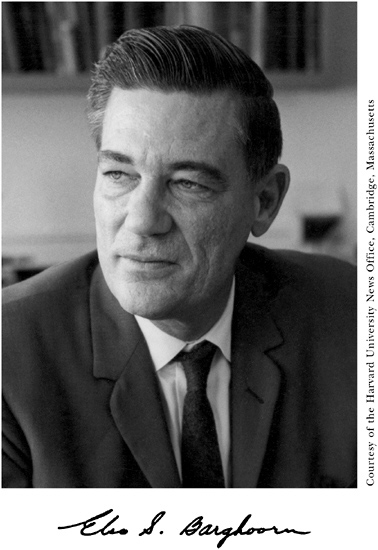
ELSO STERRENBERG BARGHOORN JR.
June 30, 1915–January 27, 1984
BY LYNN MARGULIS AND ANDREW H. KNOLL
ELSO BARGHOORN, PALEONTOLOGIST and polymath, extended knowledge of the fossil record of life back some 2 billion years to the Archean eon. When he began his career, all life, for most scientists, was classified as either plant or animal. When he first launched investigations of the fossil record, most agreed that plants and animals did not appear until the Cambrian Period. At that time, in early 1940s, the Precambrian-Cambrian boundary was set some 650 million years ago. Since animals depend for sustenance on plants, by logic plants, with their capacity for photosynthesis, must have preceded (i.e., evolved prior to) the evolution of animals. Indeed, by the same logic, the origin of life was assumed to be equivalent to the origin of plants. Precambrian sedimentary rocks were known to exist prior to the Cambrian Period (now set from 541 to 490 million years ago), but none had yielded definitive evidence of animals or plants. Many thought that the origin of life was so entirely improbable that it had taken eons for life to originate (i.e., the long stretch of time from Earth’s origin to the explosion of fossils at the base of the Cambrian was required). The dramatic discontinuity between the abundantly fossiliferous Cambrian sediments in Wales and in the Grand Canyon, for example, and the barren igneous and sedimentary deposits prior to
the Cambrian had even puzzled Charles Darwin and his predecessors before 1859. The scientific consensus in any event was that the abrupt appearance and rapid diversification of trilobites, brachiopods, sclerites, and other abundant well-preserved remains of life implied a sudden appearance of Cambrian fossil animals. This discontinuity at the Precambrian boundary was considered “the most vexing riddle of paleontology” (Fischer, 1965).
The discoveries of Barghoorn, more than any other single scientist, generated a revolution in these views: He entirely altered the way early evolution is perceived by organic chemists, biologists, Earth scientists, and now even the literate public.
At the end of 1950 Robert B. Shrock, at a meeting of the Geological Society of America, gave to Elso Barghoorn some black rock samples that he had received from Stanley Tyler, a geology professor at the University of Wisconsin. Iron ore was the object of Tyler’s research. The importance of the iron supply for the Gary, Indiana, steel mills that supplied Detroit’s automobile industry was inestimable. The vast sedimentary deposits in Michigan, Minnesota, and Ontario, the source of the ore, had led many geologists, including Tyler, to intense study of the region. Tyler began petrographic investigation (i.e., to study rocks associated with the ore by light microscopy). For observation of rocks collected from a 20-foot-deep test pit, he made standard 0.03-millimeter petrographic thin sections and mounted them on glass microscope slides. Because the sides of the pit had collapsed, no rocks from further depths could be accessed. Tyler suspected he had discovered coal. He approached Shrock in search of a paleobotanical expert. All three geologists—Shrock, Tyler, and Barghoorn—recognized that accurate identification of coal was potentially extremely important. Tyler wanted advice about his shiny black samples
from the shale pit because they so closely resembled Pennsylvanian coal. The samples were from a formation called “the Michigamme slate” in the Iron River district of Michigan. Of course,the economic incentive was to find new sources of coal.
As both Tyler and Barghoorn knew, the earliest well-documented extensive coal deposits were far, far younger. The Michigan rocks had been already well dated as Upper Huronian in age. They were approximately 1.9 billion years old, whereas those, replete with plant fossils, from the Carboniferous of Pennsylvania were only 350 million years in age!
In December 1951, in a letter to Dr. Barghoorn (the professors did not yet address each other by the first name), Tyler wrote, “I am sending you under separate cover a thin section of the Michigamme shale associated with the coal, which I believe contains a fairly large quantity of the amber material … [Microscopic examination] … shows considerable differentiation in the amber material which I presume may be algal cell structure.” Hence, Tyler was on to a discovery of “fossil plants” more than 1.5 billion years younger than the accepted date for plants in the paleontological literature! At Barghoorn’s request Tyler sent results of an analysis “of the putative coal as determined in the coal research laboratories of Jones and Laughlin Steel Corporation.” At first Tyler cautiously wrote “coal” in quotation marks, but after later analysis, including the “amber material,” he omitted the quotes. Results showed the black shiny samples to be 79.9 percent carbon, 16.3 percent sulfur with an ignition temperature of 755°F. Both scientists, in full agreement, dropped their skepticism and their quotation marks. They indeed had discovered Precambrian coal! Thin sections were further analyzed at Harvard by Barghoorn. No doubt that much of the “orange-yellow material” (i.e., the amber-colored
rock) was mineral, probably “iron oxide [hematite and goethite] and not organic in origin,” wrote Tyler to Barghoorn. By early 1952 Barghoorn begged Tyler’s pardon for a delay in his response. Barghoorn had been distracted by a request from Near East archaeologists that he honored when “a batch of charcoal was visited upon me” from a hearth site. Barghoorn told Tyler that the charcoal was of great interest because it came from “the oldest known community site yet discovered.” “After working with it [the Near East charcoal] briefly I’m not certain whether pre Cambrian coal or charcoal is the more difficult material to handle!”
This correspondence, which as we will see, led directly to the discovery of the world’s oldest fossils at the time, demonstrates Barghoorn’s qualities of mind. Barghoorn was always captivated by the scientific effort to reconstruct the early history of life. He was easily distractible but only by serious scientists with questions of the highest scientific significance. He worked indefatigably, but only on a one-to-one basis with those whom he respected. He kept things whole: He recorded in correspondence and in his many notebooks wise speculation about the significance of his data along with the data itself. In the same letter to Tyler (January 15, 1952), he wrote, “I have attempted to determine the possible origin of that concentric fan-like appearance, in reflected light, on the coal specimens. There is one existing blue green alga which could conceivably make a similar pattern … Rivularia. It is entirely conceivable that our coal is composed almost solely of the remains of this colonial alga. I seriously doubt if the discrete patterns on the coal could be other than biological in origin.”
The new rocks, including cherts that Tyler sent Barghoorn from Canada, were far better samples than the polished black coal from Michigan. From certain obscure localities rock samples were collected by Tyler and his colleagues.
Among these from two widely separate sites in Ontario (Frustration Bay and Schrieber Beach) were the rocks that yielded spectacular fossil remains. Thin sections of these black cherts became microbial Rosetta stones in the search for ancient life. Cherts, an opal-like material technically called “crypto-crystalline quartz,” preserved with incredible detail an abundance of microorganisms. Although tricky to find in the first place, great quantities of black chert had to be painstakingly processed. However, when found the prodigious samples contained up to 1.5 million microfossils per cubic centimeter. The trickiness was because most black cherts in the region, even those quite close to the lucky optimal samples, when thin-sectioned contained no fossils at all. In June 1953 Tyler sent Barghoorn a slide of chert “containing crystals of carbonate and considerable organic matter.” The rocks were from the upper members of the Gunflint Iron Formation. The specimen had been taken on the shore of Lake Superior about 30 miles east of Port Arthur, Ontario. “The black carbonaceous material certainly looks like organic matter to me.” The collection of beautifully preserved enigmatic microfossils at this site were soon added to those of the basal Gunflint Iron Formation from Schreiber Beach. Tyler wrote, “A second slide from the algal chert [is from] the Schreiber locality. This is a lulu. Filaments are extremely abundant and there are many rounded bodies which may be spores—occasionally the rounded bodies appear to be attached to a filament.” Hasty sketches annotated Tyler’s letters. In spite of quizzical suggestions by Tyler that the microfossils might be radiolaria or jellyfish medusa, “fancy algal spores” or “actinomycetes” (a kind of filamentous bacterium), Barghoorn opted for an interpretation as algae. He mentioned his conversations with Professor William (“Cap”) Weston, Harvard professor and the most experienced fungal expert of his generation.
Today we can see in these letters the first descriptions of Kakebekia, Gunflintia, Huronospora, Leptoteichus, and a host of other named genera. Even today by no means have all the Gunflint microfossils been described and identified to the general satisfaction of geologists and biologists. But most now agree that these beautifully preserved organic forms are primarily fossils of bacteria, both cyanobacteria (formerly called blue-green algae) and iron-oxidizing bacteria. Whatever the species names are, the importance and consequence for science is indisputable. The Tyler-Barghoorn discovery of abundant and diverse 2-billion-year-old microfossils associated with iron ores began the study of Precambrian life.
Robert Shrock wrote on December, 14, 1953, to Tyler, “Dear Stan: I spent last Friday afternoon with Elso Barghoorn and had a wonderful time looking at the flora which you have unearthed in the Pre-Cambrian. It would be a tremendous understatement to say that I was thrilled, I was fully prepared for what I saw after what you and Elso have been telling me for the past several years, but even with such preparation I was amazed at the excellence of preservation of such tiny plants.” Shrock goes on to urge publication “not only in the United States but elsewhere” and continues, “I think your discovery is of such great importance that announcement of it should be made in all the common languages and in the biological as well as paleontological journals.” The Gunflint microbiota was documented by publication in 1954 with a short joint paper that announced the discovery.
Subsequent work on the rocks of the Swaziland system of South Africa led Barghoorn to extend the Gunflint-style analysis to even older former sediments. The nearly 3.5-billion-year-old cherts and shales from the Barberton Mountainland preserve a tractable, if scrappy signature of
life. Barghoorn, his colleagues, and especially his students went on to document life’s evolutionary record from these earliest roots to the Cambrian explosion of animal diversity, some 85 percent of life’s recorded history. They helped provide the geochronological scaffolding for environmental and molecular evolution. Indeed, they founded a new formal paleontological field, “Precambrian Paleobiology.”
Elso Barghoorn was born on June 30, 1918, in New York City, or as he liked to put it, remembering wistfully the rural character of his first home: in “Queens Village on Long Island.” During his boyhood the Barghoorn family moved to Dayton, Ohio, where Elso’s interest in both rural life and natural history blossomed. Long summer hours spent curled in the crotch of a tree with books about science or exploration set Elso on his course toward discovery. The teenaged Barghoorn developed reputations as both fine athlete and budding scholar, and upon completion of high school he enrolled in nearby Miami University. Elso would complete an honors degree in botany in 1937 but not before departing for a number of jobs, including a stint as deckhand on a Great Lakes freighter.
Later in 1937 Elso began graduate study at Harvard, supported first by an Anna C. Ames Fellowship and then by an Austin Teaching Fellowship. In a pattern that persisted his entire life Barghoorn plunged immediately into a variety of research studies. Elso’s thesis, completed in 1941 under the tutelage of the preeminent plant anatomist I. W. Bailey, elucidated the anatomy, development, and taxonomic variation of vascular rays in woody plants. The papers that issued from this work remained standard references for decades. At the same time, Elso’s work with paleobotanist William Darrah kindled a lifelong love of fossils. Barghoorn’s first paleobotanical publication was on the plant Hornea, preserved in the Rhynie Chert, which Elso renamed Horneophyton.
Inspired by the same Professor William (“Cap”) Weston who had helped analyze the Gunflint chert, Elso also became fascinated by the decay of wood by fungi. Among other things he demonstrated to an initially skeptical community that cellulolytic fungi, admittedly a very few species, live in the ocean as well as on land. Some even form little mushrooms under water on driftwood. These three topics—plants, fossils, and fungal decay—would be intertwined in Elso’s work for more than 40 years.
Several months of research at the Atkins Botanical Garden in Cienfuegos, Cuba, introduced Elso to another enduring interest: tropical botany. Tropical environments and fungal decay found common focus when World War II began. Called in 1943 from his first faculty position at Amherst College, Elso reported to Barro Colorado Island in Panama, where he spent the duration of the war conducting research on a problem that plagued Allied troops in the Pacific theater: fungal degradation of canvas tents, clothing, food, and even optical equipment where lenses were mounted with organic glues.
After the war, Elso returned to Massachusetts, where he was appointed instructor at Amherst College. However, in 1946 he returned to Harvard University. He began as an assistant professor but was soon promoted to associate professor (in 1949). From 1955 until his death he held a position of full professor of biology. In 1973 he was honored with a Harvard chair. He became the Fisher Professor of Natural History. The distinguished botanist Richard A. Fisher had founded the Harvard Forest School of Forestry at the turn of the twentieth century and had set up an experimental forest reserve some 70 miles away from the Cambridge campus in (central) Petersham, Massachusetts.
In the decade that followed the war Elso published important papers in Carboniferous paleobotany, the early geological record of flowering plants, fungal decay, and even
marine mycology and archaeology (analyses of timbers used in the pre-Columbian Boylston Street Fishweir, Boston, and study of the colonial iron works at Saugus, Massachusetts). But he also made two paleontological discoveries (or to be strictly correct, one rediscovery and one new discovery) that were to play key roles in his subsequent research life. First, Elso rediscovered and began the systematic study of Oligocene-Miocene plant fossils preserved in a small out-cropping of lignite near Brandon, Vermont. As documented by two generations of graduate students, wood, pollen, fruits, seeds, and rare flowers from Brandon provide a unique yet extensive and unusually well-preserved view of Tertiary vegetation in northeastern North America.
But it was the beautifully preserved fossils of the Gunflint that captured the attention of scientists well beyond the world of paleontology. In the decade of work culminating in their Science paper (1965) on the Gunflint “plants,” Tyler and Barghoorn nearly quadrupled the known history of life. They set the stage for the new and distinctive field. At first “Precambrian Paleobiology” expanded slowly, but Barghoorn’s research in the 1960s, along with that of graduate student J. William Schopf, placed this discipline on a firm footing (Schopf, 1983; Schopf and Klein, 1992). The publications on the Gunflint biota (1963, 1965) were followed in short order by the discovery of exceptionally well-preserved microfossils in cherts of the ca. 800-million-year-old Bitter Springs Formation, Australia, and possible microfossils in nearly 3.5-billion-year-old cherts of the Onverwacht Group, South Africa. At the same time, Elso and his colleagues expanded paleobiological research on Precambrian rocks to include biogeochemistry as well as the fossil morphologies traditionally studied by paleontologists (Knoll, 2003). Today, fossils and geochemical data are routinely integrated in accounts of Earth’s early biological and environmental history.
When he died, in 1984, Barghoorn left the beginnings of this new and solid “science of Precambrian life.” In his long and productive career Elso never wavered in his pursuit of evidence and his enthusiasm for important and accessible scientific problems: the origin of life, the early stages of evolution, origin of coal, silicification of fungi and of wood, the formation of the atmosphere, the origin of Earth and its land forms and water bodies, and the origin and fossil record of seeds and flowers. Nor did he fail to help colleagues and students who shared his interests. Although he was shy and avoided purely social events and meetings, he enjoyed intense personal scientific relations with many of his nearly 89 coauthors. His eclectic tastes are revealed by perusal of the thesis projects of his nearly two dozen Ph.D. and undergraduate honors research students. The first two, Alfred Traverse (1949) and William Spackman (1951), and one of his last, Bruce Tiffney (1977), dealt with the Brandon Lignite. Between these came projects on topics as diverse as the origin of amber, the formation of petrified wood, the origins of maize, Pleistocene vegetation in the Panamanian rain forest, the early diversification of flowering plants, and of course, the Precambrian fossil record.
As early as the 1960s, while deeply involved in the study of Precambrian rocks and their modem analogues, Barghoorn reflected on the extraterrestrial implications of his discoveries. Although one of us (L.M.) was the chair of the National Academy of Sciences’ Committee on Planetary Biology and Chemical Evolution (1977-1980), Barghoorn was the great intellectual force behind its report; the 80-page pamphlet published in 1981 by the Space Science Board (Origin and Evolution of Life—Implications for the Planets: A Scientific Strategy for the 1980’s) became the unsung charter for today’s astrobiology initiative. Behind the scenes Barghoorn’s scientific acumen, his ability to see Earth as a whole planet
through time and space, to recognize the adequacy as well as the limitations of research tools such as gas chromatography, mass spectroscopy, and electron microscopy for specific tasks coupled with his clear prose style and genuine humility make this report his lasting nearly anonymous contribution to world-class science. He was the master teacher of the committee members for all of the chapters. These include: Overall Goals and Recommendations (for “Chemical Evolution and Planetary Biology”); Global Ecology; Chemical Evolution: Distribution and Formation of Biologically Important Elements; Chemical Evolution: Early Earth Prior to Life; and Early Evolution of Life. Appendix B of this document concluded that “there is no evidence for current life at Viking sites.” Besides his immense contribution to the National Academy of Sciences’ Space Science Board exploration strategy, as exemplified by this document, Barghoorn was an advisor to NASA. He helped develop a strategy for biological aspects of the exploration of the entire solar system and sought, but did not find, signs of life in the returned Apollo lunar samples and in the Orgeuil meteorite that landed in France in the nineteenth century. His long-standing interest in the red neighbor, especially the Viking missions to Mars, would have been prelude to Elso’s fascination with the data currently streaming from the NASA rovers Spirit and Opportunity.
In many ways Elso’s life followed his science. A keen practical botanist, Elso reveled in the vegetables and exotic plants he grew at his farm and in the greenhouse. At his rural home and abroad Elso also read the night sky and described the clouds, the aurora borealis, and the evening light. His notebooks contain far more extensive commentary on weather and local climate than they do about people. He admitted to one of us (L.M.) that from childhood he was afraid of thunderstorms; when L.M.’s family lived in
Newton and the phone rang after 10 p.m. on a lightening-ridden Saturday night, it would be Elso calling from Carlisle, ostensibly to make a date to meet in the lab or to check on a missing reference in a joint article. Only after quite a number of such calls did it become clear that he wanted company when the storm was furious, especially in his last two years after his wife, Dorothy, died. Not surprisingly, Elso also loved to travel—not to the castles and museums of Europe but to the ends of the Earth, where natural treasures abound.
Elso married Margaret Alden MacLeod in 1941. One son, Steven, followed in his father’s footsteps into paleontology, but in vertebrate paleontology rather than in paleobotany. Tragically, a second son died as a young adult. This marriage ended in divorce. Neither Barghoorn’s second marriage to Teresa Joan LaCroix, in 1953, nor his last and lasting marriage to Dorothy Dellmer Osgood, in 1964, resulted in more children. His final marriage ended with Dorothy’s untimely death by suicide in 1982. A native of Brookline, Massachusetts, Dorothy had graduated from the geology and geography department of Mt. Holyoke College. She was his knowledgeable companion in the laboratory and the office for nearly two decades. Not only did she breed dogs and raise Morgan horses on their land in Carlisle, northwest of Boston, but she also enjoyed cordial and helpful relations with Elso’s students, colleagues, and myriad visitors until the end of her life.
Elso Barghoorn received many honors during his productive career, including a New York Botanical Garden award for “outstanding contributions to fundamental aspects of botany” in 1966, the Botanical Society of America’s Certificate of Merit in 1968, the Hayden Memorial Award of the Academy of Natural Sciences in Philadelphia in 1968, and the Charles D. Walcott Award of the National Academy of
Sciences in 1972. His election to the National Academy of Sciences came in 1967.
We now know that all life is not “either animal or plant” and in fact plants and animals, closely related to each other, reside on two relatively short branches of a greater microbedominated tree of life. We also know that life has left an interpretable fossil record in some of our planet’s oldest rocks. We begin to have the tools to search for comparable signatures of life in sediments deposited on other planets. Elso Barghoorn’s contribution was quietly enormous, and his death at home at age 68 deprived us of an intellectual giant in our lives.
Barghoorn published more than 122 scientific research papers from 1938 until 1982. A book contract from Lewis Thomas’s Commonwealth Book Fund committee sat on his desk from 1980 until he died. The committee had urged him to write up his scientific life and to encourage him they even sponsored a superb typist (Geraldine Kline) to transcribe his correspondence as well as his laboratory and field notebooks. The offer included the committee’s usual $50,000 advance limited to carefully chosen active research scientists for an acceptable two-page book proposal. Although he certainly could have used the money, and he wrote well and with ease, he refused to sign. He claimed that never, in any agreement with anyone, had he failed to deliver a publishable manuscript in good form and on time. Never either had he dared to write a book. He simply would not sign in good conscience any commitment he felt he could not deliver. Even given the extraordinary generosity of the Commonwealth Book Fund committee and even after one of us (L.M.) helped to prepare a book outline to his specifications, his reluctance to submit a proposal was permanent.
We are left with his magnificent published work in the primary literature. Here we have chosen 25 representative
papers with great difficulty, as Elso S. Barghoorn was an excellent writer and a profound scholar, who widely traveled and documented his observations with great care. As a generous teacher he gently accepted only the highest standards of scholarship from his students and colleagues. The papers chosen here indicate the range of interest and breadth of coauthorship over his long, productive life. His full contribution, including the Commonwealth Book Fund type-scripts (in possession of L.M.) and the rest of his writings and correspondence banked in the archives of the Harvard University Library, are worthy of further attention by historians of twentieth-century science.
REFERENCES
Committee on Planetary Biology and Chemical Evolution, Space Science Board, Assembly of Mathematical and Physical Sciences. 1981. (L. Margulis, E. S. Barghoorn, R. Burris, H. O. Halvorson, K. H. Nealson, J. Oró, L. Thomas, J. C. G. Walker, and G. M. Woodwell.) Origin and Evolution of Life—Implications for the Planets: A Scientific Strategy for the 1980’s. Washington, D.C.: National Academy of Sciences.
Fischer, A. G. 1965. Fossils, early life, and atmospheric history. Proc. Natl. Acad. Sci. U. S. A. 53:1205-1215.
Knoll, A. H. 2003. Life on a Young Planet: The First Three Billion Years of Evolution on Earth. Princeton, N.J.: Princeton University Press.
Schopf, J. W., ed. 1983. Earth’s Earliest Biosphere, Its Origin and Evolution. Princeton, N.J.: Princeton University Press.
Schopf, J. W., and C. Klein, eds. 1992. The Proterozoic Biosphere, A Multidisciplinary Study. New York: Cambridge University Press.
SELECTED BIBLIOGRAPHY
1938 With I. W. Bailey. The occurrence of cedrus in the auriferous gravels of California. Am. J. Bot. 25:641-647.
1942 With I. W. Bailey. Identification and physical condition of the stakes and wattles from the fishweir. In The Boston Street Fishweir. Papers of the Robert S. Peabody Foundation for Archaeology, vol. 2, chap. 6. Andover, Mass.: Philips Academy.
The occurrence and significance of marine cellulose-destroying fungi. Science 96:358-359.
1948 Sodium chlorite as an aid in paleobotanical and anatomical study of plant tissues. Science 107:480-481.
1949 With W. Spackman Jr. A preliminary study of the flora of the Brandon lignite. Am. J. Sci. 247:33-39.
1952 Degradation of plant tissues in organic sediments. J. Sediment. Petrol. 22:34-41.
1954 With S. A. Tyler. Occurrence of structurally preserved plants in Pre-Cambrian rocks of the Canadian shield. Science 119:606-608.
1957 With S. A. Tyler and L. P. Barrett. Anthracitic coal from Precambrian upper Huronian black shale of the Iron River District, Northern Michigan. Bull. Geol. Soc. Am. 68:1293-1304.
1961 With U. Prakash. Miocene fossil woods from the Columbia basalts of central Washington. II. J. Arnold Arboretum 42:347-362.
1964 The evolution of the cambium in geologic time. In Formation of Wood in Forest Trees, ed. M. H. Zimmerman, pp. 3-17. New York: Academic Press.
1965 With S. A. Tyler. Microorganisms from the Gunflint chert. Science 147:563-577.
With J. Oró, D. W. Nooner, A. Zlatkis, and S. A. Wiksfrom. Hydrocarbons of biological origin in sediments about two billion years old. Science 148:77-79.
With J. W. Schopf, M. D. Maser, and R. O. Gordon. Electron microscopy of fossil bacteria two billion years old. Science 149:1365-1367. 1966
With J. W. Schopf. Microorganisms three billion years old from the Precambrian of South America. Science 152:758-763.
1970 With D. Phillpott and C. TurnbiIl. Micropaleontological study of lunar material. Science 167:775.
1971 The oldest fossils. Sci. Am. 244(5):30-42.
With M. Rossignol-Strick. Extraterrestrial biogenic organization of organic matter: The hollow spheres of the Orgueil meteorite. Space Life Sci. 3:89-107.
1974 With B. H. Tiffney. Fossil record of the fungi. Occasional Papers of the Farlow Herbarium 7:1-42.
1975 With A. H. Knoll. Precambrian eukaryotic organisms: A reassessment of the evidence. Science 190:52-54.
1976 With A. H. Knoll. A Gunflint-type microbiota from the Duck Creek dolomite, Western Australia. Origins Life 7:417-423.
1977 With A. H. Knoll. Archean microfossils showing cell division from the Swaziland system of South Africa. Science 198:396-398.
1978 With S. Francis and L. Margulis. On the experimental silicification of microorganisms. II. On the time of appearance of eukaryotic organisms in the fossil record. Precambrian Res. 6:65-100.
1979 With B. H. Tiffney. Flora of the Brandon lignite. IV. Illiciaceae. Am. J. Bot. 66:321-329.
1980 With L. Margulis, D. Ashendorf, S. Banerjee, D. Chase, S. Francis, S. Giovannoni, and J. F. Stolz. The microbial community in the layered sediments at Laguna Figueroa, Baja California, Mexico: Does it have Precambrian analogues? Precambrian Res. 11:93-123.
1982 With C. Lenk, P. K. Strother, and C. A. Kaye. Precambrian age of the Boston Basin: New evidence from microfossils. Science 216:619-620.


