
7
Marriage in Transition: Evidence on Age, Education, and Assets from Six Developing Countries
Agnes R. Quisumbing and Kelly Hallman
Marriage is an event of great social and economic significance in most societies. It is a rite of passage that marks the beginning of an individual’s separation from the parental unit, even if families continue to be socially and economically interdependent. In many developing countries, it represents the union not only of two individuals, but also of two families or kinship groups. In many societies, it also entails a substantial transfer of assets from the parent to the child generation.
Assets brought to marriage are more than a form of intergenerational transfer—they may affect the distribution of bargaining power and resources within the marriage itself. Recent work testing the collective versus the unitary model of household behavior suggests that conditions at the time of marriage may affect the distribution of welfare within marriage. In particular, it has been shown that the distribution of assets between spouses at the time of marriage is a possible determinant of bargaining power within marriage (Quisumbing and de la Brière, 2000; Quisumbing and Maluccio, 2003; Thomas, Contreras, and Frankenberg, 2002). Assets at marriage confer bargaining power because they influence the exit options available to spouses. Although assets at marriage may not completely determine the distribution of assets upon divorce (Fafchamps and Quisumbing, 2002), these measures are, in themselves, worth investigating because they shed light on the institution of marriage and inheritance.
Given the centrality of marriage in an individual’s life history, surprisingly little has been written regarding trends in marriage patterns. Because the timing of first marriage critically influences subsequent life events for women, most of the analyses have focused on the female mean singulate age
at marriage (e.g., United Nations, 1990) and its determinants. Singh and Samara (1996), using data from 40 Demographic and Health Surveys (DHS) in developing countries, found that, although age at marriage is increasing, a substantial proportion of women in developing countries continue to marry as adolescents. Increases in age at marriage are associated with major social-structural changes such as increases in educational attainment, urbanization, and the emergence of new roles for single women. Jejeebhoy (1995), analyzing 51 studies based on a number of data sources, mostly the World Fertility Survey and the DHS, found that education is the single factor most strongly related to the postponement of marriage, but the relationship may be subject to threshold effects. In many countries, the tendency for education to raise marriage age becomes universal only after a few years of primary education. However, because the results of the few studies available are contradictory, little can be said about trends in the relationship between education and age at marriage over time (Jejeebhoy, 1995, p. 66).
Because research on marriage timing has been motivated largely by a demographic interest in the initiation of reproduction (Malhotra, 1997), and because few fertility surveys collect marriage data for men, most of the studies on age at marriage have been limited to women’s experiences (Singh and Samara, 1996). As Malhotra (1997) argues, the focus on women neglects the fact that entry into marriage is also an important life course transition for men, which reflects family structure, gender relations, and social change. Malhotra’s own work in Indonesia is one of a few recent studies that examines the determinants of marriage timing for both men and women. Although not examining determinants, Hertrich (2002) documents trends in marriage age for men and women in Africa. (Earlier studies include Dixon, [1971], and Smith, [1980].)
In addition, the literature on marriage rarely pays attention to the resources that men and women bring to marriage. This is a serious gap because empirical work on intrahousehold behavior suggests that the distribution of resources at marriage may affect bargaining power within marriage. Part of this gap is because of data limitations.
Anthropological studies are detailed and informative, but only for a small set of people in a particular setting, and they rarely follow the same group through time. However, anthropological techniques have been used innovatively to study changes in marriage patterns. For example, Caldwell, Reddy, and Caldwell (1983) combine data collected using quasi-anthropological approaches and small-scale surveys in a rural area of the south Indian state of Karnataka to examine the changing nature of marriage. Economic analyses have focused mainly on transfers at marriage such as dowries and brideprice (Rao, 1993b; Zhang and Chan, 1999), and not the totality of assets that spouses bring to marriage. Even if dowries or
brideprice have great social and cultural significance, there is evidence that they account for only a small proportion of assets brought to marriage, at least in rural Ethiopia (Fafchamps and Quisumbing, 2002), and none at all in countries that do not practice either dowry or brideprice. In general, there are little quantitative data that capture both cross-sectional and longitudinal variation with enough detail to capture the significance of marriage conditions in different cultures. Thus, work analyzing marriage patterns and resources at marriage in a number of countries, using comparable data collection methodologies and empirical analyses, has been scarce.
This chapter contributes to the literature on marriage patterns by analyzing data on husband’s and wife’s human and physical capital and conditions surrounding marriage; the data were collected by the International Food Policy Research Institute (IFPRI) in six developing countries.1 Four data sets—Bangladesh, Ethiopia, Guatemala, and South Africa—were collected as part of a larger research program on gender and development policy at IFPRI (Bouis et al., 1998; Fafchamps and Quisumbing, 2002; Hallman, 2000; Hallman et al., 2005; Maluccio, Haddad, and May, 2000; Ruel et al., 2002; Quisumbing and de la Brière, 2000); the Mexico data were collected for the evaluation of PROGRESA (Programa Nacional de Educación, Salud, y Alimentación), a nationwide conditional transfer program (de la Brière and Quisumbing, 2000; Skoufias, 2001); and the Philippines data were part of an earlier study on gender difference in intergenerational transfers (Quisumbing, 1994).2 The data sets in all six countries used comparable data collection methodologies, drew from qualitative studies or the anthropological literature to formulate quantitative survey modules, and contain retrospective data on family background and physical and human capital at marriage for both husbands and wives. The IFPRI study countries were also chosen to capture geographic and cultural variation, as well as to focus on specific policy issues related to gender. Assets at marriage are deflated using the appropriate consumer price index (CPI) to make the real value of assets from earlier and later marriages comparable. Unlike the DHS, the samples are relatively small and are not nationally representative; the study sites are not, however, outliers relative to living conditions within each country (see Table 7-1). Moreover, because the surveys were not designed to
examine demographic variables (e.g., fertility histories, age at marriage), it is possible that these aspects of the data are less reliable than the economic modules. These caveats need to be borne in mind when interpreting some of the regression results, particularly those on age at marriage.
We use these data to estimate similar regressions for all countries: (1) regressions on levels of human capital (education), age at marriage, and assets at marriage, separately for husband and wife, as a function of parental background for each spouse, the population sex ratio (ratio of females to males of mean sample marriageable age, an indicator of the “marriage market squeeze”) in the 5-calendar-year interval during which the marriage took place, and the year of marriage; and (2) regressions on differences in age, human capital, and assets at marriage between husband and wife, as a function of the year of marriage, the sex ratio when the marriage took place, and differences in the corresponding parental background variables. The second set of regressions enables us to examine whether schooling differences, age differences, and asset differences are changing through time, controlling for parental background effects.
Our results show that both husbands and wives are more educated and older in more recent marriages. Although husbands bring more physical assets to marriage than wives, trends in physical assets at marriage are less clear cut. Asset values of husbands increase through time in four countries, and remain constant in the Philippines and Ethiopia. Asset values of wives increase in three countries (South Africa, Mexico, and Guatemala), remain constant in the Philippines and Ethiopia, and decline in Bangladesh. In terms of differences between spouses, in four out of six countries, age differences between husband and wife have decreased; the exceptions are the Philippines and South Africa where females marry relatively later. In three out of six countries, husband-wife gaps in schooling attainment at marriage have also decreased. Despite trends toward equality in education and age, the distribution of assets at marriage continues to favor husbands. In three out of six countries, the husband-wife asset difference has not changed through time—and therefore continues to favor husbands—and has increased in the other three countries. The reduction of husband-wife gaps in schooling and age argue well for an improvement in the balance of power within the family, but asset ownership continues to favor husbands. Persistent differences in assets in favor of men have important implications for household well-being and the welfare of future generations, given recent findings which show that increasing women’s status and control of assets has favorable effects on a number of human capital outcomes, particularly of the next generation.
TABLE 7-1 Description of Data Sets
|
Country |
Description of Data |
Country-Level Descriptors |
|
|
Bangladesh |
Project title: Commercial Vegetable and Polyculture Fish Production in Bangladesh: Their Impacts on Income, Household Resource Allocation and Nutrition |
% urbana |
23.9 |
|
|
Survey coverage and dates: 955 rural households; 4 rounds of data collection from June 1996 to September 1997 |
% literateb |
|
|
Female: |
29.3 |
||
|
|
Study sites: The data were collected as part of an impact evaluation of vegetable and fish pond technologies being disseminated in rural areas through nongovernmental organizations (NGOs). The survey sites were areas where new Consultative Group for International Agricultural Research (CGIAR) technologies had been introduced but their impact not yet evaluated. CGIAR technology is highly prevalent in rural Bangladesh. These areas are in no way unusual relative to others in rural Bangladesh. |
Male: |
51.7 |
|
Estimated earned incomec |
|
||
|
Female: |
1,076d |
||
|
|
Sampling design and notes: In each of the 3 survey sites (47 villages total), 3 types of households were identified: A households—NGO member adopting households in villages where the technology has been disseminated (A villages); B households—NGO member likely adopter households in villages where the technology has not been introduced (B villages); and C households—a sampling of all other households in both types of villages (C villages). The general sampling approach involved a multistage design using unique sampling methodologies in each site that randomly selected the A, B, and C villages followed by the A, B, and C households. |
Male: |
1,866d |
|
|
Collaborator: Data Analysis and Technical Assistance, Dhaka, Bangladesh |
|
|
|
Philippines |
Project title: Gender Differences in Schooling and Land Inheritance |
% urbana |
57.7 |
|
|
Survey coverage and dates: 275 rural households; Round 1–1989, Round 2–1996-1998 |
% literateb |
|
|
Female: |
94.9 |
||
|
|
Study sites: The five survey sites are rice-growing villages that were surveyed by the International Rice Research Institute for a study on the differential impact of modern rice technology (1985-1986). These are typical rice-growing villages that span the range of environmental conditions, from fully irrigated to rainfed. |
Male: |
95.3 |
|
South Africa |
|
Estimated earned incomec |
|
|
|
Sampling design and notes: For this survey, the data came from two retrospective surveys conducted in 1989 covering 339 households and a resurvey in 1997 covering 275 of the same sample households in 1989. |
Female: |
2,684 |
|
Male: |
4,910 |
||
|
Collaborators: Tokyo Metropolitan University and International Rice Research Institute |
|
|
|
|
Ethiopia |
Project title: Gender and Intrahousehold Resource Allocation |
% urbana % literateb |
17.2 |
|
|
Survey coverage and dates: 1399 rural households; 4th-round data were collected from May to December 1997 |
Female: |
31.8 |
|
|
|
Male: |
42.8 |
|
|
Survey sites: This survey added a 4th-round to a panel collected by IFPRI, the Centre for the Study of African Economies, and Addis Ababa University (CSAE/AAU) in 1994-1995. Six of the 15 village sites were originally surveyed by IFPRI in 1989 for the Ethiopia Famine Project. IFPRI added 3 villages to the sample in 1994 for a study assessing vulnerability to droughts. The rest of the other villages represent different ecological zones. Although not nationally representative, the sample is representative of the country’s agroecological zones. |
Estimated earned incomec |
|
|
Female: |
414d |
||
|
Male: |
844d |
||
|
|
Sampling design and notes: The original sample size of 1,500 households was decided jointly by IFPRI and CSAE/AAU. The sample was to be allocated based on the wereda (the level of administration next to region) population of each site, with a minimum of 60 households per site. |
|
|
|
|
Collaborators: CSAE/AAUa |
||
|
Country |
Description of Data |
Country-Level Descriptors |
|
|
|
Project title: KwaZulu-Natal Income Dynamics Study |
% urbana |
50.1 |
|
|
Survey coverage and dates: 1,200 rural and urban households; Round 1 – August-November 1993, Round 2 – March-June 1998 |
% literateb |
|
|
Female: |
84.2 |
||
|
|
Survey sites: This was a resurvey of households in the KwaZulu-Natal area that were part of the 1993 national survey of South Africa. IFPRI has access to the 1993 data set. KwaZulu-Natal is 43% urban and has a slightly higher proportion of inhabitants of Indian descent than other provinces. Its poverty, education, unemployment, and infrastructure indicators are just slightly worse than the country average, but the majority of these differences are not statistically significant. It has a higher than average HIV/AIDS prevalence (South Africa Department of Social Development, 2000). |
Male: |
85.7 |
|
Estimated earned incomec |
|
||
|
Female: |
5,473d |
||
|
Male: |
12,452d |
||
|
|
Sampling design and notes: The sampling design was a two-stage, self-weighting procedure. In the first stage, clusters were chosen proportional to population size from census enumeration areas or approximate equivalents where not available. In the second stage, all households in each chosen cluster were enumerated and then a random sample of them selected. In 1998, only African and Indian households were targeted. Sample is representative at the province level. |
|
|
|
|
Collaborators: University of Natal-Durban and University of Wisconsin |
||
|
Mexico |
Project title: Evaluation of the National Program for Education, Health, and Nutrition (Programa Nacional de Educación, Salud, y Alimentación [PROGRESA]) |
% urbana |
74.2 |
|
% literateb |
|
||
|
Guatemala |
Survey coverage and dates: 24,000 households in rural Mexico; census survey in November 1997 (ENCASEH) to select beneficiary households; evaluation surveys (Encuesta Evaluation de los Hogares or ENCEL) in March 1998 (prior to distribution of benefits); October/November 1998 (ENCEL98O), June 1999 (ENCEL98M), and November 1999 (ENCEL99N). The module on family background and assets at marriage was fielded as a part of the June-July 1999 round (ENCEL99M). |
Female: |
89.1 |
|
Male: |
93.1 |
||
|
Estimated earned incomec |
|
||
|
|
Survey sites: 506 localities in the seven states of Guerrero, Hidalgo, Michoacan, Puebla, Queretaro, San Luis Potosi, and Veracruz. Of the 506 localities, 320 localities were assigned to the treatment group (T=1) and 186 localities were assigned as controls (T=0). |
Female: |
4,486 |
|
Male: |
12,184 |
||
|
|
Sampling design and notes: The 320 treatment localities were randomly selected using probabilities proportional to size from a universe of 4,546 localities that were covered by phase II of the program in the 7 states mentioned above. Using the same method, the 186 control localities were selected from a universe of 1,850 localities in these 7 states that were to be covered by PROGRESA in later phases. The coverage of the program in its final phase constitutes around 40% of all rural families and one ninth of all families in Mexico. |
|
|
|
Collaborators: Programa Nacional de Educación, Salud, y Alimentación, Mexico; University of Pennsylvania; Yale University and University of California |
|||
|
Country |
Description of Data |
Country-Level Descriptors |
|
|
|
Project title: Strengthening and Evaluation of the Hogares Comunitarios Program in Guatemala City |
% urbana |
39.4 |
|
% literateb |
|
||
|
Survey coverage and dates: 1,340 urban households in Guatemala City, surveyed in 1999 |
Female: |
60.5 |
|
|
Survey site: Site was one of three areas where the Hogares Comunitarios Program was operating in Guatemala City at the time of the survey. Characteristics of this area did not differ from other two program areas. All program areas were among the lower half of the urban socioeconomic strata. The study site is representative of urban poor areas of the country. |
Male: |
75.6 |
|
|
Estimated earned incomec |
|
||
|
Sampling design and notes: This survey was designed to provide a qualitative and quantitative assessment of the operations and impact of the Hogares Comunitarios Program, a day care program under the auspices of the office of the First Lady of Guatemala. Two surveys were carried out: a random sample of 1,340 households with preschool children, and an impact evaluation sample of 550 households with preschool children divided into participating and control households. The current manuscript uses the random sample data. |
Female: |
1.691d |
|
|
Male: |
5,622d |
||
|
Collaborator: Staff from the Programa de Hogares Comunitarios |
|
||
|
aUnited Nations, Human Development Report 2001. Rates as of 1999. bUnited Nations, Human Development Report 2001. Age 15 and above in 1999. cUnited Nations, Human Development Report 2001. Figures are PPP US$ (Purchasing Power Parity—see technical note 1 in HDR 2001 report). Note: Because of the lack of gender-disaggregated income data, female and male earned income are crudely estimated on the basis of data on the ratio of the female nonagricultural wage to the male nonagricultural wage, the female and male shares of the economically active population, the total female and male population and GDP per capita (PPP US$) (see technical note 1 in HDR 2001 report). Unless otherwise specified, estimates are based on data for the latest year available during 1994-1999. dUnited Nations, Human Development Report 2001. Note: No wage data available. For purposes of calculating the estimated female and male earned income, an estimate of 75 percent, the unweighted average for the countries with available data, was used for the ratio of the female nonagricultural wage to the male non-agricultural wage. |
|||
BACKGROUND AND METHODS
Assets at Marriage and Bargaining Power
The IFPRI studies collected data on assets at marriage and conditions surrounding marriage in order to arrive at quantifiable indicators of bargaining power within marriage that are exogenous to current marital decisions. While data on human capital at marriage, such as schooling, have been collected in numerous surveys, data on assets at marriage are relatively rare. This data collection effort was motivated largely by the desire to test the collective model of the household, which predicts that one’s share of resources received within a relationship will be determined by one’s bargaining power within that relationship.3 Because bargaining power is an elusive concept, candidate proxies for bargaining power have included: (1) public provision of resources to specific household members and exogenous policy changes that affect the intrahousehold distribution thereof (Lundberg, Pollak, and Wales, 1997; Rubalcava and Thomas, 2002); (2) shares of income earned by women (Hoddinott and Haddad, 1995); (3) unearned income (Schultz, 1990; Thomas, 1990); (4) current assets (Doss, 1999); (5) inherited assets (Quisumbing, 1994); and (6) assets at marriage (Thomas et al., 2002). Of course, none of these measures is perfect. In most contexts there is no public program that can serve as a natural experiment. Labor income, typically included in the calculation of income shares, is problematic because it reflects time allocation and labor force participation decisions that are likely to have been the result of some bargaining process within the marriage. Several studies use nonlabor income, either directly, or as an instrument for total income (Thomas, 1993). However, the assumption that nonlabor income is independent of tastes and labor market conditions may not be true if much of it comes from pensions, unemployment benefits, or earnings from assets accumulated over the lifecycle.
Current asset holdings, used by Doss (1999) in her study of Ghanaian households, also may be affected by asset accumulation decisions made within marriage. Depending on provisions of marriage laws, assets acquired within marriage may be considered joint property and will not be easily assignable to husband or wife. The validity of inherited assets as an indicator of bargaining power may be conditional on the receipt of assets prior to marriage, unless bargaining power also depends on the expected value of inheritance. Inherited assets could also be correlated with individual unobservables, such as previous investments in the individual during
childhood (Strauss and Thomas, 1995). Assets brought to marriage, however, are plausible indicators of bargaining power that are not affected by the decisions made within the marriage—that is, they are exogenous to those decisions, although assets of husband and wife could be correlated if the marriage market is characterized by assortative matching.
Differences in Other Husband-Wife Characteristics and Their Implications
Although a clear body of evidence has begun to emerge on how husband versus wife assets affect various human capital investments and outcomes within the household, assets at marriage are only one aspect of the conditions surrounding marriage and later bargaining power within the union. Husband age and education seniority also have been used to connote male control over women (e.g., Cain, 1984; Miller, 1981). Education differences can be viewed as a proxy for differences in earning power, which carries bargaining power (e.g., Sen, 1989). For example, Smith and colleagues (2003) measure of women’s decision-making power relative to their male partners (usually their husbands) is based on four underlying indicators: whether a woman works for cash; her age at first marriage; the age difference between her and her husband; and the education difference between her and her husband.
Aside from their use as proxies for differential economic resources, the effects of spouse age differences on power imbalances have not been well studied. One issue has to do with measurement error: Measurement error in the age variable is likely in low-literacy populations with unreliable civil registration systems. Another issue is the difficulty of predicting the effect of age differences outside a particular social and cultural context.
Recent studies from sub-Saharan Africa, for example, show that wider age differences between sexual partners confer greater HIV vulnerability to young women (e.g., Gregson et al., 2002; Kelly et al., 2001), presumably via greater male sexual experience and their correlation with male wealth advantage in sexual relationships. However, the reverse effect could also be true if women, especially in patriarchal settings, derive status from their husband’s characteristics. This would imply that having a husband who is senior in age, education, or economic means would impart well-being (e.g, Kishor, 1995).
The fact is that only a handful of studies have even documented the extent of such spouse differences. Notable exceptions include Luke and Kurz (2002), who in reviewing literature on the extent of age mixing in sexual relationships in sub-Saharan Africa find that a sizable proportion of sexual partners of adolescent girls are at least 6 to 10 years older. Hertrich (2002) documents trends in age at first marriage for men and women in
African countries where survey or census information are available for at least two points in time; she finds women’s marriage age is increasing, the trend for men is mixed, and spouse age differences are declining. Mensch, Bruce, and Greene (1998), using DHS data from Colombia, Egypt, and Turkey to document spouse age differences by a woman’s age at marriage, find that even after controlling for female education, spouse age differences are larger among women who marry before age 20. Kishor and Neitzel (1996), also using DHS data, report spouse education differences for 25 countries: husbands are likely to have more education in 16 countries; in 7 countries education levels are likely to be equal; only in Brazil and the Philippines are women more likely to be more educated than their husbands. Casterline, Williams, and McDonald (1986) examine spouse age differences in 28 developing countries using World Fertility Survey data; they find that age differences are generally largest in societies which are patriarchal and have patrilineal kinship organization (much of sub-Saharan Africa and the Middle East Crescent, and some of South Asia), and smallest in settings where the traditional social structure allows for more equal status of spouses and/or where processes of modernization have improved the status of women (many in Southeast and East Asia, Latin America, and the Caribbean).
Data Collection Methodology
Separate qualitative studies on different aspects of gender, including marriage customs, informed the design of surveys in Bangladesh, Ethiopia, Guatemala, and South Africa. For the Philippines and Mexico, an extensive review of the anthropological literature and interviews with anthropologists and researchers who had worked on marriage customs in those areas influenced questionnaire design. The authors and their colleagues participated in intensive pretests of the survey modules in all countries except Mexico.
Because each data set has specific features related to the purpose of the survey, we discuss only the common features of the data in this section, and leave the country-specific details for later. All the modules on assets at marriage include information on the premarital human and physical capital of each spouse (e.g., age, education, work experience, land, livestock, other assets), year of marriage, and parental background. A variety of assets brought to the marriage were recorded, as well as all transfers made at the time of marriage (gifts, brideprice, and dowries), where applicable. Some of the surveys also collected information on marriage histories of each spouse (Ethiopia), the circumstances surrounding the marriage (e.g., type of marriage contract, involvement in the choice of a spouse, relative ranking of parents’ social status) (Bangladesh, Ethiopia); social networks of the wife (Bangladesh, South Africa, Guatemala); inheritance by siblings (Philippines);
and gender-specific information on income streams and control and ownership of land and livestock; and other assets (Bangladesh, Ethiopia, Philippines). In all the surveys (except Mexico and South Africa), the reported values of assets at the time of marriage have been converted to survey year values using the national CPI and the year of marriage. For Mexico, we used an asset index, and for South Africa, a count of assets at marriage. Details regarding the construction of the asset measures are found in the country-specific sections.
Empirical Methodology
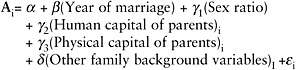
We first estimate a series of levels regressions on husband’s and wife’s human capital (education), age at marriage, and assets at marriage using the general form:
(1)
where A is a vector consisting of outcomes such as human capital, age at marriage, and assets, all evaluated at the time of marriage for each i, i = h, w (for husband and wife, respectively); year of marriage is the reported year of marriage, which is the same for husband and wife; the sex ratio is the ratio of females to males of marriageable age in the 5-calendar-year interval when the marriage took place; human capital of parents is an indicator of the parents’ educational attainment (usually years of schooling); physical capital of parents includes land holdings of parents (in some cases, disaggregated for fathers and mothers); family background variables include other indicators of parental status, number of male and female siblings, birth order, and other factors; and ε is an error term. We estimate (1) separately for husbands and wives.
With the exception of the sex ratio, all the explanatory variables were obtained from the household surveys. The sex ratio is defined as the ratio of females in the age category corresponding to the mean marriage age of females to that of males in the corresponding mean marriage age category, and was obtained from United Nations country-level population statistics. Although it would have been desirable to have district- or village-level sex ratios corresponding to the marriage year, historical data at this level of disaggregation for each study site were not available. Therefore, we used the country-level figures instead. Because this variable is defined at the country level, it masks the possibility that some areas within the same country (e.g., rural areas with high rates of male outmigration) may have a relative surplus of
marriageable wives, while other areas may have a deficit. It also does not capture possible differences in the supply of marriageable individuals of a specific caste or race, if interracial or intercaste marriages are rare. Thus, the coefficients on the sex ratio variable should be interpreted with caution because it is a highly imperfect measure of the “marriage squeeze.” We use year of marriage rather than year of birth as an explanatory variable because of difficulties in recalling birth year; because marriage is a more recent event, respondents were better able to recall the year of marriage, or the number of years they had been married. We do not include education as a regressor in the age at marriage equation because the same variables that determine age at marriage may also influence educational attainment, especially in societies where young women leave school to get married. Although one approach could have been to estimate an age at marriage equation with education treated as endogenous, in practice it is difficult to find instrumental variables which would affect only education, but not age at marriage.
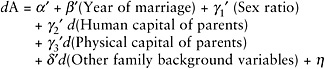
To ascertain whether differences between husbands and wives are narrowing across time, we also estimate a version of (1) in difference form:
(2)
where d is the difference between husband’s and wife’s variables, and all lefthand-side and righthand-side variables (except year of marriage and the sex ratio) are in difference form and η is the error term in this equation.
MARRIAGE PATTERNS IN ASIA, AFRICA, AND LATIN AMERICA: AN OVERVIEW
In this section we present a descriptive overview of marriage trends in our six study countries, characterizing the societies in which the data were gathered, describing the samples, and examining trends in spousal characteristics and assortative mating over time. Our sample consists of two countries each in Asia, sub-Saharan Africa, and Latin America. Although partly motivated by reasons of data availability, we also chose countries that were different rather than similar within each geographical region to highlight the role of cultural differences and to see whether, despite these differences, there are common emerging trends.4
Country Overviews
Table 7-2 consists of means and standard deviations of spouses’ characteristics at marriage (age, schooling, and assets), while Table 7-3 presents trends in these variables through time for all six study countries.
Bangladesh5
Similar to other societies in South Asia, Bangladeshi society is dominated by a patrilineal and patrilocal kinship system. Despite Islamic law, which in principle applies to 85 percent of the population and allows women to own property, the practices of benami, where husbands acquire property in their wives’ name, and naior, where daughters are encouraged to relinquish their inheritance claims to their brothers, illustrate some of the limitations that rural women face in exercising their property rights (Subramanian, 1998).
The survey was conducted in 47 villages from 3 sites in rural Bangladesh, each chosen as part of an impact evaluation for 2 agricultural technology dissemination programs (IFPRI-BIDS-IFNS, 1998). In two of the sites (Saturia and Jessore), NGO programs targeting only women promoted vegetable gardening and group-based fishponds, respectively, providing training and credit. In the third site (Mymensingh), project and Department of Fisheries extension agents provided training in fishpond cultivation to relatively well-off households and the same training, combined with credit, to relatively poorer households. This program was intended for both men and women, though in practice there were more male beneficiaries. The four-round survey, conducted every 4 months from June 1996 to September 1997, collected information on household expenditures on various food, health, and other items in each round; information on parental and sibling background for both the husband and wife; and in the last survey round, information on premarriage assets, transfers at marriage, inheritance, and indicators of women’s mobility and empowerment. In particular, respondents were asked to recall the assets they owned before their wedding (land, cattle, housing, food items, and “durables”—jewelry, clothes, and household utensils), the questions were designed based on the findings of a qualitative study conducted in two villages from each of the three sites (Naved, 2000). The reported values of these assets at the time of marriage have been converted to current values using the national consumer price index.
The first notable finding is that Bangladeshi wives bring far less to the marriage than do their husbands, as measured by the value of premarital
assets (in 1996 taka) and years of schooling (Table 7-2). Indeed, the value of female assets seems to have decreased through time, while those of males has increased (Table 7-3). Female assets typically consist of food items and durable goods. In addition, a specific module about gifts and transfers at marriage was administered to the female respondents. The transfers to the bride and groom include assets and cash and were computed by summing up all transfers to each individual and assigning to each individual half of the transfers reported “to the couple.” Data presented in Table 7-2 show an average net transfer to the bride at the time of marriage, although more recent weddings exhibit a net transfer to the groom (Table 7-3). This is consistent with the shift from brideprice to dowry reported in Naved (2000).6 In no case are the transfers at marriage enough to overcome the value of the other resources including cattle and housing, that men bring to the union, however, as indicated by the husband’s advantage in the sum total of prewedding assets and marriage transfer payments.
Bangladeshi women have the youngest age of marriage across the six studies (Table 7-2), although age at marriage has been increasing through time (Table 7-3). Men’s age at marriage is at par with men from the Philippines and Latin America. There is also a gender gap in education of spouses. However, with the introduction in the past decade of “Food for Education” and other female education subsidy programs (Ahmed and del Ninno, 2002), spouse education gaps are narrowing (see Table 7-3; discussed more below). Indeed, the higher levels of schooling reported by wives in the last 5-year period may be due to such programs that link receipt of food and other assistance to attendance in secondary school.
Philippines
Unlike Bangladesh, the other Asian country in our sample, the Philippines is characterized by bilateral kinship and bilateral inheritance patterns, and both anthropological studies (e.g., Medina, 1991) and studies on intrahousehold allocation support the notion that society is basically egalitarian (Estudillo, Quisumbing, and Otsuka, 2001a, 2001b). For example, the word for “child” in Tagalog does not distinguish between “son” or “daughter”; in some Philippine languages, there is no distinction between “husband” and “wife.” Egalitarian distribution does not necessarily mean that men and women within the same household receive the same transfers from parents. In the lowland Philippines, for example, parental preferences in land inheritance may favor male children in communities where farming is intensive in male
TABLE 7-2 Assets at Marriage and Human Capital of Husband and Wife
|
Assets and Human Capital |
|
|
ASIA |
|
|
Bangladesh |
|
|
|
Age at marriage (years) |
|
Years of schooling |
|
|
Value of assets + transfers at marriage (1996 taka) |
|
|
Value of assets at marriage (1996 taka) |
|
|
Value of transfers at marriage to each (1996 taka) |
|
|
Philippines |
|
|
|
Age at marriage (years) |
|
Years of schooling |
|
|
Land area at marriage |
|
|
Value of nonland assets (1989 pesos) |
|
|
AFRICA |
|
|
Ethiopia |
|
|
|
Age at marriage (years) |
|
Years of schooling |
|
|
Value of assets at marriage (1997 birr) |
|
|
South Africa |
|
|
|
Age at marriage (years) |
|
Years of schooling |
|
|
Count of assets at marriage |
|
|
Value of transfers from this family at marriage (1998 Rand) |
|
|
LATIN AMERICA |
|
|
Mexico |
|
|
|
Age at marriage (years) |
|
Years of schooling |
|
|
Owned land at marriage (1 if yes) |
|
|
Asset score |
|
|
Guatemala |
|
|
|
Age at marriage (years) |
|
Years of schooling |
|
|
Value of assets at marriage (1999 Quetzales) |
|
labor (Estudillo, Quisumbing, and Otsuka, 2001a, 2001b). Among the Ilocanos of the northern Philippines, for example, parents traditionally give a portion of their land holdings to a newly married son as a gift. Some writers (e.g., MacArthur, 1977, cited in Caldwell et al., 1998) term this as bridewealth; the local term (sabong) means male land dowry (Anderson, 1962). Both primogeniture and ultimogeniture—inheritance by the first and last born, respectively—are practiced among the Ilocanos depending on the availability of land. Among the Ilonggos of Panay Island in the middle Philippines,
|
Husband |
Wife |
||
|
Mean |
Standard Deviation |
Mean |
Standard Deviation |
|
23.8 |
5.7 |
15.0 |
3.8 |
|
3.2 |
4.0 |
1.7 |
2.8 |
|
36,428.5 |
150,560.2 |
12,950.1 |
20,139.5 |
|
32,146.0 |
148,767.9 |
2,542.9 |
10,477.0 |
|
4,258.7 |
15,116.7 |
10,333.5 |
16,339.0 |
|
25.1 |
5.7 |
22.2 |
5.1 |
|
6.3 |
3.1 |
6.3 |
3.0 |
|
0.5 |
0.9 |
0.2 |
0.6 |
|
761.8 |
769.3 |
463.3 |
473.2 |
|
26.3 |
7.6 |
17.9 |
6.0 |
|
1.7 |
2.3 |
0.7 |
1.6 |
|
4,584.0 |
8,340.3 |
1,918.0 |
3,744.4 |
|
28.5 |
8.4 |
23.2 |
7.1 |
|
5.2 |
3.8 |
5.1 |
3.6 |
|
2.1 |
1.6 |
0.7 |
1.0 |
|
36,272.4 |
50,740.4 |
6,435.4 |
22,680.6 |
|
23.3 |
6.3 |
18.4 |
4.0 |
|
3.2 |
2.9 |
3.0 |
2.8 |
|
0.13 |
0.34 |
0.00 |
0.06 |
|
0.02 |
0.08 |
0.01 |
0.06 |
|
22.6 |
5.1 |
19.9 |
3.7 |
|
7.2 |
3.5 |
6.0 |
3.7 |
|
5,226.8 |
12,013.8 |
727.4 |
1,684.5 |
daughters and sons may receive land rights more equally and independently than the Ilocanos, although for land-constrained households, children who help the parents in farming receive more land than do their siblings.
Preferential land inheritance in favor of males is balanced by higher educational attainment of females, at least since the expansion of public education in the 1960s. An ethnographic study by Bouis et al. (1998) indicates that parental decisions regarding schooling depend on the inherent attitudes of the child. According to this study, Filipino parents invest in
TABLE 7-3 Trends in Husband and Wife Characteristics at Marriage, by 5-Year Marriage Intervals
|
ASIA |
No. |
Years of Schooling |
Age at Marriage |
Marriage Assets + Transfers |
|||
|
Husband |
Wife |
Husband |
Wife |
Husband |
Wife |
||
|
Bangladesh |
|
||||||
|
1930-1934 |
1 |
0.00 |
0.00 |
27.00 |
9.00 |
0.00 |
0.00 |
|
1935-1939 |
2 |
0.00 |
0.00 |
28.19 |
12.50 |
0.00 |
0.00 |
|
1940-1944 |
3 |
5.00 |
1.67 |
19.42 |
11.33 |
0.00 |
0.00 |
|
1945-1949 |
16 |
2.31 |
0.88 |
20.84 |
11.32 |
0.00 |
0.00 |
|
1950-1954 |
34 |
2.82 |
0.82 |
22.93 |
13.05 |
8,621.90 |
21,507.74 |
|
1955-1959 |
50 |
2.64 |
0.86 |
22.47 |
13.62 |
40,355.99 |
19,638.39 |
|
1960-1964 |
62 |
2.44 |
0.97 |
22.40 |
12.70 |
33,399.62 |
23,142.25 |
|
1965-1969 |
94 |
3.86 |
1.77 |
24.39 |
14.45 |
37,466.66 |
20,959.34 |
|
1970-1974 |
120 |
3.54 |
1.42 |
22.92 |
14.16 |
65,319.44 |
18,201.53 |
|
1975-1979 |
121 |
4.38 |
2.15 |
23.22 |
14.98 |
44,708.19 |
11,703.86 |
|
1980-1984 |
141 |
2.76 |
1.46 |
24.09 |
16.01 |
28,593.82 |
6,524.70 |
|
1985-1989 |
108 |
2.42 |
1.44 |
24.64 |
16.28 |
27,741.57 |
6,919.89 |
|
1990-1994 |
83 |
3.13 |
3.39 |
26.26 |
17.45 |
27,482.85 |
5,679.25 |
|
1995-1999 |
6 |
3.33 |
5.17 |
26.54 |
16.00 |
30,184.62 |
3,228.01 |
|
|
No. |
Years of Schooling |
Age at Marriage |
Land at Marriage |
|||
|
Husband |
Wife |
Husband |
Wife |
Husband |
Wife |
||
|
Philippines |
|
||||||
|
1925-1929 |
2 |
5.50 |
9.50 |
16.00 |
22.00 |
0.00 |
0.50 |
|
1930-1934 |
4 |
4.75 |
3.25 |
23.25 |
19.75 |
0.25 |
0.67 |
|
1935-1939 |
8 |
2.75 |
3.63 |
21.50 |
23.50 |
0.10 |
0.24 |
|
1940-1944 |
12 |
4.08 |
4.08 |
24.17 |
19.75 |
0.18 |
0.50 |
|
1945-1949 |
14 |
4.64 |
4.86 |
25.21 |
22.14 |
0.02 |
0.52 |
|
1950-1954 |
29 |
4.34 |
5.24 |
24.45 |
22.45 |
0.27 |
0.40 |
|
1955-1959 |
28 |
7.32 |
5.46 |
25.75 |
22.25 |
0.89 |
0.26 |
|
1960-1964 |
27 |
5.93 |
6.63 |
24.04 |
21.30 |
0.48 |
0.39 |
|
1965-1969 |
33 |
6.61 |
6.15 |
24.45 |
21.97 |
0.66 |
0.11 |
|
1970-1974 |
34 |
6.85 |
6.74 |
25.29 |
21.38 |
0.72 |
0.12 |
|
1975-1979 |
38 |
7.37 |
7.58 |
27.71 |
24.13 |
0.37 |
0.00 |
|
1980-1984 |
30 |
7.87 |
7.73 |
24.20 |
21.80 |
0.52 |
0.03 |
|
1985-1989 |
3 |
10.00 |
10.00 |
34.00 |
31.00 |
0.00 |
0.64 |
|
Assets at Marriage |
Transfers to |
Sex Ratio |
||
|
Husband |
Wife |
Husband |
Wife |
|
|
0.00 |
0.00 |
0.00 |
0.00 |
1.02 |
|
0.00 |
0.00 |
0.00 |
0.00 |
1.02 |
|
0.00 |
0.00 |
0.00 |
0.00 |
1.02 |
|
0.00 |
0.00 |
0.00 |
0.00 |
1.02 |
|
5,679.54 |
5,335.48 |
2,770.26 |
19,021.64 |
1.02 |
|
28,739.80 |
19,257.46 |
9,955.70 |
15,727.31 |
1.06 |
|
27,329.91 |
11,918.45 |
5,621.68 |
19,977.07 |
1.12 |
|
32,792.70 |
7,388.71 |
4,673.96 |
18,009.26 |
1.11 |
|
58,167.31 |
5,800.13 |
5,442.83 |
15,576.75 |
1.31 |
|
39,691.58 |
16,617.34 |
4,355.09 |
7,400.15 |
1.10 |
|
28,571.70 |
3,468.11 |
3,243.71 |
4,995.88 |
1.11 |
|
24,637.40 |
13,602.81 |
2,400.25 |
4,085.83 |
1.08 |
|
24,900.69 |
1,885.30 |
3,547.63 |
4,703.04 |
1.07 |
|
26,947.19 |
1,334.24 |
3,237.43 |
2,548.52 |
1.06 |
|
Assets at Marriage |
|
Sex Ratio |
||
|
Husband |
Wife |
|
||
|
407.64 |
472.45 |
|
1.15 |
|
|
693.72 |
299.84 |
1.15 |
||
|
723.82 |
413.82 |
1.15 |
||
|
888.83 |
442.27 |
1.15 |
||
|
704.53 |
435.28 |
1.15 |
||
|
902.62 |
506.99 |
1.15 |
||
|
790.80 |
582.67 |
1.29 |
||
|
516.27 |
434.45 |
1.15 |
||
|
757.92 |
490.17 |
1.17 |
||
|
595.65 |
388.06 |
1.13 |
||
|
868.60 |
449.85 |
1.26 |
||
|
847.86 |
440.84 |
1.17 |
||
|
1,243.85 |
700.34 |
1.16 |
||
|
AFRICA |
No. |
Years of Schooling |
Age at Marriage |
|
|||
|
Husband |
Wife |
Husband |
Wife |
||||
|
Ethiopia |
|
||||||
|
1955-1959 |
144 |
0.69 |
0.08 |
31.68 |
20.11 |
|
|
|
1960-1964 |
56 |
0.67 |
0.09 |
25.52 |
16.44 |
||
|
1965-1969 |
84 |
1.20 |
0.36 |
23.76 |
15.72 |
||
|
1970-1974 |
62 |
2.29 |
1.00 |
23.65 |
16.32 |
||
|
1975-1979 |
72 |
2.31 |
1.03 |
24.08 |
17.01 |
||
|
1980-1984 |
99 |
2.86 |
1.52 |
24.17 |
17.98 |
||
|
1985-1989 |
53 |
3.29 |
1.24 |
26.29 |
19.43 |
||
|
1990-1995 |
1 |
5.00 |
0.00 |
50.25 |
46.25 |
||
|
|
No. |
Years of Schooling |
Age at Marriage |
Asset at Marriage |
|||
|
Husband |
Wife |
Husband |
Wife |
Husband |
Wife |
||
|
South Africa |
|
||||||
|
1950-1954 |
7 |
2.57 |
2.14 |
17.86 |
11.57 |
1.14 |
0.00 |
|
1955-1959 |
14 |
3.36 |
2.50 |
25.36 |
17.93 |
2.00 |
0.36 |
|
1960-1964 |
30 |
3.30 |
3.00 |
24.03 |
18.17 |
1.60 |
0.63 |
|
1965-1969 |
66 |
4.15 |
3.62 |
26.03 |
21.42 |
1.89 |
0.53 |
|
1970-1974 |
67 |
5.51 |
4.69 |
26.55 |
21.82 |
1.96 |
0.55 |
|
1975-1979 |
92 |
5.39 |
5.30 |
26.08 |
20.75 |
2.20 |
0.77 |
|
1980-1984 |
83 |
6.00 |
6.04 |
30.13 |
24.18 |
2.22 |
0.80 |
|
1985-1989 |
72 |
5.75 |
5.57 |
31.92 |
26.19 |
2.47 |
0.82 |
|
1990-1995 |
47 |
5.68 |
6.38 |
34.04 |
28.87 |
2.40 |
1.04 |
|
1995-1999 |
14 |
6.29 |
7.43 |
39.00 |
35.93 |
1.93 |
1.57 |
|
LATIN AMERICA |
No. |
Years of Schooling |
Age at Marriage |
|
|||
|
Husband |
Wife |
Husband |
Wife |
||||
|
Mexico |
|
||||||
|
1920-1924 |
1 |
0.00 |
0.00 |
17.00 |
16.00 |
|
|
|
1925-1929 |
1 |
1.00 |
0.00 |
23.00 |
17.00 |
||
|
1930-1934 |
17 |
0.76 |
0.39 |
22.24 |
17.00 |
||
|
1935-1939 |
52 |
0.73 |
0.58 |
21.79 |
17.00 |
||
|
1940-1944 |
128 |
0.84 |
0.54 |
22.41 |
17.00 |
||
|
1945-1949 |
215 |
0.97 |
0.75 |
22.37 |
18.00 |
||
|
1950-1954 |
421 |
1.33 |
0.83 |
23.15 |
18.00 |
||
|
1955-1959 |
665 |
1.47 |
1.04 |
23.06 |
18.00 |
||
|
1960-1964 |
889 |
1.56 |
1.26 |
23.24 |
18.00 |
||
|
1965-1969 |
1,210 |
1.86 |
1.46 |
23.44 |
18.00 |
||
|
1970-1974 |
1,457 |
2.23 |
1.87 |
23.45 |
18.00 |
||
|
1975-1979 |
1,854 |
2.88 |
2.51 |
23.42 |
18.00 |
||
|
1980-1984 |
2,008 |
3.44 |
3.09 |
23.25 |
18.00 |
||
|
1985-1989 |
2,165 |
4.27 |
4.08 |
23.04 |
19.00 |
||
|
1990-1994 |
2,047 |
4.94 |
4.92 |
22.99 |
19.00 |
||
|
1995-1999 |
1,038 |
5.36 |
5.34 |
24.05 |
20.00 |
||
|
Assets at Marriage |
Sex Ratio |
|
||
|
Husband |
Wife |
|
||
|
6,664.50 |
2,360.70 |
1.37 |
|
|
|
6,661.85 |
3,450.78 |
1.38 |
||
|
4,964.11 |
1,789.68 |
1.39 |
||
|
3,818.32 |
2,548.83 |
1.39 |
||
|
2,925.50 |
1,233.61 |
1.39 |
||
|
2,873.41 |
1,059.34 |
1.45 |
||
|
2,565.61 |
1,133.21 |
1.47 |
||
|
1,605.21 |
500.00 |
1.45 |
||
|
Transfers From |
Sex Ratio |
|
||
|
Husband |
Wife |
|
||
|
17,477.13 |
7,413.69 |
1.06 |
|
|
|
44,270.71 |
6,480.63 |
1.07 |
||
|
51,014.27 |
8,110.00 |
1.12 |
||
|
46,676.74 |
8,617.73 |
1.18 |
||
|
46,719.09 |
15,143.04 |
1.17 |
||
|
55,176.04 |
7,624.90 |
1.20 |
||
|
29,727.18 |
3,713.56 |
1.12 |
||
|
16,419.83 |
1,792.36 |
1.17 |
||
|
11,608.50 |
937.60 |
1.19 |
||
|
6,517.53 |
1,007.00 |
1.11 |
||
|
|
Land |
|
Assets |
Sex Ratio |
|
Husband |
Wife |
Husband |
Wife |
|
|
0.00 |
0.00 |
0.00 |
0.00 |
1.15 |
|
0.00 |
0.00 |
0.00 |
0.00 |
1.15 |
|
0.21 |
0.00 |
0.01 |
0.01 |
1.15 |
|
0.23 |
0.00 |
0.02 |
0.02 |
1.15 |
|
0.16 |
0.01 |
0.01 |
0.02 |
1.15 |
|
0.15 |
0.00 |
0.01 |
0.01 |
1.15 |
|
0.15 |
0.01 |
0.02 |
0.01 |
1.15 |
|
0.15 |
0.00 |
0.01 |
0.01 |
1.14 |
|
0.15 |
0.01 |
0.02 |
0.01 |
1.20 |
|
0.14 |
0.00 |
0.02 |
0.01 |
1.19 |
|
0.14 |
0.00 |
0.02 |
0.01 |
1.24 |
|
0.14 |
0.01 |
0.02 |
0.01 |
1.24 |
|
0.13 |
0.01 |
0.02 |
0.01 |
1.22 |
|
0.12 |
0.01 |
0.03 |
0.01 |
1.26 |
|
0.11 |
0.00 |
0.03 |
0.01 |
1.24 |
|
0.13 |
0.00 |
0.04 |
0.02 |
1.10 |
|
|
No. |
Years of Schooling |
Age at Marriage |
||
|
Husband |
Wife |
Husband |
Wife |
||
|
Guatemala |
|
||||
|
1945-1949 |
2 |
|
1.00 |
|
20.00 |
|
1950-1954 |
3 |
4.00 |
0.00 |
18.00 |
22.00 |
|
1955-1959 |
1 |
3.00 |
7.00 |
24.00 |
16.00 |
|
1960-1964 |
4 |
5.33 |
7.00 |
21.33 |
17.75 |
|
1965-1969 |
7 |
1.50 |
2.00 |
20.50 |
18.00 |
|
1970-1974 |
18 |
5.53 |
3.00 |
26.33 |
19.83 |
|
1975-1979 |
55 |
5.75 |
4.00 |
22.34 |
19.58 |
|
1980-1984 |
117 |
6.09 |
4.00 |
22.90 |
19.73 |
|
1985-1989 |
224 |
6.83 |
6.00 |
23.45 |
20.61 |
|
1990-1994 |
424 |
7.13 |
6.00 |
23.24 |
20.53 |
|
1995-1999 |
435 |
7.60 |
6.00 |
23.35 |
21.10 |
the schooling of girls because they are “more studious,” “patient,” “willing to sacrifice,” and “interested in their studies,” which are traits that would make them succeed in school. On the other hand, boys are more prone to vices (e.g., drinking), fond of “roaming around” and “playing with their barkada” (peer group) and have to be “reminded” and “scolded” to do their schoolwork.
The data used for this analysis come from a retrospective survey of 344 households—in five rice-growing villages in the Philippines with different agroecological characteristics—conducted from June to October 1989. Two villages are in Central Luzon, and three are in Panay Island. The retrospective survey in 1989 included questions on the parents, siblings, and children of the respondents, yielding information on three generations called the grandparents’, parents’ (respondents and siblings), and (grand)children’s generations. The respondents were asked about premarriage wealth (education and land ownership) of their parents and in-laws, their own and their spouses’ education and inheritance, and schooling and proposed bequests to their children. Spouses were present during most of the interviews, facilitating collection of data on spouses’ family background.7 The respondents were also asked about the transfers of land and assets received by each sibling regardless of whether the individual lived in the survey area or had migrated.8
|
Assets at Marriage |
Sex Ratio |
|
||
|
Husband |
Wife |
|
||
|
16,075.40 |
700.50 |
1.14 |
|
|
|
167.79 |
773.91 |
1.14 |
||
|
0.00 |
0.00 |
1.07 |
||
|
374.50 |
375.75 |
1.13 |
||
|
306.25 |
932.53 |
1.20 |
||
|
900.50 |
141.61 |
1.25 |
||
|
1,818.03 |
204.96 |
1.17 |
||
|
5,224.25 |
525.46 |
1.22 |
||
|
3,876.46 |
469.78 |
1.21 |
||
|
5,476.17 |
728.64 |
1.23 |
||
|
6,288.56 |
1,236.61 |
1.21 |
||
Compared with Bangladesh, Filipino women marry at later ages (Table 7-2), although, in this rural sample, there is no clear trend toward rising marriage age (Table 7-3). Although Filipino men bring more land and assets to marriage, there is no gender gap in education in this generation of respondents.
Ethiopia
Ethiopia is characterized by substantial ethnic and religious diversity; more than 85 ethnic groups and most major world and animist religions are represented, making generalizations about gender roles difficult (Webb and von Braun, 1994). The ethnographic literature does suggest, however, that women’s status is relatively higher in the north, but declines as one goes south. The diversity within Ethiopia extends beyond the people and their cultures to its environment; agroecological zones, and consequently farming systems, vary substantially around the country. Currently, Ethiopia ranks as one of the poorest countries in the world, in part a reflection of its tumultuous recent history; over the past decade, it has experienced drought, famine, civil war, and the demise of a military government.
|
|
bestowal were available were inflated to 1989 values using the farm gate rice price index for farm animals, farm assets, on-farm residential house and lot, or a region-specific CPI for readily tradeable consumer durables. Because mobility and fungibility of farm assets is limited, and the value of farm property is linked to returns on rice production, the rice price index may be a better adjustment factor than the CPI. |
The 1997 Ethiopian Rural Household Survey (ERHS) interviewed approximately 1,500 households in 15 villages across Ethiopia, thus capturing much of the diversity described above.9 Although sample households within villages were randomly selected, the choice of the villages themselves was purposive to ensure that the major farming systems were represented. Thus the sample cannot be taken as representative of rural Ethiopia as a whole, but it does capture much of the country’s diversity.
The survey collected information from ever-married individuals regarding their circumstances at the time of marriage (e.g., age, education, experience, family background, and assets) as well as the circumstances surrounding the marriage itself (e.g., type of marriage contract used, if any; decision maker regarding the choice of a spouse). A variety of assets brought to the marriage and transfers made at the time of the marriage were recorded. The value of assets at the time of marriage is inflated to current value based on the date of marriage and a national consumer price index. Only households with a partnership are considered, yielding a sample of 1,347 households, of which this chapter examines approximately 550 first marriages.10 Marriage is a fluid state in Ethiopia; divorce is frequent and serial marriages are common (Pankhurst, 1992). We focus on the first marriage because of its significance in Ethiopian society. This is due to the economic value put on virginity and the greater likelihood that the marriage involved a bond between households, rather than a personal arrangement by the bride and groom (Pankhurst, 1992, p. 122).
Given the difficulties inherent in a long recall period and choice of inflation factor for these items, it is hard to measure premarital assets precisely. Nonetheless, clear patterns emerge. On average men bring substantially more physical and human capital to the marriage than do women (Table 7-2). Contrary to expectations, ritual gifts—such as, dowry or brideprice—account for only a small proportion of the transfers of ownership that take place at the time of marriage (Fafchamps and Quisumbing, 2002). On average, the groom’s family spends three times as much as the bride’s family on gifts to the bride’s family or to the bride and groom. The
amounts involved are quite small, on average, however, and the median is always zero; hence they are not analyzed separately in this chapter.
The great majority of the new couple’s assets are brought by the newlyweds themselves, with grooms bringing substantially more start-up capital than brides. Assets brought to marriage vary dramatically among couples, with a median of zero for most asset categories except livestock and jewelry/clothing/linen. Contrary to the preconception that marriage is the time at which parents endow their offspring with farmland, most of the land brought in by grooms was already theirs prior to marriage. This finding may be specific to Ethiopia, given that the state nominally owns all land (e.g., Gavian and Ehui, 1999; Gavian and Teklu, 1996). User rights over land are supposed to be allocated by Peasant Associations (PAs), the local administrative units in rural areas, although many regions of the country have not experienced land reallocations in recent years. Many young men may wait until the PA allocates them land before deciding to marry. In recent years, marriages have been delayed both because of poverty and as an indirect effect of state policies due to new rigidities in land allocation, labor mobility, and house construction. Pankhurst (1992) notes that given chronic land shortages, a growing population, and increasing corruption, most young households had to wait before being allocated their own plot of land. The sale of labor within the community and seasonal labor migration were restricted, and after villagization, even building a new hut became problematic. This is reflected in lower values of assets at marriage through time, for both husbands and wives, but particularly so for husbands (Table 7-3). Whether these time trends are significant needs to be confirmed by the regressions that control for other confounding variables. Although both husbands and wives appear to be obtaining more schooling through time, the improvement in schooling attainment seems to be greater for husbands.
South Africa
KwaZulu-Natal, South Africa’s most populated province, is ethnically diverse, although not to the extent of Ethiopia. More than three quarters of its people are African (nearly all of these Zulu), 10 percent Indian, 7 percent white, and 1 percent colored (mixed race). Ethnographic evidence on marriage contracts and other relations between men and women indicate large differences in the African versus Indian cultural traditions. The marriage agreement in the Zulu tradition, as is common in many other African cultures, involves a bridewealth payment, or lobola, from the groom and his family to the bride’s family before the couple can marry. Among Indians, the more common traditional scenario is dowry, with the majority of payments being made from the bride’s to the groom’s family.
The survey, the KwaZulu-Natal Income Dynamics Study (KIDS), includes Africans and Indians in both rural and urban areas.11 Aside from the Guatemala sample, this is the only other country in this study that includes urban areas. Despite the fact that South Africa is an upper middle-income country with 1997 per capita gross national product (GNP) of approximately $3,000, it is a highly unequal society and the majority of the population lives in poverty (Carter and May, 1998). The survey site, though not the poorest province, is relatively poor despite being relatively urban. In addition to being culturally different, Africans and Indians also differ economically. For example, annual per capita expenditures for Africans average just under $500, while for Indians they are nearly four times as large. It should be noted that Africans and rural residents have relatively low educational attainment, reflecting historical disparities in access to education.
For couples, information was collected on whether each partner owned a variety of assets before marriage, including cattle, other livestock, land, a house, and jewelry, among other things. The simple count of the number of assets owned by each partner is used as a proxy for assets owned at marriage (see Table 7-2). Although this measure obviates the need for respondents to impute values of items owned in the distant past, it suffers from the same concerns for assets at marriage described in detail above, that is, it is imprecise. Due to sensitivities in the reporting of asset ownership (stemming from apartheid-era abuses), information on family background wealth was not collected. However, given the combination of late age at marriage and short life expectancy of parental generations, parent survival to a child’s marriage year is not always the rule (approximately 80 percent of mothers and 65 percent of fathers are living at the time of the child’s marriage), and therefore is used as an indicator of parental social and economic resources available to a bride or groom.
As in the other countries, men bring far more assets to the marriage. They do not, however, have more schooling than women, reflecting historic and current trends in gender equity in educational attainment within traditional race categories (Statistics South Africa, 2001; United Nations Development Program, 2000). Both men’s and women’s schooling levels have risen through time as well (Table 7-3). Compared with Ethiopia, South African men and women marry late (Table 7-2), with age at marriage rising in recent years as well (Table 7-3). Because of the dominance of the Zulu population in our sample, we see large mean marriage payments from the groom’s side to the bride’s side. However, marriage payments from each
side have fallen with time, reflecting the modernization that has come with the opening of up of former African homelands and with later generations of Indians becoming more distanced from the dowry customs of South Asian society (Table 7-3). Africans have higher marriage transfer payments than Indians, with amounts coming from the husband’s side being more than double those from the wife’s side, consistent with the Zulu tradition of lobola (75 percent of couples are African; 25 percent are Indian). Over time, differences in spouse education and marriage payments from each side have narrowed. Disparities in age and assets brought to marriage appear not to have changed, although the mean differences here are not large anyway. For Africans, however, there are statistically significant spousal differences in each outcome. Being African means that relative to their wife, men are one year older, have one less year of schooling, bring more assets to marriage, and have families that make more marriage payments.
Mexico
Data on assets at marriage in rural Mexico were collected as part of the evaluation of the impact of PROGRESA on women’s status and intrahousehold decision making (Adato et al., 2000; de la Brière and Quisumbing, 2000). The IFPRI and PROGRESA teams jointly designed a module to collect information on family background and the human and physical capital of the husband and wife (assets at marriage).12 Previous work on marriage patterns in Mesoamerica (e.g., Robicheaux, 1997) was instrumental in the design of this module, which was first administered to a group of promotoras (community organizers) in February 1999 as a pilot. Based on the results of the pilot and further discussion with PROGRESA staff, a module on family background was fielded as a part of the June-July 1999 evaluation survey round.13
The module on family background and assets at marriage asked the wife to report whether or not she and her husband owned land, farm assets, farm animals, a house, or consumer durables at the time of marriage. The question was asked separately regarding the husband’s and wife’s assets,
but neither the quantity in each category nor the value of each asset was asked. We used a modification of a procedure employed by Morris et al. (1999) to arrive at an aggregate asset index for each spouse.14 The asset score for each spouse was computed by assigning to each item on the list of assets (g) a weight equal to the reciprocal of the proportion of husbands and wives that reported owning the item at the time of marriage (wg), multiplying that weight by the indicator (0 or 1) that the spouse owned the particular asset g (fg), and summing the product over all possible assets:

(3)
The choice of the weighting system is based on the assumption that households would be progressively less likely to own a particular item the higher its monetary value. Morris et al. (1999) find that the log of the asset score is highly correlated with the log of the household asset value (computed by summing the reported value of assets) and thus is a good proxy indicator of household wealth.15 We did not include land in the asset score; rather, we have two dummy variables indicating whether the husband and the wife had land at the time of marriage.
Husbands enter marriage with more physical capital than their wives: husbands’ asset scores were twice those of wives (Table 7-2). Thirteen percent of husbands had land at the time of marriage, compared to less than 1 percent of wives. Table 7-2 also indicates that husbands have more years of schooling than wives, suggesting that they enter a union with significantly more human capital as well. If, as the literature suggests, human and physical capital significantly influence bargaining power within marriage, rural Mexican husbands wield more power within their households than their wives. However, Table 7-3 indicates that women’s schooling levels have increased through time, although the asset index continues to favor males. The age at marriage has also increased for women, with no clear trends for males. This suggests that for some measure of resources at marriage—those related to human capital—gaps between husband and wife may be decreasing.
Guatemala
The Guatemala data were collected as part of an impact evaluation of the Hogares Comunitarios government-sponsored day care program by the International Food Policy Research Institute.16 It included a random sample of 1,363 women with a child ages 0 to 7 years located in Mixco, one of the three urban zones of Guatemala City where the Hogares Comunitarios government-sponsored day care program was operating in 1999.
The household survey collected data on household demographic and socioeconomic characteristics, maternal characteristics and employment, child care arrangements, maternal family background and social networks, and maternal and child anthropometry. Among the family background variables of interest are factors that may have shaped a woman’s labor force behavior during adolescence and early adulthood, such as the composition of her natal household and her mother’s work behavior and child care utilization patterns when the woman was a child, as well as the value of nine major categories of assets that the woman or her husband brought to her most recent marriage (or union): house, land, furniture, vehicle, stove, sewing machine, linens and bedding, savings, and other assets.
Because the purpose of the original study was to evaluate the benefits children and their mothers received from the Hogares Comunitarios day care program, family background information was not collected for husbands. Human capital information is available, however, for current husbands. In this sample 1,290 women have ever been married; 1,136 are currently married; 997 of the current marriages are first marriages, of which 976 have complete background information on the wife.
Husbands have completed more years of schooling than wives (Table 7-2), and husbands bring more assets to marriage as well. Both husbands’ and wives’ years of schooling have increased through time (Table 7-3), along with wives’ age at marriage. Although both husbands and wives also bring more assets to marriage through time, the relative percentage that wives bring is increasing slightly with time.
Trends in Assortative Matching Through Time
One way of characterizing the marriage process is to examine the criteria through which spouses are matched. Are spouses matched randomly, or is marriage characterized by assortative mating? Although a thorough analysis of assortative mating—the tendency of individuals to select partners
who are most similar to them—is outside the scope of this chapter (see Fafchamps and Quisumbing, 2003b), we can examine the degree to which the socioeconomic characteristics of spouses are correlated, and whether this correlation has changed through time. We examine patterns in the correlation between personal characteristics of husbands and wives, and between their parental characteristics, to indicate whether personal characteristics are more or less important than familial characteristics in one’s choice of a spouse, and whether the importance of personal versus parental characteristics has changed through time.
Table 7-4 presents simple correlation coefficients between husbands’ and wives’ personal and parental characteristics, for 5-calendar-year periods corresponding to the year of marriage, for all our study countries. To avoid “noise” due to excessively small cell sizes, we report only those correlation coefficients for samples with at least 14 observations. Not surprisingly, age at marriage of both husband and wife are highly correlated in all time periods, with no discernable time trend in the correlation coefficients. In Bangladesh, positive assortative mating based on schooling appears to be stronger than matching based on assets or parental characteristics. Matching based on wedding transfer payments is greater than that on assets brought to marriage, while the correlation between parental land of spouses is higher than that with parental schooling. The strength of sorting based on personal versus parental characteristics is a possible indication of individual choice, as individuals—particularly girls—become more educated and exercise a stronger role in the choice of a spouse, even if marriages are still arranged by parents.
In the Philippines, positive assortative mating is evident in nonland assets at marriage in addition to sorting on age and schooling. Correlations between spousal characteristics are larger than those on parental characteristics, with the exception of maternal schooling. In the Philippines, marriages are no longer arranged by parents, although young people are reluctant to marry without parental approval (MacArthur, 1977). Surprisingly, the correlation between mothers’ schooling of both spouses is higher than that for fathers’ schooling, or even parental land, probably indicating the importance that mothers play in the choice or approval of a future spouse. An interesting feature is the low, and often negative, correlation between spouses’ land at marriage. Although the groom’s parents will typically give their son land to farm, if a groom enters marriage without land, the bride’s parents will provide land. Thus, land bestowal behavior tends to be compensatory rather than strategic in Philippine marriages.
In Ethiopia, the highest correlation is between spouses’ age at marriage, followed by years of schooling. Sorting based on assets at marriage is evident as well, indicating the presence of assortative mating, although it
operates on a variety of levels that cannot be summarized into a single additive index (Fafchamps and Quisumbing, 2003b). In South Africa, the strongest correlations are between age at marriage and schooling; assortative mating based on assets appears to be weaker. Interestingly enough, the correlation between marriage payments is weak, and is turning negative, indicating both that traditional marriage systems are weakening, and that, instead of competing to bestow their children with assets, families of the bride and groom may “trade off” or compensate transfers from each side. While we have limited information on family background in the South Africa survey, the available data show that sorting along paternal education exists, and is stronger than that along maternal education. The correlation between maternal education of both spouses has decreased through time.
In both Latin American countries, the strongest correlations are between spousal age and years of schooling. In Mexico, correlation between spouses’ land brought to marriage is weak, probably because women rarely, if ever, bring land to marriage. Correlation among parental characteristics—father’s schooling, mother’s schooling, and land—is positive, but not as strong as the correlation with spouse’s schooling. Indeed, the correlations among father’s schooling, mother’s schooling, and parental land seem to have decreased through time. This is consistent with evidence that personal characteristics of spouses have become more important in the choice of a marriage partner; younger Mexican women emphasize trust, intimacy, and communication more than women of their mothers’ generation, who put greater importance on marrying someone from a good family (Hirsch, 2003). Although we cannot perform the same extent of analysis for the Guatemala data because of limited information on the family background of husbands, we find that spousal correlations between age at marriage and years of schooling are high—higher than that between assets at marriage for both spouses.
REGRESSION RESULTS
Bangladesh
Table 7-5 presents regressions on years of schooling, age at marriage, and value of assets at marriage for husbands and wives. Findings show that although both spouses are more educated in more recent marriages, the gains for women are larger. This finding is consistent with recent shifts in education finance policies designed to close the male-female schooling gap. Despite this trend toward more gender equity in education, changes over time in the value of assets brought to marriage (defined here as the sum of premarital assets and payments made at the time of marriage) show distinct
TABLE 7-4 Trends in Assortative Matching at Marriage, by 5-Year Marriage Year Intervals
|
ASIA |
Correlation Coefficients Between Husband and Wife |
|||
|
No. of Marriages |
Age at Marriage |
Years of Schooling |
Land at Marriagea |
|
|
Bangladesh |
||||
|
1945-1949 |
16 |
0.69 |
0.78 |
—c |
|
1950-1954 |
34 |
0.49 |
0.57 |
— |
|
1955-1959 |
50 |
0.71 |
0.80 |
— |
|
1960-1964 |
62 |
0.27 |
0.62 |
— |
|
1965-1969 |
95 |
0.58 |
0.72 |
— |
|
1970-1974 |
121 |
0.58 |
0.68 |
— |
|
1975-1979 |
122 |
0.56 |
0.68 |
— |
|
1980-1984 |
144 |
0.63 |
0.54 |
— |
|
1985-1989 |
108 |
0.63 |
0.49 |
— |
|
1990-1994 |
83 |
0.81 |
0.58 |
— |
|
|
Correlation Coefficients Between Husband and Wife |
|||
|
No. of Marriages |
Age at Marriage |
Years of Schooling |
Land at Marriage |
|
|
Philippines |
||||
|
1930-1934 |
4 |
— |
— |
— |
|
1935-1939 |
8 |
— |
— |
— |
|
1940-1944 |
12 |
— |
— |
— |
|
1945-1949 |
14 |
0.73 |
0.51 |
−0.10 |
|
1950-1954 |
29 |
0.86 |
0.37 |
−0.09 |
|
1955-1959 |
28 |
0.78 |
0.05 |
−0.10 |
|
1960-1964 |
27 |
0.64 |
0.54 |
−0.30 |
|
1965-1969 |
33 |
0.75 |
0.53 |
0.48 |
|
1970-1974 |
34 |
0.18 |
0.44 |
0.02 |
|
1975-1979 |
38 |
0.70 |
0.63 |
−0.03 |
|
1980-1984 |
30 |
0.59 |
0.13 |
−0.20 |
|
1985-1989 |
3 |
— |
— |
— |
|
AFRICA |
Correlation Coefficients Between Husband and Wife |
|||
|
No. of Marriages |
Age at Marriage |
Years of Schooling |
Land at Marriagea |
|
|
Ethiopia |
||||
|
1955-1959 |
144 |
0.75 |
0.37 |
— |
|
1960-1964 |
56 |
0.54 |
0.52 |
— |
|
1965-1969 |
85 |
0.63 |
0.44 |
— |
|
1970-1974 |
62 |
0.78 |
0.34 |
— |
|
1975-1979 |
72 |
0.48 |
0.38 |
— |
|
1980-1984 |
99 |
0.75 |
0.39 |
— |
|
1985-1989 |
53 |
0.60 |
0.34 |
— |
|
1990-1995 |
1 |
— |
— |
— |
|
Assets + Transfersb |
Assets to Marriage |
Transfers to Marriage |
Father’s Schooling |
|
— |
— |
— |
— |
|
0.32 |
0.09 |
0.45 |
−0.02 |
|
0.34 |
0.03 |
0.07 |
0.30 |
|
−0.03 |
0.05 |
0.52 |
0.01 |
|
−0.12 |
−0.08 |
0.22 |
0.14 |
|
0.08 |
0.01 |
0.28 |
0.30 |
|
0.00 |
−0.02 |
0.43 |
0.13 |
|
0.03 |
−0.04 |
0.47 |
0.17 |
|
0.20 |
0.00 |
0.18 |
0.12 |
|
0.10 |
0.02 |
0.39 |
0.22 |
|
Assets at Marriaged |
Father’s Schooling |
Mother’s Schooling |
Parents’ Land |
|
— |
— |
— |
— |
|
— |
— |
— |
— |
|
— |
— |
— |
— |
|
0.80 |
0.27 |
0.44 |
0.37 |
|
0.91 |
0.12 |
0.22 |
−0.02 |
|
0.58 |
0.13 |
0.50 |
0.25 |
|
0.57 |
0.07 |
0.11 |
0.15 |
|
0.79 |
0.38 |
0.65 |
0.24 |
|
0.76 |
0.25 |
0.56 |
0.20 |
|
0.90 |
0.29 |
0.25 |
−0.12 |
|
0.80 |
0.41 |
0.04 |
0.09 |
|
— |
— |
— |
— |
|
Assets at Marriageb |
Father’s Schooling |
Mother’s Schooling |
Parents’ Land |
|
0.20 |
−0.02 |
— |
0.00 |
|
0.37 |
−0.03 |
−0.03 |
0.29 |
|
0.37 |
0.26 |
— |
0.46 |
|
−0.01 |
0.28 |
— |
−0.06 |
|
0.25 |
0.27 |
0.70 |
0.41 |
|
0.45 |
0.06 |
0.29 |
−0.01 |
|
0.54 |
−0.07 |
0.43 |
0.32 |
|
— |
— |
— |
— |
|
South Africa |
Correlation Coefficients Between Husband and Wife |
|||
|
No. of Marriages |
Age at Marriage |
Years of Schooling |
Marriage Payments From This Side |
|
|
1955-1959 |
14 |
0.51 |
0.85 |
0.87 |
|
1960-1964 |
30 |
0.70 |
0.65 |
0.47 |
|
1965-1969 |
66 |
0.74 |
0.68 |
0.13 |
|
1970-1974 |
67 |
0.66 |
0.84 |
0.35 |
|
1975-1979 |
92 |
0.65 |
0.72 |
0.05 |
|
1980-1984 |
83 |
0.82 |
0.79 |
0.13 |
|
1985-1989 |
72 |
0.60 |
0.61 |
0.07 |
|
1990-1994 |
47 |
0.90 |
0.66 |
−0.02 |
|
1995-1999 |
14 |
0.55 |
0.60 |
−0.14 |
|
Latin America |
Correlation Coefficients Between Husband and Wife |
|||
|
No. of Marriages |
Age at Marriage |
Years of Schooling |
Land at Marriagea |
|
|
Mexico |
||||
|
1930-1934 |
19 |
−0.28 |
−0.01 |
— |
|
1935-1939 |
53 |
0.36 |
0.58 |
— |
|
1940-1944 |
134 |
0.10 |
0.24 |
−0.04 |
|
1945-1949 |
220 |
0.25 |
0.57 |
— |
|
1950-1954 |
437 |
0.25 |
0.30 |
0.09 |
|
1955-1959 |
679 |
0.35 |
0.30 |
−0.02 |
|
1960-1964 |
904 |
0.33 |
0.39 |
0.04 |
|
1965-1969 |
1,233 |
0.37 |
0.38 |
— |
|
1970-1974 |
1,484 |
0.42 |
0.44 |
0.00 |
|
1975-1979 |
1,899 |
0.39 |
0.45 |
0.01 |
|
1980-1984 |
2,038 |
0.47 |
0.45 |
0.03 |
|
1985-1989 |
2,198 |
0.45 |
0.41 |
−0.03 |
|
1990-1994 |
2,075 |
0.49 |
0.42 |
0.05 |
|
1995-1999 |
1,086 |
0.49 |
0.44 |
−0.03 |
|
|
Correlation Coefficients Between Husband and Wife |
|||
|
No. of Marriages |
Age at Marriage |
Years of Schooling |
Assets at Marriage |
|
|
Guatemala |
||||
|
1970-1974 |
18 |
0.14 |
0.58 |
−0.13 |
|
1975-1979 |
55 |
0.52 |
0.46 |
−0.07 |
|
1980-1984 |
117 |
0.42 |
0.60 |
0.07 |
|
1985-1989 |
224 |
0.33 |
0.53 |
0.10 |
|
1990-1994 |
424 |
0.50 |
0.51 |
0.07 |
|
1995-1999 |
435 |
0.55 |
0.49 |
0.22 |
|
aLand is included with assets. bValue of assets plus transfers to and from both families. cNonland assets only. |
||||
|
Assets at Marriagee |
Father Has Any Educationf |
Mother Has Any Educationf |
|
|
0.37 |
0.15 |
−0.21 |
|
|
0.52 |
0.43 |
0.39 |
|
|
0.47 |
0.54 |
0.53 |
|
|
0.41 |
0.65 |
0.36 |
|
|
0.47 |
0.49 |
0.35 |
|
|
0.33 |
0.42 |
0.39 |
|
|
0.39 |
0.55 |
0.39 |
|
|
0.39 |
0.50 |
0.27 |
|
|
0.63 |
0.28 |
−0.03 |
|
|
Assets at Marriageb |
Father’s Schooling |
Mother’s Schooling |
Parents’ Land |
|
0.14 |
— |
— |
0.14 |
|
0.44 |
— |
— |
0.65 |
|
0.71 |
— |
— |
0.16 |
|
0.29 |
0.50 |
0.71 |
0.43 |
|
0.19 |
0.40 |
0.58 |
0.55 |
|
0.21 |
0.00 |
0.00 |
0.30 |
|
0.25 |
0.39 |
0.77 |
0.24 |
|
0.16 |
0.44 |
0.38 |
0.37 |
|
0.23 |
0.36 |
0.23 |
0.29 |
|
0.19 |
0.23 |
0.23 |
0.31 |
|
0.18 |
0.31 |
0.23 |
0.27 |
|
0.19 |
0.30 |
0.16 |
0.27 |
|
0.24 |
0.17 |
0.23 |
0.25 |
|
0.18 |
0.30 |
0.13 |
0.34 |
|
dCorrelation coefficients not reported for cell sizes less than 14. eCount of assets. f1 = yes; 0 = no. |
|||
TABLE 7-5 Determinants of Years of Schooling, Age at Marriage, and Assets at Marriage (Assets Include Marriage Payments), Bangladesh
patterns favoring men.17 Age at marriage has been rising for both sexes over time, but more so for women. Rising education and age at marriage, especially for females, reflect overall changes in the economy of Bangladesh. Severe declines in the average size of land holding of rural households due
|
|
Value of Assets at Marriage |
||||
|
Wife Coeff |
t |
Husband Coeff |
t |
Tobit Wife Coeff |
T |
|
0.12 |
10.43 |
827.53 |
2.60 |
−318.18 |
−5.19 |
|
−3.12 |
−1.96 |
13,5290.20 |
3.08 |
37,851.37 |
4.27 |
|
−0.08 |
−1.30 |
9456.12 |
4.98 |
771.82 |
2.16 |
|
−0.03 |
−0.47 |
−417.54 |
−0.18 |
−197.34 |
−0.45 |
|
0.12 |
1.40 |
−5,606.05 |
−2.44 |
−343.39 |
−0.81 |
|
0.00 |
−2.31 |
34.00 |
3.66 |
4.69 |
4.79 |
|
0.18 |
1.70 |
−1,699.95 |
−0.57 |
1,630.56 |
2.79 |
|
−0.41 |
−2.69 |
4,379.91 |
0.69 |
1,826.25 |
2.05 |
|
0.67 |
2.16 |
17,002.77 |
1.97 |
−5,672.38 |
−3.27 |
|
−0.11 |
−0.35 |
−1,2291.70 |
−1.49 |
−5,470.40 |
−3.26 |
|
−217.81 |
−9.57 |
−178,8906.00 |
−2.80 |
59,3495.00 |
4.83 |
|
786.00 |
|
||||
|
14.54 |
|||||
|
0.00 |
|||||
|
0.17 |
|||||
|
|
755 |
|
766.00 |
|
|
|
67.27 |
103.63 |
||||
|
0.00 |
0.00 |
||||
|
0.00 |
0.01 |
||||
to population growth may encourage parents to invest in the education of their children in the hope that they will be better equipped to obtain nonfarm jobs in the emerging market-based economy (Caldwell et al., 1998).
The female-to-male marriageable age population sex ratio at the time of the marriage has the effect of reducing women’s schooling and age at marriage, consistent with a female competition for scarce males hypothesis. Increases in this ratio also raise the total wealth (assets plus transfers) that both men and women bring to marriage, but the effect for males is much greater.
Parental characteristics are important determinants of education, age, and assets at marriage. Value of own parents’ land, the major form of wealth holding in rural Bangladesh, increases levels of schooling and the value of assets brought to marriage of both husbands and wives. This is consistent with better resourced parents investing in and passing on resources to the
TABLE 7-6 Determinants of (Husband-Wife) Differences in Years of Schooling, Age at Marriage, and Assets at Marriage, Bangladesh, OLS with Robust Standard Errors
next generation regardless of sex (Edlund, 1997, 2000; Gardner, 1995). Higher parental land holding, however, reduces age at marriage for women, consistent with the notion that wealthier parents do not have to save for long periods of time to accumulate sufficient dowry to marry off their daughters. Young marriage age for women traditionally has been highly valued in Bangladeshi society. Goody (1976, cited in Caldwell et al., 1998) argues that this is based on the notion that girls can better marry into “good” families if they are virgins and hence bring no possibility of “other” descendents (through past sexual relations or pregnancy) who may attempt to claim entitlement to inheritance or property. Higher birth-order children bring more assets to marriage, although after controlling for birth order, additional siblings reduce the marriage assets of husbands. Parental schooling increases the educational attainment of both husbands and wives. For wives, paternal and maternal education each increase the value of total assets she brings to marriage, but have opposing effects on her marriage age, possibly reflecting differences in parental preferences for daughter’s marriage age.
Turning to differences between husbands and wives, we observe in Table 7-6 that the husband’s age and schooling seniority are decreasing over time, but the husband’s asset advantage is getting larger. In an earlier specification with assets and transfer payments entered separately, not reported here, it was found that net wedding transfer payments are made increasingly to husbands, consistent with evidence of dowry inflation in South Asia. The sex ratio significantly increases husband’s schooling advantage. The only family background difference variable that is statistically significant is the difference between parents’ land values, and the magnitude of the effect is not large. The greater the difference is between land owned by the husband’s and the wife’s family, the greater the difference is between the husband’s and wife’s age and assets brought to marriage.
Philippines
Table 7-7 presents regressions on years of schooling, age at marriage, land area, and nonland assets at marriage of husband and wife. Reflecting the expansion of public education in the 1960s, both husbands and wives are more educated in more recent marriages. In line with rising levels of education, age at marriage also has been rising for both men and women. However, while husband’s land area at marriage has remained constant, the trend is distinctly negative for women, probably due to increased land scarcity and the increasing tendency of Filipino parents to give land to sons and schooling to daughters (Estudillo et al., 2001b). There are no clear time trends in nonland assets.
Parental characteristics are important determinants of both age at marriage and human and physical capital brought to marriage. Father’s land, a
TABLE 7-7 Determinants of Years of Schooling, Age at Marriage, and Assets at Marriage, Philippines
proxy for parental wealth, increases age at marriage and land area for both husband and wife. In Ilocano-speaking areas such as our Central Luzon sites, land from the groom’s parents is considered essential to the start of the new family unit. Mother’s land increases land that wives bring to marriage, as well as husband’s nonland assets. Father’s schooling increases nonland assets of the wife, but has a slight negative effect on husband’s land, probably because fathers with more schooling are likely to be working in nonagricultural occupations and may have less land. Mother’s schooling has a positive and significant effect on wife’s schooling, which is larger than the effect of father’s schooling, and a negative (but only weakly significant) effect on husband’s nonland assets. Unlike in Bangladesh, the sex
|
Land Area Tobit |
Nonland assets Tobit |
||||||
|
Husband Coeff |
t |
Wife Coeff |
t |
Husband Coeff |
t |
Wife Coeff |
t |
|
0.02 |
1.55 |
−0.04 |
−3.20 |
2.79 |
0.85 |
−2.24 |
−1.04 |
|
−0.61 |
−0.23 |
−0.09 |
−0.03 |
1,391.35 |
1.86 |
655.98 |
1.32 |
|
−0.10 |
−1.72 |
−0.01 |
−0.09 |
9.44 |
0.62 |
26.45 |
2.38 |
|
0.04 |
0.63 |
−0.01 |
−0.20 |
−34.48 |
−1.87 |
−12.92 |
−0.99 |
|
0.09 |
2.17 |
0.20 |
3.76 |
12.87 |
1.08 |
8.72 |
0.77 |
|
−0.01 |
−0.23 |
0.19 |
2.21 |
51.98 |
3.11 |
3.68 |
0.19 |
|
0.31 |
0.63 |
−0.33 |
−0.65 |
699.73 |
5.28 |
368.56 |
4.10 |
|
1.09 |
2.43 |
0.64 |
1.50 |
166.05 |
1.32 |
136.21 |
1.63 |
|
1.14 |
2.59 |
0.75 |
1.87 |
1,404.18 |
11.80 |
927.27 |
12.10 |
|
0.68 |
1.54 |
−0.84 |
−1.68 |
353.81 |
2.94 |
515.60 |
6.49 |
|
−37.08 |
−1.58 |
72.14 |
3.15 |
−6,948.45 |
−1.09 |
3,544.47 |
0.84 |
|
259 |
|
259 |
|
259 |
|
259 |
|
|
16.71 |
57.82 |
164.52 |
148.14 |
||||
|
0.08 |
0.00 |
0.00 |
0.00 |
||||
|
0.03 |
0.15 |
0.04 |
0.04 |
||||
ratio does not affect either years of schooling, age at marriage, or land area, and has only a weak positive effect on husband’s nonland assets.
Turning to changes in the difference between men and women over time, we find that neither age, schooling, nor asset differences change through time (Table 7-8). This is not surprising given the underlying egalitarian social structure of Philippine society. The only gap that seems to be increasing through time is that in land area: husbands are bringing more land to marriage than their wives. Although this may seem to increase the bargaining power of men within the household, it is offset by women’s rising education levels and their increasing propensity to be employed in nonfarm jobs, which have higher returns to schooling (Estudillo et al.,
TABLE 7-8 Determinants of (Husband-Wife) Differences in Age, Years of Schooling, and Assets at Marriage, Philippines, OLS with Robust Standard Errors
2001b). The only parental background variable that is significant in the entire set of regressions is the difference between husband’s and wife’s fathers’ land, which is positive and significant. That is, the greater the difference is between land owned by the husband’s father and the wife’s father, the greater the difference is between husband’s and wife’s land area at marriage. Similar to the levels results, the sex ratio or “marriage squeeze” factor does not affect the gap between the resources that each spouse brings to marriage.
Ethiopia
Similar to the Philippines and Bangladesh, more recent marriages are characterized by husbands and wives with more schooling (Table 7-9). Father’s schooling has a strong positive influence on husband’s schooling, but none of the parental background variables significantly affect wife’s schooling. Trends in age at marriage in Ethiopia appear counterintuitive: Age at first marriage seems to be declining for both men and women. This could be due to reporting error in the age variable and thus should be taken with caution. Evidence from Hertrich (2002) and the National Family Fertility Survey (NFFS) (Central Statistical Authority, 1993), for example, suggest that women’s age at marriage, though still quite low, has increased over time (World Bank, 1998).18 Husbands whose parents have more land appear to marry later, while those with more brothers marry earlier, perhaps because of the availability of substitutes for male labor on the family farm. Although human capital has been increasing at marriage, however, the real value of physical capital brought to marriage has not changed appreciably through time, contrary to the descriptive results.19 Parental land increases the value of assets that husbands bring to marriage, while mother’s schooling increases the assets that wives bring. Probably due to sibling competition effects, wives with more sisters bring fewer assets to marriage.
The ratio of women to men of marriageable age affects neither schooling nor assets brought to marriage, but increases marriage age for both men and women. This may reflect longer waiting time for women, due to the
TABLE 7-9 Determinants of Years of Schooling, Age at Marriage, and Assets at Marriage, Ethiopia, First Marriages Only
larger supply of marriageable women. Facing a market where there are fewer males per marriageable woman, males may also feel no pressure to accelerate marriage.
How have differences between husbands and wives changed over time? Age differences between husbands and wives have declined (Table 7-10). A marriage in which the husband’s mother is better educated than the wife’s mother is associated with a smaller age difference between husband and wife. The increasing gender gap in schooling attainment at marriage is more surprising, although this effect is only weakly significant. While overall schooling levels of husband and wives have increased, the difference between husbands and wives is also increasing. Differences in father’s schooling increase the gap between husband’s and wife’s schooling, but differences in parental land in favor of the husband’s parents reduce the schooling gap between husband and wife. It is possible that fathers who are better
|
Value of Assets at Marriage Tobit |
|||
|
Husband Coeff |
t |
Wife Coeff |
t |
|
−132.24 |
−1.59 |
4.23 |
0.10 |
|
−3,458.13 |
−0.15 |
−14,842.62 |
−1.27 |
|
757.76 |
0.52 |
−842.93 |
−1.13 |
|
5,649.13 |
1.61 |
2,278.18 |
1.95 |
|
17.23 |
4.90 |
−9.78 |
−0.54 |
|
−248.52 |
−1.32 |
102.06 |
1.08 |
|
−16.75 |
−0.08 |
−204.45 |
−1.98 |
|
−701.44 |
−0.54 |
−3,017.56 |
−4.73 |
|
−376.69 |
−0.31 |
−4,682.03 |
−7.58 |
|
−904.75 |
−0.77 |
−4,045.30 |
−6.99 |
|
270,900.40 |
2.02 |
17,929.32 |
0.27 |
|
558.0 |
|
555.0 |
|
|
65.94 |
85.51 |
||
|
0.00 |
0.00 |
||
|
0.01 |
0.00 |
||
educated invest more in their sons’ education, but families who have more land are less likely to do so, given the heavy involvement of males in Ethiopian agriculture. Husbands also tend to bring more assets than their wives to marriage if their families have more land, although the trend shows no narrowing in asset gaps over time. In contrast to its effects on levels, the sex ratio does not affect age differences between spouses nor differences in the resources that they bring to marriage.
South Africa
Table 7-11 presents regressions on years of schooling, age, asset counts, and transfers made at marriage of husband and wife. Here the values of prewedding assets and marriage transfers could not be combined because the assets are merely counted and values not imputed.
TABLE 7-10 Determinants of (Husband-Wife) Differences in Age, Years of Schooling, and Assets at Marriage, Ethiopia, First Marriages Only
Unlike the South Asian case where payments may come from one’s own family, most payments were transferred across families. Regression results show that education, age, and assets at marriage have been rising over time for both men and women. Across our six study countries, both schooling and age at marriage are rising for both sexes at an average rate of about 0.10 units per year (with the exception of Ethiopia, where education is rising at more than twice the average rate and age at marriage is falling). While time trends in educational advances in South Africa are around this average, age at marriage is rising at three times the rate of the other countries. Observing marriage patterns before independence, Schapera (1933, quoted in Caldwell et al., 1998) describes rising age at marriage across southern African countries and attributes the change to the church and state largely suppressing polygyny in combination with the high value of cattle needed for bridewealth payment: Older men no longer legally take younger second and third wives, but young men may have to delay marriage because they have not yet accumulated sufficient resources for payment of bridewealth. Although this is no doubt a factor, it does not explain the major increases observed in the 1980s and 1990s. The later increases are likely due to two primary causes: (1) the opening of the economy and associated structural adjustment and capital intensification, which have raised unemployment to astronomical levels, and (2) increases in HIV prevalence and deaths due to AIDS. Both factors may delay marriage, in part by reducing family resources available for marriage ceremonies and bridewealth payments. Marginal increases in the female-to-male population sex ratio raise the value of bridewealth payments. This result was unexpected, but needs to be taken with caution given the level of aggregation of the “marriage squeeze” variable.
Background and parental characteristics are important determinants of all three marriage outcomes. Parental survival to child marriage, a proxy for access to parental resources and support, reduces age at marriage, especially for men. Parental education, particularly the father’s, has a similar effect. These two factors may help ensure availability of bridewealth payment, thus hastening the marriage of young men. Mothers’ and fathers’ educations increase the education of children at marriage regardless of sex. Fathers’ education increases the assets that husband and wife bring to marriage; this may reflect paternal earning power and hence unmeasured parental wealth. Marriage payments from each side have fallen with time, reflecting the modernization that has come with the opening up of former African homelands and with later generations of Indians becoming more distanced from the dowry customs of South Asian society. Africans have higher marriage transfer payments than Indians, with amounts coming from the husband’s side being more than double those from the wife’s side,
TABLE 7-11 Determinants of Years of Schooling, Age at Marriage, Assets at Marriage, and Marriage Payments, South Africa
consistent with the Zulu tradition of lobola (75 percent of study couples are African and 25 percent are Indian).
Over time, differences in spouse education and marriage payments from each side have narrowed (Table 7-12). Disparities in age and assets brought to marriage appear not to have changed with time, although the mean differences here are not large anyway. A higher female-to-male marriageable age population ratio at the time of the wedding increases the marriage payments made by husbands. This result runs contrary to a “scarce husband hypothesis” and the same caveat as above applies. Being African means that relative to his wife, a man is one year older, has one less year of schooling, brings more assets to marriage, and has a family that makes more marriage payments. In urban areas, husband-wife asset
|
Count of Assets at Marriage Tobit |
Value of Marriage Payments from Family Tobit |
||||||
|
Husband Coeff |
t |
Wife Coeff |
t |
Husband’s Coeff |
t |
Wife’s Coeff |
t |
|
0.02 |
2.44 |
0.04 |
4.71 |
−1545.46 |
−6.08 |
−500.31 |
−2.83 |
|
2.29 |
0.96 |
0.02 |
0.01 |
18,2234.20 |
2.52 |
−18,834.74 |
−0.37 |
|
1.55 |
5.84 |
0.20 |
0.72 |
52,227.22 |
6.27 |
20,263.96 |
3.46 |
|
−0.35 |
−1.50 |
0.39 |
1.55 |
−9,897.23 |
−1.40 |
6,362.25 |
1.30 |
|
0.18 |
0.81 |
−0.47 |
−1.92 |
1,655.72 |
0.25 |
9,310.94 |
1.79 |
|
−0.05 |
−0.26 |
0.06 |
0.29 |
1,674.52 |
0.31 |
−3,962.29 |
−1.03 |
|
−0.24 |
−1.20 |
−0.30 |
−1.36 |
2,139.56 |
0.34 |
12,130.33 |
2.73 |
|
0.44 |
2.12 |
0.61 |
2.60 |
12,145.61 |
1.89 |
1,378.11 |
0.29 |
|
−41.86 |
−2.57 |
−85.02 |
−4.69 |
2,831,604.00 |
5.69 |
973,536.40 |
2.83 |
|
492.00 |
|
492.00 |
|
492.00 |
|
492.00 |
|
|
92.64 |
41.02 |
110.35 |
35.36 |
||||
|
0.00 |
0.00 |
0.00 |
0.00 |
||||
|
0.05 |
0.03 |
0.01 |
0.01 |
||||
disparities are smaller. A husband’s mother surviving to his marriage results in a smaller spouse age difference. If a husband’s mother has more schooling than his wife’s mother, he will be closer to his wife in age and in the number of assets at marriage. If, on the other hand, his father is more educated than his father-in-law, he will have more assets at marriage than his wife.
Mexico
Table 7-13 presents regressions of the effects of parental characteristics on husband’s and wife’s schooling, age, land ownership, and asset scores. For both husband and wife, years of schooling increase with later marriage
TABLE 7-12 Determinants of (Husband-Wife) Differences in Years of Schooling, Age at Marriage, Assets at Marriage, and Marriage Payments, South Africa, OLS with Robust Standard Errors
years. More years of schooling are also associated with literate parents (both father and mother), and primary school attendance and completion of both parents. Although social status variables of the father—proxied by the father’s wearing shoes—have a positive and significant effect on both husband’s and wife’s schooling, the corresponding social status variable for the mother only affects wife’s schooling. Lastly, parental land holdings also positively influence the number of years completed in school. A larger supply of women relative to men of marriageable age is associated with fewer years of schooling for both men and women. If women stop schooling to get married, the potential of increased competition for mates may induce them to marry earlier and thus stop schooling.
Similar to the other countries in our study, both spouses are older in more recent marriages. Whether the husband’s father wore shoes while the husband was a child—an indicator of parental status—seems to decrease husband’s age at marriage, but the mother’s wearing shoes has an opposite effect on husband’s age. Wives whose parents owned more land tend to marry late, but primary school completion by the father reduces wife’s age at marriage. The sex ratio has opposite effects for husbands and wives. A larger supply of women of marriageable age exerts downward pressure on women’s age at marriage and increases men’s age at marriage.
How do time trends and parental background affect the assets that each spouse brings to marriage? Land ownership by husbands at the time of marriage has declined through time, possibly reflecting land scarcity and population pressure. Land ownership by wives, which is minimal, has not been affected by secular trends. For both husband and wife, parental land holdings are the most important determinant of land ownership at marriage, although the size of the marginal effects is small. In contrast, over time, new husbands and wives seem to be bringing more durable assets to marriage. Husbands whose fathers have completed primary school, and whose parents wore shoes in the husband’s childhood, bring more assets to the marriage. Wives whose mothers wore shoes, and whose parents owned larger land areas, bring more assets to the marriage. A larger supply of marriageable women seems to decrease the durable assets that both spouses bring to marriage, but the reason behind this is not clear.
Turning now to differences over time, we find that schooling, age, and land ownership differences have declined in more recent marriages (Table 7-14). However, asset differences have increased. Thus, it seems that while gaps in human capital at marriage are decreasing, gender differences in durable asset ownership are increasing. Differences in parental literacy and schooling (in favor of the husband) are reflected in larger educational differences between husband and wife. Parental land holding inequalities also contribute to age differences. None of the differences in parental background variables are significant determinants of gender differences in asset
TABLE 7-13 Determinants of Years of Schooling, Age at Marriage, and Assets at Marriage, Mexico
scores. Note, however, that because our land ownership measure is only a dummy variable for whether the husband or wife owned land at the time of marriage, this measure is more imprecise relative to the other measures of physical and human capital. The sex ratio affects years of schooling and asset score differences in opposite ways: A larger supply of females of marriageable age increases the schooling gap between husbands and wives, while it reduces the gap between husband and wife asset scores. It is pos-
|
Age at Marriage OLS with Robust Standard Errors |
|||
|
Husband Coeff |
t |
Wife Coeff |
t |
|
0.02 |
4.70 |
0.04 |
14.10 |
|
−3.09 |
−2.58 |
−3.94 |
−5.37 |
|
−0.32 |
−1.30 |
0.11 |
0.71 |
|
0.00 |
−0.02 |
−0.16 |
−1.21 |
|
−0.31 |
−1.25 |
−0.02 |
−0.10 |
|
−0.29 |
−1.14 |
0.02 |
0.14 |
|
0.71 |
1.00 |
−0.50 |
−1.73 |
|
−0.89 |
−1.48 |
0.23 |
0.63 |
|
−0.70 |
−3.24 |
−0.08 |
−0.61 |
|
0.20 |
0.96 |
0.16 |
1.30 |
|
0.01 |
0.91 |
0.03 |
3.44 |
|
1.46 |
5.14 |
0.55 |
3.69 |
|
1.04 |
3.54 |
0.65 |
4.10 |
|
1.25 |
4.33 |
0.13 |
0.83 |
|
0.67 |
2.03 |
0.80 |
4.21 |
|
2.08 |
7.05 |
0.80 |
5.02 |
|
0.74 |
2.75 |
0.08 |
0.57 |
|
−15.80 |
−1.81 |
−50.46 |
−10.10 |
|
11,506 |
|
12,279 |
|
|
7 |
18.96 |
||
|
0.00 |
0.00 |
||
|
0.01 |
0.03 |
||
sible that, facing competition from other women, women leave school early in order to marry. If most assets that couples bring to marriage are their own, as this is not a dowry nor a brideprice society, the main asset that would come from parents would be land. It is then possible that, facing a larger supply of marriageable females, prospective grooms do not feel they need to accumulate more assets to be worthy candidates in the marriage market.
Guatemala
Levels regressions are presented in Table 7-15. Here age of marriage (or, more accurately, age at first union) is increasing over time for wives but not husbands. Years of schooling and assets at marriage have each increased over time for both husbands and wives in the slums of Guatemala City. A higher female-to-male marriageable age population ratio at the time of the wedding decreases the assets wives bring to marriage, perhaps be-
|
Asset Score Tobit |
|||
|
Husband Coeff |
t |
Wife Coeff |
t |
|
0.00 |
4.44 |
0.00 |
3.18 |
|
−0.14 |
−2.98 |
−0.21 |
−2.33 |
|
0.01 |
0.45 |
−0.01 |
−0.37 |
|
0.01 |
1.21 |
0.03 |
1.23 |
|
0.01 |
0.49 |
0.00 |
−0.06 |
|
−0.01 |
−0.92 |
−0.01 |
−0.39 |
|
2.86 |
0.00 |
0.02 |
|
|
0.05 |
1.66 |
0.09 |
1.81 |
|
0.02 |
1.69 |
0.01 |
0.29 |
|
0.02 |
2.06 |
0.05 |
2.50 |
|
0.00 |
2.32 |
0.00 |
2.14 |
|
0.03 |
2.12 |
0.15 |
4.24 |
|
0.12 |
8.03 |
0.30 |
8.11 |
|
0.05 |
3.57 |
0.09 |
2.57 |
|
2.28 |
0.05 |
1.20 |
|
|
0.02 |
1.25 |
0.16 |
4.29 |
|
0.05 |
3.77 |
0.18 |
5.23 |
|
−4.60 |
−2.82 |
−3.63 |
|
|
|
0.30 |
|
|
|
11,675 |
|
12,279 |
|
|
|
331.63 |
|
|
|
0.00 |
|||
|
0.06 |
|
0.07 |
|
cause, facing competition, women who are poor migrants from the countryside more readily enter a consensual union. Similar to Mexico, it is likely that the assets spouses bring to marriage are their own, because dowry and brideprice are not common, and land transfers would not be relevant to most couples because the sample is entirely urban. Indigenous ethnicity is associated with low levels of human capital (education) for both sexes, younger marriage age for men, and fewer assets brought to marriage by females.
TABLE 7-14 Determinants of (Husband-Wife) Differences in Age, Years of Schooling, Land Ownership, and Assets at Marriage, Mexico
Family background characteristics are important for the timing and the human and physical capital brought to marriage by women. Having been raised in a rural area and migrated to the city as an adult is associated with younger age and less education at marriage for women. Rural areas in Guatemala historically have been characterized by scarcity of infrastructure and services, particularly for education and health (Brush et al., 2002). Having additional brothers slightly increases a woman’s marriage age, while additional sisters reduces the value of assets a woman brings to her marriage, possibly because of competition for parental resources. If a woman’s mother worked for pay (an indicator of economic need in her natal household), her marriage age and level of education is reduced. Her mother being literate has opposite effects, increasing her education and assets brought to marriage.
|
Land Ownership Ordered Probit, Robust SE |
Asset Score OLS with Robust SE |
||
|
Coeff |
z |
Coeff |
t |
|
−0.01 |
−4.96 |
0.00 |
5.63 |
|
−0.20 |
−0.69 |
−0.06 |
−3.02 |
|
0.01 |
0.11 |
0.00 |
−0.60 |
|
−0.05 |
−1.00 |
0.00 |
0.77 |
|
0.01 |
0.10 |
0.00 |
0.83 |
|
0.06 |
1.09 |
0.00 |
−1.22 |
|
−0.03 |
−0.25 |
0.01 |
1.29 |
|
−0.21 |
−1.62 |
0.00 |
0.03 |
|
−0.06 |
−1.25 |
0.00 |
−1.18 |
|
0.06 |
0.99 |
0.00 |
−0.54 |
|
0.00 |
0.78 |
0.00 |
0.75 |
|
|
−0.56 |
−5.44 |
|
|
11,177 |
|
11,177 |
|
|
|
3.34 |
||
|
0.00 |
|||
|
0.00 |
|||
|
36.93 |
|
||
|
0.00 |
|||
|
0.00 |
|||
Spouse difference regression results are presented in Table 7-16. Because background data are not available for husbands, family of origin difference variables could not be constructed. Therefore, two versions of the difference results are presented: one with only year of marriage, population sex ratio, and ethnicity, and a second that also includes levels of family background characteristics for women. In the first specification, spouse age differences are declining over time, but male advantage in the value of assets brought to marriage is rising. Indigenous ethnicity is associated with larger husband education advantage. In the second version of the regressions, spouse schooling differences are now found to decline over time, and male advantage in the assets brought to marriage is still rising. Further, if a woman was raised in a rural area, her husband will be relatively older and more educated. If her mother was a single mother, her husband is likely to
TABLE 7-15 Determinants of Years of Schooling, Age at Marriage, and Assets at Marriage, Guatemala, First Marriages
be younger. Women with more brothers bring fewer assets to marriage relative to their husbands; those with more sisters marry men with education levels similar to their own. Women whose mothers worked for pay marry men who are slightly older, while those whose mothers are literate are closer in age and educational attainment to their spouses. The population sex ratio variable does not have any effect on spouse differences.
SUMMARY AND CONCLUSIONS
Table 7-17 presents a summary of trends in schooling, age, and assets at marriage, based on the regression coefficients on the year of marriage.
|
Value of Assets at Marriage Tobit |
|||
|
Husband Coeff |
t |
Wife Coeff |
t |
|
310.33 |
3.59 |
47.37 |
3.19 |
|
−23,718.53 |
−0.99 |
−11,101.02 |
−2.70 |
|
−337.09 |
−0.20 |
−561.59 |
−1.74 |
|
|
|
−321.77 |
−1.59 |
|
|
−155.87 |
−0.42 |
|
|
|
|
56.87 |
1.07 |
|
|
|
−118.10 |
−2.16 |
|
|
−79.13 |
−0.43 |
|
|
|
|
611.11 |
3.27 |
|
−587,440.60 |
−3.25 |
−81,150.60 |
−2.62 |
|
976.00 |
|
976.00 |
|
|
16.42 |
57.45 |
||
|
0.00 |
0.00 |
||
|
0.00 |
0.01 |
||
Human capital at marriage has been increasing for both men and women in the majority of our study countries. In all six countries, years of schooling at marriage have increased for husbands and wives.
Consistent with rising educational attainment, age at marriage is increasing for husbands and wives in the majority of countries; that is, men and women are marrying at later ages in more recent marriages. This upward trend can be observed for husbands in five out of six countries. Age at marriage for men is decreasing in Ethiopia, although the latter could reflect measurement error in the age variable. Women are also marrying at later ages in five out of six countries. In Ethiopia, age at marriage is decreasing, possibly reflecting both measurement error and isolation from outside forces
TABLE 7-16 Determinants of (Husband-Wife) Differences in Years of Schooling, Age at Marriage, and Assets at Marriage, Guatemala, First Marriages, OLS with Robust Standard Errors
in these rural villages. In spite of considerable political turmoil over the past decades, local traditions regarding marriage and inheritance have remained relatively untouched, given the lack of roads and the relative isolation of the countryside.20
There is no clear trend regarding land ownership at marriage, although grooms seem to be bringing more physical assets to marriage in four out of six countries. In the two countries where land holding information is not aggregated with total assets, husbands’ land ownership at marriage remains constant in one case (Philippines) and declines in the other (Mexico). Land ownership at marriage by women is decreasing through time in the Philip-
|
Value of Assets at Marriage |
|||
|
Coeff |
t |
Coeff |
t |
|
134.66 |
2.79 |
146.06 |
3.05 |
|
−12,030.85 |
−0.74 |
−8,569.73 |
−0.54 |
|
314.44 |
0.27 |
−39.64 |
−0.03 |
|
|
|
1,171.24 |
1.31 |
|
|
−987.86 |
−1.08 |
|
|
|
|
525.09 |
1.89 |
|
|
|
99.04 |
0.46 |
|
|
356.19 |
0.45 |
|
|
|
658.89 |
0.84 |
|
|
−24,9076.30 |
−2.60 |
−27,7950.70 |
−2.91 |
|
976.00 |
|
976.00 |
|
|
2.69 |
1.94 |
||
|
0.05 |
0.04 |
||
|
0.01 |
0.02 |
||
pines, and remains constant, though very low (less than 1 percent of marriages) in Mexico. Asset values of husbands increase through time in four countries, remaining constant in the Philippines and Ethiopia. Asset values of wives increase in three countries (South Africa, Mexico, and Guatemala), remain constant in the Philippines and Ethiopia, and decline in Bangladesh. (In the two countries for which we have data on marriage payments, trends have been in opposite directions: increasing for husbands and decreasing for wives in Bangladesh, and decreasing for both in South Africa.)
We now turn to how differences in human capital, age, and assets at marriage between husband and wife have changed through time. In three out of six countries, husband-wife gaps in schooling attainment at marriage have decreased—pointing to an equalization of human capital at marriage. The exceptions are the Philippines, where the difference in years of schooling has not changed over time; Guatemala, where the evidence is mixed as to whether the difference is stable or falling; and Ethiopia, where the differ-
TABLE 7-17 Trends by Marriage Year in Age, Human Capital, and Assets at Marriage
|
Trends |
Husband |
Wife |
Difference (Husband-Wife) |
|
|
ASIA |
|
|||
|
Bangladesh |
|
|||
|
|
Years of schooling |
Increasing |
Increasing |
Decreasing |
|
|
Age at marriage |
Increasing |
Increasing |
Decreasing |
|
|
Value of assets + transfers at marriage (1996 taka) |
Increasing |
Decreasing |
Increasing |
|
Philippines |
|
|||
|
|
Years of schooling |
Increasing |
Increasing |
Constant |
|
|
Age at marriage |
Increasing |
Increasing |
Constanta |
|
|
Land area at marriage |
Constant |
Decreasing |
Increasing |
|
|
Value of nonland assets (1989 pesos) |
Constant |
Constant |
Constant |
|
AFRICA |
|
|||
|
Ethiopia |
|
|||
|
|
Years of schooling |
Increasing |
Increasing |
Increasing |
|
|
Age at marriage |
Decreasing |
Decreasing |
Decreasing |
|
|
Value of assets at marriage (1997 birr) |
Constant |
Constant |
Constant |
|
South Africa |
|
|||
|
|
Years of schooling |
Increasing |
Increasing |
Decreasing |
|
|
Age at marriage |
Increasing |
Increasing |
Constant |
|
|
Count of assets at marriage |
Increasing |
Increasing |
Constant |
|
|
Value of transfers from family at marriage (1998 Rand) |
Decreasing |
Decreasing |
Decreasing |
|
LATIN AMERICA |
|
|||
|
Mexico |
|
|||
|
|
Years of schooling |
Increasing |
Increasing |
Decreasing |
|
|
Age at marriage |
Increasing |
Increasing |
Decreasing |
|
|
Owned land at marriage (1 if yes) |
Decreasing |
Constant |
Decreasing |
|
|
Asset score |
Increasing |
Increasing |
Increasing |
|
Guatemalab |
|
|||
|
|
Years of schooling |
Increasing |
Increasing |
Constant |
|
|
Age at marriage |
Constant |
Increasing |
Decreasing |
|
|
Value of assets at marriage (1999 Quetzales) |
Increasing |
Increasing |
Increasing |
|
a“Constant” implies that t-statistic on the marriage year variable is not significant at 10 percent or better, regardless of the magnitude of the coefficient. bGuatemala difference results are for the first specification reported in Table 7-16, without female family background variables. |
||||
ence is increasing. In the Philippines, there is no gender gap in schooling in current marriages (see Table 7-2), however, in urban Guatemala the difference is still greater than one year. The disturbing trend in Ethiopia is consistent with a leveling off of enrollment rates for girls and persistent through diminishing gender gaps in education in sub-Saharan Africa, a consequence of lack of improvement in public education facilities and high opportunity costs of education for girls.21
In line with the closing of the education gap, in four out of six countries, age differences between husband and wife have decreased—a move toward increasing equality, given the possibility that seniority and experience may give husbands a bargaining advantage over their wives. The two countries where the difference in age at marriage has not decreased are South Africa and the Philippines, the two countries where women’s age at marriage is the highest among our study countries.
The distribution of assets at marriage continues to favor husbands. In three out of six countries, the husband-wife asset difference has not changed through time—and therefore continues to favor husbands—and has even increased in the two Latin American countries. Finally, transfers at marriage are increasingly favoring men in Bangladesh, while the gap in transfers at marriage is decreasing in South Africa.
What do these trends imply for the distribution of power within marriage? The reduction of husband-wife gaps in age and schooling indicates a potential improvement in the balance of power within the family, but asset ownership continues to favor husbands. These findings from our data mirror changes in investment in human capital and asset ownership worldwide (Quisumbing and Meinzen-Dick, 2001). In general, investment in women’s human capital has improved markedly in the past 25 years: Life expectancy has increased 20 percent faster for females than for males, fertility rates have declined, and gaps in educational attainment have begun to close. However, gender gaps in physical assets and resources that women can command through available legal means continue to persist. In large part this is due to social and legal mechanisms that do not give women equal rights to own and inherit property, particularly land (Crowley, 2001; Gopal, 2001). Persistent differences in assets in favor of men have important implications for household well-being and the welfare of future generations, given recent findings that increasing women’s status and control of assets
has favorable effects on child nutrition and education (Hallman, 2000; Quisumbing and Maluccio; 2003; Smith et al., 2003).
These trends do not only affect the distribution of power within marriage, but also the role that marriage plays in the transition to adulthood. Rising education levels, particularly of women, increase the role of individual choice rather than parental choice of a spouse or partner. Indeed, the increasing importance of personal rather than parental characteristics in characterizing matches in the marriage market point to increased individual choice. At the same time, globalizing and modernizing economies raise the expectations of young people beyond traditional roles. Young people delay marriage in the hopes of getting payoffs for their educational investments in the form of secure and well-paying jobs (Caldwell et al., 1998). However, structural adjustment programs have altered the employment structure of many developing economies; with the contraction of the public sector, there are now fewer government and other types of jobs historically considered “good.” Transition to paid work, especially for adult males, often precedes the transition to marriage and adulthood; rising youth unemployment is associated with the feeling of frustration with the inability to move on in life. If marriage marks the transition to adulthood in most societies, this transition is being delayed, either due to the desire to stay in school or capture returns to schooling through employment, or to the inability to find gainful employment. The impact of this delayed transition on the institution of marriage itself deserves further investigation.
REFERENCES
Adato, M., de la Brière, B., Mindek, D., and Quisumbing, A. (2000). Final report: The impact of PROGRESA on women’s status and intrahousehold relations. Washington, DC: International Food Policy Research Institute.
Ahmed, A., and del Ninno, C. (2002). The food for education program in Bangladesh: An evaluation of its impact on educational attainment and food security. (Food Consumption and Nutrition Division Discussion Paper No. 138.) Washington, DC: International Food Policy Research Institute.
Anderson, J.N. (1962). Some aspects of land and society in a Pangasinan community. Philippine Sociological Review, 19, 41-58.
Bloch, F., and Rao, V. (2002). Terror as a bargaining instrument: A case study of dowry violence in rural India. American Economic Review, 92, 1029-1043.
Bouis, H.E., Palabrica-Costello, M., Solon, O., Westbrook, D., and Limbo, A.B. (1998). Gender equality and investments in adolescents in the rural Philippines. (Research Report No. 108.) Washington, DC: International Food Policy Research Institute.
Brush, L., Heyman, C., Provasnik, S., Fanning, M., Lent, D., and De Wilde, J. (2002). Description and analysis of the USAID girls’ education activity in Guatemala, Morocco, and Peru. Report produced for the Bureau for Economic Growth, Agriculture, and Trade, Office of Women in Development, U.S. Agency for International Development.
Cain, M.T. (1984). Women’s status and fertility in developing countries: Son preference and economic security. (World Bank Staff Working Paper No. 682.) Washington, DC: World Bank.
Caldwell, J.C., Reddy, P.H., and Caldwell, P. (1983). The causes of marriage change in south India. Population Studies, 37(3), 343-361.
Caldwell, J.C., Caldwell, P., Caldwell, B.K., and Pieris, I. (1998). The construction of adolescence in a changing world: Implications for sexuality, reproduction, and marriage. Studies in Family Planning, 29(2), 137-153.
Carter, M.R., and May, J. (1998). Poverty, livelihood, and class in rural South Africa. World Development, 27, 1-20.
Casterline, J., Williams, L., and McDonald, P. (1986). The age difference between spouses: Variations among developing countries. Population Studies, 40(3), 353-374.
Central Statistical Authority. (1993). Report on the National Rural Nutrition Survey, Core Module. (Statistical Bulletin 113.) Addis Ababa, Ethiopia: Author.
Crowley, E. (2001). Land rights. In A.R. Quisumbing and R.S. Meinzen-Dick (Eds.), Empowering women to achieve food security (2020 FOCUS 6). Washington, DC: International Food Policy Research Institute.
de la Brière, B., and Quisumbing, A.R. (2000). The impact of PROGRESA on intrahousehold decision making and relative schooling achievements of boys and girls. In M. Adato, B. de la Brière, D. Mindek, and A.R. Quisumbing (Eds.), The impact of PROGRESA on women’s status and intrahousehold relations: A final report (pp. 1-45). Washington, DC: International Food Policy Research Institute.
Dixon, R.B. (1971). Explaining cross-cultural variations in age at marriage and proportions never marrying. Population Studies, 25(2), 215-234.
Doss, C.R. (1999). Intrahousehold resource allocation in Ghana: The impact of the distribution of asset ownership within the household. In G.H. Peters and J. von Braun (Eds.), Food security, diversification, and resource management: Refocusing the role of agriculture? (pp. 309-316). Aldershot, England: Dartmouth.
Edlund, L. (1997). Dowry to daughters: Theory and evidence. New York: Columbia University Press.
Edlund, L. (2000). The marriage squeeze interpretation of dowry inflation: A comment. Journal of Political Economy, 108(6), 1327-1333.
Estudillo, J., Quisumbing, A.R., and Otsuka, K. (2001a). Gender differences in land inheritance, schooling, and lifetime income: Evidence from the rural Philippines. Journal of Development Studies, 37(4), 23-48.
Estudillo, J., Quisumbing, A.R., and Otsuka, K. (2001b). Gender differences in schooling and land inheritance in the rural Philippines. Land Economics, 77(1), 130-143.
Fafchamps, M., and Quisumbing, A.R. (2002). Control and ownership of assets within rural Ethiopian households. Journal of Development Studies, 38, 47-82.
Fafchamps, M., and Quisumbing, A.R. (2003a). Assets at marriage in rural Ethiopia. (Working Papers Series No. 2000-28.) Oxford, England: University of Oxford and International Food Policy Research Institute, Centre for the Study of African Economies.
Fafchamps, M., and Quisumbing, A.R. (2003b). Marriage and assortative matching in rural Ethiopia. (Development and Comp. Systems Working Papers Series No. 0409023.) Oxford, England: University of Oxford and International Food Policy Research Institute, Centre for the Study of African Economies. Available: http://econwpa.wustl.edu:80/eps/dev/papers/0409/0409023.pdf [accessed June 2005].
Gardner, K. (1995). Global migrants, local hires: Travel and transformation in rural Bangladesh. Oxford, England: Oxford University Press.
Gavian, S., and Teklu, A. (1996). Land tenure and farming practices: The case of Tiyo Woreda, Arsi, Ethiopia. Paper presented to the annual conference, Agricultural Economics Society of Ethiopia, International Livestock Research Institute, Addis Ababa.
Gavian, S., and Ehui, S. (1999). Measuring the production efficiency of alternative land tenure contracts in a mixed crop-livestock system in Ethiopia. Agricultural Economics, 20, 37-49.
Goody, J.R. (1976). Production and reproduction: A comparative study of the domestic domain. Cambridge, England: Cambridge University Press.
Gopal, G. (2001). Law and legal reform. In A.R. Quisumbing and R.S. Meinzen-Dick (Eds.), Empowering women to achieve food security (2020 FOCUS 6). Washington, DC: International Food Policy Research Institute.
Gregson, S., Nyamukapa, C.A., Garnett, G.P., Mason, P.R., Zhuwau, T., Carael, M., Chandiwana, S.K., and Anderson, R.M. (2002). Sexual mixing patterns and sex-differentials in teenage exposure to HIV infection in rural Zimbabwe. Lancet, 359, 1896-1903.
Haddad, L., Hoddinott, J., and Alderman, H. (1997). Intrahousehold resource allocation in developing countries: Models, methods, and policy. Baltimore, MD: Johns Hopkins University Press.
Hallman, K. (2000). Mother-father resource control, marriage payments, and girl-boy health in rural Bangladesh . (Food Consumption and Nutrition Division Discussion Paper No. 93.) Washington, DC: International Food Policy Research Institute.
Hallman, K., Quisumbing, A.R., Ruel, M., and de la Brière, B. (2005). Mothers work and child care: Findings from the urban slums of Guatemala city. Economic Development and Cultural Change, 53(4), 855-886.
Hertrich, V. (2002, May 9-11). Nuptiality and gender relationships in Africa: An overview of first marriage trends over the past 50 years. Session on Family Change in Africa and Latin America, Population Association of America 2002 annual meeting, Atlanta, GA.
Hirsch, J.S. (2003). A courtship after marriage: Sexuality and love in Mexican transnational families. Los Angeles: University of California Press.
Hoddinott, J., and Haddad, L. (1995). Does female income share influence household expenditures? Evidence from Côte D’Ivoire. Oxford Bulletin of Economics and Statistics, 57, 77-95.
International Food Policy Research Institute, Bangladesh Institute of Development Studies, Institute of Food and Nutrition Science. (1998). Commercial vegetable and polyculture fish production in Bangladesh: Their impacts on income, household resource allocation, and nutrition (Donor Report). Washington, DC: International Food Policy Research Institute.
Jejeebhoy, S.J. (1995). Women’s education, autonomy, and reproductive behavior: Experience from developing countries. Oxford, England: Clarendon Press.
Kelly, R.J., Gray, R.H., Sewankambo, N.K., Serwadda, D., Wabwire-Mangen, F., Lutalo, T., and Wawer, M.J. (2001). Age differences in sexual partners and risk of HIV-1 infection in rural Uganda. Baltimore, MD: Johns Hopkins University School of Hygiene and Public Health.
Kishor, S. (1995). Autonomy and Egyptian women: Findings from the 1988 Egypt Demographic and Health Survey. (DHS Occasional Papers No. 2.) Calverton, MD: Macro International.
Kishor, S., and Neitzel, K. (1996). The status of women: Indicators for twenty-five countries. (DHS Surveys Comparative Studies No. 21.) Calverton, MD: Macro International.
Luke, N., and Kurz, K.M. (2002). Cross-generational and transactional sexual relationships in Sub-Saharan Africa: Prevalence of behavior and implications for negotiating safer sexual practices. Washington, DC: International Center for Research on Women and Population Services International.
Lundberg, S., Pollak, R., and Wales, T.J. (1997). Do husbands and wives pool their resources? Evidence from the United Kingdom child benefit. Journal of Human Resources, 32, 463-480.
MacArthur, H. J. (1977). Adolescent peer groups and socialization in the rural Philippines: A socioecological perspective. Ph.D. dissertation, University of Hawaii.
Malhotra, A. (1997). Gender and the timing of marriage: Rural-urban differences in Java. Journal of Marriage and the Family, 59(2), 434-450.
Maluccio, J., Haddad, L., and May, J. (2000). Social capital and income generation in South Africa, 1993-98. Journal of Development Studies, 36(6), 54-81.
May, J., Carter, M.R., Haddad, L., and Maluccio, J.A. (2000). KwaZulu-Natal income dynamics study (KIDS) 1993-1998: A longitudinal household database for South African policy analysis. Development Southern Africa, 17, 567-581.
Medina, B.T.G. (1991). The Filipino family: A text with selected readings. Diliman, Quezon City: University of the Philippines Press.
Mensch, B., Bruce, J., and Greene, M.E. (1998). The uncharted passage: Girls’ adolescence in the developing world. New York: Population Council.
Miller, B.D. (1981). The endangered sex: Neglect of female children in rural North India. Ithaca, NY: Cornell University Press.
Morris, S., Carletto, C., Hoddinott, J., and Christiaensen, L.J.M. (1999). Validity of rapid estimates of household wealth and income for health surveys in rural Africa. (Food Consumption and Nutrition Division Discussion Paper No. 72.) Washington, DC: International Food Policy Research Institute.
Naved, R.T. (2000). Intrahousehold impact of transfer of modern agricultural technology: A gender perspective. (Food Consumption and Nutrition Division Discussion Paper No. 85.) Washington, DC: International Food Policy Research Institute.
Pankhurst, H. (1992). Gender, development, and identity: An Ethiopian study. London, England: Zed Books.
Project for Statistics on Living Standards and Development. (1994). Project for statistics on living standards and development. South Africans rich and poor: Baseline household statistics. Cape Town: University of Cape Town, South African Labour and Development Research Unit.
Quisumbing, A.R. (1994). Intergenerational transfers in Philippine rice villages: Gender differences in traditional inheritance customs. Journal of Development Economics, 43, 167-195.
Quisumbing, A.R., and de la Brière, B. (2000). Women’s assets and intrahousehold allocation in rural Bangladesh: Testing measures of bargaining power. (Food Consumption and Nutrition Division Discussion Paper No. 86.) Washington, DC: International Food Policy Research Institute.
Quisumbing, A.R., and Maluccio, J.A. (2003). Resources at marriage and intrahousehold allocation: Empirical evidence from Bangladesh, Ethiopia, Indonesia, and South Africa. Oxford Bulletin of Economics and Statistics, 65(3), 283-328.
Quisumbing, A.R., and Meinzen-Dick, R.S. (2001). Overview. In A.R. Quisumbing and R.S. Meinzen-Dick (Eds.), Empowering women to achieve food security (2020 FOCUS 6). Washington, DC: International Food Policy Research Institute.
Rao, V. (1993a). Dowry “inflation” in rural India: A statistical investigation. Population Studies, 47, 283-293.
Rao, V. (1993b). The rising price of husbands: A hedonic analysis of dowry increases in rural India. Journal of Political Economy, 101(4), 666-677.
Rao, V. (1997). Wife-beating in rural South India: A qualitative and econometric analysis. Social Science and Medicine, 44, 1169-1180.
Robicheaux, D.L. (1997). Residence rules and ultimogeniture in Tlaxcala and Mesoamerica. Ethnology, 36(2), 149-171.
Rubalcava, L., and Thomas, D. (2002). Family bargaining and welfare. Santa Monica, CA: RAND.
Ruel, M.T., de la Brière, B., Hallman, K., Quisumbing, A.R., and Coj, N. (2002). Does subsidized childcare help poor working women in urban areas? Evaluation of a government-sponsored program in Guatemala City. (Food Consumption and Nutrition Division Discussion Paper No. 131.) Washington, DC: International Food Policy Research Institute.
Schapera, I. (1933). Premarital pregnancy and native opinion: A note on social change. Africa, 6(1), 59-89.
Schultz, T.P. (1990). Testing the neoclassical model of family labor supply and fertility. Journal of Human Resources, 25, 599-634.
Sen, A.K. (1989). Cooperation, inequality, and the family. Population and Development Review, 15(Suppl.), 61-76.
Singh, S., and Samara, R. (1996). Early marriage among women in developing countries. International Family Planning Perspectives, 22(4), 148-157, 175.
Skoufias, E. (2001, July). PROGRESA and its impacts on the human capital and welfare of households in rural Mexico: A synthesis of the results of an evaluation by IFPRI (Research Report). Available: http://www.ifpri.org/themes/progresa.htm.
Smith, L.C., Ramakrishnan, U., Ndiaye, A., Haddad, L., and Martorell, R. (2003). The importance of women’s status for child nutrition in developing countries. (Research Report No. 131.) Washington, DC: International Food Policy Research Institute.
Smith, P.C. (1980). Asian marriage patterns in transition. Journal of Family History, 5(1), 58-96.
South Africa Department of Social Development. (2000). The state of South Africa’s population report 2000: Population poverty and vulnerability. Pretoria, South Africa: Department of Social Development, National Population Unit.
Statistics South Africa. (2001). South Africa in transition: Selected findings from the October household survey of 1999 and changes that have occurred between 1995 and 1999. Pali Lehohla, Pretoria, South Africa: Office of Statistician General.
Strauss, J., and Thomas, D. (1995). Human resources: Empirical modeling of household and family decisions. In T.N. Srinivasan and J. Behrman (Eds.), Handbook of development economics (pp. 1883-2023). Amsterdam, The Netherlands: Elsevier.
Subramanian, J. (1998). Rural women’s rights to property: A Bangladesh case study. Madison: University of Wisconsin-Madison, Land Tenure Center.
Thomas, D. (1990). Intrahousehold resource allocation: An inferential approach. Journal of Human Resources, 25, 635-664.
Thomas, D. (1993). The distribution of income and expenditure within the household. Annales de Economie et de Statistiques, 29, 109-136.
Thomas, D., and Chen, C. (1994). Income shares and shares of income. (Labor and Population Working Paper 94-08.) Santa Monica, CA: RAND.
Thomas, D., Contreras, D., and Frankenberg, E. (2002). Distribution of power within the household and child health (mimeo). Santa Monica, CA: RAND.
United Nations. (1990). Patterns of first marriage: Timing and prevalence. New York: United Nations, Department of International Economic and Social Affairs.
United Nations Development Program. (2000). Human development report 2000. Oxford, England: Oxford University Press.
Webb, P., and von Braun, J. (1994). Famine and food security in Ethiopia: Lessons for Africa. Chichester, England: John Wiley and Sons.
World Bank. (1998). Ethiopia: Social sector note. (Report No. 16860-ET.) Washington, DC: Author.
World Bank. (2001). Engendering development through gender equality in rights, resources, and voice. (World Bank Policy Research Report.) Washington, DC: Author.
Zhang, J., and Chan, W. (1999). Dowry and wife’s welfare: A theoretical and empirical analysis. Journal of Political Economy, 107(4), 786-808.


