
2
Changing Contexts in Which Youth Are Transitioning to Adulthood in Developing Countries: Converging Toward Developed Economies?
Jere R. Behrman and Piyali Sengupta
At the start of the twenty-first century, youth in developing countries are making transitions to adulthood in a changing world. Many researchers and other observers suggest, for example, that accelerating globalization is not only changing the world more rapidly than in earlier periods, but is making it more homogeneous, with increasing convergence of developing economies toward the developed economies, in many important dimensions.1
The purpose of this chapter is simple: To describe to what extent the contexts in which youth have been making transitions to adulthood in developing countries have been converging toward the developed economies. Some aspects of these changing contexts relate to overall economies and societies and affect many outcomes—not only the transitions of youth to adulthood. But the fact that they may have broader effects does not lessen their possible importance for youth in developing economies. Such descriptions do not, of course, tell us anything very persuasive about causality—such as whether globalization or particular components of globalization are causing con(di)vergence. However, they provide useful perspective on many dimensions of the changing contexts in which transitions to adulthood are occurring. They also show to what extent there has been
convergence or divergence (or a mixture of both) in a number of important dimensions among countries grouped by geographical region.2
The descriptions summarized in this chapter are based on time series of aggregate country-level data for more than 100 selected variables, many of which have been used widely to characterize cross-country patterns.3 These variables, in turn, are grouped into seven categories that relate to indicators of:
-
Population
-
Economy
-
Labor
-
Health
-
Education
-
Environment
-
Transportation and Communication
Because of the perceived importance of gender, we include explicit representations of what has happened to gender differentials in those categories in which the data permit such comparisons—namely population, labor, health, and education.
The descriptions presented here focus on the extent to which the selected indicators, in each of these seven categories of variables, have changed in the direction of convergence or divergence, or have shown a mixture of convergence and divergence. For this purpose, developing countries are grouped into six regions (with individual countries weighted by population) as defined by the World Bank.4 These regions are East Asia and the Pacific,
Europe and Central Asia, Latin America and the Caribbean, the Middle East and North Africa, South Asia, and sub-Saharan Africa.
We describe the extent of convergence or divergence by an index that compares in percentage terms the ratio of the developing country to the developed country value in the last year for which data are available (generally 2000 or 2001), with the same ratio for the first year for which data are generally available (generally in the 1960s and 1970s, but some in the 1980s and, for a few variables, data are available only for the 1990s, such as number of Internet users or mobile phones per 100 people, or public expenditure on health).5 A positive value indicates movement toward convergence and a negative value, divergence. Convergence or divergence is always measured in reference to the paths of the developed country characteristics.6 However, to shorten the exposition below, we usually summarize the recent history of a variable as having been in the direction of “convergence” or “divergence,” without repeatedly stating that the reference group is the developed countries. Because we are focusing on how developing country characteristics compare with the developed country characteristics as the latter change over time, we are assessing “convergence” or “divergence” with respect to a moving target. As we note below, for some of the characteristics we consider, there have been large changes in the developed country characteristics over time so that even if the developing country values have, for example, changed a lot in the direction of the developed country characteristics, they may not have changed enough for there to have been convergence. An important example, to illustrate, is per capita national product. For most (not all) developing country groups, there have been increases in recent decades, but in many cases the increases have not been as great as those for the developed country group—so there has been divergence despite the secular increases.
|
5 |
To be more explicit, the index = 100* [(Region value for 2000)/(Developed Country value for 2000) – (Region value for earliest year data available)/(Developed Country value for earliest year data available)] for variables for which (Region value for earliest year data available)/(Developed Country value for earliest year data available) is < 1. This condition holds for most of the variables, but not for some (e.g., exceptions include a number of the population variables such as the dependency ratio and the share of agriculture in production). For the variables for which (Region value for earliest year data available)/(Developed Country value for earliest year data available) is > 1, the index is −100* [(Region value for 2000)/(Developed Country value for 2000) − (Region value for earliest year data available)/(Developed Country value for earliest year data available). The last column in Table 2-1 gives the first and last year used for each of the variables that we consider. |
|
6 |
And not, for example, whether there is convergence or divergence among the developing country groups, though, of course, to the extent that for some characteristics the developing country groups converge toward the characteristics of the developed countries, there is also likely (though not with certainty) to be convergence of these characteristics among the developing countries. |
The convergence/divergence index that we use gives the change in percentage points over the whole time period considered, relative to developed country values.7 If, to illustrate, for the earliest year covered a developing country group per capita income were 15 percent of that for the developed country group and for the most recent year the same developing country group per capita income were 18 percent of that for developed countries, the index is 3 percent (18 percent minus 15 percent), indicating convergence with the developing country group; in other words, it represents catching up by 3 percent, relative to the developed country group, over the interim. If, instead, the developing country group per capita income were 15 percent of that of the developed countries in the earliest year covered and fell to 10 percent of that of the developed countries in the most recent year, the index would be −5 percent (10 percent minus 15 percent), indicating divergence by 5 percent from the developed country value over the period considered. Although the index refers to the whole period, of course, there may be combinations of convergence and divergence over the period, even if one or the other dominates. To illustrate, in the first example given in this paragraph, there is convergence of 3 percent over the entire period. However, there may have been divergence for part of the period. For example, suppose the value were 20 percent two thirds of the way through the entire period. That would indicate a divergence of −2 percent for the last third of the period, despite an overall convergence of 3 percent for the entire period.
In the remainder of the chapter we summarize the patterns of convergence and divergence by developing country regional group, on the basis of this index. We consider, in turn, each of the seven variable groups defined above, focusing on the numerical values of our convergence index (shown in Table 2-1) for much of the discussion. For selected variables we also present one of two types of graphs or figures. For most of the variables, the figures give the ratio of the developing country group to the developed country group over time so that the horizontal line at 1.0 in the figures represents the developed country group experience. For a subset of variables, for which the developed country group has very small and varying values over time—such as overall population growth rates on the share of total employment in agriculture—using such values as denominators does not lead to very informative graphs. For this subset of variables, therefore, we present the values for all the country groups (including the developed countries), but NOT relative to the values for the developed countries. (The titles of the figures indicate whether they are “compared to developed countries = 1.0,” as they are for the first type of figures.) These figures present more information about the patterns of convergence and divergence
than do the numerical values of the indices because the figures show the paths between the initial values and the end points, while the index just summarizes the changes between the initial values and the end points. The figures also suggest in a number of cases that there are subperiods of convergence and divergence, even though one or the other dominates over the entire period considered. However, the figures take considerable space, so we only present selected ones even though we have generated such figures for all the variables (Behrman and Sengupta, 2004, present a larger set of figures). We indicate in the text explicitly when we include figures because they are included only in selected cases.
POPULATION
We begin with population because aspects of population condition so many of the contexts in which youth make transitions to adulthood. Some of these effects are direct and others work through other groups of variables considered in the sections below.
Population Growth, Fertility Rates, and Mortality Rates
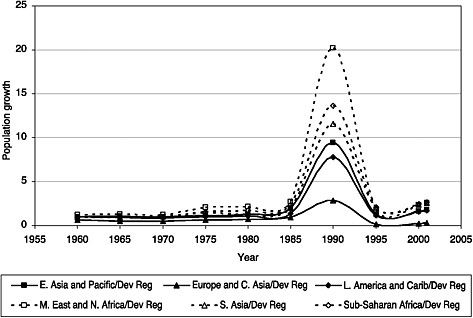
The patterns of the demographic transition, lagged to various degrees in various developing country groups behind that experienced by the developed country group, result in convergence being the dominant feature for population growth rates despite the very low and declining population growth rates for the developed economies (Figure 2-1).8 However, this pattern is not universal, with both Europe and Central Asia and the Middle East and North Africa diverging from the (declining) population growth rates for the developed countries.
For birth rates and total fertility rates, in contrast, the dominant tendency is for divergence, particularly before 1985. The only exceptions are Europe and Central Asia for birth rates and Latin America and the Caribbean for total fertility rates. The dominance of divergence for fertility rates, however, tends to be offset by considerable convergence for mortality rates so that the overall dominant tendency is for convergence in terms of population growth rates, as noted above.9 Mortality rates have been converging
TABLE 2-1a Index of Convergence/Divergence by Region
|
Latin America and the Caribbean |
Middle East and North Africa |
South Asia |
Sub-Saharan Africa |
Data Availability: First and Final Years |
|
57.3 |
−116.4 |
142.9 |
150.8 |
1960/2001 |
|
−0.1 |
−12.1 |
−54.9 |
−93.6 |
1960/2001 |
|
14.8 |
−14.6 |
−53.4 |
−100.8 |
1960/2001 |
|
42.3 |
116.2 |
97.5 |
35.4 |
1960/2001 |
|
13.0 |
−6.5 |
−27.4 |
−44.3 |
1960/2001 |
|
−12.0 |
−35.1 |
−49.8 |
−66.3 |
1960/2001 |
|
0.2 |
−0.3 |
2.3 |
−0.8 |
1960/2001 |
|
0.2 |
−0.3 |
−2.2 |
−0.8 |
1960/2001 |
|
−1.4 |
−14.3 |
−14.1 |
−14.5 |
1960/2001 |
|
6.2 |
1.2 |
−5.2 |
−8.9 |
1960/2001 |
|
−1.5 |
0.2 |
5.0 |
−0.5 |
1960/2001 |
|
−1.4 |
0.2 |
4.8 |
−0.4 |
1960/2001 |
|
371.4 |
410.0 |
1171.6 |
979.3 |
1965/2001 |
|
−15.2 |
32.4 |
−101.8 |
−47.2 |
1960/2001 |
|
−55.2 |
−29.3 |
−176.2 |
−126.3 |
1960/2001 |
|
11.9 |
30.1 |
11.2 |
25.8 |
1960/2001 |
|
−1.5 |
−1.0 |
5.4 |
2.2 |
1960/2001 |
|
−0.3 |
−0.7 |
4.6 |
1.6 |
1960/2001 |
|
−3.0 |
−0.1 |
−9.3 |
−1.0 |
1960/2001 |
|
10.5 |
6.9 |
3.7 |
5.7 |
1960/2001 |
|
−3.4 |
−0.6 |
4.6 |
0.9 |
1965/2001a |
|
−1.0 |
−0.5 |
3.1 |
0.9 |
1960/2001 |
TABLE 2-1b Index of Convergence/Divergence by Region
|
Latin America and the Caribbean |
Middle East and North Africa |
South Asia |
Sub-Saharan Africa |
Data Availability: First and Final Years |
|
−26.6 |
82.5 |
81.3 |
−19.4 |
1965/2000 |
|
−3.0 |
0.6 |
0.6 |
−2.4 |
1960/2001 |
|
−2.1 |
−9.3 |
1.8 |
−3.5 |
1975/2000 |
|
−1.8 |
−5.7 |
2.3 |
−2.9 |
1975/2000 |
|
−23.6 |
144.4 |
−168.1 |
−161.5 |
1960/2001a |
|
95.1 |
65.4 |
−7.6 |
−4.3 |
1960/2001a |
|
30.2 |
0.3 |
16.8 |
16.1 |
1960/2001a |
|
37.8 |
795.6 |
−12.5 |
301.4 |
1960/2001a |
|
−18.0 |
52.1 |
−8.3 |
−17.8 |
1960/2001a |
|
−5.1 |
42.9 |
3.0 |
−6.2 |
1960/2001a |
|
6.7 |
1.0 |
−34.5 |
3.4 |
1970/2001 |
|
3.9 |
4.0 |
0.3 |
−0.6 |
1990/2000 |
|
63.5 |
50.2 |
37.2 |
42.8 |
1990/2000 |
|
11.0 |
14.9 |
14.3 |
35.9 |
1960/2000 |
|
−4.1 |
0.2 |
−3.1 |
−6.4 |
1970/2001 |
|
47.7 |
−20.9 |
22.2 |
−4.1 |
1980/2001 |
|
67.2 |
14.0 |
10.8 |
88.0 |
1970/2001 |
TABLE 2-1c Index of Convergence/Divergence by Region
|
Latin America and the Caribbean |
Middle East and North Africa |
South Asia |
Sub-Saharan Africa |
Data Availability: First and Final Years |
|
−1.2 |
−5.1 |
70.7 |
97.4 |
1960/1999 |
|
0.3 |
1.9 |
35.6 |
55.2 |
1960/2001 |
|
4.1 |
−3.6 |
7.2 |
−7.5 |
1960/1999 |
|
−11656.9 |
−5028.7 |
−49079.6 |
−61165.0 |
1960/2001 |
|
−124.6 |
274.0 |
−203.2 |
−456.3 |
1980/2000 |
|
13.2 |
−70.1 |
−30.8 |
−37.1 |
1980/2000a |
|
−2.2 |
16.0 |
22.8 |
52.3 |
1980/2000 |
|
−101.2 |
−913.9 |
−304.0 |
477.9 |
1980/2000b |
|
−7.6 |
−22.8 |
78.3 |
401.2 |
1980/2000 |
|
48.3 |
67.5 |
110.1 |
40.3 |
1980/2000 |
|
7.1 |
−1.0 |
18.3 |
23.7 |
1980/2000 |
|
12.0 |
−17.3 |
36.4 |
62.2 |
1980/2000 |
|
3.2 |
8.8 |
32.2 |
54.3 |
1980/2000 |
|
127.1 |
23.3 |
−232.4 |
−196.7 |
1980/2000c |
|
15.1 |
−111.0 |
−91.5 |
−8.3 |
1980/2000d |
|
40.9 |
109.5 |
1.1 |
4.8 |
1980/2000d |
|
58.7 |
10.5 |
392.7 |
−4857.0 |
1980/2000e |
|
−145.8 |
−41.6 |
−36.6 |
−400.8 |
1980/2000e |
|
−106.4 |
103.4 |
6.4 |
−420.4 |
1980/2000e |
|
dEarliest year available for ECA: 1985; for SA: 1990; Latest year available for MENA, SA, and SSA: 1999. eEarliest year available for ECA, MENA, and SSA: 1990; for SA: 1985; Latest year available for MENA and SA: 1995. |
||||
TABLE 2-1d Index of Convergence/Divergence by Region
|
Latin America and the Caribbean |
Middle East and North Africa |
South Asia |
Sub-Saharan Africa |
Data Availability: First and Final Year |
|
7.2 |
16.9 |
15.0 |
3.5 |
1960/2001 |
|
7.9 |
16.9 |
16.5 |
2.7 |
1960/2001 |
|
6.4 |
16.9 |
13.3 |
4.4 |
1960/2001 |
|
28.8 |
16.3 |
59.3 |
−20.8 |
1960/2001 |
|
−11.6 |
−5.2 |
35.9 |
−288.9 |
1960/2001a |
|
−16.3 |
9.0 |
19.1 |
−130.6 |
1960/2001a |
|
40.1 |
1.4 |
82.3 |
12.3 |
1960/2001a |
|
−234.9 |
−289.7 |
−860.4 |
−1284.1 |
1960/2001 |
|
−165.9 |
−163.4 |
−820.6 |
−1446.3 |
1960/2001 |
|
3.9 |
4.0 |
0.3 |
−0.6 |
1990/2000 |
|
63.5 |
50.2 |
37.2 |
42.8 |
1990/2000 |
|
37.0 |
55.8 |
64.3 |
7.8 |
1980/2001 |
|
41.6 |
59.9 |
63.0 |
20.0 |
1980/2001 |
|
9.6 |
5.0 |
−7.5 |
−0.2 |
1960/2000b |
|
−34.3 |
−18.0 |
−8.4 |
−24.4 |
1960/2000c |
TABLE 2-1e Index of Convergence/Divergence by Region
|
Indicators |
East Asia and the Pacific |
Europe and Central Asia |
|
EDUCATION |
|
|
|
School Enrollment Overall and Gender Differences |
|
|
|
Gross primary enrollment |
20.7 |
6.8 |
|
Gross primary enrollment (female) |
31.5 |
5.4 |
|
Gross primary enrollment (male) |
23.3 |
−7.2 |
|
Gross primary enrollment (male-female) |
81.4 |
81.4 |
|
Gross secondary enrollment |
21.9 |
2.5 |
|
Gross secondary enrollment (female) |
24.6 |
4.5 |
|
Gross secondary enrollment (male) |
15.9 |
−5.1 |
|
Gross secondary enrollment (male-female) |
120.5 |
171.9 |
|
Ratio, female to male students (primary and secondary) |
12.9 |
−1.5 |
|
Years of expected schooling |
−0.8 |
−2.5 |
|
Years of expected schooling (female) |
23.9 |
−6.2 |
|
Years of expected schooling (male) |
18.4 |
−7.2 |
|
Years of expected schooling (male-female) |
170.7 |
171.3 |
|
Schooling Inputs |
|
|
|
Pupil-teacher ratio |
−68.0 |
32.3 |
|
Public expenditure on education |
−5.0 |
29.6 |
|
Years of schooling for adults |
27.0 |
1.4 |
|
Years of schooling for adults (female) |
33.4 |
3.6 |
|
Years of schooling for adults (male) |
21.4 |
−0.9 |
|
Years of schooling for adults (male-female) |
18.4 |
0.0 |
|
Adult illiteracy |
−34.9 |
−7.9 |
|
Adult illiteracy (female) |
−60.1 |
−0.7 |
|
Adult illiteracy (male) |
−9.7 |
−12.5 |
|
Adult illiteracy (male-female) |
−172.5 |
38.0 |
|
Other |
|
|
|
Youth illiteracy (15-24 years) |
−152.6 |
−2.6 |
|
Youth illiteracy (female, 15-24 years) |
−350.6 |
15.4 |
|
Youth illiteracy (male, 15-24 years) |
−62.9 |
−4.5 |
|
Youth illiteracy (male-female, 15-24 years) |
520.7 |
−108.7 |
|
Latin America and the Caribbean |
Middle East and North Africa |
South Asia |
Sub-Saharan Africa |
Data Availability: First and Final Years |
|
10.4 |
15.8 |
32.1 |
37.2 |
1970/2000 |
|
9.8 |
26.3 |
38.8 |
40.2 |
1970/2000 |
|
10.9 |
6.7 |
26.5 |
34.1 |
1970/2000 |
|
−231.9 |
−254.2 |
−1593.6 |
−1106.9 |
1970/2000 |
|
18.3 |
31.9 |
10.6 |
20.2 |
1970/2000 |
|
19.1 |
40.4 |
14.7 |
20.9 |
1970/2000 |
|
18.9 |
20.9 |
4.8 |
18.3 |
1970/2000 |
|
103.9 |
249.5 |
273.4 |
−195.0 |
1970/2000 |
|
5.3 |
36.8 |
42.1 |
15.1 |
1970/2000 |
|
−1.5 |
−0.1 |
0.0 |
0.2 |
1970/2000 |
|
4.6 |
30.1 |
21.8 |
18.6 |
1970/2000 |
|
8.2 |
13.1 |
12.4 |
15.0 |
1970/2000 |
|
36.8 |
381.8 |
469.2 |
316.5 |
1970/2000 |
|
−33.7 |
−33.4 |
−143.1 |
−129.4 |
1970/2000 |
|
11.0 |
14.9 |
14.3 |
35.9 |
1960/2000 |
|
12.7 |
35.6 |
13.6 |
15.7 |
1960/1999 |
|
15.2 |
33.2 |
13.6 |
15.6 |
1960/1999 |
|
10.3 |
38.1 |
14.7 |
15.9 |
1960/1999 |
|
−43.6 |
−158.6 |
−118.5 |
−71.3 |
1960/1999 |
|
−37.4 |
−99.7 |
−242.1 |
−209.3 |
1970/2001 |
|
46.4 |
−184.4 |
−308.8 |
−274.8 |
1970/2001 |
|
−26.4 |
1.7 |
−161.7 |
−122.5 |
1970/2001 |
|
29.7 |
−532.9 |
−552.6 |
−472.0 |
1970/2001 |
|
−155.9 |
−243.6 |
−911.3 |
−746.4 |
1970/2001 |
|
−294.4 |
−827.8 |
−1990.6 |
−1631.5 |
1970/2001 |
|
−67.2 |
26.7 |
−328.3 |
−248.1 |
1970/2001 |
|
−74.7 |
1737.0 |
2091.3 |
1609.2 |
1970/2001 |
TABLE 2-1f Index of Convergence/Divergence by Region
|
Latin America and the Caribbean |
Middle East and North Africa |
South Asia |
Sub-Saharan Africa |
Data Availability: First and Final Years |
|
6.6 |
19.1 |
30.4 |
1.4 |
1960/1999 |
|
−134.2 |
−276.6 |
−112.2 |
97.1 |
1960/1999 |
|
57.4 |
126.6 |
35.3 |
16.6 |
1975/1999 |
|
1.0 |
21.3 |
1.6 |
0.0 |
1960/1999 |
|
2.5 |
13.3 |
1.1 |
−3.7 |
1975/2000a |
TABLE 2-1g Index of Convergence/Divergence by Region
considerably for all the developing country groups, with the single exception of Europe and Central Asia.
Age Structure
Over the entire period considered, the age dependency ratio has been converging in East Asia and the Pacific, Europe and Central Asia and particularly in Latin America and the Caribbean, but diverging (with some reversal to convergence in the 1990s) in the other three country groups (Figure 2-2). Underlying
|
Latin America and the Caribbean |
Middle East and North Africa |
South Asia |
Sub-Saharan Africa |
Data Availability: First and Final Years |
|
4.7 |
5.3 |
0.3 |
−0.2 |
1970/2001 |
|
8.0 |
3.7 |
−3.1 |
−0.4 |
1970/2001 |
|
3.1 |
18.6 |
0.0 |
12.9 |
1990/1999 |
|
0.4 |
−6.3 |
1.7 |
13.2 |
1990/2000a |
|
−0.6 |
52.8 |
0.9 |
−4.0 |
1980/2000a |
|
−0.7 |
−0.3 |
0.0 |
0.2 |
1990/2000a |
|
1.1 |
1.2 |
−8.0 |
−4.2 |
1990/2000b |
|
−6.6 |
−10.5 |
7.1 |
14.8 |
1970/2000c |
|
−10.6 |
−28.8 |
5.5 |
3.9 |
1970/2001 |
|
20.8 |
10.4 |
11.0 |
10.5 |
1965/2001 |
|
25.7 |
14.3 |
6.3 |
0.7 |
1970/2001d |
|
5.4 |
12.2 |
2.4 |
−12.0 |
1990/2001e |
|
12.2 |
14.8 |
1.8 |
−1.3 |
1990/2001e |
|
47.6 |
7.2 |
32.8 |
92.2 |
1960/2001f |
|
17.4 |
12.0 |
3.7 |
1.0 |
1960/2001 |
|
27.5 |
33.6 |
19.0 |
12.6 |
1960/2001g |
|
1193.1 |
19731.3 |
15325.6 |
1388.0 |
1965/2000 |
|
9.2 |
4.8 |
1.3 |
2.5 |
1990/2001h |
|
5.9 |
1.7 |
3.8 |
−3.0 |
1995/2001i |
|
eEarliest year available for EAP and MENA: 1985; for developed countries: 1980. fEarliest year available for EAP and SA: 1975; for LAC and MENA: 1970; for SSA: 1985. gEarliest year available for EAP, LAC, SA, and SSA: 1975; for MENA: 1970. hEarliest year available for developed countries: 1980. iEarliest year available for developed countries: 1990. |
||||
these patterns is strong divergence (at least until the 1990s) in the share of population in the 0-14 age range, for although there have been widespread fertility declines in the developing world, they generally have not kept pace with those in the developed world. Another factor is divergence (with the single exception of Europe and Central Asia) in the share of the population in the 65+ age range, though the data show some recent reversal. Although the share of the population in this age range has been increasing rapidly from a small base in developing countries, these increases have not yet been of the magnitude to keep pace with the rapidly aging populations in the developed countries.
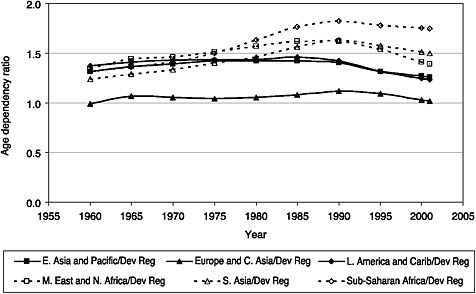
In some contrast, the share of the population in the 15-64 age range for four developing country regions—most notably in Latin America and the Caribbean—has been converging, although there has been divergence in South Asia and sub-Saharan Africa. One implication of these patterns is that over the period considered, Latin America and the Caribbean, East Asia and the Pacific, and Europe and Central Asia have had opportunities for exploiting the advantages of the “demographic bonus” part of the demographic transition, with relatively high proportions of working-age population and relatively low proportions of population with the education and health needs of infants and children, and health needs of aged adults. For youth transitioning to adulthood during such a demographic bonus, the lessened dependency ratios potentially offer advantages that may in part offset the competition for work and other options experienced with peers in their relatively large cohorts. Projections are that in the next few decades, Latin America and the Caribbean will continue to have the opportunities related to the demographic bonus and South Asia will have increasingly greater such opportunities, with sub-Saharan Africa lagging somewhat behind (Behrman, Duryea, and Székely, 2003). Rapidly aging populations in developing country regions such as East Asia and the Pacific and Europe and Central Asia, however, imply that opportunities for exploiting this “bonus” are not likely to continue much longer, if at all, in such areas.
Rural-Urban Composition
Rural population growth rates, generally (except in Europe and Central Asia) have been converging toward the very low rates experienced in the developed countries. Despite this convergence in the rural population growth rates, the shares of population in the rural sector generally have been diverging, except in the Middle East and North Africa. The obverse of this is that the growth rates of urban population generally have been diverging despite fairly widespread declines from previous high levels—with the exception of some convergence for Europe and Central Asia, though the shares of urban population have been converging (Figure 2-3). The contrast between the convergence of growth rates and shares is possible because the initial shares (as of the mid-twentieth century) of the population in rural areas were so much larger (and those in urban areas so much smaller) in most developing country regions than in developed countries that convergence in the growth rates will have to continue for some time before the shares, too, start to converge. Associated with the rapid urbanization rates experienced recently in most developing country regions—and projected to continue—are changed opportunities for human capital investments, employment, sexual relations, entertainment, marriage, autonomy, and other related factors for youth.
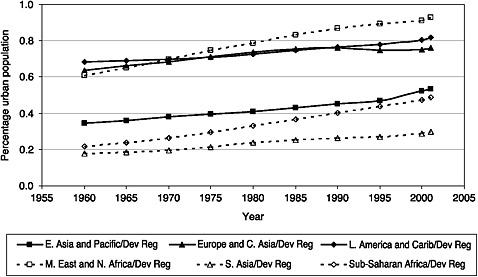
FIGURE 2-3 Urban population (as a percentage of total population) (compared to developed countries = 1.0) by region over time.
Female-to-Male Sex Ratio
The female-to-male sex ratio has tended to converge in the more populous regions of the world, where it previously was relatively low—South Asia and East Asia and the Pacific, as well as in sub-Saharan Africa (Figure 2-4). On the other hand, there has been some divergence in Europe and Central Asia and to a lesser extent in Latin America and the Caribbean and the Middle East and North Africa (the last being a region where the sex ratio was relatively low at the start of the period covered). Thus if historically the relatively low female-to-male sex ratios in parts of Asia and the Middle East and North Africa were caused by more limited access to resources within or outside of the household by females (as claimed, e.g., by Sen, 1990), then in the more populous of these areas (though not in the Middle East and North Africa), apparently, the differential access has been lessened. For two of the regions for which there is divergence (Europe and Central Asia, Latin America and the Caribbean), moreover, the divergence favors females relatively to males because these country groups initially had higher female-to-male sex ratios than did the developed country group. Thus quite broadly in the developing world, with the notable exception of the Middle East and North Africa, sex ratios have shifted toward females. This is consistent with female youth as recently having benefited from more resources and opportunities relative to males on average than was the case
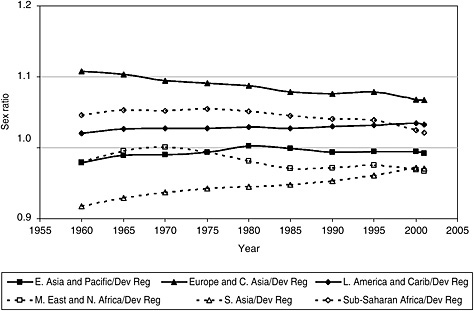
FIGURE 2-4 Sex ratio (compared to developed countries = 1.0) by region over time.
in the past—though the movement toward closing the gender gap favoring males does not mean that it has been closed entirely.
ECONOMY
The nature of the economy has an important effect on the options that youth have through a number of channels, both directly (e.g., in terms of employment options and the returns to different types of human capital investments) and indirectly (e.g., through transfers from family and subsidies from governments for human resource investments). This section explores the impact that some such variables may have on the economic environment that prevails when youth transition into adulthood.
Gross Domestic Product (GDP) Growth Rates and Levels
Rates of growth of gross domestic product (GDP) have varied substantially among regions. Four of the regions—East Asia and the Pacific, Europe and Central Asia, the Middle East and North Africa, and South Asia—have experienced considerable convergence in economic growth rates. The other two—Latin America and the Caribbean and sub-Saharan Africa—have diverged (in a negative direction). Per capita incomes in purchasing power
parity (PPP) terms10 have been converging somewhat on average in East Asia and the Pacific and South Asia, but diverging considerably in Europe and Central Asia and the Middle East and North Africa, and to a lesser extent (but still substantially), in sub-Saharan Africa and Latin America and the Caribbean (Figure 2-5). This suggests that youth in large parts of the developing world are in economies where per capita product/income has been slipping further behind that in the developed world, even if in some cases, such as Europe and Central Asia and the Middle East and North Africa, the growth rates have been converging. On the other hand, the two regions in which the majority of youth live in the developing world—East Asia and the Pacific and South Asia—have been converging somewhat in terms of per capita product/income level, because their economies on average have grown rapidly enough to offset the momentum of starting from much lower per capita product/income levels. Different commentators may view this record as more or less positive, or even negative. But it certainly suggests that the overall economic contexts in which most youth in the developing world have been making their transitions to adulthood have changed, and that these changes have varied substantially among regions, with much more positive aggregate economic experiences in Asia, which houses the majority of youth in developing countries, than elsewhere.
Shares of Production in Major Sectors
The shares of production in various sectors may shape substantially the nature of options, particularly employment and human resource-related options, for youth in developing countries. Conventional wisdom is that the share of agriculture in production declines steadily in the process of development—from about half or more at low levels of per capita income to a level of about 5 percent. At the same time, the share of industry increases initially, and then peaks and declines somewhat, and the share of services tends to increase—particularly for per capita income levels above that at which the share of industry starts to fall.11 The patterns, over time, for most of the developing regions are consistent with these characterizations. The nonlinear
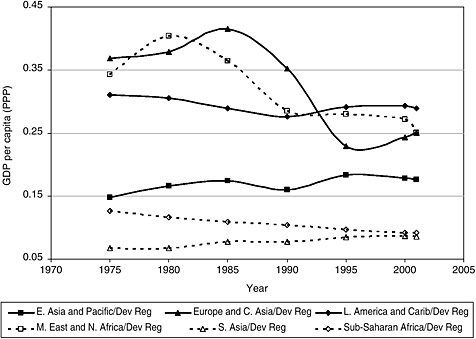
FIGURE 2-5 GDP per capita (compared to developed countries = 1.0) by region over time.
nature of these paths, however, means that what appears to be divergence in the shorter run may be consistent with longer run convergence.
The share of value added in agriculture has been declining fairly steadily in most country groups. The share of value added in industry has been converging rapidly for East Asia and the Pacific, Europe and Central Asia, Latin America and the Caribbean, and the Middle East and North Africa. There has been some smaller divergence, in contrast, for South Asia and sub-Saharan Africa. The share of value added in services has been converging rapidly for Latin America and the Caribbean and East Asia and the Pacific, and somewhat less rapidly for South Asia and sub-Saharan Africa (with a small drop for Europe and Central Asia and almost no change for the Middle East and North Africa). These patterns are roughly consistent with the conventional wisdom sketched out above. However, the relatively large movements toward the developed country shares for Latin America and the Caribbean, South Asia, and sub-Saharan Africa—given their respective levels of development—raise some concerns that the service sectors in these cases may be absorbing labor in low-productive activities because of limited job expansion in goods-production sectors. In any case, youth in
the developing countries clearly have faced job options in economies with fairly rapidly changing production structures that probably have changed the returns to different forms of human capital (e.g., increased the returns to formal schooling in comparison with informal learning in family enterprises) and have involved some dislocation (including physical migration) to adjust to the changes—and, once again, with some important differences among regions.
Openness to International Trade
Probably the most prominent conjecture in the development literature about the relation between openness to international trade and levels of development is that exposure to international markets, particularly through having to compete to export in such markets, increases the efficiency of physical and human investments and of technological adoptions, encourages greater national and international investments, and expands markets, and therefore, increases the rate of development. On the other hand, there is a long-standing perception, advocated, for example, by Latin American structuralists and revived recently in a related form by some international economists and other commentators on global changes, that development involves industrialization and high-end services—the domestic expansion of which must be nurtured at least initially by limiting or precluding strong competition from international markets and investors. A related observation is that economies that depend on primary exports of agricultural and mineral products need to be very open, but are not likely to transform themselves into developed economies very rapidly.
Four of the six developing country regions have recently converged toward the developed countries in a standard measure of openness—the share of exports plus imports in national product. The exceptions are East Asia and the Pacific and, to a much lesser extent, South Asia. For East Asia and the Pacific (but not for South Asia), the nature of the divergence has been to increase openness more rapidly than the developed countries, which often has been interpreted as being an important causal factor in the relatively successful recent development of this region. In any case, it is clear that openness (and the underlying export and import share components) has changed substantially in the developing world, again with considerable variations among developing country groups. This is likely to have been related to substantial changes in economic structure, and therefore with the opportunities facing youth as they make important transitions to adulthood and consider what time uses are likely to have the highest payoffs for themselves.
Governmental Roles in the Economy
The process of development typically involves an expansion of dependencies on markets and on the government and a reduction of family and kin support (e.g., Ben-Porath, 1980; Pollak, 1985; Chenery and Syrquin, 1986).12 These changes alter the context in which youth make transitions to adulthood by making those transitions more dependent on markets (e.g., employment opportunities) and governmental services (e.g., publicly subsidized school systems). The expansion of the government, in turn, requires an expansion in governmental revenues, which normally takes primarily the form of expanded tax revenues.
The share of tax revenues in national product has tended to increase and converge for Europe and Central Asia, Latin America and the Caribbean, sub-Saharan Africa, and, barely, the Middle East and North Africa—but to diverge for East Asia and the Pacific and South Asia (though in both of these cases considering a somewhat different time period suggests some convergence). On the governmental expenditure side, we focus on expenditures on human capital because these are among the most relevant expenditures directly affecting youth in transition to adulthood. The shares of public expenditures on health and on education have converged substantially for most of the developing country regions (Figures 2-6 and 2-7). The single exception among the regions is East Asia and the Pacific for education, where public expenditures in recent decades have fluctuated around 4 percent of national product (as compared with about 5 percent in the developed country group). But fragmented evidence for this region suggests a substantially larger role of private financing of education than in most other regions. In summary, generally in developing countries there has been significant convergence regarding governmental roles—that reflect substantial shifts from families to the state for human resource investments.
LABOR
Shifts in the labor force that occur with the process of development are strongly correlated with the shifts described above in population and in the economy, as well as with the concomitant marketization of what formerly were primarily family functions. The latter not only increases adult participation in formal labor markets—particularly by females—but also reduces child and adolescent labor force participation as learning in school tends to replace learning by work experience during childhood and adolescence. The
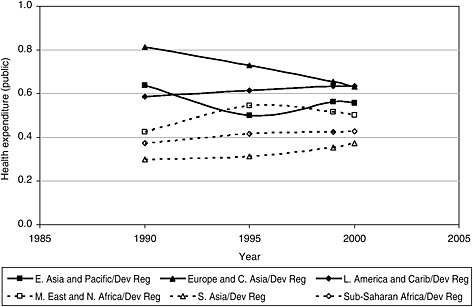
increased formal labor force participation also results in greater measured unemployment, perhaps in part due to the greater investment in job searches for good matches and in part due to the more rapid changes in the economy.
Labor Force Activity Rates, Gender, and Child Labor
The female labor force activity rates have tended to converge substantially for East Asia and the Pacific, Europe and Central Asia, South Asia, and sub-Saharan Africa, but have diverged slightly for Latin America and the Caribbean and the Middle East and North Africa. In substantial part, this reflects the great change in female labor force participation in the developed countries (nearly doubling between 1960 and 2000), which permitted catch-up with the developing countries in East Asia and the Pacific, Europe and Central Asia, South Asia, and sub-Saharan Africa (in each of which there was much less change), but which increased disparities with Latin America and the Caribbean and the Middle East and North Africa (in which there were increases from lower bases, but not as rapidly as in the developed countries). The male labor force activity rates, on average, in developing countries have changed much less relative to the developed countries than have the female rates—with some convergence in East Asia and the Pacific, Europe and Central Asia, Latin America and the Caribbean, and South Asia and some divergences in the Middle East and North Africa and sub-Saharan Africa. The combination of the patterns for females and males has resulted in substantial convergence in the share of females in the labor force in most regions (much less in Latin America and the Caribbean and the Middle East and North Africa) (Figure 2-8). This is consistent with labor force opportunities by gender shifting (substantially in most regions) toward those in the developed countries. Finally the child (ages 10 to 14) labor force participation rates have dropped considerably in all the developing country regional groups, though the indices generally indicate substantial divergence because of the very low and declining almost to zero rates in the developed countries (Figure 2-9).
Sectoral Distribution of Employment
The shares in industrial and service employment tend to have converged or diverged fairly similarly to those discussed above, with regard to the shares in value added. But the patterns are not exactly the same because of differential average labor productivity changes across group. As a result there is a tendency for somewhat less convergence for labor shares than for production shares, perhaps most strikingly in the case of the industry shares in the Middle East and North Africa. As for the overall labor force activity rates, there is somewhat of a tendency for greater convergence (but somewhat weaker) in the sectoral labor force shares for females than for males.
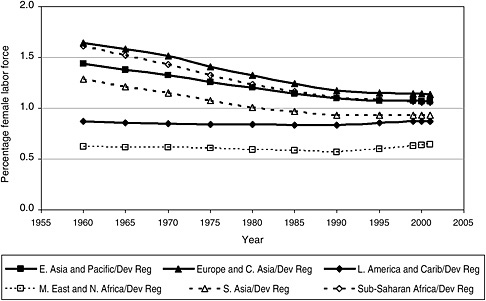
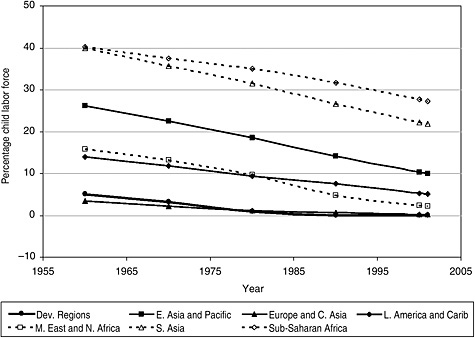
Unemployment Rates, Gender, and Youth
The indices are not very informative for unemployment rates because such rates are rather small with a fair amount of fluctuations in the developed countries. The unemployment rates in the developing country groups also have considerable fluctuations, but in general possibly exhibit some upward trend. Underlying these overall rates tend to be rates that are higher and more volatile for females, including among adolescent and youth ages 15-24 years. The interpretation of trends and relative fluctuations in unemployment rates, however, is not straightforward because there are both demand-side considerations (related to the demand for labor) and supply-side factors (related to more searches for better matches with the marketization of labor and development and a lower dependence on families for absorbing underemployed workers).
HEALTH
Health is of interest in itself because it contributes directly to individual welfare. In addition, improved health has important productivity effects through increased learning and performance directly on the job, with both effects being quite strong in poor populations (e.g., Alderman, Behrman, and Hoddinott, 2005; Behrman, Duryea,and Székely, 2003; Pollitt, 1990; Strauss and Thomas, 1995, 1998). For example, better health not only makes learning easier, but it increases the returns to learning through increasing post-education productivity and higher expected duration of productive years.
Life Expectancies and Gender
Life expectancies and the mortality rates13 that underlie them refer to fundamental aspects of health as they relate to the duration of life, even though they do not refer to the quality of life or the nature of morbidity.14
|
13 |
Due to space limitations, we do not discuss the patterns in the underlying mortality rates, but some convergence indices for mortality rates are presented in Table 2-1d for interested readers. |
|
14 |
A frequently used measure that refers to the quality of life is Disability Adjusted Life Years (DALYs). We have not included DALYs in this chapter because they are not included in the World Bank database that we use and because estimates are not available for much of the relevant historical period. But analyses of DALYs by types of morbidity indicate considerable recent and predicted convergence, with large shifts from communicable to noncommunicable diseases (despite the spread of HIV/AIDS in the former category). Behrman and Sengupta (2004, Appendix E) summarize some of this information. For discussions of aspects of convergence in the epidemiological and nutritional transitions, also see Omran (1971), Olshansky and Ault (1986), and Popkin (2002). |
With the exception of Europe and Central Asia, there has been substantial convergence with regard to overall life expectancies in all the developing country regions (Figure 2-10). This is very impressive because average life expectancy in the developed countries has increased substantially in recent decades, from 66 years in 1960 to 77 years in 2000. The general convergence reflects that in most developing country regions, life expectancy has increased even more than in developed countries. The Europe and Central Asia exception reflects the deceleration and the fall in life expectancies with the deterioration of health services and behaviors in the former Soviet Asia and allied countries. In this case, though there has been divergence from the developed countries, there has been convergence with the other developing countries. Perhaps more troubling is sub-Saharan Africa, for which there has been some convergence over the whole period considered, but divergence since 1990 due in part to the HIV/AIDS pandemic (with a fall in life expectancy at birth from 50.8 years in 1990 to 48.6 in 2001).
Gender differences in life expectancies at birth have converged substantially in most developing country regions, but have diverged in the Middle East and North Africa and sub-Saharan Africa (Figure 2-11). The convergence that is prominent in most parts of the developing world suggests that any differential access to health resources that may have discriminated against females has decreased in recent decades, as is noted above with
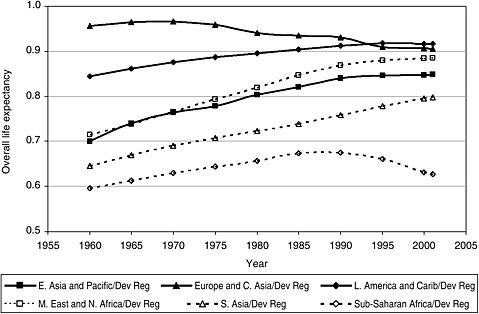
FIGURE 2-10 Overall life expectancy at birth (compared to developed countries = 1.0) by region over time.
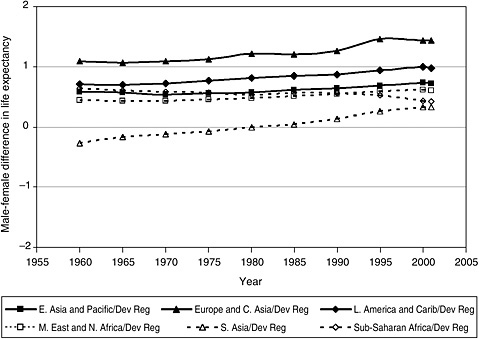
FIGURE 2-11 Male-female difference in life expectancy (compared to developed countries = 1.0) by region over time.
regard to the discussion of population sex ratios. In fact, since 1985 life expectancies for females have exceeded those for males on average in all the developing country regions, as well as the developed country regions. This does not mean that there is discrimination in the distribution of health-related resources against males because some life expectancy differences may be biological rather than behavioral. But apparently even in the developed countries, some of the differences are behavioral (e.g., consumption of tobacco and alcohol products, undertaking risky and stressful activities), with the result that the gender difference in life expectancies favoring females has varied over time (e.g., 4.8 years in 1960, increasing to 6.2 years in 1980, and declining to 5.5 years in 2000). The divergence in gender differences for life expectancies in Europe and Central Asia seems to be part of the convergence to the patterns in other better performing developing country regions that is noted above with respect to overall life expectancies. The divergence in gender differences for life expectancies in sub-Saharan Africa may reflect the feminization of the incidence of HIV/AIDS in that region and possibly that females are more marginalized when economies are stagnant (though the latter factor does not seem to have dominated in Latin America and the Caribbean, which also has been relatively stagnant economically in recent decades).
Health Determinants
Many, and perhaps the most important, health determinants reflect a range of behavioral choices related to nutrition, physical activity, and risky behaviors. Unfortunately we have not been able to locate comparable data on such activities across countries for the time periods covered. But fragmented evidence suggests at least some convergence in such behaviors, including in some behaviors (e.g., smoking, diet) that may be deleterious to health.
What we have been able to compare are a limited set of indicators of curative health. As we note above in the discussion of governmental expenditures in the section on the economy, the share of public health expenditures has converged substantially in all regions. In addition, we consider indices for DPT vaccination, measles vaccination, physicians per 1,000 people, and hospital beds per 1,000 people. The indices suggest that movement toward convergence is predominant for vaccinations. There also has been movement toward convergence in number of physicians per 1,000 people in East Asia and the Pacific, Latin America and the Caribbean, and the Middle East and North Africa, and in the number of hospital beds per 1,000 people in East Asia and the Pacific and in Europe and Central Asia (but only barely).
EDUCATION
Education is widely viewed as critical in improving transitions to adulthood in developing countries, particularly if there are rapidly changing conditions and increased marketization. As noted in Chapter 3 (National Research Council and Institute of Medicine, 2005), the form that education takes generally changes in the development process from learning-by-doing in family-related jobs to formal schooling and subsequent learning-by-doing in wage jobs.
Schooling Enrollments Overall and Gender Differences
Gross primary and secondary schooling enrollments have both converged substantially for all the developing country groups. For primary schooling, this basically represents a catch-up to a stable target, because in the developed countries, gross primary enrollments have been basically 100 percent, at least since 1970. For secondary schooling, the convergence is more impressive because gross secondary school enrollments in the developed countries have increased substantially—from 64 percent in 1970 to 106 percent in 2000.15 Thus there has been substantial convergence at the
secondary level despite a significantly increasing moving target. These relative enrollment increases in the developing countries, together with those at the tertiary level, have implied significant convergence in the expected schooling for synthetic cohorts, as well as the average schooling of adults—changing considerably the educational human capital acquired by youth in developing countries.
There also have been striking changes in gender differences in enrollments. The absolute gender differences favoring males in gross enrollments at both the primary and the secondary levels have fallen substantially for all the country groups that we consider—and in some cases have even been reversed (Figures 2-12 and 2-13).
Schooling Inputs
We have been able to locate little information with which to make comparisons over time regarding schooling inputs. We have already discussed, in the section on the economy, the predominant tendency for the share of public expenditures devoted to education to move toward convergence. One other indicator that we have been able to find pertains to the pupil-teacher ratio. This indicator suggests general divergence, with the
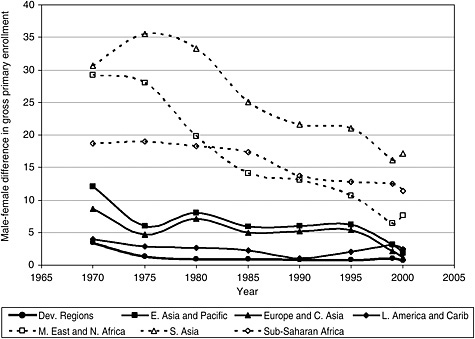
FIGURE 2-12 Male-female difference in gross primary enrollment (compared to developed countries = 1.0) by region over time.
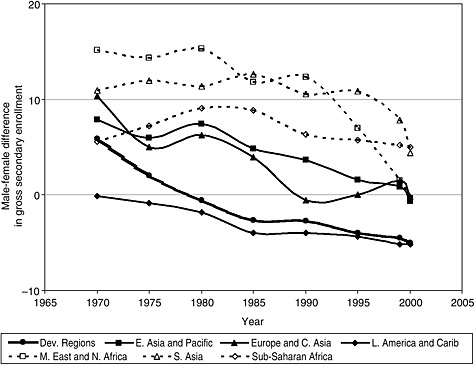
FIGURE 2-13 Male-female difference in gross secondary enrollment (compared to developed countries = 1.0) by region over time.
exception of the Europe and Central Asia region. This is a reflection of the relatively large cohorts of school-age children who have been passing through school systems in developing countries, together with the increasing enrollment rates, during recent decades. Looking forward, however, the combination of more educated adults due to the substantial schooling expansion (the pool from which teachers will be drawn) and the spread to additional developing regions beyond East Asia and the Pacific of the “demographic bonus” is likely to make possible increases in resources (including teachers) per student and in schooling quality more broadly defined.
ENVIRONMENT
We consider carbon dioxide emissions (total, Kg per GDP in PPP dollars, per capita) and electric power per capita in assessing the impact that environmental factors might have on the changing climate in which youth make transitions to adulthood. The predominant tendencies are toward convergence. This is particularly the case for carbon dioxide emissions per
GDP in PPP dollars, which in the case of the developed country measure, declines sharply (to less than a third of its 1975 value by 2000); therefore, the extent of convergence in the developing countries is all the more striking. The convergence by the other measures is less, in part because of the divergence outside of Asia in per capita GDP in PPP terms, noted in the discussion of the section on economy. But generally there is still convergence, though less so in Europe and Central Asia, which (alone among the regions) experienced per capita declines in both carbon dioxide emissions and electric power after 1990 (i.e., after the demise of the Soviet Union). Therefore, while carbon dioxide emissions in general have increased recently (with the exception just noted), suggesting some deterioration in these aspects of the environments in which youth are becoming adults, at the same time the economies in which they live are becoming more like those in the developed countries with falling emissions per unit of real product.
TRANSPORTATION AND COMMUNICATION
Increased transportation and communication, of course, are critical channels through which phenomena such as globalization are often presumed to occur. This suggests that the greater the expansion of transportation and communication (given that the developing countries in most respects are less intensive regarding transportation and communication than the developed countries), the greater the convergence of variables in all the groups that we consider. In most cases, it would seem that the more rapid the expansion of transportation and communication the more the developing countries are converging toward the (changing) developed countries in terms of transportation and communication per se.
Air Transport
The number of air passengers has increased substantially in the developed countries in recent decades—by a factor of about 3.5 between 1970 and 2000. This means that for there to have been some convergence, the number of air passengers in developing countries would have had to increase even more rapidly. In fact, there has been considerable convergence by this measure recently in East Asia and the Pacific, and a somewhat lesser convergence in Latin America and the Caribbean and the Middle East and North Africa—but not much relative change in South Asia and sub-Saharan Africa, and some divergence in Europe and Central Asia (Figure 2-14). For the number of aircraft departures, the patterns are similar, though with about as much convergence in Latin America and the Caribbean as in East Asia and the Pacific and with divergence only in South Asia.
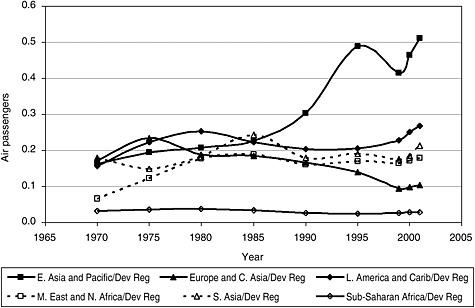
FIGURE 2-14 Number of air passengers (compared to developed countries = 1.0) by region over time.
Vehicular Transport
Convergence has been the primary tendency, though with exceptions. Vehicles per 1,000 people, for example, have tended to converge strongly for East Asia and the Pacific, Europe and Central Asia, the Middle East and North Africa, sub-Saharan Africa, and, to a lesser extent, Latin America and the Caribbean—though not in South Asia. Taking into consideration all the indicators included in the tables, the convergence tends to have been greatest and most consistent in East Asia and the Pacific, and probably least in South Asia, though there are also mixed patterns in the other four regions.
Communication
For most of the available indicators for most regions, a tendency for convergence has been the norm—though with exceptions that tend to be concentrated among older communication media (e.g., radio sets per 1,000 people, newspaper circulation per 1,000 people). Sub-Saharan Africa (all phone and mobile phone subscriptions per 1,000 people and Internet users) also seems to be an exception to this general trend of convergence exhibited by the other developing regions. Some interesting examples for different
types of communication are provided by radio sets per 1,000 people, phone subscriptions per 1,000 people, personal computers per 1,000 people, and Internet users (Figures 2-15 through 2-18). There seem to be some weak tendencies for convergence to have been the greatest for Europe and Central Asia, probably with East Asia and the Pacific ranking second, and the least for sub-Saharan Africa.
Thus for both transportation and communication, there has been a much greater tendency for convergence than for divergence for developing country regions. These tendencies have been a little stronger for East Asia and the Pacific in transportation and for Europe and Central Asia in communication, and weakest for South Asia in transportation and sub-Saharan Africa in communication. But generally there have been considerable changes, basically in the direction of the (again, changing) transportation and communication structures of the developed countries in the contexts in which youth in the developing world have been making transitions to adulthood. These changes are associated with greater mobility and greater information about the broader world, both of which would seem to be associated with changed—and probably increased—options and with lessened tendencies to choose traditional options.
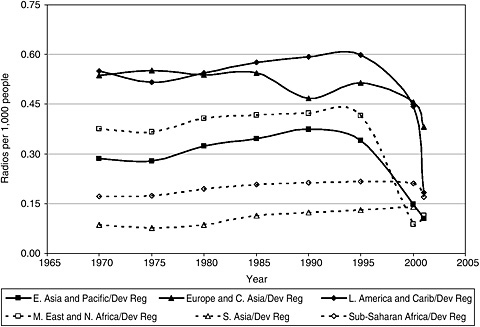
FIGURE 2-15 Radios per 1,000 people (compared to developed countries = 1.0) by region over time.
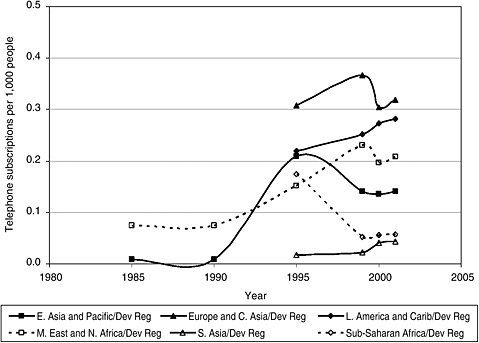
FIGURE 2-16 Telephone (fixed line and mobile) subscriptions per 1,000 people (compared to developed countries = 1.0) by region over time.
CONCLUSIONS
The developing countries have tended to converge toward the characteristics of the developed countries in a number of important respects in recent decades. But there also has been significant divergence in some other respects. Furthermore, there has been considerable variance among the seven groups of indicators considered and among developing country regions. The tendency for convergence has been considerable for the available indicators of health, education, environment, transportation and communication, and gender differences, but somewhat less for the other indicators. Though there has been a tendency for convergence for many aspects of the economy, the pattern is mixed for the important overall indicators of economic growth rates and for per capita product. In particular, two of the regions—Latin America and the Caribbean and sub-Saharan Africa—have diverged negatively with regard to economic growth rates. Only two of the regions—East Asia and the Pacific and South Asia—have been converging rather than diverging in terms of per capita real product. Though the majority of youth in the developing world live in the latter two regions, a significant minority lives in the other regions, for which there has been a

FIGURE 2-17 Personal computers per 1,000 people (compared to developed countries = 1.0) by region over time.
tendency for divergence for per capita real product. Taking into consideration all the indicators, the region of East Asia and the Pacific generally has converged most toward developed economics and sub-Saharan Africa least. The other regions are in between, with Europe and Central Asia in several cases diverging from the developed economies, but converging toward the more developed of the developing regions.
Such results suggest that the dominant thrust, as suggested by many observers of globalization, has been toward a more integrated and more similar world in which youth are making transitions to adulthood. This implies many changes for current youth in comparison with previous generations: much more dependence on markets than on family enterprises for jobs; much more emphasis on formal schooling than on learning by working with parents and other relatives; much more awareness of options and lifestyles from the broader world than just from the local community; longer life expectancies and less susceptibility to infectious diseases; smaller gender gaps favoring males; and much more mobility in a number of dimensions. But this major thrust should be qualified by important nuances that differ importantly among the regions and with respect to various indi-
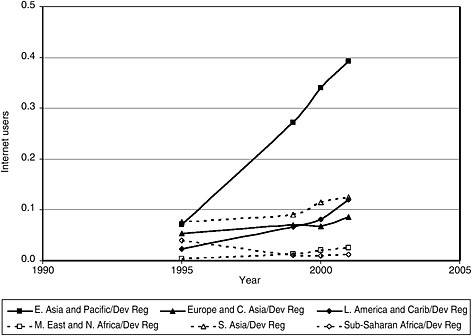
FIGURE 2-18 Internet users (compared to developed countries = 1.0) by region over time.
cators. Opportunities for youth in East Asia and the Pacific have changed differently in important respects from those, for example in sub-Saharan Africa or Europe and Central Asia. Therefore, analysis of changing transitions to adulthood in developing countries needs to be sensitive both to the predominant tendencies toward convergence and to some important tendencies toward divergence.
REFERENCES
Ahmad, S. (1994). Improving inter-spatial and inter-temporal comparability of national accounts. Journal of Development Economics, 44(1), 53-76.
Alderman, H., Behrman, J.R., and Hoddinott, J. (2005). Nutrition, malnutrition, and economic growth. In G. López-Casasnovas, B. Rivera, and L. Currais (Eds.), Health and economic growth: Findings and policy implications. Cambridge, MA: MIT Press.
Behrman, J.R., and Rosenzweig, M.R. (1994). Caveat emptor: Cross-country data on education and the labor force. Journal of Development Economics, 44(1), 147-172.
Behrman, J.R., and Sengupta, P. (2004). Convergence? Divergence? Or some of both? Major trends in selected indicators among country groups in recent decades. Philadelphia: University of Pennsylvania.
Behrman, J.R., Duryea, S., and Székely, M. (2003). Aging and economic opportunities: Major world regions around the turn of the century. In O. Attanasio and M. Székely (Eds.), A dynamic analysis of household decision-making in Latin America. Washington, DC: Inter-American Development Bank.
Ben-Porath, Y. (1980). The f-connection: Families, friends and firms, and the organization of exchange. Population and Development Review, 6(1), 1-30.
Bouis, H.E. (1994). The effect of income on demand for food in poor countries: Are our databases giving us reliable estimates? Journal of Development Economics, 44(1), 199-226.
Chamie, J. (1994). Population databases in development analysis. Journal of Development Economics, 44(1), 131-146.
Chenery, H.B., and Syrquin, M. (1986). Typical patterns of transformation. In H.B. Chenery, S. Robinson, and M. Syrquin (Eds.), Industrialization and growth. New York: Oxford University Press.
Heston, A. (1994). A brief review of some problems in using national accounts data in level comparisons and growth studies. Journal of Development Economics, 44(1), 29-52.
Lloyd, C.B., and Hewett, P.C. (2003). Primary schooling in sub-Saharan Africa: Recent trends and current challenges. New York: Population Council.
National Research Council and Institute of Medicine. (2005). Growing up global: The changing transitions to adulthood in developing countries. Panel on Transitions to Adulthood in Developing Countries. C.B. Lloyd (Ed.). Committee on Population and Board on Children, Youth, and Families. Division of Behavioral and Social Sciences and Education. Washington, DC: The National Academies Press.
Olshansky, S.J., and Ault, A.B. (1986). The fourth stage of the epidemiologic transition: The age of delayed degenerative diseases. Milbank Quarterly, 64, 355-390.
Omran, A.R. (1971). The epidemiological transition: A theory of the epidemiology of population change. Milbank Quarterly, 49, 509-538.
Pollak, R.A. (1985). A transaction cost approach to families and households. Journal of Economic Literature, 23(June), 581-608.
Pollitt, E. (1990). Malnutrition and infection in the classroom. Paris, France: UNESCO.
Popkin, B.M. (2002). An overview on the nutrition transition and its health implications: The Bellagio meeting. Public Health Nutrition, 5(1A), 93-103.
Sen, A.K. (1990). More than 100 million women are missing. New York Review of Books, 37(2), 61-66.
Srinivasan, T.N. (1994). Database for development analysis: An overview. Journal of Development Economics, 44(1), 3-26.
Strauss, J., and Thomas, D. (1995). Human resources: Empirical modeling of household and family decisions. In J.R. Behrman and T.N. Srinivasan (Eds.), Handbook of development economics (vol. 3A, pp. 1883-2024). Amsterdam, Holland: North Holland.
Strauss, J., and Thomas, D. (1998). Health, nutrition, and economic development. Journal of Economic Literature, 36(2), 766-817.
Stromquist, N.P., and Monkman, K. (Eds.). (2000). Globalization and education: Integration and contestation across cultures. Lanham, MD: Rowman & Littlefield.


