
3
Effects of Roads on Ecological Conditions
INTRODUCTION
Widespread attention continues to be drawn to the ecological effects of roads, especially as the road system continues to expand. Roads are created because of changing interactions between people and their environments. They are created to facilitate access to natural resources, to connect human communities, to move goods to markets, and to move people to work. Whatever their purpose, roads, road establishment, road maintenance, and road travel have a broad variety of effects.
In this chapter, the committee addresses the following two questions as stated in its charge:
-
What are the appropriate spatial scales for different ecological processes that might be affected by roads?
-
What are the effects of road density on ecosystem structure and functioning and on the provision of ecosystem goods and services?
Roads have effects that can vary with a range of spatial scales. The committee’s analysis examines what is known about road effects at three scales, which are discussed later in the chapter.
For the second question, the committee used the phrase “ecological condition” for “ecosystem structure and functioning.” Because most information on road effects is given in terms of ecological structure and
functioning rather than ecosystem goods and services, ecological condition is used. These terms are defined in the next section.
This chapter is organized into five sections to summarize the interaction between roads and ecological conditions. After this introduction, terms and concepts are defined in the second section. A short summary of effects on ecological goods and services is provided in the third section. The fourth section summarizes published, mostly refereed literature and is organized according to two dimensions: the first is the ecological process of interest (many of which are listed in Table 3-1) and includes the effects of each process on the different levels of ecological organization (for example, abiotic, population, species, and ecosystem), and the second is the scale of the effect. Many of the effects of roads on the environment are caused by other forms of human activity and land use. Impacts of agriculture, urbanization, forest practices, and manufacturing are in many ways similar and sometimes interrelated with the impacts of roads. Information gaps are discussed in the fifth section.
DEFINITIONS
Ecological condition is a general term that describes the structure and functioning of ecosystems. It may refer to the status of the ecological environment at a particular time or to dynamic changes in its components and processes over time. The dynamic aspects of these condition measurements are discussed later in the chapter where both spatial and temporal dimensions are addressed. Ecosystems encompass all living organisms (biotic components) plus the nonliving environments (abiotic components) with which they interact. The abiotic components consist of hydrological and geomorphological processes, chemicals, and such disturbances as landslides, climate and weather. Levels of organization of biotic components used in this report are genetics, species and population (plants and animals), and ecosystem. Each level of biotic components has attributes of composition, structure, and functioning, and together constitute biological diversity (often called “biodiversity”).
Composition refers to the identity and variety of elements in each of the biodiversity components. Structure refers to the physical organization or pattern of the elements. Ecological (or ecosystem) functioning refers to the ecological and evolutionary processes acting among the elements, or how the ecosystem works.
TABLE 3-1 Comparison of Ecosystem Goods and Servicesa and Ecosystem Structures and Processes Affected by Roads
Diversity of the genetic component refers to the variation in genes within a particular species, subspecies, or population. A relevant measure of the genetic component is allelic diversity, a measure of its structure is heterozygosity, and a measure of its functioning is gene flow.
Diversity of the population and species component refers to the variety of living species and their populations at the local, regional, or global scale. A relevant measure of this component is species abundance, a measure of its structure is population age, and a measure of its functioning is demographic processes, such as births and deaths.
Diversity of the ecosystem component refers to the number of species, biotic communities, and ecosystem types and to the genetic variation in the organisms present. Relevant measures of this component include a variety of measures of species diversity (see NRC 2001), including the ratio of native to nonnative species; various measures of genetic diversity (see Hedrick 2004); and variations in trophic activities and structure, such as food-chain length and feeding adaptations.
ECOLOGICAL CONDITION—ECOSYSTEM GOODS AND SERVICES
Ecological condition incorporates the concepts of ecosystem goods and services through the ecosystem component. Ecosystem goods are the materials and elements (for example, water, food, fiber, and fuel) that are products of ecosystems and used for a variety of human needs. Ecosystem services are the benefits that people obtain from ecosystems. Those include goods, such as food and water; services, such as regulation of floods, droughts, land degradation, and disease; supporting services, such as soil formation and nutrient cycling; and cultural goods, such as recreational, spiritual, religious, and other nonmaterial benefits (Millennium Ecosystem Assessment 2003).
An enumeration of road effects on ecosystem goods and services is marginally addressed in this report. The effects of roads on those ecological structures and processes that are of direct and indirect use to humans are, however, discussed in detail. Ecosystem structure and functioning can be translated into ecosystem goods and services, as described in subsequent sections.
Roads affect ecosystem goods and services in many ways. The documented road-associated changes to be discussed can be translated into equivalent alterations in ecosystem goods and services (Table 3-1).
Among the changes are altered local climatic conditions, altered nutrient cycling, loss of flood and drought mitigation, loss of soil fertility, and changes in biodiversity.
Ecological Conditions and Scale
Roads interact with ecosystems across a wide range of scales. For example, at small scales, heavy metal molecules accumulate in soils adjacent to roads. At intermediate scales, roads disrupt soil structures and hydrological pathways and alter plant and animal communities. At large scales (regions to nation), roads alter migration patterns and increase spread of exotic organisms. Many effects can occur at more than one spatial scale (for example, effects on migration patterns). The literature review in the next section documents effects of roads on ecological conditions at three scales. The smallest scale assessed is the road segment. This scale generally extends to a hundred meters (see Figures 1-1, 1-2, and 1-3). The intermediate scale is identified as a system of a geographic region—defined either politically (for example, a state or province) or ecologically (for example, a watershed or eco-region). This scale extends from one to tens of kilometers (see Figures 1-4 and 1-5). The largest scale is the macroscale and is defined by regional ecological units (for example, eco-regions) (Bailey et al. 1994) to national political boundaries. This scale extends from hundreds to thousands of kilometers (see Figures 1-6 and 1-7).
LITERATURE REVIEW
The committee developed an annotated bibliography (Appendix B) of road effects on ecological conditions, with an emphasis on spatial scale. The review included only studies that directly measured the effects of roads on the surrounding environment. Effects were categorized as either abiotic or biotic. Abiotic effects included the effects on hydrogeomorphic process, the effects of road-related chemicals on water and air quality, and the effects of other disturbances, such as landslides, local climate, and lighting. The three subcategories of biotic effects were genetic, species and population, and ecosystem. Within each subcategory, the effects of roads on structure, functioning, and composition were documented.
Every aspect of roads (as with many human activities) has some interaction with the surrounding environment, including road construction, operation, and maintenance. However, the committee’s review focuses on operation—that is, the effects of roads and their structures (for example, culverts) and vehicles that use them.
The literature review and synthesis provides an overview of the current understanding, trends, and information gaps relating to the effects of roads and traffic on ecological conditions and the spatial scales at which roads affect ecological conditions. The available information at different scales of ecological effects is also examined.
Approach
The committee collected and reviewed over 500 journal articles and conference proceedings. The literature was obtained primarily from scientific journals, although some reports were obtained from the grey literature. The list of studies was not meant to be exhaustive but nonetheless captured the majority of accessible literature. The focal area of the review was North America, but research findings from Europe and Australia were also included.
Table 3-2 summarizes the available bibliographic information. For each of the ecological conditions and spatial scales, the committee qualitatively categorized the number of studies as none, few, several, or many. For some subcategory and scale assessments, little information was obtained; however, there was a general consensus among committee members that more information was available but not in formats readily accessible. The findings of the studies are summarized in the following sections.
Ecological Significance of Road Attributes
The presence or absence of roads is not the only factor that governs impacts on the surrounding environment. A major impact of roads is related to their use—that is, traffic. The density of the road network, the volume of traffic on a roadway or road segment, the road surface, and other engineered features also affect the extent of ecological effects of a road. This section briefly discusses the direct individual ecological impacts of various road attributes.
TABLE 3-2 Summary of Number of Studies Addressing Different Types of Road Effects on Ecological Conditions
|
Ecological Condition |
Single-Segment Scale |
Intermediate Scale |
National or Regional Scale |
|
ABIOTIC |
|||
|
Hydrology/Geomorphology |
|||
|
Stream networks |
Fewa |
Many |
None |
|
Sediment production |
Fewa |
Many |
None |
|
Changes in waterflow |
Fewa |
Fewa |
None |
|
Chemical Characteristics |
|||
|
Mineral nutrients |
Many |
Few |
None |
|
Heavy metals |
Many |
None |
None |
|
Organic (water and sediment) |
Few |
None |
None |
|
De-icing salt |
Many |
Few |
None |
|
Volatile organic carbons (air) |
Fewa |
None |
None |
|
Other Disturbances |
|||
|
Landslides |
Fewa |
Few |
None |
|
Light |
Few |
None |
None |
|
BIOTIC |
|||
|
Genetic |
|||
|
Structure |
|||
|
Barrier to movement |
Few |
Few |
None |
|
Functioning |
|||
|
Isolated populations |
Few |
None |
None |
|
Composition |
|||
|
Filtering effect |
Few |
None |
None |
|
Species/Populations |
|||
|
Structure |
|||
|
Wildlife population structure |
Several |
Few |
None |
|
Functioning |
|||
|
Additional habitat |
Several |
Few |
Few |
|
Reduced habitat quality |
Many |
Few |
Few |
|
Dispersal corridor |
Several |
Several |
None |
|
Movement barrier |
Several |
Few |
Few |
|
Distribution |
Several |
Several |
Few |
|
Composition |
|||
|
Species richness |
Several |
Several |
None |
|
Road mortality |
Many |
Several |
Few |
|
Nonnative plants in roadsides and adjacent landscapes |
Many |
Several |
Nonea |
|
Ecosystem |
|||
|
Structure |
|||
|
Fragmentation |
Few |
Few |
None |
|
Functioning |
|||
|
Pollutants |
Several |
None |
None |
|
Composition |
|||
|
Environmental characteristics |
Several |
Few |
None |
|
aCategories thought to have more information available but not in readily accessible formats. |
|||
Road and Traffic Density
The density of the road network, the volume of traffic on a road, the road’s location, topography, and other factors have major roles in the intensity of associated environmental effects of roads. A few studies have correlated the density of the road network to their environmental effects (Findlay and Houlahan 1997, Carr and Fahrig 2001). Reduced construction of new roads reduces habitat fragmentation, suggesting that, in general, less habitat fragmentation occurs in a less-dense road network with high traffic volumes than in a dense network with low traffic volumes per road mile.
The direct effects of traffic density, defined in this report as the number of vehicle miles traveled on a given stretch of roadway in a given time, have been more widely studied. In general, an increase in traffic density correlates with an increase in the atmospheric deposition and the aquatic concentration of vehicle-emitted chemicals, such as heavy metals (Bocca et al. 2003, Fakayode and Olu-Owolabi 2003), particulate matter (Boudet et al. 2000), and organic pollutants (Ellis et al. 1997, Forman and Alexander 1998, Viskari et al. 2000, Ilgen et al. 2001, Latha and Badarinath 2003). Only areas with road density less than 0.72 km/km2 (1.16 mi/mi2) seem to support vibrant populations of wolves (Canis lupus) in Minnesota (Mech, et al. 1988, Fuller 1989), Wisconsin (Thiel 1985, Mladenoff et al. 1999), the western part of the Great Lakes region of the United States (Mladenoff et al. 1995), and Ontario (Canada) (Jensen et al. 1986). An exception to the trend is an established wolf population in a fragmented area of Minnesota with a road density of 1.42 km/km2 (2.29 mi/mi2) (Merrill 2000). Increased traffic density also has been shown to reduce amphibian population (Fahrig et al. 1995, Carr and Fahrig 2001).
Road Surfaces
Because construction of asphalt concrete and hydraulic cement concrete road surfaces involves many of the same techniques, the differences in the direct effects of roadway construction using these materials are minimal. Well-constructed asphalt concrete and hydraulic cement concrete pavements are impervious; therefore, both are likely to exhibit similar runoff. Work completed in National Cooperative Highway Re-
search Program Project 25-09 and reported in 2001 in National Cooperation Highway Research Program (NCHRP) Report 448 (Nelson et al. 2001) concluded that most materials, including asphalt concrete and hydraulic cement concrete, used in the construction and repair of highways “behave in a benign fashion in the environment. On the highway surface, leaching is slow, transport is rapid, and dilution is great….” Further, the results of Project 25-09 show no significant practical differences in the potential impact of runoff from asphalt concrete and hydraulic cement concrete pavement surfaces.
Engineering Structures
The impact of engineering structures is generally consistent with the functioning of the structure itself. Concrete barriers, right-of-way fences, noise barriers, and perhaps to a lesser extent, guardrails are designed to serve as barriers for people and noise, but they also function as barriers to flora and fauna. These barriers may result in habitat fragmentation and species isolation (Forman and Alexander 1998).
Wildlife underpasses and overpasses, long-span bridges, and culverts can help to mitigate the adverse impacts of habitat fragmentation. Examples of the use of these structures for ecological improvements are identified in Chapter 4 of this report.
Poorly designed engineering structures can often hinder the ecological improvements for which they were designed. In an aquatic culvert system, for example, several key design characteristics ensure effective utilization by the target species (see Box 3-1 under Biotic Consequences).
Abiotic Consequences
Abiotic conditions that can be influenced by roads include hydrological, geomorphological, and chemical characteristics and such disturbances as landslides, noise, and light. In this section, the committee considers only changes to the abiotic conditions themselves, and examples of each are provided below. How these abiotic changes affect the biota is considered in later sections.
Hydrological and Geomorphological Changes
Landscape changes result when roads alter the hydrological and geomorphological aspects of watersheds and landscapes. They can cause important changes (some for short periods, others for longer periods) in fluvial dynamics, sediment production, and chemical balances, which can adversely affect floodplain functioning and alter ecological conditions in aquatic and riparian areas (Figure 3-1).
Roads also affect water movements, sedimentation, and transport of pollutants. Because they often interrupt or otherwise alter sheet flow and
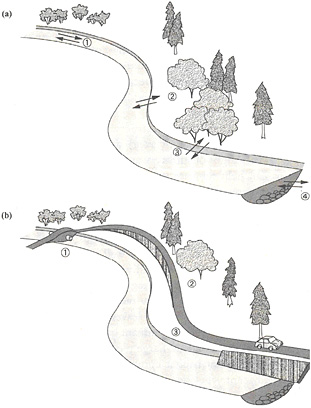
FIGURE 3-1 Road affecting four aspects of stream connectivity. (a) Upstream-downstream (1), floodplain-stream (2), forest-stream (3), and surface-subsurface water connections (4). (b) The connections severed or disrupted by a road in the floodplain. Source: Forman et al. 2003. Reprinted with permission; copyright 2003, Island Press.
runoff patterns, roads can affect the amount and quality of water that goes to recharging groundwater (Forman et al. 2003; NRC 1996, 2004), and they can affect surface waters in many ways. Because road embankments trap dust and dirt and they face the low winter sun at an angle, they can accelerate snowmelt (NRC 2003). Roads and associated ditches can become part of hydrological networks (Forman et al. 2003).
Several geomorphological processes and factors influence change. The nature of geomorphological processes affected by roads is strongly influenced by where and how roads are constructed, by the geology of the area, and by storm characteristics.
Chemical Characteristics
Water Quality
The most observable abiotic environmental consequence of roads is the contribution of motor vehicles on paved roads to water pollution. However, this contribution cannot be disassociated from the surrounding land use.
The largest number of studies reporting on the chemical characteristics of road effects focus on the chemical effects arising from rainfall events at the single-segment scale (FHWA 1981; Asplund et al. 1982; Gjessing et al. 1984; Kerri et al. 1985; Lord 1985; Yousef et al. 1985; Barrett et al. 1995, 1998; Sansalone et al. 1995; Lopes and Dionne 1998; Wu et al. 1998). Water quality is adversely affected by pollutants present in surface runoff and the atmosphere. Pollutants that accumulate on roadways from spills, wastes generated during vehicle use, litter, and adjacent land uses enter waterways via surface runoff. Atmospheric wet (snow and rain) and dry (smoke and dust) deposition of pollutants, which can be transported long distances, also affects water quality and fisheries. Although concentrations of nitrogen oxide (NOX) emissions from transportation have been quantified, there is no way to quantify wet deposition sources of nitrates from motor vehicles. Further, no quantification systems exist to measure or break down percentages of atmospheric nitrate deposition into a water body from specific nonmobile or mobile sources.
The primary source of pollutants associated with road use comes from vehicles, including fuel and exhaust; brake-lining and tire wear; leakage of oil, lubricants, and hydraulic fluids; and cargo spillage
(Forman et al. 2003, Hahn and Pfeifer 1994, Buzas and Somlyody 1997, Ball et al. 1998) (Figure 3-2). Shaheen (1975) examined urban roadway runoff and found that although the more hazardous constituents in highway runoff come directly from motor vehicles, they constitute less than 5% of the total solid pollutant load in highway runoff. These components include organic materials, such as petroleum and n-paraffin found in lubricants, antifreeze, and hydraulic fluids; lead; copper; chromium; zinc; nickel; and asbestos. Asbestos in brake linings was banned in 1989 (Shabecoff 1989), so vehicular sources of asbestos are minuscule, although resuspension of previously deposited asbestos is still a concern. In spite of the low contribution of constituents originating from the vehicle itself, vehicular traffic volume was identified as the principal factor influencing pollutant mass in highway runoff. That might be because vehicles are a transport mechanism as well as a source of pollution (Asplund et al. 1982).
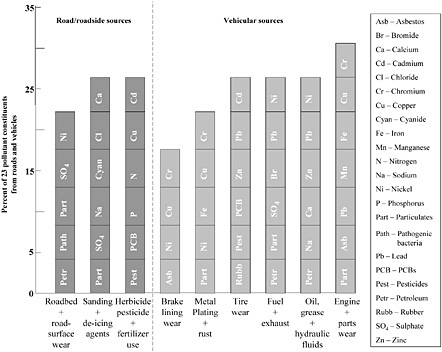
FIGURE 3-2 Sources of 23 pollutant constituents in storm-water runoff. Source: Forman et al. 2003. Reprinted with permission; copyright 2003, Island Press.
More recent studies have associated chemical pollutants with traffic flow. Pollution associated with traffic varies not only with the density of the traffic but also with the ratio of passenger cars to trucks and the mechanical condition of the vehicles (Buzas and Somlyody 1997). Studies of the Brunette River Watershed in British Colombia showed a correlation between the concentration of hydrocarbons in streambed sediment and storm water and the density of traffic. The three predominant hydrocarbon types found—xylenes and alkyl-substituted benzenes, alkanes, and high-molecular-weight unresolved complex mixtures—are consistent with petroleum or petroleum-product sources, indicating a vehicle-related source. Values were between 2.6 and 3.4 milligrams (mg) of hydrocarbon per liter (L) of sediment or storm water per unit of traffic (vehicle km/day per hectare) (Larkin and Hall 1998).
There also is a strong correlation between concentrations of heavy metals and volatile matter in highway runoff (Flores-Rodriguez et al. 1994). Metals associate with organic matter, thereby changing the metal solubility, which primarily affects the temporal characteristics of the runoff (Harrison and Wilson 1985).
Road salt has been commonly used to de-ice roads for many years. Compared with the literature on other road-related contaminants, the literature on pollution of surface water and groundwater by road salt is voluminous (Forman et al. 2003). The use of road salt results in the accumulation of sodium and chloride ions in runoff, thereby increasing concentrations of those ions in the soil, groundwater, and surface water above background concentrations and sometimes to unacceptable concentrations in drinking-water sources. The increase in the concentrations of ions reduce the soil’s ability for ion exchange, decreasing permeability and aeration, and increasing alkalinity of the soil.
Air Quality
Some studies also focused on the impact of vehicular chemical pollutants on local air quality. The majority of these studies examined the impact of vehicular traffic on the presence or absence of volatile organic compounds (VOCs) (Clifford et al. 1997, Tsai et al. 2002). Surprisingly few studies have examined the effects of chemical pollutants at the intermediate scale that could provide valuable information on total area effects primarily in watersheds or protected areas. Although most of the concern with roads and air quality focuses on new emissions added by
vehicle tail-pipe emissions, resuspended particles from traffic flow, dust from roadside areas, and other fugitive (non-tail-pipe) emissions are of concern.
The primary effects of local air pollution come from the increase in VOCs, NOX, carbon dioxide, particulate matter, and ground-level ozone that come from emissions of the traffic on the road. In the presence of sunlight, VOCs and NOX are precursors of ozone, a regulated ambient air constituent in the United States (de-Nevers 2000). The impact of these pollutants on a variety of species, primarily humans, has been well documented (Forman and Alexander 1998, Ilgen et al. 2001, Buckeridge et al. 2002, Delfino et al. 2003, Dongarra et al. 2003, Wilhelm and Ritz 2003, Zmirou et al. 2004).
Other Disturbances
Landslides
Physical disturbance can disrupt ecological systems, and roads promote such disturbances. For example, roads in mountainous areas can create landslides due to unstable soil and steep slopes. Paved road surfaces can increase water discharge rates in watersheds, thus increasing the potential for landslides and flash floods in streams and rivers.
Lighting
Roads and associated structures usually have artificial lighting. At some interchanges, especially near urban centers, the lights can be intense. Many rural roads do not have lights, although headlights from nighttime traffic and occasionally other lights are visible.
Noise
Noise along roads is a function of traffic type and amount. In rural areas, road noise can be audible to humans up to 10 km from the road and occasionally more than 10 km in optimal conditions.
Local Climate Effects
Roads interact with climate at a wide range of scales. At local scales, highly developed areas (urban centers) have been shown to experience an increase in temperature (Woolum 1964) in a process called the urban-heat-island effect. Urban heating can also result in increased rainfall (Shepherd et al. 2002). Roads change the albedo (fraction of light reflected by a surface) and other surface characteristics, but other structures, such as buildings, parking lots, and sidewalks, also contribute to heat-island effects.
Local climate might also be affected simply by the presence of roads and associated development. The loss of pervious surfaces and vegetation and their replacement with impervious surfaces that hold heat and do not respire result in localized temperature increases. Temperature increases can result in increased volatilization of organic contaminants from vehicular emissions (Saitoh et al. 1996). Thermal characteristics of the road surface cause accelerated snow melt (NRC 2003).
Biotic Consequences
Roads can have biotic effects on the genetics of populations, on species, and on ecosystems, and their effects can accumulate over space and time (e.g., NRC 2003; Figure 3-3).
The framework prepared by the Environmental Protection Agency (EPA) (Figure 6-1) also is a helpful way to conceptualize the ecological effects that roads can have. In general, their effects can operate through a variety of ecological mechanisms.
The effects occur at various stages of road planning, construction, operation, maintenance, and perhaps decommissioning or road removal. They often are expressed differently over space and time. Any approach to the assessment of the ecological effects of roads must take these broad categories of effects into account, as well as the variety of scales over which they can operate. Below, the various categories of effects are discussed. The biotic consequences of the following effects of roads are considered below: direct effects include roads as barriers, enhancement of dispersal, roadkill, and effects on habitats; indirect effects include results of the access that roads provide to previously inaccessible areas, changes in water and air quality, and effects of lighting and noise.
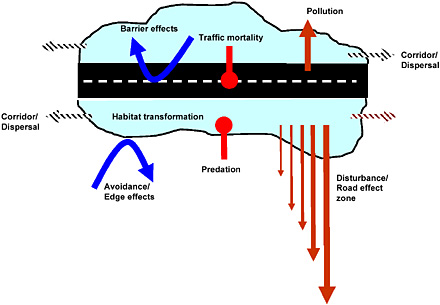
FIGURE 3-3 Schematic representation of the primary ecological effects of roads on species and populations. Source: Adapted from van der Zande et al. 1980. Reprinted with permission; copyright 1980, Elsevier.
Roads as Barriers
Roads can impede animal movements by direct mortality or avoidance behavior. The barrier effect varies between species, road types, and adjacent habitat quality; however, traffic volume and speed strongly influence the effect. Some authors have suggested that divided highways with 90 m of cleared areas as barriers are as effective as bodies of water twice as wide in obstructing dispersal of small forest mammals (Werner 1956, Sheppe 1965). In the Canadian Rockies, grizzly bears were more likely to cross low-volume roads and more likely to cross at points with high habitat rankings. Male grizzly bears were found closer to low-volume roads than females, but they crossed roads less often than females, particularly during the berry season (Chruszcz et al. 2003).
The barrier effect for some species is less related to traffic than to habitat changes (road-forest edges and gap creation caused by roads). Small road clearances (less than 5 m) can impede movement of certain small mammals. For example, road crossing by small mammals was inversely related to road width in Australia (Barnett et al. 1978), and small
road clearances (less than 3 m) have been shown to reduce crossing by small mammals, such as voles and rats (Swihart and Slade 1984).
Barriers to the movement of wildlife can lead to fragmentation of populations. Isolation caused by physical barriers to movement, such as roads, may reduce gene flow, thus causing genetic effects (Slatkin 1987) that in the extreme could result in local extirpation. For small mammals, that could result in ecosystem-level alterations because of their importance as seed dispersers and their role as prey for such predators as marten, wolverine, and raptors.
Fish passage can be blocked by improperly functioning stream culverts (Box 3-1) or by a lack of them, creating an often impassable barrier. The committee is not aware of studies showing that culverts have genetic effects on aquatic organisms, although such effects could be expected. Knaepkens et al. (2004) used genetic analyses to show that a culvert was not a migration barrier for the endangered European bullhead (Cottus gobio), but Schaefer et al. (2003) reported that culverts did restrict movement of the darter (Percina pantherina, a North American fish).
Because little is known about the long-lasting ecological effects of roads on animal populations, concern has been raised about the large-scale influence of barriers, such as interstate highways, on normal mammalian distributional patterns and perhaps ultimately on speciation (Baker 1998). Mitigation measures, such as large-span bridges and wildlife-crossing structures, are successfully being used to reconnect isolated populations, restore hydrological processes, and assist movement of wildlife across roads (Forman et al. 2003) (Figure 3-4, see also Chapter 4).
By creating barriers, roads also affect ecosystem functioning. The effects of roads on hydrological processes, most commonly through interfering with patterns of flow, have been the focus of many studies. Changes in hydrological processes affect ecosystem processes, such as habitat connectivity, primary productivity, decomposition, nutrient cycling, and disturbance regimes (for example, flooding frequency and intensity) (Jones et al. 2000).
Roads as Enhancers of Dispersal
Roads can act as habitat corridors as well as barriers. Road corridors (roads, their verges, and sometimes roadside ditches or wetlands) can contribute to the movement of wildlife and plant dispersal. Roadside verges facilitate animal movement, resulting in range expansion or dispersal between core habitats. Verges also aid in the spread of plant spe-
|
BOX 3-1 Aquatic Culvert Design Effects Salmon have evolved to negotiate waterfalls during both upstream spawning migrations and downstream juvenile passage to the sea. However, this ability is fairly rare among fishes. Few other families can accomplish either, especially with respect to upstream movement. Hence, even a small vertical rise or drop becomes impassable. The general image of a dam may be a wall of rock or concrete, but in fact any steep drop in flow of more than a few centimeters is impassable to most fishes. Among the most common such barriers are road culverts, typically involving large pipes under a road where it crosses a stream. If a culvert is not level with the grade of the stream, if the stream gradient is more than a few degrees, or if velocity exceeds 1 m/sec (and even if a culvert initially lies level with the bed of the stream), flow around and through the pipe scours and erodes the streambed. Hydraulic jump upstream and outlet drop downstream create an ever-steeper waterfall and deeper plunge pool. The pipe mouth eventually extends out over the stream, creating a vertical drop while lacking the rock face characteristic of a natural waterfall. Culverts and similar road-crossing structures have proved to be substantial barriers to fish passage. In a study of spring and summer movement by 21 fish species in seven families in the Ouachita Mountains of Arkansas, Warren and Pardew (1998) found an order of magnitude less movement upstream through culverts than through other types of crossings or natural reaches. They also found that fishes upstream of culverts were significantly less likely than fishes below culverts to move downstream, a result they attributed to avoidance of the increased flow velocity that typifies culverts. Such reluctance to move could be a factor isolating upstream populations and contributing to localized extirpations. Culverts can increase vulnerability of imperiled species by reducing movement among habitat patches. For example, federally threatened leopard darters (Percina panthera) in Oklahoma failed to move upstream through culverts, even though water temperatures at downstream sites had risen to undesirable levels and thermal refugia were available upstream (Schaefer et al. 2003). Obstructions, such as culverts, and their impacts are avoidable. Designs for culvert construction that minimize impacts on fishes are readily available (TranSafety 1997, Moore et al. 1999, Bates et al. 2003) and take into consideration hydrological, geological, biological, and economic factors. Where conditions prohibit design modifications that minimize culvert impacts, small bridges become a preferred, albeit more expensive, alternative. |
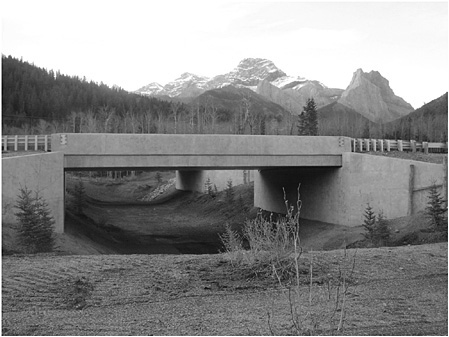
FIGURE 3-4 Wildlife crossings are designed to link critical habitats and provide safe movement of animals across busy roads. Typically they are combined with high fencing and together are proven measures to reduce roadkill and restore movements and regional connectivity. The photograph is of a newly constructed open-span bridge underpass installed on the Trans-Canada Highway near Canmore, Alberta. Source: Photograph by Tony Clevenger, 2005.
cies (often exotics). Roads with low traffic volumes are often used by wide-ranging wildlife because of the ease of travel, particularly when snow is present.
Invasion of nonnative plants can also occur from vehicles transporting nonnative seeds into natural areas and clearing land during road construction (Tyser and Worley 1992, Parendes and Jones 2000, Gelbard and Belnap 2003). In addition, insects and pathogens can be transported into new environments by vehicles (NRC 2002).
Roadkill
Roadkill can have demographic consequences for some species of wildlife (Maehr et al. 1991, Jones 2000). Roads and traffic can reduce
wildlife population densities and ultimately affect the survival probability of local populations. Traffic-related mortality has contributed to the decline of several species: Eurasian badger (Meles meles) (Bekker and Canters 1997) and moor frog (Rana arvalis) (Vos and Chardon 1998) in The Netherlands, Hermann’s tortoise (Testudo hermannii) (Guyot and Clobert 1997) in southern France, and Florida panther (Felis concolor coryi) (Maehr et al. 1991) are some examples. Road networks also particularly affect wide-ranging carnivore species (Maehr et al. 1991, Brandenburg 1996). Metapopulation theory suggests that more mobile species are better able to manage with habitat loss (Hanski 1999). Yet mortality of individuals in the matrix habitat (for example, road corridors) does not typically figure into metapopulation theory. Studies show that when mortality is high in the matrix habitat, highly mobile species are actually more vulnerable to habitat loss (Carr and Fahrig 2001, Gibbs and Shriver 2002). Younger age classes tend to be more affected by roads, as they interact more and live closer to them (Fowle 1996).
Habitat Effects
Roads have large, widespread effects on aquatic habitats (NRC 1996, 2004; Forman et al. 2003). When roads fail, landslides and torrents of water-borne debris can have serious adverse effects on stream habitats (NRC 1996). Roads and their associated structures, such as bridges, culverts, and berms, modify streamflows and sediment transport and often make passage for aquatic organisms more difficult or even impossible (NRC 1996, 2004; Forman et al. 2003; Warren and Pardew 1998; Schaefer et al. 2003). Because paved roads (and to a lesser degree, unpaved roads) are impervious, they increase runoff and otherwise alter hydrological patterns. Finally, they often interrupt the connectivity of aquatic ecosystems, although by providing new networks of aquatic systems, for example, in long ditches, they can enhance connectivity as well (Forman et al. 2003). Fragmentation effects of roads, as part of the cumulative effects of many factors, can strongly influence the distribution and land-use patterns of wide-ranging and migratory wildlife (Ward 1982, Noss et al. 1996).
Roads affect types of landcover, particularly their spatial composition and structural integrity. Although roads are narrow and linear, as discussed previously in the chapter, they create a disproportionate amount of habitat fragmentation, resulting in loss of connectivity. Al-
though other factors contribute to fragmentation, roads are clearly a major factor. There are various ways to measure habitat fragmentation that reflect different ecological concerns, such as number of patches, patch size, change in patch size, number of edges, edge size, and the nature of the barrier. As road density increases, larger and more contiguous expanses of habitat become smaller and more isolated (Forman et al. 2003). Substantial amounts of edge habitat with increased heterogeneity are created by roads and benefit “edge” species, such as white-tailed deer, whereas interior “core-sensitive” species are at a disadvantage (Forman et al. 2003).
Although roads typically adversely affect the density and diversity of plant and animal species and populations, especially early on, there are locations along roads and bridges over waterways that support healthy and diverse wildlife populations. For example, in Virginia at the crossings of the Potomac and Rappahannock Rivers along the I-95 corridor, there are populations of eagles and osprey that feed on the fish near the road-bridge crossings. Although these particular species are supported in this area, it might not be their preferred habitat, and the density and diversity of other wildlife in this area might be different from that during preconstruction.
Roadside verges (margins) can increase habitat diversity where there is little remaining natural or seminatural habitat. Depending on the nature of roadside verges, they can support abundant populations of some small mammals, insects, and birds, as well as native plant species. Roadside verges can also be important habitats for rare native plant species when juxtaposed in human-modified landscapes. For example, a large proportion of native plants and animals in Great Britain are found in roadside verge habitat. Furthermore, roadside verges have the potential to help restore native grass and wildlife communities. Also, in the arid west, the productivity of desert vegetation can be markedly greater near the roadside (Johnson et al. 1975), particularly on the upslope side. However, large areas on the downslope side of the road can be deprived of runoff, resulting in much lower plant biomass and productivity (Schlesinger and Jones 1984).
Roads create ideal conditions for the proliferation of nonnative plants because of increased light, disturbed soils, and dispersal vectors (caused by wind and vehicles). Many nonnative plants were introduced intentionally to control erosion; however, there are now ongoing efforts to reduce the use and spread of nonnative plants on roadsides and in ad-
jacent habitats. The practical aspects of nonnative plant management and other resource issues are discussed further in Chapter 4.
Road Access with Secondary Effects
Roads are usually built to provide transportation corridors between population centers or between industrial or resource centers and users. In such cases, development and resource use, or the expectation of them, precede and motivate the construction of roads. It can be difficult to separate cause and effect in many cases, but an excellent example of a road built to access planned development is the Dulles Airport Access Road in northern Virginia, which was specifically built to provide that access and which prohibits use by non-airport traffic.
However, roads also can bring about development or environmental exploitation by providing access to secondary resources (not the resources that the road was built to access). The provision of secondary access often also involves the construction of secondary roads (e.g., Hawbaker and Radeloff 2004). The construction of the James Dalton Highway from Fairbanks to Prudhoe Bay on Alaska’s North Slope to service the Trans-Alaska Pipeline and provide road access to the large oil fields also has provided access to the North Slope for recreational hunters, anglers, and tourists, increasing the mortality of some animal species (NRC 2003). Forest roads in the Congo Basin (Africa) have had the secondary effects of providing market accessibility and access to animals by hunters (Wilkie et al. 2000), and roads can influence patterns of settlement and land use (e.g., Pedlowski et al. 1997, Wear and Bolstad 1998, Hawbaker and Radeloff 2004). A major bypass being constructed around the Hoover Dam on the northwestern Arizona and southeastern Nevada border has caused developers to plan to build 55,000 houses in sparsely populated White Hills, Arizona, because the new road will cut the driving time to Las Vegas, Nevada, by at least one-third, making commuting from there feasible (Argetsinger 2005).
Water Quality
Because roads are impervious, runoff from them is greater than that from most unconstructed land cover types. As mentioned earlier, this runoff usually contains pollutants from the road and the vehicles on it.
Wegner and Yaggi (2001) reviewed the environmental impacts of road salt and of its main alternatives, calcium magnesium acetate and potassium acetate. They reported a variety of adverse impacts of salt on roadside and aquatic plants and animals. Ferrocyanide used as an anti-caking agent in road mixtures can also harm sensitive fishes (Environment Canada 2003).
Runoff contaminated with chemicals, including salt, affects roadside vegetation. Salt runoff can damage vegetation, resulting in reductions in seeding establishment and flowering and fruiting of sensitive plant species; foliar, shoot, and root injury; and growth reductions. Areas affected by salt runoff also demonstrate a shift in plant community structure when salt-sensitive plant species are replaced by halophytic species, such as cattails and common reed grass (Environment Canada 2003). Fleck et al. (1988) reported that roadside salt and sand application resulted in significant declines in the vigor of roadside stands of white birch (Betula papyfera), including increased numbers of dead trees. Richburg et al. (2001) reported that both salt and invasive species affected the species composition in a roadside wetland and suggested that the presence of roads could have enhanced the ability of the invasive giant reed (Phragmites australis) to invade the ecosystem.
The effects of road salts on vegetation discussed above can affect wildlife in several ways, including by diminishing their habitat (Wegner and Yaggi 2001, Environment Canada 2003). Road salting can inhibit movement across roads by amphibian species. Survivorship of some amphibians was also reduced in roadside pools contaminated by road salt. Behavioral and toxicological impacts have also been associated with exposure of mammals and birds to road salts. Ingestion of road salts increases the vulnerability of birds to vehicle collisions and may poison some birds if water is not available.
NOX are emitted by vehicles and are deposited from the atmosphere either through smoke and dust (dry deposition) or through rain and snow (wet deposition). Both kinds of deposition contribute nitrogen to aquatic environments, such as the Chesapeake Bay. Their effect accumulates with the effects of other sources of nitrogen in runoff, mainly agriculture, and they can result in algae blooms. Algae reduce the penetration of light, thus killing submerged aquatic vegetation that forms the basis of the bay’s food chain. As the algae die and decay, oxygen levels decrease, further affecting aquatic organisms. A diverse range of effects can be generated by many sources of chemical pollutants, including sediment, oil and grease, metals, and organics. Pollutants in runoff from
highways are comparable to those of urban runoff (Ellis et al. 1997). The organic chemicals tend to adhere and partition to particulate matter and to accumulate in aquatic organisms. Many of these organic pollutants are known or suspected to be carcinogens and are listed as priority pollutants by the U.S. Environmental Protection Agency.
Air Quality
Alterations in roadside plant communities can also change chemical characteristics of an ecological system. Chemical pollution from vehicle exhaust (primarily NOX) enriches roadside soil and changes plant composition, favoring a few dominant flowering plants at the expense of more sensitive plant species (for example, ferns, mosses, and lichens). The extent of this effect can range up to 200 m from multilane highways and up to 35 m from two-lane highways (see previous section for discussion on the effects of nitrogen dissolved in water).
Lighting
Artificial lighting associated with dams and canals in The Netherlands did not affect the spatial behavior of most mammal species; however, predators (such as stoats, foxes, and polecats) appeared to be attracted to the lights (de Molenaar et al. 2003). The study did not evaluate any effects of lighting, noise, and movement associated with the presence of roads and traffic. Other studies examining lighting pollution in general, however, suggest that roadway lighting has ecological effects (Scigliano 2003). Beier (1995) found that cougars avoided night lighting in a fragmented and increasingly urbanized habitat in southern California. Lighting in the study area was associated with industry and roads, including residential and busy highways. More research is needed on the effects of artificial lighting on animal movements to better understand and properly assess how lit roadways and increasingly lit landscapes affect the long-term survival of wildlife populations.
Noise
Impacts of noise from vehicle movement on humans have been well documented, but noise also affects wildlife (Forman et al. 2003). For
example, of 43 species of woodland breeding birds, 26 species (60%) showed reduced densities near highways (Reijnen and Foppen 1994). Traffic noise explained the most variation in bird density in relation to roads in a regression model. This effect also occurred for grassland birds (Reijnen et al. 1996) and is more important in years with a low overall population size (Reijnen and Foppen 1995). An analysis of the total effect of The Netherlands’s most dense network of main roads on “meadow birds” showed a possible population decrease of 16%, attributable to reduced habitat quality and traffic noise (Reijnen et al. 1997).
It is not known how well wildlife can acclimate to constant noise, for example, along a roadside, and acclimation no doubt varies among organisms. Furthermore, breeding activities of species, such as birds and amphibians that rely on vocalization, may be particularly susceptible to disruption by noisy conditions. Existing noise barriers in suburban settings are designed to protect humans from noise. As such, they can serve as barriers to animal movement. Generally, noise impacts decline with distance to the road.
Range of Occurrence of Effects
Roads interact with plants, animals, water, sediment, and other ecological attributes in ways that extend beyond the road edge (Table 3-3). The distance from a road that ecological effects can be detected is called the “road-effect zone” (Forman et al. 2003) or “zone of influence” (NRC 2003). The effect of distance varies, depending on the organism, location, and disturbance type, and generally increases with traffic volume (Clark and Karr 1979, Reijnen and Foppen 1994, Nellemann et al. 2001). Aquatic environments and organisms are highly sensitive to roads and traffic densities (Eaglin and Hubert 1993, Vos and Chardon 1998, Turtle 2000). For example, wetland species diversity is negatively correlated with paved-road density up to 2 km from wetlands (Findlay and Houlahan 1997). The effects of roads on wetland diversity take about 3-4 decades to be fully realized (Findlay and Bourdages 2000).
Road-effect zones occur due to disturbances from high-volume traffic, which can reduce the habitat quality near roads (Table 3-3). Breeding densities and distribution of many bird species are reduced adjacent to busy roads. Animals avoid roads by a distance that increases with increasing traffic volumes. This road-avoidance zone contributes to the road-effect zone. Similar distance effects of roads occur with chemical
TABLE 3-3 Examples of the Extent to Which Road-Induced Effects Penetrate Adjacent Habitat
|
Road Effect |
Distance |
Reference |
|
Heavy metals |
||
|
In soils and plants near roads |
50-100 m |
Ministry of Transport, Netherlands 1994 |
|
Chemical pollution |
||
|
Oxides of nitrogen changing plant communities |
200 m |
Angold 1997 |
|
Animal distribution |
||
|
Pink-footed geese (Anser brachyrhunchus) and graylag geese (A. anser) |
100 m |
Keller 1991 |
|
150 m |
Ortega and Capen 1999 |
|
|
Territory size of ovenbirds (Seiurus aurocapillus) |
|
|
|
Traffic noise |
200-1,200 m |
Van der Zande et al. 1980 |
|
Breeding bird density |
40-1,500 m |
Reijnen et al. 1996 |
|
Road lights |
||
|
Breeding bird density |
200-250 m |
De Molenaar et al. 2000 |
|
Avoidance zone |
||
|
Caribou (Rangifer tarandus) |
5,000 m 200 m |
Nellemann and Cameron 1998 Rost and Bailey 1979 |
|
Deer (Odocoileus hemionus) and elk (Cervus elaphus) |
1,000 m |
|
|
Grizzly bears (Ursus arctos) and black bears (U. americanus) |
|
Kasworm and Manley 1990 |
|
Increase in edge species |
||
|
Component of bird community |
100 m |
Ferris 1979 |
|
Road density |
||
|
Wetlands species richness |
2,000 m |
Findlay and Houlahan |
|
Moor frog (Rana arvalis) presence |
750 m |
1997 |
|
Leopard frog (R. pipiens) distribution |
1,500 m |
Vos and Chardon 1998, Carr and Fahrig 2001 |
|
Early melting of permafrost |
100 m |
Walker et al. 1987 |
pollution, nonnative plant species, and other wildlife species’ distributions. The road-effect zone is reduced on low-volume roads.
Scale of Effects
Most of the literature reviewed by the committee focused on the effects of roads on species and populations of wildlife and plants. The
need to assess project-level effects of road building and expansion on species and their populations as part of policy guidelines (the National Environmental Policy Act and the Endangered Species Act) has been the catalyst for most single-segment and intermediate-scale studies (Evink 2002). Although current research is making valuable contributions, its ultimate impact is limited by low funding, inadequate coordination across research entities, and short-term or project-specific focus (TRB 2002a).
Species and populations have been relatively well researched at the intermediate scale, particularly with respect to the effect of roads on species composition. Little information has been reported at the national scale on species richness, nonnative plants at roadsides, and road-related mortality of wildlife. These effects, although varied, are widespread geographically. Thus, a synthesis of available information or metaanalysis could provide valuable insight into the extent of effects at a broader scale than is known today. The committee found that very little research covers long periods, and almost no research has addressed large spatial scales of road effects.
Few studies were found that describe the effects of roads on ecosystems, and most of those were carried out at the single-segment scale. Investigations of the effects at larger scales are scarce. A national-scale assessment estimated that one-fifth of the U.S. land area is directly affected ecologically by public roads (Forman 2000), even though the paved road network covers less than 1% of the U.S. land area. With increasing availability of digital biophysical and land-use data, geographic information system (GIS) tools and applications are becoming widely used among resource managers and transportation planners for amassing information and modeling the potential effects of roads at multiple scales (Dale et al. 1994, Tinker et al. 1998, Vos and Chardon 1998, Clevenger et al. 2002a). The increased use of GIS will probably facilitate more GIS-based studies that evaluate the ecological effects of roads at regional and national scales.
Ecologists have long conducted studies on species diversity patterns at broad spatial and temporal scales (Brown and Lomolino 1998). Yet, attempts to understand how geographical and environmental features structure genetic variation at the population and the individual levels are new (Manel et al. 2003). These approaches focus on processes at fine spatial and temporal scales by detecting genetic discontinuities and correlating these with such environmental features as barriers, including highways (Gerlach and Musolf 2000, Conrey and Mills 2001, Thompson 2003). The new genetic approaches and techniques combined with in
creasing interest in how highways affect population viability is likely to result in more research in the coming years.
The committee selected several of the most common ecological effects of roads and plotted the extent of their effects with respect to spatial and temporal scales (Figure 3-5). The abiotic consequences of altered water flow and sediment deposition are relatively fast-acting and essentially limited to single-segment and watershed scales. However, the impact of chemical pollutants, both organics and heavy metals, can be long lived (such as contaminated drinking-water sources) and far reaching (such as atmospheric deposition) due to sediment and particulate transport, sediment accumulation, and bioaccumulation. For the biotic component, reduced genetic structure related to barrier effects on animal movement probably would be manifested over a longer period (months and decades) and have effects at a broader spatial scale (watershed and eco-regions) than most abiotic effects. Proliferation of invasive exotic plants and landscape fragmentation due to roads occur over longer periods and are pervasive, affecting entire nations and continents as well as smaller-scale areas.
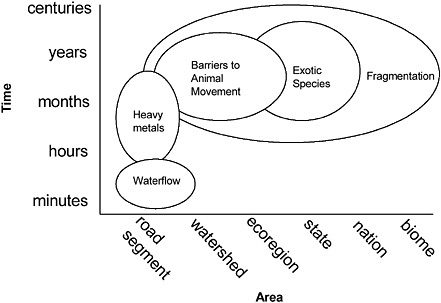
FIGURE 3-5 Spatial and temporal dimensions of ecological effects of roads.
Figure 3-5 reveals some of the spatial and temporal scales at which these effects most often occur. (See Figure 6-4 for another plot of spatial scales by the U.S. Department of Defense.) The figure suggests that ecological effects of roads can alter ecological processes over scales that range from minutes to centuries (time) and from meters to thousands of kilometers (in space). That is, ecological effects occur at scales that extend much longer in time and broader in space than those scales currently being used in assessment, planning or management. This issue is addressed in subsequent chapters. The figure also suggests that there is no “correct” scale for understanding how roads interact with ecosystems, but rather multiple, overlapping ranges of scales that correspond to specific ecological structures and processes under consideration.
Figure 3-5 also indicates that ecological processes occur at particular scale ranges, and hence assessments conducted at different scales could miss some ecological effects of roads. An example was discussed in a recent National Research Council report (NRC 2003). In that case, (unpaved) roads and the traffic on them affected the movements of caribou, especially of females. As a result, the caribou were more likely to encounter insects in years favorable to insects, and the interaction between roads and insects resulted in a subtle but measurable reduction in carbon productivity in those years. Local assessments did in fact fail to identify that effect; the assessment that was required extended over a far greater area than the direct road-effect zone for caribou. Other cases might include birds that migrate between wintering and breeding areas over many thousands of kilometers. A road that affects a resting area on a migration route might affect the entire population of the species, but conducting the assessment at a scale of hundreds of meters—or even at the scale of a county—could easily miss that population effect. A very similar example would be a road that crossed a stream that provided habitat for a migratory species of fish (see for example Box 3-1 and the entire discussion in the section “Roads as Barriers” in this chapter). An assessment at the scale of the barrier would most likely miss any population effect.
Cross-Scale Effects
This section indicates that ecosystems are scale variant; that is, the cross-scale biological structures and processes cannot be easily aggregated from one scale to another but are dependent on the scale of focus.
Scale variance is in contrast to many physical processes, such as waterflow dynamics and large-scale fire patterns that are scale invariant (Gunderson and Snyder 1994). Scale invariance means that structures and processes are self-similar as the scales change. A broad set of human-induced ecological changes, such as forest-pest outbreaks, algae blooms, salinization, and grassland to shrubland conversion, are all examples of scale-variant phenomena. The property of scale variance has great implications for the ability to assess and manage across a wide range of scales.
The major conceptual framework for understanding ecological cross-scale structure and dynamics is hierarchy theory. Ecologists (Allen and Starr 1982, O'Neill et al. 1986, Allen and Hoekstra 1992) built on the seminal work of Simon (1962) to develop a theoretical base that emphasizes a pattern of aggregations (hierarchical levels, or “holons”) nearly separable across scales. Hierarchical levels can be identified by a stronger set of interactions within a hierarchical level than among levels. These hierarchical levels correlate to scales, and each level has characteristic spatial and temporal domains; that is, each level (see leaf, tree, or forest level in Figure 1-9) has a characteristic turnover time and spatial domain. Hierarchical levels can be identified in ecological systems, but how do they interact?
The nature of ecological interactions at various scales has been the subject of much scientific debate. The focus has been on the interaction between processes and their associated structures that operate for long periods and over large spatial scales and processes that are faster and smaller. They also have been cast as “top-down” versus “bottom-up” control. An example of top-down control, sometimes called “hierarchical control,” is how altered soil types and microclimates associated with road rights-of-way determine the suite of plant and animal species that thrive. Because roads affect variables that change slowly, such as geological formations, soil composition, and topography, they often produce top-down effects. However, top-down and bottom-up effects often occur together and interact; this complex and dynamic set of ecological interactions has been called “panarchy” by Gunderson and Holling (2002). Examples of such interactions include disturbance dynamics, such as forest fires or forest-pest outbreaks (Gunderson and Holling 2002). Peterson (2002) demonstrated how a road network can disrupt spatial patterns and succession in southern U.S. forests. Other types of surprising ecological behavior appear to arise from such panarchical interactions.
Scales of the U.S. Road System and Ecological Effects
The physical structure of the U.S. road system covers few thousands of kilometers. The replacement time of roads is on the order of multiple decades, although this value can vary as a function of road type. The presence of roads across the landscape generates a variety of effects and interactions with ecological systems. The effects fall into three categories: (1) effects that are fixed in scale; that is, the domain of the change is fixed in space and time with sharp boundaries; (2) effects that generate or initiate cross-scale interactions; and (3) effects that constrain or limit cross-scale interactions. In this context, cross-scale interactions are those that traverse hierarchical levels. Each of the categories is described in the following paragraphs.
Many ecological effects of roads are spatially small. Most of the documented effects occur at the road-segment level, which includes the road, roadside, and a zone described as the effective road-impact zone (Forman et al. 2003). Generally, the zone ranges from a few meters to a few kilometers, depending upon the type of impact. Many effects are confined to the road and shoulder zone. Altered physical and chemical soil conditions from construction, management (fertilization or salt applications), or vehicle exhausts are found primarily in a narrow zone around roads. Some of the effects on biota, such as changes to populations (increased mortality) or community composition, occur primarily within this zone or within an area of a few hundred meters perpendicular to the road segment.
Some road effects cross scales of space and time. These effects include the abiotic and the biotic components of ecological systems. One example is the set of effects on hydrological systems, where sediments, nutrients, and heavy metals are introduced into riparian systems. Changes in inputs have created shifts in biogeochemical cycles, resulting in changes in species distribution and abundance. Another cross-scale effect occurs when roads serve as ecological corridors and increase dispersion. One example attributed to roads is the spread of exotic organisms, both plants, such as kudzu, and animals, such as armadillos (Taulman and Robbins 1996).
Many ecological effects of roads eventually influence structures and processes at longer and broader scales than first imagined. The spread of kudzu (or any other invasive organism) is a good example of an unintended, broader scale effect. Originally intended as an ornamental vegetation cover for stabilizing steep roadsides, the vine has spread
across much of the southeast, invading areas never imagined in original assessments. Similar arguments could be made for the nutrients, such as nitrogen from automobile exhausts, that have been observed to spread via atmospheric transport and accumulate in wetland and estuarine areas.
Cumulative effects have been described in two ways. One type of cumulative effect is the cross-scale effect described in the previous paragraph. These effects accumulate over time, space, or both. They can manifest as a cumulative change in an ecosystem structure or function, such as the increase in the amount of heavy metals in soils adjacent to roadways or the increase in species or populations, such as scavengers that eat organisms killed on the roadway. Spatial accretions occur as structures increase in distribution, such as the spread of kudzu. The other type of cumulative effect involves synergistic interaction among key structures or functions associated with a road. For example, caribou migration in Alaska was differentially affected by the combination of roads and oil pipelines (NRC 2003). The implications of the latter type of effect for assessment and environmental review are discussed in the next section on cumulative effects.
The final set of effects occurs when roads decrease the scale of ecological structures or processes. Often, they are barriers to landscape-scale phenomena. The restriction of wildlife migration or dispersion has long been recognized as a road effect. Fragmentation of populations due to roads is another such effect. Broad-scale disturbances, such as fire, that are critical to many types of ecosystems (prairies in the Midwest and pine forests in the eastern and western United States) are limited in spatial extent by roads that act as fire breaks. In some fire-adapted ecosystems where fire is heavily managed, rules of smoke management restrict when and how prescribed fires may be set because of the need to prevent visual hazards on roads caused by the smoke. Shifts in the timing and extent of fires can generate large-scale changes in ecosystems.
Cumulative Effects
Even though the awareness of the ecological effects of roads has grown steadily over the past few decades, only a small body of literature addresses cumulative effects associated with roads. In evaluating effects of oil and gas activity on Alaska’s North Slope, the NRC (2003) found that roads had a synergistic effect with pipelines and off-road vehicle
traffic. These factors accumulated to affect the habitat and behavior of animals, physically changed the environment next to the road, and increased access and social contacts among human communities. Caribou migration on and near roads, although they are gravel, is one example of a cumulative effect; roads with a parallel pipeline and those without a parallel pipeline had different migration patterns (Forman et al. 2003, NRC 2003). In addition, new roads often are associated with development of residential, commercial, and industrial activities. In some cases, the roads are built to support the new activities and, in other cases, the roads lead to the additional development.
INFORMATION GAPS
Historically, most studies of road effects have been carried out at the project level, with local studies focusing on specific transportation effects. Collaborative research among multiple government agencies has been lacking. States or provinces have had little coordinated formal data sharing to allow for information syntheses and analyses of effects at larger and perhaps more meaningful scales of evaluation. Defining the appropriate scale of research will depend on the ecological condition of interest. A watershed is one example of an appropriate spatial scale to assess water-quality issues. Transportation projects sponsored by the Federal Highway Administration (FHWA) and the Transportation Research Board (TRB) have stimulated and encouraged collaborative studies involving multiple state agencies with similar transportation problems that might be solved through large-scale ecological assessments and pooled-funding approaches (TPF 2004). Pooled-funding projects often focus on specific information needs defined by the collaborative state transportation agencies, which frequently represent diverse environments across the continent. Often, projects are not defined by appropriate scales or ecologically defined areas, such as specific eco-regions (for example, the northern Rocky Mountains).
Reports have called for nationwide assessments and national syntheses on how wildlife respond to highway barriers, for mapping habitat linkages and landscape connectivity at regional and national scales, and for means of standardizing roadkill data collection and analyses (Evink 2002). Two reports (Evink 2002, TRB 2002a) highlight the need for more systems-level studies addressing long-term issues regarding re-
search in surface transportation and natural systems, in addition to continuing studies focusing on short-term, project-specific, transportation needs.
General sources of research for transportation and ecology include FHWA, TRB, NCHRP, American Association of State Highway and Transportation Officials Center for Environmental Excellence, universities, and other agencies. As discussed above, these efforts have produced a substantial body of literature that documents the effects of roads and traffic on ecological conditions. However, almost no studies of ecological effects of roads have been conducted over long time periods (multiple decades) or at large spatial scales (spatial windows above tens of kilometers). Such studies should be a priority for research. Few, if any, studies directly address ecological effects of road density.
The appropriate scale for research is not always known beforehand, and the ecological impacts of roads can go undetected if an arbitrary scale is chosen for the research. Some multiscale studies have shown that roads affect ecological condition at much larger scales than previously thought. Therefore, multiscale studies can uncover the ecological effects of roads and the scale at which roads affect ecological condition.
Finally, much of the research on the ecological effects of roads can be found in reports that may not have been peer-reviewed or commercially published. For example, committee members are aware of studies documenting the effects of roads on sediment production in reports from the state departments of transportation, the Army Corps of Engineers, and the World Bank. Although included in some searchable databases, such as the Transportation Research Information Service, these reports are not included in scientific abstracting services (for example, Cambridge Abstracts) and, therefore, are generally less accessible to the academic research community. Future studies on the ecological impacts of roads should be published in the peer-reviewed venues.
SUMMARY
Roads influence ecological conditions across a range of organizational levels and scales. A large part of the scientific knowledge of ecological effects of roads has been based on short-term studies focused on narrowly defined objectives and has generally been related to specific construction or planning needs. As a result, more research is needed on ecological effects that occur over large areas or long periods. Ecological
conditions are not only affected by the construction of roads and road appurtenances (bridges and culverts) but also by the traffic on the roads and, at larger scales, by the increases in road density. The ecological effects of roads are much larger than the roads themselves, and the effects can extend far beyond ordinary planning domains. Few studies address the complex nature of the ecological effects of roads. For example, little is known about how roads impede access to foraging areas or key prey species, potentially resulting in cascading or other trophic effects. Studies assessing ecological effects are often based on small sampling periods and, therefore, do not adequately sample the range of variability in ecological systems. More research should be directed at identifying the appropriate scale at which roads affect ecological conditions.
Information on the resiliency of biodiversity components to road-related disturbances is needed to better understand the effects of roads on ecological systems. Research on the ecological effects of roads over long periods or at large spatial scales and research on the complex nature and impacts of roads within ecologically defined areas, such as watersheds, eco-regions, or species’ ranges, should be a priority. Research on the local scale should continue, however, because the context of many transportation decisions is at the local scale with direct application, and studies that address the context are likely to be the most frequently used and have the largest influence.


