
5
Improving Spent Fuel and High-Level Waste Transportation in the United States
The focus of this chapter is on the last two charges of the original statement of task for this study (see Sidebar 1.1):
-
What are likely to be the key principal technical and societal concerns for radioactive waste transportation in the future, especially over the next two decades?
-
What options are available to address these concerns, for example, options involving changes to planned transportation routes, modes, procedures, or other limitations/restrictions; or options for improving the communication of transportation risks to decision makers and the public?
The task statement makes a clear distinction between current and future transportation activities. This distinction was made in recognition of the fact that the federal government is planning to initiate a large-scale, multidecade program to transport much of the nation’s commercial spent nuclear fuel and Department of Energy (DOE) spent fuel and high-level radioactive waste to a federal repository. To this end, DOE plans to submit an application to the U.S. Nuclear Regulatory Commission (USNRC) for a license to construct and operate a repository at Yucca Mountain, Nevada (see Chapter 1). At the time the task statement was developed, the National Academies anticipated that there were likely to be specific technical and societal concerns associated with a transportation program to a federal repository. This is in fact the case as shown in this chapter.
The committee was not directed by the statement of task to undertake
a detailed programmatic review of the federal repository transportation program, nor did it attempt to do so. While many of the concerns raised in this chapter apply specifically to this federal transportation program, they could also apply to other transportation programs designed to move large quantities of spent fuel and(or) high-level waste within the United States to other federal repositories or to interim storage—for example, the Private Fuel Storage, LLC program. A detailed description of the transportation system for this federal repository is provided in Appendix C.
5.1 PRINCIPAL FINDINGS AND RECOMMENDATION
PRINCIPAL FINDING ON TRANSPORTATION SAFETY: The committee could identify no fundamental technical barriers to the safe1transport of spent nuclear fuel and high-level radioactive waste in the United States. Transport by highway (for small-quantity shipments) and by rail (for large-quantity shipments) is, from a technical viewpoint, a low-radiological-risk activity with manageable safety, health, and environmental consequences when conducted in strict adherence to existing regulations. However, there are a number of social and institutional challenges to the successful2initial implementation of large-quantity shipping programs that will require expeditious resolution as described in this report. Moreover, the challenges of sustained implementation should not be underestimated.
Spent fuel has been transported in the United States and several other countries for several decades; the committee knows of no releases of radioactive materials from package containments above regulatory limits.3 This safety record can be attributed to the robust design and construction of the packages used for transport and the rigorous regulatory oversight of transportation operations. Studies of package performance have demonstrated the effectiveness of package containment over a wide range of transport conditions, including most severe accident conditions (Chapter 2). Similarly, studies of the health and safety risks of spent fuel transportation (Chapter 3) indicate that such risks are generally well characterized and are
|
1 |
As noted in Chapter 1, safety refers to measures taken to protect spent fuel and high-level waste during transport operations from failure, damage, human error, and other inadvertent acts. |
|
2 |
The committee defines “success” in terms of the program’s ability, under existing statutes, regulations, agreements, and budgets, to transport spent fuel and high-level waste in a safe, secure, timely, and publicly acceptable manner. |
|
3 |
As described in Section 3.1, however, there are well-documented instances in which radioactive contamination on the external surfaces of packages have exceeded regulatory limits. The committee is aware of no documented instances in which this contamination has resulted in exposures of workers or the public above regulatory limits. |
generally low. However, the social risks and related institutional challenges may impinge on the successful implementation of large-quantity shipping programs. Transportation programs can take proactive steps to identify and manage these risks and challenges as discussed in Chapter 3 and elsewhere in this chapter.
The wording of this finding—“The committee could identify no fundamental technical barriers to the safe transport of spent fuel and high-level radioactive waste in the United States”—is carefully and narrowly constructed. This finding is focused on the technical aspects of transportation programs: package and conveyance design, fabrication, and maintenance and the conduct of transportation operations. It is predicated on the assumption that these technical tasks are being carried out with a high degree of care and in strict adherence to regulations. The finding also is based on an assessment of past and present transportation programs and would apply to future programs only to the extent that they continue to exercise appropriate care and adhere to applicable regulations. Continued vigilance by all parties involved in these transportation programs—planners, implementers, and regulators—will be required to ensure that transportation operations in the United States continue to be conducted in a safe manner, especially as large-quantity shipping programs to interim storage and a federal repository are ramped up over the next one to two decades. Some issues of particular concern are discussed in Section 5.2.
In Chapter 2, the committee notes concerns about the potential impacts of very long duration fires on package containment effectiveness. Specifically, the committee notes that there may be a very small number of credible accident conditions involving long-duration, fully engulfing fires that are potentially capable of damaging the seals on transportation packages if such fires are allowed to burn in an uncontrolled manner for long periods of time (many hours to days). The committee also recommends that additional investigations be carried out to obtain a bounding-level understanding of the risks and consequences of such accidents. In Chapter 3, the committee describes a relatively simple operational step that can be taken to mitigate these risks. Consequently, the committee judges that very long duration fires do not present a technical barrier to transportation safety.
PRINCIPAL FINDING ON TRANSPORTATION SECURITY: Malevolent acts against spent fuel and high-level waste shipments are a major technical and societal concern, especially following the September 11, 2001, terrorist attacks on the United States. The committee judges that some of its recommendations for improving transportation safety might also enhance transportation security. The Nuclear Regulatory Commission is undertaking a series of security studies, but the committee was unable to perform an
in-depth technical examination of transportation security because of information constraints.
RECOMMENDATION: An independent examination of the security of spent fuel and high-level waste transportation should be carried out prior to the commencement of large-quantity shipments to a federal repository or to interim storage. This examination should provide an integrated evaluation of the threat environment, the response of packages to credible malevolent acts, and operational security requirements for protecting spent fuel and high-level waste while in transport. This examination should be carried out by a technically knowledgeable group that is independent of the government and free from institutional and financial conflicts of interest. This group should be given full access to the necessary classified documents and Safeguards Information to carry out this task. The findings and recommendations from this examination should be made available to the public to the fullest extent possible.
Several participants at the committee’s information-gathering meetings highlighted security4 as an important current concern for transportation of spent fuel and high-level waste in the United States. The committee concurs with this view and judges that such concerns are likely to grow in the future, especially once shipments commence to centralized interim storage or a federal repository.
As reported in Section 1.2, the committee was unable to perform an examination of transportation security risks because of information restrictions: much of the information available on this topic is either classified or otherwise restricted. The committee concluded that it would be difficult to provide a substantive assessment of security issues because not all committee members have the necessary clearances to access this information.
Four members of the committee and one staff member with appropriate security clearances were given a classified briefing by USNRC staff on investigations under way within that agency to assess the security of transportation packages. Some of these members also have some knowledge of the extensive classified and unclassified literature on this topic. There appears to be sufficient information available to undertake a substantive review of spent fuel and high-level waste transportation security by a cleared group if it is given unrestricted access to the relevant literature and information. The cooperation of several federal agencies (USNRC, DOE, and the
|
4 |
As noted in Chapter 1, security refers to measures taken to protect spent fuel and high-level waste during handling and transport from sabotage, attacks, and theft. |
Department of Homeland Security [DHS]) would be required to obtain the information needed to carry out this study.
The committee’s recommendation that an examination of spent fuel and high-level waste transportation security be carried out independently of the government and by a group free of financial and institutional conflicts of interest is made in the spirit of improving its objectivity and public credibility. The committee’s recommendation that the findings and recommendations of this examination be presented in a format that can be shared with the public is made in the spirit of improving the quality of informed dialogue on this sensitive but important issue. The preparation of findings and recommendations that are suitable for public release will require that the group charged with this examination be given access to appropriate and timely classification guidance.
While the recommendations in this report are focused primarily on improving transportation safety, the committee judges that some of these might also improve transportation security. For example, the recommended operational changes to reduce the number of total shipments to a federal repository (Section 5.2.1), to limit shipment travel times and stops (Section 5.2.3), and to encourage transport of older (and radiologically cooler) spent fuel (Section 5.2.4) would help to reduce the opportunities for some types of malevolent acts or limit their potential consequences.
5.2 TRANSPORTATION OPERATIONS
The committee uses the term transportation operations to refer to the spectrum of activities associated with the actual shipments of spent fuel and high-level waste in the United States. The committee provides findings and recommendations on the following six operational issues in this section:
-
Mode (road vs. rail) for transporting spent fuel and high-level waste to a federal repository (Section 5.2.1)
-
Route selections for transport to a federal repository (Section 5.2.2)
-
Use of dedicated trains for transport to a federal repository (Section 5.2.3)
-
Acceptance order for commercial spent fuel transport to a federal repository (Section 5.2.4)
-
Emergency response planning and training (Section 5.2.5)
-
Information sharing and openness (Section 5.2.6)
Although these recommendations are focused on DOE’s program for transporting spent fuel and high-level waste, they also apply to any large-quantity shipping programs whether federally or privately operated. The committee intends that these recommendations would also apply to the
Private Fuel Storage program for transporting large quantities of commercial spent fuel to centralized interim storage in Utah, if that facility is constructed and opened.
5.2.1 Mode for Transporting Spent Fuel and High-Level Waste to a Federal Repository
FINDING: Transport of spent fuel and high-level waste by rail has clear safety, operational, and policy advantages over highway transport for large-quantity shipping programs. The committee strongly endorses DOE’s selection of the “mostly rail” option for the Yucca Mountain transportation program for the following reasons:
-
It reduces the total number of shipments to the federal repository by roughly a factor of five, which reduces the potential for routine radiological exposures, conventional traffic accidents, and severe accidents (Table 3.8).
-
Rail shipments have a greater physical separation from other vehicular traffic and reduced interactions with people along transportation routes, which also contributes to safety.
-
Operational logistics are simpler and more efficient.
-
There is a clear public preference for this option.
The committee does not endorse the development of an extended truck transportation program to ship spent fuel cross-country or within Nevada should DOE fail to complete construction of the Nevada rail spur or procure the necessary rail equipment by the time the federal repository is opened.
RECOMMENDATION: DOE should fully implement its mostly rail decision by completing construction of the Nevada rail spur, obtaining the needed rail packages and conveyances, and working with commercial spent fuel owners to ensure that facilities are available at plants to support this option. These steps should be completed before DOE commences the large-quantity shipment of spent fuel and high-level waste to a federal repository to avoid the need to procure infrastructure and construct facilities to support an extended truck transportation program. DOE should also examine the feasibility of further reducing its needs for cross-country truck shipments of spent fuel through the expanded use of intermodal transportation (i.e., combining heavy-haul truck, legal-weight truck, and barge) to allow the shipment of rail packages from plants that do not have direct rail access.
Mode selection is of special concern for the federal repository transpor-
tation program given its size and multidecade duration. DOE has decided that the mostly rail alternative defined in the final Yucca Mountain Environmental Impact Statement (EIS; DOE, 2002a) is its preferred alternative for transporting spent fuel and high-level waste to a federal repository (DOE, 2004d). In this EIS, DOE noted that it referred to rail as its preferred mode as early as 1998 in the draft request for proposals for contractor support for waste acceptance and transportation (DOE, 2002a, p. M-9). In identifying mostly rail as the preferred mode, DOE evidently does not mean that it prefers each of the detailed site-specific mode choices assumed in the final EIS (DOE, 2002a), but rather that it will seek to employ rail transportation to the extent practicable.
DOE summarized its evaluation of transportation mode options in the final EIS as follows (DOE, 2002a, p. 2-97–2-98):
DOE believes that the EIS provides the environmental impact information necessary to make certain broad transportation-related decisions, namely the choice of a national mode of transportation outside Nevada (mostly rail or mostly legal-weight truck), the choice among alternative transportation modes in Nevada (mostly rail, mostly legal-weight truck, or heavy-haul truck with use of an associated intermodal transfer station), and the choice among alternative rail corridors or heavy-haul truck routes with use of an associated intermodal transfer station in Nevada.
DOE has identified mostly rail as its preferred mode of transportation, both nationally and in Nevada. The environmental impacts for mostly rail are expected to be less overall than the impacts for mostly truck. For the mostly rail scenario, 9,600 rail and 1,100 truck shipments[5] are expected for shipping 70,000 MTHM [metric tons heavy metal] and, for the mostly truck scenario, 53,000 truck and 300 rail shipments are expected. The reduced number of shipments to move 70,000 MTHM and corresponding expected reduction in environmental impacts are the basis for preferring the mostly rail scenario.
The impacts that weighed most heavily in DOE’s mode preference are safety related, primarily involving fatalities from exposure to ionizing radiation and conventional traffic fatalities (see Table 3.8). DOE noted that
security considerations also support its rail preference. The analysis in the final EIS indicates that in the event of a terrorist attack on a transport package in transit, the likely consequences for a rail shipment would be less than for a legal-weight truck shipment, mainly because of the rail package’s thicker wall.6 The committee did not examine the risks of terrorist attacks on spent fuel packages and therefore cannot confirm this conclusion.
Table 3.8 shows that the mostly rail option results in about a factor of five decrease in the number of shipments to the federal repository (53,000 mostly truck shipments versus 9600 mostly rail shipments7) over a period of 24 years. The mostly rail option also results in almost a factor of four reduction in expected radiation-related fatalities during routine transport, from 15 fatalities to 4. The number of expected fatalities for the maximally reasonably foreseeable accident is higher for the rail option than for the truck option (five fatalities versus less than one fatality), but the likelihood of occurrence of such a rail accident is very small (less than 3 in 10 million chances of occurring per year).
The committee also sees clear operational advantages to the mostly rail option. Railroads in the United States are privately owned and operated, which allows for greater control over other activities on the rail line and a more coordinated regime for carrying out safety inspections. Rail transport can also result in reduced shipment travel times, especially if dedicated trains are used, which allows for the more efficient utilization of transport packages and conveyances.8
DOE’s mostly rail transportation strategy will require the development of a rail spur within Nevada, because the Yucca Mountain site is currently without direct rail access.9 The final EIS (DOE, 2002a) examined three alternative, but not mutually exclusive, provisions for transportation within Nevada: (1) a rail alternative that would entail constructing a rail spur from
a point on an existing rail line to the repository; (2) a heavy-haul truck alternative, in which full-size rail packages would be removed from railcars at a terminal constructed near an existing rail line and loaded onto heavy-haul trucks for transport to the repository; and (3) a legal-weight truck alternative involving the transport of spent fuel and high-level waste from commercial and DOE sites to the repository by truck. The final EIS stated that mostly rail is also the preferred mode within the State of Nevada (DOE, 2002a, p. S-2). DOE examined five possible rail corridors in Nevada in its final EIS (Figure 5.1) but it did not express a preference among them.
In December 2003, DOE published a notice10 announcing that one of the five corridors, the Caliente corridor, is its preferred corridor in which to construct a rail line, and that a second route, the Carlin corridor, is its secondary preference. The notice explains the significance of this designation as follows: “If the Department adopts the mostly rail mode in Nevada, DOE will issue a Record of Decision selecting a rail corridor…. If the Department selects a rail corridor, DOE will issue a Notice of Intent in the Federal Register to initiate the preparation of a rail alignment EIS … to consider alternative alignments within the selected corridor….” Concerning the basis for the selection, the notice states: “The Department’s preference for Caliente takes into account many factors, including its more remote location, the diminished likelihood of land use conflicts, concerns raised by Nevadans, and national security issues raised by the U.S. Air Force on the Caliente-Chalk Mountain corridor [another corridor analyzed in the EIS].” DOE further explained its preferred mode designation and selection of the corridor in a Record of Decision (ROD) published in April 2004 (DOE, 2004d) and at the same time announced (DOE, 2004e) that it was beginning an EIS covering the selection of the alignment within the Caliente corridor and construction and operation of the rail line, with a draft to be issued in early 2005.
The Caliente corridor begins at a point on the Union Pacific rail line near Caliente Nevada, 120 miles northeast of Yucca Mountain; runs west, passing north of the Nevada Test and Training Range, a military facility; and then turns south to Yucca Mountain (Figure 5.1). The final Yucca Mountain EIS estimates the cost of building the rail line in this 319-mile (513-kilometer) corridor to be $880 million in 2001 dollars and the construction time to be 46 months (DOE, 2002a).11 The three nonpreferred corridors are shorter and have lower estimated construction costs than the
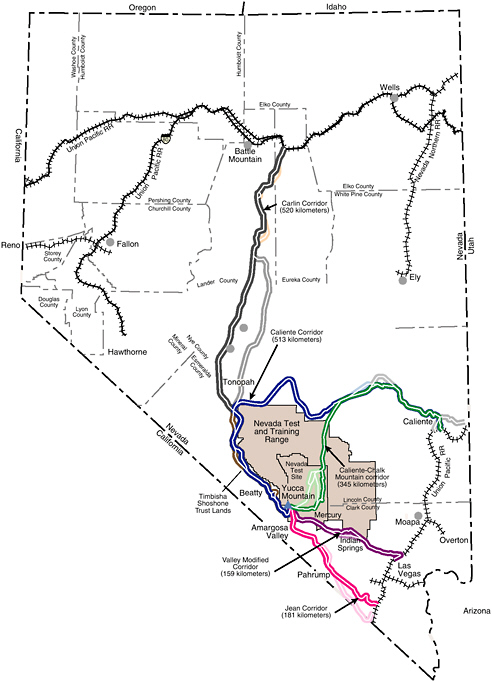
Caliente route, but would have routed shipments through or near Las Vegas or through the Nellis Range.
In its notice on beginning the alignment EIS (DOE, 2004e), DOE invited comments on whether it should allow private entities to ship commercial commodities on its rail line. The possibility of commercial use might make construction of the route more acceptable to some local interests. The choice of whether the line should be available for public use has implications for regulatory oversight of the line’s construction and operation. According to federal law, the Surface Transportation Board12 has jurisdiction over rate and service issues for common carrier rail lines (i.e., rail lines available for public use). The board must approve construction, and all state and local environmental or permitting requirements are preempted. Construction of a track for exclusive DOE use would not require board approval. Federal law would not preempt state and local regulation of construction of such a track.
DOE’s preferred rail transportation strategy will also require the execution of an ambitious intermodal transportation scheme to move transportation packages to railheads from commercial sites lacking direct rail connections. The final Yucca Mountain EIS notes that 24 commercial spent fuel storage sites have no rail service but do have facilities to load rail packages. Of these 24, 17 have access to waterways, and the other 7 can ship to railheads by heavy-haul truck. There are an additional 6 sites that lack crane capacity or other facilities to load rail packages (DOE, 2002a, p. J-15, Tables J-5 and J-26).
Of the 9600 train shipments in the final EIS mostly rail scenario, on the order of 2000 would be moved from sites without rail access to a railhead by heavy-haul truck or barge over distances of 6 to 256 kilometers (4 to 160 miles) (DOE, 2002a, Tables J-5, J-26, J-27). DOE’s illustrative heavy-haul truck (DOE, 2002a, Figure 2-29) is 67 meters (220 feet) long and weighs 90 metric tons (100 short tons) empty and around 180 metric tons (200 short tons) loaded. For comparison, a legal-weight truck carrying a spent fuel package would be about 18 meters (60 feet) in length and have a loaded weight of 36 metric tons (40 short tons).
The possibility of a large volume of barge shipments of spent nuclear fuel has been a point of controversy. State representatives reported to the committee that there is opposition in the upper Midwest to spent fuel barge shipments on the Great Lakes. The final EIS estimates were not based on an evaluation of whether barge would be preferred from the standpoint of cost or risk at any sites of origin. Until up-to-date and detailed local site access
assessments are available, it is not possible to say whether any significant volume of local barge transport will occur.
The final EIS assessments of spent fuel origin site (i.e., commercial nuclear plant sites and independent spent fuel storage installations) capabilities to ship by rail, either directly or with local truck or barge haul to a nearby railhead, were based on two DOE studies published in 1992: the Facility Interface Capabilities Assessment (FICA) (Viebrock et al., 1992) and Near Site Transportation Interface (NSTI) study (Viebrock and Mote, 1992). FICA was a study of the capability of each nuclear generator site to handle spent fuel packages of four dimensions: legal-weight truck package, an overweight truck package, and two rail or barge packages. The NSTI study examined on-site and near-site rail and barge infrastructure at 76 reactor sites.
It is likely that changes have occurred at some origin sites since these studies were completed. The NSTI warned that rail line abandonment was tending to curtail rail access to reactor sites. Development in areas surrounding origin sites since 1990 may also have restricted transportation options. On the other hand, facilities that have developed on-site dry spent fuel storage facilities (see Sidebar 1.4) may have improved their package-handling capabilities.
The State of Nevada has argued that DOE is underestimating the significance of origin site access and handling capabilities as constraints on transportation options and, as a consequence, DOE’s estimate of the total number of shipments to the repository in the mostly rail scenario (9600 rail and 1000 truck, as described above) is overly optimistic. A 1996 analysis for the Nevada Nuclear Waste Project Office concluded that substantial truck shipping would be likely, even after Nevada rail access was constructed.13
The Nevada analysis used data from the FICA and NSTI studies to construct scenarios for possible Yucca Mountain shipping campaigns, similar to the transportation scenarios in the final EIS for Yucca Mountain, but with more specificity about modes and routes and with explicit consideration of how each origin site would go about analyzing its mode choice. It concluded that with Nevada rail access to the repository in place, it would be reasonable to expect at least 17 utilities to ship by truck for the entire journey to the repository, rather than the 6 assumed in the final Yucca Mountain EIS analysis. Nevada officials stated to the committee that it is their expectation that, even with a Nevada rail link, at least 25 percent of
|
13 |
Planning Information Corporation, The Transportation of Spent Nuclear Fuel and High-Level Radioactive Waste: A Systematic Basis for Planning and Management at the National, Regional, and Community Levels, September 1996, http://www.state.nv.us/nucwaste/trans/1pichome.htm. |
all commercial spent fuel would travel by truck,14 implying 10 times the volume of truck movements in the final EIS mostly rail scenario.
Nuclear power industry participants dispute the state’s estimates.15 They note that shipment by truck would be unattractive to commercial operators: The cost and time required for loading and shipping a truck package would be comparable to that for a rail package that held seven times the quantity of spent fuel. Moreover, loading large amounts of spent fuel for truck transport would overburden origin site facilities. These representatives believe that origin sites will have a strong preference to ship by rail whenever possible.
The degree to which DOE must defer to the spent fuel owners’ preferences regarding transport mode is governed by the terms of the standard contracts (see Appendix C and Sidebar 5.1). The owners’ delivery commitment schedule, required under the contract, will specify a “proposed shipping mode” (truck, rail, or barge). DOE can disapprove a delivery commitment schedule, in which case “the parties shall promptly seek to negotiate mutually acceptable schedules” (Standard Contract, Article V.B). However, the contract also specifies that DOE must provide transport packages “suitable for use at the Purchaser’s [spent fuel owner’s] site” (Article IV.B), so DOE apparently could not require a utility to use a rail package if doing so would require site modifications.
DOE is now updating the FICA information regarding on-site capabilities to load and handle shipping packages of various dimensions that will be needed to order shipping packages; DOE plans to update the NSTI data as well.16 Until these updates are complete, estimates of the likely number of rail and truck shipments must be considered uncertain.
Other modal options that might conceivably play a useful role have not yet been evaluated fully. These include intermodal transportation employing conventional trucks; that is, placing spent fuel at the point of origin into standard truck packages, transporting the containers by truck to a nearby rail terminal, transferring them to railcars for transportation to the repository, and finally transferring them back to truck at a point near the repository if the repository does not have rail access. Trucks could be of the
|
SIDEBAR 5.1 Title 10, Part 961 of the Code of Federal Regulations, Standard Contract for Disposal of Spent Nuclear Fuel and/or High-Level Radioactive Waste, specifies the responsibilities of DOE and purchasers of its services (i.e., the owners of commercial spent fuel) for transportation of spent fuel to the federal repository:
The standard contract also establishes the priority order for DOE acceptance of commercial spent nuclear fuel as follows:
DOE and the purchaser are also responsible for exchanging the following information on an annual basis:
|
dimensions that are legal to operate on all main highways (80,000 pounds [approximately 36 metric tons] total weight, limiting the weight of the container and spent fuel to about 50,000 pounds [approximately 22 metric tons]) or that exceeded the legal weight but were within the range of weights that states routinely approve for operation after issuance of special permits (at least 120,000 pounds [approximately 53 metric tons] in most states, allowing packages that weigh 80,000 pounds [approximately 36 metric tons]).
Nevada representatives, among other observers, have expressed concern that in spite of DOE’s expressed rail preference, events may be directing it toward commencing shipments to the repository by truck, possibly with the intention of a later conversion to mostly rail transportation.17 The Western Governors’ Association (WGA) also acknowledged the prospect of interim transportation arrangements for initial shipments in a 2005 resolution (WGA, 2005, p. 1): “For many years, Western Governors have consistently urged the federal government to develop a comprehensive transportation plan, including the preparation of contingency plans for events such as the early shipment of waste.”
DOE has acknowledged that to deal with the uncertainties and complexities of the Yucca Mountain program, the goal of its transportation planning has been to maintain as much flexibility as possible, including the flexibility to ship by truck as well as by rail.18 DOE’s desire for flexibility conflicts with the states’ preference for early and specific decisions on transportation. The ROD on mode and corridor choices states DOE’s current position on the use of trucks (DOE, 2004d):
The Department would use truck transport where necessary, depending on certain factors such as the timing of the completion of the rail line proposed to be constructed in Nevada. This could include building an intermodal capability at a rail line in Nevada to take legal-weight truck casks from rail cars and transport them the rest of the way to the repository via highway, should the rail system be unavailable at the time of the opening of the repository. In addition, since some commercial utilities are not able to accommodate rail casks, they would ship by legal-weight truck to the repository.
The option of shipping in legal-weight truck packages on railcars to Nevada and then on truck to the repository was considered in the final Yucca Mountain EIS, but dismissed as impractical, at least as the primary
method of operation over the life of the transportation program (DOE, 2002a, pp. J-74–J-75). Nevada has raised questions about the safety of shipping truck packages by rail, especially with respect to the performance of these packages under extreme accident conditions. (Such shipments are allowed under current USNRC regulations.) The risk analyses described in Chapter 3 have not considered this transportation scenario, so additional analyses might be prudent if DOE were to ship truck packages by rail.19
The costs of initiating the transport of spent fuel and high-level waste to Yucca Mountain using trucks followed by the initiation of rail could be considerable, especially if an extended, high-throughput initial truck campaign was planned. It would require setting up essentially two independent transportation systems, each requiring funding for planning, scheduling, package and conveyance procurement, and package maintenance. It might also require the modification of package-receipt facilities at the federal repository to handle large numbers of smaller truck packages. If the costs of standing up and operating the truck program were high, DOE might not have the resources to complete the construction and procurement of rail infrastructure, and DOE and the nation could be saddled with a long-term truck transportation program.
Several challenging tasks remain before DOE will be in a position to fully implement the mostly rail option:
-
Completion of the Nevada rail EIS and construction of the Nevada rail line
-
Completion of the NSTI study on rail and barge infrastructure at commercial sites
-
Completion of the FICA surveys on infrastructure to load and handle shipping packages at commercial sites
-
Construction of any needed infrastructure improvements at commercial sites and along planned routes
-
Acquisition of a transport package and conveyance fleet to support the mode decision
Time and adequate resources will be required to complete these tasks in advance of the opening of a federal repository at Yucca Mountain. Failure to complete these tasks before the repository is opened may create pressure on DOE to initiate its transportation program using legal-weight or overweight trucks. Similarly, an early congressional directive to open an interim storage facility for commercial spent fuel at another government site could also result in large numbers of truck shipments. The extensive use of trucks
|
19 |
As noted in Section 2.2.3, the USNRC is examining the performance of a truck package in a rail tunnel fire. |
in the early stages of these programs could divert time and resources away from implementation of the mostly rail option, especially if DOE is forced to procure truck packages and conveyances. It could also affect the receiving facilities at the repository, which presumably will be designed primarily to handle rail packages. Finally, it could increase opposition to the transportation program and reduce trust and confidence in DOE’s transportation program and its managers, which could conflict with DOE’s stated desire (as noted previously) to maintain flexibility in mode selection.
Even under the mostly rail option envisioned in the final EIS for Yucca Mountain, there will still be 1100 truck shipments (DOE, 2002a). DOE has an opportunity to further reduce the truck shipments, especially cross-country shipments, through an expanded use of intermodal transport for those sites that lack direct rail access.
5.2.2 Route Selection for Transportation to a Federal Repository
FINDING: DOE has not made public a specific plan for selecting rail and highway routes for transporting spent fuel and high-level waste to a federal repository. DOE also has not determined the role of its program management contractors in selecting routes or specific plans for collaborating with affected states, tribes, and other parties.
RECOMMENDATION: DOE should identify and make public its suite of preferred highway and rail routes for transporting spent fuel and high-level waste to a federal repository as soon as practicable to support state, tribal, and local planning, especially for emergency responder preparedness. DOE should follow the practices of its foreign research reactor spent fuel transport program of involving states and tribes in these route selections to obtain access to their familiarity with accident rates, traffic and road conditions, and emergency responder preparedness within their jurisdictions. Involvement by states and tribes may improve the public acceptability of route selections and may reduce conflicts that can lead to program delays.
Implementation of DOE’s transportation program for Yucca Mountain will be a daunting task, given its size coupled with its lack of control over budgets and schedules (see Section 5.3), the large number of involved parties, the geographic extent of the transportation system (Figure 1.1), and the long time frames for transportation operations. This argues for simplification, and one of the best ways to simplify the program is to ship by rail whenever practicable. There will be many fewer shipments that need to be routed, and transport will take place over private rights of way. Railroads have established procedures in place for selecting routes for hazardous materials carriage. These procedures, however, do not take into account all
of the concerns of the states and tribes (e.g., avoiding large population centers and being sensitive to environmental justice concerns). The DOE program for transporting foreign research reactor spent fuel (Chapter 4) is a good model for involving states and tribes in rail routing decisions.
Once DOE selects the suite of routes20 it will use for its shipments, it may be required to undertake selected route infrastructure improvements before any shipments can be made, as described in Appendix C. It also must decide on safety and security measures, procedures for notification of jurisdictions through which shipments pass, arrangements for state inspections of shipments, communications and tracking, and handling contingencies en route. Most of these operations would be carried out by contractors. DOE has proposed and withdrawn two proposals for the organization of contractor support for management of transportation operations.
Comments submitted on the final Yucca Mountain EIS revealed frustration over DOE’s lack of specificity on route designations. DOE has asserted that it was not required in the EIS to specify routes for each site or the decision process for route selection. The EIS does, however, state DOE’s conception of route selection as follows (DOE, 2002a, p. J-23):
Approximately 4 years before shipments to the proposed repository begin, the Office of Civilian Radioactive Waste Management plans to identify the preliminary routes that DOE anticipates using in state and tribal jurisdictions so it can notify governors and tribal leaders of their eligibility for assistance under the provisions of Section 180(c) of NWPA.
Section 180(c) refers to assistance for emergency responder training. This issue is discussed in more detail in Section 5.2.5 of this chapter.21
DOE summarizes its rail routing practices for spent fuel as follows (DOE, 2002a, p. M-6):
Except for requirements contained in 10 CFR 73.37, there are no Federal regulations pertaining to rail routes for shipment of spent nuclear fuel or high-level radioactive waste. The shipper and railroad companies (carriers) determine rail routes based on best available route and track conditions, schedule efficiency, and cost effectiveness.
The regulation cited, 10 CFR 73.37, provides the USNRC’s require-
|
20 |
The NWPA requirements for emergency responder training requires that DOE select routes well in advance of shipments (see Section 5.2.5). For security reasons, DOE will not provide advanced public notice of shipments along these routes, only advanced notification to state governors and law enforcement officials. See Appendix C, Section C.1.4, for more details. |
|
21 |
Emergency responder preparedness has been used as a route selection criterion in the research reactor transport program as described in Chapter 4. DOE could in principle use emergency responder preparedness as a route selection criterion in the federal repository program, but to the committee’s knowledge has not announced any plans to do so. |
ments for physical protection of spent nuclear fuel in transit (see Appendix C). Specifically, it gives the Commission the authority to preapprove proposed routes for spent fuel shipments based on security considerations. However, DOE is not subject to these regulations because it accepts ownership of commercial spent fuel at the plant gate.
The final Yucca Mountain EIS describes the rail route evaluation process envisioned as follows (DOE, 2002a, p. M-10):
The Regional Servicing Contractor would identify rail transportation routes in conjunction with the appropriate rail carriers. Because railroad companies determine the routing of shipments, the Contractor would rely on the rail carrier to provide primary and secondary route recommendations consistent with safe railroad operating practices. Guidelines would include … use of key routes as described in [the Association of American Railroad’s] Recommended Railroad Operating Practices for Transportation of Hazardous Materials….
Although DOE has not proceeded with the Regional Servicing Contractor arrangement, this statement presumably reflects its general plan for rail route selection through consultation with railroads. It is not clear from this statement whether DOE would in any circumstances impose route choices on rail carriers, for example, for security reasons or to avoid large population centers. No specific mention is made of consultation with the states on rail routes. Some states are seeking greater specificity and control of the process for reaching decisions on rail routing or on ensuring that the appropriate notification procedures and emergency response capabilities are in place as noted later in this section.
In 1996, DOE stated that it did not intend to produce general routing criteria for spent fuel and high-level waste shipments and would instead rely on standard railroad practice to determine rail routes (WIEB, 1995, p. 44). Such practices do not normally provide for much state and tribal consultation. On the other hand, DOE has shown a willingness to consult with states and tribes in planning for and carrying out spent fuel shipments. As described in some detail in Chapter 4, DOE consulted with South Carolina in developing rail routes for foreign research reactor spent fuel shipments to Savannah River. DOE even agreed to identify an alternate rail route at the state’s request.
DOE has also imposed routing restrictions on carriers, including requirements to minimize time, distance, and number of interchanges; to use the best track; to avoid population centers; and to schedule movements through cities outside peak commuter hours for other spent fuel transportation campaigns. Examples of such special provisions include the rail shipping arrangements for transport of core debris from Three Mile Island in 1986 to 1990 and several series of rail shipments from commercial nuclear plants to temporary storage (WIEB, 1991, pp. 90–92).
For highway routing, the Regional Servicing Contractor would first select a route consistent with U.S. Department of Transportation (DOT) regulations and with consideration of infrastructure adequacy along routes. Then (DOE, 2002a, p. M-9),
… the Contractor would submit the route plan to DOE for approval. DOE would interact with states and Native American governments concerning these selections…. With DOE approval, the Contractor would then submit the route plans to the Nuclear Regulatory Commission….
Although the Regional Contractor plan is no longer current, the statement provides an indication of DOE’s intentions on how route selections would be made.
In past DOE highway routing debates, the states have tended to urge DOE in the direction of taking an active role in route designation and of reducing the discretion of carriers to choose routes. DOE worked closely with affected states to select highway routes for foreign research reactor shipments from the Savannah River Site to Idaho National Laboratory (see Chapter 4). In preparing for transportation of transuranic waste22 to the Waste Isolation Pilot Plant (WIPP), an underground repository in New Mexico, DOE specified a set of routes in consultation with the states, and these routes were incorporated in state alternate preferred route designations. DOE then specified routes in its contracts with carriers (see TEC, 2002). The WGA (2005) cites the WIPP transportation program as the model DOE should follow in planning for the Yucca Mountain transportation program.
The WGA has repeatedly expressed its concern that DOE is not on track to produce a transportation plan that is sound, timely, and built on adequate consultation with the states. It recommended that DOE undertake a series of actions that include the following23 (see also WGA, 2005):
-
Develop criteria and a methodology for evaluating and selecting routes and modes;
-
Propose a set of shipping routes to the affected states and tribes for review and comment;
-
Through this consultation with states and tribes, identify a set of primary and secondary routes for each site of origin to each destination; and
-
Require the use of these routes through contract provisions with the private parties engaged in transportation.
While the WIPP transportation program in some ways offers useful lessons for how DOE could collaborate with states, there are some important differences between transuranic waste and spent fuel or high-level waste that limit the relevance of this model. The cooperative effort to develop the WIPP transportation program was led by western governors who had a strong interest in moving waste out of their states to WIPP. Moreover, the development of the WIPP repository was supported by its host state (New Mexico). In contrast, for the Yucca Mountain program, some important transit states and the repository state (Nevada) have no spent fuel or high-level waste to be shipped. Additionally, the requirements for transport to the Nevada repository are more demanding, given the greater hazards of the materials being shipped. Consequently, security arrangements and emergency responder preparation will require more resources and pose more difficult logistical problems.
The WIPP transportation program is not a useful model for the transportation operations addressed by this study in other ways. Transportation to WIPP has so far been entirely by truck, whereas transportation to Yucca Mountain (and to Private Fuel Storage, LLC) is planned to be mostly by rail. The schedule for opening a WIPP repository was aggressive and did not allow much time for transportation planning. There were unanticipated delays in opening the repository, however, which allowed enough time for the transportation program to develop. While the outcome was good, the process for getting there was not. Recent delays in the aggressive schedule for opening the federal repository at Yucca Mountain program might also provide additional time for transportation planning and route selection.
Past DOE experience in routing spent fuel and transuranic waste shipments has demonstrated the benefits of state and tribal consultations. Such consultations provide DOE with information on accident rates for specific routes, road conditions that could affect shipments, and emergency responder preparedness—information that DOE could not easily obtain on its own. The selection of routes will ultimately require that DOE, in consultation with states, balance these factors and its own programmatic and security considerations in a transparent and supportable fashion.
5.2.3 Use of Dedicated Trains for Transport to a Federal Repository
FINDING: Studies carried out to date on transporting spent fuel by dedicated versus general trains have failed to show a clear radiological risk-based advantage for either option. However, the committee finds that there are clear operational, safety, security, communications, planning, programmatic, and public preference advantages that favor dedicated trains. The committee strongly endorses DOE’s decision to transport spent fuel and high-level waste to a federal repository using dedicated trains.
RECOMMENDATION: DOE should fully implement its dedicated train decision before commencing the large-quantity shipment of spent fuel and high-level waste to a federal repository to avoid the need for a stopgap shipping program using general trains.
In July 2005, DOE’s Office of Civilian Radioactive Waste Management (OCRWM) announced that DOE was adopting the following policy regarding rail operating practices for shipments to Yucca Mountain: “The Department of Energy will use dedicated train service … for its usual rail transport of spent nuclear fuel … and high-level radioactive waste … to the Yucca Mountain Repository site in Nevada when the repository is operational” (DOE 2005b).
This declaration follows a long-running controversy in the United States about whether rail shipments of spent fuel and high-level waste should be carried out using
-
Dedicated trains, which would carry only spent fuel and high-level waste; or
-
General trains, which could carry other freight in addition to spent fuel and high-level waste, just as other routine hazardous materials shipments are handled. Certain additional practices and precautions would still be applied to such trains.24
During the 1960s, some railroads in the eastern United States announced that they would refuse to handle spent nuclear fuel and some other radioactive waste shipments under the rates and terms of common carriage (i.e., by general train service). The railroads announced that they would require special contracts for these shipments. Such contracts typically include a hold-harmless clause covering the railroad, an obligation on the part of the shipper to guarantee connecting line service, and a stipulation that the service would be made by dedicated trains (Klassen, 1982, pp. 1–3).
The Energy Research and Development Administration (a DOE predecessor agency), the USNRC, and commercial nuclear utilities challenged the legality of the railroads’ tariff actions in 1975. These plaintiffs argued that dedicated trains could not be shown to significantly improve safety and that their use added to costs. The Interstate Commerce Commission ruled against
the railroads, and the railroads appealed the case to the Supreme Court, which upheld the ruling in 1980. The railroads were thus required to publish tariffs for transporting spent fuel and to cancel mandatory special train tariffs (Klassen, 1982, p. 2-3).
Although some spent fuel shipments have moved in general service trains in recent years,25 dedicated trains appear to be standard practice in the United States.26 DOE and the railroads have agreements in place on a set of safety and security protocols and special operating restrictions for spent fuel movements. These cover the make-up of trains as well as security provisions and operating restrictions and controls. There appears to be strong industry support for the use of dedicated trains.27 The Association of American Railroads has adopted a policy recommending shipment of spent fuel by dedicated train.28 Private Fuel Storage, LLC, a consortium of commercial nuclear utilities that plans to build an interim storage facility for spent fuel in Utah (see Chapter 1), plans to ship spent fuel primarily using dedicated trains. A representative from the Nuclear Energy Institute, the nuclear energy industry’s policy and lobbying arm, told the committee at one of its information-gathering meetings that the industry also prefers dedicated trains for shipping its spent fuel to Yucca Mountain.
DOE’s final EIS for Yucca Mountain (DOE, 2002a) did not provide a detailed analysis of the benefits of dedicated trains to support a decision on the issue. The EIS noted (p. J-76) that “DOE has not determined the commercial arrangements it would request from railroads for shipment of spent nuclear fuel and high-level radioactive waste.” It acknowledged the policy of the railroad industry favoring dedicated trains but also cited a 1998 study by the Research and Special Programs Administration29 (RSPA) of the U.S. Department of Transportation (DOT, 1998), which concluded that shipments by dedicated train would result in a greater number of nonradiological accident fatalities than shipments in general trains because there would be more trains on the rails.
The Government Accountability Office (GAO) examined the question of the relative safety of dedicated and general trains for the transport of spent fuel in a July 2003 report (GAO, 2003). The report identifies three arguments that are commonly made by proponents of dedicated trains that the use of such trains lowers transportation risks. First, dedicated trains have a shorter travel time from origin to destination than a railcar in general service, thus reducing exposure to terrorist attacks. GAO cites a rail industry estimate that a spent fuel package would travel from the East Coast to Nevada in 3 to 4 days by dedicated train versus 8 to 10 days by general train. In the industry estimate, the extra time for the general rail movements would be spent primarily in rail yards. Second, the use of dedicated trains would ensure that cars carrying spent fuel packages are not mixed with cars carrying flammable materials. This reduces the consequences of potential accidents involving fires and explosions. Third, because cars carrying spent fuel packages are much heavier than typical freight cars (470,000 pounds [210,000 kilograms] versus about 200,000 pounds [90,000 kilograms], according to GAO), mixing spent fuel cars with ordinary cars in a train creates stability problems and increases the likelihood of train derailments. GAO concluded (p. 23) that “it is not clear that the advantages of dedicated trains outweigh the additional costs”; however, it did not cite cost data.
The July 2005 dedicated train policy statement identifies the following grounds for DOE’s decision (DOE, 2005b):
-
“[R]adiological risk resulting from transport [via dedicated train] without incident may be lower due to decreased time in transit.”
-
Dedicated trains have “potential advantages” for security, although “DOE shipments have been and will continue to be made securely using both [dedicated train service] and general freight service.”
-
The “primary benefit” of dedicated trains would be “significant cost savings over the lifetime of the Yucca Mountain project” because any higher costs of dedicated train operations would be offset by savings from shorter transit and turnaround times, which allow operations with fewer packages and railcars.
Although not cited in DOE’s policy statement, a study by the Federal Railroad Administration (FRA) on use of dedicated trains provides support for DOE’s arguments. The study was prepared in response to a congressional directive and transmitted by the Secretary of Transportation to Congress in September 2005 (FRA, 2005).30 The study concluded that
dedicated train service would result in lower risk to the general public than general train service from radiological exposure in incident-free operations; the probability that a package carried in a dedicated train will be involved in an accident is lower than for a regular service train; a package on a dedicated train has lower risk of being exposed to an engulfing fire in the event of an accident; and radiological exposure in the event of a severe accident involving a dedicated train would be less, compared with a comparable accident involving a regular train, because wreckage could be cleared more quickly. The study also concluded that “regardless of the type of train, the potential exposures are essentially benign when compared to a lifetime of normal background radiation exposure …” (FRA, 2005, p. 3).
FRA acknowledges that its study did not compare the risks, for dedicated trains and regular service, of injuries and fatalities that result from train accidents and are unrelated to radiation exposure. As noted above, the 1998 RSPA study (DOT, 1998) concluded that the use of dedicated trains would lead to greater losses of this kind, compared with regular train service, because the use of dedicated trains would increase the total nationwide annual train-miles of traffic. However, the FRA report argues that the disadvantage of dedicated trains in this respect would be less than proportional to the increase in train-miles because superior equipment and operational requirements would be placed on dedicated trains and because the frequency of some operations that carry higher risks, such as switching at the origin point of the shipment, would be the same whether dedicated trains or regular service were employed.
Although DOE’s policy statement on dedicated trains, along with the railroads’ professed unwillingness to handle spent nuclear fuel in regular service, would appear to settle the question, critics of DOE’s Yucca mountain repository plan have noted that the wording of the policy statement is vague on some points. In particular, the meaning of the term “usual rail transport” and the significance of the statement that “DOE shipments have been and will continue to be made securely using [dedicated trains] and general freight service” have been questioned.31
In summary, the committee’s recommendation that DOE implement its dedicated train decision before commencing the large-quantity shipment of spent fuel and high-level waste to Yucca Mountain is based on the following operational, safety, security, communications, planning, and programmatic advantages:
-
Increased efficiency of operations. The use of dedicated trains would allow greater control over schedules and routes, reduce travel times
|
31 |
Senator Harry Reid and Senator John Ensign, letter to Hon. Samuel W. Bodman, Secretary, Department of Energy, August 17, 2005, http://reid.senate.gov/record2.cfm?id=244114. |
-
to the repository, and simplify tracking. This could increase throughputs and reduce costs for equipment (conveyances and packages) and escort personnel, and allow more flexibility in the planning and deployment of those escorts.
-
Increased safety of operations. Reduced travel times would help limit worker32 and public radiation exposures during incident-free transport (see Chapter 3). If desired and feasible, such trains also could be routed to avoid major population centers. The separation of spent fuel and high-level waste shipments from other freight would reduce the potential for accidents involving very long duration fires (see Chapters 2 and 3). Dedicated trains can be designed and operated to higher safety standards than are currently required for general trains, further reducing the potential for accidents, especially train derailments.
-
Increased security of operations. Security concerns have become more central to this issue since the September 11, 2001, attacks on the United States. These concerns, especially with respect to layovers in rail yards and routing through large population centers, have not been fully addressed by previous studies. The use of dedicated trains would help reduce transit times and therefore reduce opportunities for malevolent acts, especially in rail yards. Additional security escorts also could be added more easily to dedicated trains when needed.
-
Reduced program risks. An accident involving spent fuel or high-level waste transport packages could cause substantial program delays, particularly if it involves fatalities and/or results in damage to the transportation package, even in the absence of any radiation releases. The use of dedicated trains would allow DOE greater control over avoidance of situations (e.g., avoid tunnels, switching yards, and peak traffic conditions on heavily traveled corridors; minimize stops in yards and on sidings) that could contribute to such accidents.
5.2.4 Acceptance Order for Commercial Spent Fuel Transport to a Federal Repository
FINDING: The order for accepting commercial spent fuel that is mandated by the Nuclear Waste Policy Act (NWPA) was not designed with the transportation program in mind. In fact, the acceptance order prescribed by the NWPA could require DOE to initiate its transportation program with long cross-country movements of younger (i.e., radiologically and thermally hotter) spent fuel from multiple commercial sites. There are clear transportation operations and safety advantages to be gained from shipping older
|
32 |
As shown in Table 3.8, some estimated worker exposures for the Yucca Mountain transportation program are at DOE administrative limits; however, public doses are much lower. |
(i.e., radiologically and thermally cooler) spent fuel first and for initiating the transportation program with relatively short, logistically simple movements to gain experience and build operator and public confidence.
RECOMMENDATION: DOE should negotiate with commercial spent fuel owners to ship older fuel first to a federal repository or federal interim storage, except in cases (if any) where spent fuel storage risks at specific plants dictate the need for more immediate shipments of younger fuel. Should these negotiations prove to be ineffective, Congress should consider legislative remedies. Within the context of its current contracts with commercial spent fuel owners, DOE should initiate transport through a pilot program involving relatively short, logistically simple movements of older fuel from closed reactors to demonstrate the ability to carry out its responsibilities in a safe and operationally effective manner. DOE should use the lessons learned from this pilot activity to initiate its full-scale transportation program from operating reactors.
The NWPA, as amended, establishes the order in which DOE must accept spent fuel from commercial reactors for transport to Yucca Mountain (Appendix C and Sidebar 5.2). The NWPA specifies that DOE must accept spent fuel based on the amount and order in which it was discharged from the owner’s reactors. Each time a nuclear plant discharges fuel from its reactor, its owner receives an allocation in the “acceptance queue” to ship an equivalent amount of spent fuel to the federal repository. DOE will accept commercial spent fuel for shipment to the federal repository starting at the beginning of the queue and will work its way through the queue during the planned 24-year life of the transportation program. The NWPA allows owners to ship any spent fuel from any of their sites for each of their allocations in the acceptance queue.
There are two exceptions to this requirement (see Sidebar 5.2):
-
DOE may accord priority for acceptance of spent nuclear fuel from reactors that have been permanently shut down.
-
The owners of spent fuel can exchange positions in the acceptance queue, but only with the approval of DOE.
The latest report on acceptance priority ranking and annual capacity, which DOE is required to issue annually under its standard contract with commercial spent fuel owners (see Sidebar 5.1), was issued in July 2004 (DOE, 2004f). This report provides DOE’s current plans for accepting commercial spent fuel for transport to Yucca Mountain. This ranking shows that DOE will nominally be required to accept 400 MTHM of commercial spent fuel during the first year of repository operations (estimated in the
|
SIDEBAR 5.2 The NWPA establishes the order in which DOE must accept commercial spent fuel from its owners for disposal at a federal repository. The NWPA specifies that DOE must accept spent fuel based on the amount and order in which it was discharged from the owner’s reactors. Each time a nuclear plant discharges fuel from its reactor, its owner receives an allocation in the “acceptance queue” to ship an equivalent amount of spent fuel to the federal repository. DOE will accept commercial spent fuel for shipment to the federal repository starting at the beginning of the queue and will work its way through the queue during the planned 24-year life of the transportation program. There are two exceptions to this rule, which are discussed in Sidebar 5.1. The main advantage of this acceptance system is that it provides an equitable order for acceptance of spent fuel. Owners who have allocations near the beginning of the acceptance queue made earlier payments into the Nuclear Waste Fund and have had to bear the costs for on-site spent fuel storage for a longer period of time. These owners are able to ship their spent fuel to the federal repository first, relieving them of further on-site storage costs. Owners who have more recent allocations in the acceptance queue will be required to maintain on-site spent fuel storage until they move to the front of the queue. This acceptance system has two significant disadvantages, however. First, it will require that DOE make multiple shipments from multiple reactor sites during its planned 24-year transportation program. Second, the NWPA allows owners to ship any spent fuel from any of their sites for each of their allocations in the acceptance queue. Owners are likely to have a strong preference to ship spent fuel that is stored in spent fuel pools to free up space and reduce the need for (and expense of) future movements of spent fuel into dry casks. Some of the fuel offered for shipment could be recently discharged and radiologically active. Both of these factors could greatly complicate planning and execution of the transportation program and increase overall transportation risks. |
report to be 2010) in 16 allocations from spent fuel owners (Table 5.1). The acceptance rate ramps up to 3000 MTHM in 39 allocations by 2014.
Some of the allocations (see column 4 of Table 5.1) are not large enough to fill even a single transportation package. Unless multiple allocations are combined,33 there could be a large number of partially filled packages transported to Yucca Mountain. This could greatly increase the number of total shipments to the repository. For rail shipments, DOE may have to marshal packages from several reactors in rail yards to reduce the total number of trips to Yucca Mountain.
|
33 |
In some cases, a single owner may hold several allocations in a given year. In other cases, allocations can be traded or purchased, subject to DOE review and approval. See Sidebar 5.1. |
TABLE 5.1 Spent Fuel Annual Capacity and Acceptance Priority Ranking
|
Year of Repository Operationa |
Quantity of Spent Fuel to Be Shipped to Repository (MTHM) |
Number of Allocations in Acceptance Queueb |
Range of Allocation Quantitiesc (MTHM) |
|
1 |
400 |
16 |
0.1–145 |
|
2 |
600 |
23 |
0.1–72 |
|
3 |
1200 |
26 |
0.1–251 |
|
4 |
2000 |
37 |
0.1–467 |
|
5 |
3000 |
39 |
0.1–488 |
|
6 |
3000 |
39 |
0.1–452 |
|
7 |
3000 |
43 |
0.1–420 |
|
8 |
3000 |
47 |
0.1–375 |
|
9 |
3000 |
50 |
0.1–524 |
|
10 |
3000 |
46 |
0.1–444 |
|
aAfter Yucca Mountain is opened. bNumber of allocations made to owners of commercial spent fuel. In some cases, owners may have multiple allocations. cMinimum and maximum allocated quantities of spent fuel for the number of allocations listed in column 3. SOURCE: DOE (2004f). |
|||
The term “nominal” is used to describe these acceptances because, as described previously, the owners of the spent fuel will ultimately decide which fuel DOE will be required to transport. Some owners may have multiple allocations in a given year and may own multiple reactors. Under the standard contract, they have the right to designate fuel from any of their reactors for transport up to the combined quantity limits of their annual allocations. Owners are not required to inform DOE of which sites will ship spent fuel until about 5 years prior to the transport date and also are not required to finalize these plans until 12 months in advance of the shipping date. This makes DOE’s planning assumptions especially tenuous.
The order for acceptance of spent fuel from commercial owners prescribed by the standard contract could require DOE to initiate its transportation program with movements of spent fuel from multiple, geographically dispersed sites. It gives DOE limited control over the age and radiological content of the fuel that is offered for transport.34 It provides little opportu-
nity for optimizing the transportation program to reduce the total number of shipments or the need for maintaining large numbers of transportation routes and for emergency responder training.
The order in which fuel is shipped to Yucca Mountain has important implications for safety, operational efficiency, and possibly the security of a Yucca Mountain transportation program. For reasons described in more detail below, it would be preferable from a safety standpoint to ship older spent fuel first to the federal repository. Under the current standard contract system, owners of commercial spent fuel are not required to ship older fuel first, however. The oldest fuel at many operating commercial reactors now resides in dry casks.35 These casks were purchased and loaded by the owners, and some of these casks are licensed only for storage. They represent significant sunk costs,36 which continue to grow as more plants resort to dry storage. Owners are likely to have a strong preference to give DOE their more recently discharged spent fuel, which is stored in pools at nuclear plant sites. This would free up pool space and reduce the need for (and the expense of) future movements of spent fuel into dry casks.37
Under current USNRC regulations, owners are required to store spent fuel in their pools (see Sidebar 1.4) for one year38 before it can be transported. Owners could in principle designate one-year-old fuel for transport to Yucca Mountain. This could necessitate the purchase by DOE of transport packages with heavy shielding and active cooling systems39 to maintain adequate cooling and reduce external radiation doses to workers and
|
35 |
Current industry practice is to store only spent fuel that is older than five years in dry casks. See Sidebar 1.4. |
|
36 |
Each dry cask can cost $1 million or more to purchase and load, and the storage facilities can cost several tens of millions of dollars to license, construct, and protect. The federal government may be legally liable for those costs that occurred as the result of the failure of DOE to begin accepting spent fuel from commercial nuclear power plants in 1998. |
|
37 |
In December 2005, legislation was introduced into Congress that would require plant operators to move spent fuel from pools to dry casks at their sites within six years of its discharge from the reactor. The legislation would also require DOE to take title to the spent fuel once it is moved to dry casks and full responsibility for maintaining dry storage. The intent of this legislation is to eliminate the short-term need for a federal repository. However, if the legislation were to become law and a federal repository were to be opened, DOE could presumably ship spent fuel in whatever order desired because it would already have title to that fuel. |
|
38 |
This requirement dates to the 1970s when industry planned to ship spent fuel for reprocessing within 90–120 days of its discharge from the reactor. This would have required heavily shielded packages with active cooling systems. The requirement was established to provide enough time for iodine-131 (which has an 8-day half-life) in the fuel to decay. |
|
39 |
These packages have pumps and heat exchangers to remove decay heat from the spent fuel. Active cooling is generally required for spent fuel that is less than about three years old. Currently, there are no certified spent fuel transportation packages with active cooling systems in the United States. |
the public. Designation of any fuel younger than five years old might require DOE to seek additional transport package approvals from the USNRC and to ship only partially filled packages to meet external dose requirements.
A recent Government Accountability Office study for Congress explores some of these issues (GAO, 2003). The GAO concluded that transport risks would be reduced by moving larger quantities of spent fuel per shipment and by deliberate selection of the order for picking up spent fuel from commercial nuclear plant sites. The report argues that reducing the number of shipments reduces risks because moving spent fuel in fewer, larger shipments would present fewer chances for accidents and fewer targets for terrorists. It would also simplify the problems of tracking and protecting shipments, and it would reduce routine exposure of workers to radiation. GAO found that the standard contracts between DOE and industry constrain DOE’s ability to minimize the number of shipments or to control the order in which stocks of spent fuel are picked up.
GAO analyzed DOE’s current plans for acceptance of spent fuel from commercial nuclear plant sites. It estimated that the 12 utilities with the largest quantities of spent fuel would make 576 shipments, with each shipment consisting of up to three rail packages, based on this current plan. GAO determined that if each owner consolidated its fuel into shipments of five full rail packages, total shipments would be reduced by roughly half to 287 (GAO, 2003, pp. 18–19).
The GAO study also found that properly selecting the order of shipment of spent fuel could reduce transportation and storage risks in three ways:
-
Early shipments of fuel from shut-down reactors would reduce the number of spent fuel storage sites. GAO found that nine spent fuel storage sites are not accumulating any additional fuel and could be cleared of their stocks, eliminating them as potential terrorist targets.
-
Early shipment of fuel from storage pools would reduce the likelihood of a pool fire, which could result from sustained loss of coolant from a spent fuel storage pool (see NRC, 2005d).
-
Shipping the older fuel first would reduce radiological transportation risks.
Selecting the shipment schedule that minimized risk would require an analysis to find the right balance between the advantages of moving older fuel first and of removing fuel from pool storage. However, GAO observed that under the terms of the standard contract, DOE cannot choose the order and locations of shipments according to age or form of present storage of the spent fuel. Contracts guarantee utilities positions in the queue for
shipping specified quantities of spent fuel, and each utility can decide which fuel it wishes to ship within each of its allocated slots.
GAO did not recommend that DOE necessarily change the standard contracts. Rather, it noted that the absolute magnitude of risk reduction that could be obtained is unknown; therefore, it is unknown whether the benefits would justify the costs entailed in renegotiating the contracts and changing spent fuel owners’ disposal plans. GAO recommended that DOE evaluate the potential benefits of selecting the order of shipments to minimize risk (GAO, 2003, p. 24).
In the committee’s judgment, there are substantial transportation safety advantages (and possibly security advantages40) to be gained from moving the older fuel first.41 This fuel has relatively low burn-ups (typically 25,000–30,000 megawatt-days per metric ton) relative to more recently discharged spent fuel (with burn-ups approaching 60,000 megawatt-days per metric ton). The low burn-up fuel emits less decay heat and radiation. Some of the oldest spent fuel has been in storage for several decades, enough time for the shortest-lived radionuclides to decay to background levels (Figure 5.2). Shipping this fuel first would provide an additional margin of safety, especially in reducing the potential hazards to workers and the public during both normal42 and accident conditions.
The wording of the committee’s recommendation was carefully constructed in recognition that there could conceivably be at-plant storage risks that might dictate earlier-than-desirable (from a transportation standpoint) movements of younger spent fuel to a federal repository or federal interim storage. The committee has not examined at-plant storage risks and
|
40 |
As noted in Chapter 1, the committee was unable to perform an assessment of transportation security. If security threats do turn out to be a serious concern for spent fuel transport, then shipping older fuel first could help to reduce those threats by reducing inventories of radioactive materials in transportation packages. |
|
41 |
While not the subject of this report, shipping younger spent fuel first is also not optimal from a repository operations standpoint because that fuel may have to be stored for aging in surface facilities before being emplaced underground. This could require the construction of additional above-ground storage pads, the acquisition of additional storage packages, and additional handling steps. See also Footnote 34. |
|
42 |
While public exposures from routine transportation are already very low, this is not necessarily the case for transport workers. As shown in Table 3.8, for example, some transport workers involved in the program to ship spent fuel and high-level waste to the federal repository are estimated to receive the maximum doses allowed under DOE administrative guidelines. However, these guidelines also specify that exposures should be as low as reasonably achievable (ALARA). Shipping older fuel could help reduce these exposures. |
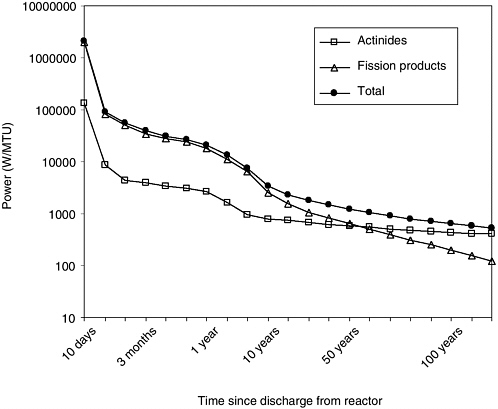
FIGURE 5.2 Plot of decay heat power (watts per metric ton of uranium) as a function of time (on a logarithmic scale) for commercial spent fuel after discharge from a reactor. Decay heat drops by about a factor of 100 during the first year after its removal from a reactor. SOURCE: NRC (2005d).
does not know if they are significant.43 Nevertheless, the committee sees several practical difficulties in carrying out analyses to identify such risks as part of DOE’s acceptance order negotiations with spent fuel owners:
-
USNRC regulations require that spent fuel be stored at plant sites in a safe and secure manner, and the Commission and industry have repeatedly asserted that at-plant storage is safe and secure (see NRC, 2005d).
-
Consequently, a plant owner could place itself in legal and regula-
-
tory jeopardy if it told DOE that it needed to ship younger spent fuel to reduce on-site storage risks.
-
DOE lacks the data or authority to carry out at-plant storage risk analyses.
Moving old fuel first has a collateral benefit: Much of this fuel is in pool or dry storage at 15 of 23 permanently shut-down reactors (Table 5.2). These reactors are located throughout the United States. There would be several benefits of shipping spent fuel from these shut-down sites as early as possible in the transportation program:
-
As noted previously, DOE has the authority under its standard contracts with spent fuel owners to choose the time and order in which it will ship from these shut-down sites. This provides operational flexibility during the early years of the transportation program, when DOE needs it most.
-
DOE could initiate its transportation program by shipping spent fuel from one or two sites that were located close to main line rail routes, thereby reducing burdens on federal agencies and/or states for route security inspections, emergency responder training, and en route inspections.
-
Some of these shut-down sites have enough stored spent fuel to support an extended shipping campaign, which would further reduce burdens for inspections and emergency responder training.
-
Some of these shut-down sites have enough stored spent fuel to support greater than three-package rail shipments, which is currently the nominal DOE shipping configuration. Such shipments could help reduce program schedules and costs, reduce the total number of shipments to the federal repository, increase the cost-effectiveness of dedicated trains, and decrease any long-term safety or security concerns from leaving this material at these shut-down sites.
-
Some of the spent fuel at these shut-down sites has already been placed into transport-ready form, and most of these sites have rail access.
-
Removal of spent fuel from these sites would allow earlier license termination and site closure.
In short, shipping the older fuel first from shut-down plants would give DOE a better ability to optimize routing, scheduling, and emergency responder planning and training, especially during the early phases of its transportation program.44 As experience is gained, longer movements could
TABLE 5.2 Permanently Shut-down Commercial Nuclear Reactors in the United States
|
Reactor Unit Name |
Location |
Reactor Type (Thermal Output, MW) |
|
Vallecitos |
California |
BWR (50) |
|
CVTR |
South Carolina |
Heavy water (65) |
|
Pathfinder |
South Dakota |
Superheat BWR (190) |
|
Fermi 1 |
Michigan |
Breeder (200) |
|
Saxton |
Pennsylvania |
PWR (28) |
|
Indian Point 1 |
New York |
PWR (615) |
|
Peach Bottom 1 |
Pennsylvania |
HTGR (115) |
|
Humbolt Bay 3 |
California |
BWR (200) |
|
Dresden 1 |
Illinois |
BWR (700) |
|
Three Mile Island 2 |
Pennsylvania |
PWR (2772) |
|
Shippingportb |
Pennsylvania |
PWR (~200) |
|
LaCrosse |
Wisconsin |
BWR (165) |
|
Fort St. Vrain |
Colorado |
HTGR (842) |
|
Rancho Seco |
California |
PWR (2772) |
|
Shoreham |
New York |
BWR (2436) |
|
Yankee Rowe |
Massachusetts |
PWR (600) |
|
San Onofre 1 |
California |
PWR (1347) |
|
Trojan |
Oregon |
PWR (3411) |
|
Millstone 1 |
Connecticut |
BWR (2011) |
|
Haddam Neck |
Connecticut |
PWR (1825) |
|
Maine Yankee |
Maine |
PWR (2772) |
|
Big Rock Point |
Michigan |
BWR (67) |
|
Zion 1, 2 |
Illinois |
PWR (3250 each) |
|
NOTE: BWR = boiling water reactor; HTGR = high-temperature gas reactor; PWR = pressurized water reactor. aAs of December 31, 2002. bDOE was responsible for decommissioning this reactor and moving spent fuel into off-site storage. |
||
be added. Such an operation could be part of a pilot program by DOE to gain experience and build public confidence45 by demonstrating an ability to transport spent fuel to Yucca Mountain in a safe, secure, and operationally effective manner. These advantages are further elaborated in another National Research Council report (NRC, 2003).
|
45 |
A University of New Mexico survey suggests that public concerns about the program to transport transuranic waste to the WIPP repository in New Mexico were reduced once the shipping program was under way and waste was being shipped on a routine basis. See Section 3.2.1. |
|
Shutdown Year |
Location of Spent Fuel Storage |
Quantity in On-site Storage (MTHM)a |
|
1963 |
Off-site |
NA |
|
1967 |
Off-site |
NA |
|
1967 |
Off-site |
NA |
|
1972 |
Off-site |
NA |
|
1972 |
Off-site |
NA |
|
1974 |
On-site |
31 |
|
1974 |
Off-site |
NA |
|
1976 |
On-site |
29 |
|
1978 |
On-site |
91 |
|
1979 |
Off-site |
NA |
|
1982 |
Off-site |
NA |
|
1987 |
On-site |
39 |
|
1989 |
On-site |
15c |
|
1989 |
On-site |
229 |
|
1989 |
Off-site |
NA |
|
1991 |
On-site |
128 |
|
1992 |
On-site |
245 |
|
1992 |
On-site |
360 |
|
1995 |
On-site |
526 |
|
1996 |
On-site |
448 |
|
1996 |
On-site |
543 |
|
1997 |
On-site |
71 |
|
1998 |
On-site |
1021 |
|
cThe spent fuel is stored in an on-site ISFSI licensed by the USNRC. DOE took title to the fuel in 1999. SOURCES: USNRC. 2004. Fact Sheet on Decommissioning Nuclear Power Plants. http://www.nrc.gov/reading-rm/doc-collections/fact-sheets/decommissioning.html; DOE (2004f, Appendix A); information on Shippingport and Ft. St. Vrain from various sources. |
||
5.2.5 Emergency Response Planning and Training
FINDING: Emergency responder preparedness is an essential element of safe and effective programs for transporting spent fuel and high-level waste. Emergency responder preparedness has so far received limited attention from DOE, states, and tribes for the planned transportation program to the federal repository. DOE has the opportunity to be innovative in carrying out its responsibilities for emergency responder preparedness. Emergency responders are among the most trusted members of their communities. Well-trained responders can become important emissaries for DOE’s trans-
portation program in local communities and can enhance community preparedness to respond to other kinds of emergencies.
RECOMMENDATION: DOE should begin immediately to execute its emergency responder preparedness responsibilities defined in Section 180(c) of the Nuclear Waste Policy Act. In carrying out these responsibilities, DOE should proceed to (1) establish a cadre of professionals from the emergency responder community who have training and comprehension of emergency response to spent fuel and high-level waste transportation accidents and incidents; (2) work with the Department of Homeland Security to provide consolidated “all hazards” training materials and programs for first responders that build on the existing national emergency response platform; (3) include trained emergency responders on the escort teams that accompany spent fuel and high-level waste shipments; and (4) use emergency responder preparedness programs as an outreach mechanism to communicate broadly about plans and programs for transporting spent fuel and high-level waste to a federal repository with communities along planned shipping routes.
The transportation of spent nuclear fuel to a federal repository would utilize the same state, tribal, and local emergency response capabilities that are in place to deal with existing hazardous materials transport accidents and incidents (see Appendix C). DOE has special responsibilities under the NWPA to ensure that emergency response capabilities and training are adequate to support its repository transportation program. It is responsible under the NWPA for providing technical assistance and funding to states and tribal nations for training on both routine transportation procedures and emergency response. These responsibilities are enumerated in Section 180(c):
The Secretary shall provide technical assistance and funds to States for training for public safety officials of appropriate units of local government and Indian tribes through whose jurisdiction the Secretary plans to transport spent nuclear fuel or high-level radioactive waste…. Training shall cover procedures required for safe routine transportation of these materials, as well as procedures for dealing with emergency response situations. The [Nuclear] Waste Fund shall be the source of funds for work carried out under this subsection.
DOE issued a statement of policies and procedures for providing such assistance in an April 1998 Federal Register notice (DOE, 1998b). This statement was the product of more than three years of work by DOE staff and involved several rounds of Federal Register notices and public comments. DOE has determined that this latest notice will remain in draft form
“until program progress or legislation provides definitive guidance as to when shipments will commence. At that time, OCRWM may finalize these policy and procedures or will consider promulgating regulations on Section 180(c) implementation” (DOE, 1998b, p. 27353).
This notice addresses training for both safe routine transportation and emergency response situations. The draft notice states (DOE, 1998b, p. 23754):
It is OCRWM’s policy that, for NWPA shipments, each responsible jurisdiction will have the training necessary for safe routine transportation of spent nuclear fuel or high-level waste and to respond to NWPA transportation incidents or accidents. OCRWM will provide training and technical assistance, subject to annual appropriations, to assist states and tribes to obtain access to the increment of training necessary to prepare for NWPA shipments…. If Congress does not fully appropriate the funds requested, the funding to eligible jurisdictions will be decreased proportionately.
For safe routine transportation of spent nuclear fuel and high-level waste, it is OCRWM’s policy to provide each eligible state and tribe the funding and technical assistance to prepare for safety and enforcement inspections of NWPA highway shipments, for rail measures that complement FRA inspection procedures, and for access to satellite tracking equipment and training on that equipment in cases where the capability does not already exist.
To carry out this policy, DOE intends to make two types of grants available to eligible states and tribal nations:
-
One-time planning grants of $150,00046 to help eligible jurisdictions determine their needs for training funds and technical assistance. The amount of the grant is based on DOE’s experience with planning for shipments to WIPP in New Mexico.
-
Base grants for safety and enforcement planning and training activities. Such grants will be available on an annual basis for up to five years and will consist of two parts: The first part will be for safety and enforcement inspection training and awareness-level training, awareness-level refresher training, and emergency responder trainer training (see Sidebar 5.3). The second part will be for enhanced emergency responder training such as operations- or technician-level training. The amount of funding available to a particular jurisdiction is based on need as determined by DOE.
States and tribal nations will be eligible to apply for grants approxi-
|
SIDEBAR 5.3 Emergency responder training requirements are established by federal regulation. Occupational Safety and Health Administration regulations (29 CFR 1910.120) require that emergency responder training for “hazardous substances” (which includes radioactive materials) be based on the duties and function of each person in the emergency response organization. These regulations describe five levels of training proficiency and require that individuals receive sufficient annual refresher training to maintain their competence or else demonstrate competence on at least an annual basis. 1. First-responder awareness level. This training is for individuals who are likely to discover the hazardous release and who have been trained to initiate the emergency response by notifying the proper authorities. These individuals would include most public safety personnel, including police officers and firefighters, and possibly highway maintenance workers. Such individuals are required to have training or sufficient experience to demonstrate competence in recognizing the presence of hazardous substances in an emergency; the risks and potential outcomes associated with these substances; and the ability to recognize the need for additional resources and to make appropriate notifications. 2. First-responder operations level. This training is for individuals who respond to actual or suspected releases of hazardous substances and are responsible for defensive actions to protect people, property, and the environment. They are responsible for keeping the release from spreading and preventing exposures. These individuals would likely be part of a hazmat team associated, for example, with a fire company. Operations-level responders are required to have at least eight hours of training or sufficient experience to demonstrate competence beyond a basic awareness level in the following: knowledge of basic hazard and risk assessment techniques; selection and use of operational-level protective personnel equipment; basic hazardous material terms; basic containment, confinement, or control operations; basic decontamination techniques; and relevant operating procedures. 3. Hazardous materials technician. This training is for individuals who are responsible for stopping hazardous substance releases to the environment. They |
mately four years before shipments are scheduled to commence through or along the borders of their jurisdictions. DOE estimates that it will take as long as one year for the application process to be completed, which will leave approximately three years for the assistance program to be implemented. DOE will notify the governor or tribal leader in writing when the jurisdiction becomes eligible to apply for these grants. Jurisdictions will be asked to select an agency or representative to apply for and administer the grants.
Only state and tribal organizations are eligible to apply for these grants. However, states and tribes are required to coordinate their planning with local jurisdictions and indicate in the grant application how the needs of
|
take aggressive actions in approaching the points of release to plug or patch them. These individuals are required to have at least 24 hours of training at the operations level and, in addition, to demonstrate competence in the following: ability to implement the emergency response plan; knowledge of the classification and verification of known and unknown materials by using survey instruments; ability to function within an assigned role in the incident command system; ability to select and use chemical personnel protection equipment; understanding of hazard and risk assessment techniques; ability to perform advance control, containment, or confinement operations in the capabilities of available protective equipment and resources; understanding and implementing decontamination procedures; understanding basic chemical toxicological terminology and behavior. 4. Hazardous materials specialist. This training is for individuals who have similar responsibilities to a hazardous materials technician but with more directed knowledge of the hazardous substances that they are called upon to contain. They are required to have at least 24 hours of training at the technician level and be able to demonstrate competence in the following: ability to implement the local emergency response plan and knowledge of the state response plan; understanding classification, identification, and verification of known and unknown substances using advanced survey instruments; ability to select and use specialized personnel protective equipment; an in-depth understanding of hazard and risk assessment techniques; ability to perform specialized control, containment or confinement operations; ability to determine and implement decontamination procedures; ability to develop a site safety and control plan; understanding of chemical, radiological, and toxicological terminology and behavior. 5. On-scene incident commander. This training is for individuals who will assume control of the incident scene. These individuals must receive at least 24 hours of training at the operations level and demonstrate competence in the following: ability to implement the incident command system and emergency response plan; knowledge of the hazards and risks associated with employees working in chemical protective clothing; knowledge of the state emergency response plan and Federal Regional Response Team; knowledge and understanding of the importance of decontamination procedures. |
local safety officials have been considered and how incremental training will be provided. This would include a description of where training would be obtained, what drills and exercises would be included in the training, what equipment and supplies would be purchased, and what other technical assistance would be needed from DOE. DOE anticipates that awareness-level training (see Sidebar 5.3) will be made available to local public safety officials and that enforcement training will be made available to state-level and tribal employees. However, it is largely up to the state or tribal nation to determine, in consultation with local governments and first responders, who receives training and at what frequency such training is provided.
DOE received 19 sets of comments from states and organizations on its proposed policies and procedures. These are enumerated in a Federal Register notice.47 According to the notice (p. 23757), “the large majority of commenters emphasized that they believe that additional change is still needed in key areas, primarily more cooperative route selection and a more cooperative transportation planning process.” Several organizations identified the WIPP transportation planning process as a good example of cooperative planning. Some specific comments addressed the following unmet needs, specifically for:
-
Improved communications, including early and substantive public outreach, with DOE taking the responsibility for interacting with states and tribes rather than relegating these responsibilities to private contractors.
-
Early selection of routes to allow sufficient time for states to designate alternate routes and assess their planning and training needs.
-
Policies on early and cooperative selection of routes, especially to avoid the possibility that the selection of too many routes would dilute planning and training resources.
-
Training of emergency responders equivalent to Occupational Safety and Health Administration (OSHA) operations-level training (see Sidebar 5.3).
Concerns about transportation planning and emergency responder training continue to be voiced at DOE-sponsored forums such as the Transportation External Coordination (TEC) Working Group meetings (see Section 3.4). A consistent theme expressed at these meetings is the need for DOE to get on with the process of route selection so that states and tribal nations can begin planning and training activities.
DOE’s Office of Environmental Management, which is responsible for cleanup of the nation’s nuclear weapons sites, has developed the Transportation Emergency Preparedness Program (TEPP) to support training of federal, state, tribal, and local authorities in emergency preparedness and response to transportation incidents involving DOE radioactive materials shipments. The program has designated coordinators in each of DOE’s eight regional offices and has been used extensively for WIPP-related emergency preparedness and response. The TEPP provides a number of planning and training tools for state, tribal, and local governments. The planning tools include models for developing needs assessments, preparedness plan-
ning, and response procedures. They also include a “drill-in-a-box” that provides scenarios and materials for preparing and conducting tabletop exercises and drills for transportation incidents. The program provides technical assistance to state and tribal governments for developing, updating, and testing emergency response plans.
TEPP also provides training materials (Modular Emergency Response Radiological Transportation Training [MERRTT]) for emergency managers and responders, firefighters, law enforcement, and related personnel. These materials provide information on fundamental concepts and procedures for responding to radioactive materials transport incidents. The training is organized into a modular format and includes manuals, instructor guides, and overheads. The program offers several train-the-trainer sessions at various locations across the United States for qualified instructors.
The WIPP emergency responder training program is often cited as a good model for transportation planning and emergency response. WIPP’s success was somewhat fortuitous, however. Transportation routes to WIPP were not identified early in the program. When DOE made an initial and ultimately unsuccessful effort to open WIPP in 1988, little planning for transportation had been carried out. It took DOE another 11 years (until 1999) to get the repository open, which gave the agency more time to identify routes and provide the necessary training to emergency responders.
Transportation to WIPP ramped up over a period of five years, which provided DOE with time for planning and training. Initially, only one site shipped waste to WIPP: Rocky Flats, near Denver, Colorado. WIPP has now received waste from eight sites. A relatively small number of routes are used for WIPP shipments (Figure 5.3). This has allowed DOE to keep the demand for emergency responder training and coordination to a manageable level.
The WIPP program was willing to go beyond its legally mandated requirements in planning and implementing its transportation program. For example, DOE executed a memorandum of understanding with the WGA and Southern States Energy Board that included emergency response operations. The WGA, in cooperation with DOE, developed the WIPP Transportation Safety Program Implementation Guide (WGA, 2003), which governs the conduct of transuranic waste shipments through the western states, including the conduct of emergency response operations. The Southern States Energy Board (SSEB, 1994) developed the Transuranic Waste Transportation Handbook, which serves as a primer for waste transportation through its member states.48 The Council of State Governments’ Midwest-
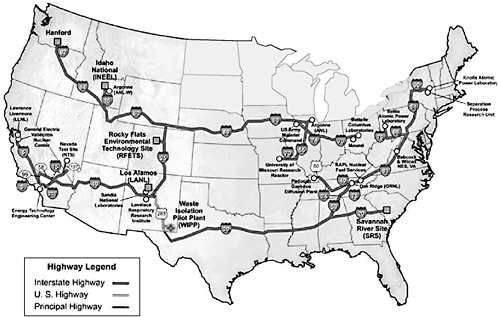
FIGURE 5.3 Routes used for shipping transuranic waste to the Waste Isolation Pilot Plant near Carlsbad, New Mexico. SOURCE: Modified from http://www.wipp.ws/routes.htm.
ern Office has also issued guidance for radioactive waste shipments through its member states (CSG, 2004).
WIPP is providing direct training in emergency preparedness and response to first responders along WIPP routes through TEPP. While Section 180(c) of the NWPA requires DOE to provide funds for emergency response training for Yucca Mountain, direct training is not required.
Many lessons from the WIPP transportation program could potentially be applied to Yucca Mountain. DOE’s Yucca Mountain Program issued its safe transportation strategic plan in November 2003 (DOE, 2003c). In it, DOE pledged to (p. 2) “approach its transportation planning cooperatively, using a collaborative process that incorporates the successful elements from transportation systems developed for other DOE programs.” WIPP is mentioned as such a program.
While the WIPP experience offers some useful lessons, the experience may not be scalable to the Yucca Mountain transportation program. DOE will have to provide training assistance to emergency responders along planned shipping routes in up to 45 states. Even during the early phases of the program, DOE is likely to face demands for training assistance from a dozen or more states along identified transportation routes.
DOE will not begin providing Section 180(c) technical assistance and funding to states until it identifies the routes for shipping spent fuel and high-level waste to Yucca Mountain. The committee sees a clear strategic advantage to DOE in making these decisions and providing at least a base level of assistance at the earliest possible date.
Volunteer and paid emergency responders have been the institutional foundations in many communities since Benjamin Franklin’s era and are among their communities’ most trusted members. If adequately involved, they can become important emissaries for DOE’s program with the local community. When elected officials or members of the public ask “Are these shipments safe?” and “Can our community handle an emergency?” they often look to local emergency response officials for answers. It is in DOE’s interests to provide the training and technical assistance necessary for these officials to feel confident that they have the equipment and training needed to respond to any accident or incident involving spent fuel and high-level waste. This training and technical assistance might also help to mitigate some of the social risks described in Chapter 3 (see Section 3.2).
A DOE representative told the committee that training may be ineffective if started too early, given the expected turnover of emergency responder personnel, especially volunteer firefighters, who may experience a 20 percent or higher annual turnover.49 Although it is true that turnover in some
segments of the emergency responder community is high, especially among volunteers, the committee nevertheless judges that it is never too early to start training. There is a cadre of professionals who will stay in their positions over the long term; they would benefit from early training and they could help DOE with planning for such training. Such early training will be essential for developing appropriate organizational memory and culture and for setting expectations. DOE could focus its early assistance on training-the-trainer and other long-term activities such as planning for equipment procurements, calibrations, upgrades, and replacements of radiation detection instruments used by emergency responders.50
There are even benefits, albeit more indirect, to be gained from training volunteer emergency responders who may leave their posts before the transportation program begins operating: these people live in the communities through which these shipments will pass and some are community leaders. They can serve as informal but important sources of information to their communities about DOE’s transportation program.
Since DOE’s Section 180(c) assistance will reach the majority of states and many tribal nations, the committee sees clear opportunities for innovation. DOE could work with the Department of Homeland Security to provide consolidated all hazards training materials and programs for emergency responders that would provide at least awareness-level training (see Sidebar 5.3). Such programs could reach large numbers of emergency responders well in advance of any route determinations and would help to leverage DOE’s limited 180(c) funding. Such training could also help counteract the possible perception among emergency responders, local officials, and members of the public that if special training is needed for spent fuel and high-level waste shipments, transporting such materials must be an especially risky activity.
Another opportunity for innovation involves the deployment of trained emergency responders on the escort teams that accompany spent fuel and high-level waste shipments to Yucca Mountain. These individuals could be given the responsibility for establishing liaisons with tribal and local government emergency responder organizations along transportation routes. Such individuals would provide the first line of emergency response in an
|
|
ments are as rigorous as those for full-time paid fire service, and most volunteer firefighters take enormous pride in their service and competence. While it is true that turnover among volunteers is high, many volunteer departments have a cadre of long-serving members who retain the corporate memory and help to train newcomers. |
accident or incident and would function as a known and trusted resource for local incident commanders. This innovation could be most readily implemented for rail shipments, because these will be fewer in number and will have more space to accommodate escorts.
DOE could also use this state and local interest to communicate more broadly with the public about its transportation program by
-
Opening its emergency responder training sessions to selected individuals from local communities, especially opinion leaders,
-
Providing emergency responder information through a Web site designed for interested non-experts, and
-
Working with local communities and their schools to develop programs to monitor environmental conditions (e.g., radiation levels) along transportation routes.
Although the discussion in this section has focused on the federal repository transportation program operated by DOE, the committee’s suggested innovations are also potentially applicable to the transportation program operated by Private Fuel Storage, LLC. This private transportation program has no legal responsibility under the NWPA to support emergency responder preparedness along its shipping routes. To the committee’s knowledge, Private Fuel Storage, LLC, has no plans to provide financial aid to communities along its planned transportation routes to support emergency responder training. However, state, tribal, and local communities are likely to take a keen interest in emergency response preparedness in this program. The committee judges that there would be significant benefits to the program in terms of capacity and public confidence building through early and innovative actions to support emergency responder preparedness.
5.2.6 Information Sharing and Openness
FINDING: There is a conflict between the open sharing of information on spent fuel and high-level waste shipments and the security of transportation programs. This conflict is impeding effective risk communication and may reduce public acceptance and confidence. Post–September 11, 2001, efforts by transportation planners, managers, and regulators to further restrict information about spent fuel shipments make it difficult for the public to assess the safety and security of transportation operations.
RECOMMENDATION: The Department of Energy, Department of Homeland Security, Department of Transportation, and Nuclear Regulatory Commission should promptly complete the job of developing, applying, and disclosing consistent, reasonable, and understandable criteria for protecting
sensitive information about spent fuel and high-level waste transportation. They should also commit to the open sharing of information that does not require such protection and should facilitate timely access to such information: for example, by posting it on readily accessible Web sites.
This finding and recommendation are motivated by several factors. In a representative democracy, citizens have a general right, subject to legitimate privacy and national security restrictions, to obtain information about government programs that affect their communities. Such sharing of information might also help to build community trust and confidence in transportation programs and help implementers to identify and manage the social risks described in Chapter 3 (Section 3.2).
The current study was conceptualized before the September 11, 2001, terrorist attacks on the United States, and its original focus was intended to be on the safety of spent fuel and high-level waste shipments. During the committee’s information-gathering meetings, however, several participants expressed concern about the security of spent fuel and high-level waste transport, especially the potential consequences of terrorist attacks on transport packages in highly populated areas. Other participants expressed concerns about the efforts of federal agencies to use the September 11 attacks as a pretext for withholding information that could help the public to evaluate the safety and security of spent fuel and high-level waste shipments. These presenters expressed concern that such withholding could allow the government to operate such programs with little public scrutiny.
The committee itself encountered information restrictions during this study. In compiling historical data on spent fuel shipments in the United States, the committee discovered that the USNRC had removed some of the needed information (USNRC, 1978) from its Web site and document reading room because it was deemed to be too sensitive for public release. The committee saw no reason for withholding this information given that it involved only past shipping campaigns. However, at the committee’s request, Commission staff provided the summary data on historical spent fuel shipments for use in this report (Chapter 3). The staff also told the committee that it is now updating and reviewing this historical information to determine what is appropriate for public release.
The committee discussed the possibility of expanding its report to include information on the security of spent fuel and high-level waste transportation. This effort was supported by the federal study sponsors. As noted previously, four members of the committee and one staff member with appropriate security clearances were given a classified briefing by USNRC staff on investigations under way within that agency to assess the security of transportation packages. However, the committee was not able to receive timely written guidance from the study sponsors on what infor-
mation from these studies and other documents51 could be released to the public in the committee’s final report.
The USNRC has provided guidance to its staff for communicating security risks since the September 11, 2001, terrorist attacks (USNRC, 2004e, f). The guidance notes that “[p]eople who live near power plants and other nuclear facilities have a different sense of the risks they are asked to bear on behalf of the rest of the country” (USNRC, 2004e, p. 54) and recommends that agency officials “clearly establish what information can be shared and what can’t” (USNRC, 2004e, p. 52). The guidance notes that information can be shared about additional security personnel, new equipment, and upgraded procedures put in place, but without specifics being disclosed. The guidance also recommends that agency officials clearly state why they cannot share detailed security information. The agency asserts, “Because the public is keenly aware of security concerns most will understand and respect the need to keep certain information classified” (USNRC, 2004e, p. 52).
DOE’s transportation program for Yucca Mountain apparently has not yet confronted this issue to the same extent, largely because it is still in the planning stages. However, DOE’s Environmental Management program, which is responsible for cleaning up the U.S. nuclear weapons complex, has long grappled with the issue of openness (e.g., Ashford and Rest, 1999; Bradbury et al., 1996a,b, 1997a,b, 2003; Bradbury and Branch, 1999; Drew et al., forthcoming). The TEC Working Group, which advises the Yucca Mountain transportation program, has provided suggestions on best practices to assist DOE program managers “in their efforts to communicate about radioactive materials transportation in a manner that is responsive to the needs and concerns of stakeholders” (TEC, 2002, p. 1). TEC recommends sharing information such as the number of shipments, mode(s), possible route(s), time frame, quantity, type of material being shipped, and reason for making the shipments. Web sites are also considered “good tools for making information available” (TEC, 2002, p. 3).
Some of the information recommended for sharing by TEC is considered by other parts of DOE to be too sensitive to share with the public. For example, the program for transporting transuranic waste to WIPP has restricted information sharing about its shipments. At its Albuquerque meeting, the committee received comments from the representative of a stakeholder group concerning public restrictions on information sharing about these shipments after the terrorist attacks of September 11, 2001 (Hancock, 2004). This representative noted that State of New Mexico officials were no longer allowed to provide shipment schedule information to members of
the public, and DOE no longer responded to requests for information about incidents involving these shipments.
Clearly, the public has a right to receive some timely information about the shipments of spent fuel and high-level waste that pass through their communities. The TEC guidance on information sharing described above strikes the committee as a reasonably complete and appropriate guidance for sharing at different times in the life cycle of a shipment or shipping campaign. Some general information is appropriate to share before shipments commence: This includes reasons for making the shipments; general information about the materials to be shipped; possible shipping modes and routes; and general shipping time frames. Appropriate post-shipment information includes more details on the shipments, such as quantities of materials shipped; specific modes and routes used for the shipments; timing of shipments; accidents and incidents during shipments; and any resulting response actions.
Federal agencies need to develop and then abide by clear and consistent guidelines for protecting information about spent fuel and high-level waste transportation activities. The class of information to be protected should be defined clearly and should be small, encompassing only that information that is truly in need of protection. The remaining information should be made freely available to the public through agencies’ Web postings and other dissemination channels.
5.3 ORGANIZATIONAL STRUCTURE OF THE FEDERAL TRANSPORTATION PROGRAM
FINDING: Successful execution of DOE’s program to transport spent fuel and high-level waste to a federal repository will be difficult given the organizational structure in which it is embedded, despite the high quality of many current program staff. As currently structured, the program has limited flexibility over commercial spent fuel acceptance order (Section 5.2.4); it also has limited control over its budget and is subject to the annual federal appropriations process, both of which affect the program’s ability to plan for, procure, and construct the needed transportation infrastructure. Moreover, the current program may have difficulty supporting what appears to be an expanding future mission to transport commercial spent nuclear fuel for interim storage or reprocessing. In the committee’s judgment, changing the organizational structure of this program will improve its chances for success.
RECOMMENDATION: The Secretary of Energy and the U.S. Congress should examine options for changing the organizational structure of the Department of Energy’s program for transporting spent fuel and high-level
waste to a federal repository. The following three alternative organizational structures, which are representative of progressively greater organizational change, should be specifically examined: (1) a quasi-independent DOE office reporting directly to upper-level DOE management; (2) a quasi-government corporation; or (3) a fully private organization operated by the commercial nuclear industry. The latter two options would require changes to the Nuclear Waste Policy Act. The primary objectives in modifying the structure should be to give the transportation program greater planning authority; greater budgetary flexibility to make the multiyear commitments needed to plan for, procure, and construct the necessary transportation infrastructure; and greater flexibility to support an expanding future mission to transport spent fuel and high-level waste for interim storage or reprocessing. Whatever structure is selected, the organization should place a strong emphasis on operational safety and reliability and should be responsive to social concerns.
The Yucca Mountain transportation program operates within the larger milieu of the repository development effort (Chapter 1). Consequently, its success will depend to a large degree on the decisions made within DOE, other agencies, and Congress on whether and when to license, construct, and open a federal repository. If completed, the federal repository program will be the most expensive waste disposal effort in U.S. history. Current projected life-cycle costs are $58 billion in 2000 dollars (DOE, 2001d). The transportation program would also be the most expensive effort to ship spent fuel and high-level waste in the nation’s history. Its share of the life cycle costs is about $6 billion in 2000 dollars.
Certain characteristics of the Yucca Mountain transportation program will make it exceptionally challenging to carry out successfully: The transportation program
-
Will last for more than two decades;
-
Is decentralized, encompassing more than 70 sites in 31 states;
-
Involves a large number of parties (i.e., industry, regulators, and state, tribal, and local governments) over which it has limited control;
-
Must operate with a high degree of consistency and reliability;
-
Has limited flexibility over schedules because of the standard contract requirements for acceptance of spent fuel (see Section 5.2.4); and
-
Has limited budgetary control within DOE and is subject to the annual congressional appropriations process.
The transportation system is not only physically and logistically complex, but also has a “nested complexity” that derives from the institutional architecture in which it is embedded. The transportation program is embed-
ded in DOE’s OCRWM, which is responsible for constructing and operating a federal repository. The transportation program must compete with the much larger repository development program for personnel, funding, and management attention.
OCRWM has embarked on what some have described (and the committee agrees) is an ambitious schedule to open a Yucca Mountain repository. Its last announced schedule for opening the repository included the following milestones:
-
Submission of a repository construction license application to the USNRC in December 2004.
-
Approval by the Commission in 2008 to begin construction of the repository and ancillary surface facilities.
-
Submission of a license amendment to the USNRC in 2009 to begin receiving waste.
-
Approval of this amendment by the USNRC and start-up of repository operations by the end of 2010.
DOE missed the first milestone because of problems with the Environmental Protection Agency Agency’s standard for Yucca Mountain and completion of DOE’s licensing support network (see Section 1.3.2). A new schedule had not been formally announced by December 2005 when work on this report was being completed, although DOE has stated that Yucca Mountain will not open until 2012 at the earliest.
The transportation program’s schedule is linked to the schedule for opening the repository. The last announced schedule for the transportation program included the following milestones:
-
Complete work on the Nevada rail EIS and issue a ROD on the specific alignment in early 2006.
-
Award the design contract for the rail spur in early 2005 and begin construction of the rail spur in early 2006. According to the final Yucca Mountain EIS (DOE, 2002a), construction is planned to last no more than 46 months at an estimated cost of about $880 million (see Section 5.2.1).52
-
Issue a request for proposals on rolling stock (i.e., railcars) in early 2005 and begin receiving equipment deliveries in early 2007.
-
Undertake an assessment of industry’s ability to provide transportation packages of the sizes and quantities needed for the program. Package
-
design, certification, and fabrication activities would be carried out in fiscal years 2005 and 2006.
-
Complete work on an operational plan and issue a final concept of operations in early fiscal year 2005. This would presumably detail how DOE plans to conduct its transportation operations, including the role of contractors.
-
Issue final routing selection criteria in late fiscal year 2005 and its transportation operations plan in late fiscal year 2006.
-
Identify a suite of transportation routes in early fiscal year 2006, which will then trigger the awarding of Section 180(c) planning grants (see Section 5.2.5) to states later that fiscal year. Awards of Section 180(c) base grants would be made later in fiscal year 2007.
In October 2005, OCRWM announced that it intended to adopt a standardized package design to transport, store, and dispose of commercial spent fuel. This will require certification of the new package design and modification of the design for the fuel receipt and handling facilities at the federal repository. DOE has not indicated what additional delays may be encountered in the repository program and its associated transportation program to implement these changes.
Funding for the Yucca Mountain Program comes from a combination of direct federal appropriations to cover the costs of disposing of defense spent fuel and high-level waste and the Nuclear Waste Fund (Appendix C) to cover the costs of commercial spent fuel disposal. Both funding sources are controlled by Congress through the annual appropriations process.53 The transportation program’s annual budget request to Congress is submitted as part of the OCRWM budget request based on a target set by the Office of Management and Budget in consultation with DOE management. As shown by Table 5.3, the transportation program’s budget has not received high priority within OCRWM, possibly because the overall OCRWM budget has itself been underfunded relative to requested levels during several of the past years. The transportation program will require substantially higher future budgets to construct a Nevada rail line, procure transportation equipment, and make other necessary infrastructure improvements.
While the apparent delay in opening a federal repository would potentially provide more time for the transportation program to attain operational readiness, it introduces other complications. For example, the com-
TABLE 5.3 Congressional Appropriations for OCRWM and Its Transportation Program
|
Federal Fiscal Year |
OCRWM Request ($ millions) |
OCRWM Appropriation ($ millions) |
Transportation Program Request ($ millions) |
Transportation Program Appropriation ($ millions) |
|
1999 |
380 |
353 |
2 |
2 |
|
2000 |
409 |
351 |
2 |
2 |
|
2001 |
437 |
401 |
3.8 |
2.7 |
|
2002 |
445 |
375 |
5.9 |
4.6 |
|
2003 |
591 |
457 |
30.2 |
9.4 |
|
2004 |
591 |
577 |
73.1 |
63.6 |
|
2005 |
131a |
572 |
186 |
30.7 |
|
2006 |
651 |
450b |
85.4 |
19.9 |
|
aDOE requested $880 million, but the Bush administration requested only $131 million for defense waste disposal. The administration intended to obtain the remaining funding from the Nuclear Waste Fund and unsuccessfully attempted to have that fund taken “off budget,” which would have freed it from the annual congressional appropriations process. bDoes not include the $50 million appropriated by Congress in fiscal year 2006 for initiation of a site selection process for an integrated spent fuel recycling facility. SOURCE: DOE budget documents and written communications. |
||||
mercial nuclear industry could begin shipments of spent fuel to Private Fuel Storage, LLC, in Utah once that facility is constructed and opened.54 Under current plans, this fuel will be placed in packages (see Sidebar 1.4) for transport and storage. However, unless the industry adopts the new DOE standardized package, which has not yet been designed, licensed, or manufactured, it may be required to repackage the fuel before it can be transported to the federal repository. In the meantime, additional nuclear plants are expected to establish dry-cask storage to relieve growing storage pressures in their pools, and additional plants may be closed and decommissioned. These changes could further affect the transportation program’s pickup schedules and require more repackaging of spent fuel for transport to the federal repository.
The recent decision by Congress to promote the development of one or more federal interim storage sites for commercial spent fuel potentially
|
54 |
A license for this facility was submitted to the USNRC in 1997. As noted in Chapter 1, the Commission authorized its staff to issue a license to construct and operate this facility under the conditions in 10 CFR 72.40. |
further complicates DOE’s transportation mission. The Energy and Water Development Fiscal Year 2006 report55 provides the following direction to DOE (italics added):
Integrated spent fuel recycling.—Given the uncertainties surrounding the Yucca Mountain license application process, the conferees provide $50,000,000, not derived from the Nuclear Waste Fund, for the Department to develop a spent nuclear fuel recycling plan. Under the Nuclear Energy account, the conferees provide additional research funds to select one or more advanced recycling technologies and to complete conceptual design and initiate pre-engineering design of an Engineering Scale Demonstration of advanced recycling technology. Coupled with this technology research and development effort, funds are provided under the Nuclear Waste Disposal account to prepare the overall program plan and to initiate a competition to select one or more sites suitable for development of integrated recycling facilities (i.e., separation of spent fuel, fabrication of mixed oxide fuel, vitrification of waste products, and process storage) and initiate work on an Environmental Impact Statement. The site competition should not be limited to DOE sites, but should be open to a wide range of other possible federal and non-federal sites on a strictly voluntary basis. The conferees remind the Department that the Nuclear Waste Policy Act prohibits interim storage of nuclear waste in the State of Nevada. To support the development of detailed site proposals for this competition, the conferees make a total of $20,000,000 available to the site offerors, with a maximum of $5,000,000 available per site. To be eligible to receive these funds, each applicant site must be able to identify all state, regulatory, and environmental permits required for permitting this facility, including identifying any legislative or regulatory prohibitions that might prevent siting such a facility. The conferees direct the Secretary to submit a detailed program plan to the House and Senate Committees on Appropriations not later than March 31, 2006, and to initiate the site selection competition not later than June 30, 2006. The target for site selection is fiscal year 2007, and the target for initiation of construction of one or more integrated spent fuel recycling facilities is fiscal year 2010.
The development of an integrated spent fuel recycling facility will likely require interim storage at the recycling facility as well as additional transportation capacity, possibly involving a different mix of transportation packages, conveyances, and routes than for the federal repository.
Even if Yucca Mountain fails to receive a license and an integrated spent fuel recycling facility is never constructed, the federal government may still require a transportation capability to move commercial spent fuel
to one or more centralized storage sites to meet its commitments under the NWPA (see Chapter 1 and Appendix C).56 This fact alone argues for the establishment of a generic federal transportation capability that could service a repository and possibly other government transportation needs. Under the current organizational structure for the transportation program, all of the federal government’s transportation “eggs” have been placed in the federal repository basket.
The current transportation program is unusual in another sense: The committee knows of no other federal government-run program that has a mission to take ownership of private-sector waste for the purposes of transport and disposal.57 Such programs are usually private-sector responsibilities. The government’s usual role is to control and regulate such activities.
Several members of the committee have extensive experience with the design and operation of large transportation programs. Their experience suggests that such programs are more likely to be successful when they have the following:
-
An appropriately focused mission;
-
A systems-driven focus on the mission;
-
Authority to carry out the mission and accountability for failure;
-
Independent and strong regulatory oversight;
-
Continuity and predictability of funding; and
-
Alert, flexible, and responsive management.
OCRWM’s transportation program lacks some of these attributes. The current program is focused on transport to Yucca Mountain; it is not organized to provide a generic transportation capacity that could serve the government’s other transportation needs. The transportation program director’s authority for carrying out the mission is limited because priorities
|
56 |
The fiscal year 2006 House Energy and Water Development Appropriations Bill directed DOE to begin accepting commercial spent fuel for interim storage at a government site within 12 months, but this language was not included in the final conference report. |
|
57 |
Amtrak, a government-chartered corporation, has carried private-sector freight. The federal government has programs for the shipment of government-owned materials and wastes. For example, the military has transportation programs for moving military materials and wastes. DOE has transportation programs for shipping nuclear weapons and naval spent fuel. It also has transportation programs for shipping the wastes from its environmental cleanup programs at defense sites. Transport of non-DOE domestic and some foreign research reactor spent fuel is the responsibility of reactor operators (see Chapter 4). DOE is responsible for the transport of some foreign research reactor fuel, but this fuel is of U.S. origin and, because it contains HEU (see Chapter 4), is a proliferation concern. |
are set at higher levels in the department. In principle, accountability follows authority. The program is partially self-regulating (see Table 1.3). There is little continuity, predictability, or rationality of funding in the annual appropriations process, as noted previously, and the transportation program has historically received a low priority for funding within OCRWM (see Table 5.3).
The committee judges that there are several options for changing the current organizational structure to improve its chances for success; the principal attributes and advantages of these structures are summarized in Sidebar 5.4. One of these options could be implemented within the current structure of the NWPA, whereas two others would likely require fundamental changes to the NWPA. All of the options involve transferring the transportation program out of OCRWM with the explicit goal of increasing management authority and accountability for executing the program’s mission(s). Such a transfer could also be advantageous to OCRWM because it would allow that program to focus its staff and resources on its primary near-term mission, which is to license and construct a federal repository.
There are of course some advantages to the current organizational structure: The transportation and repository development programs are closely coupled. In principle, this promotes coordination, cooperation, and systems-driven integration, helping to ensure a match-up between transportation supply, demand, and schedules. However, the committee has not seen much evidence that these advantages are being realized in the current transportation program. Programmatic decisions appear to be based more on funding availability (Table 5.3) than on technical or schedule considerations.
The committee did not perform an exhaustive analysis of alternative organizational structures for the transportation program. However, based on the expertise and experience of its members, at least three different organizational structures seem feasible. The following paragraphs describe these options and their potential advantages and disadvantages.
First, within the current structure of the NWPA, the transportation program could be organized as the Nuclear Waste Transportation Administration, a quasi-independent DOE office program reporting directly to upper-level DOE management (i.e., the DOE secretary, deputy secretary, or under secretary). The main advantages of this structure are that it would free the transportation program from the budget, personnel, and schedule constraints imposed by OCRWM management and give program staff greater authority to execute its mission. The effectiveness of this structure would be enhanced by giving the program more predictability and continuity of funding so that it could make long-term commitments to
|
SIDEBAR 5.4 Nuclear Waste Transportation Administration
Quasi-Government Corporation
Private Company
|
construct the Nevada rail spur58 and purchase transportation packages and conveyances. This could be accomplished by giving the program more
|
58 |
Under this and the other two organizational options described in this section, the responsibility for constructing the Nevada rail spur and making other transportation-related infrastructure improvements within Nevada could continue to reside within OCRWM following the recommended organizational restructuring. The transportation program could be given the responsibility for purchasing transportation packages and conveyances and making the needed infrastructure improvements at commercial power plant sites (see Appendix C) and on transportation routes outside of Nevada. This could provide a better separation between repository-specific responsibilities and other responsibilities for a generic federal transportation capability. |
direct access to the Nuclear Waste Fund and authority to tap that fund without prior congressional authorization.
A possible model for this arrangement is the Federal Highway Administration (FHWA) within DOT, which reports directly to the Secretary of Transportation. The FHWA is funded mainly from congressional appropriations from the Highway Users Trust Fund, a government account replenished by highway user fees. While FHWA’s main mission is to provide programmatic grants to states for highway construction, it also sets selected standards for federally funded roads and provides technical support to state departments of transportation. Additionally, it funds and conducts research to develop and improve relevant technology and enhance the effectiveness of its grant programs.
FHWA oversees a highly decentralized set of activities in which oversight is provided by the federal government but roads are owned by states and local governments, and built and maintained largely by hundreds of private contractors. Some of these activities are also subject to review and approval by other agencies—for example, the Environmental Protection Agency and the Department of Defense. Many of these activities also involve considerable public outreach and participation. The FHWA must operate in a collaborative fashion to execute its missions and has had a long and successful partnerships with state, contractor, material supplier, and academic institutions. The administration has developed a skilled staff with the core competencies required to carry out its missions.
A successful Nuclear Waste Transportation Administration would be similar in many respects to the FHWA. It would be largely dependent on congressional appropriations for its funding and, like FHWA, would rely on a permanent fund (the Nuclear Waste Fund) for most of its budget. It would be involved heavily in cooperative relationships with other federal agencies, states, tribes, local governments, nuclear utilities, contractors, and other nongovernmental organizations. Even though it would likely contract out many of its functions, it would need to have a strong staff with competencies in transportation planning, design, operations, materials handling, and public outreach. However, it would also be different from FHWA in some respects: It would have operational responsibilities and would be much smaller in dollar terms.
The other two organizational models would require changes to the NWPA. The second option would be to reorganize the transportation program as a quasi-government corporation. Such a corporation would operate like a private-sector organization and would be subject to the full regulatory authority of the government for corporate finances and governance, worker and public health and safety, and transportation safety and security. The charter for this corporation would give it exclusive authority to take title to commercial spent fuel for transport to the federal repository or
federal interim storage.59 DOE would take title to shipped materials at the gate of the federal repository or interim storage facility.
This quasi-corporate model has two primary advantages. First, it would bring some private-sector efficiencies to the transportation program, which could help the program operate in a more timely and cost-effective manner. The corporation could freely draw upon existing worldwide transportation capabilities, thereby reducing development costs and schedules. Second, this arrangement would get the government out of the business of regulating itself, which creates both real and perceived conflicts of interest. It would also reduce the potential for political pressures on program plans and operations—for example, on the acceptance order for commercial spent fuel. If desired, DOE could also contract with this corporation to transport its defense spent fuel and high-level waste to the repository.
The main potential disadvantages of this model are that a corporation could be perceived to have less accountability to the public and would be freed from many of the public participation processes in which the government is required to engage.60 If chartered correctly, however, a quasi-government corporation might actually be more accountable than a government agency for meeting legal and regulatory requirements: the corporation could be fined and its staff subject to civil and criminal penalties for violating statutes and regulations. Moreover, in chartering this corporation, Congress could establish requirements for outside consultation and public participation and make it responsive to the social risk concerns described in Chapter 3 (Section 3.2).
There is a precedent for this organizational model in the United Kingdom and France. British Nuclear Fuels Limited (BNFL) and the French company AREVA are private companies with a high level of government ownership.61 These companies provide a wide range of nuclear services, including spent fuel and high-level waste transportation services. They are subject to the full regulatory authorities in all of the countries in which they operate, including their home countries.
A third option for reorganizing the transportation program is to make it a fully private company operated by the commercial nuclear industry. There is already an industry consortium in existence (Private Fuel Storage, LLC; see Chapter 1) that is developing a transportation capability that could serve as a model for such a company. This arrangement would have some of the same advantages and disadvantages of the quasi-government corporation option, although requirements for outside consultations and public participation might be harder to enforce. However, this might be the most effective option for addressing the commercial spent fuel acceptance order issue (Section 5.2.4), especially if owners had collective economic incentives to maximize the efficiency of the transportation program,62 and individual owner interests did not trump these collective incentives. Under this option, DOE would be responsible for transporting its own spent fuel and high-level waste but could contract this activity out to the private entity if desired.
The selection of a specific organizational model for the federal transportation program is a policy decision that goes well beyond the task for this study. In making this decision, the federal government will have to consider factors beyond Yucca Mountain. The government is encouraging the construction of new nuclear plants in the United States. If such construction occurs on a large scale, the federal repository and the transportation program that supports it will have to be expanded. In this case, it might make sense for the government to turn over the transportation program to a quasi-private or private entity if it does not wish to be in the permanent business of transporting the industry’s spent fuel. As noted previously, a generic transportation capability could also be useful if the federal government decides to transport commercial fuel to one or more centralized sites for storage or reprocessing to meet its commitments under the NWPA (see Chapter 1 and Appendix C). This argues for the establishment of a generic transportation capability that could service a range of government transportation needs.
If the federal government decides to maintain the transportation program in its current organizational form, the committee judges that it will at the very least need a greater commitment to continuity in funding and programmatic direction from the Secretary of Energy and Congress to successfully execute its mission. This may not be possible in the current fiscal and political climate, which is why the committee is recommending that other organizational structures be examined.
Regardless of which option is selected, continuing attention must be paid to ensuring that the transportation program develops and maintains an integrated systems focus. The program is complex from both physical and institutional perspectives: it will involve the movement of large quantities of hazardous materials from multiple locations over long distances for sustained periods of time. It will also involve major construction, equipment acquisition, and training. It must coordinate its activities with a large number of constituencies: Congress; spent fuel owners; state, tribal, and local governments; and other nongovernmental organizations. The successful operation of various components and functions of the transportation system is a necessary but not a sufficient condition for overall system effectiveness. The interconnections among the components must also be explicitly thought through and managed. An integrated systems approach is a proven technique for achieving this goal.
The committee did not review the current OCRWM transportation program to determine if it has an integrated systems focus. The committee did see evidence of integrated systems thinking in one presentation it received from transportation program staff (Lanthrum, 2004). However, the committee also saw clear evidence that the current organizational structure for the transportation program is impeding such an integrated approach because, as noted previously, the program does not have the autonomy and funding necessary to execute its mission.
The industry has developed best practices that could be applied to this program (Meredith et al., 1985; Blanchard and Fabrycky, 2005). One element of such best practices is the development of a continuing review and correction process to ensure that a systems focus is maintained from program conception through operations. The committee strongly encourages the program to seek expert advice (e.g., using consultants and expert advisory groups) to learn about and incorporate best industry practices for designing and operating this transportation system using an integrated systems approach. This encouragement is in addition to the recommendations in Section 3.4 for an expert committee to advise transportation implementers on social risk.
Finally, the committee’s comments in this section should not be interpreted to reflect on the quality of the federal staff in OCRWM’s Office of National Transportation. The committee has had the opportunity to interact with several of these staff during the course of this study and judges that they are capable and dedicated individuals. However, they are working within a difficult organizational structure and in a political environment that could make success close to impossible.


