
APPENDIX B
Automotive Technology Projections
This appendix explains the assumptions and methods of the fuel economy projections summarized in Table 4-2 and presents results of two additional studies (SMP 2004; NRC 2004).
ANNUAL ENERGY OUTLOOK
Table 4-2 and Figure 4-4 show the Department of Energy’s (DOE’s) 2005 AnnualEnergy Outlook (AEO) projections of light-duty vehicle fuel economy to 2025 in the reference case and the “high technology” case (EIA 2005a). Figure 4-4 also shows the reference case fuel economy projections from the 2006 Annual EnergyOutlook Early Release (EIA 2005b). DOE explains its 2005 vehicle technology projections as follows (EIA 2005a, 82, 83, 86):
Fuel efficiency is projected to improve more rapidly from 2003 to 2025 [in the reference case] than it did during the 1990s…. No changes are assumed in currently promulgated fuel efficiency standards for cars and light trucks. Low fuel prices and higher personal incomes are expected to increase the demand for larger, more powerful vehicles, with average horsepower for new cars projected to be 26 percent above the 2003 average in 2025…. Advanced technologies and materials are expected to provide increased performance and size while improving new vehicle fuel economy…. Advanced technology vehicles … are expected to reach 3.8 million vehicle sales per year and make up 19.1 percent of total light duty vehicle sales in 2025. Alcohol flexible-fueled vehicles are expected to continue to lead advanced technology vehicle sales…. Hybrid electric vehicles … are expected to sell well, increasing to 1.1 million vehicles [sold] in 2025…. About 80 percent of advanced technology sales are as a result of Federal and State mandates for fuel economy standards, emissions programs, or other energy regulations…. The high technology case assumes lower costs and higher efficiencies for new transportation technologies.
DOE also acknowledges numerous sources of uncertainty related to fuel price, consumer preferences, and regulation (EIA 2005a, 54, 55):
Recent introductions of more efficient crossover vehicles …, increasing consumer interest in environmentally friendly vehicles, the possibility of sustained high fuel prices, and increasing consumer demand for improvements in vehicle performance and luxury all will influence the future of light-duty vehicle sales and fuel economy. In addition, carbon emission regulations for light-duty vehicles that have been issued in eight U.S. States and Canada would require improvements in vehicle fuel economy starting in 2009 that go beyond those required by current U.S. CAFE standards. (AEO2005 does not include the impact of these carbon emission regulations, because their future is uncertain….) NHTSA is also considering modification of the light truck CAFE standards…. In summary, considerable uncertainty surrounds the future of light-duty fuel economy.
As Figure 4-4 shows, light-duty fleet on-road fuel economy improves only slightly in the AEO 2005 cases, reaching 21.0 mpg in 2025 (compared with 20.2 in 2003) in the reference case and 22.1 mpg in the high technology case. New light-duty vehicle miles per gallon is projected to rise from 25.0 in 2003 to 26.6 in the reference case to 28.2 in the high technology case in 2025, according to the Environmental Protection Agency (EPA) fuel-economy definition. (These cannot be directly compared with the fleet projections because on-road fuel economy is about 15 percent poorer than EPA-definition fuel economy.)
Gasoline consumption is 4 percent less, and total energy consumption in transportation 5 percent less, in the high technology case in 2025 than in the reference case. In the AEO 2005 “high B” oil price case (not shown in Figure 4-4), the price of gasoline in 2025 is 27 percent higher than in the reference case, light-duty fleet fuel economy reaches 21.7 mpg in 2025, and gasoline consumption is 7 percent less in 2025 than in the reference case. In summary, DOE projected that no likely developments in automotive technology, regulation, or world energy prices would have more than a modest effect on fuel economy or highway fuel consumption by 2025.
In the AEO 2006 Early Release reference case projections, which assume future world oil prices similar to those of the AEO 2005 high B oil price case, in 2025 light-duty fleet fuel economy reaches 22.0 mpg and new light-duty vehicle (EPA) mpg is 28.8.
NATIONAL RESEARCH COUNCIL’S CORPORATE AVERAGE FUEL ECONOMY STANDARDS STUDY
This 2002 report of a National Research Council (NRC) committee examined the historical effects of the federal corporate average fuel economy (CAFE) standards and the prospects for future fuel economy improvements characterized as “cost-
efficient,” for various classes of vehicles. The report defines cost-efficient technology as “combinations of existing and emerging technologies that would result in fuel economy improvements sufficient to cover the purchase price increases they would require, holding constant the size, weight, and performance characteristics of the vehicle(s)” (NRC 2002, 64). The technologies considered are those that could be in production by 2015. The cost-efficient increases in miles per gallon range from 12 percent for subcompact automobiles to 42 percent for large SUVs. The hypothetical vehicles with improved fuel economy were designed by adding increments of technology improvements in order of cost-effectiveness until no further cost-effective improvements were available. Consequently, according to the NRC estimates, the total savings to the vehicle owner would exceed the purchase price of the new technology. The study does not consider the market response to the availability of such vehicles; that is, it does not consider the extent to which consumers would buy them if they were offered as an option or whether consumers would take advantage of cost savings by buying larger or better-performing vehicles.
The study estimates cost-effective fuel economy improvements under two alternative assumptions about the rate of return on expenditures for fuel savings that consumers would require: that consumers would discount fuel cost savings at a 12 percent discount rate over the entire 14-year average life of a vehicle, or that they would require a 3-year payback period. The fuel economy projections from the study that are described in Chapter 4 are those that assume the 12 percent discount rate over 14 years.
NATIONAL COOPERATIVE HIGHWAY RESEARCH PROGRAM STUDY OF HIGHWAY TRUST FUND IMPACTS
The National Cooperative Highway Research Program (NCHRP) study was specifically concerned with the effects of possible vehicle technology and regulatory developments on Federal Highway Trust Fund revenues to 2020, under the assumption that tax rates are unchanged. The fleet mpg projections shown in Table 4-2 are for a scenario in which the government adopts new CAFE standards paralleling the new-vehicle mpg values by size that the NRC 2002 study estimated to be cost-efficient. The NCHRP study also independently reviewed prospects for six technologies for light-duty vehicle power:
-
Hybrid internal combustion–electric vehicles. These are on the market now; the Honda Insight and Toyota Prius have EPA-rated fuel efficiencies of 75 and 57 mpg, respectively.
-
Purely electric vehicles with rechargeable batteries.
-
Fuel cell–powered vehicles running on either hydrogen or gasoline.
-
Hydrogen-fueled internal combustion engine–powered vehicles.
-
Internal combustion engine vehicles fueled by compressed or liquefied natural gas.
-
Diesel engine power for light-duty vehicles. The report notes that diesel is popular in Europe, with 40 percent of the light-duty vehicle market, mainly because it has a 40 percent efficiency advantage (in gpm) over gasoline. Diesel is also of interest because technology is available (the Fischer–Tropsch process) to manufacture diesel fuel from natural gas or coal.
The judgment of the authors was that, of these technologies, only hybrid vehicles have a high probability of attaining a large enough market share by 2020 to have an appreciable effect on trust fund revenues, while a substantial shift to diesel is a low- to medium-probability event. Adoption of any of the other technologies in this period was judged to be a low- or very-low-probability event (Cambridge Systematics 2004, Table 6). The authors cite in support the 15 percent market share projection for hybrid vehicles by 2020 in DOE’s Annual Energy Outlook. That forecast is driven in part by DOE’s expectation of continued future tightening of fuel economy or emissions standards by the federal and state governments.
FUTURE U.S. HIGHWAY ENERGY USE
The DOE Future U.S. Highway Energy Use study constructs six strategies for the directed evolution of the automotive travel system to 2050 that are judged to be feasible or conceivable and compares their outcomes with a base case forecast that assumes the absence of new government interventions. The strategies involve adoption of new-vehicle technologies, changes in travel habits, and development of new fuel sources. The outcomes of the strategies are judged in terms of their impacts on carbon emissions and oil imports and are estimated to be capable of producing large reductions in both measures (Birky et al. 2001, 17–26). The base case forecast appears to be generally consistent with the DOE Annual EnergyOutlook.
CALIFORNIA CO2EMISSIONS STANDARDS PROPOSAL
According to California law enacted in 2002 (Assembly Bill 1493), by 2005 the state is to “develop and adopt regulations that achieve the maximum feasible and cost-effective reduction of greenhouse gas emissions from motor vehicles.” The law specifies that the regulations are to be “economical to the owner or operator of a vehicle.” The regulations affect model year 2009 and later vehicles. The law stipulates that regulations are not to require imposition of additional fees on vehicles, fuels, or miles traveled; banning of any type of vehicle; reduction in weight; limits
on speed; or limits on miles traveled. The state’s proposal on emissions standards to implement the law is relevant as a current technical analysis of practical fuel economy improvements and as an indicator of the form that future regulations affecting fuel economy may take (CARB 2004).
In the proposal, the regulations take the form of an addition to the state’s existing new-vehicle emissions standards. Each motor vehicle manufacturer would be required to meet standards for the average emissions per mile of carbon dioxide (or other pollutants equivalent in greenhouse warming effect) for its new vehicles sold in California, beginning in 2009 and with more stringent standards applied annually through 2014. The 2014 standard for cars and smaller light trucks would represent a 34 percent average reduction from 2002 emissions (and up to 39 percent for some manufacturers); the standard for larger light-duty pickups would represent a 30 percent reduction compared with 2002 emissions (CARB 2004, iii, 95). The regulation would also include a credit for vehicles burning alternative fuels to allow for differences in net greenhouse gas (GHG) emissions in production of alternative and conventional fuels.
As the basis of its proposal, the California Air Resources Board (CARB) conducted a review to determine fuel economy technologies that would be available to meet the proposed implementation schedule and would satisfy the legislative requirement that the standards be economical to vehicle operators. The promising technologies identified include engine and drivetrain improvements that are now available or in development and expected to be available. They include turbocharging combined with engine downsizing, automated manual transmissions, and engine design changes to allow optimized valve timing (CARB 2004, ii, 54–57). The emissions standards are derived from the estimates of fuel economy improvements that these technologies could yield but leave the selection of technologies up to manufacturers. The standards are estimated to increase the average purchase prices of new vehicles by amounts ranging from $500 for a sedan to $1,000 for a large pickup or SUV but to reduce life-cycle costs to owners in all vehicle classes. The payback period would be 3 to 5 years for typical drivers (CARB 2004, 150–152).
The technology review does not project that compliance with the 2014 standard will entail a substantial market share for hybrid electric vehicles (HEVs), presumably because this technology appeared less cost-effective or practical as a near-term measure than the engine and drivetrain improvements that are the basis of the proposed emissions standard. HEV is identified as a long-term technology with large-scale implementation appropriate after 2014 (perhaps in response to a future tightening of emissions standards, although the report does not explicitly state this possibility). Advanced HEV systems are credited with the potential to reduce CO2 emissions (and fuel consumption) by half. Similarly, certain diesel engine designs are identified as promising in the long term (after 2014) (CARB 2004, 54–57).
The standards are projected to reduce fuel-related operating costs (and presumably fuel consumption per mile) by 31 percent for 2014 new cars and smaller light trucks and by 21 to 26 percent for larger light-duty trucks (CARB 2004, 151). GHG emissions from motor vehicle operation (that is, excluding the effect of the regulation on emissions from fuel production) are projected to be reduced by 17 percent in 2020 and 25 percent in 2030 (in terms of equivalent tons of CO2) compared with projected emissions without the regulations (Figure B-1). The reductions are almost entirely in CO2 emissions. Approximately the same percentage reductions would occur in gallons of motor fuels consumed. The state’s evaluation of the proposed regulation considered the effect of increased purchase price on new-vehicle sales and total vehicle registrations and of lower operating cost on vehicle miles of travel. It concluded that both effects would be small: essentially no effect on fleet size and less than a 1 percent effect on vehicle miles (CARB 2004, 152–161).
MOBILITY 2030
This report, the product of the World Business Council for Sustainable Development, an international business group, presents projections of technology for the
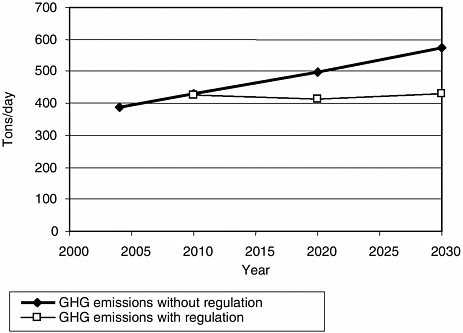
FIGURE B-1 California proposed CO2emissions regulations: projected effect on GHG emissions from motor vehicle operation. (Source: CARB 2004.)
world motor vehicle fleet, but not for the United States alone. The purpose was “to obtain a better sense of the potential impact of various technologies and fuels in reducing transport-related GHG emissions.” The report explains that “our exercise did not examine the technical or economic feasibility of any of the actions being simulated” (SMP 2004, 113). However, the study did consider feasibility and cost and reviewed estimates of the cost and retail price impact of motor vehicle technologies.
One projection scenario is driven by the objective of reducing motor vehicle CO2 emissions by half by 2050 from the level projected to occur in a reference case in which historical trends continue (SMP 2004, 115–117). In the projection, by 2030, half of worldwide light-duty vehicle sales are hybrid vehicles and 45 percent use diesel fuel (these could be hybrids or conventional diesel vehicles). Fuel cell–powered light-duty vehicle sales start in 2020 and are 50 percent of sales by 2050.
NRC HYDROGEN FUELS STUDY
In a DOE-sponsored study, an NRC committee examined the prospects for a conversion to hydrogen as a major fuel in the U.S. economy, and it recommended research and development priorities. The study includes a projection of the feasible rate of conversion to hydrogen fuel cells for motor vehicle propulsion, characterized as a “plausible, but optimistic vision” (NRC 2004, 65), which suggests the possibility of much earlier conversion to new propulsion technologies than the other projections reviewed in this chapter. In the projection, conventional internal combustion engines make up 27 percent of new-vehicle sales and 50 percent of vehicle miles of travel by 2025; hybrid and fuel cell vehicles are 75 percent of sales and 50 percent of vehicle miles of travel. By 2030, hybrid and fuel cell vehicles are 90 percent of sales and 75 percent of vehicle miles of travel. Highway gasoline consumption grows only 17 percent from 2000 to 2025 (compared with 63 percent growth in DOE’s Annual Energy Outlook 2003 reference case projection) and declines after 2015. It falls below 2000 consumption after 2030.
It is not clear what probability the committee placed on this projection. The committee explains that “this vision is not a prediction…. However, it is offered to allow some specificity in the analysis of the possible implications for the U.S. energy system of a transition to hydrogen” (NRC 2004, 64). The report also describes the projection as an “upper-bound market penetration case for fuel-cell vehicles” (NRC 2004, 117) and explains it depends on the assumption that by 2015 to 2020 technology progresses to the point that fuel cell vehicles “have the same functionality, reliability, and cost associated with their gasoline fueled competitors.” The committee did not conduct its own analysis of vehicle costs. In contrast, the CARB and NRC CAFE standards studies, for example, included
component-by-component projections of costs and development schedules. The report does not discuss the driving forces that would be necessary to bring about the projected conversion, but presumably the committee postulated the carrying out of a large-scale and successful industry research and development program, with strong government financial or regulatory incentives for research and sales.
One of the study’s major findings is that “these impacts [of hydrogen-fueled light-duty vehicles] are likely to be minor for the next 25 years” (NRC 2004). If the projection is taken as an upper bound, it indicates that the highest plausible market share of fuel cell vehicles in 2030 will be 20 percent of vehicle miles of travel. However, the projection suggests that rapid growth after 2030 is conceivable.
REFERENCES
Abbreviations
CARB California Air Resources Board
EIA Energy Information Administration
NRC National Research Council
SMP Sustainable Mobility Project
Birky, A., D. Greene, T. Gross, D. Hamilton, K. Heitner, L. Johnson, J. Maples, J. Moore, P. Patterson, S. Plotkin, and F. Stodolsky. 2001. Future U.S. Highway Energy Use: A Fifty Year Perspective: Draft. Office of Transportation Technologies, U.S. Department of Energy, May 3.
Cambridge Systematics. 2004. Assessing and Mitigating Future Impacts to the Federal Highway TrustFund such as Alternative Fuel Consumption. National Cooperative Highway Research Program.
CARB. 2004. Draft: Staff Proposal Regarding the Maximum Feasible and Cost-Effective Reduction ofGreenhouse Gas Emissions from Motor Vehicles. California Environmental Protection Agency, June 14.
EIA. 2005a. Annual Energy Outlook 2005 with Projections to 2025. U.S. Department of Energy, Feb.
EIA. 2005b. Annual Energy Outlook 2006 Early Release. U.S. Department of Energy, Dec.
NRC. 2002. Effectiveness and Impact of Corporate Average Fuel Economy (CAFE) Standards. National Academies Press, Washington, D.C.
NRC. 2004. The Hydrogen Economy: Opportunities, Costs, Barriers, and R&D Needs. National Academies Press, Washington, D.C.
SMP. 2004. Mobility 2030: Meeting the Challenges to Sustainability. World Business Council for Sustainable Development.


