
1
Introduction
The charge to the Committee to Review and Assess the Health and Productivity Benefits of Green Schools is to review and assess existing empirical and theoretical studies concerning the possible connections between characteristics of “green schools” and the health and performance of students and teachers. Ideally, such an evaluation would be based on a generally accepted definition of green schools that would convey specific architectural features, systems, and operational practices. However, among educational professionals, architects, engineers, and others, there is no single, accepted definition of a green school (sometimes referred to as “high-performance green schools” or “high-performance schools”). Instead, there are many definitions with varying levels of detail. The definitions typically focus on environmental or other objectives to be achieved by building in a “green” or sustainable manner. MASSTECH, for example, defines a green school as having the following three distinct attributes:
-
Less costly to operate than a conventional school,
-
Designed to enhance the learning and working environment, and
-
Conserves important resources such as energy and water.
The Collaborative High Performance Schools Web site notes that green schools are defined by the following 13 attributes: healthy, comfortable, energy efficient, material efficient, water efficient, easy to maintain and operate, commissioned, environmentally responsive site, a building that teaches, safe and secure, community resource, stimulating architecture, and adaptable to changing needs (CHPS, 2005). Other definitions abound.
The definitions often are put into operation through various sets of guidelines for constructing green schools. The guidelines typically identify a number of ways in which the objectives can be achieved to some degree. Such guidelines have been issued by California (CHPS, 2004) and Washington state (WSBE, 2005) and are in developmental stages in Massachusetts. These guidelines move well beyond design and engineering criteria for school buildings to address land use, processes for construction and equipment installation, and operation and maintenance practices. Guidelines may include design and engineering goals such as locating schools near public transportation to reduce pollution and land development impacts; placing a building on a site to minimize its environmental impact and optimize daylighting and solar gain; designing irrigation systems and indoor plumbing systems to conserve water; designing energy and lighting systems to conserve fossil fuels and maximize the use of renewable resources; selecting materials that are nontoxic, biodegradable, and easily recycled, and that minimize the impacts on landfills and otherwise reduce waste; and creating an indoor environment that provides occupants with thermal comfort and acoustic, visual, and air quality.
Guidelines for green schools also include construction goals such as the appropriate storage of materials on construction sites to avoid water damage, the reduction of waste
materials and appropriate disposal to reduce resource depletion, and the introduction of commissioning practices1 to ensure the performance of integrated building systems. To address the life-cycle performance of schools, guidelines for operation and maintenance practices are also included, such as using nontoxic cleaning products, replacing air filters in ventilation systems on a regular schedule, and establishing a long-term indoor environmental management plan.
GREEN SCHOOLS VERSUS CONVENTIONAL NEW SCHOOLS
Given the lack of a generally accepted definition of green schools, the committee focused on differentiating land use, building design/engineering, construction, and operations and maintenance practices that are often highlighted in the green school literature and not likely to be introduced in conventional new school construction. The committee then identified research in the literature looking at the relationships between these characteristics and a performance outcome (health, learning, productivity) in students or teachers. A complicating factor is that building systems and characteristics operate in an integrated fashion to effectively deliver (or not) overall building performance in regard to thermal comfort; air, visual, acoustic, and spatial quality; and long-term building integrity. Further, this performance will be affected by the operation and maintenance of these integrated systems over time and by the occupants of buildings and their activities. Thus there is a need to synthesize the results so that potential trade-offs between certain features and practices can be identified.
The committee’s approach then was to identify those building characteristics that are emphasized in available definitions and guidelines as constituting green school design and differ from conventional new school construction norms. The committee also identified those elements that potentially have a level of importance for health and learning outcomes. In this interim report, the committee has focused on the following characteristics of green school buildings and their relationship to occupant health and productivity outcomes:
-
Building envelope, moisture management, and health;
-
Ventilation, pollutant source control, health, and productivity;
-
Lighting, performance, and health;
-
Acoustics, student learning, and teacher health; and
-
Building condition and student achievement.
THE ELEMENT OF TIME
The design and construction of a new school or the renovation of an existing one require a substantial commitment of resources—time, dollars, materials, expertise—by a community. Typically, once built, a school is used for educational purposes for 30 years or
longer. While the building is in service, the investment made in its operation, maintenance, and repair will be six to eight times greater than the initial cost of construction.2
School buildings are composed of materials and components that wear out at differing rates and that vary in their complexity and operations and in the costs to maintain them. So, although a building’s foundations and walls may last for 50 to 100 years, the roof will likely wear out after 20 years and the air-conditioning system in 15 years. The level of maintenance undertaken, the timeliness and quality of the maintenance, the climate, and other factors will also affect the service lives of various systems and components.
Some design changes in green schools may increase the complexity of building systems. No matter how positive the design/engineering and construction gains are for green schools, their ongoing maintenance will be critical to the outcomes for health, learning, and productivity. Thus, the process of creating a green school does not end at the ribbon cutting.
MODELING THE EFFECTS OF GREEN SCHOOLS
Green schools have two complementary, but not identical, goals: (1) to support the development (physical, social, and intellectual) of students, teachers, and staff by providing a healthy, safe, comfortable, and productive physical environment and (2) to have positive environmental and community attributes. Thus, research on green schools might be conceptualized with two quite different sets of outcome measures: improved student and staff health and development, or improved environment and community. In line with its charge, the committee is focusing on outcomes associated with student and teacher health and performance.
An assessment of the outcomes of the quality of a school building on student and teacher health and performance must be set in context. First, time spent in school is, at most, 40 to 50 hours per week, and other environments could equally affect health and performance, including home, neighborhood, recreational, cultural, and religious settings. Even if outcomes could be tied specifically to the quality of the school setting, the influence of other educational factors might be far greater, including quality of curriculum, teacher education/preparation, parental support, peer support, background of student, prior health of student, quality of the administration, and educational standards. For example, research on teaching suggests that student learning is affected by teacher quality (variously defined as teacher experience, teacher knowledge, etc.), and research on learning suggests that student learning may also be affected by the quality of instructional materials, including curriculum, texts, and laboratory equipment. Policy researchers suggest that teaching and learning might be shaped by various state policies regarding teacher education, licensing, hiring, and professional development (Darling-Hammond, 1999), national policies such as the No Child Left Behind Act, and their implementation.
To help inform the committee of mechanisms by which the physical environment might affect student learning, teacher productivity, or the health of students, teachers, and staff, the committee developed a conceptual model for evaluating the research related to such links (Figure 1.1).
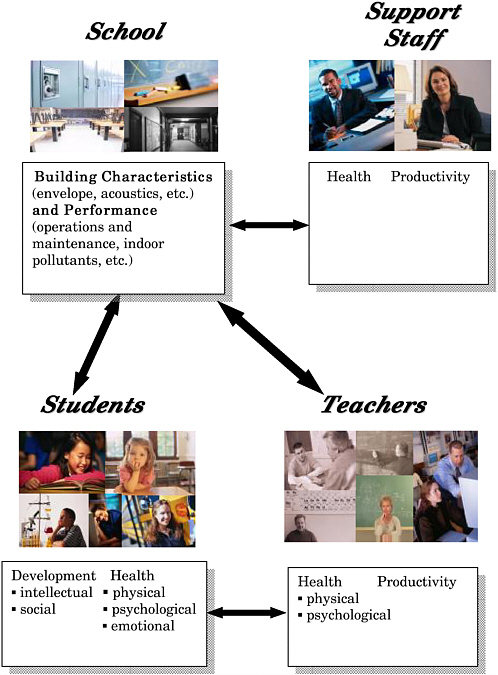
School Building Characteristics and Human Response
In the conceptual model, a school building’s physical characteristics (envelope, acoustics, lighting) affect an individual by providing an environment with appropriate (or inappropriate) light, sound, temperature, air, spatial condition, and other qualities. The performance of a school building and the quality of the environment provided will change by season (e.g., airborne pollen) and over time (e.g., mold growth from chronic water leakage) and will be affected by operational, maintenance, and repair practices and procedures.
Despite the individual nature of systems in school buildings, whether conventional or green, the interactions among systems can determine the overall performance of a building. Ventilation, for example, affects other environmental factors such as temperature, humidity, noise, vibration, and air quality factors of moisture control and microbial contamination. The mechanical ventilation system may also play a role in the transmission of infectious diseases or chemical emissions from materials and products. The location of air intakes, the efficiency of ventilation filters, and the operation of the system all will affect the amount and quality of outdoor air used to ventilate the indoor environment. The quality of a ventilation system’s performance will depend on nonmechanical factors such as the level and timeliness of maintenance and repair, the training of maintenance staff, and management and operational practices. How a school is used (for educational purposes only or for community and other activities) and how intensely it is used (9 or 12 months of the year, by how many people) will also affect the overall performance of its systems.
The physical and psychological health of teachers may be affected by a school building’s characteristics and conditions. When teachers’ well-being suffers, so too might their instruction and their participation in school activities. In that sense, teachers can be seen as both an outcome of building conditions (they might be healthier or not, more motivated or not) and a mediating variable (they might teach differently or interact with students differently depending on their health and well-being) in explaining students’ experiences. They may also positively or negatively alter a school’s physical setting by adjusting the temperature of a room, opening or closing windows, and other actions.
A second population affected by building characteristics is students. Primary outcomes of interest are student learning and health. Student outcomes might be directly or indirectly related to a school building’s condition: If there is high absenteeism at a school among teachers because of poor air quality, the content of instruction may suffer. If students are absent because of poor air quality, there is less opportunity to receive instruction. And, just as teachers can alter the school setting, so too can students.
A third population that can affect and be affected by a school’s environment is the administrators (principals, financial staff, counselors, librarians) and support staff (building operations, maintenance, cleaning crews, and kitchen workers). These groups may spend as much time in a school building as teachers and students and sometimes at different times of the day (before and after classes, on weekends, during school breaks and summer vacation). The quality of the support staff training may be of particular significance in the performance of building systems, the timeliness and quality of maintenance and repair, and cleaning and sanitation practices.
Outcomes of Human Responses
It is impossible for researchers to directly access an individual’s personal experiences. Instead, access to those experiences is gained indirectly by measuring outcomes such as learning, productivity, or attendance or by revealed preference (surveys). It becomes quite complicated to draw firm inferences about a cause-and-effect relationship between the physical environment and health and performance outcomes for individuals. Often multiple converging lines of research are needed for establishing “scientific fact.” In addition, differing populations may have differing responses to features or attributes of the built environment.
In studying the relationships between building characteristics and condition and related teacher and student outcomes, researchers use indicators or surrogates for the relevant variables (Table 1.1). In the studies reviewed by the committee, multiple and quite varied measures were used for both the independent and the dependent variables. One measure, absenteeism, was used as a surrogate measure for student health, teacher health, student learning, and teacher productivity. (The committee plans to discuss outcome indicators in greater detail in its final report.)
TABLE 1.1 Illustrative Example of Indicators Used to Measure Relevant Outcomes
|
|
Student |
Teacher |
|
Health |
Asthma |
Asthma |
|
Allergies |
Allergies |
|
|
Cold/flu and other respiratory diseases |
Cold/flu and other respiratory diseases |
|
|
Headaches |
Vocal fatigue |
|
|
Eye fatigue |
Headaches |
|
|
|
Eye fatigue |
|
|
Development (learning and productivity) |
Standardized test scores |
Turnover/retention |
|
Working memory |
Attitude/motivation |
|
|
Prospective memory |
Teaching behaviors/methods |
|
|
Sustained attention |
Years of experience |
|
|
Reading comprehension |
Knowledge |
|
|
Verbal comprehension |
Educational preparation |
|
|
Demonstration of concepts |
Certification/licensure |
|
|
Graduation rates |
Teacher examination scores |
|
|
College enrollment rates |
|
|
|
Disciplinary incidents |
|
COMPLEXITY OF THE TASK
The committee has been asked to consider the possible influence of confounding, bias, error, and chance in the relevant literature. Confounding, in particular, poses a major challenge to researchers and those evaluating their work. Confounding occurs when the exposure-adverse event association is biased as a result of a third factor that is capable of
causing the adverse event and is statistically associated with the exposure. For example, in any epidemiological study comparing an exposed with a nonexposed group, a simple comparison of the groups may either exaggerate or hide the true difference, because it is likely that the two groups will differ with respect to factors that are also associated with the risk of the outcome of interest, such as socioeconomic status. Said differently, a simple comparison of the incidence of health outcomes among exposed and nonexposed groups may exaggerate an apparent difference because socioeconomic status is also thought to influence the incidence of several health problems.
A variety of confounding factors will be present in any study that attempts to link features of school buildings with student and teacher health and development. Age differences among students will influence the outcomes of research into health and learning: Young children have a higher relative volume of breathing per weight than teenagers; their tissues and organs are actively growing; they are still developing language and cognitive skills; and they spend more time in school than anywhere but home.
Research studies that include the use of any measure of student performance in making comparisons to other variables must try to control extraneous variables that influence the performance of students. For instance, when comparing student achievement test scores with the condition of the physical environment, a researcher would normally attempt to control other influences or variables that affect outcomes. They may include socioeconomic status, the community background of a student or a teacher, or the curriculum. Student test scores will also be influenced by conditions in the classroom on the day of the test and other factors.
Another confounding factor is that school buildings themselves are not standardized, making direct comparisons between school environments problematic. Unlike tract housing developments, most schools are designed by architects as unique structures, whose features depend on the resources available, construction methods, teaching methods, and building codes in effect at the time. They may have one or multiple stories, accommodate a hundred or several thousand students, and may be 5 or 100 years old; all of these factors could potentially influence health and performance outcomes.
The condition of school buildings is also a factor to be considered. School conditions are widely divergent across the country or even within localities. Those school systems with less financial ability and a greater percentage of students from low-income households seem to have school buildings in worse condition than those school systems that have a high tax base and the financial and leadership ability to solve the problems of providing good school buildings for students. Compounding these difficulties is the collection of data about school buildings: The Educational Writers Association (1989) found that few states had sufficient capability to properly evaluate school buildings because the department of education either had few or no personnel to conduct such services. Consequently, the collection of data was erratic.
The Variability and Quality of Research
Gaps in the research literature are also of concern. For example, much of what is known about the impact of the physical environment on health, well-being, and performance is based on studies of adult populations. Some research is quite narrow—in an effort to control for all possible extraneous variables. Other research is so broad that confounding
variables are possible, if not likely. In general, much less is known about the impact of the school environment—green or otherwise—on the health and performance of children as compared with the impact of workplace environments on adults. Extrapolating from studies of adults to conclusions about a much younger population can be suspect. For example, environmental factors in the school may interact with genetic factors to determine the degree to which a child develops language skills or displays asthma symptoms. The physical environment could potentially have acute as well as lifelong effects on children’s health and performance.
The line of reasoning inherent in this study’s task—mapping connections from physical environments to student and teacher outcomes—poses significant challenges concerning cause-and-effect relationships. One challenge is that of directionality of relationships. Green schools might have positive effects on student health, but it might also be that students who live in communities inclined to build green schools are healthier to begin with. Another challenge is that in a conceptual model such as the one used here, the effects of physical environments might be “trumped” in some ways by other forces—teacher quality or parent involvement or financial resources. With outcomes as complex as student health and development—influenced as they are by many school, family, and community factors—it might be impossible to design research that controls for all potentially confounding variables.
A third challenge concerns the variability in the characteristics and standards used by different disciplines to conduct research. For example, medical research may employ clinical trials and intervention studies in which various factors can be controlled for and their results directly evaluated using established protocols. Often clinical trials of drugs include placebos administered according to the same protocol as the drug of interest. Epidemiological studies often rely on statistical significance as a quantitative measure of the extent to which chance or sampling variation might be responsible for an observed association between an exposure and an adverse event. In these studies, quantitative estimation is firmly founded in statistical theory on the basis of repeated sampling.
Studies linking the built environment with the behaviors of its occupants, in contrast, cannot set up strictly controlled trials or easily manipulate variables to test for statistical significance. Studies attempting to link students’ and teachers’ development with school environments cannot control for the effects of the environments in which students and teachers live during the times when they are in nonschool venues. In addition, there are no standard protocols for conducting building-related research, although some studies have used similar methodologies or evaluation methods, including multiple regression analyses and measures of statistical significance.
Measuring Student Learning and Teacher Productivity
Education is the transferring of knowledge and skills to students and is difficult to measure directly. To measure whether and how well students are learning, indicators or surrogate measures are often used to determine whether cognitive skills are indeed being transferred. Such surrogates include standardized test scores, demonstration of concepts, and graduation rates.
Productivity for an individual or an organization has been defined as the ability to enhance work output through increases in either the quantity and/or the quality of the product or service to be delivered (Boyce et al., 2003). Productivity is influenced both by the individual and the system within which he or she works. Increasing evidence is available to indicate that the built environment can influence both individual and organizational productivity. It can be measured in the number of units manufactured or in the number of words typed correctly in a given amount of time. Absence is often used as a surrogate, the rationale being that people who are absent are less productive than people who are on the job.
For other kinds of work, including teaching, productivity is more difficult to define and measure. Productivity is closely linked to the “quality” of teachers, both individually and collectively. Researchers have used various measures such as years of service, educational preparation, certification/licensure, and scores on teacher examinations (Praxis) in an attempt to obtain a measure of objectivity in determining the quality of the teaching staff. These measures can be quantified to a certain extent and therefore are used quite efficiently in research studies. These measures of quality have not been tested sufficiently, however, to enable a great deal of confidence in their effectiveness. The years of experience a teacher has is to a degree a measure of quality because the teacher is usually evaluated for the decision of granting tenure. To that extent, the quality of the teacher is high enough that the administration decides to retain the teacher because in its judgment the teacher has performed satisfactorily in the years before being considered for tenure. Conversely, there is no guarantee that gaining tenure is anything more than meeting the minimum standards.
For those reasons and because of the multiplicity of variables that can influence learning, evaluations of educational interventions do not often find a significant change in student achievement outcomes. Intensive in-service education for teachers, major revisions of curriculum, and addition of curricular units on substance abuse prevention or economics tend to show small gains at best. Thus, if certain building characteristics or operation practices also are shown to yield only a small gain, at best, in student achievement, such an outcome is not unexpected.
COMMITTEE’S APPROACH
The committee’s initial review of the literature focused specifically on those studies that purport to address the connections between sustainable or green building design, student learning and health, and teacher productivity and health. No well-designed, evidence-based studies concerning the overall effects of green schools on the health or development of students and teachers were identified. However, a few studies examined specific building features often emphasized in green school design and the effects of these features on health and performance. Among those are a series of studies on daylighting and student achievement produced by the Heschong-Mahone Group between 1999 and 2003. These studies are discussed in Chapter 4. For the most part, however, the literature on green schools, health, and productivity consists of anecdotal information and case studies of varying quality. The committee also did not identify any evidence-based studies that analyze whether green schools are actually different from conventional schools in regard to the health and productivity of occupants. This lack of well-designed, evidence-based studies specifically related to green schools is understandable, because the concept of green schools
is relatively new and evidence-based studies require a significant commitment of time and resources.
A much more robust body of scientific evidence is available that looks at the characteristics emphasized in green school design—building envelope, mechanical and engineering systems, lighting, acoustics—and their relationships to occupant health, development, and productivity. Typically, those studies look at a single system or at a very limited number of variables, and the quality of the studies varies. For example, a literature review of the available evidence on building characteristics, dampness, and health effects identified 590 epidemiological studies addressing these topics. Of these, only 61 met standards for a strong study design and the provision of useful information (NORDAMP, 2002). Relatively few studies look at the interrelationships of two or three building systems and their effects, for example, ventilation, acoustics, learning, and health. With these caveats in mind, the committee determined it should review the scientific literature relating to those characteristics of green schools that are typically emphasized in definitions and guidelines and that differ from conventional school building practices.
However, a review of all research literature that touches on some aspect of buildings and their potential impacts on occupant health, learning, or productivity is an undertaking beyond the resources of this study. In cases in which rigorous reviews of a particular aspect of interest have been conducted by the National Research Council or other organizations or researchers, the committee relies on that work (e.g., IOM, 2004; Mendell and Heath, 2004). In those areas in which the research is fairly limited but important to the study, the committee is conducting its own review. In all cases, the committee describes the source of the literature reviewed, the research methodology used in the studies reviewed, and the basis for the committee’s conclusions. Ultimately, the determination of the scope of the literature review must be based on the committee’s collective judgment in regard to where its efforts should be concentrated to best address the task statement and meet the sponsors’ requirements.
In evaluating the literature, the committee has relied on a hierarchy of evidence for scientific inference developed by the National Academies (Box 1.1) for use in health-related studies (IOM, 1991, 1993, 1994, 1996, 1999, 2003). This hierarchy has played an important role in the committee’s deliberations.
Given the level of interaction between people and their environments and other confounding factors, it may never be possible to categorically establish a causal relationship between an attribute of a school building and its effect on students, teachers, and staff. The effects of the built environment will necessarily appear to be small, given the number of variables. Nor may it be possible to quantify the effects of one feature, such as acoustics, on student learning. The committee used its collective best judgment with regard to evaluating the plausibility of the published research and possible explanations of physiological mechanisms, and then integrated the results of those studies found to be useful (if flawed) into its findings, conclusions, and recommendations.
|
Box 1.1 National Academies’ Hierarchy of Evidence for Scientific Inference in Health-Related Studies Sufficient Evidence of a Causal Relationship: Evidence is sufficient to conclude that a causal relationship exists between the agent and the outcome. That is, the evidence fulfills the criteria for sufficient proof of an association, and in addition, satisfies evaluation criteria such as strength of association, biologic gradient, consistency of association, biologic plausibility and coherence, and temporally correct association. The finding of sufficient evidence of a causal relationship between an exposure and a health outcome does not mean that the exposure would inevitably lead to that outcome. Rather it means that the exposure can cause the outcome, at least in some people under some circumstances. Sufficient Evidence of an Association: Evidence is sufficient to conclude that there is an association. That is, an association between the agent and the outcome has been observed in studies in which chance, bias, and confounding can be ruled out with reasonable confidence. Limited or Suggestive Evidence of an Association: Evidence is suggestive of an association between the agent and the outcome but is limited because chance, bias, and confounding could not be ruled out with confidence. For example, at least one high-quality study shows a positive association, but the results of other studies are inconsistent. Inadequate or Insufficient Evidence to Determine Whether or Not an Association Exists: The available studies are of insufficient quality, consistency, or statistical power to permit a conclusion about the presence or absence of an association. Alternatively, no studies exist that examine the relationship. Limited or Suggestive Evidence of No Association: Several adequate studies are consistent in not showing an association between the agent and the outcome. A conclusion of “no association” is inevitably limited to the conditions, magnitude of exposure, and length of observation covered by the available studies. SOURCE: IOM, 2004. |
Empirical measures do not, however, necessarily capture all relevant considerations that should be applied when evaluating research results. Qualitative aspects of the environment are also important. Thus, in the committee’s collective judgment, there is value in attempting to identify design features and building processes and practices that may lead to improvements in learning, health, and productivity for students, teachers, and other school staff, even if empirical results are less than robust.
Chapters 2 through 6 of this interim report present the committee’s findings and recommendations related to building envelope, moisture management, and health; ventilation, pollutant source control, health, and productivity; lighting, performance, and health; acoustics, student learning, and teacher health; and building condition and student achievement. As noted previously, additional topic areas, findings, and recommendations will be included in the committee’s final report.
FINDINGS
Finding 1: In its review thus far, the committee has found the following:
-
There are no well-designed, evidence-based studies concerning the overall effects of green schools on the health or development of students and teachers, in part because the concept of green schools is quite new. There are, however, a few well-designed studies that examine specific building features often emphasized in green school design and the effects of these components on health and learning.
-
Given the level of interaction between people and their environments and other confounding factors, establishing cause-and-effect relationships between an attribute of a school building and its effect on students, teachers, and staff is difficult. The effects of the built environment will necessarily appear to be small, given the number of variables.
-
Empirical measures do not, however, necessarily capture all relevant considerations that should be applied when evaluating research results. Qualitative aspects of the environment are also important. Thus, in the committee’s collective judgment, there is value in attempting to identify design features and building processes and practices that may lead to improvements in learning, health, and productivity for students, teachers, and other school staff, even if empirical results are less than robust.


