
Outcomes of the Research Program Grants
The committee was able to arrive at some conclusions and offer observations about the success of the Research Program Grants program on several dimensions.
THE TRUST’S FUNDS WERE DISTRIBUTED IN ACCORDANCE WITH MRS. MARKEY’S WISHES
More than $325 million were distributed to 92 Research Program Grants recipients during an interval of only 10 years. This sum represented about three-fifths of the entire Markey estate. Funding for Research Program Grants was directed to basic biomedical research in accordance with Mrs. Markey’s wishes; all funds were expended within 15 years of her death, and the Trust was terminated, as she had directed. The committee recognized that it was unable to assess either the scientific merit of the 92 Research Program Grants proposals or the outcomes of each grant. However, it was able to assess the expenditure of funds by grantees in relation to their original proposed uses of funds. The committee observed that in nearly every case, grantees spent the funds they received in accordance with the manner proposed.
THE SELECTION PROCESS USED BY THE MARKEY TRUST AND THE NATURE OF AWARDS MADE DIFFERED FROM THOSE OF THE NIH AND NSF
The selection process used by Markey Trustees was considerably different from that used by public funders of basic biomedical research. Rather than a peer-review system that is repeated on an annual basis, Markey Trustees solicited and invited elite and proven researchers to submit ideas for research proposals. Investigators whose proposals interested the Trustees were asked to revise and resubmit their proposals. For some investigators, this entailed multiple iterations to develop a proposal that fit the Trustee’s criteria. In such cases, the Trust staff worked with potential grantees to fine-tune proposals. These criteria are detailed in the section “Selection of Research Program Grants” earlier in this report.
During its initial planning meetings and at the two think-tank meetings, the Trust established the grant mechanism as the vehicle for distribution of most of its fund. More than $325 million was given to an elite cadre of proven investigators with a high likelihood of success. Success can be measured by examining the characteristics of recipient investigators and institutions and comparing them with the criteria for funding mandated by the Trustees. Within this report, Appendix A provides descriptions of all Research Program Grants recipients. An additional approach to examining the success of the selection process is to examine the outcomes of the recipient investigators and institutions. It is possible in a very general way to say that Markey funds were used to support infrastructure, recruit faculty, support postdocs, and to fund research. The committee utilized analysis of progress reports to assess the outcomes of the Research Program Grants recipients. Finally, another approach to determining the excellence of awardees is to determine the amount of competition or the “success rate” of Research Program Grants applications, which is the probability of any individual applicant receiving an award. In addition, the Markey success rate can then be compared to that of other funders of basic biomedical research.
During its lifetime, the Trust received 792 proposals for Research Program Grants that were deemed of sufficient quality to be reviewed by the director for medical science and/or senior consultants. The success rate for Research Program Grants made by the Markey Trust was 12 percent. This was considerably lower that the 47 percent acceptance rate for research program projects (P01 awards) and the 27 percent of traditional research project grants (R01 awards) funded by the National Institutes of Health (NIH) during the same years (NIH, 2004). For the National Science Foundation (NSF), the success rate for grants in the Directorate of Biological Sciences during the interval ranged from 23 to 30 percent.
TABLE 1 Number of Research Grant Proposals Reviewed and Funded by the Markey Trust, Total Funding by Year, and Average Award Amount: 1985 to 1995
|
Fiscal Year |
Applications Reviewed |
Grants Awarded |
Total Funding |
Average Award Amount |
|
1984 |
41 |
— |
— |
— |
|
1985 |
202 |
0 |
— |
— |
|
1986 |
152 |
5 |
$38,037,773 |
$7,607,555 |
|
1987 |
47 |
0 |
— |
— |
|
1988 |
78 |
21 |
$105,120,402 |
$5,005,733 |
|
1989 |
77 |
3 |
$20,540,000 |
$6,846,667 |
|
1990 |
58 |
5 |
$27,100,000 |
$5,420,000 |
|
1991 |
32 |
12 |
$41,450,000 |
$3,454,167 |
|
1992 |
43 |
9 |
$29,500,000 |
$3,277,778 |
|
1993 |
10 |
5 |
$14,000,000 |
$2,800,000 |
|
1994 |
21 |
6 |
$9,100,000 |
$1,516,667 |
|
1995 |
31 |
26 |
$31,400,000 |
$1,207,692 |
|
Totals |
792 |
92 |
$310,003,175 |
$3,437,486 |
|
SOURCES: Lucille P. Markey Charitable Trust, 1996. Lucille P. Markey Charitable Trust Records. |
||||
Table 1 shows the number of proposals reviewed and the number funded by the Markey Trust from 1985 to 1995. It is difficult to compare directly to NIH or NSF because they used a peer- review process and proposals were both reviewed and funded within the fiscal year of receipt. At NSF, for example, the median time for review of a grant application is about 6 months. For the Markey Trust, the lag between receipt of a proposal for review and its eventual funding was considerably longer. In many cases, the lag spanned several years.
NIH is the largest funder of biomedical research. Although there is no NIH funding mechanism that compares directly with Markey Research Program Grants, two similar mechanisms are traditional research projects and research program projects. During the 1985 to 1995 interval, NIH made 832 new research program project awards, each for about $800,000 per year. These research program projects, or P01, awards are made “for the support of a broadly based, multidisciplinary, often long-term research program, which has a specific major objective or a basic theme.” They may involve relatively large groups of individuals under the direction of an established investigator or involve sharing of resources, includ-
ing clinical facilities. They are directed toward multiple problems having a central research focus. During the same interval, NIH funded 28,445 traditional research project, or R01, awards for about $180,000 per year. Table 2 shows the number of applications for P01 and R01 grants between 1985 and 1995, the number funded, and the average cost for the first year of funding.
Most Markey awards were made for a period of 5 years; but many of the awards made in 1994 and 1995 were for only 3 years. Because of the flexibility of the Markey award structure, many grantees were able to extend the period of performance up to an additional 3 years. The median length for the NIH competing research project awards was approximately 3.5 years (NIH, 2000). Thus, by extrapolation, the typical NIH research program project award was about $2,800,000, and the typical traditional R01 research project award was about $630,000 compared to $3,437,486 for the average Research Program Grants funded by the Markey Trust.
An additional difference between the Markey Trust and NIH was the focus and time frame for the selection process. The Markey Trustees and expert consultants were under no time constraints in their review of applicants. In many cases, the review process extended over many years and involved multiple revisions and resubmissions of an application. The focus of the Markey selection process was on the identification of a few outstanding applications that had a very high probability of achieving the project’s goals. NIH, however, has less flexibility in funding and does not have the luxury of being able to establish interactive and iterative communications with an applicant.
The Directorate of Biological Sciences of NSF supports research to advance understanding of the underlying principles and mechanisms governing life. NSF does not fund basic biomedical research per se. Rather it funds research that ranges from the study of the structure and dynamics of biological molecules, such as proteins and nucleic acids, through cells, organs, and organisms, to studies of populations and ecosystems. In FY 2003, the Directorate of Biological Sciences awarded 1,448 grants with a median annual award size of $102,000. Table 3 shows the number of applications for NSF grants for the Directorate of Biological Sciences grants between 1985 and 1995, the number funded, and the median level of funding. The median length of these NSF awards was approximately 2.75 years (NSF, 2004), and by extrapolation, the median amount of the typical award was about $151,000.
In summary, the committee recognized that the Markey Trustees adopted a method of identification and selection of grantees that differed considerably from methods used by NIH and NSF. The approach adopted by the Trustees utilized an expert review rather than a peer- review approach to assess a proposal’s merit. This approach provided dollars to
TABLE 2 Number of Research Grant Proposals Reviewed and Funded by NIH, Success Rate, and Average Annual Costs: 1985 to 1995
|
Fiscal Year |
NIH P01 Awards |
NIH R01 Awards |
||||||
|
Number Reviewed |
Number Awarded |
Success Ratea |
Average Costb |
Number Reviewed |
Number Awarded |
Success Ratea |
Average Costb |
|
|
1985 |
214 |
76 |
35.5 |
$703,612 |
12721 |
3093 |
24.3 |
$124,286 |
|
1986 |
164 |
70 |
42.7 |
$709,287 |
12015 |
2821 |
23.5 |
$125,675 |
|
1987 |
200 |
94 |
47.0 |
$748,366 |
10525 |
2747 |
26.1 |
$145,827 |
|
1988 |
202 |
78 |
38.6 |
$876,216 |
11628 |
2545 |
21.9 |
$149,072 |
|
1989 |
186 |
66 |
35.5 |
$776,301 |
12203 |
2449 |
20.1 |
$169,682 |
|
1990 |
201 |
68 |
33.8 |
$783,349 |
12647 |
2217 |
17.5 |
$180,421 |
|
1991 |
218 |
80 |
36.7 |
$773,510 |
12041 |
2569 |
21.3 |
$193,754 |
|
1992 |
224 |
89 |
39.7 |
$850,039 |
12351 |
2555 |
20.7 |
$194,054 |
|
1993 |
218 |
74 |
33.9 |
$875,730 |
13971 |
2212 |
15.8 |
$198,789 |
|
1994 |
184 |
60 |
32.7 |
$946,895 |
15148 |
2755 |
18.2 |
$208,157 |
|
1995 |
268 |
77 |
28.8 |
$790,298 |
13923 |
2482 |
17.8 |
$223,078 |
|
aSuccess rates are the number of reviewed applications divided by the number funded, on a fiscal year basis. bThe cost is the sum of direct and indirect costs for the fiscal year, and not for the life of the project. SOURCE: NIH Competing Applications by Type of Grant and Activity, available at http://grants1/nih/gov/grants/award/success/rpgbyacttype7002.htm |
||||||||
TABLE 3 Numbers of NSF Grants from the Directorate of Biological Sciences Reviewed and Funded, Success Rate, and Median Award Amount: 1985 to 1995
|
Year |
Number Reviewed |
Number Awarded |
Success Rate |
Median Annual Awarda |
|
1985 |
5459 |
1623 |
30 |
$50,000 |
|
1986 |
5520 |
1395 |
25 |
$50,000 |
|
1987 |
5254 |
1450 |
28 |
$51,685 |
|
1988 |
5959 |
1369 |
23 |
$53,222 |
|
1989 |
5319 |
1502 |
28 |
$52,373 |
|
1990 |
5881 |
1523 |
26 |
$50,000 |
|
1991 |
5670 |
1406 |
25 |
$57,167 |
|
1992 |
5147 |
1390 |
27 |
$59,242 |
|
1993 |
4863 |
1318 |
27 |
$56,667 |
|
1994 |
4677 |
1402 |
29 |
$63,083 |
|
1995 |
5216 |
1389 |
26 |
$61,803 |
|
aThe median duration of awards wa about 2.75 years. SOURCE: National Science Foundation. 2004. Funding Rate by State and Organization for Biological Sciences, available at http://delweb.bfa.nsf.gov/awdfr3/org.asp. |
||||
proven investigators and institutions that enabled them to take risks and innovate across disciplines and departments.
FUNDING OUTCOMES
Evaluating the outcomes of each of the 92 Research Program Grants is beyond the scope of this study. Nor are the data available to assess outcomes of the grants, for a number of reasons:
-
For most awards, the level of funding originally requested was reduced by the Trustees to a more modest level, sometimes without changing the scope of the proposal. Because Research Program Grants were not renewed, Trustees tended to fund one-time expenses and leave funding of continuing operations to the host institution. Nevertheless, the sustainability of many of the programs, such as those at the University of Vermont, Baylor College of Medicine, and the Whitehead Institute, demonstrates the ongoing success of the programs.
-
In many cases, moneys from the Markey Trust were commingled with funding from other sources. In such cases it was difficult, if not
-
impossible, to differentiate the outcomes attributable to Markey funding from those attributable to other funding.
-
Research Program Grants were funded for 5 years. Moreover, owing to the flexibility of the Markey Trustees in administering Research Program Grants, many recipients were able to extend funding beyond the original dates. For some of these grantees, the original program goals and processes evolved and changed during the grant’s tenure.
-
Awards made by the Markey Trustees were not renewed because this was a limited-term trust. (However, some recipients received one-time supplements.) Consequently, the leverage generated by the renewal process was not available to enhance outcomes. Instead, the Markey Trust relied on leadership, faculty collegiality, and the identification of a productive scientific environment at host institutions to ensure positive outcomes.
-
A small minority of grantees faced major obstacles or encountered major barriers to reaching their program goals. In most cases, this involved the inability to recruit or the unexpected loss of key personnel. In such cases, the grantee regrouped, reorganized, and targeted new areas of biomedical research. Unfortunately, in many cases, these changed plans were not documented and therefore the data are not available for evaluation.
-
Finally, grantees were not required nor expected to conduct process and outcome evaluations. Consequently, they did not collect monitoring data that would aid in an evaluation.
Although the programs funded by Markey grants do not lend themselves to explicit evaluation of their outcomes, the committee believes that the grants were used by institutions and individuals in the way intended (i.e., to support the development of infrastructure, to recruit and provide start-up packages for faculty, to support training and research of graduate students, and to advance the biomedical sciences). The committee saw many examples of excellent science and outstanding programs in the site visits and interviews. In the committee’s opinion these are worthy investments for other philanthropic organizations, but due to the structure and approach used here, there is little information to inform the specific guidelines for making grants. The committee, however, does want to note that investment in institutions with proven records and in an elite cadre of principal investigators is an appropriate approach by private funders to making grants.
A detailed listing of the minimal assessment of uses of grant funds is presented in Appendix D. In summary, the 92 Research Program Grants supported 1,744 persons: 150 faculty with full support; 502 faculty with partial support; 121 postdoctoral fellows with full support; 330
postdoctoral fellows with partial support; 471 graduate students and 11 undergraduate students; 112 technicians; and 47 investigators. Investigators included scientists in non-academic institutions, and scientists in academic institutions without academic rank. In addition, the 92 Research Program Grants provided $62,700,000 for major equipment purchases and $30,368,000 in construction and renovation costs. Finally, a number of recipients used Markey funding to support animal and other shared facilities.
One of the goals of the Research Program Grants was to fund projects that ordinarily would not be funded by NIH or NSF. The construction or renovation and major equipment costs were examples of funding sometimes not covered by NIH or NSF. Moreover, Markey funds were used to provide flexible dollars to support preliminary data or risky science often not supported by NIH or NSF.
Anecdotal evidence indicates that investigators often were able to commingle Markey funds with funding from other sources to achieve even greater goals. For example, at Cornell’s Institute of Human Neuroscience, Markey funds were combined with those from other sources to make major equipment purchases. At Florida State University (FSU), Markey funds were combined with those from NIH, NSF, and the FSU Research Foundation to establish the Institute for Molecular Biophysics. At Carnegie Mellon University, Markey funds were commingled with funds from the University of Pittsburgh to establish the Pittsburgh Nuclear Magnetic Resonance Center for Biomedical Research. In addition, many of the scientists initially supported by Markey funding were able to obtain funding from other sources that enabled them to continue or expand their research agendas.
THERE WERE DIFFERENCES IN THE OUTCOMES FOR INFRASTRUCTURE DEVELOPMENT VS. INVESTIGATOR-INITIATED GRANTS AND FOR LARGE VS. SMALL AWARDS
As part of the assessment, the committee classified Research Program Grants as infrastructure development awards or investigator-initiated awards. In addition, the committee dichotomized awards as large—$4 million and or more in total funding—or small. The committee classified infrastructure development awards as those focused on the creation or major expansion of a department, center, or institute. Investigator-initiated awards were those that were oriented toward enhancing the research agendas of existing or newly hired scientists. The committee viewed investigator-initiated awards as being similar to R01 or P01 awards made by NIH.
Half of the awards made were for infrastructure development, and

FIGURE 2 Number of research program grants awards and total funding by award size and type.
SOURCE: Lucille P. Markey Charitable Trust, 1996.
half funded investigator-initiated research. However, infrastructure development awards received more than $200 million in funding; considerably more than the $110 million awarded to investigator-initiated programs (see Figure 2).
Recipients of large awards were more likely to purchase major equipment and to use funds for construction and renovation. Of the 30 large awards recipients—21 infrastructure development and 9 investigator-initiated awards—over $62 million was used on equipment, construction, or renovation, an average of $2 million per award. Of the 62 of small awards recipients—26 infrastructure development and 36 investigator-initiated awards—$28 million was used on equipment, construction, and renovation. Almost all of these funds were used for equipment—an average of $450,000 per award.
Recipients of small awards tended to use Markey funding for human capital. The 62 small awards used Markey funds to support more than 1,000 persons, ranging from undergraduates to research professors. On average, the small-award recipients supported 8.6 persons for each mil-
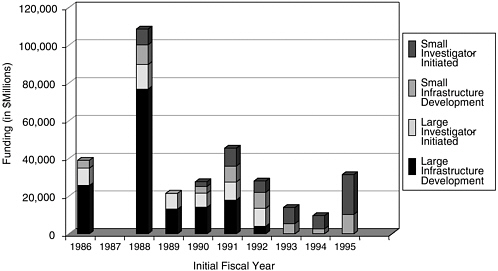
FIGURE 3 Funding of research program grants awards by size, type of award, and initial fiscal year.
SOURCE: Lucille P. Markey Charitable Trust, 1966.
lion dollars of Markey funds. The 30 large-award recipients supported more than 700 persons at all levels. On average, the large-award recipients supported 3.5 persons for each million dollars of Markey funds.
Figure 3 shows the changes in the distribution of Research Program Grants awards by size and type from the beginning to the final years of the Markey Trust. The figure clearly reflects the change in Trustee focus from large infrastructure development awards during the initial years of funding to small investigator-initiated awards during the final years of the Trust.
THE TRUST’S FLEXIBILITY IN THE ADMINISTRATION RESEARCH PROGRAM GRANTS WAS CITED MY MANY INVESTIGATORS AS EXTREMELY USEFUL
The Markey Trustees prided themselves on two aspects of the administration of the Trust. First, the Trustees were dedicated to minimizing costs associated with the Trust’s administration; second, they wanted to maximize the flexibility by which funds were used by Research Program Grants recipients. The Trustees were less concerned with the processes and time lines adopted by the recipients to achieve the outcomes listed in the proposals; this was noted by recipients as a valuable attribute.
In addition, the Trustees were willing to allow principal investigators to carry funds forward if they could not be spent wisely in the current fiscal year. In some cases, protocols and personnel envisioned in the Research Program Grants proposals were not completed within the proposed funding period. Approximately 30 percent of the grantees requested no-cost time extensions, some for as long as 4 years. For some projects, this involved identifying and hiring key scientists. Usually the recipient could not commit to a new faculty slot until funding had been secured. In other cases, the recruiting and hiring process for new faculty lines took much longer than anticipated. A few recipients experienced the unexpected departure of key faculty at critical times and were forced to place the project on hold until replacement faculty could be identified and hired. Finally, for some infrastructure development awards, facility construction and renovation time lines took much longer than anticipated. For all of these examples, the Trust’s authorization to carry funds forward and not lose them allowed the recipients to shepherd the funds until they could be spent wisely. One grant recipient wrote:
One of the major reasons that the Markey funds have been so effective in supporting these successes has been the degree of flexibility that the Trust has provided for using these funds. Since the use of most other funding is tightly and narrowly restricted, the Markey funds have been virtually the only source of flexible funding for our Institute, with which we can respond to new needs and, even more importantly, new opportunities.
The flexibility of the Markey funds is not surprising. In an earlier study on the financing of biomedical research, Ginzberg and Dutka state (1989:91):
On balance, foundation and private donor support for biomedical R&D is viewed by the respondents as providing more flexibility than government support. Specific attention is directed to less onerous reporting requirements, the ability to work with the donor in shaping the terms of the gift, and the speed of eliciting support when time is an important consideration.
Consequently, the committee believes that the policy of giving principal investigators flexibility in the use of funds contributed to the effective use of Markey funds. The committee recognizes that the “use-it-or-lose-it” approach of annual funding allocations can lead to less than optimal use of funds. The committee also recognizes that for large projects, such as infrastructure development projects, unexpected barriers to implementation can occur and that flexibility in funding can enable the recipient to develop strategies to overcome these barriers. Echoing these sentiments, another Research Program Grants recipient wrote:
By being limited in time and focused in programmatic giving, it had a profound catalytic effect on American biomedical sciences related to problems of human disease. It will, of course, be more difficult to measure this than programs which have spent less of their resources and have used their resources to sustain themselves over many, many years. The Markey Trust was always lean and mean with minimal administrative staff and maximal flexibility. They had unique leadership in the persons of Dr. Robert Glaser and Mr. Louis Hector whose wisdom I have not seen equaled before or after. It is my impression that a great many charitable foundations spend a large proportion of their resources on program officers and staff; they inevitably become bureaucratized and they dole out funds in small amounts which have minimal impact. The Markey Trust used an opposite philosophy, giving relatively large sums that truly made a difference in a concentrated way with minimal bureaucratic micromanaging. This is, I think, a reflection not only of the trustees and of the excellent staff, but of the outstanding and enlightened leadership of Bob Glaser and Louis Hector.
THE MARKEY FUNDING ENABLED INVESTIGATORS AND INSTITUTIONS TO TAKE RISKS
The committee found notable examples of high-risk research funded by Markey that had substantial payoffs. For example, Dr. Eric Lander arrived at Whitehead as a Markey Fellow and then was appointed to the faculty. As a Markey Fellow, he could test and refine new concepts in gene mapping, gene sequencing, and bioinformatics. Today, he heads the largest academic genome center in the world. Through his work in functional genomics, he is building a new framework for deciphering the origins of complex human diseases such as cancer, diabetes, and heart disease. The Markey Trust helped lay the foundation for this progression by providing partial support for the Lander laboratory for 5 years. Lander has been the subsequent recipient of 11 NIH grants—1 research program project, 3 specialized center awards, 3 R01 awards, 1 scientific evaluation award, and 3 Cooperative Agreements.
In 1991, the molecular neurobiology group at Cold Spring Harbor Laboratory was initiated to study the molecular basis of learning and memory. The initial research focus employed learning and memory mutants of Drosophila to identify genes involved in these processes and determine how they affected behavior. The first big breakthrough came with the surprising and important discovery that Drosophila had long-term memory and that spaced learning trials were necessary to memorize learned tasks (as is true in humans). In succeeding years the group reported the identification of the transcription factor CREB as an essential
component of the memory process and the demonstrated enhanced memory by overexpressing a form of the CREB protein prior to learning. The initial success of this program led to its continued expansion. It now includes the molecular basis of long-term potentiation, synaptic plasticity, neuronal development, behavioral genetics, and computational neuroscience.
With the support of Markey funds, researchers in the Neurobiology Research Center at the University of Alabama at Birmingham identified new intracellular receptors for inositide polyphosphate for the regulation of intraneuronal calcium; a new synapse-specific protein molecule that is transiently expressed in certain developing dendritic spines in neurons; and the mechanisms of control of intracellular calcium and pH in modified glial cells in brain tumors. They also demonstrated the role of the brain’s production of the gas nitric oxide in modulating the release of various chemical transmitters. Additional support and new equipment was procured for joint collaborative efforts for an electrochemical nitric oxide measuring system for investigators to pursue “risky” and novel experiments that might not have been possible with conventional research grant funds.
The committee notes with interest the inception of the Pioneer Awards by NIH in 2004. These awards fund high-risk, high-impact research, a component of the NIH portfolio that has been conspicuously absent. The Pioneer Awards give academic researchers $500,000 for five years to investigate unrestricted areas of biomedical research. NIH hopes that researcher’s freedom to follow the science will lead to new breakthroughs (NIH, 2004b).
THE EXPERIENCE OF THE MARKEY TRUST MAY BE USEFUL TO OTHER FUNDERS OF BIOMEDICAL RESEARCH
The Research Program Grants comprised the largest category of Markey Trust awards. The Research Program Grants awards exhibited a number of characteristics that could be useful to other funders of biomedical research:
-
Recipients were able to make major equipment purchases and to engage in construction or renovation projects to house new equipment and staff. These uses of funding are generally discouraged or prohibited by government funders such as NIH.
-
Recipients were able to fund sizable start-up costs for promising scientists.
-
Recipients were able to engage in high-risk research. In addition, Markey funding provided seed money to enable investigators to branch into new areas of inquiry for which they had no established track record.
-
Recipients were able to use funds as a match for other funding, thereby increasing the total funding pool for the grant recipient.
-
Interdisciplinary research in the biological sciences received support and grants to institutions facilitated the elimination of departmental barriers to such research.
-
Awards were large enough to make a major impact on the recipient—to make quantum changes in the recipient’s research agenda rather than incremental changes.
-
Awards were based on merit and less so on competition. The Trustees and their scientific experts identified researchers and/or areas of biomedical research that had high expectations of success in the cutting-edge areas of biomedical science.
-
A broad range of programs, subject areas, and emerging scientific topics received support. Rather than focus on any specific content areas, the Trust had no restrictions on content and focused instead on the contributions the work could make to basic biomedical research and on the qualifications of the researchers. The committee believes that the Research Program Grants funded many projects that would have fallen through the cracks of traditional funders.
Through the Research Program Grants, the Markey Trust created a program that identified scientists with promising ideas and models, providing them with substantial funding, and minimizing administrative barriers to maximize their potential to make quantum advances in biomedical research. The need still remains for funding basic biomedical research whose outcomes are neither ensured nor predictable. The Committee believes that the example of the Markey Trust can serve as a model for other funders of biomedical research.
The committee believes that the experience of the Markey Trust can serve as a model for other philanthropies that wish to consider a limited-term trust. The Markey Trust demonstrated that, with a relatively small administrative staff and the judicious use of expert consultants, a large sum of money can be distributed effectively to a large number of recipients in a short period of time. Because the Markey Trust was a limited-term trust, it never lost its funding focus and was able to fulfill its goal of awarding sums large enough to have a significant impact on the recipient institution. Other funders should view the Markey Trust as a case study to be considered and emulated.
The committee believes that the Research Program Grants made a
unique contribution to funding basic biomedical research. No other funder of biomedical research has filled the void left by the Markey Trust. The committee believes that future funders of biomedical research, both private and public, should consider funding mechanisms that provide support for infrastructure, purchase of equipment, funds for faculty recruitment, and support of graduate students—with the flexibility to follow new leads and change directions.


