
3
The Experimental Opportunities
As described in Chapter 2, recent discoveries in particle physics have led to the key scientific challenges that now define the frontiers of research in the field. This chapter looks at experiments that could be done in the coming decade to address these exciting research challenges. Some of the facilities needed to carry out the next generation of experiments are now being built, such as the Large Hadron Collider (LHC) at the European Organization for Nuclear Research (CERN), new experimental facilities at the Japan Proton Accelerator Research Complex (J-PARC), experimental devices designed to measure cosmic microwave background (CMB) radiation, detectors for high-energy particles from cosmic sources, and instruments to detect gravity waves. Other key experimental facilities—such as the proposed International Linear Collider (ILC); enhanced neutrino studies at accelerators, at reactors, and in large underground laboratories; proton decay experiments; and new space-based experiments—are the subject of planning and ongoing research and development.
This chapter divides potential experiments into three categories: those using high-energy beams, those using high-intensity beams, and those using particle sources provided by nature. As is the case throughout particle physics, different experiments can address the same questions from different perspectives, revealing the rich interconnections within the field and between particle physics and other fields. The chapter concludes by outlining the increasing importance of international collaboration in particle physics—collaboration that best meets the needs of science and represents the most responsible public policy.
As the preceding chapter demonstrated, particle physics has entered a special time. The most exciting scientific questions that need to be addressed are clear. The next cohort of experiments needed to address many of those questions are about to begin or are on the scientific horizon. Expert groups of scientists, engineers, and advanced students are available and eager to move this segment of the scientific frontier forward. A goal that has occupied science for centuries—gaining a fuller and deeper understanding of the origins and nature of matter, energy, space, and time—is ready for what may be a revolutionary leap forward.
HIGH-ENERGY BEAMS: DIRECT EXPLORATION OF THE TERASCALE
Discoveries at the Terascale
With experimental study of the Terascale about to begin, physicists are finally gaining the tools needed to address questions that have been asked for decades:
-
Why do the weak interactions look so different from electromagnetism, given that the fundamental equations are so similar?
-
Where do particle masses come from? Does the Standard Model describe them correctly, or do the particle masses come from some more exotic mechanism?
-
Are the forces of nature unified at some high energy scale? With the elementary particles known today, unification does not quite work, but it fails in a way that suggests the missing pieces will be found at the Terascale.
-
Do space and time have additional dimensions? Do they have new quantum dimensions?
-
What is the dark matter of the universe? Can it be produced in the laboratory?
The next generation of experiments will answer at least some of these questions.
Tools for Exploring the Terascale
Particle accelerators recreate the particles and phenomena of the very early universe. When particles collide in accelerators, new particles not readily found in nature can be produced and new interactions can be observed. These new particles and interactions were prominent in the early universe but disappeared as it cooled, leaving only scattered clues about their continuing influence. Understanding the properties of these particles, however, is essential to building a full understanding of the natural world and its evolution. Accelerator experiments are the sole places
where these particles and interactions can be studied in a controlled fashion. Other facilities provide crucial information, but high-energy particle accelerators remain the most important single tool available for addressing the scientific challenges facing particle physics.
The Tevatron collider at Fermi National Accelerator Laboratory (Fermilab) outside Chicago is currently the highest energy accelerator in the world, and it will remain so for another year or two. The Tevatron collides beams of protons and antiprotons with a total energy of about 2 trillion electron volts (TeV). The luminosity, or intensity, of the particle beams at the Tevatron has steadily increased in the last few years, and continued increases are essential to the success of the Tevatron physics program. Precision measurements and discoveries at the Tevatron have helped to pave the way toward exploration of the Terascale at the LHC; measurement of the W boson mass and the discovery and measurement of top quark properties now help point the way toward the possible discovery of the Higgs particle and even supersymmetry at the Terascale.
The program at the Tevatron has two main thrusts: searches for new particles and precise measurements of particle properties. In the latter category, for example, the Tevatron continues to improve knowledge of heavy particles such as the top quark, which was discovered at the Tevatron and whose large mass still places it out of reach of other facilities.
In 2007 the LHC at CERN is scheduled to begin accelerating beams of protons to a total energy of 14 TeV, thus exceeding the energy available at Fermilab by a factor of 7. In historical terms, this is a large jump in energy, which is made all the more exciting because so many clues point to the importance of the Terascale (see Box 3-1). With its initial luminosity, the LHC has wide potential for new discoveries. The prospects are so varied as to defy brief summary, but they include possible new elementary particle forces, the first evidence for supersymmetric particles, the discovery of a Higgs particle, and much more. The LHC’s discovery capabilities will grow further when it achieves its full luminosity after a few years of operation.
What is the next step beyond the LHC? The advance of science proceeds on many fronts and requires many different kinds of tools. If one kind of tool were the best for all purposes, that tool would be built and then made bigger or better. But the world does not give up all of its secrets that way.
In particle physics the obvious needs are for higher energy, more accurate measurements, and the ability to detect new, rare, or elusive processes. Each of these frontiers is best advanced with a different kind of instrument.
To make an analogy, in astronomy the largest Earth-based telescopes are capable of detecting the dimmest objects; the Hubble Space Telescope (HST) has a smaller mirror but is able to produce the sharpest pictures; and numerous other
|
BOX 3-1 Particle Detectors In particle physics, experimentation studies collisions of particles that have been accelerated to very high energies. The collisions convert energy to mass, producing new particles or new phenomena associated with fundamental particle interactions through Einstein’s famous equation, E = mc2. Particle physics facilities can be thought of as enormous microscopes that are powerful enough to probe physical processes at extremely small distance scales. In modern particle physics experiments, different types of detector systems surround the collision point. The detectors measure the properties of the passing particles. The LHC, which is scheduled to begin operation in 2007, will produce proton beams seven times more powerful than those at Fermilab. The LHC beams also will reach much greater levels of intensity. In fact, experiments at the LHC will witness something like 1 billion collisions per second. Only 100 collisions per second, at 1 megabyte of data per collision, can be recorded for later analysis. It is a major challenge to design and build the high-speed, radiation-hardened custom electronics that provide the pattern recognition necessary to select potentially interesting collisions. In a colliding-beam experiment, the particles travel out in all directions from the collision point, so the detector is usually as tightly closed as possible (see Figure 3-1-1). Following each 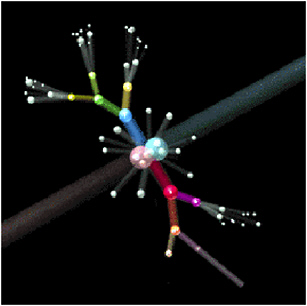 FIGURE 3-1-1 An artist’s illustration of a particle collision event. Courtesy of the ATLAS experiment. |
|
collision, called an event, computers record the data. Each particle type has its own signature in the detector, but the detailed analysis of an event can be very complicated and can sometimes take years and a great deal of scientific creativity and judgment to decipher correctly. The results of these analyses generate the key scientific discoveries. There are two multipurpose experiments at the LHC, the Atoroidal LHC Apparatus (ATLAS) and the Compact Muon Solenoid (CMS). The ATLAS experiment, the larger of the two, is about the size of a five-story building. ATLAS and CMS are the largest collaborative efforts ever attempted in the physical sciences. For example, at present ATLAS has more than 1,800 physicists (including 400 students) participating in the experiment from more than 150 universities and laboratories in 34 countries. The two experiments are similar in concept but different in detail. ATLAS and CMS both have charged-particle tracking to determine particle momentum; calorimetry to measure the energy of electrons, photons, and quark jets; and the ability to identify muons. ATLAS detects muons with a gigantic toroid assembly. CMS detects electrons and photons with its crystal calorimeter. Both experiments can detect short-lived particles with silicon pixel vertex detectors. ATLAS and CMS are poised to make discoveries when the accelerator delivers its first collisions (see Figure 3-1-2). Some interesting facts about CMS are as follows (ATLAS has its own set of fascinating facts):
|
instruments such as cosmic ray detectors or radio telescopes look at the cosmos in different ways. Astronomy would be greatly impoverished if it had just one or two types of instruments. That is, different instruments can work in different ways to make discoveries that advance science.
Three types of instruments also can be identified in particle physics. First there are the proton accelerators, such as the Tevatron and the LHC, which offer the fastest route to the highest energy. They might be compared to very large ground-
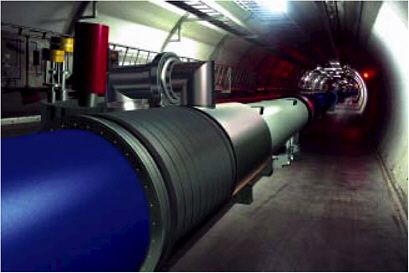
based telescopes. Second are the electron accelerators. At any point in history, the energy that was reachable with electron accelerators—such as those currently operating in California and Japan—has typically been lower than what could be reached with a proton accelerator, but electron collisions offer a much clearer picture of particle properties and interactions. Electron-positron colliders might be compared to HST. Finally, as in astronomy, there are a host of different instruments—nuclear reactors, underground laboratories, tabletop measurements,
space-based observations, and more—each of which elicits entirely different kinds of information.
Science is full of uncertainty, and new discoveries from the LHC or elsewhere might change the picture. But as of today, the substantial majority of particle physicists in the United States, Europe, and Japan do not advocate that the next step in particle physics should be a larger facility of the same type as the Tevatron and the LHC. Rather, the dominant view—increasingly so in recent years—has been that the next step should be to push the frontier of clarity and sensitivity with a TeV-class electron-positron collider, the ILC. The initial phase of the ILC is envisioned to have a total energy of 500 GeV, with the possibility of a subsequent increase in the energy to 1 TeV.1
The ILC can make many important discoveries that are beyond the reach of the LHC, even though LHC energies will allow the production of particle states up to around 5 TeV. It can provide detailed information about phenomena that the LHC can only glimpse. These may include phenomena predicted in the Standard Model but not yet observed, such as the Higgs particle. They may include phenomena that are already observed but difficult to study fully at proton colliders, such as the top quark. Or they may include entirely new phenomena that emerge at the LHC, including supersymmetry, large extra dimensions, new particle forces, and more. The LHC can see farther (higher in energy) into the Terascale but with relatively blurry vision, while the ILC can see more clearly but not directly into the higher regions of the Terascale (see Figure 3-1).
The advantage of the ILC is that it collides electrons, which are simpler and easier to understand than the protons used at the Tevatron and the LHC. Protons can be accelerated more cheaply and easily, but electrons typically give more detailed information. In that respect, building the ILC will be like launching a telescope above Earth’s atmosphere.
Historically, the energy reach of hadron colliders has been greater than that of electron colliders, while the ability to extract the details of collisions has been better with electron colliders than with hadron colliders. (For more discussion on this topic, see Box 3-2.) Most previous electron colliders accelerated the beams in circular orbits, allowing the beams to be reused again and again. Energy is lost in
|
1 |
For a full description of the internationally agreed-upon general parameters for the ILC, please see International Linear Collider Steering Committee, Parameters Subcommittee, Parameters for the Linear Collider, September 2003; the report is available online at <http://www.fnal.gov/directorate/icfa/LC_parameters.pdf>. For the baseline configuration design of the ILC, please see <http://www.linearcollider.org/wiki/doku.php?id=bcd:bcd_home>. |
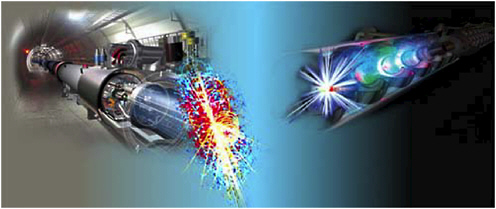
FIGURE 3-1 As depicted in this artist’s montage, while both the LHC (left) and ILC (right) will collide particles at Terascale energies, the character of the interactions will be quite different. For the LHC, protons (containing various elementary quarks) will collide; at the ILC, pointlike electrons (and positrons) will collide. Courtesy of CERN and DESY Hamburg.
each orbit of the electrons, however, and the energy loss increases dramatically as the energy of the beam is increased. For this reason, it is impractical to reach Terascale energies with a circular electron collider. To reach such energies in electron collisions requires the challenging new technology of a linear collider. An early accelerator of this type, the SLC, operated at the SLAC laboratory in California in the early 1990s and proved to be an important milestone in establishing the feasibility of a linear accelerator; the project also led to some of the most precise tests yet of the Standard Model (see Figure 3-2). Building on this experience and using novel technology, physicists today are proposing to build a large-scale version of an electron-positron linear collider—possibly 30 km long—that can explore the Terascale.
The LHC, with the high energy of its collisions, and the ILC, with the extremely precise measurements possible at an electron-positron collider, can combine to provide the necessary tools to explore the Terascale. Taken together, discoveries at the LHC and ILC could uncover the much anticipated mysteries of this new domain of nature.
|
BOX 3-2 Collisions of Different Types of Particles: Electrons vs. Protons For a physicist, the electron is about as simple as a particle can be. It is called a “point particle,” and it obeys the simplest laws that are allowed by the principles of relativity and quantum mechanics. Electrons have been smashed together at huge energies in accelerators and probed in ultraprecise tabletop experiments to measure their magnetic and electric properties. The results fit with the current understanding of the electron as a relativistic and quantum mechanical point particle. The proton, by comparison, is not simple (see Figure 3-2-1). It is composed of simpler objects called quarks and gluons. The equations governing quarks and gluons have been known for 30 years, but they are so complex that even with modern supercomputers, physicists are still struggling to understand how quarks and gluons behave. Electrons and protons, and their antimatter counterparts (the positron and antiproton), are the most easily accelerated particles. But they have contrasting virtues for experiments:
As a result, many discoveries have been made first with protons, and often the most precise measurements are made with electrons. For example, the direct evidence for quarks was demonstrated in electron-proton scattering experiments in the 1960s at SLAC. Proton-proton scattering had reached higher energies, but the results were too complicated to reveal the existence of quarks. More recently, many of the high-precision tests of the Standard Model have come from collisions involving electrons. |
Physics at the Terascale
Discovering the Higgs Particle
According to the Standard Model, the difference between the weak interactions and electromagnetism is related to the origin of the masses of most elementary particles through the unusual behavior of a new particle called the Higgs particle. Whether this hypothesis is correct is not known experimentally. All that is

known for sure, based on extrapolating from what has already been observed, is that at Terascale energies, either a Higgs particle will emerge or the Standard Model will become inconsistent and a new mechanism will be needed.
If the Standard Model is correct, the LHC will discover the Higgs particle. But its ability to test the Standard Model theory of the Higgs particle will be limited. Is the Higgs particle really responsible for particle masses? Have Higgs particle interactions hidden the weak interactions from our everyday experience, as the Standard Model claims? Is there just one Higgs particle, or several? Answering these
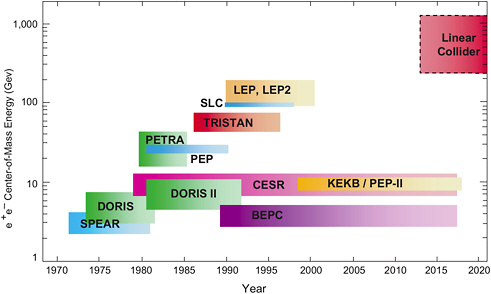
FIGURE 3-2 A 30-year history of electron colliders around the world indicates the increasing energy of collision. The colored bars represent the chief operating periods of the named accelerators. The red region in the upper right corner surrounded by a dashed line represents a proposed scenario for the ILC. Figure content courtesy of M. Tigner, Cornell University, and R.N. Cahn, Lawrence Berkeley National Laboratory.
questions requires measuring the interactions of Higgs particles in a more precise way than can be done at the LHC. The high energy of the LHC will enable it to produce and detect Higgs particles if the Standard Model is correct, but the complexity of proton interactions limits the information about these particles obtainable from the LHC.
The ILC will be able to zoom in on the Higgs particle and measure its properties and to measure multiple Higgs particle interactions with high precision. The ILC will be sensitive to subtle modifications of the behavior of the Higgs particle resulting from unknown physics at much higher energies, perhaps even from exotic new physics such as extra dimensions of space and time (see Figure 3-3).
Of course, it is possible that the Standard Model theory of weak interaction symmetry breaking and particle masses is incorrect, or not entirely correct. Perhaps instead of a Higgs particle there is a more exotic mechanism behind these phenomena—possibly something that physicists have not even thought of yet. Or perhaps something exists that is somewhat like a Higgs particle but the Standard
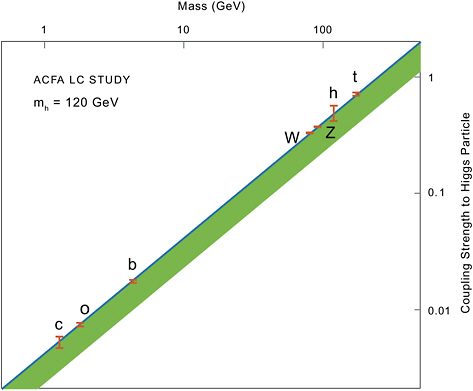
FIGURE 3-3 The interactions of the Higgs particle with the particles of the Standard Model will generally be sensitive to the presence of extra dimensions of space and time. The orange error bars show the precision possible at an ILC for the measurements of the couplings of the Higgs particle to other particles, while the green band shows the range of predictions in theories with extra spatial dimensions. The Standard Model prediction is the upper edge of the green band. If extra special dimensions exist, the measurements of the Higgs couplings obtained at the ILC could provide evidence for them. Courtesy of American Linear Collider Physics Group.
Model does not describe it correctly. In any case, data from the LHC may be confusing, difficult to interpret, or subject to misinterpretation. The greater clarity and precision of the ILC will likely be even more important if the Standard Model theory of these phenomena is incomplete or incorrect.
Even such a basic property of the Higgs particle as its spin cannot be easily measured at the LHC. The Standard Model requires that the Higgs particle has no spin (in contrast to, say, the electron and proton, which spin like tiny magnets). If
a Higgs particle is discovered, the spin can be measured straightforwardly by determining the rate at which it is produced at different energies at the ILC.
The precision measurements at a linear collider together with the results from LHC are crucial to establish the Higgs mechanism responsible for the origin of mass and for revealing the character of the Higgs boson. If the electroweak symmetry is broken in a more complicated way than foreseen in the Standard Model, the ILC and LHC together can help define alternative models of Terascale physics.
Supersymmetry: The Search for New Quantum Dimensions
Past measurements of particle interactions have given hints that a new phenomenon known as supersymmetry might emerge at the Terascale. Supersymmetry, if it is correct, updates Einstein’s theory of special relativity by including quantum variables in the description of space and time. Ordinary dimensions are measured by numbers—it is 3 o’clock, we are 200 meters above sea level at 40 degrees north latitude, and so on. If nature is supersymmetric, space and time will have new quantum dimensions as well as the familiar dimensions that we see in everyday life.
Previous hints for the existence of supersymmetry come from two types of measurements. First, based on the rates that are measured for the different particle interactions, it appears that the particle forces all have equal strength at very high energies if nature is supersymmetric; otherwise, they differ by small amounts. Second, supersymmetry gives a satisfactory explanation of why observed particle masses are so tiny compared to the energy of particle unification, which is expected to be around 1016 GeV. The inability to explain this disparity is considered a serious drawback of the Standard Model.
What might be observed in the laboratory if supersymmetry is correct? Vibrations of ordinary particles in the new supersymmetric dimensions will give rise to new particles with distinctive properties. In a supersymmetric world, there are supersymmetric “shadows” of the known particles—a little like the shadow world of antimatter that was discovered in the 20th century. These new particles are called superpartners and may well provide the explanation for dark matter (see Figure 3-4).
If supersymmetry becomes apparent at the Terascale, the LHC will blaze the first trail. It will discover some and possibly many of the superpartner particles and make numerous important measurements. But many of the most important measurements will be out of reach of the LHC. Physicists will need the ILC to make the crucial measurements to verify that the new particles are indeed supersymmetric counterparts of the observed particles, to understand their main properties, and possibly to gain a new understanding of the unification of forces (see Figure 3-5).
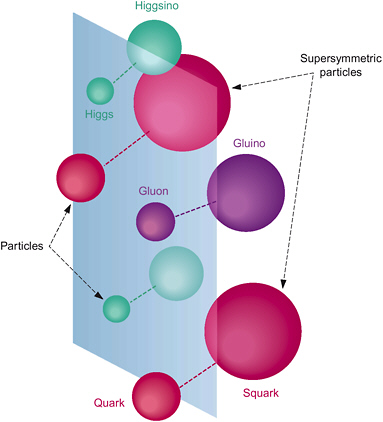
FIGURE 3-4 A key feature of supersymmetry is the existence of so-called superpartner particles for each type of ordinary particle.
Extra Dimensions of Space and Time
Supersymmetry is by no means the most exotic possibility for physics at the Terascale. Space may have extra dimensions beyond the three that we experience in everyday life. These are new dimensions that would be unlike the quantum dimensions of supersymmetry; they would be more akin to ordinary dimensions, like the ones seen in everyday life except smaller. These extra dimensions sound like science fiction, but they are the basis for fascinating theories of physics at the Terascale (see Figure 3-6).
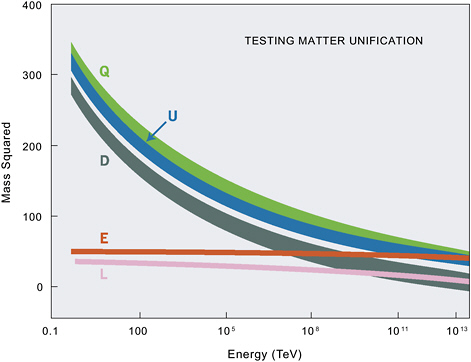
FIGURE 3-5 Particle masses depend on the energy at which they are measured. If superpartner masses are measured (the left-hand edge of the plot) at the LHC and ILC, then their masses at very high energies can be calculated and used to test the theory of unification. The Q, U, and D curves are the masses of the superpartners of the quarks measured at the LHC, while the E and L curves are the masses of the superpartners of the electron and neutrino measured at the ILC. The bands represent the potential experimental accuracy. This test of unification requires both the LHC and the ILC. Courtesy of the American Linear Collider Physics Group.
These extra dimensions, if they exist, must be small, simply because they have not yet been detected. Discovering such extra dimensions requires the high energy of particle accelerators. If the extra dimensions are large enough, the LHC will obtain the first indication that they exist by observing and studying collisions in which energy seems to disappear. If such events are seen, there will be many possible explanations, including the disappearance of the missing energy into new dimensions of space.
Learning if this is the right explanation will take a great deal of work, and the
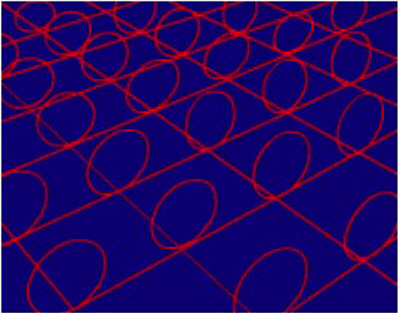
FIGURE 3-6 Artist’s conception of small extra dimensions proposed in superstring theories. The circles represent an additional spatial dimension that is curled up within every point of familiar three-dimensional space; shown here is a two-dimensional space (the plane of intersecting lines) with a third dimension that is small because it is curled up (shown as a loop).
LHC can make some of the important measurements. The ILC, however, will be able to go much farther, measuring many new properties of exotic events and gaining far more information on the number and shape of possible extra dimensions of space (see Figure 3-7). Its ability to do this depends on the fact that in an electron collider one can control the energy of the incoming electron beams. A proton collider does not have the same degree of control because a proton is made of many quarks and gluons. In a proton collider, the energies of the quarks and gluons responsible for a specific high-energy collision can vary over a large range.
Dark Matter
One of the great surprises in astronomy is that matter of the sort familiar to us—atoms and molecules, electrons, protons, and neutrons—makes up only about
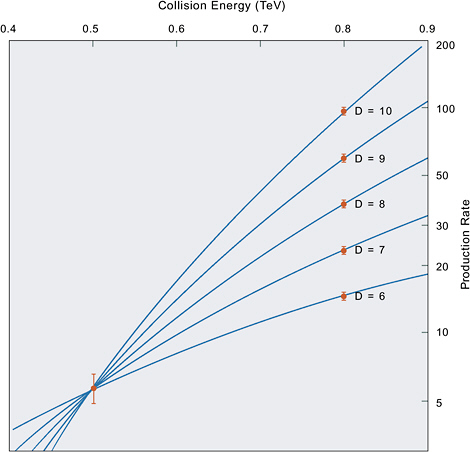
FIGURE 3-7 The ILC can observe particles that seem to disappear into extra dimensions, because such events appear not to conserve energy as particles disappear into the extra dimensions. The production rate for this type of process depends on the incoming electron beam energy and the number and size of the extra dimensions. In this example, the size of the extra dimensions has been chosen so that all the curves overlap at 500 GeV. The different lines on the graph are indexed by the number, n , of extra dimensions, D. It is possible that the production rates will overlap at one energy, as shown in the diagram at 0.5 TeV; however, by running the ILC at more than one energy, the number of extra dimensions can be determined. The capability of the ILC to change the collision energy of the electrons is thus crucial to this type of measurement. Courtesy of the American Linear Collider Physics Group.
4 percent of all the matter in the universe. The rest is dark matter, inferred from its gravitational effects but not observed, or dark energy.
What is dark matter? Calculations suggest that it consists of Terascale particles, though these guesses require physics beyond the Standard Model. No suitable particle is predicted in the Standard Model, and none has been observed so far. Thus, dark matter almost certainly consists of particles that do not exist in the Standard Model and whose nature and origin are a mystery.
The current understanding of particle physics can be extrapolated to very early times, shortly after the big bang, when the universe was dense and hot and all particles were in thermal equilibrium. Then, as the universe expanded and cooled, most of the dark matter particles decayed and disappeared. How much dark matter one ends up with now depends on the mass and interaction rates of dark matter particles. Terascale particles (such as new particles associated with supersymmetry) turn out to have just about the right properties.
Physicists are now looking for dark matter particles in experiments placed deep underground to shield them from ordinary cosmic rays. If the dark matter is really made of Terascale particles, there is a good chance of detection within the next decade. However, dark matter observatories, if they find something, will not quite be able to determine what they have found. They will reveal something about the mass, the abundance in the universe, and the interaction rates of the dark matter particles, but they will not produce enough information to disentangle these properties and piece together the whole story.
To understand Terascale dark matter and its role in particle physics, there is no good substitute for actually producing it and studying it in the lab (see Figure 3-8). The LHC has an excellent chance of making the first observation. By studying how energy and momentum seem to disappear when dark matter particles are created, physicists working at the LHC should be able to make an initial discovery. The ILC then would serve as the ideal dark matter microscope. By making the detailed measurements that show how much a new particle contributes to dark matter, the ILC could precisely determine how many of the Terascale particles should be left over from the big bang. These measurements have profound implications for both particle physics and cosmology.
The Standard Model and Beyond
The ILC will probe the Standard Model with unprecedented precision, well beyond what was achieved in the last decade by electron colliders of lower energy at the SLAC and CERN laboratories in California and Europe, respectively. Literally dozens of high-precision measurements will be made, involving the masses, lifetimes, and reaction rates of W and Z particles, top quarks, possibly Higgs
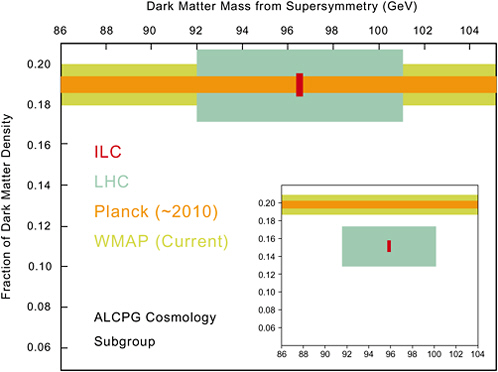
FIGURE 3-8 The WMAP and Planck satellites may determine the total amount of dark matter in the universe, but they will not measure the dark matter’s mass. The LHC and ILC colliders could determine the mass of an individual dark matter particle. For example, agreement between satellite and collider measurements might imply that supersymmetric particles known as neutralinos are the dark matter. As shown in the full diagram, the ILC would offer substantially improved measurement precision in this comparison. Potential disagreement, as shown in the inset, would provide evidence for additional dark matter components. Courtesy of the American Linear Collider Physics Group Cosmology Subgroup.
particles, and others. If the Standard Model survives these tests, physicists will gain a new level of confidence in its validity and scope.
There are many ways in which the Standard Model could fail. The ILC can infer the validity or breakdown of the Standard Model even at energies beyond the Terascale. This is because quantum mechanics allows new particles to appear briefly, influencing a reaction among lighter particles, even if there does not seem
to be enough energy for the heavier particles to play a role. This facet of the quantum world is a fundamental characteristic of nature, being responsible, for example, for the radioactive decay of certain atomic nuclei. Taking advantage of this, physicists using the LHC, and especially the ILC, will be able to explore the validity of the Standard Model at energies even higher than can be reached with today’s technologies.
Toward the Terascale
Soon the LHC will begin the exploration of the Terascale, and a proposed linear collider would extend this exploration into unknown realms and add new insights to those discoveries. Together, these two accelerators would enable physicists to probe the critical questions of particle physics in many different ways. The exploration of the Terascale with the LHC and the ILC is the top scientific challenge of particle physicists today. As such, direct investigation of this energy frontier continues to offer the broadest approach to the questions posed in the previous chapter.
The LHC will be ready soon, whereas the international effort to design the ILC is still under way, relatively speaking. Invoking the analogy of exploring a new landscape, the LHC can provide a bird’s-eye view of the most interesting features. The ILC will be able to focus on specific landmarks with exquisite precision as well as with different observational capabilities.2 Table 3-1 provides some specific examples of the combined discovery potential of the LHC and the ILC.
The ILC may be able to discover important but rare or hard-to-detect processes that the LHC will miss (see Box 3-3). For example, the ILC will be able to measure the relevant quantum numbers and lifetimes of the particles that it detects. To take a recent example, more than a decade after the discovery of the top quark at the Tevatron, very little is known about this particle. Its lifetime, its spin, and even its charge have not been experimentally determined. Physicists are sure that it is the top quark because its mass and a few of its key properties have been measured, and they agree with the Standard Model expectations. Moreover, the Standard Model is extremely successful, and its applicability to quarks is well established. Thus, measuring the top quark mass and some of its properties was enough to claim a discovery.
However, discoveries at the LHC are likely to be a different matter, especially
TABLE 3-1 Potential Synergies Between the ILC and LHC in Explorations of the Terascale
|
If LHC Discovers: |
What ILC Could Do: |
|
A Higgs particle |
Discover why the Higgs exists and who its cousins are. Discover effects of extra dimensions or a new source of matter-antimatter asymmetry. |
|
Superpartner particles |
Detect the symmetry or supersymmetry. Reveal the supersymmetric nature of dark matter. Discover force unification and matter unification at ultra-high energies. |
|
Evidence for extra dimensions |
Discover the number and shape of the extra dimensions. Discover which particles are travelers in extra dimensions and determine their locations within them. |
|
Missing energy from a weakly interacting heavy particle |
Discover its identity as dark matter. Determine what fraction of the total dark matter it accounts for. |
|
Heavy charged particles that appear to be stable |
Discover that these eventually decay into very weakly interacting massive particles; identify these “super WIMPS” as dark matter. |
|
A Z-prime particle, representing a previously unknown force of nature |
Discover the origin of the Z-prime. Connect this new force to the unification of quarks with neutrinos, or quarks with the Higgs, or with extra dimensions. |
|
Superpartner particles matching the predictions of supergravity |
Discover telltale effects from the vibrations of superstrings. |
if there is a major breakdown of the Standard Model at the Terascale. If a particle is discovered near 135 GeV, for example, one might suspect that it is the long-sought-after Higgs particle, but one could not be certain just from the initial observation of the particle. Because the Standard Model theory of Higgs particles has not been tested, it will be necessary to measure all of the properties of the purported Higgs particle. The LHC will begin this job, and the ILC will continue it. The ILC will have the capability to measure key quantum numbers, coupling constants, and lifetimes in a way independent of specific models.
There have been two distinct and complementary strategies for gaining new understandings of energy, matter, space, and time at particle accelerators:
-
Exploration of new energy regimes to directly discover new phenomena, such as by using accelerators operating at the energy scale of the new particle.
-
High-precision measurements to observe differences in expected patterns of behavior to infer new physics—that is, searching for the quantum echoes of higher energy phenomena.
These two strategies have worked well together, revealing much more than either by itself. Enough is now known to predict with confidence that a linear collider will be needed to fully answer the key questions about ultimate unification, the origin of mass, the nature of dark matter, and the structure of space and time that the LHC will begin to address.
HIGH-INTENSITY BEAMS
Some questions in particle physics are answered best not by the highest energy beams but by very intense beams, such as intense sources of bottom quarks or beams of neutrinos (see Boxes 3-4 and 3-5). These beams are valuable because they can reveal processes that occur very rarely. Also, very intense beams, like high-energy beams, offer a window onto energies that are beyond the reach of accelera-tors through the small but perceptible effects of very massive particles on low-energy processes. In addition, intense beams are needed to study neutrinos, since a vanishingly small percentage of neutrinos leave a trace in a typical detector.
The B factories that produce bottom quarks in abundance are one example of high-intensity beams. By the end of this decade, the B factories at KEK in Japan and SLAC in California will have observed billions of B meson decays, in addition to the B meson decays observed at Cornell’s CESR accelerator. These decays have provided a solid understanding of charge parity (CP) violation as it affects quarks. They also have allowed physicists to explore indirectly (and rule out) some of the phenomena hypothesized for the Terascale.
If the LHC sees phenomena that are inexplicable within the Standard Model, such as the particles associated with supersymmetry, studies of B meson decays could reveal some of their properties. A relative of the B meson, called the Bs meson, has been produced in sufficient quantity for detailed studies at hadron colliders. The study of the Bs meson has begun at Fermilab and will be expanded in the next decade with the LHCb experiment now under construction at CERN. A super-B factory might expand on the sample of B meson decays by as much as an additional factor of 10, allowing the measurement of even rarer events. Ideas for such a facility are being studied in both Japan and Italy.
Intense beams of neutrinos allow physicists to study neutrino oscillations, in which neutrinos of one variety morph into another variety as they travel. The most incisive information about neutrino oscillations today comes from experiments using neutrinos from a variety of sources: nuclear reactors, the sun, cosmic ray interactions in the upper atmosphere, and accelerators. Experimental observations of oscillations from atmospheric neutrinos have been verified using accelerator-produced neutrinos from the KEK accelerator in Japan (the K2K experiment) that mimic those from the atmosphere. Two accelerator experiments are now in
|
BOX 3-3 The Science of the ILC Exploration of the Terascale will be at the center of particle physics in the coming decades. The journey will begin with the discoveries of the LHC and will continue with the ILC, a proposed new accelerator designed to make discoveries at the Terascale and beyond. The ILC will consist of two linear accelerators, each about 15 kilometers long, aimed straight at each other (see Figures 3-3-1 and 3-3-2). One accelerator will contain electrons, the other positrons. The electrons and positrons will be assembled into bunches, each containing 10 billion particles. The particles will be accelerated to near the speed of light and then brought into collision. At the collision point, the beams will be focused down to approximately 3 nanometers wide. In the resulting collisions, electrons and positrons will annihilate into energy and produce new particles. Electron-positron collisions are clean and precise, and in a linear collider the energy can be adjusted to focus on the physics of interest. For the ILC, the plan is to start at a center-of-mass energy of 500 GeV, with a later increase in energy to 1 TeV. The initial energy is sufficient to produce and study Higgs particles and possibly other new physics; the higher energy might well be needed to access additional new features of the Terascale. The timing and nature of the energy upgrade will depend on what is found at the LHC and on the ILC’s initial operation. The scientific case for the ILC has many components:
In whatever direction the LHC points, the ILC will push even farther the exploration of the mysteries of the Terascale. |
progress at Fermilab. MINOS is a long-baseline experiment that will precisely measure the difference in neutrino masses corresponding to the atmospheric neutrinos studied at K2K.3 The MiniBoone experiment will confirm or rule out a
|
3 |
First results from the MINOS experiment have been announced that are consistent with the K2K and Super-K measurements. For more information, see the press release at <http://www.fnal.gov/presspass/press_releases/minos-3-30-06.html>. |

result from a still controversial experiment, which used the meson facility at Los Alamos National Laboratory, suggesting that there may be more than three neutrinos. In Europe, the CERN-Neutrinos-to-Gran-Sasso experiment will be operational by late 2006 and will seek to directly observe the oscillations of the muon-type neutrino over a distance of 730 km.
Neutrino experiments have demonstrated that any one neutrino of definite mass can be thought of as a quantum mechanical mixture of the electron neutrino,
|
BOX 3-4 Flavor Physics: Precision Science of Particle Interactions Progress in particle physics at the energy frontier has been complemented by precision investigation of flavor physics—studies of the patterns of weak decays. In the Standard Model, these decay patterns for quarks are predicted by a set of four parameters that define a set of couplings known as the Cabibbo Kobayashi Maskawa matrix. A single one of these four parameters accounts for all CP-violating effects, which produce the differences between the laws of physics for matter and antimatter. Physicists are interested in studying such effects because the existence of matter in the universe is thought to depend on this difference. Once the Standard Model theory is extended to include neutrino masses, there is an additional matrix of parameters relating the light leptons—the electron, muon, tau, and their neutrinos. Little is known today about the details of these parameters, which also include additional possibilities for CP violation and thus provide another possible, and quite different, root cause for the matter-antimatter imbalance in the universe. Because there are few parameters describing all weak decays of quarks and a similarly small set describing decays that change one family of lepton into another, the Standard Model can be subjected to precision testing in this sector. Any new particles, even with masses beyond the range of current accelerators, can contribute to these decays through unseen quantum intermediate states. In many cases, such contributions would be detectable because they destroy the decay patterns predicted by the Standard Model alone. The effect of such new particles decreases rapidly if the mass of the new state is larger. Therefore, sensitivity to discovering these unseen but indirectly involved particles is greatest when particle physicists have very accurate knowledge of the Standard Model prediction for a specific experiment. In particular, where the new contribution makes possible a decay that was predicted to be extremely rare (or even absolutely forbidden) in the Standard Model, very sensitive searches can be made for the indirect effects of new heavy particles. These precision measurements provide a window on new physics that can in some cases be as sensitive as direct searches at high energy. The observations from flavor physics are complementary to the capabilities of both the LHC and ILC and hence will continue to provide important information, even when these facilities begin to probe the Terascale directly. The LHC beauty experiment (LHCb) experiment will probe some of this physics, and a possible super-B factory experiment can add studies of modes that are very difficult to study in the LHC environment. Experiments to search for lepton flavor violations and further study of the neutrino “mixing” matrix provide a separate opportunity for study. |
muon neutrino, and tau neutrino. In this way, neutrinos produced as a definite flavor type can oscillate or mix to become a different type as they travel. The basic mixing is reminiscent of the pattern already known for quarks, but the mixing effect is small for quarks and surprisingly large for neutrinos. Experiments have measured two of the three parameters that describe how neutrino mixing occurs. The third mixing parameter, known as θ13, is not as large as the other two and so far has eluded experimenters.
The next generation of experiments, including possible reactor experiments,
|
BOX 3-5 Neutrinos: An Enigma Wrapped in a Mystery Neutrinos are among the least understood of the fundamental particles. They are similar to the more familiar electron, with one crucial difference: Neutrinos do not carry electric charge. Because neutrinos are electrically neutral, they are not affected by the electromagnetic forces that act on electrons. Neutrinos are affected only by the weak force, which has a much shorter range than electromagnetism. They therefore are able to pass through great quantities of matter without being affected by it. It would take a wall of ordinary matter more than 100 light-years thick to stop a beam of neutrinos like those produced by the sun. Precisely because they are so elusive, neutrinos produced at the center of the sun traverse the entire mass of the sun without being absorbed, providing a way to see deep into the sun’s interior. John Updike’s 1959 poem “Cosmic Gall” featured neutrinos’ two most important and puzzling features—masslessness and elusiveness. Today, it is known that neutrinos are almost, but not quite, massless. However, even by subatomic standards, neutrinos have only minuscule masses and are therefore only barely affected by gravity. Three types of neutrinos are known; there is strong evidence that no additional neutrinos exist, unless their properties are unexpectedly very different from the known types. Each type, or flavor, of neutrino is related to a charged particle (which gives the corresponding neutrino its name). Hence, the electron neutrino is associated with the electron, and two other neutrinos are associated with heavier versions of the electron called the muon and the tau (see Figure 3-5-1). Experiments are needed to complete the picture. The pattern of partnerships is determined by the ordering of the masses, and it is not yet known whether the electron associates with ν1 or ν3 (an issue known as the hierarchy problem). The picture that is emerging is reminiscent of the pattern for quarks in the weak interaction, but the effect is much more dramatic for the leptons because neutrino mixing is a much larger effect. 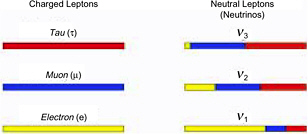 FIGURE 3-5-1 Schematic depiction of how the neutrinos fit into the new version of the Standard Model along with their charged lepton partners, the electron (e), muon (µ), and tau (τ). The colored segments represent the relative proportions in which each particle incorporates the property that characterizes it as electron, muon, and tau in the weak interaction. The electron, muon, and tau each have single colors and are states with definite mass. The observed partner neutrino particles are ν1, ν2 , and ν3; they are multicolored, indicating that each is a mixture of the neutrino flavor states νe, νµ, and ντ. |
|
Neutrinos have been shown to oscillate, which demonstrates, in effect, that they have mass. Understanding neutrino oscillations requires a trip into the world of quantum mechanics (see Figure 3-5-2).  FIGURE 3-5-2 The image uses a musical analogy to represent the behavior of a simplified model. Imagine two neutrinos that can oscillate into one another, and imagine representing each neutrino as a musical pitch. Further assume that only one pitch at a time can be detected. Let the muon neutrino be represented by a G-note and the electron neutrino by, say, a B-note. In the absence of neutrino oscillations, one could assume that a G originated as a G and would remain forever a G, and the same would be true of a B. However, with the possibility of neutrino oscillations, a muon neutrino G can “de-tune” into a B as time passes, and vice versa. Since only one pitch at a time can be detected, the neutrino will sometimes sound like a G and sometimes like a B; the rate of detuning is related to the neutrino mixing parameters. The probability of observing the muon neutrino as an electron neutrino varies as a function of time (or distance if the neutrino is traveling), as shown by the sinusoidal curves alongside the scales. The detailed properties of neutrino oscillations are important to understanding how Standard Model particles interact and the properties of galaxies and the universe. Courtesy of Paul Nienaber and Andrew Finn, BooNE Collaboration. |
the NOνA experiment at Fermilab, and the Tokai-to-Kamioka (T2K) experiment at J-PARC, hope to measure the neutrino-mixing parameter θ13. The proposed NOνA experiment at Fermilab would not only be sensitive to θ13 but may also be able to use the interaction of neutrinos with Earth to learn whether neutrinos masses are ordered in a way reminiscent of quarks and the charged leptons. The ordering of the neutrino masses could be a critical clue for understanding what the structure of the constituents of the Standard Model reveals about the underlying physics. Taken together, the proposed NOυA and T2K experiments would reveal somewhat more information than either one alone.4 The amount of additional information gained by carrying out both experimental programs depends critically on the value of θ13. If θ13 is too small, the planned experiments will not be sensitive to the neutrino mixing and will have more limited scientific value. The ultimate goal of this line of research is to understand the possible pattern of CP violation in the neutrino sector, which might have contributed to the dominance of matter over antimatter in the early universe as revealed by astrophysical observations.
If θ13 is big enough, experiments might be able to detect CP violation in neutrinos. The most sensitive searches for both θ13 and CP violation will require massive detectors and extremely intense beams of neutrinos. The United States is investigating possible designs for a facility that would produce neutrinos from an intense beam of protons known as a “proton driver.” Japan currently has such a facility under construction at J-PARC. In the longer run, ultrapure beams of electron neutrinos produced either from the radioactive decay of beams of unstable atomic nuclei (“beta beams”) or from a neutrino factory might be required to pin down the issue of CP violation in neutrinos (though a realistic design for a neutrino factory is at least a decade away). A future generation of neutrino experiments may require underground detectors much more massive then the ones that already exist. Ironically, what became the first underground neutrino detectors were originally motivated by the hope of discovering that the proton is not stable. Proton decay is expected in many unified theories, and in many models the predicted proton lifetime is very near the current experimental sensitivity. Observing proton decay would be a major step forward in particle physics. In any case, future massive underground neutrino detectors can also serve as much more sensitive experiments to discover proton decay.
|
4 |
See, for example, the recent report of the U.S. Neutrino Science Assessment Group to the DOE/ NSF High Energy Physics Advisory Panel and the DOE/NSF Nuclear Science Advisory Committee in February 2006; available online at <http://www.science.doe.gov/hep/HEPAP/Mar2006/NuSAG_to_HEPAP_mar06.pdf> (last accessed March 10, 2006). |
Other experiments would use intense beams of muons or K mesons. These experiments study very rare processes in the decays of K mesons that would pin down the underlying parameters that govern the Standard Model. Experiments like these are being proposed for J-PARC, CERN, and the Paul Scherrer Institute in Switzerland. A source of ultracold neutrons is planned at several places in the world to measure the electric dipole moment of the neutron with a sensitivity two orders of magnitude greater than existing limits. A finite value would signal time-symmetry violation beyond that expected in the Standard Model and could help to explain the dominance of matter over antimatter in the universe.
NATURE’S PARTICLE SOURCES
Nature also produces particles. Gamma ray photons or neutrinos from outer space can have very high energies. The background buzz of particles traversing the galaxy or universe can serve as a sort of astrophysical laboratory, reflecting the ongoing evolution of the universe (see Box 3-6). A slab of solid material or a volume of liquid or gas of terrestrial origin can serve simultaneously as a source of particles (via decay of the constituents, such as by radioactive decay) and as a detector of particles (by providing a detecting medium for interactions of external particles with the constituents of the material).
For example, the radioactive decays of nuclei provide some information about the mass of the electron neutrino. When a neutron converts to a proton in nuclear beta decay, an electron is released whose characteristic energy spectrum depends, ever so slightly, on the mass of the electron neutrino. If the neutrino mass is large enough, this distortion will be visible. Sensitive experiments using the beta decay of tritium have been carried out for many years. Using the most ambitious experiment so far conceived, an international collaboration is mounting an experiment in Germany called KATRIN, which is designed to be sensitive to the distortion from a neutrino with a mass less than 1 eV.
Double beta decay, which was first observed in 1986, is a radioactive process in which two neutrons in the same nucleus simultaneously convert to protons, emitting two electrons and two neutrinos. However, many physicists suspect that a rarer and not yet observed type of double beta decay can also occur. If the neutrino is its own antiparticle, it is possible to have a double beta decay process in which no neutrinos are emitted at all. If such neutrinoless double beta decay is observed, the understanding of neutrinos will change substantially. This discovery would show that the origin of neutrino masses is very different from that of the masses of other known particles. It might provide a way to measure for the first time the overall mass scale of the neutrinos, and it might give a glimpse into physics at energies far beyond the Terascale, possibly involving particle unification.
|
BOX 3-6 Experimental Frontiers of Particle Astrophysics Experiments in particle astrophysics use a remarkable range of techniques to address fundamental questions about the composition and evolution of the universe. In addition to searching for new physics, the experimental approaches listed here will help narrow uncertainties about fundamental parameters of cosmology:
|
TABLE 3-2 Potential Neutrinoless Double-Beta Decay Experiments
|
Experiment |
Isotope |
Sensitivity (meV) |
Comments |
|
|
Near Term |
Upgrade |
|||
|
CUORE |
130Te |
189 |
63 |
Total mass = 750 kg; upgrade isotope purity |
|
EXO |
136Xe |
330 |
59 |
Upgrade total mass from 200 kg to 1,000 kg |
|
Majorana M180 |
76Ge |
130 |
|
|
|
MG1000 |
|
|
51 |
Hypothetical total mass 1,000 kg |
|
MOON |
100Mo |
403 |
141 |
Upgrade total mass from 200 kg to 1,000 kg and run longer |
|
|
82Se |
141 |
34 |
|
|
Super-NEMO |
82Se |
153 |
|
Total mass = 100 kg |
|
NOTE: The exact scenario will depend on the real physics of our universe, but these examples give a taste of the potential of combining these two tools for exploration. SOURCE HEPAP, Discovering the Quantum Universe , 2006. For six selected neutrinoless double beta decay experiments, the signal sensitivities for neutrino mass in units of millielectronvolts (meV) are shown for a first-stage experiment as well as an upgraded capability. Different approaches use different radioactive isotopes (denoted by chemical symbol and total number of nucleons) to generate the beta decays. SOURCE: Neutrino Scientific Assessment Group; Recommendations to the Department of Energy and the National Science Foundation on a United States Program in Neutrinoless Double Beta Decay, September 1, 2005. |
||||
These experiments are notoriously difficult because radioactive decays from trace contamination in the material or the surroundings can produce a false signal. To overcome this liability, these experiments use ultrapure materials cooled to suppress background events and are located deep underground, which greatly reduces rates for cosmic ray events. A number of experiments are under way or planned to look for these phenomena (see Table 3-2).
The existence of dark matter was first inferred in the 1930s by measuring the motions of galaxies in large clusters.5 However, the identity of the dark matter has remained a mystery. If dark matter is composed of weakly interacting elementary particles, as many astrophysicists and particle physicists believe, then, as Earth passes through a cloud of dark matter in its path around the sun, some of these particles can easily pass through the atmosphere and thousands of feet of rock to reach a detector deep underground. As they travel through the detector, it is expected that some will occasionally scatter off an atomic nucleus, causing the nucleus to recoil with the energy of a few tens of thousands of electron volts.
|
5 |
This section identifies only a few of the ongoing and planned experiments in particle astrophysics. A more complete list (as of 2003) can be found in NRC, Connecting Quarks with the Cosmos: Eleven Science Questions for the New Century, Washington, D.C.: The National Academies Press, 2003; and DOE, Scientific Assessment Group for Experiments in Non-Accelerator Physics, available at <http://www.science.doe.gov/hep/SAGENAPFINAL.pdf>. |
Detectors such as the Cryogenic Dark Matter Search (CDMS) in an abandoned iron mine in Soudan, Minnesota, use germanium and silicon detectors to detect such processes. Other examples include the Zoned Electroluminescence and Primary Light in Noble Gases (ZEPLIN) experiments in Britain’s Boulby mine, which detects the light produced when a nucleus recoils in liquid xenon; the WIMP Argon Program (WARP), which uses liquid argon; and the Directional Recoil Identification from Tracks (DRIFT-II) experiment, also in the Boulby mine, which uses large gas-filled detectors to determine the direction of incoming dark matter. Observing the dark matter coming from the cosmos and producing dark matter in a particle accelerator (assuming that a particle is responsible for the dark matter) will combine to shed light on this mystery.
No one has ever seen evidence of proton decay, but most grand unified theories predict that proton decay should occur (though past experiments have indicated that the half-life of the proton is greater than 1032 years). The trick to observing proton decay is to have an exceedingly large volume of material in which the very rare decay products would be detectable. Possibilities include a large volume of water or liquid argon in which to detect radiation from such a decay. To go beyond the limits of past searches, these detectors would have to be hundreds of thousands of tons in size, and they would have to be deep underground to reduce background effects from particles coming from the sky. As noted before, a detector of this type also would detect neutrinos from space and could serve as the detector for neutrinos from a distant accelerator. The early proton decay experiments searched for decays of protons in water. Other detectors used different materials and more sophisticated tracing methods that are more sensitive to specific possible decay patterns of the proton.
Very energetic neutrinos (with energies well above the Terascale) might come from quasars, gamma ray bursts, black holes, or dark matter annihilation. Neutrino telescopes work by detecting light produced when such a neutrino encounters a nucleus. Some experiments look for this light in the ice of Antarctica, which is so clear that the light can travel for 100 meters undiminished. Other experiments look for it in the clear water of the sea or in a large lake. The first neutrino observatories—Amanda at the South Pole and the Baikal Neutrino Observatory at Russia’s Lake Baikal—recently started operation. Others are now under construction or are being planned. The Antares experiment, deep in the Mediterranean near Marseilles, and Nestor, southwest of the Peloponnesian Islands at the deepest ocean site, will start operation in 2007. Amanda’s successor in Antarctica, IceCube, is under construction and will be completed in 2010. A clever design and engineering approach makes the detector very modular and it is, in fact, already collecting data, with additional modules to be installed over the next few years.
Together with the research community, NSF has initiated a process to con-
sider constructing a multidisciplinary deep underground science and engineering laboratory (DUSEL) and has selected two possible sites: the Homestake mine in South Dakota and the Henderson mine in Colorado. A decision on where to construct such a facility will be made later in 2006. DUSEL will offer an overburden of more than 6,000 meters-of-water-equivalent (that is, it will offer protection from cosmic rays equivalent to being under 6 km of ocean) and will have an initial suite of experiments that could include biological observations, dark matter experiments, a double beta decay experiment, and searches for solar neutrinos. In addition, the laboratory might contain a large cavern that would be suitable for a proton decay experiment.
Other experiments look for photons from the galaxy or beyond with energies of up to 1 TeV (see Box 3-6). These gamma rays might produce information about astrophysical accelerators, such as active galactic nuclei, pulsars, and supernova remnants, or perhaps about the origin of gamma-ray bursts. High-energy gamma rays might be produced when pairs of dark matter particles annihilate into pairs of photons. These would originate from the center of galaxies, where dark matter is most concentrated. Earth-based Cerenkov telescopes such as the Very Energetic Radiation Imaging Telescope Array System (VERITAS) and satellite experiments such as the Gamma-ray Large Area Space Telescope (GLAST) will search for these events.
Some evidence for ultra-high-energy cosmic rays (energies greater than 500 times the Terascale) has been reported, which conflicts with theoretical predictions that the gamma rays should have been slowed by their interactions with the cosmic background radiation. Using detector arrays roughly the size of Rhode Island, physicists at the High Resolution Fly’s Eye (HiRes) experiment in Utah and the Pierre-Auger Observatory in Argentina are exploring this high-energy regime and trying to identify the sources of the highest energy cosmic rays. An outpost of the Auger experiment in the northern hemisphere could further help to pinpoint the sources of high-energy cosmic rays.
Telescopes can produce information about both dark matter and dark energy. They can look for distortions of the light from galaxies caused by the gravitational field of dense clumps of dark matter lying between a galaxy and Earth. They also can use these distortions, as well as supernovae, improved measurements of the cosmic background radiation, and the spatial distribution of clusters of galaxies, to learn about dark energy. Some proposed telescopes are ground based (such as the Dark Energy Survey, the Large Synoptic Survey Telescope, and the Panoramic Survey Telescope and Rapid Response System (PanSTARRS), while others will be launched into space so that they can cover more of the sky and look at more distant galaxies (an example is the Joint Dark Energy Mission).
Other telescopes are tuned to look at the CMB that remains from the moment
380,000 years after the big bang, when free electrons and protons cooled into hydrogen atoms. For instance, the European-led satellite Planck is scheduled to launch in 2007 and will analyze, with the highest accuracy ever achieved, the distribution and structure of the CMB. Other missions, such as NASA’s Inflationary Probe, will search for the imprint of gravitational waves on the polarization of the CMB, a critical test that can distinguish among competing cosmological models.
INTERNATIONAL COOPERATION
International cooperation and collaboration have been prominent in particle physics since the field’s inception in the first part of the 20th century. Scientists and laboratories around the world have engaged in both cooperation and healthy competition as the field has advanced. European, Asian, and other scientists from abroad have participated in experiments in the United States, and U.S. researchers have participated in efforts abroad.
Global Activity in Particle Physics
Some examples of the formal mechanisms the particle physics community has used to carry out international collaborations of various kinds are listed in Box 3-7. It should be noted that many successful international collaborations of the past decades began with grass-roots activities of interested scientists who then worked to obtain recognition by governments or government-to-government agreements.
As facilities on the scientific frontier have become more expensive to build and to operate, physicists from other countries have been asked to contribute financially to projects in host countries. The largest and most recent examples in the United States are the B factory experiment at SLAC and the CDF and D0 experiments at Fermilab. Roughly half of the collaborators on these experiments are from outside the United States, and the experiments are supported in part with significant financial contributions from abroad. Most of the international contributions to accelerator facilities have been in the form of scientific expertise and inkind contributions to the detectors, as opposed to the building and operation of the accelerator.
Due to similar constraints for instrumentation and facilities in the global astronomy community, the United States has had great success partnering with other countries to construct and operate world-leading observatories such as the International Gamma-Ray Astrophysics Laboratory, the XMM-Newton X-ray Telescope, and the optical/infrared Gemini Observatory. Future observatories will include the Atacama Large Millimeter Array and GLAST.
|
BOX 3-7 Existing Mechanisms to Promote International Cooperation Over the years the particle physics community has used a number of mechanisms for international discussion and planning. Current fora include:
|
Perhaps the most important international collaboration in particle physics is the CERN laboratory in Geneva, which is a long-term cooperative effort of many European countries.6 The construction programs for the detectors at the LHC,
along with the accelerator itself, also are examples of successes in international collaboration, with the United States and other non-CERN members contributing both financial and intellectual resources. The significant U.S. participation in the LHC project exemplifies some of the elements of a new era of global programs in particle physics.
During discussions about the high cost of excavating the tunnel for the Large Electron Positron Collider (LEP) at CERN, European researchers chose to examine possible future-generation accelerators to replace LEP at the same site. In 1985 the CERN Long-Range Planning Committee recommended installing a multi-TeV facility in the LEP tunnel after the completion of that program. In late 1991, the CERN Council agreed in a unanimous decision that the LHC was “the right machine for the further significant advance in the field of high energy physics research and for the future of CERN.”7
When Congress terminated the construction of the Superconducting Super Collider (SSC) in 1993, the particle physics community and DOE recognized that the best practical opportunity to explore the Terascale within the next 10 to 20 years would be at the CERN-based LHC. At the request of DOE, HEPAP convened a panel to develop a new long-range plan for U.S. particle physics. It recommended that the United States participate in both the LHC experimental program and the construction of the LHC accelerator through significant contributions of in-kind components and cash for purchases of critical items in the United States. The particle physics community, DOE, and NSF strongly supported these recommendations. In early 1996, CERN’s director general led a delegation to Washington to begin negotiations concerning a U.S. role in the LHC project. Around that time, CERN reached agreements for contributions to the LHC from Japan, India, Russia, and Canada, and NSF began to fund some LHC-related activities. The administration requested funds for strong U.S. participation in the LHC in its FY1997 budget; Congress then appropriated funds for both NSF and DOE to provide the U.S. contributions to the LHC. A very important step in this process was taken when Congress authorized DOE to enter into a formal agreement with CERN on behalf of the United States. U.S. officials signed the agreement with CERN in December 1997, promising to contribute $531 million to the LHC project over about 10 years. That investment is now nearly complete. This process of national initiative followed by international negotiation and agreement (resulting in a significant multiyear commitment from the United States) to invest in a facility abroad was an important achievement for the U.S. particle physics program and the U.S. government.
The CMS and ATLAS detectors being built for the LHC each have around 2,000 collaborators from all regions of the world. U.S. researchers make up about 20-25 percent of each detector collaboration, and the number of U.S. researchers is growing. By 2007, more than half of all U.S. experimental particle physicists are expected to be working at the LHC. The overwhelming reason for this shift is the planned conclusion of the U.S.-based experiments at SLAC, Cornell, and Fermilab. Many of the scientists in the university groups and laboratories that participated in the research program of these experiments are now transferring their efforts to the LHC. The model used by particle physicists to fund, build, and perform science with particle detectors has been and continues to be successful even at the largest scales.
Among recent projects, the J-PARC multiprogram accelerator complex was approved by the government of Japan, including an accelerator neutrino experiment, after which international involvement was welcomed. Significant non-Japanese funds (80 percent) have been raised to pay for one of the detectors at the facility. In general, if the science is exciting, scientists from around the world will want to join those efforts and will raise modest funds to participate. The director of KEK has said that if it is approved by the government, the new proton decay experiment HyperK will require international funds to move planning forward.
Accelerators around the world have thus far been built based on decisions made by a single country or laboratory; the exception has been the largest projects at CERN, such as the LHC (the CERN Council includes scientific and government representatives from each of the member states). The SLAC B factory accelerator was a U.S. presidential initiative, Fermilab’s Tevatron was a U.S. decision, and constructing the SSC was a U.S. decision by President Reagan. The largest accelerator project to be successfully completed in the United States, the Spallation Neutron Source at Oak Ridge National Laboratory (with a cost exceeding $1.4 billion), was an internal U.S. decision. As is customary with DOE acceleratorbased facilities, access will be open to scientists from around the world. DESY used a different model for the HERA accelerator: The plan was to build components of the accelerator in several countries as in-kind contributions to be assembled at the main facility. Although DESY had hoped for substantial contributions, the final non-German fraction was 15 percent. Even the Euro-XFEL, a $1 billion project just under way and being hosted at DESY, was approved by the German government, after which contributions amounting to 50 percent of the cost were sought from Europe. This approach appears to have been successful because of the strong support from the user community for this facility.
Europe, through CERN, recently took the next step in formalizing its regional planning activities. A group has been established through the initiative of the CERN Council to develop a strategy that addresses the main thrusts of particle
physics in Europe, both accelerator-based and non-accelerator-based, including R&D for novel accelerator and detector technologies. The strategy is designed to address collaboration between the European laboratories, coordinated European participation in world projects, the visibility of the field, and knowledge transfer beyond the field. Since CERN is an international organization, its Council is composed of government representatives. Thus, approval by the CERN Council invokes the treaty relationship between each government and the CERN organization, creating a binding agreement among the individual governments.
The opportunities for international collaboration in particle physics and the challenges posed have never been greater. More rigorous international prioritization of new particle physics research opportunities and greater leveraging of international funding could have great benefits as particles physicists seek to answer the exciting questions now before the field. Such benefits, however, can only be realized through genuine cooperation both among scientists and among the government agencies sponsoring their work. The most extensive current example of international collaboration is the set of activities that surround the planning and R&D phases for the proposed ILC.
The International Linear Collider
Particle physics research communities around the world have declared that the ILC is the highest priority project after the LHC.8 The ILC promises to provide answers to a host of the most important questions in particle physics. It is clearly of a scale where decisions on design, funding, and operation must be international from the start. (See Appendix A for additional analysis of the path forward.)
The committee felt strongly that, if possible, the ILC should be located near an existing particle physics laboratory to take advantage of existing resources and talent.9 Past experience with the SSC, as well as current experience with the LHC, shows the advantages of undertaking new projects with existing facilities and talent. As the only laboratory devoted primarily to particle physics, Fermilab is an obvious candidate site. It is attractive as a potential site for the ILC because of its existing laboratory and physical plant infrastructure. Like CERN in Europe, Fermilab has a critical nucleus of accelerator expertise that could play a significant role in the ILC. Fermilab has successfully built, operated, and upgraded the
Tevatron, one of the most sophisticated accelerators in the world. In collaboration with DESY in Germany and other laboratories, Fermilab also has developed expertise with superconducting radiofrequency technology, the choice for the ILC. Fermilab must provide the leadership necessary to mobilize a coalition of U.S.based resources and facilitate U.S. participation in the ILC.
The ILC has been an international effort from its inception and should continue to be pursued as a global venture. In 2005 the U.S. effort in ILC R&D was budgeted for $25 million; other regions of the world have invested much more. For instance, European governments invested more than $50 million in 2005. Integrated over about 5 years, the Japanese and European investments in ILC R&D total at least several hundred million dollars.
A critical element of any U.S. strategy to move forward with the ILC beyond the initial R&D phase coordinated by the Global Design Effort (GDE) will be the formation of an entity capable of negotiating both scientific and financial matters with the other expected regional partners. At present, the association between the U.S. program (through DOE and NSF) and the GDE is only informal (for more on the GDE see Appendix A). Moving forward on the ILC will demand new mechanisms of cooperation and agreement among the research agencies of many nations. Several such agencies have begun to discuss the ILC project at an international level through the FALC group, an informal body composed of representatives from relevant funding agencies from Canada, France, Germany, Italy, Japan, the United Kingdom, the United States, and CERN. Formed in 2003, FALC provides a forum to discuss funding issues, policy strategies, and progress toward designing an ILC. As this effort moves forward, the decision-making process will be complex and will require simultaneous discussions at the scientific level and at various governmental levels that transcend the FALC group. Experience with other international joint ventures (such as ITER and the LHC) demonstrates the potential for success in sophisticated international agreements of this kind.
A PATH FORWARD
Over the next 15 years, today’s international collaboration, already extensive, will need to intensify to effectively address the challenges on the scientific frontier. The committee believes that particle physics should evolve into a truly global collaboration that allows the particle physics community to leverage its resources, prevent duplication of effort, and provide additional opportunities for particle physicists throughout the world.
This prioritization process could lead to a new model for international collaboration in particle physics. For example, each country or region could special-
ize to some extent in programs sited in their country or region and then play a relatively smaller role in programs sited elsewhere. Such an evolution would be in keeping with the framework proposed in Allocating Federal Funds for Science and Technology.10 Among the report’s recommendations, two are particularly noteworthy:
The President and Congress should ensure that the [federal science and technology] budget is sufficient to allow the United States to achieve preeminence in a select number of fields and to perform at a world-class level in the other major fields.
The United States should pursue international cooperation to share costs, to tap into the world’s best science and technology, and to meet national goals.
Both goals would be met if the United States were to participate in a worldwide effort to plan particle physics research from a global perspective. Furthermore, the ILC could serve as the model for a global program, since the early planning has already started from a global perspective rather than from the perspective of an individual country. This planning process could ultimately be expanded into many other areas of particle physics. While meeting these goals would serve the interests of particle physics and fulfill the public policy objective of using resources in the most efficient manner, success can only be achieved through multilateral agreements between governments and/or government agencies, not unilaterally. This is a challenging task but one that must be done given the environment the committee believes will evolve over the next 15 years.
The tools of particle physics have evolved significantly over the past 50 years. Originally particle physics was a small field; individual scientists could construct particle accelerators (first tabletop and then room-sized cyclotrons) and detectors (plates of film) in their own laboratories. As the science drove accelerators to higher energies, the scale of projects continued to expand. In the modern era, the most recently designed and constructed machines require literally hundreds of scientists and engineers. Partly because of the demands for high performance and partly because of the eclectic nature of the investigations, particle physics projects in the United States are constructed (and then operated) with sizable involvement of scientists and engineers, more so than in some other fields, such as magnetic fusion.
The planning process for particle physics in the United States historically has
involved more than one government agency. Broad involvement of the particle physics community has been achieved by creating a variety of advisory committees, such as HEPAP and its subcommittees, which advise DOE and NSF; program advisory committees at the major laboratories; and National Research Council committees that periodically review the field from a broader perspective.
Nearly all of the larger national laboratories have had an important program in particle physics, which is a tribute to the broad appeal and importance of particle physics to the physical sciences. Argonne National Laboratory, Brookhaven National Laboratory, Cornell Laboratory for Elementary Particle Physics, Fermilab, Lawrence Berkeley National Laboratory, Lawrence Livermore National Laboratory, Los Alamos National Laboratory, SLAC, Thomas Jefferson National Accelerator Facility, and others have all contributed to scientific and technological advances in particle physics. Different laboratories have pursued different initiatives by developing machines capable of new investigations, whether involving higher energies, higher intensities, or beams of different particles. A strong and healthy national program was maintained through intense but healthy competition (for both resources and personnel) among the variety of different projects. This situation is changing, however. As Fermilab becomes the only laboratory devoted entirely to particle physics, the system of planning and coordinating efforts will have to evolve as well.
Approved projects are subject to ongoing external reviews by experts from the broader community, at least during their construction phase. Large projects that overlap the interests of more than one agency need a planning and review process that is effective and not duplicative. New initiatives need to be able to bubble up within the field, but large-scale efforts need a coordinated decision process to establish their overall priority, a process that is national rather than based on a single laboratory or government agency. The astrophysics community has achieved this goal with a structured decadal review process. In particle physics, HEPAP has been the leading source of advice to the U.S. government, and its recently established P5 subcommittee offers program review and coordination at a higher level than the laboratory program committees for larger ventures, although this mechanism is new and has not yet been effectively deployed. The advisory apparatus has been evolving, and the emerging structure of tactical subfield-specific scientific assessment panels (such as in neutrino physics or dark energy) feeding into P5 and HEPAP for the formulation of strategic guidance is a step in the right direction. The challenge for federal agencies is to continue to get the needed community input but to avoid creating an overlapping and possibly contradictory set of advisory groups and panels. This requires some interagency coordination and works best when there is a stable, long-term planning process that the community understands and accepts as authoritative.
No description of developments in particle physics would be complete without acknowledging that, as in any area of science, not all experiments have achieved their goals. Some experimental disappointments inevitably accompany the exploration of the unknown and are a part of the process responsible for scientific progress. Other experiments failed to find what they were looking for but instead found other very important results.
Within the U.S. program, the biggest disappointment was the collapse, in the early 1990s, of the SSC program. This accelerator was designed to access extremely high energies, substantially higher even than the energies that will be reached at the LHC when it begins operation. The cancellation of the SSC was a severe blow to U.S. scientific leadership and to progress in particle physics (see Box 3-8).11 A number of lessons were learned from this difficult and costly experience about effective ways to proceed with large scientific projects involving international partnerships.
First, effective international partnerships require the meaningful participation of all parties from planning and design through conduct of the experiments. Second, very detailed design parameters are essential before starting construction and before announcing any cost estimates. Third, effective simulation models are needed (and have since been developed) to help provide more reliable and robust cost estimates and performance expectations. Fourth, effective, integrated management that takes advantage of existing resources and infrastructure is critically important. These hard-won lessons are being implemented in studies surrounding the proposed ILC.
OPPORTUNITIES AHEAD
The different tools of particle physicists—high-energy accelerators, intense particle beams, and ground- and space-based observations of the universe—will all be necessary to take the next steps in answering the fundamental questions of particle physics. New physics at the Terascale will be revealed and studied at the LHC and the ILC. Neutrino beams can yield further insights into the properties of many other particles. And a full understanding of dark matter and dark energy will require the tools of particle astrophysics.
|
BOX 3-8 A Brief History of the Superconducting Super Collider The idea for a colliding proton-proton accelerator with energy of 20 TeV per beam was first discussed at a series of workshops held in 1978 and 1979 by ICFA. Plans for the collider were discussed extensively at a summer study sponsored by the American Physical Society in 1982 in Snowmass, Colorado. Even then, the project was recognized as a multi-billion-dollar undertaking that would require substantial international collaboration. In 1983, after several subsequent workshops, HEPAP recommended that DOE seek “immediate initiation of a multi-TeV high-luminosity proton-proton collider.”1 In 1984 DOE approved the establishment of the Central Design Group for the SSC under the management of the University Research Association (URA), a consortium of universities that also manages Fermilab. By 1986 the design group, based largely at the Lawrence Berkeley National Laboratory campus, had produced a conceptual design with a price tag of more than $4 billion. DOE recommended moving forward with the project, and in January 1987 the Reagan administration made the project a national initiative. The selection of a site near the town of Waxahachie, Texas, was announced on November 10, 1988. Even at that point, several of the tensions that would later become critical factors in the cancellation of the project were apparent. Proposals for the SSC from the administration posited significant financial contributions from other countries. But parts of the administration and several powerful senators saw the SSC as primarily a U.S. undertaking designed to reestablish national supremacy in high-energy physics. As a result, international collaboration was not part of the project from the beginning and was pursued only after Congress had already committed to the project. The management of the project also was becoming controversial. DOE officials had doubts that physicists could manage a project the size of the SSC. Responding to these doubts, the URA’s proposal to build the SSC featured partnerships with industrial firms that had experience in managing large construction projects. This unusual management scheme contributed to dissatisfaction among the members of the Central Design Group, many of whom declined to continue working on the project. Increases in the estimated cost of the SSC were another source of concern. After the selection of the Texas site, DOE submitted a revised cost estimate to Congress of $5.9 billion in early 1989. However, work was under way at that time to incorporate into the design several additional features felt to be necessary, such as a more powerful proton injector ring and better superconducting dipole magnets. These and other modifications added more than $2 billion to the cost, yielding a revised estimate of $8.25 billion in February 1991. In key votes in 1989, 1990, and 1991, both the House and Senate supported the SSC. But misgivings about the project were growing. The Europeans were working on plans to build their own proton-proton collider at CERN. The Japanese reportedly were willing to contribute to the construction costs of the collider, but they wanted a personal request from either President Bush or newly elected President Clinton, which, for various reasons, never came. The project also was being criticized by other scientists, including some physicists, who saw its funding undermining support for other areas of research. In June 1993 the House voted 280 to 150 to terminate the SSC project. The Senate continued to support the project and prevailed in conference to have funding included in the DOE appropriations bill. Then, on October 19, 1993, the House rejected the entire appropriations bill by a vote of 282 to 143. Support for the SSC subsequently collapsed. Congress directed that the $640 million appropriated for the project in 1994 be used to terminate the project. After |
|
expenditures of approximately $2 billion, the contracts for the superconducting magnets were canceled, the entrances to the 15 miles of tunnel already dug were blocked with rock, and the employees of the SSC laboratory began looking for new jobs. Foreign assistance for the SSC had been expected to come not as cash that could be spent within the United States but as in-kind contributions—chiefly furnished materials and manufactured items such as superconducting magnets, cryogenic systems, computers, or other electronic components. Projected international cooperation did not materialize, which meant that the entire cost of the project would have to be borne by U.S. taxpayers. The proponents of the SSC had argued that many countries were eager to participate and contribute financially if only Congress would demonstrate good faith by funding the SSC more fully—a classic chicken-and-egg problem. By 1992, however, India was the only nation to pledge any support for the SSC project—a total of $50 million, or about half of 1 percent of the projected total cost. The European Community, which had been planning its own supercollider (which became the LHC), was not a realistic source of funding for a U.S. project, many contended. Japan had been expected to be a major contributor, but the Japanese government resisted pressures by the U.S. government to become one. Some contend that Japan, which may have been willing to commit up to $1 billion, was reluctant to proceed until more formal government-to-government agreements to provide a framework for cooperation were worked out. According to an editorial in Science, “In its quest for big bucks for the particle accelerator, the United States appears to have ignored the golden rule for getting major contributions from Japan: links must be built at ground level before an official approach for funds.”2 The cancellation of the SSC not only was a severe blow to the U.S. program in particle physics and U.S. scientific leadership, but it also delayed progress in particle physics by postponing direct exploration of the Terascale with a proton collider. The LHC now being built at CERN shares many of the scientific goals of the original SSC, but it has a higher particle intensity and a lower energy. The proposed ILC would differ significantly from both the SSC and the LHC by employing colliding electrons to probe the Terascale. The ILC proposes using a technical approach and management structure entirely different from that for the SSC (see details in the text). |
The strong attraction of Terascale physics is underscored by the convergence of interests from distinct scientific areas. From cosmology, there is growing interest in dark matter and dark energy. From particle physics, there is great interest in supersymmetry, in the origins of mass, and in Einstein’s dream that all the forces can be unified. This convergence is what makes the Terascale so compelling. The intersection of scientific interests is often a signal that major new discoveries are
on the horizon. Thus, the committee feels that explorations of the Terascale have enormous scientific potential.
Addressing these scientific challenges can be part of a national commitment to renew the country’s portfolio in basic research to “maintain the flow of new ideas that fuel the economy, provide security, and enhance the quality of life.”12 Moreover, it is a deeply human endeavor that involves some of the most world’s most talented scientists, engineers, and students.


