
Analysis of the Damon Runyon Cancer Research Foundation Fellowship Program (1947–2003)
Amy L. Francis
INTRODUCTION
The Damon Runyon Cancer Research Foundation is a public charity, founded in December 1946. The foundation’s mission is to identify and support exceptional early-career scientists conducting basic and translational research relevant to all forms of cancer. Prior to 1975, two types of awards were given: (1) individual fellowships supporting the salaries of postdoctoral fellows and (2) grants for established scientists or hospitals for research support. In 1975, budget constraints prompted the foundation to focus on fellowships exclusively. The fellowship program has become very competitive, and the awards are considered very prestigious in the scientific community. In 1996 the Damon Runyon Scholar Award was established to support junior faculty conducting primarily basic research, and in 2000 the Damon Runyon Clinical Investigator Award was established for early-career physician-scientists engaged in translational research.
In 2003 the foundation began an evaluation of its fellowship program by collecting information about former fellowship recipients from 1947 to the present. There were several goals of the study: (1) to track the subsequent career paths of those completing the program; (2) to learn about professional accomplishments, particularly as they relate to cancer; (3) to examine career-related trends over time; and (4) to obtain anecdotal information that could be used to enhance fund-raising efforts.
METHODS
The foundation maintains a database of past and present awardees in the Raiser’s Edge (Blackbaud, Inc.), which contained records for all current, and 2,074 former, Damon Runyon fellows. Entries contain basic information about award recipients, such as gender, degrees held, and where and when award was distributed, although some records from the earliest recipients were missing data (referred to as “Unknown” in the Results section). To obtain additional information, a Web-based questionnaire was constructed and launched using Zoomerang software (Market Tools, Inc.). The survey contained 30 basic questions and nine additional questions that were presented if specific responses preceded them. Most questions were multiple-choice, but five required write-in answers. An invitation to participate in the survey was sent to all former fellows for whom the foundation had an e-mail address (1,301 individuals out of a total of 2,002 former fellows who were still living). The survey was open for data collection for 86 days, during which time three reminders were sent to those who had not completed the survey.
RESULTS
Database-Derived Data
Over 2,000 Fellowships were awarded between January 1, 1948, and December 31, 2003, as shown in Table 1. The number of fellowships has
TABLE 1 Number and Distribution of Awards
|
Year Fellowship Began |
Number Awarded |
Percentage Awarded |
|
1948–1959 |
205 |
9 percent |
|
1960–1964 |
64 |
3 percent |
|
1965–1969 |
84 |
4 percent |
|
1970–1974 |
222 |
10 percent |
|
1975–1979 |
257 |
12 percent |
|
1980–1984 |
392 |
18 percent |
|
1985–1989 |
189 |
9 percent |
|
1990–1994 |
232 |
10 percent |
|
1995–1999 |
257 |
12 percent |
|
2000–2003a |
204 |
9 percent |
|
Unknown |
100 |
4 percent |
|
Total |
2206 |
|
|
aIncluded current Fellows. |
||
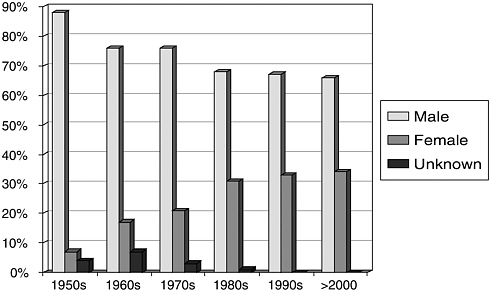
FIGURE 1 Gender distribution of fellowships by decade of award.
fluctuated over the years, with the fewest awards given between 1960 and 1964 and the most given from 1980 to 1984.
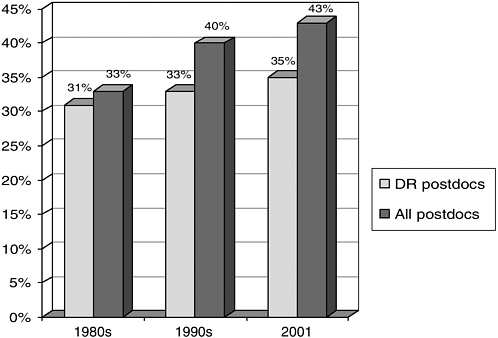
During the interval from 1947 to 2003, males accounted for 72 percent of fellowship recipients, 26 percent were female, and for 2 percent gender was unknown. The proportion of female awardees has increased over time, from 7 percent in the 1950s to 34 percent during the period of 2000–2003 (see Figure 1). The proportion of females in the Damon Runyon fellowship program was slightly less than that in the pool of all postdoctoral scientists in the United States (see Figure 2).
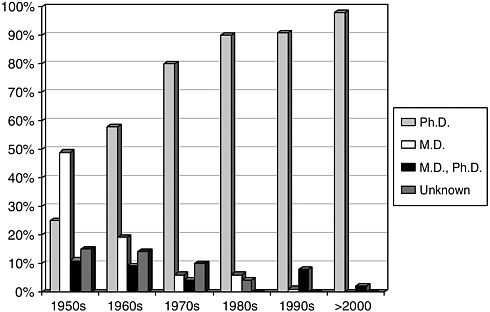
Although those holding Ph.D., M.D., or M.D.-Ph.D. degrees are eligible to apply for the fellowship, 80 percent were awarded to Ph.D.-level scientists, followed by 10 percent to M.D.s, and 5 percent to M.D.-Ph.D. holders (for 5 percent of awards, degree was unknown). As seen in Figure 3, the distribution of degrees has shifted dramatically since inception of the award. In the 1950s, 48 percent of fellowships went to M.D.s, while currently 98 percent of fellowships are awarded to Ph.D.-level scientists.
SURVEY RESULTS
From a total of 1,301 individuals sent an invitation to participate in the survey, 779 completed the survey, 419 did not respond, and 101 e-mail invitations were undeliverable. This represents a response rate of 65 per-
cent. Recent awardees were slightly overrepresented in the respondent group. For example, fellows who began between 1995 and 1999 represented 12 percent of the total fellow pool but made up 23 percent of the survey respondent group. M.D.s were slightly underrepresented in the respondent group. Ten percent of all fellows held M.D. degrees, but M.D.s made up only 3 percent of the respondent group. Those working outside academia may have been underrepresented because they were more likely to have invalid addresses or missing e-mail addresses in the database.
The average age at which awardees received their fellowships was 28.8 and has increased over the time, from a low of 27.5 in the 1970s to 29.7 from 2000 to 2003. The total length of postdoctoral training averaged 4.0 years, a figure that increased by one full year from the 1960s to the 1990s.
The majority of survey respondents (68 percent) accepted jobs in academia when they finished their Damon Runyon fellowships (see Table 2). Of the 533 individuals who stayed in academia after their fellowships, the majority (75 percent) obtained a tenure-track assistant professorship. The remaining 25 percent took non-tenure track appointments, such as research assistant professor (15 percent), staff scientist (5 percent), or instructor (5 percent).
At the time of the survey, 83 percent of respondents were working in academic or private research institutions, 7 percent in biotechnology companies, 5 percent in government laboratories, 4 percent in pharmaceutical companies, and 2 percent in other areas (e.g., law, publishing, private medical practice, consulting).
Fellows’ productivity has been substantial. For example, survey respondents have trained over 4,000 graduate students and 4,000 postdoctoral fellows/associates. Survey respondents had an average of 49
TABLE 2 Number and Percentage Distribution of First Position Following Fellowship Award
|
Position |
Number of Fellows |
Percentage of Fellows |
|
Academia/Private Research Organization |
533 |
68 percent |
|
Did a second postdoctoral |
101 |
13 percent |
|
Biotech/Pharma |
70 |
9 percent |
|
Government |
35 |
5 percent |
|
Hospital (clinical training) |
3 |
<1 percent |
|
Pursued another degree |
1 |
<1 percent |
|
Non-research position |
1 |
<1 percent |
|
Still a postdoctoral at survey time |
35 |
5 percent |
publications in peer-reviewed scientific journals, and 35 percent of survey respondents held patents on their work. Nearly all (96 percent) survey respondents indicated that they were still conducting research or had been until their retirement. Finally, 83 percent of survey respondents indicated that they were working in areas relevant to understanding cancer and/or finding new approaches to prevent, diagnose, or treat it.
Fellows have had an outstanding record of securing additional extramural funding. Over 90 percent of the survey respondents who started their Damon Runyon fellowships prior to 1995 and were working at U.S. academic research institutions at the time of the survey have been a principal investigator on an R01 or R29 grant from the National Institutes of Health. The age at which respondents received their first R01 has varied slightly over time, but averaged 35. Survey respondents also obtained prestigious awards from private sources; among them were 26 Pew scholars, 19 Burroughs-Wellcome Fund awardees, 19 Howard Hughes Medical Institute (HHMI) investigators, 17 Searle scholars, and 6 American Cancer Society professors. Among the total pool of former Damon Runyon fellows (not just survey respondents), there were 22 current HHMI investigators, representing 7 percent of all HHMI investigators, at the time of the analysis.
Fellows also assumed positions of leadership. Among the survey respondents, 53 had served as department chairs, 29 as institute directors, and 11 as deans. Moreover, fellows were recognized and honored for their scientific leadership through a number of national and international awards. At the time of the analysis, 19 former Damon Runyon fellows had been elected to the National Academy of Sciences and seven to the Institute of Medicine. Former fellows had also won major cancer prizes. Three won cancer prizes from General Motors: George Klein, M.D., and Bruce Stillman, Ph.D., won the Alfred P. Sloan, Jr. Prize, and Peter Vogt, Ph.D., won the Charles S. Mott Prize. Susumu Tonegawa, Ph.D., and Peter Vogt, Ph.D., received the Brisol-Myers Squibb Freedom to Discover Award for Distinguished Achievement in Cancer Research. Three former fellows had received Lasker awards: Min Chiu Li, M.D., in 1972; Susumu Tonegawa, Ph.D., in 1987; and James E. Rothman, Ph.D., in 2002. Two former fellows have received a Nobel Prize: Susumu Tonegawa, Ph.D., in 1987, and Sidney Altman, Ph.D., in 1989.
Nearly all of the survey respondents, 98 percent, felt that the Damon Runyon fellowship had a positive impact on their careers. In addition, 74 percent felt that the fellowship made them more competitive in the job market, 66 percent found that it gave them confidence in their ideas, 52 percent felt that it gave them freedom to pursue their own ideas, and 51 percent felt that it helped them obtain subsequent funding.
DISCUSSION AND CONCLUSIONS
The absence of a control group and appropriate benchmarks makes assessment of the Damon Runyon fellowship’s impact on the careers of awardees impossible. However, the survey did provide a wealth of new information about the accomplishments of former fellows and trends in postdoctoral training over time. The foundation considered four findings from the survey to be positive indicators of the program’s value:
-
a strong commitment to research (96 percent of survey respondents stayed in research),
-
a high success rate in competing for subsequent funding (90 percent of appropriate survey respondents had obtained an R01 or R29),
-
a high degree of participation in cancer relevant research (83 percent of survey respondents are engaged in cancer research), and
-
the strong perception by recipients that the fellowship had a positive impact on their careers.
Additional value was provided by the responses to several open-ended questions about fellowship recipients’ decision to pursue cancer research, contributions to their field, and involvement in the development of cancer therapeutics. Although the voluminous nature of this information precluded any efforts to summarize or present the material effectively, the material did provide useful quotes for foundation publications and enabled a more complete assessment of each individual’s experience.


