
3
Malaria Vaccines
The complex Plasmodium life cycle is summarized in Figure 3-1. Infection is initiated by inoculation of sporozoites from an infected anopheline mosquito. In humans the parasite undergoes cycles of replication in the liver (exoerythrocytic cycle) and in the blood (erythrocytic cycle). The sporozoites and liver stages are cumulatively referred to as the preerythrocytic stages.
For protection of individuals, studies of experimental and naturally acquired immunity provide a solid rationale for the feasibility of a malaria vaccine that can target either preerythrocytic (sporozoite and liver) stage or asexual erythrocytic blood stages of the parasite, or both. While both types of vaccine would also reduce transmission, it is also theoretically feasible to protect communities by high coverage with vaccines that would generate immune responses to sexual stages in the blood of humans and that would then interfere with completion of the life cycle when anophelines consume the blood of such vaccinated humans. However, the latter type of vaccine is not immediately useful for individual protection as would be required by the Department of Defense (DoD).
Vaccines based on the preerythrocytic stages usually aim to prevent infection completely, whereas blood-stage vaccines aim to reduce (and perhaps eventually eliminate) the parasite load once a person has been infected, thus alleviating the clinical symptoms. However, vaccines acting at the preerythrocytic stage may also reduce the severity of the subsequent blood infection. This could occur by reduction in the number of parasites emerging from the liver into the blood or by delaying the initiation of the
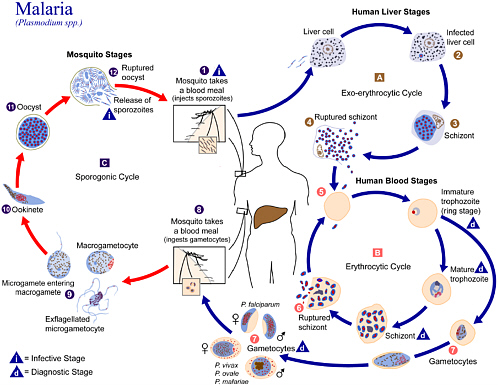
The malaria parasite life cycle involves two hosts. During a blood meal, a malaria-infected female Anopheles mosquito inoculates sporozoites into the human host  . Sporozoites infect liver cells
  and mature into schizonts
  , which rupture and release merozoites
  . (Of note, in P. vivax and P. ovale a dormant stage [hypnozoites] can persist in the liver and cause relapses by invading the bloodstream weeks or even years later.) After this initial replication in the liver (exoerythrocytic schizogony
  ), the parasites undergo asexual multiplication in the erythrocytes (erythrocytic schizogony
  ). Merozoites infect red blood cells
  . The ring-stage trophozoites mature into schizonts, which rupture releasing merozoites
  . Some parasites differentiate into sexual erythrocytic stages (gametocytes)
  . Blood-stage parasites are responsible for the clinical manifestations of the disease.
The gametocytes, male (microgametocytes) and female (macrogametocytes), are ingested by an Anopheles mosquito during a blood meal  . The parasites’multiplication in the mosquito is known as the sporogonic cycle
  . While in the mosquito’s stomach, the microgametes penetrate the macrogametes and generate zygotes
  . The zygotes in turn become motile and elongated (ookinetes)
  and invade the midgut wall of the mosquito where they develop into oocysts
  . The oocysts grow, rupture, and release sporozoites
  , which make their way to the mosquito’s salivary glands. Inoculation of the sporozoites into a new human host perpetuates the malaria life cycle .
SOURCE: CDC, 2002.
blood-stage infection thereby allowing the immune system additional time to mount effective immune responses.
It is generally agreed that a vaccine effective against both preerythrocytic and asexual blood stages would be ideal to protect individuals at high risk. However, inclusion of multiple antigens in a vaccine complicates its development: intellectual property issues must be addressed, clinical trials must assure that there is no interference among the antigens, and the cost is increased. Nevertheless, there is ample evidence from an array of bacterial and viral vaccines (e.g., various multivalent infant combination vaccines including diphtheria-pertussis-tetanus, measles-mumps-rubella-varicella, 7-valent pneumococcal conjugate, etc.) that there is precedent for developing effective vaccines containing multiple antigens.
SPECIFIC MILITARY NEEDS WITH RESPECT TO A MALARIA VACCINE
The committee was asked to consider whether the military malaria vaccine requirements were different from those in other populations. The answer is a qualified yes. For the military it would be ideal to prevent infection (parasitemia) completely, but it is certainly necessary to achieve a high level of protection from the debilitating clinical effects of malaria (Table 3-1). A relatively short duration of protection is acceptable (approximately 6 months). For children in highly endemic areas, on the other hand, complete protection from infection may not be essential; a vaccine that reduces clinical and severe malaria by half would be extremely useful. However, the duration of protection for children in endemic areas needs to be at least one year, given the difficulty of delivering booster doses. Nevertheless, it is conceivable that a vaccine meeting military needs could also have a significant public health impact.
The needs of the tourism/traveler market are quite similar to those of the military (Table 3-1). One difference is that most civilian travelers may not require even as long as 6 months protection—a shorter period may be acceptable as long as efficacy is high. A short initial schedule would also be desirable for travelers, but less critical for the military where basic training of several weeks to months occurs before deployment.
For all needs (military, public health, and civilian travelers), P. vivax is less of an urgent problem than the potentially fatal P. falciparum. This committee was asked to consider only the P. falciparum vaccine program, as it is the most severe and urgent problem. However, prevention of the clinical debilitation of P. vivax and other malaria species is also critical to the military as a second priority.
TABLE 3-1 Malaria Vaccine Needs in Different Groups
|
|
U.S. Military Personnel |
Typical Civilian Traveler |
High-Risk Populations in Malaria Endemic Areas |
|
Primary goal |
High-level protection against infection (or clinical diseasea) in nonimmune adults |
High-level protection against infection (or clinical disease) in nonimmune adults |
Prevent disease and death in young childrenb |
|
Minimum duration of efficacy |
6 months |
6 months |
13–18 months |
|
Rapid onset of protection |
Yes (after booster) |
Yes |
Not necessarily |
|
Able to be boosted by natural infection |
Desirable but not essential |
Desirable but not essential |
Yes |
|
Compatible with current childhood immunization schedules |
No |
No |
Preferably |
|
Short initial schedule |
Desirable but not essential |
Yes |
Preferably |
|
Lack of interference with other vaccines |
Yes (other predeployment vaccines) |
Yes (other pretravel vaccines) |
Yes (other childhood vaccines) |
|
aAlthough protection from clinical disease is most important, protection against infection as well as against clinical disease would also eliminate potential risk of transfusion malaria. bThe level of protection required has been estimated by the Malaria Vaccine Technology Working Group, a recently formed consensus group (Roadmap, 2006). The goals and timelines are as follows: for a first-generation vaccine, protective efficacy of more than 50 percent against severe disease and death (licensure 2015); for a second-generation vaccine, more than 80 percent protection against clinical disease and death (licensure 2025). |
|||
MALARIA VACCINE DEVELOPMENT
Development of any new vaccine is a difficult task, and the malaria parasite is even more challenging because of its complex life cycle and antigenic complexity. As with any complex new vaccine (e.g., HIV, tuberculosis), there will be a long list of potential vaccine antigens and formulations in the early stages; this list is expected to be whittled down to a few better prospects during the development process. Potential vaccine constructs may be eliminated because they turn out not to be protective, because they cannot be reliably produced, because the companies developing them do not have sustained interest, or because of safety issues with either the antigens or the formulations (e.g., adjuvants).
Malaria vaccines under development include attenuated whole organisms, recombinant proteins, peptides, and gene-based (DNA or viral vector) vaccines, using a variety of adjuvants. A fairly recent development is the prime-boost strategy, which involves a combination of different antigen delivery systems encoding the same epitopes or antigen (for example naked DNA followed by DNA in a viral vector), delivered at an interval of a few weeks apart.
The following section briefly describes the history of research and development on malaria vaccines, including the identification of important malaria antigens and understanding of immunogenicity, much of which was done by Military Infectious Diseases Research Program (MIDRP) Malaria Vaccine Program researchers. The following information illustrates the depth of experience in the MIDRP Malaria Vaccine Program and their collaborators as well as the fact that current promising candidates have emerged from a long and sustained effort over the last 30 years (Appendix A).
Prelicensure vaccine trials in humans progress in step-by-step fashion under regulatory supervision. The trial stages are defined here according to Levine et al beginning with phase 1 (dose-finding, preliminary safety, and initial immunogenicity studies) (Levine et al., 2002). These are followed by phase 2 (larger-scale safety and immunogenicity and sometimes preliminary assessments of efficacy [e.g., via experimental challenge studies]) and phase 3 trials (large-scale studies to assess efficacy under conditions of natural challenge and to gather additional information on safety).
Preerythrocytic Stages
Attenuated Sporozoites
Early studies in the 1960s demonstrated high levels of protective immunity following immunization with radiation-attenuated sporozoites in
experimental rodent and primate models (Nussenzweig and Nussenzweig, 1989). Protection was sterile in that no blood-stage parasites were demonstrable in the blood of immunized hosts challenged with viable sporozoites. Protection was also stage specific, as the sporozoite-immunized animals remained fully susceptible to challenge with blood-stage parasites. Hallmark early studies in humans demonstrated that sterile immunity could be obtained in volunteers immunized by frequent exposure to large numbers of irradiated mosquitoes infected with P. falciparum or P. vivax (Clyde, 1990; Rieckmann, 1990). Protection was species specific and strain cross-reactive in that volunteers immunized by exposure to the bites of irradiated P. falciparum-infected mosquitoes were protected against multiple strains of P. falciparum from diverse geographical areas, but not against P. vivax. These findings were confirmed in later studies carried out by the University of Maryland and the Naval Medical Research Center (NMRC) in which 95 percent of volunteers exposed to a minimum of 1,000 bites from irradiated mosquitoes infected with P. falciparum were protected for periods of up to 9 months (Herrington et al., 1991; Hoffman et al., 2002).
Circumsporozoite Protein
The early identification of target antigens was based on recognition by sera and cells of protected volunteers and experimental hosts immunized with attenuated sporozoite vaccine. The first antigen identified by serological screening was a major surface antigen of the sporozoite, the circumsporozoite protein (CSP),1 and this protein was the first malaria parasite to be cloned and sequenced in P. knowlesi, followed soon thereafter by P. falciparum (Dame et al., 1984; Ellis et al., 1983; Enea et al., 1984). The sequences showed a prominent feature of the CSP: It contains a large number of repeats of a short amino acid sequence (NANP in P. falciparum). CSP remains a primary vaccine candidate, either alone or in combination with other preerythrocytic- or erythrocytic-stage antigens, in vaccine development programs of the Walter Reed Army Institute of Research (WRAIR) and the NMRC, as well as at other institutions (WHO, 2005).
Mechanisms of immune protection that target the CSP include both antibody and cellular responses. Based on the demonstration in rodent and primate models that high antibody titers against CSP repeats correlated with protection (Zavala et al., 1985), early P. falciparum vaccine efforts focused on generation of strong humoral immunity. The first phase 1 and
2 trials (see Appendix A) tested efficacy of P. falciparum CSP expressed as a recombinant protein R32tet32, comprising 32 repeats of the tetramer NANP expressed in tandem with 32 amino acids from the bacterial tetracycline resistance gene translated out of frame (Ballou et al., 1987). Further studies used a synthetic peptide-protein conjugate NANP3-TT, comprising three copies of the NANP repeat conjugated to tetanus toxoid as carrier (Herrington et al., 1987). Challenge of a small number of volunteers immunized with the alum adjuvanted subunit vaccines provided the first demonstration that antirepeat antibodies were protective in humans in vivo, but vaccine efficacy was limited by overall low titers. Subsequent clinical trials by WRAIR examined CSP repeats using various conjugates including fusion with 81 amino acids from a nonstructural protein of influenza (R32NS1), adjuvanted with monophosphoryl lipid A(MPL)/ cell wall skeleton of Mycobacterium phlei and squalene (Hoffman et al., 1994), and R32 fused to Tox A (Fries et al., 1992). These different conjugates increased antibody titers but did not significantly increase protection.
In addition to antibody responses, cellular responses to CSP were found to play a critical role in protection (Aggarwal et al., 1990; Romero et al., 1989; Sadoff et al., 1988; Weiss et al., 1988). In irradiated sporozoite rodent models, the role of antibody and cells differed depending on malaria species and strain of mouse (Doolan and Hoffman, 2000). Cellular responses are multifaceted, but a primary immune mechanism is the production of interferon that targets the intracellular hepatic exoerythrocytic forms (Ferreira et al., 1986; Schofield et al., 1987a). Interferon gamma, produced by CD4+ or CD8+ T cells elicits nitric oxide production in the infected cell that destroys the hepatic-stage parasites (Mellouk et al., 1991; Seguin et al., 1994). A number of CD4+ and CD8+ T-cell epitopes were identified in the N and C terminus of the CS protein (Nardin and Nussenzweig, 1993), several of which overlapped polymorphic regions of the P. falciparum CS protein (Good et al., 1989).
A phase 2 trial of recombinant P. falciparum CSP containing CD4+ and CD8+ T cell epitopes, but no NANP repeats, administered in liposomes/ MPL/alum did not demonstrate any protection (Heppner et al., 1996). This implies that a combination of antirepeat antibody and cellular responses may be required for vaccine efficacy in humans, as suggested by studies in the sporozoite immunized rodent model ( Schofield et al., 1987b; Rodrigues et al., 1993). Such vaccines would provide a multi-pronged approach with antibody eliminating most if not all of the infectious sporozoite inoculum and cellular responses, mediated by inhibitory cytokines or direct cytotoxicity, targeting the remaining intracellular exoerythrocytic forms in the liver. Recombinant full-length CSP, however, was poorly immunogenic in phase 1 trials using alum as adjuvant, indicating that antigen format was important (Herrington et al., 1992).
RTS,S Vaccine and the Effect of Adjuvant
The most successful approach to improve immunogenicity of CS subunit vaccines was provided by WRAIR in collaboration with GlaxoSmithKline (GSK). A multimeric antigen was constructed by fusing the CSP repeats and C terminus to hepatitis B virus surface antigen (HBsAg). Notably, the recombinant CS protein-HBsAg hybrid monomers (RTS) when coexpressed in yeast cells with native hepatitis B surface antigen monomers (S) spontaneously formed viruslike particles, a vaccine preparation termed RTS,S.
Most importantly, it was found that a specific adjuvant was critical to vaccine efficacy, as protection was obtained only with RTS,S formulated in a potent adjuvant developed by GSK comprising a combination of MPL and QS21 in an oil in water emulsion (Garcon et al., 2003). This vaccine formulation elicited sterile immunity in a proportion of both malaria-naïve volunteers and malaria-experienced adults in the Gambia (Bojang et al., 2001; Kester et al., 2001; Stoute et al., 1997, 1998).
Gene-Based and Prime-Boost Approaches
DNA vaccines and viral vectors were amongst the vaccine delivery systems that appeared promising for the generation of CS-specific cellular immunity, and in some initial studies in small animals this goal was achieved (Rodrigues et al., 1994, 1997, 1998; Sedegah et al., 1994). However, clinical trials of these candidate vaccines when used alone or in repeated homologous boosting regimes have been disappointing, with low levels of antibody and minimal protection (Le et al., 2000; Wang et al., 1998).
Recent years have seen the development of immunization strategies using a combination of different antigen delivery systems encoding the same epitopes or antigen, delivered at an interval of a few weeks apart. This sequential immunization approach with different vectors is known as heterologous prime-boosting and is capable of inducing greatly enhanced and persistent levels of CD8+ T cells and Th1-type CD4+ T cells compared to homologous boosting (Anderson et al., 2004; Li et al., 1993; Sedegah et al., 1998). Recently in murine malaria models, different strains of adenovirus have also been shown to be promising candidates for this approach (Ophorst et al., 2006). Efforts to boost RTS,S-primed responses with the recombinant modified vaccinia Ankara (MVA) virus expressing CSP, or vice versa, did not increase vaccine efficacy (Dunachie and Hill, 2003).
Erythrocytic Stages
A rationale for blood-stage vaccines is provided by the naturally acquired immunity that develops by adulthood in people living in endemic areas. Passive transfer of immune serum from adults to children was shown to decrease parasitemia and clinical disease (Cohen et al., 1961; Edozien, 1961; Sabchareon et al., 1991).
The potential targets of blood-stage immunity include a highly polymorphic antigen on the surface of erythrocytes, PfEMP-1, as well as antibodies that target polymorphic merozoite antigens known to play a role in invasion of erythrocytes, such as MSP-1 and AMA-1.
Many studies ranging from phase 1 to phase 3 have been done with a synthetic polymer, termed SPf66, which contains peptides derived from the amino acid sequences of three P. falciparum merozoite proteins found to be protective in the Aotus monkey model (Patarroyo et al., 1987). Clinical trials in adults and children in South America, Africa, and Southeast Asia failed to demonstrate reproducible levels of protection against infection or clinical disease (results are summarized in Appendix A, Table A-3).
More recently, phase 2 clinical trials of a combination vaccine composed of MSP-1, MSP-2, and RESA, a ring-infected erythrocyte surface antigen expressed on erythrocytes, demonstrated a 62 percent reduction in parasite density with a lower prevalence of parasites expressing the MSP-2 allele found in the vaccine (Genton et al., 2002).
Multiantigen Multistage Approaches
A multistage vaccine would be expected to reduce the sporozoite inoculum and hepatic stages as well as block merozoite invasion of erythocytes, thereby reducing or eliminating clinical disease. A vaccine that also included different allelic forms of polymorphic antigens would also reduce the potential for selection of strain-specific responses.
The scientists at WRAIR were among the first to test a multistage vaccine composed of a recombinant vaccinia virus, NYVAC 7, engineered to express CSP and six additional antigens derived from sporozoite/liver and blood stages. These included sporozoite/liver-stage antigen SSP-2/ TRAP,2 important in parasite targeting to host cells and motility (Sultan et al., 1997), LSA-1, a parasite protein expressed only in the liver (Hollingdale
et al., 1998); and MSP-1 and AMA-1 expressed in the invasive merozoite stage. Despite the ability of the vaccine to elicit antibody and cellular immune responses to these antigens, only 1 out of 35 volunteers was protected (Ockenhouse et al., 1998). See Appendix A.
In efforts to increase efficacy of RTS,S-induced immunity the CSP-based vaccine has been combined with a preerythrocytic-stage antigen (SSP-2/TRAP) or blood-stage antigen (MSP-1). However, in the experimental challenge model, RTS,S protective efficacy was not increased by a combination of RTS,S + MSP-1, and immunization with RTS,S + SSP2/TRAP resulted in reduced vaccine efficacy (Heppner et al., 2005; Heppner, 2006).
The multistage vaccine approach adopted by the NMRC focused initially on DNA plasmid vaccines. NMRC was first to study immunogenicity of a CSP DNA plasmid malaria vaccine in human volunteers showing the ability to elicit strong CD8, but poor CD4 and antibody responses (Wang et al., 1998). Efforts to boost CSP DNA-primed responses with RTS,S were not successful (Epstein et al., 2004; Wang et al., 2004). Strong support for the potential of multistage DNA vaccines, however, was provided by studies in the P. knowlesi/rhesus model (Rogers et al., 2001). Immunization with four plasmids encoding full-length P. knowlesi CSP, SSP-2/ TRAP, AMA-1, and MSP-142 followed by poxvirus boost elicited significant levels of sterile protection and control of parasitemia in rhesus monkeys (Rogers et al., 2002). In human volunteers phase 1 and 2 trials of MuStDO5, a mixture of DNA plasmids encoding five preerythrocytic-stage proteins, CSP, SSP-2/TRAP, LSA-1, LSA-3 (a second liver-stage antigen expressed also in sporozoites), and PfExp1 (an exported liver-stage antigen found in parasitophorous vacuoles), have been carried out. Although the vaccine elicited positive CD4+ and CD8+ T-cell responses, no antibody or protection against challenge was obtained in the immunized volunteers (Wang et al., 2005), indicating that nonfalciparum animal models can be very misleading in predicting results with falciparum immune responses and/or protection in humans. Recent studies have demonstrated immune interference by certain antigens within the combination and these findings have been used to down-select antigens and identify the most promising combination, termed CSLAM (CSP, SSP-2/TRAP, LSA-1, AMA-1, MSP-1) for further studies (Sedegah et al., 2004).
A clinical trial of ME-TRAP, a multiple epitope construct, containing T- and B-cell epitopes from several preerythrocytic-stage antigens linked to SSP2/TRAP and delivered as a DNA prime followed by a boost in the MVA viral vector, failed to show protection in malaria-exposed volunteers (McConkey et al., 2003; Moorthy et al., 2004b). However this is still a highly active area of research with different combinations of viral vectors being investigated (Webster et al., 2005).
SCIENTIFIC BARRIERS TO MALARIA VACCINE DEVELOPMENT
Insufficient Knowledge of Malaria Biology
A major scientific barrier to developing malaria vaccines is insufficient knowledge about the malaria parasite, especially parasite polymorphism and antigenic variation. It must be acknowledged that most current vaccines were developed without extensive knowledge of this variability. However, most vaccines for simpler organisms are not as challenging as malaria. At present there are no FDA-approved vaccines for organisms more complex than viruses and bacteria, although some other parasite vaccines are in development.
The sequencing of the malaria genome has helped to accelerate the study of different variants of important target antigens, but it is not clear which antigens or how many allelic variants of each will be needed in a vaccine. Despite the large number of parasite antigens, most research focuses on a few long-known antigens out of the approximately 5,000 genes present in the malaria genome. Understanding parasite population structure and antigenic variation in nature requires lengthy and difficult field and laboratory studies, some of which are currently underway by other groups.
Lack of Understanding of Protective Immunity
A second major problem is the lack of understanding of the mechanisms of immune protection from malaria (Good, 2001). Most vaccines are established based on examples of naturally acquired immunity, and there are not good examples of complete immunity to the disease in nature that can be used as a model. Despite the fact that there is an established challenge model of protection against preerythrocytic stages, there is still no fundamental understanding of why certain people are protected and others not. Romero et al (1989) demonstrated the characteristics of T cells in the mouse that confer immunity, and the results of Kryzch et al (1995) tended to confirm these findings, but in general these results cannot be clearly reproduced in human challenge studies.
Although some work has suggested that protection in adult volunteers immunized with RTS,S correlated with presence of high antirepeat antibodies and CD4+ T cells (Lalvani et al., 1999) and with low numbers of CD8+ T cells detected by intracellular cytokine staining (Sun et al., 2003), generally trials conducted either with experimental challenge (Kester et al., 2001; Stoute et al., 1997, 1998) or natural challenge (Alonso et al., 2005; Bojang et al., 2001) have not demonstrated clear immune
correlates of protection. Either the assays or reagents being used are not sophisticated enough, or there is a fundamental unrecognized immune process involved.
Inadequate Animal Models
There is considerable uncertainty about how well animal research models reflect human immunity. The lack of a good animal model is reflected in the fact that the WRAIR and NMRC programs are in conflict: WRAIR scientists apparently do not believe the Aotus model to be useful on the path to a vaccine (Heppner et al., 2001), whereas NMRC uses it (among several other animal models) as a means for evaluating potential antigens. The use of many different animal models in preclinical studies precludes direct comparison of similar vaccine constructs being developed by WRAIR and NMRC, such as adenovirus 35 versus adenovirus 5 viral vectors.
Poor Definition of Outcomes
Lack of clear definition of desired outcomes (prevention of infection, clinical disease, and severe disease) contributes to confusion about the best approach to developing a malaria vaccine. Even with defined outcomes in particular animal model systems, it is often not clear how well protection in these model systems correlates with success in humans.
The Malaria Vaccine Technology Roadmap
Many of these barriers are of long standing, having been recognized in an earlier Institute of Medicine (IOM) report on malaria vaccines (IOM, 1996) and also by the Malaria Vaccine Technology Roadmap Working Group (Roadmap, 2006), a collaborative process sponsored by Malaria Vaccine Initiative (MVI), the Bill and Melinda Gates Foundation, WHO, and the Wellcome Trust, in which the MIDRP Malaria Vaccine Program scientists fully participated. Overcoming these barriers forms the rationale for the list of top 10 priorities produced by the roadmap committee, with priority initiatives 1 through 7 being of direct relevance to MIDRP Malaria Vaccine Program vaccine efforts (Table 3-2). The MIDRP Malaria Vaccine Program could contribute significantly by developing jointly agreed criteria about the appropriateness of different animal models and outcome measurements in order to assist the global community in defining joint go/no-go criteria for vaccine candidates.
TABLE 3-2 Top 10 Priority Initiatives for Malaria Vaccine Development According to the Malaria Vaccine Technology Roadmap
|
Category |
Priority Initiative |
Detail |
|
Advancing Science |
1. Improved understanding of parasite-host interactions |
Use new technologies in genomics, proteomics, and other disciplines to study parasite biology and parasite-host interactions to enhance scientific understanding of the human immune response induced by P. falciparum. |
|
|
2. Correlates of protection |
Identify and validate correlates of protection, which would greatly expedite vaccine design. |
|
|
3. Standardized assays and reagents |
Develop standardized “tool kits” of validated assays, reagents, and operating procedures to enable comparison of results from models, field trials, and other experiments. |
|
|
4. Process development capabilities |
Improve access to robust process development and GMP pilot-lot manufacture to accelerate the clinical testing of promising vaccine candidates. |
|
|
5. Standardized trial end points |
Clearly define standard end points and measurement methodologies for use in clinical trials. Producing comparable field metrics can extend the value of clinical trials beyond the efficacy of a particular vaccine candidate. |
|
Improving Processes |
6. Shared go/no-go criteria |
Develop a common set of measurable criteria, linked to the strategic goals, to guide scientific and investment decisions at various stages along the entire vaccine development process. |
|
|
7. Increased and sustained clinical trial capacity |
Increase the capacity of endemic regions to provide ample, epidemiologically diverse sites with good clinical practice capability to support planned clinical trials. |
|
|
8. Balanced global portfolio |
Create a structured process to help guide and manage a balanced global portfolio of malaria vaccine research and development to focus global and local investments on the most critical needs. |
|
Shaping Policies and Commer- cialization |
9. Novel regulatory and introduction strategies |
Develop innovative regulatory strategies to prepare endemic countries and global bodies to evaluate a future malaria vaccine. Early attention to regulatory processes can avoid delays and allow a smooth transition to diminish the special challenges of deploying a malaria vaccine, including effective integration with existing intervention strategies. |
|
|
10. Innovative financing mechanisms |
Pursue innovative financing mechanisms that are supported by nation-level decision-making processes to stimulate market pull and ensure a viable market in endemic countries. |
|
SOURCE: Roadmap, 2006. |
||
DEPARTMENT OF DEFENSE SCIENTIFIC CONTRIBUTIONS TO THE GLOBAL MALARIA VACCINE RESEARCH EFFORT
A long-standing commitment to malaria research, including crucial drug development research mentioned above, has led the MIDRP Malaria Vaccine Program labs to the forefront of malaria vaccine development. Some of the highlights of the basic research from the last 40 years include being one of the first laboratories in which malaria parasites were cultured (Haynes et al., 1976), the development of automated and standardized culture techniques and growth inhibition assays (Desjardins et al., 1979; Haynes et al., 2002), and the establishment of routine mosquito infections from cultured parasites (Chulay et al., 1986).
Expertise in immunology and monoclonal antibody production at WRAIR was crucial to the success of cloning and sequencing the CSP gene (Dame et al., 1984). Particular expertise was developed in identifying (by antibody selection from a P. falciparum expression library) and sequencing several merozoite surface antigens that are recognized by neutralizing antibodies, including MSP-1 and MSP-2 (Lyon et al., 1986; Thomas et al., 1990). Important conformational targets on MSP-1 recognized by inhibitory antibodies and containing T-cell epitopes were identified (Krzych et al., 1995; Lyon et al., 1997), as well as the discovery of both inhibitory and blocking epitopes (Uthaipibull et al., 2001) on the MSP-142 portion of the molecule, leading to redesign of this vaccine candidate.
Sequencing of the CSP gene led directly to the first recombinant protein vaccine R32tet32 and its subsequent modifications (Ballou et al., 1987), which are described in more detail above and in Appendix A. The MIDRP Malaria Vaccine Program researchers also demonstrated the importance of the CSP central repeats in generating protective antibodies as well as the necessity for cell-mediated immune responses in protection, with target epitopes in the CSP C-terminal region (Aggarwal et al., 1990; Malik et al., 1991; Sadoff et al., 1988). This information was crucial in designing the RTS,S vaccine antigen.
In more recent years the MIDRP Malaria Vaccine Program, especially the NMRC, have played a major role in the successful effort to sequence the complete P. falciparum genome and the subsequent complete sequencing of other malaria species (Carlton et al., 2002; Gardner et al., 2002a,b).
The current capability of the MIDRP Malaria Vaccine Program labs to carry out P. falciparum sporozoite challenge trials is unparalleled in the world; they have by far the most experience in carrying out these experimental challenge trials. Sporozoite challenge for P. vivax vaccine trials (using mosquitoes infected from gametocyte carriers rather than culture) is also available at the Armed Forces Research Institue of Medical Sciences (AFRIMS). The other unit that was self-sufficient for many years in the
1980s and 1990s in performing multiple sporozoite challenges of volunteers was the Center for Vaccine Development of the University of Maryland School of Medicine, which maintained a dedicated insectary of mosquitoes infected with a cloned P. falciparum strain (CVD-1) (Davis, 1994; Herrington et al., 1988). It is only very recently that any other academic labs have taken on the task of P. falciparum experimental challenge. For example, during the past five years, the University of Oxford has performed multiple challenge studies using mosquitoes reared at Imperial College, London, United Kingdom (Webster et al., 2005); WRAIR assisted in setting up the initial Oxford challenge trials. The University of Nijmegen, the Netherlands, has also recently completed one small sporozoite challenge trial for a CSP peptide vaccine (Genton et al., 2005).
In addition to the ability to conduct human clinical trial challenges, the MIDRP Malaria Vaccine Program labs have contributed immensely to standardizing animal models of malaria, including the P. yoelii/mouse model, the P. knowlesi/rhesus model, and the P. falciparum/Aotus model. Development of an additional P. knowlesi model in natural rhesus hosts in Indonesia is in progress.
Notably, the MIDRP Malaria Vaccine Program has been involved in development and testing of three of the seven P. falciparum vaccine candidates that have progressed as far as phase 2 trials in endemic areas (Appendix A, Table A-3). The most promising one at present is RTS,S. Of the others that have reached the stage of human clinical trials in endemic areas, four ([NANP3]-tetanus toxoid, R32toxA, CSP-NANP/5.1, and SPf66) are no longer being considered as candidates; MSP-1/MSP-2/ RESA (combination B) is dormant; and ME-TRAP DNA and recombinant viral vector heterologous prime-boost vaccines are still being evaluated.
WRAIR scientists played a significant role in clarifying the efficacy of the SPf66 vaccine. Much effort and many field trials were devoted to testing the efficacy of non-GMP pilot-lot formulations of this peptide vaccine after initial promising results from South America. Independent manufacture and testing of the vaccine with assistance of WRAIR eventually contributed to the view that SPf66 conferred insufficient protection to warrant further development or routine use.
STATUS OF CURRENT VACCINE CANDIDATES
Figure 3-2 summarizes the current status of the most important P. falciparum vaccine antigens being considered and demonstrates the level of MIDRP Malaria Vaccine Program involvement in the worldwide effort. Constructs with which the MIDRP Malaria Vaccine Program is involved are shown as solid lines. Only trials of P. falciparum preerythrocytic, blood-stage and multistage vaccine candidates are included in Figure 3-2;
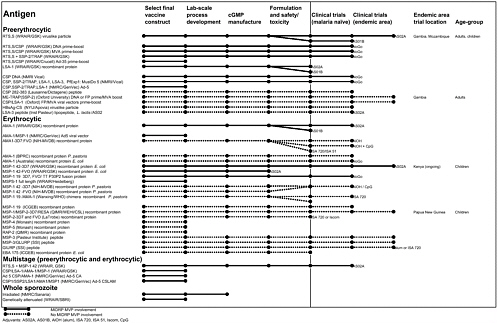
transmission-blocking antigens and P. vivax vaccines are beyond the scope of this review. Several reviews describe the trials in more detail (Ballou et al., 2004; Graves and Gelband, 2003; Moorthy et al., 2004a; Richie and Saul, 2002; Targett, 2005). More details about individual vaccine constructs are given in Appendix A, which lists the constructs and trials that have been conducted according to the type of trial (safety and immunogenicity trials only [Table A-1], and trials with experimental [Table A-2] or natural [Table A-3] challenge) and the parasite stage involved (preerythrocytic, erythrocytic, and multistage, respectively).
It can also be seen from Figure 3-2 that the MIDRP Malaria Vaccine Program is involved in the development of about half of the vaccine candidates that have not yet reached phase 2 trials but are under active development. These include some of the most advanced constructs that have achieved investigational new drug filing including MSP-1, AMA-1 and LSA-1 recombinant proteins with AS02A and AS01B adjuvants. The MSP-1 vaccine is currently in clinical efficacy trials in Kenya.
Because of the importance of RTS,S to the MIDRP Malaria Vaccine Program’s current strategy, we summarize the results of randomized studies in endemic areas in Figure 3-3. Four randomized efficacy trials of RTS,S have been conducted: one trial of RTS,S in nonimmune adults used artificial challenge with infected mosquitoes (Kester et al., 2001), one trial was with adult men followed over two malaria seasons in the Gambia (Bojang et al., 2001), and two cohorts of children aged 1–4 years in Mozambique were followed for up to 18 months (Alonso et al., 2004, 2005).
Figure 3-3 shows efficacy as estimated by three different outcomes: new malaria infection, clinical malaria, and severe malaria. Initial estimates of RTS,S efficacy in completely preventing infection from the trials at WRAIR were about 50 percent (Kester et al., 2001; Stoute et al., 1997). This level of efficacy was not borne out in a trial in adults in the Gambia in the first season after immunization, although there was 71 percent increase in time to first infection in the first 9 weeks after immunization (Bojang et al., 2001). However the efficacy of RTS,S against clinical episodes of malaria was high (63 percent reduction, 95 percent confidence interval [CI]: 18–93 percent) in the second year after immunization, after a booster dose (Bojang et al., 2001).
Two cohorts of children 1–4 years of age in Mozambique (one of which received chemotherapy to clear infections before follow-up) were partially protected by RTS,S for up to 18 months after immunization (Alonso et al., 2004, 2005) (Figure 3-3). Although the protection against new malaria infection (assessed in cohort 1) over a six month period was low (9 percent, 95 percent CI: 1–16 percent), the efficacy against clinical malaria was 30 percent (95 percent CI: 11–45 percent) over a six month period and remained at this level for up to 18 months (efficacy 35 percent, 95 percent
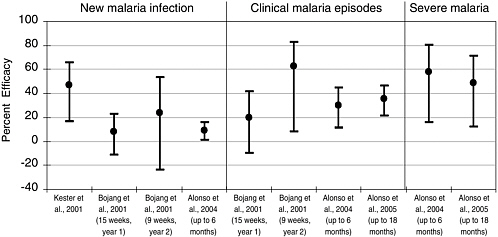
CI: 22–47 percent). It was encouraging that RTS,S also showed significant protection against severe malaria in children, estimated at 58 percent (95 percent CI: 16–81 percent) in the first six months and 49 percent (95 percent CI: 12–71 percent) over an 18 month period (Alonso et al., 2004, 2005). No significant safety issue associated with RTS,S vaccines was found, although the frequency of some local and systemic adverse effects (e.g., injection site pain, malaise) was increased compared to placebo (Bojang et al., 2005). Protection was not limited to the CSP variants used to make the vaccine (Alloueche et al., 2003).


