
B
R&T Challenges for Propulsion and Power
A total of 16 R&T Challenges were prioritized in the propulsion and power Area. Table B-1 shows the results. The R&T Challenges are listed in order of NASA priority. National priority scores are also shown.1 This appendix contains a description of each R&T Challenge, including milestones and an item-by-item justification for each score that appear in Table B-1.2
B1a Quiet propulsion systems
The adverse environmental by-products of aviation—primarily noise and emissions—are major constraints on the growth of aviation. Public concerns over the environmental impact of aircraft and airport operations, along with increasingly strict legal and regulatory requirements, can severely constrain the ability of civil aviation to meet national and global needs for mobility, increased market access, and sustained economic growth. Aircraft noise concerns include takeoff and landing noise; taxi and engine run-up noise; flyovers at cruise altitude over very quiet areas; and sonic booms associated with supersonic flight.
Figure B-1 shows how the impact of aviation noise on people living around airports has declined in the United States. It contrasts the growth of air travel with the reduction in the number of people exposed to 65-decibel (dB) day-night average sound level (DNL), which is what the federal government has defined as the “significant noise level.” In 1975, approximately 7 million people were exposed to significant aircraft noise. Since 1975, the number of persons exposed to significant noise levels has greatly declined even as air travel has grown dramatically. One of the most effective federal policies implemented to reduce aviation noise was the transition of commercial aircraft to quieter models. The availability of low-noise technologies, such as high-bypass-ratio engines, contributed significantly to this transition.
Assuming the industry’s continued recovery, and given the goal of doubling capacity over the next 10 to 35 years, future abatement efforts may need to achieve noise levels, as recognized by authorities both in the United States (NASA, 2003) and Europe (ACARE, 2001). The environmental impact of aircraft noise is projected to remain roughly constant in the United States for the next several years and then increase as air travel growth outpaces expected technological and operational advancements (Waitz et al., 2004). Furthermore, the public currently reports considerable annoyance even when DNLs are below 65 dB. Regulatory actions to limit or reduce noise exposure will likely lead to even more stringent limits.
Meeting future noise targets will be extremely challenging and will require continued fundamental research in noise generation and transmission phenomena and advanced propulsion technologies. Since the revolutionary introduction of the turbofan, engine source noise reductions have been more evolutionary, with incremental advances such as high-bypass-ratio engines and better acoustic liner technology. The development of validated noise prediction tools by NASA will greatly aid the development of quieter engines. NASA should emphasize physics-based noise source models that can distinguish core noise from other engine noise sources to identify source mechanisms. Research is needed to reduce the noise of engine systems, including fan noise, jet noise, and core noise. Research should also encompass systems analysis; advanced concepts, such as adaptable chevrons; the community impact of aircraft noise; and improved metrics to quantify and mitigate these impacts.
Noise and emissions are not independent phenomena in aircraft engines. There are physical interrelationships between noise and emissions and among various types of emissions, so that when one is decreased, another may be increased.
TABLE B-1 Prioritization of R&T Challenges for Area B: Propulsion and Power
|
|
|
|
Strategic Objective |
National Priority |
Why NASA? |
NASA Priority Score |
|||||||||
|
|
|
|
Capacity |
Safety and Reliability |
Efficiency and Performance |
Energy and the Environment |
Synergies with Security |
Support to Space |
Supporting Infrastructure |
Mission Alignment |
Lack of Alternative Sponsors |
Appropriate Level of Risk |
Why NASA Composite Score |
||
|
R&T Challenge |
Weight |
5 |
3 |
1 |
1/4 each |
||||||||||
|
B1a |
Quiet propulsion systems |
9 |
1 |
3 |
9 |
3 |
1 |
90 |
3 |
9 |
3 |
9 |
6.0 |
540 |
|
|
B1b |
Ultraclean gas turbine combustors to reduce gaseous and particulate emissions in all flight segments |
9 |
1 |
3 |
9 |
3 |
1 |
90 |
3 |
9 |
3 |
9 |
6.0 |
540 |
|
|
B3 |
Intelligent engines and mechanical power systems capable of self-diagnosis and reconfiguration between shop visits |
3 |
9 |
3 |
3 |
3 |
1 |
82 |
3 |
9 |
3 |
9 |
6.0 |
492 |
|
|
B4 |
Improved propulsion system fuel economy |
3 |
1 |
9 |
9 |
3 |
1 |
78 |
3 |
9 |
3 |
9 |
6.0 |
468 |
|
|
B5 |
Propulsion systems for short takeoff and vertical lift |
9 |
1 |
3 |
3 |
3 |
1 |
72 |
3 |
9 |
3 |
9 |
6.0 |
432 |
|
|
B6a |
Variable-cycle engines to expand the operating envelope |
3 |
1 |
9 |
3 |
3 |
9 |
68 |
3 |
9 |
3 |
9 |
6.0 |
408 |
|
|
B6b |
Integrated power and thermal management systems |
3 |
1 |
9 |
3 |
3 |
9 |
68 |
3 |
9 |
3 |
9 |
6.0 |
408 |
|
|
B8 |
Propulsion systems for supersonic flight |
3 |
1 |
3 |
1 |
9 |
9 |
50 |
9 |
9 |
3 |
9 |
7.5 |
375 |
|
|
B9 |
High-reliability, high-performance, and high-power-density aircraft electric power systems |
1 |
3 |
9 |
3 |
3 |
3 |
62 |
1 |
9 |
3 |
9 |
5.5 |
341 |
|
|
B10 |
Combined-cycle hypersonic propulsion systems with mode transition |
1 |
1 |
3 |
1 |
9 |
9 |
40 |
9 |
9 |
3 |
9 |
7.5 |
300 |
|
|
B11 |
Alternative fuels and additives for propulsion that could broaden fuel sources and/or lessen environmental impact |
3 |
1 |
3 |
9 |
3 |
1 |
60 |
3 |
3 |
3 |
9 |
4.5 |
270 |
|
|
B12 |
Hypersonic hydrocarbon-fueled scramjet |
1 |
1 |
3 |
1 |
9 |
9 |
40 |
9 |
3 |
3 |
9 |
6.0 |
240 |
|
|
B13 |
Improved propulsion system tolerance to weather, inlet distortion, wake ingestion, bird strike, and foreign object damage |
3 |
9 |
3 |
1 |
3 |
1 |
76 |
3 |
3 |
3 |
3 |
3.0 |
228 |
|
|
B14 |
Propulsion approaches employing specific planetary atmospheres in thrust-producing chemical reactions |
1 |
1 |
1 |
1 |
1 |
9 |
26 |
3 |
9 |
9 |
9 |
7.5 |
195 |
|
|
B15 |
Environmentally benign propulsion systems, structural components, and chemicals |
1 |
1 |
1 |
9 |
3 |
1 |
44 |
3 |
3 |
3 |
3 |
3.0 |
132 |
|
|
B16 |
Reduced engine manufacturing and maintenance costs |
3 |
3 |
3 |
3 |
3 |
1 |
52 |
3 |
1 |
1 |
3 |
2.0 |
104 |
|
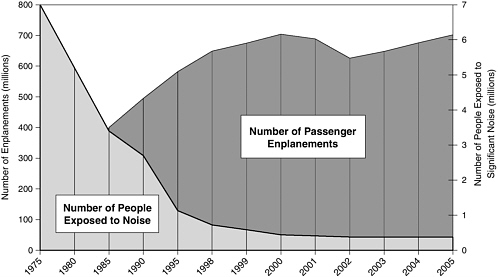
FIGURE B-1 Actual and predicted exposure to significant noise (65-dB day-night average sound level) and enplanement trends for the United States, 1975-2005. SOURCE: C. Burleson, FAA, “Aviation environmental challenges,” Presentation to Panel B on December 13, 2005.
Adequately understanding and mitigating the environmental impact of aviation requires an integrated approach to noise and emissions research that considers these tradeoffs.
High-risk, long-term research is required to meet future demands. Close collaboration between government and industry is required to mature and transition promising technologies. NASA plays a critical role in supporting fundamental source noise abatement research at universities, which can lead to both revolutionary technology advances and a workforce that can answer new technical questions. Key milestones include
-
Develop validated physics-based models to predict engine noise and conduct trade-off studies.
-
Improve understanding and prediction capabilities, and develop propulsion cycles compatible with noise and emissions reduction.
-
Develop advanced low-noise fan designs, liner concepts, and active control technologies.
-
Develop concepts to reduce installed noise (e.g., adaptable chevrons).
-
Develop and demonstrate propulsion designs that show the feasibility of technologies to reduce noise by 10 dB (in 15 years) from Boeing 777/GE 90 levels.
Relevance to Strategic Objectives
Capacity (9): In the absence of breakthroughs, increasingly strict noise requirements will constrain aviation system capacity.
Safety and Reliability (1): This Challenge will not help to achieve this objective, though equipment designed to reduce noise must be compatible with safety and reliability requirements.
Efficiency and Performance (3): Some noise reduction approaches (e.g., higher bypass ratio) increase efficiency while others (e.g., acoustic liners) increase weight, which may reduce efficiency. In addition, engines often run at nonoptimal conditions to reduce noise. Innovative noise solutions may permit new, optimized operating approaches.
Energy and the Environment (9): Aircraft noise directly impacts the environment.
Synergies with National and Homeland Security (3): Noise constraints impact DoD operations in civil airspace. This Challenge will alleviate this constraint.
Support to Space (1): This Challenge has no impact on this Objective.
Why NASA?
Supporting Infrastructure (3): NASA is well poised to conduct engine source noise abatement research. It has excellent facilities, a large staff of qualified personnel working in this area, and a track record of contributing to advancements. However, strong capabilities also exist at universities and in industry.
Mission Alignment (9): This Challenge is very relevant to NASA’s mission to improve aircraft performance.
Lack of Alternative Sponsors (3): NASA is well-qualified to support this Challenge, but industry has a strong incentive to conduct noise reduction research, even if NASA does not.
Appropriate Level of Risk (9): This Challenge is high risk.
B1b Ultraclean gas turbine combustors to reduce gaseous and particulate emissions in all flight segments
Emissions from aircraft constrain the growth of aviation due to their environmental impacts and potential human health consequences. While aviation sources remain a very small percentage of transport emissions, local worries about the environmental impact of these emissions can impede airport improvements to increase capacity. About 25 percent of U.S. commercial airports are in areas that are in non-attainment or maintenance for national ambient air quality standards—including 43 of the top 50 airports. Airports located in air quality nonattainment or maintenance areas increasingly find that air emissions add to the complexity, length, and uncertainty of the environmental review and approval of expansion projects (Akin et al., 2003). Furthermore, it is increasingly difficult for airport development projects to conform to Clean Air Act requirements, and air quality regulators in some states are working to directly or indirectly control growing aircraft emissions.
Key pollutants of concern include oxides of nitrogen and sulfur (NOx and SOx), carbon monoxide (CO), unburned hydrocarbons (UHCs), hazardous air pollutants, and particulate matter (PM). In addition, emissions of carbon dioxide (CO2) and water vapor (H2O) in the upper troposphere and stratosphere are of concern because of their potential impact on Earth’s climate (IPCC, 1999). Both CO2 and H2O are inherent combustion products of hydrocarbon fuels, and their emissions can only be reduced through improvements in overall cycle efficiency (see R&T Challenge B4) or a change in fuels.
Emissions of SOx and, possibly, PM can be reduced through fuel processing (e.g., desulfurization), fuel additives, or both. However, an improved understanding of PM formation and destruction mechanisms is required to reduce PM emissions. This a difficult problem given the inherent chemical complexity of aviation jet fuels and the lack of well-validated measurement techniques for PM.
Emissions of NOx, CO, UHC, and PM from the combustor can be reduced through the development of ultraclean combustion approaches, a critical step to mitigate the environmental impacts of aviation. Understanding (1) the tradeoffs between different emissions and noise and (2) the health and welfare impacts of various emissions and noise at different levels is also necessary to make informed design choices.
Low NOx emissions can be achieved with both lean-burning combustor designs and those that run rich in the front end (but lean overall)—the main point being low combustion temperatures. In addition, catalytic combustion systems have ultralow emissions levels, but durability and cost considerations make them unlikely candidates for aviation applications, at least for several decades. Rich-burn concepts (such as the so called rich-burn/quick-quench/lean-burn concept) use sequential rich, then lean combustion and, to some extent, are realized in most commercial engines using a rich primary zone followed by dilution. Key technical issues with this concept involve PM emissions and quench zone mixing (Lefebvre, 1999). Lean combustion concepts attempt to create a lean premixed fuel-air mixture, either upstream of the combustion chamber with lean, premixed, prevaporized (LPP) designs, or in the combustion chamber with multipoint, lean direct injection (LDI) approaches. Lean premixed approaches have received substantial market penetration in land-based gas turbine applications over the last two decades. While the majority of these devices use natural gas, similar LPP concepts have been used for liquid fuels by vaporizing the fuel. Such systems have demonstrated ultralow levels of NOx, CO, UHC, and PM. The key issues associated with LPP combustors are unsteady combustion phenomena, including combustion instability, flame blow-off, flashback, and autoignition, which are major operability concerns; autoignition is a key concern in high-pressure-ratio engines. These unsteady combustion issues are prominent concerns in commercial land-based applications and have degraded engine reliability and availability relative to more polluting alternatives (i.e., non-premixed flame combustors). LDI approaches, which have been extensively explored at NASA, avoid flashback and autoignition, but at the price of increased complexity. A variant of these concepts is to heavily dilute the fuel-air mixture with combustion products prior to combustion, sometimes referred to by the misnomer flameless combustion.
These combustion approaches share a number of common issues that should form the basis of future NASA research. These include mixing, PM formation and inhibition, and unsteady combustion phenomena. Fast, effective fuel-air and combustion product–reactant–quench air mixing is a
key enabling technology for all of the above-mentioned combustion technologies. Unsteady combustion phenomena are quite complex and, while heuristic explanations have allowed for an understanding of the basic physics, more in-depth understanding of the underlying dynamic processes is required to develop true predictive capabilities. For example, the conditions under which combustion instabilities occur and the amplitudes of instabilities cannot currently be predicted. In addition, some phenomena, such as blowoff or flashback, are well understood in fundamental laboratory burners but not at all in practical swirling devices, where new mechanisms and physics occur.
Developing effective mitigation for PM is predicated on understanding the formation of particles and their composition, growth, and transport mechanisms. Effective measurement techniques are also needed to assess aviation’s contribution to PM concentrations and potential interrelationships between PM and other aviation emissions, as well as noise. Metrics for human health and atmospheric impacts should also be established and correlated with particulate emissions from aviation. Finally, mitigation strategies to address all aviation emissions, taking into account interdependencies, need to be defined and developed. Key milestones include
-
Understand PM formation mechanisms and kinetics and develop fuel additives to disrupt formation.
-
Understand air toxicity measurement techniques and the impact of PM on human health and welfare.
-
Improve understanding and prediction capabilities and develop optimized approaches for mixing in multiphase flows.
-
Develop large eddy simulations (LES) with optimized subgrid models that contain key physics needed to capture chemical reactions, mixing, and unsteady combustor phenomena.
-
Develop physics-based, reduced-order combustor models, including emissions, combustion instability, blow-off, and flashback, for inclusion in intelligent engine control systems.
-
Develop validated chemical mechanisms that describe fuel kinetics.
-
Develop and demonstrate combustor designs that show the feasibility of technologies to reduce NOx emissions by 85 percent while also reducing PM, relative to 1996 International Civil Aviation Organization (ICAO) limits for future large and regional subsonic engines (with pressure ratios of 55:1 and 30:1, respectively).
Relevance to Strategic Objectives
Capacity (9): This Challenge will help create breakthroughs that are necessary to prevent increasingly strict emissions requirements from constraining the capacity of the air transportation system.
Safety and Reliability (1): Reliability issues have been a prominent issue for commercialized low-emissions combustors for ground-based applications. Low-emission combustion approaches for aircraft engines are unlikely to enhance safety and need to be well engineered so safety and reliability are not compromised.
Efficiency and Performance (3): Efficiency improvements reduce the fuel burn and pollutants emitted for a given mission, all other things remaining equal.
Energy and the Environment (9): Combustor emissions directly impact the environment.
Synergies with National and Homeland Security (3): Improved understanding of dynamic combustion processes and mixing will contribute to DoD goals for main engine and augmentor combustors.
Support to Space (1): This Challenge has no impact on this Objective.
Why NASA?
Supporting Infrastructure (3): NASA has excellent facilities and a large staff working in this area, but strong capabilities also exist at other university, DoD, and DOE laboratories.
Mission Alignment (9): This Challenge is very relevant to NASA’s mission to improve aircraft performance.
Lack of Alternative Sponsors (3): NASA is well qualified to support this Challenge, but DOE and DoD are also supporting similar programs for power, energy, and military applications.
Appropriate Level of Risk (9): This Challenge is quite challenging.
B3 Intelligent engines and mechanical power systems capable of self-diagnosis and reconfiguration between shop visits
In the future, advances in sensing, control, and information technology will lead to engines that are more sophisticated and more intelligent. Research thrusts should investigate how more intelligent systems can (1) improve engine health diagnostics and remedial actions in flight, (2) optimize the mission, and (3) use flight data to improve maintenance on the ground.
For current engines, the focus will be very much on diagnostics. Better physics-based modeling will be essential. Development of better CFD tools, better life-prediction tools, and better performance, steady-state, and dynamic checks will be the keys to success. Reducing in-flight shutdowns by a factor of 3 and unscheduled engine removals and delays and cancellations by a factor of 5 should reduce maintenance costs by 50 percent. Requirements include (1) smaller sensors, with better response and higher operating temperatures and (2) better materials with narrower properties tolerances. This should increase the lives of disks and airfoils by 50 percent.
Intelligent engine development will include active combustor control, which will permit operation with leaner burners, leading to lower NOx emissions. Active stall control will enable compressors at higher pressure ratios, increasing propulsion efficiency. For engines with current architectures, intelligent engines will put more emphasis on variable systems. The goal will be to have an engine morph itself between takeoff and cruise, for example, to accommodate the individual point requirements. On new engines with new architectures, the ultimate intelligent engines will be the variable-cycle engines, which are discussed in Challenge B6a below.
Another technology to develop will be closed-loop clearance control. A pressing need in this regard is the development of a three-point probe system to monitor turbine clearances online. Software will be developed to control turbine clearances by modulating the cooling air on the casing. Inservice deterioration will be reduced by accommodating the clearance loss due to rubs in the airfoils and the casing and by minimizing large clearances due to transients. This should significantly reduce operating temperature margins. Reducing the required engine margins by 50°F would increase on-wing life by about 3 years for most engines. Such a system would improve turbine efficiencies in flight and reduce fuel burn as much as 2 percent. Other relevant technologies include variable exhausts, active cooling control, improved aircraft– engine integration, better electric power generation, and better noise and emissions controls. Key milestones include
-
Develop better computational simulation tools to understand operability limits.
-
Develop better life prediction tools.
-
Develop improved steady-state and dynamic performance checks.
-
Develop improved health diagnostics systems.
-
Develop new health prediction systems.
-
Develop improved clearance control systems.
-
Develop active compressor stall control.
-
Develop active combustion control.
Relevance to Strategic Objectives
Capacity (3): Intelligent engines can improve capacity by preventing in-flight shutdowns and reducing delays and cancellations caused by unscheduled maintenance.
Safety and Reliability (9): Intelligent engines will provide new diagnostics systems and life-prediction capabilities that will greatly improve aviation safety and reliability.
Efficiency and Performance (3): Intelligent engines will help increase efficiency by reducing aircraft downtime, and they may provide a small reduction in fuel burn through engine optimization.
Energy and the Environment (3): Intelligent engine technology may reduce engine noise or control combustion for lowered pollutant formation.
Synergies with National and Homeland Security (3): This Challenge is relevant to military aircraft.
Support to Space (1): Space propulsion systems are generally highly instrumented so contributions from intelligent engine technology are likely to be minor, particularly for expendable vehicles.
Why NASA?
Supporting Infrastructure (3): NASA has very good sensor development and modeling capabilities.
Mission Alignment (9): This Challenge is very relevant to NASA’s mission to increase aircraft performance and operability.
Lack of Alternative Sponsors (3): This Challenge involves far-reaching technology that industry expects NASA to develop. DoD and DOE also perform relevant research.
Appropriate Level of Risk (9): This is challenging research that requires breakthroughs to succeed.
B4 Improved propulsion system fuel economy
The fuel economy of gas turbine propulsion systems is a function of engine efficiency, propulsion-induced drag, and propulsion weight. Overall engine efficiency is the product of the efficiency of creating hot, high-pressure gases (thermal or cycle efficiency), the efficiency of transferring energy from the hot high-pressure gases to a more desirable form (transfer efficiency), and the efficiency of creating thrust from the engine fan and core flows (propulsion efficiency). The thermal efficiency for a gas turbine (Brayton cycle) is primarily a function of the overall engine pressure ratio. That is, as long as the turbine can tolerate the inlet temperature corresponding to a given pressure ratio, the overall pressure ratio sets the efficiency of the cycle. Figure B-2 illustrates very clearly that state-of-the-art gas turbines have not reached the theoretical limits of thermal efficiency. The technologies identified in the figure have the potential to improve the thermal efficiency of gas turbines, to significantly increase fuel economy, and to decrease the environmental impact of the air transportation system.
The pressure ratio for state-of-the-art gas turbines is approximately 46:1 (for large engines) and 18 to 1 (for small engines). To reach fuel economy goals, the overall pressure ratios for large engines must be increased to between 60:1 and 65:1, and small engines must be increased to between 30:1 and 40:1. The technology that limits the overall pressure ratio is compressor disk material stress at operating temperature. Maximum disk temperature must be increased from 1350°F to 1500°F, and turbine blade materials, coatings, and cooling configurations must withstand 3600°F. Thus, advances in materials technology are key enablers of enhanced fuel economy.
Transfer efficiency is determined by the component efficiencies of the fan and low-pressure turbine and the losses of
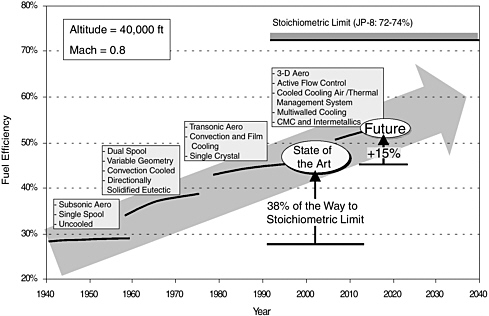
FIGURE B-2 Considerable gas turbine fuel efficiency improvements are still possible. SOURCE: J. Stricker, Air Force Research Laboratory, Private communication to panel member D. Crow, February 2006.
the shaft bearings. High-efficiency, low-pressure turbines need high rotor speeds, but highly efficient fans require low rotor speeds. Therefore, engines with high transfer efficiency must have reduction gearboxes or other technologies that permit different rotor speeds for the fan and low-pressure turbine.
Propulsion efficiency is a function of the difference between the velocity of engine exhaust and the forward velocity of the aircraft. Increasing the mass flow of air through the system at slower speed improves propulsion efficiency and decreases noise. However, doing so increases the diameter of the engine, which increases friction and flow blockage. Since larger engines will also be heavier, the use of composites or other lightweight materials for construction of the large structural pieces of the turbofan will also be necessary.
As shown in Figure B-2, improving thermal efficiency by 15 percent requires advances in several technologies: 3-D aerodynamics, active flow control, cooled cooling air and a thermal management system, multiwalled cooling, and ceramic matrix composites (CMCs) and intermetallics. Also, unconventional engine architectural arrangements, such as unducted fan engines, have demonstrated high performance potential and should be considered.
Over the long term, advances in all three efficiencies (thermal, transfer, and propulsion) should be able to improve fuel economy by 30 percent relative to the GE 90 for large commercial engines and 30 percent relative to T700/CT7 for small engines. Key milestones include
-
Demonstrate laboratory-scale materials for 1500°F compressor disks.
-
Demonstrate materials for full-scale, 1500°F compressor disks.
-
Perform 1,000-hour test of a 50-horsepower per pound speed reduction gearbox.
-
Test a reduced-weight, high-bypass-ratio engine and nacelle-to-wing configuration in a wind tunnel.
-
Demonstrate an acceptably low-cost, advanced high-pressure turbine cooling system.
Relevance to Strategic Objectives
Capacity (3): Improving the fuel economy of civil aircraft will reduce operating costs and increase capacity by permitting airlines to increase flight schedules and fleet sizes profitably.
Safety and Reliability (1): This Challenge has no impact on this Objective.
Efficiency and Performance (9): The fuel economy of the propulsion system and the drag of the aircraft determine the fuel burned for air travel. Based on FAA projections (FAA, 2006), a 20 percent increase in fuel economy would decrease
fuel consumption by U.S. civil aviation by 4 to 6 billion gallons a year between 2006 and 2016. As gas prices approach $2 per gallon, this amounts to $8 billion to $12 billion dollars.
Energy and the Environment (9): Increasing fuel economy will significantly decrease aircraft emissions. Also, because increasing fuel economy requires engines with higher bypass ratios, it will also decrease noise.
Synergies with National and Homeland Security (3): Increasing fuel economy in civil aircraft will require engines that operate at higher pressure ratios. The high-pressure engine core is applicable to military aircraft engines.
Support to Space (1): This Challenge has no impact on this Objective.
Why NASA?
Supporting Infrastructure (3): NASA programs such as the Energy Efficient Engine and the High Speed Civil Transport have led to technologies that have greatly improved civil aviation. NASA has the complete set of analytical and experimental tools to undertake this Challenge, including excellent staff and facilities for the development of gearboxes. However, DoD and industry also have many of the necessary tools.
Mission Alignment (9): This Challenge is very relevant to NASA’s mission.
Lack of Alternative Sponsors (3): No organization other than NASA is supporting high-bypass-ratio research to improve fuel economy. However, DoD is supporting research to increase overall engine pressure ratio.
Appropriate Level of Risk (9): Relevant R&T related to materials and rotating machinery aerodynamic issues faces significant risk.
B5 Propulsion systems for short takeoff and vertical lift
The use of short (STOL), extremely short (ESTOL), or vertical (VTOL) takeoff and landing airplanes (collectively called V/STOL)3 and increased use of helicopters could greatly increase the capacity of the air transportation system by allowing more takeoffs and landings at existing airports without increasing demand for runway usage (NRC, 2003). V/STOL airplanes include tilt-wing aircraft, tilt-rotor aircraft, vertical-lift fan aircraft, and blown-wing aircraft.4 Currently, the fuel economy of V/STOL propulsion systems is not on par with that of fixed-wing commercial airplanes. Propulsion systems for all new aircraft must also demonstrate extremely high levels of reliability. Propulsion systems for V/STOL aircraft are in an early state of development or do not exist for civil airplanes. In addition, engine-out strategies need to be developed and verified for certification.
This Challenge should support development of V/STOL and helicopter propulsion systems with fuel economy comparable to future small commercial aircraft—namely, 20 percent better than the CT7 family of engines that is currently in production for small conventional aircraft. Many of the same technologies that apply to large and small engines for conventional aircraft also apply to V/STOL propulsions systems. However, additional technologies such as high-efficiency, angled gearboxes; high-efficiency reduction gearboxes, large-bleed systems; thrust vectoring systems; noise reduction both inside and outside the aircraft; and fan-tip-driven turbines will be required to put V/STOL airplanes into affordable, large-scale commercial service with minimal environmental impact.
There are three major technology efforts to be undertaken in support of V/STOL aircraft for civil aviation. The most important is to demonstrate an engine in the 3,000-shaft-horsepower (hp) range that meets the fuel economy goals. The important characteristics of this demonstration engine are to achieve overall pressure ratios of 25:1 or 30:1 and turbine inlet temperatures of 2800°F. This will require some combination of the following technologies: (1) new compressor disk materials, (2) greatly improved turbine cooling configurations, (3) new turbine blade alloys and coatings, (4) component aerodynamics designed with the latest computational models, and (5) highly effective, low-pressure-drop dirt separation devices. Such an engine would benefit helicopters as well.
Secondly, the powertrain system of most V/STOL airplanes (as well as helicopters) will consist of shafting with speed reduction gearboxes, angled gearboxes, and perhaps clutch systems. Reliable clutch operation would enable many new types of V/STOL aircraft. NASA should develop the design tools and demonstrate candidate gearboxes and clutch systems.
Thirdly, engine-assisted wing lift, such as the blown wing, offers the simplest, most energy-efficient short takeoff. Wing aerodynamics need to be developed and the bleed or suction
locations and quantities required need to be demonstrated for blown-wing V/STOL airplanes.
The tools, techniques, and devices demonstrated in the paragraphs above would enable new families of V/STOL aircraft to enter the civil aviation market. The capabilities of these aircraft would greatly increase the capacity of the civil air transportation system and decrease door-to-door travel time for the flying public. Key milestones include
-
Demonstrate pressure ratios between 25:1 and 30:1 and turbine inlet temperatures of 2800°F for 3,000-shaft-hp-class engine components.
-
Develop and validate the design tools required for candidate gearboxes and clutch systems.
-
Demonstrate highly reliable gearboxes, which have transfer efficiencies of about 99.8 percent and power: weight ratios of about 50 hp per pound.
-
Demonstrate clutch system technologies with 10,000-cycle life and a probability of failure of 1 × 10⁻⁶ over the life of the system.
Relevance to Strategic Objectives
Capacity (9): V/STOL civil airplanes would allow more takeoffs and landings at existing airports and enhance the role of small or regional airports within the air transportation system.
Safety and Reliability (1): New V/STOL aircraft would be certified for commercial use only if they meet the existing high standards for safety and reliability. For vertical lift approaches, engine out strategies need to be demonstrated and validated. Congestion relief could increase safety.
Efficiency and Performance (3): Efficient V/STOL civil airplanes will decrease door-to-door travel time.
Energy and the Environment (3): Properly designed and engineered V/STOL airplanes could help restrict noise to within the boundaries of the airport, but they might increase noise within airport boundaries.
Synergies with National and Homeland Security (3): DoD and DHS have used and will continue to use many V/STOL airplanes.
Support to Space (1): This Challenge has no impact on this Objective.
Why NASA?
Supporting Infrastructure (3): NASA has many analytical and experimental tools to develop propulsion systems for V/STOL airplanes. DoD also has some relevant tools. In the past, NASA and the Army shared funding and leadership in basic rotorcraft research. However, NASA eliminated all rotorcraft funding in FY 2006.5
Mission Alignment (9): This Challenge is very relevant to NASA’s mission.
Lack of Alternative Sponsors (3): DoD will develop some—but not all—of the technologies needed by civil V/STOL airplanes.
Appropriate Level of Risk (9): Propulsion technology required to develop affordable and environmentally benign civil V/STOL airplanes does not yet exist.
B6a Variable-cycle engines to expand the operating envelope
Variable-cycle engines have two or three flow paths through the engine, variable vanes, and variable exhaust nozzles, all of which allow them to vary engine bypass ratios and pressure ratios. Variable-cycle engines can improve the performance of both military and civil aircraft in many flight regimes by changing the bypass ratio and pressure ratio as a function of speed, altitude, and mission requirements. For the long-range JSF, this should permit a twofold increase in rapid response radius, an eightfold increase in loiter capability, and a 30 percent reduction in gross weight. For a JSF follow-on aircraft, a 25 percent increase in lift and a 10-25 percent increase in range, depending on the mission, appear possible.
Variable-cycle engines have the potential to increase subsonic engine fuel economy. They also appear attractive for a supersonic commercial aircraft that has to accommodate stringent takeoff noise requirements and still achieve reasonable performance at supersonic speeds. For access to space, variable-cycle engines could provide a large reduction in payload costs as well as marked safety improvements.
This Challenge will lower noise at takeoff while maintaining good fuel consumption at cruise, and it will enable optimized engine configurations during climb and descent. Engines will be able to run cooler, which will reduce maintenance costs.
This Challenge requires the development of numerous technologies: integrated thermal management approaches; reliable prime air-to-fuel heat exchangers; low-pressure-drop air-to-air heat exchangers; improved JP-8 heat sink capability; CMC technologies and associated life-prediction tools for operation above 2400°F; complex shape fabrication; high-speed bearings; improved turbine cooling; better engine health predictions; probabilistic life analysis; in-flight data analysis; low-emission, high-temperature combustors; variable-geometry fan systems; and improved airframe–engine integration. This Challenge would benefit from the development of smart engines (Challenge B3). Key milestones include
-
Develop variable exhaust nozzle technology to optimize fuel burn.
-
Develop improved thermal management systems.
-
Develop CMC technologies for hot section components.
-
Develop highly loaded, high-speed bearings.
-
Develop probabilistic analysis for more accurate designs and life prediction.
-
Develop improved turbine cooling technology.
-
Develop high-temperature combustors to accommodate increased operating pressure ratios.
-
Develop improved aircraft–engine integration tools.
Relevance to Strategic Objectives
Capacity (3): The reduced maintanence needed by these engines would decrease delays and increase availability.
Safety and Reliability (1): This Challenge has no impact on this Objective.
Efficiency and Performance (9): This Challenge will allow the aircraft to attain constant on-design performance by adapting to flight conditions.
Energy and the Environment (3): Variable-cycle engines may be able to tailor conditions to reduce noise or emissions, although they will primarily be used to improve performance and efficiency.
Synergies with National and Homeland Security (3): There will be some impact here as they will become our future weapon systems.
Support to Space (9): Variable-cycle engines are very relevant to potential two-stage-to-orbit systems.
Why NASA?
Supporting Infrastructure (3): NASA has relevant facilities in place, but they are not unique.
Mission Alignment (9): This Challenge is very relevant to NASA’s mission, especially for supersonic systems and space.
Lack of Alternative Sponsors (3): Currently the only other agency that would sponsor relevant technologies would be DoD. Industry will not fund relevant R&T until it is more advanced.
Appropriate Level of Risk (9): This Challenge faces high risk.
B6b Integrated power and thermal management systems
The goal of this Challenge is to integrate and optimize, at the aircraft system level, the traditionally severable airframe power and thermal management system. An integrated systems approach optimizes aircraft cost, weight, and performance rather than optimizing individual components. This approach also enables integrated prognostics and health monitoring, thereby improving safety and reliability. The current state of the art involves architecture of federated systems, with separate component machinery for auxiliary and emergency power; environmental control; engine start; accessory drive units; waste heat rejection; and so on.
“Integration” refers to the physical, functional, and requirements integration of key propulsion and power system components, with those components combined into fewer multifunctional units all tied together in a more-electric architecture (see Challenge B9). Key components and functions include engine starting; electrical power generation, power conditioning, and routing; air cycle environmental control; avionics, fuel, and oil cooling; ventilation; flight control actuation; and overall vehicle and propulsion system thermal management, especially waste heat recovery and/or rejection. For example, engine start, auxiliary power, and environmental control systems may be combined into an airframe-mounted integrated power package that is physically coupled to the engine through power extraction and waste heat recovery. In this integrated approach, flight control systems are likely to be driven by electric or electrohydrostatic actuation, and thermal management is addressed in a seamless, system-level fashion. At the propulsion system level, electric power must be generated and integrated with airframe needs in the most efficient manner. This may be by a generator mounted on the shaft of the low-pressure turbine or, eventually, by fuelcell-driven generators distributed within the airframe.
This Challenge includes airframe thermal management and waste heat recovery for higher speed applications. At hypersonic speeds, the thermal energy generated by the high-enthalpy flow over the airframe must be dissipated. The primary method for thermal management involves heating the fuel prior to combustion using structural cooling or heat exchange with working fluids used to cool the structure.
Today’s modeling tools are derived from legacy approaches in which numerous component suppliers individually design, develop, and validate their product based on component-level requirements and specifications. New modeling and simulation infrastructures are necessary to allow these tools to be used in a system-level design framework, accommodating multiple platforms across multiple sites. A robust modeling framework is necessary to justify the system-level benefit of a given integrated component, which may need to weigh or cost more than a traditional component or have different or enhanced functionality.
Integrated systems also defy traditional business models in which hardware and software design, development, and validation responsibilities are clearly defined. In the integrated approach, some hardware manufactured or procured by the airframe manufacturer will be engine mounted, and some engine hardware may be mounted on the airframe. Although the engineering product is physically and functionally integrated, contractual responsibilities must still be divided between business units, and it is unclear how to do this. Key milestones include
-
Identify and mature new business models for the design, development, validation, and support of hardware and software components of integrated systems.
-
Develop an objected-oriented modeling infrastructure that allows networking resources to operate across different hardware platforms and geographic sites.
-
Develop new engine-airframe systems integration architectures for both subsonic and higher speed flight.
-
Develop physics-based subsystem component models that can analyze transient operations.
-
Develop and mature concepts for the integration of fuel cell technology as secondary power sources.
-
Develop advanced electric or electromechanical actuators that have rapid response, high power-to-weight, and low heat rejection.
-
Develop subsystem components that can survive in more stressful thermal environments, require less cooling, and reject less waste heat, including thermally efficient fuel pumps and high-temperature electronics for power management and distribution systems.
-
Develop lightweight, high-energy-density batteries.
-
Develop advanced heat exchanger technologies.
Relevance to Strategic Objectives
Capacity (3): This Challenge will reduce aircraft weight and cost, increasing the number of passengers a given aircraft can carry.
Safety and Reliability (1): This Challenge will have little impact on system safety but should result in modest gains in system reliability.
Efficiency and Performance (9): This Challenge will significantly reduce fuel consumption, particularly with waste heat recovery rather than rejection.
Energy and the Environment (3): This Challenge will reduce emissions by increasing efficiency and reducing fuel consumption.
Synergies with National and Homeland Security (3): This Challenge is applicable to military aircraft.
Support to Space (9): General principles associated with this Challenge apply to high-Mach-number space launch vehicles.
Why NASA?
Supporting Infrastructure (3): NASA has led the development of new turbomachinery computing infrastructure, including the Numerical Propulsion System Simulation tool, now used for many U.S. aircraft engine development and integration efforts. NASA’s code framework could be expanded to fully encompass the modeling requirements of integrated systems.
Mission Alignment (9): This Challenge is very relevant to NASA’s mission. Novel configurations offer significant potential for breakthroughs in aircraft performance.
Lack of Alternative Sponsors (3): NASA has an important contribution to make to this Challenge. DoD and industry will also support relevant R&T. Collaboration is suggested whenever possible.
Appropriate Level of Risk (9): This Challenge faces high risk.
B8 Propulsion systems for supersonic flight
Commercially viable supersonic propulsion remains an elusive goal. To be successful, a commercial supersonic aircraft must simultaneously meet environmental standards related to local air quality, noise, sonic boom, and high-altitude emissions; performance requirements in terms of T/W, specific fuel consumption, etc.; and FAA certification requirements (NRC, 2001). With the last flight of the Concorde in 2003, the world entered a hiatus from commercial flight at a Mach number greater than 1. At least two American companies are trying to build and fly a supersonic business jet with a capacity of about 12 people by 2012 (<www.aerioncorp.com>; <www.saiqsst.com>). No efforts to build a commercial supersonic transport (with a capacity, for example, of more than 100 people) are under way.
Faster travel is a natural progression of any transportation system. In the case of affordable supersonic flight, shorter travel times, especially on long transoceanic and transcontinental routes, are highly desirable. A profitable supersonic transport would open a new avenue of growth for the U.S. aerospace industry. Two previous NRC studies (NRC, 1997, 2001) specifically focused on commercial supersonic flight, its complexities, and a possible roadmap forward.
Today, federal regulations (14 CFR 91 ¶817) ban civil supersonic flight over the continental United States. Furthermore, since 1994, the FAA has had a supersonic noise policy stating that any future supersonic airplane must have no greater noise impact on a community than a subsonic airplane. After January 1, 2006, that means the aircraft design must also meet Stage 4 noise standards. Defining and achieving acceptable sonic boom levels and reducing community noise to Stage 4 levels, with sufficient margin to account for additional noise restrictions that may be imposed in the future, are critical to making supersonic commercial flight viable. Particularly for supersonic flight, propulsion systems development needs to be integrated with the design of the rest of the aircraft in a multidisciplinary effort to find an optimal trade-off between performance, efficiency, noise, emissions, and thermal management. Engine–airframe integration becomes more critical as the flight speed increases. This Challenge requires validated physics-based numerical simulation codes for component-level analysis and the improvement of multidisciplinary, system-level design tools for vehicle analysis. Technology development should proceed in close coupling with psychoacoustic research to establish acceptable noise levels, especially for sonic booms in inhabited areas, and with climate impact research to establish appropriate emissions levels. As the cruise Mach number increases, a more integrated approach to thermal management is needed to efficiently reject or use the increased amounts of both aerodynamic heat and waste heat generated by the propulsion and power systems. Gas turbine research topics of interest include
-
Variable-cycle engines optimized for both subsonic and supersonic flight with low specific fuel consumption, high T/W, and low noise.
-
Lightweight, low-noise, efficient inlets and nozzles that also reduce wave drag and help in efficient sonic boom shaping.
-
Integrated airframe and propulsion controls to actively reduce vibration mode interactions between the engine and the plane (NIA, 2005).
-
Noise and emissions data to validate models for sonic boom signature and its effect on humans (psychoacoustics), to assess the interaction of combustion products with ozone, and to help establish or confirm noise and emissions regulations.
-
Electric actuation systems to eliminate the need for high-temperature hydraulic actuation systems.
-
Active flow control to improve engine efficiency, reduce noise, and enable different airframe–propulsion integration concepts.
-
Combustion process physics: modeling and experimental validation of injection, mixing, ignition, finite-rate kinetics, turbulence–chemistry interactions, and combustion instability to improve efficiency and life.
-
Advanced materials and coatings (including high-temperature alloys for compressor and turbine disks) that meet requirements for operating temperature, service life, strength, and propulsion system noise.
-
Alternative engine cycles for supersonic flight might replace or enhance traditional gas turbines.
Many of these technologies are included in other R&T Challenges; much of the research proposed for subsonic engines will build a foundation for supersonic flight. In addition, knowledge gained through NASA’s High Speed Research Program and DARPA’s Quiet Supersonic Platform Program should be leveraged in the search for a new generation of commercial supersonic aircraft.
The technology issues for commercial supersonic transports become more difficult as cruise speed increases. The technology issues for commercial supersonic transports with cruise speeds below approximately Mach 2 are more tractable than those for higher cruise speeds. Key milestones include
-
Establish needed boundary conditions, initial conditions, and other inputs and outputs for each module of multidisciplinary, system-level design tools.
-
Develop technology that will enable supersonic aircraft to meet Stage 4 noise standards.
-
Validate boundary layer control techniques for inlet performance and drag reduction.
-
Demonstrate a supersonic variable-cycle engine with specific fuel consumption of 1.1 or lower and a T/W of at least 6 (NIA, 2005).
-
Demonstrate high-performance, low-drag, noncircular inlet designs (NIA, 2005).
-
Obtain flight test data on noise, emissions, human annoyance caused by sonic boom, and system interactions across the flight regime.
Supersonic aircraft represent the next step toward hypersonic aircraft. Most of the technologies matured for supersonic aircraft can become the starting point for hypersonic aircraft. To cite a few examples, variable-cycle engines proposed for optimized supersonic flight could be a starting point for combined cycles for access to space. Some high-temperature composites or alloys developed for supersonic flight will also carry over to hypersonic flight. Finally, a more-electric engine will likely transition to hypersonic applications.
In summary, the development of propulsion systems for supersonic transports may require NASA or some other federal agency to support the multidisciplinary, multiyear effort described by this Challenge.
Relevance to Strategic Objectives
Capacity (3): Increasing the speed with which people and goods are moved from one place to another directly increases capacity.
Safety and Reliability (1): This Challenge is not relevant to this Objective.
Efficiency and Performance (3): Supersonic flight improves performance but reduces efficiency, because higher speed increases fuel consumption.
Energy and the Environment (1): Supersonic flight has potentially negative environmental impacts, which need to be mitigated for supersonic flight to become viable.
Synergies with National and Homeland Security (9): This Challenge is very relevant to supersonic military aircraft.
Support to Space (9): This Challenge will be applicable to combined cycles, including air-breathing supersonic flight, for access to space. Many of the technologies developed for supersonic flight can also be transitioned to hypersonic flight.
Why NASA?
Supporting Infrastructure (9): NASA has a unique collection of facilities tailored for supersonic flight research, such as the Langley Unitary Plan Wind Tunnel, the Supersonic Low Disturbance Tunnel, and the 20-inch Supersonic Wind Tunnel. NASA also has staff that know how to operate such facilities and have done extensive research in this area (e.g., the High Speed Research program).
Mission Alignment (9): This research is very relevant to NASA’s mission to transform our nation’s air transportation system and to support future air and space vehicles.
Lack of Alternative Sponsors (3): DoD already supports supersonic R&T for military applications, and industry could
sponsor work in this area, especially for development of supersonic business jets.
Appropriate Level of Risk (9): Commercial supersonic flight is a long-range, high-risk Challenge, but it is achievable.
B9 High-reliability, high-performance, and high-power-density aircraft electric power systems
Future aircraft power systems must be able to meet the demands of what is being called the “more-electric aircraft” (MEA). Future aircraft will progressively replace more and more mechanical and hydraulic systems with electrical systems, and electrical loads imposed by conventional systems will also continue to grow, to improve performance, convenience, and reliability. The higher power requirements of conventional loads is being driven by advances in avionics as well as by passenger entertainment and productivity needs. For example, the electric power demand on Boeing’s 787 is nearly 1 MW, which is double that of the Boeing 777 and many times that of the first U.S.-built commercial jet, the Boeing 707 (Ames, 2005). The growth of new MEA loads is being driven by advances in the capabilities of electric actuators and controls, and it is being enabled by the development of more flexible and reliable aircraft generators. This Challenge can be met by improving key components and system-level technologies.
Below is a representative list of the potential benefits of future advanced aircraft power systems and a sampling of the technology developments that will enable them.
-
Power efficiency. Reduction of heat dissipated by the power system to minimize the on-board thermal management problems.
-
Energy efficiency. Reduction of fuel consumed for electric power generation by up to 20 percent.
-
Power density. Reduction of power system weight and volume per unit of power generated, processed, and delivered to the load.
-
Energy density. Fivefold reduction of weight and volume of (1) energy storage components, such as batteries and ultracapacitors, and (2) static electric power plants, such as fuel cells.
-
Flexibility. Ability to upgrade or evolve the power system as the component technologies or the system mission changes.
-
Reliability. Ability of the power system to perform without malfunctions and to recover from or adapt to full or partial faults and failures (short circuits, open circuits, control and component failures, aging, and so on).
-
Stability. Ability of the system to maintain performance integrity in the presence of deleterious dynamics caused by sudden change in the states of the loads or in the power management and distribution (PMAD) system.
-
Advanced system engineering and development methodologies. Advanced analytical and computer modeling of multiconverter aircraft power systems and controls.
-
Advanced component development. Wireless control systems, compact, high-efficiency electric motors and generators, advanced sensorless electric machine controls for improved performance, and advanced PMAD systems, including model-referenced control of power systems.
-
High-power-density electric generators. Integrated engine–generator architectures, such as a high-power-density electric generator on the low-pressure turbine shaft.
Present aircraft power systems are similar to other vehicle power systems, with a generator coupled to the engine through drives and gears. Generators on transport aircraft are generally connected to a 400-Hz power bus, which feeds the loads through manual or electronic switches, with some automatic PMAD functionality. Conventional aircraft power systems will become too large, heavy, inefficient, and inflexible if they are scaled up to supply the power demands of future MEA. Therefore, fundamentally better architectures and technologies for aircraft power systems must be developed to improve the weight and volume density of power systems by factors of 10 and 2, respectively (Emadi et al., 2003). Key milestones include
-
Demonstrate tenfold increase in power density for suitable electric generators and motors.
-
Demonstrate fivefold increase in energy and power density of suitable batteries and hybrid storage systems (e.g., the battery–ultracapacitor).
-
Demonstrate an order of magnitude lighter optimized power system architectures (including, for example, a DC power bus, remotely controlled loads, and a wireless system control).
-
Demonstrate intelligent PMAD using advanced system models and wireless sensors or sensorless control technologies for graceful degradation and failsafe operation.
-
Demonstrate advanced analysis and simulation tools for multiconverter power systems, which can predict new modes of system dynamics and instability.
Relevance to Strategic Objectives
Capacity (1): This Challenge is not relevant to this Objective.
Safety and Reliability (3): Aircraft safety, to a moderate extent, and aircraft reliability, to a greater extent, will be improved by aircraft power systems with improved stability and fault tolerance.
Efficiency and Performance (9): Aircraft efficiency and performance will be improved by this Challenge due to improved aircraft design, improved PMAD, improved electric power generation, and intelligent system behavior.
Energy and the Environment (3): More efficient electrical systems will reduce fuel burn and emissions.
Synergies with National and Homeland Security (3): This Challenge is relevant to manned and unmanned military aircraft and will improve the performance of reconnaissance and surveillance aircraft for homeland security missions.
Support to Space (3): This Challenge is relevant to space launch vehicles.
Why NASA?
Supporting Infrastructure (1): NASA does not have any significant supporting infrastructure for the development of MEA technologies.
Mission Alignment (9): This Challenge is very relevant to NASA’s mission, due to its key role in the advancement of aircraft technology.
Lack of Alternative Sponsors (3): Industry is supporting some R&T related to this Challenge. However, some of the basic knowledge and tools, such as multiconverter power system analysis and simulation models, are unlikely to be developed without NASA’s support.
Appropriate Level of Risk (9): This Challenge faces significant risk.
B10 Combined-cycle hypersonic propulsion systems with mode transition
The United States has made significant progress in hypersonic flight technology over the past 40+ years; however, a renewed effort is needed if it is to continue to progress toward making hypersonic flight viable and to maintain world leadership in this challenging and critical technology. This is especially relevant in today’s environment, where Japan (Kakuda Space Center) and Germany (DLR) have some of the best high-enthalpy test facilities in the world. Australia (University of Queensland), like the United States, has also flight-tested a hydrogen-fueled scramjet. The two pacing technologies for hypersonic flight are the propulsion system, the topic of this R&T Challenge, and high-temperature materials, which is one of the R&T Thrusts in this Area, propulsion and power.
The primary NASA hypersonics mission is for access to space in support of the space initiative and in placing and maintaining scientific payloads in low Earth orbit. A two-stage-to-orbit (TSTO) vehicle using a hydrogen-fueled, airbreathing first stage and a hydrogen-fueled rocket second stage, could double the payload fraction to low Earth orbit relative to a two-stage hydrogen-fueled rocket (P. Buckley, AFRL, “Payload mass fraction vs. staging velocity for TSTO vehicles to 51.7° orbit,” Presentation to the DoD Technology Area Review and Assessment on March 29, 2004). This greatly reduces the cost of putting a payload into orbit. In addition, air-breathing hypersonic vehicles offer the potential for airplanelike operations, with increased safety and efficiency, robust operation, and mission flexibility relative to rockets. A secondary mission for NASA hypersonics is to provide synergy with the DoD programs in the development of missiles for time-critical mobile targets; global strike and rapid resupply aircraft; and routine, on-demand space launch for placing, maintaining, and protecting key satellites in orbit.
NASA’s X-43A hypersonic vehicles demonstrated thrust greater than drag at Mach 7 and Mach 10. These were the first in-flight tests of scramjets on a flight vehicle. The X-43A propulsion system was designed to operate at a fixed Mach number (rather than accelerate the vehicle to higher speeds), had enough fuel for just a few seconds of powered flight, and used a heat-sink structure (instead of a fuel-cooled structure, which is needed for a cruise vehicle). Designing a vehicle to accelerate from takeoff to hypersonic speeds, while managing the thermal loads on the aircraft, is still a considerable problem.
One combined-cycle hypersonic propulsion system under study for access to space is a turbine-based combined-cycle (TBCC) system. This system uses a turbine to accelerate the vehicle from takeoff to Mach 3+. At about Mach 3.5, the system transitions to operate as a ramjet and then operates in a dual mode (mixed subsonic and supersonic) from about Mach 4.5 to 5.5. At about Mach 5.5, the system transitions again to operate as a scramjet for TSTO or for single stage to orbit (SSTO). A lot of research has been conducted on steady-state engine operation in the three modes, but transients associated with mode transitions are very difficult to study experimentally or to model numerically. Since all hypersonic vehicles will experience mode transitions on acceleration and deceleration between Mach 3 and Mach 6, it is critical that these transients be well understood.
In order to design complex, combined-cycle hypersonic propulsion systems, experimentally validated, physics-based tools must be developed and refined, because steady, full-enthalpy, clean air conditions cannot be reproduced in hypersonic ground test facilities. Experiments must be conducted on unit problems (e.g., jet injection into a supersonic stream) that contain the relevant flow physics but are amenable to simulation. Facility upgrades, such as for long-duration, high-temperature testing of engine materials and structures, should be completed to conduct the unit experiments under near-realistic flight conditions. Advanced instrumentation must be developed and used to obtain detailed databases in unit problem experiments for complete validation of computational tools that can then be used for the vehicle design. Multiple-point validations are needed to verify that the tools produce results that can be extrapolated to conditions not available on the ground. Ultimately, flight testing must be conducted in order to obtain results under realistic operating conditions. Low-cost flight experiments on suborbital rockets should be exploited in lieu of experiments on expensive flight vehicles.
Figure B-3 delineates some of the fundamental problems that must be addressed during development and validation of computational tools for engine components:
-
Inlet. Shock wave–boundary layer interactions, prediction of turbulence amplification by shocks (currently overpredicted by Reynolds-averaged Navier-Stokes (RANS) methods), 3-D spillage, starting mechanism, and off-design performance.
-
Isolator. Prediction of shock train generated by combustion backpressure or engine contraction ratio, and unsteady flow due to cowl door or lip movement.
-
Isolator/combustor. Dual-mode operation governed by complex interactions of boundary layer separation, shock-boundary layer interaction, shock–shock interactions, fuel-air mixing and combustion efficiency, and chemical kinetics.
-
Combustor. Modeling of injection, mixing, ignition, and flameholding by LES and other techniques, subgrid scale modeling of turbulent combustion, RANS/LES transition methodology, excessive dissipation in LES modeling of mixing and combustion, probability density function transport modeling of species mixing, turbulence–chemistry interactions, and finite-rate chemistry.
-
Nozzle. Thermal and chemical nonequilibrium, and boundary layer relaminarization.
Once these component-level models have been developed and validated, they can be integrated to create a full vehicle, tip-to-tail computational tool.
Milestones should mark the completion of validated component-level models using appropriate facilities, unit experiments, and advanced diagnostics. Key milestones include
-
Develop advanced diagnostics capable of measuring time-averaged and time-resolved flow parameters and their correlations.
-
Demonstrate ramjet-scramjet (dual-mode) transition and isolator performance for a simplified geometry with alternately clean and vitiated air.
-
Conduct transient experiments to simulate cowl door movement for turbine-ramjet mode transition and cowl lip movement to control inlet contraction.
-
Demonstrate injection, mixing, and combustion using simple fuel injectors and with alternately clean and vitiated air.
-
Conduct inlet studies with variable angles of attack and sideslip angles.
-
Investigate new engine configurations using inward-turning inlets, elliptical cross-sections, etc.
Relevance to Strategic Objectives
Capacity (1): This Challenge has no impact on this Objective.
Safety and Reliability (1): This Challenge has no impact on this Objective.
Efficiency and Performance (3): This Challenge will improve the understanding of complex fluid and structural physics at hypersonic speeds, which will be useful for understanding lower speeds as well.
Energy and the Environment (1): This Challenge has no impact on this Objective.
Synergies with National and Homeland Security (9): Hypersonic propulsion systems being developed by the DoD will benefit significantly from a NASA research program in combined-cycle propulsion systems with mode transition.
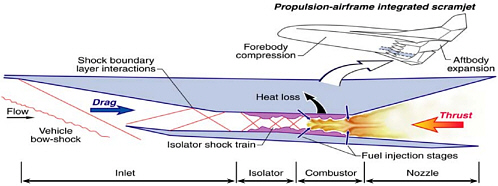
FIGURE B-3 Technology issues in supersonic combustion ramjets. SOURCE: NASA, 2006.
Support to Space (9): This Challenge is very relevant to NASA’s space exploration and access-to-space missions.
Why NASA?
Supporting Infrastructure (9): NASA has relevant facilities (e.g., Langley’s 8-Foot High-Temperature Tunnel, Arc-Heated Scramjet Test Facility, Combustion-Heated Scramjet Test Facility, Direct Connect Supersonic Combustion Test Facility, 15-Inch Mach 6 High-Temperature Tunnel, 20-Inch Mach 6 CF4 Tunnel, 20-Inch Mach 6 Tunnel, 31-Inch Mach 10 Tunnel) and expertise that are uniquely capable of supporting the development of combined-cycle hypersonic propulsion systems.
Mission Alignment (9): This Challenge is very relevant to several items in NASA’s charter.
Lack of Alternative Sponsors (3): Both NASA and the DoD support the development of hypersonic propulsion systems.
Appropriate Level of Risk (9): This Challenge faces high risk, too much for industry to take the lead, but it has a good chance of success if the program is supported adequately over the next decade.
B11 Alternative fuels and additives for propulsion that could broaden fuel sources and/or lessen environmental impact
Current aircraft are designed to operate on kerosene, which, like other transportation fuels in the United States, is currently derived from petroleum. The U.S. transportation sector increases U.S. dependence on foreign oil. The environmental impact of current fuels, which emit, among other things, NOx, SOx, particulates, and greenhouse gases (CO2 and H2O), is coming under increasing scrutiny. These issues, coupled with the long-term inability of gains in energy efficiency to fully offset increasing demand, provide impetus for alternative fuels for transportation in general and aviation in particular. Alternative fuels for transportation include liquid fuel derived from domestic shale oil and coal (e.g., kerosene produced from gasified coal via Fisher-Tropsch chemistry), biomass-derived fuels, natural gas, hydrogen, methanol, and ethanol. That last two have significantly lower energy densities (heating values of 22.6 and 29.7 MJ/kg, respectively, relative to about 43 MJ/kg for gasoline) and are therefore less likely candidates for aviation fuel. The energy density of hydrogen by weight is high (120 MJ/kg), but the energy densities by volume of hydrogen and natural gas are very low compared to liquid fuels, which creates storage problems that are difficult to solve when it comes to aviation. Key performance metrics for any alternative fuel include cost, availability, sustainability, energy density, pollutant emissions, greenhouse gas emissions, and safety.
Use of alternative fuels such as synthetic kerosene, methane, or hydrogen could reduce aircraft emissions and mitigate U.S. dependence on imported crude oil, thereby increasing sustainability. For example, hydrogen would enable engines with zero emissions of CO, SOx, particulates, and CO2, but large emissions of water vapor, which could exacerbate environmental issues associated with contrails (NRC, 2002). Synthetic kerosene derived from domestic resources could be cleaner and emit lesser amounts of particulates and SOx. The environmental benefits of an alternative fuel would, of course, need to be quantified. Alternative aviation fuels would provide significantly less benefit than alternative fuels for ground-based transportation, because aviation accounts for only 2.6 percent of U.S. greenhouse gas emissions compared to the 28 percent share accounted for by the total transportation sector (EPA, 2006).
DOE, DoD, and industry support most alternative fuels research. Within DOE, significant efforts have been under way to develop alternative fuels for the automotive sector, including compressed natural gas, methanol, ethanol, biomass-derived fuels, hydrogen (the hydrogen fuel initiative was reviewed in a recent NRC report (NRC/NAE, 2004)). The U.S. Air Force conducted extensive research in the late 1970s and early 1980s to develop alternative aviation fuels from shale oil, coal, and tar sands, and tested them extensively in military engines. The DoD also has a new initiative in clean fuels (Barna et al., 2005).
The key technical questions associated with alternative fuels for civilian aviation are cost, availability, the ground transportation and storage infrastructure, onboard storage, combustion, quantification of environmental impacts, and certification. All of the potential alternative fuels are currently more expensive than conventional jet fuel (Saynor et al., 2003), so large-scale, cost-effective production of alternative fuels (particularly synthetic kerosene and hydrogen) still requires significant research. Recent reports address in detail the technical barriers for hydrogen production (NRC/ NAE, 2004; DOE, 2003).
No commercial aircraft or engines have been designed to operate using alternative fuels, so airframe and auxiliary systems as well as new engines and fuel injection systems for handling these fuels remain to be developed. Onboard storage systems for natural gas and hydrogen would require significant modifications to existing aircraft or new airframe designs (NRC, 2002). Hydrogen-based fueling concepts have been advanced and investigated since the 1950s (Saynor et al., 2003; Faass, 2001). Aircraft combustors capable of handling gaseous fuels such as methane and hydrogen or prevaporized liquid fuels will need to address a variety of dynamic combustor operability phenomena, such as blow-off, flashback, and combustion instabilities—problems that are still poorly understood in ground-based turbines that already use gaseous fuels. Fundamental combustion research, with particular focus on pollutant formation and unsteady combustor phenomenon, would be required to address these issues. Fuel specifications would also need to be defined to assure quality and consistency worldwide.
Research is needed to quantify the costs and environmental benefits of alternative fuels. For example, production and delivery of hydrogen as currently practiced could increase overall greenhouse gas emissions (NRC/NAE, 2004). Alternative fuel development for civilian aviation will, with reason, lag that for ground-based transportation due to the significantly greater problems associated with aviation applications and the larger research efforts necessary to solve them. NASA should monitor the progress of the DOE and DoD programs and take advantage of synergies, as appropriate. Key milestones include
-
Develop mechanisms to monitor and interact with ongoing efforts in DOE, DoD, and elsewhere to develop alternative fuels with possible application to civil aviation.
-
Develop specifications for alternative civil aviation fuels.
-
Develop understanding of and predictive capabilities for correlating the molecular composition of fuels with their bulk properties (e.g., density, lubricity, stability, and emissions).
-
Understand the various means, including additives, of enhancing the performance (e.g., lubricity, stability, emissions, performance) of alternative fuels.
-
Understand chemical mechanisms and develop validated models that describe combustion for alternative fuels.
-
Develop advanced testing methods and standards for alternative fuels.
Relevance to Strategic Objectives
Capacity (3): A long-term supply of sustainable fuels with reduced emissions would help eliminate constraints on growth in capacity.
Safety and Reliability (1): This Challenge has little or no relevance to this objective.
Efficiency and Performance (3): Development of alternative fuels is motivated primarily by emissions and sustainability concerns. However, alternative fuels would also affect the efficiency and performance of aircraft engines and, indirectly, the air transportation system as a whole.
Energy and the Environment (9): The long-term impact of alternative fuels with reduced emissions could greatly reduce the environmental effects of aviation.
Synergy to National and Homeland Security (3): Alternative fuels developed for civil aviation could probably also be used by military aircraft, and this Challenge would support ongoing work by the DoD on alternative fuels.
Support to Space (1): This Challenge has little relevance to this Objective because the amount of fuel used to support the space program is quite small compared to that for ground and air transportation.
Why NASA?
Supporting Infrastructure (3): NASA has the technical expertise to address engine combustor issues and, in collaboration with industry, aircraft design issues associated with alternative fuels.
Mission Alignment (3): Some aspects of this Challenge, such as the investigation of combustion issues, are very relevant to NASA’s mission, but other aspects, such as fuel production and delivery, are not.
Lack of Alternative Sponsors (3): DOE, DoD, and industry are supporting research relevant to this Challenge, although NASA support is necessary to address all issues concerning the use of alternative fuels for civil aviation.
Appropriate Level of Risk (9): Use of alternative fuels is a long-term problem that faces moderate risk.
B12 Hypersonic hydrocarbon-fueled scramjet
DoD has had operational hypersonic systems for the past 40+ years in the form of intercontinental ballistic missiles, launch vehicles, and reentry vehicles. The Air Force’s Vision 2020: Global Vigilance, Reach and Power (USAF, 2000) stated that the service should strive for “controlling and exploiting the full aerospace continuum.” NASA programs to develop hypersonic propulsion systems should be coordinated with similar DoD efforts.
In the near term, hydrocarbon-fueled scramjets can be used to power rapid response aircraft, missiles, and expendable space lift vehicles. In the medium term, combined-cycle engines can propel rapid global response and reconnaissance aircraft. These engines, such as the TBCC, operate in several engine modes (see R&T Challenge B10). In the far term, combined-cycle engines can be used for access-to-space vehicles.
Air-breathing hypersonic propulsion systems for space access could enable aircraftlike operations, increasing mission flexibility and payload fraction relative to rocket-based propulsion systems. For NASA and DoD access to space, a TSTO vehicle could use a hydrocarbon fuel in the first stage and a hydrogen fuel for the second stage. The fuel of choice for most DoD applications will be hydrocarbons because of their high energy density, good heat capacity, and storability.
Significant ground testing has been done by the DoD on hydrocarbon-fueled scramjets. In addition, the Air Force scramjet-engine-demonstrator is being developed to demonstrate scramjet operation in flight, with a scramjet takeover at Mach 5.5 and cruise at Mach 6.5 to 7.0. NASA has already demonstrated in-flight operation of a scramjet at Mach 7 and Mach 10 in the X-43A program.
The development of hydrocarbon-fueled hypersonic propulsion systems will require many of the same basic technologies as those that are hydrogen-fueled. See B10 for a detailed listing of the issues involved. Key milestones include
-
Develop advanced instrumentation capable of measuring time-averaged and time-resolved flow parameters to validate design tools.
-
Complete unit experiments based on generic inlets, isolators, combustors, and nozzles to provide benchmark data sets for model validation.
-
Conduct experiments on mode transition for validation of unsteady models.
-
Assist DoD flight demonstration programs that are currently in progress.
Relevance to Strategic Objectives
Capacity (1): This Challenge has no impact on this Objective.
Safety and Reliability (1): This Challenge has no impact on this Objective.
Efficiency and Performance (3): This Challenge will improve the understanding of complex fluid and structural physics at hypersonic speeds, which will be useful for understanding lower speeds as well.
Energy and the Environment (1): Environmental impact is likely to be small given the small number of hypersonic vehicles likely to be produced.
Synergies with National and Homeland Security (9): Hypersonic propulsion systems being developed by the DoD will benefit significantly from this Challenge.
Support to Space (9): This Challenge is very relevant to NASA and DoD development programs for access-to-space vehicles.
Why NASA?
Supporting Infrastructure (9): NASA has relevant facilities (e.g., Langley’s 8-Foot High-Temperature Tunnel, Arc-Heated Scramjet Test Facility, Combustion-Heated Scramjet Test Facility, Direct Connect Supersonic Combustion Test Facility, 15-Inch Mach 6 High-Temperature Tunnel, 20-Inch Mach 6 CF4 Tunnel, 20-Inch Mach 6 Tunnel, 31-Inch Mach 10 Tunnel) and expertise that are uniquely capable of supporting the development of DoD hypersonic propulsion systems.
Mission Alignment (3): This R&T Challenge has some relevance to the NASA mission, but would mainly be in support of DoD research.
Lack of Alternative Sponsors (3): Both NASA and the DoD support the development of hypersonic propulsion systems.
Appropriate Level of Risk (9): This Challenge faces high risk, too high for industry to take the lead, but it has a good chance of success if the program is supported adequately over the next decade.
B13 Improved propulsion system tolerance to weather, inlet distortion, wake ingestion, bird strike, and foreign object damage
Over the last 20 years, considerable progress has been made in engine and propulsion system design to address issues related to tolerance to weather, inlet distortion, wake ingestion, bird strike, and foreign object damage (FOD). Requirements are becoming more and more stringent, however, and more work remains to be done. This is particularly the situation with the advent of larger inlets on commercial engines, which makes engines more susceptible to bird ingestion and FOD.
To accommodate adverse weather (e.g., rain, ice, hail, and crosswinds), better analytical models are needed to predict the impact of the elements on fans, compressors, and combustor stability. These models should be physics-based and validated with experimental data. Detailed weather data as a function of altitude are needed for altitudes up to 20,000 ft; data on water concentration and droplet size are especially important. Analyses of the impact of ingested rain, ice, and so on as they traverse the propulsion system need to be improved. Better models will lead to more robust engine designs and improved operational procedures.
Better designs are also needed to toughen turbomachinery against bird ingestion and FOD without a significant loss in performance. This will require better materials and better design techniques. Development of improved aircraft and engine controls should also be considered to maximize the ability of aircraft to withstand to these events. Key milestones include
-
Improve analytical tools to model more accurately the effects of rain, ice, and hail ingestion on engine behavior.
-
Improve fan, compressor, and combustor stability to anomalous events.
-
Collect detailed data about weather at altitude, particularly water concentration and droplet size, up to 20,000 ft.
-
Improve impact resistance of turbomachinery.
-
Improve engine and aircraft controls to adjust for impact events and erosion.
Relevance to Strategic Objectives
Capacity (3): Reduced sensitivity to weather and operational anomalies would increase capacity during adverse weather.
Safety and Reliability (9): This Challenge will increase safety and reliability by reducing the probability and severity of malfunction when the engine encounters anomalies.
Efficiency and Performance (3): This Challenge will minimize performance degradation through increased robustness.
Energy and the Environment (1): Improved robustness should maintain current levels of noise and emissions.
Synergies with National and Homeland Security (3): This Challenge will also benefit DoD aircraft.
Support to Space (1): This Challenge has very little relevance to this objective because space launch and return-to-Earth can generally avoid poor weather by altering schedules.
Why NASA?
Supporting Infrastructure (3): NASA has a few relevant facilities, such as icing tunnels.
Mission Alignment (3): This Challenge is relevant to NASA’s mission of improving the safety and capacity of the air transportation system.
Lack of Alternative Sponsors (3): Industry and DoD are much more active than NASA in supporting research relevant to this Challenge. It has enough payoff and impact for industry to pursue.
Appropriate Level of Risk (3): This Challenge faces low risk.
B14 Propulsion approaches employing specific planetary atmospheres in thrust-producing chemical reactions
The three types of power sources for producing vehicle thrust in planetary atmospheres are electric, chemical, and nuclear. Electrical sources include solar cells, fuel cells, and batteries. Chemical sources involve combustion of a fuel in the presence of an oxidizer (bipropellant) or a catalyst (monopropellant) in an internal combustion engine, a piston expander, a gas turbine, or a rocket. Only chemical propulsion can produce the thrust levels needed for practical flight in planetary atmospheres.
The inner terrestrial planets—Mercury, Venus, Earth, and Mars—are too small to have prevented the light gases, hydrogen and helium, from being blown away by the solar wind; in fact, Mercury has only a trace atmosphere. Venus and Mars have about 96 percent CO2 atmospheres, with Venus’s atmosphere being very acidic. Titan’s atmosphere is about 95 percent nitrogen but contains many hydrocarbons. The outer (Jovian) planets, Jupiter, Saturn, Uranus, and Nepture, are large enough to have retained gases from a nearby nebula; therefore, their atmospheres are all about 80-97 percent hydrogen, with several percent helium and methane. Mars and Venus, therefore, have oxidizing atmospheres, whereas Titan and the Jovian planets contain hydrogen or hydrocarbon, which can be used as fuels in a planetary flight vehicle. The method of propulsion from chemical reaction is, therefore, quite different for each planet.
Propulsion systems for planetary flight vehicles on Mars have received a lot of study and increasingly so with NASA’s Space Exploration Initiative. Combustion of metals in CO2 is the most promising source of energy for these vehicles. Using the CO2 in the atmosphere of Mars averts the need to transport an oxidizer, greatly simplifying the spacecraft system and increasing its payload fraction. Magnesium is currently recognized as the best candidate fuel owing to its high adiabatic flame temperature, high specific impulse at high oxidizer:fuel ratios, high heat per unit mass, and low ignition temperature. The effective specific impulse of magnesium combustion in carbon dioxide is 1,190 seconds for an oxidizer:fuel ratio of 6. Magnesium also combusts at pressures suitable for internal combustion or turbine engines on Mars. It can be liquefied for use in a bipropellant rocket motor. It may be possible that, in the future, magnesium will be produced directly on Mars since the Viking Landers found that martian soil is 5 percent magnesium. The combustion of magnesium in CO2 could become the main source of energy for human exploration on Mars.
Fundamental studies have been conducted on the burning of magnesium particles in CO2. Simplified particle combustion models include two reactions zones: an outer zone, where magnesium reacts at a transport-limited rate to form condensed magnesium oxide plus carbon monoxide, and an inner zone, at the particle surface, where carbon monoxide reacts with liquid magnesium to form solid carbon and solid magnesium oxide, which remain with the particle. Kinetic mechanisms have been investigated and burning rates calculated and measured.
Considerable research needs to be done on engine cycles that operate with small magnesium and magnesium oxide particles. A gas turbine would have to operate with these erosive particles and would need a large inlet and exhaust nozzle owing to the rarefied atmosphere on Mars (about 1 percent of that on Earth). Internal combustion engines would have to be supercharged owing to the rarefied atmosphere. Binders for the magnesium and methods for supplying the gaseous or liquefied carbon dioxide to a rocket is another topic for research. Key milestones include
-
Conduct detailed investigations, numerical and experimental, of the fundamental combustion characteristics of fuels or oxidizers that could be used in conjunction with the specific materials that make up the planetary atmospheres.
-
Perform research on engine cycles that can operate with the indigenous atmospheric materials.
-
Demonstrate propulsion systems found to be most promising for planetary flight vehicles in atmospheres of interest.
Relevance to Strategic Objectives
Capacity (1): This Challenge has no impact on this Objective.
Safety and Reliability (1): This Challenge has no impact on this Objective.
Efficiency and Performance (1): This Challenge has no impact on this Objective.
Energy and the Environment (1): This Challenge is not relevant to this objective.
Synergies with National and Homeland Security (1): This Challenge is not relevant to this Objective.
Support to Space (9): This Challenge provides a significant contribution to NASA’s space exploration initiative to Mars and beyond.
Why NASA?
Supporting Infrastructure (3): NASA has relevant facilities and expertise, but they are not unique as there are also many ongoing university programs.
Mission Alignment (9): This Challenge area has major relevance and impact on several items in NASA’s charter for space exploration as well as aeronautics.
Lack of Alternative Sponsors (9): This is a challenge where NASA would have to take the lead. Appropriate Level of Risk (9): This Challenge faces high risk.
B15 Environmentally benign propulsion systems, structural components, and chemicals
This R&T Challenge is often referred to as the “green” (sometimes “evergreen”) engine. The aim is to minimize the environment impact of gas turbine engines from cradle to grave (i.e., spanning the complete spectrum from manufacturing processes to operations to product end of life and disposal). The green concept generally includes minimizing noise and emissions, but these have already been identified separately as high-priority R&T Challenges and are not explicitly included here. The aim of this Challenge is to use, to the greatest degree possible, structural and maintenance materials that are environmentally benign and that can be recycled or safely disposed of at the end of life; environment-friendly manufacturing methods (e.g., the use of aqueous solvents, cutting fluids, and degreasers); and engine lubricants and working fluids that are environmentally safe. In some cases, human factors issues, such as ergonomically sound manufacturing and maintenance procedures, are included in comprehensive green engine programs.
It is difficult to quantify the environmental benefits of green engineering approaches, but their economic benefits may be easier to quantify. These accrue from less waste and disposal, more recycling of rare or precious materials, and a healthier and safer environment for manufacturing and maintenance personnel.
Significant progress has been made in the last decade in both engine materials and manufacturing processes. New materials include lead-free antigallants; lead-free, nonsilver dry film lubricants; chrome-free coatings; alternatives to cadmium plating and chromium anodizing; and nonchromate primers and coatings. In the manufacturing arena, solvents with low volatile organic content; closed-loop alkalai cleaning; and closed-loop acid pickling, milling, and stripping have been introduced. Key milestones include
-
Assess current manufacturing processes and engine bills of materials to identify elements or compounds whose elimination would be environmentally beneficial.
-
Quantify environmental benefits likely with elimination of targeted compounds.
-
Assess feasibility and estimate the cost-benefit ratio of eliminating targeted compounds.
-
Replace targeted compounds with validated substitutes.
Relevance to Strategic Objectives
Capacity (1): Although there may be some economic benefit to the environmental stewardship envisioned in this Challenge, it is unlikely to be sufficiently large to impact the cost of air travel in any significant way.
Safety and Reliability (1): This Challenge is not relevant to the safety of aircraft, although the safety of ground support personnel may be increased slightly (e.g., through the simplification of some maintenance procedures).
Efficiency and Performance (1): This Challenge is not relevant to this Objective.
Energy and the Environment (9): Modest energy savings in manufacturing may accrue from the recycling of precious or rare materials. This Challenge will produce major environmental benefits by reducing the use and disposal of environmentally harmful materials during every phase of product life, from design to end-of-life disposal.
Synergies with National and Homeland Security (3): The adverse environmental impact of DoD gas turbine engine design, manufacturing, maintenance, and disposal would be reduced.
Support to Space (1): This Challenge is likely to have very little relevance to this Objective because of the small number of access-to-space vehicles and the low volume of operations.
Why NASA?
Supporting Infrastructure (3): NASA has a strong materials capability that may be able to contribute to eliminating certain hazardous elements from gas turbine materials. It does not, however, have a comparably strong manufacturing support capability.
Mission Alignment (3): This Challenge is relevant to NASA’s mission.
Lack of Alternative Sponsors (3): The Environmental Protection Agency, the Occupational Safety and Health Administration, and industry are likely to continue supporting
environmental stewardship issues. Industry, in particular, is motivated by potential economic benefits. However, aeronautics may not be a priority for these groups.
Appropriate Level of Risk (3): This Challenge faces very high risk. In the structural materials area, some chemical constituents are very likely to be absolutely necessary for high performance and cannot be eliminated, so the return on investment may be problematic.
B16 Reduced engine manufacturing and maintenance costs
This Challenge will develop the ability to design engines with simpler, fewer parts that are easily serviceable while maintaining good performance and efficiency. To reduce manufacturing costs, better simulation and modeling tools will be developed to permit the design of engines with higher aerodynamic loadings in compressors and turbines. This will lead to fewer turbomachinery stages and fewer airfoils within each stage. Better materials, less expensive materials, and materials with less variability in properties will reduce the amount of expensive materials that must be used. Better machining and manufacturing techniques will reduce machining time and costs and reduce the amount of scrap, which can be expensive, particularly when exotic materials are involved. Maintenance costs will generally be lowered if engines contain fewer parts (e.g., fewer turbine blades that need to be replaced periodically). In addition, better predictions of the on-wing life of the parts will permit them to be used longer and more efficiently without an increase in malfunctions. More intelligent systems, described in R&T Challenge B3, will permit maintenance personnel to better assess the exposure of engine parts and, therefore, to better predict life. In addition, improved health diagnostics systems will permit maintenance staff to troubleshoot problems quickly and accurately, which will reduce overhaul and repair time. This produces a dual benefit: reducing the costs of overhauls and minimizing engine downtime. Key milestones include
-
Improve turbomachinery design tools for reduced stage and part count.
-
Develop better materials with narrower tolerances to reduce unnecessarily large design margins.
-
Develop low-cost materials with the same high-performance properties.
-
Develop better manufacturing techniques to reduce scrap.
-
Develop better on-wing life predictions to minimize premature retirement of parts.
-
Develop improved health diagnostics to allow performing maintenance as required rather than as scheduled (predictive maintenance).
-
Develop intelligent engines that can adjust operation to minimize degradation of parts.
Relevance to Strategic Objectives
Capacity (3): Lower acquisition and maintenance costs will affect affordability of operations and should allow for profitable increases in capacity.
Safety and Reliability (3): Simpler designs are easier to maintain and are more reliable.
Efficiency and Performance (3): Improved, predictive maintenance should minimize performance degradation.
Energy and the Environment (3): Improved, predictive maintenance should minimize performance degradation and maintain engines near design noise and emissions levels.
Synergies with National and Homeland Security (3): DoD faces similar issues and would benefit from research on civil aircraft.
Support to Space (1): Some materials and techniques, particularly improved health diagnostics, might find applications on space vehicles, but because of differences in materials and flight regimes, benefits would be indirect.
Why NASA?
Supporting Infrastructure (3): NASA has strength in the development of the analytical tools, materials, sensors, and controls.
Mission Alignment (1): Achieving simpler, high-performance designs is very relevant to NASA’s mission, but manufacturing technologies are not particularly relevant.
Lack of Alternative Sponsors (1): Industry and DoD are already key players in such initiatives.
Appropriate Level of Risk (3): The risk of this work can range from somewhat incremental to very challenging.
REFERENCES
Advisory Council for Aeronautical Research in Europe (ACARE). 2001. European Aeronautic—A Vision for 2020. Available online at <www.acare4europe.com/docs/Vision%202020.pdf>.
Akin, Gump, Strauss, Hauer, and Feld, LLP. 2003. Airport Air Quality Guide—A Guide to Air Quality Issues Under the Clean Air Act.
Ames, B. 2005. Power electronics drive next-generation vehicles. Military and Aerospace Electronics, July 1. Available online at <http://mae.pennnet.com/Articles/Article_Display.cfm?ARTICLE_ID=232549&p=32&pc=ENL>.
Barna, T., T. Sheridan, W. Harrison, P. Serino, and C. Bauer. 2005. OSD Clean Fuel Initiative and the Air Force: National Mining Association Briefing. Available online at <www.nma.org/attach/DOD_briefing.pdf>.
Department of Energy (DOE). 2003. Hydrogen, Fuel Cells and Infrastructure: Multi-Year Research, Development and Demonstration Plan. DOE/GO-102003-1741. Washington, D.C.: U.S. Department of Energy, Energy Efficiency and Renewable Energy. Available online at <www.eere.energy.gov/hydrogenandfuelcells/mypp/>.
Emadi, A., M. Ehsani, and J. Miller. 2003. Vehicular Electric Power Systems: Land, Sea, Air, and Space Vehicles, New York, N.Y.: Marcel Dekker.
Environmental Protection Agency (EPA). 2006. Inventory of U.S. Greenhouse Gas Emissions and Sinks: 1990-2004. Available online at
<http://yosemite.epa.gov/oar/globalwarming.nsf/content/ResourceCenterPublicationsGHGEmissions.html>.
Faass, R. 2001. Cryoplane. Available online at <www.haw-hamburg.de/ers/Scholzz/dglr/hh/text_2001_12_06_cryoplane.pdf>.
Federal Aviation Administration (FAA). 2006. FAA Aerospace Forecasts FY 2006-2017. Available online at <www.faa.gov/data_statistics/aviation/aerospace_forecasts/2006-2017/>.
Intergovernmental Panel on Climate Change (IPCC). 1999. Special Report: Aviation and the Global Atmosphere. Geneva: World Meteorological Organization.
Lefebvre, A. 1999. Gas Turbine Combustion. Philadelphia, Pa.: Taylor and Francis.
National Aeronautics and Space Administration (NASA). 2003. Aerospace Technology Enterprise Strategy, NP-2003-01-298-HQ. Washington, D.C.: NASA Headquarters. Available online at <www.aero-space.nasa.gov>.
NASA. 2006. NASA Hyper-X program demonstrates scramjet technologies. NASA Facts. Available online at <www.nasa.gov/centers/langley/pdf/142891main_X43A_2006.pdf>.
National Institute of Aerospace (NIA). 2005. Responding to the Call: Aviation Plan for American Leadership. Available online at <www.nianet.org/nianews/AviationPlan.php>.
National Research Council (NRC). 1997. Assessing NASA’s High Speed Research Program. Washington, D.C.: National Academy Press. Available online at <www.nap.edu/catalog/5848.html>.
NRC. 2001. Commercial Supersonic Technology: The Way Ahead. Washington, D.C.: National Academy Press. Available online at <http://books.nap.edu/catalog/10283.html>.
NRC. 2002. For Greener Skies: Reducing Environmental Impacts of Aviation. Washington, D.C.: National Academy Press. Available online at <http://books.nap.edu/catalog/10353.html>.
NRC. 2003. Securing the Future of U.S. Air Transportation: A System in Peril. Washington, D.C.: The National Academies Press. Available online at <http://fermat.nap.edu/catalog/10815.html>.
NRC/National Academy of Engineering (NAE). 2004. The Hydrogen Economy: Opportunities, Costs, Barriers, and R&D Needs. Washington, D.C.: The National Academies Press. Available online at <http://books.nap.edu/catalog/10922.html>.
Saynor, R., A. Bauen, and M. Leach. 2003. The Potential for Renewable Energy Sources in Aviation. Imperial College Centre for Energy Policy and Technology. Available online at <www.iccept.ic.ac.uk/pdfs/PRESAV%20final%20report%2003Sep03.pdf>.
U.S. Air Force. 2000. America’s Air Force: Vision 2020: Global Vigilance, Reach and Power.
Waitz, I., J. Townsend, J. Cutcher-Gershenfeld, E. Greitzer, and J. Kerrebrock. 2004. Aviation and the Environment; A National Vision Statement, Framework for Goals and Recommended Actions. Report of the Partnership for AiR Transportation Noise and Emissions Reduction (PARTNER) to the United States Congress, December. Available online at <http://partner.aero>.


