
Abstract
This report presents the work of the Committee on Alternatives to Indian Point for Meeting Energy Needs. It reviews various options that are available for replacing the 2,000 megawatts of energy produced by the two nuclear reactors at Indian Point and assesses some of the requirements and impacts of installing the options in an appropriate time frame.
The Indian Point Energy Center is a key part of the electric power system that serves New York City and densely populated surrounding areas. Maintaining reliability of electric supply in the area is essential.
Even with Indian Point operating, new capacity will be needed to meet expected growth in the region and to replace other generating plant retirements. Replacing the two operating Indian Point generation units would add to the complexity of the task. Options are constrained by various technological, regulatory, financial, and infrastructure factors that must be considered in planning for a reliable electric energy supply for southeastern New York State.
Based on all of the information available to it, the committee identified no insurmountable technical barriers to the replacement of Indian Point’s capacity, energy, and ancillary services. However, significant financial, institutional, regulatory, and political barriers also would have to be overcome to avoid threatening reliability. As this report discusses, many replacement options exist, and if a decision were definitely made to close all or some part of Indian Point by a date certain, the committee anticipates that a technically feasible replacement strategy for Indian Point could be achievable. A replacement strategy would most likely consist of a portfolio of the approaches discussed in this report, including investments in energy efficiency, transmission, and new generation.
While the committee is optimistic that technical solutions do exist for the replacement of Indian Point, it is considerably less confident that the necessary political, regulatory, financial, and institutional mechanisms are in place to facilitate the timely implementation of these replacement options. The importance of this issue cannot be overstated in developing options for maintaining a reliable electric energy supply for the New York City metropolitan area. The report discusses in greater detail various aspects of this challenge and includes specific conclusions and findings.
Summary and Findings
This report presents the work of the Committee on Alternatives to Indian Point for Meeting Energy Needs. For over a year, the committee reviewed a wide range of potential options and assessed the feasibility of implementing these options on a scale and a timetable sufficient to replace the capacity, energy, and essential ancillary services now provided by the two operating nuclear reactors at Indian Point.
The committee recognizes the magnitude and the complexity of the issue that it was asked to study. Indian Point Units 2 and 3 provide about 2,000 megawatts (MW) of baseload generating capacity in one of the most densely populated areas in the nation. Its output represents 11 percent of the total generating capacity in southeastern New York (i.e., Long Island, New York City, and Westchester County) and 23 percent of the electric energy delivered in this region.
Based on all of the information available to it, the committee has identified no technical obstacles that it believes present insurmountable barriers to the replacement of Indian Point’s capacity, energy, and ancillary services. As this report discusses, a wide and varied range of replacement options exists, and if a decision were definitely made to close all or some part of Indian Point by a date certain, the committee anticipates that a technically feasible replacement strategy for Indian Point would be achievable. Replacements for Indian Point would be in addition to generating and transmission capacity needed for expected growth in the region and because of other plant retirements.
The report does not propose a “single solution” to the replacement of Indian Point. That was neither the committee’s directive nor its mission. Indeed, from the committee’s analysis, no “right” or clearly preferable supply alternative to Indian Point emerged. A replacement strategy for Indian Point would most likely consist of a portfolio of the approaches discussed in this report, including investments in energy efficiency, transmission, and new generation.
While the committee is optimistic that technical solutions do exist for the replacement of Indian Point, it is considerably less confident that the necessary political, regulatory, financial, and institutional mechanisms are in place to facilitate the timely implementation of these replacement options. The importance of addressing the nontechnical barriers cannot be overstated in developing options for maintaining a reliable electric energy supply for southeastern New York State. The report discusses in greater detail various aspects of this challenge and includes specific conclusions and findings.
Reliability is a key consideration, especially during peak demand. Adequate generating and transmission capacity exists to replace Indian Point during nonpeak hours, although costs might be significantly higher because Indian Point is the low-cost baseload unit. Reliability of power supply depends on several factors, including fuel availability, generation reserve, peaking load, and the growth in electric demand, both locally and regionally. An element of a reliable electricity supply also involves the stability of the transmission-distribution system. In general, the electric system in the Northeast is carefully balanced to account for the location and operation of baseload generating plants, as well as peaking units. In southeastern New York, the reliability criteria also impose specific locational resource requirements, reflective primarily of New York City and Long Island’s situation as very large demand centers at the end of the transmission grid. For these reasons, the committee’s analysis has focused on replacement strategies, that is, on electric energy supply and demand options, primarily in southeastern New York (Zones H, I, J, and K; see Figure S-1).
Adding to the complexity of choice is the issue of cost to customers and taxpayers, which could include the costs of both closing Indian Point and providing replacement resources. For example, if the plant’s life were shortened, compensation might be owed to the owner. Costs of maintaining site security would be required to keep the spent nuclear fuel secured. There is considerable uncertainty over how the cost of replacement resources, higher fuel prices, and air quality
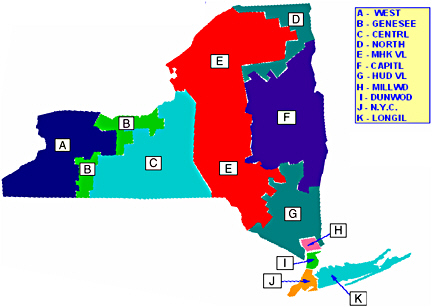
FIGURE S-1 New York Control Area load zones. SOURCE: New York Independent System Operator.
offsets would be addressed in a deregulated wholesale electric market in which price is no longer based on the cost of production but rather on an open competitive bidding process under which all bidders get the same price as the last successful marginal winning bid. Also of concern are potential indirect costs to the community at large and state and local governments, including any loss of tax base from the plant, labor dislocation, or loss of income from reduced plant operations that might be associated with the closure of the Indian Point facility.
Indian Point sits on the banks of the Hudson River whose protection has been a focal point of the American environmental law movement, so it is no surprise that a complex web of federal and state environmental regulations must also be considered in evaluating replacement resources for Indian Point. These include air quality, water quality, and thermal discharge requirements; regulations regarding toxic releases; and regional and perhaps eventual federal initiatives to reduce greenhouse gas emissions. New power plants can be permitted only under the most stringent environmental review processes, and such projects are also subject to local zoning and land use controls.
CONCLUSIONS AND FINDINGS
The issues associated with the potential shutdown of Indian Point’s two operating nuclear units are complex and interrelated. These issues impact the total energy system for New York State, the Northeast region, and beyond. Any analysis of the consequences and potential alternatives to the closure of Indian Point units cannot occur in a vacuum without reference to the context of other events unfolding in the state.
In analyzing replacement options for Indian Point, the committee examined the broader profile of New York State’s electric power system to identify what, if any, other existing resources might be available to replace some portion of the energy and capacity now provided by Indian Point. Most germane to its evaluation of replacement options for Indian Point, the committee learned that even with the Indian Point units operational, New York State will require system reinforcements, above those already under construction, as soon as 2008 in order to meet its projected demand for electricity and maintain system reliability in the Lower Hudson Valley and New York City area served by the Indian Point units. The state’s need for additional electric power resources increases rapidly thereafter. Based on currently scheduled retirements and demand growth projections by the New York Independent System Operator (NYISO), 1,200 to 1,600 MW from new projects that are not yet under construction could be needed by 2010, and a total of 2,300 to 3,300 MW by 2015. Closing Indian Point would increase by 2,000 MW New York’s need for additional electric resources, which could be in the form of new generating capacity, transmission lines, improved energy efficiency, and demand-side management.
This need for new resources is occurring at a time when it is problematic whether the existing legal, regulatory, and financial mechanisms provide sufficient incentive to build new resources in New York. The committee estimates that the generating capacity currently under construction will be insufficient to meet projected peak demand in 2009, given currently announced retirements. With the expiration in 2003 of its siting statute, Public Service Law Article X, New York State has no law designed to facilitate an integrated environmental review and siting of new power plants. NYISO has
just completed its first Comprehensive Reliability Planning Process, and as this report explains in detail, it remains to be seen whether NYISO’s new market and pricing rules will provide sufficient economic incentives to stimulate investment in new electric resources. Developers and financial markets will look for investment opportunities with the best combination of high payback and low risk, whether they are in New York or not. If price signals in New York are low, the markets will wait until they rise. Given the time that it takes to obtain a suitable site, navigate the regulatory issues and obtain permits, and then construct a power plant, new generating capacity may not be available until reserves are dangerously low. Forestalling a crisis may require extraordinary efforts on the part of policy makers and regulators.
The committee examined two time frames for the possible closure of Indian Point: (1) when the current operating licenses expire for the two reactors in 2013 and 2015; and (2) an accelerated schedule of 2008 and 2010. The general conclusions that the committee reached concern the overall ability to replace the capacity and energy required if the Indian Point units were shut down in either of the two time frames. The committee also reached agreement on eight specific findings associated with generation, transmission, and demand-side options; reliability; physical and political infrastructure; the environment; and cost considerations if an early shutdown of Indian Point is effected. The committee emphasizes that the inability to successfully meet any of the requirements set forth in its eight findings would place the general conclusions in jeopardy.
General Conclusion (2013-2015)
The committee concludes that with sufficient time, planning, authority, and investment incentives, options are possible for replacing Indian Point. The Indian Point units could be retired at the end of their current operating licenses (2013 and 2015) without causing a major disruption of power capacity in southeastern New York if sufficient resources were added by 2015 to cover anticipated system retirements and the expected growth in demand, as well as the shutdown of Indian Point. To achieve this goal, the committee estimates that an additional 5,000 to 5,500 MW, or roughly 500 MW per year, in new resources (a combination of generation, transmission, and demand-side actions) would need to be added by 2015.1 The 3,300 MW in new resources that are estimated to be required even if Indian Point continues to operate is less than 10 percent of New York’s current capacity, and it should be achievable over the next 9 years. The additional 2,000 MW of new resources required if Indian Point is closed should also be achievable if the conditions discussed below are met.
General Conclusion (2008-2010)
The committee concludes that an earlier shutdown of the Indian Point units would be much more difficult to accomplish. In 2008, when Unit 2 (1,000 MW) would be closed, New York will have very little if any excess capacity. To replace it, the committee estimates the need for an additional 700 MW in generating capacity, assuming that demand-side programs could reduce peak demand by several hundred megawatts. By 2010, with the closure of the second unit (1,000 MW), an additional 1,300 to 1,400 MW in replacement generating capacity would be needed, assuming that demand-side measures would continue to increase, totaling 650 MW in peak-demand reductions. That is in addition to the 1,200 to 1,600 MW that will be needed even with Indian Point operating. In the committee’s view, this extraordinary challenge could only be met with the firm commitment of a variety of New York government leaders and tight cooperation among many agencies. Such collaboration may be unprecedented, so the difficulty of achieving it should not be underestimated. The impacts discussed for the 2013-2015 scenario would be magnified, with potentially even greater added costs. If new generating capacity is not constructed in a timely manner, system reliability would be threatened. Not only could reserve margins drop below standards, but existing generating units would likely show lower reliability as they are run beyond their normal operation schedule.
Finding 1: Governmental Mechanisms and Regulatory Policy
The committee recognizes that maintaining a reliable supply of electricity for New York City and southeastern New York State is a primary objective for public policy and essential to the region’s health and economic well-being. However, the committee finds that current governmental mechanisms and regulatory policy may limit New York State’s ability to address in a timely and effective manner the capacity, energy, and ancillary consequences of closing Indian Point. The committee finds that in order to provide alternatives to Indian Point Units 2 and 3, a more considered long-range strategy is likely to be necessary. This strategy would be based on a detailed assessment of the current market structure and might well require significant changes in New York’s current laws and regulatory policies, such as reauthorization of the state’s Article X power plant siting process and reestablishment of the State Energy Planning Board and
the state energy planning process, in order to ensure the continued reliability of the state’s electric system.
Finding 2: Market and Financial Uncertainties
The committee notes that even with the continued operation of the Indian Point units, New York State already faces challenges in satisfying the projected growth in its electric demand and in maintaining system reliability. While conceptual planning to address these needs is under way through the New York Independent System Operator and other entities, the response of electric power developers, suppliers, and distributors is uncertain, given the current state of evolution of New York’s market. Indian Point represents a significant asset, both in terms of capacity and energy, especially for electric customers in southeastern New York, and if Indian Point is retired, replacement of its 2,000 MW capacity will place a substantial additional burden on the state’s electric supply system.
Finding 3: Transmission Options
The committee finds that improvements in transmission capability could significantly relieve congestion in the New York system and facilitate the delivery of power from existing and potential electric generation resources to the New York City area. Such improvements should include modifications to the state’s existing transmission system and the possible installation of new direct current transmission. A West-to-East line (550 MW) has been proposed across the Hudson River, and a new North-to-South transmission line (up to 1,000 MW) for better access to upstate and Canadian electric resources is under investigation. These lines could supply useful capacity in the 2010 and 2015 time period, respectively, if a variety of institutional and financial issues can be resolved. The committee notes that increasing the importation of power into southeastern New York would also increase the need to install additional reactive power equipment to maintain system voltage within the region, but this problem is relatively easy to solve.
Finding 4: Demand-Side Options
The committee finds that substantial cost-effective opportunities exist for investment in demand-side technologies that could reduce demand for electricity in southeastern New York. These could include a phase-in of programmable energy efficiency and demand-response programs, along with additions of distributed generation and combined heat and power units. These could provide reductions of more than 1,100 MW from projected peak demand by 2010 and 1,700 MW by 2015. The committee notes that these offsets are ambitious and would be in addition to the current effective programs with which the New York State Energy Research and Development Authority, the New York Power Authority, Consolidated Edison, and the Long Island Power Authority are already managing demand growth. The committee finds that these offsets are achievable, but only if well-designed programs are implemented promptly and additional resources are provided to overcome many obstacles.
Finding 5: Supply-Side Options
The committee finds that even with substantial additional investment in new transmission facilities and aggressive demand-side programs, additional generating facilities, above those already planned, would be required to compensate for the shutdown of the Indian Point units to maintain system reliability. While coal may be a reasonable generating alternative for the 2013-2015 time frame, new near-term generating solutions are most likely to be a mix of simple-cycle gas turbines and combined-cycle natural gas units. The use of the former would provide a short-term solution, but in the longer term, such units would probably be relegated to peaking usage. Owing to the nature of the New York City metropolitan region, renewable energy technologies are unlikely to contribute significant resources by 2015, with the possible exceptions of offshore wind power and distributed photovoltaics.
Finding 6: Alternative Fuel Availability and Security
The committee finds that the availability and price of natural gas would be major considerations, and perhaps constraints, in planning for new generating capacity to replace power from the Indian Point units. A large share of the 2,000 MW from Indian Point would likely be replaced with natural-gas-fired generating plants, and that is over and above the several thousand megawatts of new gas-fired capacity that will be needed to meet the growing demand for energy in southeastern New York State. This increase in New York’s dependence on natural gas for power production will stress supplies of natural gas. In addition, increased dependence on natural gas will reduce diversity of fuel supply for the New York electric system, also a serious concern.
Finding 7: Cost Considerations
Cost is a key consideration in evaluating any scenario for the early retirement of the Indian Point units. Three main categories must be taken into account: (1) any compensation that might be due Entergy Nuclear for the early retirement of the Indian Point units; (2) replacement costs, including new generation and transmission, demand-side programs, increased demand for pollution offsets, and the increased price of fuel, particularly natural gas for power production; and (3) the financial impact to Westchester County, the Town of Buchanan where Indian Point is located, and surrounding
communities from the loss of Indian Point tax revenues and the labor-commercial base. The committee found that it is difficult to make specific cost estimates for these items. Ultimately, the price that consumers pay for electricity in southeastern New York will reflect some of these costs. However, given the current market structure for the sale of electric power in New York, under which wholesale prices are set on a subregional zonal basis that reflects competitive bidding behavior, the committee could not satisfactorily determine the increase in the cost of electricity to consumers that might result from the closure of Indian Point. Some costs could be offset by demand-management practices, but new generation, and perhaps new transmission, will likely increase wholesale electric costs, especially in the New York City metropolitan area, depending on competitive bidding in the open wholesale market.
Finding 8: An Integrated Approach Is Needed
The committee emphasizes that its findings must be considered as an integrated whole. Replacements for the energy, baseload capacity, and ancillary services currently provided by the Indian Point units will not happen just because they should. The construction and operation of new electric generating facilities, natural gas pipelines, liquefied natural gas facilities, or electric transmission lines will each inevitably encounter hurdles that will have to be overcome if that project is to become a reality. Each facility needs a site, financing, permits, delivery contracts, and infrastructure agreements, and has facility-specific requirements. This is also true for any demand-side programs, which have their own timing, financial, marketing, and implementation challenges to be worked out in order to achieve sufficient participation by the general public.


