
5
Analysis of Options for Meeting Electrical Demand
The retirement of the two operating reactors at Indian Point in the 2008-2015 time frame could have significant consequences for the reliable supply of electricity in the metropolitan New York City area unless appropriate replacements are supplied. This chapter discusses the impacts that potential replacements could have on reliability, costs, and other factors.
These replacements are analyzed in the context of the current evolution of the New York electric system (the New York Control Area, or NYCA) and the regulatory system that oversees it. Until recently, the future of the NYCA was viewed with relative complacency—growth was modest, and more than enough generating plants had been proposed by developers to handle that growth. Subsequently, however, some of these plants have been canceled or deferred indefinitely. As discussed in Chapter 4, projections now show potential shortfalls as early as 2008, even without the retirement of Indian Point. Other projections, using less conservative assumptions, still predict that new capacity will be needed by 2010.
Replacing Indian Point would be likely to involve a portfolio of the options discussed in Chapters 2 and 3, including the following:
-
Energy efficiency (EE);
-
Demand-side management (DSM) and distributed generation (DG);
-
Fuller utilization of existing generation and transmission, and deferred plant retirements;
-
New generation; and
-
New transmission.
The committee did not model the actions and policy initiatives that would be required to implement the supply and demand options considered here. The early-shutdown cases in particular would require some strong measures to be implemented immediately.
Different portfolios are possible, emphasizing different options. Exactly which ones would be implemented and where would make a big difference in how well the system would operate. In this chapter, example scenarios are adopted to illustrate options that could provide alternatives to the Indian Point units should they be retired.
THE NYISO STARTING POINT
The New York Independent System Operator (NYISO) recently completed the 2005 Reliability Needs Assessment (RNA; NYISO, 2005a) and the companion analysis Comprehensive Reliability Planning Process (CRPP; NYISO, 2005b). Box 5-1 briefly reviews the criteria for reliability used in the analysis. The RNA includes all generation and transmission projects currently under construction in the NYCA (2,530 MW); retirements of existing capacity currently announced (2,260 MW); and the projected electrical load through 2015. The NYISO process is described in more detail in Appendix F-1. Peak load and known NYCA resources listed by NYISO for the period under study are shown in Table 5-1.
To quantify the magnitude of the needed correction, NYISO analyzed the system adding assumed capacity where needed until adequate reliability was achieved. The Base Case in the NYISO reports is a result of analyses showing that NYCA system reliability would be determined by voltage constraints in the system due to reactive power deficiencies in the Lower Hudson Valley (LHV). In that situation, reliability falls below requirements by 2008, and an additional 500 MW would be required then, increasing to 1,750 MW by 2010.
NYISO also projects that if essential reactive power corrections were made in the Lower Hudson Valley, thermal transmission constraints would then control, and less generating capacity (250 MW beginning in 2009, increasing to 1,250 MW by 2010) would be required to meet NYCA reliability criteria. NYISO projected the scenario with thermal constraints controlling to 2015 (but not the Base Case), when
|
BOX 5-1 Reliability Criteria System operators generally use two main criteria for ensuring reliability: reserve margin and loss-of-load expectation (LOLE). “Reserve margin” is simply the difference between the generating capacity available to serve an area and the expected peak demand divided by the peak demand. It is measured in percent. NYISO plans for the NYCA to keep a reserve margin of at least 18 percent. LOLE is more complicated but more meaningful. It measures the predicted frequency, in days per year, that the bulk power system will not meet the expected demand for electricity in one or more zones in New York State, even if only for a short time. Equipment failures in the power system (i.e., generators and the high-voltage transmission grid together) can force part of the load on the bulk power transmission system to be involuntarily disconnected. LOLE does not include the more frequent cause of blackouts for customers that are associated with failures of the local distribution system due, for example, to falling tree limbs and ice storms. The North American Electric Reliability Council recommends a reliability standard of LOLE less than 0.1, and this standard has been adopted for the region by the Northeast Power Coordinating Council, and in turn by the New York State Reliability Council. In other words, there must be sufficient generation and transmission capability in the system that a failure to serve load somewhere in the bulk power system would be expected not more than on 1 day in 10 years. The LOLE criterion is central to the discussion of reliability in this chapter. See also Chapter 1 for a discussion of reliability. |
TABLE 5-1 NYISO Base Case Peak Load and Known New York Control Area (NYCA) Resources
|
|
2008 |
2010 |
2013 |
2015 |
|
Peak load (MW) |
33,330 |
34,200 |
35,180 |
35,670 |
|
Resources (MW) |
39,759 |
39,766 |
39,766 |
39,766 |
|
Reserve margina (%) |
19 |
16 |
13 |
12 |
|
Reserve marginb (%) |
14 |
12 |
8 |
7 |
|
aFor the calculation of reserve margin and loss-of-load expectation (LOLE), NYISO adjusted installed NYCA generating capacity downward for contracted sale of hydropower outside the NYCA and for wind power (because wind cannot be counted on during peak demand). “Resources” include the adjusted NYCA generating capacity plus Special Case Resources (SCRs, 975 MW) and Unforced Delivery Rights (UDRs, 990 MW). SCRs are agreements between NYISO and large electricity consumers (e.g., industrial companies) that will reduce load at NYISO’s order. This is one of the emergency steps available to NYISO to avert outages. UDR corresponds to the two high-voltage direct current (HVDC) cables into Long Island, the Cross Sound Cable from New England (330 MW), and the Neptune Cable from New Jersey (660 MW scheduled for 2007). It is power that is expected to be available and is thus included by NYISO for planning purposes. bReserve margin without the 1,965 MW of SCR and UDR, as plotted in Figure 4-1 in Chapter 4 of this report. Assumptions on allowable resources make a large difference in the calculated reliability. SOURCE: NYISO (2005b, p. 39). |
||||
2,250 MW would be needed. All of these projections are based on Indian Point remaining in service (NYISO, 2005a).
NYISO has solicited proposed market-based or regulated solutions from participants and stakeholders in the NYCA market. The solicitations provide that “Proposed solutions may take the form of large generating projects, small generation projects including distributed generation, demandside programs, transmission projects, market rule changes, operating procedure changes, and other actions and projects that meet the identified reliability needs (NYISO, 2005c).”
Figure 5-1 shows projected NYCA LOLEs for the Base Case and the thermal constraint case (the top and bottom lines). It also shows two other analyses: if load increases faster than expected, and if power is constrained from flowing from upstate New York through New England and back to southeast New York. Both these assumptions adversely affect reliability to a significant extent compared to the thermal constraint case. All the analyses show that LOLE will violate the criteria limit of 0.1 in the 2008-2010 time frame.
THE COMMITTEE’S REFERENCE CASE
The committee adopted a Reference Case (with Indian Point still operating), similar to the NYISO Sensitivity Case with thermal transmission limits controlling.1 The Reference Case includes two assumptions that differ from the NYISO case: (1) it includes constraints on the flow of power from upstate New York through New England and back to southeast New York, an assumption that NYISO did not apply in its final RNA/CRPP for the thermal sensitivity case; and (2) it used actual, though inactive, proposals for generating stations for additional capacity to meet demand, rather than NYISO’s standard 250 MW plants located wherever they were needed. The committee used these as illustrative capacity additions to demonstrate the changes required to meet or exceed the LOLE requirements for balancing the electrical system. While there is no assurance that these projects will be built, presumably the developers would not have proceeded as far as they did without a reasonable expectation that the sites were viable, that fuel and transmission access would be available, and that all permits would be attainable (several have been permitted under Article X).2 In addition, one generic plant was included, with 580 MW. Other options could be selected along with alternative timing, but the
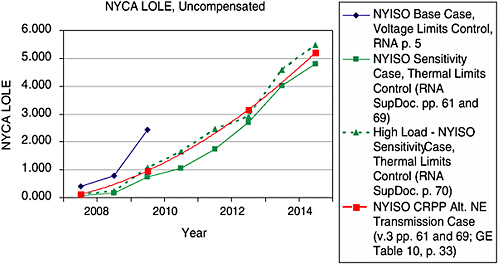
FIGURE 5-1 NYISO reliability projections. SOURCE: Derived from NYISO (2005b).
additions identified serve to illustrate the kinds of response envisaged for Indian Point replacement. The generating capacity changes assumed (beyond the 2,530 MW of generation and transmission expected to be completed before 2008) are shown in Table 5-2.
To assist the committee with the analysis, General Electric International, Inc. (GE) was retained to run its propri
TABLE 5-2 Additional Generating Capacity Assumed in Reference Case
|
Project |
Capacity (MW) |
NYCA Zonea |
Online Date |
|
SCS Astoria Energy |
500 |
J |
Jan 08 |
|
Caithness |
383 |
K |
Jan 08 |
|
Long Island Wind |
15b |
K |
Jan 08 |
|
Bowline Point |
750 |
G |
Jan 10 |
|
Wawayanda |
540 |
G |
Jan 13 |
|
Generic Combined Cycle |
580 |
H |
Jan 13 |
|
Reliant Astoria I |
367 |
J |
Jan 15 |
|
Reliant Astoria II |
173 |
J |
Jan 15 |
|
Total Power |
3,308 |
|
|
|
aSee Figure 1-3 in Chapter 1 of this report for a map of the New York Control Area (NYCA) zones. bFPL Energy has proposed a 150 MW wind energy project off the south shore of Long Island. Wind is an intermittent power producer, and only a small fraction of rated capacity may be available during peak load. The committee used 15 MW for this project in its reliability analysis. NYISO did not use any of the 47 MW of existing NYCA wind capacity in its reliability analyses. SOURCE: As shown in Hinkle et al. (2005). |
|||
etary models, MARS3 and MAPS™,4 of the New York State and Northeast region electric systems. The MARS model (Box 5-2) is one of the principal tools used to assess NYCA system reliability. The MAPS model allows a preliminary assessment of the impact of each option studied on NYCA system operations and economics.5 Reliability was analyzed only for 2008, 2010, 2013, and 2015, the years that the Indian Point reactors were hypothesized to be closed.
The goal of the reliability simulations was to determine the additional resources that would be required to meet reliability standards. Generating capacity was added until LOLE met the requirement of 0.1, and the NYCA reserve margin reached 18 percent.6
The results of the MARS analyses are shown in Figure 5-2 in comparison with NYISO’s two main cases. With the committee’s Reference Case assumptions, 3,300 MW are needed by 2015 to maintain reliability (LOLE < 0.1). LOLE is well below 0.1 day per year in 2008 and 2010, slightly exceeding 0.1 in both 2013 and 2015.7 Details of this analy-
|
BOX 5-2 Multi-Area Reliability Simulation (MARS) Model GE’s MARS simulation software is the same system reliability screening tool approved by the New York State Reliability Council (NYSRC) and used by NYISO in its CRPP/RNA studies. MARS uses Monte Carlo simulation of the electrical generation and transmission system of the New York Control Area (NYCA) interconnected with the four contiguous electrical power systems in the northeastern United States and eastern Canada. MARS is a “transportation” model, sometimes referred to as a “bubble and stick” model, connecting generation and loads in the grid. That is, it connects the sources and sinks of power with direct-current-like flows. |
sis, along with those of the scenarios below, are in Appendix F-2.
The different results (about 1 GW difference in resources needed by 2015) of the generally similar analyses by NYISO and the committee illustrate the sensitivity of the reliability analysis—and thus the additional resources needed—to differences in initial system conditions assumed. The main differences are with transmission constraints and geographic distribution of additional generating capacity.8 The committee believes that these two cases approximately encompass the range of additional resources needed. Appendix F discusses the differences between the analyses.
REPLACEMENT SCENARIOS
With the Reference Case defined, the committee examined several cases with Indian Point closing. First, it looked at simply closing Indian Point, either in 2008/2010 (Case b1), or at the end of current license in 2013/2015 (Case c1) with no measures to compensate for the 2,000 MW capacity reduction.9 As expected, the LOLE in both cases increased to unacceptable levels for these cases, as summarized in Figure 5-3.
The committee then analyzed cases with additional replacement resources, representing possible solutions that might arise out of NYISO’s solicitation process to restore or maintain system reliability. The goal was to determine how much compensation would be necessary to maintain reliability within criteria. All of these cases included additional, aggressive programs to improve efficiency of electricity use and stronger demand-side measures to reduce peak demand. For most of them, peak demand was reduced by 300 MW in 2008, 650 MW in 2010, 800 MW in 2013, and a total of 850 MW10 in 2015.
Additional supply was assumed to come from the proposed TransGas Energy project (1,100 MW, which was not needed in the Reference Case) in Brooklyn. Several of the Reference Case projects were accelerated as shown in Table 5-3 for Case b2 (early retirement) and Case c2 (end-of-license retirement).
The committee explored the consequences of additional scenarios, but in less detail, only looking at 2015. These included:
-
A 1,000 MW north-south high-voltage direct-current (HVDC) transmission line running from the Marcy Substation (near Utica in Zone E) to Rock Tavern (in Zone G, south of the current transmission bottlenecks), assumed to be operational in 2012. Cases b3 and c3 represent the early retirement and end-of-license (EOL) retirement of the Indian Point units with this HVDC cable resource in place. The inference drawn from the results is that with such a north-south transmission option, using excess power upstate and from out of state, the potential generating resource needed downstate might be reduced from 1,100 MW to 300 MW.
-
Higher market penetration of energy efficiency and demand-side management, Cases b4 and c4, for early and EOL shutdown scenarios, respectively. This scenario included 1,200 MW of energy efficiency and 800 MW of DSM load-reduction measures for a net 1,950 MW reduction of peak load by 2015, mainly in the New York City area. Demand would continue to grow, but at a low rate (390 MW growth compared with 2,340 MW without the EE/DSM measures). No additional capacity beyond the Reference Case would be necessary, as the additional EE and DSM measures would compensate for Indian Point. EE/DSM measures of this magnitude would require significant, aggressive early attention by the New York State government and a high fraction of all electricity users.
-
Sensitivity to higher fuel prices. The systems modeled were the same as in the earlier scenarios, so reliability analysis was not necessary. The committee included this analysis to estimate the approximate economic impact of higher fuel prices. The price projections used in other scenarios are lower than recent prices, and it seems plausible that gas and oil prices could remain much higher.
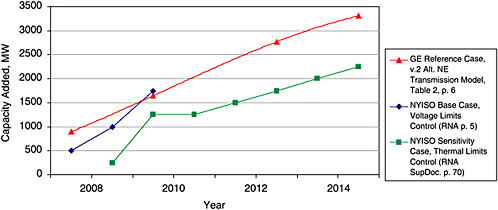
FIGURE 5-2 Approximate additional resources needed. SOURCE: Derived from NYISO (2005b) and Hinkle et al. (2005).

FIGURE 5-3 Impact on NYCA reliability loss of load (LOLE) of shutting down Indian Point without additional resources beyond the reference case. SOURCE: Derived from Hinkle et al. (2005).
Table 5-4 summarizes the assumed additions to resources for the various scenarios, based on achieving or exceeding the LOLE requirements. Details of the assumptions and timing of additions of illustrative resources are in Appendix F-2.
RESULTS OF RELIABILITY ANALYSES
Table 5-5 summarizes the reliability results of the cases run, showing the resulting LOLEs after compensation. Results for the Reference Case and the main cases of early and end-of-license shutdown of Indian Point are shown graphically in Figures 5-4 and 5-5, which also provide a comparison to the NYISO Base and Sensitivity Cases. Figure 5-6 shows the projected reserve margin for Case c2 (EOL shutdown of Indian Point), allowing comparison to reserve mar gin projections in Figure 4-1 and the impact of differing compensation.
If Indian Point is closed, roughly 2,000 MW of additional resources would be needed beyond that needed for the Reference Case. As shown in Table 5-4, the Early-Shutdown scenario (b2) requires about 4,500 MW of additional resources (total new capacity plus peak-load reduction) to be available by 2010 to meet load growth, retirements of other units, and retirement of Indian Point.11 Of this amount, about 650 MW could result from improved efficiency and demand-
|
11 |
The data on reserve margins and Figure 5-5 show the degree to which the illustrative resource additions result in overcompensation in the early years until 2013 and 2015. The schedule for adding compensation might therefore be extended in the early years. |
TABLE 5-3 Capacity Additions Assumed for Cases b2 and c2
|
|
|
|
Onlinea |
|
|
Project |
Capacity (MW) |
NYCA Zone |
Case b2 |
Case c2 |
|
SCS Astoria Energy |
500 |
J |
2008 |
2008 |
|
Caithness |
383 |
K |
2008 |
2008 |
|
Long Island Wind |
15b |
K |
2008 |
2008 |
|
Bowline Point |
750 |
G |
2010 |
2010 |
|
Wawayanda |
540 |
G |
2010 |
2010 |
|
Generic Combined Cycle |
580 |
H |
2013 |
2013 |
|
Reliant Astoria I |
367 |
J |
2008 |
2010 |
|
Reliant Astoria II |
173 |
J |
2008 |
2011 |
|
TransGas Energy |
1,100 |
J |
2010 |
2015 |
|
Total Power |
4,408 |
|
|
|
|
aAll additions were assumed to come online in January of the year listed. bSee note b in Table 5-2. SOURCE: As shown in Hinkle et al. (2005). |
||||
side management. Constructing the proposed 600 MW Cross-Hudson Cable Project, at present suspended, and extending the operation of the 880 MW Poletti 1 plant through 2010, for example, would help. Another possibility would be to extend the operation of one of the Indian Point units beyond 2010, until sufficient generation capacity could be installed in the NYCA.
In Cases b3 and c3, the added north-south HVDC transmission line was counted as a 1,000 MW resource, but the availability of sufficient generating capacity upstate was not examined in detail. As discussed in Chapter 3, the supplemental generation could come from a combination of sources, including existing or new generation upstate, or imports from Canada, all of which require additional analysis beyond the scope of this study.
This assumed HVDC line would reduce the need for new capacity in the New York City area by about 800 MW. The impact of the line on reliability would be even more substantial if (1) it would extend all the way into New York City (Zone J) and (2) if it would be backed by dedicated generat-
TABLE 5-4 Summary of Illustrative Resources Assumed to Maintain NYCA Reliability
|
|
Year |
|||
|
|
2008 |
2010 |
2013 |
2015 |
|
NYCA Peak Load, MW |
33,330 |
34,200 |
35,180 |
35,670 |
|
NYCA Firm Capacity, MW |
37,794 |
37,801 |
37,801 |
37,801 |
|
Total Resources with 975 MW SCR and 990 MW UDR, MW |
39,759 |
39,766 |
39,766 |
39,766 |
|
NYISO Additional Capacity Required for Reliability, Cumulative. Thermal Limits Controlling, MW |
0 |
1,250 |
1,750 |
2,250 |
|
COMMITTEE SCENARIOS |
|
|
|
|
|
Reference case, cumulative additional generating capacity assumed to meet or exceed load growth and scheduled retirements, Indian Point continues in service, MW |
900 |
1,650 |
2,770 |
3,310 |
|
Early shutdown + compensation, Case b2, cumulative generation added above reference case, MW |
540 |
2,180 |
1,640 |
1,100 |
|
Total Generation Added, MW |
1,440 |
3,830 |
4,410 |
4,410 |
|
Cumulative Peak-Load Reduction by EE/DSM Measures, MW |
300 |
650 |
800 |
850 |
|
Total Compensation for Scenario, MW |
1,740 |
4,480 |
5,210 |
5,260 |
|
EOL shutdown + compensation, Case c2, cumulative generation added above reference case, MW |
0 |
900 |
540 |
1,100 |
|
Total Generation Added, MW |
900 |
2,550 |
3,310 |
4,410 |
|
Cumulative Peak-Load Reduction by EE/DSM Measures, MW |
300 |
650 |
800 |
850 |
|
Total Compensation for Scenario, MW |
1,200 |
3,200 |
4,110 |
5,260 |
|
ADDITIONAL SCENARIOS |
|
|
|
|
|
Compensation including 1,000 MW HVDC line, Cases b3 and c3, cumulative generation added above reference case, MW |
|
|
|
300 |
|
Total Generation Added, MW |
|
|
|
3,600 |
|
Cumulative Peak-Load Reduction by EE/DSM Measures, MW |
|
|
|
850 |
|
Compensation including high EE/DSM measures, Cases b4 and c4, cumulative generation added above reference case, MW |
|
|
|
0 |
|
Total Generation Added, MW |
|
|
|
3,300 |
|
Cumulative Peak-Load Reduction by EE/DSM Measures, MW |
|
|
|
2,000 |
|
SOURCE: Hinkle et al. (2005). |
||||
TABLE 5-5 Results of Reliability Analyses
|
|
Year |
|||
|
|
2008 |
2010 |
2013 |
2015 |
|
NYISO 2008 CRPP/RNA Data: Table 7.3.1 Firm Resources only |
|
|
|
|
|
NYCA Reserve Margin, % |
19 |
16 |
13 |
11 |
|
NYCA LOLE |
0.073 |
0.752 |
2.692 |
4.816 |
|
For Comparison: GE-Calculated NYCA LOLE with Thermal Limits Controlling and Alternate NE Transmission Constraints |
0.122 |
0.966 |
3.164 |
5.210 |
|
NYISO Compensation Case, with Additional Capacity as in Table 5-4. Thermal Limits Controlling |
|
|
|
|
|
Estimated NYCA Reserve Margin, % |
19 |
20 |
18 |
18 |
|
Resulting NYCA LOLE |
0.073 |
0.068 |
NA |
NA |
|
COMMITTEE SCENARIOS |
|
|
|
|
|
Reference case |
|
|
|
|
|
NYCA Reserve Margin, % |
22 |
21 |
21 |
21 |
|
Resulting NYCA LOLE |
0.021 |
0.069 |
0.104 |
0.102 |
|
Early shutdown, reference case additions only, Case b1 |
|
|
|
|
|
NYCA Reserve Margin, % |
20 |
16 |
16 |
16 |
|
Resulting NYCA LOLE |
0.104 |
1.352 |
1.323 |
1.48 |
|
Early shutdown with compensation, Case b2 |
|
|
|
|
|
NYCA Reserve Margin, % |
22 |
24 |
23 |
22 |
|
Resulting NYCA LOLE |
0.023 |
0.011 |
0.032 |
0.101 |
|
EOL shutdown, reference case compensation only, Case c1 |
|
|
|
|
|
NYCA Reserve Margin, % |
22 |
21 |
19 |
16 |
|
Resulting NYCA LOLE |
0.021 |
0.069 |
0.333 |
1.48 |
|
EOL shutdown with compensation, Case c2 |
|
|
|
|
|
NYCA Reserve Margin, % |
18 |
21 |
18 |
17 |
|
Resulting NYCA LOLE |
0.013 |
0.006 |
0.036 |
0.101 |
|
ADDITIONAL SENSITIVITY ANALYSES |
|
|
|
|
|
Compensation including 1,000 MW HVDC line in 2012, Cases b3 and c3 |
|
|
|
|
|
NYCA Reserve Margin, % |
|
|
|
19 |
|
Resulting NYCA LOLE |
|
|
|
0.098 |
|
Compensation including high EE/DSM measures, Cases b4 and c4 |
|
|
|
|
|
NYCA Reserve Margin, % |
|
|
|
22 |
|
Resulting NYCA LOLE |
— |
— |
— |
0.082 |
|
NOTE: All reserve margin and LOLE results include SCR and UDR as defined in Table 5-1. SOURCE: Hinkle et al. (2005). |
||||
ing capacity. If these two conditions could be met, the transmission line would then also be counted as a resource contributing to the locational installed capacity (LICAP) requirement that Zone J’s generation capacity be at least 80 percent of peak load. This HVDC line would then be analogous to the Neptune Cable now under construction, which will meet both criteria for Long Island and therefore contribute to Zone K’s LICAP requirement of 98 percent.
The high levels of EE and DSM in Cases b4 and c4 would be advantageous in meeting reliability criteria, while reducing the additional generating resources required for load requirements with the retirement of the Indian Point units. Reducing demand growth by 1 MW would mean avoiding the need to build 1.18 MW to meet the NYCA reserve margin requirement. Even so, replacing the 2,000 MW from Indian Point would require reducing peak load by 1,700 MW by 2015, a very ambitious goal. The technical potential is there, and current programs are having considerable success, but progress comes in small increments that must be implemented by many people. It should be noted that the results of such programs are harder to verify than the contribution of a new generating capacity.
Corrections to reactive power are also required. The capital cost of static VAR compensation (SVC) is in the range of $50 per kilovar (kVAR), and that of a synchronous condenser about $35/kVAR (O’Neill, 2004).12 Equipment to replace the reactive power that Indian Point is capable of supplying would cost on the order of $30 million to $45 million. In comparison, the capital cost of a 1,000 MW power plant is on the order of $1 billion. Since the cost of correcting reac-
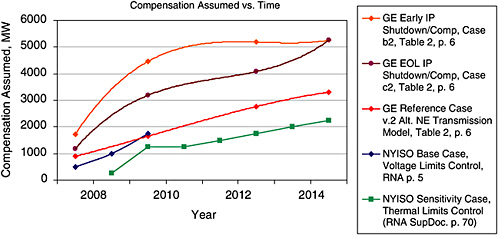
FIGURE 5-4 Capacity assumed to meet load growth and compensate for retiring Indian Point. SOURCE: Derived from NYISO (2005b) and Hinkle et al. (2005).
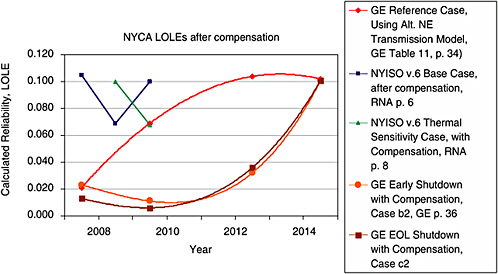
FIGURE 5-5 Loss-of-load expectation after compensation. SOURCE: Derived from NYISO (2005b) and Hinkle et al. (2005).
tive power is relatively low, the committee infers that timely local corrections to reactive power would be made.
OPERATIONAL AND ECONOMIC IMPACTS
The committee estimated the impact of closing Indian Point with the GE MAPS model for the scenarios that met reliability criteria in the MARS modeling. The NYISO case with thermal limits controlling in 2008 is the benchmark for comparing projected operational and economic impacts on (1) the diversity of the mix of fuels used to generate electricity, (2) the impact on the wholesale price of electricity, and (3) the annual variable operating cost (VOC) of producing electricity, important in the industry because it reflects the net effect of changes in both zonal generation and fuel cost (and is the fundamental variable minimized systemwide in
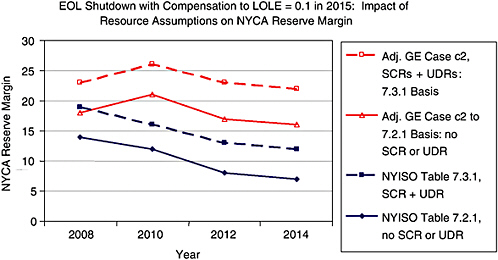
FIGURE 5-6 Projected reserve margin for End-of-License (EOL) Shutdown of Indian Point with Compensation (Case c2). SOURCE: Derived from NYISO (2005b) and Hinkle et al. (2005).
the MAPS calculations). In addition, a brief sensitivity analysis was conducted to help understand the impact that differing fuel costs would have on the cost of electricity.
Analytical Considerations
Neighboring regions (New England and part of the Pennsylvania Jersey Maryland [PJM] control area) were included in the analysis. At the outset, the committee recognized that MAPS, itself dependent on the approximate results from the MARS model analyses, would provide mainly an approximate picture of economic and cost projections into the future. Part of the MAPS model simulates the current wholesale electricity marketplace in New York State. This market is evolving to take into account aspects of pricing and investment that will differ from the present operation (see Chapter 4). Since the model cannot project such changes, confidence in the MAPS results for wholesale cost change is substantially less than in the reliability calculations of MARS.
Box 5-3 lists the main points of how the MAPS simulation works with MARS and the results produced by the simulation. Details of the modeling are contained in Appendix F-2 and the GE report (Hinkle et al., 2005).
GE’s MARS and MAPS are well-accepted screening methodologies despite their many limitations. Some additional caveats are necessary in considering some limitations in the models and databases used, and thus the utility of comparisons of results for the various scenarios.
Since MAPS calculates a systemwide minimum operating cost of producing electricity, which in turn is dominated by fuel costs, the fuel prices assumed dominate the economic outputs. Fuel-cost volatility presents a significant uncertainty in interpreting the MAPS results. For the basic calculations, MAPS used a reference 2008 cost of natural gas of $5.1 per million British thermal units ($5.1/MMBtu), decreasing to $4.2/MMBtu by 2015 (both in nominal cost, or dollars-of-the-year).13 For comparison, the U.S. Department of Energy’s Energy Information Administration (DOE/EIA) reports that natural gas prices paid by electric power producers in New York State were in the range of $7.3 to $9.3/MMBtu in August 2005 (before the price increases resulting from the damage caused by Hurricane Katrina).
To assess the impact of higher fuel prices, a sensitivity study was made using a 2008 natural gas price of $7.8/ MMBtu (decreasing to $7.0 by 2015). Although gas prices have dropped some in recent months, the committee recommends focusing on this case unless increased imports of liquefied natural gas (LNG) are seen as likely. Clearly, more in-depth study of gas prices and their consequences is needed.
The MAPS model of the scenarios adds considerable new NYCA generation based on modern, efficient gas-fired combined-cycle units, which require less natural gas than simple-cycle gas turbines for the same power produced. Consequently, application of these units results in lower system variable operating costs. However, no comparable assumption is made in the MAPS database for adjacent areas. This tends to lower the impact on the wholesale price of retiring Indian Point and would tend to project reduced imports of electricity from the adjacent areas in favor of increased, lower variable cost generation in the NYCA.
|
BOX 5-3 Multi-Area Production Simulation (MAPS) Software Model The MAPS model assesses the operational and economic characteristics of the entire interconnected region. MAPS models the electrical system in greater detail than MARS does, and is based on an economic commitment and dispatch model, also examining the flow on each transmission line for every hour of the simulation, recognizing both normal and operating reliability-related constraints. MAPS dispatches generating units in the system to meet the zonal electrical-generation requirements of a specific scenario being modeled, considering any transmission constraints. MAPS then calculates the annual variable operating cost (AVOC) of producing electricity systemwide and iterates, adjusting the dispatch of units in the system, starting with lowest variable operating cost first, to determine the minimum annual regional systemwide variable operating cost. The variable cost of producing electricity is dominated by fuel costs, but it also includes variable operational and maintenance costs, unit startup cost (say, going from a cold start and ramping up to full electrical output), and the variable cost of emission credits consumed, where required. MAPS does not explicitly consider fixed costs, which would include capital charges; in this work, MAPS was not used to mimic the bidding strategy for bids into the wholesale market submitted by generators of electricity. Instead, pricing was equal to the variable cost of the marginal bidder, which is the theoretical limit to which economic theory drives the clearing price of a commodity in a perfectly competitive market. Having established the minimum systemwide AVOC, MAPS then provides the corresponding wholesale price of electricity, airborne emissions, and the mix of fuels used in generating electricity for each pricing zone in the system. Generation resources added to maintain reliability are inputs to the model, using MARS results as a base. MAPS does not assess the financial attractiveness of adding that capacity. It assumes that the resource is there, calculates its variable operating cost, and “dispatches” it in rank order of the variable operating cost for that resource, as capacity is aggregated to meet the then-current demand for electricity in the wholesale market. Iterative use of both the MARS reliability simulations in conjunction with the MAPS simulations for the different scenarios thus provides a basis, with some caveats, for comparing both reliability and trends of operating and economic impacts among the illustrative scenarios posed by the committee. |
In evaluating the results of the MAPS analyses, readers should understand that the assumptions made tend to underestimate the projections on future wholesale prices of electricity. Therefore, the focus should be on major trends and percentage changes rather than on the absolute value of projected wholesale price of electricity. Similarly, the wholesale price of electricity modeled does not represent the final cost to consumers. Among other things, it does not include transmission and distribution costs or all of the costs for recovery of the cost of new capacity, either generation or transmission, which ultimately will, most likely, be borne by the consumer.
Fuel Diversity: Impact on NYCA Reliance on Natural Gas for Generating Electricity
Diversity of fuels used in generation is a security criterion to avoid excessive reliance on a single fuel. Generation in urban environments with minimal pollution is another criterion. New York State has benefited from ample fuel diversity in the past, and flexibility has been maintained using many gas-fired plants with dual-fuel units that can burn oil.
For the new generating capacity assumed in this study, the committee focused on natural gas in high-efficiency combined-cycle units. Natural-gas-fired generators have been the dominant choice nationwide since the mid-1980s, but that may not be strategically prudent for the next decade.
Table 5-6 compares the diversity of fuels used to generate electricity in the NYCA and the Northeast region for 2005 and 2008. Gas consumption for generating electricity is expected to increase 25 percent from 2005 to 2008. In addition, the regional shifts in fuel diversity are significant. There has been a recent reduction in the use of both oil and coal in the NYCA. In the Northeast region as a whole, the use of oil has declined, but the use of coal evidently is increasing. Finally, the projections for the Reference Case are about the same as for the Benchmark and are directionally correct in that the Reference Case adds about 1 GW of gas-based capacity and increases the change from 2005 by about another 2 percent. Further detail is shown in Appendix F-2.
Table 5-7 summarizes the projected increase of NYCA reliance on natural gas for the main options scenarios considered in this study. The table gives the percentage of NYCA reliance on natural gas for generating electricity and the impact of higher assumed fuel prices.
The MAPS projections show that reliance on natural gas would increase from 34 percent in 2008 to 44 percent in 2015 just to meet load growth and replace the capacity of units currently scheduled for retirements (the Reference Case). The projected reliance on natural gas increases to 53 percent by 2015 if Indian Point is shut down and capacity shortfall is compensated for principally by adding gas-fired units. Higher penetration of EE/DSM measures tends to reduce gas requirements, but only by about 2 percentage points. One might expect that the High EE/DSM case would lie closer to the Reference Case, but the committee was not able to investigate this further. Higher natural gas price shifts generation to other fuels, but not much, according to the MAPS projections, as the reliance on natural gas decreased only by about 3 percentage points.
In sum, the compensatory actions evaluated would significantly reduce diversity in the mix of fuels used for electrical generation in New York State. Basing compensating
TABLE 5-6 Benchmark of the Consumption of Natural Gas, Coal, and Oil for 2005 and 2008: Annual Fuel Consumption in Trillion Btu
|
|
2005 |
Benchmark CRPP Thermal Case in 2008 |
Reference Case in 2008 |
|||
|
|
NYCA |
Northeast |
NYCA |
Northeast |
NYCA |
Northeast |
|
Natural gas |
308 |
804 |
385 |
1,031 |
392 |
1,032 |
|
Oil |
103 |
132 |
47 |
59 |
32 |
44 |
|
Coal |
249 |
2,242 |
218 |
2,344 |
218 |
2,343 |
|
Percent change from 2005 |
||||||
|
Natural gas |
— |
— |
25.1 |
28.1 |
27.3 |
28.3 |
|
Oil |
— |
— |
–53.7 |
–54.8 |
–68.1 |
–66.3 |
|
Coal |
— |
— |
–12.4 |
4.5 |
–12.5 |
4.5 |
|
Percent change from benchmark 2008 NYISO Base Case |
||||||
|
Natural gas |
— |
— |
— |
— |
1.8 |
0.1 |
|
Oil |
— |
— |
— |
— |
–31.1 |
–25.4 |
|
Coal |
— |
— |
— |
— |
–0.1 |
0.0 |
|
SOURCE: Derived from Hinkle et al. (2005), plus additional personal communication with Gene Hinkle, December 2005. |
||||||
resources upstate on fuel other than natural gas could lessen the reliance on natural gas, but to meet NYCA reliability criteria, that option would also require additional transmission capacity to bring power south of the congested Upstate New York-Southeast New York (UPNY/SENY) interface. Greater than 50 percent reliance on gas presents a strategic issue. In addition, it is not clear where the additional gas will be coming from. New sources, such as imported liquefied natural gas, and new transmission pipelines are likely to be required. A coal plant might be completed upstate by 2016 (the first peak-demand period after the second Indian Point reactor reaches its current EOL would be in the summer of 2016), but planning would have to start soon. Otherwise, there are few supply alternatives to gas. Considerable analysis and planning are required to develop the optimum path forward in the common interest.
Projected Impact on the Wholesale Price of Electricity
The options selected to compensate for an Indian Point shutdown would affect the operating costs for power generation. This change in turn will influence the wholesale price
TABLE 5-7 Projected Impact on Electrical Generation Based on Natural Gas for 2008 to 2015, with Sensitivity to Fuel Price
|
|
Reference Fuel Price: NYCA Natural Gas Prices: 2008 @ $5.11/MMBtu; 2015 @ $4.24/MMBtu |
Higher Fuel Price: NYCA Natural Gas Prices: 2008 @ $7.69/MMBtu; 2015 @ $7.03/MMBtu |
||||||
|
|
2008 |
2010 |
2013 |
2015 |
2008 |
2010 |
2013 |
2015 |
|
Percent gas in: |
|
|
|
|
|
|
|
|
|
2003: 20% |
|
|
|
|
|
|
|
|
|
2005: 28% |
|
|
|
|
|
|
|
|
|
Benchmark NYISO CRPP Thermal Case in 2008 |
34 |
|
|
|
|
|
|
|
|
Reference Case |
36 |
38 |
43 |
44 |
34 |
|
|
|
|
Early Shutdown with Compensation, b2 |
40 |
48 |
53 |
53 |
38 |
47 |
49 |
50 |
|
EOL Shutdown with Compensation, c2 |
35 |
39 |
47 |
53 |
33 |
37 |
44 |
50 |
|
Early Shutdown with Higher EE/DSM, b4 |
|
|
|
51 |
|
|
|
|
|
EOL Shutdown with Higher EE/DSM, c4 |
|
|
|
51 |
|
|
|
|
|
SOURCE: Derived from Hinkle et al. (2005). |
||||||||
TABLE 5-8 MAPS-Projected Impact on Electricity Wholesale Price
|
Case |
Area |
2008 ($/MWh) |
2010 ($/MWh) |
2013 ($/MWh) |
2015 ($/MWh) |
|
HIGHER FUEL PRICES SENSITIVITY CASES |
|
|
|
|
|
|
Benchmark of 2008 NYISO Thermal Case, Lower fuel cost |
|
46.28 |
|
|
|
|
Reference Case in Year Noted |
NYCA |
61 |
58 |
57 |
59 |
|
|
Zone J |
73 |
69 |
66 |
67 |
|
Early Shutdown with Compensation, Case b2 |
NYCA |
63 |
62 |
60 |
66 |
|
|
Zone J |
77 |
75 |
71 |
79 |
|
End-of-License Shutdown with Compensation, Case c2 |
NYCA |
60 |
53 |
58 |
66 |
|
|
Zone J |
72 |
60 |
68 |
79 |
|
REFERENCE CASE NATURAL GAS PRICES |
|
|
|
|
|
|
Benchmark of 2008 NYISO Thermal Limits Case |
NYCA |
46.28 |
|
|
|
|
|
Zone J |
56 |
|
|
|
|
Reference Case in Year Noted |
NYCA |
44 |
42 |
37 |
39 |
|
|
Zone J |
51 |
49 |
42 |
43 |
|
Early Shutdown, Case b2 |
NYCA |
45 |
44 |
40 |
43 |
|
|
Zone J |
54 |
53 |
47 |
51 |
|
End-of-License Shutdown, Case c2 |
NYCA |
43 |
38 |
38 |
43 |
|
|
Zone J |
51 |
43 |
44 |
51 |
|
Shutdown with HVDC Line, Cases b3 and c3 |
NYCA |
|
|
|
41 |
|
|
Zone J |
|
|
|
47 |
|
Shutdown with High EE/DSM, Cases b4 and c4 |
NYCA |
|
|
|
43 |
|
|
Zone J |
|
|
|
49 |
|
SOURCE: Derived from Hinkle et al. (2005). |
|||||
of electricity. Table 5-8 gives the results of the MAPS-projected impact on wholesale prices of electricity in the NYCA and New York City. It is also important to recognize that other costs of producing, transmitting, and distributing electricity will ultimately be passed through, directly or indirectly, to the consumer.
As noted earlier, the committee has been unable to estimate future costs to the consumer accurately. The trends and estimated changes should be viewed as approximate. Since this is an important topic of particular importance to the consumer, additional investigation is required, including that into the evolving market structure in New York.14 For the Reference Case results with the higher-fuel-price assumption (more likely, considering the situation today), NYCA wholesale prices are projected to remain in the range of $57 to $61/MWh between 2008 and 2015.15 Zone J prices are consistently higher, ranging from $73/MWh to $66/MWh. If Indian Point is retired, MAPS calculates that wholesale prices by 2015 would be about $66/MWh in the NYCA and $79/MWh in New York City.
For the lower fuel prices (lower by 33 percent in 2008 and by 40 percent in 2015), the yearly average wholesale price of electricity in all of the NYCA for 2008 is projected at about $46/MWh for the Benchmark 2008 NYISO Thermal Limits case. As in the present market, there is a strong difference among zones, as the data in Appendix F-2 show in detail. The wholesale price is in the range $51/MWh to $53/MWh in Zones I, J, and K, but reaches $61/MWh in Zone H.
Some general observations include these:
-
Adding substantial efficient capacity based on low-cost gas tends to lower wholesale prices in meeting load growth
-
and scheduled retirements in both the NYCA and Zone J (which always has substantially higher prices than the NYCA). One should also recall that the unoptimized cases with compensation added more low-cost generation than needed (or is likely to be built) in the early years. Such over-compensation leads to predictions of lower wholesale prices than would result from a more realistic level of construction that just maintained reliability at a LOLE of 0.1.
-
The early-shutdown scenario gives up a bit of that reduction, but not much until 2010 when Indian Point Unit 2 would be shut down.
-
The HVDC case suggests the potential cost benefit of needing 800 MW less of new downstate capacity, by bringing south lower-cost electricity from upstate (assumed, arguably, to exist without new capacity upstate). It also should be noted that this case is not directly comparable to other cases, as the cost of the HVDC line would have to be passed through to the consumer in some manner, but not via the wholesale price market. The inference might still be that if no new generation is needed upstate specifically to supply the HVDC line, a lower wholesale price might well prevail downstate, but considerable analysis would be required to verify that.
-
The impact of high EE/DSM penetration has only a 2 percentage point impact on wholesale price by 2015 relative to the cases with assumed EE/DSM penetration of 875 MW. This seems to be counterintuitive, and further evaluation is warranted, as this also relates to the overall incentive to invest in EE/DSM measures. In any event, it is also important to note that the ultimate cost to the consumer may be lower with EE/DSM measures, as consumers use less electricity.
An estimate of the net change in the wholesale price solely due to shutting down Indian Point, after compensating for load growth and scheduled retirements, can be obtained from GE’s calculations by subtracting from the Reference Case the wholesale price estimates for the various scenarios considered. For example, by 2015 with the higher fuel prices used, the increase in wholesale price might increase $7/MWh for all of the NYCA and increase $13/MWh in New York City. For the lower-fuel-cost cases, the impact for the NYCA might be $2 to $4/MWh, and double that for New York City. However, the committee urges great caution in interpreting these numbers, since (1) the difference between two uncertain numbers is doubly uncertain; (2) it unrealistically takes shutting down Indian Point out of the context of the overall reliability situation facing New York today; (3) it allows the inference that shutting down Indian Point’s 2 GW at EOL would also be compensated for by adding additional low-cost, gas-based generation; and (4) as noted earlier, the committee has low confidence in the MAPS-projected wholesale prices (based on the current locational-based marginal pricing wholesale market), which are believed to be too low.
Impact on the Annual Variable Cost of Producing Electricity
The systemwide AVOC that MAPS minimizes depends principally on the annual generation in the systemwide region under consideration and the prices of fuel there.16 Table 5-9 gives part of the output results, providing a picture of the impacts on the AVOC for the NYCA and New York City (Zone J) in 2008 and 2015 and the sensitivity to fuel prices for the limited cases run. Values listed are the percentage changes from the Benchmark.
The data for the Reference Case in 2008 using the lower fuel prices show that AVOC initially decreases slightly, because fuel prices are low and low-cost generation is being added based on high-efficiency, natural-gas-fired units. But early shutdown of Indian Point changes this result because additional gas-based generation is added, and it has a higher variable operating cost than Indian Point, the lowest-variable-cost producer in the generating fleet—aside from hydropower. By 2015 the impact on AVOC is 21 percent higher for the NYCA and 40 percent higher for New York City. Generators of electricity there have substantially higher variable costs to cover.
The data in Table 5-9 show large impacts on AVOCs, especially in Zone J. The key points to note include these:
-
The impact of higher fuel prices is large for the entire NYCA, and especially for Zone J, with percentage increases over the Benchmark ranging from 27 to 70 percent for 2008 and from 44 to 117 percent for 2015, with the higher percentages applying to New York City. (Note that the higher-fuel-price assumptions correspond to a 50 percent increase of the 2008 price of natural gas.)
-
The AVOC in Zone J increases by 17 to 40 percent from 2008 to 2015, both relative to the Benchmark, for the Early Shutdown with Compensation scenario, because of the added capacity in Zone J.
-
Delaying the shutdown of Indian Point units until EOL shows a net early reduction in Zone J (up until 2015) because additions to capacity come later, and in the early years the impact of the use of more efficient units dominates total additions to capacity.
-
Addition of the HVDC line into Rock Tavern (Zone G) reduces the change in Zone J, as expected, as does greater penetration of EE/DSM measures. For Zone J in 2015, the combined net impact on AVOC is reduced to the range of an 8 to 14 percent increase over the Benchmark. The impact of this magnitude warrants further detailed study.
Appendix F-2 elaborates on the differing impact on AVOC in the various pricing zones, with large percentage changes
TABLE 5-9 Projected Impact on Annual Variable Operating Cost
|
|
Reference Fuel Prices |
Higher Fuel Prices |
||||||
|
|
2008 NYCA Gas at $5.11/MMBtu |
2015 NYCA Gas at $4.24/MMBtu |
2008 NYCA Gas at $7.69/MMBtu |
2015 NYCA Gas at $7.03/MMBtu |
||||
|
Case |
NYCA (%) |
Zone J (%) |
NYCA (%) |
Zone J (%) |
NYCA (%) |
Zone J (%) |
NYCA (%) |
Zone J (%) |
|
Reference case |
–1 |
–2 |
5 |
–8 |
29 |
42 |
48 |
44 |
|
Early shutdown, Case b2 |
6 |
17 |
21 |
40 |
40 |
70 |
77 |
117 |
|
EOL shutdown, Case c2 |
–2 |
–3 |
21 |
40 |
27 |
40 |
77 |
117 |
|
Early shutdown, including N-S HVDC line in 2012, Case b3 |
— |
— |
12 |
8 |
— |
— |
— |
— |
|
EOL shutdown, including N-S HVDC line in 2012, Case c3 |
— |
— |
12 |
8 |
— |
— |
— |
— |
|
Early shutdown, including high EE/DSM measures by 2015, Case b4 |
— |
— |
13 |
14 |
— |
— |
— |
— |
|
EOL shutdown, including high EE/DSM measures by 2015, Case c4 |
— |
— |
13 |
14 |
— |
— |
— |
— |
|
SOURCE: Derived from Hinkle et al. (2005). |
||||||||
in some instances, as MAPS adjusts the electricity dispatch of various generating units to find the minimum systemwide cost. Changes of this magnitude may influence different generators of electricity substantially and could present operating and risk-management challenges, such as reliable access to fuels, and substantial shifts as new low-cost capacity is added.
Detailed results summarized in Appendix F-2 suggest an increase in AVOCs of about 10 percent for the entire Northeast region from 2008 to 2015. But this raises another caution to consider regarding the initial MAPS runs presented here and the complexity of the economic factors. The MAPS results suggest a significant, perhaps controversial, impact on regional AVOC beyond meeting load growth and compensatory actions from shutting down Indian Point. This inference might, however, only be an artifact of the calculations because of the assumptions used in the MAPS studies. Substantial gas-fired combined-cycle capacity with high efficiency is added to the NYCA over the period in question. This new capacity could be expected to displace more-expensive generation there, even older gas-fired units having lower efficiency (after compensating for the shutdown of Indian Point). However, as just one example of complexity, no comparable assumption of adding more modern gas-fired combined-cycle capacity for the New England region went into the initial MAPS model run by GE. This approach distorts the likely pattern of new generating sources that would emerge.
Sensitivity to Higher Fuel Prices
For the fuel-price sensitivity cases, the price assumptions used in MAPS differ in the following ways. For the assumed lower fuel prices, the natural gas price is 5 to 7 percent higher in PJM and New England than in NYISO; coal is 16 to 28 percent higher in New England than in either NYISO or PJM; residual oil and distillate have the same price in all three regions.17 For the higher-fuel-price assumptions, fuel prices are the same in all regions, except that gas is 2 percent higher and coal is 16 to 23 percent higher in New England. In addition, the changes from the lower fuel prices to the higher fuel prices assume that the NYISO gas price is 50 percent higher in 2008 and 66 percent higher in 2015. The coal price is the same as in the lower set of prices; the price of residual oil rises 50 percent and 63 percent in 2008 and 2015, respectively; and the distillate fuel price goes up 38 percent and 35 percent in 2008 and 2015, respectively.
Since MAPS estimates the minimum systemwide AVOCs, these assumptions, in moving from the lower prices to the higher fuel prices, will tend to (1) slightly favor gas-based generation in NYISO over that in either New England or PJM, (2) favor coal-based generation in NYISO over coal-
|
17 |
Base case data set, Quarter 1, 2005, published by Platts, a Division of McGraw-Hill Companies. See http://www.platts.com/Analytic%20Solutions/BaseCase/index.xml. Accessed March 2006. |
based generation in New England, (3) favor coal-based generation slightly more in the high-fuel cases, (4) be neutral regarding gas-based generation relative to residual oil-based generation, or (5) favor distillate-based generation, relatively, except that distillate fuel is always 58 to 65 percent more costly than natural gas, so distillate-based generation penetrates only slightly in the MAPS analyses.
In evaluating the results of the MAPS analyses, it should be remembered that trends and percentage changes (rather that the absolute values of the calculated wholesale price of electricity) are mainly of interest.
COMPARING THE RESULTS WITH CRITERIA
Chapter 1 listed six criteria adopted by the committee. This section compares the results of the committee’s scenario analysis with those criteria.
1. Would the combination of demand and supply options provide adequate energy to replace that provided by Indian Point?
A portfolio of additional supply and demand-reduction options can be identified to replace Indian Point, but they must be added to the capacity required to meet load growth and to offset generating plant retirements. The committee estimates that even if Indian Point is not retired, New York State will need about 1.2 to 1.7 GW in 2010, and 2.2 to 3.3 GW in 2015, from projects that are not already under construction. The additional 2 GW required if Indian Point were to be closed could be met by some suitable combination of new generation in the New York City area, efficiency improvements and demand-side management, and new transmission capability from upstate.
Most of the approximately 5 GW that would be needed by 2015 probably would come from new generating capacity relying at least initially on natural gas as a fuel. Energy efficiency and demand-side management have great potential, and could replace at least 800 MW of the energy produced by Indian Point and possibly much more. The new north-south transmission line analyzed by the committee also could reduce the additional generating capacity needed downstate by about 800 MW. The committee notes that critically required corrections to reactive power would have to be made locally in a timely manner, since losing the reactive power from Indian Point would only compound the projected deficiency in the Lower Hudson Valley identified by NYISO.
2. Would the generation and transmission system be adequate to deliver the energy reliably to end users?
Identifying the generation and transmission system capability that must be provided to replace Indian Point is much easier than determining whether it actually would get built when needed. All these measures will take time to implement, and several factors may converge to make it even more difficult. As discussed in Chapter 4, the committee questions whether the present market mechanisms are adequate to attract the capital investment required for the roughly 5 GW of new capacity and transmission corrections that would be needed by 2015. In addition, the lack of a state program, such as the former Article X, to expedite siting and licensing is likely to discourage new projects. A concerted, well-managed, and coordinated effort would be required to replace Indian Point by 2015. Replacement in the 2008-2010 time frame would be considerably more difficult, probably requiring extraordinary, emergency-like measures to achieve.
3. How would the new combination of demand and supply options compare with Indian Point in terms of security of fuel supply for new generation?
While the details of security comparisons are beyond the scope of this study (and would depend on the exact set of options selected), it is possible that the NYCA would be vulnerable to potential natural gas shortages. Adding several gigawatts of electrical capacity (including projects currently under construction) based mainly on natural gas supply would increase NYCA reliance on gas-based generation from 20 percent in 2003 to over 50 percent by 2015. The present gas supply and transmission capacity is inadequate to meet such future demand. In-so-far as additional gas is supplied by imported LNG, another energy security issue is introduced. Adding electrical capacity upstate based on other fuels will require additional electrical transmission capacity to serve downstate load centers, and transmission systems are inherently vulnerable to some extent. On the other hand, distributed generation has some security advantages over large generating stations. Continued vigilance at the Indian Point site for stored spent nuclear fuel will be necessary whether or not the plant is closed.
4. How would economic costs, especially to the consumer, compare with those for continued operation of Indian Point?
The Indian Point power plant produces baseload electricity as a low-cost wholesale provider in southern New York State. While the present “regulated competition” wholesale market depends on many factors, the projected wholesale cost without the Indian Point units, based on analysis of variable operating costs only, will tend to rise. The strongest influence on wholesale costs is fuel costs. The current volatility of natural gas prices and the structure of the wholesale market make it difficult and uncertain to project costs in 2015. In any event, it is unlikely that replacing the low-cost producer would do anything other than raise the ultimate cost of electricity to consumers.
Investors must be attracted back to the NYCA for new projects, but providing for adequate return on new capital investment will tend to increase projected wholesale prices. Costs also will increase indirectly because replacement power will increase demand for natural gas, require invest-
ment in new gas transmission infrastructure, and require expenditure for emissions permits.
5. How would environmental emissions and other impacts compare with those for continued operation of Indian Point?
Since the air emissions of New York power plants currently involve emission caps already in place, new sources would have to purchase emission rights. Thus, most pollutants would be little changed. The main change expected would be an increase in carbon dioxide (CO2, the most important greenhouse gas) from substituting fossil fuel for nuclear fuel. If the regional plans for reducing or capping CO2 emissions are implemented, local CO2 increases will likely be offset with an emissions credit market. Water quality would be improved by retiring Indian Point, but much the same advantage could be achieved if the plant switched to cooling towers from the current once-through cooling.
6. What would be the impacts on local communities from closing Indian Point and replacing it with these options?
Community impacts would be mixed, depending on the choice of replacements and their locations. There would likely be potentially significant disruption in the tax base and supporting business income to Westchester and surrounding counties. A loss of employment of skilled workers would be associated with the plant’s retirement. The costs of electricity are likely to rise with changes in the electrical system infrastructure in southern New York State. Projections of all of these impacts are difficult to estimate without additional information. While the committee has not studied these factors, some benefits may occur. For example, upstate communities might benefit if replacement power plants are built there. The Indian Point site could also be used for new industrial facilities that could replace the jobs and tax benefits of the nuclear station.
REFERENCES
Hinkle, G., G. Jordan, and M. Sanford. 2005. “An Assessment of Alternatives to Indian Point for Meeting Energy Needs.” Unpublished report for the National Research Council. GE-Energy, Schenectady, N.Y., December 19.
NYISO (New York Independent System Operator). 2005a. Comprehensive Reliability Planning Process (CRPP) Reliability Needs Assessment (RNA). December 21.
—. 2005b. Comprehensive Reliability Planning Process Supporting Document and Appendices for the Draft Reliability Needs Assessment, NYISO, Albany, N.Y., December 21. See http://www.nyiso.org/public/webdocs/newsroom/press_releases/2005/crrp_supporting_rna_doc12202005.pdf. Accessed December 2005.
—. 2005c. Michael Calimano, solicitation letter to S.V. Lunt, R.M. Kessel, E.R. McGrath, and J. McMahon, December 22. See http://www.nyiso.org/public/webdocs/newsroom/press_releases/2005/rna_solution_letter.pdf. Accessed January 2006.
O’Neill, Richard. 2004. Reactive Power: Is It Real? Is It in the Ether? Harvard Electric Policy Group, Austin, Tex. December 2.
Patton, David B. 2001. New York Market Advisor Annual Report on the New York Electric Markets for Calendar Year 2000. April.
Westchester Public Issues Institute. 2002. Closing Indian Point—Implications for NYC Metro Energy Supply. June.


