
Unauthorized Use of Radiation Sources: Measures to Prevent Attacks and Mitigate Consequences
Leonid Bolshov, Rafael Arutyunyan, Elena Melikhova, and Oleg Pavlovsky
Nuclear Safety Institute of the Russian Academy of Sciences
At the beginning of the third millennium, terrorism has become a serious threat to security characterized by its unpredictable nature, variety of forms, and severe effects on the public. Its organizational structures are losing rigid hierarchy and are transforming into international networks consisting of practically invulnerable, independently functioning cells. The terrorists arm themselves with the most recent scientific achievements, adjust civilian technologies to their criminal objectives, and seek to acquire the most destructive and deadly weapons.
The metamorphosis of terrorism into its current form compels all nations to pay attention to problems of terrorism in general and to nuclear terrorism in particular. The notion of a dirty bomb is widely used to mean both a nuclear weapon featuring a low level of technology and a device built with conventional explosives and radioactive substances. The nonproliferation regime and special systems for control and accounting of nuclear weapons predetermine a situation where the threat of the use of radioactive substances for terrorist purposes is the most likely form of terrorism to be carried out.
Radiological terrorism is the deliberate dispersion of radioactive substances, the planting of ionizing radiation sources in the human environs or infrastructure, or acts of sabotage at hazardous radiation facilities, causing radiation impacts on the population and environment and disruption of social life and the economy.
Considering the problem as a whole, one may state that a terrorist act involving radioactive substances of any origin can lead to direct and indirect adverse consequences to society. Direct adverse consequences of radiation effects are
-
acute irradiation of humans by significant radiation doses that within a short period of time (hours or days) results in severe consequences to human health and even fatalities
-
prolonged irradiation of humans resulting from environmental contamination with radioactive substances that could trigger long-term adverse radiation effects including an increase in illnesses and fatalities from, for example, cancer
Indirect consequences mean social, economic, political, psychological, and demographic consequences to society, including the following:
-
direct damage from a terrorist act leading to possible deaths or serious health effects, radioactive contamination of habitat infrastructure, or loss of property
-
costs associated with elimination of the consequences of terrorist acts, required increases in radiation monitoring, deployment of systems for large-scale assessment of the actual radiation situation and its projections for the near and distant future, priority and long-term measures to protect the population, and cleanup of contaminated territories
-
degradation of the socioeconomic and psychological situation not only in the regions severely affected by radiation contamination, but also in large territories where small changes in the radiation situation would cause hardly detectable effects to human health and the environment; this would likely trigger population movement from the region and loss of the regional economic potential; frightened people would tend to leave and take their relatives with them from contaminated areas, and the entire way of life for those who stayed behind could also be changed
-
costs associated with the withdrawal from the economy of activities in the contaminated territories; possible closure of enterprises; reduction of consumer interest in items being produced in the region regardless of the real contamination levels; devaluation of real estate in the contaminated region; loss of revenues from trade, tourism, and so forth; and decrease in economic attractiveness of the territory
-
costs resulting from negative attitudes of the society to radiation in gen-eral and nuclear power in particular
Assessments of previous radiation accidents show that the indirect consequences of a radiological terrorism act can lead to economic and social losses that exceed direct losses from radiation impacts on people. In connection with this, serious attention should be paid to potential threats of radiological terrorism acts involving ionizing radiation sources as radiological weapon components. This is due to the wide use of radiation sources in various fields of the economy (industry, agriculture, medicine, and independent power sources; see Table 1)
TABLE 1 Radiation Sources in World Countries
|
Application |
Radionuclide |
Half-life |
Activity |
|
Radiotherapy |
60Co |
5.3 yr |
50-1,000 TBq |
|
137Cs |
30 yr |
500 TBq |
|
|
Industrial radiography |
192Ir |
74 days |
0.1–5 TBq |
|
60Co |
5.3 yr |
0.1–5 TBq |
|
|
Sterilization |
60Co |
5.3 yr |
0.1–400 PBq |
|
|
137Cs |
30 yr |
0.1-–PBq |
|
90Sr |
29 yr |
50–1,500 MBq |
|
|
Well monitoring |
137Cs |
30 yr |
1–100 GBq |
|
241Am |
432.2 yr |
1–800 GBq |
|
|
Level and thickness gauges |
60Co |
30 yr |
10 GBq–1 TBq |
|
60Co |
5.3 yr |
1–10 GBq |
|
|
Density detector |
241Am |
432.2 yr |
0.1–2 GBq |
|
137Cs |
30 yr |
Up to 400 MBq |
|
|
226Ra |
1,600 yr |
Approximately |
|
|
|
|
|
1,500 MBq |
|
SOURCE: International Atomic Energy Agency. 2003. The Security of Radioactive Sources. Proceedings of an International Conference held in Vienna, Austria, March 10–13, 2003. Vienna: International Atomic Energy Agency. |
|||
and imperfections in the system for accounting, licensing, regulating, and control, which make it difficult to bar all paths of illegal movements of ionizing radiation sources, especially in nonnuclear industries.
The Russian Academy of Sciences and the Federal Atomic Energy Agency (Rosatom) have jointly begun work to improve safety in handling radioactive sources, reduce the risk of unauthorized use of sealed radionuclide sources of high activity, and improve the physical protection of radiation sources. Within the framework of this effort, which includes U.S.-Russian cooperation, the Russian Academy of Sciences and Rosatom have started to identify and analyze the physical protection of sealed radioactive sources of high activity and to develop priority measures for improving the state-level system of control, accounting, and physical protection of sealed radioactive sources used in the various sectors of the national economy. Data given in Table 2 and Figure 1 serve as examples of such studies, which characterize the sealed radioactive sources situation in some regions of Russia as of 2004.
As seen from the data given in Table 2, the total number of sealed radioactive sources in a region can vary from a few to several thousand, and in some regions (for example, in Moscow and St. Petersburg) their numbers can be substantially larger. Also, it is important to note that the majority of sources have activity of several curies (see Figure 1) that, on the one hand, reduces the radiological hazard from their use as components of terrorist devices and, on the other hand, leads to the situation where physical security of such radiation sources
TABLE 2 Number of Radioactive Sources in Use in Some Regions of Russia
|
Region |
Quantity |
Total activity, Bq |
|
Arkhangelsk Region |
3,556 |
6.15E+16 |
|
City of St. Petersburg |
18,973 |
3.93E+16 |
|
Kemerovo Region |
697 |
3.57E+15 |
|
Samara Region |
483 |
1.24E+15 |
|
Saratov Region |
1,118 |
8.04E+14 |
|
Khabarovsk Krai |
722 |
9.84E+14 |
|
Chelyabinsk Region |
5,118 |
9.13E+15 |
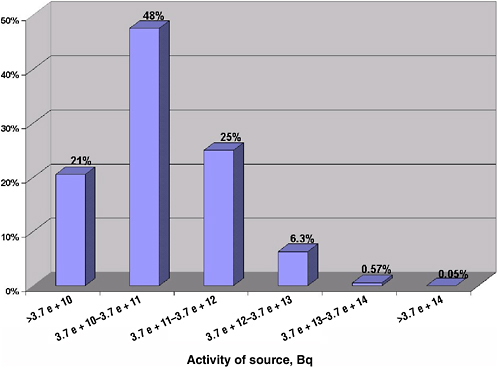
FIGURE 1 Distribution of radioactive sources in use by their activity.
could be much less stringent. Consequently, damage caused by their illegal use can be rather significant since the low-activity sources are much more vulnerable to unauthorized acquisition, clandestine movement, and stockpiling than high-activity sources.
Real difficulties in organizing control and accounting of such ionizing radiation sources can be confirmed by the officially recorded number of detected
orphan sources as well as the number of thefts, losses, and damages to sources outside Rosatom’s jurisdiction (see Table 3).
Table 3 data show that the most frequent loss of sources takes place in the course of geological surveys where actual control over the security of ionizing radiation sources is extremely difficult. A similar situation is true for other industrially developed countries; for example, in the United States up to 200 radioactive sources are lost annually.
Within the framework of the U.S.-Russian cooperation in improvement of physical protection of nuclear materials, work has included development of recommendations on measures aimed at reducing the possibility of unauthorized use of ionizing radiation sources as based on the analysis of available information. The Brookhaven National Laboratory, acting under a contract with the U.S. Department of Energy, is responsible for this work. At the first stage of the work, a survey of handling conditions for ionizing radiation sources was carried out at enterprises located in 20 regions of Russia (678 organizations) and facilities of 11 federal agencies (676 organizations).
According to the U.S. requirements special attention was paid to the high-activity sources shown in Table 4.
The analysis has shown the number of ionizing radiation sources used in 141 organizations subject to regional jurisdiction and 150 organizations subject to institutional jurisdiction. The number of high-activity ionizing radiation sources is 4,567 and 1,546, respectively.
TABLE 3 Radiological Incidents in Russia Outside the Nuclear Industry Involving Ionizing Radiation Sources from 1997–2001
|
Incident |
1997 |
1998 |
1999 |
2000 |
2001 |
|
Destruction of sources |
8 |
5 |
6 |
10 |
17 |
|
Theft of sources |
13 |
22 |
3 |
6 |
6 |
|
Detection of orphan sources |
14 |
16 |
5 |
1 |
2 |
|
Loss of sources during geological surveys |
9 |
10 |
14 |
18 |
24 |
|
Loss of sources during their transportation |
— |
5 |
1 |
2 |
1 |
TABLE 4 Minimum Activity Levels for Sources to Be Surveyed
|
Ionizing radiation |
Radionuclides |
Minimum activity, Ci |
|
Alpha |
238Pu, 241Am, 252Cf, 226Ra |
10 |
|
Beta |
90Sr |
100 |
|
Gamma |
60Co, 137Cs, 192Ir |
100 |
A large number of ionizing radiation sources are used by the institutes of the Russian Academy of Sciences. There are 80 such institutes including 15 that possess high-activity sealed radioactive sources (544 are 60Co sources and 69 are 137Cs sources). Many of the sources are no longer in use, and effective measures are required to ensure their security and disposal.
During the analysis, the parameters that characterize handling of sealed radioactive sources were determined, and the basic needs of information and analytical centers were identified in order to implement measures to improve safety in handling sealed radiation sources.
The systems analysis identified three priority areas for reducing threats of unauthorized use of high-activity ionizing radiation sources:
-
disposal of not-in-use ionizing radiation sources to reduce the number of organizations possessing high-activity ionizing radiation sources
-
improvement of the relevant physical protection systems of organizations that handle ionizing radiation sources
-
improvement of the physical protection of ionizing radiation sources during their transportation
A number of factors accounted for the selection of organizations to be classified as first priority in the work plan for reducing the threat of unauthorized use of ionizing radiation sources, including
-
the current state of physical protection systems
-
security procedures at the facility where ionizing radiation sources are present
-
economic and financial stability of the facility
-
location of the facility in terms of ease of unauthorized access
Experts from the Nuclear Safety Institute (IBRAE) of the Russian Academy of Sciences, with involvement of specialists from different ministries and agencies of Russia, have carried out for several years system analyses of possible consequences of terrorist acts involving radioactive materials and ionizing radiation sources. An important task of such analyses is to develop approaches to identifying priorities for setting out measures to prevent radiological terrorism acts and minimize consequences. The existing security measures and priorities are based, as a rule, on independent analysis of separate factors such as the design of a dispersion device and its radiation component, a limited set of scenarios of clandestine movements of the dispersion device or its parts, delivery methods to the terrorism scene, and the population affected by the possible consequences of a terrorist act. Regretfully such assessments do not fully take into account the interrelation between health consequences, socioeconomic consequences, and the design of the dispersion device.
We believe that the probability of radiological terrorism involving a specific type of radioactive substance is determined by
-
degree of protection against unauthorized (illegal) removal of the substance
-
method of movement into the target area
-
availability and effectiveness of detection equipment at different stages of movement and delivery taking into account possible camouflage techniques
-
effectiveness of special measures of detecting and terminating preparations for acts of radiological terrorism
In a generalized way, possible combinations of direct and indirect consequences of radiation impacts on humans under various scenarios of radiological terrorism can be divided into the three groups presented in Figure 2. In urban conditions, the situations are most likely to pertain to groups 2 and 3, that is, where indirect consequences prevail as compared to direct radiation consequences for a small group of people at the scene. However, there are scenarios involving a large public presence and possibly significant exposure doses to
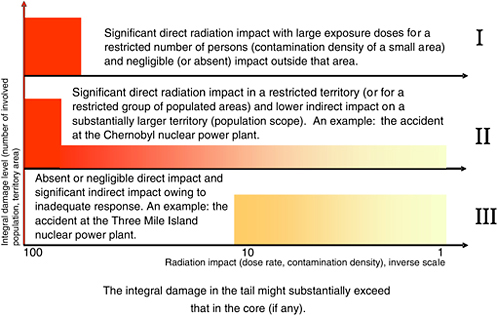
FIGURE 2 Damage caused by different levels of radiation under different scenarios. Note: I—high-level radiation impact; II—mixed radiation impact; III—low-level radiation impact.
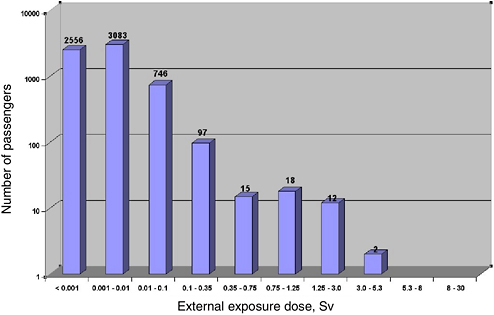
FIGURE 3 Distribution of the subway car passengers by whole-body external exposure doses.
hundreds of people. A summary analysis of the results of assessments of consequences associated with several radiological terrorism scenarios is given below.
The first scenario involves planting a radioactive source containing 60Co in a subway car. Such sources are widely used. The calculations used data for car characteristics, passenger flow, and the length of Moscow’s subway system. The calculations have shown that the majority of passengers (nearly 98 percent) could be exposed to external doses below 100 mSv (see Figure 3). About 100–200 passengers could show external signs of a radiation injury (whole-body doses are more than 0.1 Sv and accompanied by a victim’s headache, dry mouth, or nausea). For the dozen or so persons who were close to the place where the source had been planted and were exposed to maximum doses, there is even a low probability of death.
The assessments also demonstrate that for a significant number of passengers who were close to the seat where the source had been planted, high-exposure doses to the skin are possible. Such exposure could possibly result in injuries ranging from insignificant reddening to massive fracturing of skin and even internal radiation injuries.
The second scenario concerns the possible consequences of a 90Sr-based dirty bomb detonation at an underground subway station. A shallow subway station layout was selected as the model for this scenario. It was assumed that a low-yield (in TNT equivalent) dirty bomb with a widely used 90Sr radiation
source was detonated in the central section of the platform of a subway station during rush hour.
The number of passengers on the platform at the moment of the terrorist act could be up to 1,300 persons, with about 300 persons located in the area close to the detonation. Using conservative assumptions, the maximum internal exposure doses to the lungs of some persons of this group could be 5 Sv. Internal doses of 5 Sv will probably lead to detectable radiation damage to the lungs. For persons receiving exposure doses of about 1–1.5 Sv, the probability of effects is low, but for persons with poor health, especially lung problems, there may be adverse health effects. In addition, the group of passengers may become a high-risk group in terms of possible complementary lung cancer-induced illnesses and fatalities.
The indirect consequences of such a terrorist act will include radioactive contamination of the subway station and adjacent territories from the spread of radioactive substances and closing of the station, and possibly a section of the subway line, for a significant period of time. Simultaneous closing of several stations and transfer stations will nearly immobilize subway operations and cause huge transportation problems. In addition, there will be requirements for compensation for losses of contaminated belongings and for arrangements for long-term medical treatment of a large group of people directly involved in the incident and in the elimination of its consequences.
The third scenario concerns dispersion of some quantity of 137Cs over an urban area. Two 137Cs sources of low and intermediate activity are considered as the sources of radiation. Dispersion of a contaminant at 100 or 200 m above the target area is effected by detonation of a low-yield explosion device or by the use of various dispersion devices.
The assessments used a special code employing Monte Carlo methods and showed that even with dispersion of a low activity 137Cs source over the urban area, there is a probability of 0.2 to 2.6 km2 of the city being contaminated to higher than 1 Ci/km2. Larger contamination zones will emerge if a higher activity source is dispersed over the city.
After the Chernobyl accident a contaminated area with 137Cs density of 1–5 Ci/km2 was identified, according to Russian legislation, as an area of privileged socioeconomic status, although there are no health effects. Application of this guideline to an urban district contaminated as a result of radiological terrorism could lead to mandatory decontamination of an area where thousands of people reside, and losses of apartment and nonresidential buildings could be substantial.
A fourth scenario considers the possible radiological consequences of detonation of a dirty bomb with 241Am radioactivity in or near a large city. It has shown that methodologies and computer codes, which describe the behavior of contaminants when released in an open field or high rugged terrain, cannot be effectively used for urban conditions, large industrial enterprises, and transportation junctions. Therefore a three-dimensional aerodynamic model being de-
veloped by IBRAE of the distribution of radioactive admixtures in dense urban conditions with identification of typical stagnant areas and local neighborhoods featuring high contamination levels was used. Calculations have shown that an area of substantial contamination of the city environment resulting from such an incident could extend up to 1 km and would be characterized by very high gradients of radioactive concentrations in the air depending on the actual layout of buildings and the weather conditions at the moment of the dirty bomb detonation.
High time and spatial irregularity of the radiation situation parameters causes technical and methodological difficulties in the organization of monitoring and analysis of the radiation situation soon after the act. There is a need to develop special technical means of measurement and computer codes for the processing of monitoring data to obtain adequate estimates of the situation and to outline solutions for population protection.
Preliminary calculations have also demonstrated that about 100 individuals of the 5,000 present in the street at the time of the act could be affected by radiation exposure to the lungs with adverse health effects (over 5 Sv).
The fifth scenario concerns deliberate liquid contamination with high 137Cs concentration of a section of an asphalt road leading to a highway. Contamination of such a section of the road is potentially dangerous because it is the place where vehicles stop before entering the highway and external exposure doses to vehicle passengers increase. Also, the contamination transfer along the highway acquires significance from prolonged contact of car tires with the contaminated road.
Calculations using specially developed models of radioactive contamination transfer have shown that after only 15 minutes from the moment of contamination of the road activities of higher than 100 Ci/km2 would extend over 100 m. Further along the highway, some cars will exit, and additional roads will be involved in the contamination process. Assessments have shown that within several days after the initial contamination the total length of city roads contaminated over 10 Ci/km2 could be several dozens of kilometers.
In this case there is no direct radiological impact. Only the road workers and police, who because of their duties remain for several hours in the radiation contamination zone, will receive significant exposure doses. However, indirect losses could turn out to be more significant, since decontamination of large areas of road and sidewalks could be required along with arrangements for alternative traffic routes for extended periods of time. All these operations must take into account rigorous safety guidelines that will lead to labor costs and financial losses.
The radiation anxiety prevailing in the post-Chernobyl period triggered Russia to set forth unjustifiably rigid, legally binding sanitary guidelines. Application of such radiation criteria leads to cases where even only a slight harmless excess over the guidelines becomes a source of serious public concern. In the
Chernobyl-contaminated area, these have become apparent despite the fact that the allowable exposure level is deliberately lower than variations in natural background radiation.
Inadequate perception of radiation risk exists not only at the level of the average person. Prejudices against radiation are present in nearly all professional and social groups, including representatives of legislative and executive bodies who address public protection and environmental regulatory issues. The work to build adequate perception of threats and possible consequences of acts of radiological terrorism in society requires a differentiated approach to each target group. The information for political and economic decision makers must include not only radiation risk and population protection data, but also data on economic efficiency of these measures, their social acceptability, and their sufficiency.
We may consider the following criteria for zoning territory with radiation impact to the population:
-
Zone 1: radiation impact zone, which includes territories where radiation effects to the population’s health are detected or where emergency criteria are exceeded
-
Zone 2: normal condition guidelines are exceeded, including human exposure limits for normal conditions, environment contamination levels based on sanitary and ecological criteria, external dose rates related to natural background values, and accepted contamination levels for accidents
-
Zone 3: socioeconomic consequences, where social and economic conditions are disrupted and the population’s radiation concerns are clearly manifested
As a rule, in all of the radiological terrorism scenarios in an urban area, the size of low-contaminated sections (Zones 2 and 3) can exceed by 100 and more times the size of severely contaminated ones (Zone 1). This ratio turns out to be somewhat less in the Chernobyl area in Russia, due to a large number of rural settlements in these zones.
Actual measurement data demonstrate the high irregularity of contamination densities and dose rates of gamma radiation in residential parts of the Chernobyl area. There are also great differences in individual exposure doses in various professional groups and age groups. All these factors complicate territorial zoning, build negative attitudes of the population toward protective measures, and aggravate social tension. Analysis of the radiological terrorism scenarios shows that these problems will be more difficult to solve in urban conditions.
The fear of radiation and the rigidity and confusing nature of existing guidelines and criteria in the field of radiation safety and radiation protection make society extremely vulnerable to a radiological terrorism threat. This fear, in combination with the ease in acquiring instruments capable of detecting the slightest increases of the radiation level, makes the system as a whole substantially un-
stable. Social risk amplification mechanisms are triggered by the slightest threat of a terrorist act involving radiation sources. In these cases the magnitude of indirect damage caused by fear-induced behavioral responses will inevitably exceed any consequences of radiation exposure itself. The epidemic of fear can spread extremely fast in densely populated areas with well-developed communications while endangering the entire system of societal activities.
Why does society demonstrate such an inadequate response to radiation hazards? The fear of radiation has historic and psychological roots. The mere term radiation inevitably evokes in the vast majority of people the association with nuclear weapons and is accompanied by the vision of the atomic bombing of Hiroshima and Nagasaki. These images were implanted intensely in people’s minds during the years of the arms race. The second layer of negative associations is represented by the Chernobyl, Kyshtym, and other radiation accidents. This sequel of radiation disasters with thousands of imaginary victims of peaceful applications of the atom has been ingrained in the mass consciousness.
Public addresses of officials from affected countries—Belarus, Ukraine, and often Russia—have also contributed to public confusion. Huge economic losses due to the Chernobyl accident, thousands of square kilometers of contaminated soil, and millions of people who needed help were and are cited in all programmatic documents on Chernobyl used to emphasize the large-scale measures being taken to rehabilitate the area, especially when the accident consequences are discussed at the international level. This distorted image of radiation accidents of the past will certainly become a serious negative background for discussions of actual or projected consequences of radiological terrorism.
For the subsequent comparative assessments of the scale of social consequences of radiological terrorism, we introduce two categories of people—involved and concerned—in addition to the traditionally used categories of exposed and affected.
The involved category includes those who witnessed the event but whose radiation dose resulting from a radiological terrorism act does not exceed guidelines for normal conditions. For example, for detonation of a dirty bomb in the subway, the involved would be all passengers of cars present at the station at the moment of the blast. In the scenario of the detonation on the street, the involved would be residents of buildings subject to evacuation or decontamination who were in their homes at the time of the terrorist act. The involved will think they have strong grounds to be concerned about their health, since according to the linear nonthreshold model of radiation biological effects adopted by International Commission on Radiological Protection, any arbitrary low-exposure dose can lead to adverse consequences to health.
The concerned category may be the persons who received negligibly low (close to zero) additional doses, but their standards of living dropped because of the terrorist act. They could be residents of buildings neighboring the evacuation zone, families of exposed individuals, colleagues who are afraid of catching the
disease during contact with the exposed individuals in the office, residents of the location where repositories of radioactive waste resulting from demolition and decontamination could be located, and so forth.
Those in the concerned category, the same way as those in the involved category, have formal grounds (the linear nonthreshold hypothesis) to believe that their health could have been damaged. Past accident experience demonstrates that the number of concerned will be 2–3 orders of magnitude higher than those involved. If there is a terrorist act in the center of a megapolis, the number of concerned could approach several million people. The scale of sociopsychological consequences in many respects is determined by the massive nature of the phenomenon of being concerned. At an early stage these consequences are manifested in the form of distress, behavioral responses of self-defense, and mental disorders. They cannot be expressed in terms of money, but under certain circumstances these side effects could be as significant as the economic losses expressed in terms of money. As time passes the external manifestations of distress and social disadaptation decline, but distrust of the authorities and negative attitudes toward nuclear technologies remain. Lessons learned from the accidents of the past show that the aggravation of already existing social problems and politicization of the society take place in radiation-contaminated territories.
We may judge the scale of social response and rumor-spreading speed even without a radioactive substance release by the recent public response to the operational event at the Balakovo Nuclear Power Plant in Russia. The event occurred at night on November 4, 2004. It was rated Level 0, that is, without a radioactivity release, by the International Nuclear Events Scale (INES); but it indeed produced rumors in the plant’s satellite city of Balakovo (due to the lack of adequate official information) about an accident with a release of radiation. Relatives and acquaintances started telephoning each other, recommending that they immediately drink iodine and wine and, if possible, leave the area. In 30 hours, millions of residents of the European part of Russia, who can be attributed to the category of the concerned, were involved in the situation. A few cases of iodine poisoning were reported as a result of the panic.
At all levels of response to the radiation threat, there is so-called social risk amplification, which leads to great growth in the scale of indirect losses. This is confirmed by the experience of past radiation accidents. For example, after the accident at Chernobyl, protective measures were justified (proceeding from the radiation protection criteria under conditions existing at that time) for 300,000 persons. In fact, more than 7 million persons were covered by the intervention measures. Different estimates of the cumulative economic loss (direct losses plus indirect damage) varied from tens to hundreds of millions of U.S. dollars over 15 years after the Chernobyl catastrophe for Belarus, Russia, and Ukraine. If one is being guided by the Nuclear Energy Agency (NEA) estimates (2002), in the event of a hypothetical accident at a modern nuclear power plant, the consid-
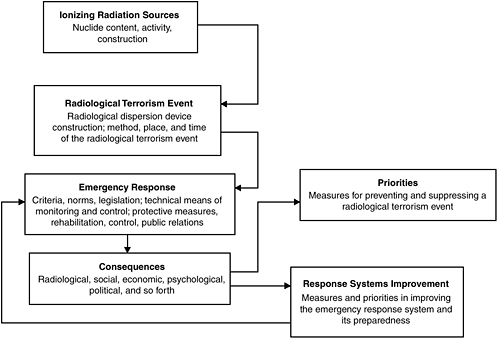
FIGURE 4 Factors determining radiological terrorism consequences and their interrelation.
eration of social risk amplification would boost losses caused by such an accident from EUR 10–20 billion up to nearly EUR 400 billion.
The mechanism for working out measures and setting priorities to prevent, terminate, and minimize consequences of radiological terrorism acts can be represented, with some simplifications, in the form of the diagram shown in Figure 4. Outlining effective measures and priorities requires a systems approach based on the multiattribute analysis of
-
various scenarios of illegal acquisition and paths of radioactive substance movements, taking into account their camouflage from detection equipment, especially for alpha and beta emitters
-
possible designs of dispersion devices, and paths and targets for terrorist acts
-
a whole set of consequences (radiological, ecological, sanitary and hygienic, economic, social, and so forth), taking into account features of radiation situations under different scenarios of radiological terrorism in urban conditions (for example, short timeframe for occurrence, special irregularity of urban radioactive contamination, multifaceted infrastructure)
-
requirements for methodologies and equipment for radiation survey and
-
monitoring including achievable detection levels of alpha, beta, and gamma radiation during illegal movements of radioactive substances, considering camouflage capabilities and means of movement and delivery
-
the existing legal and regulatory bases in the field of radiation safety and the effects on decision making
-
practical applicability of radiation protection criteria for the population, taking into account the high irregularity of radioactive contamination, complex distribution of individual exposure dose, and many interrelated components of urban infrastructure
-
causes of inadequate public perception of radiation risks
The development of instrumental means of countering radiological terrorism must pursue two paths:
-
strengthening of control over possible movements of radioactive sources, especially in public places and critical facilities of the city
-
development of methods for radiation surveys in urban conditions, including at critical infrastructure objects, life support systems, and public places, and for designing the most effective measures to protect the population
In this regard the following operations are needed immediately:
-
creation of hardware and software for control and prevention of carrying and conveying radioactive substances into public places or critical facilities of the city
-
development of methods and hardware and software sets for radiation surveys in urban conditions
-
development of decision-making support systems for adequate countermeasures for public protection in the event of a terrorist act involving radioactive substances
Stationary and mobile equipment for monitoring and surveying the radiation situation must ensure accurate and complete input information and prompt transmission and processing of data for large numbers of radioactively contaminated objects within the limited time for decision making.
Requirements for the equipment for detection of illicit trafficking of radioactive substances, their control and accounting systems, and special termination measures must be based on a realistic assessment of dangerous quantities of various radionuclides (especially alpha and beta emitters), as derived from the analysis of potential radiological, sanitary and hygienic, social, and economic consequences of the radioactive substance that is used.
Regretfully the existing radiation monitoring systems of large cities are not capable of detecting high radiation contamination or identifying gamma-
emitting ionizing radiation sources entering the city by criminal methods. This can be demonstrated using the example of Moscow. At present there are about 150 automatic radiation survey stations (ARMS detectors). Taking into account the city’s area (1,081 km2), the average survey zone of such a station is about 7 km2, or 1.5 km in radius.
Simple calculations show that when standard ARMS equipment is used, the detection of significant quantities of gamma-emitter activities is limited by a 100 m zone when the source is in the direct sight of the detector or has poor radiation shielding. The detection task becomes more difficult with alpha and beta emitters and requires special equipment. In essence the detection of radioactive substances is limited to simple tasks, such as monitoring separate critical zones where radioactive substances are moved without authorization. The setting of an effective system for detection of unauthorized movement of radioactive substances is far from being solved.
Special radiation monitoring methods should be developed and introduced to address these objectives. The prompt (within several seconds) detection of a moving ionizing radiation source requires a statistically verified detector with counting speed over the background; that is, at the background counting speed of about 1 pulse, the counting should be approximately double that. Therefore, the natural threshold of detection of a gamma source by standards instruments is 10 µR/h. Sensitivity of detectors can be increased by enlarging the detector volume and extending the measurement time. In this case, however, the cost and size of instruments will increase significantly. In addition stability and reliability will become difficult for large or multidetector equipment.
The significant reduction of signal/noise ratio can also be achieved through measurements in the spectral mode when the source radiation is recorded in the preset energy range (certainly, this range must be known in advance and preset) or through the use of a collimator. Both approaches require long exposure times (10 seconds to 1 minute), but they allow for increasing sensitivity by an order of magnitude and higher (see Table 5).
Yantar radiation monitors (designed by the Aspekt Company) are examples of existing stationary radiation source search equipment. Yantar monitors are designed to detect radioactive and fissile materials in the course of automated monitoring of vehicles, luggage, and people. Stationary radiation monitoring posts are furnished with such systems. There are several makes of Yantar monitors: pedestrian, vehicle, railway, and mail-luggage monitors. Yantar monitors have an independent alarm archive, well-developed self-diagnostics, and remote access capabilities for the setup parameters and alarm archive of the monitor.
Granat portable concealed radiation monitors (also designed by Aspekt) are an example of equipment that has already been developed. The monitor is designed to detect radioactive and fissile materials and primary identification of gamma-emitting radionuclides. Granat monitors can be used for radiation monitoring at temporary checkpoints (for example, ship’s ladders and entrance check-
TABLE 5 Capabilities of Ionizing Radiation Sources Detection Complex with a Collimator’s Angle Resolution of 20° (developed by ETC of the Khlopin Radium Institute, St. Petersburg)
|
Source and its activity |
Distance, m |
|||
|
One rotation of collimator (6 s) |
10 rotations of collimator (1 min) |
|||
|
By integral counting |
By photopeak |
By integral counting |
By photopeak |
|
|
137Cs, 1.2 GBq |
70 |
85 |
110 |
150 |
|
60Co, 4.1 GBq |
110 |
140 |
160 |
220 |
points in recreation facilities), for equipping special service officers to carry out concealed radiation monitoring, and so forth. Granat monitors record gamma radiation using NaI(Tl) crystal-based scintillation detectors and neutron radiation using proportional 3He counters.
Since cities are the likely targets of radiological terrorism acts, the existing methods of radiation survey and interpretation of measurement results could turn out to be only partially adequate. In addition, the existing methods and systems of emergency response to radiation accidents also could not produce adequate results in the event of a terrorist act, in the first place, because of the necessity to respond and make decisions immediately.
It means that it is necessary to develop new methods of calculation, modeling, measurement, and analysis of radioactive contamination in large cities’ conditions. Besides, in densely populated cities the development of operative and highly effective systems for support of decision making based on state-of-the-art means of communications and monitoring techniques becomes ever more important. A number of priority tasks may be identified:
-
the development of requirements for equipment and organization of a system for detection of illegal movements of radioactive substances, based on an analysis of potential consequences of their use and method of their delivery to the radiological terrorism scene
-
the development and manufacture of corresponding detection equipment
-
the creation of the corresponding methodological basis, software and hardware support, and system for expert support of decision making regarding population protection
-
the generation of recommendations for a regulatory basis in the field of
-
radiation safety, which will ensure effective protection of human health and prevention of unjustified social and economic consequences
-
the development of a methodology and equipment for radiation survey and monitoring in large cities
-
the establishment of national specialized centers for expert support of decision making regarding protection of the population and territories in the event of radiological terrorism
-
the development of a strategy and establishment of a corresponding system for emergency response and protection of population and territories in the event of radiological terrorism
-
the establishment of national and international systems to objectively inform the public about radiation risks, radiation safety approaches and guidelines, and lessons learned from radiation accidents and incidents of the past
To address the radiological terrorism issue, the implementation of work in these areas should be backed up by the best practices of U.S.-Russian cooperation in the field of radiation safety and protection. This will allow for finding ways to reduce the probability of radiological terrorism acts and to minimize their direct and indirect consequences should they occur.


