
Special Characteristics of Firefighting in Urban Areas
Nikolay P. Kopylov
Scientific Research Institute for Fire Prevention Defense of the Russian Ministry of Emergency Situations
In urban areas, terrorist attacks are aimed at civilian targets with many people, such as residential structures (apartment building bombings in Moscow, Volgodonsk, and Buinaksk), theatres (the Nord-Ost theater), schools (the Beslan elementary school), business centers (the World Trade Center buildings), and rail and subway trains (Spain, Moscow, South Korea, and Tokyo). The main purpose of terrorist attacks is to kill and harm as many people as possible.
In most cases, attacks on such objects cause fires. The situation can develop according to several possible scenarios:
-
impact—explosion—fire (World Trade Center)
-
explosion—fire (apartment building on Guryanov Street in Moscow; Beslan elementary school)
-
arson—fire (South Korean subway)
Firefighting and rescue activity during a terrorist attack are affected by special factors not common in usual firefighting and rescue practice. Explosions partially or completely destroy buildings, which changes the fire development scenario, decreases the fire resistance of structures, and causes hazards for firefighters, rescue workers, and civilians. In a terrorist attack, there is a strong need for the immediate evacuation of large numbers of people from the area, which becomes a difficult task in situations of panic, inappropriate mob behavior, and lack of rescue equipment. Sometimes firefighting and rescue operations must even be performed under crossfire (Beslan school). All these factors require special consideration.
FIRES CAUSED BY EXPLOSIONS
The impacts of the planes striking the World Trade Center buildings caused fuel vapor explosions and fires. Because of the high combustible load value in the area of the fires, high temperatures developed. The fires spread through the damaged and destroyed building structures. The fire-resistant coatings of load-bearing structural elements were damaged, which seriously decreased the fire resistance of the buildings. The summary effect of the impact, explosion, and fire caused the buildings to collapse.
The World Trade Center buildings had a high fire resistance rating of R240 (4 hours) for the external bearing walls and R180 (3 hours) for all other load-bearing elements. Such times (3 hours and more) guarantee the fire resistance of the building, because firefighting systems should extinguish the fire in that time. The impact and explosion decreased the fire resistance of the damaged elements. The major process responsible for the structural collapse was creep flow of the steel elements. Undamaged load-bearing elements took the strain from the destroyed elements, so the creep flow became more intense and the critical point was achieved in less time than under standard fire resistance test conditions. If certain elements are withstanding an additional load, bearing failure can occur when the temperature of the bearing element reaches 400–420 °C. Because the fire-resistant coating of many structural elements in the impact zone was damaged, the rise of structural temperatures to the above-mentioned values led to the collapse of the buildings.
The Russian Scientific Research Institute for Fire Protection has conducted studies involving the modeling of fire development in the damage zone in buildings after airplane impacts. The main purpose of the research was to obtain information necessary for estimating the necessary fire resistance rating for building structures.
The impact of a Boeing-767 into the World Trade Center was considered as a model situation. It was assumed that the crash would result in a 50 × 10 m opening in the external wall and would create an internal hollow measuring 50 × 50 × 10 m. Assuming that kerosene is spilled on the entire floor area of the damaged zone and flashover occurs quickly, an integral fire development model1 was used for estimating fire endurance time.
The main system of equations consisted of
-
mass conservation equation
-
energy conservation equation
-
oxygen balance equation
-
fuel component balance equations
The influence of the combustible load on thermal- and gas-dynamic parameters of the fire’s development was considered. Three scenarios for fire development were modeled: kerosene fire, furniture fire, and combined furniture-kerosene fire. The dimensions of the enclosure (damage zone) in all three scenarios were 50 × 50 × 10 m. The opening dimensions in the basic scenario are 50 × 10 m.
Kerosene Fire
The fuel tanks of a Boeing-767 are capable of carrying 90 tons of kerosene when fully loaded. That quantity was considered as the maximum quantity of fuel spilled in the enclosure. The temperature dynamic in the enclosure relative to the spilled fuel mass is shown in Figure 1. It indicates that if the mass of spilled fuel is more than 30 metric tons, the combustion process soon stabilizes and is characterized by a certain average ambient temperature in the enclosure. The duration of the stable period depends on the quantity of fuel. Figure 1 also shows the temperature curves for the standard fire endurance test. The modeled fire curve is close to the hydrocarbon (HC) curve, which describes liquid fuel
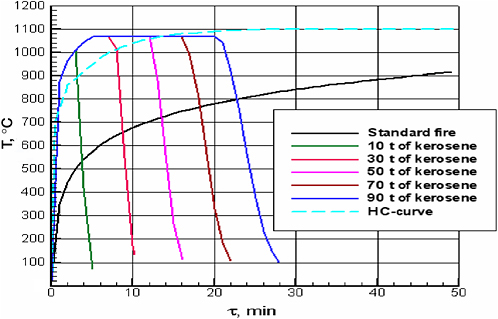
FIGURE 1 Dynamics of average temperature in the enclosure with various quantities of combustible in the form of spilled kerosene.
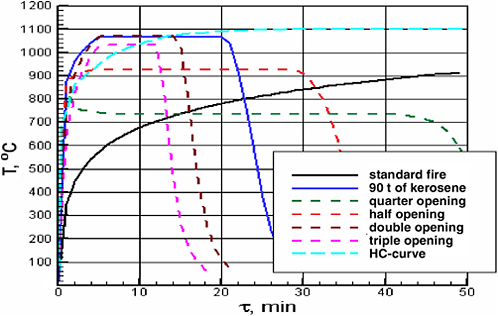
FIGURE 2 Dynamics of average temperature in the enclosure during combustion of 90 metric tons of kerosene with different sizes of opening areas.
fires. If the mass of spilled fuel is less than 10 tons, a stable combustion regime is not achieved because of the lack of fuel.
Figure 2 depicts temperature curves describing the combustion of 90 tons of kerosene in an enclosure with opening areas of various sizes. In the basic scenario, the dimensions of the opening were 50 × 10 m. Other scenarios have different opening dimensions: 12.5 × 10 m (quarter opening), 25 × 10 m (half opening), two openings of 50 × 10 m (double opening), and three openings of 50 × 10 m (triple opening). The last scenario assumes the destruction of three walls in the enclosure and is of no practical importance, but may be useful from a theoretical standpoint.
Figure 2 shows that combustion became stable in all scenarios, but the average temperatures throughout the enclosure are different. The lowest average temperature is achieved when the opening area is minimal, because in such conditions the combustion process is limited by the oxygen supply (so-called ventilation-controlled fire). The temperature rises as the opening area increases, achieving a stable regime (half-opening scenario and basic scenario) as a result of combustion rate growth (Figure 3). Fuel is consumed faster in that case, so the stable regime is shorter. Despite this factor, there is an opposite factor decreasing the average ambient temperature. An increase in the size of the opening area causes an increase in the air supply and dispersion of smoke. The quantity of gaseous nitrogen flowing through the enclosure is also increased, as is the quan-
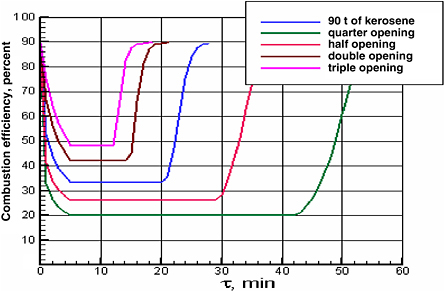
FIGURE 3 Variation of combustion efficiency during combustion of 90 metric tons of kerosene with different sizes of opening areas.
tity of heat accumulated by it. Ultimately, as shown in Figure 4, a point is reached (see curves for basic and double-opening scenarios) when an increase in the size of the opening does not cause a further increase in temperature. In fact, a further increase in the size of the opening decreases average temperature somewhat (the triple-opening scenario).
Dependences of structural temperature on fuel mass and opening area are shown in Figures 5 and 6. They are correlated with ambient temperature dependences.
Furniture Fire
Figure 7 shows average ambient temperature dynamics in an enclosure for a case in which the combustible load is common and consists of furniture. The mass of the combustible load was assumed to be in the range of 30 to 375 metric tons.
The largest value of the combustible load was chosen in accordance with the handbook of Construction Norms and Regulations 21-01-97,2 which establishes the maximum allowable quantity of the combustible load as 50 kilograms/m2 (in
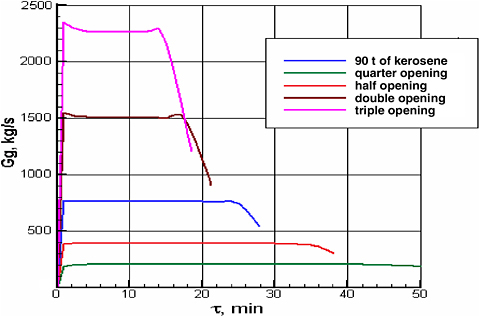
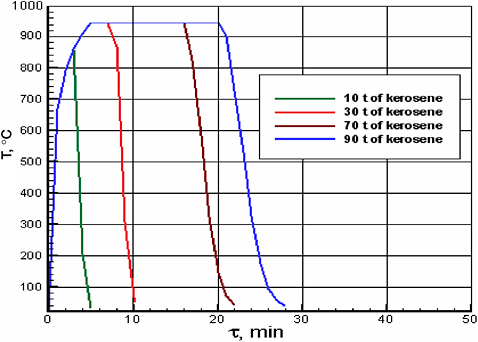
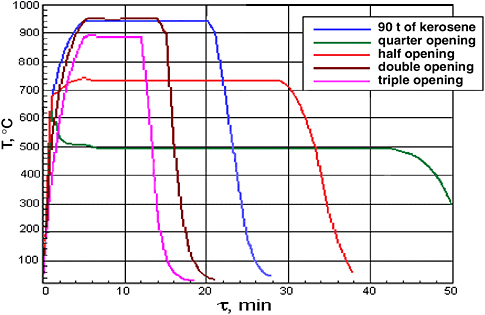
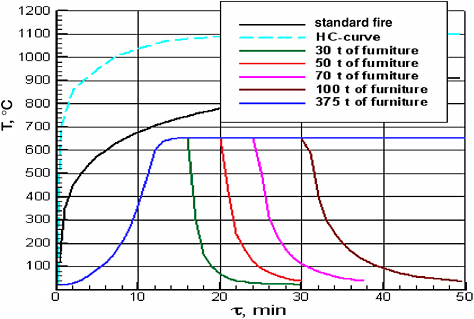
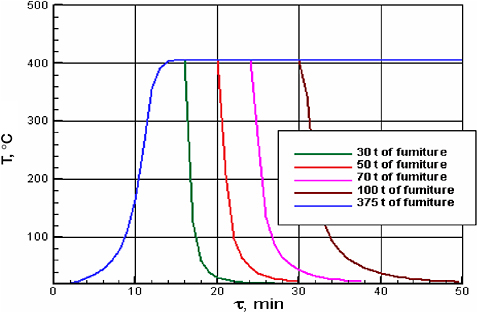
FIGURE 8 Dynamics of average temperature of the enclosure walls with various quantities of furniture.
wood). Thus, given that the floor area of that enclosure (damage zone) equals 2,500 m2 and after the impact the combustible load in the damage zone is accumulated from three floors of the building, the total mass of the combustible load in the damage zone equals 50 × 2,500 × 3 = 375,000 kg. Figure 7 shows that the temperature dynamic of the furniture fire has the same pattern as the temperature dynamic of the kerosene fire. A stable regime is achieved later than with the kerosene fire because the furniture fire spreads more slowly. The construction temperature curves for the furniture fire correlate well with the curves for the kerosene fire (Figures 7 and 8).
Combined Kerosene-Furniture Fire
Temperature-time dependences for different kerosene-furniture ratios are shown in Figure 9, which indicates that the maximum temperature is achieved during a pure kerosene fire and the minimum temperature during a furniture fire. When a combined kerosene-furniture load is burning, intermediate temperature values are achieved. It is worth noting that decreasing the kerosene ratio in the combustible load from 1 to 0.25 causes the temperature to fall by only 50 °C.
If the quantity of the furniture load meets standard requirements, the kerosene ratio is less than 25 percent even if the airplane fuel tanks are full. Thus, in most probable fire scenarios, temperature depends to a considerable extent on kerosene mass.
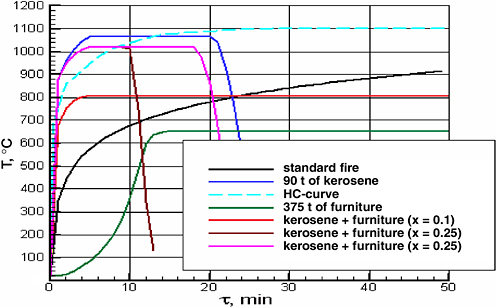
FIGURE 9 Dynamics of average temperature in the enclosure with various quantities of kerosene in the combustible load.
For a combined combustible load, as for a pure combustible load, an increase in the combustible load mass causes an increase in the stable combustion time without affecting the ambient temperature.
Temperatures of the structures are shown in Figure 10. Assuming that steel elements collapse when their temperature rises to 500 °C (± 50 °C; such an assumption is widely used in practice), with a kerosene ratio of more than 10 percent, the collapse should occur in the first minutes after the impact. In reality, the World Trade Center buildings resisted the fire for 56 minutes and 1 hour 43 minutes, respectively, before collapsing. This could occur if the mass of the kerosene burned in the damage zone was no more than 37.5 metric tons. That result correlates with U.S. researchers’ estimates that each plane had approximately 30 metric tons of fuel onboard prior to impact.3
Estimate of Fire Endurance of the Damaged Construction Elements
Experimental studies were conducted to estimate the effect of mechanical damage on fire resistance time for two types of structural elements: floor panels
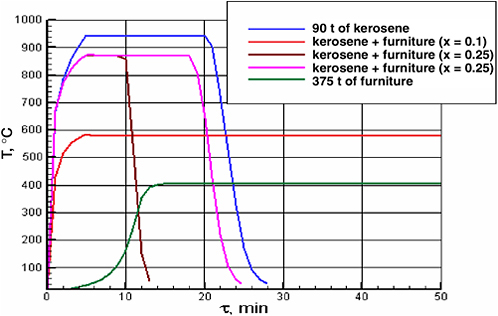
FIGURE 10 Dynamics of the temperature of the enclosure walls with various quantities of kerosene in the combustible load.
and bearing columns. Ten floor panels with dimensions 5.1 × 1.2 × 0.22 m made of M200 heavy concrete and three central compressed columns made of M300 heavy reinforced concrete with granite gravel were tested. Both types of elements were subjected to mechanical damage—cracks and chips exposing reinforcement bars. Tests were conducted according to standard procedure; the floor panel loading was Ppanel = 1,067 kg/m2 and the column loading was Pcolumn = 120 tons.
The test results are presented in Figure 11 and Table 1.
Mechanical damage to the floor panels greatly decreases their fire resistance time. Hollow-core panels with 2-millimeter reach-through transverse cracks have 21 percent less fire endurance time than undamaged panels. A transverse chip at the middle or on the edge of the panel exposing half the diameter of the reinforcement bar decreases fire endurance time by 23 percent. A 200-millimeter transverse chip at the middle of the panel exposing half the diameter of the reinforcement bars decreases fire endurance time by 50 percent.
The higher the exposure coefficient for the reinforcement bars, the lower the fire endurance time for the damaged column (for αe = 0.03, fire endurance time falls by 6 percent, and for αe = 0.14, fire endurance time falls by 21 percent). In addition, armature exposure causes column instability when a load is added. All of this may cause column-bearing failure in a fire.
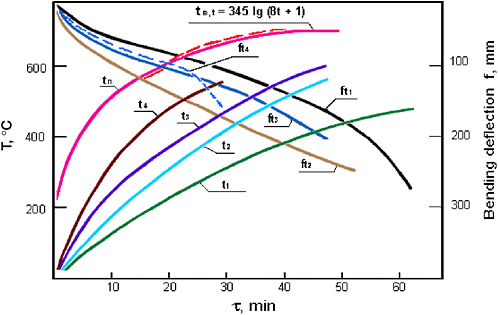
FIGURE 11 Temperature change and maximal bending deflection during fire resistance testing of hollow-core slabs.
Note: tB,t—standard temperature fire regime, °C; tn—actual temperature of the fire chamber, °C; t1,2,3,4—average values of the reinforcement heating, °C; ft1,2,3,4—bending deflection in the middle part.
TABLE 1 Theoretical and Experimental Results of Column Fire Resistance Estimates
|
Reinforcement bar exposure coefficient αe |
Fire resistance time τ, min. |
|
0 |
170* |
|
0.03 |
160 |
|
0 |
140* |
|
0.03 |
130 |
|
0.14 |
110 |
|
*theoretical value |
|
Fires in Piles of Wreckage
After a building collapse caused by a bomb explosion, fire often occurs in the wreckage. Victims trapped in the rubble may suffer from all of the hazard factors inherent in fire: high temperature, combustion products, and flame. The fire may also cause wreckage shifts as it progresses.
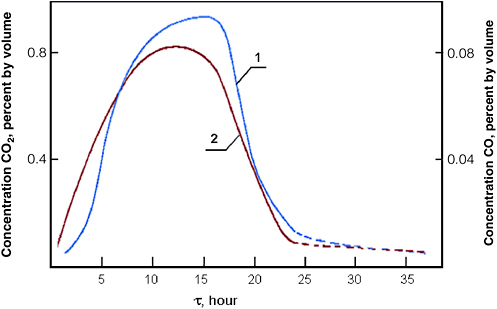
FIGURE 12 Average CO and CO2 concentrations at fires in the ruins of a one-story brick building of the second fire resistance class.
Note: 1—CO concentration; 2—CO2 concentration.
Figure 12 shows an average of experimental data illustrating the dynamics of fire hazard factors (CO and CO2 concentrations). Local concentrations at certain points in the piles of rubble may be much higher than the values shown. Therefore, rescue and firefighting operations should be performed quickly in order to save as many trapped victims as possible.
Subway Fires
Crowds of people, a limited number of evacuation exits, long evacuation paths, and fast-changing hazard dynamics during a fire make subway stations and trains especially dangerous places. It is well recognized that the most dangerous fire development scenario in a subway is a fire in a train that causes it to stop in a tunnel. Such fires occurred in 1991 in St. Petersburg and in 1994 in Moscow. It was only because there were no people onboard the trains that the fires did not lead to catastrophes.
Such a catastrophe occurred in a Baku subway tunnel on October 28, 1995. A train with 700 aboard caught fire between Ulduz and Narimanov stations; 300 people died and 270 were injured. This is the most terrible fire of that sort to date.
Until 2003 it was believed that fires in subway stations equipped with fire protection systems and evacuation exits cannot cause mass fatalities. However,
the arson fire that occurred on February 18, 2003, at Jungangno station of the Daegu city subway in South Korea caused 196 deaths and dozens of injuries. The fire started on a train at a station during rush hour (a second train was also stopped at the same station). Later investigation revealed that the high number of victims was caused by the inappropriate actions of train and station personnel.
In recent years, subway trains have become more frequent targets of terrorist attacks. The Tokyo subway was attacked by terrorists using poisonous gas (sarin). At approximately 8:00 a.m. on March 20, 1995, containers full of liquid emitting poisonous gas were placed simultaneously on trains on three lines— Hibiya, Marunouchi, and Chiyoda. Symptoms of the poisoning included fainting, vomiting, and eye pain; 12 people died (2 of them subway personnel) and approximately 5,600 were injured. Many rescue teams responded to the accident. The Tokyo fire department directed 340 rescue and chemical control units to 15 subway stations. The total number of people engaged in the operation was 1,364. Rescue and chemical control workers rendered first aid to victims at the scene and carried out tasks related to evacuating people, deactivating the gas-producing liquid, and analyzing the poisonous gas. A total of 131 rescue units saved 692 people, 688 of whom were hospitalized. Because the chemical composition of the poisonous gas was unknown when rescue efforts commenced, firefighters were included among the victims.
On February 6, 2004, a terrorist bomb exploded in the Moscow subway. A train passing through the tunnel between Avtozavodskaya and Paveletskaya stations was attacked 400 m from Avtozavodskaya station. Units from the Ministry of Internal Affairs, the Federal Security Service, and the Ministry of Emergency Situations were directed to the scene. Because the rail car was badly damaged, rescue efforts were complicated. The death toll was 39, and 122 were injured.
Subway Tunnel Fires
When fire occurs in a rail car undercarriage or hardware compartment, the concentration of combustion products in the car may reach the danger level 3–5 minutes after ignition. Temperatures outside the car at the level of 1.5 m from the tunnel floor may reach 200 °C in 6–8 minutes after ignition. After 5–15 minutes, the fire can reach the passenger compartment. In 5–10 minutes, the fire can spread through the whole car, and temperatures inside it can reach 900– 1,000 °C. The spread of the fire inside the car does not depend on tunnel air velocity and can have a rate of 1.5 m/minute. Flame spreads through the entire train at the same velocity.
After the fire has spread to one or two cars, combustion is regulated by air supply, and the total time that the train can burn can range from 3 to 7 hours. Smoke spreads through the ventilation air stream and even against it, when air velocity is less than 1.5 m/second. The fire can be approached from the fresh air side if air velocity is at least 0.75 m/second. In that case, the temperature at
positions where firefighters might be positioned (at a level of 1.5 m from the tunnel floor) does not exceed 70 °C. An illustration of temperature gradients at the fire location is shown in Figure 13.
Results of temperature modeling of a free-developing fire in a six-car train in a tunnel are shown in Figure 14. These calculations were based on the results of large-scale fire experiments conducted on a real train car in an experimental tunnel. Temperature dynamics in points between the cars is presented in the diagram.
Figure 14 shows that the temperature of the gas flow increases in the direction of fire propagation and reaches its maximum on the edge of the flame zone. The amplitude of the maximums rises asymptotically with the number of burning cars. The most intense temperature dynamic is realized at the end of the train.
The experimental studies of hazard factor dynamics during fires in the rail operator’s compartment and in undercarriage machinery were carried out on real cars in an experimental tunnel. A fan ventilation apparatus was installed at one end of the tunnel to maintain airflow velocity at 1.5 m/second. The area of the fire was limited by the envelope of the operator’s compartment. It was determined by analysis of temperature and carbon oxide concentration readings that passengers may be evacuated from the carriage if the combustible load does not exceed 45 kg/m2.
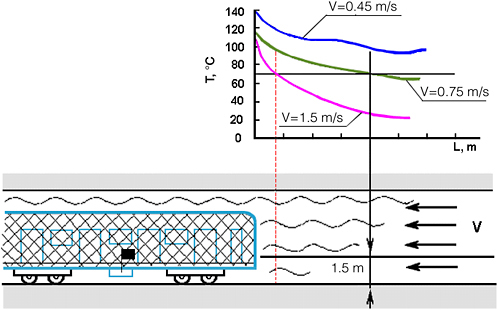
FIGURE 13 Temperature in the vicinity of the burning train car.
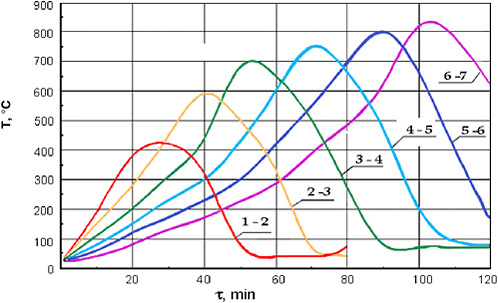
FIGURE 14 Temperature regime of a burning subway train.
Subway Station Fires
When a train is burning at a station, the fire propagates at a rate of 1–1.5 m/second. Smoke concentrations reach dangerous levels in 7–12 minutes, which allows enough time to evacuate people during rush hour. If the emergency ventilation system is not switched on immediately or is ineffective, smoke obscures the evacuation exits within 1–2 minutes. Combustible materials may also ignite on the platform at which the burning train is standing. The temperature at points removed from the burning train (on the opposite platform, at the escalator) increases slowly and reaches dangerous levels only 10–25 minutes after the start of the fire (see Figure 15).
EVACUATION FROM BUILDINGS
Analysis of the consequences of fires in buildings with large numbers of people inside indicates that simply meeting the requirements of architectural standards does not guarantee people’s safety if a fire occurs. The high-density traffic flows with large numbers of participants that fires create are almost as dangerous as the fire itself. Thus, organizing evacuation remains a problem of utmost importance for all types of multistory residential and commercial buildings.
Evacuation should be organized not only to remove people from a danger zone in a timely manner but also to avoid long-lasting accumulations of people on evacuation routes. The problem can be resolved by employing fire alarm and
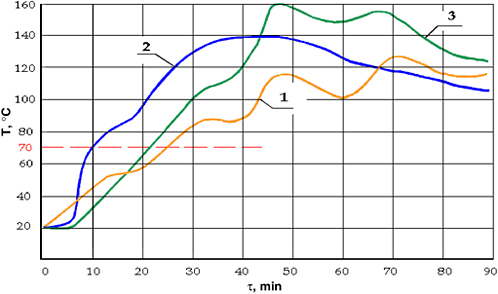
FIGURE 15 Temperature of the subway station during rolling stock fire.
Note: 1—at escalator entrance if fire originated in the middle of the train; 2—the same if fire originated in the car nearest to the escalator; 3—on the opposite platform if fire originated in the middle of the train.
evacuation control systems. Such systems should be designed using results of the analysis of possible fire scenarios.
There are a sufficient number of methods for estimating necessary evacuation parameters. In Galea and others’ article on evacuation of the World Trade Center, the authors attempted to model the process of evacuation from a 100-story building in different situations.4
The first model describes a situation in which there are 7,000 people in the building. The people are distributed evenly on all floors of the building, so there are 70 persons on each floor. Evacuation is carried out using three staircases: through L1, 3,000 people; through L2, 2,000 people; and through L3, 2,000 people.
Evacuation time in this first model equals 24.4 minutes. The results of the calculations indicate that the critical values for the accumulation of people in the evacuation routes are not achieved. Human accumulation curves have a discontinuous character, because every person entering and leaving a particular area
changes the accumulation value for a value divisible by the area of its projection on the floor. Therefore, when the quantity of people in the building is much less than the maximum, evacuation time depends on the length of the evacuation routes.
In the second model, it was assumed that two of the staircases are blocked at the 91st floor. All people from the 91st floor are evacuated by one staircase to the 90th floor. There are 70 people on each floor, so there are 700 people in total on floors 91 to 100. The staircase was assumed to be 1.4 m wide. After the calculations were made, the staircase width was increased up to 2 m and the calculations were repeated.
The estimated time to evacuate people from the 100th floor to the 90th floor through the 1.4 m-wide staircase equals 7.2 minutes. The estimated time for the same evacuation through the 2 m-wide staircase is 3.1 minutes.
It is shown that for the 1.4 m-wide staircase, critical values for the accumulation of people are achieved in the first minutes of the evacuation and are maintained throughout the process. For the 2 m-wide staircase, the estimated evacuation time is one-half that for the narrower staircase and the accumulation value throughout the process is less than critical. Thus estimated evacuation time depends to a great extent on the width of exit pathways.
In the third model, it was also assumed that two of the staircases are blocked at the 91st floor. All people from the 91st floor are evacuated by staircase to the 90th floor. The third model is the same as the second except that it is assumed there are 220 people on each floor, so there are 2,200 people in total on floors 91 to 100. The calculations were made for the two staircase widths, 1.4 m and 2 m.
The estimated time to evacuate people from the 100th floor to the 90th floor through the 1.4 m-wide staircase equals 23.1 minutes. The estimated time for the same evacuation through the 2 m-wide staircase equals 15.7 minutes.
It is shown that the width of the evacuation pathway is the most important factor affecting estimated evacuation time. For the third model for the 1.4 m-wide staircase, critical values for the accumulation of people in the evacuation routes are achieved in the first minute of the evacuation and are maintained until the end of the process. For the 2 m-wide staircase, the estimated evacuation time is approximately 75 percent of that for the narrower staircase, but the accumulation value is still more than critical.
Evacuation time may be reduced by using special rescue equipment. For example, elastic tube evacuation systems are the most promising and effective means for this purpose and are widely used throughout the world. An evacuation tube works by using frictional force to reduce the velocity of the descending body inside the tube. Descent velocity depends on tube construction and may be regulated by the evacuated person by moving his or her limbs and by rescue workers on the ground manipulating the tube. An evacuation tube consists of several coaxial cylindrical fabric layers. Each layer has its own function. The nonstretch layer works as the bearing element and resists longitudinal tensions.
The elastic layer embraces the descending person with the necessary force. The external layer resists fire.
Evacuation tube systems have several advantages:
-
They may be used to evacuate people from heights of up to 100 m.
-
They operate independent of weather conditions, climate, or time of the day.
-
They are capable of passing up to 30 people per minute.
-
They do not require time for activation or special training for their use.
-
They provide evacuation for every person regardless of physical and mental condition.
-
They help evacuees overcome the fear of heights.
An evacuation tube may be installed inside or outside the building, may be entered from one or several floors, may be carried by firefighters to the scene, or may be installed on turntable ladders.
FIREFIGHTING UNDER TERRORIST FIRE
Firefighting tactics in combat conditions have not yet been developed. To understand the problem, it is useful to study the terrorist attack on the Beslan elementary school as an example.
At 9:00 a.m. on September 1, 2004, the North Ossetia-Alania office of the Ministry of Emergency Situations received word of a terrorist attack on Beslan’s Elementary School Number 1. In addition to combat units, two AZ-40 fire trucks from the Beslan fire department were directed to the scene. The units were deployed in the area around the school by the mobile command center.
At 1:05 p.m., rescue workers from Centrospas (State Central Aero-Mobile Rescue Brigade) received orders to remove bodies from the school building. With the terrorists’ permission, rescue vehicles approached the school and rescue workers entered the building to begin work. A few minutes later, two explosions occurred in the school gymnasium, which caused a roof collapse and partial wall destruction followed by fire. The hostages began to panic. Some of them tried to escape, and the terrorists began shooting at them. The action phase of the operation had begun.
Combat continued until 3:00 p.m., when the necessary safety level for the firefighters to start work was achieved and the order to begin extinguishing the fire was received. Reconnaissance showed the area of the fire to be approximately 800 m2, and the nearest fire hydrants were within the terrorists’ firing range.
The fire department officer in charge decided to employ two hoses supplied by a fire truck water tank, using nearby buildings and structures as cover. At 3:30 p.m., two more fire trucks arrived from the State Fire Service group of the
Ministry of Emergency Situations. A mobile firefighting command center was established at the scene, and two firefighting units were formed to put RS-50 and RS-70 hoses through doorways, windows, and wall breaches. The hoses were supplied by water carried to the spot in turns by fire truck water tanks.
After two more fire vehicles from the special fire brigade of Vladikavkaz and a fire truck from the Ardon fire brigade arrived, a hose line was laid out to supply water from a distant hydrant located in a safe zone. It allowed firefighters to engage two more RS-70 hoses, which brought the fire under containment by 3:34 p.m.; three RS-70 and two RS-50 hoses were used.
At 6:30 p.m., firefighters were moved out of the area of possible crossfire by order of the commander of the Alpha special tactical unit. When shooting from the south part of the building ceased, firefighters resumed their efforts to extinguish the fire. At 9:09 p.m., the fire was out, but hoses continued to be used to provide cover for rescue operations.
At 12:05 a.m., information was received regarding a fire in the destroyed south part of the school building. The fire was caused by bomb explosions that destroyed the loft and floor slabs. Two RS-50 hoses supplied by fire truck water tanks were engaged in extinguishing flames in piles of wreckage on the ground floor and the partially destroyed first floor. Later the hoses were connected to the water-supplying hose line. The fire was contained at 12:32 a.m. and put out at 3:10 a.m. At 7:00 a.m., after reconnaissance was completed, rescue workers from the Ministry of Emergency Situations began combing through the piles of wreckage looking for bodies. Rescue operations ended at 7:00 p.m.
The fire was not interesting from the standpoint of firefighting tactics. Firefighting personnel and equipment concentrated on the scene were sufficient to put out the fire at any moment. However, firefighting operations were hindered by a lack of combat defensive equipment and armor for firefighters and fire vehicles. Two rescue workers were killed and two were wounded, and three firefighters received contusions.
One way to solve the problems of firefighting in combat zones is to develop firefighting robotics technology. Such technology may also be useful for firefighting in conditions of chemical or radioactive contamination. Development of such technologies is already under way in Russia.


