
4
Analytic Framework for Assessing Effects of New Source Review Rule Changes
INTRODUCTION
In this chapter, we review the various methods that could be used to assess the effects of the recent New Source Review (NSR) rule changes. They include econometric and statistical models, process-engineering models of particular facilities, and simulation models for the electric-power sector. Previous U.S. Environmental Protection Agency (EPA) studies using an industry-sector model are briefly summarized, and a preliminary statistical analysis of relative emission changes in two periods, 1987-1989 and 1996-1998, is provided. This chapter provides a basis for discussions, conclusions, and recommendations presented in the remainder of the report.
A number of analytic methods could, in principle, be used to assess the effects of the EPA’s recent changes in the NSR rules. They involve economic models that describe the response to changes by individual firms or facilities; industrial sectors, such as the oil and petroleum sector and the electricity-generating sector; or multiple sectors or the entire economy. Formal models are based on a set of underlying economic assumptions, such as profit maximization and market clearing of all surpluses and shortages. In addition, statistical evaluations of economic activity and emissions under different regulatory conditions can be used to estimate how different levels of NSR enforcement may have altered emissions in the past. Once changes in emissions are estimated, a full assessment of effects includes an evaluation of how the emission changes might affect air quality and human exposures and of the resulting health consequences of those exposures.
Different indicators can be used to assess magnitudes and trends in pol-
lution prevention and control, energy efficiency, emissions, air quality, and health effects (e.g., NRC 1999; Esty 2001; HEI Accountability Workgroup 2003; Hayward 2004). Table 4-1 lists possible indicators for each. Many of the indicators change or vary from one space or plant to another, and some
TABLE 4-1 Possible Indicators for Assessing Outcomes of Interest
|
Outcome |
Possible Indicators to Assess Outcome |
|
Pollution control |
|
|
|
|
|
|
Pollution prevention (source reduction) |
|
|
|
|
|
|
|
|
Energy efficiency |
|
|
Emissions |
|
|
Air quality |
|
|
Health effects |
|
|
degree of averaging or smoothing may need to be done before the data can be analyzed. In many cases, data from a single comprehensive source (or even distributed among many sources) are not available, and incomplete data would be used for drawing inferences. Furthermore, the indicators in Table 4-1 include factors that are quantitative and directly indicative of a targeted outcome—such as emissions from individual plants, industries, and states—but others that are more qualitative and difficult to measure, such as the rate of innovation in pollution-prevention and -control technologies.
Many of the outcomes and indicators in Table 4-1 are affected by factors beyond the realm of the NSR rules (or even pollution-control laws in general)—such as economic conditions, government investment in R&D, fuel supplies and prices, and meteorologic conditions—and these factors and data should be considered in analyses that attempt to assess the likely effects of NSR rule changes on the outcomes of interest. Any assessment involves (explicitly or implicitly) two estimates: an estimate of what would have happened if the rule changes had not occurred and an estimate of what will happen with the rule changes. Both are subject to substantial uncertainty, and it is necessary to consider a variety of possible scenarios for the economic and environmental assumptions that are being applied.
Table 4-2 illustrates some of the key uncertainties that limit the ability to identify and assess likely outcomes associated with the revised NSR rules. Key uncertainties exist in technological factors, economic conditions, and future regulatory and judicial outcomes regarding the NSR rules. There are also substantial uncertainties in the operating and emissions characteristics of existing facilities, air quality, and patterns of exposure and health effects that might result from the NSR changes.
Technological factors that could affect NSR include changes in the capabilities and costs of new production facilities as compared with the costs and effectiveness of replacement equipment and routine maintenance and repair, and the cost and effectiveness of new air-pollution-control technologies. Rapid evolution of new technologies would encourage more new facilities, and slower technological change will lead to more ongoing maintenance, repairs, and equipment replacements. More effective, less costly pollution-control technologies would encourage increased adoption by industry and result in lower overall emissions and could lead to greater differences between existing facilities that undergo NSR versus those that do not. In particular, facilities subject to NSR under the scenario of rapid innovation would have access to more-effective emission-control technologies than would be the case under a scenario of less-technological innovation.
Economic factors that could influence the effects of the NSR rule changes include uncertainty in (1) the general level of economic growth, (2) future demand for a particular industry’s products, and (3) future prices for fuels and other production inputs. Greater economic growth and demand would
TABLE 4-2 Key Uncertainties in Assessing Effects of NSR Rules Changes
|
Domain |
Uncertain Element |
Implications for Assessing NSR Effects |
|
Technological advancement |
Relative effectiveness of new facilities vs replacement and renovation of equipment |
Rapid evolution of technology for an industry will lead to more new facilities with cleaner technologies, while slower technological change would encourage prolonged life for existing facilities. |
|
|
Cost and effectiveness of new pollution-prevention and -control technologies |
More effective, less costly pollution-prevention and -control technologies would encourage increased adoption by industry but would also lead to greater differences in emissions between facilities that are subject to NSR and those that are not. However, some emission reductions resulting from investments in plant efficiency that might be discouraged by stricter NSR enforcement could also be achieved. |
|
Economic |
General level of economic growth as well as demand for products of particular industries |
Greater economic growth and demand could encourage plant upgrades or replacement with new facilities that use cleaner technologies. The former would increase opportunities for NSR. |
|
|
Prices of different fuels and other inputs to production for an industry |
Higher prices would discourage new investments, except for those designed to allow for greater fuel efficiency or fuel or input switching. This could lead to fewer candidate projects for NSR in some industries, while in other industries, efforts may be made to extend the life of facilities using lower-priced fuels (for example, coal). |
|
Regulatory and judicial decisions |
Uncertainty in future air-pollution-control programs such as Clean Air Interstate Rule and Clean Air Mercury Rule |
Implementation of tight nationwide or regional caps (with trading) could lessen the importance of NSR as a tool for reducing national or regional emissions but would not affect NSR’s role in safeguarding local air quality. |
|
|
Uncertainty in the effect of differential environmental regulation for new sources on the rate of technological change and associated pollution reductions |
Tighter environmental regulations for new sources result in new facilities with lower emissions but may encourage companies to prolong the life of old facilities (with higher emissions) and delay investments in new plants. |
|
Domain |
Uncertain Element |
Implications for Assessing NSR Effects |
|
|
Uncertainty in trading program outcomes and enforcement decisions for particular facilities |
Although national or regional caps may limit effects on total emissions, local hot spots of increased emissions could develop and more-lenient NSR rules could allow them to persist. This could have implications for local air quality, exposure, and health.a |
|
|
Other industry constraints such as Public Utility Commission (PUC) regulations for electric utilities |
These could constrain decisions on maintenance and repair, limiting the firm to a smaller set of investment alternatives. |
|
Existing facility responses to NSR implementation |
Uncertainty in specific aspects of the NSR implementation procedures under the pre-2002 rules, especially the extent to which states allowed firms to use periods prior to the previous 2-year period for computing prechange emissions. The definition of “routine maintenance” that will be applied by courts reviewing NSR cases |
Greater leniency under the pre-2002 rules implies less difference between the pre-2002 and the current rules. The greater the scope of the term “routine maintenance” that is applied, the fewer projects will come under the purview of NSR. This will also affect the number of cases where the surrender of allowances is part of the settlement. |
|
|
Uncertainty as to whether firms will be effectively limited to projected annual emissions |
If projected emissions underestimate actual emissions, the new rules could allow for a facility’s emissions to increase. |
|
|
Uncertainty in number of firms that will take advantage of plantwide applicability limits (PALs) and how firms with PALs will behave |
Greater adoption of PALs could either lead to adopting firms maintaining their emissions within currents caps (and possibly avoiding NSR, which would lead to further reductions in emissions) or to the adoption of additional pollution controls to stay within their caps, thereby limiting the potential for emission increases by these companies. |
encourage the building of new plants with cleaner technologies and could again exacerbate the difference in emissions between existing plants that avoid NSR and those that undergo the review. Higher prices for production inputs would discourage new investments, increasing the number of facilities that maintain, repair, or replace, thereby increasing the pool of facilities for which maintenance and repair projects might or might not trigger NSR, depending on how the NSR rules are defined and interpreted.
A number of regulatory and judicial uncertainties also make it difficult to assess the likely effects of the proposed NSR rule changes. First, there
is fundamental disagreement about whether stricter new-source pollution controls result in a net reduction in emissions as new facilities are added to the production base, or instead result in higher emissions (at least over the short term), because the construction of new, cleaner facilities is discouraged by the tight emission standards. In addition, uncertainty in future air-pollution-control programs such as the Clean Air Interstate Rule (CAIR) and the Clean Air Mercury Rule (CAMR) limits the ability to predict whether national or regional caps will control total emissions independent of NSR or whether stricter NSR enforcement could reduce emissions below planned caps. Uncertainty in the specific outcomes of trading programs limits the ability to identify local increases in emissions that might be avoided with strict NSR rules and enforcement. Effects on ambient concentrations, exposures, and health effects associated with any such hot spots are likewise uncertain because of uncertainties in the geographical distribution of emissions as well as limitations in the basic science needed to predict these outcomes. Similarly, industry constraints due to other regulations or rules could limit the applicability of NSR rules.
There is significant uncertainty in the behavioral response of firms to a number of the 2002 changes in the NSR rules, including the demand growth exclusion, the procedure for computing prechange emissions, the use of projected actual emissions to assess a project’s impact, and the decision to allow plants to apply for plantwide applicability limits (PALs). EPA is also considering revisions in its rules that might further affect NSR applicability. Finally, the courts have yet to resolve such key issues as the criteria for deciding whether a given project is routine maintenance, repair, and replacement and hence exempt from NSR, or how to calculate whether an emissions increase will result from a physical change.
Additional uncertainties are present with respect to ambient-air-pollution concentrations and how these are affected by local versus regional emissions, and with respect to the human exposures and health effects that result. Further data collection and advancements in modeling tools should allow better estimates of changes in ambient concentrations, exposures, and health effects that can be expected to occur from a particular future emission scenario.
ECONOMETRIC METHODS
Econometric methods involve the formulation and fitting of models for firm behavior, such as emissions, energy use, and production. Consider the general formulation for an econometric model. Given observations of policy X and an outcome Y, we can use econometrics to measure the effect of X on Y by estimating the function Y = f(X,Z), where Z represents other measured factors that influence Y. A linear representation of function f is

(4-1)
where i refers to each observation in the dataset; a, b, and c are parameters of the model; and e is an error term. We can think of e as the composite of all other factors that influence Y and are not measured in X or Z and the inherent limit on precisely measuring Yi. Parameter b represents the effect of the policy on the outcome.
Key assumptions for measuring b validly are that we can observe Y and X and that policy X is not correlated with the error term e. The latter assumption matters because the estimation procedure will tend to attribute as much of the variation in Y as possible to the influence of the measured variables (X and Z). If X is correlated with e, the estimate of b will be biased. For example, if policy X happened to be implemented primarily in locations where e was high, the estimation would give credit for those high e values to policy X, and the estimated value of b would be too high. In an experimental setting, we could vary X independently of Z (and e), avoiding this problem and yielding an unbiased measure of b. Instead, the econometrician must rely on a good understanding of the process generating Y and any likely sources of bias and must include a sufficient set of control variables Z to capture other important factors affecting Y and to render negligible the bias caused by the remaining unmeasured factors. The inclusion of control variables, Z, can also be augmented by use of propensity scores to reweight the analysis and remove bias (Rosenbaum and Rubin 1983; Imbens 2000).
Two types of econometric models will be considered here. A structural or behavioral model focuses on the underlying decision being made by the firm—in this case, whether to proceed with a given investment project that may be subject to NSR requirements. This type of model includes measures of the characteristics of the applicable NSR rules, allowing estimation of the effect of variations in these rules on the specific investment decision. A second approach—a reduced-form model—focuses on broader outcomes, such as total investment spending or emissions from the firm, rather than individual investment projects.
Structural or Behavioral Models
Suppose we wished to estimate directly the effects of NSR stringency on a firm’s individual investment decisions in what is called a structural or behavioral model. Conceptually, we would identify each potential investment project that a firm could make, a measure of the NSR stringency (X) the firm faced, and other factors (Z) affecting the investment decision. The outcome (Y) would indicate the firm’s decision on each specific investment project: Did the firm get an NSR permit, avoid NSR by modifying the project in some way, or choose not to make any investment at all? The relation
between NSR stringency and the firm’s investment decisions (parameter b) could differ among categories of investment projects. If X measures greater NSR stringency, we would expect to find a negative value of b (more stringent NSR reducing the likelihood of pursuing an investment project), although some smaller types of investment projects might become more likely (b positive) if larger projects were being discouraged by NSR. The 2002 and 2003 NSR changes, by making it easier for investments to avoid NSR requirements, should reduce X and therefore increase some types of investment. A detailed-enough model of the investment decision incorporating NSR might be able to predict the difference in investment decisions after the NSR rules changed. If the measures of policy stringency are sufficiently detailed (perhaps using several X variables, measuring such items as the delay required to get an NSR permit, the level of control equipment required, and the cost of consultant services needed to complete the permit application), the model could predict the effect of a wide variety of changes in NSR rules, not just the changes that actually occurred.
An appropriate structural model should include consideration of all possible factors outside the realm of NSR rules that could influence maintenance and retrofitting behavior by firms (the Z terms in Equation 4-1), including other regulations, general economic conditions, the adoption by firms of nonregulated emission-control measures (for example, for greenhouse gases or mercury), and uncertainty in future regulation due to legal challenges and pending rule making. Differences across industries may also be important. Firms in industries with rapidly expanding demand and high profit potential may be especially willing to invest in both plant expansion and pollution-control measures to ensure a quick “speed-to-market.”
Econometrically estimating a structural model of this sort faces several obstacles. The greatest difficulty is that many of the necessary data are unavailable and could not plausibly be made available; we would need information on potential investment projects that were never carried out and information on projects that were modified to avoid NSR. It is hard to imagine getting such data in complete form, especially because changes in NSR might change the projects being considered by a firm, even for planning purposes. Anecdotal information could be used to identify the types of investment projects that are being discouraged by NSR requirements, but firms could have an incentive to exaggerate these cases so that they could argue for less stringent NSR rules. In any event, it would be impossible to quantify the overall effect of the NSR changes with an anecdotal approach. Aside from the anecdotal information, one cannot observe anything about discouraged projects (not even their existence), so one cannot tell whether they would have caused a facility’s emissions to increase or decrease.
Even if we limit ourselves to investment projects that actually occurred, only a fraction will have required an NSR permit. Some modification proj-
ects may require some form of minor state permit, and perhaps there would be discussions between a firm and state regulators about what could be done to avoid the NSR permitting process. Still, it seems unlikely that much of such permit discussions would be captured in state records, and it would be difficult to identify the extent to which a firm might have modified a project on the basis of the firm’s understanding of NSR requirements, even before talking to the regulators.
Collecting those state data, either on past minor permits from state files or on future minor permits, would involve considerable effort. Even the data on projects that get NSR permits are not immediately available; it took some effort for EPA to collect basic information on a set of NSR permits using files kept at EPA regional offices. Running an analysis on only facilities with NSR permits and then defining required emission reductions as the “effect” of NSR would be to ignore the investment disincentives mentioned above and could present a picture that is misleading with respect to the sign of the effect, let alone its magnitude.
Reduced-Form Models
If we cannot estimate a structural or behavioral model of individual investment decisions, what can we do? The answer may lie with an alternative approach known as a reduced-form analysis. In a reduced-form model, we identify one set of facilities that was covered by the revised NSR requirements (the “experimental” group) and compare the outcome with the outcomes at another set that was still covered by the prerevision requirements (the “control” group). We can then test whether the two sets of facilities differ in such outcomes as emissions, investment rates, and other observable characteristics without explicitly modeling decisions on individual investment projects. Given large enough sets of facilities and a large enough effect of the NSR rule changes on the outcome, we should see some differences in outcomes between the sets of facilities.1
The reduced-form approach has the advantage of not requiring micro-level investment data and focuses our attention on differences in aggregate outcome measures, which may be easier to observe than outcomes of individual projects. However, it requires us to be able to identify two sets of observations: one of facilities operating under the prerevision NSR requirements and the other of facilities operating under the new NSR rules. The analysis could take advantage of three sources of variation, leading to three approaches: time series, cross section, and difference in differences.
A time-series approach would compare the same facilities before and after the NSR rule changes: if the rules changed in 2003, compare data on 2000-2002 with data on 2004-2005 and ascribe any differences to the NSR rule changes. Such estimates could be biased if other unmeasured factors (the error term e in Equation 4-1) changed over the same period and either encouraged or discouraged investment. For example, the recession in 2000 may have discouraged investment for a few years, so increases in investment after 2003 might be mistakenly ascribed to the NSR rule changes rather than to improvements in the macroeconomic environment. Controlling for such confounding factors, whether arising from economic forces or other regulatory initiatives, is an important part of any econometric analysis.
A cross-section approach would compare the outcome measures (facility-level investment activity and emission levels) across facilities at the same time. The analysis requires some facilities to be located in states already affected by the NSR rule changes and some facilities to be in states not yet affected. Possible confounding factors for cross-section analysis include other (non-NSR) differences in regulatory stringency across states being correlated with states that had implemented the NSR rule changes.
A difference-in-differences approach would combine the time-series and cross-sectional approaches by calculating changes in outcome variables over time (like time series) and then comparing those changes across states (like cross section). The statistical evaluations would measure whether the timing of outcome changes coincided with the timing of the rules change. Because the analysis includes different sets of facilities in the same year, some affected by the policy change and some not affected, nationwide changes in economic performance or regulatory initiatives would be less likely to bias the results. Because the difference-in-differences analysis looks at changes in outcome variables over time, long-run differences in (non-NSR) regulatory stringency across states are less likely to bias the results.
The main disadvantage of a reduced-form model relative to a structural model is that we do not gain as much insight into the determinants of the decision-making process. In contrast, a properly specified structural model could allow us to extrapolate from the effect of these NSR rule changes on investment decisions to provide estimates of the effect on investment decisions if the NSR rule changes had been different. However, structural models for particular industries may yield very different results. Given that the goal of this project is to offer suggestions about how to measure the effects of the NSR rule changes as they actually occurred, the limited ability to make generalizations on the basis of the reduced-form model is less critical here.
Existing Econometric Results
The essence of the argument that the NSR rule changes will improve environmental performance is based on an understanding of how firms respond to differences in regulation between existing and renovated facilities. In particular, if investment in new production equipment would trigger NSR rules requiring the installation of expensive pollution-control equipment, or if going through NSR review would add considerable delays and uncertainty to the investment process, firms might choose not to pursue these investment projects. In many cases, new production equipment would be less polluting than the older equipment it replaces (as well as more efficient), so some reduction in pollution could have resulted from investing in new equipment, even if no additional pollution-control equipment were installed. Changes in NSR rules that made it clear that certain investment projects would not trigger NSR would make such projects more attractive: reducing the cost of control equipment and reducing delays and uncertainties due to NSR review. If NSR sufficiently discourages modifications to existing plants, the environmental gains from imposing stricter controls on investments that do proceed could be outweighed by the environmental losses from the forgone modifications. Research has examined how firms respond to spatial and vintage-related differences in regulations when making decisions on opening and closing facilities and on investment in existing facilities. These decisions are also affected by many other factors that vary from one location to another, including labor conditions and local taxes, and these confounding factors (Z terms in Equation 4-1) must be considered to obtain an unbiased estimate of the impact of the regulation. None of the research applies directly to the new NSR rule changes, but it can provide insight into how the rule changes might matter.
Spatial differences in regulation arise primarily from stricter NSR and other regulatory requirements in nonattainment areas, although states may also differ in their overall regulatory stringency. Levinson (1996) used a conditional logit model and Census Bureau facility-level data to study whether births of new manufacturing plants in the 1990s responded to differences in state environmental regulations and found only limited effects, controlling for other factors affecting plant location decisions such as unionization, wage levels, and tax rates. Becker and Henderson (2000) studied the effects of ozone attainment status on investment decisions at facilities in four manufacturing sectors that emit high levels of volatile organic compounds (VOCs), using Census Bureau facility-level data for 1963-1992. They found that new plants were more likely to locate in attainment areas, and there were more new plants in the small-scale nonaffiliate sector (less likely to face strict regulation) than in the corporate sector. Their analysis focused
on changes over time in which counties attracted more plants, implicitly controlling for other differences across counties that might affect the location decision.
Other econometric studies have examined the effect on economic decisions of differential regulation of sources due to vintage (for example, existing versus new). Stavins (2005) reviews several such studies, which generally find that those regulations discourage new investment. Gruenspecht (1982) looked at the effects of corporate average fuel economy (CAFE) standards2 on turnover of the automobile fleet and found that applying tighter standards to new cars reduces the rate of turnover and thus increases the average age of cars on the road; the net effect on fleetwide emissions was not estimated. Maloney and Brady (1988) used data on electricity-generation-facilities investment in 1956-1982 and found that air-quality regulations reduced the rate of new plant investment and resulted in a 25% older capital stock; they concluded that the overall effect of regulation was to increase sulfur dioxide (SO2) emissions. Nelson et al. (1993) related the average age of the capital stock of a group of 45 electricity-generating facilities in 1969-1983 to measures of demand and input-price growth and to regulatory intensity; they found that differential regulations resulted in a capital stock that was 23% older, but in their dataset, older plants were not significantly dirtier than newer plants, so there was no increase in emissions. These articles do not base their analyses on time-series variation in investment and regulation, which might have confounded the 1970s growth in regulation with the slowdown in electricity demand. Instead, they use differences in regulatory stringency across states, measured by spending by state air-quality-management agencies and other measures, and find that facilities in stricter states do not replace their equipment as quickly, leading to an older capital stock.
The Becker and Henderson (2000) study mentioned earlier also examined the time pattern of investments at a facility. They found that new facilities in nonattainment areas started out larger but received less additional investment than new facilities in attainment areas, whereas existing facilities in attainment areas were less likely to survive than those in nonattainment areas. They concluded that stricter NSR rules discouraged modifications and encouraged older plants to remain in operation, potentially increasing emissions (they did not measure emissions directly). List et al. (2004) used data for 1980-1990 from the New York State Department of Economic Development to analyze the relationship between plant alteration and closure decisions and county attainment status as a proxy for stringency of NSR
requirements;3 they found that NSR appears to retard alteration of existing plants but found little evidence that NSR affects the closure of existing plants (their study did not include emission levels).
Taken as a whole, those results indicate that the NSR rules before the 2002-2003 rule changes tended to discourage investment in new facilities and in renovations of existing facilities. That suggests that the NSR rule changes, which exempted some renovations, would tend to encourage renovations of existing facilities. Full repowering—that is, replacing an old facility with a new one, might also be encouraged—because this would allow for significantly higher capacity at the same level of emissions. Nonetheless, it is possible that the NSR rule changes, by making it easier for old sources to renovate, could discourage the construction of new facilities even more, potentially offsetting any beneficial effects of encouraging investment at old facilities.
PROCESS-ENGINEERING MODELS
Many of the modeling approaches described in this chapter deal with multiple facilities and their interactions or use simplified characterizations of production technologies that merge multiple processes into a single-stage production function. However, such models often lack details about technological characteristics. For example, many life-cycle inventory and market-analysis models use linear coefficients for the ratio of energy consumption to delivered units of a particular product or for the ratio of emissions to a particular product. In reality, energy consumption and emissions at specific facilities can be a complex function of site conditions, feedstocks, process configurations, designs of process areas, operating practices, and maintenance. Furthermore, when retrofit options are being evaluated, the availability of space at a site can severely constrain the location of additions to a plant and thereby affect cost. Thus, there can be a need for a model or evaluation at the level of an individual plant that takes details of the plant’s major components into account. Such models can allow “what if” analysis of effects of changes in design, feedstock composition, and operations on efficiency, emissions, and cost at the level of an individual plant.
The numerous plant-level modeling approaches range from empirical to theoretical. An empirical approach typically involves fitting a regression equation or system of equations to available data on the inputs and outputs of individual process areas and linking the process-area models together to describe an entire plant. A theoretical approach involves developing mass and energy balances for each process area, including detailed chemistry
(such as chemical kinetics) and physics (such as fluid flow) for each unit operation. For example, the furnace of a power plant could be simulated by using computational fluid dynamics coupled with a chemical mechanism that describes the combustion of fuel and formation of pollutants during combustion. Such a simulation would make it possible to describe the temperature field in three dimensions in the combustor and dynamically. Such models can be both data-intensive and computationally intensive. If the same approach is applied to all process areas of a complex plant, the resulting model can be large and difficult to use. Thus, the choice of an appropriate modeling approach depends on the objectives of the model.
Commercially available software tools, such as the ASPEN Plus (AspenTech 2005) steady-state chemical-process simulator, can be used to develop and apply simulation models of a wide variety of process plants. The user specifies key parameters of each unit operation and of the inlet streams. Thermodynamic databases describe the key physical and chemical properties of each chemical “component,” such as compounds. ASPEN or ASPEN Plus models have been developed for a variety of power-generation systems, for example, integrated gasification combined-cycle systems (Frey and Rubin 1992). Cost models of process technologies can be developed by using built-in features of ASPEN or developed separately and coupled with the performance model as subroutines. ASPEN Plus simulation models require software-specific expertise to develop and run. It has been shown that simplified reduced-form models can be developed on the basis of ASPEN models, which in turn facilitate more rapid analyses useful for policy purposes (Frey and Bharvirkar 1998).
To be of practical use, process-engineering models of plants should be executable in a reasonably short period by users who are not experts in the model. An example is the Integrated Environmental Control Model (IECM), which runs in a Microsoft Windows environment and has a graphic user interface (Rubin et al. 1997). In the past, EPA developed and maintained a somewhat similar model, known as the Integrated Air Pollution Control System (IAPCS) (Radian 1999). However, IECM and IAPCS typically had a somewhat different technology focus, and IECM includes a distinguishing probabilistic simulation capability for quantifying uncertainty in inputs and outputs.
A key goal of plant-level models intended for policy applications is to capture salient details and key interactions among process areas without becoming unwieldy. One approach, used in the IECM and similar models, is to start with basic mass and energy balances for major “process areas” of the plant to describe, with adequate accuracy, the major mass and energy flows in the plant. For example, the major process areas of a new coal-fired electric-power plant typically include the boiler, economizer, air preheater, particulate matter (PM) control device (typically a cold-side electrostatic
precipitator or fabric filter), nitrogen oxide (NOx) control devices (typically a low-NOx burner or other combustion-based approaches and perhaps a postcombustion selective catalytic reduction system, CRS), an SO2 control strategy (for example, use of a low-sulfur fuel or postcombustion flue-gas desulfurization, FGD), a steam cycle (including heat exchangers, steam drums, steam turbines, and condensers), and other special considerations (such as mercury control with carbon injection). For each major process area of the plant, a separate mass and energy balance model is developed. The process areas are interconnected by the flow of mass and energy between them.
Process models, like econometric and other models, are subject to uncertainty. Uncertainty in a process model is associated with a lack of knowledge regarding the performance, emissions, and cost of a facility, either because necessary data are not available or because predictions are being made for future outcomes. Uncertainty is also influenced by the state of development of the technology and the level of detail of the estimation method. Furthermore, individual process technologies are subject not only to uncertainty but to variability in feedstock composition, unit costs of consumables, and the performance of unit operations. In addition, even when comparing facilities of a similar type, there is variability in design, operation, and maintenance from one facility to another. Thus, there are many sources of inter- and intraplant variation. Methods have been developed to make statistical estimates of variability and uncertainty as part of process technology models of electricity-generating facilities, and such models also include the option to simulate alternative system designs. It is possible to develop such models when the design basis of such options is relatively well known and reported. However, for nonelectricity-generator sectors, such as in manufacturing, there may be less nonproprietary information available upon which to base a process model, and there may be greater interplant variability such that it is difficult to develop a single model that captures the diversity of configurations and modifications that may occur in response to changing economic or regulatory conditions. Clearly, there are examples of nonproprietary process models that have been developed for various non-electricity-generating sectors, typically to evaluate performance, emissions, and cost of specific design options, but an integrated framework for evaluation of variation in plant design and operation, combined with quantitative assessment of uncertainty, is still lacking.
Plant-level models can be incorporated into a larger simulation framework. That has been done in the past, such as for the advanced utility simulation model (e.g., Cole and Chapman 1983), to support systemwide planning applications that take into account some of the details of design and operation of individual plants, as well as systemwide considerations
(e.g., Badger and Ojalvo 1988). The “bottom up” sectorwide models discussed in the next section are of this type.
ASSESSMENT OF SECTORWIDE RESPONSE
General Framework for Sectoral Assessment
The response of a full industrial sector to regulation can be estimated with generalizations of the tools used for individual firms, potentially including anecdotal reports and representative case studies or surveys. In addition, economic models are available to estimate the behavior of multiple plants or facilities that may or may not interact in some way in response to common constraints and incentives. The models are most often applied to electric-power generation, including short-term dispatch and long-term capital investment and technology adoption in response to future demand, prices, and regulation.
The purpose of sectoral assessments is to project the possible response of an entire sector of U.S. industry to scenarios involving government policies, technological change, and economic conditions. The major difference between sectoral assessments and individual firm analyses is that sectoral assessments aggregate the actions of all firms in an industry while imposing consistency conditions that must be met by the market as a whole. Those conditions usually require that markets clear—that is, that prices adjust so that supply equals demand for the sector’s inputs and outputs.4
In the case of outputs, an example of such a market-clearing condition is that the quantity of electric power produced by a region’s power plants equals the quantity consumed by the region’s consumers, adjusted for net imports. By imposing such a condition, a sectoral analysis ensures that, for example, if one facility or set of facilities greatly increases output (and emissions) in response to a change in NSR rules, some other facility or set of facilities will need to decrease production (and possibly emissions). A sectoral analysis can also account for the effect of price changes on demand so that, for instance, demand increases stimulated by lower prices could also consume and assimilate some of the increased production.
In the case of inputs, market clearing ensures that the aggregate demand by the sector for fuel or emission allowances, for example, is consistent with the amount available. Continuing with the power-industry example, a national cap on SO2 emissions under Title IV of the 1990 Clean Air Act amendments implies that, if the cap is binding, an increase in emissions from
one group of facilities must be matched by a decrease somewhere else or, because of allowance-banking provisions, at some other time in the future. Conversely, if emission allowances have a positive price and if a regulatory action forces a power plant to reduce its emissions and the plant is allowed to sell the resulting excess allowances rather than surrender them, the result will be an increase in emissions at another location or at another time. That outcome would not occur if, as part of the settlement agreement imposed by the regulatory action, the allowances are eliminated.5 Because the supplies of some sectoral inputs, especially fuels, respond to price, increases in inputs demanded by one set of facilities can be met by decreases in use by other facilities and by an increase in supply. Thus, for instance, if an emission policy motivates a shift in fuel from coal to natural gas, prices for coal will fall, shrinking its supply, and prices for natural gas will increase, stimulating an increase in its supply. The resulting redistribution of fuel use (and emissions) among the nation’s power plants will reflect a balancing of supply of and demand for the fuels and allowances. The purpose of sectoral analyses is to project those shifts in a way that is consistent with the operation of the sector’s input and output markets.
However, sectoral assessments do not attempt to trace the effects of a policy change throughout all sectors of the economy. For instance, changes in energy use and emissions by railroads due to a change in the power industry’s demand for low-sulfur western coal might be significant but would not be considered in a power-sector assessment.
Previous Applications of Sectoral Models for the Electric-Power Industry to Assess New Source Review Rule Changes
In EPA (2003b), the impact of the October 2003 equipment replacement rule (ERP) upon power generation emissions was projected in two separate sets of analyses. One used EPA’s Integrated Planning Model (IPM), while the other utilized the National Energy Modeling System (NEMS) of the U.S. Energy Information Agency. Both analyses are summarized below.
|
5 |
In a statement regarding the surrendering of emission allowances as part of settlement agreements, a recent report of EPA’s inspector general’s office notes that (EPA 2004c) |
|
When controls are installed, excess allowances of SO2 emissions are created, and it is vital that these allowances not be used. Consequently, all seven settlement agreements included an Emissions Trading Clause requiring the company not to use or sell any emission reductions. Also, all the settlement agreements required the surrender of allowances, except for Tampa Electricity-Power, which prohibited the selling and trading of SO2 allowances. If a facility is able to use allowances elsewhere at a plant or sell them to another facility, there will be no environmental benefit achieved. |
|
|
Further discussion of the role of allowance surrenders in NSR settlements is found in Chapter 2. |
IPM Analysis
The IPM-based regulatory impact analysis of the NSR rule change consisted of a comparison of two sets of IPM solutions, defined as follows:
-
A base case in which the previous NSR rules (in particular, those concerning routine maintenance exclusions) remain in force. EPA assumed that if a power-generation facility faced a decision about a repair or maintenance project, the facility would only opt to go forward with the project if it would clearly not trigger NSR. Thus, it was assumed that the expense of the project, including compliance with NSR, would never be justified by the net increase in energy and emission allowance revenues that would accrue because of the facility’s more efficient operation. EPA assumed that the result would be a deterioration over time in fuel-use efficiency and capacity of existing coal-fired plants, and that the recent trend towards improvement in plant availability would slacken. IPM automatically retires those facilities whose efficiencies and going-forward costs render them uneconomical under projected power prices.
-
A set of five increased maintenance cases, based upon an assumption that the proposed changes in the NSR rules would result in existing coal-fired plants undertaking more maintenance. These plants’ fuel-use efficiencies, capacities, and availabilities were assumed to have a higher trend than in the base case. The assumed increases in efficiency and capacity over the base cases ranged up to 3.2%, and the range of availability improvements considered was 0-3.4%. Ranges were considered because the precise amount of incremental maintenance and its exact effect cannot be confidently forecast.
Although the clean unit and PAL features of the NSR rule changes may also be taken advantage of by power generators, their impact was not considered in these solutions.6 It is important to note that it was not possible to tailor the efficiency, capacity, and availability assumptions to the particular circumstances of individual facilities, because it is unknown what the potential projects are at each plant, nor their effects. Rather, the intent of this analysis was to show what the implications would be of different trends for plant efficiency, capacity, and availability, under the assumption that the major impact of NSR rule changes would be to shift those trends upwards.
The major conclusions of the comparison of these IPM cases were as follows:
-
Total SO2 emissions over the period of 2005-2020 would not change, remaining, on average, at the national cap, plus allowances that were banked from previous years. Because of banking, there were some slight shifts of emissions from year to year. In none of the cases is so much coal capacity retired that the cap on SO2 emissions is no longer binding.
-
NOx emissions change more than SO2 because they are capped only in some regions for some portion of the year. The five increased maintenance cases were reported to have varying effects for the years 2005, 2010, 2015, and 2020, ranging from a decrease of less than 1% to a 2% increase. The varying results represent shifts in the relative importance of efficiency improvements (which lower NOx emissions by decreasing fuel use per megawatt-hour [MWh]) relative to capacity and availability improvements (which can increase NOx emissions by allowing the output of relatively high-emission older units to expand, at least in times and places that such emissions are not capped).
-
The improved performance due to higher maintenance would save $100 million to $2,500 million in 2005 and between $2,000 million and $3,900 million in 2020. However, these savings include only decreases in fuel costs and investments in major retrofits and new plants. They do not include the higher expenditures on maintenance that would occur under the new NSR rules, so the net savings would be less than these values.
Given the presence of binding emission caps for SO2 (nationally) and NOx (only in the 22 eastern states for the ozone season), and the assumption that the main effect of NSR rule changes would be to increase the amount of maintenance and, consequently, the efficiency and capacity of existing plants, these relatively small changes in national emissions are what should be expected.
Alternative assumptions about the impact of NSR could, however, change these results. In particular, one such alternative assumption might be that the prerevision NSR policy would result in retrofits of flue-gas desulfurization or other major New Source Performance Standard–compliant retrofits that otherwise would not take place. The above base case does not show this happening because, under the model’s assumptions, plant owners will choose to accept deterioration in performance rather than undergoing major retrofits, which are assigned a capital cost in IPM. If, on the other hand, it was assumed as part of the base case that a large number of existing coal plants would eventually deteriorate in performance so far that the only options would be retiring the plant or investing in a costly retrofit that would trigger NSR-required reductions in emissions, we might get different
results—many more retrofits and retirements in the base case, with the possibility that the NSR rules changes would result in higher emissions than the (new) base case. Such a scenario is considered in our analyses utilizing the IPM model, found in Chapter 6.7
NEMS Analysis
EPA (2003b) also provides an analysis of the ERP undertaken using the NEMS (EIA 2003b). An additional set of NEMS analyses was also undertaken by the U.S. Department of Energy (DOE) (D. Carter, DOE, unpublished material, Aug 21, 2003). Both NEMS analyses are summarized here.
NEMS is an interconnected suite of models for various components of the U.S. energy sector, as well as models of the remainder of the U.S. macroeconomy and world energy markets (EIA 2003b). The model searches for a set of prices and quantities supplied and demanded that represents an equilibrium among modules representing oil and natural gas supply, natural gas transmission, coal supply, renewable fuels supply, electricity generation, petroleum fuels processing, and energy demands by residential, commercial, transportation, and industrial customers. The modules can also be run in stand-alone fashion, for example, for just the electricity sector subject to fixed energy demands. NEMS breaks down the results by nine Census divisions and provides projections through the year 2025.
Similar to the IPM analysis, the impact of NSR rule changes upon the electric-power sector was assessed by NEMS in EPA (2003b) by assuming that the changes would encourage more maintenance in the industry, yielding improvements in the efficiency and availability of existing coal-fired power plants. Three higher maintenance scenarios were simulated, as well as a base case. Like the IPM analysis, the base case reflects an assumption that the existing coal plants would opt to avoid NSR, and so performance would not improve as much as in the higher maintenance scenarios. The ranges of values considered in the higher maintenance cases were a 5-15% improvement in fuel-use efficiency and a 0-5% improvement in availability, although additional generation by existing units was capped assuming that they would use no more fuel than in the base case. That capping served to diminish the impact of additional capacity upon output and emissions of existing coal plants. A comparison of the base and higher maintenance cases for 2010 and 2020 resulted in the following conclusions about the effect of the proposed NSR rule changes:
|
7 |
In our analysis in Chapter 6, we allow for plants to retrofit scrubbers, retool, or retire, although not in response to a modeled deterioration in performance, but rather as a surrogate for stricter NSR enforcement. |
-
SO2 emissions would be unchanged, remaining at the cap except in early years when allowances banked from Phase I of Title IV are consumed.
-
The increased maintenance cases were reported to have varying effects on NOx emissions, ranging from a decrease of approximately 10% to a slight (1% or less) increase. As in the IPM analysis, the net effect depends on the extent to which the impact of efficiency improvements (which lower NOx emissions) offsets the impact of capacity and availability improvements (which can increase emissions).
-
Regarding unregulated emissions, CO2 emissions fall in all of the increased maintenance cases by as much as 10% or more. Mercury emissions fall, except in one case when capacity improvements were at their highest assumed value and efficiency improvements were at their lowest. Variations in mercury emissions among the scenarios were generally below 10%.
-
No cost impacts were reported.
The above ranges of emission impacts are much larger than the IPM analysis because the assumed performance improvements are much greater. EPA (2003b) did caution that the higher assumptions concerning efficiency improvements may not be technologically or economically feasible. However, the central result—that the existence of emission caps dampens or eliminates changes in SO2 and NOx emissions—is the same as the IPM analysis.
The later DOE (2003) analysis using NEMS considered a narrower range of fuel efficiencies (5% and 10% improvements) and availabilities (0-2%). The earlier NEMS analysis did not consider capacity improvements, but the second analysis assumed an improvement in capacity equal to one-half the efficiency improvement. These changes did not materially alter the SO2 and NOx conclusions of the earlier NEMS analysis; cumulative SO2 emissions were unchanged, and annual NOx emissions differed from the base case by –6% to +0.2%. The later analysis did quantify cost savings, net of an assumed cost of $100/kW for capacity increases, yielding cumulative cost savings over the 24-year simulation of between $10 billion and $100 billion.
Like the IPM analyses, the NEMS analyses assumed that, under present NSR rules, owners of coal-fired power plants would be able to avoid triggering NSR by forgoing large maintenance expenditures. As noted above, we consider in Chapter 6 a different set of conditions in which plants are forced to retire or meet stricter emission standards (through scrubbing).
A RETROSPECTIVE STATISTICAL ANALYSIS OF RELATIVE EMISSION CHANGES
In Chapter 5, we consider the data needs for an effective econometric model that could address whether stricter enforcement of NSR tends to reduce or increase emissions by industry. As a preliminary statistical analysis, we evaluated changes in available reported emissions by industry in the National Emissions Inventory (NEI) for 2 years, 1989 and 1998, in each case relative to the reported emissions in the 2 previous years.
The analysis illustrates methods that could be used to better understand the distribution of actual emission changes that have occurred at different times. The analysis compares the reported emissions in 1989 and 1998 to the emissions reported for the 2 previous years, 1987 and 1988, and 1996 and 1997, respectively. This is appropriate, because the average of the previous 2 years had, until the December 2002 NSR rule change, served as the baseline for determining whether a significant increase in emissions had occurred.8 The December 2002 NSR rule change allows the use of any consecutive 24-month period during the previous 10 years.
In the October 2003 report, “Reform or Rollback? How EPA’s Changes to New Source Review Could Affect Air Pollution in 12 States,” the Environmental Integrity Project (EIP) and the Council of State Governments/ Eastern Regional Conference (CSG/ERC) conducted an analysis of historic emissions data from industrial sources to determine the potential impact of the use of a 10-year baseline period for deciding whether an emission increase at a facility triggers a NSR (EIP and CSG/ERC 2003). The study evaluated emissions from major sources of criteria pollutants, i.e., those with pollutant-specific emissions greater than 100 or 250 tons per year, depending on the source category of the plant (electric-power plants were not included in the analysis, since the proposed rule change allowing the 10-year look-back period does not apply to electricity-generating facilities). The data include annual emissions of particulate matter, nitrogen oxides, sulfur dioxide, VOCs, and carbon monoxide for periods ranging from 6 to 10 years. The results indicate significant potential emission increases allowable as a result of the switch from the 2-year to 10-year baseline period. For the 1,273 facilities considered, a total allowable increase of 1.4 million tons per year is computed across the five pollutants and the 12 states. In the following we present the results of an analysis that we conducted of actual changes in emissions from the NEI.
Emission data for two 3-year periods, 1987-1989 and 1996-1998, were obtained from the NEI database. The NEI contains information about
sources that emit criteria air pollutants and their precursors, and hazardous air pollutants. The database includes estimates of annual air pollutant emissions from point sources throughout the United States. The NEI database is based on emission inventories compiled by state and local environmental agencies, supplemented for electricity-generating units in recent years with continuous emission monitoring data. Emission data are reported for CO, SO2, and NOx for both time periods. PM emissions data are reported for 1987-1989, while both PM10 and PM2.5 emission are reported for 19961998. This latter period also includes VOC emission data. Comparisons between the two periods are made for the common pollutants, CO, SO2, and NOx, as well as PM in 1987-1989 versus PM10 in 1996-1998, since these should respond in a similar manner.
A calculation similar to that used to determine facility-allowable emissions under the current NSR rules was implemented by comparing the new actual emission value to the average of the previous 2 years9 and determining whether it exceeds the previous average by the allowable amount. To address this issue, we define a relative emission change for facility i and pollutant j (RECi,j), as follows:
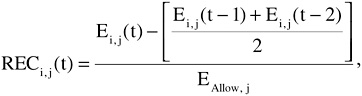
where Ei,j(t) is the annual emissions (tons) of pollutant j from facility i in year t, and EAllow, j is the allowable increase in emissions before NSR is triggered. As in the EIP report, we assign a value of 1 ton below the trigger value for each pollutant:
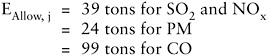
The REC variable thus provides a standardized measure that can be compared across facilities and pollutants. Emission decreases result in a negative REC value while increases in emissions result in a positive value of the REC. When the REC exceeds 1.0, this indicates an emission increase that should (or at least could) trigger NSR if this increase were associated with an
|
9 |
As pointed out in Chapter 2, firms can use a different time period to calculate the baseline, if they can demonstrate that this alternative period was more representative of normal operations. However, since the prior 2-year period is the default period for the baseline calculation, it is used as the basis for calculation in this analysis. |
applicable plant modification. We examined the distributions of REC (1989) and REC (1998) with the hypothesis that some clumping or truncation of the data below a value of 1.0 should be evident if facilities were increasing emissions at the maximum amount allowable without triggering NSR. As shown in Figures 4-1–4-8, where the empirical cumulative distribution functions (CDFs) are plotted, no such clumping is evident. Each figure includes the CDF plot for –3 < REC < 5 to illustrate nearly the full range of REC values, along with a blow-up of the region of the relative emission change between 0.2 and 2.0, to look more closely at the distribution at or below REC = 1.0. The plots indicate that some degree of aggregation is evident at a REC value of zero, since many firms undertake no change in emissions over the 3-year periods; however, the curves are otherwise smooth, with no evidence of truncation at or below REC = 1.0.
Also, we explored whether there was any change in the distribution of REC (1998) values between 1989 and 1998. This analysis is summarized in Table 4-3.
As indicated, a large sample of emission records is available, ranging from 4,957 observations of SO2 in 1989 to 20,223 observations of PM10 in 1998. In all cases, the fraction of facilities reporting increases in emissions decreased from 1989 to 1998. Mean values of RECi,j(t) values decreased as well for all pollutants from 1989 to 1998, as did their standard deviations (substantially for CO and SO2, only marginally for PM and NOx). In all cases, the fraction of RECi,j(t) values greater than 1.0 is lower in 1998 as compared with 1989. For the four pollutants, the fraction exceeding 1.0 in 1998 is reduced by a factor ranging from 2 to 6 as compared with 1989 (e.g., for SO2, the fraction above 1.0 decreases from 0.331 to 0.140, while for PM it decreases from 0.061 to 0.010). This result, consistent with the reduced means and standard deviations apparent in 1998 versus 1989, indicates that a smaller fraction of facilities implemented actual emission increases (of the magnitude associated with the current NSR rule) in 1998 as compared with 1989. Likewise, the conditional probability that the RECi,j(t) value is greater than 1.0, given that it is greater than zero (next to last row of Table 4-3), is lower in all cases in 1998 as compared with 1989. As indicated in the last row of Table 4-3, the ratio of the probability of exceeding a RECi,j(t) = 1 for those who had emission increases, decreases by a factor ranging from 2.4 to 5.6.
This analysis is illustrative of statistical evaluations that can be applied to large datasets. The analysis shows that only a small percentage of facilities report emission increases in 1989 or 1998, relative to their previous respective 2-year periods. Furthermore, the results suggest no clumping or truncation at or below 1.0 that would be suggestive of behavior by firms to undertake modifications that increase emissions, but by amounts that are constrained by NSR limitations. There is, however, a significant drop
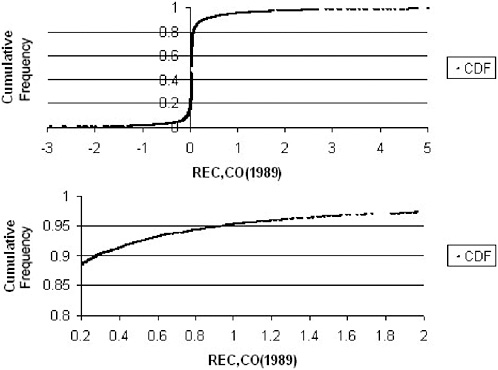
FIGURE 4-1 Relative emission change (REC) for carbon monoxide (CO) for the period 1987-1989. Cumulative distribution functions (CDFs) are shown for –3 REC 5 and a blow-up of the region of the REC between 0.2 and 2.0.
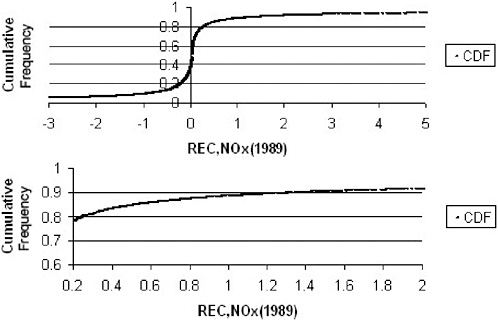
FIGURE 4-2 Relative emission change (REC) for nitrogen oxide (NOx) for the period 1987-1989. Cumulative distribution functions (CDFs) are shown for –3 REC 5 and a blow-up of the region of the REC between 0.2 and 2.0.
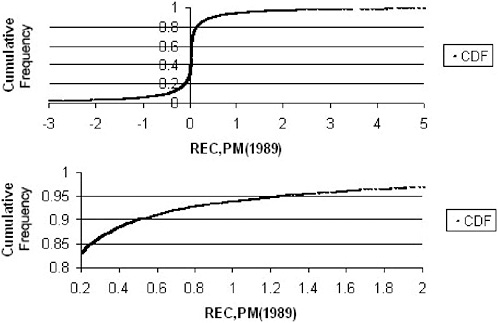
FIGURE 4-3 Relative emission change (REC) for particulate matter (PM) for the period 1987-1989. Cumulative distribution functions (CDFs) are shown for –3 REC 5 and a blow-up of the region of the REC between 0.2 and 2.0.
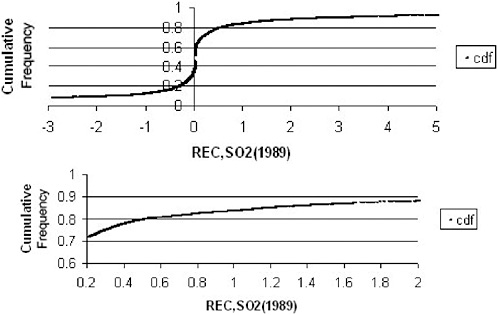
FIGURE 4-4 Relative emission change (REC) for sulfur dioxide (SO2) for the period 1987-1989. Cumulative distribution functions (CDFs) are shown for –3 REC 5 and a blow-up of the region of the REC between 0.2 and 2.0.
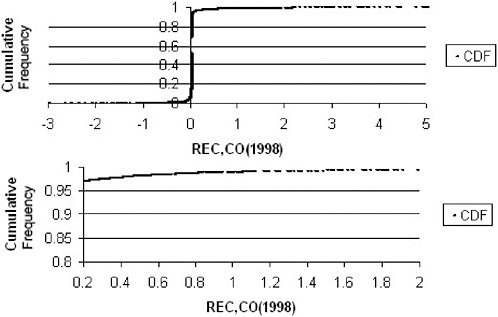
FIGURE 4-5 Relative emission change (REC) for carbon monoxide (CO) for the period 1996-1998. Cumulative distribution functions (CDFs) are shown for –3 REC 5 and a blow-up of the region of the REC between 0.2 and 2.0.
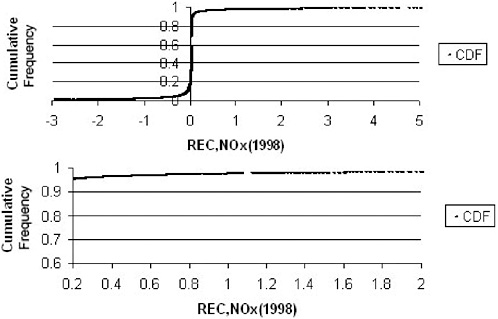
FIGURE 4-6 Relative emission change (REC) for nitrogen oxides (NOx) for the period 1996-1998. Cumulative distribution functions (CDFs) are shown for –3 REC 5 and a blow-up of the region of the REC between 0.2 and 2.0.
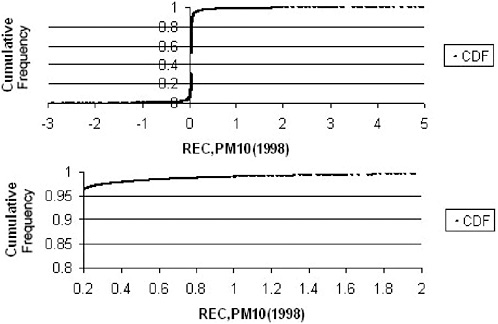
FIGURE 4-7 Relative emission change (REC) for particulate matter with an aerodynamic diameter less than 10 µm (PM10) for the period 1996-1998. Cumulative distribution functions (CDFs) are shown for –3 REC 5 and a blow-up of the region of the REC between 0.2 and 2.0.
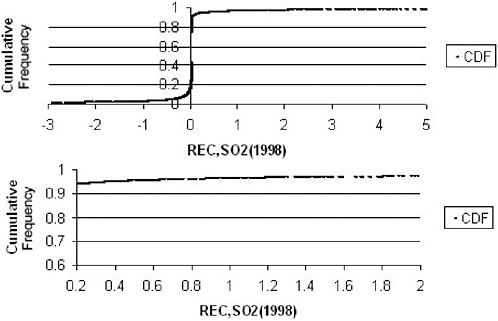
FIGURE 4-8 Relative emission change (REC) for sulfur dioxide (SO2) for the period 1996-1998. Cumulative distribution functions (CDFs) are shown for –3 REC 5 and a blow-up of the region of the REC between 0.2 and 2.0.
TABLE 4-3 Statistical Summary of RECi,j(t) Values
|
t = |
CO |
|
PM |
PM10 |
SO2 |
|
NOx |
|
|
1989 |
1998 |
1989 |
1998 |
1989 |
1998 |
1989 |
1998 |
|
|
N (number of plants) |
5,628 |
17,286 |
6,360 |
20,223 |
4,957 |
13,220 |
6,100 |
18,635 |
|
Mean |
0.304 |
0.07 |
–0.0576 |
–0.088 |
1.934 |
0.778 |
0.895 |
–0.118 |
|
Std. Dev. |
5.431 |
1.819 |
6.589 |
6.21 |
87 |
31.68 |
15.4 |
13.85 |
|
Fraction > 0 |
0.492 |
0.309 |
0.517 |
0.477 |
0.489 |
0.258 |
0.48 |
0.316 |
|
Fraction > 1 |
0.046 |
0.0104 |
0.061 |
0.01 |
0.162 |
0.0362 |
0.113 |
0.0246 |
|
Prob (>1)/Prob(>0) |
0.094 |
0.0337 |
0.118 |
0.021 |
0.331 |
0.14 |
0.235 |
0.0778 |
|
Ratio (1989:1998) of Prob (>1)/Prob (>0) |
2.79 |
|
5.62 |
|
2.36 |
|
3.02 |
|
in relative emission increases from 1989 to 1998. Inferences regarding possible implications for NSR enforcement would require information on those facilities undertaking modifications potentially subject to the NSR rules during these periods. Before such an inference could be made, however, other factors that changed during this period (e.g., economic conditions or the stringency of other regulations) would need to be considered. Furthermore, as discussed in Chapter 5, a more complete evaluation would consider more-recent time periods and differences between states.


