
1
The Importance of Telecommunications and Telecommunications Research
How important is telecommunications as an industry, and how important is telecommunications research to the overall health of that industry? Underlying these questions are several others. How important is telecommunications to the U.S. economy and society? To what extent are U.S. consumers likely to benefit directly from telecommunications research in terms of new products and services that enhance their lives or improve their effectiveness or productivity? How much scope for innovation is there left in telecommunications, or has telecommunications matured to the point that it is merely a commodity service or technology?
The core findings of this study—which are supported throughout this report—are that the telecommunications industry remains of crucial importance to the United States as a society, that a strong telecommunications research capability continues to be essential to the health and competitiveness of this U.S. industry internationally, and that the health of this industry strongly affects the U.S. economy in many ways.
TELECOMMUNICATIONS—AN EVOLVING DEFINITION
Before the emergence of the Internet and other data networks, telecommunications had a clear meaning: the telephone (and earlier the telegraph) was an application of technology that allowed people to communicate at a distance by voice (and earlier by encoded electronic signals), and telephone service was provided by the public switched telephone network (PSTN). Much of the U.S. network was owned and operated by American Telephone & Telegraph (AT&T); the rest consisted of smaller independent companies, including some served by GTE.
Then in the 1960s, facsimile and data services were overlaid on the PSTN, adding the ability to communicate documents and data at a distance—applications still considered telecommunications because they enabled new kinds of communication at a distance that were also carried over the PSTN. More recently, of course, communication at a distance has ex-
panded to include data transport, video conferencing, e-mail, instant messaging, Web browsing, and various forms of distributed collaboration, enabled by transmission media that have also expanded (from traditional copper wires) to include microwave, terrestrial wireless, satellite, hybrid fiber/coaxial cable, and broadband fiber transport.
Today consumers think of telecommunications in terms of both products and services. Starting with the Carterphone decision by the Federal Communications Commission in 1968,1 it has become permissible and increasingly common for consumers to buy telecommunications applications or equipment as products as well as services. For example, a customer-owned and customer-installed WiFi local area network may be the first access link supporting a voice over Internet Protocol (VoIP) service, and a consumer may purchase a VoIP software package and install it on his or her personally owned and operated personal computer that connects to the Internet via an Internet service provider.
The technologies used for telecommunications have changed greatly over the last 50 years. Empowered by research into semiconductors and digital electronics in the telecommunications industry, analog representations of voice, images, and video have been supplanted by digital representations. The biggest consequence has been that all types of media can be represented in the same basic form (i.e., as a stream of bits) and therefore handled uniformly within a common infrastructure (most commonly as Internet Protocol, or IP, data streams). Subsequently, circuit switching was supplemented by, and will likely ultimately be supplanted by, packet switching. For example, telephony is now routinely carried at various places in the network by the Internet (using VoIP) and cable networks. Just as the PSTN is within the scope of telecommunications, so also is an Internet or cable TV network carrying a direct substitute telephony application.
Perhaps the most fundamental change, both in terms of technology and its implications for industry structure, has occurred in the architecture of telecommunications networks. Architecture in this context refers to the functional description of the general structure of the system as a whole and how the different parts of the system relate to each other. Previously the PSTN, cable, and data networks coexisted as separately owned and operated networks carrying different types of communications, although they often shared a common technology base (such as point-to-point digital communications) and some facilities (e.g., high-speed digital pipes shared by different networks).
How are the new networks different? First, they are integrated, meaning that all media— be they voice, audio, video, or data—are increasingly communicated over a single common network. This integration offers economies of scope and scale in both capital expenditures and operational costs, and also allows different media to be mixed within common applications. As a result, both technology suppliers and service providers are increasingly in the business of providing telecommunications in all media simultaneously rather than specializing in a particular type such as voice, video, or data.
Second, the networks are built in layers, from the physical layer, which is concerned with the mechanical, electrical and optical, and functional and procedural means for managing network connections to the data, network, and transport layers, which are concerned with transferring data, routing data across networks between addresses, and ensuring end-to-end
connections and reliability of data transfer to the application layer, which is concerned with providing a particular functionality using the network and with the interface to the user.2
Both technology (equipment and software) suppliers and service providers tend to specialize in one or two of these layers, each of which seeks to serve all applications and all media. As a consequence, creating a new application may require the participation and cooperation of a set of complementary layered capabilities. This structure results in a horizontal industry structure, quite distinct from the vertically integrated industry structure of the Bell System era.
All these changes suggest a new definition of telecommunications: Telecommunications is the suite of technologies, devices, equipment, facilities, networks, and applications that support communication at a distance.
The range of telecommunications applications is broad and includes telephony and video conferencing, facsimile, broadcast and interactive television, instant messaging, e-mail, distributed collaboration, a host of Web- and Internet-based communication, and data transmission.3 Of course many if not most software applications communicate across the network in some fashion, even if it is for almost incidental purposes such as connecting to a license server or downloading updates. Deciding what is and is not telecommunications is always a judgment call. Applications of information technology range from those involving almost no communication at all (word processing) to simple voice communications (telephony in its purest and simplest form), with many gradations in between.
As supported by the horizontally homogeneous layered infrastructure, applications of various sorts increasingly incorporate telecommunications as only one capability among many. For example telephony, as it evolves into the Internet world, is beginning to offer a host of new data-based features and integrates other elements of collaboration (e.g., visual material or tools for collaborative authoring). Another important trend is machine-to-machine communication at a distance, and so it cannot be assumed that telecommunications applications exclusively involve people.
THE TELECOMMUNICATIONS INDUSTRY
Like telecommunications itself, the telecommunications industry is broader than it was in the past. It encompasses multiple service providers, including telephone companies, cable system operators, Internet service providers, wireless carriers, and satellite operators. The industry today includes software-based applications with a communications emphasis and intermediate layers of software incorporated into end-to-end communication services. It also includes suppliers of telecommunications equipment and software products sold directly to consumers and also to service providers, as well as the telecommunications service providers
|
2 |
The descriptions of layers were adapted from the Open Systems Interconnect Reference Model (ISO 7498-1), which provides a useful tool for conceptualizing network layers—see <http://standards.iso.org/ittf/PubliclyAvailableStandards/s020269_ISO_IEC_7498-1_1994(E).zip>. |
|
3 |
The term “telecommunications” takes on a particular significance with respect to the Telecommunications Act of 1996 and implementing regulations. The broad definition adopted here is intended solely to capture the scope of relevant research, not to make any statement about what technologies and services should or should not be considered telecommunications for regulatory purposes. |
themselves. It includes companies selling components or intellectual property predominately of a communication flavor, including integrated circuit chip sets for cell phones and cable and digital subscriber line (DSL) modems.
No longer a vertically integrated business, the telecommunications industry is enabled by a complex value chain that includes vendors, service providers, and users. The telecommunications value chain begins with building blocks such as semiconductor chips and software. These components are, in turn, incorporated into equipment and facilities that are purchased by service providers and users. The service providers then, in turn, build networks in order to sell telecommunications services to end users. The end users include individuals subscribing to services like telephony (landline and cellular) and broadband Internet access, companies and organizations that contract for internal communications networks, and companies and organizations that operate their own networks. Some major end-user organizations also bypass service providers and buy, provision, and operate their own equipment and software, like a corporate local area network (LAN) or a U.S. military battlefield information system. Software suppliers participate at multiple points in the value chain, selling directly not only to equipment vendors but also to service providers (e.g., operational support systems) and to end users (e.g., various PC-based applications for communications using the Internet).
An implication of defining telecommunications broadly is that every layer involved in communication at a distance becomes, at least partially, part of the telecommunications industry. The broad range and large number of companies that contribute to the telecommunications industry are evident in the following list of examples:
-
Networking service providers across the Internet and the PSTN, wireless carriers, and cable operators. Examples include AT&T, Comcast, Verizon, and DirecTV.
-
Communications equipment suppliers that are the primary suppliers to service providers. Examples include Cisco, Lucent, and Motorola.
-
Networking equipment suppliers selling products to end-user organizations and individuals. Examples include Cisco’s Linksys division and Hewlett-Packard (local area networking products).
-
Semiconductor manufacturers, especially those supplying system-on-a-chip solutions for the telecommunications industry. Examples include Texas Instruments, Qualcomm, Broadcom, and STMicroelectronics.
-
Suppliers of operating systems that include a networking stack. Microsoft is an example.
-
Software suppliers, especially those selling infrastructure and applications incorporating or based on real-time media. Examples include IBM, RealNetworks (streaming media), and BEA (application servers).
-
Utility or on-demand service providers selling real-time communications-oriented applications. Examples include AOL and Microsoft (instant messaging) and WebEx (online meetings).
-
Consumer electronics suppliers with communications-oriented customer-premises equipment and handheld appliances. Examples include Motorola and Nokia (cell phones), Research in Motion (handheld e-mail appliances), Polycom (videoconferencing terminals), Microsoft and Sony (networked video games), and Panasonic (televisions).
What is striking about this list is how broad and inclusive it is. Even though many of these firms do not specialize solely in telecommunications, it is now quite common for firms in the
larger domain of information technology to offer telecommunications products or to incorporate telecommunications capability into an increasing share of their products.
THE IMPORTANCE OF TELECOMMUNICATIONS
Telecommunications and Society
The societal importance of telecommunications is well accepted and broadly understood, reflected in its near-ubiquitous penetration and use. Noted below are some of the key areas of impact:
-
Telecommunications provides a technological foundation for societal communications. Communication plays a central role in the fundamental operations of a society—from business to government to families. In fact, communication among people is the essence of what distinguishes an organization, community, or society from a collection of individuals. Communication—from Web browsing to cell phone calling to instant messaging—has become increasingly integrated into how we work, play, and live.
-
Telecommunications enables participation and development. Telecommunications plays an increasingly vital role in enabling the participation and development of people in communities and nations disadvantaged by geography, whether in rural areas in the United States or in developing nations in the global society and economy.
-
Telecommunications provides vital infrastructure for national security. From natural disaster recovery, to homeland security, to communication of vital intelligence, to continued military superiority, telecommunications plays a pivotal role. When the issue is countering an adversary, it is essential not only to preserve telecommunications capability, but also to have a superior capability. There are potential risks associated with a reliance on overseas sources for innovation, technologies, applications, and services.
It is difficult to predict the future impact of telecommunications technologies, services, and applications that have not yet been invented. For example, in the early days of research and development into the Internet in the late 1960s, who could have foreseen the full impact of the Internet’s widespread use today?
Telecommunications and the U.S. Economy
The telecommunications industry is a major direct contributor to U.S. economic activity. The U.S. Census Bureau estimates that just over 3 percent of the U.S. gross domestic income (GDI) in 2003 was from communications services (2.6 percent) and communications hardware (0.4 percent)—categories that are narrower than the broad definition of telecommunications offered above. At 3 percent, telecommunications thus represented more than a third of the total fraction of GDI spent on information technology (IT; 7.9 percent of GDI) in 2003. In fact, the fraction attributable to telecommunications is probably larger relative to that of IT than these figures suggest, given that much of the GDI from IT hardware (particularly semiconductors) could apply to any of several industries (computing, telecommunications, media, and electronics, for example). If one assumes IT to be the sum of computers (calculating), computers (wholesale), computers (retail), and software and services, the total GDI for IT is
$440 billion, compared to the total for telecommunications (communications hardware plus communications services) of $335 billion, making telecommunications’ contribution to GDI just under 80 percent of IT’s contribution to GDI.4
The telecommunications-related industries are also a major employer—communications services employed 1 million U.S. workers in 2002, representing 1.1 percent of the total private workforce, and communications equipment companies employed nearly 250,000 people.5 Moreover, telecommunications is a high-tech sector, with many highly skilled employees.
Telecommunications is a growth business. Although markedly reduced investment in some parts of the sector (following the bubble years of the late 1990s) may have given an impression of low growth in the long run, a longer-term view taking into account the need for humans and machines to communicate suggests that telecommunications will continue to grow apace, as evidenced by the ongoing expansion of wireless and broadband access services throughout the world.
Telecommunications is also a key enabler of productivity across the U.S. economy and society.6 Not only is telecommunications an industry in itself, but it also benefits nearly every other industry. In the 1990s the U.S. GDP grew rapidly, and the U.S. economy was among the strongest in the world. It is widely believed that the Internet economy played a significant role in this success.
Today, however, new wireless applications, low-cost manufacturing innovations, and handset design are some of the areas in which the Asian countries are outinvesting the United States in R&D and are seeing resulting bottom-line impacts to their economies. For the United States to compete in the global marketplace—across industries—it needs the productivity that comes from enhancements in telecommunications. If the telecommunications infrastructure in the United States were to fall significantly behind that of the rest of the world, the global competitiveness of all other U.S. industries would be affected. Conversely, the growth in U.S. productivity has been based in part on a telecommunications infrastructure that is the most advanced in the world.
U.S. leadership in telecommunications did not come by accident—success at the physical, network, and applications levels was made possible by the U.S. investment in decades of research and the concomitant development of U.S. research leadership in communications-related areas. Telecommunications has been and likely will continue to be an important foundation for innovative new industries arising in the United States that use telecommunications as a primary technological enabler and foundation. Recent examples of innovative new businesses leveraging telecommunications include Yahoo!, Amazon, eBay, and Google. Telecom-
|
4 |
GDI estimates for 2003 from U.S. Census Bureau, Statistical Abstract of the United States: 2004–2005 (124th Edition), Washington, D.C., Table 1116, p. 715, 2004, available online at <http://www.census.gov/prod/2004pubs/04statab/infocomm.pdf>. |
|
5 |
Data for 2002 from U.S. Census Bureau, Statistical Abstract of the United States: 2004–2005 (124th Edition), Washington, D.C., Table 1117, p. 715, 2004, available online at <http://www.census.gov/prod/2004pubs/04statab/infocomm.pdf>. |
|
6 |
For more on the relationship between information and communications technologies and economic productivity, see, for example, Dale W. Jorgenson and Kevin J. Stiroh, “Raising the Speed Limit: U.S. Economic Growth in the Information Age,” Brookings Papers on Economic Activity, 2000–1, pp. 125-235, 2000; and Erik Brynjolfsson and Lorin M. Hitt, “Beyond Computation: Information Technology, Organizational Transformation and Business Performance,” Journal of Economic Perspectives, 14(4):45, Fall 2000. |
munications is also specifically a key enabler for other industries in which the United States has important competitive advantages and a positive balance of trade, such as financial services and entertainment (e.g., movies and music).
Finally, telecommunications is an important component of the broader IT industry, which is sometimes viewed as having three technology legs:7 processing (to transform or change information), storage (to allow communication of information from one time to another), and communications (to transmit information from one place to another). The boundaries between these areas are not very distinct, but this decomposition helps illustrate the breadth of IT and the role that telecommunications plays. Increasingly IT systems must incorporate all three elements to different degrees,8 and it is increasingly common for companies in any sector of IT to offer products with a communications component, and often with a communications emphasis. The IT industry’s overall strength depends on strength across communications, processing, and storage as well as strength in all layers of technology—from the physical layer (including communications hardware, microprocessors, and magnetic and optical storage), to the software infrastructure layers (operating systems and Web services), to software applications.
Telecommunications and Global Competitiveness
In this era of globalization, many companies are multinational, with operations—including R&D—conducted across the globe. For example, IBM, HP, Qualcomm, and Microsoft all have research facilities in other countries, and many European and Asian companies have research laboratories in the United States. Increasing numbers of businesses compete globally. Every company and every industry must assess the segments and niches in which it operates to remain globally competitive.
Both Asian and European nations are continuing to pursue strategies that exploit perceived U.S. weakness in telecommunications and telecommunications research as a way of improving their competitiveness in telecommunications, as well as in information technology more broadly. Leapfrogging the United States in telecommunications has, in the opinion of the committee, been an explicit and stated strategy for a number of Asian (in broadband and wireless) and European (in wireless) nations for the past decade, with notable success. These efforts have aimed to stimulate the rapid penetration of physical-layer technologies for residential access (broadband access, especially in Asia) and wireless and mobile access (cellular networks, especially in Europe).
THE IMPORTANCE OF CONTINUING INVESTMENT IN TELECOMMUNICATIONS RESEARCH: SUMMARY COMMENTS
Telecommunications research is best understood as a seed that germinates, developing into lasting value for the U.S. economy. Figure 1.1 depicts the research ecosystem and the
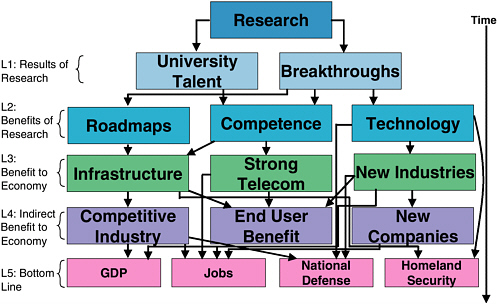
FIGURE 1.1 Impact of telecommunications research.
benefits it enables, many of which are built up recursively over time as a result of interactions among the various levels. The picture is, to be sure, simplified—the interactions between the different elements are more complex than can be reasonably characterized by the diagram— but Figure 1.1 does provide a realistic view of the impacts of research.
Shown at the top of Figure 1.1 is the research enabled by available funding. Level 1 shows the direct results: Researchers conduct exploratory studies, achieving technical breakthroughs and developing their expertise and their basic understanding of the areas studied. Talent is thus nurtured that will be expressed in the future in industry and academia. None of these results of research can be characterized as end benefits. Rather, the development of talent and the achievement of breakthroughs build a capability for later revolutionary advances.
At Level 2 the benefits of research begin to become evident. Researchers collaborate, and individual insights and results begin to fit together. The university talent generated in Level 1 develops competence—not simply low-level job skills that can be easily transported anywhere, but rather the next-generation expertise needed to ensure a skilled U.S. telecommunications workforce. The United States has access to this skilled workforce first and can thus benefit directly from the talent and knowledge base generated in Level 1 that are fundamental to continuing technological advances and being able to perform in the best future jobs.
Also at Level 2 comes the maturing of fundamental breakthroughs and their transition to usable, deployable technology for next-generation telecommunication systems and the development of roadmaps to help guide research investments.
The major benefits to the economy obtained at Level 3 are the coalescence of Level 1 and 2 elements. Skilled workers, a competence to understand the new technology, the availability of the technology, and shared goals are the ingredients required to create a healthy telecommunications industry and, more broadly, a capable telecommunications infrastructure.
Interestingly, not all of the research performed affects telecommunications alone. Because telecommunications touches multiple industries, the technology base it provides also often enables the creation of entirely new industries. The success of the iPod and other portable digital music players, for example, rests in part on earlier telecommunications-inspired work on how to compress audio for efficient transmission over limited-bandwidth channels.
At Level 4, an indirect benefit of research is a telecommunications infrastructure that provides advantages to all industries that use telecommunications. There are also end-user or consumer benefits that accrue to having an outstanding infrastructure, such as enhanced education, entertainment, and personal convenience. Finally, new companies also emerge from these new industries.
Level 5 aggregates the key benefits of research in broad areas of national concern. Concerning economic impact, the strong telecommunications industry, new spin-off industries, and more competitive industries (across the board) result in a higher GDP for the country, as well as job creation. Technological leadership and economic strength also help ensure strong leadership and capability in national defense and homeland security.
The full benefits of the process depicted in Figure 1.1 develop over an extended period of time, with a long-term buildup over several years between the seed investments in research and realization of the ultimate bottom-line benefits. Each step takes time: from innovation to mass deployment and impact. Investments by both government and industry in research by academia and industry lead to both short- and long-term contributions.
Over the years, CSTB studies have documented this phenomenon across multiple areas of information technology and telecommunications research. In particular, its 1995 report Evolving the High Performance Computing and Communications Initiative to Support the Nation’s Information Infrastructure9 and a 2003 update10 illustrate how long-term investments in research across academia and industry have led to the creation of many new, important U.S. industry segments with revenues that came to exceed $1 billion.
In closing, it is worth noting the perils of losing leadership in telecommunications. Because of the time lag, the nation may continue to exhibit leadership at Levels 4 and 5 (and possibly Level 3) even as it is failing to renew capability at Levels 1 and 2. Since Levels 3 through 5 are most visible to policy makers and the public, there is a potential to perceive the situation as less dire than it really is. If Levels 1 and 2 are left to atrophy, serious problems will occur at Levels 3 through 5. If that happens, then recovery will take a long time—or even prove impossible.


