
4.1
The Astrophysical Context of Life
A Report of the Committee on the Origins and Evolution of Life
Executive Summary
BACKGROUND
The National Aeronautics and Space Administration (NASA) Astrobiology Roadmap summarizes astrobiology in the following way:1 “Astrobiology is the study of the origins, evolution, distribution, and future of life in the universe.” Astrobiology thus addresses three fundamental questions:
-
How does life begin and evolve?
-
Does life exist elsewhere in the universe?
-
What is the future of life on Earth and beyond?
The Committee on the Origins and Evolution of Life was charged with investigating ways to augment and integrate the contributions of astronomy and astrophysics in astrobiology—in particular, in NASA’s astrobiology program and in relevant programs in other federal agencies.
The goals set for this study were as follows:
-
Identify areas where there can be especially fruitful collaborations between astrophysicists, biologists, biochemists, chemists, and planetary geologists.
-
Define areas where astrophysics, biology, chemistry, and geology are ripe for mutually beneficial interchanges and define areas that are likely to remain independent for the near future.
-
Suggest areas where current activities of the National Science Foundation (NSF) and other agencies might augment NASA programs.
In considering how to achieve these general goals, the committee focused on the key words in the statement of task (Appendix A): “to study the means to augment and integrate the activity of astronomy and astrophysics in the intellectual enterprise of astrobiology,” in particular on the words “augment” and “integrate.” It understood “augment” as an instruction to find issues in astronomical/astrobiological research where fruitful work could be done that is not now being done. The integration of interdisciplinary research topics is relevant to all the areas of astrobiology research, not just with respect to astronomy. The topic stimulated broad interest on the part of all the committee members and led to some generic—but, the committee believes, important—recommendations designed to facilitate interdisciplinary research.
The discussions about the charge led to the committee’s specific approach to the study and to the structure of the report. Seven tasks were identified:
-
Outline current astronomical research relevant to astrobiology.
-
Define important areas that are relatively understudied and hence in need of more attention and support.
-
Address the means to integrate astrophysical research into the astrobiology enterprise.
-
Identify areas where there can be especially fruitful collaboration among astrophysicists, biologists, chemists, biochemists, planetary geologists, and planetary scientists that will serve the goals of astrobiological research.
-
Identify areas of astronomy that are likely to remain remote from the astrobiological enterprise.
-
Suggest areas where ongoing research sponsored by NSF, the Department of Energy (DOE), and the National Institutes of Health (NIH) can augment NASA support of astrobiological research and education in a manner that complements the astronomical interconnection with other disciplines.
-
Where applicable, point out the relevance to NASA missions.
NOTE: “Executive Summary” reprinted from The Astrophysical Context of Life, The National Academies Press, Washington, D.C., 2005, pp. 1-6.
|
1 |
Available online at <http://astrobiology.arc.nasa.gov/roadmap/>. |
PRINCIPAL CONCLUSIONS
Astrophysical research is a vital part of astrobiology today, especially with the addition of the NASA Astrobiology Institute (NAI) nodes that are primarily focused on astrophysics. This report identifies still more areas where astrophysical research can contribute to astrobiology, including the galactic environment, cosmic irradiation in its myriad forms, bolide impacts, interstellar and circumstellar chemistry, prebiotic chemistry, and photosynthesis and molecular evolution in an astronomical context.
Astronomy brings two important perspectives to the study of astrobiology. One is to encourage thinking in a nonterracentric way. The opportunities are vast for different conditions to produce different outcomes for life, even within the standard paradigm of carbon-based life with a nucleotide-based coding system. The ambient conditions could be different—hotter, colder, more radiation or less—and the coding system could be different. It will be a challenge to discern the most important convergent processes when the details of overwhelmingly complex life are different. The other perspective that astronomy brings to astrobiology is that the astronomical environment—from the host star, to the ambient interstellar gas through which a planetary system passes in its galactic journey, to cosmic explosions—is intrinsically variable. The dominant driver of this variability is probably the host star, which is likely to be susceptible to violent chromospheric activity and nearly continuous flares when it is young or if its mass is less than that of the Sun, the most likely situation. Life in an intrinsically variable environment raises deep and interesting issues of fluctuating mutation rates, genetic variation processes, and the evolution of complexity—and even of evolvability itself. Some of these issues overlap with topics being pursued in biomedical research.
This study attempts to identify areas where astrophysical research can fruitfully interact with research in the other disciplines of astrobiology: biology, geology, and chemistry. It also identifies some broad issues involved in integrating astronomy within astrobiology. First, there is a need to recognize when astronomical research is relevant to astrobiology and when it is not. The consensus is that to be relevant to astrobiology, astronomical research should be “life-oriented.” This is a broad and dynamic filter through which not all astronomical research will pass. Second, there is the need to integrate astrophysical research in the astrobiology effort. Here the report urges the NAI teams to develop metrics for determining when truly integrated interdisciplinary work involving astrophysics is being done and to actively promote that integration.
The third broad issue is that of integrating work in an intrinsically interdisciplinary field. While integrating astrophysics research is the focus, the problem transcends astronomy alone. To this end, the report recommends a series of educational and training initiatives conceived with the astronomy component of astrobiology in mind, but that could be applied to the whole enterprise. Among these initiatives are NAI’s institutionalization of education and training, the establishment of an astrobiology graduate student fellowship program and of exchange programs for graduate students and sabbatical visitors, and sponsorship of a distinguished speaker series in astrobiology.
The astrophysics component of astrobiology has a rich and vibrant future in one of the great intellectual enterprises of humankind, understanding the origin and evolution of life.
FINDINGS AND RECOMMENDATIONS
The following is a summary of the committee’s detailed findings and recommendations.
NASA Efforts in Astrophysics for Astrobiology
Funding for astrobiology is limited, and the boundaries of the field are unclear; there is a risk that some funds might go to research topics that cannot be justifiably classified as “astrobiology.” The committee recommends that in funding decisions, NASA and other funding agencies should regard astronomical research as astrobiology if it is life-focused in plausible ways.
Review of current astronomically oriented research shows that it is concentrated in relatively few areas, especially in the Exobiology program. The committee recommends that NASA continue to ensure that an appropriate diversity of topics is included within the astrophysics component of astrobiology and that its support be coordinated with funding through other relevant programs. NASA also should develop metrics to evaluate the degree to which truly interdisciplinary work involving astronomy and astrophysics is being done in the current NAI nodes.
Areas That Could Benefit from Augmentation and Integration
Some broad areas are relatively understudied and would be especially amenable to focused effort in the near future: the galactic environment, the radiation/particle environment, bolide bombardment, interstellar molecules and their role in prebiotic chemistry, photochemistry and its relation to photosynthesis, and molecular evolution in an astronomical context. Specific areas needing attention by the research community and by funding agencies include the following:
-
Galactic habitability, including correlating stellar heavy-element abundance with the existence of planets; characterizing the interaction among stellar winds, the interstellar medium ram pressure, and the resulting cosmic ray flux; and determining which regions of the Galaxy could give rise to and sustain life.
-
Characterization of the ultraviolet (UV), ionizing radiation, and particle flux incident on evolving, potentially life-hosting planets and moons.
-
The variability of damaging UV and ionizing radiation over the course of life on Earth and how such conditions might be manifested on other life-hosting bodies.
-
Planetary geology models to better understand the presence and nature of volcanism and tectonics on other planets as a function of the age of formation of the planet, the initial concentration of long-lived radioactive species, the accretion history, and the mass of the planet.
-
Geological field work and models to characterize the rates of damage and mutation due to background radioactivities on evolving Earth and other potentially life-hosting bodies and to compare them with the rates due to other endogenous and exogenous radioactivities.
-
Searches for cosmogenic material and other live radioactive elements in ice cores and ocean sediments.
-
Research in the chemistry of the circumstellar accretion disks that evolve from molecular clouds, considering both gas- and solid-state phases and the delivery of chemical compounds to planet surfaces for an appropriate range of planets and planetary environments.
-
Research to complete the interstellar and circumstellar molecular inventory and to test reaction pathways.
-
Geological and geochemical work to identify ejecta material in the rock record surrounding large impact basins—in particular, to study existing evidence and search for additional signs of impact at the Permian/Triassic boundary and to document various anomalies in noble gas isotopic signatures and rare earth and other metal abundances that can be clearly linked to extraterrestrial impactors.
-
Return to the Moon to acquire more lunar samples to help determine when the “impact frustration” of life’s origin ended by sampling more sites—particularly sites that are older than the six sites sampled by the Apollo astronauts and the three sites sampled by the Russian robotic sample-return missions and, especially, the oldest and largest impact basin on the Moon, the South Pole-Aitken Basin.
-
Research on how carbon, nitrogen, and sulfur cycles might work on a prebiotic planet with an ocean and an incident flux of photons and particles, and how these cycles might couple with primitive life forms to provide feedstocks for their formation and energy for their metabolism.
-
Coordinated theoretical, laboratory, and observational studies of interstellar chemistry, accretion, condensation, and transport processes to determine the inventory of compounds that was delivered to a young planet, when they were available, where they were available, and in what quantities.
-
Studies of abiotic photochemistry in concert with astronomical sources of trace elements and energy to determine whether trace elements play a role in photochemical sources of organic compounds and/or high-energy activated compounds.
-
Studies of the extent to which the astrophysical environment could have fostered symmetry breaking in prebiotic organic pools.
-
Studies to understand the evolution of earthlike organisms and organisms with other coding mechanisms that are subjected to the fluctuating thermal and radiation environments expected for planetary systems with various impact histories and planets orbiting stars of various masses and ages in different parts of the Galaxy.
-
In vitro and in silico studies to learn how the stochastic variability of the environment, including the mutational environment, affects the evolution of life, especially by promoting complexity and the evolution of evolvability.
Integrating Astronomy with the Other Disciplines of Astrobiology
The committee identified three factors that currently limit the integration of astronomy and astrophysics with astrobiology and, indeed, limit robust interdisciplinary research of any kind: (1) a lack of common goals and interests, (2) lack of a common language, and (3) insufficient background in allied fields to allow experts to do useful interdisciplinary work.
The committee recommends to NASA, other funding agencies, and the research community the following approaches to overcoming communication barriers:
-
Continue and expand cross-disciplinary discussions on the origin and evolution of life on Earth and elsewhere, as are already being promoted by the NAI.
-
Continue intellectual exchange through interdisciplinary meetings, focus groups, a speaker program, and workshops, all targeted at augmenting and integrating astronomy and astrophysics with other astrobiology subdisciplines.
-
Promote a professional society (and cross-disciplinary branches within existing societies) that will cover the full range of disciplines that make up astrobiology, from astronomy to geosciences to biology. The International Society for the Study of the Origins of Life, which holds triennial meetings, may provide an appropriate basis for this. The BioAstronomy conferences sponsored by the International Astronomical Union,2 the astrobiology conferences held at NASA Ames Research Center, and the Gordon Research Conferences on the Origin of Life are useful but do not fulfill the needed roles of a professional society.
-
Undertake missions to asteroids, comets, moons such as Titan, and, possibly, Saturn’s rings to sample and analyze the surface organic chemistry.
-
Broaden the definition of outreach activities within the NAI beyond general public awareness and K-12 education to achieve the greater degree of cross-fertilization that is needed among NAI senior researchers, postdoctoral fellows, and students.
-
Reach out to university faculty in general, not just to NAI members and affiliates. This is essential for astrobiology to be embraced as a discipline and for extending and perpetuating support beyond NAI/NASA, which is otherwise unlikely to happen.
Education at all levels is a central issue. The committee recommends multiple approaches that invest both in training the next generation and in giving the larger scientific community opportunities for interdisciplinary training and collaboration.
-
NASA should encourage NAI teams to institutionalize education in astrobiology. In particular, the committee recommends that the next competition for NAI centers encourage the creation of academic programs for interdisciplinary undergraduate and graduate training in astrobiology.
-
In order to provide opportunities for graduate training within and outside the NAI nodes, NASA should establish an astrobiology graduate student fellowship program similar to existing programs in space and Earth science. These fellowships should be open to students enrolled in any accredited graduate program within the United States.
-
NASA should encourage the NAI to foster cross- and interdisciplinary training opportunities for graduate students and faculty, as already exist for postdoctoral fellows. In particular, the committee recommends that exchange programs be created to allow students to matriculate in programs outside their home field and that resources be made available for a sabbatical program for the interdisciplinary training of established scientists.
-
NASA should encourage the NAI nodes and NASA Specialized Center of Research and Training (NSCORT) nodes to engage in a self-study as part of their reporting processes to assess the progress of graduate and postdoctoral programs in training truly interdisciplinary scientists who actively engage in interdisciplinary research.
-
The NAI should sponsor a distinguished speaker series in astrobiology. It would identify accomplished speakers and provide travel support for them to present their interdisciplinary research at universities and colleges. Speakers should be selected on the basis of both disciplinary and demographic diversity. The institutions hosting the speakers would be required to involve multiple academic departments or programs.
4.2
The Atacama Large Millimeter Array: Implications of a Potential Descope
A Report of the Ad Hoc Committee to Review the Science Requirements for the Atacama Large Millimeter Array
Summary
The Committee to Review the Science Requirements for the Atacama Large Millimeter Array conducted a study to evaluate the consequences of a descope of the Atacama Large Millimeter Array (ALMA), which is intended to be the major, ground-based observational facility for millimeter and submillimeter astronomy for the next three decades. The committee was asked to consider the scientific consequences of reducing the number of active antennas from 601 to either 50 or 40 antennas. The committee concluded that:
-
A 60-element array would be greatly superior to any current or planned comparable instrument for several decades and would revolutionize millimeter and submillimeter astronomy.
-
Two of the three level-1 requirements, involving sensitivity and high-contrast imaging of protostellar disks, will not be met with either a 40- or a 50-antenna array. It is not clear if the third requirement, on dynamic range, can be met with a 40-antenna array even if extremely long integrations are allowed for.
-
Speed, image fidelity, mosaicing ability,2 and point-source sensitivity will all be affected if the ALMA array is descoped. The severest degradation is in image fidelity, which will be reduced by factors of 2 and 3 with descopes to 50 and 40 antennas, respectively.
-
Despite not achieving the level-1 requirements, a descoped array with 50 or 40 antennas would still be capable of producing transformational results, particularly in advancing understanding of the youngest galaxies in the universe, how the majority of galaxies evolved, and the structure of protoplanetary disks, and would warrant continued support by the United States.
-
Furthermore, it is the committee’s appraisal that a 40-antenna array would retain ALMA’s strong support within the general astronomical community. However, the rapid decline in imaging capability that would result with a further reduction below 40 antennas would erode this support.
NOTE: “Summary” reprinted from The Atacama Large Millimeter Array: Implications of a Potential Descope, The National Academies Press, Washington, D.C., 2005, pp. 1-2.
4.3
Earth Science and Applications from Space: Urgent Needs and Opportunities to Serve the Nation
A Report of the Ad Hoc Committee on Earth Science and Applications from Space: A Community Assessment and Strategy for the Future
Summary
Understanding the complex, changing planet on which we live, how it supports life, and how human activities affect its ability to do so in the future is one of the greatest intellectual challenges facing humanity. It is also one of the most important for society as it seeks to achieve prosperity and sustainability.
The decades of the 1980s and 1990s saw the emergence of a new paradigm for understanding our planet—observing and studying Earth as a system of interconnected parts including the land, oceans, atmosphere, biosphere, and solid Earth. At the same time, satellite observing systems came of age and produced new and exciting perspectives on Earth and how it is changing. By integrating data from these new observation systems with in situ observations, scientists were able to make steady progress in the understanding of and ability to predict a variety of natural phenomena, such as tornadoes, hurricanes, and volcanic eruptions, and thus help mitigate their consequences. Decades of investments in research and the present Earth observing system have also improved health, enhanced national security, and spurred economic growth by supplying the business community with critical environmental information.
Yet even this progress has been outpaced by society’s ongoing need to apply new knowledge to expand its economy, protect itself from natural disasters, and manage the food and water resources on which its citizens depend. The aggressive pursuit of understanding Earth as a system—and the effective application of that knowledge for society’s benefit—will increasingly distinguish those nations that achieve and sustain prosperity and security from those that do not. In this regard, recent changes in federal support for Earth observation programs are alarming. At NASA, the vitality of Earth science and application programs has been placed at substantial risk by a rapidly shrinking budget that no longer supports already-approved missions and programs of high scientific and societal relevance. Opportunities to discover new knowledge about Earth are diminished as mission after mission is canceled, descoped, or delayed because of budget cutbacks, which appear to be largely the result of new obligations to support flight programs that are part of the Administration’s vision for space exploration. In addition, transitioning of many of the scientific successes at NASA into operational capabilities at NOAA and other agencies has failed to materialize, years after the potential and societal needs were demonstrated, even as the United States has announced that it will take a leadership role in international efforts to develop integrated, global observing systems.
The Committee on Earth Science and Applications from Space affirms the imperative of a robust Earth observation and research program to address such profound issues as the sustainability of human life on Earth and to provide specific benefits to society. Achieving these benefits further requires that the observation and science program be closely linked to decision support structures that translate knowledge into practical information matched to and cognizant of society’s needs. The tragic aftermath of the 2004 Asian tsunami, which was detected by in situ and space-based sensors that were not coupled to an appropriate warning system in the affected areas of the Indian Ocean, illustrates the consequences of a break in the chain from observations to the practical application of knowledge.
The committee’s vision for the future is clear: The nation needs to rise to the grand challenge of effectively enhancing and applying scientific knowledge of the Earth system both to increase fundamental understanding of our home planet and how it sustains life and to meet increasing societal needs. This vision reflects and supports established national and international objectives, built around the presidential directives that guide the U.S. climate and Earth observing system initiatives. Realizing the vision requires a strong, intellectually driven Earth sciences program and an integrated in situ and space-based observing system—the foundation essential to developing
NOTE: “Summary” reprinted from Earth Science and Applications from Space: Urgent Needs and Opportunities to Serve the Nation, The National Academies Press, Washington, D.C., 2005, pp. 1-8.
knowledge of Earth, predictions, and warnings—as well as better decision-support tools to transform new knowledge into societal benefits and more effectively link science to applications. The payoff for our nation and for the world is enormous.
EARTH OBSERVATION TODAY
The current U.S. civilian Earth observing system centers on the environmental satellites operated by NOAA; 1 the atmosphere-, biospheres-, ocean-, ice-, and land-observation satellites of NASA’s Earth Observing System (EOS);2 and the Landsat satellites, which are currently managed under a cooperative arrangement involving NASA, NOAA, and the U.S. Geological Survey (USGS). Today, this system of environmental satellites is at risk of collapse. Although NOAA has plans to modernize and refresh its weather satellites, NASA has no plan to replace its EOS platforms after their nominal 6-year lifetimes end (beginning with the Terra satellite in 2005), and it has canceled, descoped, or delayed at least six planned missions, including the Landsat Data Continuity “bridge” mission.3
These decisions appear to be driven by a major shift in priorities at a time when NASA is moving to implement a new vision for space exploration. This change in priorities jeopardizes NASA’s ability to fulfill its obligations in other important presidential initiatives, such as the Climate Change Research Initiative and the subsequent Climate Change Science Program. It also calls into question future U.S. leadership in the Global Earth Observing System of Systems, an international effort initiated by the current Administration. The nation’s ability to pursue a visionary space exploration agenda depends critically on its success in applying knowledge of Earth to maintain economic growth and security at home.
Moreover, a substantial reduction in Earth observation programs today will result in a loss of U.S. scientific and technical capacity, which will decrease the competitiveness of the United States internationally for years to come. U.S. leadership in science, technology development, and societal applications depends on sustaining competence across a broad range of scientific and engineering disciplines that include the Earth sciences.
As a result of the recent mission cancellations, budget-induced delays, and mission descopes, the committee finds the existing Earth observing program to be severely deficient. The near-term recommendations presented below describe the minimum set of actions needed to maintain the health of the NASA scientific and technical programs until more comprehensive community recommendations are made in the final report of the survey. They address deficiencies in the current program at NASA and some of the emerging needs of NOAA and the USGS. The committee’s recommendations address issues in six interrelated areas:
-
Canceled, descoped, or delayed Earth observation missions;
-
Prospects for the transfer of capabilities from some canceled or descoped NASA missions to NPOESS;
-
The adequacy of the technological base for future missions;
-
The status and future prospects of NASA Earth science Explorer-class missions;
-
The adequacy of research and analysis programs to support future programs; and
-
Development of baseline climate observations and data records.
|
1 |
See discussion at the NOAA Web site at <http://www.nesdis.noaa.gov/satellites.html>. |
|
2 |
EOS is composed of a series of satellites, a science component, and a data system supporting a coordinated series of polar-orbiting and low-inclination satellites for long-term global observations of the land surface, biosphere, solid Earth, atmosphere, and oceans. See “The Earth Observing System,” at <http://eospso.gsfc.nasa.gov/>. |
|
3 |
In accordance with congressional guidance and the Land Remote Sensing Policy Act of 1992 (PL 102-555), the Commercial Space Act of 1998 (PL 105-303), and the U.S. Commercial Remote Sensing Policy (April 25, 2003), NASA and the Department of the Interior/USGS initially planned to continue the Landsat-7 data series by implementing a Landsat Data Continuity Mission (LDCM) that would procure data from a privately owned and commercially operated remote sensing system. Following an evaluation of proposals, NASA declined to accept any offers and canceled this plan in September 2003. Per guidance from the White House Office of Science and Technology Policy, NASA then agreed to transition Landsat measurements to an operational environment through the incorporation of Landsat-type sensors on the National Polar-orbiting Operational Environmental Satellite System (NPOESS) platform. NASA also agreed to further assess options to mitigate the risks to data continuity prior to the first NPOESS-Landsat mission, including a “bridge” mission. Unless otherwise specified, the committee’s reference to cancellation of the LDCM is to this bridge or “gap filler” option, which have launched a free-flying instrument to avoid a gap in data continuity between the already-degraded Landsat-7 and the launch of the first NPOESS-Landsat satellite in late 2009/early 2010. |
ACTIONS TO MEET CURRENT CRITICAL NEEDS
Proceed with GPM and GIFTS
Recently, six NASA missions with clear societal benefits and the established support of the Earth science and applications community have been delayed, descoped, or canceled. Two of these missions should proceed immediately:
-
Global Precipitation Measurement (GPM). The Global Precipitation Measurement mission is an international effort to improve climate, weather, and hydrological predictions through more accurate and more frequent precipitation measurements. GPM science will be conducted through an international partnership led by NASA and the Japan Aerospace Exploration Agency (JAXA). Water cycling and the availability of fresh water resources, including their predicted states, are of critical concern to all nations, and precipitation is the fundamental driver of virtually all water issues, including those concerned with national security. GPM is the follow-on to the highly successful Tropical Rainfall Measuring Mission, which is nearing the end of operations.4 It is an approved mission that has been delayed several times by NASA.
The committee recommends that the Global Precipitation Measurement mission be launched without further delays.
-
Atmospheric Soundings from Geostationary Orbit (GIFTS). The Geostationary Imaging Fourier Transform Spectrometer (GIFTS) will provide high-temporal-resolution measurements of atmospheric temperature and water vapor, which will greatly facilitate the detection of rapid atmospheric changes associated with destructive weather events, including tornadoes, severe thunderstorms, flash floods, and hurricanes. The GIFTS instrument has been built at a cost of approximately $100 million, but the mission has been canceled for a variety of reasons. However, there exists an international opportunity to launch and test GIFTS.
The committee recommends that NASA and NOAA complete the fabrication, testing, and space qualification of the GIFTS instrument and that they support the international effort to launch GIFTS by 2008.
Three other missions—Ocean Vector Winds, Landsat Data Continuity, and Glory—as well as development of enabling technology such as the now-canceled wide-swath ocean altimeter, should be urgently reconsidered, as described below.
Evaluate Plans for Transferring Needed Capabilities to NPOESS
Instruments on the following three canceled missions may be either reinstated as independent NASA missions as originally planned or replaced with appropriate instruments for flight on the National Polar-orbiting Operational Environmental Satellite System (NPOESS). This latter approach has both advantages (e.g., transfer of research capabilities to operational use) and disadvantages (e.g., decrease in instrument capability, gaps in data continuity).
-
Ocean Vector Winds. Global ocean surface vector wind observations have enhanced the accuracy of severe storm warnings, including hurricane forecasts, and have improved crop planning as a result of better El Niño predictions. Such observations are achievable from proven space-borne scatterometer systems. However, NASA has canceled the Ocean Vector Winds mission, a previously planned follow-on to the active scatterometer currently operating on the QuikSCAT mission, which has already exceeded its design life. NOAA is currently planning to use a passive microwave sounder, CMIS (Conical Scanning Microwave Imager/Sounder), which will be launched on NPOESS, to recover ocean wind measurements. Tests of the feasibility of this technique are underway based on use of a similar instrument on the Navy’s Windsat satellite.
-
Landsat Data Continuity. For more than 30 years, Landsat satellites have collected data on Earth’s continental surfaces to support Earth science research and state and local government efforts to assess the quality of terrestrial habitats, their resources, and their changes due to human activity. These data constitute the longest
-
continuous record of Earth’s surface as seen from space. The Land Remote Sensing Policy Act of 1992 directs NASA and the USGS to assess various system development and management options for a satellite system to succeed Landsat 7. The president’s budget for NASA for FY 2006 discontinues plans for launch of this satellite system and instead directs NASA to assume responsibility for providing two Operational Land Imager (OLI) instruments for delivery to NPOESS (the second OLI is to be delivered 2 years after the first).
-
Glory. Glory carries two instruments—the Advanced Polarimetric Sensor (APS) and the Total Irradiance Monitor (TIM). Part of the framework of the president’s Climate Change Research Initiative, Glory was developed to measure aerosol properties (via the APS) with sufficient accuracy and coverage to quantify the effect of aerosols on climate. Aerosol forcing is one of the most important sources of uncertainty in climate prediction. Glory would also monitor the total solar irradiance. Measurements of total solar irradiance are needed to understand how the Sun’s energy output varies and how these variations affect Earth’s climate. TIM would ensure continuity of this important time-series should the irradiance monitor on the Solar Radiation and Climate Experiment (SORCE) satellite fail prior to the launch of NPOESS.
The committee recommends that NASA, NOAA, and the USGS commission three independent reviews, to be completed by October 2005, regarding the Ocean Vector Winds, Landsat Data Continuity, and Glory missions.5 These reviews should evaluate:
-
The suitability, capability, and timeliness of the OLI and CMIS instruments to meet the research and operational needs of users, particularly those that have relied on data from Landsat and QuikSCAT;
-
The suitability, capability, and timeliness of the APS and TIM instruments for meeting the needs of the scientific and operational communities;
-
The costs and benefits of launching the Landsat Data Continuity and Glory missions prior to or independently of the launch of the first NPOESS platform; and
-
The costs and benefits of launching the Ocean Vector Winds mission prior to or independently of the launch of CMIS on NPOESS.
If the benefits of an independent NASA mission(s) cannot be achieved within reasonable costs and risks, the committee recommends that NASA build the OLI (two copies, one for flight on the first NPOESS platform6), APS, and TIM instruments and contribute to the costs of integrating them into NPOESS. APS, TIM, and the first copy of OLI should be integrated onto the first NPOESS platform to minimize data gaps and achieve maximum utility.
The reviews could be conducted under the auspices of NASA and NOAA and USGS external advisory committees or other independent advisory groups and should be carried out by representative scientific and operational users of the data, along with NOAA and NASA technical experts.
Develop a Technology Base for Future Earth Observation
Much of the recent progress in understanding Earth as an integrated system has come from NASA’s EOS, which is composed of three multi-instrumented platforms (Terra, Aqua, and Aura) and associated smaller missions.7 Initial plans, made in the 1980s, called for three series of each of the platforms to ensure a 15-year record of continuous measurements of the land surface, biosphere, solid Earth, atmosphere, and oceans. However, by the late 1990s, budget constraints and other factors led NASA to abandon plans for follow-ons to the first series of EOS satellites. Knowledge anticipated from analysis of EOS long-term data records depends now on a precarious plan to
use instruments on the nation’s next generation of operational weather satellites—NPOESS, scheduled for launch in 2009, and a new GOES series, scheduled for launch in 2012—foreign missions, and the occasional launch of small Explorer-class missions. In fact, aside from several delayed Explorer-class missions, the Ocean Surface Topography Mission (a follow-on to the current Jason-1 mission), and the Global Precipitation Measurement mission, the NASA program for the future has no explicit set of Earth observation mission plans.
The committee’s final report will include a prioritized list of new Earth observing missions and capabilities. In the meantime, a healthy scientific and technological base for future missions must be maintained.
-
Enabling technology base. The paucity of missions in active planning mode undercuts the observational capability for which a strong enabling technology base is essential. Particularly disturbing is the absence of development activities for identified measurement capabilities that have been extensively studied, vetted within the community, and endorsed by NASA. For example, interferometric synthetic aperture radar (InSAR) technology now exists in Europe and Canada to monitor small changes in Earth’s surface that might presage a volcanic eruption or an earthquake, but development of L-band technology will be required to overcome the limitations of current instruments for observing in vegetated areas. Radar interferometry (wide-swath altimetry) was also being developed to monitor coastal currents, eddies, and tides, which affect fisheries, navigation, and ocean climate, but a planned mission was canceled. Finally, the European Space Agency plans to launch in 2008 a mission to measure winds in the atmosphere using an ultraviolet laser, but in the United States active remote sensing techniques for such measurements are not yet at a comparable level of technology readiness.
The committee recommends that NASA significantly expand existing technology development programs to ensure that new enabling technologies for critical observational capabilities, including interferometric synthetic aperture radar, wide-swath ocean altimetry, and wind lidar, are available to support potential mission starts over the coming decade.
Reinvigorate the NASA Earth Explorer Missions Program
NASA developed its Earth System Science Pathfinder (ESSP) program as “an innovative approach for addressing Global Change Research by providing periodic ‘Windows of Opportunity’ to accommodate new scientific priorities and expand community participation in NASA Earth science activities. The program is characterized by relatively low to moderate cost, small to medium sized missions that are capable of being built, tested and launched in a short time interval.”8 ESSP missions were intended to be launched at a rate of one or more per year.
ESSP missions provide a mechanism for developing breakthrough science and technology that enables future societal benefits and for ensuring that human capital is maintained for future missions. For example, the Gravity Recovery and Climate Experiment (GRACE) mission measured time-varying gravity changes up to 100,000 times smaller than those measured previously and provided the first measurements of variations in groundwater storage at continental scales.9 New ESSP missions within this program need to be initiated on a frequent basis to fuel innovation,10 and missions must be launched soon after selection to keep the technology from becoming obsolete. Some of the missions now being planned may not be launched until nearly 10 years after they were selected.
The committee supports continuation of a line of Explorer-class missions directed toward advancing understanding of Earth and developing new technologies and observational capabilities, and urges NASA to:
-
Increase the frequency of Explorer selection opportunities and accelerate the ESSP-3 missions by providing sufficient funding for at least one launch per year, and
-
Release an ESSP-4 announcement of opportunity in FY 2005.
|
8 |
See information on the Earth System Science Pathfinder program at <http://earth.nasa.gov/essp/>. |
|
9 |
See M. Cheng and B.D. Tapley, 2004, “Variations in the Earth’s Oblateness During the Past 28 Years,” JGR-Solid Earth 109(N9): B09402. Also see “GRACE Science Papers” on the GRACE home page at <http://www.csr.utexas.edu/grace/publications/papers/>. |
|
10 |
This approach corresponds to the original intent of the Earth System Science Pathfinder program, which solicited proposals every 2 years for satellite measurements that were outside the scope of approved Earth science missions. Proposals were solicited in all Earth science disciplines, from which two missions and one alternate were selected based on scientific priority and technical readiness. |
Strengthen Research and Analysis Programs
The committee is concerned that a significant reallocation of resources for the research and analysis (R&A)11 programs that sustain the interpretation of Earth science data has occurred either as a result of the removal of the “firewall” that previously existed between flight and science programs or as an unintended consequence of NASA’s shift to full-cost accounting. Because the R&A programs are carried out largely through the nation’s research universities, there will be an immediate and deleterious impact on graduate student, postdoctoral, and faculty research support. The long-term consequence will be a diminished ability to attract and retain students interested in using and developing Earth observations. Taken together, these developments jeopardize U.S. leadership in both Earth science and Earth observations, and they undermine the vitality of the government-university-private sector partnership that has made so many contributions to society.
Strengthen Baseline Climate Observations and Climate Data Records
The nation continues to lack an adequate foundation of climate observations that will lead to a definitive knowledge about how climate is changing and will provide a means to test and systematically improve climate models. NASA and NOAA should enhance their observing systems to ensure that there are long-term, accurate, and unbiased benchmark climate observations.
The committee recommends that NASA, NOAA, and other agencies as appropriate accelerate efforts to create a sustained, robust, integrated observing system that includes at a minimum an essential baseline of climate observations, including atmospheric temperature and water vapor, spectrally resolved Earth radiances, and incident and reflected solar irradiance.
Finally, as recommended in previous National Research Council reports, an expanded set of long-term, accurate climate data records should continue to be produced to monitor climate variability and change. A climate data and information system for NPOESS is needed that will make it possible to assemble relevant observations, remove biases, and distribute and archive the resulting climate data records. A corresponding research and analysis effort is also needed to understand what these records indicate about how Earth is changing.
The committee recommends that NOAA, working with the Climate Change Science Program and the international Group on Earth Observations, create a climate data and information system to meet the challenge of ensuring the production, distribution, and stewardship of high-accuracy climate records from NPOESS and other relevant observational platforms.
Today the nation’s Earth observation program is at risk. If we succeed in implementing the near-term actions recommended above and embrace the challenge of developing a long-term observation strategy that effectively recognizes the importance of societal benefits, a strong foundation will be established for research and operational Earth sciences in the future, to the great benefit of society—now and for generations to come.
4.4
Extending the Effective Lifetimes of Earth Observing Research Missions
A Report of the Ad Hoc Committee on Extending the Effective Lifetimes of Earth Observing Research Missions
Executive Summary
The Earth science missions of the National Aeronautics and Space Administration (NASA) are routinely planned and funded on the basis of a nominal mission lifetime. If the mission is still functioning at the end of this nominal lifetime, there are often strong scientific and operational reasons for extending it. But the decision to do so and commitment of the needed resources must be weighed against use of the same resources for developing new observational capabilities and research missions.
NASA has recently begun using the Senior Review process, developed for the space sciences,1 to make decisions on extensions for Earth science missions. Previously, these decisions had been made ad hoc. This report by the National Research Council’s Committee on Extending the Effective Lifetimes of Earth Observing Research Missions reviews the current process and provides recommendations for adapting this process to the specific needs of NASA’s Earth science missions.
Finding. NASA’s mission-extension paradigm for accomplishing research missions—which is based on planning and funding nominal operational lifetimes, with a separate decision process for extending operations when this nominal lifetime is exceeded—is fundamentally sound.
-
Implementation of the mission-extension paradigm warrants a structured and uniformly applied process that balances the desirability of extending a mission against the feasibility of doing so.
-
An effective mission-extension process must carefully reconcile the long lead times required for budget planning against the benefits of deciding as late as possible which missions will be extended.
-
Earth science missions have unique considerations, such as future operational utility and interagency partnerships, that distinguish them from space science missions; these considerations should be explicitly included in a mission-extension decision-making process.
Recommendation. NASA should continue to formally plan and fund research missions on the basis of the mission-extension paradigm, but it should (1) ensure that the unique requirements of Earth science missions are satisfied and (2) investigate alternative approaches to mission life-cycle funding in particular cases.
Finding. The Senior Review, currently used as the basis for all NASA decisions on space and Earth science mission extensions, is a thorough and well-run process, but it does not adequately satisfy the unique considerations of Earth science missions.
Recommendation. NASA should retain the Senior Review process as the foundation for decisions on Earth science mission extensions, but should modify the process to accommodate Earth science’s unique considerations.
-
The evaluation process should be expanded to complement the NASA-only evaluation with a parallel evaluation through which non-NASA partners can provide their assessment of the need for mission extension—the final NASA decision would be made on the basis of input from both paths.
NOTE: “Executive Summary” reprinted from Extending the Effective Lifetimes of Earth Observing Research Missions, The National Academies Press, Washington, D.C., 2005, pp. 1-2.
-
The overall process should be built around a 5-year rolling approach to evaluations (see Figure ES.1), involving incremental evaluations beginning several years in advance of the final decision, so as to increase community visibility and facilitate partner commitments, with a biennial status briefing that includes all potential partners.
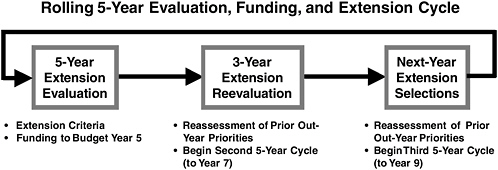
FIGURE ES.1 The rolling-wave planning approach to the mission-extension decision process, as recommended by the committee.
4.5
Preventing the Forward Contamination of Mars
A Report of the Ad Hoc Committee on Preventing the Forward Contamination of Mars
Executive Summary
The National Aeronautics and Space Administration’s (NASA’s) goals for space exploration over the coming decades place a strong priority on the search for life in the universe,1 and the agency has set in place ambitious plans to investigate environments relevant to possible past or even present life on Mars. Over the next decade NASA plans to send spacecraft to search for evidence of habitats that may have supported extinct life or could support extant life on Mars; Europe will also send robotic explorers.
These future missions, in addition to the ongoing suite,2 will continue to deliver scientific data about the planet and reduce uncertainties about the prospects for past or present life on Mars. To ensure that scientific investigations to detect life will not be jeopardized, scientists have pressed, as early as the dawn of the space age, for measures to protect celestial bodies from contamination by Earth organisms that could hitchhike on a spacecraft, survive the trip, and grow and multiply on the target world.3
Preventing the forward contamination of Mars is the subject of this report, which addresses a body of policies, requirements, and techniques designed to protect Mars from Earth-originating organisms that could interfere with and compromise scientific investigations. The report does not assess forward contamination with respect to potential human missions to Mars, nor does it explore issues pertaining to samples collected on Mars and returned to Earth, so-called back contamination.4 Those two dimensions of planetary protection, although extremely important, are beyond the scope of the charge to the Committee on Preventing the Forward Contamination of Mars. The recommendations made in this report do apply to one-way robotic missions that may serve as precursors to human missions to Mars. Included are recommendations regarding levels of cleanliness and biological burden on spacecraft destined for Mars, the methods employed to achieve those levels, and the scientific investigations needed to reduce uncertainty in preventing the forward contamination of Mars. In addition, this report urges dialogue at the earliest opportunity on broader questions about the role of planetary protection policies in safeguarding the planet Mars and an indigenous biosphere, should one exist.
In the United States, NASA has responsibility for implementing planetary protection policies that are developed in the international scientific community and, specifically, within the Committee on Space Research (COSPAR), a multidisciplinary committee of the International Council for Science (ICSU; formerly the International Council of Scientific Unions). COSPAR policies on planetary protection have evolved over time as scientists have acquired new information about Mars and other planets and about the potential for life to survive there. NASA has requested this National Research Council (NRC) study, and previous studies on the same topic from the NRC’s Space Studies Board (SSB), to inform U.S. planetary protection practices; in turn, the NRC studies have provided input to the official COSPAR policies on planetary protection.
The committee evaluated current science about Mars, the ability of organisms to survive at the extremes of conditions on Earth, new technologies and techniques to detect life, methods to decontaminate and sterilize spacecraft, and the history and prior bases of planetary protection policy, as well as other relevant scientific, technical, and policy factors. It found that (1) many of the existing policies and practices for preventing the forward
NOTE: “Executive Summary” reprinted from Preventing the Forward Contamination of Mars, The National Academies Press, Washington, D.C., 2006, pp. 1-10.
contamination of Mars are outdated in light of new scientific evidence about Mars and current research on the ability of microorganisms to survive in severe conditions on Earth; (2) a host of research and development efforts are needed to update planetary protection requirements so as to reduce the uncertainties in preventing the forward contamination of Mars; (3) updating planetary protection practices will require additional budgetary, management, and infrastructure support; and (4) updating planetary protection practices will require a roadmap, including a transition plan with interim requirements, and a schedule. In addition, the committee found that scientific data from ongoing Mars missions may point toward the possibility that Mars could have locales that would permit the growth of microbes brought from Earth, or that could even harbor extant life (although this remains unknown),5 and that these intriguing scientific results raise potentially important questions about protecting the planet Mars itself, in addition to protecting the scientific investigations that might be performed there.
Taken together, the committee’s recommendations constitute a roadmap for 21st-century planetary protection that emphasizes research and development; interim requirements; management and infrastructure for the transition to a new approach; and a systematic plan, process, and time line.
This executive summary presents a subset of the committee’s recommendations. All of the committee’s recommendations are included and discussed in Chapter 8.
RESEARCH AND DEVELOPMENT FOR 21st-CENTURY PLANETARY PROTECTION
For the most part, the bulk of NASA research and development on techniques to prevent the forward contamination of Mars was conducted during the Viking era, when the agency was preparing to send two landers to Mars that would include life-detection experiments.6 Since the Viking program, continuing though comparatively little research has been done on planetary protection techniques, owing to the 20-year hiatus in Mars lander missions (Viking in 1976, Mars Pathfinder in 1996), the post-Viking perspective that Mars was a dry and barren place, and the expense and effort required to research, develop, and implement new requirements to prevent the forward contamination of Mars.7
The techniques currently available to detect contamination of spacecraft by microbes to some extent reflect the technologies that might be used to detect life on solar system bodies such as Mars. Life-detection techniques have advanced considerably, in part because of burgeoning biotechnology sciences and industries, allowing researchers the opportunity to employ molecular methods to identify the kinds and numbers of organisms that might be found in a spacecraft assembly area or on a spacecraft destined for Mars.
Knowledge about the diversity of organisms in clean rooms where spacecraft are assembled or on the spacecraft themselves has several important implications for planetary protection. At present, however, the standard assay method used for detecting microbes on spacecraft—a method that relies on detecting the presence of heat-resistant, spore-forming bacteria, which serve as a proxy for bioburden on the spacecraft—does not provide information about other organisms that might be present on spacecraft. Such organisms include the extremophiles—terrestrial organisms that survive and grow under severe conditions on Earth such as extremes of temperatures (hot and cold) and salinity, low availability of water, high levels of radiation, and other conditions previously considered hostile to life. Based on current understanding of Mars, it is thought that such organisms, especially the cold-loving ones (psychrophiles and psychrotrophs), are among those that might have the best chance of surviving and replicating in martian near-surface environments, as discussed in Chapter 5. Knowing specifically about the organisms present in assembly, test, and launch operations environments that might have the potential to survive a trip to, and possibly grow on, Mars would allow engineers to tailor methods to decontaminate a spacecraft and its instruments more effectively prior to launch than is now done. Other organisms with known intolerances for
conditions much less severe than the harshness of interplanetary travel would be of less concern for preventing forward contamination, although efforts to clean8 spacecraft would still be important for many missions.
A more tailored approach to bioburden reduction could also reduce the costs of implementing planetary protection as compared with the costs of existing approaches such as heat sterilization, which subjects a spacecraft, or specific parts of a spacecraft, to high temperatures over several hours in order to reduce the bioburden to the levels required by NASA for life-detection missions. Furthermore, heat sterilization, which was researched for and applied on the Viking mission in 1976, has not been tested for its effectiveness in eliminating extremophiles or other organisms now known to tolerate high heat. The committee therefore concluded that, ultimately, preventing the forward contamination of Mars requires an understanding of the kinds of organisms that could be present on spacecraft and sterilization or decontamination measures tailored to eliminate those organisms of concern.
To that end, the committee recommends a suite of research and development measures to enable updating of planetary protection practices to reflect the latest science and technology.
-
NASA should require the routine collection of phylogenetic data to a statistically appropriate level to ensure that the diversity of microbes in assembly, test, and launch operations (ATLO) environments, and in and on all NASA spacecraft to be sent to Mars, is reliably assessed. NASA should also require the systematic archiving of environmental samples taken from ATLO environments and from all spacecraft to be sent to Mars. (Recommendation 5, Chapter 8)
-
NASA should sponsor research on those classes of microorganisms most likely to grow in potential martian environments. Given current knowledge of the Mars environment, it is most urgent to conduct research on psychrophiles and psychrotrophs, including their nutritional and growth characteristics, their susceptibility to freeze-thaw cycles, and their ability to replicate as a function of temperature, salt concentration, and other environmental factors relevant to potential spaceflight and to martian conditions. (Recommendation 6, Chapter 8)
-
NASA should ensure that research is conducted and appropriate models developed to determine the embedded bioburden (the bioburden buried inside nonmetallic spacecraft material) in contemporary and future spacecraft materials. Requirements for assigned values of embedded bioburden should be updated as the results of such research become available. (Recommendation 7, Chapter 8)
-
NASA should sponsor studies of bioburden reduction techniques that are alternatives to dry-heat sterilization. These studies should assess the compatibility of these methods with modern spacecraft materials and the potential that such techniques could leave organic residue on the spacecraft. Studies of bioburden reduction methods should also use naturally occurring microorganisms associated with spacecraft and spacecraft assembly areas in tests of the methods. (Recommendation 8, Chapter 8)
-
NASA should sponsor research on nonliving contaminants of spacecraft, including the possible role of propellants for future Mars missions (and the potential for contamination by propellant that could result from a spacecraft crash), and their potential to confound scientific investigations or the interpretation of scientific measurements, especially those that involve the search for life. These research efforts should also consider how propulsion systems for future missions could be designed to minimize such contamination. (Recommendation 9, Chapter 8)
-
NASA should take the following steps to transition toward a new approach to assessing the bioburden on spacecraft:
-
Transition from the use of spore counts to the use of molecular assay methods that provide rapid estimates of total bioburden (e.g., via limulus amebocyte lysate (LAL) analysis) and estimates of viable bioburden (e.g., via adenosine triphosphate (ATP) analysis). These determinations should be combined with the use of phylogenetic techniques to obtain estimates of the number of microbes present with physiologies that might permit them to grow in martian environments.
-
Develop a standard certification process to transition the new bioassay and bioburden assessment and reduction techniques to standard methods.
-
|
8 |
“Cleaning” refers to reducing any nonliving contaminants of concern as well as living contaminants. Decontamination, bioburden reduction, and sterilization refer to standard methods that have proven to reduce the presence of bacterial spores to quantifiable levels. (See Chapter 2 for details.) |
-
Complete the transition and fully employ molecular assay methods for missions to be launched in 2016 and beyond. (Recommendation 11, Chapter 8)
INTERIM REQUIREMENTS FOR USE UNTIL R&D EFFORTS ARE COMPLETE
Until the above-recommended R&D activities have been completed, the committee believes that the existing framework for planetary protection methods should be updated to reflect recent science regarding environments on Mars and knowledge about extremophiles. There is too much new information about the planet and new science about microorganisms not to update the existing framework of planetary protection requirements while research efforts are being conducted.
The most critical issue regarding Mars science and the potential forward contamination of Mars concerns so-called special regions. A “special region” is defined by COSPAR planetary protection policy as being “a region within which terrestrial organisms are likely to propagate, or a region which is interpreted to have a high potential for the existence of extant martian life forms” (COSPAR, 2003, p. 71). Under existing COSPAR policy, missions to Mars are categorized as IVa (those without life-detection instruments), IVb (those with life-detection instruments),9 or IVc (those going to special regions, regardless of instrumentation), and COSPAR policy sets levels of bioburden reduction differently for missions categorized as IVa, IVb, or IVc. Missions categorized as IVa are allowed higher levels of bioburden than missions that will carry life-detection instruments (IVb) or missions going to special regions (IVc).
The committee found, as discussed in Chapter 4, that there is at this time insufficient data to distinguish confidently between “special regions” and regions that are not special. Scientific results from the Mars Exploration Rovers and Orbiter missions have provided evidence for the existence of past water on Mars and suggest that it is substantially more likely that transient liquid water may exist near the surface at many locations on Mars. It is very difficult on the basis of current knowledge to declare with confidence that any particular regions are free of this possibility. Additional information is needed to identify the presence of liquid water, and collection of such data should continue to be a high priority.
-
NASA’s Mars Exploration Office should assign high priority to defining and obtaining measurements needed to distinguish among special and nonspecial regions on Mars. (Recommendation 10, Chapter 8)
The committee developed a new set of categorizations for Mars missions, IVs (missions to special regions) and IVn (missions not going to special regions). In the absence of sufficient data to distinguish IVs from IVn, the committee recommends that all landed missions to Mars be treated as IVs until additional data indicate or allow otherwise.
-
For the interim period until updated planetary protection methods and techniques can be fully implemented,
-
NASA should replace Categories IVa through IVc for Mars exploration with two categories, IVn and IVs. Category IVs applies to missions that are landing or crashing in, or traversing, excavating, or drilling into, special regions; Category IVn applies to all other Category IV missions.
-
Each mission project should (in addition to meeting the requirements imposed by Categories IVn and IVs) ensure that its cleanliness with respect to bioburden and nonliving contaminants of concern is sufficient to avoid compromising its experiments, in consultation with NASA’s planetary protection officer. (Recommendation 12, Chapter 8)
-
-
Until measurements are made that permit confident distinguishing between regions that are special on Mars and those that are not, NASA should treat all direct-contact missions (i.e., all Category IV missions) as Category IVs missions. (Recommendation 13, Chapter 8)
In addition to the issue of special regions, the committee analyzed several other issues pertinent to Category IV missions, including the kinetics of the growth of microorganisms that could potentially reproduce on Mars, the possibility of long-lived water, the probability of a mission crash, and the potential for radioisotope thermal generators (RTGs) to create liquid water. Based on this analysis, the committee devised five levels of bioburden reduction for application to Mars missions (see Table 8.1, Chapter 8).
-
NASA should ensure that all category IVs missions to Mars satisfy at least level 2 bioburden reduction requirements.10 For each IVs mission, NASA’s planetary protection officer should appoint an independent, external committee with appropriate engineering, martian geological, and biological expertise to recommend to NASA’s planetary protection officer whether a higher level of bioburden reduction is required. This analysis should be completed by the end of Phase A (performance of the concept study) for each mission. (Recommendation 14, Chapter 8)
MANAGING THE TRANSITION TO NEW PLANETARY PROTECTION POLICIES AND PRACTICES
Transitioning NASA’s planetary protection practices to reflect current scientific understanding of Mars and advances in microbiology and to benefit from advanced technologies will require investments in a series of research and development efforts and assessments of new technologies that can be applied to the implementation of planetary protection policies. A successful transition will also depend on an infrastructure for managing these research efforts and on coordination with the engineering, spacecraft/instrument development, and science communities at NASA headquarters, NASA centers, industry, universities, research laboratories, and with the international community, especially COSPAR.
The committee recognizes that the research activities it recommends have cost implications. But it points out that the search for past and present life is cited as the second of NASA’s 18 strategic objectives (NASA, 2005), and the attention to identifying potential habitats for life on Mars is reflected in the ambitious series of missions comprised by the Mars Exploration Program. Additional resources for updating planetary protection practices are critical for ensuring the integrity of these important scientific investigations. Such an investment could also introduce innovation into the planetary protection process, such as advanced technologies and methods that could potentially lead to faster and more effective practices for assessing and reducing the bioburden on Mars-bound spacecraft.
-
NASA should establish and budget adequately for, on an ongoing basis, a coordinated research initiative, management capability, and infrastructure to research, develop, and implement improved planetary protection procedures. The research initiative should include a training component to encourage the growth of national expertise relevant to planetary protection. (Recommendation 2, Chapter 8)
In addition, recognizing the rapid advances in scientific understanding being gained from existing Mars missions and anticipated as a result of future missions, advances in life-detection technologies, and growth in research on and understanding of extremophiles, the committee concluded that NASA’s planetary protection practices should be revisited on a 3-year basis to allow regular updates, as necessary.
-
NASA should establish an independent review panel that meets every 3 years to (1) consider the latest scientific information about Mars, as well as about Earth microorganisms, and recommend to NASA appropriate modifications to NASA’s planetary protection implementation requirements as needed in light of new knowledge; and (2) identify and define the highest-priority measurements needed at Mars to inform future assessments and possible modifications of planetary protection requirements. (Recommendation 4, Chapter 8)
The first meeting of the review panel should be held in 2008, and meetings should occur every 3 years thereafter, unless major changes in understanding of Mars or other factors related to planetary protection require meetings on an urgent basis.
RECONSIDERING PLANETARY PROTECTION: PROTECTING THE SCIENCE AND PROTECTING THE PLANET
Historically, planetary protection policy has addressed the concern that the forward contamination of planetary environments by terrestrial organisms could compromise current or subsequent spacecraft investigations sent to search for indigenous life. As a result, current practice imposes the strictest standards of cleanliness on those spacecraft that will conduct life-detection experiments, whereas spacecraft that will not search for life are required to meet less stringent standards. Nevertheless, current practice recognizes that missions intended to access “special regions” on Mars must comply with stricter standards, regardless of whether they carry life-detection instruments.
As discussed in Chapter 4, recent discoveries suggest that there may be numerous (and potentially difficult to detect) environments on Mars where the potential for terrestrial organisms to grow is substantially higher than previously thought. For that reason, the committee recommends increased requirements for bioburden reduction until the results of new research and development make it possible to reduce the uncertainty in preventing the forward contamination of Mars. There remains the potential that lower standards of bioburden reduction permitted for spacecraft that do not include life-detection experiments may permit the introduction of terrestrial organisms into sensitive environments where they may reproduce over long time scales—posing a potential long-term threat to any indigenous biosphere that may exist.
Although ethical issues concerning the introduction of terrestrial organisms into sensitive extraterrestrial environments fall outside the mandate of the current committee, the committee believes that they should be given consideration at the earliest opportunity. The need for urgency in this deliberation is underscored by the current uncertainty regarding the extent and distribution of sensitive martian environments, the failure rate and cleanliness levels of past Mars landers, and the projected rapid pace of future spacecraft investigations. For these reasons, the committee recommends that NASA and its international partners address this issue as expeditiously as possible.
-
In light of new knowledge about Mars and the diversity and survivability of terrestrial microorganisms in extreme environments, NASA should work with COSPAR and other appropriate organizations to convene, at the earliest opportunity, an international workshop to consider whether planetary protection policies for Mars should be extended beyond protecting the science to include protecting the planet. This workshop should focus explicitly on (1) ethical implications and the responsibility to explore Mars in a manner that minimizes the harmful impacts of those activities on potential indigenous biospheres (whether suspected or known to be extant), (2) whether revisions to current planetary protection policies are necessary to address this concern, and (3) how to involve the public in such a dialogue about the ethical aspects of planetary protection. (Recommendation 1, Chapter 8)
PLANETARY PROTECTION IN THE 21ST CENTURY: A ROADMAP
The committee urges that its recommendations be considered as a roadmap; the recommendations build on each other to outline a modern planetary protection regime. (See Figure ES.1.) The committee also encourages NASA to implement these recommendations according to a transition plan and time line, as illustrated in Figure ES.2.

FIGURE ES.1 The proposed framework for moving from the current approach to the new approach to planetary protection (PP), along with the programmatic support and overarching policy considerations required to make the transition.
TRANSITION PLAN, PROCESS, AND TIME LINE
Given the rapid advancement in in situ science instrument capabilities and the possibility of contamination in a Mars environment potentially more water-rich than previously believed, it is important to review and adjust Mars forward contamination requirements and procedures as expeditiously as possible.11 That said, the earliest chance to alter planetary protection procedures for Mars and begin to demonstrate, verify, and validate new methods from the ground up would likely be on the next new (not yet in development) flight project, i.e., the 2011 Mars Scout mission. The next program-directed mission, possibly a Mars Sample Return mission to be flown in 2013, will probably also begin its development at the same time as the 2011 Mars Scout mission, because it is expected to be a more complex mission and to require more development time before launch. Hence, there will be an opportunity during Fiscal Year 2008, when development of both the 2011 and the 2013 Mars missions is expected to start, to begin to test and demonstrate the effectiveness of new bioburden reduction requirements and procedures. Implementation of a new, completely validated planetary protection protocol that employs advanced bioassay and
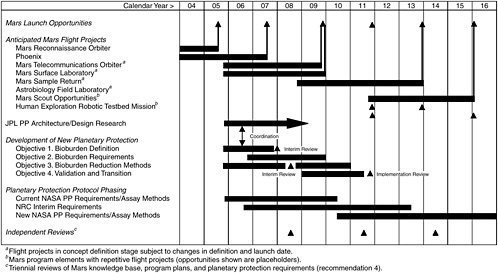
FIGURE ES.2 Proposed schedule for the revision of Mars planetary protection requirements.
bioburden reduction methods would more realistically be accomplished on a mission developed for launch early in 2016. Such a transition would have to be initiated no later than the beginning of Fiscal Year 2012.
A set of four objectives for development of a new planetary protection plan and a schedule based on these considerations, along with the development periods for all current and planned missions through the 2016 launch, is depicted in Figure ES.2. The four objectives are as follows:
-
Objective 1: Assessment of spacecraft contaminants. The first step is to determine what microbes present in the construction, testing, and launch of Mars missions actually constitute potential threats either to Mars science or for contamination of the planet Mars itself. Assaying to know exactly what constitutes the bioburden within spacecraft development, assembly, and test facilities should be followed by determining what fraction of this bioburden could actually threaten to contaminate the Mars environment or confound planned life-detection measurements.
-
Objective 2: Definition and development of revised requirements for reduction of bioburden. Review and revision of existing standards for reduction of bioburden (specifications), in terms of both parameters and limits, would follow from the ability to expressly target those microbial populations of greatest concern as potential contaminants (objective 1).
-
Objective 3: Improvement of bioburden reduction techniques. Alternative bioburden reduction techniques could offer more effective and/or less stressful means of reducing or eliminating species-specific bioburdens. Knowing where and what bioburden must be reduced is necessary to determining when and how bioburden reduction can be accomplished and maintained throughout the mission development process.
-
Objective 4: Validation of and transition to new standards and techniques. Changes in planetary protection practices enabled by meeting objectives 1 through 3 and proposed in response to the committee’s recommendations must be validated. Hence new practices should be demonstrated and tested during a validation period in which existing bioburden reduction requirements continue to apply. Once validated and certified, new practices can then be applied with the confidence that they will provide the benefits expected, and old approaches can be phased out.
A complete transition to applying modern methods (without concurrent application of existing bioassay and bioburden reduction techniques) would most realistically be accomplished on a mission developed for launch early
in 2016. Such a transition would have to be initiated no later than the beginning of Fiscal Year 2012. Assuming that a detailed research plan embracing the objectives outlined above is developed, reviewed, and funded within the next few years, NASA could accomplish the first three objectives outlined above within the next 6 years, as suggested in the proposed timeframe shown in Figure ES.2. Addressing the four objectives in the committee’s recommended approach to updating planetary protection is an effort that clearly should be coordinated with a planned research effort at the Jet Propulsion Laboratory (JPL) (shown in Figure ES.2 as the JPL Planetary Protection Architecture/ Design Research component) that shares several of the objectives of the approach outlined here. At NASA’s discretion, this JPL work could even be integrated with the approach and schedule suggested here.
Because the results of each objective discussed above feed into and affect the subsequent objectives, periodic review of research progress by an independent panel is strongly recommended. As a separate matter, the committee recognizes that there would be an important interface to maintain with COSPAR to gain concurrence on a process that would clearly change how NASA complies with internationally acceptable planetary protection protocol.
The objectives for updating Mars planetary protection clearly illustrate that changing NASA’s current approach to embrace advances in microbiology and growing understanding of Mars cannot be done quickly. Even an aggressive plan such as that outlined here will take the better part of a decade to complete and fully apply to the Mars Exploration Program. There is, therefore, every reason to begin the work at hand as quickly as possible.
REFERENCES
Baker, A. 2001. Space Hardware Microbial Contamination Workshops 1 and 2. A Report from Workshops at Moffett Field Calif. (December 1999) and Golden Colo. (June 2001). Contract No. A63616D(SXS). NASA Ames Research Center, Moffett Field, Calif.
Baker, A., and J.D. Rummel. 2005. Planetary Protection Issues in the Human Exploration of Mars. Final Report and Proceedings, February 10-12, 2004, Cocoa Beach, Fla. NASA/CP-2005-213461. NASA Ames Research Center, Mountain View, Calif.
Bionetics Corporation. 1990. Lessons Learned from the Viking Planetary Quarantine and Contamination Control Experience. Contract NASW-4355. NASA, Washington, D.C.
COSPAR. 2003. Report on the 34th COSPAR Assembly, COSPAR Information Bulletin, No. 156, April, pp. 24, 67-74. Elsevier Science Ltd., Oxford, United Kingdom.
Dickinson, D.N., M.T. La Duc, W.E. Haskins, I. Gornushkin, J.D. Winefordner, D.H. Powell, and K. Venkateswaran. 2004a. Species differentiation of a diverse suite of Bacillus spores using mass spectrometry based protein profiling. Appl. Environ. Microbiol. 70: 475-482.
Dickinson, D.N., M.T. La Duc, M. Satomi, J.D. Winefordner, D.H. Powell, and K. Venkateswaran. 2004b. MALDI-TOFMS compared with other polyphasic taxonomy approaches for the identification and classification of Bacillus pumilis spores. J. Microbiol. Methods 58(1): 1-12.
Kminek, G., and J.D. Rummel, eds. 2005. Planetary Protection Workshop on Sterilization Technologies. ESA WPP-243, ISSN 1022-6656, June.
MEPAG (Mars Exploration Program Analysis Group). 2004. Scientific Goals, Objectives, Investigations, and Priorities: 2004, unpublished document. Available at <mepag.jpl.nasa.gov/reports/index.html>.
MSPSG (Mars Science Program Synthesis Group). 2004. Mars Exploration Strategy, 2009-2020. D.J. McCleese, ed. JPL 400-1131. Jet Propulsion Laboratory, Pasadena, Calif.
NASA (National Aeronautics and Space Administration). 2003. National Aeronautics and Space Administration 2003 Strategic Plan. NP-2003-01-298-HQ. NASA, Washington, D.C.
NASA. 2005. The New Age of Exploration: NASA’s Direction for 2005 and Beyond. NP-2005-01-397-HQ. NASA, Washington, D.C.
NRC (National Research Council). 1992. Biological Contamination of Mars: Issues and Recommendations. National Academy Press, Washington, D.C.
Venkateswaran, K., M. Satomi, S. Chung, R. Kern, R. Koukol, C. Basic, and D. White. 2001. Molecular microbial diversity of spacecraft assembly facility. Syst. Appl. Microbiol. 24: 311-320.
Venkateswaran, K., N. Hattori, M.T. La Duc, and R. Kern. 2003. ATP as a biomarker of viable microorganisms in clean-room facilities. J. Microbiol. Methods 52: 367-377.
4.6
Principal-Investigator-Led Missions in the Space Sciences
A Report of the Ad Hoc Committee on Principal-Investigator-Led Missions in the Space Sciences
Executive Summary
Beginning in the early to mid-1990s, NASA moved toward mission lines that offer scientists the opportunity to lead their own space science missions. Before that, scientists had taken responsibility for science instruments and data analysis on a mission, but NASA had managed the projects and developed the spacecraft.1 As a first step, NASA introduced the Discovery Program and developed it into a competitive, peer-reviewed mission line moving toward planetary science exploration under the principal investigator (PI) mode.2 Then it transitioned the Explorer Program, the oldest of its competitive mission lines, to the PI-led mode as well. Explorer missions are focused on goals in solar and space physics and in astrophysics; Discovery missions address solar system exploration and the goals of NASA’s Origins and Astrobiology programs. The PI-led approach gives scientists more autonomy and freedom in the decision making and management of a developing space mission but at the same time enforces a strict cost cap that constrains competition for the selection and subsequent development of the PI-led mission. In the last 5 years, NASA has introduced two additional PI-led mission lines: Mars Scout provides mission opportunities for the Mars Exploration Program, and New Frontiers invites proposals for targeted solar system exploration.
Thirteen PI-led projects have successfully achieved—or are about to achieve—their mission, and eight others are currently in various stages of development. Two suffered technical failures and one was canceled. In addition, the PI-led mission lines have had to adjust to the changing environment at NASA and in society as a whole. Recently, PI-led mission costs and schedules have increased so much that NASA is considering what lessons might be learned from the different PI-led programs and whether the programs can be improved. To that end, NASA asked the Space Studies Board of the National Research Council to explore the factors contributing to the successes and challenges of PI-led missions. The Committee on Principal-Investigator-Led Missions in the Space Sciences undertook this task with the understanding that such missions are an essential, scientifically productive component within NASA’s suite of missions that complements the strategic missions emerging from the decadal survey and roadmap processes. The importance of these small and medium Discovery- and Explorer-class missions was noted in several previous NRC reports;3-5 one of them, a 2004 report,6 stated:
The Explorer program contributes vital elements that are not covered by the mainline … missions. Explorers fill critical science gaps in areas that are not addressed by strategic missions, they support the rapid implementation of attacks on very focused topics, and they provide for innovation and the use of new approaches that are difficult to incorporate into the long planning cycles needed to get a mission into the strategic mission queues…. The Explorers also provide a particularly substantial means to engage and train science and engineering students in the full life cycle of space research projects. Consequently, a robust … science program requires a robust Explorer program.
Input from PIs, project managers (PMs), and others led the committee to the following overall finding:
Finding. The space science community believes that the scientific effectiveness of PI-led missions is largely due to the direct involvement of PIs in shaping the decisions and the mission approach to realizing the proposed science concepts.
NOTE: “Executive Summary” reprinted from Principal-Investigator-Led Missions in the Space Sciences, The National Academies Press, Washington, D.C., 2006, pp. 1-9.
In this report the committee recommends practices and incentives for improving the overall conduct of PI-led missions. In particular, it recommends adjustments to the selection and implementation processes that aim to strengthen the mission-line programs so that they can continue to provide one of the best science returns per taxpayer dollar for NASA, the scientific community, and the public. The committee’s findings and recommendations are presented below and organized into five themes: the selection process, funding profiles, international contributions, program management, and project management.
SELECTION PROCESS
Information gathered by the committee indicates that the scientific and technical communities invest excessive effort in preparing proposals for PI-led mission programs and that few institutions can or should maintain the infrastructure support (administrative, management, cost estimation) that is required for responding to announcements of opportunity (AOs) for PI-led missions. The review panels involved in evaluating and selecting PI-led mission proposals need to be able to make their decisions based on a more concise set of essential information and in the end to select from proposals that have made a short list and that have been better developed because proposers received funding to prepare mission concept studies. As a result of the large number of detailed proposals submitted in response to AOs, for which NASA conducts separate science and technical merit reviews, the selection process can be inefficient and ineffective. The administrative, management, and cost analysis efforts and the time involved in preparing proposals (for which the chance of success is only 10 percent or less) are unnecessarily exhausting proposers and reviewers, depleting their resources and resulting in selections that in some cases are destined for cost and schedule problems from the start. NASA may wish to reconsider the basic ideas behind the technical, management, cost (TMC) experiment of 1999, TMC-lite, which tried out a selection process aimed at reducing the information required in a proposal and, thus, the burden on the proposer. NASA may also wish to consider emphasizing certain scientific targets or concept areas in the AOs as a means of reducing the number of proposals submitted—and another means of reducing the burden on proposers. On the other hand, the concept studies that will be required after the provisional selection round of competition need to be more mature in project design definition and TMC planning in order to provide a sound basis for final evaluation and selection.
Proposals and Reviews
Finding. The PI-led mission selection process could be made more efficient and effective, minimizing the burden on the proposer and the reviewer and facilitating the selection of concepts that become more uniformly successful projects.
Recommendation 1. NASA should consider modifying the PI-led mission selection process in the following ways:
-
Revise the required content of the mission proposals to allow informed selection while minimizing the burden on the proposing and reviewing communities by, for example, reconsidering the TMC-lite approach and eliminating the need for content that restates program requirements or provides detailed descriptions such as schedules that would be better left for postselection concept studies,
-
Alter the order of the review process by removing low- to medium-ranking science proposals from the competition before the TMC review, and
-
Allow review panels to further query proposers of the most promising subset of concepts for clarification, as necessary.
Finding. The still-competitive but already funded concept study stage (Phase A) of selected, short-listed PI-led missions is the best stage for the accurate definition of the concept details and cost estimates needed to assist in final selection.
Recommendation 2. NASA should increase the funding for and duration of concept studies (Phase A) to ensure that more accurate information on cost, schedule, and technical readiness is available for final selection of PI-led missions.
Finding. Community-based studies of science opportunities and priorities can be used to focus AO proposals on specific topics of great interest and to guide the choices of selection officials.
Recommendation 3. NASA should make explicit all factors to be considered in the selection of PI-led missions—for example, targets and/or technologies that are especially timely and any factors related to allocating work among institutions and NASA centers.
Proposing Team Experience and Leadership
The committee finds that the importance of team experience and interpersonal and institutional interactions cannot be overstated. The officials who select PI-led missions need to be able to evaluate and duly weigh the teaming aspect of a proposed mission. Along the same lines, the members of a chosen mission, especially the PI and the technical PMs, need to seek out experienced teammates, especially individuals who have worked on other PI-led missions, suborbital projects, core missions, and/or technology development projects such as complex technical systems or instruments. NASA can help to make these experiences available to younger scientists and engineers and also to foster the transfer of information from active mission teams to potential proposers.
Finding. The combined relevant experience of the PI and the PMs in PI-led missions is critical to mission success. Programs can emphasize the importance of experience in their selections and create opportunities for prospective PIs and PMs to gain such experience.
Recommendation 4. NASA should develop PI/PM teams whose combined experience and personal commitment to the proposed implementation plan can be evaluated. NASA should also provide opportunities for scientists and engineers to gain practical spaceflight experience before they become involved in PI-led or core NASA missions. These opportunities could become available as a result of revitalizing some smaller flight programs, such as the sounding rocket and University-class Explorer programs.
Technology Readiness
Based on its interviews and data-gathering efforts, the committee identified underdeveloped technologies as a major source of cost and schedule problems for PI-led missions. At the same time, the committee found that opportunities—for example, availability of competed funds—for developing technologies for PI-led missions outside the actual mission were limited. Explicit, competed technology development components for each PI-led program (Discovery, New Frontiers, Explorer, Mars Scout) could help ensure that a pipeline of technology developments, from the breadboard to the brassboard levels (closer to flight-ready design), will be available for use on future PI-led missions. Such competed technology development efforts would diminish the likelihood that untested technologies would be used in a PI-led mission.
Finding. As a rule, PI-led missions are too constrained by cost and schedule to comfortably support significant technology development. Those missions that include technology development inevitably have cost and schedule problems. Regular technology development opportunities managed by PI-led programs could lead to a technology pipeline that would help to enable successful mission selection and implementation.
Recommendation 5. NASA should set aside meaningful levels of regular funding in PI-led programs to sponsor relevant, competed technology development efforts. The results from these program-oriented activities should be made openly available on the program library Web site and in articles published in journals or on the World Wide Web.
FUNDING PROFILES
Project funding profiles—schedules for spending a project’s funds for development, implementation, and operations—have been mandated in some AOs, resulting in funding increments that force the PI to follow a development schedule that may be inefficient or even risky. For instance, funds spent early on instrumentation or
systems technologies can ensure that the instruments have been tested sufficiently before being integrated onto the spacecraft. The selection process could include an evaluation of the funding profile established by the proposer(s). NASA could consider adjusting a project’s cost caps if it cannot secure funds on the schedule proposed for the selected mission.
Finding. Funding profiles represent a special challenge for PI-led missions because they are planned at the mission concept stage with the goals of minimizing costs and achieving schedules. However, like all NASA missions, PI-led missions are subject to the availability of NASA funding, annual NASA budgetary cycles, and agency decisions on funding priorities, all of which can disrupt the planned funding profiles for PI-led missions.
Recommendation 6. NASA and individual mission PIs should mutually agree on a funding profile that will support mission development and execution as efficiently as possible. If NASA must later deviate from that profile, the mission cost cap should be adjusted upward to cover the cost of the inefficiency that results from the change in funding profile (see Recommendation 10).
INTERNATIONAL CONTRIBUTIONS
International contributions have an important impact on the science capabilities of PI-led missions, often providing major pieces of the science instrument payload. Yet these collaborations are viewed as risky because it is difficult to get foreign entities to commit funds before a proposal has been selected and to conduct technical exchanges in the face of International Traffic in Arms Regulations (ITAR) requirements. While the increased national emphasis on ITAR, with its sometimes poorly defined restrictions on technology and technical information exchange, has hurt many NASA mission programs, its impact on the highly cost-constrained PI-led missions can be even more damaging, especially as it discourages the involvement of international team members. University and student participation in PI-led missions, ostensibly an advantage of the PI-led approach, can also be compromised because, based on ITAR concerns, NASA in its contracts with universities, private industry, or other entities restricts the access of some individuals to certain technical information.
Finding. International contributions have an important positive impact on the science capabilities of PI-led missions but are faced with an increasingly discouraging environment, in part due to ITAR. In addition, logistical difficulties associated with foreign government budgetary commitments and the timing of proposals and selections persist. The result is both real and perceived barriers to teaming and higher perceived risk for missions including international partners.
Recommendation 7. NASA PI-led-mission program officials should use recent experiences with ITAR to clarify for proposers (in the AO) and for selected projects (e.g,, in guidance on writing technical assistance agreements and transferal letters7) the appropriate application of ITAR rules and regulations.
PROGRAM MANAGEMENT
Role of the Program Office
The PI-led mission program offices provide support and oversight functions for PI-led projects. Each of the offices, which are staffed by NASA personnel, has a different location, style of operating, and approach to assisting the PI-led projects in its program. The Explorer Program Office at Goddard Space Flight Center (GSFC) has, through its long history and NASA center infrastructure, provided substantial project assistance. The Discovery Program Office has been relocated on more than one occasion and is in a state of flux, which has led to difficulties for some Discovery missions. A recently merged Discovery and New Frontiers Program Office is in the process of being reestablished at Marshall Space Flight Center (MSFC), and the relatively new Mars Scout Program Office at the Jet Propulsion Laboratory is managing its first mission.
Finding. The PI-led program offices can play a critical positive role in the success of PI-led missions if they are appropriately located and staffed, and are able to offer enabling infrastructure for projects and NASA Headquarters from the proposal through the implementation stages.
Recommendation 8. NASA should ensure stability at its program offices, while providing sufficient personnel and authority to enable their effectiveness, both in supporting their missions and in reporting to and planning with NASA Headquarters.
Program Oversight Practices
NASA oversight of all missions, including PI-led missions, has been increasing over the past decade, largely in response to the failures of non-PI-led Mars missions in the 1990s, followed by the Columbia shuttle disaster. This increase in oversight has meant cost and schedule difficulties for PI-led missions and has challenged their style of management by adding formal technical and management reviews by NASA-appointed review teams. PI-led mission PMs argue that such reviews can introduce risk into PI-led projects, because they repeatedly distract the team from the planned implementation tasks. Even when compensated for the costs of these reviews, PI-led project managers view NASA-mandated reviews as less useful to their projects than informal peer reviews of subsystems in which small numbers of experts external to the project provide technical assessments and advice. NASA needs to consider both the appropriate level of oversight for PI-led missions and adjustments to the cost caps to cover the cost of additional reviews. Such actions would be especially timely in view of the recent establishment of the Independent Technical Authority (ITA), a new technical oversight organization whose impact on NASA science missions is still undetermined, according to NASA interviewees.
Finding. NASA oversight of PI-led missions, as well as of all missions, increased following a string of mission failures in the late 1990s and is again increasing following the Columbia shuttle disaster. Some of the added oversight, and especially the style of that oversight, appears excessive for robotic missions as small as the PI-led missions. Increases in oversight also strain project resources and personnel to the point of adding risk rather than reducing it.
Recommendation 9. NASA should resist increasing PI-led mission technical and oversight requirements—as for example, on quality assurance, documentation, ITA-imposed requirements, or the use of independent reviews—to the level of requirements for larger core missions and should select missions whose risks are well understood and that have plans for adequate and effective testing.
Finding. There is confusion about the processes in place for adjusting PI-led mission cost caps and schedules to accommodate oversight requirements introduced after selection.
Recommendation 10. NASA should clarify the change-of-scope procedures available for projects to negotiate the cost and schedule impacts of any changes in requirements initiated by NASA Headquarters or a PI-led program office, including the addition of reviews, documentation, reporting, and/or increased standards. The schedule impact of negotiating changes of scope should also be evaluated.
Threat of Cancellation
If a PI-led mission is projected to exceed its cost cap for reasons that NASA Headquarters judges to be within the project, the PI-led program office (Explorer, Discovery/New Frontiers, Mars Scout) and NASA Headquarters may call a termination review. The Program Management Council of NASA Headquarters’ Science Mission Directorate conducts these reviews to determine the cause of the cost overrun and the appropriate response. Possible responses to overruns include allowing the mission to proceed, often at additional cost; changing project management and/or contractors in consultation with the PI; descoping the mission (removing systems or instruments); or terminating it. The committee learned that termination reviews are no longer regarded as mission-threatening, because very few missions have been canceled even though some PI-led (and most core) missions do grow beyond their initial cost cap. Moreover, canceling a mission after substantial investment has been made is not reasonable if the mission has no fatal technical issues or additional cost or schedule requirements. However, a PI-led mission is
more vulnerable than a core mission to cancellation or descopes because its cost cap was a key factor in its winning the competition. The committee considers termination reviews as an effective management tool for missions that overrun their cost caps, provided that both NASA and the project teams recognize that such reviews raise the prospect of Headquarters-mandated changes to the mission capability. Lessons learned from these reviews should be used to inform other active PI-led program and project leaders. A related concern is science instrument descopes that have been decided without the PI’s agreement and outside the termination review process.
Finding. The threat of cancellation in a termination review is no longer an effective way of keeping PI-led missions within their cost caps, because few missions have been canceled as a result of exceeding their cost caps. Nevertheless, a termination review is taken seriously because it reflects negatively on project management performance and raises the possibility of science descopes. Project leaders need to be made aware of problems that lead to termination reviews so that they can avoid them.
Recommendation 11. NASA should continue to use the existing termination review process to decide the fate of PI-led missions that exceed their cost cap. It should develop lessons learned from termination reviews and make them available to other PI-led projects.
Finding. High-impact decisions such as descopes made by NASA outside the termination review process undermine a PI’s authority and can cause a mission to lose science capability.
Recommendation 12. NASA should not descope mission capabilities (including science instruments) without the PI’s agreement or outside the termination review process.
PROJECT MANAGEMENT
Technical and Programmatic Failures
The committee found that potentially valuable lessons learned in both the technical and management areas of PI-led missions are neither easily located nor widely discussed despite being resources of which every PI-led mission leader should be aware. The PI-led program offices can help disseminate lessons-learned information. For example, the well-regarded engineering practice “test as you fly,” which replicates in-flight conditions as closely as possible in ground subsystems tests, can be reinforced, useful peer reviewer names shared, and design and parts information quickly aired. Such practices could allow a return to fewer technical requirements, such as prevailed in the early days of PI-led missions.
Finding. Lessons learned from experience in both PI-led and other missions can be extremely valuable for reducing risk and inspiring ideas about how to do things better. Much useful lessons-learned documentation is available on the Web but is not collected in a coherent library or directory. A modest effort by the program offices to locate these distributed documents, provide a centralized Web site containing links, and advertise its existence would allow these lessons to be more widely used.
Recommendation 13. NASA PI-led program officials and PI-led mission teams should study lessons-learned documentation to benefit from the experiences of previous PI-led missions. NASA should make such lessons learned easily and widely available and update them continuously, as is done on the Discovery Program Web site posted by the Langley Research Center.
Team Interactions
The ability of PI-led mission team members, especially the PI and the PM, to work together has a critical impact on the progress of these projects. PIs need to choose a PM they can acknowledge as a technical lead and on whom they can rely. If unresolvable differences arise and appropriate efforts at resolution fail, the PI should have the authority to replace the PM with the concurrence of the relevant program office. Similarly, project leadership and the relevant NASA center and/or industrial teammates should communicate openly and be able to ensure that all team members function in their designated roles. NASA should enable and support PIs in adjusting the composition
of project leadership and teams if that becomes necessary. Similarly, the supporting institution supplying the PM, including a NASA center, should not have the authority to replace the PM without the PI’s agreement.
Finding. The leaders of PI-led missions occasionally find they must replace a manager or a key team member to reach their goals. While the cost and schedule impacts of such a major change must be considered, a change in project management needs to be allowed if it is for the good of the mission. The PI should make all final decisions on project management personnel.
Recommendation 14. NASA and the PIs should include language in their contracts that acknowledges the PI’s authority to make the final decisions on key project personnel.
Cost, Schedule, and Science Performance
The committee encountered difficulties in obtaining a consistent set of mission cost performance summaries, a situation that apparently stems from differences in the ways in which the different PI programs and projects keep cost and budget records. While many records contain useful mission budgetary and schedule information, the committee was unable to obtain the kind of moderately detailed data that would normally be expected to be readily available for NASA’s own internal use or for an analysis of historical trends. Consolidating records into a few standard templates for mission programs, including PI-led missions, would facilitate analyzing the cost and schedule performance of those missions.
The information that could be obtained on cost and schedule performance in PI-led missions indicated that they face the same cost growth drivers as core or strategic missions but that any such growth in PI-led missions is more visible within NASA because the cost caps are enforced so much more strictly. The cost growth, in percent, of PI-led missions is in any case documented as being, on average, less than that for core missions (see Chapter 5). The perception of a cost growth problem specific to PI-led mission lines is thus not supported by the records. On the other hand, their science performance appears to be competitive with that of core missions, although more highly focused, with science analysis phase (Phase E) investments in PI-led projects averaging around 10 percent of the mission cost. The guest investigator opportunities funded by some PI projects, as well as supplemental resources from NASA supporting research and technology and data analysis programs, benefit science outcomes.
Finding. The summary cost and schedule performance records for PI-led and other missions are not kept in a consistent way, making external comparative analyses difficult. Science activities on PI-led missions seem to be competitive with those on core missions to the extent that the data sets are made available and science analysis is supported.
Recommendation 15. NASA should maintain and make available for assessment consistent and official documentation of project costs and reasons for cost growth on all PI-led (and other) missions.
PI-LED MISSIONS AND THE VISION FOR SPACE EXPLORATION
In considering the recommendations provided here in their entirety, the committee recognizes that NASA is already at least partially implementing (or attempting to implement) some of the items, such as moderating ITAR impacts on space science missions and considering enhanced concept study phases (Phase A’s). The Discovery/ New Frontiers Program Office is currently undergoing changes, and the technology development issues for space science missions are under scrutiny. Nevertheless, the committee believes these issues should be emphasized here.
As the committee completes this report, NASA Headquarters and its programs are undergoing significant change in response to the President’s Vision for Space Exploration. The Science Mission Directorate now consists of four subdivisions: Heliophysics, Planetary Science, Earth Science, and Astronomy and Physics. Earth Science has its own line of PI-led missions.8 The space science PI-led mission lines described in this report have the potential to address some of the high-priority science recommended in NRC decadal surveys. They also have the
potential for application to the Vision for Space Exploration, particularly for missions related to the exploration of the Moon and Mars and for characterizing the solar-activity-related radiation environment. Subjects relevant to the Vision that match or complement the objectives and/or instrument capabilities of desirable missions in the decadal surveys may be especially strategic targets for PI-led missions at this time in NASA’s history. The committee believes that its report provides some useful suggestions and recommendations that would help NASA administrators, agency program managers, centers, and the science community as they continue to exploit this most grassroots of NASA mission lines.
4.7
Priorities in Space Science Enabled by Nuclear Power and Propulsion
A Report of the Ad Hoc Committee on Priorities for Space Science Enabled by Nuclear Power and Propulsion
Executive Summary
In 2002, NASA initiated a program to explore the use of nuclear power and propulsion systems for both human and robotic activities. By 2004, this activity, Project Prometheus, had acquired five tasks:
-
Developing a new generation of radioisotope power systems (RPSs);
-
Conducting advanced studies of nuclear power and propulsion systems;
-
Initiating development of the first Prometheus flight program, the Jupiter Icy Moons Orbiter, and its nuclear-electric propulsion (NEP) system;
-
Studying nuclear power systems as a means to supply auxiliary power for spacecraft in transit (i.e., to operate, for example, life-support and other spacecraft systems) and to supply power for surface activities on the Moon or Mars; and
-
Exploring the use of much larger nuclear power systems to support thermal or NEP systems for human exploration activities beyond the Earth-Moon system.
ORIGIN AND ORGANIZATION OF THE STUDY
Against this backdrop, NASA asked the National Research Council (NRC) to undertake a two-task study. The first task was to identify high-priority space science objectives that could be uniquely enabled or greatly enhanced by the development of advanced spacecraft nuclear power and propulsion systems. The second was to make recommendations for an advanced technology development program for future space science missions employing nuclear power and propulsion capabilities.
In response to NASA’s request, the Committee on Priorities for Space Science Enabled by Nuclear Power and Propulsion—consisting of a steering group and three science panels—was established to address the charge. This Phase I report addresses the first task only.
As a starting point for its scientific deliberations, the committee used the goals, priorities, and recommendations from the NRC’s decadal surveys for solar system exploration (SSE),1 solar and space physics (SSP),2 and astronomy and astrophysics (AAp).3 Although these reports predate the initiation of Project Prometheus, the community consensus they embody makes them compelling guides to the identification of high-priority science activities in their respective disciplines. Although none of the missions identified in these decadal survey reports as priorities for implementation in the coming decade explicitly require NEP, these reports are not entirely silent on the need for and uses of nuclear power and propulsion systems. In addition to calling for the reopening of RPS production lines, both the SSE and SSP decadal survey reports recommended that NASA assign a high priority to the development of advanced propulsion systems, including NEP.4,5 The SSE decadal survey explicitly included NEP in its list of recommended technology developments, and it pointed to several missions that “are enabled or enhanced by NEP” and that naturally follow on from missions recommended as priorities for the decade 2003-2013.6 The 2001 AAp decadal survey makes no recommendations concerning the use of nuclear power and propulsion systems.
It was specifically not the task of the committee to reprioritize the decadal surveys, to set priorities for the period beyond the time horizons of the respective surveys, or to draft a formal review of Project Prometheus. But because the committee was charged to identify high-priority objectives, it used selection criteria that are broadly consistent with those used by the three most recent decadal surveys. That is, priorities are determined by consideration of intrinsic scientific merit and a combination of other issues, including technical readiness, programmatic balance, availability of necessary infrastructure, and budgetary impact.7
NOTE: “Executive Summary” reprinted from Priorities in Space Science Enabled by Nuclear Power and Propulsion, The National Academies Press, Washington, D.C., 2006, pp. 1-8.
In practice, this approach implied that the committee’s primary task was the identification of a series of promising mission concepts to help define where the availability of space nuclear systems could have a major scientific impact. It also implied that a necessary secondary task was the identification of a variety of technological, programmatic, societal, and budgetary caveats that might impact the potential space science applications of nuclear power and propulsion systems. It is the committee’s hope that, these caveats aside, the conceptual missions discussed in this Phase I report will be studied by NASA and the wider scientific community and, if found to have sufficient merit and potential, will then be considered for prioritization in future decadal surveys.
CONTRIBUTIONS OF NUCLEAR POWER AND PROPULSION TO THE SPACE SCIENCES
Solar and Space Physics and Solar System Exploration
The material presented in Chapters 4 and 6 clearly demonstrates that the availability of nuclear power and propulsion technologies has the potential to enable a rich variety of solar and space physics and solar system exploration missions. A particularly exciting prospect for the solar system exploration community is the likely availability of a new generation of RPSs that will enable missions ranging from long-lived surface landers to deep atmospheric probes. Similarly, the solar and space physics community is intrigued by the possible uses of nuclear power and propulsion systems to enable complex, multidisciplinary exploration activities in the outer solar system and the local interstellar medium.
Of the various nuclear technologies considered, RPSs directly enhance or are enabling for missions identified as priorities for the coming decade in the SSP and SSE survey reports. RPSs can also enhance and enable missions mentioned in the respective survey reports that are likely to be candidates for consideration as priorities in subsequent decades.
These and additional mission possibilities exist, but because of the lack of detailed studies, it is not possible at this time to say whether or not these missions are uniquely enabled or greatly enhanced by nuclear power and propulsion systems. Rather, the discussions in Chapters 4 and 6 center on the identification of a number of promising mission concepts that could plausibly be enhanced or enabled by RPS technologies and/or NEP. The mission concepts selected by the committee as particularly promising include the following (in heliocentric order):
-
Solar Coronal Cluster—an NEP-class mission designed to deploy multiple RPS-powered subsatellites in the inner heliosphere to study the origins of space weather (see Box 4.2);
-
Long-Lived Venus Lander—an RPS-powered lander designed to conduct seismic and other observations on the surface of Venus for at least 1 month (see Box 6.1);
-
Long-Lived Mars Network—a network of RPS-powered probes designed to conduct seismic, meteorological, and other observations on the surface of Mars for an extended period (see Box 6.2);
-
Jupiter Magnetosphere Multiprobe Mission—an NEP-class mission designed to deploy multiple RPS-powered subsatellites to study the global dynamics of the jovian magnetosphere (see Box 4.4);
-
Cryogenic Comet Sample-Return Mission—an RPS-powered spacecraft designed to perform extensive remote-sensing and in situ observations of a cometary nucleus prior to collecting and returning a sample, maintained at cryogenic temperatures, to Earth (see Box 6.3);
-
Titan Express/Interstellar Pioneer—an NEP-class mission designed to deploy an RPS-powered aerobot in Titan’s atmosphere and then continue on to perform a secondary mission in the outer heliosphere (see Box 6.4);
-
Neptune-Triton System Explorer—an NEP-class mission designed to perform a comprehensive study of Neptune and Triton by deploying atmospheric probes and landers (see Box 6.5);
-
Solar System Disk Explorer—an NEP-class mission equipped with RPS-powered subsatellites designed to study the collisional evolution of the solar system by conducting complementary observations of dust and Kuiper Belt objects (see Box 4.3); and
-
Interstellar Observatory—an NEP-class mission equipped with multiple RPS-powered subsatellites designed to conduct a comprehensive multidisciplinary study of the particles, fields, and dust environments encountered as it traverses the heliosphere and penetrates into interstellar space (see Box 4.1).
All these mission concepts and the others mentioned in Chapters 4 and 6 (and Appendix C) have to be studied in much more detail before their feasibility and priority can be determined. Exploiting the capabilities of nuclear power and propulsion systems will require ancillary technical developments in a variety of areas, including communications, radiation-hardened electronics, radiation-tolerant detectors, contamination mitigation procedures, and multispacecraft systems.
Astronomy and Astrophysics
The prospective contributions of nuclear technologies in astronomy, astrophysics, and fundamental physics are, as shown in Chapter 8, not very promising. Nuclear power and propulsion systems are not enhancing or enabling for any of the current high-priority goals of astronomy and astrophysics as defined in the decadal surveys or subsequent priority studies.8 Most envisaged missions work as well at 1 AU from the Sun as anywhere and have power requirements of <10 kWe. Thus, their power and propulsion requirements can be met most readily with photovoltaic arrays and chemical (or, if needed, solar-electric) propulsion systems, respectively.
The one major exception where nuclear technologies appear to have some promise is in the area of infrared imaging. For this application, a case can be made between deploying a relatively large telescope in the high-zodiacal-light background at 1 AU versus deploying a smaller telescope in the lower-zodiacal-light background at 3 AU. Nuclear power in the form of RPSs or a small reactor might be attractive for such a mission, but there are serious issues—e.g., the effect of high-energy particles, gamma rays, and waste heat from nuclear reactors on sensitive astronomical detectors—that would have to be addressed.
Other possibilities considered—e.g., the use of nuclear power to support astronomical facilities on the Moon— do not appear to offer clear advantages over other means of obtaining the same scientific observations. The lunar surface as an observatory site, for example, does not offer any enabling advantages over free space and has the disadvantages of gravity and, potentially, dust. Free space offers the same vacuum as the lunar surface does, and although the lunar polar craters are naturally very cold, passive cooling strategies—e.g., deployable sunshades— can achieve similarly low temperatures in free space. In addition, a nuclear-powered observatory on the lunar farside is not a uniquely enabling solution to the problem of terrestrial radio interference, because a free-flying fleet of solar-powered dipole receivers is likely to be easier to implement than is a similar array of dipoles deployed on the Moon’s farside.
There do appear to be some more exotic astronomy and astrophysics mission possibilities that might be enhanced or enabled by the use of nuclear technologies—e.g., the Binary-Star Gravitational Telescope and the Solar Gravitational Telescope—but they do not uniquely address high-priority goals of the astronomy and astrophysics community. Similarly, there are a variety of interesting missions—e.g., the Gamma-Ray Burst Locator, the Infrared Background/Zodiacal Light Mapper, and the Microlensing Parallax Mapper—that also do not address major, high-priority questions in astronomy and astrophysics but that might be considered as cost-effective add-ons to missions to the outer solar system and interstellar space. Finally, missions such as the Interstellar Observatory or the Titan Express/Interstellar Pioneer may allow direct measurement of the properties of the local interstellar medium beyond the heliosphere. Although such measurements are of astronomical interest, they are not high-priority goals enunciated in either the latest AAp decadal survey or more recent priority studies.
Of particular concern to the astronomical community is the operation of nuclear reactors in Earth’s magnetosphere. This practice is well documented as causing significant interference to balloon-borne and orbiting gamma-ray observatories. The effect that operating space reactors might have on other scientific activities should be carefully studied.
PRIMARY FINDINGS AND RECOMMENDATIONS
If nuclear propulsion is developed and demonstrated, then it can enable radically new missions capable of conducting activities of a scope never before contemplated by the space science community. Thus NASA and its partners in other federal agencies have taken some courageous and undoubtedly important first steps in what will be a long-term program to harness nuclear power and propulsion for the benefit of space exploration. Despite the promise of these technologies, however, it is essential to be clear about their positive and negative aspects. Nuclear propulsion systems will give researchers access to previously inaccessible objects and destinations and enable them to conduct comprehensive studies of a type and with a flexibility not previously contemplated in the history of space
exploration. Yet spacecraft nuclear propulsion is in its infancy and will require a great deal of technological development. As described in Chapter 2, NASA’s parametric studies of candidate NEP missions reveal a significant gap in performance (in terms of, for example, transit time) between what appears to be currently feasible and what is desirable from a scientific perspective. The committee is concerned that NASA’s current nuclear propulsion research and development activities may be too narrowly focused on a single technology—NEP—and believes that NASA’s efforts might benefit from a broader consideration of other technological approaches.
Spacecraft using nuclear propulsion systems, regardless of the exact technologies employed, will be very large, very heavy, very complex, and, almost certainly, very expensive. The development and deployment of such technologies may proscribe the diversity of space science missions. But it is difficult to imagine that space science goals for the period beyond 2015 will still be addressed with the power and propulsion technologies of the Mariners, Pioneers, and Voyagers. At the same time, though, it is equally difficult to imagine how it will be possible to transition smoothly from an era of Cassini, Mars Exploration Rovers, New Horizons, Discovery, and Explorers to a time when the mix of activities will be just as diverse but will also include super-flagship-class NEP missions.
Finding: Nuclear power and propulsion technologies appear, in general, to have great promise and may in some sense be essential for addressing important space science goals in future decades. This is particularly true for the fields of solar and space physics and solar system exploration, and especially so with respect to near- to mid-term applications of radioisotope power systems. Nevertheless, the committee has significant reservations about the scientific utility of some of NASA’s current nuclear research and development activities, about NASA’s current technological approach to the implementation of nuclear propulsion, and about the agency’s ability to integrate a new class of large and potentially very expensive nuclear missions into its diverse and healthy mix of current missions.
This finding is elaborated on below, and specific recommendations are offered.
Radioisotope Power Systems
Finding: Radioisotope power system technologies will enable varied and rich space science activities.
RPSs have a long history of enabling science investigations. For maximum scientific utility, RPSs must be able to operate in a number of modes and settings (e.g., on orbiters, landers, and rovers) and environments (e.g., in extremes of hot and cold, in the vacuum of deep space, or in planetary atmospheres). RPSs may be useful on a variety of different classes of missions, and their use on small, principal-investigator-led missions, such as Mars Scout and Discovery, warrants serious consideration.
NASA and its partners in other federal agencies (e.g., the U.S. Department of Energy) are to be commended for supporting the future use of RPS technologies. Of particular interest to the space science community in the near term is the ongoing development of two new types of RPS—the so-called multi-mission radioisotope thermoelectric generator (MMRTG) and the Stirling radioisotope generator (SRG). The committee notes that both of these new RPSs are less efficient in terms of their specific mass (i.e., kg/kWe) than the devices they are replacing. Further, the SRG has moving parts that may limit its lifetime as well as cause vibrations and electromagnetic interference.
The committee is concerned that interruptions in the production, supply, or packaging of the plutonium isotope (238Pu) fuel for RPSs could have an impact on future mission plans. A steady and reliable source of 238Pu is required if the scientific potential of missions enhanced and enabled by RPS technologies is to be realized.
Recommendation: NASA should expand the development and application of radioisotope power system (RPS) technologies. Advances in these technologies should be pursued for such purposes as reducing specific mass, minimizing electromagnetic and other forms of contamination, and developing systems that can work in a variety of environments, from the surfaces of diverse planetary bodies to orbiters to the outer solar system. Attention should be given to the development of new types of RPSs that have smaller and, possibly, larger electrical power outputs than those currently in use or under development.
Nuclear Propulsion Systems
Finding: Nuclear propulsion technologies will likely be used initially for moving relatively large scientific payloads (~1,000s kg) to destinations in the outer solar system and beyond and extremely large payloads (~10,000s kg) in support of human exploration activities in the inner solar system. But it is necessary to investigate nuclear propulsion technologies more thoroughly to determine if they can provide fast, affordable access to the outer solar system and beyond and can move large payloads in the inner solar system cost-effectively and efficiently.
NASA’s parametric studies of the potential applications of the NEP system being developed by Project Prometheus indicate that numerous desirable missions—e.g., a Neptune orbiter and an interstellar probe—will require a transit time of more than 10 years. Transit times of a decade or more create problems for sustaining continuous operation of systems, maintaining public support, and ensuring systems’ reliability. Long transit times also mean that a scientific payload may be obsolete by the time it reaches its destination. The committee was not convinced that adequate work has been done to demonstrate that a viable NEP system with wide scientific applicability can be developed. Alternative technologies, such as nuclear-thermal propulsion (NTP) and bimodal systems, may provide a more cost-effective, faster means of transport to the outer solar system and beyond. Determining the benefits of nuclear propulsion requires level-playing-field trade-off studies that compare such metrics as the cost, initial mass in low Earth orbit, launch-vehicle requirements, and transit time of various propulsion options. Missions recommended for future study are described in the text boxes in Chapters 4 and 6. Other promising robotic mission candidates (e.g., those resulting from NASA’s so-called Vision Missions competition), together with human missions to the Moon and Mars, should also be studied. Assessments of trade-offs among chemical propulsion, solar-electric propulsion, solar sail, NEP, NTP, and bimodal systems should be completed for missions with requirements for a wide range of velocity changes.
Trade-off studies should also consider the impact of system reliability when determining suitable space reactor system designs and operational profiles, especially for those systems designed to operate continuously without maintenance or repair for extended periods of time. For example, the current NEP concepts being considered for missions to the outer solar system are required to function without human intervention for durations between 10 and 20 years. However, no high-power-density reactor has ever been operated on Earth, without maintenance shutdowns, for any period longer than one order of magnitude or more below such a duration.
Recommendation: NASA should commission detailed, comprehensive studies—supported by external independent reviews and the broad participation of the space science and space technology communities—to examine the feasibility of developing space nuclear propulsion systems with reduced transit times and costs, in order to determine which nuclear propulsion technologies should be pursued at this time, and to ensure that investments in advanced propulsion technologies yield the greatest benefit for the NASA community.
SECONDARY FINDINGS AND RECOMMENDATIONS
The Decadal Surveys and Program Balance
Finding: Program balance is critical to the long-term health of the space science enterprise. An important aspect of a balanced program is a flight program encompassing a range of flagship missions combined with moderate and small missions.
The most recent decadal surveys have placed high importance on overall program balance and have reiterated the need for a mix of more frequent, principal-investigator-led small- and medium-class missions combined with less frequent, more costly, larger missions. This overall program balance is considered practical, given the size of NASA budgets, and is necessary for nurturing a healthy scientific and engineering community; it promotes the achievement of progress and discovery on a broad front. The development of nuclear propulsion systems is seen as offering many possible advantages for future science missions. However, the cost associated with their development may have a dramatic impact on near-term mission capability. If NASA’s science program is required to cover the development of nuclear power and propulsion systems, the result will be a substantial decline in the diversity and scope of space science activities. Recovery from such a decline will not occur quickly.
Recommendation: The cost of developing advanced power and propulsion technologies, and of implementing missions employing such technologies, must not be allowed to compromise the diversity of the space science missions recommended by the decadal surveys, because these missions address the most important scientific questions in solar and space physics, solar system exploration, and astronomy and astrophysics and are thus essential to maintaining the long-term health and vitality of the entire space science enterprise. Given the level of resources required to implement NEP-class missions, these super-flagship endeavors will have to be extraordinarily capable of addressing a broad-based, cross-cutting range of truly interdisciplinary scientific activities, if such missions are to provide a scientific return commensurate with the investment made in them.
Public Acceptance and Launch Approval
Finding: Previous launches of nuclear-powered spacecraft have raised concerns among members of the public. If such concerns were to intensify, it could seriously affect any planned use of nuclear technology on space science missions.
The perceived risk of nuclear power plants and the associated hazards posed by the disposal of long-lived radioactive waste have led to a significant fraction of the U.S. public resisting the development of new nuclear systems. The experience with space nuclear systems has been somewhat different. Opposition to the launch of RPS-powered spacecraft has been visible and vocal, but not necessarily widespread, and not ultimately successful in preventing the launch of these systems. Nevertheless, the potential for public opposition to nuclear power development exists and must be considered by NASA in planning the development of nuclear space power and propulsion systems. Denial of risk and neglect of possible impacts have led to the demise of otherwise potentially beneficial nuclear technologies, such as nuclear power generation for civilian uses. Nuclear space reactor technology has seen very limited development and undoubtedly poses a number of reliability and safety questions that have to be fully understood and addressed by the technical and scientific community, and made comprehensible to the public at large.
Recommendation: It is essential that NASA communicate clearly and openly with the public regarding the potential benefits of and challenges posed by the use of space nuclear power and propulsion systems. The agency and its partners must avoid the denial of risks and neglect of impacts, as well as the perception thereof. NASA should adopt a very proactive stance and role in the management and integration of current (e.g., National Environmental Policy Act and interagency launch-approval procedures) and future foreseeable processes of assessment and decision making that will undoubtedly influence public opinion about the general environmental and safety risks associated with the use of nuclear power and propulsion systems in space.
Human Exploration Activities
Finding: Fission reactors are likely to be useful in providing long-term power for human activities on the surface of the Moon and Mars. Surface power systems are, in practice, likely to be very different from shipboard reactors and will require separate development programs.
Nuclear systems could provide the large amounts of electricity necessary to power astronauts’ life-support systems and to support surface science and exploration activities. Surface and space power systems are likely to be different, and it is not clear whether the NEP-class reactor currently under study by Project Prometheus is adequate for either application. NTP systems may be better able to provide the thrust needed to send astronauts to Mars. Nuclear reactor power and propulsion systems for human exploration missions, however, must be qualified to a level of reliability much higher than that for power and propulsion systems for robotic missions, and will have to be validated for reliable operation at full power and mission lifetime.
Recommendation: NASA should reexamine the technology goals of Project Prometheus to assess the benefits (in terms of cost, schedule, and performance) of using a technology that can support the propulsion requirements of both human and robotic missions.
Heavy-Lift Launch Vehicles
Finding: NEP-class spacecraft are inherently massive and, as such, will require either in-space assembly following multiple launches of components on the largest launch vehicles currently available, or a single launch on a new heavy-lift booster.
A heavy-lift launch capability would potentially enable new classes of space science missions.
Recommendation: Studies of trade-offs comparing propulsion options should take into account the complexities and cost of launching NEP-class missions.
Technical, Programmatic, and Infrastructure Issues
Finding: Attention has to be paid to a variety of technical and programmatic issues that can affect the scientific utilization of NEP-class missions. These issues include the fraction of a spacecraft’s launch mass dedicated to the science payload; high-bandwidth communications; onboard data processing; the capacity of the Deep Space Network, Planetary Data System, and research and analysis programs to handle increasing volumes of data; the availability of radiation-hardened components and radiation-tolerant detectors; and mitigation of contamination. Failure to make allowance for some or all of these factors can lead to hidden costs that will impact the implementation of NEP-class missions.
Considerations relating to these technical and programmatic issues include the following:
-
Fraction of launch mass for science—On typical planetary missions flown over the last 30 years, the ratio of science payload mass to total mass has varied between 0.09 and 0.17. The science payload mass ratios for Cassini and JIMO are 0.1 and 0.06, respectively. The much larger masses necessitated by large NEP systems should offer the opportunity for much larger science payloads.
-
The Deep Space Network and the Planetary Data System—The ability to accommodate the extremely large volume of data returned by NEP missions will require some combination of advanced onboard data processing, high-bandwidth communications, and improvements in the Deep Space Network. The Planetary Data System and other data repositories will have to be expanded, and data-analysis programs will have to be established and/or augmented to meet the needs of future missions and ensure that the data returned are fully analyzed.
-
Radiation-hardened components and radiation-tolerant detectors—The development of new, more capable, radiation-hardened electronic components, together with new detector materials and detection concepts, will enhance measurement capabilities.
-
Contamination mitigation for instruments—To enhance or enable scientific measurements from spacecraft equipped with nuclear reactors, power and propulsion systems must be “clean” and “stable” in terms of transient magnetic and electric fields, chemical contamination, radiation and charged-particle levels, and vibration. In addition, nuclear reactors should not be operated within Earth’s magnetosphere unless it can be demonstrated that interference to other spacecraft caused by primary and secondary gamma rays, electron bremsstrahlung, and positron-annihilation radiation will not occur.
Recommendation: Determination of the cost of NEP-class missions should take into account the cost of necessary associated technologies and programs. Particular emphasis should be placed on studies of the means to maintain or, if possible, increase the fraction of launch mass allotted to science payloads above that typical for current space science missions.
REFERENCES
1. National Research Council, New Frontiers in the Solar System: An Integrated Exploration Strategy, Space Studies Board, The National Academies Press, Washington, D.C., 2003, pp. 202-205.
2. National Research Council, The Sun to the Earth—and Beyond: A Decadal Research Strategy in Solar and Space Physics, Space Studies Board, The National Academies Press, Washington, D.C., 2003.
3. National Research Council, Astronomy and Astrophysics in the New Millennium, Board on Physics and Astronomy–Space Studies Board, National Academy Press, Washington, D.C., 2001.
4. National Research Council, New Frontiers in the Solar System: An Integrated Exploration Strategy, Space Studies Board, The National Academies Press, Washington, D.C., 2003, pp. 202-205.
5. National Research Council, The Sun to the Earth—and Beyond: A Decadal Research Strategy in Solar and Space Physics, Space Studies Board, The National Academies Press, Washington, D.C., 2003, pp. 10-11 and 85.
6. National Research Council, New Frontiers in the Solar System: An Integrated Exploration Strategy, Space Studies Board, The National Academies Press, Washington, D.C., 2003, p. 205.
7. See, for example, National Research Council, New Frontiers in the Solar System: An Integrated Exploration Strategy, Space Studies Board, The National Academies Press, Washington, D.C., 2003, pp. 176-177 and 189.
8. See, for example, National Research Council, Connecting Quarks with the Cosmos—Eleven Science Questions for the New Century, Board on Physics and Astronomy, The National Academies Press, Washington, D.C., 2003.
4.8
Review of Goals and Plans for NASA’s Space and Earth Sciences
A Report of the Panel on Review of NASA Science Strategy Roadmaps
Executive Summary
As charged by NASA and Congress, the Panel on Review of NASA Science Strategy Roadmaps reviewed six science roadmaps. It found that the proposed roadmaps have significant scientific merit and that, with a few notable exceptions, their near-term recommendations are generally consistent with the decadal-scale studies produced by the National Research Council (NRC). The panel believes that the roadmaps are reasonable inputs to NASA’s strategic planning/efforts process and together provide rationales for future planning that are generally well supported by the existing NRC decadal surveys.1-4
The main sources of gaps and potential missed opportunities in some of the six roadmaps are a shortage of scientific justification for their stated goals and an overly narrow interpretation of the presidential exploration vision by the NASA roadmap teams. If science in pursuit of the exploration vision is to be aligned with the priorities set forth by the scientific community in NRC decadal survey reports, it will be essential for NASA to embrace the broadly based science program that has been recommended by the 2004 report of the President’s Commission on Implementation of United States Space Policy5 and the principles articulated in the 2005 Space Studies Board report Science in NASA’s Vision for Space Exploration.6 Also, much more should be done to coordinate planning across the various roadmaps and with other federal agencies. The short timescale for writing the roadmaps and the lack of community input may have contributed to these shortcomings.
The panel was able to draw some broad conclusions from its review, which are provided as general principles for integration and prioritization of the strategic planning to fulfill the exploration vision. These principles are stated briefly in this Executive Summary and in more detail in Chapter 7. The most important result of the roadmapping activity may now be its contribution to a balanced and clearly defined decision process. The panel’s key recommendations are that the overall science program be guided by scientific merit and be driven by discoveries.
INDIVIDUAL STRATEGIC ROADMAPS AND RESEARCH THEMES
Robotic and Human Exploration of Mars
The Robotic and Human Exploration of Mars strategic roadmap7 provides a reasonable approach to future Mars science exploration during the next three decades. The roadmap’s strengths are its early recognition of broad scientific goals, consideration of preparations for human exploration, and strategies for developing the next generation of Mars scientists. Its major weakness is that the scientific goals are poorly linked to the specific missions, which focus on putting humans on Mars. The roadmap does not present scientific justification for its goal of placing humans on Mars, and the issues of forward and back contamination are not addressed adequately.
The panel recommends careful consideration of the broad science goals and priorities for Mars studies set forth in the NRC decadal survey New Frontiers in the Solar System8 when the robotic and human exploration of Mars is being planned.
To maintain flexibility and ensure responsiveness to new discoveries, the panel recommends that clear budget lines of small- (Scout-class) and medium-scale missions be developed for the long-term robotic exploration of Mars.
Solar System Exploration
The panel finds that overall the proposed missions and timescales in The Solar System Exploration Strategic Roadmap9 have significant scientific merit, and the near-term recommendations are consistent with those of the NRC decadal survey New Frontiers in the Solar System. The Solar System Exploration Strategic Roadmap appropriately recognizes the importance of timely technology development to support cost-capped missions, and it emphasizes the contributions to NASA’s education and outreach program and the need to continue this vital effort.
NOTE: “Executive Summary” reprinted from Review of Goals and Plans for NASA’s Space and Earth Sciences, The National Academies Press, Washington, D.C., 2006, pp. 1-6.
The panel agrees with the breakdown of goals listed in the roadmap and notes that they are consistent with, and support, the goals outlined in the NRC solar system decadal survey. However, the roadmap uses the concept of planetary habitability as its basic premise for scientific exploration, but it does not clearly articulate how the planned investigations will address planetary habitability and how each proposed mission will build on previous mission results.
The panel recommends that a proper science approach be developed and that clearer relationships between the concept of habitability and missions proposed to demonstrate habitability be articulated and maintained in any future NASA solar system exploration program.
Universe Exploration and the Search for Earth-like Planets
The two roadmaps Universe Exploration and The Search for Earth-like Planets10,11 make a strong case for exploring the fundamental physics associated with the beginning of the universe and the nature of space-time and for searching for Earth-like planets. They do not, however, present the most robust case possible for the suite of missions that address the important broad range of astrophysical questions at the forefront of astrophysical research. Not all of these missions fall conveniently in the scope of the Beyond Einstein and the Search for Earth-like Planets programs. The division of topics between these two roadmaps also tends to deemphasize the capability of some of the proposed missions, which are critical to the search for Earth-like planets, to do broader astrophysical research. Finally, the partitioning into two roadmaps has deemphasized the value of shared technology, facilities, and infrastructure.
A significant issue conspicuously absent in the Universe Exploration roadmap is the future of the Hubble Space Telescope (HST). In a 2004 report the NRC laid out a continuing science role for HST in astronomy and astrophysics.12 The fate of HST is intimately connected to the development of other NASA missions in the roadmap.
Much of NASA’s former Structure and Evolution of the Universe and Origins programs has been redefined as the Pathways to Life theme, which appears to be an overly narrow interpretation of the vision for space exploration. However, a broader interpretation of NASA’s science mission in the exploration vision was described by the president’s commission’s report A Journey to Inspire, Innovate, and Discover13 and also expressed in the NRC report Science in NASA’s Vision for Space Exploration.14 Those reports stated that astronomy can and should be more than the search for life.
The Search for Earth-like Planets roadmap outlines an ambitious plan of large, expensive, and technologically challenging missions; however, the roadmap contains very little discussion of mission costs and technological challenges and milestones that must be met for each mission to be successful. The realism of the proposed mission timeline and the ability of the proposed missions to fit into the budget line are serious concerns.
The panel recommends that broad-based community input be sought to guide decisions about priorities and scientific directions if any significant revision to the Search for Earth-like Planets strategic roadmap mission sequence becomes necessary.
Earth Science and Applications from Space
Unlike the other roadmaps, Exploring Our Planet for the Benefit of Society, the strategic roadmap for Earth science and applications from space,15 had no NRC decadal survey to guide it. Past NRC studies have articulated the importance of broad community discussion and input as an essential part of NASA’s long-term strategic planning—input that will be available after completion of the NRC decadal survey on Earth science and applications that is now in progress.
The panel recommends that the forthcoming NRC Earth science and applications decadal survey be used as a starting point for mid- to long-term planning (i.e., for beyond 2010). Before the completion of the decadal survey, NASA planning and advanced technology programs should remain flexible to avoid commitments to missions that might not receive broad community support. In the near term NASA should focus foremost on the specific recommendations made in the NRC decadal survey interim report.16 In particular, attention should be given to the near-term gaps in the current program of long-term observations.
Interagency cooperation is critical for ensuring long-term operational measurements, and ongoing mission planning will be needed with the National Oceanic and Atmospheric Administration (NOAA), which plays a strong role in atmospheric and oceanic observations. International cooperation also will be important in implementing and enhancing the NASA program.
Recognizing the strong message from the NRC Earth sciences decadal survey interim report that “NASA must retain Earth science as a central priority, to support critical improvements in understanding the planet and developing useful applications,”17 the panel recommends that NASA strongly support the Earth science program independent of its involvement in the vision for space exploration.
Sun-Solar System Connection
The Sun-Solar System Connection roadmap18 is a well thought out document that succeeds in placing many science objectives into the context of the vision for space exploration. The roadmap correctly notes that the science program has reached a level of maturity that allows it to focus on “systems science” that addresses the strong interactions between all of the different components of the Sun-solar system environments, even while essential work continues on the individual constituents. Adjustments have been made to accommodate resources and to support the vision for the space exploration schedule; however, the resulting overall priorities are roughly consistent with the relevant NRC decadal survey19 and its recent follow-on NRC study.20 The latter study reexamined the NRC decadal survey recommendations in the context of the objectives of the vision for space exploration.
At the highest level the panel generally supports the science and implementation program developed in the roadmap. However, the rationale undervalues the role of fundamental discovery science, instead focusing too single-mindedly on how scientific findings will flow down to other applications and operations interests. This may result in a program that is too narrow to match the broad scientific exploration goals of the vision for space exploration.
PRINCIPLES FOR INTEGRATING SCIENCE STRATEGY ROADMAPS
The panel, in addition to reviewing each of the six roadmaps individually, considered the principles that should be used for prioritization and integration, leading to an overall space and Earth science exploration program spanning more than two decades. These principles are an expansion and amplification of the principles noted in the NRC report Science in NASA’s Vision for Space Exploration.21
Advancing Intellectual Understanding
A guiding principle should be scientific merit, as measured by the advancing intellectual understanding of the cosmos and our place in it. The goals and objectives set in relevant NRC decadal surveys and similar reports should be the primary criteria for setting priorities and program content. These surveys have always striven to identify the most important, revolutionary science that should be undertaken and, as such, have set a high bar of excellence. The NRC decadal surveys have benefited from the broad inputs by the scientific community and are recognized for their credibility and stability. This process has been one of the foundations that has enabled NASA to develop an outstanding scientific program with a long and successful record to its credit. Science that is enabled by exploration should be held to the same standard of scientific merit and advancing intellectual understanding as the science goals embodied and recommended in past NRC decadal surveys.
Program Span, Diversity, Stability, and Flexibility
The integrated science program constructed by NASA based on these roadmaps should have characteristics such that all major scientific disciplines can make progress toward their goals as established in NRC decadal surveys or other similar reports. The program should be discovery driven and not rigid, allowing exciting new discoveries to be rapidly accommodated in a program plan, and should include the broad scientific community’s involvement in the decision process. Flexibility is enhanced by having a mix of small, highly responsive missions as well as flagship missions that may take the better part of a decade to complete.
Creating Opportunities for the Future
A robust, sustainable aerospace community is required. Investment in the nation’s intellectual and physical infrastructure that provides the basis for the capability for space exploration—and stewardship of that infrastructure—are daunting but essential tasks if we are to continue to be a space-faring nation.
Explicit strategies should be defined for developing the next generation of space scientists and space engineers, and the generation after that. These strategies, which include public outreach and education, need to have a scope commensurate with the scope of the vision for space exploration.
Research and analysis programs, theory programs, and rocket- and balloon-based research programs provide the training and experience base at our universities and research institutes. These programs should be evaluated, judged, and prioritized using the same high standard the panel recommends as applicable to initiatives described in NRC decadal surveys.
Continuing, vigorous development of technology is necessary for the success of the exploration program. Advanced technology needs should be assessed, prioritized, and properly funded so that technologies with long lead times can be developed in time to reduce mission technical risk as well as schedule and cost risk. Multiple-use technologies that are applicable to several branches of the space sciences, for example, those spanning several of the scientific disciplines addressed by the roadmaps, should receive special consideration.
Capabilities to handle the communications and data transmission, storage, and archive needs of the space exploration initiative require assessment and appropriate investment for timely implementation. The NASA roadmap integration and strategic planning process should consider these needs as a vital part of developing the space exploration initiative infrastructure.
Amplifying the Span, Reach, Impact, and Strength of the NASA Exploration Program
The panel’s review of NASA strategic roadmaps suggests that NASA research can have societal benefits in addition to increasing fundamental knowledge in science. There is much to be gained by enhancing the connections with other agencies of the executive branch that have responsibilities for or interests in space research and space technology. These agencies include NOAA, the Department of Defense, the Department of Energy, and the National Science Foundation. The impact of space research now transcends the space science community and in many cases involves nonscientists, affecting diverse areas such as agriculture, fisheries, and a host of other enterprises and activities at the commercial, industrial, and state level. An important goal is reinvigorating the transition from space research to operations—typically from NASA to NOAA—and enhancing the ultimate use of the data by a host of enterprises.
International Cooperation and Coordination
NASA has had a decades-long history of international cooperation in human and robotic space activities. Cooperative missions with other nations have provided direct scientific benefits to both the United States and the other cooperating nations. Although the panel recognizes that international cooperation can have its negative aspects as well, the subject should receive serious explicit attention.
The extraordinary scope of the exploration vision and the multigenerational span of this effort provide an opportunity to seek out partners from other nations to join us in this grand adventure. The panel recognizes that current implementation of International Traffic in Arms Regulations (ITAR) continues to be a serious impediment to international cooperation; however, the overwhelming imperative of the exploration vision should provide the basis for a renewed effort to ameliorate the effects of ITAR so that ITAR goals can be obtained without unduly affecting NASA’s international cooperation efforts with foreign partners.
CROSSCUTTING OPPORTUNITIES AND ISSUES
The panel was struck by the relative paucity of crosscutting opportunities identified in the six individual roadmaps. To be sure, some opportunities were noted, but it is the judgment of the panel that the scope and span of the opportunities noted in the roadmaps do not do justice to the scope and span of the vision for space exploration.
The panel notes two additional crosscutting issues. Although it did not review a lunar roadmap, the panel was concerned about the interrelation between lunar and martian exploration and scientific goals. Although it recognizes that human lunar exploration goals should be secondary to human Mars exploration goals, the panel emphasizes that lunar science is of great intrinsic scientific interest and should not be neglected under the lunar exploration program.
The panel also notes that several similar or related missions appear in separate roadmaps. The panel warns that in such cases, desirable but not required missions can seem more important because of multiple appearances in roadmaps. As noted in the prioritization criteria above, the panel reiterates that every proposed mission should be evaluated on the basis of its scientific merit and ability to meet the goals of the NRC decadal survey in its particular discipline.
REFERENCES
1. National Research Council (NRC). 2003. New Frontiers in the Solar System: An Integrated Exploration Strategy. The National Academies Press, Washington, D.C.
2. NRC. 2005. The Sun to the Earth—and Beyond: A Decadal Research Strategy in Solar and Space Physics. The National Academies Press, Washington, D.C.
3. NRC. 2001. Astronomy and Astrophysics in the New Millennium. National Academy Press, Washington, D.C.
4. NRC. 2005. Earth Science and Applications from Space: Urgent Needs and Opportunities to Serve the Nation [interim report]. The National Academies Press, Washington, D.C.
5. President’s Commission on Implementation of United States Space Exploration Policy. 2004. A Journey to Inspire, Innovate, and Discover. Available at <govinfo.library.unt.edu/moontomars/>.
6. NRC. 2005. Science in NASA’s Vision for Space Exploration. The National Academies Press, Washington, D.C.
7. National Aeronautics and Space Administration (NASA), Advanced Planning and Integration Office. 2005. Robotic and Human Exploration of Mars. NASA, Washington, D.C. Available at <www.hq.nasa.gov/office/apio/pdf/mars/mars_roadmap.pdf>.
8. NRC. 2003. New Frontiers in the Solar System.
9. NASA, Advanced Planning and Integration Office. 2005. SRM 3—The Solar System Exploration Strategic Roadmap. NASA, Washington, D.C. Available at <www.hq.nasa.gov/office/apio/pdf/solar/solar_roadmap.pdf>.
10. NASA, Advanced Planning and Integration Office. 2005. Universe Exploration: From the Big Bang to Life. NASA, Washington, D.C. Available at <www.hq.nasa.gov/office/apio/pdf/universe/universe_roadmap.pdf>.
11. NASA, Advanced Planning and Integration Office. 2005. The Search for Earth-like Planets. NASA, Washington, D.C. Available at <www.hq.nasa.gov/office/apio/pdf/earthlike/earthlike_roadmap.pdf>.
12. NRC. 2005. Assessment of Options for Extending the Life of the Hubble Space Telescope. The National Academies Press, Washington, D.C.
13. President’s Commission on Implementation of United States Space Exploration Policy. 2004. A Journey to Inspire, Innovate, and Discover.
14. NRC. 2005. Science in NASA’s Vision for Space Exploration.
15. NASA, Advanced Planning and Integration Office. 2005. Exploring Our Planet for the Benefit of Society: NASA Earth Science and Applications from Space Strategic Roadmap. NASA, Washington, D.C. Available at <www.hq.nasa.gov/office/apio/pdf/earth/earth_roadmap.pdf>.
16. NRC. 2005. Earth Science and Applications from Space [interim report].
17. NRC. 2005. Earth Science and Applications from Space [interim report], p. 14.
18. NASA, Advanced Planning and Integration Office. 2005. Sun-Solar System Connection. NASA, Washington, D.C. Available at <www.hq.nasa.gov/office/apio/pdf/sun/sun_roadmap.pdf>.
19. NRC. 2002. The Sun to the Earth—and Beyond: A Decadal Research Strategy in Solar and Space Physics.
20. NRC. 2004. Solar and Space Physics and Its Role in Space Exploration. The National Academies Press, Washington, D.C.
21. NRC. 2005. Science in NASA’s Vision for Space Exploration.
4.9
Review of NASA Plans for the International Space Station
A Report of the Review of NASA Strategic Roadmaps: Space Station Panel
Executive Summary
This report of the National Research Council’s (NRC’s) Space Station Panel reviews NASA plans for the completion of the International Space Station (ISS) and its utilization in support of the human exploration of the solar system. At the time this report was written, no single integrated plan for the ISS was available for the panel’s review. Instead, from the information made available to it from several recent NASA planning activities relevant to ISS utilization for the new exploration missions, the panel developed broad advice on programmatic issues that NASA is likely to face as it attempts to develop an updated utilization plan for the ISS. The panel also discussed some potentially important research and testbed activities to support exploration objectives that may have to be carried out on the ISS to be successful.
CURRENT STATUS OF ISS PLANS
According to the information presented to the panel, the ISS today is approximately 50 percent completed. NASA plans 18 or 19 more flights to finish construction of the ISS but hopes to reduce that number. The shuttle, currently the only transportation system capable of deploying the large ISS structural components and research modules, is planned to be decommissioned at the end of 2010. The panel’s understanding is that NASA still plans to deploy all previously planned rack-level research facilities except for those associated with the centrifuge accommodation module (i.e., the life sciences glove box and animal holding racks). However, it appears that much of the racks’ supporting equipment has been eliminated in concert with the NASA research programs that would have utilized the racks. The ISS currently carries a reduced crew of two, and NASA is considering scenarios for increasing it to six in 2009 or 2015, with 2008 being the earliest date that the ISS might be capable of sustaining a crew of six.
NASA currently defines the mission objectives for the ISS in support of extended crewed exploration of space as follows:
-
Develop and test technologies for exploration spacecraft systems,
-
Develop techniques to maintain crew health and performance on missions beyond low Earth orbit, and
-
Gain operational experience that can be applied to exploration missions.
The panel agrees that these are appropriate and necessary roles for the ISS. However, the panel noted with concern that these objectives no longer include the fundamental biological and physical research that had been a major focus of ISS planning since its inception. In addition to increasing fundamental scientific understanding, much of that research was intended to have eventual terrestrial applications in medicine and industry. Previous reports1-3 also emphasized the importance of fundamental biological and microgravity research for the development of new technologies and the mitigation of space-induced risks to human health and performance both during and after long-term spaceflight. The loss of these programs is likely to limit or impede the development of such technologies and of physiological and psychological countermeasures, and the panel notes that once lost, neither the necessary research infrastructure nor the necessary communities of scientific investigators can survive or be easily replaced.
BIOMEDICAL AND TECHNOLOGY RESEARCH
Although it seems unlikely that the ISS will have to play a critical research role in support of lunar sorties (because of their short duration and capability for rapid return), the panel concluded that the ISS provides an
NOTE: “Executive Summary” reprinted from Review of NASA Plans for the International Space Station, The National Academies Press, Washington, D.C., 2006, pp. 1-5.
essential platform for research and technology testing in support of long-term human exploration, including lunar outpost missions and, most especially, the human exploration of Mars. Indeed, it is uncertain whether the risks involved in sending humans on long-term exploration missions can be mitigated to acceptable levels without precursor experimentation and testing aboard the ISS. Understanding cumulative biological and psychological effects in long-term space environments and the impact of microgravity on the physical phenomena on which spacecraft systems depend, as well as long-term verification of hardware and biological countermeasures and lifecycle testing, will all require the ISS as the only capability available to allow tended experiments in a free-fall environment for periods of time that approximate the duration of a Mars outpost mission.
Given the lack of a single defined research plan for the ISS, the panel could not verify that specific areas it had identified as critical to exploration were in fact gaps in NASA’s current planning. A number of broad areas of research important to exploration have been identified in past studies, and this report discusses several of these as examples of research and testing that may prove critical to fulfilling NASA exploration goals. As described in the report, these priority areas of research on the ISS include:
-
Effects of radiation on biological systems,
-
Loss of bone and muscle mass during spaceflight,
-
Psychosocial and behavioral risks of long-term space missions,
-
Individual variability in mitigating a medical/biological risk,
-
Fire safety aboard spacecraft, and
-
Multiphase flow and heat transfer issues in space technology operations.
This list is by no means comprehensive and includes at least some areas that have been considered, if not necessarily implemented, in one more of the NASA ISS planning studies reviewed by the panel.
PROGRAMMATIC ISSUES
Incomplete Information in Decision Support Tools
The panel noted that risk-based criteriaa are conspicuously missing from the decision support tools presented to the panel. This weakness is particularly troubling in light of the need to prioritize what work can and must be done with respect to time limitations and other resource limitations such as cost, crew time, and so forth.
Recommendation: As has been discussed elsewhere,4 the characterization of risk should be clearly communicated, along with concrete go/no-go criteria for missions, so as to achieve a rational and supportable allocation of ISS resources.
Using the ISS to Support Exploration Missions
The panel saw no evidence of an integrated resource utilization plan for use of the ISS in support of the exploration missions. Presentations that covered some elements of criteria and processes for determining priorities for utilization of the ISS for different exploration missions demonstrated poor definition of those criteria and processes. In particular, the materials presented to the panel did not seem to take into account the effects that assigning high priority to one mission would have on factors such as the ability to complete another, perhaps later mission, because of depletion of necessary resources or limitations imposed by necessary lead times.
Recommendation: NASA should develop an agency-wide, integrated utilization plan for all ISS activities as soon as possible. Such a planning effort should explicitly encompass the full development of the Exploration Systems Architecture Study technology requirements, migration of current ISS payloads to meet those requirements, identification of remaining gaps unfilled by current ISS payloads, and the R&D and technology or operations payloads needed to fill those gaps. An iterative process that includes Exploration Systems
Mission Directorate stakeholders and the external scientific and technical community should be employed to ensure that the as-flown experiments closely match the integrated ISS utilization plan.
Recommendation: Scheduled periodic reviews of the ISS utilization plan with the participation of a broad group of stakeholders (internal and external, scientific and operations) are needed to ensure that the plan remains appropriate and that it continues to promote an integrated approach to attaining the ultimate program goals.
Including Research and Development as an Objective for ISS Utilization
The ISS represents a unique platform for conducting enabling R&D for exploration missions, particularly a Mars mission. Enabling research was not noted as an objective of ISS support for exploration missions. The panel noted with concern this apparent gap in understanding the value of the ISS for exploration missions. Even in an era of extremely limited resources, the ISS may well represent the only timely opportunity to conduct the R&D that is necessary to solve exploration problems and reduce crew and mission risks prior to a Mars mission.
Recommendation: NASA should state that the objective for ISS utilization in support of exploration missions is to conduct enabling research for (1) technologies for exploration, (2) ways to maintain crew health and performance for missions beyond low Earth orbit, and (3) development of an operational capability for long-distance flights beyond low Earth orbit.
Recommendation: Based on the involvement of a broad base of experts and a rigorous and transparent prioritization process, NASA should develop and maintain a set of research experiments to be conducted aboard the ISS that would enable the full suite of exploration missions. These experiments should be fully integrated into the ISS utilization process.
Planning ISS Utilization to Support the Demonstration of Operations for Exploration
The ISS represents a unique platform with which to conduct operations demonstrations in microgravity. For a Mars mission, where significant periods of the mission will occur in microgravity because of the long travel times en route to and returning from Mars, the ISS may prove the only facility with which to conduct critical operations demonstrations needed to reduce risks and certify advanced systems. The panel is concerned that no evidence of definition of operations demonstrations requirements for exploration missions was shown, and such requirements do not appear to be a part of the plans for utilization of the ISS for exploration missions.
Recommendation: Using a rigorous process based on formal prioritization and involvement of the operations community, NASA should develop and maintain a set of operations demonstrations that need to be conducted on the ISS to validate operational protocols and procedures for long-duration and long-distance missions such as the ones to Mars. These demonstrations should be integrated into utilization of the ISS to support exploration.
Crew Size
As discussed in previous NRC and IOM reports,5-9 no three-person crew (let alone the current two-person crew) will have time to do the necessary research and testing, nor will they be able to serve for human experimentation. Six astronauts will be needed to devote adequate time and effort to the research and testing essential for human missions to Mars and beyond.
Recommendation: NASA should give top priority to restoring the crew size of the ISS to at least six members at the earliest possible time, preferably by 2008.
Completion and Support of ISS Research Capability
Given that shuttle flights are being delayed and that no future shuttle flight schedule is certain, it is possible that the planned ISS configuration will not have been completed by 2010, putting the ISS contribution to exploration
research at risk. It appears that there are no plans to provide a backup alternative for delivering ISS structural components and research modules if the shuttle does not complete this process by 2010.
Recommendation: NASA should plan options and decision points for obtaining a post-shuttle logistics capability for maintaining the ISS facility, for supporting the flight crew and research, and for demonstrating the technology and operations that will enable exploration missions. NASA should establish priorities and develop back-up plans to enable the post-2010 deployment of large ISS structural components and the research facilities required to accomplish exploration mission objectives.
REFERENCES
1. Institute of Medicine (IOM). 2001. Safe Passage: Astronaut Care for Exploration Missions. National Academy Press, Washington, D.C.
2. National Research Council (NRC). 1998. A Strategy for Research in Space Biology and Medicine in the New Century. National Academy Press, Washington, D.C.
3. NRC. 2003. Assessment of Directions in Microgravity and Physical Sciences Research at NASA. The National Academies Press, Washington, D.C.
4. IOM and NRC. 2006. A Risk Reduction Strategy for Human Exploration of Space: A Review of NASA’s Bioastronautics Roadmap. The National Academies Press, Washington, D.C.
5. NRC. 2003. Factors Affecting the Utilization of the International Space Station for Research in the Biological and Physical Sciences. The National Academies Press, Washington, D.C.
6. NRC. 1998. A Strategy for Research in Space Biology and Medicine in the New Century.
7. NRC. 2000. Review of NASA’s Biomedical Research Program. National Academy Press, Washington, D.C.
8. IOM. 2001. Safe Passage: Astronaut Care for Exploration Missions.
9. IOM and NRC. 2006. A Risk Reduction Strategy for Human Exploration of Space.
4.10
Science in NASA’s Vision for Space Exploration
A Report of the Ad Hoc Committee on the Scientific Context for Space Exploration
Summary
We live in an extraordinary period of exploration. Over the last few decades, humanity has used space as a vantage point from which to dramatically advance the exploration of our planet, the solar system, and the universe. In this transformative era, our understanding of every aspect of the cosmos has been reshaped as a result of a process driven by science—the desire to gain a fundamental and systematic understanding of the universe around us. Many aspects of exploration share this characteristic and constitute a form of science as well. This synergism establishes an overarching perspective from which to view science as an integral part of NASA’s vision for space exploration.
On January 14, 2004, NASA received specific instructions from President George W. Bush to undertake a space exploration program with a clear set of goals, including implementation of “a sustained and affordable human and robotic program to explore the solar system and beyond.”1 We have an opportunity, then, to pursue critical scientific questions that remain just beyond our grasp and to extend the human presence across the solar system and thus become a true space-faring civilization. The opportunities for future discovery are vast, encompassing our home planet Earth, the Moon and Mars and other places in the solar system where humans may be able to visit, the broader solar system including the Sun, and the vast universe beyond. Indeed, there is an extraordinary richness to the opportunities, but of course also a sobering reality, given the need to consider the limitations of available resources.
The issue thus is not what to pursue ultimately, but rather what to pursue first. Accordingly, the Committee on the Scientific Context for Space Exploration recommends the following guiding principles:2
-
Exploration is a key step in the search for fundamental and systematic understanding of the universe around us. Exploration done properly is a form of science.
-
Both robotic3 spacecraft and human spaceflight should be used to fulfill scientific roles in NASA’s mission to explore. When, where, and how they are used should depend on what best serves to advance intellectual understanding of the cosmos and our place in it and to lay the technical and cultural foundations for a space-faring civilization. Robotic exploration of space has produced and will continue to provide paradigm-altering discoveries; human spaceflight now presents a clear opportunity to change our sense of our place in the universe.
-
The targets for exploration should include the Earth where we live, the objects of the solar system where humans may be able to visit, the broader solar system including the Sun, and the vast universe beyond.
-
The targets should be those that have the greatest opportunity to advance our understanding of how the universe works, who we are, where we came from, and what is our ultimate destiny.
-
Preparation for long-duration human exploration missions should include research to resolve fundamental engineering and science challenges. More than simply development problems, those challenges are multifaceted and will require fundamental discoveries enabled by crosscutting research that spans traditional discipline boundaries.
The appropriate science in a vibrant space program is, therefore, nothing less than that science that will transform our understanding of the universe around us, and will in time transform us into a space-faring civilization that extends the human presence across the solar system.
NASA has embarked on a strategic planning activity that is built around 13 top-level agency objectives (see Chapter 2). The committee has reviewed the objectives, particularly those relating to science, and finds them to be comprehensive and appropriate. They have the potential to encompass all of the scientific topics that should be
NOTE: “Summary” reprinted from Science in NASA’s Vision for Space Exploration, The National Academies Press, Washington, D.C., 2005, pp. 1-3.
pursued under NASA’s broad mission statement, which in turn is supported by the recent policy directives governing NASA. However, to be thorough and effective, strategic planning will require much forethought and the involvement of a diverse scientific community, because many of the scientific and technological challenges cut across several of the agency’s objectives.
The breadth of NASA’s top-level strategic objectives is an important strength. The topics do not distinguish between science and human exploration but rather reflect the recognition that each objective offers the opportunity both to advance and to benefit from understanding of the universe in which we live, and each is a worthy endeavor in a robust space exploration program. The committee believes that exploration, in the broad sense defined in this report, is the proper goal for NASA.
The committee recommends that, as planning roadmaps are developed to pursue NASA’s objectives and as priorities are set among them, decisions be based on the potential for making the greatest impact and that the strategic roadmaps do the following:
-
Emphasize the critical scientific or technical breakthroughs that are possible, and in some cases necessary, and
-
Highlight how a vibrant space program can be achieved by selecting from an array of approaches to realizing potential breakthroughs across the full spectrum of goals embodied in NASA’s mission statement.
For many years priorities for space science research have been developed and recommended through decadal surveys conducted under the auspices of the National Research Council (NRC). These studies use a consensus process to identify the most important, potentially revolutionary science that should be undertaken within the span of a decade, and numerous mission and program concepts that do not meet this standard are not pursued. In that sense NASA’s science program currently is and always has been planned with the intent to generate the paradigm-altering science that NASA should undertake.
The committee considered how NRC science strategies and other reports can contribute to NASA’s strategic planning process, and it makes the following recommendations:
-
The most recent NRC decadal surveys for the fields of astronomy and astrophysics, solar system exploration, solar and space physics, and the interface between fundamental physics and cosmology do provide appropriate guidance regarding the science that is critical for the next decade of space exploration. The committee recommends that these reports—Astronomy and Astrophysics in the New Millennium (2000), New Frontiers in the Solar System: An Integrated Exploration Strategy (2002), The Sun to the Earth—and Beyond: A Decadal Research Strategy in Solar and Space Physics (2002), and Connecting Quarks with the Cosmos: Eleven Science Questions for the New Century (2003)—be used as the primary scientific starting points to guide the development of NASA’s strategic roadmaps that include these areas.
-
Other highly relevant, discipline-specific NRC studies provide guidance for prioritizing critically important biomedical and microgravity research that must be conducted to enable human space exploration. The committee recommends that these reports—A Strategy for Research in Space Biology and Medicine in the New Century (1998), Safe Passage: Astronaut Care for Exploration Missions (2001), Factors Affecting the Utilization of the International Space Station for Research in the Biological and Physical Sciences (2002), Microgravity Research in Support of Technologies for the Human Exploration and Development of Space and Planetary Bodies (2000), and Assessment of Directions in Microgravity and Physical Sciences Research at NASA (2003)—be used as a starting point for setting priorities for research conducted on the International Space Station so that it directly supports future human exploration missions.
-
Science for enabling long-duration human spaceflight is inherently crosscutting, spans many of the agency’s 13 new top-level objectives, and requires input from many fields of science and technology. Thus, no single decadal survey or combination of surveys necessarily can provide the totality of advice needed for the new programs that are anticipated under NASA’s vision for exploration. Also, no single scientific or engineering discipline can provide the expertise and knowledge required for optimal solutions to the problems that will be encountered in human space exploration. Therefore, simply redoing the decadal surveys would not provide ideal guidance for defining the science that will enable human space exploration. Instead, the necessarily crosscutting advice should come from interdisciplinary groups of experts rather than from traditional committees that have a single scientific focus. Therefore the committee recommends that NASA identify scientific and technical areas critical to enabling
-
the human exploration program and that it move quickly to give those areas careful attention in a process that emphasizes crosscutting reviews to reflect their interdisciplinary scope, generates rigorous priority setting like that achieved in the decadal science surveys, and utilizes input from a broad range of expertise in the scientific and technical community.
-
NASA’s robotic science program has enjoyed remarkable success, and it provides lessons that are worth applying to the human spaceflight program. The committee recommends that successful aspects of the robotic science program—especially its emphasis on having a clear strategic plan that is executed so as to build on incremental successes to sustain momentum, use resources efficiently, enforce priorities, and enable future breakthroughs—should be applied in the human spaceflight program.
New opportunities for research will arise as a result of human space exploration, and other research efforts will facilitate its success, but these two categories of science need to be treated differently. Science that is enabled by human exploration is properly competed directly with “decadal-survey” science4 and then ranked and prioritized according to the same rigorous criteria. For science to enable human exploration, competitive choices will depend on the criticality of the problem the science addresses and the likelihood that it will resolve the problem. For the former kind of science, understanding is an end in itself. For the latter, understanding is a means to the goal of resolving an identified problem, and the degree of understanding needed depends on the problem at hand.
The presidential policy directive on exploration also provides the context for deciding on the future of the space shuttle and the mission of the International Space Station. NASA is directed to retire the shuttle as soon as the assembly of the ISS is complete, which is assumed to be by 2010, and to focus the use of the ISS on supporting the goals of long-duration, human space exploration. Doing this in the most cost-effective way possible is essential for achieving NASA’s goals for robotic and human exploration.
|
4 |
Decadal-survey science is the set of endeavors identified by the science community, via an NRC-organized process described in Chapter 3, as potentially yielding the most important, even revolutionary, science and thus recommended to NASA for emphasis over the coming decade. |


