
1
Radio-Frequency Regulation
1.1
SCIENTIFIC FREQUENCY PROTECTION GOALS
The Panel on Frequency Allocations and Spectrum Protection for Scientific Uses calls attention to the statement of task of the National Research Council’s Committee on Radio Frequencies1 (CORF): namely, to advise U.S. government agencies on the needs for spectrum protection and allocation for scientific research. Scientific research that uses the radio spectrum would benefit from U.S. radio-frequency managers working with those of other Administrations2 at future World Radiocommunication Conferences (WRCs) to improve the spectrum access for the Radio Astronomy Service (RAS) and the Earth Exploration-Satellite Service (EESS). (In addition to the RAS and EESS, other services are also used by scientists. (See Table 1.1.) It is important that World Radiocommunication Conferences in which the RAS and EESS are not explicitly considered do not change the radio regulations in ways that would be deleterious to these services.
Protecting bands allocated to the science services from emissions spilling over from adjacent bands is a critical part of ensuring the vitality of the science. Yet-to-be-discovered knowledge about the universe is encoded in the spectrum of radiation that arrives at Earth. The spectrum is therefore a resource to be protected for future generations, which will develop the technology to detect and decode this information.
The science services are protected both by frequency allocations and by some special geographic restrictions on other users, such as the geographic restriction in the National Radio Quiet Zone that includes the National Radio Astronomy Observatory’s facility in Green Bank, West Virginia. Such protection is needed because in some science service bands, radio emissions from airborne and spaceborne transmitters exist very close to the atomic and molecular spectral line frequencies—for
|
1 |
CORF is a standing committee of the National Research Council operating under the auspices of the Board on Physics and Astronomy. For more information on CORF, see its Web site at www.nationalacademies.edu/corf. |
|
2 |
An “Administration” is a foreign body that negotiates in international matters. |
TABLE 1.1 Science Services
|
Service |
Abbreviation |
Description of Service |
|
Earth Exploration-Satellite Service |
EESS |
Remote sensing from orbit, both active and passive, and the data downlinks from these satellites |
|
International Global Navigation Satellite System (GNSS) Service |
IGS |
Accurate position and timing data |
|
Meteorological Aids Service |
MetAids |
Radio communications for meteorology, e.g., weather balloons |
|
Meteorological Satellite Service |
MetSat |
Weather satellites |
|
Radio Astronomy Service |
RAS |
Passive ground-based observations for the reception of radio waves of cosmic origin |
|
Space Operations Service |
SOS |
Radio communications concerned exclusively with the operation of spacecraft—in particular, space tracking, space telemetry, and space telecommand |
|
Space Research Service |
SRS |
Science satellite telemetry and data downlinks, space-based radio astronomy, and other services |
example, in the bands allocated for observations of hydroxyl (OH) between 1660 and 1668.4 MHz. In recent years, this difficulty has grown greatly in importance, particularly with the introduction of higher-powered space transmitters and the use of spread spectrum modulation techniques. Because the radio astronomy and remote sensing sensitivities to interference are so great and because terrain shielding (the use of geographical features to block radio signals of certain frequencies) cannot be employed, it is most difficult to avoid interference from the sidebands of some spaceborne transmitters, even though their central transmitting frequencies may lie outside the radio astronomy bands. Furthermore, additional geographic restrictions are going to be difficult or impossible to obtain in the United States.
1.2
REGULATORY STRUCTURES
Radio regulations are formulated at several levels and involve a plethora of acronyms (see Appendix I). At the international level, the Radiocommunication Sector of the International Telecommunication Union (ITU-R) formulates regulations through World Radiocommunication Conferences and recommendations through the work of its various study groups.
Much of the work of the ITU-R takes place through its study groups, which are further organized into working parties and task groups. These deal with specific areas or problems and provide studies of questions concerning technical and procedural aspects of radio communications. Study Group 7 has responsibility for use of the spectrum for scientific research (the science services): remote sensing systems are the concern of Working Party 7C (WP7C), and radio astronomy is the concern of Working Party 7D (WP7D). The other services under Study Group 7 are as follows: WP7A, time and frequency standards; WP7B, space research and Earth exploration-satellite services (mostly communications). The
services involved provide support of interest and use to the scientific community. The International Council of Scientific Unions (ICSU) that operates under the aegis of the United Nations Educational, Scientific, and Cultural Organization (UNESCO) provides additional input from the scientific community through the Scientific Committee on Frequency Allocations for Radio Astronomy and Space Science (IUCAF). IUCAF is sponsored by three international scientific unions: the International Astronomical Union (IAU), the International Union of Radio Science (URSI), and the Committee on Space Research (COSPAR).
The work of the ITU-R results in an extensive system of formal documents that includes the following:
-
Questions—which specify the subjects to be studied within the study groups;
-
Recommendations and Reports—which record the conclusions from these studies; and
-
Regulations—which are adopted by adhering Administrations and have treaty status. Footnotes may provide additional information, and often provide protection to particular services on a primary or secondary basis.
Each recommendation must be approved by all administrations within the ITU-R before being brought into force, and thus the recommendations are widely regarded as authoritative. Final discussion and acceptance of International Radio Regulations occurs at World Radiocommunication Conferences, meetings that now take place approximately every 3 to 5 years.
The relationship among national and international radio regulatory and advisory bodies with respect to the Radio Astronomy Service and the Earth Exploration-Satellite Service is complicated. See Figures 1.1 and 1.2, which depict the connections among many of these agencies and their relationship to one another both nationally and internationally.
Within the United States, non-federal-government use of the spectrum is regulated by the Federal Communications Commission (FCC). Federal government use is regulated by the National Telecommunications and Information Administration (NTIA), which is part of the U.S. Department of Commerce. Most, if not all, spectrum use for scientific research is under shared federal government/non-federal-government jurisdiction. Many federal agencies have spectrum-management offices—for example, the Department of Defense (DOD), National Aeronautics and Space Administration (NASA), and the National Science Foundation (NSF). The Interdepartment Radio Advisory Committee (IRAC) is a standing committee that advises NTIA with respect to the spectrum needs and use by departments and agencies of the U.S. government.
The U.S. administration has set up national-level study groups, working parties, and task groups that mirror those that operate within the ITU-R. For example, U.S. Working Party 7C (U.S. WP7C), part of U.S. Study Group 7, develops U.S. positions and draft documents concerning remote sensing (U.S. WP7D does so for the RAS). These documents are reviewed by the United States International Telecommunication Advisory Committee (ITAC) and, if approved, are forwarded by the U.S. Department of State to the ITU-R as input for international meetings.
In the United States, radio astronomers, EESS scientists, and others who use the passive and active bands for scientific research can interact with the system of spectrum management through CORF and U.S. WP7C and WP7D, all of which hold meetings that are open to the public. They can also communicate with the spectrum-management offices of the NSF and NASA, the FCC (through public proceedings and ex parte comments, described at http://www.fcc.gov/ogc/admain/ex_parte_factsheet.html) and NTIA, and with members of IUCAF.
As indicated above, CORF is a committee of the National Research Council—the operating arm of
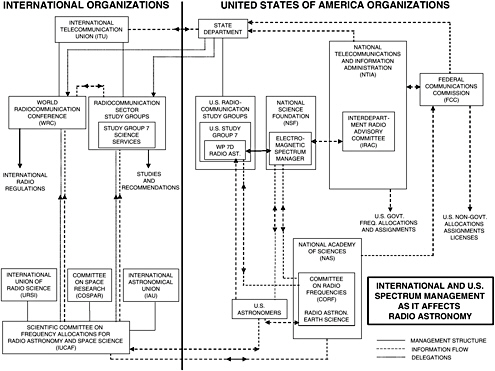
FIGURE 1.1 The diagram depicts the complex relationship among the national and international radio regulatory bodies for the Radio Astronomy Service.
the National Academy of Sciences, which is a private, nonprofit organization chartered by the U.S. Congress. CORF serves as a link between the radio astronomy and remote sensing communities and the spectrum-management offices at the NSF, NASA, and the National Oceanic and Atmospheric Administration (NOAA). CORF participates in public proceedings of the Federal Communications Commission.
1.3
RADIO ASTRONOMY SERVICE
The scientific needs of radio astronomers for the allocation of frequencies were first addressed at the World Administrative Radio Conference (predecessor of the WRC) held in 1959 (WARC-59). Astronomers proposed the following:
-
That the science of radio astronomy should be recognized as a service in the radio regulations of the ITU,
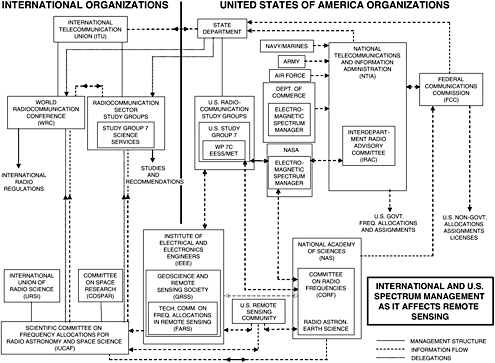
FIGURE 1.2 The diagram depicts the complex relationship among the national and international radio regulatory bodies for the Earth Exploration-Satellite Service.
-
That a series of bands of frequencies should be set aside internationally for radio astronomy— these should lie at approximately octave intervals above 10 MHz and should have bandwidths of about 1 percent of the center frequency, and
-
That special international protection should be afforded to the hydrogen (H) line (1400-1427 MHz) and to the predicted deuterium (D) line (322-328.6 MHz).
By the end of WARC-59, considerable action had been taken to meet these needs. The Radio Astronomy Service (RAS) was established, and the first frequency allocations were made for this new service. At subsequent conferences, growing scientific needs were recognized and further steps were taken to meet them. For example, the discovery of many new interstellar molecular lines in the radio spectrum led to new frequency allocations and footnote protection. Radio astronomy research now extends into the millimeter and submillimeter wavelength bands, which are now recognized in new allocations and footnotes to the allocation table.
At the World Radiocommunication Conference in 2000 (WRC-2000), the spectrum allocations above 71 GHz were revised, and a number of new allocations to the RAS were made. WRC-2003 was held in Geneva, Switzerland, June 9 to July 4, 2003. There were more than 2,200 delegates, 17 of whom were radio astronomers. Out of a total of 50 agenda items, 10 were of interest to radio astronomers. Most of these involved allocations to satellite downlinks, adjacent or close to radio astronomy allocations.
1.4
EARTH SCIENCE SERVICES
The Earth Exploration-Satellite Service was established at WARC-71. Frequencies were allocated for the transmission of environmental data from space to Earth in order to accommodate the needs of satellite programs such as Landsat, which utilize passive sensors operating in the visible part of the electromagnetic spectrum. Today, the EESS also includes meteorological services—primarily communications, such as the Meteorological Satellite Service (MetSat) and the Meteorological Aids Service (MetAids). Frequencies were first allocated to the EESS and the Space Research Service (SRS) for use by spaceborne active and passive microwave sensors at WARC-79. That WARC made more than 50 allocations for spaceborne microwave sensors: 10 for active sensors and more than 40 for passive sensors.
By 1997, there was a need to improve the regulatory environment for spaceborne microwave sensors. Spectrum requirements for passive sensors had been refined in the 18-year interval between 1979 and 1997, particularly in the unique 50-70 GHz region where measurements in the vicinity of oxygen absorption lines are used to determine atmospheric temperature profiles for use in weather forecasts and climate studies. Also, time had shown that the secondary footnote allocations made for active microwave sensors in 1979 were of little use in preventing new allocations from being made to other services—allocations that could (and did) cause active sensors to be unusable owing to interference.
At WRC-97, passive remote sensing bands between 50 and 60 GHz were realigned. Most active remote sensing bands were upgraded to primary allocations. In the EESS communications area, the 8025-8400 MHz band was upgraded to a primary allocation, and a new wider-bandwidth space-to-Earth allocation was obtained at 26 GHz.
At WRC-2000, the passive bands above 71 GHz were realigned, and the top of the range was extended from 275 GHz to 1 THz via a footnote. The 18.7 GHz passive band gained protection, as did civilian Global Positioning System (GPS) bands.
At WRC-2003, an active band at 437 MHz was allocated, and the active sensing band at 5.3 GHz was expanded in bandwidth from 210 to 320 MHz, but at the cost of losing protection against outdoor radio local area networks at the low end. Of particular concern, up/down communication links near the 1.400-1.427 GHz passive band were given a provisional secondary allocation pending further study and a report to WRC-2007. Note that any emissions in this band are explicitly prohibited by international footnote 5.340.
1.5
ANCILLARY SERVICES
Ancillary services support science and are in fact essential to the operation of spacecraft, observation, and the retrieval of data. While some of these services (i.e., communications) are incorporated within the science services, they are clearly indispensable, and their importance should be recognized.
1.5.1
The Space Research and Space Operations Services
The Space Research Service and the Space Operations Service (SOS) need to be protected and managed in order to enable the community to operate its spacecraft and to retrieve data taken by them. Without these bands, spaceborne science cannot be carried out.
The SRS covers the communications services necessary for spacecraft launch and for data communications with spacecraft. The most prominent network supporting near-Earth missions related to both Earth science and space science is the NASA Deep Space Network (DSN), an international network of antennas operated by the Jet Propulsion Laboratory for NASA. The DSN supports interplanetary spacecraft missions and radio and radar astronomy observations for the exploration of the solar system and the universe. The network also supports selected Earth-orbiting missions.
The SRS also includes communications for space radio astronomy (space very long baseline interferometry) using antennas in Earth orbit. The spacecraft transmit the data to ground stations for processing and analysis.
1.5.2
Frequency, Time, and Position Systems
The Standard Frequency and Time Signal-Satellite Service, as well as navigational systems used by the science community, provide position data needed for measurements of motions of Earth’s crust and glaciers as well as for navigation of our spacecraft. They also sometimes support intrinsic scientific uses in addition to navigational purposes—for example, measurements of general relativity.
These systems provide timing virtually anywhere on Earth, orders of magnitude more accurate than any other system. GPS provides timing with an accuracy that can be exceeded only by having an atomic clock located in a laboratory.
The International Global Navigation Satellite System (GNSS) (IGS), formerly the International GPS System, is a voluntary federation of more than 200 worldwide agencies that pool resources and permanent navigation satellite station data to provide the highest-quality data and products in support of Earth science research, multidisciplinary applications, and education. Currently the IGS includes two GNSSs—GPS and the Russian Global Navigation Satellite System (GLONASS)—and intends to incorporate future GNSSs, such as Europe’s Galileo system. The IGS is primarily used by the EESS for spacecraft position and timing information in support of remote sensing. There are also experimental scientific uses of IGS for radio science and bistatic radar.


