
4
Success and Its Evaluation in Science and Engineering
CHAPTER HIGHLIGHTS
Progress in academic careers depends on evaluations of one’s accomplishments by those more senior in a process widely believed to be objective. Research shows, however, that bias negatively affects the evaluations and judgments made about women scientists and engineers and their work. Women consequently are not only underrepresented in numerous science and engineering fields, but are also likely to work in less prestigious institutions than men, to hold lower rank, to take longer to be promoted and tenured, to win fewer awards and honors, and to be named less often to positions of leadership in their institutions and disciplines.
One of the key factors in career advancement is productivity, as measured by the number of published papers that carry the faculty member’s name. Women scientists and engineers have long been considered less productive than men because they published fewer papers. Evidence shows, however, that productivity is not an independent characteristic of individuals but rather a reflection of their positions in the academic hierarchy and the access to resources that those positions make possible. When academic position, available resources, type of institution, and other personal and institutional factors are held constant, men and women scientists and engineers are equally productive. Other evidence indicates that women’s publications have greater average impact than men’s.
Many people believe that discrimination involves explicit, blatant hostility, but current bias against women scientists and engineers is often subtle, implicit, and unexamined. Under prevailing gender schemas, competent women are often viewed as “overaggressive” and “not nice” whereas traditionally subservient women are seen as “incompetent.” In addition, organizational rules and policies that appear egalitarian often produce different results for men and women. The playing field is not level. Women and minority groups make up an increasing proportion of the labor force. They also are an increasing proportion of the pool of students from which universities can recruit faculty. To capture and capitalize on this talent, policies adopted when the workplace was more homogeneous need to be changed to create organizational structures that manage diversity effectively. Equity efforts need to address the systemic changes required to build and sustain educational, research, and workplace environments that promote effective participation in an increasingly pluralistic society.
FINDINGS
4.1 Throughout a scientific or engineering career, advancement depends on judgments of one’s performance by more senior scientists and engineers. A substantial body of research shows these judgments contain arbitrary and subjective components that disadvantage women. The criteria underlying the judgments developed over many decades when women scientists and engineers were a tiny and often marginal presence and men were considered the norm.
4.2 Gender bias—often unexamined, and held and acted on by people of both sexes who believe themselves unbiased—has affected many women scientists’ chances of career progress. Minority-group women face the double bind of racial and gender bias.
4.3 Incidents of bias against individuals not in the majority group tend to have accumulated effects. Small preferences for the majority group can accumulate and create large differences in prestige, power, and position. In academic science and engineering, the advantages have accrued to white men and have translated into larger salaries, faster promotions, and more publications and honors relative to women.
4.4 Women have the qualities needed to succeed in academic careers and do so more readily when given an equal opportunity to achieve. For example, publication productivity is one of the most important factors by which scientists are evaluated for hiring, promotion, and
tenure. Women scientists’ publication productivity has increased over the last 30 years and now matches men’s. The critical factor affecting publication productivity is access to institutional resources; marriage, children, and elder-care responsibilities have minimal effects.
4.5 Career impediments based on gender or racial or ethnic bias deprive the nation of an important source of talented and accomplished researchers.
RECOMMENDATIONS
4.1 Trustees, university presidents, and provosts should provide clear leadership in changing the culture and structure of their institutions to recruit, retain, and promote women—including minority women— into faculty and leadership positions.
4.2 University leaders should work with their faculties and department chairs to examine evaluation practices to focus on quality of contributions and their impact.
4.3 Deans, department chairs, and their tenured faculty should take the responsibility for creating a productive environment and immediately implement programs and strategies shown to be successful in minimizing the effect of biases in recruiting, hiring, promotion, and tenure.
4.4 Faculties and their Senates should initiate a full faculty discussion of climate issues.
4.5 Universities should provide management and leadership training for deans, department heads, search committee chairs, and other faculty with personnel management responsibilities; they should also provide management training to new faculty as part of a professional development core.
4.6 University leaders should, as part of their mandatory management efforts, hold leadership workshops for deans, department heads, search committee chairs, and other faculty with personnel management responsibilities, that include an integrated component on diversity and strategies to overcome bias and gender schemas and strategies for encouraging fair treatment of all people. It is crucial that these workshops are integrated into the fabric of the management of universities and departments.
4.7 Deans, department chairs, and their tenured faculty should develop and implement programs that educate all faculty members and
students in their departments on unexamined bias and effective evaluation; these programs should be integrated into departmental meetings and retreats, and professional development and teacher-training courses. For example, such programs can be incorporated into research ethics and laboratory management courses for graduate students, postdoctoral scholars, and research staff and can be part of management leadership workshops for faculty, deans, and department chairs.
4.8 Scientific and professional societies should provide professional development training for members that includes a component on bias in evaluation; develop and enforce guidelines to ensure significant representation of women on meeting speaker lists, on editorial boards, and in other significant leadership positions; and work to ensure that women are recognized for their contributions to the nation’s scientific and engineering enterprise through nominations for awards and leadership positions.
4.9 Honorary societies should review their nomination and election processes to address the underrepresentation of women in their memberships.
4.10 Journals should examine their entire review process, including the mechanisms by which decisions are made to send a submission to review, and take steps to minimize gender bias, such as blinded reviews.
4.11 Federal funding agencies and foundations should work with scientific and professional societies to host mandatory national meetings that educate members of review panels, university department chairs, and agency program officers about methods that minimize the effects of gender bias in evaluation. The meetings should be held every 2 years for each major discipline and should include data and research presentations on subtle biases and discrimination, department climate surveys, and interactive discussions or role-modeling. Program effectiveness should be evaluated on an ongoing basis.
4.12 Federal funding agencies should collect, store, and publish composite information on demographics, field, award type and budget request, review score, and funding outcome for all funding applications.
4.13 Funding organizations should expand support for research on the efficacy of organizational programs designed to reduce gender bias, and for research on bias, prejudice, stereotype threat, and the role of leadership in achieving gender equity.
To build a successful academic career, a scientist or engineer must succeed—and be seen by colleagues and superiors to have succeeded—at
each of a number of increasingly demanding stages of development. Judgments of performance are widely thought to be objective, but a substantial body of research shows that they are significantly affected by biases.
The effect of any specific instance of bias may not in itself be large— receiving a somewhat lower evaluation or a less enthusiastic recommendation than would be true in the absence of bias, not being invited to chair a session at a meeting, or being excluded from conversations in a friendship network.
Such instances of bias would not prevent a person from doing research or pursuing a career. A growing body of evidence shows, however, that such incidents of bias tend to accumulate. In a highly competitive field in which reputation and influence are crucial aspects of professional standing, small preferences can accumulate into large differences in prestige, power, and position (Box 1-4). In academic science and engineering, the advantages accrued to white men have translated into increased salaries, faster promotions, and more publications and honors relative to women.
BUILDING A CAREER
A career has four interlocking dimensions: education, position, productivity, and recognition.1 Whether a given scientist or engineer succeeds in building such a career depends on a number of factors, some personal and some institutional—as well as luck or happenstance. Does he or she possess the qualities of intellect, character, and personality needed to succeed when there is high-stakes competition? Does he or she work on research questions that produce results worthy of publication and citation? Does he or she succeed in obtaining adequate funding to carry out research? Does he or she develop relationships that help to advance the research and the career? Do the institutions where he or she was educated and trained and where he or she attempts to establish and further a career provide advantages or impose disadvantages that make success more or less likely?
Productivity
College and university faculty members fulfill three main functions: teaching, research, and service in various capacities, such as committee members or department officials involved in running the institution. For purposes of hiring and advancement to higher rank, however, research productivity—defined as authorship of peer-reviewed publications—is
|
1 |
MF Fox and JS Long (1995). Scientific careers: Universalism and particularism. Annual Review of Sociology 21:45-71. For a discussion of education and position, see Chapter 3. |
weighed most heavily,2 even though efforts have been made to expand the definition of scholarship to include teaching, the integration of knowledge, grants awarded, and applications of research in addition to original discoveries.3
Publications, particularly those in high-prestige journals or conference proceedings, carry the greatest weight.4 That is true regardless of whether the responsibilities of the faculty member’s position actually involve doing research or instead focus on administration, teaching, or service. Faculty productivity measured by quantity of publications has also been shown to correlate with stamina and opportunity but not with creativity or measured intelligence.5 And studies show that teaching and research have opposite relationships to publication productivity: increased time commitments to teaching are associated with decreased publication productivity.6
Observers have argued that emphasis on number of publications overvalues the work of men scientists and engineers at the expense of women because of the unequal allocation of tasks that characterizes academic life. Women, on average, devote more time than men to teaching and service, while men, on average, devote more time than women to research.7 Recent evidence from faculty surveys indicates that more women than men faculty feel that mentoring as a service activity is undervalued by their department (Figure 4-1). Some have suggested that discrepancy reflects value differences between the sexes, namely that women give greater emphasis to such nurturing activities as teaching and advising students and men give greater emphasis to competition. Others argue that the discrepancy reflects the fact that women generally have less power and less opportunity to obtain positions at research universities, where support systems and resources clearly increase faculty productivity.8
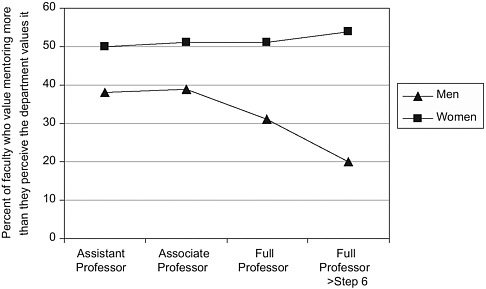
FIGURE 4-1 Individual and perceived institutional value of student mentoring, by rank and sex.
NOTE: The survey asked faculty to rate whether they valued mentoring more, the same, or less than they perceived their department valued mentoring.
SOURCE: University of California Faculty Climate Survey, 2003. Available at http://www.ucop.edu/acadadv/berkeley-response/faculty-climate.pdf.
Especially during the probationary years, graduate students, postdoctoral scholars, and assistant professors feel intense pressure to prove that they are not only productive, but serious about their science and engineering careers. They often spend very long hours at their work and try to show a total commitment to an academic career. “By its nature, academic work is potentially boundless: there is always one more question to answer; one more problem to solve; one more piece to read, to write, to see, or to create.”9 In addition, for scientists or engineers working on federal grants, the granting agencies impose time accounting requirements.10
|
9 |
JW Curtis (2004). Balancing work and family for faculty: Why it’s important. Academe 90(6), http://www.aaup.org/publications/Academe/2004/04nd/04ndtoc.htm. |
|
10 |
J Couzin (2006). US rules on accounting for grants amount to more than a hill of beans. Science 311:168-169. |
Some have suggested that a postdoctoral fellow intent upon a research career should be spending 60-80 hours per week in the laboratory and clinical fellows 80-120 hours per week.11 The National Science Foundation (NSF) has determined the average workweek for science and engineering faculty to be 50.6 hours per week.12 At one research university, faculty with and without children reported engaging in professional work 51-60 hours per week, but women faculty with children spend substantially more time than men faculty with children on household and child-care responsibilities (Figure 4-2).13 Those findings mirror what is seen in a national sample of science and engineering doctorates. Men engage in professional work an average of 0.7 hour per week more than women, but the difference was associated with having children living in the household. Men and women without children reported working 49 hours per week, and women with children—but not men with children—reported working 46 hours per week.14
Those statistics belie the nature of work for a scientist or engineer, whose productivity does not depend solely on total hours logged in the laboratory. Indeed, other sorts of work—including reading literature, going to meetings, and discussions with colleagues—may occur off site but are no less important. For persons with major caregiving responsibilities, particularly the care of children or other dependent family members, the limitless time demands of a competitive academic career present a major challenge. The great majority of those bearing caregiving responsibilities are women, and their effort in their family responsibilities does not count as “work” in the academic schema, but rather as a distraction from work.
|
11 |
S Kern (2002). Fellowship Goals for PhDs and MDs: A primer on the molecular biology postdoctoral experience. Cancer Biology and Therapy 1:74-85. Kern notes the total hours include research and reading; he also notes that the routine 80-120 hours in clinical training “may be incompatible with a researcher’s need for creativity and precision.” |
|
12 |
TB Hoffer and K Grigorian (2005). All in a Week’s Work: Average Workweeks of Doctoral Scientists and Engineers (NSF 06-302). Arlington, VA: National Science Foundation, http://www.nsf.gov/statistics/infobrief/nsf06302/nsf06302.pdf. |
|
13 |
WH Gmelch, PK Wilke, and NP Lovrich (1986). Dimensions of stress among university faculty: Factor-analytic results from a national survey. Research in Higher Education 24:266-286; MA Mason and M Goulden (2004). Marriage and baby blues: Redefining gender equity in the academy. Annals of the American Academy of Political and Social Science 596(1):86-103, http://ann.sagepub.com/cgi/reprint/596/1/86. |
|
14 |
Hoffer and Grigorian (2005), ibid. |
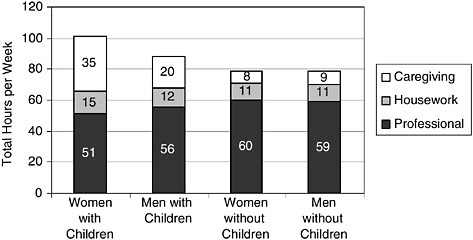
FIGURE 4-2 University of California faculty, 30-50 years old, self-reported hoursTotal Hours per Week per week engaged in professional work, housework, and caregiving.
SOURCE: Adapted from: MA Mason, A Stacy, and M Goulden (2003). University of California Faculty Work and Family Survey, http://ucfamilyedge.berkeley.edu/workfamily.htm.
|
The “ideal worker” is someone whose commitment to work is unlimited by child bearing or rearing—i.e., a man. Success in academia today continues to be aligned with traditional masculine stereotypes of autonomy, competitiveness and heroic individualism. The ‘ideal worker’ is someone for whom work is primary, the demands of family, community, and personal life secondary, and time to work unlimited. —Ellen Ostrow, clinical psychologist and founder of Lawyers Life Coach15 |
Sex Differences in Publication Productivity
Why is publication productivity important? It is through publications that research results are communicated and verified. Publication productivity is both the cause and the effect of status in science and engineering.
|
15 |
E Ostrow (2002). The backlash against academic parents. Chronicle of Higher Education (February 22), http://chronicle.com/jobs/2002/02/2002022202c.htm. |
Several researchers have shown that publication productivity reflects and partially accounts for the depressed rank in status of women in science and engineering.16 However, this assumes that it is the number of papers that is important and does not account for differences in the impact of papers.
In decades past, data have shown an apparent gender gap in the numbers of papers published by men and women faculty. In a study of scientists who received PhDs in 1969-1970, Cole and Zuckerman estimated that, on average, women published slightly more than half (57%) as many papers as men.17 Little information is available on publication rates for minority-group scientists.18
The root of the difference in publication productivity is an essential question. Several studies have examined the effect of family-related factors. Although more women than men leave academe because of family responsibilities, research on the effects of marriage, children, or elder-care responsibilities has yielded mixed results.19 The critical variable appears to be access to resources. A recent longitudinal analysis by Xie and Shauman of faculty in postsecondary institutions in 1969, 1973, 1988, and 1993 shows that the sex difference in research productivity has declined—from a female:male ratio of 0.580:1 in 1969 to 0.817:1 in 1993. In that period, the primary factor affecting women scientists’ research productivity was their overall structural position, such as institutional affiliation and rank. When type of institution, teaching load, funding level, and research assistance are factored in, the productivity gap disappears.20
|
16 |
G Sonnert and G Holton (1996). Career patterns of women and men in the sciences. American Scientist 84:63-71; EG Creamer (1998). Assessing faculty publication productivity: Issues of equity (ASHE-ERIC Higher Education Report 26(2)). Washington, DC: George Washington University; LJ Sax, S Hagedorn, M Arredondo, and FA Dicrisi (2002). Faculty research productivity: Exploring the role of gender and family-related factors. Research in Higher Education 43(4):423-446; MF Fox (2005). Gender, family characteristics, and publication productivity among scientists. Social Studies of Science 35(1):131-150. |
|
17 |
JR Cole and H Zuckerman (1984). The productivity puzzle: Persistence and change in patterns of publication of men and women scientists. Advances in Motivation and Achievement 2:217-258; see also JS Long (1992). Measures of sex differences in scientific productivity. Social Forces 71:159-178; there appears to be a publication productivity gap between men and women and white and minority students in graduate school, see Chapter 3 and MT Nettles and CM Millett (2006). Three Magic Letters: Getting to PhD. Baltimore, MD: Johns Hopkins Press. |
|
18 |
MF Fox and JS Long (1995). Scientific careers: Universalism and particularism. Annual Review of Sociology 21:45-71; W Pearson (1985). Black Scientists, White Society, and Colorless Science: A Study of Universalism in American Science. Millwood, NY: Associated Faculty. |
|
19 |
Reviewed in LJ Sax, S Hagedorn, M Arredondo, and FA Dicrisi (2002), ibid. |
|
20 |
Y Xie and KA Shauman (1998). Sex differences in research productivity: New evidence about an old puzzle. American Sociological Review 63(6):847-870. |
Another analysis provides a clear illustration of the correlation between productivity, institutional affiliation, and rank.21 Overall, men academic scientists and engineers produced 30% more publications than women academic scientists and engineers, but when men at Research I universities were compared with women at the same type of institution, the productivity gap fell to 25%. Women were much more likely to be in non-tenure-track posts than men, and comparing only scientists and engineers who held faculty positions reduced the productivity gap to 13%. Focusing on tenured faculty members found tenured men with only 8% more publications than their women tenured colleagues. The difference in publication productivity between men and women who are full professors of science or engineering at the Research I institutions was under 5%.
The effect of a scientist’s institutional affiliation on his or her productivity is so great that the prestige of the department or university has been found to affect scientists’ productivity, rather than the other way around. Prestige serves as a symbolic stand-in for an array of characteristics that can foster or hamper productivity, including financial, physical, and staff resources and intellectual environment. Evidence shows that when scientists move to more prestigious institutions, their productivity increases.22
Another essential question is whether number of papers is the appropriate metric of productivity. In a study of biochemists, Long found that articles by women received, on average, more citations than articles with men primary authors.23 Some have argued that both quantitative and qualitative measures of productivity should be taken into account in making important decisions about a scientist’s career.24 Indeed, recent metrics have been developed to measure citations of an article—its “impact factor”—as well as the prestige of the journal in which it is published.25
Recognition
Another indicator of scientific productivity, and one especially germane to career advancement, is recognition in the field. Being invited to
|
21 |
National Research Council (2001). From Scarcity to Visibility: Gender Differences in the Careers of Doctoral Scientists and Engineers. Washington, DC: National Academy Press, http://www.nap.edu/catalog/5363.html. |
|
22 |
P Allison and S Long (1990). Departmental effects on scientific productivity. American Sociological Review 55:119-25. |
|
23 |
JS Long (1992). Measures of sex differences in scientific productivity. Social Forces 71:159-178. |
|
24 |
Sonnert and Holton (1996), ibid. |
|
25 |
P Ball (2006). Prestige is factored into journal ratings. Nature 439(16):770-771, http://www.nature.com/nature/journal/v439/n7078/pdf/439770a.pdf. |
speak at major professional society meetings is one type of recognition, but women are not well represented among symposium speakers and keynotes (Box 4-1).
Recognition of lifetime achievement by election to a high-prestige honorific society is a cherished honor. However, the numbers of women elected to such societies as the National Academy of Sciences, the National Academy of Engineering, the Institute of Medicine, the American Academy of Arts and Sciences, and the American Philosophical Society, or awarded such prestigious honors as the Lasker Prize or the National Medal of Science have been small (Table 4-1).
Some organizations point to the low numbers of women who are “eligible” for honors and awards; to a first approximation, the nomination pool for lifetime achievement honors, such as election to an honorific society, is the cohort who received PhDs about 30 years ago. Indeed, the representation of women in that cohort is quite small. Recent classes of electees, however, have included younger people, and not all societies elect solely PhD recipients. A recent report from the InterAcademy Council (IAC) concludes that the disproportionately small number of women in the science and technology enterprise, particularly in leadership positions, is a major hindrance to strengthening science capacity worldwide.26 The IAC called upon all academies to address the underrepresentation of women in their memberships, in particular by implementing internal management practices that encourage and support women, and by influencing policy makers and other leaders to bring about broader change.
As with the tenure-track applicant pool (see Chapter 3), the nominee pool for honors and awards likely underrepresents the available pool of excellent women researchers. A case in point is the recent experience with the Pioneer Awards offered by the National Institutes of Health (NIH) (Box 4-2). In its first year, not only did the new program designed for early-career researchers not select any women, but all the awardees were well established and in middle to late career. In response to community concern, NIH took the time and energy to diagnose the problem, and found that several small changes in the program announcement and attention to the selection process changed the outcome greatly in the program’s second year.
One issue brought to the fore by the Pioneer Award was the difference in the number of women who self-nominated as opposed to those who were nominated by mentors or peers. It appears, as with hiring, that relying on
|
26 |
InterAcademy Council (2006). Women for Science. Amsterdam: InterAcademy Council, http://www.interacademycouncil.net/?id=11228. The IAC is an organization created by 90 science academies across the globe. |
established networks can lead to underrepresentation of women in the nominee pool.27 One organization, the Committee on the Advancement of Women Chemists (COACh), is working with professional societies to ensure that qualified women are nominated for awards and leadership positions (Box 4-3).
LEADERSHIP POSITIONS
Women, especially minority-group women, are underrepresented in science and engineering faculties at all levels.28 The dearth of women is even more pronounced in the upper tiers of the academy. In addition to being outnumbered, women have lower salaries,29 are awarded less grant money,30 and perceive the scientific workplace as unwelcoming and even hostile.31 Few women are chief editors of top-rated journals and their representation varies substantially by field (Table 4-2). Even a cursory glance at most organization charts in research organizations shows that women are underrepresented, not only in senior faculty positions but also in leadership positions. According to a recent study of academic medical
|
27 |
Networks have also been shown to affect decisions to publish; as gender balance improves within a field, network access changes, and the representation of women as authors also improves. See JM McDowell, LD Singell, and M Stater (2006). Two to tango? Gender differences in the decisions to publish and coauthor. Economic Inquiry 44(1):153-168. |
|
28 |
DJ Nelson (2005). A National Analysis of Diversity in Science and Engineering Faculties at Research Universities, http://cheminfo.chem.ou.edu/faculty/djn/diversity/briefings/Diversity%20Report%20Final.pdf; J Handelsman, N Cantor, M Carnes, D Denton, E Fine, B Grosz, V Hinshaw, C Marrett, S Rosser, D Shalala, and J Sheridan (2005). More women in science. Science 309(5738):1190-1191; CA Trower and RP Chait (2002). Faculty diversity: Too little for too long. Harvard Magazine 104(4), http://www.harvard-magazine.com/on-line/030218.html. |
|
29 |
Trower and Chait (2002), ibid; PD Umbach (2006). Gender Equity in the Academic Labor Market: An Analysis of Academic Disciplines. Paper presented at the 2006 annual meeting of the American Educational Research Association, San Francisco, CA, April 7-11, http://myweb.uiowa.edu/pumbach/AERA2006_equitypaper.pdf. |
|
30 |
SD Hosek, AG Cox, B Ghosh-Dastidar, A Kofner, N Ramphal, J Scott, and SH Berry (2005). Gender Differences in Major Federal External Grant Programs. Washington, DC: RAND. |
|
31 |
D Olsen, SA Maple, and FK Stage (1995). Women and minority faculty job satisfaction: Professional role interests, professional satisfactions, and institutional fit. Journal of Higher Education 66(3):267-293; Trower and Chait (2002), ibid; ALW Sears (2003). Image problems deplete the number of women in academic applicant pools. Journal of Women and Minorities in Science and Engineering 9:169-181; LA Krefting (2003). Intertwined discourses of merit and gender: Evidence from academic employment in the USA. Gender, Work, and Organization 10(2):260-278; RR Callister (2006). The impact of gender and department climate on job satisfaction and intentions to quit for faculty in sciene and engineering fields. Journal of Technology Transfer 31:367-375. |
|
EXPERIMENTS AND STRATEGIES BOX 4-1 Speaker Representation at Scientific and Professional Society Meetings The invitation to speak at a professional or academic society conference is one of the key benchmarks of a successful academic career. To ensure the proper recognition and advancement of women scholars in science and engineering, it is essential that the process for inviting conference speakers be absent of gender bias. Invited and distinguished conference speakers are usually selected by program committees and the speaker nomination process often fails to ensure adequate gender representation. Program committees lacking gender diversity tend to result in a lack of diversity among invited speakers.a The common practice of program committee members nominating themselves as invited speakers augments this effect.b Table B4-1 presents data on the percentage of invited speakers to speak at prestigious symposiac at professional and scientific society conferences who were women in a number of disciplines. It has proven challenging to ensure that speakers at society-sponsored events reflect the diverse membership of the society with respect to appropriate representation by gender. TABLE B4-1 Speakers at 2004-2005 Scientific and Professional Society Meetings, by Sex
Some societies have implemented speaker selection criteria to mandate that those who propose symposia specifically consider diversity of suggested speakers. At the American Society for Cell Biology (ASCB) 45th Annual Meeting, 36% of the invited speakers were women, which is an appropriate reflection of the nearly |
||||||||||||||||||||||||||||||
|
40% of women professors in biological sciences. ASCB employs the following speaker selection guidelines:i
The Federation of Clinical Immunological Societies (FOCIS) has gone one step further and reformed the way in which invited speakers are selected. For minisymposium speakers at their 12th annual International Congress of Immunology (participants were from 86 countries, and about half were women), FOCIS instituted an abstract review process that was blinded as to author and institution. This resulted in 48% of 976 oral presenters being women. For speakers and chairs, the program committee used research excellence and publication impact criteria for speaker selection. Twenty-two percent of the 480 invited speakers were women, a substantial increase from the previous year, when only 10% of the invited speakers were women.j Other organizations that sponsor and organize scientific conferences instruct and encourage conference planners to include appropriate gender representation among invited speakers and planning committees. The NIH encourages a “concerted effort to achieve appropriate representation of women” as conference organizers, speakers, and attendees for all meetings it sponsors.k Gordon Research Conferences and Keystone Symposia sponsor topically focused interdisciplinary research symposia with a small number of participants to foster discussion and collaboration. Both organizations instruct conference organizers to represent the gender diversity of the discipline when inviting conference speakers.l
|
TABLE 4-1 Percentage of Women Nominated to an Honorific Society or for a Prestigious Award and the Percentage of Women Nominees Elected or Awarded, 1996-2005
|
|
% Nominees |
% Nominated Elected |
|
Society |
|
|
|
American Philosophical Societya |
14.6 |
23.7 |
|
Mathematical and physical sciences |
19.0 |
24.0 |
|
Biological sciences |
11.5 |
23.3 |
|
American Academy of Arts and Sciences |
N/A |
15.8 |
|
Mathematical and physical sciences |
N/A |
11.6 |
|
Biological sciences |
N/A |
20.0 |
|
Institute of Medicineb |
19.2 |
22.7 |
|
National Academy of Engineering |
5.3 |
6.0 |
|
Aerospace engineering |
3.1 |
7.1 |
|
Bioengineering |
6.9 |
4.6 |
|
Chemical engineering |
5.9 |
5.2 |
|
Civil engineering |
4.1 |
2.4 |
|
Computer science and engineering |
11.9 |
8.6 |
|
Electric power and energy systems engineering |
3.1 |
2.3 |
|
Electronics engineering |
2.8 |
3.7 |
|
Industrial manufacturing and operations systems engineering |
4.9 |
4.3 |
|
Materials engineering |
5.7 |
7.8 |
|
Mechanical engineering |
2.5 |
5.6 |
|
Petroleum mining and geological engineering |
9.5 |
8.7 |
|
Special fields and interdisciplinary engineering |
5.7 |
6.3 |
|
National Academy of Sciences |
12.5 |
15.6 |
|
Award |
|
|
|
Lasker Prize |
6.1 |
4.0 |
|
National Medal of Sciencec |
N/A |
12.0 |
|
Behavioral and social science |
N/A |
0 |
|
Biological sciences |
N/A |
26.1 |
|
Chemistry |
N/A |
15.4 |
|
Engineering |
N/A |
0 |
|
Mathematical and computer sciences |
N/A |
15.4 |
|
Physical sciences |
N/A |
0 |
|
NIH Pioneer Awardd |
|
|
|
First program year (2004) |
22.0 |
0.0 |
|
Second program year (2005) |
26.0 |
46.2 |
|
aData from 2000 to 2005. bData from 1999 to 2005. cData from 1996 to 2003. dAward first offered in 2004. N/A: demographic information not solicited or maintained for nominations. SOURCE: Data were provided by membership departments of listed organizations and awards. |
||
centers, women made up 18% of section chiefs, 11% of department chairs, and 10% of deans.32 At the Department of Energy national laboratories, women make up 11% of scientific directors and 3% of directors and deputy directors (Table 4-3). Similar proportions of women serve in leadership posts at the NSF engineering research centers and science and technology centers (Tables 4-4 and 4-5).
Grants and Contracts
Grants and contracts offer another measure of leadership. At NIH over the last 20 years the participation of women has grown in all extramural grant budget categories. For the traditional research project grants (RPGs), also known as R01s, the percentage going to women increased from 17% to 24% from 1990 to 2004. Over the period 1983-2004, the share of grants going to women has increased from 13% to 24% for all RPGs33 and 17% to 39% for career development awards. Representation of women among principal investigators on center awards has increased from 4% to 17%, but this is still far below the level of participation of women in the individual investigator grant categories.
The average size of grants varies considerably across budget category, and the differences in sizes of grants to women and men vary as well. In FY 2004, the biggest differences in the average award are for centers, where women serve as principal investigators on grants that are on average only 60% as large as those for men. The average size of the NIH Small Business Innovation Research Program and Small Business Technology Transfer Program awards for women slightly exceeds that of men. And the average RPG and career development award for women is about 90% of the size for men (Figure 4-3).34
Evaluation of Leaders
Underlying this skewed representation of women in leadership positions are sex differences in the expectation and evaluation of leadership. For example, both men and women hold more negative attitudes toward women than toward men authorities, although women’s explicit attitudes
|
32 |
Association of American Medical Colleges (2005). Analysis in Brief: The Changing Representation of Men and Women in Academic Medicine. Washington, DC: AAMC. |
|
33 |
The RPG category constitutes 79% of NIH extramural awards and 75% of the extramural dollars. |
|
34 |
Office of Extramural Research (2005). Sex/Gender in the Biomedical Science Workforce. National Institutes of Health, http://grants2.nih.gov/grants/policy/sex_gender/q_a.htm#q5. |
|
EXPERIMENTS AND STRATEGIES BOX 4-2 Pioneer Award The NIH director’s Pioneer Award was created in 2004 as part of the NIH Roadmap for Medical Research. The award was designed to promote “exceptionally creative scientists taking innovative approaches to major challenges in biomedical research.” In its first year, outside nominations and self-nominations were solicited. The application consisted of a five-page essay and three letters of recommendation. Of the 1,300 nominations, 20 applicants were asked to interview. All of the awardees were men. Although all were doing exceptional research, they were not representative of the intended target audience—early career researchers. The award program was in its first year, and NIH did not anticipate the large number of nominations, most of which occurred in the last few days. To review the applications, NIH had to recruit a sizable number of additional reviewers in a short period. As a result, 60 of the 64 reviewers were men. In addition, because self-nominations and external nominations were accepted, reviewers found it difficult to compare self-nomination essays describing applicants’ own accomplishments with external nomination essays written on behalf of the nominees. Carnes et al.a suggest several evidence-based reasons why women scientists might have been disadvantaged in the Pioneer Award’s nomination and selection process, including:
|
are more egalitarian than men’s.35 Martell and DeSmet had 151 managers judge the leadership effectiveness of men and women middle managers on various categories of leadership behavior.36 They found that both men and women managers rated men higher on delegating behavior, and rated
|
Jeremy Berg, director of National Institute of General Medical Sciences, and Judith Greenberg, director of the Division of Genetics and Developmental Biology, took on the challenge of revamping the award selection process in 2005. Together, they implemented some minor changes that had a dramatic impact on the result. These changes included:
In 2005, of the 13 recipients of the Pioneer Award, 6 were women, one was an African American man, and all the winners were significantly younger—evidence that the procedural changes created the opportunity and environment in which a diverse pool of candidates could be seriously considered. |
women higher on consulting behavior. Women rated women middle managers more favorably on inspiring, mentoring, problem solving, rewarding, and supporting; men either rated men and women equally or rated men more favorably on these behaviors.
Sinclair and Kunda found that the rating of women evaluators depended more on the nature of the evaluation than that of men.37 Specifi-
|
EXPERIMENTS AND STRATEGIES BOX 4-3 Breaking through the “Polycarbonate Ceiling”— The Committee on the Advancement of Women Chemists The Committee on the Advancement of Women Chemists (COACh) was formed in 1998 and is working to increase the numbers and success of women scientists in academe. Initially focused on women in chemistry, it has expanded to include men and women in geology, physics, mathematics, computer science, and biology. COACh has two important missions: first, it brings senior women chemists together for networking events, interactive workshops, and mentoring support; and second, it actively seeks to improve the professional lot of women scientists at academic institutions at all levels. COACh offers a series of workshops at professional meetings and institutions that are designed to enhance leadership skills, to expand women’s professional networks, to improve institutional climate, and to level the playing field for all faculty. COACh has implemented professional skills workshops that provide negotiation, management, and leadership skills to help women to achieve their professional goals as faculty in the sciences. Through a variety of instructional and interactive approaches, these sessions provide an opportunity to share experiences with others and engage in small group discussions. Over 1,100 women academic scientists from around the country have participated in these workshops in the last 4 years. Nine of 10 women who have taken COACh workshops report increased negotiation and communication skills and reduced workplace stress.a Over 90% of COACh workshop attendees report mentoring other women in the skills they learned.b COACh workshops specifically designed to address issues of minority-group women scientists have recently been launched. COACh also conducts research on institutional climate and factors contributing to the low number and advancement of women chemistry faculty, including collecting data and personal stories of sexism that women scientists still suffer.c COACh is working to ensure that women are nominated for awards and leadership positions and is working with academic institutions to help them to eliminate biases and barriers that work against underrepresented groups in the sciences. COACh efforts are jointly sponsored by NSF, NIH, and the Department of Energy (DOE). More details about COACh and its programs can be found on its Web site at http://coach.uoregon.edu.
|
TABLE 4-2 Percentage of Women Chief Editors at Top-Ranked Journals, by Field
|
Field |
Top Journalsa |
% Women Editorsb |
|
Overall |
CA: A Cancer Journal for Clinicians, Annual Review of Immunology, New England Journal of Medicine, Annual Review of Biochemistry, Nature Reviews Cancer, Science, Nature Reviews Immunology, Reviews of Modern Physics, Nature Reviews Molecular Cell Biology, Cell |
40% |
|
Biology |
PLOS Biology, Quarterly Review of Biology, FASEB Journal, Bioessays, Biological Reviews, Philosophical Transactions of the Royal Society B, Bioscience, Journal of Biological Rhythms, Proceedings of the Royal Society, London: B-Biological Sciences, Radiation Research |
10% |
|
Medical |
New England Journal of Medicine, Lancet, JAMA, Annals of Internal Medicine, Annual Review of Medicine, British Medical Journal, PLOS Medicine, Archives of Internal Medicine, Canadian Medical Association Journal |
50% |
|
Chemistryc |
Chemical Reviews, Surface Science Reports, Nature Materials, Progress in Solid State Chemistry, Chemical Society Reviews, Annual Review of Physical Chemistry, Accounts of Chemical Research, Aldrichimica Acta, Nano Letters (2 chief editors), Coordination Chemistry Reviews |
9% |
|
Computer sciencec |
ACM Computing Surveys, Bioinformatics, HumanComputer Interactions, Journal of the American Medical Informatics Association, VLDB Journal (3 chief editors), Journal of Machine Learning Resarch, Neuroinformatics (3 chief editors), IEEE Transactions on Pattern Analysis and Machine Intelligence, International Journal of Computer Vision (2 chief editors), |
13% |
|
Engineeringc |
Annual Review of Biomedical Engineering, Progress in Quantum Electronics, Journal of Catalysis, Biomaterials, Chemistry and Physics of Carbon, Environmental Science and Technology, International Journal of Plasticity, IEEE Transactions on Medical Imaging, Proceedings of IEEE, IEEE Transactions on Pattern Analysis |
0% |
|
Field |
Top Journalsa |
% Women Editorsb |
|
Mathematics |
Journal of the American Mathematics Society, Annals of Mathematics, Computational Complexity, Journal de Mathematiques Pures et Appliquees, Bulletin of the American Mathematics Society, ACTA Math-Djursholm, Inventiiones Mathematica, Journal of the European Mathematics Society, Memoirs of the American Mathematical Society, and Duke Mathematical Journal |
20% |
|
Physics |
Reviews of Modern Phyics, Annual Review of Astronomy and Astrophysics, Surface Science Reports, Nature Materials, Astrophysics Journal Supplement Series, Materials Science and Engineering Reviews, Physical Reports, Advances in Physics, Astronomy and Astrophysics Review, Reports on Progress in Physics |
0% |
|
Psychology |
Annual Review of Psychology. Psychological Bulletin, Psychology Review, Psychotherapy and Psychosomatics, Neurobiology of Learning and Memory, Cognitive Psychology, Psychosomatic Medicine, Health Psychology, Psychological Medicine, Biological Psychology, and Cognitive Psychology |
9% |
|
Social sciencesc |
Research in Organic Behavior, Evolution of Human Behavior, Econometrica, Social Science and Medicine, Psycho-Oncology, Sociology of Health and Illness, AIDS and Behavior, Future Child, Accident Analysis and Prevention, Hastings Center Report |
40% |
|
aTop 10 journals were determined by impact factor using the Thompson ISI rating system; in some fields there are more than 10 due to a tie. bIncluded only chief editor position; some journals have more than one chief editor. cThe top 10 journals in these fields were determined by looking at all subdisciplines within the larger field using Thompson ISI Journal Citation Reports, for example, Chemistry includes the subdisciplines of Physical Chemistry, Analytical Chemistry, Biochemistry, etc. SOURCE: Journals: Thompson ISI 2005 Journal Citation Reports. Editors: individual journal Web sites, August 2006. |
||
cally, women evaluators were viewed as less competent than men evaluators after providing negative feedback to a rater but not after providing positive feedback. Other studies find mixed evidence of sex differences in the evaluation of leaders. A meta-analysis of perceptions of men’s and women’s leadership showed no sex differences when the data were analyzed in the aggregate. Yet, although men and women were found to be
equally effective in leadership positions overall, both sexes were found to be more effective in gender-congruent roles.38 That these findings from the world of business cross into science and engineering is evident in Tables 4-2 to 4-4 in the difference in representation of women in scientific director positions versus administrative director positions.
EVALUATION OF SUCCESS
People pursue their careers in organizations and workplaces populated by others and governed by rules, norms, and practices quite independent of any individual worker’s control. Persistent wage and employment sex differentials exist in the labor market as a whole and for scientists in particu-lar.39 Research has amply documented discrimination against women and minority-group members in hiring and evaluation, especially in traditionally male fields.40 Social psychologists argue that most discriminatory behavior takes the form of implicit bias and results from gender schemas, the largely unexamined sets of ideas people hold concerning gender roles.41 For example, women’s performance ratings exceed men’s in jobs that are sex-typed female, one meta-analysis found, but suffer in comparison with men in jobs considered male.42 One program is using theater to examine the heretofore unexamined biases that affect interactions and decision making (Box 4-4).
|
38 |
AH Eagly and MC Johannesen-Schmidt (2001). The leadership styles of women and men. Journal of Social Issues 57(4):781-797. |
|
39 |
JG Altonji and RM Blank (1999). Race and gender in the labor market. In Handbook of Labor Economics, Volume 3, eds. O Ashenfelter and D Card. Amsterdam: Elsevier Science; D Ginther (2001). Does science discriminate against women? Federal Reserve Bank of Atlanta Working Papers No. 02(2001):66, http://www.frbatlanta.org/publica/work_papers/wp01/wp0102.htm. |
|
40 |
V Nieva and B Gutek (1980). Sex effects on evaluation. Academy of Management Review 5:267-276; ME Heilman, AS Wallen, D Fuchs, and MM Tamkins (2004). Penalties for success: Reactions to women who succeed at male gender-typed tasks. Journal of Applied Psychology 89(3):416-427; for example, see: M Bertrand and S Mullianathan (2004). Are Emily and Greg more employable that Lakisha and Jamal? American Economic Review 94(4):991-1013. |
|
41 |
V Valian (1998). Why So Slow? The Advancement of Women. Cambridge, MA: MIT Press; MR Banaji and AG Greenwald (1995). Implicit gender stereotyping in judgments of fame. Journal of Personality and Social Psychology 68:181-198; M Biernat and ER Thompson (2002). Shifting standards and contextual variation in stereotyping. European Review of Social Psychology 12:103-137; LA Rudman and P Glick (2001). Gender effects on social influence and hireability: Prescriptive gender stereotypes and backlash towards agentic women. Journal of Social Issues 57(4):743-762. |
|
42 |
HK Davison and MJ Burke (2000). Sex discrimination in simulated employment contexts: A meta-analytic investigation. Journal of Vocational Behavior 56:225-248. |
TABLE 4-3 Department of Energy National Laboratory Leadership Positions
|
Laboratory |
Director and Deputy Directors |
Scientific Directors |
Administrative Directors |
Notes |
|||
|
Male |
Female |
Male |
Female |
Male |
Female |
||
|
Ames |
2 |
0 |
11 |
0 |
7 |
7 |
Division directors and unit directors |
|
Argonne |
3 |
0 |
23 |
0 |
12 |
5 |
Division directors, associate directors, and unit directors |
|
Brookhaven |
3 |
0 |
17 |
1 |
22 |
8 |
Directors, associate directors, and unit directors |
|
Fermi |
4 |
0 |
19 |
2 |
10 |
5 |
Division directors, division deputies, unit heads and associate unit heads |
|
Idaho |
4 |
0 |
6 |
0 |
8 |
3 |
Directors, deputy directors, and associate laboratory directors |
|
Lawrence Berkeley |
3 |
0 |
15 |
0 |
11 |
0 |
Directors, deputies, and associates |
|
Lawrence Livermore |
3 |
1 |
8 |
2 |
7 |
3 |
Directors, associate laboratory directors, division directors, and department heads |
TABLE 4-4 National Science Foundation Engineering Research Center Leadership Positions
|
Engineering Research Center (ERC) |
Director and Deputy Directors |
Scientific Directors |
Administrative Directors |
Notes |
|||
|
Male |
Female |
Male |
Female |
Male |
Female |
||
|
Georgia Tech/Emory Center for the Engineering of Living Tissues |
2 |
1 |
7 |
1 |
0 |
4 |
|
|
Computer-Integrated Surgical Systems and Technology ERC |
1 |
0 |
1 |
1 |
3 |
2 |
|
|
Biomimetic MicroElectronic Systems |
2 |
0 |
7 |
0 |
1 |
3 |
|
|
VaNTH ERC in Bioengineering Educational Technologies |
4 |
2 |
4 |
0 |
1 |
1 |
Directors includes director, codirector, and assistant director |
|
Engineered Biomaterials ERC |
1 |
1 |
3 |
0 |
2 |
0 |
|
|
Center for Advanced Engineering Fibers and Films |
2 |
0 |
2 |
1 |
2 |
2 |
|
|
Center for Environmentally Beneficial Catalysis |
5 |
0 |
10 |
1 |
5 |
1 |
Directors include director and associate director. Each person has one or two titles; some may appear in multiple columns |
|
ERC for Reconfigurable Machining Systems |
2 |
0 |
3 |
1 |
1 |
2 |
Science directors includes thrust leader and senior team member |
|
Pacific Earthquake ERC |
2 |
0 |
7 |
1 |
2 |
2 |
Each person has one or two titles; they may appear both on director and science director columns |
|
Mid-America Earthquake Center |
2 |
0 |
|
|
1 |
2 |
Thrust leader information not available |
|
Multidisciplinary Center for Earthquake Engineering Research |
2 |
0 |
4 |
1 |
6 |
1 |
|
|
ERC for Extreme Ultraviolet Science & Technology |
1 |
1 |
5 |
2 |
2 |
1 |
One woman is both a director and co-thrust leader on two science thrusts, thus appearing three times in the table |
|
ERC for Collaborative Adaptive Sensing of the Atmosphere |
5 |
1 |
4 |
0 |
1 |
2 |
Director includes director, and deputy and associate directors |
|
Center for Wireless Integrated MicroSystems |
4 |
0 |
5 |
0 |
2 |
2 |
Director includes director, and deputy and associate directors. |
|
Center for Subsurface Sensing and Imaging Systems |
6 |
0 |
|
|
|
|
Director includes director and associate directors; detailed scientific and administrative directorate information not available. |
|
Integrated Media Systems Center |
2 |
0 |
5 |
1 |
3 |
1 |
Director includes director and deputy directors |
|
Center for Power Electronics Systems |
6 |
0 |
6 |
1 |
1 |
2 |
Director includes campus directors |
|
Total (%) |
49 |
6 (11%) |
73 |
11 (13%) |
33 |
28 (46%) |
|
|
SOURCE: Personnel data obtained from organizational charts published on-line byeach center. Data retrieved May 1, 2006. |
|||||||
TABLE 4-5 National Science Foundation Science and Technology Center Leadership Positions
|
Science and Technology Center (STC) |
Director and Deputy Directors |
Scientific Directors |
Administrative Directors |
Notes |
|||
|
Male |
Female |
Male |
Female |
Male |
Female |
||
|
Adaptive Optics |
|
1 |
|
|
|
|
Names of leadership unavailable beyond director |
|
Advanced Materials for Water Purification |
1 |
0 |
6 |
0 |
2 |
2 |
|
|
Behavioral Neuroscience |
1 |
0 |
5 |
0 |
3 |
3 |
Scientific directors includes core heads |
|
Biophotonics |
2 |
0 |
14 |
4 |
3 |
2 |
Includes senior management only. Scientific directors includes project leaders for projects under three main thrusts |
|
Earth-Surface Dynamics |
1 |
1 |
6 |
0 |
0 |
3 |
Science directors include integrated project leaders and managers |
|
Embedded Networked Sensing |
1 |
1 |
11 |
0 |
2 |
1 |
Scientific directors includes principal investigators listed onorganization chart under research areas |
|
Environmentally Responsible Solvents and Processes |
3 |
0 |
4 |
0 |
2 |
1 |
|
|
Integrated Space Weather Modeling |
2 |
0 |
2 |
2 |
3 |
0 |
|
|
Materials and Devices for Information Technology Research |
2 |
0 |
2 |
0 |
5 |
2 |
Administrative directors includes associate directors. Scientific directors includes only thrust leaders |
|
Nanobiotechnology |
2 |
1 |
5 |
0 |
0 |
1 |
|
|
Remote Sensing of Ice Sheets |
2 |
0 |
9 |
0 |
2 |
1 |
Scientific directors includes research team leaders |
|
Sustainability of Semi-arid Hydrology and Riparian Areas |
1 |
1 |
10 |
9 |
3 |
0 |
Scientific directors includes macro-theme leaders Administrative directors excludes program coordinator and business manager |
|
Ubiquitous Secure Technology |
2 |
0 |
2 |
1 |
4 |
1 |
Director includes director and executive director. Scientific director includes coordinators of the three research areas |
|
Total (%) |
20 |
5 (20%) |
76 |
16 (17%) |
29 |
17 (37%) |
|
|
SOURCE: Personnel data obtained from organizational charts published on-line by each center. Data retrieved May 1, 2006. |
|||||||
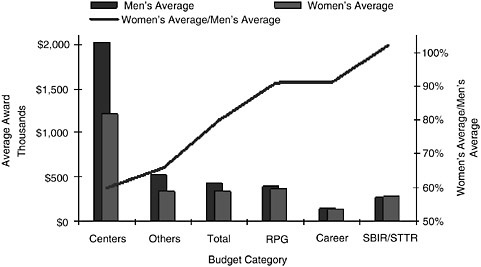
FIGURE 4-3 Average NIH research grant award to women and men by budget category, FY 2004.
SOURCE: Office of Extramural Research (2005). Sex/Gender in the Biomedical Science Workforce. National Institutes of Health, http://grants2.nih.gov/grants/policy/sex_gender/q_a.htm#q5.
Many academic scientists and engineers believe that they function within a meritocratic system that objectively rewards ability and productivity, and that careers should be open to talent.43 The institutions making up that system, however, are differentiated by major distinctions of prestige, power, and available resources. As described above, those factors influence the ability to do research and influence the evaluation of efforts. The characteristics and policies of an institution therefore can exert a major influence on career outcomes.
Because the path to an academic career is long and consists of multiple steps, any advantages or disadvantages that befall a scientist or engineer, even apparently small ones, can accumulate and lead to further advantages or disadvantages.44 The reputation of one’s degree institutions, the connec
tions and eminence of one’s mentors, the resources of the laboratories where one works, the significance of the problems one works on, the stature of the journals in which one publishes—these and many similar factors can foster or impair a researcher’s rise in the academic world.
Gender Bias in Evaluation
Deeply ingrained in the culture of academic science is the assumption that merit, as revealed by the purportedly objective process of peer review, determines the distribution of status, rewards, and opportunities. From Marie Curie to Christiane Nüsslein-Volhardt, prominent women have had their work recognized because it was so important and original. Research, however, has shown that gender colors evaluation of scientific and engineering accomplishment and thus affects the opportunities and rewards that women receive. In the intense competition for academic standing, even small differences in advantage can accumulate over the span of a career and create large differences in status and prestige. That results in white men scientists and engineers often receiving greater rewards for their accomplishments than women or minority-group members.45
A study of the peer-review scores awarded on applications for postdoctoral fellowships in Sweden—the country named by the United Nations as the world leader in gender equality—revealed that men received systematically higher competence ratings than equally productive women. A woman, in fact, had to be more than twice as productive as a man to be judged equally competent. “It is not too far-fetched to assume that [similar] gender-based discrimination may occur elsewhere,” the researchers suggested. They argued that the documented discrepancy in the perception of female work could “entirely account” for the shortage of women in senior faculty positions.46 Other research suggests that there is a similar gendered evaluation of research grants in the United States.47
Gendered evaluation runs deep in science. Tregenza, studying journal peer review in ecology, a field in which senior academics are predominantly male and younger researchers are close to gender parity, found differences in acceptance rates across journals according to the sex of the first au-
|
EXPERIMENTS AND STRATEGIES BOX 4-4 Center for Research on Learning and Teaching (CRLT) Theater Program: NSF ADVANCE at the University of Michigana Interactive theater can be used to build community, raise awareness, and stimulate discussion.b It has been used to confront issues that are difficult to resolve due to conflicts between ideals and practice.c The Center for Research on Learning and Teaching (CRLT) Theater Program, sponsored by the NSF ADVANCE program at the University of Michigan, uses interactive performances to demonstrate how faculty interactions shape and reflect the climate. They have developed performances that explore search committee discussions of job candidates, mentoring of junior faculty, and committee meeting discussions of tenure candidates. The performances are based on extensive faculty interviews, focus groups, and faculty and administrative consultation and review conducted at the University of Michigan. The main component of the CRLT Theater Program is the CRLT Players, a theater troupe composed of professional and student actors who use interactive sketches to draw attention to everyday issues in academe surrounding pedagogy, diversity, and inclusion. Using research from the experiences of faculty members and students, the players present different viewpoints to draw the audience in with a mix of comedy and drama. At the end of the show, the actors continue to play their roles during a question-and-answer session with the audience. In one theater presentation, the CRLT Players enact a meeting of search committee for a faculty position in the computer science department. The actors discuss which of two candidates—one man, one woman—they should hire. The five men and one woman simulating the search committee debate their research backgrounds, credentials, potential family plans, and gender diversity in the department. The scene ends with the chair stating that he would give the name of the man candidate to the dean for hiring. After the presentation, faculty observing the skit question the actors, who, in turn, answer the questions while remaining in character. The audience is allowed to critique the discussions and results of the search committee. |
thor.48 Some researchers argue that journals should use blinded peer review to minimize gender bias (Box 4-5). Trix and Penska evaluated letters of recommendation written by senior professors in support of men and women candidates for US medical school faculty positions and found that gender stereotyping systematically resulted in women candidates receiving less favorable recommendations than men.49
|
The program seems to be effective at multiple levels. Immediate feedback is provided during the question-and-answer session to help the troupe improve their performance. Audience members are asked to fill out a survey at the end of each performance. And the ADVANCE program also monitors long-term effects on department and university policies and procedures.d Audience members have given consistently high ratings to the relevance and effectiveness of the performances:
The CRLT performance centered on mentoring was used to augment the development and roll-out of the Faculty Advising Faculty Handbook and departmental mentoring plans. In general, based on follow-up correspondence with attendees on what worked and what did not, it has become clear that the performances have caused faculty members to reflect on their own behavior and on group dynamics during various committee meetings. They have found that the most critical issues are setting, audience composition, and framing—giving the target audience a reason to care about the information presented and way to make use of it. |
Steinpreis and colleagues examined gender stereotyping in evaluation of curricula vitae (CVs). They sent academic psychologists CVs ostensibly submitted by men and women candidates for an assistant professorship and for tenure. In fact, the documents recounted the career of a real woman psychologist who had been hired as an assistant professor and attained early tenure. The CVs for each career level were identical, except that half of respondents received a version identified by a stereotypically male name and half by a stereotypically female name. Both men and women faculty members showed a significant preference for hiring the man, rating “his” research, teaching, and service above the identical record of the woman candidate. Although the “man” and “woman” tenure candidates proved
|
FOCUS ON RESEARCH BOX 4-5 Blinded Peer Review High publication demands and the low acceptance rate of peer-review journals place journal editors and their reviewers in a powerful position. Journal reviewers have a vital role not only in influencing the journal editor’s publication decisions, but also in the very nature and direction of scientific research. Because of their influence in peer-review outcomes, journal editors and reviewers are aptly described as the “gatekeepers of science.”a Almost all English-language scientific and medical journals use anonymous review, in which authors do not learn the names of reviewers, but fewer than 20% use blinded review, in which reviewers do not learn the names of authors.b Journal editors who use blinded review have argued that blinding serves to decrease bias in the review process. Indeed, several studies have examined the effect of blinding and found that it reduced reviewer bias with regard to personal characteristics of the authors, including nationality, institutional affiliation, sex, friendship with the reviewer, race or ethnicity, and intellectual conformity with the reviewer.c This phenomenon was demonstrated with alarming clarity in an study examining the effects of blinding auditions for symphony orchestras, where, similar to universities, the training period is long, there are many more candidates than slots available, and in which number of positions is highly fixed and turnover is slow. The practice of “blind” auditions (placing a screen between the player and the judge) increased by 50% the probability that women would advance out of preliminary rounds, and explained between 30 to 55% of the increase in the proportion of women among new hires and between 25 to 46% of the increase in the percentage of women in the orchestras from 1970 to 1996.d Additional research controlling for a variety of author, article, and journal attributes shows that articles published in journals using blinded peer review were |
equally likely to be promoted on the basis of the superb CV, respondents were 4 times more likely to ask for supporting evidence about the woman, such as a chance to see her teach or proof that she had won her grants on her own, than they were for the man.50 Earlier research has shown that department chairmen evaluating male and female applicants with identical records tended to hire the men as associate professors and the women as assistant professors.51
|
cited significantly more than articles published in journals using nonblinded peer review.e Some have suggested that in addition to blinded review, journal editors conduct periodic internal and external evaluations of their journals’ peer-review process and outcomes to ensure that review bias is minimized.f |
The University of Wisconsin-Madison’s Women in Science and Engineering Leadership Institute (WISELI) provides workshops to train search committee chairs on good search methods and to sensitize them to hiring bias (Box 4-6).52 WISELI recommends spending 15-20 minutes on each application, reading the entire application rather than relying on one measure of performance, developing criteria for evaluations that can be consistently applied, and periodically evaluating decisions to determine whether qualified women and minority-group members were included.53 The Uni-
|
52 |
Women in Science and Engineering Leadership Institute. Training for hiring committees. University of Wisconsin-Madison: WISELI, http://wiseli.engr.wisc.edu/initiatives/hiring/training_hiring.html#Workshops. |
|
53 |
Women in Science and Engineering Leadership Institute, University of WisconsinMadison, ibid. |
|
EXPERIMENTS AND STRATEGIES BOX 4-6 Searching for Excellence and Diversity: Workshops for Search Committee Chairs at the University of Wisconsin-Madison The Women in Science and Engineering Leadership Institute (WISELI) at the University of Wisconsin-Madison offers workshops for faculty chairs of search committees that aim to increase the diversity of candidates recruited and hired for faculty and administrative positions. Relying on principles of active learning and peer education, the workshops encourage faculty to share search experiences and strategies across department and school/college boundaries.a The workshops emphasize the 5 Essential Elements of a Successful Search.b An introduction to and discussion of the effects of unconscious biases and assumptions on evaluation of candidates is an important feature of the workshop experience. From 2003 through 2006, 152 faculty members representing 70 different departments (57% of all departments in the university) participated in the workshops. WISELI has been evaluating the success of this approach to improving the hiring process at UW-Madison by tracking:
|
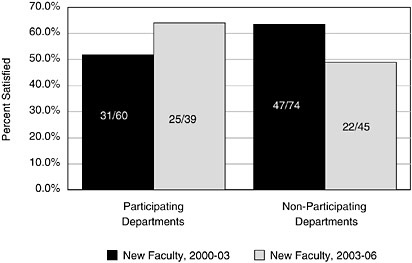 FIGURE B4-6A 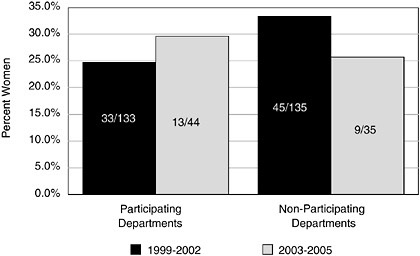 FIGURE B4-6B
|
|
These measures indicate that WISELI’s approach to educating search committee chairs appears to be working, although many other factors such as the motivation of the individual search committee chairs and departments are likely to also play an important role. WISELI plans to continue implementing workshops across the UW-Madison campus, expanding them beyond faculty and administrative searches to searches for other staff as well. One large college made participation in these workshops mandatory for all search committee chairs beginning in 2005/2006. WISELI is also visiting other campuses to offer a day-long session, “Searching for Excellence & Diversity: Implementing Training for Search Committees,” to help universities, university systems, and/or regional collectives develop and present search workshops on their own campuses.g |
versity of Michigan has its STRIDE (Strategies and Tactics for Recruiting to Improve Diversity and Excellence) program,54 which uses senior professors of science and engineering who have been trained by social scientists to work with recruitment committees to overcome biases. University administrators can make departments accountable by making participation in such programs a condition for undertaking a faculty search. Building in a measure of accountability reduces the use of stereotypes in choosing job candidates.55
Understanding Discrimination56
Although women today in the United States have many more opportunities than women of previous generations, many societal traditions inhibit their full participation in the technical workforce. Women have been struggling for access into universities and entrance into the labor force since the
|
54 |
University of Michigan STRIDE Web site, http://sitemaker.umich.edu/advance/stride. See AJ Stewart, D LaVaque-Manty, and JE Malley (2004). Recruiting women faculty in science and engineering: Preliminary evaluation of one intervention model. Journal of Women and Minorities in Science and Engineering 10(4):361-375. |
|
55 |
PE Tetlock (1985). Accountability: A social check on the fundamental attribution error. Social Psychology Quarterly 48:227-236. |
|
56 |
See Appendix C for a discussion of the theories of discrimination. Excerpted from National Research Council (2004). Measuring Racial Discrimination. Washington, DC: The National Academies Press, pp. 55-70, http://fermat.nap.edu/catalog/10887.html. |
middle of the 19th century.57 But, admission was only half the battle. Women were often co-opted into the science and engineering professions to provide lower-cost labor necessary to combat temporary workforce shortages. In addition, as described in Chapter 5, when women are hired into faculty or upper management, institutions do not provide contexts conducive to their productive potential or retention.58
Subtle, Implicit, or Unexamined Bias
Even as gender equity gains ground and a national consensus has developed that explicit racial hostility is abhorrent,59 people may still hold prejudiced attitudes, stemming in part from the US history of overt sex and racial prejudice. Although prejudicial attitudes do not necessarily result in discriminatory behavior with adverse effects, the persistence of such attitudes can result in unconscious and subtle forms of discrimination in place of more explicit, direct hostility. Such subtle prejudice is often abetted by differential mass-media portrayals60 and by de facto segregation in education and occupations. All manifestations of subtle prejudice constitute barriers to full equality of treatment. Subtle prejudice is much more difficult to document than more overt forms, and its effects on discriminatory behavior are more difficult to capture. However, subtle does not mean trivial or inconsequential; subtle prejudice can result in major adverse effects. More recently, legal scholars have begun to use the term unexamined to describe such discriminatory behavior, arguing that it shifts the burden of proof and acknowledges that such behavior can be changed.61
Pervasive, unexamined gender bias has played a major role in limiting women’s opportunities and careers because American culture generally stereotypes science, mathematics, and engineering as domains appropriate to white men and much less suitable for women or members of racial or ethnic minorities. If gender bias takes a so-called benevolent form, women are viewed as pure and morally superior, although not suited for male occupations. Under a hostile form of gender bias, women who aspire to traditionally masculine roles are seen as undermining or attacking the rightful prerogatives of men. The combination of those biases often causes competent women to be perceived as “not nice” or even “overly aggressive” and traditionally subservient women to be perceived as “incompetent” and “trivial.”62
As described in Chapter 2, in-group and out-group stereotypes can lead to lower test performance and reduce confidence and can lead some women and members of underrepresented minorities to develop less interest in pursuing science- and mathematics-based careers, even when they major in those fields. It can also affect students’ interest in taking on the leadership roles that are necessary for success in academic research.63 The tendency to see women and minority-group members as less competent than white men and their accomplishments as less worthy and significant is a prominent component of the “glass ceiling,” the well-known complex of attitudes and biases that keeps women and minorities in many organizations and professions out of the most powerful, influential, and prestigious positions because they are assumed to be unfit for leadership.64 Stereotyping and cognitive bias thus create a “built-in headwind” for women and minorities in the sciences and engineering.
|
62 |
P Glick and S Fiske (1996). The Ambivalent Sexism Inventory: Differentiating hostile and benevolent sexism. Journal of Personality and Social Psychology 70:491-512. |
|
63 |
CM Steele and J Aronson (1995). Stereotype threat and the intellectual test performance of African Americans. Journal of Personality and Social Psychology 69:797-811; M Inzlicht and Ben-Zeev (2000). A threatening intellectual environment: Why women are susceptible to experience problem-solving deficits in the presence of men. Psychological Science 11:365-371; J Keller (2002). Blatant stereotype threat and women’s performance: Self-handicapping as a strategic means to cope with obtrusive negative performance expectations. Sex Roles: A Journal of Research 47:193-198; T Schmader, M Johns, and M Barquissau (2004). The costs of accepting gender differences: The role of stereotype endorsement in women’s experience in the math domain. Sex Roles: A Journal of Research 50:835-850; PG Davies, SJ Spencer, and CM Steele (2005). Clearing the air: Identity safety moderates the effects of stereotype threat on women’s leadership aspirations. Journal of Personality and Social Psychology 88:276-287. |
|
64 |
JC Williams (2004). Hitting the maternal wall. Academe 12(6), http://www.aaup.org/publications/Academe/2004/04nd/04ndwill.htm; JC Alessio and J Andrzejski (2000). Unveiling the hidden glass ceiling. American Sociological Review 26 (2):311-315. |
The main effect of subtle prejudice seems to be to favor the in group rather than to directly disadvantage the out group.65 One might, for example, fail to promote someone on the basis of race, perceiving the person to be deferential, cooperative, and “nice” but essentially incompetent, whereas a comparable in-group member might receive additional training or support to develop greater competence. Conversely, one might acknowledge an out-group member’s exceptional competence but fail to see the person as sociable and comfortable—and therefore not fitting in, not “one of us,” and less collegial—and on that account fail to promote the person as rapidly.
The Case for Diversity: “There Goes the Neighborhood?”
There have been dramatic changes in workforce demographics over the last 40 years. As discussed in Chapter 1, women and minority groups make up an increasing proportion of science and engineering students and the technical labor force.66 The benefits of workforce diversity seem clear in knowledge-based innovative work requiring creativity and flexibility.67 In the past decade, a number of reports and popular books have touted the benefits of workplace diversity,68 connecting it to enhanced group problem solving, increased creativity, and increased profits.69 A vast and growing body of research provides evidence that a diverse student body, faculty, and
staff benefits the joint missions of teaching and research.70 However, if the structural conditions and individual perspectives do not exist to harness their benefit, diverse workgroups can lead to increased workplace tension, team fragmentation, and increased staff turnover.71 Ineffective processes and policies are manifested as workplace bias: differences in career outcomes by gender or race/ethnicity that are not attributable to the differences in skills, qualifications, interests, or preferences that individuals bring to the employment setting.72
|
Diversity and discussions of it can be turbulent and uncomfortable, but it also is clarifying, illuminating, leading to a deeper understanding of one’s self and one’s world. Diversity advances innovation. Diversity powers excellence. —Shirley Jackson, President, Rensselaer Polytechnic Institute (2005)73 |
Businesses and universities realize that to capture and capitalize on this talent, they need to change policies adopted when the workplace was more homogeneous and create new organizational structures.74 Most organizational efforts have focused on race and gender, but many also incorporate other aspects of diversity, including socioeconomic status, ethnic heritage, sexual orientation, and disability status.75 At the same time, organizations must consider increasing challenges to the concept of affirmative action and the discontinuation of programs seen to be providing advantage to any
|
70 |
See WISELI’s Benefits and Challenges of Diversity, http://wiseli.engr.wisc.edu/initiatives/climate/Benefits_Challenges.pdf. |
|
71 |
See review by Jackson, May, Whitney (1995), ibid. |
|
72 |
WT Bielby (2000). Miminizing workplace gender and racial bias. Contemporary Sociology 29(1):120-129. |
|
73 |
UCSC Chancellor’s Inaugural Symposium, November 3, 2006, http://celebration2005.ucsc.edu/symposium.asp. |
|
74 |
WB Johnstone and AE Packer (1987), ibid. |
|
75 |
See, for example, M Loden (1995). Implementing Diversity. Burr Ridge, IL: McGrawHill. |
specific group.76 Equity efforts need to address not just individual needs but also the systemic changes needed to build and sustain educational, research, and workplace environments that promote effective participation in an increasingly pluralistic society. As described below (Box 4-7), such structures would include proactive recruiting, programs to enhance team-building and interpersonal skills, compensation equity, family friendly policies, mentoring and career development programs for junior and senior employees, and accountability through annual appraisals and evaluations.
Accountability and Evaluation
Program evaluation must be an integral part of any diversity initiative. Models for some best practices have begun to emerge from some ADVANCE institutions (Box 5-5).77 However, none of the ADVANCE institutions have to date completed their 5-year institutional transformation grant, so evaluation of the success of these programs is not possible. Progress can be gleaned from annual reports to NSF78 and on many of the individual program Web sites.
Effective assessment is an iterative self-diagnostic process. It ideally involves continuous cycles of program improvement and refinement. A program should incorporate a hypothesis, a set of measurable goals, and should collect baseline (formative) and outcomes (summative) data to test that hypothesis. Reasoned analyses and plans are followed by “experimental” trials with continuous testing, learning, and program refinement from those planned trials. A percentage of total program funding should be allotted to evaluation activities and an individual should be designated to be responsible for data collection and analysis; 5% of total project funding is a common allocation for evaluation in federal programs.79
|
76 |
G Custred and T Wood (1996). California’s Proposition 209, http://www.acri.org/209/209text.html; Gratz v. Bollinger, No. 02-516, 123 S. Ct. 2411 (2003); Grutter v. Bollinger, No. 02-241, 123 S. Ct. 2325 (2003); A Klein (2004). Affirmative-action opponents suffer setbacks in Colorado and Michigan. Chronicle of Higher Education 50(31):A23; R Roach (2005). Ford diversity fellows urged to defend affirmative action. Diverse Issues in Higher Education, http://www.diverseeducation.com/artman/publish/article_4898.shtml; P Schmidt (2006). From “Minority” to “Diversity”. The transformation of formerly race-exclusive programs may be leaving some students out in the cold. Chronicle of Higher Education 52(22): A24; P Schmidt (2006). Southern Illinois U. and Justice Dept. near accord on minority fellowships. Chronicle of Higher Education 52(22):A26; R Clegg (2006). Faculty hiring preferences and the law. Chronicle of Higher Education 52(37):B13. |
|
77 |
See SV Rosser (2006). Creating an inclusive work environment. In: Biological, Social, and Organizational Components of Success for Women in Science and Engineering. Washington, DC: The National Academies Press. |
|
78 |
Available at http://www.nsf.gov/advance. |
|
79 |
National Research Council (1996). The National Scholars Program: Excellence with Diversity for the Future. Washington, DC: National Academy Press. |
|
FOCUS ON RESEARCH BOX 4-7 Making Diversity Work “If you think managing diversity is a program, you don’t get it.”a Considerable research has shown the barriers limiting the appointment, retention, and advancement of women faculty. The question is how to move beyond these barriers and make diversity work. An evaluation of a wide-ranging campus diversity initiative in the University of California system provides specific lessons for academe. Programs that were effective had three key components: the campus had a framework for monitoring progress, a commitment to analyze and use data for organizational change, and a commitment to take corrective action.b These results mirror what is found in other organizations that have implemented successful diversity management programs. Several researchers have examined program efficacy using a variety of techniques, including tracking of workforce composition and employment practices,c and case studies in industryd and federal agencies.e While there are some important differences, there are some common factors that successful programs—those shown to improve workforce diversity—exhibit. These benchmarks of success are:
Industries that have large research and development (R&D) components may be most likely to hold lessons for academia. In this context, several actions are correlated with increased workforce diversity:g
|
|
Overall, these findings support the creation of systems of authority and accountability (diversity committees, affirmative action plans) (Box 6-2), the use of targeted searches and incentives (Box 3-6), the use of surveys to assess university culture (Box 6-7), and the implementation of mentoring programs (Box 6-3). While diversity training is helpful in R&D intensive industries, it is important to note that corporate diversity training is very different from the sort of diversity initiatives found in the ADVANCE programs (Box 5-5), in which academic scientists rather than hired consultants lead training and create ongoing feedback and learning systems (Boxes 4-3, 4-4, and 4-6). Such training systems are akin to diversity committees, which are quite effective in both R&D industries and elsewhere. To derive maximal benefits from diversity, members of academic communities must show respect for each other’s cultural and stylistic preferences and awareness of unconscious assumptions and behaviors that may influence interactions. Only when differences are openly discussed and learned from do the positive effects of diversity accrue; open discussion makes it possible for the groups to create psychological safety.h The goal is to create a climate in which everyone feels personally safe, listened to, valued, and treated fairly and with respect.
|
|
EXPERIMENTS AND STRATEGIES BOX 4-8 Specific Steps for Overcoming Bias
|
|
FOCUS ON RESEARCH BOX 4-9 Top Research Articles on the Effects of Bias on Evaluationa Each of the 19 institutions that have received NSF ADVANCE grants were asked which research publications have proven most effective in their institutional transformation projects. The most-cited publications were these: RE Steinpreis, KS Anders, and D Ritzke (1999). The impact of gender on the review of the curricula vitae of job applicants and tenure candidates: A national empirical study. Sex Roles: A Journal of Research 41:509-528. F Trix and C Psenka (2003). Exploring the color of glass: Letters of recommendation for female and male medical faculty. Discourse and Society 14(2):191-220. V Valian (1999). Why So Slow: The Advancement of Women. Cambridge: MIT Press. C Wennerås and A Wold (1997). Nepotism and sexism in peer-review. Nature 387: 341-343. |
The committee has prepared a detailed scorecard for the purposes of measuring progress toward improving the representation of women in university programs and faculties (Box 6-7). Measurables include
-
Changes in the representation of women and minorities in the student body, new faculty interviews, hire offers, faculty rank positions, and in administrative positions.
-
Changes in hiring, promotion, tenure, retention, and turnover. Exit interviews can be an important means of evaluating reasons for turnover and designing retention programs (Box 3-5).
-
Differences in salary or resource allocation.
BEYOND BIAS
The underrepresentation of women and minorities in science and engineering faculties stems from a number of issues that are firmly rooted in our society’s traditions and culture. To accelerate the rate at which women and minority-group members take their places as leaders in science and engineering, it is essential that all members of the scientific and engineering community—men and women alike—reflect on their own values, beliefs, and behavior to ensure that they do not further stereotypes, prejudices, policies, practices, or climates that discourage or exclude women and minorities from academe (Box 4-8).
A powerful way to reduce evaluation bias has been to bring to the attention of those performing evaluations—including provosts, department chairs, and search committees—the research in the field (Box 4-9).
CONCLUSION
Our analysis shows that women possess the qualities needed to succeed in academic careers and can do so when given an equal opportunity to achieve. Furthermore, reducing the homogeneity of faculty enhances problem solving, teaching, and research. The need to eliminate bias against women scientists and engineers—whether explicit, covert, or unexamined— is therefore more than a moral or legal obligation of universities. It is a requirement for assuring a scientific workforce of the highest quality. Only the best possible scientific workforce will permit the nation to compete in an increasingly global world of science and engineering.


