
5
Institutional Constraints
CHAPTER HIGHLIGHTS
In addition to bias, systematic constraints and expectations built into academic institutions have impeded the careers of women scientists and engineers. The traditional scientific or engineering career presumes the model of an out-of-date male life course. It is predicated on the assumption that the faculty member will have an unlimited commitment to his or her academic career throughout his or her working life. Attention to other serious obligations, such as family, is taken to imply lack of dedication to one’s career. Historically, that career model depended on a faculty member having a wife to take care of all other aspects of life, including the household, family, and community. The model still fits some men but is increasingly unsuitable for both men and women who need or want to participate in other activities important to them and their communities.
The traditional career model is clearly difficult for women scientists and engineers to fulfill, especially if they have children. Because the burden of family, household, and community care generally falls more heavily on women than on men—and because women seldom have substantial spousal support—women scientists and engineers often experience intense conflict between their family and professional roles. A well-documented complex of biases known as the maternal wall or family responsibilities discrimi-
nation hampers the career advancement of women scientists and engineers with children and the minority of male scientists and engineers who bear major caregiving responsibilities. Those on highly competitive academic career tracks are aware of these issues and often make compromises to lessen the conflict or choose not to avail themselves of accommodations for which they are eligible, such as stopping the tenure clock or reducing work responsibilities, out of fear of damaging their career prospects. Women scientists and engineers in fast-track positions, for example, are less likely than those on less competitive career tracks to be married or to have children. Those who are mothers tend to have fewer children than comparable men. Furthermore, the perseverance of women scientists and engineers is seldom perceived as evidence of the very high level of devotion to their profession that it represents.
Anti-discrimination law requires universities to remedy conditions that differentially affect women’s entry into and promotion in academic scientific and engineering careers. Under recent legal decisions, the existence of stereotyping can serve as proof of discrimination. Legal trends thus encourage institutions to reduce stereotyping and also to change the institutional practices and norms that limit women’s advancement. Other steps needed to remove barriers include documenting the status and progress of underrepresented groups, establishing a work environment that is explicitly inclusive, and providing services that allow scientists and engineers to be productive while meeting their responsibilities outside of work. All those steps require leadership—and resource commitments—at the highest department and institutional levels. The most necessary and most difficult change is a thorough reconsideration of the long-accepted recruitment and evaluation practices implicit in the outdated academic career model.
FINDINGS
5-1. Systematic structural constraints built into academic institutions have impeded the careers of women scientists and engineers. A successful academic career has traditionally involved the presumption that unlimited attention can be given to that throughout one’s life.
5-2. Deviation or delay, any substantial hiatus, or serious attention to responsibilities outside of the academic realm have harmed faculty members’ ability to compete successfully because it has been taken to indicate a lack of seriousness about their careers.
5-3. Scientists and engineers without substantial spousal support, particularly those who shoulder major caregiving responsibilities, are disadvantaged in meeting the norms and expectations of academe.
5-4. The mere existence of apparently family-friendly policies at universities will not reduce the pressure on women faculty or their fear that family life will damage or even destroy their careers.
5-5. Well-planned, data-driven efforts to remove institutional constraints on women academics’ careers can produce significant results.
5-6. Whether those efforts involve “small wins” or institution-wide transformations, to be successful they must be based on accurate information about the existing situation, attention to problematic elements in the institution’s culture and practices, input from affected persons to help to identify those elements, evaluation of results, and buy-in from leadership at all institutional levels. Recalcitrance at lower levels can torpedo top-down initiatives, and bottom-up efforts can sink without support from those with power at top levels.
5-7. Adequate data gathering, planning, implementation, and evaluation of changes require the dedication of sufficient resources to the objective of increasing diversity.
RECOMMENDATIONS
5-1. For lasting change to occur, academic institutions, professional societies, and federal agencies should work together to provide leadership on issues of equity, hold their constituents accountable for change, and provide clear methods and measures for compliance.
5-2. University leaders should incorporate into campus strategic plans goals of counteracting bias against women in hiring, promotion, and treatment. This includes working with the inter-institution monitoring organization (see recommendation 5-7 below) to perform annual reviews of the composition of their student body and faculty ranks, publicizing progress toward the goals annually, and providing a detailed annual briefing to the entire board of trustees.
5-3. University leaders should take action immediately to remedy inequities in hiring, promotion, and treatment.
5-4. University leaders should require evidence of a fair, broad, aggressive search, before approving appointments and hold departments accountable for the equity of their search process and outcomes even if it means canceling a search or withholding a faculty position.
5-5. University leaders should develop and implement hiring, tenure, and promotion policies that take into account the flexibility that faculty need across the life course, allowing integration of family, work, and community responsibilities. They should provide central policies and funding for faculty and staff on leave and should visibly and vigorously support campus programs that help faculty with children or other caregiving responsibilities to maintain productive careers. These programs should, at a minimum, include provisions for paid parental leave for faculty, staff, postdoctoral scholars, and graduate students; facilities and subsidies for on-site and community-based child care; dissertation defense and tenure clock extensions; and family-friendly scheduling of critical meetings.
5-6. Faculties and their senates should immediately review their tenure processes and timelines to ensure that hiring, tenure, and promotion policies take into account the flexibility that faculty need across the life course and do not sacrifice quality in the process of meeting rigid timelines.
5-7. The committee recommends that the American Council on Education convene national higher education organizations, including the Association of American Universities, the National Association of State Universities and Land Grant Colleges, and others to discuss implementation of an oversight/intermediary body. Analogous to the National Collegiate Athletics Association, this body would act as an intermediary between academic institutions and federal agencies in establishing norms and measures, in collecting data, and in cross-institution monitoring of compliance and accountability. A primary focus of the discussion should be on defining the scope and structure of data collection.
5-8. Scientific and professional societies should serve in an analogous role to individual national governing bodies for sports and set professional and equity standards and collect and disseminate field-wide education and workforce data.
5-9. Universities and scientific and professional societies should provide child-care and elder-care grants or subsidies to enable their members to attend work-related conferences and meetings.
5-10. Federal funding agencies and foundations should ensure that their practices—including rules and regulations—support the full participation of women and do not reinforce a culture that fundamentally discriminates against women. All research funding agencies and foundations should make it possible to use grant monies for dependent-care expenses necessary to engage in off-site or after-hours research-related
activities or to attend work-related conferences and meetings. They should establish policies for extending grant support for researchers who take a leave of absence due to caregiving responsibilities, and create additional funding mechanisms to provide for interim technical or administrative support during a leave of absence related to caregiving.
5-11. Federal agencies and foundations should lay out clear guidelines and leverage their resources and existing laws to increase the science and engineering talent developed in this country, including enforcing federal anti-discrimination laws at universities and other higher education institutions through regular compliance reviews and prompt and thorough investigation of discrimination complaints.
5-12. Federal enforcement agencies should ensure that the range of their enforcement efforts covers the full scope of activities involving science and engineering that are governed by the anti-discrimination laws. If violations are found, the full range of remedies for violation of the anti-discrimination laws should be sought.
5-13. Federal enforcement efforts should evaluate whether universities have engaged in any of the types of discrimination banned under the anti-discrimination laws, including: intentional discrimination, sexual harassment, retaliation, disparate impact discrimination, and failure to maintain required policies and procedures.
5-14. Federal compliance review efforts should encompass a sufficiently broad number and range of institutions of higher education to secure a substantial change in policies and practices nationwide. Types of institutions that should be included in compliance reviews include 2-year and 4-year institutions; institutions of undergraduate education; institutions that grant graduate degrees; state universities; private colleges; and educational enterprises, including national laboratories and independent research institutes, which may not be affiliated with universities.
5-15. Federal enforcement agencies, including the Equal Employment Opportunity Commission (EEOC); the Department of Justice, the Department of Labor, and the Department of Education; and individual federal granting agencies’ Offices of Civil Rights should encourage and provide technical assistance on how to achieve diversity in university programs and employment. Possible activities include providing technical assistance to educational institutions to help them to comply with anti-discrimination laws, creating a clearinghouse for dissemination of
strategies that have been proved effective, and providing awards and recognition for model university programs.
5-16. Congress should take steps necessary to encourage adequate enforcement of anti-discrimination laws, including regular oversight hearings to investigate the enforcement activities of the Department of Education, the EEOC, the Department of Labor, and the science granting agencies, including the National Institutes of Health and the National Science Foundation, the Department of Defense, the Department of Agriculture, the Department of Energy, the National Institute of Standards and Technology, and the National Aeronautics and Space Administration.
A number of factors disadvantage women scientists and engineers compared with their men colleagues. Bias plays an important role, but it is only one of the features of academic life that creates obstacles for women. Various institutional practices—especially those related to recruitment, tenure, and promotion—have differential effects on women and men. Such practices can have unintended detrimental effects on people whose circumstances do not fit the traditional assumptions on which these practices were based.
The traditional image of the “ideal” scientist or engineer (see below) tends to disadvantage women and advantage men. Even when an institution applies its rules and practices without explicit regard to sex, members of a group that constitutes a small minority in the organization—one less valued and less influential in setting norms—experience the effects of rules and practices differently from members of the more prestigious majority group. That often works to the detriment of the minority. Seemingly neutral practices, based as they are on the life experiences and characteristics of men, can create barriers to the careers of women in science and engineering.
Social connections between academic institutions and other institutions—such as church, day care, schools, health care, or banks—can constrain the options of some people but not others, particularly with regard to expected work schedules. Women still bear the brunt of caregiving and experience the major conflict with such expectations. Institutions will need to recognize the features of their institutional life that disproportionately and systematically burden women and accordingly change policies and practices. Simple one-shot efforts will not remedy the effects of long-standing and pervasively male-biased expectations and norms. Careful analysis of particular situations and thoughtfully designed, multipronged approaches are needed to bring real change and foster the advancement of women scientists and engineers.
THE “IDEAL” SCIENTIST OR ENGINEER
As discussed in the previous chapters, an important constraint on women’s careers is the traditional image of who merits an academic position. Not only are men presumed competent while women have to prove their worth, the traditional career model assumes that aspiring researchers can devote the decades of their twenties and thirties single-mindedly to their careers. Deviation or delay in following that course, any substantial hiatus or serious attention to responsibilities outside the academic realm, have traditionally harmed the scientist’s or engineer’s ability to compete successfully because it has been taken to indicate a lack of seriousness about one’s career.
In that model, scientists and engineers may marry, become parents, and participate in family life while pursuing their demanding careers because they have full-time spousal support to assume the major household responsibilities, including rearing children and running the home. It thus presumes a life course and social role that no longer fits many men and does not fit most women.1 The model clearly does not take into account the life course of women who wish to become parents inasmuch as it requires unbroken concentration on work during the peak female reproductive years. Nor does it take into account the needs of unmarried, divorced, or widowed scientists and engineers who shoulder household, family, and community obligations without spousal support. It is a model that fits the lifestyle of an ever smaller group of people. Furthermore, this outdated model may not fit current trends in science and engineering, which call for more collaborative and less single-minded and individualistic approaches. The need is urgent to transform academic norms and expectations so that the academy can continue to attract the best people.
Beyond the assumptions about timing, the traditional career model assumes that successful faculty members will become part of a community of colleagues in their laboratories, departments, and disciplines, and will receive the guidance and support of senior faculty members. For that to occur, aspiring scientists and engineers must gain acceptance and a feeling of belonging among their colleagues. As discussed in Chapter 3, women constitute a minority—and often a very small minority—in many scientific and engineering fields, and commonly feel isolated, left out, or not accepted. Bringing women and other minority groups into the mainstream is a necessary prerequisite to capturing the talent of the diverse workforce (Box 4-7).
|
1 |
E Ostrow (2002). The backlash against academic parents. Chronicle of Higher Education (February 22), http://chronicle.com/jobs/2002/02/2002022202c.htm. |
|
Assertiveness and single-mindedness are easier to measure quantitatively than the qualities that we are really interested in, intellectual curiosity, dedication, and so on, which have more human dimensions. Assertiveness and single-mindedness are stand-ins that worked pretty well for a large group of men in previous generations. Even though they are no longer very appropriate, our system still selects for them. And because it “works” (at least if you ignore gender discrimination and such things), we haven’t tried very hard to do better. —Howard Georgi, Mallinkrodt Professor of Physics, Harvard University2 |
RECRUITMENT
Are the recruitment practices used by academic institutions inviting and accessible to women? To understand how to increase the proportion of women and minority-group applicants, universities are studying their own recruitment and hiring practices. In one example, the University of California, Berkeley (UCB) examined department-level data on hiring and recruitment practices and noted which practices correlated with hiring women above, at, or below their percentage in the applicant pool.3 Departments that were successful in recruiting women did not assume that women feel sufficiently confident or included to send in an application. Merely taking such steps as designating an affirmative action officer to serve on the search committee or stating in the job announcement that women and minority-group members are encouraged to apply correlated with hiring below the level of the applicant pool. However, departments that hired at or above the level of women in the applicant pool used specific strategies that included getting input from graduate students, selecting diverse search committees, and establishing relationships with women at professional meetings and inviting them to apply.
Conflict between work and family also affects the applicant pool. Mason and Goulden have found that married women who have children are
|
2 |
H Georgi (2000). The back page: Is there an unconscious discrimination against women in science? American Physical Society Newsletter, http://schwinger.harvard.edu/~georgi/women/backpage.htm. |
|
3 |
A Stacy (2006). Recruitment practices. In Biological, Social, and Organizational Components of Success for Women in Science and Engineering. Washington, DC: The National Academies Press. |
50% less likely to gain faculty positions, compared with single women or married men who have children.4 Ginther, examining career progression by field, found single women scientists and engineers 16% more likely than single men to be in tenure track jobs 5 years after the PhD while married women with children were 45% less likely than married men with children to be in tenure-track positions. Having children, especially young children, decreases the likelihood of women’s obtaining a tenure-track job by 8% to 10% in all science and engineering fields but has no significant impact on men. Ginther attributes those differences to the coincident timing of the tenure and biological clocks and to women’s role as primary caregivers for children.5
Narrow position specifications also affect the applicant pool and the numbers of women hired. There is mounting evidence that women are choosing to work at the boundaries of disciplines. Among the science, technology, engineering, and mathematics (STEM)6 faculty at UCB, 26% of the women and 15% of the men have joint appointments. Women tend to hold joint appointments in business, biology, law, city and regional planning, economics, and environmental science. In one of the newer departments, bioengineering, half of the faculty are women. When the biological sciences were restructured to include broad, multidisciplinary approaches, the proportion of women faculty increased to 50%.
|
I can’t tell you how many times I have reviewed searches in which the people—predominantly women and minority-group members—were not hired, because they didn’t “fit”. —Angelica Stacy, Professor of Chemistry and Associate Vice Provost for Faculty Equity, University of California, Berkeley (2006)7 |
As part of its diversity initiative, UCB has started to hold some full-time equivalent faculty positions centrally to encourage groups of faculty and
departments to pool resources and propose hires in new multidisciplinary research areas. The University of Wisconsin, Madison, and a number of other institutions have similar central-hire or cohire programs based on a commitment to enhance interdisciplinary research.8 Those policies counteract the tendency of departments to hire people to fill the mainstream slots, rather than moving the institutions forward into new fields. To accomplish the latter, institutional leadership is important.
INSTITUTIONAL INTERACTIONS
As shown in Chapter 4, distinctions based on sex and race or ethnicity emerge from the identification of people as members of a group, rather than their identification as individuals. Our findings on the education and career trajectories of men and women scientists and engineers do not reveal differences in ability, training, or even productivity that explain the sex differences in career progression. Rather, a web of factors—including psychosocial features, family patterns, institutional requirements, and aspirations and expectations—combine to produce unequal career outcomes for men and women. Various institutions of society—including family, schools, and employers—interact to create obstacles to women’s careers.
Those interactions strongly influence the differential choices that men and women make at crucial points along their educational and career progressions. Such choices are not necessarily voluntary. Rather, career choices reflect the broad social structure and therefore tend to reinforce the current sex segregation of occupations.9 Examples include the greater propensity of women scientists to enter biological science rather than physical science fields and the lower propensity of men than women in general to respond to career setbacks by withdrawing from the workforce and devoting themselves to family responsibilities. Indeed, the latter may be a rational response for women who perceive their career success as adversely affected by factors they cannot (or choose not to) change, such as being female or having children.
The set of societal and institutional connections around family formation are particularly complex and have starkly different effects on men and women scientists and engineers. The institutions on which parents depend for support in caring for their families typically have rules, traditions, as-
|
8 |
NAS/NAE/IOM (2004). Facilitating Interdisciplinary Research. Washington, DC: The National Academies Press, Chapter 5. |
|
9 |
Y Xie and KA Shauman (1998). Sex differences in research productivity: New evidence about an old puzzle. American Sociological Review 63(6):847-870. |
sumptions, and policies of their own that may conflict with those of laboratories and universities. Familial roles embody implications about available time, energy, and income. Day care providers, schools, and other child-centered organizations run on calendars that assume that parents can be available at particular hours, on particular days, or for entire seasons of the year and can afford particular costs. Laboratories assume that scientists or engineers are available when needed for research, and departments assume that researchers are free to travel to present results and deal with collaborators. Fellowship and hiring committees assume that people are free to relocate to maximize career opportunities.
The importance of institutional connections shows up in the differential career effects of marriage and the presence of young children. They spur the career advancement of men but slow the advancement of women.10 On average, 64.4% of women doctoral scientists and engineers in tenure or tenure-track careers are married; 83.4% of men are married, 42.2% of women have children, and 50% of men have children. These proportions differ by field, but have not changed substantially between 1993 and 2003 (Figure 5-1). Of those women who are married, more women scientists and engineers are married to men who work full time (Figure 5-2), and depending on field, 64% to 81% of women scientists and engineers marry fellow scientists and engineers (Figure 5-3).
The academic job market is national. Geographic mobility is important for career advancement. At a minimum, most successful academics relocate from where they did their graduate work. A number of lines of evidence indicate that mobility of women academics differs from that of men, and that this is tied to the increased likelihood that more women than men are in dual-career marriages, particularly in marriages to other academics. Research since the 1970s shows that women academics are more likely to be living in large urban areas, a strategy that increases the likelihood that both partners in a dual-career marriage will find satisfactory employment.11
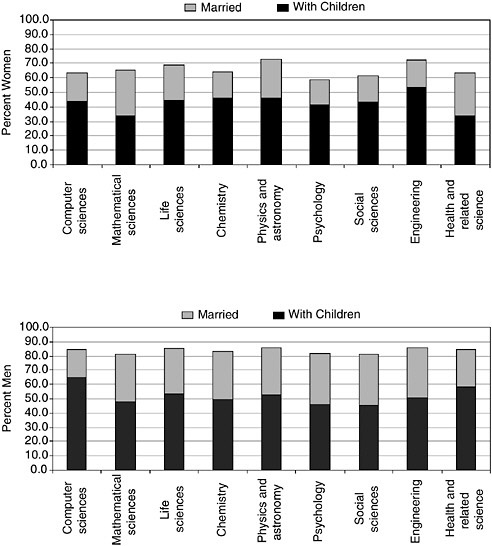
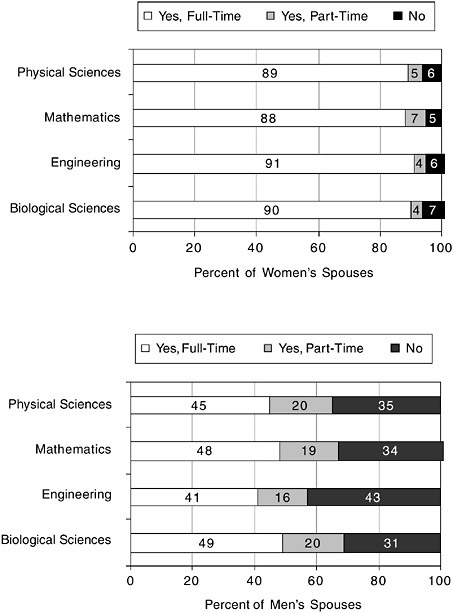
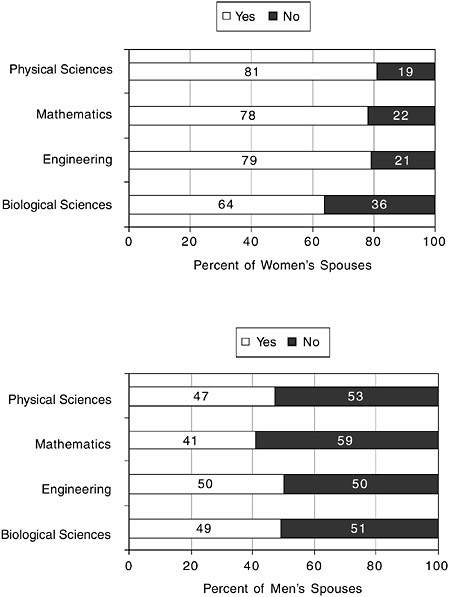
FIGURE 5-3 Employment expertise of spouses of science and engineering PhDs, 30-44 years old in 1999: Married PhDs with employed spouses.
NOTES: Yes = married to another scientist or engineer; No = not married to another scientist or engineer.
SOURCE: National Science Foundation (1999). Survey of Doctoral Recipients. Arlington, VA: National Science Foundation.
Irrespective of sex, unmarried scientists have the highest mobility rates, and scientists married to nondoctorate professionals have the lowest mobility rates. Life scientists and physical scientists have higher mobility rates than social scientists. The main difference in mobility by sex centers on the presence of young children. Women’s mobility appears much more constrained than men’s by preschool (women 11% less likely to move) and elementary-age children (women 39% less likely to move).12 Whatever the reasons, early parenthood often corresponds with the early years of the mother’s scientific or engineering career, so lower mobility limits many women’s ability to respond to career opportunities that may make a crucial difference in their ultimate career outcomes. Compromises made in initial faculty appointments can have long-term detrimental effects because the quality of colleagues and the resources available at the crucial early stages of a career affect productivity and visibility in a field. Men’s geographic mobility does not appear constrained until their children reach their teens.13 By that time, an academic career is generally well established and lessened mobility may have a smaller effect on ultimate outcomes.
All those considerations indicate that differences in career trajectories for men and women are generated and reinforced by the social structures in which people are situated and by the networks of interactions in which they participate. Increasing women’s representation in science and engineering requires many social, cultural, and economic changes that are large in scale and interdependent.14
Family Responsibilities and the Bias Against Caregivers
Underlying the disproportionate disadvantage for the careers of women academic scientists and engineers of parenthood or other significant care responsibilities is a strong cultural devaluation of femininity and a consequent bias against caregivers that is deeply embedded in a number of practices and attitudes in academe.15 American culture generally stereotypes caregiving as feminine work; many more women than men carry the main or exclusive responsibility for caregiving—whether of children or of elderly
|
12 |
Shauman and Xie (1996), ibid. |
|
13 |
Shauman and Xie (1996), ibid. |
|
14 |
Y Xie and KA Shauman (2003). Women in Science: Career Processes and Outcomes. Cambridge, MA: Harvard University Press; JC Williams (2000). Unbending Gender: Why Work and Family Conflict and What to Do About It. New York: Oxford University Press. |
|
15 |
Williams (2000), ibid; R Drago, C Colbeck, KD Stauffer, A Pirretti, K Burkum, J Fazioli, G Lazarro, and T Habasevich (2005). Bias against caregiving. Academe 91(6), http://www.aaup.org/publications/Academe/2005/05so/05sodrag.htm. |
or disabled relatives—within their families.16 This is reflected in the fact that overall, women between the ages of 20 and 40 take off more time from work than men to care for children, including disability leave and more time in the hospital.17 In the United States, 9 in 10 women return to work within a year after the birth of a child;18 family leave coverage increases the likelihood that a woman will return to work after childbirth.19 After age 45, the differences in disability leave reverse. Men experience more episodes of chronic illness, longer hospital stays, and are more likely to go on longterm disability.20
In academe, caregiving is often seen as competing for the time and attention needed to succeed in highly competitive fields and, therefore, as indicating a lack of dedication to a scientific career. The determination to overcome the difficulties inherent in doing science while bearing caring responsibilities is somehow not generally seen as indicating the even greater dedication to science or engineering that it represents.21
|
I really felt by having a child I gave up a lot of respect I had worked very hard to earn. —Anonymous woman professor, 200122 |
The Maternal Wall
Women attempting to pursue scientific or engineering careers while also carrying major child-care responsibilities encounter a well-documented complex of constraints and biases called the maternal wall, which contributes to the scarcity of women in the upper faculty ranks.23 Research has shown that the maternal wall, also known as family responsibilities discrimination, penalizes mothers, potential mothers, and fathers who seek an active role in family care.24 The researchers document that mothers experience gender stereotyping in how jobs are defined, in the standards to which they are held, and in assumptions that are made about them and their work; for example, a man who is absent is assumed to be presenting a paper, whereas a woman who is absent is assumed to be taking care of her children. Mothers also face negative assumptions about their competence, specifically, that they are less competent or committed than other workers. Similarly, fathers who take parental leave or even a short leave to deal with family matters often receive fewer rewards and lower performance ratings and are viewed as less committed.
|
I have been under a lot of stress dealing with expectations after having a child. In the eyes of the departmental administration I was no longer a faculty member but had become a “pregnant female.” There was no prior experience with this overlap so the expectations of me were way out of line with how we normally treat faculty. —Anonymous woman professor, 200125 |
Because of those effects, parenthood, especially when it begins early in an academic career, affects women’s prospects for advancement far more adversely than men’s. Motherhood has been identified as the factor most
|
23 |
JC Williams (2004). Hitting the maternal wall. Academe 90(6), http://www.aaup.org/publications/Academe/2004/04nd/04ndwill.htm. |
|
24 |
JC Williams and HC Cooper (2004). The public policy of motherhood. Journal of Social Issues 60(4):849-865; C Etaugh and G Gilomen (1989). Perceptions of mothers: Effects of employment status, marital status, and age of child. Sex Roles: A Journal of Research 20:59-70; C Etaugh and C Moss (2001). Attitudes of employed women toward parents who choose full-time or part-time employment following their child’s birth. Sex Roles: A Journal of Research 44:611-619; SJ Correll and S Benard (2005). Getting a job: Is there a motherhood penalty? Presentation at American Sociological Association Annual Meeting, August 15, 2005, Philadelphia, PA, http://sociology.princeton. edu/programs/workshops/Correll_Benard_manuscript.pdf. |
|
25 |
Participant in leadership workshop hosted by COACh. |
likely to preclude a woman with science or engineering training from pursuing or advancing in an academic career.26 As discussed above, women scientists and engineers disproportionately marry fellow scientists and engineers.27 For example, 44% of women members of the American Physical Society are married to physicists, and another 25% are married to other scientists. 80% of women mathematicians and 33% of women chemists are married to men in their fields.28 Marrying within an academic discipline, termed disciplinary endogamy, is more widespread in the sciences and engineering than in other academic fields. It can create problems for hiring (especially for women), because most universities do not have dual-career hiring policies.29 Even in the 1980s, 20% of faculty resignations were related to spousal employment.30 Wolf-Wendel and colleagues have surveyed dual-career policies at 360 institutions of higher education, performed case studies of five colleges and universities, and compiled a detailed compendium of institutional policies and practices.31
That said, women on highly competitive academic career tracks are less likely to marry or reproduce and more likely to divorce than comparable men or than women in lower-level academic posts.32 A longitudinal study of more than 160,000 academics shows that two-thirds of women who took academic jobs on the fast track before they had become mothers never had children.33 While there was no change in marriage rates of PhD recipients from 1978 to 1994, both men and women PhDs are increasingly
|
26 |
Y Xie and KA Shauman (2003). Women in Science: Career Processes and Outcomes. Cambridge, MA: Harvard University Press; D Ginther (2006). The economics of gender differences in employment outcomes in academia. In Biological, Social, and Organizational Components of Success for Women in Academic Science and Engineering. Washington, DC: The National Academies Press; MA Mason and M Goulden (2004). Marriage and baby blues: Redefining gender equity in the academy. Annals AAPSS 596:86-103. |
|
27 |
MA Mason and M Goulden (2002). Do babies matter? The effect of family formation on the lifelong careers of academic men and women. Academe 88(6):21-27, http://www.aaup.org/publications/Academe/2002/02nd/02ndmas.htm. |
|
28 |
Stanford Study on Dual-Career Couples, see http://news-service.stanford.edu/news/2005/november9/dual-110905.html; LE Wolf-Wendel, SB Twombly, and S Rice (2000). Dual-career-couples: Keeping them together. Journal of Higher Education 71(3):291-321. |
|
29 |
LE Wolf-Wendel, S Twombly, and S Rice (2000). The two-body problem: Dual-career-couples hiring practices in higher education. The Journal of Higher Education 71(3):291-321. |
|
30 |
D Burke (1988). A New Academic Marketplace. New York: Greenwood Press. |
|
31 |
L Wolf-Wendel, SB Twombly, and S Rice (2003). The Two-Body Problem: Dual-Career-Couple Hiring Practices in Higher Education. Baltimore: Johns Hopkins University Press. |
|
32 |
Drago et al. (2005), ibid; B Sullivan, C Hollenshead, and G Smith (2004). Developing and implementing work-family policies for faculty. Academe 90(6), http://www.aaup.org/publications/ Academe/2004/04nd/04ndsull.htm. |
|
33 |
Mason and Goulden (2002), ibid. |
delaying having children until later in their career.34 About 45% of women who have tenure do not have children. That rate of childlessness—much higher than among tenured men—reflects the belief of many young female academics that they must choose between tenure and children and can have one only at the cost of the other.35
Given the tie between gender and caregiving, ostensibly gender-neutral institutional policies often seriously disadvantage women scientists and engineers. They may be as apparently innocuous as providing funding to cover travel expenses but not additional child care expenses for scientists attending out-of-town conferences to present papers. The widely used 7-year tenure clock and the pressure on tenure candidates to show early promise, although apparently gender-neutral, often force women to choose between taking time out for pregnancy, childbirth, and child care, or pursuing a fast-track career.
Scientists and engineers are generally well aware of the bias against caregivers, and those seeking fast-track academic careers use a number of strategies to keep family responsibilities from damaging their careers. One is to minimize family commitments that interfere with career progress. The most obvious method is avoiding marriage and parenthood. Overall, 17% of women at research universities stay single, as opposed to 10% of men; 30% of women but only 13% of men have limited their number of children to avoid anticipated career damage; 18% of women but only 8% of men have delayed their second child for the same reason.36
A number of universities permit faculty members to request that the tenure clock stop for a period or that their workload be temporarily lightened to mitigate the career effects of childbearing and childrearing. Many academics, however, fearful of seeming to lack dedication and seriousness, decline to avail themselves of those opportunities. Over a 7-year period at one large research university, for example, only four parents of either sex, of the 257 on the tenure track, took advantage of official family leave.37 That tactic typifies the effort to deflect attention from one’s family responsibilities. Other tactics include missing children’s events and returning to
work earlier than desired after a birth. Studies show that more women than men engage in these tactics, which adds to their stress. For faculty—men and women—who engage in bias avoidance behaviors, time to tenure was reduced and age at tenure was reduced by over a year.38
Thus, the mere existence of apparently family-friendly policies at universities will not reduce the pressure on women faculty or their fear that family life will damage or even destroy their careers. Rather, to reduce the conflict between work and family that faculty members experience, university leaders, including top administrators and department chairs, must adopt policies that recognize and mitigate the disadvantages imposed by caregiving and, through word and deed, demonstrate their belief that faculty members can combine a high level of professional achievement with family life (Box 5-1).39
Glass Ceilings
In addition to the maternal wall, women scientists must contend with the “glass ceiling,” another complex of attitudes and practices that keeps women in many organizations and professions out of the most powerful, influential, and prestigious positions because they are assumed to be unfit for leadership.40 The tendency to see women as less competent than men and their accomplishments as less worthy and significant is a prominent component of the glass ceiling. Scientific and professional societies and universities need to recognize talented women and provide opportunities to serve in leadership roles; these can be as various as keynote speaker, center director, elected position, prestigious award, or an administrative position.41 That said, the eagerness to find talented women sometimes causes them to be promoted before they have had enough experience. As with any
|
38 |
Drago, et al. (2005), ibid. |
|
39 |
K Ward and L Wolf-Wendel (2004). Fear factor: How safe is it to make time for family? Academe 90(6), http://www.aaup.org/publications/Academe/2004/04nd/04ndward.htm. |
|
40 |
JC Williams (2006). Long time no see: Why are there still so few women in academic science and engineering. In Biological, Social, and Organizational Components of Success for Women in Academic Science and Engineering. Washington, DC: The National Academies Press; JC Alessio and J Andrzejski (2000). Unveiling the hidden glass ceiling. American Sociological Review 26(2):311-315. |
|
41 |
If University leaders do appoint women to positions of prominence, where they can gain leadership experience, these women have a high probability of going on to even greater things. For example, every woman ever appointed to the position of Provost at Yale has as her next job become President of a prestigious university (Hanna Gray, President of University of Chicago; Judith Rodin, President of the University of Pennsylvania; Alison Richard, Vice Chancellor of Cambridge University; and Susan Hockfield, President of the Massachusetts Institute of Technology). |
|
DEFINING THE ISSUES Box 5-1 Universities Reaffirm Pledge for Gender Equitya In 2001, nine universities came together as a group to state publicly that “institutions of higher education have an obligation, both for themselves and for the nation, to develop and utilize fully all the creative talent available.” They reaffirmed that statement in 2005, recognizing that barriers to the full participation of women still exist, not only in science and engineering, but also in academic fields throughout higher education. “In the summer of 2005, representatives from our nine universities convened to share best practices and specific initiatives addressing faculty with family responsibilities. While considerable progress has been made since 2001, we acknowledge that there are still significant steps to be taken toward making academic careers compatible with family caregiving responsibilities. Our goal as research universities is to create conditions in which all faculty are capable of the highest level of academic achievement. Continuing to develop academic personnel policies, institutional resources, and a culture that supports family commitments is therefore essential for maximizing the productivity of our faculty. The future excellence of our institutions depends on our ability to provide equitable and productive career paths for all faculty.” —David Baltimore, California Institute of Technology; Lawrence H. Summers, Harvard University; Susan Hockfield, Massachusetts Institute of Technology; Shirley M. Tilghman, Princeton University; John Hennessy, Stanford University; Robert Birgeneau, University of California, Berkeley; Mary Sue Coleman, University of Michigan; Amy Gutmann, University of Pennsylvania; Richard C. Levin, Yale University |
promotion, this works only if there is enough advice and support from above. The Committee on the Advancement of Women Chemists (COACh) program is an example of what can be done to “break” the glass ceiling (Box 4-3).42
PIONEERS AND TIPPING POINTS
The obstacles and impediments that women scientists and engineers experience as they pursue careers in academic institutions do not arise
solely from institutional constraints, stereotyping, or bias. Organizational studies show that introducing members of previously excluded groups into social units creates predictable attitudes and reactions among both the new arrivals and the established group members. The exact nature of these behaviors depends in part on the personalities and attitudes of the established members and on the number of newcomers relative to the group at large.43 Sometimes the members engage in bullying or threatening behavior, at other times, welcoming and supportive behavior. The reactions evolve as the proportion changes.44
Bullying behavior is often systematically applied to women and can persist even in the highest levels of the academic hierarchy. Bullying is an abuse or misuse of power characterized by work-oriented aggression and is distinct from sexual harassment in nature and target of the aggression.45 Work-related bullying may involve excessive assignment of work, reassignment of responsibilities, unfair criticism, and excessive monitoring. Bullies tend to target newcomers, particularly those from groups not well-represented in the workplace. In science and engineering academic environments, this means women are often targeted. Furthermore, gender plays a role in the form and perception of bullying. So, although both men and women are bullied, women tend to be affected differently. The combined effects of being more likely to be targeted, less likely to report bullying behavior, and lacking support structures can translate to a hostile environment for women in high academic and administrative positions. Mentoring programs have been effective at strengthening the support infrastructure and helping women faculty survive and overcome bullying. Ombuds offices are another avenue providing advocacy and support for those targeted.
For the small numbers of women in faculty and leadership positions in science and engineering a major issue is singularity or tokenism (Box 5-2). Numerical representation is an influential structural characteristic of most work organizations. Minority-group size affects attitudes, achievement, and the frequency and quantity of interpersonal contact between
majority and minority group members46 and may also affect salaries.47 However, as dicussed in Chapter 4 (Box 4-7) the reliance on quotas to eliminate the occupational inequalities faced by tokens, the “add women and minority-group members and stir” model, may hinder the integration of the workplace if the underlying institutional structures are not addressed.48
Pioneering women scientists and engineers who are among the first of their sex to enter a field or laboratory or to be hired in a department face the predictable problems of tokenism and scarcity, including social isolation and extreme visibility.49 The problems are more pronounced for pioneering women who belong to underrepresented racial or ethnic minorities.50 Thus, even when women scientists and engineers achieve high academic rank in research I universities, full equality with their male colleagues often eludes them.
A survey of women science faculty members at MIT, for example, found that those in junior positions felt that their departments supported them and that gender bias would not threaten their future careers. Many of the women in tenured senior positions found themselves effectively “invisible” and “marginalized” within their departments and excluded from par-
|
FOCUS ON RESEARCH BOX 5-2 Workplace Pioneers: “Men in Skirts” When these women enter the workforce, they all begin with a common assumption: I have a chance. They believe their degrees, their raw talent, their ingenuity, and their industry will be the keys to their success. Then somewhere along the way, the women—especially the black women—begin to see that people still question their intelligence, and discount what they think. They are told to wait for opportunities, to prove themselves. So they wait. They continue to prove themselves. They contribute to the company’s bottom line, they take on leadership positions, and they put in excessive time, often to the detriment of their personal lives. Yet, even the most successful women reach the point where they realize their own expectations haven’t been met. That the rewards are not always commensurate with the costs. Many keep searching—and aching—for an answer. Others find this too toxic, and regrettably, bow out.a Commitment to an organization is directly related to a person’s comfort with their relationship to the organization: are opinions, experiences, and perspectives heard and respected?b Are contributions valued? Most newcomers enter the workplace expecting no difficulty fitting in. However, when a newcomer is identified by the current workers as an outsider—whether that determination be based on demographic factors such as race or gender, or cultural, physical, or role-related factorsc—that optimism can turn to a sense of being tolerated rather than accepted.d The resulting emotional conflict is likely to lead to increased absence and turnover.e |
|
There is an implicit assumption that the differences between groups are larger than the variance within groups. This leads to the phenomenon called “out-group homogeneity.” In effect, when it comes to values, personality traits, and other characteristics, people tend to see outsiders (members of a group to which one does not belong) as more alike each other than insiders (members of the group to which one belongs). As a result, outsiders are at risk of being seen as interchangeable or expendable, and they are more likely to be stereotyped.f Why is this? In-group members usually have less contact with outsiders,g but this is not the sole factor. People tend to organize and recall information about insiders in terms of persons rather than abstract characteristics.h In some cases, people are also more motivated to make distinctions among others with whom they will have future contact.i Together, these factors produce a group of differentiated insiders and a relatively homogeneous, undifferentiated outsider group. This tendency of people to favor their own group, known as insider bias, has been found in cultures around the world.j Some researchers argue that increasing the number of outsiders in a group or organization will lead to a reduced perception of difference and hence reduced discrimination.k Others argue that increased numbers threaten the current majority group and lead to increased discriminatory behavior, termed backlash,l and suggest that any numerical increase must be combined with attention to status and power relationships.m Certainly, the historical representation of women in a job |
|
has tremendous impact on compensation, reward, mobility prospects, and workplace culture.n Women who are relatively new to traditionally male-dominated work settings often attract more attention, are evaluated more extremely, are perceived as outsiders, receive less support, and are more likely to be viewed as a disruptive force in the workplace than male co-workers.o Similar consequences are seen in workplaces with skewed racial distributions.p Strategies used to bring newcomers into a group influence how people express and manage tensions related to diversity, whether members of traditionally underrepresented groups feel respected and valued by their colleagues, and how people interpret the meaning of their sex or racial identity at work. These, in turn, have implications for how well the workgroup and its members function. There are three basic strategies employed by groups and organizations to incorporate people with different backgrounds and perspectives: acceptance, assimilation, or convergence. Acceptance. That “essential differences”q exist between groups is hotly debated;r empirical research shows that acceptance of the differences hypothesis does not alter power imbalances and can often exacerbate outsider status.s |
|
Assimilation of outsiders leads to feelings of inauthenticity—for women, the “men in skirts” phenomenon.t At the same time, some argue that there is little reason to assume that outsiders placed in an organization will be able to withstand pressure to conform. Convergence. In workplace situations where repeated personal interaction is required, game theory indicates that cooperation is the preferred strategy, particularly where players are able to monitor each otheru or mobility is low,v two conditions that often exist in the workplace. To achieve cooperation among diverse group members, research shows that creating a convergent environment in which group members are seen as individuals rather than group members reduces between-group differences and creates a common in-group identity—everyone rooting for the same team.w Empirical research shows that only the convergence per |
ticipating in significant decisions. Even more striking, those extremely accomplished scientists reported that their sense of marginalization had grown as their careers advanced. Early in their careers, they, like their junior colleagues of today, had believed “that gender discrimination was ‘solved’ in the previous generation and would not touch them. Gradually, however, their eyes were opened to the realization that the playing field was not level after all.”51
|
51 |
Massachusetts Institute of Technology (1999). A study on the status of women faculty in science at MIT. MIT Faculty Newsletter 11(4), http://web.mit.edu/fnl/women/women.htm. |
|
spective provides the rationale and guidance needed to achieve sustained benefits from diversity.x Convergence aims to ensure that practices are “identity-blind,” or the same for each individual.y Unless done carefully, efforts to get decision-makers to attend to the actual traits of individuals can backfire, and increase the degree to which stereotypes shape decisions.z Done well, convergence promotes both the attitudinal and structural integration of individuals with diverse backgrounds and perspectives.aa |
If the number of women in a field or department grows to about 20% of total membership, a “critical mass” develops, and a social tipping point occurs.52 Women now form a noticeable contingent in the organization and start to perceive their common interests, joining together to press for improvements in policies relevant to their needs, such as those concerning
family issues. They also begin to appear in leadership positions. With these signs of solidarity, however, the first signs of backlash begin to appear among the men, who start to perceive women as a threat to the established order and to their traditional position and privileges. Men may begin to resist further hiring or promotion of women, sometimes overtly but often covertly.53
|
It seems that when I stand up for myself and speak my mind, I am told that I am crazy, that I am a trouble-maker. What makes this particularly difficult to deal with is that this is exactly opposite to the way I was treated when I first arrived here. For the first 3 or 4 years I had a voice and was seemingly a highly respected and contributing member of the department. Getting cut off and invalidated in this way seemed to correlate almost exactly with the many outward signs of my success as a scientist in my field. It was then that I did not receive the greater respect that I had seemingly earned. Instead, I was cut off and treated in a patronizing manner. —Anonymous female associate professor, 200454 |
If female representation continues to increase and reaches 40%-60% of the group, a second tipping point occurs. Now gender issues seem to matter less and attract less attention. Such issues as bias and inequality in hiring, pay and promotion seem to disappear. If the proportion of women continues to grow, however, a third tipping point occurs; at 90% gender segregation returns; the department or field is now perceived as female and therefore less appropriate to men. The changeover from male to female can bring substantial consequences, in that fields viewed as female are less prestigious and poorer paying than those viewed as male.55
|
53 |
See discussion of tipping points in science and engineering fields in P England, P Allison, S Li, N Mark, J Thompson, M Budig, and H Sun (2004). Why Are Some Academic Fields Tipping Toward Female? The Sex Composition of US Fields of Doctoral Degree Receipt, 1971-1998, http://www.stanford.edu/dept/soc/people/faculty/england/Tipping.pdf; L Zhang (2004). Crowd Out or Opt Out: The Changing Landscape of Doctorate Production in American Universities (Working Paper 63). Ithaca, NY: Cornell Higher Education Research Institute. http://www.ilr.cornell.edu/cheri/wp/cheri_wp63.pdf. |
|
54 |
Participant in leadership workshop hosted by COACh. |
|
55 |
B Reskin and P Roos (1990). Job Queues, Gender Queues: Explaining Women’s Inroads into Male Occupations. Philadelphia: Temple University Press; M Bellas (1997). Disciplinary differences in faculty salaries: Does gender play a role? Journal of Higher Education 68(3):299-321. |
THE LEGAL LANDSCAPE
The need for universities to develop practices that provide women scientists and engineers an equal chance of career success is far more than a moral imperative. Under modern anti-discrimination law, it is also a legal requirement. The low representation of women in the upper reaches of academe was long attributed to the “chilly climate” of those high realms. Today, however, legal thinkers argue that remedial action must go beyond vague formulations of creating a culture of faculty support. Universities must meet their obligation as employers to provide a workplace free of unlawful discrimination.56
As discussed in Chapter 3, the numbers of women earning bachelor’s and graduate degrees have increased, but in many fields of science and engineering, an increasing PhD pool has not necessarily led to increased representation of women on faculties.57 What legal options exist to redress this situation? Some have argued for using the federal Title IX statute58 to compel science and engineering departments to hire women by threatening to withhold federal funding from institutions that fail to do so.59 That strategy has worked well to increase the number and accessibility of athletic programs for women.
Legal theory and practice have evolved to combine a numerical analysis of workplace representation with an analysis of the underlying policies and climate that affect occupational entry or promotion. The legal avenues for redressing workplace discrimination are detailed in Box 5-3. Effective use of both Title IX and Title VI is critical for women—and especially women of color—in science and engineering fields. In addition, Title VII of the Civil Rights Act of 196460 prohibits employment discrimination based on race, color, religion, sex, or national origin in any organization with more than 15 employees. It bars discrimination from recruitment through termination, and it has been used in most tenure denial cases. Even though
|
56 |
JC Williams (2006). Long time no see: Why are there still so few women in academic science and engineering. In Biological, Social, and Organizational Components of Success for Women in Academic Science and Engineering. Washington, DC: The National Academies Press. |
|
57 |
A Stacy (2006). Recruitment practices. In Biological, Social, and Organizational Components of Success for Women in Science and Engineering. Washington, DC: The National Academies Press. |
|
58 |
Title 20 U.S.C. Sections 1681-1688. See http://www.dol.gov/oasam/regs/statutes/titleix.htm. |
|
59 |
DR Rolison (2003). Can Title IX do for women in science and engineering what it has done for women in sports? American Physical Society News Online 12(5):8. |
|
60 |
Pub. L. 88-352. For a full description, see http://www.eeoc.gov/policy/vii.html. |
Title VII was originally intended to protect racial minorities from employment discrimination, it appears to have been more effective in remedying sex segregation.61 The Equal Pay Act of 1963 bars sex-based wage differentials between people who do the same or substantially similar jobs. Executive Order 11246 requires all federal contractors to file a discrimination statement and affirmative action plans. The Family and Medical Leave Act applies to all workplaces with 50 or more employees and guarantees an employee 12 weeks per year of unpaid leave to care for a family member. Title IX, passed in 1972,62 prohibits sex-based discrimination in or exclusion from any educational program or activity receiving federal financial assistance. Finally, constitutional standards of equal protection apply, but only for public organizations.
Traditionally, proving discrimination involved comparing a plaintiff— for example, a woman denied tenure who claimed to be the subject of discrimination—with a similarly situated person in the other group. Recent cases, however, have opened a promising new approach by finding that the existence of stereotyping can serve as proof of discrimination.63 Thus, a woman caught under the glass ceiling for purportedly being “too aggressive” to be a collegial colleague, or one up against the maternal wall for “lacking dedication” to her career because she sought to reduce her hours during her child’s infancy may have grounds for a suit.
Those legal trends can encourage institutions not only to take steps to reduce stereotyping but also to provide services and establish programs that meet federal requirements and remove constraints that limit faculty (usually women) who have caretaking responsibilities. One-third of academic institutions, for example, have family policies that appear to violate the Pregnancy Discrimination Act, which forbids treating pregnancy differently from other temporary disabilities.64 Women—and, in some cases, men—academics who try to assert their rights under such laws as the Family and
|
61 |
E Hirsh (2006). Enforcing Equal Opportunity: The Impact of Discrimination Charges on Sex and Race Segregation in the Workplace (Working Paper). Department of Sociology, University of Washington. |
|
62 |
Title 20 U.S.C. Sections 1681-1688. See http://www.dol.gov/oasam/regs/statutes/titleix.htm. |
|
63 |
Price Waterhouse v. Hopkins, 490 U.S. 228 (1989); Back v. Hastings-on-Hudson, 365 F.3d. 107 (2d Cir. 2004); Lust v. Sealy Inc., 383 F.3d 580 (7th Cir. 2004). See discussion of glass ceiling and families responsibilities discrimination in JC Williams (2006). Long time no see: Why are there still so few women in academic science and engineering? In Biological, Social, and Oganizational Components of Success in Academic Science and Engineering. Washington, DC: The National Academies Press. |
|
64 |
S Thornton (2003). Maternity and childrearing leave policies for faculty: The legal and practical challenges of complying with Title VII. University of Southern California Review of Law and Women’s Studies 12(2):161-190. |
Medical Leave Act, which mandates 12 weeks of unpaid leave and the right to return to work, however, often find themselves pressured to return sooner than they wish and face increased scrutiny, adverse career consequences, and other forms of retribution.65
The odds in sex discrimination cases do not favor plaintiffs. In most sex discrimination cases that reach trial, universities win. Most cases never reach trial, however, because they are dropped or resolved during the litigation process (Box 5-4 for a description of types of discrimination warranting legal action). A report by the American Association of University Women revealed that women academics won only a minority of lawsuits alleging improper denial of tenure.66 Bringing such a case usually entails substantial effort and financial risk and the possibility of being considered a troublemaker. “It taints all levels of your professional life at the university,” according to a woman who sued and ultimately settled with the university. Although the legal process can be financially and emotionally draining, however, it can empower plaintiffs.
|
Beyond the economic risks of charges, institutional theory calls attention to the role legal sanctions may play in cultivating a normative environment that discourages discrimination. One factor that constitutes firms’ institutional environment is industrial sector. EEO charges and settlements against a single firm in an industry may reverberate throughout the entire industry, providing legal and normative pressure for change and raising legitimacy concerns for recalcitrant firms. For example, a sex discrimination settlement against Home Depot may serve as a wake up call to Lowe’s or other home improvement stores to get more women out on the sales floor. —Elizabeth Hirsh, University of Washington (2006)67 |
In some cases, publicity generated by discrimination cases can benefit the plaintiff and women faculty because it attracts the attention of legislators, advocates, and other organizations that can work toward long-term safeguards against discrimination and improvements in hiring and promotion. In Penk v. Oregon State Board of Higher Education (816 F.2d 458
|
DEFINING THE ISSUES BOX 5-3 A Primer on Anti-discrimination Lawsa Title VII of the Civil Rights Act of 1964b Title VII covers employees and applicants and bans employment discrimination based on sex, race, national origin, and religion by all employers with 15 or more employees, whether or not those employers receive federal funds. Title VII applies to employment in institutions of higher education. Thus, depending on the facts of their working arrangements, graduate fellows and teaching assistants can be covered under Title VII as employees, as well as under Title IX as students or employees. Title VII is enforced by the Equal Employment Opportunity Commission, which investigates and resolves discrimination complaints and can bring lawsuits on behalf of claimants. Individual commissioners may also file commissioner’s charges to initiate investigations of discrimination even absent a specific complaint. Title IX (20 USC § 1681)c Title IX bans sex discrimination in education and covers (a) students, faculty and employees at institutions of higher education that receive federal funds and (b) students and employees of educational programs that are offered by other institutions that receive federal funds. Statutes parallel to Title IX bar discrimination by recipients of federal aid on the basis of race (Title VI of the Civil Rights Act of 1964), disability (Section 504 of the Rehabilitation Act of 1973), and age (the Age Discrimination Act of 1975). Every federal agency that gives funds to institutions of higher education or to other institutions that run educational programs—including all cabinet agencies (such as the Department of Education and the Department of Defense) and such agencies as the National Science Foundation, the National Institutes of Health, and the National Aeronautics and Space Administration—is obliged to enforce Title IX. Each federal agency has issued regulations delineating its enforcement responsibilities under the law, and each has the authority to investigate and resolve discrimination complaints and to initiate compliance reviews of recipients of federal aid. For educational programs, Title IX is enforced by the Department of Education and by each federal agency that provides federal funds to the program. The Department of Justice is charged with coordination of agency efforts under Title IX and is obliged to ensure overall enforcement of the statute.
|
|
Executive Order 11246d Executive Order 11246 bans discrimination and requires federal contractors (including universities) to maintain affirmative action plans that set goals and timetables for increasing the representation of women and underrepresented minorities in their workforces. The executive order is enforced by the Office of Federal Contract Compliance Programs of the Department of Labor, which has the authority to resolve complaints and undertake compliance reviews of federal contractors. Equal Protection (a constitutional claim) (42 USC §1983) Academics who teach in public universities can recover damages if they can prove that men were disadvantaged compared with women, as when parental leave is routinely offered to women but men are forbidden to or severely discouraged from taking it. Women in public universities also can sue if they are not given equal protection of the law. Equal Pay Act (29 USC § 206)e It is illegal to pay higher salaries to men than to women doing “equal work” in jobs that require substantially “equal skill, effort, and responsibilities … under equal working conditions” (29 USC § 206(d)(1)). One federal case, Lovell v. BBNT Solutions, LLC, 295 F. Supp. 2d 611 (E.D. Va. 2003), refused to apply a categorical rule excluding a part-time chemist from being compared with full-time chemists, in a ruling that suggests that professors on part-time tenure track should be paid the proportion of their salary equal to the proportion of a full-time schedule that they work (for example, 75% pay for a 75% workload). Pregnancy Discrimination Act (PDA) (42 USC § 2000e-(k))f Employers are required to treat pregnant professors “the same” as other workers whose ability to work is similar. Evidence of a violation of the PDA includes stereotyping a pregnant woman as incompetent or not committed to her career, stripping a pregnant woman of duties and opportunities, and imposing conditions on her that are not applied to nonpregnant employees.
|
|
Family and Medical Leave Act of 1993 (FMLA) (29 U.S.C. § 2601) The FMLA applies to all organizations with 50 or more employees; it gives professors and other university employees (including most postdoctoral scholars and some graduate students) the legal right to up to 12 weeks of unpaid leave per year if the employee or his or her child, partner, or parent has a serious health condition, or if he or she has or adopts a child. Giving leave is mandatory. Covered employers are prohibited from denying or interfering with leave, including implying that leave will be seen as a lack of commitment to career. Americans with Disabilities Act (ADA) (42 USC § 12101)g Employees may not be discriminated against because they are caring for a family member whose illness or disability is covered by the ADA.
|
(9th Cir. 1987)), the plaintiffs—women faculty—lost but the Oregon State legislature subsequently passed a law against discrimination in the state’s institutions of higher education.
Are the outcomes of individual cases leading to lasting change in organizations? Affirmative action laws have made inroads for women, but they have not always resulted in better working conditions in industry or academe. Even in companies, many of which have private dispute processes, workers file 25,000 cases of sex discrimination a year with the EEOC. About one-fifth result in favorable outcomes for complainants. In a retrospective 10-year analysis of 2,000 firms that filed EEOC reports in 2000,68 Hirsh has shown that sex discrimination lawsuits often cause other firms in the same industry sector to make pre-emptive changes, apparently to
|
DEFINING THE ISSUES BOX 5-4 Types of Discrimination Banned under the Anti-discrimination Laws
|
avoid problems of their own.69 That suggests that the pressure of EEOC enforcement is indirect—that firms are more sensitive to the enforcement mechanisms they experience in their institutional environments than to the direct coercive pressure that discrimination charges bring. Institutional theorists argue that the law plays a role in shaping organizational behav-
|
EXPERIMENTS AND STRATEGIES BOX 5-5 National Science Foundation ADVANCE Program One funding source that has been essential in providing awards to universities has been the National Science Foundation (NSF) ADVANCE program. This program offers awards for institutional solutions that empower women to participate more fully in science and technology.a The precursor to ADVANCE at NSF was Professional Opportunities for Women in Research and Education (POWRE), an individual fellowship program designed to foster professional growth during the tenure-track years and to increase the pool of women role models in science and engineering. The POWRE fellowships, which were awarded to women on an individual level, did little to effect institutional change in universities and organizations or to help women integrate work and family life.b Recognizing that POWRE could not facilitate institutional change on a permanent basis, NSF replaced it with ADVANCE in 2001. During the 2005-2006 year, ADVANCE supported the following types of projects:c
|
ior, not because sanctions deter noncompliance, but rather because the law cultivates a normative environment, a “new normal,” that legitimates and motivates compliance.70
BRINGING INSTITUTIONAL CHANGE
Transforming academic institutions so that they will foster the career advancement of women scientists and engineers is a complex task. The NSF’s ADVANCE program is geared specifically to promote such institutional transformation (Box 5-5). It reflects the increasing understanding that individual accommodations and help are not sufficient to bring gender
During the first funding cycle of the ADVANCE program, nine colleges and universities each received about $4 million from NSF over 5 years.d Some of the successful programs that have been funded through the ADVANCE program are the University of Michigan NSF ADVANCE Project (Box 4-4), the WISELI program at the University of Wisconsin-Madison (Box 4-6 and Box 6-4), the NSF Program for Institutional Transformation at the Georgia Institute of Technology,e and the Committee on the Advancement of Women Chemists (COACh) program (Box 4-3).
|
equity to the academy; as discussed above and illustrated in Figure 3-5, long-standing sectorwide measures appear to be necessary to accomplish the integration of women into the academy.71 The Sloan Foundation takes the approach one step further in offering rewards for academic institutions that demonstrate the implementation and effectiveness of flexible faculty career policies (Box 5-6).
Small-Win Experiments
A number of organizations have successfully fostered female employees’ career advancement by undertaking experiments that produce small but important changes in work procedures, practices, or norms. In most
|
71 |
N Hopkins (2006). Diversification of a university faculty: Observations on hiring women faculty in the schools of science and engineering at MIT. MIT Faculty Newsletter 18(4):1, 16-23, http://web.mit.edu/fnl/volume/184/hopkins.html. |
|
TRACKING AND EVALUATION BOX 5-6 The Alfred P. Sloan Awards for Faculty Career Flexibilitya The Alfred P. Sloan Foundation, in partnership with the American Council on Education and the Families and Work Institute, has created the Alfred P. Sloan Awards for Faculty Career Flexibility to promote institutional efforts in research universities toward broader implementation of flexible career policies, critical for recruiting and retaining talented women scientists and engineers. The awards, initiated in 2006, will provide five research institutions each a $250,000 grant to recognize leadership and accomplishments in implementing ground-breaking policies for tenured and tenure-track faculty. In addition, two $25,000 awards will be given to universities that have shown innovative practices in career flexibility. The Sloan awards reward those institutions that have career-flexible policies and incentives to programs seeking to develop policies and programs. Institutions will be judged according to their use of the following models:
An expert review panel will use a two-part process to select awardees. In the first round, applicants fill out a survey about the career flexibility offered to tenured and tenure-track faculty. The score that the university receives on the questionnaire determines whether it can advance to the next stage. In the second round, the selected institutions will complete a survey of tenured and tenure-track faculty regarding perceptions of, access to, and use of flexible career policies and practices. Universities will also be asked to devise a university-wide plan for accelerating the development and use of career flexibility among faculty to achieve institutional goals. Applicants will be asked to develop this plan while administering the survey to the faculty. Each university that participates in the second round will receive information about their ratings on the institutional survey and an anonymous comparison to the average ratings of other award applicants.
|
organizations in which women’s advancement and leadership opportunities have been limited, the problem is not old-style, overt sex discrimination, but rather unrecognized features of the organizational culture that affect men and women differently. Those features tend to be so embedded in organizational life as to be invisible. They generally also bear no obvious relationship to gender. The only indication that such issues exist may be an unexplained inability of the organization to attract, retain, or promote women in sufficient numbers despite an apparent willingness to do so.
In an approach to overcoming such problems called small-win experiments, members of the organization, preferably with the backing of leadership, systematically seek out the features and set about finding ways to change them. An example of such a constraining cultural feature in one organization was a looseness about punctuality and the length of meetings that made it difficult for many women—who often live with tighter time restrictions than men because of their family responsibilities—to attend all the meetings they needed to attend to keep abreast of developments in the organization. Overtly establishing a new norm that meetings start and end at the announced times is a small-win experiment that made the organization much more congenial to women.72 In another example, the custom of giving major credit for a successful project to the lead scientist devalued the “invisible work” of other professionals and support staff, many of whom were women.73 The solution was to establish a way to give public recognition to the importance of “invisible work” and the people who do it.
Successful small-win experiments must be carefully tailored to the specific circumstances of a particular organization (Box 5-7). That requires a close examination of the organization’s culture to uncover unstated assumptions about what constitutes success and who attains it, as well as implicit norms about how work is done and recognition granted. The consequences of the assumptions and practices must also be examined, and then discrete, concrete ways of changing the ones that adversely affect women must be devised. Once the project is under way, however, “it’s surprising how quickly people can come up with ideas for small wins—and how quickly they can be put into action.”74
One career customization work analogue in the academy is the suggestion of “5 in 10,” that is, any time within 10 years of hiring, a faculty member can choose 5 years on which to base his or her tenure application. Other customized tenure options are explored by the American Council on Education (Box 5-8).
|
EXPERIMENTS AND STRATEGIES BOX 5-7 Deloitte and Touche: Leadership in Industry Case Studya A corporate example shows how it is possible to bring together a number of such change processes with fairly dramatic effects on the number of women in leadership positions. Deloitte and Touche USA, LLP, has recognized that formal flexible work arrangements are not sufficient to bring about that result. They have instituted a process of “mass career customization” whereby employees have a series of choices about position and responsibilities, rate of career progress, location and schedule, and workload, which may shift during the career. It increased the number of women partners from 3 in 1982 to 116 in 2005—the highest percentage of women partners in the four biggest professional services firms. It also keeps in touch with people who have stopped out temporarily to raise children, paying their professional fees to make it easier for them to come back. Lessons from the Deloitte and Touche Women’s Initiative:
|
Identifying Barriers to Success in Science and Engineering
Universities across the country have begun to conduct studies of the institutional “climate” for women and minority-group scientists and engineers.75 Among the issues addressed by the climate studies are whether there is fair representation of women and minorities at various levels of academe; whether space, research support, and salaries are fairly allocated; and whether university policies reflect an understanding of the challenges faced by scientists and engineers in underrepresented groups.76 A data-
|
75 |
The National Academies Committee on Women in Science and Engineering. Gender Faculty Studies at Research I Institutions, http://www7.nationalacademies.org/cwse/gender_faculty_links.html. |
|
76 |
American Psychological Association (2000). Women in Academe: Two Steps Forward, One Step Back, http://www.apa.org/pi/wpo/academe/report.html; Women in Science and Engineering Leadership Institute, University of Wisconsin-Madison. Advice to the Top: Top 10 |
|
DEFINING THE ISSUES BOX 5-8 Creating Flexibility in Tenure-Track Faculty Careersa On March 22, 2005, the American Council on Education (ACE) released the report, An Agenda for Excellence: Creating Flexibility in Tenure-Track Faculty Careers, which concluded that “higher education leaders urgently need to examine and proactively address the institutional climate that governs the entire career cycle of faculty, from entry-level to tenure-track positions to retirement.” The panel reports that, for a variety of reasons, an increasing number of new PhDs are leaving academe or opting for careers outside the traditional tenure-track path. To achieve a better balance between personal and professional life, some faculty, especially women, choose adjunct and non-tenure-track positions, despite low pay, minimal or no benefits, and potential lack of job security. The ACE report argues that in many fields, especially science and engineering, the United States cannot afford to lose its potential academic workforce, and US institutions of higher learning should “act immediately to attract the best faculty to the tenure-track professoriate.” The report makes the following general recommendations:b
|
driven approach to examining those concerns lends credibility to and enables a less confrontational discussion of the issues.77
|
Tips for Academic Leaders to Accelerate the Advancement of Women in Science and Engineering, http://wiseli.engr.wisc.edu/Products/Sex_and_Science.pdf; Harvard University (2005). Report of the Task Force on Women Faculty, http://www.news.harvard.edu/gazette/daily/2005/05/women-faculty.pdf. |
One approach to documenting the status of women in academic science and engineering is to combine quantitative data collection (see Chapter 3) with qualitative information obtained from faculty, students, and university leaders. For example, the Association for Women in Science (AWIS) created a Web-based interactive toolkit of surveys, literature, Web links, and guidelines to help universities to evaluate the climate for women on their campuses.78 At the request of department chairs, confidential surveys are used to query faculty and students on department demographics, gendered practices and policies, and the climate for women. Departments are also asked to provide enrollment data. After collecting that background information, a panel of respected scientists who are familiar with climate issues meets with faculty, students, and administrators to discuss their views about the status of women in a department. The panel then makes recommendations based on the information collected and helps the department to implement them.
|
We must grow our women leadership ranks. We must help our women and our men fit their lives into their work and their work into their lives, so that we can keep our pipeline robust. With women comprising nearly 50% of the labor force, we can’t succeed in the marketplace unless we attract and retain a representative share of women at all levels of our organization, including partner, principal, and director. —Jim Quigley, Chief Executive Officer, Deloitte and Touche, USA, LLP (2005)79 |
The AWIS program was based on a site visit program established by the American Physical Society (APS) to evaluate physics departments. The goal of APS was to identify and intervene in both the generic and specific problems commonly experienced by women and minority groups in physics departments.80 After a visit, a team submitted a written report of its findings, including suggestions for improvement, to the department chair. In turn, the department chair was asked to describe in writing actions taken to remedy the problems. Women’s committees in professional societies have been a powerful force for change (Box 5-9).
A number of universities have used a similar approach internally. For
|
78 |
CJ Didion, MA Fox, and ME Jones (1998). Cultivating academic careers: AWIS project on academic climate. AWIS Magazine 27(1):23-27, http://www.awis.org/pubs/mentoring/98winter.pdf. |
|
79 |
Deloitte and Touche (2005). Why Flexible Work Arrangements Are not the Answer: The Case for Career Customization (internal document). |
|
80 |
American Physical Society. Improving the Climate for Women Site Visits. http://www.aps.org/educ/cswp/visits/index.cfm. |
|
EXPERIMENTS AND STRATEGIES BOX 5-9 Women in Cell Biology Women in Cell Biology (WICB) is widely credited with providing leadership in the inclusion of women in the society’s annual meeting and in its officer ranks (see Box 4-1). WICB began in the early 1970s as an ad hoc group of women cell biologists who met during the American Society for Cell Biology (ASCB) annual meeting and distributed a photocopied newsletter. In 1992, ASCB invited WICB to become a standing committee of ASCB. Some of the activities that WICB offers at the annual ASCB meeting are
In addition, WICB members write a column in the quarterly ASCB newsletter, and their Web site offers many links to various women in science resources, ranging from obtaining speakers in all fields of cell biology to balancing work and family life.a
|
example, Duke University (Box 5-10) has used a combination of surveys, interviews, and focus groups. Other universities have also used quality of life surveys for internal information to help them to pinpoint critical areas on which to focus change efforts.
In addition to examining the campus climate, it is important that the university leadership make it known that it is committed to the advancement of women and minority groups. This may include drawing attention to the status of women, demonstrating that the inferior status of women is a problem for the entire university, noting that the campus has zero tolerance for sexual harassment and discrimination, and making deans and department heads accountable for what happens to women in their constituencies.81
|
DEFINING THE ISSUES BOX 5-10 Women’s Initiative, Duke University The Steering Committee for the Women’s Initiative at Duke University released a study in September 2003 in which it surveyed faculty, staff, graduate students, undergraduates, and alumnae to understand the full range of experiences in the university.a The study found that the most salient issues for women at Duke are related to the positions that they hold at the university. Those issues can range from the effects of the tenure clock on faculty members; child-care responsibilities for young faculty, postdoctoral scholars, and graduate students; and the effects of social pressure on undergraduates. The steering committee came to several important findings:
Duke University is working to improve the campus climate for both women and men. A Commission on the Status of Women was appointed to monitor the conditions for women on campus and develop “smaller working groups around specific topics of concern.” At the same time, the university announced that it would spend $1 million per year to “enhance the strategic hiring of women and minorities.”b The university also decided to spend an additional $2 million to expand its day-care center, doubling the number of children it can handle from 76 to 153 and opening it up to graduate students for the first time. Duke has made innovative investments in the community. The university has invested in day-care centers off-campus. This has benefited the entire community and allowed the facilities to leverage funds from the state. In exchange, the centers reserved a number of places for Duke faculty, staff, and graduate students.c In 2006, Duke will have 29 day-care centers participating in the program.d
|
The American Psychological Association (APA) recommends that the individuals who “fail to make the corrections necessary for gender equity should be given feedback, and their effectiveness in correcting these problems should be reflected in their compensation.”82 Additional recommendations include establishing oversight committees within schools. For example, Harvard and Yale have created a position of senior vice provost for diversity and faculty development; Princeton for some time has had a person in charge of these issues. In each case, the person is a member of the university’s central administration, is a highly respected member of the faculty, and has the ability to bring together people and practices from across the university and to initiate and implement new programs.83 Other universities, such as Duke and MIT, have advisory committees or councils on faculty diversity.
ESTABLISHING AN INCLUSIVE WORK ENVIRONMENT
Reports suggest that both women and minority-group members perceive the climate of university science and engineering departments as “uninviting, unappealing, and unaccommodating,”84 and they cite isolation as a reason for leaving.85 Women tend to be less satisfied than men with their fit in their departments, the racial and ethnic diversity of their department faculty, and the quality of mentoring that they receive from senior faculty.86 Good mentoring is important for postdoctoral scholars as they develop greater independence and for junior faculty as they navigate the professional and personal changes at the start of their faculty careers.87 Mentoring is also a critical component in creating and maintaining a diverse workforce (Box 4-7). To foster mentoring, some universities pair junior faculty with a senior mentor who is encouraged to provide guidance, career advice, and even intervention on behalf of the junior faculty member.88 In addition to providing mentoring to graduate students, postdoctoral fellows, and junior faculty, it is important to train and encourage all faculty to become good mentors.89
Mentoring not only helps those being mentored, but helps mentors to attract new students, develop their professional networks, and stay abreast of the work in their fields.90 Studies show that students and mentors feel more comfortable when paired with people of the same sex and ethnicity,91 so the dearth of senior women and minority-group faculty may make it difficult for junior faculty and for students in these groups to find appropriate mentors.92 Moreover, appropriate mentors may already be overburdened by service obligations.93 Team mentoring may alleviate time pressures on individual mentors. Students and faculty can seek out different mentors for different issues; they may have one person with whom they talk with about how to manage the conflicts between work and other obligations, another about research, and a third about teaching.
Besides mentoring, it is important that faculty have role models. Although some argue that mentoring is by far more important for career progression,94 “modeling oneself on an older person has been found to be a good way of creating a pathway into a career, making for likely early success.”95 Here, too, similarity is important. The percentage of women faculty is therefore also an indicator of academic success for women undergraduates.96 The lifestyle of role models may be as important as their sex, however. If students or junior faculty see only single women or highly aggressive and “man-like” women, they may not see anyone who is an appropriate role model. Young women—and many young men—desire a different kind of lifestyle, and if the academy cannot make room for this variety, it will lose some of its potential contributors.
Women and minority-group members also report having limited opportunities to participate in department decision making and complain about being given “token” committee assignments.97 MIT’s report recommends actively seeking out women for influential positions in departments and on key committees.98 APA recommends providing lines of communica-
tion between senior women faculty and administration and developing strategies for mutual rather than hierarchical use of power.99
Integrating Work into One’s Whole Life
It is important that university leadership recognize that both men and women have interests and obligations outside work. Those may include spending time with family, performing community service, seeking educational opportunities, and engaging in leisure and hobby activities. Employers for Work-Life Balance, a UK-based public interest organization that works to implement and improve sustainable work-personal life strategies, defines the goal as “having a measure of control over when, where and how you work, leading to being able to enjoy an optimal quality of life.”100 A 2003 survey found that, when considering employers, graduates preferred flexibility to pay.101 Although flexibility is an important component of such control, it is not sufficient, as the Deloitte and Touche example shows. Without more fundamental institutional transformation, such practices as flexible work arrangements, family leave policies, and education and training opportunities, however important, will not be sufficient for gender equity.
Maintaining the ability to combine productive work with outside interests and responsibilities is an issue for everyone, not just for parents. Nonetheless, because family care is so basic a responsibility and women are still the primary caretakers, it remains a key issue for women in academe.102 The American Association of University Professors (AAUP) recommends that all institutions go beyond federal entitlements by offering paid disability leave for pregnancy regardless of what other leave policies universities have.103 AAUP further recommends going beyond the provision of the Family and Medical Leave Act by extending provisions of leave for care of same-sex and domestic partners and for family members other than children and spouses and by providing some form of paid family care leave.
|
99 |
APA (2000), ibid. |
|
100 |
Employers and Work-Life Balance. http://www.employersforwork-lifebalance.org.uk/. |
|
101 |
UK Graduate Careers survey (2003). Cited in Employers for Work-Life Balance, http://www.employersforwork-lifebalance.org.uk/media/faqs_a1.htm#Q3. |
|
102 |
R Drago and C Colbeck (2003). Final Report from the Mapping Project: Exploring the Terrain of U.S. Colleges and Universities for Faculty and Families, http://lsir.la.psu.edu/workfam/mappingproject.htm; M Mason and M Goulden (2002). Do babies matter? The effect of family formation on the lifelong careers of academic men and women. Academe 88(6). |
|
103 |
American Association of University Professors (2001). Statement on Principles of Family Responsibilities and Work, http://www.aaup.org/statements/REPORTS/re01fam.htm. |
AAUP also suggests allowing the use of short-term emergency leave for contingencies, such as a lack of family care services.
Along these lines, the University of Washington ADVANCE program104 offers awards of between $5,000 and $12,000 to faculty who are dealing with the birth of a child, caring for an ailing parent, or confronting other personal issues. The grants provide assistance in the form of released time, conference travel, research support, and so forth. Similarly, the Earth Institute at Columbia University offers “transition support grants” that provide partial salary support for women researchers during times at which they must limit their research productivity to tend to family affairs. The grants provide support for research assistants, postdoctoral scholars, or adjunct professors to assist women faculty with their research.105
Both Stanford University and Dartmouth University have announced graduate student childbirth and pregnancy leave policies (Box 6-6) that allow students to postpone or reduce academic requirements for up to 3 months while remaining eligible for full-time enrollment status and retaining access to university facilities, housing, and benefits. Harvard Law School’s parental leave policy allows either parent who is the sole provider of care for 20 or more hours per week to take paid leave; this policy allows benefits to be extended to men and women without requiring that they be the primary caregivers, thereby “protecting mothers while encouraging fathers to engage in equal parenting.”106
Enabling faculty to take time off for the birth or adoption of a child does not, however, solve a problem facing many faculty committed to both careers and children, namely, that the timeline for achieving tenure corresponds with many women’s timelines for having children. One approach to easing that dilemma is to “stop the tenure clock” or delay tenure decisions for some period for women having children.107 That would allow women to stop or reduce work while engaged in child care without suffering a
|
104 |
University of Washington ADVANCE, http://www.engr.washington.edu/advance/work-shops/index.html. |
|
105 |
ADVANCE at The Earth Institute of Columbia University. Transition Support Grants: Information for Application 2004, http://www.earthinstitute.columbia.edu/advance/pdf/ADV_Transition_Support.pdf. |
|
106 |
J Williams (2005). Are your parental leave policies legal? The Chronicle of Higher Education, http://chronicle.com/jobs/2005/02/2005020701c.htm. |
|
107 |
R Colwell (2002). Rethinking the Rules to Promote Diversity. NSF Director Rita R. Colwell’s Remarks to the American Chemical Society, http://www.nsf.gov/od/lpa/forum/colwell/rc02081acsdiversity.htm; Etzkowitz et al. (1994), ibid; Harvard University (2005). Report of the Task Force on Women Faculty; MA Mason, A Stacy, M Goulden, C Hoffman, and K Frasch (2005). University of California Faculty Family Friendly Edge. An Initiative for Tenure-Track Faculty at the University of California, http://ucfamilyedge.berkeley.edu/. |
penalty during tenure review. Recognizing that child rearing is an issue for both men and women, some universities provide tenure clock extension to all assistant professors who have substantial responsibility for the care of young children.108
As shown in the Duke University example above, providing access to day care and other assistance with child rearing may also help to ease the burdens of parents seeking tenure or otherwise coping with juggling the competing demands of work and family. Recommendations include providing affordable child care, facilities for sick children, safe environments for children within the workplace, after-school care, child-care cooperatives, and lactation rooms.109 Universities could also establish part-time tracks for parents during early child-rearing years that would allow parents to reenter full-time work.110 In addition, many institutions have adopted “active service-modified duties” policies so that workers can reduce their workload during busy times but still receive full pay.111 These and other suggestions are summarized in the ACE report An Agenda for Excellence: Creating Flexibility in Tenure-Track Faculty Careers (see Box 5-8 above).
Even with parental leave and tenure clock extension policies in place, women have been reluctant to take advantage of the programs for fear of experiencing a backlash. Suggested remedies include making it clear that tenure clock extension and active service-modified duties policies are entitlements.112 Instituting a minimal maternity leave policy and making tenure clock extension automatic upon granting maternity leave may ease this issue.113 For example, since 2001 MIT has automatically extended the tenure clock for women tenure-track faculty who bear a child. Princeton University recently established an automatic extension for men and women for both birth and adoption. And UC-Berkeley includes in its letters asking for review of a candidate that reviewers must ignore any time extension due to family responsibilities.
Still, some fear that if leave policies and tenure clock stoppages are offered to both men and women, women will use them for their intended purpose, whereas men will use them to engage in scholarship, resulting in “upping the ante for tenure instead of leveling the playing field.”114 Drago
and Colbeck115 recommend neither expecting nor rewarding exceptional productivity during family leave periods or tenure clock stoppages to avoid “ramping up of performance bars.”
Service Obligations
Scientists and engineers also have to deal with competing commitments in their work lives, and this particularly hits women and minority-group faculty. Because they are relatively few, the same people are repeatedly called upon to serve on university and community committees, boards, and service groups and to mentor women and minority-group students.116 Even though women and minority-group faculty may feel overburdened by service obligations, they may be reluctant to decline these opportunities.117 As a result, the mounting obligations may result in overload and stress.118 Northwestern University’s faculty diversity committee recommends mentoring women on when and how to decline service invitations.119 Other recommendations include recognizing service contributions in annual merit, promotion, and tenure decisions120 and calling on tenure committees to prize teaching and service as much as research.121
BREAKING THE CONSPIRACY OF SILENCE: MINORITY-GROUP WOMEN FACULTY
Women of color are peculiarly invisible in all the discussion of academic careers because they are either part of “women,” a group that is mainly white, or “minorities,” a group that is mainly male, particularly in the senior ranks.122 Furthermore, they themselves are not a homogeneous group and this further hides their particular experiences and issues. So, for example, Turner and Myers123 use 1990 census data and show that,
|
115 |
Drago and Colbeck (2003), ibid. |
|
116 |
Association of American Law Schools (1996). Retaining faculty of color. AALS Newsletter. http://www.aals.org/mlt3.html. |
|
117 |
American Psychological Association (2000), ibid; AALS (1996), ibid. |
|
118 |
AALS (1996), ibid. |
|
119 |
Faculty Diversity Committee, Northwestern University (2004), http://www.northwestern.edu/provost/committees/diversity/reports.html. |
|
120 |
American Psychological Association (2000), ibid. |
|
121 |
Trower and Chait (2002), ibid. |
|
122 |
This is a long-standing issue; see for example GT Hull, B Smith, and PB Scott (eds) (1982). All the Women are White, All the Blacks are Men, But Some of Us Are Brave. Toronto: Hushion House. |
|
123 |
CSV Turner and SL Myers (2000). Faculty of Color in Academe: Bittersweet Success. New York: Allyn and Bacon. |
whereas among Native Americans and Latinos women are better represented in faculties than are men, the opposite is the case for African Americans and Asian Americans. And even though African American women earn doctorates at higher rates than African American men, they have a smaller representation on faculties.124 Among Asian Americans, 70% of faculty are male.125
Interviews with women faculty of color126 have revealed how closely race and gender bias are linked in their experiences. Nonetheless, the salience of race appears to be higher, and these faculty members feel that white women, who are doing better than faculty of color of either sex, have a cultural bias that causes difficulties for women of color. As one noted; “the discipline is really dominated by Western European notions.” In addition to having greater service obligations than whites in their universities because of their small numbers, women of color also are likely to have more extended responsibilities in their families and communities.127 Finally, they are even more likely than white women to have their legitimacy in the class room challenged. For all those reasons, it is critical that this group not be made invisible by inclusion in larger groups that do not share their issues. They need special and specific attention. As Turner says, it is important to break the conspiracy of silence about this group.
FUNDING-AGENCY-DRIVEN INSTITUTIONAL TRANSFORMATION
In addition to the university-specific practices detailed above, both public and private organizations have created awards aimed at advancing women in science and engineering by providing financial support for both individual women investigators and the institutions that support them. The goal of the NSF ADVANCE program (Box 5-5) is to create institutional changes that will help all faculty and diminish distinctions by gender and race or ethnicity.
The Clare Boothe Luce (CBL) program, the largest source of private
funding for women in science and engineering, “strives to increase the participation of women in the sciences and engineering at every level of higher education and to serve as a catalyst for colleges and universities to be proactive in their own efforts toward this goal.”128 Among its programs, CBL provides “professorship” grants that support women at the beginning of the tenure track. In addition to allowing for a stipend and benefits, the CBL professorship allocates 20% of the total award for covering professional expenses, including child care. Professorship awards are proposed by an institution, and may only be used to hire new tenure-track faculty. CBL funding also provides universities with an incentive to advance their women faculty. Proposals must describe an institution’s plan for increasing the external visibility of the candidate, nurturing her professional development, and incorporating her into a regular position at the end of the grant period. They must also demonstrate that the institution understands the factors that may hinder women’s career advancement and must describe the university’s policies for advancing women.
With a substantial proportion of women leaving the academic career path because of caregiving responsibilities, re-entry postdoctoral positions may be an effective “on-ramp” to bring these women back into academic science and engineering careers. The Harvard Women in Science and Engineering Task Force (Box 6-3) recommended “senior postdoctoral fellowships” and similar kinds of funding at key transition points to enable women to reach leadership levels; such grants have also been available to facilitate career re-entry through the NIH Mentored Research Scientist Development Award K01 grant mechanism.129 The American Physical Society recently implemented the Hildred Blewitt Scholarship to support the career re-entry of a researcher who has had a career interruption due to family responsibilities.130
CONCLUSION
Considerable attention has been directed at understanding how to create work environments that provide women and minority-group members fair compensation and resources, networking opportunities, and appropriate integration of work and home responsibilities. Resistance to change is
|
128 |
The Clare Boothe Luce Program. Proposal Guidelines for Invited Colleges/Universities, http://www.hluce.org/4cbldefm.html. |
|
129 |
Mentored Research Scientist Development Award (K01) Web page, http://www.grants.gov/search/search.do?mode=VIEW&oppId=8425. |
|
130 |
See American Physical Society Hildred Blewitt Scholarship Web page, http://www.aps.org/educ/cswp/blewett/index.cfm. |
rooted in the worry that standards will be lowered if, for example, allowances are made for a young woman who has children while working toward tenure. Because academic institutions need the best minds, dedication and effort needs to be considered in context. It’s like watching two racers complete an obstacle course in nearly the same time, while one carries a 100-pound pack on their back and the other is unencumbered. Currently, we favor the lightweight because they probably finished first. But we should think about the heavyweight, and realize their intrinsic ability is much greater—something we would miss if we didn’t consider the context. Next year, or 5 years from now, that heavyweight’s burden will likely be lower, and the lightweight’s burden could have increased, due to aging parents or disease or a divorce. Judging intrinsic merit is important.
Programs already under way in universities and funding agencies across the nation illustrate that well-planned knowledge-based efforts to remove constraints on women academics’ careers can produce substantial results. Whether those efforts involve “small wins” or institution-wide transformations, to be successful they must include use of accurate information about the existing situation, attention to problematic elements of institutional culture and practices, input from affected persons to help identify those elements, evaluation of results, and buy-in from leadership at all institutional levels.
Carrying out adequate data gathering, planning, implementation of changes, and evaluation requires that sufficient resources be dedicated to the objective of increasing diversity. Academic institutions must be joined by scientific and professional societies and federal agencies for lasting change to occur. All three sectors must provide leadership on issues of diversity, hold their constituents accountable for change, and provide clear measures and methods for compliance. Together, they can work to promote and ensure equity, increase the pool of talented scientists and engineers, and ensure their integration into the nation’s economy.


