
2
Tracking and Benchmarking Progress
Nanotechnology is an enabling technology for advanced materials and products, and the U.S. national investment in NNI-related R&D (see Chapter 1 for more detail), coupled with U.S. industrial strength and economic infrastructure, promises significant returns for the United States. Other countries with excellent science and technology (S&T) infrastructure and well-coordinated nanotechnology initiatives are also expected to have similar or perhaps better programs in select fields. While speculative in places owing to the lack and generally poor quality of the data available for examination by the committee, the discussion in this chapter addresses the relative position of U.S. nanoscale R&D vis-à-vis that of the rest of the world.
Benchmarking of science and technology as applied to materials R&D1,2 has shown that attempting to track data and provide a quantitative analysis in support of an objective international benchmarking assessment presents considerable challenges, and this is true for nanotechnology as well. In carrying out this element of its charge, the committee examined certain input factors and the output indicators that together illustrate overall trends. The inputs, or investments, made by a country include public and private funding, infrastructure such as facilities and instrumentation, and R&D focus. The outputs, or accomplishments, derived from the inputs include scientific publications, patents, other intellectual property and intellectual assets, new business formation, standards, trained researchers and an educated workforce, and national coordination to address, for example, societal issues.
PUBLIC AND PRIVATE INVESTMENTS IN NANOTECHNOLOGY
Funding
Investment in nanotechnology, including both public and private funding, is a major factor used to benchmark the standing of countries’ support for nanotechnology R&D. According to Lux Research3,4 and the President’s Council of Advisors on Science and Technology (PCAST),5 the United States is a global leader among governments funding nanotechnology (Figure 2-1). Nevertheless, it is difficult to compare U.S. public spending on nanotechnology R&D with funding with that of other governments because of differences in calculating and budgeting expenditures. For example, how various governments define nanotechnology, invest through combinations of public and private funding, calculate indirect costs, and report R&D cost factors, including researchers’ salaries, can differ from U.S. practice in connection with the NNI.
Despite its current strength, the U.S. position in nanotechnology investment is being challenged as nanotechnology funding in other countries increases to similar levels.6 Boosts in R&D budgets to $1 billion a year for nanotechnologies and materials in the European Union have been announced recently, and launches
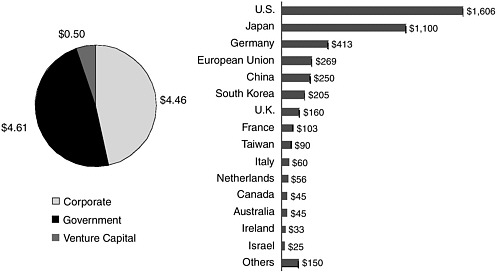
FIGURE 2-1 World nanotechnology funding, 2005. (Left) Nanotechnology funding globally by source, 2005 (U.S. $ billion). (Right) Government nanotechnology funding by country, 2005 (U.S. $ million). SOURCE: Lux Research, Inc. 2006. The Nanotech Report. 4th Edition. New York: Lux Research, Inc.
of new initiatives have been reported from various individual countries.7 PCAST has commissioned the Science and Technology Policy Institute, a federally funded research and development center, to conduct a study to assess U.S. government funding as it compares to that of foreign governments.8
So that the current status of U.S. public investment in nanotechnology R&D can be better assessed, the committee in Chapter 1 recommends that the government continue to develop and improve means for tracking of agency budgetary requests, authorizations, and expenditures on an annual basis.
According to Cientifica’s 2003 Nanotechnology Opportunity Report, global venture capital investment in nanotechnology-related companies totaled $261.7 million in 2002, with $207 million going to U.S. companies, $30.1 million to U.K. companies, $12.6 million to German companies, and $6 million to Israeli companies.9 North America had the most venture capital funding up to 2001 (Figure 2-2), indicating that the venture capital industry is significantly more developed in the United States and suggesting the potential for ongoing U.S. leadership in venture capital-funded start-ups over the next several years. The committee notes, however, Japan’s launch in 2003 of the Nano-Business Creation Initiative for the purpose of creating new nanotechnology businesses in Japan and building up the founda-
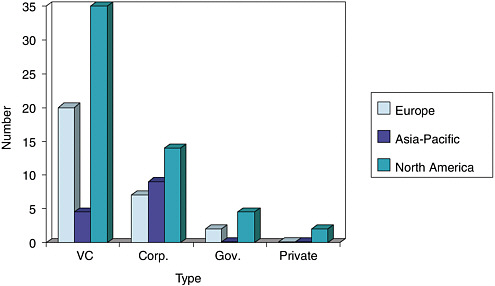
FIGURE 2-2 Number of venture capital funders by type and region up to the end of 2001. SOURCE: Cientifica Ltd. 2003. The Nanotechnology Opportunity Report. 2nd Edition. London: Cientfica Ltd.
tion necessary for its nanotechnology businesses to be global leaders in the future. Therefore, an increase in the number of venture capital companies in Japan investing in nanotechnology can be expected in the near future. Data were not available to it that would allow the committee to comment on possible directions in venture capital funding in other countries.
Infrastructure
In addition to funding type and amount, R&D infrastructure, human resources, industry infrastructure, and industry readiness also represent important investments in nanotechnology development. A recent survey by the Asia Nano Forum, presented at the Global Nanotechnology Network (GNN) workshop in May 2005, showed the United States as among the leaders in terms of funding for these infrastructure elements (Table 2-1).10
R&D Focus
Nanotechnology will provide a set of enabling tools, processes for manipulating matter, and new products and services based on nanoscale materials and processes, all of which will impact many industry sectors. Focused nanotechnology R&D funding by government agencies will enable improved positioning for business leaders and developers of platform technologies in government, academia, and industry.
Whereas the United States and the European Union as a whole are pursuing a broad spectrum of nanotechnology and related business areas, including nanomaterials, manufacturing, devices, energy, the environment, biotechnology/ medicine, and instrumentation development, Asian countries have a more focused approach. According to an Asia Nano Forum survey, Japan, Korea, and Taiwan show significant interest in nanotechnology’s impact on energy, the environment, and health care, and Australia, too, has a strong interest in nanotechnology in relation to health care (Table 2-2).
A 2005 report by the Asian Technology Information Program indicated that Japan had focused on research in nanomaterials, nanodevices, nanobiotechnology, and nanostructure characterization; China and India were more focused on nanomaterials; Korea and Taiwan had increased funding for nanodevices, nanomaterials, and nano-characterization; and Singapore had focused on nanobiotechnology and nano-characterization (Table 2-3).11 It is noteworthy that Asian governments have supported nanotechnology R&D initiatives but that industry impact in Asia has been minimal, with the exception of Japan and Korea (see Table 2-2). The assessment presented in Table 2-2 indicates that public awareness in Asian countries of
TABLE 2-1 Asia Pacific Region Funding and Infrastructure Assessment of Nanotechnology R&D Compared with U.S. and EU Funding and Infrastructure
|
Country/Region |
Population (million) |
Funding 2004 (U.S $ million) |
Funding Per Capita |
R&D Infrastructure |
Human Resource |
Industry Infrastructure |
Industry Readiness |
|
Australia |
19.2 |
30 |
1.563 |
Good |
Good |
Fair |
Fair |
|
China |
1282.2 |
60 |
0.047 |
Good |
Good |
Fair |
Fair |
|
Hong Kong |
6.98 |
10 |
1.433 |
Good |
Good |
Good |
Fair |
|
India |
109.5 |
5 |
0.005 |
In progress |
Training |
Fair |
Fair |
|
Indonesia |
219.3 |
20 |
0.091 |
In progress |
Good |
Fair |
Fair |
|
Korea (South) |
49.9 |
208 |
4.168 |
Excellent |
Good |
Good |
Good |
|
Malaysia |
26.5 |
4 |
0.151 |
In progress |
Training |
Fair |
Fair |
|
New Zealand |
4 |
11 |
2.750 |
Good |
Good |
Fair |
Fair |
|
Singapore |
3.55 |
9 |
2.535 |
Good |
Good |
Good |
Fair |
|
Taiwan |
22.8 |
91.1 |
3.996 |
Good |
Good |
Good |
Good |
|
Thailand |
65.7 |
5 |
0.076 |
In progress |
Training |
Fair |
Fair |
|
Vietnam |
82.85 |
1 |
0.012 |
In progress |
Training |
Fair |
Fair |
|
Japan |
128.1 |
940 |
7.338 |
Excellent |
Good |
Excellent |
Excellent |
|
USA |
296.2 |
961 |
3.244 |
Excellent |
Excellent |
Excellent |
Excellent |
|
EU |
460 |
1,816 |
3.948 |
Excellent |
Excellent |
Excellent |
Excellent |
|
SOURCE: K. Tanaka and L. Liu, “Nanotechnology in the Asia Pacific Region,” presentation to the 3rd International Workshop to Develop a Global Nanotechnology Network, May 26-27, 2005, Saarbrücken, Germany. Available at http://129.105.220.55/saarbrucken/saar_talks/Tanaka.pdf, accessed August 2005. |
|||||||
TABLE 2-2 Asia Pacific Region Assessment of Nanotechnology and Society Factors
|
Economy |
GovernmentPolicy Awareness |
Government Policy Support |
Industry Impact |
Education Program |
Public Awareness of Benefits |
Public Concern About Risk |
Awareness of Energy Impact |
Awareness of Environmental Impact |
Awareness of Health Care |
|
Australia |
Medium |
Medium |
Medium |
High |
Medium |
Medium |
Medium |
Medium |
High |
|
China |
High |
High |
Low |
Medium |
Medium |
Medium |
Medium |
Medium |
Medium |
|
Hong Kong |
High |
High |
Medium |
Low |
Medium |
Good |
Medium |
Medium |
Medium |
|
India |
High |
Medium |
Low |
Low |
Medium |
Fair |
Medium |
Medium |
Medium |
|
Indonesia |
Low |
Low |
Low |
Low |
Medium |
Fair |
Medium |
Medium |
Medium |
|
Japan |
High |
High |
High |
High |
High |
Medium |
High |
High |
High |
|
Korea |
High |
High |
High |
High |
High |
Medium |
High |
High |
High |
|
Malaysia |
Medium |
Medium |
Low |
Low |
Medium |
Fair |
Fair |
Medium |
Medium |
|
New Zealand |
Medium |
Medium |
Low |
Medium |
Medium |
Fair |
Fair |
Medium |
Medium |
|
Singapore |
High |
High |
Medium |
High |
High |
Good |
Fair |
Medium |
High |
|
Taiwan |
High |
High |
Medium |
High |
High |
Good |
Good |
High |
High |
|
Thailand |
High |
High |
Low |
Medium |
High |
Fair |
Fair |
Medium |
Medium |
|
Vietnam |
High |
High |
Low |
High |
Medium |
Fair |
Fair |
Medium |
Medium |
|
SOURCE: K. Tanaka and L. Liu, “Nanotechnology in the Asia Pacific Region,” presentation to the 3rd International Workshop to Develop a Global Nanotechnology Network, May 26-27, 2005, Saarbrücken, Germany. Available at http://129.105.220.55/saarbrucken/saar_talks/Tanaka.pdf, accessed August 2005. |
|||||||||
TABLE 2-3 Nanotechnology Funding and Projects in Asia
|
Assessment Criterion |
Japan |
China |
Korea |
Taiwan |
Singapore |
India |
|
R&D infrastructure |
10 |
5 |
8 |
7 |
6 |
3 |
|
Industry base |
10 |
5 |
8 |
8 |
6 |
3 |
|
Manpower |
9 |
9 |
7 |
6 |
4 |
7 |
|
Nano materials |
9 |
8 |
7 |
6 |
5 |
5 |
|
Nano device |
9 |
5 |
8 |
7 |
5 |
3 |
|
Nanobio |
9 |
4 |
5 |
5 |
6 |
3 |
|
Nano characterization |
9 |
5 |
7 |
6 |
6 |
4 |
|
Overall assessment |
9 |
6 |
7 |
6 |
5 |
4 |
|
SOURCE: The Asian Technology Information Program (ATIP). 2005. ATIP05.026: Nanotechnology in Asia—Funding & Projects, p. 4. Tokyo: ATIP. |
||||||
the potential benefits of nanotechnology is higher than public concern about risks, possibly indicating enhanced public trust, knowledge of science and technology, and proactive parallel efforts to establish guidelines and standards.
BENCHMARKING OUTPUT: INDICATORS OF OUTCOMES FROM INVESTMENT IN NANOTECHNOLOGY
Two indicators of output from nanotechnology investment that can be evaluated are trends in scientific papers published and in patents awarded. Yet benchmarking output is difficult both because nanotechnology is still in the early stages of discovery and development and because, as with government investments, the tracking of indicators is complicated by countries’ differing definitions of what constitutes nanotechnology and by lack of uniformity and consistency in what information is reported.
Even within the United States, it is very difficult to gather data on publications and patents developed as a result of NNI investments, as no central agency is responsible for the collection and tracking of this type of data. In the following sections, the committee discusses some studies conducted by various organizations and individuals that assess and analyze publications and patents as indicators of national standing worldwide. While the trends suggested by each are similar, the raw numbers differ from study to study because of different methodologies, criteria (e.g., definition of nanotechnology), and sources used (e.g., United States Patent and Trademark Office data versus results of surveys of individual companies). Nevertheless, the committee found it possible to draw some conclusions as described below.
Scientific Publications
An analysis of the number of peer-reviewed scientific papers in the Web of Science database12 that were published since 1990 and contained the keyword “nano*” showed the United States as a global leader in that indicator of output (Figure 2-3). This analysis also showed that, although the number of U.S. nanotechnology-related publications had grown each year, the U.S. lead was facing significant and increasing international competition: of the total number of “nano” papers published globally, the percentage originating from the United States declined from 40 percent in the early 1990s to less than 30 percent in 2004.13 Global trends described in the benchmarking report by Lux Research also indicate increased nanotechnology publication output by other countries such as China, for example (Figure 2-4).14 In the high-impact journals Science, Nature, and Physical Review Letters, the United States continued to lead, authoring 50 percent of the nanotechnology-related publications in 2006 (which represented between 6 and 7 percent of total articles published; Figure 2-5), even though the U.S. investment in nanotechnology was only 25 percent of the global total. Over the same time period, however, other countries’ shares of such publications increased.
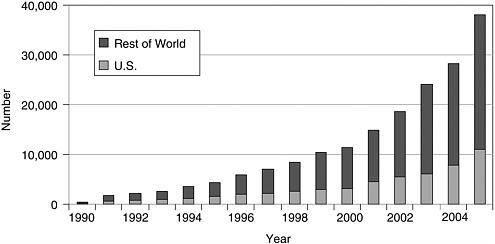
FIGURE 2-3 Number of nanotechnology-related publications by country of origin, 1990 to 2005. Number of articles in ISI Web of Science database found by searching on “nano*” as the keyword. SOURCE: Courtesy of James S. Murday, Naval Research Laboratory. Updated from a similar figure that appeared in President’s Council of Advisors on Science and Technology, 2005, The National Nanotechnology Initiative at Five Years: Assessment and Recommendations of the National Nanotechnology Advisory Panel, May.
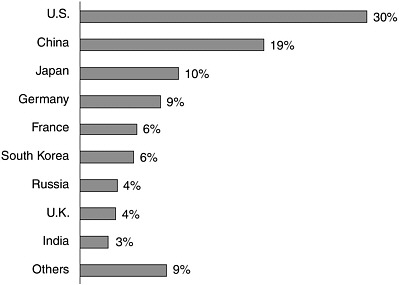
FIGURE 2-4 Percentage of nanotechnology-related publications by country of origin, 2005. SOURCE: Lux Research, Inc. 2005. Ranking the Nations: Nanotech’s Shifting Global Leaders. New York: Lux Research, Inc.
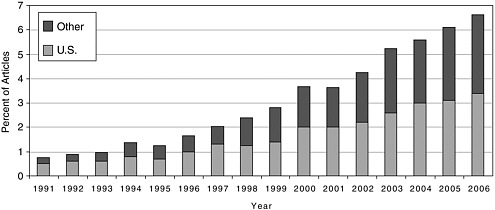
FIGURE 2-5 Articles identified by a keyword search on “nano*” as a percentage of the total articles published in Science, Nature, and Physical Review Letters, 1991 to 2006, and relative share of authorship, United States and other countries. SOURCE: Courtesy of James S. Murday, Naval Research Laboratory. Updated from a similar figure that appeared in President’s Council of Advisors on Science and Technology, 2005, The National Nanotechnology Initiative at Five Years: Assessment and Recommendations of the National Nanotechnology Advisory Panel, May.
Patents
The number of patents applied for and granted is another indicator of a nation’s standing and accomplishments with respect to R&D and business innovation. Yet, although patents relating to nanotechnology are currently tracked by the U.S. Patent and Trademark Office (USPTO), it is difficult to trace a patent back to a specific NNI-funded research project. Moreover, patents relating to nanotechnology might span more than one discipline or field, challenging the ability to classify patents and link them to particular research results. The use of a nanotechnology patent class created in 2004, USPTO Patent Class 977 (Box 2-1), has contributed recently to an improved capability to track nanotechnology-related patents in the United States.
Several analyses of data on patent activity have been conducted both in the United States and abroad. Huang et al. searched the USPTO database for patent titles and claims with nanotechnology-related keywords and found that more than 8,600 nanotechnology-related patents were issued in 2003 before Patent Class 977 was created. This number represented an increase of about 50 percent over the number issued in the previous 3 years.15 The same study also indicated that the United States holds a strong leadership position with respect to patents in this area granted by the USPTO. In drawing conclusions about the U.S. share of nanotechnology patents it is of course important to take into account the concept of “home advantage”—that is, patent applicants are more likely to file for a patent in their home country rather than with a foreign patent office. According to Huang et al., aggregating the annual data from 1976 to 2003 showed that the top five countries receiving the highest number of nanotechnology-related patents issued by the USPTO were the United States (42,988), Japan (6,563), Germany (5,898), France (1,800), and Canada (1,772). In terms of share, U.S. entities accounted for about 67 percent of nanotechnology patents recorded in the USPTO over the same period. In 2003, the United States had 5,228 patents, followed by Japan (926), Germany (684), Canada (244), and France (183). Among the patents identified by that study’s search, U.S. patents received the most citations in subsequently filed patent applications. Huang et al. also noted an increase in the number of nanotechnology-related patents issued by the USPTO to assignees in other countries, with the Netherlands and Korea showing particularly strong growth.
A survey by EmTech Research (a subsidiary of Small Times, Inc.) of U.S.-based companies, found that 25,372 patents were granted to 599 companies identified as nanotechnology suppliers.16 Of these 25,372 patents, 2,063 (8 percent of the total) were for nanotechnology-related projects. The 599 nanotechnology suppliers (companies bringing products to market) were chosen by EmTech Research based on the following criteria: having headquarters or major business activity in the
|
BOX 2-1 USPTO Patent Class 977 In 2004, to improve the quality of its patent examination system in response to the rapidly growing number of patents relating to nanotechnology, the U.S. Patent and Trademark Office (USPTO) created a new U.S. Patent Classification Cross-Reference Art Collection (USPC XRAC), Class 977, focused on nanotechnology. Currently, Class 977 contains 2,618 patents.1,2 This class provides for disclosures3 related to research and technology development at the atomic, molecular, or macromolecular levels, at a length scale of approximately 1 to 100 nanometers in at least one dimension, that provides a fundamental understanding of phenomena and materials at the nanoscale and enables the creation and use of structures, devices, and systems that have novel properties and functions because of their small and/or intermediate size. In addition, disclosures in Class 977 may be defined by one or more of the following statements:
In some particular cases, the critical length scale for novel properties and phenomena may be less than 1 nanometer or be slightly larger than 100 nanometers. The novel properties or functions, e.g., special effects, are attributed to and are intrinsic at the nanoscale. Such nanoscale materials are infinitesimally minute arrangements of matter (i.e., nano-structural assemblages), have particularly shaped configurations formed during manufacture, and are distinct from both naturally occurring and chemically produced chemical or biological arrangements composed of similar matter. Also encompassed within Class 977 are disclosures related to the controlled analysis, measurement, manufacture, or treatment of such nano-structural assemblages and their associated processes or apparatus specially adapted for performing at least one step in such processes. Novel and differentiating properties and functions related to Class 977 must relate to the altering of basic chemical or physical properties of the materials involved as a result of their being assembled on the nanoscale.
|
United States; focusing on the development and sale of materials with features at a scale of 1 to 100 nanometers; developing these products as part of an integrated system; and demonstrating advantages inherent to these products or materials because of their small size.
A broader analysis performed in the United Kingdom17 of nanotechnology-related patents awarded from 1990 to 2004 (Figure 2-6) used the keyword ”nano” to select records without deleting those including words like “nanosecond” or “NaNO3” that would likely reflect miscounts. The results indicated that the United States was the global leader in the number of nanotechnology-related patents held, followed by Japan, China, and Europe.
Cientifica’s 2003 Nanotechnology Opportunity Report indicated steady growth globally in the number of patents relating to nanotechnology awarded between 1991 and 2001.18 In particular, the years 2000 and 2001 saw surges in such growth. A 2003 review by Thomson Derwent of the number of patents in nanoscience and nanotechnology granted from 2000 to 2002 showed the United States as the leader internationally at 32 percent, with Japan, China, Germany, and Korea following at 21 percent, 12 percent, 11 percent, and 8 percent, respectively.19
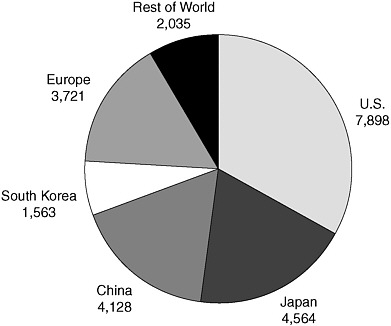
FIGURE 2-6 “Nano” patents awarded from 1990 to 2004 according to the applicant’s country of origin. SOURCE: Courtesy of N. Fox-Male, Eric Potter Clarkson LLP.
Drawing on USPTO Patent Class 977-related data in the Thomson Aureka and Delphion search engines and databases, a 2005 study from U.S.-based Intellectual Assets Inc. indicated that nanotechnology was a growing field worldwide over the period from January 1, 1975, to August 15, 2005, and also noted a significant increase in the early 2000s in U.S. patents issued; acquisition by U.S.-based companies of intellectual property (IP) in all areas of materials, manufacturing, and applications; and aggressive efforts by U.S.-based companies to follow up and block other companies’ initial work.
At the 2003 GNN meeting,20 it was reported that while the number of Chinese patents had increased significantly, the number of original inventions was very low. It was also noted at that meeting that very few Chinese patents were assigned to companies outside China.
In summary, a number of studies show that the United States leads the world in the number of patents awarded in nanotechnology, sometimes broadly defined. It is also clear, however, that U.S. dominance of the share of patents in this area is being challenged as activity generating intellectual property continues to increase across the globe.
Other Indicators of U.S. Standing
Other possible indicators of the relative position of U.S. nanotechnology R&D compared with that worldwide include trends in the employment and mobility of R&D personnel, attendance at international conferences, and data on the number of nanotechnology start-up companies. It is difficult at this time to benchmark with confidence the relative standing of countries based on such indicators, because trends usually become apparent only over longer periods of time. It might also be possible to gauge relative U.S. performance by looking at trends in the transfer of technology to industry. In this regard, a 2004 survey by the European Commission21 indicated that North America was perceived as the leader in nanoscience R&D (67 percent) and in the transfer of nanotechnology to industry (66 percent) (Figure 2-7).
CONCLUSION
Input factors, such as investments and spending, and output indicators, such as publications and patents, can be tracked within the limits of certain constraints, as discussed above. However, linking these indicators to specific NNI investments is not possible with currently available data. In Chapter 1, the committee emphasizes the importance of consistent reporting of agencies’ investments in nanotechnology R&D and recommends that the government continue to develop and enhance
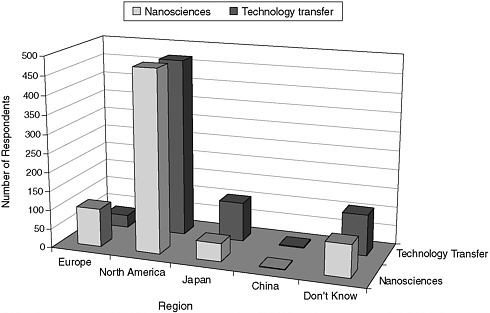
FIGURE 2-7 Regions perceived to be leading in nanoscience and the transfer of nanotechnology to industry, 2004. SOURCE: I. Malsch and M. Oud. 2004. Outcome of the Open Consultation on the European Strategy for Nanotechnology. Nanoforum.org. December. Available at http://www.nanoforum.org/dateien/temp/nanosurvey6.pdf, accessed August 2005.
mechanisms for uniform reporting and tracking of the funds requested, authorized, and expended annually. The committee believes that improved reporting of budget data will also help with tracing and elucidating the linkages between federal support for nanoscale R&D and output of the types discussed above to enable more solid benchmarking of U.S. standing globally. The committee suggests that an independent research organization could perhaps be commissioned under the auspices of the NNI to investigate appropriate techniques and methodologies for collecting and tracking data on output indicators that can be traced back to NNI investments.
Finally, the committee offers the following conclusion based on its analysis of the benchmarking data presented in this chapter.
Conclusion. Although good comparative indicators of investment in nanotechnology R&D, resultant innovation, and economic exploitation of nanotechnology do not exist,
existing data point to worldwide growth in investment in nanoscale research and innovation. The United States appears to remain in the lead, but with other countries closing this gap.
NOTES
|
|
1. National Academy of Sciences, National Academy of Engineering, Institute of Medicine. 2000. Experiments in International Benchmarking of U.S. Research Fields. Washington, D.C.: National Academy Press. |
|
|
2. National Research Council. 2005. Globalization of Materials R&D: Time for a National Strategy. Washington, D.C.: The National Academies Press. |
|
|
3. Lux Research, Inc. 2006. The Nanotech Report. 4th Edition. New York: Lux Research, Inc. |
|
|
4. Lux Research, Inc. 2005. Ranking the Nations: Nanotech’s Shifting Global Leaders. New York: Lux Research, Inc. |
|
|
5. President’s Council of Advisors on Science and Technology. 2005. The National Nanotechnology Initiative at Five Years: Assessment and Recommendations of the National Nanotechnology Advisory Panel. Available at http://www.nano.gov/FINAL_PCAST_NANO_REPORT.pdf, accessed July 2006. |
|
|
6. See, for example, Lux Research, Inc., 2005, Ranking the Nations: Nanotech’s Shifting Global Leaders, New York, Lux Research, Inc. |
|
|
7. S. Lawrence. 2005. Nanotech grows up. Technology Review. Available at http://www.technologyreview.com/articles/05/06/issue/datamine.asp?, accessed August 2005. |
|
|
8. President’s Council of Advisors on Science and Technology. 2005. The National Nanotechnology Initiative at Five Years: Assessment and Recommendations of the National Nanotechnology Advisory Panel. Available at http://www.nano.gov/FINAL_PCAST_NANO_REPORT.pdf, accessed July 2006. |
|
|
9. Cientifica Ltd. 2003. The Nanotechnology Opportunity Report. 2nd Edition. London: Cientifica Ltd. |
|
|
10. Asia Nanotechnology Forum, 3rd International Workshop to Develop a Global Nanotechnology Network, May 26-27, 2005, Saarbrücken, Germany. |
|
|
11. The Asian Technology Information Program. 2005. Nanotechnology in Asia—Funding & Projects. ATIP05.026. Tokyo: ATIP. |
|
|
12. The Web of Science database is maintained by the Institute for Scientific Information and contains data on papers in about 5,400 professional journals. |
|
|
13. Note that the database search provides only the number of papers without indicating their relevance to the field, as might be indicated by a citation analysis, for instance. |
|
|
14. Lux Research, Inc. 2005. Ranking the Nations: Nanotech’s Shifting Global Leaders. New York: Lux Research, Inc. |
|
|
15. Z. Huang, H. Chen, Z.-K. Chen, and M. Roco. 2004. International nanotechnology development in 2003: Country, institution, and technology field analysis based on USPTO patent database. Journal of Nanoparticle Research 6:325-354. |
|
|
16. EmTech Research. 2005. 2005 Nanotechnology Industry Category Overview. Ann Arbor, Mich.: EmTech Research (a division of Small Times Media). |
|
|
17. N. Fox-Male. 2004. Nanotechnology and patents—a European perspective. International Congress of Nanotechnology, San Francisco, November 7-12, 2004. |
|
|
18. Cientifica Ltd. 2003. The Nanotechnology Opportunity Report. 2nd Edition. London: Cientifica Ltd. |
|
|
19. Nanotechnology Research Institute. 2004. Asia Pacific Nanotech Weekly, Vol. 2, article 24. Available at http://www.nanoworld.jp/apnw/articles/library2/pdf/2-24.pdf, accessed August 2005. |
|
|
20. International Union of Materials Research Societies. Undated. 2nd Workshop on Nanotechnology Networking and International Cooperation, October 11-12, 2003, Yokohama, Japan. Available at http://www.nims.go.jp/ws-nanonet/2_Report/NanoNetWS_RepLet0.pdf. |
|
|
21. Outcome of the Open Consultation on the European Strategy for Nanotechnology. Nanoforum. org. December 2004. Available at http://www.nanoforum.org/dateien/temp/nanosurvey6.pdf, accessed August 2005. |


