
1
Introduction
Florida’s Everglades are recognized globally as a unique ecological treasure. In the last century, however, the Everglades has been transformed from a “river of grass” (Vignoles, 1823) into an international magnet for tourism, agriculture, retirement communities, finance, and transportation. The remnants of the original Everglades (Figure 1-1) now compete for vital water with urban and agricultural interests and store runoff from these two activities. Within this twenty-first-century social, economic, and political latticework, the restoration of the South Florida ecosystem is now under way, representing one of the most ambitious ecosystem renewal projects ever conceived.
The Everglades once encompassed about 3 million acres of slow-moving water and associated biota that stretched from Lake Okeechobee in the north to Florida Bay in the south (Figure 1-1a and Box 1-1). Uniquely shaped by the slow flow of water, its vast landscape of sawgrass plains, ridges, sloughs, and tree islands supported a high diversity of plant and animal life. Today, urban and agricultural development has reduced the Everglades to about one-half its pre-drainage size (Davis and Ogden, 1994; Figure 1-1b) and polluted its waters with phosphorus, nitrogen, mercury, and pesticides. Associated drainage and flood-control structures have diverted large quantities of water to the ocean, thereby reducing the freshwater inflows that defined the ecosystem (Figure 1-2). The profound hydrologic alterations were accompanied by many changes in the biotic communities in the ecosystem, including changes in the composition and distribution of the vegetation, and reductions and changes in the composition, distribution, and abundance of the populations of wading birds (see Chapter 2). The remnant Everglades ecosystem became the focus of restoration activities that began taking firm shape early in the 1990s and continue today.
The Comprehensive Everglades Restoration Plan (the CERP, also referred to as the Plan) was unveiled in the Central and Southern Florida
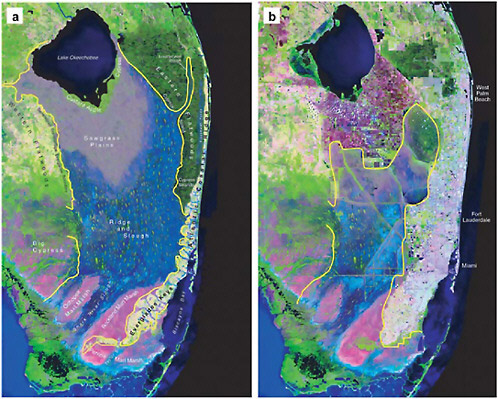
FIGURE 1-1 Reconstructed (a) pre-drainage (circa 1850) and (b) current (1994) satellite images of the Everglades ecosystem.
NOTE: The yellow line in (a) outlines the historical Everglades ecosystem, and the yellow line in (b) outlines the remnant Everglades ecosystem as of 1994.
SOURCE: Courtesy of Christopher McVoy, Jayantha Obeysekera, and Winifred Said, South Florida Water Management District.
Comprehensive Review Study Final Integrated Feasibility Report and Programmatic Environmental Impact Statement (USACE and SFWMD, 1999), also known as the Yellow Book. The CERP aims to achieve ecological restoration by restoring hydrologic characteristics as close as possible to their pre-drainage conditions in what remains of the Everglades ecosystem, recognizing that irreversible changes to the landscape make restoration to full pre-drainage conditions impossible. Although the CERP is the largest of the major restoration initiatives under way to restore the South Florida
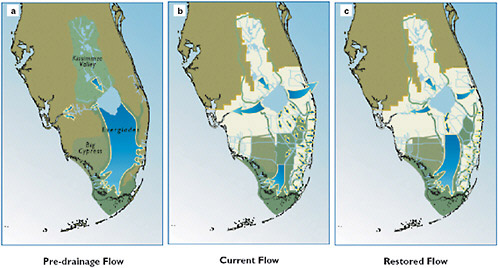
FIGURE 1-2 Water flow in the Everglades under (a) historical conditions, (b) current conditions, and (c) conditions envisioned upon completion of the CERP.
SOURCE: Graphics provided by the U.S. Army Corps of Engineers, Jacksonville District.
ecosystem, it operates within a context of many other state and federal restoration activities that are not components of the CERP (hereafter, non-CERP activities). The CERP and non-CERP activities are described in more detail in Chapter 2.
THE NATIONAL RESEARCH COUNCIL AND EVERGLADES RESTORATION
The National Research Council (NRC) has been providing scientific and technical advice related to the Everglades restoration since 1999. The NRC’s Committee on the Restoration of the Greater Everglades Ecosystem (CROGEE), which operated from 1999 until 2004, was formed at the request of the South Florida Ecosystem Restoration Task Force and produced six reports. The NRC’s Panel to Review the Critical Ecosystem Studies Initiative produced an additional report in 2003. The reports provided scientific and technical advice about aquifer storage and recovery (NRC, 2001a), regional issues in aquifer storage and recovery (NRC, 2002a), research programs in Florida Bay (NRC, 2002b), the planning and organization of
|
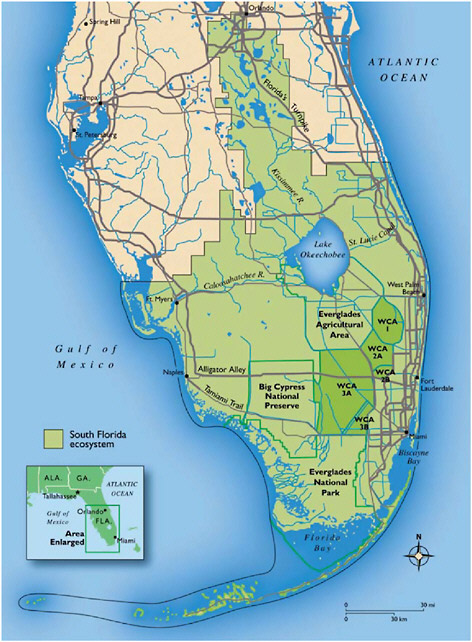
BOX 1-1 Geographic Terms The committee found numerous cases in restoration documents where geographic terms were not used consistently, which can to add confusion about the focus of the restoration efforts. Therefore, to minimize confusion, this box defines some key geographic terms used throughout this report.
The following represent legally defined geographic terms used in this report:
Many maps in this report include shorthand designations that use letters and numbers for man-made additions to the South Florida ecosystem. For example, canals are labeled C-#; levees and associated borrow canals as L-#; and structures, such as culverts, locks, pumps, spillways, control gates, and weirs, as S-#. |
science (NRC, 2003a), adaptive monitoring and assessment (NRC, 2003b), the importance of water flow in shaping the Everglades landscapes (NRC, 2003c), and risks and opportunities associated with reengineering water storage in the Everglades (NRC, 2005).
The Present Study
The Water Resources Development Act of 2000 (WRDA 2000)1 mandated that the Department of the Army, the Department of the Interior, and the state of Florida, in consultation with the South Florida Ecosystem Restoration Task Force, establish an independent scientific review panel to review the progress toward achieving the natural system restoration goals of the CERP. Therefore, the present committee, the NRC’s Committee on Independent Scientific Review of Everglades Restoration Progress, was established in 2004 under contract with the U.S. Army Corps of Engineers. The committee is charged to submit biennial reports that address the following items:
-
an assessment of progress in restoring the natural system, which is defined by section 601(a) of WRDA 2000 as all the land and water managed by the federal government and state within the South Florida ecosystem (see Figure 1-4);
-
discussion of significant accomplishments of the restoration;
-
discussion and evaluation of specific scientific and engineering issues that may impact progress in achieving the natural system restoration goals of the Plan; and
-
independent review of monitoring and assessment protocols to be used for evaluation of CERP progress (e.g., CERP performance measures, annual assessment reports, assessment strategies).
The committee based its assessment of progress on information received from a variety of sources, including relevant CERP and non-CERP restoration documents; briefings at its public meetings from agencies, organizations, and individuals involved in the restoration; testimony from citizens at public comment sessions; and field trips to sites with restoration activities (see Acknowledgments). The committee’s recommendations and
|
1 |
The WRDA 2000 can be read online at http://www.evergladesplan.org/wrda2000/wrda_docs/wrda2000_gpo.pdf. |
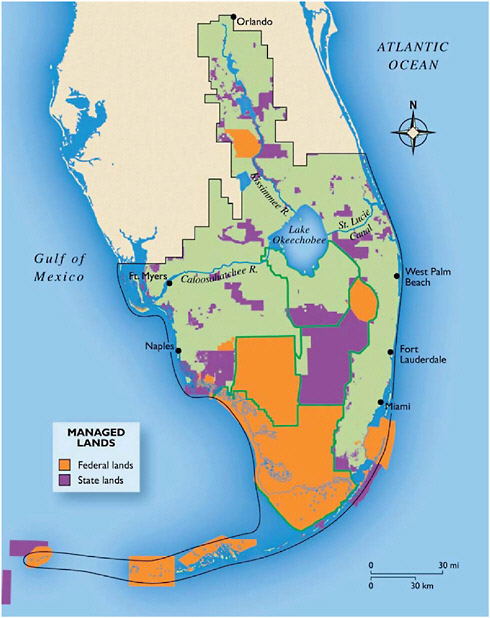
FIGURE 1-4 Land and waters managed by the state of Florida and the federal government for conservation purposes within the South Florida ecosystem as of December 2005.
SOURCE: Based on data compiled by Florida State University’s Florida Natural Areas Inventory (http://www.fnai.org/gisdata.cfm).
conclusions were also informed by a review of relevant scientific literature and the experience and knowledge of the committee in their fields of expertise. The committee was unable to consider in any detail new materials received after December 1, 2005. For example, although the committee reviewed the CERP Monitoring and Assessment Plan: Part I Monitoring and Supporting Research (RECOVER, 2004), the 2005 Assessment Strategy for the Monitoring and Assessment Plan (RECOVER, 2005a), The RECOVER Team’s Recommendations for Interim Goals and Interim Targets for the Comprehensive Everglades Restoration Plan (RECOVER, 2005b), and the September 2005 Draft CERP Adaptive Management Strategy (RECOVER, 2005c; superseded by RECOVER, 2006a), the committee did not evaluate in detail the revised draft of the CERP System-wide Performance Measures report (RECOVER, 2006b). However, this is the committee’s first report, and the CERP System-wide Performance Measures report can be addressed in greater detail, among other topics, in future reports of this committee.
REPORT ORGANIZATION
Chapter 2 provides an overview of the CERP in the context of other ongoing restoration activities and discusses the restoration goals that guide the overall effort. Chapter 2 also discusses restoration challenges and the implications for successes in the CERP by analyzing changes to the natural system and the human environment that have occurred since the early 1990s. Chapter 3 discusses program implementation for the CERP, including project management, the Master Implementation Sequencing Plan (USACE and SFWMD, 2005d), and project finances (addressing Tasks 2 and 3). Chapter 3 also highlights the challenges faced in maintaining partnerships during the implementation of the CERP. Chapter 4 discusses the use of science in restoration decision making, including the monitoring and assessment program in support of adaptive management (Tasks 2 and 4). Chapter 5 reviews progress in restoring the natural system, including progress in implementing key CERP and non-CERP activities and issues encountered during project implementation (Tasks 1, 2, and 3). Chapter 6 outlines a proposed approach to accelerate natural system restoration that facilitates decision making in spite of uncertainty and other constraints (Task 3).


