
4
Summary and Workshop Conclusions
The participants in the workshop reached consensus on a number of key issues. The six separate working groups selected representatives to present their summary conclusions at the end of the workshop (their individual reports are summarized in Appendix A). This chapter summarizes the conclusions of the working groups.
A central theme that emerged during the workshop, both in the formal presentations in the plenary sessions and in the focused discussions of the thematically organized working groups, is the importance of the timely prediction of the radiation environment for mission design and mission operations. There was general agreement among the participants that it is in this area that the solar and space physics community can, through improved characterization and understanding of the sources of space radiation, contribute substantively to NASA’s radiation management effort and to the Vision for Space Exploration.
Further, many of the workshop participants agreed on the following:
-
Developing timely predictions of the radiation environment is a complex task whose components vary depending on the timescale considered and on the mission characteristics;
-
Delivering timely predictions requires advances in basic solar and space physics, development of observational assets, improved modeling capabilities, and careful design of communications;
-
The space operations community—that is, those who plan and manage human spaceflight missions—must be informed about these advances in understanding and expanding capabilities so that operators can take advantage of advances; and
-
In some cases operational tools (i.e., tools for space operations) must be developed or adapted from scientific analytical tools and converted to real-time reporting tools; the transition from research to operations is a very challenging task.
The workshop helped assess the current level of understanding of solar and space physics, contributed to an understanding of the issues faced by the NASA space radiation program as it deals with radiation effects on humans, led to fuller understanding of the challenges of ensuring the reliable functioning of instruments and machines in space, and, ultimately, illustrated how progress in understanding, defining,
and making timely predictions of the space radiation environment is essential for implementation of the Vision for Space Exploration (VSE). Until now, there has been little need for the separate solar and space physics and human spaceflight communities to communicate and cooperate with each other. Many of the participants at the conference for the first time focused on ways that their research corresponded with NASA’s needs to support humans traveling beyond low Earth orbit for the first time in decades. Scientists realize that there is significant overlap in interests between the solar and space physics community and the human spaceflight community and that the space physics community can assist the goals of the Vision for Space Exploration.
UNDERSTANDING OF SOLAR PHYSICS
The understanding of solar activity and its relation to coronal mass ejections (CMEs) and flares has made tremendous progress on the basis of the contributions of a series of spacecraft, such as Yohkoh, the Solar and Heliospheric Observatory, and most recently the Ramati High Energy Solar Spectrographic Imager. Emerging technologies developed for heliosesimology have shown their ability to forecast active regions before they come around the solar limb. This allows predictive power for large solar active regions, which are the source of most of the strongest flares and the fastest, most hazardous CMEs. These helioseismological techniques are currently implemented and perfected to allow following active regions throughout the entire solar rotation.
There are other observational techniques that are being implemented, many of them in early stages of development. They involve global measures of the free magnetic field before eruptions, the total transport of magnetic-free energy through the photosphere on all relevant temporal scales, and the identification of coronal morphology changes up to 1 day before eruption, for example, through the identification of coronal density enhancement.
Major progress in the predictive capabilities is expected to come from a number of parallel thrusts, which were addressed during this workshop. For example:
-
An improvement of observations of the boundary conditions in the corona; this improvement can include “force-free” vector magnetograms in the chromosphere or the corona;
-
The assimilation of data to the global coronal magnetic-field specification from radio, x-ray/extreme ultraviolet radiation, and imaging spectroscopy, as well as coronal seismology;
-
Detailed observational determination of the magnetic topology in filament channels to determine the CME eruption mechanism; and
-
The development of self-consistent magnetohydrodynamic models that couple the photosphere and the corona, with a vigorous investigation of CME initiation processes.
FUNDAMENTAL UNDERSTANDING OF HELIOPHYSICS
There are currently over a dozen NASA, National Oceanic and Atmospheric Administration (NOAA), and Department of Defense (DOD) spacecraft obtaining scientific measurements of solar wind, energetic particles, magnetic fields, and electromagnetic radiation from many vantage points in the heliosphere. They provide data to test and guide the development of theoretical models as well as supporting the operational space weather community. These spacecraft are located at strategic vantage points in the heliosphere from the L1 Lagrange point (1.5 million km upstream from Earth), to inside Earth’s magnetosphere, and out to the termination shock (near the boundary with the interstellar medium where the solar wind slows down from supersonic to subsonic speeds).
Current operational space weather models are climatological and empirically based and therefore do badly in predicting extreme events. Several physics-based models in the research community were presented at the workshop. While continuing to provide insight into the understanding of the fundamental processes, research models have too many unknown input parameters for making the required space weather predictions. The challenge to the research community is to know how improved physics can be included in these models without making them too difficult for transition to operational use.
Progress can be made through the vigorous development of models that can describe the following processes: (1) flare/CME/shock initiation, (2) particle acceleration at or close to the Sun, (3) three-dimensional transport in the heliosphere, and (4) particle acceleration near 1 AU (for lunar exploration sites). New observations from current and future space missions will also be needed to provide inputs for testing and validating these models. Finally, the models and missions that provide the input data need to be transitioned to operational use.
SOLAR ENERGETIC PARTICLE EVENT PREDICTIONS AND FORECAST PROSPECTS
The limits of the long-term variability in the space radiation environment need to be determined, including those for galactic cosmic radiation (GCR), solar energetic particle (SEP) events, and Earth’s trapped radiation belts. The goal, to predict this variability, may require an understanding of the long-term secular changes in the GCR spectrum using 10Be concentrations measured in ice cores, Voyager measurements beyond the termination shock, nitrate measurements from ice cores, and other historical data. 10Be measurements show that the recent experience of researchers with solar-cycle modulation of GCRs might not be a good predictor of future levels. There are also indications that the current levels of GCR intensity are among the lowest for the past 1,150 years, and that the frequency of occurrence of large solar particle events in recent times has been low compared to the long-term average.
The greatest needs in the area of SEP events, as reported by personnel from the Space Radiation Analysis Group at the NASA Johnson Space Center, are these:
-
Predictions of the temporal evolution profile of the next most likely SEP event at selected energies with associated probabilities, before particles begin to arrive;
-
Flux data from the actual event at the selected energies in real time;
-
The capability to refine the temporal profiles and associated probabilities as the data arrive in real time; and
-
Reliable forecasts of no solar activity of interest, that is, all-clear forecasts.
LONG-TIMESCALE CHANGES IN GALACTIC COSMIC RADIATION
Given the significant contribution of GCR to the total astronaut radiation exposure, it is important to understand long-timescale (decades or more) variations in the GCR. It is well established that at short timescales (months to years) the GCR flux varies with solar activity, peaking at solar minimum (Figure 4.1). Over longer timescales, the solar-cycle amplitudes also vary—some solar maxima are more intense than others. During a period known as the Maunder minimum, sunspots, a measure of solar activity, almost disappeared. Recent solar cycles have had relatively large amplitudes, suggesting that the present is in a period of relatively low GCR maxima. Since a human Mars mission may not happen for several decades, it is important to develop an understanding of how much solar activity may vary from what was experienced over the past few solar cycles, and what these variations may mean to the GCR environment to which astronauts will be exposed. Fortunately there is experimental access to records that shed some light on
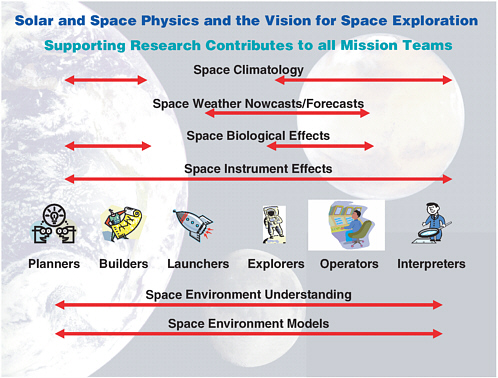
FIGURE 4.1 Solar and space physics research contributes to all aspects of the Vision for Space Exploration. SOURCE: Courtesy of Howard Singer, National Oceanic and Atmospheric Administration Space Environment Center.
long-scale variations of solar activity, including 14C records in tree rings, nitrate and 10Be deposits in polar ice, and even studies of radioisotopes in lunar rocks. Further analysis of these resources could lead to a better understanding of how intense GCR flux could be for future missions.
WORST-CASE SOLAR PARTICLE EVENTS
The studies used to determine long-scale variability in the GCR can also be used to address a related question of high significance to astronauts, which is, How bad can an SEP event be? Knowing how intense an SEP event could be is important to mission design and also to the development of surface operations concepts. There exist only a few decades of direct observation of SEP events, and so only a few major storms such as the August 1972 event have been measured. In order to provide mission planners with guidelines for “worst case” events, the community frequently chooses multiples of a well-known large event (say, two
times more intense than August 1972) or uses the spectral character of one event (the very hard 1956 event) and the flux history of another (the large and relatively rapid August 1972 event). A detailed evaluation of historical records may place upper limits on how intense a “superstorm” could be, or at least on what the largest such storm could have been within the past few hundred years.
SUMMARY
In summary, the Workshop on Space Radiation Hazards and the Vision for Space Exploration revealed the numerous ways in which solar and space physics research can contribute to all phases and aspects of the VSE. These contributions are illustrated schematically in Figure 4.1. The VSE will engage teams responsible for planning missions (Planners); for building instruments, habitats, and spacecraft (Builders); for launching vehicles (Launchers); for flying the missions (Explorers); for providing support for mission operations (Operators); and for analyzing a wealth of data and information (Interpreters). Each of these teams and activities will rely on a foundation of knowledge and tools that can be found in space environment understanding and models contributed by solar and space physics research. The figure also illustrates that some solar and space physics expertise will provide critical knowledge to specific mission activities. For example, space weather forecasting will be most important for activities carried out by explorers and operators, whereas space climatology will be more important for planners and builders. In conclusion, solar and space physics provides a rich foundation of space environment information and a community that can be called on to contribute importantly to the success of the Vision for Space Exploration.


