
5
Monitoring Pollinator Populations and Services
Given that information on the status of pollinators and pollination services is far from complete, it is important to establish standardized, wide-scale, long-term protocols for monitoring pollinator populations and pollination services so that future changes can be assessed and appropriate actions taken. Existing monitoring efforts, in place for commercial honey bees and for some wild bee, butterfly, bird, and bat pollinators, provide a starting point. However, all extant programs need to be improved and an overarching framework will be useful for establishing cost-effective and feasible monitoring programs for a broader range of commercial and wild pollinators and pollination services in North America.
REVIEW AND ASSESSMENT OF CURRENT MONITORING PROGRAMS
Commercial Honey Bee Colonies
The National Agricultural Statistics Service (NASS) generates agricultural production statistics through the use of annual surveys of producers of agricultural products in each state. NASS offices continuously update producer lists, which are solicited from a variety of sources including commodity and grower groups. Beekeeping is one of the industry groups monitored by NASS. NASS reports on beekeeping operations through its annual honey report and its 5-yearly agricultural census.
The NASS Annual Honey Report of beekeeping commodities includes
national statistics on the price of honey (per pound) by color and marketing channel, and the following commodity statistics for each state:
-
The number of honey-producing colonies.
-
The average honey yield per colony.
-
Total honey production.
-
The average price per pound paid to beekeepers.
-
Total value of honey production.
-
Stocks of honey held by producers (not including stocks held by producers under the commodity loan program).
Data from states with few beekeeping operations—Connecticut, Delaware, Maryland, Massachusetts, New Hampshire, Oklahoma, Rhode Island, and South Carolina—are pooled to maintain confidentiality. Colony counts reported by NASS in its Annual Honey Report are based on beekeepers with more than five colonies and on honey-producing colonies only. Colony counts include all honey-producing colonies in a state and may count colonies more than once if they produce honey in more than one state (migratory beekeeping).
The 5-yearly Census of Agriculture uses different counting procedures than the Annual Honey Report. The most recent 2002 census (USDA-NASS, 2004a) counted all bee colonies, and counted them only “in the county where the owner of the colonies largest value of agricultural products was raised or produced” (USDA-NASS, 2004a, Appendix A, p. A-8). The census reports inventories and sales of colonies of bees, and honey produced, both nationally and by state.
The data reported suffer from a number of ambiguities. Restricting reported counts to honey-producing colonies results in an underestimate of the number of colonies; although NASS collects data in its annual survey form “Bee and Honey Inquiry” on the total number of colonies, they report on only the honey-producing colonies. According to the most recent agricultural census, for example, 30 percent of the nation’s 17,357 beekeeping operations did not produce honey in 2002 (USDA-NASS, 2004a, Table 2.19, p. 378). Yet counting colonies in each state in which they produce honey results in an overestimate of the number of colonies. The magnitude of these two countervailing errors is undetermined. Restricting colony counts to beekeepers with more than five colonies also results in an underestimate of the number of colonies nationwide. This undercount may involve as many as 100,000– 400,000 colonies, assuming 100,000 hobbyist beekeepers with 1–4 colonies each (Chapter 1). Although, the colonies of most hobbyists are unlikely to find their way into the commercial pollination marketplace, they may contribute substantially to pollination for small grower operations, backyard gardens and urban landscapes, and wild (native and weedy) plants.
NASS statistics also do not include an assessment of pollination-relevant characteristics such as colony quality (strength, presence of parasites or pathogens), number of colonies lost over the winter (trade journal reports of winter losses are largely anecdotal), number of colonies rented for pollination, pollination rental fees, crops pollinated, and the numbers of queens and packages produced. At present, NASS statistics provide data only from beekeepers; such information from growers as rental price paid or the ease of obtaining the appropriate pollination service would provide a useful comparison with data collected from beekeepers to allow for an assessment of demand and shortages.
Wild Pollinators
Bees
Repeat Surveys
Several contemporary investigators have visited historical field sites where earlier pollinator surveys, particularly of native bees, had been conducted to determine if landscape changes during intervening years had resulted in changes in bee guild composition or losses of species from the area. Carlinville, Illinois, was sampled from 1884 to 1916 by Robertson (1929), who collected 214 bee species on over 400 plant species. Of the 214 species, 157 were found on only 24 of the plant species sampled. Approximately three-quarters of a century later (1970–1972), Marlin and LaBerge (2001) repeated that survey in Carlinville, concentrating their sampling effort on the 24 plant species that provided the bulk of the bee species reported by Robertson (1929). They collected 140 species of bees representing 82 percent of the species found by Robertson (as well as 14 species not recorded on those plants in the earlier survey). The relatively high degree of similarity in the bee community, despite the passage of 75 years and extensive landscape changes, was not the anticipated result. The authors suggested that patches of diverse habitats embedded within the agricultural matrix (for example, rural grasslands, forests, and open woods) have maintained bee diversity over time despite major changes in land use patterns.
Kevan and his colleagues have been analyzing data for pollinator diversity and abundance (Kevan et al., 1997) on New Brunswick blueberry fields for a period of about 8 years and find that the Sørensen, and other indices, of similarity between years but on the same fields are typically low (about 0.2) (unpublished). Turnock et al. (in preparation) have analyzed 8-year-long patterns of abundance in bumble bees in Manitoba, and noted changes by orders of magnitude from one year to the next. Javorek has some longer term studies ongoing in New Brunswick and Nova Scotia (Javorek et al., 2002). Sheffield (2006) has compared the data of Brittain (1933)
with his own and found that by and large, the diversity of bees that visit apple blossoms has not changed. Roubik studied euglossine bees at chemical baits for 20 years in Panama and reviewed other monitoring studies of bees conducted in California and in Central and South America (Roubik 2001). The euglossine bee guild in Panama showed no detectable overall change in species richness over 20 years, but interannual variability in bee abundances, both at the community and species level, was high (4–14 fold, respectively). He concluded that surveys must include a minimum of four sampling years to detect statistically significant trends in bee populations (Roubik, 2001).
New Monitoring Programs
Several of the most comprehensive and extensive long-term monitoring programs for bees have been established outside temperate North America (for example, Europe, Box 5-1). In recent years, however, several notable programs have been initiated for monitoring North American bee species. Since 2002, James Cane (U.S. Department of Agriculture’s Bee Biology and Systematics Laboratory in Logan, Utah) has coordinated a network of professional scientists collecting data on the diversity and abundance of bees at native and cultivated squash and gourd plants in Canada, the United States, and Mexico using standardized observation and sampling techniques (http://www.ars.usda.gov/Research/docs.htm?docid=12040). This effort is designed to establish baseline data and assess changes in cultivated squash and gourd bee guild populations over time and under different land management practices.
Butterflies
As with bees, many of the longest and most comprehensive monitoring programs for butterflies are conducted outside the United States, either in the New World tropics (for example, the 35-year program in the Atlantic Forest region, Brown and Freitas, 2000) or the 30-year Butterfly Monitoring Scheme in the United Kingdom (Roy et al., 2001). However, several U.S. butterfly species have been studied and their populations censused for decades by individual investigators. Perhaps best known are the long-standing studies of Paul Ehrlich and colleagues of Euphydryas editha bayensis, the Bay checkerspot butterfly. This species was regularly censused in Stanford University’s Jasper Ridge Biological Preserve near Palo Alto, California, for almost 40 years (Ehrlich and Hanski, 2004; Chapter 2). Among the insights gained from this long-term study are the prevalence of local extinctions (even of federally protected species), the importance of topographic heterogeneity to allow populations to weather extreme droughts and floods,
and the need for nearby populations to provide migrants for recolonizing habitat patches following local extinctions. These insights apply not only to Euphydryas editha bayensis populations, but also to many other pollinator species that require habitat heterogeneity (particularly the ones that exist in subdivided populations because of habitat fragmentation). Habitat heterogeneity accommodates the different habitat requirements of larvae and adults and allows the insects to respond adaptively to intraannual and interannual weather variations.
Another notable butterfly monitoring effort, also in California, has been conducted near Davis, California. Arthur Shapiro and colleagues (University of California at Davis) conducted an annual census of butterflies from Willow Slough, California, for over 29 years. Examination of census records of over 39,000 individuals representing 36 species for trends in faunal diversity and in the probability of presence of individual species (Chapter 2 and O’Brien et al., forthcoming) revealed a statistically significant decline of 38 percent in overall species diversity. That long-term studies are needed to detect declines is evidenced by the fact that for 22 years the measured decline in observed richness did not achieve statistical significance.
The annual fall migration of the monarch butterfly, Danaus plexippus, has been monitored according to a standardized protocol by Lincoln Brower and colleagues on an annual basis from the peninsular town of Cape May, New Jresey, from 1991 to 2004 (Walton et al., 2005). The 13-year survey revealed substantial annual fluctuations in the numbers of migrating butterflies, with a 13-year low recorded in 2004. Across the 13-year period, numbers of monarchs counted per season varied 35-fold. In general, years of above-average abundance tend to be followed immediately by years of below-average abundance, a pattern that, again, emphasizes the value of multiyear long-term monitoring in order to avoid drawing inappropriate conclusions about pollinator status.
North American Butterfly Association
The North American Butterfly Association (NABA, http://www.naba.org) has about 5,000 members and is the largest group of individuals in North America (Canada, United States, and Mexico) interested in butterflies. The Xerces Society for the Invertebrate Conservation and subsequently NABA have conducted the annual Fourth of July Butterfly Counts across North America since 1975 (http://biology.usgs.gov/s+t/noframe/f070.htm; http://www.naba.org/counts.html). Results are posted on the Internet (http://www.naba.org/pubs/countpub.html) along with a checklist of North American butterflies (http://www.naba.org/ftp/check2com.pdf). For example, in 2004, a total of 467 counts were held in 48 U.S. states, 4 Canadian provinces, and 1 Mexican state. Each count represents compila-
|
BOX 5-1 A Model Monitoring Program for Pollinators from Europe (ALARM)a An extensive and innovative European Union (EU) scientific program for long-term monitoring of bees and other pollinators has begun within the multicountry framework of conservation farming practices. The Assessing Large-Scale Risks for Biodiversity with Tested Methods project (ALARM; http://www.alarmproject.net) started in 2004. ALARM is a consortium of 54 partners from academic institutions representing 26 countries, including 19 EU countries (Austria, Belgium, Czech Republic, Denmark, Estonia, Finland, France, Greece, Ireland, Italy, Lithuania, the Netherlands, Poland, Portugal, Romania, Slovenia, Spain, Sweden, and the United Kingdom), and Bulgaria, Romania, Israel, Switzerland, and three International Cooperation states. From 2004 to 2009, 16.7 million euros are budgeted for the project. ALARM aims to quantify the environmental risks to biodiversity, including pollinators, with standardized and repeatable sampling methodologies. ALARM has five modules: pollinator loss, climate change, invasive species, environmental chemicals, and socioeconomics. The pollinator module objectives are to (1) quantify distribution shifts in keystone pollinator groups across Europe; (2) measure the economic and biodiversity risks associated with the loss of pollination services in agricultural and natural habitats; (3) determine the relative importance of drivers of pollinator loss; (4) develop predictive models for pollinator loss and consequent risks to habitat, humans, and wildlife; and (5) create and maintain a knowledge database to underpin the sustainable conservation and management of pollinator species across Europe. ALARM researchers have just concluded an extensive analysis of before-and-after data from 1980 repeat surveys of native bees and flower flies (family |
tions of all butterflies observed at sites within a 15-mile-diameter circle by teams of citizen-scientist observers in a 1-day period. Comparisons of the NABA count results across years have proved useful in elucidating effects of habitat and weather changes on North American butterflies (Kocher and Williams, 2000).
Monarch Watch
Monarch Watch (http://www.monarchwatch.org/) is a University of Kansas Entomology Program founded in 1992 and dedicated to education, conservation, and research on monarch butterflies in North America. It engages citizen-scientists in large-scale research projects designed to reveal
|
Syrphidae) in the United Kingdom and the Netherlands (Biesmeijer et al., 2006; see Box 2-2 in Chapter 2). ALARM is also undertaking many repeat historical observations of EU pollinators by resampling previously well-studied locations. The aim is to fill current knowledge gaps with point estimates of changes across Europe in regions where large national data sets are unavailable. The ALARM group is developing and testing standardized and repeatable methods for sampling pollinators in six European countries using 48 natural and agricultural sites. Methods tested in parallel include trap nests for bees, water-filled pan traps, netting at flowers along fixed transects, and counts at fixed observation plots. The final ALARM standardized methods “toolkit” is planned to be ready for distribution to other researchers by 2007. The ALARM project provides a model for a monitoring program that could be replicated in North America. North America contains many of the same biomes (tundra, boreal forest, temperate deciduous and coniferous forests, prairies or steppes, Mediterranean scrub) as Europe, with a few additions (desert, subtropical, and tropical forests). A monitoring project in North America could be more complex ecologically but a lot simpler administratively than the European program, which involves 26 countries. Canada already has an existing Ecological Monitoring and Assessment Network (http://www.eman-rese.ca/eman/program/about.html), which is a cooperative partnership of federal, provincial, and municipal governments; academic institutions; aboriginal communities and organizations; industry; environmental nongovernmental organizations; volunteer community groups; elementary and secondary schools; and other groups and individuals involved in ecological monitoring. |
valuable information about monarch butterfly biology and their annual migration to and from overwintering sites in the state of Michoacan west of Mexico City. Participants tag 30,000–100,000 butterflies each year during the fall migration, with a recovery rate of tagged butterflies in Mexico of 0.6 to 1.8 percent per year (which is considered high given the distance the monarch butterflies travel, the hazards of the migration, and the overall population size). This is one of the largest mark and recapture programs in operation. All tag recoveries are posted online (http://www.monarchwatch.org/tagmig/recoveries.htm). An estimated 100,000 people participate in Monarch Watch each year, including students from over 2,000 schools, and nature centers and other organizations in Canada, the United States, and Mexico. A conservation initiative known as “Monarch Waystations”
(http://www.monarchwatch.org/ws/) has encouraged the creation and registration of over 600 monarch habitats (with host and nectar plants) located at schools, nature centers, zoos, private homes, and businesses. Monarch Watch serves as a model for how to maintain a long-term outreach program that engages the public in scientific endeavors and conservation relevant to pollinators (Rogg et al., 1999; Taylor, 2000). Other citizen-scientist programs for Lepidoptera could benefit from adopting their tagging methods and incentives for study and reporting.
Birds
A number of different programs monitor hummingbird populations, but the results they provide are often inconsistent, in part due to different temporal and spatial scales of study as well as different methodologies used. The Breeding Bird Surveys (http://www.mbr-pwrc.usgs.gov/bbs/bbs.html) provide data and trends for many bird species, including eight hummingbirds. In the 105-year database of Audubon Society’s Christmas Bird Counts (CBC; http://audubon2.org/birds/cbc/hr/graph.html), no species of hummingbird appears to be declining. However, December is not a good time of year to census migratory species of hummingbirds in Canada (none recorded) and their abundance is quite low in the United States at that time because they are in Mexico. The data for nonmigratory Anna’s hummingbird are highly variable (probably reflecting in part growth of participation in the CBC) but show no indication of decline. Although the eBird citizen science project of the Cornell Laboratory of Ornithology does not yet provide population monitoring data, it is working toward this goal. In Mexico, a country-wide effort to document birds was launched in 2005, AverAves (http://www.ebird.org/aVerAves/). Despite existence of multiple programs, many species, including those that are endangered or threatened, are not monitored at all. For example, of the 45 endangered species, only a small number have ever been or are currently being monitored (Sibley, 2000).
In addition to these large-scale, long-term monitoring programs, several individual investigators have carried out long-term monitoring of rufous (Selasphorus rufus) and broad-tailed (Selasphorus platycercus) hummingbirds for decades in the western United States, Canada, and northern Mexico. These monitoring programs have elucidated details of the migratory patterns and population and breeding structure that would otherwise probably not have been discovered. For example, Calder (1987, 1992; Banks and Calder, 1989) found that the broad-tailed hummingbird is subdivided into two populations: one that migrates to spend the summer in the United States, breeding from May through July and molting in midwinter, and a resident population that remains in Mexico year-round, molting in May and June and breeding from September through December (Calder and
Calder, 1992). In contrast, in the rufous hummingbird, all individuals migrate north in the early spring across the Pacific coastal states and then diverge into two breeding groups: one in the Pacific Northwest and one in the northern Rockies. Additional studies restricted to local populations have been useful in elucidating ecology and natural history, but could potentially better inform management action if conducted at a larger scale. E. Santana (University of Guadalajara, Mexico, personal communication, December 2005) has monitored the abundance of several hummingbird species in the Manantlan Biosphere Reserve of western Mexico for 18 years and found nonuniform interannual changes between species, which suggest differential responses among species to habitat and other changes. Another regional study (Schondube et al., 2004) conducted between 1995 and 2001 indicated that the number of rufous hummingbirds has remained relatively stable in western Mexico.
Although bird populations are monitored, the monitoring is not necessarily conducted at the most informative spatial or temporal scales. Data on seasonal, spatial, and numerical fluctuations on hummingbirds and other flower-visiting birds could be collected across the three countries in North America. The United States can play a role in promoting collaborative efforts to monitor population trends, biological factors, and pollination services by those species under standardized protocols.
Bats
The monitoring of pollinating bats to date has been limited to two of the four threatened and endangered species. In fact, the inclusion of two migratory nectar-feeding species on the U.S. Endangered Species List (as endangered) and the Mexican list of species at risk (as threatened, both species) stimulated the monitoring and study of the lesser long-nosed bat (Leptonycteris curasoae) and the Mexican long-nosed bat (L. nivalis) (Medellín, 2003; Medellín et al., 2004). The intermittent monitoring so far has allowed a preliminary understanding of the status, ecology, and movements of migratory pollinating bats. These species continue to be monitored by the Program for Conservation of Mexican Bats (Medellín et al., 2004). In Arizona, a monitoring effort by the Arizona Game and Fish Department (2006) continues to produce important information (Krebbs et al., 2005). For example, simultaneous visits to all known roosts of the lesser long-nosed bat in Arizona and northern Sonora have been conducted for the past few years. The simultaneous counts constitute one of the most robust ongoing efforts to assess the status and population dynamics of this species. Bats congregate in their roosts so that counting them in roosts provides an accurate assessment of a large proportion of their total population.
Because of their habit of roosting in caves, identifying ecologically sig-
nificant caves for ongoing standardized monitoring is essential for assessing the status of bat populations. Documenting population size and evidence of reproduction is the most important priority, but dates of arrival at and departure from the roosts, diet composition, and other data are important to acquire in order to understand conservation needs (Medellín, 2003). Given the long-distance, international movements of those species, only monitoring at large scales of multiple colonies across the species’ summer and winter ranges will provide the needed information. International collaborative efforts in monitoring and conservation practices are therefore critical for the benefit of those primarily migratory species.
REQUIREMENTS FOR ADEQUATE MONITORING OF POLLINATORS AND POLLINATION FUNCTION
Commercial Pollinators
An accurate assessment of commercially managed pollinator status and function is a fundamental antecedent to a rational decision-making process aimed at recommending allocation of private and public resources for management of commercial pollinator species. An accurate assessment requires an unambiguous determination of the number and type of commercial pollinating units available, the quality of those pollinating units (for example, health and strength), assessments of annual and seasonal losses, pollination fees or purchase prices, and the crops that are pollinated with each species. Complete and accurate data will permit statistical trend analyses of commercial pollinator status and function, and such analyses can provide stakeholders with a rational basis for action.
Specifically, monitoring activities could include an array of pollination-specific characteristics. Questions could be directed to both suppliers of pollination services (for example, solitary bee operations and bumble bee companies), and consumers of pollination services (for example, crop growers). Questions for suppliers could include queries regarding the number of pollination units rented or sold for pollination (by crop); in the case of honey bees, the number of times a colony was rented in a year; and rental fees or selling prices charged for pollinating units. For honey bees, data should be segregated according to the crop being pollinated. Data on annual colony losses and colony losses during the previous winter should also be collected. Questions for growers could include queries on whether pollination services were purchased during the previous seasons, the species involved (honey bees, bumble bees, solitary bees), the number of units purchased or rented, the price or rental fee paid, the crop grown, and some measure of the difficulty in obtaining the desired pollination services.
NASS is already collecting some pollination-specific data, but surveys
could be adjusted to acquire the information mentioned above. Moreover, monitoring methods could be adjusted to eliminate current ambiguities in the honey data report and data collection could be modified to include tracking of winter losses of honey bee colonies. Such information can provide a measure of volatility in colony numbers that is not captured by current methods.
Wild Pollinator Populations
Little is known about the status of most wild pollinators in North America, especially for wild populations of native bees, the dominant pollinators of flowering plants on wild or unmanaged lands (Chapter 3); in particular, there is seldom a historical baseline to which modern data can be compared. Two sampling strategies could be employed to compensate for the absence of relevant baseline data. First, existing historical data could be used in conjunction with recent survey data to conduct focused assessments of the status of pollinators in certain regions of North America. For example, given a set of bee species collected from a specific locality in Connecticut between 1900 and 1930, a re-survey can be conducted to determine how many of those species can still be detected (see Box 2-3; Biesmeijer et al., 2006). Second, a long-term annual monitoring program could be initiated expressly to establish a baseline for evaluating status of pollinators at different times in the future. Such monitoring, in contrast to an assessment that provides a “snapshot” in time, can both illuminate trends in species abundance and allow detection of relationships between changes in community composition and putative environmental causes of change (Kevan et al., 1997; Kremen, 1992; Kremen et al., 1993). Understanding such relationships is crucial for developing plans to mitigate environmental change and to manage for species persistence (Walters and Holling, 1990). Although such programs are difficult to set up and maintain, the European ALARM project (Box 5-1) provides an inspirational example of a pollinator monitoring program across many countries.
In addition to assessing and monitoring pollinator populations and communities, monitoring pollination function over time is important. The relationship between the presence, absence, or abundance of a given pollinator species and the pollination service that a particular plant species receives is complex (Bond, 1995; Memmott et al., 2004; Morris, 2003). Relationships between plants and their pollinators are most commonly generalized; that is, most plant species have several to many pollinating species as visitors, and most pollinator species visit and pollinate many different plant species (Chapter 2). In addition, asymmetric specialization, whereby specialist mutualists can interact with more generalized partners, appears to be common in pollinator-plant networks (Vázquez and Aizen,
2004). This asymmetry can reduce the vulnerability that specialist species face in relying on only one or a few mutualist partners. These studies suggest that quite a few pollinators could become locally or globally extinct with little impact on the plants that they pollinate. Most of the work done to date is theoretical and predicts potential impacts on plant species based on deleting pollinators from known webs of interactions, rather than on observing impacts on plants as communities of pollinators decline in richness and abundance (but see also Fontaine et al., 2006). Because the impact of a decline in abundance or extinction of pollinator species on ecosystems is unknown, monitoring pollination function is as important as monitoring pollinator abundances.
A two-part program to, first, assess the current status of wild pollinators in North America, and second, to establish a framework for long-term monitoring of pollinator populations and function over time (Figures 5-1A and 5-1B) is thus a laudable goal. A possible model for setting up an assessment and monitoring program is described below. An assessment program could capitalize on past survey work by targeting re-surveys in areas that were well sampled in the past and by mining museum collections and the literature for historical data that correspond to areas of ongoing, high-intensity sampling. A long-term monitoring program could maximize results obtained per dollar spent by integrating professional scientist monitoring activity with citizen-
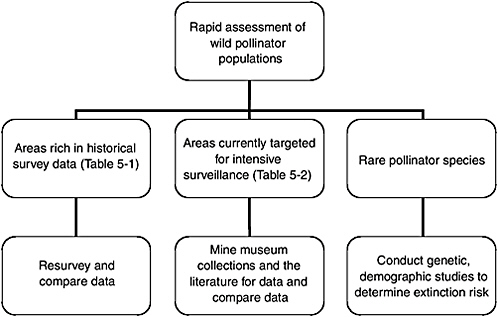
FIGURE 5-1A Assessment program.
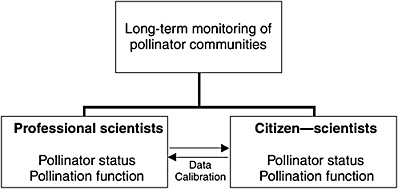
FIGURE 5-1B Monitoring program.
scientist monitoring activity in assessing both pollinator status and pollination function. Citizen-science monitoring programs are recent endeavors, and few have been subject to rigorous comparisons with professional monitoring. Figures 5-1 provide a flowchart illustrating the structure of each component of such an assessment and monitoring program.
With respect to carrying out this program, the professional science activities fall within the mandate of governmental agencies including the U.S. Department of Agriculture, the U.S. Geological Survey (USGS), the U.S. Fish and Wildlife Service, and the National Science Foundation’s proposed National Ecological Observatory Network. The citizen-scientist activities could be coordinated, for example, by partnerships between nongovernmental organizations (NGOs), governmental organizations, and citizen groups. The North American Amphibian Monitoring Program (http://www.pwrc.usgs.gov/naamp/) provides a useful model. It is a collaborative effort among regional partners that include state natural resource agencies, nonprofit organizations, and USGS. Participating NGOs for a North American Pollination Monitoring Program could include the North American Pollinator Protection Campaign, the Xerces Society, Monarch Watch, and likely citizen-scientist groups such as native plant societies, gardening clubs, schools, friends of nature reserves, community farm alliances, or commodity groups. The Pollinator Watch Program in Canada is currently under development through the Environmental Monitoring and Assessment Network’s Nature Watch Program (http://www.eman-rese.ca/eman/naturewatch.html).
Knowledge of all important pollinator taxa could benefit from monitoring programs. Funding restrictions might require prioritizing among taxonomic groups, at least initially. As arguably the most important and
least well-studied groups of pollinators (Proctor et al., 1996), wild bees could be a top priority for coordinated assessment. Lepidoptera, especially butterflies, have been utilized as a key indicator group for insects (for example, Fleishman et al., 2005) and their visibility, familiarity, and ecological importance argue for focusing monitoring efforts on this group initially, and then expanding to include others. That said, many of the monitoring techniques proposed here allow simultaneous collection of observations and samples of a wide range of flower-visiting species. Such data could be collected and archived even if time and resources do not allow processing and analysis immediately.
Assessment Program
Assessment programs will provide information about the status of a wide variety of pollinators in North America. The ALARM project showed that a before-and-after comparison based on past and recent surveys could reveal range contractions in many pollinator species (Biesmeijer et al., 2006; Box 2-3). The results suggest that concerns about pollinator status are warranted. Using that project as a guide, an assessment program in North America could include three activities:
-
Conduct intensive field surveys to collect, curate, and identify insect pollinators, repeated over at least 3–4-year periods (because of year-to-year variability in populations and species composition; see Chapter 3), in regions where significant historical records (late 1800s to early 1900s for many localities in eastern North America; 1950s–1970s for more recently surveyed localities in western North America) are known to exist for pollinators (Table 5-1). Current species presence can be compared with historical records to determine the number of species that still occur in these geographic areas (Biesmeijer et al., 2006; Marlin and LaBerge, 2001).
-
Capture historical data from museum collections (Anderson et al., 2002; Biesmeijer et al., 2006; Graham et al., 2004) for selected localities where intensive field surveys are currently being carried out for comparison of records. (See Table 5-2 for locations and sampling dates of recent or ongoing surveys.)
-
Monitor populations of selected pollinator species that are rare or suspected to be in decline (for example, Bombus spp., Chapter 2), using contemporary genetic or demographic techniques. For example, for bees, recent studies suggest that measuring the proportion of diploid males (Chapter 3) may be a simple, but effective, genetic technique to determine whether populations have experienced significant decline and are at enhanced risk for the future (Roubik, 2003, Zayed and Packer, 2005; Zayed et al., 2004).
TABLE 5-1 Examples of Areas Appropriate for Repeat Survey of U.S. Pollinator Populations (Localities, Some of Which Have Been or Are Being Re-surveyed, Contain Substantial Collections of Bees and Other Flower-Loving Insects)
|
Locality |
County |
State |
Collection Period |
Collection Method |
|
Portal |
Cochise |
AZ |
1950-1970 |
Net |
|
Antioch Dunes |
Contra Costa |
CA |
1930-1960 |
Net |
|
Mt. Diablo |
Contra Costa |
CA |
1930-1950 |
Net |
|
Surprise Canyon |
Inyo |
CA |
1950-1970 |
Net |
|
Altadena, La Crescenta |
Los Angeles |
CA |
1930 |
Net |
|
Tanbark Flat |
Los Angeles |
CA |
1950 |
Net |
|
Hastings Preserve |
Monterrey |
CA |
1930-1940 |
Net |
|
Sagehen Creek, Hobart Mills |
Nevada |
CA |
1930-1960 |
Net |
|
18 mi W Blythe |
Riverside |
CA |
1950-1970 |
Net |
|
Boyd Deep Canyon Desert Research Center |
Riverside |
CA |
1940-1970 |
Net |
|
Idyllwild, Keen Camp |
Riverside |
CA |
1920-1940 |
Net |
|
Palm Springs, Whitewater Canyon |
Riverside |
CA |
1930-1960 |
Net |
|
Riverside |
Riverside |
CA |
1930-1950 |
Net |
|
The Gavilan |
Riverside |
CA |
1930-1950 |
Net |
|
Morongo Valley |
San Bernardino |
CA |
1930-1960 |
Net |
|
Twentynine Palms |
San Bernardino |
CA |
1930-1960 |
Net |
|
Victorville, Apple Valley |
San Bernardino |
CA |
1930-1960 |
Net |
|
Borrego Valley |
San Diego |
CA |
1930-1960 |
Net |
|
Putah Creek and Canyon |
Yolo |
CA |
1950-1960 |
Net |
|
Moldenke transect, northern California |
|
CA |
1960-1970 |
Net |
|
Boulder |
Boulder |
CO |
1930-1940 |
Net |
|
Rocky Mountain Biological Laboratory |
Gunnison |
CO |
1975-1980s |
Net |
|
Miami and vicinity |
|
FL |
1930 |
Net |
|
Moscow |
Latah |
ID |
1930-1960 |
Net |
|
Carlinville |
Macoupin |
IL |
1890-1920 |
Net |
|
Chicago and vicinity |
|
IL |
1920-1930 |
Net |
|
Lawrence |
Douglas |
KS |
1930-1960 |
Net |
|
Plummer’s Island |
Montgomery |
MD |
Net |
|
|
Mount Desert and vicinity |
Hancock |
ME |
1910-1950 |
Net |
|
E.S. George Reserve |
Livingston |
MI |
1970 |
Net |
|
Hattiesburg |
Forrest |
MS |
1940 |
Net |
|
Raleigh |
Wake |
NC |
1920-1950 |
Net |
|
Fargo |
Cass |
ND |
1910-1950 |
Net |
|
Mesilla |
|
NM |
Early 1900s |
Net |
|
Rodeo |
Hidalgo |
NM |
1950-1970 |
Net |
|
Albany Pinebush Reserve |
Albany |
NY |
Net |
|
|
Ithaca and vicinity |
Tompins |
NY |
1880-1950 |
Net |
|
Locality |
County |
State |
Collection Period |
Collection Method |
|
Brooklyn (Flatbush, Prospect Park, Floyd Bennett Field) |
Kings |
NY |
1890 |
Net |
|
Gardiner’s Island |
Suffolk |
NY |
1910 |
Net |
|
Corvallis |
Benton |
OR |
1920-1960 |
Net |
|
Curlew Valley |
Box Elder, Oneida |
UT, ID |
1960-1970 |
Net, Malaise |
|
Cache Valley |
Cache, Franklin |
UT, ID |
1940-2000 |
Net, pan, Malaise |
|
Milwaukee |
Milwaukee |
WI |
1900-1930 |
Net |
|
Laramie |
Albany |
WY |
1970 |
Net |
|
SOURCE: J. Asher, American Museum of Natural History, and T. Griswold, USDA, personal communication, October, 2005; Procter, 1946. |
||||
Monitoring Pollinator Communities and Pollination Function
A useful monitoring program must employ standardized, tested, repeatable methodology applied with sufficient spatial and temporal replication to ensure confidence and allow interpretation of time trends in the resulting data. Describing the many factors that must be taken into account in designing a monitoring program is beyond the scope of this report, but such factors are discussed by Elzinga et al. (2001) and Potts et al. (2005). Monitoring programs can be designed to assess specific techniques to guide management, or they can be designed to track trends over time to assess the changing status of species or ecosystems (Kevan et al., 1997; Kremen et al., 1993). The latter type of program is most appropriate for monitoring both pollinator communities and pollination function across large geographic regions such as North America.
Monitoring insect populations and their function as pollinators presents certain challenges. Many species can be identified only by a professional taxonomist or are not yet described so that the “taxonomic impediment” (Box 2-1) can be a significant obstacle (Kremen et al. 1993; O’Toole, 2002). In addition, insect populations tend to experience large interannual or interseasonal changes in abundance (Roubik, 2001; Wolda, 1988), making detection of temporal trends difficult. Insect communities often include many rare species (Magurran, 1988) and rare species are inherently less amenable to monitoring with confidence across space and time. Complicating the process of evaluating insect communities is that variation in composition can be extremely high, even in samples from nearby areas of the same habitat type, or at the same site across time (Williams et al., 2001). Thus, any monitoring program focusing on insect pollinators must address both the taxonomic impediment and the challenge of collecting data with sufficient spatial and temporal resolution to allow trend detection.
TABLE 5-2 Examples of Modern Inventory Areas for Bee Pollinators (Corresponding Museum Data Could BeCaptured for the Listed Localities to Compare Between Historical and Modern Records and Provide a Status Assessment)
|
Location |
State |
Collection Period |
Digitized |
Records |
Species |
Data Ownera |
Collection Method |
Time |
Standard Interval |
Plot |
Notes |
|
San Rafael Desert |
UT |
1979-1993 |
Yes |
12,218 |
333 |
TG |
Net |
|
|
|
|
|
Death Valley National Park |
CA |
1993-1995, 1999-2000 |
Yes |
7,065 |
270 |
TG |
Net, pan |
|
Biweekly |
|
Biweekly on dunes |
|
Pinnacles National Monument |
CA |
1996-1999 |
Yes |
25,196 |
398 |
OM, TG |
Net, pan |
|
Biweekly |
|
Trail segments systematically sampled |
|
Clark County |
NV |
1998, 2004-2005 |
Yes |
67,617 |
598 |
TG |
Net, pan |
|
|
|
Identifications not complete |
|
Grand Staircase-Escalante National Monument |
UT |
2000-2003, 2005 |
Yes |
99,156 |
647 |
OM, TG |
Net |
X |
Biweekly |
X |
Identifications not completed for 2005 |
|
Dugway Proving Grounds |
UT |
2003-2004 |
Yes |
6,783 |
223 |
TG |
Net, pan |
X |
Biweekly |
X |
Identifications not completed for 2005 |
|
Yosemite National Park |
CA |
2004-2006 |
Yes |
23,021 |
|
TG |
Net, pan |
X |
Biweekly |
X |
Identifications not complete |
|
Avalon Plantation |
FL |
1999-2000 |
Yes |
3,000 |
125 |
SB |
Net, pan |
|
Monthly |
|
|
|
Yuma Proving Ground |
AZ |
2001-2002 |
Yes |
5,000 |
>200 |
SB, U.S. Army |
Pan |
|
Monthly |
|
|
|
White Sands Missile Range |
NM |
2003-2005 |
Yes |
10,000 |
>250 |
SB, U.S. Army |
Pan |
|
Monthly |
|
|
|
aData owner: TG: T. Griswold, USDA-ARS; OM: O. Messinger, USDA-ARS; SB: S. Buchmann, University of Arizona, Tucson. SOURCE: T. Griswold, USDA-ARS, personal communication, October 2005. |
|||||||||||
A cost-effective approach to addressing the two kinds of obstacles to monitoring insect pollinators might be to involve both professional scientists and citizen-scientists in the effort (Lepczyk, 2005). The professional science component provides the scientific rigor and detail needed for robust assessments of biodiversity response to changes in management practices (Bednarek and Hart, 2005; Noss, 1990). The citizen-scientist component may then increase the temporal and spatial breadth of studies that can be conducted at minimal cost, but at a sacrifice of some quality in the data (Table 5-3). Studies conducted by citizen-scientists could be carried out at low taxonomic resolution (for example, “bumble bee,” “flower fly” rather than identifications at the genus or species level), thereby circumventing the difficulty in identifying most pollinating insects caught in field studies to the species level. Careful integration of citizen-scientist efforts with professional efforts (for example, calibrating the data collected by citizen-scientists against that from the professional scientist program—see below) is necessary to optimize the utility of the resulting data. An important added advantage to including citizen-scientists is that it builds appreciation and understand-
TABLE 5-3 Pollinator Long-Term Monitoring Program: Comparison of Professional and Citizen-Scientist Monitoring Programs
|
|
Professional |
Citizen-Scientist |
|
Number of sites |
50-100 |
Many |
|
Type of sites |
Gradients of disturbance and sites shared with citizen-scientist program |
Many, of interest to citizens |
|
Taxonomic resolution |
High: genus and species |
Low: operational taxonomic units such as bumble bee, sweat bee, flower fly |
|
Temporal resolution |
High: monthly, biweekly, or daily |
Low: often annual |
|
Pollinator Status measurement |
Species richness, relative abundance, identity (specimens) |
Counts of operational taxonomic units (observations) |
|
Pollinator function measurement |
Pollen limitation for plants with varied breeding systems, including species studied by citizen-scientists |
Fruit or seed set for self-incompatible plants; bulbil counts on agaves in Mexico |
|
Goals |
|
|
|
Benefits, costs, and caveats |
Provides high-quality data but at high cost |
Provides large quantity of data at low cost but must be tested, calibrated |
ing of pollinators among stakeholders (for example, Condon, 1995; Kevan, 1975a). Examples of successful citizen-scientist monitoring programs that have yielded scientifically valid monitoring data with potential to assist in conservation and management of various species include the Tucson Bird Count (Turner, 2003; Turner et al., 2004), the Breeding Bird Survey (Mineau et al., 2005; Vance et al., 2003), and the House Finch Disease Survey (http://www.birds.cornell.edu/hofi/) of the Cornell Ornithological Laboratory (Altizer et al., 2004; Dhondt et al., 2005).
Professional Science Programs
The professional science program could be designed with two goals in mind: (1) to obtain an intensive, detailed data set to use in determining the long-term effect of land use change (the dominant force enhancing extinction rates and altering ecosystem processes; Millennium Ecosystem Assessment, 2005) on pollinator communities and pollination function, and (2) to obtain targeted data for a small number of sites with the goal of calibrating the data from the citizen-scientist programs to make the data from those programs more useful.
To assess the influence of land use change on pollinator communities, the professional scientist monitoring program could also monitor sites across an existing land use gradient, from relatively pristine natural habitats to extensively anthropogenically altered habitats. Studies across environmental gradients provide immediate information about the effects of land use change. They trade spatial coverage for (see also Greenleaf and Kremen, 2006a,b) time coverage by providing an estimate of the correlation between the accumulated environmental characteristics associated with different degrees of land use change and the community or functional characteristics. For example, Kremen et al. (2002b) found that the intensification of agriculture in California, from small-scale organic farms near natural habitats to large-scale conventional farms isolated from natural habitats, greatly reduced the diversity and abundance of wild pollinators at watermelon and other crops, and hence the services provided. In the intensively farmed region, many common species known from historical records have disappeared (Kremen et al., 2002b; Larsen et al., 2005). Thus a “snapshot study” can provide a useful amount of information about the local status of pollinator species (see also Kevan, 1975a; Kevan et al., 1997; Scott-Dupree and Winston, 1987).
Land use change is dynamic; for example, in the United States, European colonization was accompanied by extensive conversion of forested lands to agriculture, but those trends have since been replaced by afforestation (Caspersen et al., 2000; Lepers et al., 2005). In some regions, both forested and agricultural areas are being converted to urban or ex-urban
areas (Brown et al., 2005). The different land uses are likely to have radically different effects on pollinator communities (for examples, see Cane et al., 2006; Chacoff and Aizen, 2006; Frankie et al., 2005; Klein et al., 2002; Kremen et al., 2004; Ricketts, 2004; Winfree et al., 2006), and thus on pollination function (Herrera, 2000; Larsen et al., 2005; Memmott et al., 2004). Grixti and Packer emphasized in their paper (2006) that pollinator assemblages change with successional advances in vegetation, even in urbanized locations. Both community composition and function could be monitored over time along land use gradients.
To calibrate the data obtained from the citizen-scientist program, the professional scientist program would need to involve data collection at a much higher spatial, temporal, and taxonomic resolution in selected areas that overlap with the citizen-scientist program (for example, at urban gardens in the northeastern United States, and on vegetable farms in California—see below). Data for the most part could be specimen-based. Specimens can be identified to species by professional taxonomists in combination with trained para-taxonomists (as in the INBio—Instituto Nacional de Biodiversidad—program in Costa Rica—Janzen, 2004; and the All Taxa Biodiversity Inventory in the Great Smoky Mountains, http://www.dlia.org/index.shtml). Such data can be analyzed to determine the degree of association between the citizen-scientist data and the professional scientist data (see also Bhattacharjee, 2005; Danielsen et al., 2005; Gaidet-Drapier et al., 2006).
Citizen-Scientist Programs
A proposed citizen-scientist program could use simple measures of pollinator abundance (such as the number of bees observed at flowers) and pollination function (such as seeds set within fruits or flower-to-fruit ratios on target plants) that could be correctly implemented by nonscientists with minimal training. Inexpensive identification guides could be made available following the online model of “Discover Life” (http://www.discoverlife.org/) developed by John Pickering at the University of Georgia, Athens, or Frogwatch (run jointly by the National Wildlife Federation and USGS, http://www.nwf.org/frogwatchUSA/).
Programs could be designed and coordinated by scientists, possibly working in public-private partnerships (as is the case with Frogwatch), but implemented by citizens, educators, and students. Such a program could be carried out over a large number of localities, in places that people frequently visit and care about (such as urban gardens and accessible nature reserves). Data can be collected at a relatively coarse temporal and taxonomic resolution, with the goal of long-term annual monitoring of common species and easily recognizable guilds (for example, bumble bees, carpenter bees, and flower flies). Simple, easily implemented observational techniques and
measurements are ideal for this enterprise (for examples, see Methods section below). Use of websites for data entry and to view data is desirable because it allows participants to gain immediate feedback about their work and enhances their motivation (see http://www.tucsonbirds.org/results/ and http://www.eman-rese.ca/eman/datamanage.html for examples). Many excellent examples of existing citizen-scientist monitoring programs provide models (for example, Frogwatch, Monarch Watch, Tucson Bird Count, Illinois Butterfly Monitoring Network, http://www.bfly.org/, Canada’s Ecological Monitoring and Assessment Network, and others).
Methods
Monitoring Pollinator Status
The professional scientist program could use a combination of specimen-based and observation methods to monitor species abundance (Potts et al., 2005), whereas observational methods are best suited to citizen-scientist programs. Many methods are available for collecting pollinator specimens (Potts et al., 2005), and archiving voucher specimens in a recognized museum collection is a requirement for identification of many species, especially insects. Methods include netting visitors at flowers or trapping pollinators in pan traps, trap nests, or Malaise traps. Netting visitors at flowers is an active sampling method that requires training, and results from this method vary greatly depending on the skill of the netter. All of the other methods are termed passive sampling methods; these do not require great skill and are therefore less subject to inter-investigator biases, but trap placement and collection must be conducted in a highly standardized manner, both within and between sites. Investigators conducting surveys utilize a combination of methods, because a single method is rarely suitable for capturing all species present (Cane et al., 2000; Potts et al., 2005). A standardized protocol developed in North America for sampling bees and other pollinators includes both active and passive sampling methods and is listed at http://online.sfsu.edu/~beeplot/pdfs/Bee%20Plot%202003.pdf. For the passive, pan-trap sampling methods, some testing has been conducted to determine the effects of bowl color emission spectrum, bowl size, bowl spacing, type of soap utilized in water, and length of time operated. These tests suggest that yellow, blue, and white UV-emitting bowls are the most effective for trapping pollinators, and that bowls should be spaced at least 5 m from each other for maximum efficiency. Dish-washing detergent should be used in the water to break surface tension. The size of bowl used for sampling duration did not affect the number of pollinators caught (http://online.sfsu.edu/~beeplot/). Other standardized protocols involving these and other methods are currently being tested in Europe by the ALARM project (see Box 5-1).
Pollinator communities and populations can also be monitored through visual observation (Potts et al., 2005). Identifying insect pollinators to species on the wing is difficult and requires extensive training in most cases. Thus, monitoring programs relying on visual observation will necessarily be conducted at a coarse taxonomic resolution, except in rare cases involving extremely familiar and exceptionally recognizable species such as Apis mellifera or Danaus plexippus. Such resolution may be appropriate with a minimum level of training for a citizen-scientist monitoring program for pollinators. Citizen-scientist monitoring programs have also been developed for birds and bats in Mexico and for birds in the United States (for example, Breeding Bird Survey, http://www.pwrc.usgs.gov/bbs/).
To standardize sampling, both visual observation and specimen sampling must be conducted only under specified weather conditions (sun, cloud cover, temperature, wind) and time of day or season, in predetermined sampling units of time (for example, a given number of minutes per sample, and samples per site per day) and space (transects or plots) to achieve equal sampling effort between sites (Dafni et al., 2005).
Monitoring Pollination Function
A standard method for monitoring pollination function, well suited to the professional scientist program, is to measure “pollen limitation” (Box 4-2) and in doing so determine whether focal plants become more or less pollen-limited over time or with land-use intensification. Pollen limitation is measured by comparing reproduction on flowers that are experimentally cross-pollinated (by hand-pollinating the flower with pollen from another individual) against control flowers on the same plant and on an adjacent, companion plant that are pollinated under ambient (open) conditions (Dafni et al., 2005; Kearns and Inouye, 1993; Box 4-2). Use of potted plants placed in different environments minimizes differences in plants due to nutrition, genetics, and other variables.
A simpler method that could be used by citizen-scientists is to monitor a self-incompatible, pollinator-dependent plant over time and assess fruit or seed set. Accessible techniques for assessing breeding systems are available in Bernhardt and Edens (2004) and Dafni et al. (2005). Monitoring of pollination function in this manner over time, or along land use gradients, provides a valuable companion data set to that gathered on pollinator abundance trends.
Alternative methods for monitoring pollination function may exist for specific plants and their pollinators. For example, in the deserts of Mexico and the southwestern United States, monitoring of bulbil production by agaves may provide a simple but effective measure of ecosystem pollination services provided by vertebrate organisms, usually bats. Agaves can repro-
TABLE 5-4 Areas for Monitoring Pollination Function Using Agave Bulbil Production
|
Area |
Region or State |
Country |
|
Cañon de Santa Elenaa |
Northwestern Chihuahua |
Mexico |
|
Central Mexican Highlandsb |
Hidalgo, Puebla, Tlaxcala |
Mexico |
|
Chiricahua Mountainsa |
Southeastern Arizona |
United States |
|
Chisos Mountainsa |
Big Bend National Park, Texas |
United States |
|
Cumbres de Monterrey National Parka |
Central Nuevo León |
Mexico |
|
Hatchet and Animas Mountainsa |
Southwestern New Mexico |
United States |
|
Maderas del Carmena |
Northwestern Coahuila |
Mexico |
|
Sierra Madre Occidentala |
Northeastern Sonora |
Mexico |
|
Sierra Madre Occidentala |
Northwestern Chihuahua |
Mexico |
|
Tehuacán Valleyc |
Southern Puebla |
Mexico |
|
Trans-Mexican Volcanic Beltb |
Morelos, Michoacan, Jalisco, Colima |
Mexico |
|
aArea vegetation dominated by agaves. bAgaves locally abundant. cAgaves dominate vegetation in the southernmost stretch. |
||
duce vegetatively by producing shoots and rhizomes, or sexually by producing seed-bearing fruits in the stalk after successful pollination (Arizaga and Ezcurra, 1995, 2002), but when pollinators fail to appear, agaves may produce aerial bulbils in the flowering stalk (Arizaga and Ezcurra, 1995). In the Tehuacan Desert of central Mexico, about 5 percent of the plants were never pollinated and instead produced bulbils (Arizaga and Ezcurra, 2002). Monitoring the frequency of bulbil production in selected areas (Table 5-4) may provide a direct indicator of pollinator availability or pollinator service to agaves.
CONCLUSIONS
Current monitoring systems for commercial pollinators, chiefly Apis mellifera, exist, but these fail to report or capture all of the necessary data to monitor pollinator status and function. In particular, new questionnaires directed at both the beekeepers and growers need to be developed to capture information on pollination by agricultural commodity. Several monitoring programs also exist for specific taxa or functional groups of pollinators, but many of these programs are either run by individual scientists, and are therefore limited in scale and not sustainable over the long term, or by citizen-scientist groups, and are therefore limited in precision and repeatability.
For pollinators, the ALARM project of the EU provides an excellent model for monitoring and includes development and testing of monitoring methods. In addition, some excellent models exist for a variety of taxa that
couple professional and citizen-scientist collection efforts. The combination of professional and citizen-scientist collection efforts extends the potential for data accumulation, although testing and calibration are needed to assure data quality and validity. A monitoring program could be developed for long-term assessment of pollinator status and function using both professional and citizen-science elements. To address the enormous spatial and temporal variability in pollinator populations as well as the taxonomic impediment, calibration systems could be developed to determine the degree of correspondence between data collected by professional scientists at a fine taxonomic resolution, and data collected by citizen-scientists at a coarser resolution. If valid calibrations can be developed and data quality can be assured, use of both types of data sets is likely to provide more information germane to evaluating pollinator status in time and space at a relatively low cost.
Legacy data (specimens archived in museums) could be captured digitally and utilized (more extensively than has been done to date) to provide a baseline for assessing the status of pollinators in North America today. Areas where substantial legacy data exist should be re-surveyed; areas where contemporary surveys are ongoing should be targeted for digital capture of historical specimen data.


