
6
DIKA
Throughout a vast swath of western tropical Africa, from Senegal to Angola, dika is a part of the diet. In the southwestern corner of its range, from Nigeria to Angola, the fruits are eaten. However, in the main area of occurrence, from Senegal to Uganda, the major food by far is the seed. Despite international obscurity, dika is hardly a minor resource. It provides food and income to rural communities in almost twenty countries. In several countries—Cameroon, Nigeria, Gabon, and Equatorial Guinea, for instance—it is one of the most widely sold of all forest products. Millions count on it for cash during the harvest season.
Throughout its native range the tree providing these valued fruits and seeds is among the most appreciated natural resources. When forests are cleared dikas are universally left untouched. Those treasured, multi-branched specimens topped by dense and often curving canopies of foliage are to be seen scattered through many secondary forests.
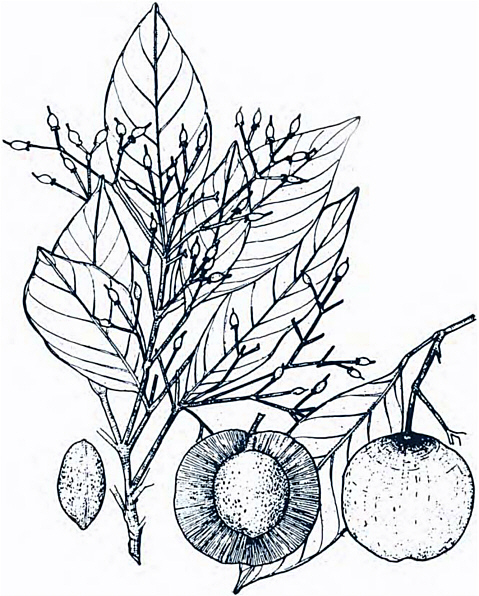
In season these companionable trees, which can grow as high as 40 m, become laden with green-and-yellow fruits that look like small mangoes. Depending on the species, the fruits vary between sweet and bitter.1 Although the sweet version is mainly enjoyed fresh, it is also turned into jelly, jam, or “African-mango juice.” There’s even been an attempt to make dika wine—the result, so its maker claims, being compared in tastings to a Moselle Riesling.2
Seen in Africa-wide perspective, however, the fruit is a tiny resource compared to the seed. Each year harvesters gather “dika nuts” by the thousands of tons. The hard round balls, which look something like smooth walnuts, must be cracked open to get to the edible part. The kernels found inside have the texture normal to nuts and can be eaten raw or roasted like
cashews. Most, however, are processed. Some are pounded into dika butter, a product akin to peanut butter or almond paste. Some are compacted into blocks resembling chocolate (once called Gaboon chocolate). Many are pressed to squeeze out the oil that makes up more than half the kernel’s weight.
In the main, though, the kernels are ground and combined with spices to form the key ingredient in “ogbono soup.” This extremely popular special dish is a sort of unifying regional favorite (although every country fervently considers that it produces the best). Like okra and baobab leaves, this so-called dika bread provides the slippery texture so beloved in African soups, stews, and sauces. It also adds a sharp and spicy tang that is unforgettable.
Given the popularity of ogbono3 soup, dika kernels are traded on both a local and a regional scale. All across western Africa they bring high prices, especially out of season. Even as far back as 1980 it was calculated that a farmer could make US$300 from the seeds gathered off a single dika tree.
Strongly flavored condiments such as dika are crucial to diets where staples are bland in the extreme. Sharp tasting soups, sauces, or stews add both flavor and nutritional balance to cereals, tubers, plantain, fufus, and doughs (cold gelatinous, warm glutinous, and steamed non-glutinous) that anchor the West African diet. Traditionally, these condiments contained local bushmeat, fish, leafy vegetables, dawadawa, dika, spices, or oils. In more recent years, however, foreign ingredients—including tomato, onion, garlic, chili pepper, black pepper, celery, and parsley—have begun making inroads. Even European processed products, including bouillon cubes and dehydrated soup mixes, are nowadays prime ingredients in traditional African sauces. Nonetheless, the original components—including dika, okra, egusi, sesame, spicy cedar, peanuts, oilbean seed, as well as an immense variety of leafy vegetables—still remain in common usage.
That continuing tradition is certainly surprising in the case of dika products, which are gathered individually by hand from scattered wild trees. Throughout history the notion of commercially cultivating this resource and creating an organized industry like that of, say, cashew has been inconceivable. Of the various hindrances, the biggest was the once-widespread belief that dika trees must be at least 10 or 15 years of age before they bear any fruits or nuts. For any large-scale operation requiring financial investment that was a killer condition.
Now, however, pioneers are opening a new future for this crop’s wider use. Although still basically a wild species, dika can be said to be in the early stages of domestication. Advances now transforming its prospects include the recent availability of trees selected for kernel qualities such as shells that naturally crack open by themselves (like the commercial pistachio). Perhaps the greatest advance has been developments in
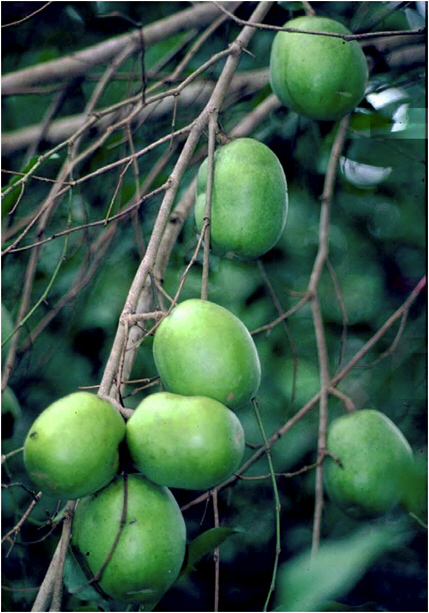
Dika fruits have traditionally been collected from wild trees in the forests, so not much has been reported about their likely ultimate contribution to food security. Nonetheless, harvesters gather dika nuts by the thousands of tons each year, and those kernels, if dried, can be stored for long periods. Through dika, millions of farmers already earn a critical income. They sell the fruit for juice, jam, jellies, and the fresh market. They sell the oil to factories making margarine, soap, or pharmaceuticals. The greatest profit center of all, however, is in the defatted kernel meal. (E.C.M. Fernandes, ecf3@cornell.edu)
vegetative propagation, allowing mass replication of such elite germplasm. Just as important, though, vegetative propagation slashes the delay in fruiting time; budded trees reportedly start producing fruits and seeds just two to four years after planting.
Those advances in knowledge are transforming the possibilities for this formerly scientifically obscure resource. Nigerian researcher J.C. Okafor for more than a decade developed horticultural techniques to facilitate commercial cultivation. In recent years, more and more researchers have begun to follow through with their own investigations. The International Centre for Research in Agroforestry (ICRAF, now the World Agroforestry Centre) chose dika as a priority species for African agroforestry.4 Already, small experimental plantings have been established in Nigeria: at Iva Valley in Enugu and at Onne in River State. The latter was planted using marcots (air-layering plants), which flowered and fruited just 2-4 years after planting. Both Nigeria and Cameroon have even begun creating village-level nurseries where dika trees designated “superior” by local farmers are vegetatively propagated.
Although vast uncertainties still remain, no insurmountable barriers to this plant’s complete domestication are known at this time. The coming years seem likely therefore to bring new life to the production of both nuts and fruits—making an agro-industry that is bigger, better organized, and more reliable than ever in dika history. Possibly, the added output will come from industrial-scale plantations. More likely, it will come from scattered village production as millions of farmers supplement and upgrade the trees they already possess. Dika moreover will be planted for shade, shelterbelts, beautification—along, for instance, streets in cities and highways in the countryside—thereby easing life in more ways than just the provision of food.
These activities are not just emanating from scientists flexing new-won knowledge. Among West and Central Africa’s indigenous food plants, dika is high on the list of species the inhabitants hope to see developed. In a survey of five southern Cameroonian villages, for instance, dika was ranked top of the Ten-Most-Wanted-Tree list. Also, a report of farmer preference carried out in southern Nigeria showed that dika was top on the list of 5 preferred fruit trees.
Steamy zones such as southern Cameroon and eastern Nigeria represent one of the dika’s special agronomic niches. Tropical lowlands are difficult to farm with modern agronomic approaches, and have consequently fallen behind the rest of the arable world. Dika, however, thrives in places such as the evergreen forests of Gabon, Equatorial Guinea, eastern Nigeria, and
southern Cameroon, where magnificent primeval specimens can still be seen on all sides. This special adaptation to heat and humidity raises the possibility of improved dika plants being employed as an environmentally friendly cash crop for dense, moist, heavily shaded conditions. Communities around Enugu in southeast Nigeria planted dika extensively to control the menace of soil erosion. In the future, it might even help reduce the pressure on the ecosystem that worries so many of today’s observers…the African rainforest.
Another important future possibility is the use of dika for lowering malnutrition. Although various oil-rich tropical seeds are being advanced to meet the hungry nations’ escalating needs for food energy and protein, few (to our knowledge) are fostering dika for the purpose. Yet the kernel meal is high in oil and protein (including six of eight essential amino acids), and would make an exceptional tool for nutritional intervention in West and Central Africa where marasmus and kwashiorkor are the main baby killers.
Yet a third important possibility is its use as a cash crop. As a reward for hard work nothing succeeds like cash, and in this special regard dika is one of the most motivational of trees. Through it, millions of farmers already earn a critical income. They sell the fruit for juice, jam, jellies, and the fresh market. They sell the oil to factories making margarine, soap, or pharmaceuticals. The greatest profit center of all, however, is in the defatted kernel meal. This shelf-stable soup ingredient even has export potential. Indeed, entrepreneurial West Africans living in the United States already hawk molded ogbono cubes over the Internet.
Considered in overview, then, it can be said that although dika makes up a vital part of the traditional food system in much of West and Central Africa, its full potential has so far gone unharnessed. At this particular moment in history, however, the plant’s imminent domestication is opening new opportunities for alleviating rural poverty and malnutrition, while at the same time promoting tree planting, diversifying land-use, and developing durable rainforest agroecosystems capable of superseding today’s mindless exploitation.
The current handful of dika researchers are certainly enthused by the prospects their discoveries are unfolding. One calls the exploitation of dika a “win-win landuse strategy for Africa.” He envisages a “Really Green Revolution” based on the diversification of agroecosystems with new perennial tree crops that reduce poverty, expand exports, and come close to sustainable agriculture. Dika is not the only species capable of transforming Africa’s land use this way, but it is a leading candidate.
PROSPECTS
Given dika’s special climatic adaptation and geographical occurrence, the prospects for enhancing its contributions seem good. But they are also limited by the tree’s geographic demands.
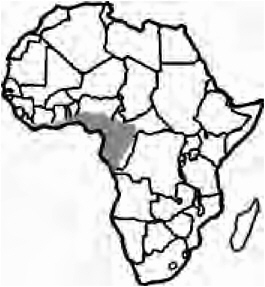
Throughout a giant triangle from Senegal to Uganda to Angola dika is a part of the daily fare. Although this tree’s fruits are eaten in some areas, the seed is the major resource. As a result, this so-far-undomesticated tree scores high on the list of species inhabitants hope to see developed. (Distribution after David Ladipo.)
Within Africa
Humid Areas Good. The real opportunities are in humid West/Central Africa, the area where the species is indigenous. A canopied jungle, however, is not its only habitat. This versatile tree also occurs naturally in gallery forest and semi-deciduous forest, where it stands in the open sunlight. Furthermore, it is often seen—usually standing alone—around the outskirts of towns or villages.
Dry Areas Poor. Dika is apparently restricted to fairly wet, well-drained, loamy-to-clay soils. Probably, it has little potential outside those warm, wet, fertile regions, but no one has tried to find out for sure.
Upland Areas Poor. Although dika seems to have no hope of thriving at altitude, trial plantings of individual trees might prove quite interesting.
Beyond Africa
It seems unlikely that dika will catch on as a food crop outside Africa. Nevertheless, the tree at-the-least would be an interesting one for long-term
plantings such as tropical botanical gardens to acquire and observe. Many now-highly productive trees of the humid tropics—rubber comes to mind— have only hit their stride outside their homelands.
USES
Although various parts of this species have their uses, not excluding the living tree itself, the seed is the resource upon which the crop’s future overwhelmingly rests.
Fruits The fruits have traditionally been collected from wild trees for domestic use in the forests of the humid forest zone of southeastern Nigeria, Cameroon, Gabon, and both Congos. Despite the fact that they are routinely consumed in those countries, not much has been reported about their technical qualities.
Seeds If dried, the kernels can be stored for long periods. These dika nuts are usually ground into a smooth paste before use. Typically, that paste is mixed with hot water or slightly heated palm oil to create the unique flavoring that constitutes the essence of ogbono soup. When dropped in just a few minutes before serving, it also serves to thicken soups and stews, producing the viscous consistency consumers covet.
Oil The ground-up meal of dika nuts is commonly pressed to separate the oil. The glycerides in this yellowish liquid are made up largely of saturated fatty acids, notably myristic and lauric. The oil is used, as we’ve said, in soapmaking and cooking, and it has potential for pharmaceutical use as well.
Wood Dika wood is a local building material. It is a hard, heavy timber with fine grain. It is of minor overall economic value but the trade can be lucrative and exploitive.5
Medicinal Uses Dika products are used medicinally in most parts of tropical Africa. In Sierra Leone, for example, the Mende tribe uses the bark to relieve pain. The presence of an analgesic effect has been documented in experiments on mice.6
Other Uses The living tree serves as an ornamental as well as a shade tree for food, cash crops, and animals.

Dika seed kernels (processed and unprocessed). These so-called “dika nuts,” are widely traded in West Africa. They are something like cashews, can be eaten raw or roasted. Most, though, are ground and combined with spices to form the key ingredient in “ogbono soup,” a spicy dish extremely popular among West Africans and Central Africans. This shelf-stable soup ingredient even has export potential. Indeed, entrepreneurial West Africans living in the United States are already hawking molded ogbono cubes over the Internet. (R.R.B. Leakey)
NUTRITION
The fruits’ popularity is largely due to its sweet-and-sour flavor combination. The sugar content of juice has been found comparable to pineapples and oranges, with even more vitamin C than the latter.7
In one set of measurements, the kernels contained about 60 percent oil, 30 percent total carbohydrate, 3 percent ash, 8 percent crude protein, 1 percent crude fiber, plus 10 mg vitamin C per 100 g.8 Reportedly, it is also rich in beta-carotenes.9
Although such high oil content gives remarkable food-energy values, other reports have quoted oil contents up to and beyond 70 percent.10
According to one report the oil was made up of 39 percent myristic acid and 51 percent lauric acid.11 Such saturated fats may not be the Western World’s ideal in edible oil but they still merit recognition in hungry nations with high levels of marasmus, the form of malnutrition deriving from too few calories.
The amino acids in these seed kernels are reasonably balanced for human nutrition. In one test, lysine, tryptophan, valine, threonine, isoleucine, and phenylalanine were the essential amino acids whose levels compared favorably with the FAO/WHO provisional pattern for proper nutrition. Methionine and cysteine were deficient, and were the first limiting amino acids.12
In addition to food energy and quality protein, the seed could be a potential source of potassium, calcium, and phosphorus. The levels of iron, zinc, copper, and manganese are said to be low, but their levels probably depend on the local soil. The total oxalates are low when compared with other vegetables, so these antinutritional factors are unlikely to interfere.
The kernel’s food-thickening property is thought to be due to mucilaginous polysaccharides that become more viscous with cooking. This unusual characteristic has been called “drawability.”
HORTICULTURE
Horticulturally speaking, dika suffers from the fact that it has never been a managed crop. Nevertheless, it seems likely to respond to conventional horticultural practices. As far as field cultivation is concerned, it is known that the growth from seeds is slow. In addition, unless the seeds are handled carefully, most fail to germinate. According to one recent report, drying the seeds slowly under ambient conditions and subsequently soaking them for a day gives 100 percent germination.13 And it has been found that certain seeds certainly don’t require 10 or 15 years to fruit. In trials many trees flowered in about a third that time—not so different from apple and most orchard crops.14
It is known, also, that grafting, budding, air-layering, marcotting, and cuttings are all feasible, at least when applied on young wood. In addition, it has been discovered that many dika trees on Cameroonian farms had arisen from transplanted wildlings.
HARVESTING AND HANDLING
As far as best practices for handling, not much is reported. One study showed that fruits harvested at the mature green stage and ripened at 26-29°C were preferred to the naturally tree-ripened fruits in color and texture, although their overall composition remained unchanged.15
LIMITATIONS
The complexities of such things as flowering and fruiting are little understood. Anyone endeavoring to manage a dika plantation will be a true pioneer. In any such effort it is crucial to start with plants possessing the genetic capacity to produce well. In this regard, researchers at Onne in southeast Nigeria, have found that different trees demonstrate vast variation. For example, in 1995 one young tree produced only 18 fruits while its neighbor yielded 207.16
To extract the kernels the shells are currently broken open by hand. Different countries favor different techniques. Some extract the seeds from the fresh fruits as practiced by fruit collectors at Enugu. Others ferment the fruits and extract the kernels wet, while yet others ferment and sun-dry the seeds before cracking open the hard, dry shells. All these methods are problematic. The whole operation is exceptionally tedious and absorbs untold proportions of the villagers’ lives.
NEXT STEPS
What could the world do to advance dika? Almost everything. Examples follow.
Extension Support With no extension support for dika farmers, anyone possessing a tree is on her own. One simple thing that could help such worthy souls is capacity-building specifically for their needs. This might involve practical training to pass on the techniques and requirements for successful cultivation. It might also involve demonstration plots where farmers can see and learn how the tree is best treated. And it might even include incentives to small farmers.
In a related effort, green-fingered individuals should set up elite germplasm plots and sell or supply grafted plants to villagers. The current “superior” germplasm currently being evaluated may help to improve farmers’ welfare if it is a big improvement over the average dika material today’s farmers rely upon.
In general, then, emphasis should be placed on the mass production of planting materials using vegetative propagation and skilled professionals.
Document Cultural Traditions It is reported that the Baka of the Dja Forest (Cameroon) and the Ibos of southeast Nigeria have a wealth of insight into their local dika trees. Other peoples certainly have knowledge to share as well. The opportunity to tap the experience of farmers who have lived their lives with dika should not be missed.
Horticultural Development As already noted, vegetative propagation is the key to the process. Currently, studies are in progress in Nigeria and Cameroon to improve dika air layering, grafting and budding, all of which are means of propagating from the mature crowns of selected trees. The use of cuttings would be an especially attractive alternative as it avoids graft incompatibilities and potentially can produce large numbers of trees. Simple, low technology methods have been developed for juvenile shoots,17 but getting successful cuttings from mature shoots is still an unsolved challenge.
Desirable improvement objectives include increasing fruit size, improving the taste of fruits, increasing yield, and reducing tree height and the time to bear fruits. It is already clear that dika trees vary hugely in fruit and kernel traits. It is also already clear that the potential for selecting trees with superior characteristics is great. These elite specimens are candidates for vegetative propagation. Finding them across thousands of kilometers of difficult terrain is the problem, but it is a far-from-insoluble one.
Already a few germplasm collections have been made. In Nigeria, for instance, genebanks have been established at Ibadan (in collaboration with the National Centre for Genetic Resources and Biotechnology) and Onne (in collaboration with the International Institute of Tropical Agriculture, IITA). In Cameroon a dika genebank has been established at M’Balmayo (in collaboration with the Institut de Recherche Agronomique pour le Développement). More should be set up in Congo, Gabon, Côte d’Ivoire, and so forth.
The existing collections, together with observations on field-grown trees, have already revealed individual specimens that could promote rapid progress towards domestication. These unusually promising variants include:
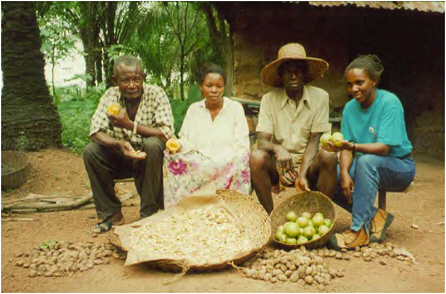
Collecting dika germplasm in Southeast Nigeria. The tree thrives in tropical Africa, and its special adaptation to heat and humidity raises the possibility of improved forms being employed as an eco-friendly crop for dense, moist, heavily shaded conditions. Also, dika holds promise as a crop for controlling soil erosion. Thus, it could be used to benefit the ecosystem whose future so many worry about today: the African rainforest. Here, two (female) students and two farmer volunteers show off the results of a day’s search. (Paul Anegbeh)
-
Multiple Bearing In several countries dikas that flower and fruit several times in a year have been observed. Among the 182 trees planted in 1990 at the IITA Station in Onne, Nigeria, for example, a few flower two, three, or even four times annually.
-
Precocity Some seeds produce plants that start fruiting at a far younger age than expected. Of the trees mentioned above, about half flowered within five years. Some even set fruit twice a year by then.18
-
Good Form Branching and tree form can be key to a successful orchard in fruit and nut trees. Dwarfing is an especially valued trait because it greatly simplifies the harvest. So far, dwarfs have not been found or created (by grafting, for instance), but have been developed by marcoting.
-
Split Fruits During 1995 dika collections in the north of Gabon, a tree was found whose nuts split open naturally. When its fruits were spread out to dry, 93 percent had split open after 72 hours; none of the seeds from six other Gabonese dika trees had split at all.19
-
Color On a typical dika, the young leaves are pale green although some can be pink. But on a few trees the leaves remain red even when mature. This phenomenon apparently occurs only in the fruit-type species (Irvingia gabonensis). This quality could presumably be captured by vegetative propagation. Rosy-leaved dika trees might have potential for amenity plantings throughout western Africa, if not the whole tropics.
Plantation Trials The germplasm and knowledge already assembled indicates that dika domestication can enhance the human nutrition, natural environment, and local economy of the places where the species occurs. For the present we hesitate to recommend full-scale commercial plantings, but now is certainly the time to continue establishing ever-more sizable trials on research stations and on farms to test performance of the best genetic stock currently available. Also, it is not too soon to start large-scale demonstration trials in the right rural areas.
Expanding Markets Governments, good-will organizations, and activated individuals need to pool their efforts to increase and regularize the wider use of dika products. This should help rural people, rural economies, and rural environments. Even now many Africans depend on dika and other non-timber forest products for their livelihood. In a survey made in Cameroon’s humid forest zone, sales of the four main non-wood native forest products20 amounted to at least US$1.75 million in the first half of 1995. More than 1,100 traders, mainly women, were engaged in distributing the wild-tree products. Furthermore, the traders reaped a 30 percent mark up on each sale. But in the future even more Africans could benefit. The potential for expanding production and trade are good. Contrary to international belief, this sustainable use of living trees is not a dying business. Increased urbanisation is actually encouraging market expansion, as transplanted countryfolk living in the cities pine for the tastes of home.
Dika nut may also find a market beyond Africa. Indeed, it is a good candidate for “green marketing” in places such as Europe and North America. Exporting dika products such as thickening agents, oil, ogbono soup cubes, and the rest will provide incentive for West and Central African farmers to diversify and control quality. This will generate income for subsistence farmers, and create export revenues for countries in desperate need of them.
Quality Control Most non-wood forest products are still collected and marketed informally, with little organized oversight. The result is an
unreliable resource. Now is the time to introduce various safeguards, performance standards, and a pricing system reflective of quality. Farmers will then strive to reap the reward of greater profit. The result will be superior products, a reliable resource, and better off farmers.
In southern Nigeria, where ogbono is consumed extensively, various growers, wholesalers, and consumers have already begun the process of upgrading the supply. They’ve proposed quality classes for dika kernels, ranging from Grade A (the top) to Grade D. To encourage the further use of dika-kernel oil, a quality standard for pharmaceutical grade oil has also been proposed.
Protection Although the species is still relatively common and widespread, many wild stands are in decline owing notably to pressures from logging and human settlement, as well as to the plant’s reluctance to regenerate. Various animals, including elephants and lowland gorillas, love the mango-like fruits and disperse the seeds. But without those creatures the species apparently has difficulty regenerating. In certain regions of Côte d’Ivoire, for instance, people replanting dika seed around their village are the only ones sustaining this age-old resource.
What anyone could do about this is not so clear, but a few possibilities come to mind. For one, across the species’ range the destruction of these exceptionally useful trees, which provide food and income for up to a century, should be minimized. For another, the few locations where dika diversity is especially high should be conserved. And the replanting of dika trees should be everywhere encouraged.
Food Technology Food technology could do wonders for the dika business, and it provides a powerful way to open new markets. Among the most crucial needs is a nut-cracking device.
One special use for processed dika may be as a generalized food thickener. Indeed, a polysaccharide chemist could well have a field day exploring the ingredients and properties of this barely studied material. Dika nut meal reportedly absorbs water and fat better than raw soymeal does, and “hence may have useful applications in processed foods, such as bakery products and minced meat formations.”21
The kernel’s food-thickening property is, as previously noted, thought to be due to mucilagenous polysaccharides that increase viscosity with heat. This characteristic “drawability” is an important trait for genetic selection, and through its development food technologists could provide exceptional input into the dika-domestication activities. Without that input, the plant-domestication efforts may create magnificent trees whose seeds are spurned
by consumers because they just don’t make an ogbono soup that is slippery enough on the palate.
Nutrition For a food as widely used as this one, there is an perplexing lack of nutritional information. Not only are rheological analyses needed, but chemical, biochemical, and nutritional trials should be run in both laboratories and clinics.
SPECIES INFORMATION
Botanical Name Irvingia gabonensis (Engl.) Engl. and Irvingia wombolu Vermoesen.
Synonyms There are many, such as Mangifera gabonensis Aubry-Lecomte ex O'Rorke, but in practice both species are field-recognized as Irvingia gabonensis. Formerly, the sweeter form was considered to be Irvingia gabonensis var gabonensis; the bitter form (now Irvingia wombolu) was Irvingia gabonensis var excelsa.22
Family Irvingiaceae (also placed in Simaroubaceae)
Common Names
English: bush mango, wild mango, dika, dika nut
French: manguier sauvage, chocolatier
Hausa: Agbalo
Nigeria: oro, oba, abesebuo, goron biri, oro, moupiki, muiba, eniok, andok,
Ibo: ogbono (kernels)
Afemai (Edo): ikpe (I. wombolu); ogi (fruit of I. gabonensis)
Yoruba: apon
Sierra Leone: bobo
Côte d’Ivoire: boboru, wanini
Cameroon: andok
Batanga (language in prime dika country near Kribi, Cameroon): mbumbwe’bo, nja’a
Congo: meba, mueba
Description
The dika is a deciduous tree reaching heights of 30 to 40 m. The bole, usually straight and cylindrical, is covered by a scaly gray bark that flakes away in plates. The trunk is typically short and slightly buttressed, with a
diameter of 1 m and more. The smooth leathery leaves are attached to the stem alternately. The flowers are greenish yellow, as are the open-pollinated, mango-like fruits.
The heartwood is pale-green, brown, or orange yellow, fading on exposure to a gray brown. Sometimes, it develops dark gray streaks. The sapwood is lighter, but is not always differentiated. In woodworking terms, the texture is fine to medium, the grain straight to interlocked, and the surface is without luster.
Distribution
Within Africa Dika is found in the western and central tropics, from southern Senegal to the northern tip of Angola (notably Cabinda), including Congo, DR Congo, Nigeria, Príncipe, Ghana, Côte d’Ivoire, Guinea, Sierra Leone, Sudan, and western Uganda. It is often found near riverbanks and reaches optimal growth in the dense evergreen rainforest.
Beyond Africa The tree is apparently unknown outside the African continent.
Horticultural Varieties
No named varieties are yet in commercial use.
Environmental Requirements
The outer limits of its cultivation are unknown, and whether the present occurrence is truly representative is uncertain.
Rainfall Although the tree probably cannot survive drought, it is generally unaffected by heavy rainfall (so long as the soil does not become waterlogged). It performs well at Onne, Nigeria with an average of 2400 mm of rainfall annually.
Altitude This is exclusively a lowland species, but whether that is a genetic imperative is uncertain.
Low Temperature Dika trees probably cannot take freezing weather and even temperatures that approach freezing may damage them, although in the absense of any trial of cold conditions that is speculation.
High Temperature Given the tree’s native habitat, it seems safe to say that it can withstand warmth.
Soil As earlier reported, dika occurs in fairly wet, well-drained, loamy-to-clay soils. The assumption for now is that it is restricted to such sites.
Related Species
In Southeast Asia a few dika cousins can be found. Mainly, they are renowned as prime candidates for high-priced tropical timbers. But one, Irvingia malayana Oliver ex Bennett, is the source of a vegetable oil called “cay-cay fat.” In Nigeria are found two other species, Irvingia smittii Hook.f. and Irvingia grandifolia (Engl.) Engl, the latter used as timber.


