
8
EGUSI
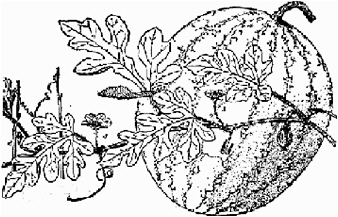
The egusi plant looks so much like a watermelon plant that most botanists think it is one. The fruit looks so much like a small, round, watermelon that the two are also easily confused.1 However on the inside the egusi fruit is neither red, nor luscious, nor sweet. Indeed, it is white and dry and bitter enough to be repulsive. This is one fruit not even monkeys bother with. But for all that egusi is a food crop…and far from a small one at that.
Egusi2 is grown for its seeds, which resemble large, white, melon seeds. In West Africa, a region where soups are integral to life, they are a major soup ingredient and a common component of daily meals. Coarsely ground up, they thicken stews and contribute to widely enjoyed steamed dumplings. Some are soaked, fermented, boiled, and wrapped in leaves to form a favorite food seasoning.3 They are also roasted and ground into a spread like peanut butter. Some are roasted together with peanuts and pepper and ground into an oily paste4 that is used when eating kola nuts, eggplant, and fruits. Egusi-seed meal is compacted into patties that serve as a meat substitute. It is even said that the dry seeds placed on a hot skillet pop like popcorn and come out looking like puffed rice.
Beyond their use in processed form, egusi seeds are commonly parched and eaten individually as a snack. In his recollections of life in Ghana, one commentator notes: “Whenever a group of men were standing around talking, their hands were usually busy dehulling [shelling] egusi seeds.” And another recalling life in Cameroon notes: “On many an evening or hot afternoon in farming villages, women sitting with their families will be deftly and rapidly shelling the seeds ready for sale or home cooking.”
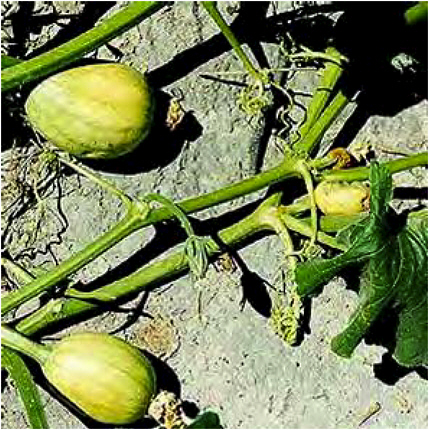
Northern Namibia. This plant is easy to grow. Indeed, it survives on barren sites, not to mention some of the driest and most climatically challenged locations. Further, it blankets the soil and helps protect the land. Most of all, though, this vigorous annual suppresses weeds. After a month, fields planted with egusi are typically weed free. (Arne Larsen)
As we have said, this is no minor food. Almost all the big markets in Benin, Cameroon, Ghana, Nigeria, Togo, and the other nearby nations sell the seed. Egusi is in high demand in tropical markets, especially in the peri-urban and urban markets. Exactly how much is sold is unknown, but as far back as the 1960s Nigeria was annually producing 73,000 tons. Today the figure is likely much greater, and about a dozen other nations also grow egusi. The area under this crop is not insignificant, either. In Nigeria during the 1970-71 planting season more than 360,000 hectares were reportedly planted to it. In the 30 years since, egusi production has spread further.
Although outsiders might assume this melon seed to be merely a localized specialty, it actually has universally acceptable flavor and food-processing qualities. Indeed, it is already being introduced to other nations.
It is, for instance, available either whole or in flour form wherever African food is sold…notably in Europe and the United States. It is also peddled over the Internet, and apparently very successfully; search engines turn up scores of online egusi dealers.
Oil makes up the seed’s largest nutritional component, averaging more than 50 percent…a figure so high that among major foods only peanut can match it.5 In composition the oil is almost ideal. One recent analysis recorded its fatty-acid makeup as 63 percent linoleic and 16 percent oleic. And this highly polyunsaturated lipid is widely used. In northern Ghana one survey found that although shea6 was the major cooking oil, egusi oil ranked next in importance.
Despite being a significant foodstuff even by global standards, egusi is hardly known to nutritionists outside a few West African nations. That is more than a pity; the seed could be an exceptional tool for nutritional intervention wherever protein-calorie malnutrition occurs. Although more than half its weight is edible oil, another 30 percent is protein. And that protein has high nutritional quality. The seed also contains important amounts of vitamins, especially thiamin and niacin. Additional dietary bonuses come from its levels of minerals.
This is a nutritional combination of unmistakable portent considering that the crop thrives where milk is largely unavailable (mainly because the presence of tsetse fly means an absence of cows). A high-energy, high-protein concentrate like this might ideally complement Africa’s prevalent diets based on starch-rich grains (sorghum and maize, for instance) and roots (notably cassava). It doesn’t take much of any food that is half oil and almost a third protein to provide the calories and amino acids that stressed, sick, and fast-growing bodies need each day. Egusi could thus be a vital tool against marasmus, kwashiorkor, and other debilitations.
This plant is not difficult to grow. Indeed, it grows so easily it could be called a farmer’s friend. Many West Africans raise it and it normally yields very well for them. It is largely free of pests and diseases. It survives on impoverished sites and in forest clearings, as well as in some of the most climatically challenged locales. And wherever if grows the plant blankets the soil and helps protect the land. Most of all, though, this vigorous annual suppresses weeds. After 4 weeks of growth, fields with egusi in them are typically weed free.
Often the plant is grown alone. Sometimes it is grown in unused places around the fields, such as banks and bunds. But mostly it is interspersed among other crops, a combination that is especially appreciated because egusi takes care of the weeds. Normally, fields of crops such as sorghum,
|
5 |
The figure is based on the dehulled seed, the kernel, which is the edible portion. By comparison, peanut has roughly 48 percent oil and 25 percent protein. Soybean weighs in at about 18 percent oil and 38 percent protein. |
|
6 |
See Chapter 17. |
|
WHAT IS EGUSI? In this chapter egusi is presented primarily as the seed of one species, Citrullus lanatus, a type of watermelon. That species is indeed very popular, thanks to its productivity and food quality. But in reality, the situation is confused because the name egusi is applied generally to any of several similar looking seeds. All these seeds come from cucurbit species (family Cucurbitaceae) and all have high oil and protein contents. In some West African countries the main egusi crop may be Cucumeropsis mannii (Cucumeropsis edulis). Seed of the gourds Lagenaria sicceraria and Telfairia occidentalis are also consumed as egusi. All are cultivated on a large scale in West and Central Africa as they are easy to grow and their seeds are popular foods, and most of what we say here applies to them as well. Sometimes outside Africa, “egusi” can also refer to the bitter apple or vine of Sodom, Citrullus colocynthis (Linnaeus) Schrader; in turn, this scientific binomial is not to be confused with Colocynthis citrullus Linnaeus, which is a botanical synonym for Citrullus lanatus, the egusi treated here. |
cassava, coffee, cotton, maize, or banana require two, three, or more weedings during the growing season. An intercrop of egusi cuts that to one.7
In spite of nutritional value and benefits to farmers and the land, this nutritious age-old resource is languishing. But this plant has so much to offer that it deserves concentrated local, regional, and international attention. A tasty seed that is not only rich in oil but rich in protein could be of exceptional value in most parts of Africa, especially where chronic malnutrition strains health and drains initiative. Indeed, egusi is already to be found in many of the nations on which dietary deficiencies hang heaviest, but is not being fully harnessed for humanitarian good.
Additional justification for the notion of a major egusi initiative comes from North American research. For over a decade U.S. Department of Agriculture scientists have studied the seed’s nutritional and functional properties. The research leader, John Cherry, is convinced the crop has a future. “Egusi-seed flour contains excellent quantities of the major nutrients, oil, and proteins,” he reports. “The essential amino acids in the proteins of
the flour make it a good vegetable protein.”
A separate USDA research group has concluded that egusi could find a place in the food industry. Its promise is for thickening, stabilizing, and fortifying processed products. The group’s analyses were mostly done on defatted, low-hull flour—the form most appropriate for processed foods. It proved to have high water and oil holding capacities; it formed thick and stable emulsions.8
Despite its promise for the food industry, it is the small-scale, subsistence use that most concerns us here. In this regard, foods produced from locally grown egusi seed could improve diets in many an African country whose population currently suffers inadequate diet. Egusi seed compares with the best-known high-protein/high-fat food plants, and it is indigenous. Noteworthy is the fact that the seeds can be stored for long periods. This is one oilseed that can supply quality food year-round.
Given attention, the plant is likely not only to improve nutrition but also farmers’ income. A women’s group of central Benin (Bante) cultivating 10 hectares of egusi earned more than they would have from cotton, the region’s main cash crop.
Indeed, when grown well, egusi boosts soil quality too. And its benefits are likely to be felt not only in West Africa but also in eastern and southern Africa, and perhaps elsewhere.
Women would be special beneficiaries. Although in some places women grow egusi, in the main they are they the ones who harvest and process the crop. Generally speaking, they receive relatively high cash income for their work. Indeed, the “egusi wage” is regarded as the standard for women’s agricultural payment for all tasks, and the women defend it with determination because it sets the standard of their lives. Any improvement in egusi’s profitability will directly help millions of women of all ages and all rural jobs.
PROSPECTS
Although it now gets no particular support from national or international agronomic research organizations, egusi could be made into a nutritious and tasty food for much of the continent, if not the world. At least within West Africa, getting people to consume more and farmers to grow more should be easy, so long as seeds for planting are available and the harvest continues attracting a fair price.
Within Africa
Egusi is notable for tolerating an extreme range of conditions, from damp to dry.
Humid areas More than a dryland plant, egusi (or its close relatives9) grows in equable sites. It is an especially promising food for the regions of lower West Africa, where cows cannot thrive and milk is in consequence a rarity.
Dry Areas As noted, the plant resists drought and has long supported people dwelling in West Africa’s dry regions. It is not so drought resistant as to thrive near the true desert, but it is well adapted to the semiarid zone (incorporating, for instance, the Guinea savanna, Sudan savanna, and the sub-Sahelian region) that lies halfway between the Sahara and the sea.
Upland Areas Wherever watermelons grow, egusi should grow too. Thus, many tropical highlands as well as warm temperate locations are candidates for at least trialing the crop.
Beyond Africa
Egusi seeds are potentially a source of quality protein for many countries. However, beyond Africa they may not catch on in a big way. For one thing, consumers may not immediately take to eating a melon seed. For another, it is hard to produce this sprawling plant on a scale to compete with other mass-produced oilseeds. Egusi is therefore most likely to stay a specialty crop for sale in African food markets. However, roasted pumpkin seeds have become a fairly widespread snack in the United States; egusi could perhaps become a counterpart. Not only is it tasty and nutritious, it likely would sell at a premium.
USES
Even ignoring that some egusi-seed “suppliers” are gourds and melons with their own individual uses, this is a multiple-purpose food.
Seeds The seeds are shelled (dehulled) and the kernel is ground into a flour. As already mentioned, that flour enriches and thickens soups as well as other foods. The whole seeds are dry-roasted and consumed as a snack. Pounded roasted seed produces a paste. Known as ose-oji in Nigeria, this peanut-butter-counterpart may be spread on bread, mixed with other foods, or dropped into soups and stews.
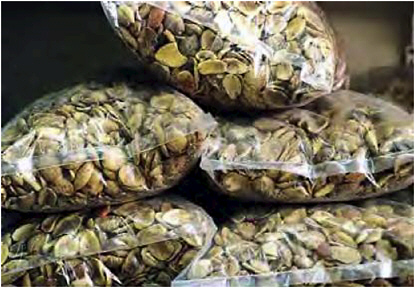
London grocery store. Egusi is increasingly exported to Europe. In Brussels it is sold under the Congolese name, mbika. In Paris, retailers use the (North African, Asian and Cameroonian) name of courge. In London and Madrid, the seeds are sold under the commercial name of egusi. (Honoré Tabuna)
Oil In West Africa egusi oil is sometimes extracted, but so far only on a small scale. It is used in cooking and seems suitable as salad oil. The seed has occasionally been exported to Europe for processing into vegetable oil.
De-fatted Meal The solid remaining after the oil has been squeezed out contains 60 percent protein. This remarkable defatted solid can be ground into flour with myriad dietary uses. It is mainly used as a meat substitute.
Leaves It is reputed that the young, tender leaves may be cooked and eaten as a potherb.
NUTRITION
Despite its widespread importance as food, little nutritional detail is readily available to an international readership. In general, however, the kernel contains about 50 percent oil, 30 percent protein, 10 percent carbohydrate, 4 percent ash, and 3 percent fiber.
The protein content compares favorably with that in the most renowned legume seeds.10 The exceptional level of essential amino acids makes the
protein composition special. Egusi is an excellent source of arginine, methionine, and tryptophan. The biological indices of its protein quality have been described as: “lower than soybean but comparable to or higher than most oilseeds.” Nutritionally, the limiting amino acids are lysine and threonine.
Several micronutrients also contribute to human nutrition. Vitamins occurring in notable quantities include B1, B2, and niacin. In one analysis the highest mineral component was phosphorus, followed by potassium, magnesium, manganese, sulfur, calcium, iron, and zinc.
Soluble sugars and starch make up the bulk of the carbohydrates.
Only a few nutritional trials have been conducted. In general, however, significant growth improvement was reported when egusi flour supplemented traditional West African diets. The biological value, net protein utilization, and protein-efficiency-ratio proved comparable to or higher than those of standard oilseeds. The results suggest that egusi seeds have good potential for fortifying both traditional and modern food formulations.
HORTICULTURE
The crop is usually handled like watermelon or pumpkin, species to which it is not only related but similar in plant type and agronomic need.
Propagation is exclusively by seed. Although the exact planting method depends on site and situation, most is sown during the major rainy season, typically after the first few heavy showers. Generally, two or three seeds are placed in holes about 2 cm deep. Where conditions are conducive to good growth the holes are normally spaced about 1 m apart and two plants are allowed to grow per hole. A pre-planting application of complete fertilizer followed by dressings of nitrogenous fertilizer at intervals to maintain a regular growth rate has been recommended.
This is how egusi is produced in the Transition Zone located between the dry savannas and the humid coastal area. There, the crop is grown in dense, pure stands and it achieves its best productivity. There, too, the soil tends to be fairly high in organic matter and fertility. Also, the rainfall is high (1,400 mm) and well distributed throughout half the year (April to October).
In the more challenging zone immediately to the north (the Guinea and Sudan savannas, for instance), egusi is more often grown as a mixed crop, especially on ridges between sorghum. The soils here are poor in both organic matter and fertility; the rainfall low (800 mm) and brief. As a result, wider spacing (about 3 m between plants) is necessary. Understandably, then, production-per-hectare is much reduced.
Whatever the overall conditions, most seeds germinate and within a week seedlings are emerging. Three weeks later, the vines nearly cover the ground and flowering starts. Often the fruits are ready to harvest 120-150 days (4-5 months) after sowing. However, in some locations they take 180-200 days to mature. The vines then wither and die.
As noted earlier, neither pests nor diseases much affect the growing plant. Variegated locusts have been reported to eat egusi seedlings (and everything else of course).
HARVESTING AND HANDLING
Once the fruits stop enlarging they can be harvested. The timing, however, is not critical…this is one crop in which there is no particular urgency to bring in the mature fruits. Within reason, they can remain in the field without serious loss.
In better-watered areas with reasonable soil the harvest averages five fruits per plant. In drier and more barren locations the yield averages two fruits per plant. Normally a fruit weighs between 0.8 and 1.5 kg, but those grown in the more challenging climates tend to be smaller.
The fruits keep well, and can be stored several months without decaying.
To remove the seeds West Africans employ several age-old methods:
-
They break open the fruits with a hard stick and lay the pieces on the soil pulp-side down. After several days the pulp has decayed, freeing the seeds.
-
They bury the fruits whole, and leave them to decompose a month or so underground.
-
They crack the shells, heap the fruits up, and cover the pile to promote decomposition.
Following any of these procedures, the seeds are easily separated by hand or by a stream of water. They are then washed to remove any remaining pulp fragments and allowed to dry in the sun. The dried seeds are best stored in sealed containers. Certain beetles can ruin the whole harvest.11 But given care the seeds can be stored almost indefinitely.
Before use as food the seeds must be shelled. At present, this is mostly done by hand.
LIMITATIONS
The plant often seems quite susceptible to root-knot nematodes as well as to waterlogged soil.
This sprawling species is poorly adapted for mechanized operations. It seems unlikely, therefore, that it could compete on the world stage for the industrial-scale production of cooking oil or protein concentrate.
Despite having fed generations of Africans and despite its promise for feeding future generations, egusi has had very little development support. There is no standard method for measuring its yield. Its biology is virtually unknown. Its nutritive value is based on only a few samples that may or may not have been nutritionally representative. Even its scientific name and genetic relationship to several related plants is not without doubt.
NEXT STEPS
This crop has such high prospects it deserves intense and far-ranging research. And it seems quite amenable to rapid progress. An annual, it gives results quickly. It is relatively easy to manipulate and propagate for the purposes of crop improvement. Seed is available. And there are no major technical barriers to be overcome before advances can be achieved. Indeed, it should be able to ride piggyback on a wealth of research already available from its relatives—watermelon, melon, squash, and pumpkin—thereby saving much time and money.
Publicity This is not a resource that needs much introduction, at least in West Africa. Nonetheless, the knowledge about egusi and its many uses should be brought together and made available for the benefit of all. One project could be the production of a Farmer’s Handbook on the best methods for planting and managing the crop. Another might be a compilation of the greatest recipes from the countries where egusi grows. Cooking contests and other challenges would be both interesting and beneficial to the public awareness of the crop’s importance.
Rural Development Taken all round, egusi offers one of the best interventions for raising farm performance and nutritional performance in West Africa (and perhaps many other parts of the continent as well). Although it is not a legume, the crop should be at least tested in programs that use legumes. It provides high-protein and high-oil foods like soybean and peanut as well as ground covering capacity like mucuna or lablab.
Malnutrition Could egusi be used as baby food? An NGO in Ghana reports that blending 200 ml of water with 240 ml of dehulled seeds, and seasoning the result with a little honey and salt produces a mixture resembling mother’s milk. This smooth, milky, liquid might prove useful as an infant-food supplement where neither mothers nor cattle can provide adequate milk, they say. Perhaps this could open the door to the long-sought homemade weaning food containing both the high energy and the quality protein needed to combat protein-calorie malnutrition in the very young.
That is not too hard to imagine. Every home in every village has a stone mill or small mortar and pestle. Using such simple equipment, the seeds are easily crushed into a peanut-butter consistency.12
Studies conducted by the Nutrition Centre at Bawku, in the Upper Region of Ghana, on the use of egusi as a source of protein and fat in the diet of children who show the effects of marasmus (lack of calories) and kwashiorkor (lack of protein) has proved to be satisfactory. In Benin, the defatted egusi flour, known as fagous, is used to make cake and it is also added to baby food.
Food Technology Egusi offers many opportunities for the world’s food technologists to help reduce African hunger. For one thing, it could become a protein source in many processed foods as well as a supplement to cereal-and root-based staples. Such extended use will depend on the knowledge of its chemical properties, nutritional properties, and functional properties, such as those relating to thickening, stabilizing, and fortifying processed products. All of these await further elucidation.
In addition, the seed-extraction methods need updating. To produce egusi on any scale, you cannot rely on rotting away the pulp of billions of fruits. One approach would be to find uses for the flesh that is now wasted. Perhaps there are animals that will eat the intensely bitter material, but a more promising line of research would be to investigate the bitter compounds themselves. Even now, there’s a demand for compounds for “bittering” consumer products and thereby deterring children from accidental poisonings. A natural product like this could perhaps have a marketplace advantage big enough to overcome the limitations of distance and doubt. Concentrated egusi-fruit-extract could even prove more profitable in international trade than egusi seed.
Another pressing need is mechanical shelling. Again, the crop cannot expand dramatically if all the seed must be shelled by hand. Clearly, people cannot deal with billions of seeds using their fingers. This operation is probably not too difficult to mechanize, given that pumpkin seeds are already treated this way on a large scale.13
Nutritional Research Egusi seed comes in various types, and there is a crying need for critical studies of the variation in lipid and amino acid components between them. The parallel relation between the species’ genetic diversity and protein quality also needs to be better understood.
Horticultural Development Like vegetables highlighted in other chapters, egusi presents agronomists, plant pathologists, crop breeders, and more with the chance to confront a new crop, to apply first principles, and to develop a baseline of technical knowledge that presently does not exist. Research challenges will be exposed on every side, however, a few of the things clearly needing investigation include:
-
Floral biology. Though considered taxonomically just another watermelon, there are questions whether the plant is strictly monoecious, or perhaps occasionally dioecious, or mixtures of both? What are the most effective routes to pollination?
-
Germplasm. The species’ biodiversity needs to be gathered, conserved, and compared.
-
Varietal selections. Elite types need development. Extra-large seeded types are one good target.
-
Agronomic details. The optimal and minimal agronomic requirements should be better understood.
-
Yield. There is a crying need for critical studies of how to achieve the greatest productivity. This may involve increasing the number of fruits per plant, the number of seeds per fruit, and/or speeding up the maturity time.
-
Edaphic effects. Tests of the plant’s ability to restore fertility and rehabilitate soil need to be run.
-
Crop limits. The crop’s limits also deserve testing. Is the egusi plant productive at high elevation? Under high rainfall? How about cool conditions? Scorching ones? What are its susceptibilities to disease and insects? Are there differences among individuals in such adaptabilities?
-
Acid soils. This is one special limit deserving attention. Given its closeness to watermelon (which tolerates acidity as extreme as pH 5), egusi should be excellent for areas suffering from the burden of laterite, the red, mostly barren, acid soil that dominates many tropical regions.
Extend Egusi Beyond West Africa This would be a good time to test this crop in research studies across Central Africa, East Africa, the Horn of Africa, and southern Africa. Citrullus lanatus and Lagenaria species are well known in West, Central, East and Southern Africa and even in North Africa, but their usage varies from region to region. Some authors indicated that Citrullus lanatus originated from more than just the Kalahari Desert and surrounding areas. They include the southern Sahelian zones and neighboring savannas and arid areas.
Trials Beyond Africa Most nations now produce cucurbits—notably, watermelon, pumpkin, squash, and melon. The egusi plant is likely to grow well for them, too. People in the former Soviet Union commonly snack on pumpkin, sunflower, and similar seeds. Could egusi become a Russian or
Ukrainian crop? Maybe. The giant size of the seeds would be a good incentive. In addition, the plant might thrive in the Central Asian republics, whose aridity makes many crops difficult to grow.
It is worth getting egusi samples, using proper protocols, into the research programs on those related crops all over the world. Those specialists with lifetimes of experience with related cucurbits are likely to possess deep insights that can boost egusi and help Africa’s food production right away.
Special Research Challenges A number of technological developments could help. These include:
-
Mechanical processing. Post harvest handling constitutes a serious constraint for the production of egusi. Currently, a lot of labor and water are required to process the seeds. In addition, continual sunshine and clean drying areas are vital, because if the seed starts germinating its value plummets. Developing appropriate technologies or tools will do more than almost anything to boost this crop.
-
Dehulling. In particular, a machine that facilitates the laborious extraction of egusi kernels will increase production almost beyond measure.
-
Hull-less types. A diligent search may turn up “naked” egusi seeds (counterparts to those found in pumpkin). This would mean that people would not have to shell the seeds, which would save countless days of drudgery.14
-
Fuel. Research should be undertaken to explore the possibility of sun-drying egusi roots and burning them. The roots are very large and, like those of other cucurbits, they dry to form a hard, wood-like material that makes good fuel for cooking stoves. In the semiarid zones, where egusi grows, sun is plentiful but fuel is difficult or impossible to obtain. Egusi-root could perhaps become a major fuel for the Sahel, which has been largely denuded by wood-gatherers.15
Taxonomic Clarification Is egusi really an aberrant watermelon? Perhaps this is a case where conventional taxonomy is inadequate for determining differences in the DNA. The flower structure may resemble a watermelon’s and they can be interbred (though we heard no reports of “cross-contamination” being a problem in the field), but the two plant types are obviously not genetically identical.16 Their other parts look quite distinct,
and the two seem to come from different areas of Africa.17 Modern technologies, such as DNA fingerprinting and cross-pollination trials under rigorous laboratory conditions, are needed to clarify whether egusi is an inedible watermelon or a distinct species.
As has been mentioned, the egusi seed seen in the markets actually comes from a variety of species, depending on the location and season. So, follow-up may actually expose a cluster of climbing, crawling, trailing, and creeping herbaceous plants with both individual and common promise—all of them masquerading under the name egusi.
SPECIES INFORMATION
Botanical Name Citrullus lanatus (Thunb.) Matsum. & Nakai var. lanatus
Synonyms The disagreement on egusi nomenclature is such that the botanical name is variously given as:
-
Citrullus vulgaris Schrader (also watermelon)
-
Citrullus vulgaris Eckl. and Zeyh. (also watermelon)
-
Citrullus lanatus Thunb. (also watermelon)
-
Citrullus lanatus (Thunb.) Mansf. (also watermelon?)
-
Colocynthis citrullus (L.) Kuntze.
-
Colocynthis citrullus Linnaeus
Family Cucurbitaceae, Gourd Family
Common Names
English: edible-seed melon, white-seeded melon
French: ononde, graines d’quonde, “sesame”
Fon: Goussi
Fulani: denne nai
Ghana: neri, niri
Nigeria: egusi, guna shanu (Hausa); denne nai (Fulani); ibara, bara, ito (Yoruba)
Spanish: calabaza pamué
Sudan: surat
Description
The egusi plant is a vine with a non-climbing creeping habit. Its leaves are deeply lobed and blue-gray in color. The pinnately dissected leaves are alternately arranged. They are glabrous or slightly scabrid, denticulate and about 24 cm long. The flowers are monoecious, solitary in axils yellow and measure 13-20 cm in diameter. The yellow-green fruits are about the size of a melon, reaching about 18 cm in length. Their skin is often shiny; the flesh white.18
The seeds are numerous, white, smooth, flattened, and narrow. Most are larger than watermelon seeds, but they vary in size and thickness. Basically, they come in three separate forms: small, medium, and large. They also vary in the texture of the seed coat, which may be thin, thick, or encrusted in bumps. And the thickness of the edges varies from flat to molded. About half the weight of the seed is in the hull.
Distribution
Within Africa The exact extent of egusi cultivation within tropical West Africa has not been determined. Likely, it stretches from Senegal to Sudan and perhaps as far south as Congo. Major egusi-growing nations include: Mali, Burkina Faso, Togo, Ghana, Côte d’Ivoire, Benin, Nigeria, and Cameroon.
Beyond Africa The crop exists outside Africa, but its uses vary and are little-documented.
Horticultural Varieties
Several varieties of egusi exist in Ghana, Benin and Nigeria. They vary in color or size of the fruit and the seed.
Environmental Requirements
So little has been reported about egusi that we here rely largely on the cultivation conditions reported for watermelon. (See Horticulture)
Rainfall Although drought-tolerant, the plant requires a steady supply of water for best fruit production. It needs only a small amount of rainfall (250-500 mm) for survival, since their deep root system efficiently exploits available soil moisture. Excessive rainfall and relative humidity reduce flowering, and encourage development of leaf diseases. Waterlogging kills the plant.
Altitude Watermelons grow well up to 1,000 m in the subtropics, and may reach 1,500 m above sea level at tropical latitudes. Egusi probably acts similarly.
Low Temperature Watermelon requires a relatively long, hot, growing season (usually about 4 months of frost-free weather). For the seeds to germinate, the soil temperature at 5 cm depth must be at least 15°C. For growing watermelon the optimum temperature range is 23-27°C. Growth stops below about 18°C and the plant is very susceptible to frost. This limits production in regions with cool summers.
High Temperature Excessively high temperatures (over 30°C) during blooming may be harmful, reducing fertilization of the flowers. But such heat does not kill the plant. The wild melons in the southern African deserts grow where the temperature is often 36°C or more. Plants will tolerate even higher temperatures for short periods of time.
Soil Not unexpectedly, egusi yields are best on fertile humus-rich loose soil. It also grows successfully on soil of low fertility. Soil depth should be at least 10 cm. Watermelon tolerates not only acidity, but also alkalinity (up to pH 8.0); the optimum pH range, however, is 5.5-7.0.
Related Species
Egusi-ito19 is a crop so similar to egusi that much of what has been said above can be applied to it as well. The plant is even less well known, it grows in wetter, more humid locations, and is a climber that is often grown up over the roofs of village houses. It is also often cultivated close to small trees and shrubs, fences, or similar support.
This white-seeded melon is grown mostly in Western Nigeria and Cameroon as an oilseed crop. Its oil is considered superior to that of peanut, and it sells for higher prices in the market. It is also a source of protein. It has been described as a species of immense potential as a new crop for the tropics and deserving of further investigation.
Botanically speaking, egusi-ito is a monoecious, partially drought-resistant curcurbit. The fruit may be up to 30 cm long and 10 cm in diameter. It contains numerous quite large seeds each of which may be up to 2 cm long. They are used like the seeds of egusi. In some parts of eastern Nigeria, the leaves are wrapped around fresh cornmeal and winged termites, cooked, and then eaten as a delicacy, mostly by women and children.
This plant is more promising than egusi at low elevations in moderately high rainfall areas.
More Relatives
As noted, the “egusi seeds” in the markets may in fact derive from several species. The Gourd Family, to which egusi belongs, is represented in Nigeria by 21 genera and 41 species. Most are wild but a number are cultivated. Little-investigated relatives of economic importance include Coccinia barteri and several species of Cucumis, Zehneria, and Momordica.


