
11
LOCUST BEAN
The West African locust looks nothing like what Westerners might consider a vegetable plant to be. It is a tree. A true Jack-and-the-beanstalk kind of crop, it is indeed related to beans, albeit distantly. It often grows more than 20 meters tall, and people harvest all the pods they can get, sometimes climbing all the way to the top.
Outsiders might dismiss this as a tall tale, but they’d be wrong. Locust combines in a single species Africa’s two greatest needs: food and tree cover. More locusts mean more food and more trees, which add up to more hope for a better continent.
Botanists named this plant genus Parkia in honor of Mungo Park, one of the first Europeans to record it. This intrepid Scottish surgeon-naturalist, who drown in distress attempting to unravel the course of the Niger River, would even now be hardly displeased with the honor. Two centuries on, his namesake plant still plays a vital role in the village and nomadic life of rural peoples living throughout the northern and western savanna regions.
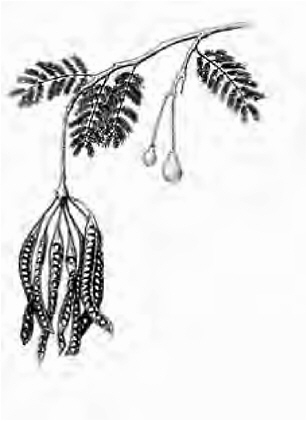
Locust beans are attractive savanna trees, with dramatically spreading crowns and clusters of globular bright red flowers dangling like holiday decorations on long stalks. And they produce many benefits.
For one thing, they produce fruit. Numerous large pods, up to as long as your forearm and wider than your thumb, emerge all over the spreading crown, dangling like the fingers of a green or brown giant. Inside each pod is a yellow or orange dryish pulp. People like it, and no wonder: it can be half sugar and very sweet to the taste, almost like a desert. This mealy delight can make a useful baby food but for many children it may be the main—if not the only—dish, depending on what is left in the family’s granary. It is also made into colorful and refreshing drinks. And it is dried down into a white or yellowish powder that can be stored for later use, at which time it is commonly sprinkled over rice or meat.
But sugary pulp is not this tree’s main gift. Instead, it is the seeds enclosed within it that are the most prized product. These are a regular part of people’s diet and, throughout much of West Africa, they also turn into lifesavers in times of famine. They contain about 30 percent protein, 20 percent fat, 12 percent sugar, 15 percent starch, and 12 percent fiber, as well
as vitamins and minerals such as calcium and iron. In sum, they are about as balanced and concentrated a food as could be devised. Add the fact that they mature in the dry season, the traditional “hungry time,” and their value as emergency food becomes plain.
Reliability is key. Even when drought has seared the landscape, the products from this deep-rooted tree continue appearing on schedule. This is how they save lives. Indeed, they are so good at it that Muslim African tradition claims the tree to be a gift from Heaven—actually brought to Africa by the Prophet Himself. Their reliability as well as the fact that they remain available when most other vegetation has died certainly seems to indicate the hand of providence.
The most famous (or infamous) product from the seeds is a greasy extract with the stench of the strongest cheese. It typically comes in the form of sticky blackish balls, well known in West Africa, where itinerant traders barter them under the Hausa name dawadawa as well as under the name soumbala (Bambara- and Malinké speaking peoples of central West Africa). This fermented material keeps well even in tropical heat and is rich in protein, vitamins, and food energy. Mostly used as a seasoning, it is also an important soup ingredient.
Outsiders may scoff at dawadawa, but it is no less beloved by its aficionados than is limburger in Europe, fish paste in Indonesia and Vietnam, or Vegemite in Australia. Throughout the northern part of West Africa it is a regular dietary item. In some areas it is eaten at least once a day almost every day of the year.
Thanks to dawadawa, locust seed is a major item of commerce across West Africa. However, producing the pungent paste is a traditional family craft and, although some dried beans are sold in local markets, most are collected and processed by individuals for their own use. Overall, it is estimated that 200,000 tons of locust seeds are collected annually for dawadawa just in northern Nigeria.1 Making and selling this product constitutes an important economic activity for women.
Because of all this, locusts—along with baobab (Chapter 3) and shea (Chapter 17)—are among the most commercially valuable of all parkland and farm trees in that and other parts of the region. Although they are among the commonest natural trees seen across the park savanna of West Africa, each one is the property of a nearby villager. Those ownership rights are worth hanging on to. As far back as 1964, the seeds from a single locust were valued at around $20 a year.
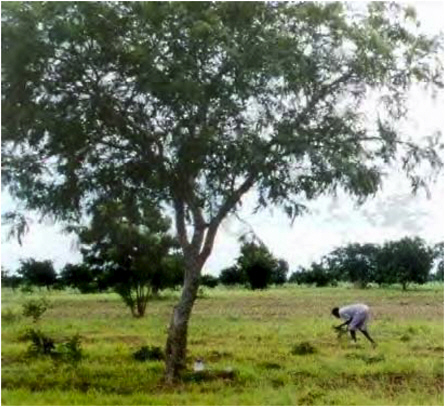
Saboba, northern Ghana. In this savanna region locust bean trees populate a field of the native cereal called fonio. The locust, which has received almost no horticultural recognition, combines likely answers to Africa’s twin needs of food and tree cover. Its seeds are gathered by the thousands of tons and peddled by itinerant traders throughout West Africa. Chiefly, they are fermented into the famous dawadawa, a cheesy solid rich in protein, vitamins, and food energy. In some ways it takes the place of cheese or meat in a European diet. It keeps well without refrigeration even in the tropical heat and is popular as a seasoning and soup ingredient. (Yosei Oikawa)
Thus, locusts are sometimes the only trees to be seen in the West African savannas. They are left standing whenever bush is cleared. Indeed, several West African nations have laws against cutting one down. Some chiefs, stressing that the trees are living creatures in need of their protection, demand a fee before permitting the owner to harvest his own beans.
Despite all this monetary, nutritional, and environmental importance the species has seldom been accorded systematic silvicultural development, nor has it been promoted in regions outside its native habitat. Given the powerful possibility of increasing food production, rural development, nutritional well-being, and forest cover with one crop, this seems a shameful neglect.
Perhaps the idea of reforesting swatches of savanna with this food tree is extreme, but it is noteworthy that locust thrives on a wide range of alluvial,
sandy, and lateritic soils and has very low susceptibility to pests and diseases. It survives fires and thrives in full sun and tropical heat. Moreover, it is deep-rooted and almost independent of equable rainfall. According to some accounts, seeds sprout readily, seedlings transplant well, and young plants grow quickly. All this would seem to make locust an ideal candidate for planting in appropriate parts of Africa, especially the long-ago deforested savannas. They also make many shady, edible avenues for now sun-drenched cities, towns and highways.
PROSPECTS
Given its importance to traditional rural populations, this multipurpose legume could certainly be employed more widely and more intensively. The existing trees almost all grew up in the wild; how the species will respond to the hand of horticulture remains uncertain, despite the seeming evidence of the millions of existing specimens. It is encouraging that in recent years several projects have begun to focus specific attention on Parkia biglobosa to conserve its germplasm and extend the uses by improvement of agronomic measures.
Within Africa
Clearly prospects are greatest in West Africa, where the plant and its products are known and loved. A major constraint, however, is that the popularity of dawadawa may be diminishing. Possibly, this is because the product’s quality is variable and its shelf life unreliable. Possibly, it is because European dried soups and bouillon cubes are highly promoted on the urban markets in francophone countries). Possibly it is due to the recent appearance of soybean substitutes, fostered through development agencies on the basis that soybeans are easier to grow and process. Quality dawadawa, however, still seems preferred everywhere, and should always have a ready market.
Humid Areas Unknown and unlikely. Possibly locust trees will survive under greater rainfall and humidity than they get in their native habitat; it seems not likely that they will become food crops there.
Dry Areas Here, locust trees are potential sources for food, edible oil, fodder, lumber, firewood, and green manure. Their particular importance is not so much for reforesting the deserts or the Sahel, but the savannas, parklands and agroforestry situations, where plant life is already present but not of great benefit. Trees that yield vital products in drought years could be good not only for people but for the whole area and the creatures in it. However, locust seems more sensitive to drought than many of its other companion species.
Upland Areas Locust seems likely to find a niche in warm upland areas, but that niche may prove too small for investment of targeted resources.
Beyond Africa
The plants are worth testing in tropical savannas worldwide. How they will perform is hard to gauge, but it seems possible that they will complement better-known nitrogen-fixing trees such as leucaena and calliandra by outperforming them in places just a little too dry for them to exert their normal vigor. It seems unlikely that locusts will be employed for food in such locations, but their other benefits to people and the soil are enough to warrant initial trials.
USES
Like so many species in this book, the locust provides a wealth of useful products.
Pulp As noted, the colorful pulp within the pod is eaten raw as a sweetmeat, mixed with water and made into a refreshing drink, used as a sweetener in different foods, and fermented into an alcoholic beverage. It is popular with children. It is also popular with travelers, and keeps so well that it is commonly taken on long journeys.
Seeds In the production of dawadawa the seeds are boiled up to 24 hours, pounded, cleaned, and rendered down into a black paste, which is then set aside to ferment. After two or three days the odoriferous result is pressed into cakes or balls. In the dry form these can keep for over a year in traditional earthenware pots, without refrigeration. Small amounts are crumbled into traditional soups and stews, which are usually eaten with sorghum or millet dumplings and porridges. (The dawadawa is added during the cooking process because the powerful smell then disappears.) Because of its savory taste and high protein and energy values, it is sometimes described as a meat or cheese substitute, but it is often more like a condiment that is eaten in tiny quantities. In parts of Togo, Ghana, Burkina Faso, and Nigeria daily per-capita consumption has been estimated at 4g, 2g, 12g, and 1 to 17g, respectively.2 The seeds are also sometimes roasted as a coffee eaten in
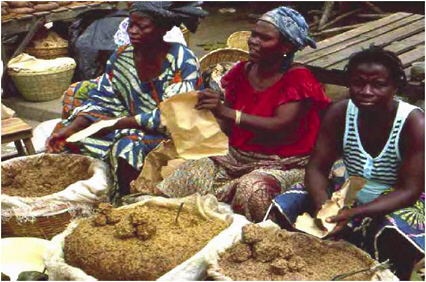
Dantokpa market, Cotonou, Benin. “Mustard” made from seeds of the savanna tree commonly called locust in English is essential for making nutritious soup. Across West Africa locust bean is a major item of commerce, as is its major processed form, dawadawa, a nutrient-dense, cheese-like food. These together constitute an important economic activity for women. Production of the pungent paste is a traditional family craft and although most is produced for home use, some ends up being sold in local markets. (L.J.G. van der Maesen)
tiny quantities. In parts of Togo, Ghana, Burkina Faso, and Nigeria daily per-capita consumption has been estimated at 4g, 2g, 12g, and 1 to 17g, respectively.3 The seeds are also sometimes roasted as a coffee substitute, “café de soudan.”
Wood The white, yellow, or dull brown wood is soft, medium-grained, and easily worked. It is said to be of less than top quality, but is used for house posts, mortars, bowls, and some carpentry. Most, however, goes for fuel. In the 1970s, it was estimated that locust probably constituted over 90 percent of the firewood supplied to Kano, a Nigerian city whose population was over 250,000 at the time.
Shade The tree makes a superb avenue tree, especially for the drier regions, where shade is perhaps the most precious of all commodities. In thousands of villages it is planted at eating- and meeting places, for shade, for shelter from desert winds, for beautification, and as an insurance against the several times in a generation when it is needed to save lives.
Land-Improvement Not only is this a useful windbreak and shade tree, it is a benefit to the soil. Sites beneath this legume are improved by dung and urine of the livestock sheltering there (attracted by the shade and possibilities of browse). They are also improved by the leaf fall, which is so abundant and so rich in nitrogen and minerals that in certain places the leaves are collected for soil improvement, like manure.
Living Tree Locust is one of the trees that provide poor people a toothbrush. Its twigs are used to brush thousands of teeth a day in countries such as Niger. The bark stains the mouth red but the soapy compounds (saponins) it contains clean teeth. Locust also provides good bee forage. And the fruits and seeds are consumed by a wide variety of animals, including monkeys, making the trees friends of wildlife as well as people and the land.
Forage The sugary pods are much relished by cattle and other domestic livestock. Throughout the region they provide a valuable dry-season ration. The leaves also are traditionally used, whole branches being lopped for fodder. During the dry season, when other feed supplements are scarce or impossible to find, both the ground-up seeds and the sugary pulp are relied on as pig food in northern Nigeria.
Medicinal Uses The bark is an ingredient of ancient remedies sold in Senegalese and other West-African markets or used in the villages. It is also sold for mouthwash, vapor inhalant for toothache,4 or ear complaints. Many trees in the sub-Sahel zone appear maltreated from harvesting square patches of bark about 15-20 cm square.
Plaster The pod valves can be fermented in water and the resulting liquid is used to decorate walls of loam houses (e.g., in Burkina Faso).
NUTRITION
Although not eaten in quantity, the seeds make a concentrated food containing a nice balance of protein, fat, sugar, starch, and fiber, not to mention vitamins and minerals. About 7 percent of the protein is lysine, a level similar to that in whole egg, one of the best protein foods known. Unfortunately locust seeds are deficient in two other critical amino acids, methionine and tryptophan.
The fat in the beans is nutritionally important. Approximately 60 percent is unsaturated, the major fatty acid being linoleic, a nutritionally useful
ingredient often missing in poor-people’s diets.5
The fermented locust-seed product, dawadawa, is equally nutritious. It too is rich in protein. Like the bean itself, it is deficient in certain amino acids, but is rich in lysine. In addition, it contains about 17 percent of a semisolid fat. Further, it contains an array of vitamins, notably vitamin B2.
The floury pulp surrounding the seeds in the pod, sometimes called dozim, is an energy-packed food with up to 60 percent sugar. It is also high in vitamin C (291 mg per 100g dry matter in one analysis6). This is yet another locust food that becomes available in the season when little else is available for the picking.
HORTICULTURE
Although there are no known major plantings, methods for producing the plants in nurseries have been elaborated.7 The trees can be propagated by seed, which grow rather vigorously. An overnight soak in hot water has been suggested as a pretreatment.
Vegetative propagation is also possible, but apparently is difficult. Trial plots of grafted locust have been established by CNSF in Burkina Faso. The tree also has been propagated by budding, to produce early fruiting, in Nigeria.8 Pruning of seeding trees is said to hasten fruiting.
HARVESTING AND HANDLING
Pods are picked from the tree, sometimes by climbing but more often by using a long pole fitted with a knife at the end. Transporting these flat leathery pods presents few problems. Most are hauled around roughly in baskets or sacks.
LIMITATIONS
Just how good a return any planter will get is mere guesswork. The seed yield is reported to be low (between 350 and 500 kg per hectare), a feature to be expected in a wild plant and one that would likely improve dramatically in managed plantations.
The seeds have tough leathery seedcoats; they have to be cooked or peeled before eating. Even more than for some other pulses, cooking times for the toughest beans can extend out twelve hours or more, consuming large amounts of precious fuel.
Though no part of the fruit contains cyanogenic glycosides, the raw seeds
are suspected of containing anti-nutritional factors. Those must be eliminated in the cooking process. It is reported, for example, that in cooked locust seeds the only factors that lower nutritive value are the low levels of methionine and tryptophan. This was deduced from the fact that diets supplemented with those amino acids increased the growth of rats to almost that obtained with whole egg.
Although the mature tree is a fire-resistant heliophyte that needs little protection or care, the seedlings are harmed by browsing and hence need careful safekeeping from wandering livestock.
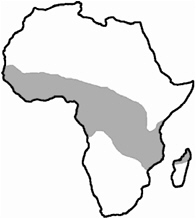
General distribution of locust bean. It is noteworthy that the tree thrives on a wide range of alluvial, sandy, and lateritic soils. It also resists pests and diseases, resists fires, and thrives in full sun and tropical heat. Moreover, its deep-roots make it almost independent of equable rainfall. All this would seem to make locust an ideal candidate for mass planting in appropriate parts of Africa, notably the once-forested savannas. (M.R. Dafforn, after Frost Entomological Museum, Pennsylvania State University and other sources)
NEXT STEPS
To turn locust into a reliable food resource, there are many steps that could be taken and a few that must be taken. Both are mentioned here.
Plantings Ideally, a major initiative could be mass planting of locusts wherever they can take root and thrive. Also, fostering village plantings can be recommended. At that time a key barrier will be the availability of sufficient top-quality seed. Given high expectations, it would not be amiss to establish seed plantations in preparation for the day of mass demand. As an agroforestry species, it can be highly recommended—no delay for further research or trials seems necessary. Perhaps its greatest promise will occur on lateritic sites. The growth is stunted but under such circumstances growth rate is far less important than survival. These red, acid, aluminous, mostly barren soils beset the tropics, and are one of their main causes for low productivity and hunger.
Locust would appear to be a superb multipurpose agroforestry species. Many areas have lost much of their tree cover, and farmers have begun to reestablish specific beneficial species, including locust. The promotion of maintenance, strengthening and reestablishment of such agroforestry associations would seem to hold the best prospects for the tree in local livelihood systems. Possibly, locust could be planted in association with
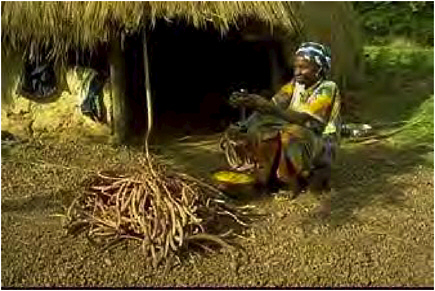
Labé, Guinea. Farmer shelling locust beans. Although a regular part of the diet, the beans become lifesavers during times of famine. The seeds contain protein, fat, sugar, starch, fiber, vitamins, and minerals, and are a concentrated and very balanced food. Add the fact that they mature in the dry season, the traditional “hungry time,” and their value as emergency rations becomes plain. Even when drought has seared the landscape, this deep-rooted tree continues producing food almost as if independent of the weather. (IFAD/Roberto Faidutti)
shea and the occasional baobab.
Small cooperatively managed plantations, especially those owned and managed by women, might be a real boost in some places. On the other hand, investment in larger-scale plantations by business people and civil servants from the city might destroy entirely the cottage industry based around the production and sale of dawadawa, which comprises a significant portion of women’s, albeit meager, incomes across the region.
Horticultural Improvement Because there have been few conscious attempts at yield improvement there is probably much potential to select for improved yields. Many approaches seem promising. For one, research into pests and diseases, plant nutrition, and cultivation techniques may lead to vast improvements. For another, plant physiological research may indicate ways to encourage a larger number of hermaphrodite flowers to develop into pods. Some evidence suggests that trees in plantations perform better than isolated trees, and improvement of plantation establishment techniques could contribute substantially to production.
Genetic Selection A selection of superior strains is certainly needed.
Throughout West Africa there are many varieties with different forms, seed sizes, seed colors, and so forth. Ample germplasm exists for selection and breeding work. Thus, there is much scope for selection and building up extremely productive plantations by choosing superior specimens. Establishment of provenances, documentation of genetic variation, selection for improved cultivars, (e.g., precocity in fruiting) is also needed. In sum, this species is like a recently opened book, just waiting to be read by more locust lovers, students, plant scientists, and nurserymen.
Vegetative Propagation As stated, both grafting and budding have been conducted successfully. “Plus trees” could be selected as the basis for seed orchard establishment, with tree planting campaigns promoting locust bean trees using budded seedlings.
Management Pruning trials should also be carried out with the existing seedling trees, with active participation of local farmers. It is said that pruning speeds fruiting.
Pollinators Wind, bees, and flies all contribute to pollination, but it is also reported that bats can be major pollinators of locust trees. Encouraging bat populations in plantations could be very helpful for increasing seed.
Food Technology There is a need for research into the presence of alkaloids in the seeds. These are possibly confined to the seedcoat (testa), which is usually removed before the seed is used as food.
Additionally, the whole process of commercial dawadawa production needs modernization research.9 Such things as defined starter cultures and standardized (and sterile) processing might provide more consistent flavor, improve shelf life, and help maintain its overall popularity. Also, processing methods that reduce the smell might be developed, so dawadawa can better compete with soybean substitutes and bouillon cubes in the commercial markets. Moreover, technologies that require less labor and fuelwood would truly help the producers.
Sustainable Agriculture
There is the possibility of creating continuous cropping systems around locust. Deep-rooted trees such as this could be a key in semi-arid areas. The short rainy season is the limiting factor to farming, if not life, and therefore the cropping systems in these areas have to be designed on the basis of the water availability.
|
9 |
Achi, O.K. 2005. Traditional fermented protein condiments in Nigeria. African Journal of Biotechnology 4(13):1612-1621; online at academicjournals.org/AJB. |
SPECIES INFORMATION
Botanical Name Parkia biglobosa (Jacq.) R.Br. ex G.Don
Major Synonyms Parkia africana R.Br., Parkia intermedia Oliver, Parkia clappertoniana Keay.
Family Leguminosae. Subfamily: Mimosoideae.
Common Names
Bambara: néré
English: African locust bean,
French: arbre a farine, arbre a fauve
Nigeria: nitta, nete, nere, dawa-dawa, dawadawa, dadawa, ogiri okpi (Igbo)
Fulani: narghi
Gambia: monkey cutlass, netetou
Sierra Leone: kinds
Sudan: dours
Chad Arabic: maito
Kanouri: runo
Djerma: dosso
More: rouaga
Description
African locust trees are large in size: typically over 18 m high and 1.5 m in trunk diameter. They are considered handsome, with clear, rough-textured trunks, fine feathery bipinnate leaves made up of many leaflets, and red, club-shaped flower heads about 5 cm in diameter. The pods are 15-42 cm long and 2 cm wide, and appear in long hanging clusters. The trees lose their leaves during the dry season. Indeed, they are often wholly or partially leafless whilst flowering.
The flowers begin to open at dusk, close and wilt at dawn, lasting only a single night. They are reportedly hermaphrodite. However, the topmost flowers in each cluster are said to be sterile, and produce copious amounts of nectar, presumably to attract fruit bats. While open, the flower clusters resemble pom-poms, an ideal structure for bat pollination. Bees also frequent the flowers in the early hours of the day, and are certainly important pollinators.
Distribution
Locust is not strictly a Sahelian species. It is more properly a savanna species, common also in deciduous forests. In Senegal it extends to the northern limit of the Sudanian Region; further east it is less widely distributed in the drier northern parts, but reaches the southern boundary of the Sahel in Nigeria and Niger.
Within Africa Senegal, Gambia, Mali, Guinea-Bissau, Guinea, Sierra Leone, Côte d’Ivoire, Burkina Faso, Ghana, Togo, Benin, Niger, Nigeria, Cameroon, Chad, Central African Republic, Sao Tome, Gabon, Democratic Republic of Congo, Sudan, Uganda.
Beyond Africa African locust is found on several Caribbean Islands. It is naturalized in Haiti, for instance. Possibly, this is a holdover from the slave trade, and the African love of locust.
Horticultural Varieties
No formal varieties exist. There are considerable genotypic differences, often well known to locals, that are proving useful in making formal selections.
Environmental Requirements
Rainfall The species has been observed growing where mean annual rainfall is 400 mm, but it usually occurs where rainfall is 600-700 mm. It has also been recorded where rainfall is 1200 mm.
Altitude The limits are unknown, but altitude is probably not a practical limitation, at least in equatorial latitudes.
Low Temperature Freezing weather is foreign to its native habitat, but the plant is certainly frost sensitive.
High Temperature Locust trees thrive in semiarid tropical climates with an average daily maximum above 33.5 °C.
Soil It is adapted to a wide range of alluvial soils and is known to grow on shallow drift sands as well as on deep, heavy sand (the type on which sorghum grows well). It does best, however, on deep, cultivated soils but occurs on shallow skeletal soils and is known to survive on poor, rocky sites. In technical terms, it has been said that the sites suiting locust are those with tropical ferruginous soils, ferrisols, and moderately leached ferralitics.
Related Species
Parkia filicoidea. is a related African species from riparian forests. Other species occur both in tropical Asia and Latin America. These are generally handsome, quick-growing trees, large in size, with clear, smooth trunks and fine feathery leaves. They too are useful and highly regarded. Most are pollinated by bats as well as bees. Examples include:
-
Parkia speciosa. Indigenous to Southeast Asia, where it can be found in cultivated plantations. There the odorous/stinking seeds are eaten raw. roasted and fried after sun drying and storage, or else cooked in sauces and curries, more as a condiment. In Indonesia and Malaysia, the pods are an important foodstuff. When ground into a meal, they make a nutritious ingredient of livestock rations. These trees may be found in fairly moist areas in southern Asia. Many of the species are noted for the pods or beans and nuts they bear, which are of good quality and make excellent and nutritious foodstuffs. The leaves also provide useful forage for livestock.
-
Parkia biglandulosa. Malaysia. Seeds roasted, also a substitute for coffee; seedlings also consumed.
-
Parkia intermedia. Indonesia. Seeds eaten raw or roasted.
-
Parkia javanica. Indonesia, Philippines. Pods used for flavoring.
-
Parkia roxburghii. Thrives in moist low areas up to about 600 meters above sea level.
These further members of the genus Parkia are worthy of much more extensive planting, with progressive breeding and selections of improved strains. Several institutions in various parts of Asia and the Americas have begun showing an interest in developing them for forestry and farms.


