
14
MORINGA
Although few Westerners have ever heard of it, moringa is potentially one of the planet’s most valuable plants, at least in humanitarian terms. Perhaps the fastest growing useful tree, it commonly tops 3 m—or even 5 m—within a year of the seed being placed in the ground.1 Some people actually grow it as an annual.
Strangely, this tree is raised for food rather than forestry. A sort of supermarket on a trunk, it yields at least four different edibles: pods, leaves, seeds, and roots. And beyond edibles, it provides products that make village life more self-sufficient: lubricating oil, lamp oil, wood, paper, liquid fuel, skin treatments, and the means to help purify water, to name but a few. The living tree, itself, also provides such things as shade, landscaping, and shelter from the elements.
Arguably, this multi-tasking species is the most exciting tropical resource still awaiting widespread application. And it is a supreme poor-person’s plant with promise for benefiting much of rural Africa. Not without reasons do aficionados refer to it as “mother’s best friend.”
Foreigners who have read about the seemingly wondrous moringa are usually disappointed when they finally get to see one. Except under the best of conditions, it is far from handsome. Indeed, it typically is small, scrawny, wispy, and wholly unimpressive to the eye. Partly that is because people forever pick it for food, but even the most pampered specimens will never be confused with the forest giants of popular imagination. All in all, this is a down-to-earth, unpretentious, and unsophisticated member of the tree world.
But this “working-class” species works, and it works well. Some varieties flower profusely and are used chiefly to produce young pods; others flower sparsely and principally yield leaves. In both cases production can be outstanding. A single tree grown under good conditions can, for instance, bear more than 1,000 pods a season and can supply leaves year round if the climate is conducive.
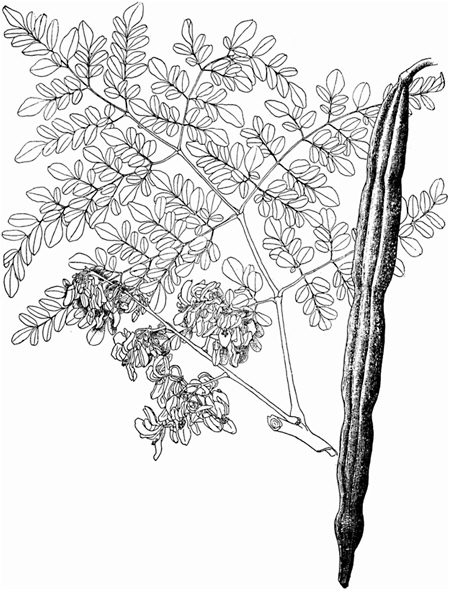
Of all moringa’s edible parts, the green young pods are most sought-after. These legume-like fruits are typically 30-60 cm in length and are
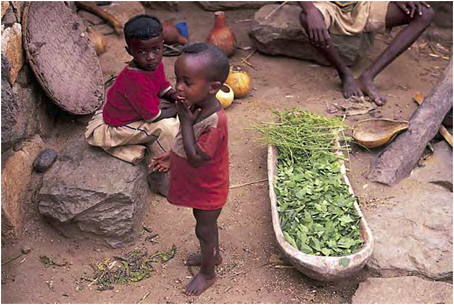
Village of Kolme, Konso, Ethiopia. Moringa yields at least four different edibles: pods, leaves, seeds, roots. Next to the green pods, foliage is the most important food product. People in various countries boil up the tiny leaflets and eat them like spinach. Taken all round, this supreme poor-person’s plant shows a remarkable capacity to help solve problems such as hunger, malnutrition, rural poverty, disease, deforestation, and visual blight. The leaves here are Moringa stenopetala, a cultural heritage and domesticated plant of the Konso people. In this region of southwestern Ethiopia its leaves constitute an important part of their diet. (E. Demeulenaere)
usually served as vegetables. Looking like giant string beans, but tasting somewhat like asparagus, they are highly nutritious. For one thing, they provide a good balance of all the essential amino acids. That alone is unusual in a plant food, but these pods also possess one of the highest vitamin C levels of any tropical vegetable, not to mention goodly quantities of vitamins A and B. And beyond all that they are among the best sources of minerals.2
Foliage is the next most important moringa food. People in many countries boil up the tiny leaflets and eat them like spinach—a spinach that nature has chopped to confetti size. In the Philippines, where moringa is exceptionally popular, these boiled leaves are commonly fed to babies. Nutritionally speaking, they are remarkable for methionine and cystine. Both are essential to health, and both are among the hardest amino acids for the
|
2 |
A current summary and analysis of moringa nutrition, along with an overview and information on cultivation and food preparation, is Fuglie, L.J. 1999. Moringa oleifra: Natural Nutrition for the Tropics. Church World Service, Dakar; available on-line at churchworldservice.org/moringa/miracletree.html. |
body to acquire from plant-based diets. Moreover, moringa leaves contain vitamins A and C, more calcium than most other greens, and so much iron doctors prescribe them for anemic patients.3 And regular consumption of the leaves is reported to increase milk production among lactating women.
Because of discoveries like these a number of development organizations around the world are actively promoting moringa leaves and dried leaf powder as nutritional supplements. The leaves are remarkably easy to handle. Unlike many other leaf crops there is no fibrous leaf stalk (petiole) to be removed. The leaflets are thus 100-percent edible. And with more than three times the dry matter of spinach, they dry quickly and easily.
The thick, soft roots are probably moringa’s third most important food resource. They are a popular condiment, with the flavor of horseradish, for which they are employed as a substitute. Other parts of this plant provide useful food items too. The shoot tips, flowers, and even whole seedlings make boiled greens that are similarly high in protein, vitamins, and minerals. Finally, the pods that are too old and tough to be eaten like green beans are employed as a snack—slit open and the sweet, frothy, white pulp sucked out.
Perhaps the most innovative and provocative use of this already innovative and provocative species is to treat water and wastewater. The protein found in moringa seeds can be used to settle silt and other contaminants. Research in Africa has disclosed that it can replace alum, a normally imported and expensive material. The water still needs a final filtration but the seeds make the process easier and more complete, while extending the useful life of water filters. This could be of major significance where water-borne diseases are prevalent and where central water treatment systems are creaky or nonexistent.
The genus Moringa is a small one whose center of biodiversity is the Horn of Africa.4 The best-known species, Moringa oleifera, must have sprung from those East African “proto-roots” although it apparently completed its evolution across the Indian Ocean, in the foothills of the Himalayas. So although not African itself it derives directly from African stock. The following text relies mostly on this species (for the reason that it
|
3 |
Researchers summarizing moringa put it this way: “…among the leafy vegetables, one stands out as particularly good. It is the horseradish tree, Moringa oleifera. The leaves of the tree are outstanding as a source of vitamin A and, when raw, vitamin C. They are a good source of B vitamins and among the best plant sources of minerals. The calcium content is very high for a plant. Phosphorus is low, as it should be. The content of iron is very good. They are an excellent source of fat and carbohydrates. Thus, these leaves are one of the best plant foods that can be found.” Martin, F.W. R.M. Ruberte, and L. Meitzner. 1998. Edible Leaves of the Tropics, 3rd ed.; available via ECHONet.org. |
|
4 |
There are 13 species in the genus. Nine occur in eastern Ethiopia, northern Kenya, and Somalia (8 occur nowhere else). The densest concentration is Kenya’s northeast corner, where 4 species are found. Two more occur in Madagascar and 1 is endemic to Namibia and southern Angola. Only 1 of the 13 species, Moringa oleifera itself, seemingly arose full-blown outside Africa. Information from Mark Olson. |
is the only one about which much information is available). Nonetheless, it seems more than likely that the chapter’s statements are at least generally relevant to M. stenopetala and perhaps also to the other species (see later), which presently remain all but unknown to experimental science and the technical literature.
Whether or not it has direct African roots, moringa could certainly prove beneficial to Africa. Taken all round, it shows a remarkable capacity to help solve problems such as:
Hunger An ability to provide so many different foods makes this tree potentially valuable for the needy and destitute. It yields up its bounty at little cost to, or effort from, the growers.
Malnutrition The pods and leaves are among the most nutritious foods to be found in the plant kingdom. In West Africa the leaves appear at the end of the dry season, when there are few other sources of leafy green vegetables. Several programs already promote production of moringa leaf powder for use in sauces or as a general food additive.
Rural Poverty Potentially there is profit in moringa. First, this is a fast-growing, high-yielding oilseed. Second, the trunk is gaining importance as a raw material for papermaking. And third, pods can be produced for the fresh market or for processing.
Public Health With its mother lode of vitamins and minerals, moringa is virtually a nutritional supplement for farm or village. Exceptional levels of iron and calcium should make it particularly valuable for women young and old. Adding to its public-health benefits is that its seeds can help purify water. There are also indications that seed extracts are useful treatments against skin complaints.
Deforestation This species is not a foresters’ tree but its ability to thrive in wastelands and provide rapid shade cover could make it the choice for many tree-planting projects. Likely, too, it is a good nurse crop for slower-growing species that eventually will dominate the site.
Visual Blight Moringa is an excellent candidate for fast-track beautification of streets, slums, and squatter settlements. The average specimen looks like an arborist’s nightmare, but a little care can endow it a pleasing rounded appearance. Interestingly, it might help de-uglify the megacities that are projected to dominate the future of the tropics, and make them more livable.
Overall, moringa is easy to use. It is particularly valuable for planting for
and by the young, the poor, and the landless—in schoolyards, parks, roadsides, bus stops, cemeteries, and so on. It likely has a special role in the camps for displaced persons now all too prevalent in many parts of Africa. This rugged, resilient species tends to produce well in marginal growing conditions and is a reliable source of greens in seasons and locations where few other vegetables can produce much of anything. In equatorial areas, it bears food almost year-round. With hunger, malnutrition, poverty, disease, deforestation, and visual blight so widespread, now is the time to bring this tree fully into the fold of African—nay, world—crops. Success seems likely to be not only quick but comprehensive.
PROSPECTS
Despite the previous neglect, this species seems poised to rise to take a major role in many facets of rural life in the world’s warmer regions.
Within Africa
Humid Areas For the wet tropics moringa could be a most useful resource. This is not its traditional habitat, but the plant seems well adapted to hot, humid conditions and, at least in certain areas, has thrived under annual rainfall exceeding 3,000 mm.
Dry Areas Moringa is especially adapted to dryness and may resist several months of drought, probably because its swollen roots store water. It has survived, for example, blistering heat, desiccating drought, and depleted dunes in places such as Sudan and the Sahel.
Upland Areas Originally, moringa was recommended for planting only at altitudes below 600 m. However, the discovery of healthy stands at elevations of 1,200 m in Mexico and over 2,000 m in Zimbabwe has demonstrated that it is much more adaptable than supposed. It withstands light frost but is seriously harmed if temperatures dip 5°C below freezing for even one evening.
Other Regions
Some may at first balk at picking table greens from a tree, but for the hot and hungry corners of the tropical belt any such reluctance is likely to be temporary and will hardly keep moringa from quickly becoming invaluable.
USES
This living cornucopia can provide various means to a better life in the hot, harsh rural regions.
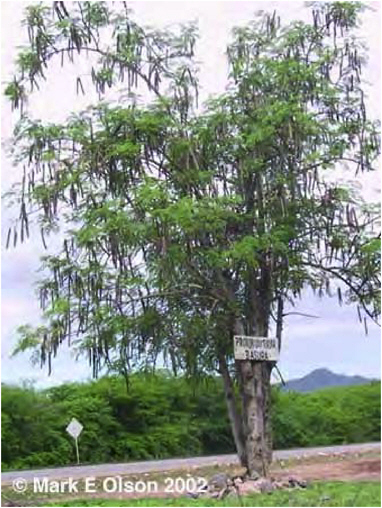
A rugged, resilient tree species, moringa tends to produce well in marginal growing conditions and is a reliable source of greens in seasons and locations where few other vegetables can produce much of anything. In West Africa the leaves appear at the end of the dry season, a time when other sources of leafy green vegetables have mostly died. Here, an older tree produces abundantly in the highlands of Oaxaca, Mexico (Mark Olson - explorelifeonearth.org)
Immature Pods As has been noted, the tender young pods have the general characteristics of a succulent string bean. They may be eaten whole but for ease of use most are sliced and diced before cooking. In India, these long thin vegetables are a common fare, frequently added to curries and even sliced, blanched, canned, and peddled in thousands of markets and stores. There is even an international trade in both fresh and canned pods. India, Sri Lanka, Taiwan, and Kenya for instance export them to Asia, Europe, and the United States, where they end up mainly in ethnic Indian groceries.
Mature Pods As the pods mature, they quickly turn tough. Even by the time they are as thick as a pencil they are often too fibrous to eat like string beans. In that form, they are called drumsticks, and are typically cut into pieces and the sweet frothy inside material is slurped out. Throughout India drumstick slices are well-known ingredients in pickles and in Madras they are common also in the famous drumstick curries.
Leaves The foliage is fernlike, with myriad tiny leaflets produced in abundance through most of the year. The feathery leaves are easily stripped to separate the leaflets, which are 1-2 cm in diameter. The young ones are particularly prized in the Philippines, where certain ethnic groups proudly associate their whole culture with the plant.5 In addition to being boiled like spinach, they are dried, crushed, and sprinkled on food.6 In many areas of Africa, people have found the leaves easy to preserve by air-drying (which should be done indoors since sunlight destroys vitamins A and C).
Seeds The soft seeds extracted from immature drumsticks are boiled and eaten like fresh peas. Fried, they taste like peanuts. Only immature white seeds are eaten (either boiled or fried). Once they ripen, the taste turns bitter.
Roots The pungent fleshy root is pulverized into a flaky condiment with a horseradish bite. This has given moringa the widely used name “horseradish tree.” The thick, soft roots are also pickled. For this, they are peeled, dried, ground, and steeped in vinegar.
Seedlings Young seedlings are pulled up, boiled, and eaten whole.
Flowers The flowers, which occur year round in some places but are more often seasonal, are cooked as a vegetable and are sometimes steeped in boiling water to yield a fragrant tea. In Kenya’s Kibwezi region, farmers fry the flowers and liken the taste to that of fried egg.7 Raw, they have a strong or hot radish-like flavor. In Oaxaca, Mexico, poor people have adopted the tree solely as a source of white flowers for decorating churches and houses on religious festival days.
Honey A good bee tree, moringa begins flowering at a young age. Specimens from seed usually flower within 2 years; those grown from
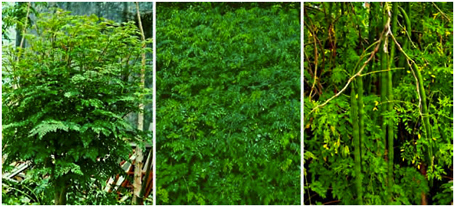
With its mother lode of vitamins and minerals, moringa is possibly the planet’s most valuable undeveloped plant, at least in humanitarian terms. Regular pruning can maintain a compact form whose leaves are easily harvested (left). New leaves are produced in abundance almost daily (center), or plants can be managed to produce pods (right). Intensive management such as this can give impressive, sustain yields in a small space. (Neofarming - moringa.com.tw.)
cuttings have been known to flower when only a few months old.8 Then, as long as the climate is conducive, they bloom continually for years on end. The resulting honey is tasty, clear, and often consumed as a medicine.
Fodder Livestock relish the foliage so much that in some regions moringa is an important fodder. In India, for example, water buffaloes are fed the chopped up leaves and branches, which are said to boost milk production. Trials conducted in Nicaragua found that range-fed cows gave a 30-percent increase in milk and meat production when their diet was supplemented with 45 percent moringa forage.9
Oil Pressing the seeds produces a pale-yellow oil. Alternately, seed can be boiled in water, in which case the oil floats to the surface where it can be skimmed off. Oil makes up 20-40 percent of the seed—a reasonable quantity. It is a valued base for ointments since it lacks color, smell, and taste, and turns rancid only slowly. These same properties make this non-drying oil useful for enfleurage, the process by which perfume companies extract flower fragrance. Because it absorbs and retains delicate scents, it is also valued in products like hair oil. It was once traded internationally (“ben oil”) for lubricating the wheels of clocks as well as making oil paints for artists. More recently, it has shown particular value for making quality soap.
Fuel Moringa oil is said to equal the best lamp fuel, burning with little scent or smoke and emitting a light both bright and clear.
Gum When wounded, the bark exudes a polysaccharide used like glue.
Wood Although soft and spongy and not a great fuel, the wood burns cleanly and gives off little smoke or smell. White and tasteless, it also makes good chopsticks, and provides a pulp suitable for newsprint as well as wrapping, printing, and writing papers, not to mention the viscose rayon used in textiles and cellophane.
Shelter, Shade, and Privacy Screens Though never showy, this tree is not unattractive. People sometimes plant it to ornament gardens as well as highway verges. Its airy foliage casts only light shade. Planting a line of seedlings produces a living fence that can become a seamless line in as little as a year. For even faster results, sizable branches can be set upright in the ground to form an “instant hedge.”
Agroforestry The tree is good in agroforestry and mixed cropping. The thin shade helps protect vegetables in the hot tropical sun. Because of its downward rooting pattern, there is little competition with associated crops.10 In sum, this seems to have the making of an ideal agroforestry component.
Water Purification Inside each pod are found up to 25 seeds, which yield a quality vegetable oil and in crushed form they can be used to help clarify turbid water. Charged proteins in the seed tissues coagulate suspended particles, precipitate disease organisms, and generally help turn a dangerous muddy muck into a clear potable liquid.
Medicinal Uses Many supposedly effective folk remedies incorporate moringa. The pulp of the root, for instance, is used like a “mustard plaster.” The crushed seed has been recommended as an ingredient in ointments because it demonstrates anti-microbial activity.
NUTRITION
Most parts of this plant are more than just edible; they are nutritious.11 Moringa, unlike most foods in this report, has been analyzed in many studies that support high (though highly variable) levels of carbohydrate, protein,
and especially vitamins and minerals. It has been said, for example, that: “As sources of the usually short sulfur-bearing amino acids methionine and cystine, Moringa oleifera, grown for edible leaves, shoots, young fruits, and roots, is incomparable.”12 Methionine and cystine are arguably the most critical dietary ingredients for people lacking regular access to meat, milk, cheese, eggs, or fish.
Leaves Leaves are eaten fresh or dried as a storable powder (in which process they can lose much of their vitamin C). On a dry-weight basis, both have more than 200 calories (up to 400 is reported), with about 30 percent protein and 1-2 percent fat. Nutritional trials with laboratory rats show that the leaf is an excellent supplement to rice and other staples. In addition to being rich in overall protein these leaves also, as noted, provide methionine and cystine. A modest helping (100 g dry-weight) generally provides at least an adult’s daily requirement for provitamin A. The leaves are also supply good folate and other B vitamins. Further, they are among the best plant sources for dietary minerals, especially calcium (up to about 2000 mg) and iron approaching 30 mg, about twice the level of spinach and exceeding even the amount in patent medicines touted for stimulating pep and vigor.
Pods On a dry-weight basis the protein content of moringa pods ranges from 20 to 30 percent—an amount well above average for a vegetable. Moreover, vitamin C content is so high that a 50 g serving (or less) provides an adult’s daily needs. In addition, minerals seem to be in good proportion. Iron—often deficient in African diets—is as high or higher in the pods than in the leaves, although the level probably depends on site conditions and preparation. The content of copper also seems notable (though highly variable and requiring confirmation).
Seed Oil The liquid making up a quarter to almost half the seed’s weight is not unlike olive oil in composition. In one analysis of the fatty acids, the seed oil contained about 66 percent oleic, 9 percent palmitic and behenic, and 7 percent stearic.13 The nutritional contribution of the oil itself to meager diets could be significant.
HORTICULTURE
This tree generally grows satisfactorily, but just how to grow it best is far from certain. Outside certain regions of India, where large-scale cultivation is practiced, the tree receives little professional horticultural attention and has not been subjected to formal comparative trials.
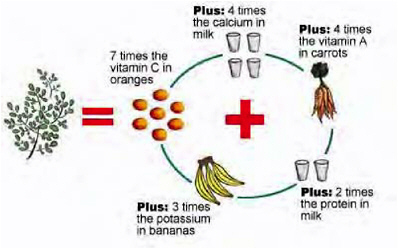
Gram for gram, fresh moringa leaves outperform these well-known nutritional champions, and they taste good too. (TreesForLife.org.)
Moringa can be propagated through seed. No pretreatment is required and seeds sprout in only a few days in prepared seedbeds, a week or two in the field. However, this species is mostly (and most easily) propagated via cuttings. Even sections of branches as long as an arm will root in moist soil, becoming tree-like in just a few months and producing fruit within a year. However, trees grown from cuttings tend to have short and spreading roots.
Mulching and fertilizing improve production and quality of the leaves. In addition, heavy pruning encourages lateral shoots and increased leaf production. Pruning tops (at about head height) provides for easy harvest.
By and large, diseases or pests seldom affect the tree seriously. In India, a foot rot (Diplodia), a bark disease (Indarbela), and a defoliant are reportedly problematic. Also, caterpillars sometimes leave the tree leafless and termites sometimes tunnel into the trunk. Termites (Macrotermes spp.) can kill mature trees, especially during prolonged droughts. When planted in very wet conditions, it may suffer root rot.
A contributor has passed on advice for making eye-catching moringas: “This awkward tree can actually be quite attractive if the tip is pinched out when the tree is perhaps 2 meters tall, and the side shoots likewise pinched when they have grown some. This forces a rounder canopy. We grow it that way and use it as a light shade for vegetables that do not do well in the full tropical sun.”
HARVESTING AND HANDLING
The tree withstands heavy cutting and can provide a continuing supply of wood, fodder, and other products. Both coppicing (continual cutting near the
base) and pollarding (continual cutting higher up the trunk) are possible. One recommended system is to set the trees about a meter apart and trim them regularly like a hedge to provide successive crops of leaves.
Plants raised from cuttings bear in 6-8 months after planting. The pods are usually taken directly from the trees individually by hand.
The leaflets are easy to harvest by stripping them off between thumb and forefinger. As already noted, there is no leaf stalk to be removed and the leaves dry quickly and easily.
LIMITATIONS
Many (even most) of the trees now scattered throughout the tropics are pale shadows of the top-performing types. Plants raised from seed often produce inferior pods because of intercrossing with bitter-tasting wild types. Thus for quality crops, vegetative propagation is a must.
The pods must be picked at the right stage because within a day or two they toughen up and turn stringy. Unfortunately, it is not easy to tell (in words) exactly when a pod is at the point where it is ready to pick.
Termites in some areas may limit the tree’s culture. Leaf-cutting bees sometimes strip a tree of almost all its greenery. Browsing animals are also a threat. Both livestock and wild herbivores consider moringa to be like candy, and can destroy a new planting overnight. Pigs have been known to dig out even established trees to feast on the tasty roots.
The tree’s limbs are weak and break off easily, especially when laden with pods. The soft, almost spongy wood is slow to dry and very susceptible to termite attack, so it is not useful in construction.
The horseradish substitute from the roots must be made with care because the bark evidently contains alkaloids. To eliminate any possibility of toxicity, careful peeling is needed. Indeed, this usage as a peppery condiment may not be safe at all.
NEXT STEPS
Any tree that can provide food to the hungry parts of the planet could be the subject of massive plantings and major initiatives. Such projects need to be undertaken; some are already in action and have much to teach that is positive. In West Africa, Church World Service (CWS), has helped establish over 70 hectares of moringa plantings and is creating a farm for intensive production of leaf powder. In Tanzania, Optima of Africa is growing thousands of hectares of moringa for production of oil and of the flocculent used to clarify water, and Trees for Life has projects in many Asian and tropical American countries. A quick Internet search reveals many others.
Publicity With all the potentials, it is hard to imagine why there aren’t million-dollar moringa-promotion programs with international backing.
Foresters probably shun it because it is basically a food crop; agronomists because it is a tree; fruticulturists because it is a vegetable. The combined neglect has reached such a pass that in many countries hungry people don’t even realize that the moringas growing around them are edible. Even where millions are malnourished or starving the plant’s nutritious products often are wasted. Haiti and Sudan are just two examples where this good food goes begging. In both cases the tree was introduced as an ornamental and the fact that it provides life-giving nutrients remains mostly unrecognized. Local and international efforts are needed to provide information, publicity, and greater awareness of this tree and its capabilities—particularly to the people on the ground and their supporters.14 Introduction of good genotypes for multi-location testing is also required.
New Plantings In each of the several dozen appropriate countries— especially those facing chronic malnutrition—a rapid search (rather than a time-wasting, exhaustive one) should be made for adequate moringa types, which should then be vegetatively propagated and planted out in nurseries and observational trials. A few groups are already way ahead on this and have such trees already selected and planted out. The Kenya Forestry Research Institute, for instance, has initiated such a program and is also developing seed orchards of improved material for specific purposes and end uses.15 But many more groups across many African countries should be also exploring this most promising resource.
From these “foundation banks” seeds or cuttings can be taken and distributed to farmers, homeowners, and others. In all of this there are good chances for both humanitarian success and small-business development. Moringa cultivation should be particularly promoted in the slum areas of cities, where small plantings should prove of immediate benefit to children (see below).
Nutritional Interventions Throughout Africa, moringa could be immediately incorporated into programs tackling the misery of malnutrition. It is reported by CWS that three spoonfuls of moringa leaf powder (about 25g) contain 300 percent of a typical toddler’s daily vitamin A requirement, along with 42 percent of the protein, 125 percent of the calcium, 71 percent of the iron and 22 percent of the vitamin C. It also contains a full complement of minerals and amino acids.
With four times the beta-carotene of carrot, moringa has especial potential for programs dealing with avitaminosis, the vitamin A deficiency
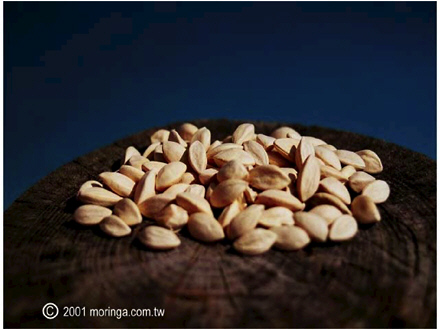
Moringa produces seed in abundance. Immature seed is relished fresh, boiled, or fried. Mature, it yields a very pure oil widely used in cooking as well as for energy and quality lubrication (“ben oil”). The remaining meal has proven to be a powerful home-grown water-purifier whose use is rapidly expanding in many parts of rural Africa. (Neofarming - moringa.com.tw.)
that causes 70 percent of childhood blindness.16 Other diseases caused by the lack of nutrients that are abundant in moringa include beri beri, rickets, and scurvy. There’s already some precedent to follow: Since 1996, for instance, CWS and local partners have been actively promoting moringa for improved nutrition in Senegal. Based on CWS research funded by the U.S. Agency for International Development, many health centers now stock moringa leaf powder in their pharmacies for use in treating cases of moderate malnutrition.
The seed oil could become a valuable nutritional commodity with the ability to extend diet and provide cooking oil from a readily available local source.
Horticultural Development While such major initiatives are under way, more basic studies are also needed to provide better materials and more reliable guidelines for long-term use. Three examples are:
Genetic Improvement Almost certainly moringa can be selected and improved in ways that produce separate cultivars for top-quality vegetable
oil as well as for various tasty and nutritious vegetables from fruits and leaves. Hybridization between elite types might also be carried out. Elite cultivars of course require vegetative propagation. In India, over 85 types of moringa have been developed to reflect local tastes in pod size and shape. Many of these types are grown for one to three years, and then replaced with new trees on a regular rotation, almost as if they were biennials.
Genetic Diversity This immensely useful tree’s genetic variability needs careful assessment. Although many types exist, no one presently knows which are best suited to various uses, environments, and local needs. Much genetic diversity is especially available in the Terai region of India and Nepal, as well as Uttar Pradesh in northern India. Surprising genetic diversity has also been located in century-old material in eastern Africa.17
Agronomy There needs to be more exploration into the most favorable conditions for cultivating moringa. The plant seems to grow well under many different conditions and in many different soils, but no one knows its optimal requirements or its limits.
Water Purification Lack of drinkable water is, arguably, the world’s biggest health threat. In the rural regions of many developing countries, people must take drinking and washing water from rivers, wadis, swamps, lakes, and even hollowed-out tree trunks. Using moringa seed to clarify such supplies should be more widely tested and, where appropriate, used. The science behind it has already been pinned down enough to proceed in this way. Two groups have already made spectacular advances in our understanding of the process.18
One of these pioneers has discovered that oil plays no part in the water-clarification process. He now recommends introducing small-scale moringa-seed extraction in the rural areas. Pressing the seeds provides the valuable oil as well as the presscake (solids residue after oil extraction) containing the charged proteins that effect water clarification. He now sees the coagulant as the byproduct of high-quality oil extraction.19
Other Uses The economic feasibility of employing the wood for paper pulp deserves pantropic exploration. By most standards the wood is poor, but the tree grows fast and might become extremely valuable wherever other
pulp sources are scarce. Indeed, large-scale moringa plantings are already being established to help meet India’s paper shortage. In sub-Saharan Africa there are large tracks of dryland suitable for moringa, but not conducive to other crops; these might perhaps be planted to moringa, thereby protecting the environment as well as generating useful resources, including pulp.
Moringa is potentially useful in alley cropping and contour hedges grown across hillslopes to slow soil erosion. Specimens grown from seed are deep rooted, with few lateral roots to interfere with the neighboring crop plants.
Exploration of the Wild Resource Although the Horn of Africa is the “birthplace” of the genus, only recently have significant efforts been made to explore the Moringa species to be found there and the uses to which they are put.20 In fact, the traditional cultivation of the “cabbage tree” (M. stenopetala) was apparently “lost” to science until mentioned for the first time in a geographical paper concerning Ethiopia as recently as 1938. Even today, the tree is maintained inside compounds as well as on terraces, and its leaves are an important vegetable during the dry season. Yet it has never been subject to scientific investigation.21
Food Technology In the handling and processing of moringa products, much remains to be done before the tree’s full potentials can be approached, perhaps even in India. Examples of two needs follow.
-
Cooking Oil Many Third World families would benefit enormously if they could grow a quality cooking oil on trees in the backyard. Moringa may not prove the best candidate, but this possibility ought to be explored. Typically oilseeds need to be heated to free up the oil before they are pressed, but this has been found unnecessary in the case of moringa seed—friction generates sufficient heat.22 This is a boon in that it removes one cumbersome and costly step, and it also means that the oil may be classed as “cold pressed” and touted as a “natural, pure vegetable oil.”
-
Seeds Tests should be done to determine the range of nutritional values for the seeds (and pods), and the potential production of animal feed from the seed meal (the solid left after the oil has been expressed).
Medicinal Uses Moringa is renowned for supposed medicinal properties. A few investigations have suggested there may be some merits to the claims.
|
20 |
Mark Olson’s modern moringa explorations are outlined at explorelifeonearth.org/moringahome.html. |
|
21 |
The growers are mainly the Konso, Burji, and Gidole tribes in the highlands south of Lake Chamo in Ethiopia and the Konso and Burji minorities in the Marsabit District in Kenya. |
|
22 |
Information from G. Folkard. “One advantage,” he writes, “is that if a small extractor is used no external heat is needed.” |
The root bark, for instance, contains two alkaloids—moringine and spirochine—that act on the nervous system. The roots contain pterygospermin, which inhibits growth of gram-positive and gram-negative bacteria.23 An old report from Southeast Asia says a decoction of bark stimulates menses and is used for “morning after” birth control. In parts of West Africa, moringa leaves or juice are taken for diabetes and high blood pressure. Some or all of these might have merit, but only careful analysis, sound research, and (if warranted) trials involving control groups and statistical analysis will answer that. Initial investigations seem worthwhile.
SPECIES INFORMATION
Botanical Name Moringa oleifera Lamarck
Synonyms Moringa pterygosperma Gaertner; Moringa zeylanica Pers.; Guilandina moringa L.
Family Moringaceae
Common Names
English: moringa, horseradish tree, drumstick tree, sujuna, ben tree, ben oil tree,
French: ben ailé, ben oléifère, benzolive, arbre radis du cheval
Spanish: ben, árbol del ben, paraiso, morango, moringa
Portuguese: acácia branca, marungo, muringa, moringuiero; cedro (Brazil)
Arabic: ruwag, alim, halim, shagara al ruwag (Sudan)
Swahili: mzunze, mlonge, mjungu moto, mboga chungu, shingo
German: Behenbaum, Behenussbaum, flügelsaniger Bennussbaum, Pferderettichbaum
Italian: sàndalo ceruleo
Fon: kpatima, yovokpatin,kpano,yovotin
Gun: èkwè kpatin, kpajima
Yoruba & Nago: èwè igbale, èwè ile, èwè oyibo, agun oyibo, ayun manyieninu, ayèrè oyibo
Adia: kpashima
Mina: Y\yovo vigbe, yovo kpati
Bariba: yuru ara, yorwata yoroguma
Saxwe: kotba
|
23 |
Few studies have been conducted to validate scientifically their popular use, but two Guatemalan doctors reported making an ointment that proved as effective as neomycin in clinical trials. They used seed from moringa. Ointment can be prepared by extracting the active seed ingredient with very inexpensive equipment and mixing with petroleum jelly. Information from ECHONet.org. |
Waama: yori ku-oununfa
Fulani: gawara, konamarade, rini maka, habiwal hausa
Hausa: zogall, zogalla-gandi, bagaruwar maka, bagaruwar masar, shipka hali, shuka halinka, barambo, koraukin zaila, rimin turawa
Ibo: Ikwe oyibo
Tonga: mupulanga, zakalanda
Wolof: neverday, nébéday
Philippines: malunggay or malungai (Tagalog)
India: sujuna, sajina, lopa, horseradish or drumstick tree
Senegal: nebeday
Haiti: benzolive (Haitian Creole)
Description
Moringa is a medium-sized tree that attains about 10 m in height. It has a straight trunk (10-30cm thick) with bark that is whitish or gray, corky, with longitudinal cracks. It also has a tuberous taproot, whose presence helps explain the species’ tolerance to drought conditions.
Normally umbrella shaped, the tree comes with a lax crown of graceful, airy foliage, whose feathery effect is due to the finely tripinnate division of the leaves. Those leaves are densely crowded at the tops of the branchlets. Depending on climate the foliage is evergreen or deciduous and, from a distance, reminiscent of a legume like leucaena or calliandra.
In season the tree is enshrouded in creamy white, honey-scented flowers arranged in drooping panicles 10-30 cm long. Flowers are insect pollinated and “require a large number of insect visitations,” with carpenter bees the most common guests.24 Flowers and fruits (pods) can occur twice a year; in many places flowering and fruiting occur year-round. 25 The fruits are initially light green, slim, and tender, eventually turning dark green and firm. Depending on genotype, they are up to 120 cm long. While most are straight a few are wavy and some curly. In cross-section most are rectangular but a number are triangular and some are round. Fully mature, the dried seeds are surrounded by a lightly wooded shell with three papery wings.
Distribution
Africa. Although widespread in Africa, moringa is seldom cultivated intensively and in only a few places is selected and put to use in anything like an optimal manner.
Beyond Africa Moringa has long been cultivated in rural areas throughout the Indian Subcontinent as well as much of Southeast Asia. It is, for example, naturalized in Sri Lanka, India, Malaysia, and the Philippines. In addition it has been introduced to the West Indies and tropical America (from Mexico to Peru, Paraguay, and Brazil).
Horticultural Varieties
This crop has not been systematically improved, but several named cultivars with individual qualities are known in India. One called ‘Bombay’ has curly fruits and is considered among the best. Another, ‘Jaffna,’ is noted for having fruits 60–90 cm. A third, ‘Chavakacheri murunga,’ is known for its exceptionally elongated pods (90-120 cm long). Finally, there are the so-called baramassi varieties, which tend to flower continuously because they have been selected through the ages to provide buds, flowers, and fruits for food throughout the year. These jack-of-all-trades types are especially suitable for subsistence use. There is also a dwarf variety known as ‘PKM1,’ bred for the short stems that make it easy to harvest the pods, which are exceptionally long. Some Indian varieties are showing exceptional promise at the International Institute of Tropical Agriculture in Nigeria.
Environmental Requirements
Moringa is an extremely adaptable species. It grows fine throughout the warmer life zones, ranging from subtropical through tropical and from dry savanna to rainforest.
Rainfall While preferring moist situations (such as along waterways and coastal areas), it adapts to climates with several months of drought. Moringa is reported to tolerate annual precipitation of 250-1,500 mm.
Altitude Elevations below 600 m are reported best for moringa, however it thrives at elevations over 1,100 m in protected tropical uplands (southern Mexico and Dire Dawa, Ethiopia, western Kenya near Lake Victoria, for example).26 Indeed, in some tropical areas it has been recorded growing at 2,000 m. In Ethiopia the related species Moringa stenopetala is regularly found at altitudes up to 1,800 m.
Low Temperature The tree is reported to tolerate light frosts without significant damage. Even when a freeze kills a mature tree back to the roots, it usually quickly sends out new growth from the ground. A good overall temperature range is 20-30°C.
High Temperature No upper limit has been reported. It is known that moringa can take up to 48°C for limited amounts of time.
Soil The tree survives on all types of soils, including the heavier clays. However, it grows best on sandy sites and alluvial lands. The soil (especially the clay ones) must be well drained because the tree is sensitive to waterlogging. It can be established in alkaline soils (up to pH 9) and acid ones (pH 4.5).
Related Species
As we’ve noted, out of the 13 Moringa species only M. oleifera has been accorded research and development. The rest remain almost unknown to science.27 Perhaps they could provide even better food ingredients, flocculants, antibiotics, oils, or wood. Perhaps they have their own unique qualities. No one knows at present.
Of these ignored species, one stands out. Unequivocally African, Moringa stenopetala was domesticated in the East African lowlands. Many different ecotypes and cultivars are still found in Ethiopia, for instance. The plant has been called cabbage tree and it is very similar to moringa except that it is more drought tolerant and the leaves and seeds are larger. Some claim that its leaves are even tastier than moringa’s.28 In addition, this species is said to be even more promising as a coagulant for water clarification.29 For all that, though, it is barely known to anyone but the villagers whose ancient ancestors first put it to use.
A third species, Moringa peregrina, is another Horn-of-Africa native. It is used as a condiment and for several other purposes in West Africa but in modern times remains almost unstudied. That was not so in the past, however. Its fruits have been found in many Egyptian tombs and it is
frequently mentioned in ancient Egyptian texts for its oil and medicinal applications.30 This species (a widely used synonym is M. aptera) provided the original ben oil (the name deriving from the Arabic al Bân), an odorless sweet oil that keeps well and is esteemed in perfumery. This species is still found today in Egypt and in Israel’s Rift Valley as far as the southern shore of the Dead Sea. It has wood that is good for firewood and charcoal, and also reportedly resists termites.
There is also the potential for hybridizing Moringa oleifera with other members of its genus. M. stenopetala, for example, has been shown to contain flocculating agents that show a high homology to those in M.oleifera. With M. stenopetala producing bigger seeds (but usually a lower yielder) than M .oleifera, it may be possible to increase overall seed yield through such hybridizations. It may also be possible to increase the oil yield of M .oleifera by producing a hybrid with M. peregrina, whose seeds yield approximately 50 percent oil.


