
1
Overview
The energy problem now faced by the United States began to be recognized 10 years or more ago. Still, the occasional symptoms (the oil embargo of 1973, the natural gas shortage of 1976–1977, and the gasoline lines of the summer of 1979) are frequently mistaken for the problem itself. As each symptom is relieved, the public sense of crisis fades. The seeds of future crisis, however, remain.
Resolution of the problem demands a systematic examination of energy supply and demand in the context of existing policies, and articulation of a coherent set of policies for the transition to new sources of energy and new ways of using it. The essential difficulty is that these policies must be as consonant as possible with other, often conflicting, national objectives—protecting the environment and public health and ensuring national security, economic growth, and equity among different regions and classes. The nation’s energy problems are exemplified by two simple facts: stagnant domestic production and rising demand. Total energy production in the United States in 1978 was about 3 percent less than in 1972, the last full year before the oil embargo and OPEC price rise of 1973–1974 (Figure 1–1). In the same period, energy consumption rose by 9 percent (Figure 1–2). The difference is made up by increasing oil imports at continually rising prices. Imports now provide about half of all the oil consumed in the United States, up from about 30 percent in 1972. The total cost has jumped from $4.77 billion in 1972 to $41.46 billion in 1978.1
In the meantime, total world demand for oil has risen even more rapidly2–4 while exporting nations, with an eye to the ultimate depletion of what is in many cases the sole source of wealth, have exercised strict
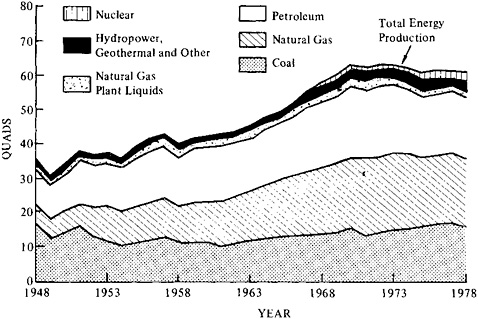
FIGURE 1–1 Energy production in the United States from 1948 to 1978, by energy source (quads). Source: U.S. Department of Energy, Energy Information Administration, Annual Report to Congress, 1978, vol. 2, Data (Washington, D.C.: U.S. Department of Energy (DOE/EIA-0173/2), 1979).
control over production. Thus, the United States is forced to compete for supplies in an increasingly tight world market. The inevitable result is upward pressure on prices and enhanced opportunities for the control of prices by cartel.
The United States is a key factor in the world oil situation. U.S. oil consumption is huge, amounting to almost 30 percent of world consumption. At the same time, its domestic production is declining, probably irreversibly (except for some temporary help from Alaskan production, which will peak in the 1980s). Natural gas production is also on a downward trend. These production trends might be arrested by higher prices and favorable public policies, but any increase above current production levels is likely to be small and to decline after the year 2000. The only readily available large-scale domestic energy sources that could even in principle reverse the decline in domestic energy production over the next three decades—coal and nuclear fission*—face a variety of technical, political, and environmental obstacles, and will be difficult (though not impossible) to expand very rapidly.†
|
* |
See statement 1–1, by H.Brooks, Appendix A. |
|
† |
See statement 1–2, by J.P.Holdren, Appendix A. |
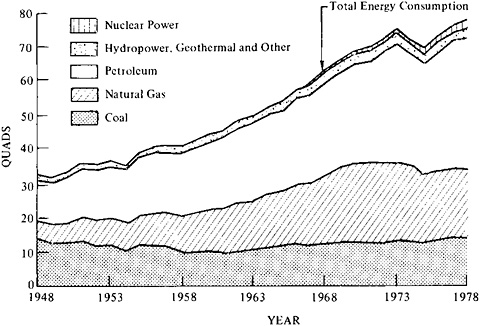
FIGURE 1–2 Energy consumption in the United States from 1948 to 1978, by energy source (quads). Source: U.S. Department of Energy, Energy Information Administration, Annual Report to Congress, 1978, vol. 2, Data (Washington, D.C.: U.S. Department of Energy (DOE/EIA-0173/2), 1979).
The implications are serious. First of all, rising dependence on increasingly costly foreign oil tends to degrade the value of the dollar and exacerbates inflation. The heavy and growing involvement of the United States in the world oil market not only worsens the domestic problem, but puts less affluent importing countries at a growing disadvantage in competing for supplies. The foreign policy consequences of this strained situation are twofold: Oil-producing countries find it increasingly feasible to exact political concessions from importers, and U.S. relations with other oil importers are weakened.
The United States has been a net importer of energy since the early 1950s. Energy was cheap, and it grew cheaper throughout the 1950s and 1960s; little concern was expressed as consumption more and more outpaced domestic production. In constant 1948 dollars, the price per barrel of crude oil at the wellhead fell from $2.50 in 1948 to $1.85 in 1972; imported oil was even cheaper. Most other forms of energy—notably electricity and coal—declined even more in price than oil. Net energy imports rose on the average more than 10 percent annually throughout the 1960s, more than doubling in that decade. Sources of supply became increasingly concentrated in the Middle East and Africa.
In 1970 domestic oil production peaked, and growth in imports accelerated. From 1970 until the fourfold OPEC price rise in 1973–1974, oil imports rose at rates exceeding 30 percent annually—almost doubling again in 3 years. The price rise brought in its wake a serious economic recession; energy consumption, and therefore imports, dipped in response. They rebounded sharply afterward, though rates of increase are now less than in the early 1970s. The nation now imports more than a fifth of its primary energy in the form of foreign oil.
The solution to this problem is not simply to produce more energy, and not simply to conserve, but rather to find a new economic equilibrium between supply and demand.* Higher prices are inevitable, and the nation must take advantage of the resulting new opportunities for both enhanced supply and greater efficiency in energy use.
Ordinary market forces will play important roles here. In some cases, however, such as the international oil market, they will be relatively ineffective and must be supplemented by government incentives to conserve and by federal aid in developing new technologies that can allow wider use of domestic resources such as coal, to allay the growth in demand for oil.
All in all, conservation deserves the highest immediate priority in energy planning. In general, throughout the economy it is now a better investment to save a Btu than to produce an additional one.† On the supply side, the most important short-term measure is to enhance domestic oil and gas production by exploiting unconventional sources and enhanced-recovery techniques. The most important intermediate-term measure is developing synthetic fuels from coal, and perhaps from oil shale, to serve where coal and nuclear power (which are most suitable now for electricity production) cannot directly replace oil and gas, as in transportation. Perhaps equally important is the use of coal and nuclear power to produce electricity for applications such as space heating, where such replacement is possible.
While these measures are being taken, the research and development necessary to bring truly sustainable energy sources—nuclear fission, solar energy, geothermal energy in places, and perhaps fusion—into place for the long term must receive continued attention. The relative merits of the principal long-term choices, and the timing of their execution, are discussed in subsequent sections of this chapter and in the body of the report
MODERATING DEMAND GROWTH
Slowing the growth of energy demand will be essential, regardless of the supply options developed during the coming decades. In fact, the demand element of the nation’s energy strategy should be accorded the highest priority. Some reduction in growth will inevitably result from rising energy prices, and this reduction could be accelerated by such explicit government policies as taxes and tariffs on energy and standards for the performance of energy-using equipment. In any event, studies by the CONAES Demand and Conservation Panel indicate that the growth of demand for energy in this country could be reduced substantially—particularly after about 1990—by gradual increases in the technical efficiency of energy end-use and by price-induced shifts toward less energy-intensive goods and services.5
In this analysis the Demand and Conservation Panel explored the dynamics and determinants of energy use by performing detailed economic and technological analyses of the major energy-consuming sectors: buildings, industry, and transportation. The projected energy intensities for each sector were based on (1) expected economic responses to price increases and income growth and (2) technical changes in energy efficiency that would be economical at the prices assumed and would minimize the life cycle costs of automobiles, appliances, houses, manufacturing equipment, and so on. No credit was taken for major technological breakthroughs; only advances based on currently available technology were considered.
A major conclusion from this analysis is that technical efficiency measures alone could reduce the ratio of energy consumption to gross national product (for convenience, the energy/GNP ratio) to as little as half* its present value over the next 30–40 years. (This conclusion is sensitive to the prices assumed in the analysis, and a result of this magnitude is attained only if prices for energy increase more rapidly than is probable in a market at equilibrium.) Similar conclusions were reached by the CONAES Modeling Resource Group,6† whose work suggests that such reductions are possible without appreciable impacts on the consumer market basket.
In some cases the price increases necessary to reach such reductions in demand would have to be secured by taxes that would open up a wedge between consumer prices and the costs of producing and delivering energy. Whether this would be politically tolerable or not may be open to question. It is possible, however, that if such price increases are not imposed
|
* |
Statement 1–5, by R.H.Cannon, Jr.: It would be wrong to depend on so large an improvement. Calculations using other models and assumptions predict severe economic impact for smaller energy/GNP reductions. |
|
† |
See statement 1–6, by E.J.Gornowski, Appendix A. |
domestically, they will be imposed by the international oil market with considerably greater abruptness.
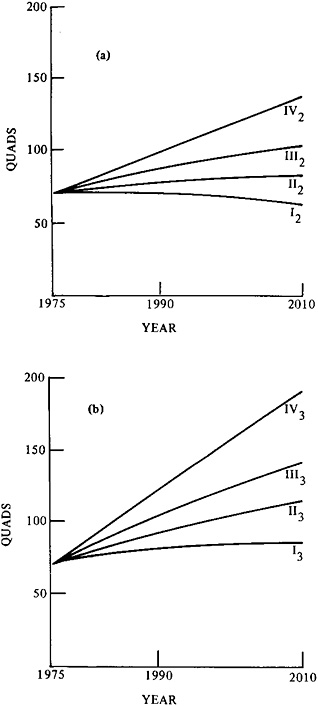
These findings are embodied in the panel’s “scenarios,” or estimates of energy demand under a range of different assumed circumstances involving the price of energy and the consequent technological responses in terms of energy consumption. (A scenario is a kind of “what if” statement, giving the expected results of more or less plausible assumptions about future events, according to some self-consistent model.) The Demand and Conservation Panel’s scenarios are intended to project—given certain unvaried assumptions about population growth and income growth, labor productivity, and the like—the effects on energy demand between 1975 and 2010 of various price schedules for delivered energy. The assumed prices range from an average quadrupling by 2010 to a case in which the average price of delivered energy actually decreases by one third. Table 1–1 lists the generalized assumptions and postulated prices for each of these demand scenarios. (The specific assumed prices for individual fuels in each of these demand scenarios can be found in Table 11–2 of chapter 11.) Obviously, high-priced energy evokes greater efficiency in use and thus lower consumption.
One of the key assumptions in the panel’s scenarios is that the U.S. gross national product grows at an average rate of 2 percent between 1975 and 2010*; a variant of one scenario explores the implications of 3 percent growth. More rapid economic growth, as might be expected, implies higher energy consumption.†
The panel found that the economically rational responses of consumers to this range of energy prices would result in a broad range of energy consumption totals for the year 2010.‡ Figures 1–3 and 1–4 illustrate the width of this range. Chapters 2 and 11 explain more about the assumptions and methods used in making these projections.
A WORD ABOUT THE STUDY’S PROJECTIONS
The Demand and Conservation Panel’s scenarios are only one of a variety of scenarios developed and used in this study to aid in visualizing the complex interplay among policies, prices, and technologies in the supply and demand of energy. Table 1–2 summarizes the main features and
|
* |
Statement 1–7, by R.H.Cannon, Jr.: Over the entire 33-yr period 1946 to present, 3.4 percent GNP growth, not 2 percent, has been consistent with a healthy economy and reasonably low unemployment. |
|
† |
See statement 1–8, by H.S.Houthakker and H.Brooks, Appendix A. |
|
‡ |
Statement 1–9, by R.H.Cannon, Jr.: Assuming 3.4 percent GNP growth would make the 2010 quad figures (roughly) for scenario A 125, for scenario B 160, for scenario C 230, and for scenario D 270. |
TABLE 1–1 Essential Assumptions of Demand and Conservation Panel Scenarios
|
Scenario |
Energy Conservation Policy |
Average Delivered Energy Price in 2010 as Multiple of Average 1975 Price (1975 dollars) |
Average Annual GNP Growth Rate (percent) |
|
A* |
Very aggressive, deliberately arrived at reduced demand requiring some life-style changes |
4 |
2 |
|
A |
Aggressive; aimed at maximum efficiency plus minor life-style changes |
4 |
2 |
|
B |
Moderate; slowly incorporates more measures to increase efficiency |
2 |
2 |
|
B′ |
Same as B, but 3 percent average annual GNP growth |
2 |
3 |
|
C |
Unchanged; present policies continue |
1 |
2 |
|
D |
Energy prices lowered by subsidy; little incentive to conserve |
0.66 |
2 |
purposes of each set. Chapter 11 deals in some detail with all the scenario projections made in this study, but brief descriptions of the most important ones will be vital to an understanding of much of what follows.
The Supply and Delivery Panel, in its scenarios, estimated the availabilities of various energy forms between 1975 and 2010 under three progressively more favorable sets of assumed financial and regulatory conditions. These are denoted “business as usual,” “enhanced supply,” and “national commitment.” This exercise provided the committee with an idea of the problems and potentials of the nation’s major energy supply alternatives. Table 1–3 lists, as an example, the supplies of energy that might be made available if all energy sources could be accorded the incentives implied by the panel’s enhanced-supply assumptions.
With the scenarios of these two panels as a basis, the staff of the study attempted to develop a self-consistent set of projections for the consumption of the various energy forms between 1975 and 2010; the method in brief was to use the demand scenarios as a framework, and to fill the demands thus established by entering the available supplies of each major energy form as given by the Supply and Delivery Panel’s scenarios. Some interfuel substitutions were made, and the resulting differences in
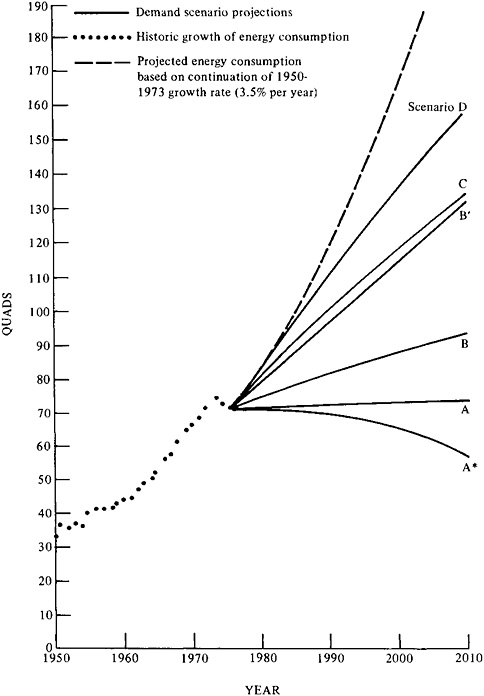
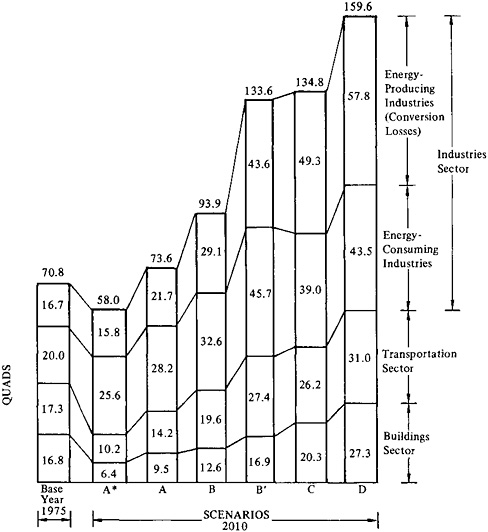
FIGURE 1–4 Demand and Conservation Panel projections of primary energy use by energy-consuming sectors to 2010 (quads). Energy demand projections for different assumptions about GNP or population growth can be roughly estimated by scaling the scenario projections. For example, for a crude idea of the effect of 3 percent average annual GNP growth (rather than the 2 percent assumed in constructing the scenarios), one would multiply the demand total by 3/2.
conversion and distribution losses and the like cause the projected totals to vary somewhat from the Demand and Conservation Panel’s framework. These scenarios offer a 3 percent GNP growth variant for each of the Demand and Conservation Panel’s scenarios. Figure 1–5, showing the primary energy totals for these scenarios, illustrates the difference varying GNP growth assumptions might make.
Yet another set of scenarios was developed by the CONAES Modeling
TABLE 1–2 Scenario Projections Used in the CONAES Study
|
Scenario |
Source |
Description |
|
Demand scenarios: A*, A, B, B′, C, D |
Demand and Conservation Panel |
A, B, C, and D explore the effects of varied schedules of prices for energy at the point of use, from an average quadrupling between 1975 and 2010 (scenario A) to a case (scenario D) in which the average price of energy falls to two thirds of its 1975 value by 2010. Basic assumptions include 2 percent annual average growth in GNP, and population growth to 280 million in the United States in 2010. Scenario A* is a variant of A that takes additional conservation measures into account. Scenario B′ is a variant of B, projecting the effect on energy consumption of a higher annual average rate of growth in GNP (3 percent). |
|
Supply scenarios: Business as usual, enhanced supply, and national commitment |
Supply and Delivery Panel |
Projections of energy resource and power production under various sets of assumed policy and regulatory conditions. Business-as-usual projections assume continuation without change of the policies and regulations prevailing in 1975; enhanced-supply and national-commitment projections assume policies and regulatory practices to encourage energy resource and power production. |
|
Study scenarios: I2, I3, II2, II3, III2, III3, IV2, IV3 (correspondence between study scenarios and demand scenarios: I2=A*, II2=A, III2=B, III3=B′, IV2=C; scenario D was not used) |
Staff of the CONAES study |
Based on the demand scenarios; integrations of the projections of demand from the demand scenarios and projections of supply from the supply scenarios. A variant of each price-schedule scenario was projected for 3 percent annual average growth of GNP. |
|
MRG scenarios |
Modeling Resource Group |
Estimates of the economic costs of limiting or proscribing energy technologies in accordance with various policies. |
Resource Group in its econometric investigation of various determinants of energy supply and demand. Unlike the three sets of scenarios thus far described, those of the Modeling Resource Group do not proceed from prices (or, equivalently, policies) given at the outset. They are based instead on equilibration of supply and demand, so that prices come as outputs, rather than being given as inputs. Generally speaking, these scenarios contain much less sectoral detail than the other scenarios used in the study; in exchange for this simplification, they permit a more extensive exploration of different policies (including special constraints or moratoria on particular technologies).
It should always be borne in mind, in dealing with scenarios and other projections, that they cannot pretend to predict the future. All scenarios require great oversimplification of reality, and many judgments enter into their assumptions. The value of scenarios is in their self-consistency, which allows an approximate view of relationships between supply and demand, trade-offs among different energy sources, and the possible impacts of broadly defined policies.* The temptation to take this kind of projection too literally should be resisted, but as means of illustrating certain gross features of the nation’s energy system and its possible evolution, this study’s scenarios have value.
THE ECONOMIC EFFECTS OF MODERATING ENERGY CONSUMPTION
According to the analyses of the Demand and Conservation Panel, the kinds of energy conservation that offer the greatest promise of substantially moderating in the growth of energy consumption involve replacing equipment and structures with those that are more energy efficient. To avoid economic penalties, the rate of replacement must generally depend on the normal turnover of capital stock—about 10 years for automobiles, 20–50 years for industrial plants, and 50 years or more for housing—though rising energy prices will accelerate this turnover in most cases. The effects of conservation will become evident only over the long term,† but these long-term benefits require many actions that must be begun immediately, and sustained consistently over time.
As Table 1–1 and Figure 1–3 illustrate, the panel found that any of a range of primary energy consumption totals (varying by a factor of more than 2) could be compatible with the same rate of growth in GNP. Thus, energy consumption may exert less influence on the size of the economy than often has been supposed.
These findings were borne out by the work of the Modeling Resource
|
* |
See statement 1–10, by E.J.Gornowski, Appendix A. |
|
† |
Statement 1–11, by J.P.Holdren: An oversimplification. Many approaches to conservation—such as retrofitting existing equipment—produce big short-term gains. |
TABLE 1–3 Supply of Major Energy Forms Under Supply and Delivery Panel’s Enhanced-Supply Assumptions (quads)a
|
Energy Form |
Annual Supply |
|||
|
1977 |
1990 |
2000 |
2010 |
|
|
Crude oil |
19.6 |
20.0 |
18.0 |
16.0 |
|
Natural gas |
19.4 |
15.8 |
15.0 |
14.0 |
|
Oil shale |
0 |
0.7 |
1.0 |
1.5 |
|
Synthetic liquidsb |
(0) |
(0.4) |
(2.4) |
(8.0) |
|
Synthetic gasb |
(0) |
(1.7) |
(3.5) |
(4.8) |
|
Coal |
16.4 |
26.6 |
37.2 |
49.5 |
|
Geothermal |
0 |
0.6 |
1.6 |
4.1 |
|
Solar |
0 |
1.7 |
5.9 |
10.7 |
|
Nuclear |
2.7 |
13.0 |
29.5 |
41.7 |
|
Hydroelectric |
2.4 |
4.1 |
5.0 |
5.0 |
|
aFor specific assumptions underlying estimates, see the report by the National Research Council, U.S. Energy Supply Prospects to 2010, Committee on Nuclear and Alternative Energy Systems, Supply and Delivery Panel (Washington, D.C.: National Academy of Sciences, 1979) and Chapter 11, Table 11–14. bSynthetic fuels are produced from coal and oil shale and are not included in totals. |
||||
Group7—work undertaken by different methods and for different purposes. This group sought, among other aims, a first approximation of the cost of limiting the energy available from specific technologies, the cost being measured as the size of the resulting effect on cumulative GNP. The group also assessed the feedback effect on GNP of imposing a blanket tax on all primary sources of energy to reduce energy consumption to specific levels below a base case.
The group found this feedback surprisingly small, assuming that the economy is given time to adjust by shifting capital and other resources from the processes of energy production and use to less energy-intensive processes, activities, and products. Subsequent work8,9 has tended generally to confirm these conclusions.*
The size of the feedback depends critically, however, on the parameter that describes the quantitative effect of all these substitutions taken together: the long-term price elasticity of demand for primary energy. This value is the ratio of the percentage change in demand to the percentage change in price that evokes it. For example, if demand falls 5 percent in
response to a 10 percent increase in price, the price elasticity of demand is equal to −5÷10, or −0.5.
The Modeling Resource Group reports that for the case in which primary energy consumption is reduced by 58 percent below the market-equilibrium “base case,” cumulative GNP between 1975 and 2010 decreases just 2 percent if the price elasticity of demand for primary energy is −0.5, but 29 percent if the value of this parameter is −0.25. The elasticity parameter thus is a key source of uncertainty in the Modeling Resource Group’s work, because its true value is not well known. More detailed discussions can be found in chapters 2 and 11.
It should be noted that even for the higher elasticity value, achieving this reduction is estimated by the Modeling Resource Group to require a tax on electricity rising by 2010 to 126 mills per kilowatt-hour (kWh) and a tax on oil and gas rising to $8.90 per million Btu (both measured in 1975 dollars). This implies a price for oil of more than 4 times the 1978 OPEC price. For electricity it implies about an eightfold increase over 1975 prices.* (See notes to Table 11–38.)
The work of the Demand and Conservation Panel and the Modeling Resource Group points up the importance of allowing the economy sufficient time to make the substitutions and institute the changes necessary to accommodate higher prices for energy or limitations on supply (or both). Sudden supply curtailments or changes in energy prices can disrupt the economy. The same changes introduced gradually over several decades may have only minor economic effects.
DOMESTIC ENERGY SUPPLIES FOR THE NEAR TERM
The supply of fluid fuels—gas and oil—which together provide about 75 percent of the nation’s energy, will be critical in the 1980s and 1990s. Petroleum supplies worldwide will be severely and increasingly strained as world production approaches its probable peak near the end of the century. This probably would be true even if there were no OPEC; the possibilities of politically controlled prices and production cutbacks are greatly enhanced by such a situation. Domestic production of oil and natural gas has already peaked and begun to decline, and U.S. demand for imports already imposes rather serious strains on the world oil market. Oil production from Prudhoe Bay in Alaska will provide only temporary relief before beginning to fall off in the 1980s. Even the most optimistic projections of the CONAES Supply and Delivery Panel10 show irreversible
|
* |
See statement 1–13, by J.P.Holdren, Appendix A. |
declines in domestic oil and natural gas production in the future. Coal and nuclear power are the only large-scale alternatives† to oil and gas in the near term (before about 2000), as the use of fluid fuels begins to wane.‡ Both are best suited to the generation of electricity in this period. As such they are limited as replacements for fluid fuels, but will have uses in other applications.
A balanced combination of coal- and nuclear-generated electricity is preferable, on environmental and economic grounds, to the predominance of either. The principal points that favor nuclear electricity in its present form (light water reactors (LWR’s) operated with a once-through fuel cycle without fuel reprocessing) are as follows.
-
In most regions, the average cost of nuclear electricity is less than that of coal-generated electricity, and the difference is likely to continue in the future.*
-
The cost of nuclear energy is less sensitive than that of coal to future increases in fuel prices and to changes in environmental standards, Because of this, the use of nuclear power could reduce future regional disparities in electric power costs.
-
Nuclear fuel supplies are more readily stockpiled than coal, and nuclear electricity is thus less subject to interruption by strikes, bad weather, and transportation disruptions.
-
The environmental and health effects of routine operation of nuclear reactors are substantially less than those of coal per unit of electric power produced.
-
If the effect of carbon dioxide (CO2) accumulation on climate becomes a major global environmental issue in the early years of the twenty-first century, it will be aggravated by utility commitments to the use of coal, because power plants have lives of 30–40 years.
The principal points in favor of coal are the following.
-
Coal power plants and the coal fuel cycle are not subject to low-probability, high-consequence accidents or sabotage, which are inherently uncertain and unpredictable. The hazards of coal can be made relatively predictable, given sufficient research on such matters as the health effects of coal-derived air pollutants. (This research will take perhaps 15–20 years to complete, however.)
|
† |
See statement 1–14, by E.J.Gornowski, Appendix A. |
|
‡ |
Statement 1–15, by J.P.Holdren: My longer dissenting view, statement 1–2, Appendix A, also applies here. |
|
* |
Statement 1–16, by J.P.Holdren: This point and the next one may well depend on a lower incidence of safety-related nuclear plant shutdowns than is likely. |
-
Coal burning in utilities has no major foreign policy implications, as does nuclear power via the problems of nuclear weapons proliferation and safeguards. The outlook for political acceptance of coal may thus be more favorable than that for nuclear energy.
-
Coal is better adapted to generation of intermediate-load power, and in this sense is complementary to base-load nuclear plants. In addition, the lead time for planning coal-burning power plants is less than that for nuclear plants.
-
Coal-generated electricity has a much larger resource base than light water reactors operated on a once-through fuel cycle, which will be important if fuel reprocessing and the development of more resource-efficient reactor systems and fuel cycles are further delayed.
-
In the absence of a demonstrated, licensable plan for high-level waste management, the nuclear fuel cycle may be considered an incompletely proven technology, which is therefore subject to uncertainties as to whether its continued growth will be permitted. To the degree that this is so, nuclear energy runs a greater risk than coal of future capacity shortfalls due to unexpected technical developments.
After 1990, coal will likely be increasingly demanded for conversion to synthetic fuels, and nuclear generation may thus be required for continued growth in generating capacity. The amount of nuclear capacity needed is sensitively dependent on the profile of electricity growth after 1990, and especially after 2000. The several issues surrounding coal- and nuclear-generated electricity are discussed in chapters 4, 5, and 9. Chapter 11 compares various rates of installation for both coal-fired and nuclear power plants under assumed rates of growth for electricity consumption.
Electricity can be provided from almost any primary fuel and thus adds a good deal of flexibility to energy supply. However, probably even in comparison with synthetic liquids and gases, it has high capital costs.11 There is a complex trade-off between fuel flexibility, which favors electricity, and cost, which favors fluid fuels in applications such as heating and cooling buildings and providing most industrial heat. Electricity prices are considered likely to rise less rapidly than the prices of oil, gas, and synthetic fuels, owing to technological progress in the generation of electricity and to the large fraction of electricity cost attributable to fixed capital charges, which remain constant once a plant is built but for future plants tend to increase at the same rate as the general price level. The CONAES Demand and Conservation Panel, however, assumed delivered electricity prices would rise nearly as quickly as other
fuel prices. These differences may result in underestimated electricity growth in the CONAES projections.*
For the intermediate term, conservation of fluid fuels is an urgent necessity. Even in the projections embodying vigorous energy conservation, limited supplies of fluid fuels could lead to rapid price rises, especially if imports are constrained or subject to cartel pricing. If prices rise too rapidly, there will be insufficient time for development and investment to adjust, and economic dislocation will result.
The constraints on supplies of fluid fuels could probably not be fully relieved by a high-electrification policy depending on coal and nuclear fission, except at a considerably increased total cost.† However, accelerated electrification could contribute significantly to relieving future fluid fuel problems. Commitment to rapid nuclear development, for example, could be regarded as fairly expensive insurance against rapid increases in fluid fuel prices, but domestic oil and gas exploration and development of a strong synthetic fuel industry‡ should be accorded the most urgent priorities in energy supply (next in importance to conservation).
DOMESTIC OIL AND GAS
Production of both petroleum and natural gas in the United States is on the decline, and according to the analysis of this study, will continue to decline. Oil production in this country peaked in 1970 at 3.5 billion barrels, and by 1978 had fallen to 3.2 billion barrels. Domestic natural gas production shows a similar pattern; production peaked in 1973 at 21.7 trillion ft3, and by 1978 stood at 18.9 trillion.
These trends reflect the fact that domestic oil and gas are rapidly becoming more difficult and expensive to find and produce, as development moves toward deeper wells and the exploitation of deposits in such relatively inaccessible locations as the Alaskan North Slope and the Outer Continental Shelf. Reserves of both oil and natural gas have been falling since about 1970, though exploration has expanded rapidly in that time. Reserves now equal about 10 times annual production—the lowest level since the Prudhoe Bay field was added to reserves in 1970.
Under the policies prevailing until recently, the CONAES Supply and Delivery Panel projected that domestic production of oil would fall from 20 quadrillion Btu (quads) in 1975 to only 6 quads in 2010 (production in 1977 was 17.5 quads). Moderately enhanced conditions for oil production (including removal of price controls, accelerated offshore leasing, and somewhat advanced exploration and production technology) would bring production in 2010 to 16 quads, according to the projections, and a national commitment (relaxation of some environmental standards and permit requirements, along with federal priorities on labor and materials for oil development) might raise this to 18 quads in 2010. Under no plausible conditions does it appear possible even to maintain current domestic oil production, much less increase it.*
Gas production projections of the Supply and Delivery Panel show an even more severe decline than the oil projections. Under prevailing policies, extrapolated to 2010, gas production falls from a 1975 total of 19.7 quads to 5 quads in 2010. Moderately enhanced conditions yield a 2010 production level of 14 quads, and a national commitment results in 16 quads of gas production in 2010. Not all experts (including several participants in the CONAES study) agree with these conclusions, however. There is a considerable body of opinion that the potential for new natural gas sources, including several types of “unconventional” sources, is much higher than the study’s supply projections indicate. This opinion has gained a considerable number of new adherents since 1976, when the supply projections were made.
In the light of the Demand and Conservation Panel’s projections for liquid and gaseous fuels12 (which suggest that demand is likely to continue rising until at least 2010), this outlook for production is disturbing. It suggests that the nation will become increasingly dependent on imports of oil from a world market that is already strained and that the oil situation will worsen before improving.
The situation for natural gas is not so serious, because there is a large amount of unmarketed (flared or reinjected) gas in the world. However, even sustaining current domestic natural gas consumption will probably require imports larger than the current 1 quad/yr. Most of these imports are likely to come by pipeline from Canada and possibly from Mexico, but the remainder may have to be in the form of liquefied natural gas (LNG), the landed price of which reflects the costs of liquefaction, transportation, and storage. World supplies of gas are larger compared to demand than those of oil, and their production can be expanded more readily. The international implications of importing gas are correspondingly less severe.
However, the cost, and its effect on our trade balance, will not be negligible. It would be obviously unwise for the nation to become as dependent on imported gas as it now is on imported oil.*
The response of the United States to this challenge must be two-sided. Every reasonable effort must be made to conserve both oil and natural gas by using them more efficiently, by substituting alternative domestic energy forms (initially coal and conventional nuclear power for the most part, and later synthetic liquids and gases, solar energy, breeder reactors, and other long-term energy sources),† and by reducing growth in overall energy demand. An equally determined effort must be made to sustain and encourage domestic production to the extent consistent with environmental protection.
This committee does not believe that oil shale, despite the huge energy content of the domestic resource, will be a major source of energy.‡ First, the resource is concentrated in a very small and relatively primitive region, where large-scale development is likely to face resistance on environmental grounds. Second, water supplies are a serious constraint.13 Third, the amount of solid waste that must be handled is very large relative to the energy extracted, even with in situ processing. However, these conclusions should not be interpreted as justifying the neglect of oil shale development. Every new source helps, and oil from shale will probably become economically competitive earlier than other synthetic fuels.
These efforts to deal with the problem of fluid fuels—it must be stressed—deserve high national priority in energy policy. The longer a commitment is delayed, the more likely it will be that pressures for hasty and ill-considered crash programs will build up. Such programs would involve high technological risks and possibly compromise of environmental and safety standards.
PROSPECTS FOR COAL
Coal is the nation’s (and the world’s) most abundant fossil fuel. Domestic recoverable reserves amount to 6,000 quads, part of a total domestic resource of about 80,000 quads and world resources crudely estimated at 300,000 quads. Of this huge supply, we consume about 14 quads each year in the United States, or less than 0.3 percent of domestic recoverable coal
|
* |
See statement 1–21, by H.Brooks, Appendix A. |
|
† |
Statement 1-22, by J.P.Holdren: I reject the implication of this wording that the need to replace oil and gas justifies the use of every alternative, including breeders. |
|
‡ |
Statement 1–23, by R.H.Cannon and E.J.Gornowski; Despite the problems foreseen, we believe that the huge oil shale reserves in the United States will be developed to produce very large quantities of fluid fuel. |
reserves. In contrast, the nation extracts almost 10 percent of its 420-quad recoverable reserves of oil and natural gas each year.
The substitution of coal for natural gas and oil on a large scale, either directly or through synthetic coal-derived substitutes, would on these grounds seem a ready-made solution to the nation’s energy problems. The simple arithmetic of availability, however, does not tell the whole story. Doubling or tripling the use of coal will take time, investments amounting over the years to hundreds of billions of dollars, and coordinated efforts to solve an array of industrial, economic, and environmental problems.
Unlike oil and gas consumption, coal use is limited not by reserves or production capacity, but by the extraordinary industrial and regulatory difficulties of mining and burning it in an environmentally acceptable, and at the same time economically competitive, manner. Coal is chemically and physically extremely variable, and it is relatively difficult to handle and transport. Its use produces heavy burdens of waste matter and pollutants. Even at its substantial price advantage, Btu for Btu, it cannot compete with oil and natural gas in many applications, because of the expense of handling and storing it, disposing of ash and other solid wastes, and controlling emissions to the air. Only in very large installations, such as utility power plants and large industrial boilers, is coal today generally economic and environmentally suitable as a fuel. Domestic coal production capacity today exceeds domestic* demand, and this may well remain true until the end of the century.14
The health problems associated with coal affect both its production and its use. The health of underground miners presents complex and costly problems, for example, and is in need of better management; black lung is the notable instance. At the other end of the fuel cycle, the evolving state of air pollution regulations to deal with the emissions of coal combustion complicates planning for increased demand and thus in turn inhibits investment in mines, transportation facilities, and coal-fired utility and industrial boilers.
The future is obscured also by a number of more speculative problems, which may result in further regulatory restrictions on the use of coal. Chief among these is the risk that before the middle of the next century, emissions of carbon dioxide, an unavoidable (and essentially uncontrollable) product of fossil fuel combustion, may produce such concentrations in the atmosphere that large and virtually irreversible alterations may occur in the world’s climate. (See chapter 9.) Also worrisome is the water-supply situation, which could limit synthetic fuel production or electricity generation unless large-scale and possibly expensive measures are taken to
minimize water consumption and manage water supplies. The location of these industrial activities, even in the East, will require regional hydrological studies to determine where they can best be supported, with due attention to the needs of other water consumers, including ecosystems. Water shortage in the West is already a well-known difficulty. Both of these problems deserve very high research priorities.
Over the coming 10–20 years, some of these obstacles will weaken as new technologies increase the efficiency and convenience of coal use, and as the prices of oil and gas rise while their reliability of supply declines, Current expectations for some of these technologies are indicated in Table 1–4.
A number of the advanced electric power cycles for coal, now under development, would be suitable for smaller installations, and their relatively clean environmental characteristics would make it possible to locate them near users of their power. For smaller industrial users, fluidized-bed combustion and synthetic fuels could provide additional new markets for coal.
Department of Energy regulations under the Powerplant and Industrial Fuel Use Act of 1978 (Public Law 95–620), when implemented and enforced, will further improve the outlook for coal by banning oil and natural gas use in most new power plants and large industrial heating units.
This is not to imply that all the problems of coal use are solvable or that coal can become the mainstay of the domestic energy sector over the long term. Its environmental costs will remain high; mining and burning 2–3 times the present coal output, even if done efficiently and with care, will be difficult (and increasingly expensive) if the contributions of this energy source to air and water pollution and land degradation are to be kept from increasing.
With the foregoing in mind, we see the following as the prime objectives of national coal policy in the coming decades.
-
Provide the private sector with strong investment incentives to establish a synthetic fuel industry in time to compensate for declining domestic and imported oil supplies (probably some time near 1990),
-
Continue the broad federal research and development program in fossil fuel technology to widen the market for coal by increasing the efficiency and environmental cleanliness with which it can be used.
-
Improve health in the mines by strengthening industrial hygiene and by performing the necessary epidemiological research. The black lung problem especially should be clarified. (See chapter 9.)
-
Devote the necessary resources to supporting long-term epidemiological and laboratory studies of the public health consequences of coal-derived air pollutants, thus putting air quality regulation on a firmer
TABLE 1–4 Advanced Technologies for the Use of Coal
|
Technology |
Characteristics |
Status of Development |
Possible Date for Introduction at Commercial Scale |
|
Atmospheric fluidized-bed combustion |
Applicable to small power plants and small-scale industrial uses |
Pilot plants now operating |
1980s |
|
Pressurized fluidized-bed combustion |
Applicable to larger units than atmospheric version, more efficient, better control of nitrogen and sulfur oxide emissions |
13-MWe pilot plant planned |
1990s |
|
Gasification combined-cycle (gas and steam turbines) generating units |
Burn medium-Btu gas produced from coal at generating site; require operation at high temperatures |
Demonstration plant now being built to generate and burn low-Btu gas |
1990s |
|
Molten-carbon. ate fuel cells |
Essentially noiseless, pollution-free, and efficient; could possibly use low- or medium-Btu gas as source of hydrogen ions for fuel |
5–10 years from demonstration with synthetic gas from coal |
Late 1990s; lags other fuel cell development by 5 years |
|
Magnetohydrodynamics |
Potential 50 percent conversion efficiency from coal to electricity; sulfur can be separated out in operation; high-temperature exhaust could be used directly or to generate steam |
Pilot plant in U.S.S.R., fueled by natural gas; coal system still experimental |
2000 or later |
|
Synthetic gas |
Low- and medium-Btu gas from coal now technically feasible, but expensive; |
|
|
|
|
High-Btu gas (methane) also feasible, but even more expensive today; new processes now being developed |
Second-generation technologies now being tested in pilot plants Third-generation technologies in design stage |
1990s for second-generation processes |
|
Technology |
Characteristics |
Status of Development |
Possible Date for Introduction at Commercial Scale |
|
Synthetic oil |
Indirect liquefaction technology; complicated, expensive, and inefficient |
Used commercially in South Africa |
|
|
|
Pyrolysis: range of products, including refinable heavy high-sulfur oils and char (for which there is no ready market); not favored in current program |
Small experimental unit operating since 1971 |
1980s |
|
|
Solvent extraction and catalytic hydrogenation: catalysts expensive; burden of hazardous wastes and control of nitrogen |
Pilot plants now testing several processes |
1990s |
-
scientific basis that allows more confident and efficient setting of standards, on which industry can depend in its long-range planning. (See chapter 9.)
-
Develop a long-range plan, recognizing that coal presents some serious environmental and occupational health and safety problems, and that it does not relieve the nation of its need to develop truly sustainable energy sources for the long term.
By 1985, given reasonably coherent policy and successful research and development, domestic demand for coal should approach 1 billion tons/yr (about 20–25 quads). Some new synthetic fuel and direct combustion technologies will be on the verge of commercialization. Knowledge of the environmental and public health effects of coal production and use should be improved to the point that the current regulatory uncertainties can be reduced.
As the year 2010 is approached, coal use in the United States may reach 2 billion tons annually.* Some of the cleaner, more efficient coal-use techniques now being developed should attain full commercialization. Knowledge of the environmental and public health characteristics of coal
may be sufficient for confident standard setting. At the same time, however, water supply will be increasingly critical, and, if the hypothesis of climatic change due to carbon dioxide accumulation proves correct, the first signs of climatic effects from carbon dioxide emissions may be appearing. But it is possible that at about this time indefinitely sustainable energy sources may begin to become available.
For now, however, there is little room for maneuver. Coal must be used in increasing quantities, and mainly with current technologies, until at least the turn of the century, regardless of what happens with respect to such alternatives as nuclear fission or solar energy. However, because of the variety of environmental and social problems it presents, it cannot indefinitely provide additions to energy supply. To keep these problems under control until truly sustainable energy sources can be deployed widely, it would be wise to approach coal as conservatively as possible under the circumstances, with an eye especially to its environmental risks,
PROSPECTS FOR NUCLEAR POWER
Nuclear power could serve as both an intermediate- and long-term source of energy. Its prospects and problems are unique. For example, energy that can be extracted from the available nuclear fuel depends extremely heavily on the fuel cycle used. The light water reactors now in use in the United States, with their associated fuel cycle, make very inefficient use of uranium resources, and could exhaust the domestic supply of high-grade uranium in several decades. By contrast, if breeder reactors were to be developed and used, the domestic nuclear fuel supply could last for hundreds of thousands of years. An intermediate class of reactors and fuel cycles—advanced converters—could, under certain circumstances, extend domestic nuclear fuel supplies for perhaps a half century. These subjects are taken up in chapter 5 under the heading “Availability of Uranium.”
Decisions about nuclear power have precipitated debate about the role of citizen participation in technological policy. Opposition to nuclear power in the United States has been expressed in legal and political challenges to the siting and licensing of specific power plants, and in protests over the lack of a waste disposal program and alleged deficiencies in federal regulation and management of nuclear power.15 The resulting delays and uncertainty have contributed to rapid escalation of the capital costs of nuclear installations and to considerable difficulty in predicting their future costs and availability.
While many of these protests have centered on specific issues, social scientists suggest that the sources of public concern with the technology are broader and deeper, and thus that concern is unlikely to subside with
the resolution of specific issues.16 The technical and scientific community is itself divided, and debates among experts have heightened public awareness of the uncertainty surrounding many of the technical issues bearing on nuclear power. Very briefly, the principal issues for nuclear power as an intermediate-term energy source are as follows.
-
The future role of nuclear energy, in general, and the relative roles of different nuclear options, in particular, depend on the extent of domestic and worldwide uranium resources, and on the rates at which these resources could be produced at reasonable levels of cost.
-
The choice between a breeder reactor and an advanced converter reactor and the timing of development and introduction depend on a complicated integration of a number of technical factors. Most prominent among these are the rate of growth of electricity use, the supply of fuel, and the relative capital costs of advanced converters and breeders. Relatively low electricity growth rates and large supplies of low-cost uranium would generally favor the advanced converter.* It should not be forgotten, however, that the breeder and its fuel cycle are probably in a more advanced state of development worldwide than any high-conversion-ratio converter alternative, and that moderate to high electricity growth rates and/or rather limited supplies of uranium would favor the breeder alternative.
-
There is a need for early action on a workable program of nuclear waste management, which has until very recently been neglected by the federal government. Adequate technical solutions can probably be found, but some particularly difficult political and institutional problems will have to be solved.
-
Public appraisal of nuclear power is of vital importance. Among the most important public concerns are the potential connection of commercial nuclear power with international proliferation of nuclear weapons, the safety of the nuclear fuel cycle (a concern heightened by the recent nuclear reactor accident near Harrisburg, Pennsylvania), and the question of nuclear waste treatment and disposal.
Uranium Resources
According to the CONAES Supply and Delivery Panel’s Uranium Resource Group,17 only those uranium deposits considered, technically, “reserves” or “probable additional resources” should be taken as a basis for prudent planning. They further state that the availability of uranium ore at
estimated forward costs (the costs of mining and milling once the ore has been found) of more than $30/lb, is known with such little certainty that it cannot be used for planning. They estimate at about 1.8 million tons the uranium available in these categories at forward costs below $30/lb. This committee believes that estimates of reserves and probable additional resources at forward costs of up to $50/lb are reliable enough to plan on; according to the U.S. Department of Energy,18 the quantity of uranium in these categories and at this forward cost is about 2.4 million tons. If, however, less reliably known uranium supplies (listed as “possible” or “speculative” additional resources) are included, the estimate would rise to about 4 million tons.
A typical 1-gigawatt (electric) (GWe) light water reactor with once-through fueling requires about 5600 tons of fuel for a 30-yr useful life. Thus, only about 400 such reactors could be built before the estimated 2.4-million-ton resource base of uranium would be completely committed. The limits on capacity could be extended somewhat (without major alterations in the fuel cycle such as recycling spent fuel) by optimizing the design of light water reactors for fuel efficiency (up to 15 percent improvement in uranium oxide (U3O8) consumption), and by lowering the uranium-235 (235U) concentration in enrichment plant tails. The additional reactor capacity that could be available in 2000 as a result of these measures depends on how soon they could be introduced. The most optimistic estimate would probably not exceed 500 GWe (insufficient for the highest-growth projections of the CONAES study but adequate for other projections).
In brief, if the pessimistic estimates of the Uranium Resource Group are borne out by experience, more efficient reactors and fuel cycles probably will be needed in the United States by the first decade of the next century. Otherwise, the use of nuclear fission will have to be curtailed, beginning at about that time. This will occur when coal demand for synthetic fuels could be increasing rapidly to offset the decline in domestic oil and gas production, and when the first evidence of climatic change (due largely to CO2 emissions from fossil fuel combustion) may be appearing. Unless various solar options could be introduced and spread very rapidly, this phasing out of nuclear energy would come therefore at a particulary awkward time.
Alternative Fuel Cycles and Advanced Reactors
Light water reactors with the current once-through fuel cycle use only 0.6 percent of the energy potential in uranium as mined. By contrast, breeder reactors are capable of converting the abundant “fertile” isotope 238U to fissile plutonium-239 (239Pu), and of regenerating more plutonium than
they use. They can eventually make use of more than 70 percent of the energy potential of uranium ore. There are also conceptual reactors and fuel cycles capable of converting fertile thorium-232 (232Th) to another fissile isotope of uranium, 233U. These could in principle make use of nearly 70 percent of the energy in thorium, which is believed to be 4 times as abundant as uranium in the earth’s crust.
Thus, the ability to unlock the energy potential of the fertile isotopes 238U and 232Th has a tremendous multiplying effect on available resources—much more than the approximate factor of 100 implied by the numbers just quoted. This is because the use of breeder reactors reduces the contribution of resource prices to the price of electricity by a factor of 100, thus making available ores that are too low in grade, and thus too expensive, to be used as fuel for conventional reactors. For practical purposes, the resource costs for breeders make a negligible contribution to the cost of electricity. Thus, the economics of breeders are closer to those of renewable resources than to those of nonrenewable resources.
As explained earlier, the present generation of light water reactors can be relied on as an energy source only until the early twenty-first century, even if optimized for fuel efficiency. The resource base may be extended 20–30 percent by working enrichment plants harder (to recover a larger fraction of the 235U in the natural uranium). Another 35–40 percent extension could be achieved by reprocessing spent fuel in a chemical separation process to recover fissile plutonium and uranium for refabrication into new fuel elements. Either measure, however, would significantly extend the life of a nuclear industry based on light water reactors only if electricity growth leveled off after 2000.
Unfortunately, during fuel reprocessing, plutonium appears briefly in a form that can be converted into nuclear weapons much more readily than can the fissile and fertile material in the spent fuel elements themselves. This gives rise to the fear that a nation in possession of fuel reprocessing facilities might be tempted to manufacture clandestine nuclear weapons, or that a determined and well-organized terrorist group could steal enough material to manufacture a nuclear bomb, It is possible that the recycling process could be modified to make it much less vulnerable in this respect, but both the desirability and the effectiveness of such modifications are still matters of debate. (See chapter 5 under the heading “Reprocessing Alternatives.”) These considerations bear heavily on decisions to deploy advanced, more efficient reactors, because all advanced reactors require reprocessing and refabrication of fuel to realize their maximum potential for more efficient resource use. (However, there are several advanced converter designs that could realize substantial, though not the greatest possible, resource savings over improved light water reactors even with a once-through fuel cycle.)
This difficulty has spurred consideration of substantial improvements in nuclear fuel use that do not require reprocessing. One option that might be available, for example, is the Canadian CANDU heavy water reactor fueled with slightly enriched uranium—perhaps 1 percent 235U. (The CANDU as now operated is fueled with natural, unenriched uranium.) With a once-through fuel cycle (that is, without reprocessing), this could in principle reduce the fuel requirements per unit of power by nearly 40 percent as compared to an unmodified light water reactor of existing design. Although this might be worthwhile under some circumstances, it would still not be sufficient to preserve the option of supplying electricity by nuclear power much beyond 2000, unless the rate of growth in demand for electricity diminished greatly after that date. Uranium resources could be extended an additional 20 percent if some method such as laser isotope separation is developed for stripping the fissile material from the tailings at uranium enrichment plants (though this is unlikely before the 1990s at the soonest). The benefits of these measures would become important, however, only if the nuclear power industry were not called upon to expand significantly; growth in capacity would otherwise consume the extra supplies within a few years.
Until recently, the nuclear research and development program in this country concentrated on the liquid-metal fast breeder reactor (LMFBR) and the plutonium-uranium fuel cycle. The advantage of this approach is that the LMFBR offers the greatest degree of independence from the continuing need for natural uranium. For times of the order of hundreds of years, the LMFBR could use as fertile material the stored tails left over from the enrichment process for weapons material and reactor fuel. Such breeders could extend the life of the uranium resource indefinitely, for practical purposes, and they could be fueled initially with plutonium separated from the spent fuel of light water reactors, as well as with natural uranium. Thus, they offer electrical energy independence to the United States and other nations that have access to even small quantities of enrichment tails. (Nations that operate their light water reactors with fuel enriched in the United States are legally entitled to enrichment tails; these tails are worthless unless they can be used in breeder reactors or stripped for their remaining fissile content by laser isotope separation or another technique.)
Because the LMFBR generates almost 20 percent more fissile isotopes than it consumes, it can be used as the basis for a growing nuclear capacity without requiring the mining of new ore.* For this reason, it appears attractive for a wide range of projected growth rates in electrical capacity.
Breeders, in the course of their operation, produce more fissile isotopes
than they consume. Converters such as light water reactors and CANDU produce a good deal less. Advanced converters produce almost as much as they consume. If their spent fuel is reprocessed and reloaded into the reactors, they can be run with much less fresh fissile material than is needed to run light water reactors or CANDU’s. There are many possible advanced converters.
The principal advanced-reactor alternatives are listed in Table 1–5, along with indications of their relative developmental maturity.
Thus, as between breeders and advanced converters, the following conditions (not all of equal weight) would favor the use of fast breeder reactors over advanced converters in the United States for nuclear-generated electricity.
-
The demand for electricity in the United States grows steadily after the year 2000.
-
Total domestic uranium resources are found to be at the low end of recent estimates.
-
Very little intermediate-grade uranium ore that can be produced at costs in the range of $100–$200/lb is found.
-
The world growth of nuclear capacity in conventional light water reactors exerts pressure on the United States to export some of its uranium or enriched fuel (or both) to offset the balance-of-payments deficit from oil imports, to discourage recycling of fissile isotopes or installation of breeder reactors elsewhere, or for other reasons.
The following conditions would generally favor the use of advanced converters for nuclear-generated electricity.
-
The demand for electricity in the United States grows slowly, especially after 2000.
-
Sufficient uranium resources are found to fuel advanced converters at their projected rate of introduction and installation, particularly intermediate-grade ores producible at costs around $100–$200/lb.
-
Capital costs of advanced converters turn out to be significantly less than those of breeders.
-
The operation of advanced converters and their fuel cycles offers advantages in safeguarding against proliferation or diversion.
-
New enrichment technologies that permit economic operation at low tails assays become available early.
As has been noted, economics and the type of measures adopted by the world to slow proliferation of nuclear weapons could dominate the choice. Both are highly uncertain factors; we can only estimate future costs
TABLE 1–5 Nuclear Reactors and Fuel Cycles; Development Status
|
Reactor Type |
Fuel Cycles |
Development Status |
Possible Commercial Introduction in the United Statesa |
|
Light water reactor (LWR) |
Slightly enriched U (~3 percent 235U) |
Commercial in United States |
1960 |
|
Spectral-shift-control reactor (SSCR) |
Th-Ub |
Conceptual designs, small experiment run; borrows LWR technology |
1990; fuel cycle, 1995 or laterc |
|
Light water breeder reactor (LWBR) |
Th-Ub |
Experiment running; borrows LWR technology; fuel cycle not developed |
1990; fuel cycle, 1995 or laterc |
|
Heavy water reactor (CANDU or HWR) |
Natural uranium |
Commercial in Canada, some U.S. experience |
1990 |
|
|
Slightly enriched U (~1.2 percent 235U) |
Modification of existing designs |
1995 |
|
|
Th-Ub |
Modification of designs; fuel cycle not developed |
1995 |
|
High-temperature gas-cooled reactor (HTGR) |
Th-Ub |
Demonstration running; related development in Germany; fuel cycle partly developed |
1985; fuel cycle, 1995 or laterc |
|
Molten-salt (breeder) reactor (MSR or MSBR) |
Th-Ub |
Small experiment run; much more development needed |
2005 |
|
Liquid-metal fast breeder reactor (LMFBR) |
U-Pub |
Many demonstrations in the United States and abroad* |
1995 |
|
|
Th-Ub |
Fuel cycle not developed |
1995 |
|
Gas-cooled fast breeder reactor (GCFBR) |
U-Pub Th-Ub |
Concepts only; borrows LMFBR and HTGR technology |
2000 |
|
aBased on the assumption of firm decisions in 1978 to proceed with commercialization. No institutional delays have been considered except those associated with adapting foreign technology. On the basis of light water reactor experience, it can be estimated that it would take about an additional 15 years after introduction to have significant capacity in place. bIndicated fuel cycles demand reprocessing. cThorium-uranium fuel reprocessing is less developed than uranium-plutonium reprocessing. Indicated reactors could operate for several years before accumulating enough recyclable material for reprocessing. *Statement 1–28, by J.P.Holdren: Fuel reprocessing with the short turnaround time, high throughput, and high plutonium recovery needed to make the LMFBR perform as advertised remains undemonstrated. |
|||
qualitatively, and we can rely on surprises in international decision making.
This committee could not reach a consensus on whether the likelihood of the circumstances favoring advanced converters is great enough to warrant their development as insurance against difficulties and delays in LMFBR development. Nor was it able to reach agreement on how much the availability of the breeder option might be delayed by a parallel effort on advanced-converter development, and whether such a delay would be justified by a greater ultimate chance for the success of at least one advanced-reactor alternative. It did, however, reach general agreement that the LMFBR dominates the nuclear alternatives over the widest range of assumed future circumstances, provided that its cost goals and other technical objectives can be realized. Those who believe that low growth in demand for electricity is desirable and can be achieved after 1990 argue that a U.S. program to develop the LMFBR sets a poor example to other nations whose development of the LMFBR would increase the danger of proliferation, The LMFBR, they argue, would be needed only for unnecessarily high rates of growth in electricity demand, which could be avoided in this country by sensible conservation policies.* In this view, the advanced converter provides sufficiently improved resource efficiency over present reactors to fill the gap until sustainable nonnuclear long-term technologies become available. These arguments underscore the importance of energy demand considerations in planning energy supply systems for the United States.†
The Demand for Electricity
It is obvious from the foregoing that the rate of growth in electricity use will largely determine how much nuclear power is needed and will govern the strategy of nuclear development.‡ Some pertinent quantities are set out in Table 1–6, which uses the CONAES study scenarios (described in detail in chapter 11) to indicate the trade-offs between nuclear power and other sources of electricity.
Study scenario III3, for example, shows nuclear power providing about 35 percent of the nation’s electricity in 2010. Its contribution of 1670 billion kWh is about twice what the U.S. Department of Energy19 forecasts nuclear power will contribute in 1990. Thus the scenario involves a modest rate of nuclear growth over the 20-yr period 1990–2010. Coal-generated
|
* |
See statement 1–29, by H.S.Houthakker, E.J.Gornowski, and L.F.Lischer, Appendix A. |
|
† |
See statement 1–30, by L.F.Lischer and E.J.Gornowski, Appendix A. |
|
‡ |
Statement 1–31, by L.F.Lischer, E.J.Gornowski, and H.I.Kohn: This, in our opinion, is neither obvious nor a foregone conclusion. |
electricity in this scenario is at about twice the 1978 level. Coal and nuclear power together generate some 3.8 trillion kWh.
If nuclear power were unavailable in 2010, and the entire amount of energy were generated by coal, this would represent a fourfold increase in coal-based generation over the 1978 level, approaching the threshold of serious environmental risks, and in some mining areas introducing or exacerbating problems of water supply. (See chapters 9 and 4, respectively.)
In the high-growth case represented by study scenario IV3, 3 times the present electrical capacity would be required. Assuming that 1 GWe of nuclear capacity generates 6 billion kWh in the course of 1 year’s operation, 470 GWe of nuclear capacity would be required to generate the 2810 billion kWh specified for nuclear power by this scenario. Together, nuclear power and coal generate nearly 6 trillion kWh. If coal-based generation were restricted to, say, 2 trillion (or about twice its 1978 level) and the remaining 4 trillion were supplied by nuclear power, an extraordinary national commitment to nuclear capacity additions would be necessary. With the above assumption about the productivity of 1 GWe unit of nuclear capacity, some 670 GWe of nuclear capacity would be needed, including breeders or other advanced reactors.†
These examples illustrate the limited mutual substitutability of nuclear energy and coal in the high-growth cases and suggest that if growth in demand for electricity is underestimated, shortages of energy may begin to appear during the first decade of the twenty-first century.*
Nuclear Weapons Proliferation and Breeder Development
Two interrelated issues concerning the breeder reactor are the scale and pace of development and the relationship of breeders to the problem of nuclear weapons proliferation and diversion (chapter 5). Regarding proliferation of nuclear weapons, sharply different and irreconcilable views emerged in this study. One view holds that plutonium reprocessing would be a major step toward proliferation, and advocates that the United States forgo for a considerable period the benefits of reprocessing and the breeder to demonstrate how seriously this nation regards the proliferation problem. This view acknowledges that proliferation can thus be only delayed, not prevented, but asserts that deferral of reprocessing and breeder deployment could provide time to develop international institutions and procedures to safeguard the nuclear fuel cycle. In this view, the
|
† |
See statement 1–32, by H.Brooks, Appendix A. |
|
* |
Statement 1–33, by J.P.Holdren: The narrow emphasis on high-growth futures in this passage and the accompanying table is unwarranted and gives an unbalanced impression of the possibilities. |
TABLE 1–6 Electricity Generated, by Source (billions of kilowatt-hours)
|
|
Actual 1978a |
CONAES Study Scenarios for 2010 |
||
|
II2 |
III3 |
IV3 |
||
|
Nuclear |
276 |
670 |
1670 |
2810 |
|
Coal |
976 |
1460 |
2110 |
3140 |
|
Other |
954 |
730 |
940 |
1080 |
|
TOTAL |
2206 |
2860 |
4720 |
7030 |
|
aSource: 1978 data are From U.S. Department Of Energy, Annual Report to Congress 1978, vol. 2. Data, Energy Information Administration (Washington, D.C.: U.S. Government Printing Office. 1979). |
||||
LMFBR should be treated primarily as a long-term technology of last resort, to be used only if research in the coming decades indicates that other long-term options are much more costly or will not be available in time to offset the phasing out of light water reactors.
The contrary view holds that the breeder has been demonstrated to be the most promising option for the long-term future, with favorable economics and minimal ecological effects, and that therefore a national commitment to large-scale development should be made now, so that LMFBR’s can be available before the twenty-first century. It is argued that the commercial nuclear fuel cycle is the least likely and most expensive of several possible paths to proliferation, and that inexpensive means for producing weapons-grade material by isotope separation are likely to be widely available by the time commercial reprocessing of plutonium becomes widespread.
The response by those favoring deferral of reprocessing is that, whereas there are indeed other routes to proliferation, they require more deliberate political decisions, while a weapons capability could be “backed into” rather easily once commercial reprocessing and refabrication facilities have been installed in a given country. The critical consideration in this view is not the availability of cheaper and less elaborate routes to weapons (which certainly exist) but the reduced warning time between a decision to divert material from the commercial fuel cycle and the production of the first weapons.*
The view that breeder development should proceed rapidly holds that deferral would increase the potential pressures of the United States on the world petroleum market and on the limited world uranium supply for light water reactors. This would in turn stimulate other countries that are much more dependent than the United States on outside energy sources to pursue the breeder reactor—the one option close to availability that promises a degree of energy independence. Moreover, this argument asserts, world conflict over limited petroleum supplies appears more likely to lead to nuclear war than weapons proliferation resulting from reasonably safeguarded commercialization of plutonium.
Management of Radioactive Wastes
The current plans for managing nuclear wastes involve underground burial. The technical aspect of the problem has two parts: first, to find the best technology for packaging and isolating the wastes and, second, to secure a geological environment that would itself be proof against the failure of containers after one or two hundred years, so that migration of the waste nuclides in groundwater would be slow enough and accompanied by so much dilution that the radioactivity of the water when it reached the biosphere would be a small fraction of the natural background.
There is no lack of potential disposal methods. There is enough knowledge about the bedded salt disposal option, for example, to warrant a full-scale engineered test of this option with an initial sample of commercial waste. The engineering of such a test would require mainly acquisition of site-specific geological and hydrological data for a few chosen sites. There is, however, no data base adequate for a final choice among the proposed solutions, nor proof that a given choice of sites and waste forms poses the lowest possible risk to the public. Waste disposal is often used as a basis for the political expression of more generalized opposition to nuclear power and to the whole decision-making mechanism for nuclear power.
Two points should be kept in mind. First, it is not necessary to look upon waste disposal as a problem to which the perfect solution must be found before any action can be taken. Caution is necessary, of course, but the risks should not be a bar to the continued use of nuclear power. The maximum hazard resulting from inadequate waste disposal is much smaller than that which could be postulated as the result of a reactor accident or sabotage. Indeed, the maximum exposures involved can almost certainly be kept below those associated with routine exposures to radioactivity in nuclear operations, which are themselves very small compared to exposure to natural background radiation. Caution is dictated not by the magnitude of the risks but by their long duration. The principal risks extend for about a thousand years, and the presence of actinides in
the wastes adds a very small continuing risk for millions of years. In this respect, however, nuclear waste disposal is not entirely unique. Elevated CO2 concentrations in the atmosphere, once established, will persist for many hundreds of years, and over this extended period could have devastating effects, if the hypothesis of climatic changes due to CO2 accumulation proves correct.
The following specific conclusions and recommendations represent the consensus view of CONAES.
-
The nature of the risks from geological disposal of nuclear waste must be clearly spelled out and publicized. The only credible mechanisms by which wastes, once emplaced, could reach the environment involve the slow return of highly dilute radioactive materials, rather than the sudden return of concentrated ones.* This could lead to small increases of environmental radiation over previous background levels, lasting for a long time and covering a large area. It could not lead to severe or acute radiation exposures.
-
The federal government should immediately proceed to set criteria for geological waste disposal. These should be (1) performance criteria (i.e., leach rates, heat rates) on waste forms in categories that take account of the risks from different types of wastes and (2) site criteria (i.e., groundwater standards, seismic stability standards, resource and mining restrictions).
-
The problem of disposal must be separated from the problem of spent fuel storage.
-
The problem of military wastes must be settled, and the issue separated from that of commercial wastes. It may well be that long-term entombment is appropriate. If so, it should be effected. Military wastes consist mostly of fission products, and their period of high risk is therefore relatively short.
-
The federal government should accept full responsibility for any radioactive wastes in existence, leaving the question of joint state-federal responsibility to be resolved for wastes generated in the future.
-
Standards must be set and enforced for the treatment of abandoned mines and of tailings from mines and mills. These standards should permit disposal of low-level alpha-active wastes (i.e., alpha-active wastes which, if blended with the tailings, would not significantly increase their risk) in tailings piles.† This will require collaboration between the federal government and the uranium-mining states.
|
* |
Statement 1–35, by J.P.Holdren: To say “only credible mechanisms” bespeaks a confidence in our knowledge of the possibilities that I cannot entirely share. I would accept “most plausible mechanisms.” (H.I.Kohn: I concur with the general intent of this remark.) |
|
† |
See statement 1–36, by J.P.Holdren, Appendix A. |
-
While retrievability of waste after emplacement is a desirable feature of a test facility, and such a facility would be useful for a research and development program, retrievability ought not to be a consideration in designing a repository for actual waste disposal.
These recommendations agree substantially with those of the American Physical Society’s “Report to the American Physical Society by the Study Group on Nuclear Fuel Cycles and Waste Management.”20
Putting these recommendations into effect may involve serious political difficulty.* Most states and communities would like nuclear wastes to be disposed of elsewhere, and some have imposed virtual bans on waste treatment and other fuel cycle operations. This raises important legal and constitutional questions about the limitations of federal power to overrule state and municipal land-use laws. This committee did not consider itself competent to judge these issues.
Public Appraisal of Nuclear Power
The principal sources of public concern with nuclear power are not merely technical, but institutional and social as well. Questions about technical approaches to proliferation control, reactor safety, and waste management are largely expressions of concern about whether human beings and institutions can be relied on over the long term to manage radioactive wastes, ensure reactor safety, and secure weapons-usable material.
The accident at the Three Mile Island plant in Pennsylvania has heightened this concern. It occurred late in this committee’s deliberations, and it is still too early for final judgments in detail. However, what the committee has learned about it thus far has not led it to change its assessment of the physical risks of nuclear power; chapter 9, in the section on the health impacts of energy production and use, discusses this event and its likely impact on human health (which is very small).† Public opinion of the accident and its implications, however, is vital, and it is probably too early to know how that will be expressed. Major studies of the accident and its consequences are underway throughout the world; notable in this country are an investigation by a specially appointed Presidential commission and one by the Electric Power Research Institute’s newly formed Nuclear Safety Analysis Center. The Nuclear Regulatory Commission, in reaction to the accident, may impose additional safety requirements on nuclear reactors.
Other aspects of the appraisal of nuclear power reflect individual views
of the social impacts of this technology. Nuclear power, for example, has become for some a symbol of large-scale, centralized technology over which citizens have surrendered control to experts who cannot be held accountable. Some feel that nuclear power, and particularly the breeder, promotes the continuation of a high-growth materialistic society that will ultimately prove disastrous to the physical and social environment. Some see nuclear power as competing for capital resources with energy systems that are more subject to local control, and thus excluding patterns of social organization that are based on such local autonomy. Many* fear that the level of social discipline necessary for adequate management and safe-guarding of nuclear power will prove incompatible with democratic institutions and will erode civil liberties. They point to the growth of alienation, terrorism, and crime and to the associated vulnerability of centralized sociotechnical systems.†
Others, of course, see nuclear power as essential if people are to have enough energy to meet basic needs, live in reasonable comfort, and look forward to improving their own lives and those of their children and the underprivileged. It is clear that even in controversies over technical issues, judgments are influenced by the social and institutional values of the individuals involved. The greater the technical uncertainties, the more room there is for interpreting whatever knowledge exists to support one’s subjective preferences. Not uncommonly, decisions among technological options will have to be reached—if only in the form of postponements of action—before the technical uncertainties can be fully resolved. To a great extent, therefore, technical questions as well as social and institutional ones will be decided by political processes.‡§
INDEFINITELY SUSTAINABLE ENERGY SOURCES
Four energy sources—nuclear fission with breeding, solar energy in various forms, controlled thermonuclear fusion, and geothermal energy—offer the potential for indefinitely sustainable energy supply. That is, each could supply up to 10 times our present energy requirements for thousands of years (or much more). They differ widely in their readiness for use, in their probable side effects, and in their economics. Present knowledge is insufficient for meaningful economic comparisons and permits only limited comparisons by other criteria, such as environmental and safety risks or
|
* |
Statement 1–39, by H.I.Kohn: “Some” is a better estimate than “many.” |
|
† |
See statement 1–40, by B.I.Spinrad, H.Brooks, and D.J.Rose, Appendix A. |
|
‡ |
Statement 1–41, by H.I.Kohn: To assist these processes, the widespread dissemination of factual information must be promoted. |
|
§ |
See statement 1–42, by L.F.Lischer, H.Brooks, and D.J.Rose, Appendix A. |
the likelihood of successful technical development. The degree of risk associated with a technology often depends on details of engineering design and on compromises between safety and economics that cannot be foreseen until the technology has been translated into full-scale designs with considerable practical operating experience to back up assessments of component reliability and the like. A technology in the conceptual stage often appears less risky than it will after the practical engineering questions have been faced.
The government’s program in long-term energy supply, to allow realistic choices of long-term options, should include sustained research and development of many of these technologies. Priorities at this stage should depend more on the likelihood of significant technical progress than on economic comparisons among existing versions. New technical developments and changes in resource economics are likely to alter comparative cost assessments radically. Furthermore, a combination of long-term sources is likely to offer more flexibility and overall reliability than dependence on a single system. The ultimate total cost of deploying a new energy technology on a broad scale is so much larger than the research and development costs that maintaining an array of options in the development stage is fully justified, A cost advantage of a few percent in a deployed system would easily pay for all the research and development that produced it.
THE BREEDER REACTOR
The breeder reactor, in the form of the liquid-metal fast breeder reactor, has benefited from a sustained and relatively large federally financed research and development effort. It is also the cboice of several other countries, including the United Kingdom, France, West Germany, the U.S.S.R., and Japan, all of which have large LMFBR development programs, Worldwide, about 3.8 GWe of LMFBR capacity is under construction or on order. Given the present state of breeder development worldwide, construction of a commercial breeder could begin somewhere in the world within 10 years, provided there are no unexpected technical developments or insurmountable political obstacles. Significant capacity could be in place by the year 2000. This will probably not take place first in the United States because this country has more energy options than most other countries, but it is not technically impossible. However, there are technical uncertainties related to reactor safety, capital costs, and fuel cycle safeguards that could still seriously delay the program.
Other types of breeder reactors, such as the gas-cooled fast breeder reactor (GCFBR) and the molten-salt breeder reactor (MSBR), are in much earlier stages of development but have some potentially attractive features
(described in chapter 5). If the LMFBR is pursued vigorously and successfully and is required relatively soon, the other types of breeder may never be brought to the point at which they can compete. On the other hand, if breeders turn out not to be required early, these other types could prove to be realistic alternatives by the time a breeder is needed and might be superior to LMFBR’s on a number of technical grounds.*
SOLAR ENERGY
In the long term, it should be possible for solar energy to provide each of the energy forms used by people: heat, electricity, and fuels.21 In the near term, outside of hydroelectric power—included by convention with solar energy—only certain heating applications are economical.†
Assessing the long-term potential of solar energy will require an extended period of research and development. A major issue for national solar energy policy is the balance of research and development effort among the variety of solar technologies. The federal solar energy program emphasizes technologies for producing electricity, but the most important use of solar energy in the long-term future may in fact be the synthesis of fluid fuels, which could solve the problem of energy storage and make good use of the existing distribution system developed for gas and oil.
Direct Thermal Use of Solar Energy
Technologies for the direct use of solar heat are in general the most nearly economical today. Some of the methods—domestic space heating, domestic hot water heating, and production of hot water or low-pressure steam for industrial and agricultural processes—can be considered fairly well developed; they are among the most probable candidates for widespread commercialization in the intermediate term. Efficient and economical solar cooling remains a difficult problem.
The direct applications of solar thermal energy are generally more costly than conventional alternatives, Btu for Btu, and even more costly in terms of the initial investments in complete heating and cooling systems. (For a discussion of the economics of such systems see chapter 6 under the heading “Direct Use of Solar Heat.”) It can be argued, however, that conventional economics do not reflect the full comparative advantage of solar applications when social costs are taken into account. Savings in imported oil may have a moderating effect on the rise of world oil prices which could generate savings elsewhere in the U.S. economy, more than
|
* |
See statement 1–43, by B.I.Spinrad, H.Brooks, and L.F.Lischer, Appendix A. |
|
† |
Statement 1–44, by J.P.Holdren: Biomass (as crop, timber, and municipal wastes) is economical today for process steam and electricity generation in some U.S. localities. |
offsetting the extra initial cost of solar installations. The risks of solar energy appear to be generally less than those of other energy sources, and public confidence in solar energy is strong; public controversy (which is costly in itself) can thus be avoided in deploying these technologies. These advantages strengthen the case for introducing government incentives to induce consumers to select solar systems in preference to conventional alternatives. Such measures would help solar heating for buildings and industrial processes to gain a significant market share earlier than it would otherwise. Such incentives are already widely incorporated in federal and state programs. Unfortunately, there is no agreed upon calculus by which to estimate the market penetration likely with any given level of subsidy, or with which to quantify the benefits to society of substituting solar energy for otherwise cheaper alternatives.
Solar-Generated Electricity
The amount of electricity that could in principle be generated by solar energy could more than provide for present demand. The main obstacle is cost; unless major technical breakthroughs occur, solar electricity will be expensive compared to alternatives. Four concepts under active development for generating electric power from solar radiation are: photovoltaic conversion (with so-called solar cells); solar thermal conversion, which involves concentrating sunshine to achieve high-temperature heat; wind power; and ocean thermal energy conversion, which would use floating power stations to exploit the temperature difference between the ocean’s surface and subsurface waters to run heat engines.
Photovoltaic Conversion Photovoltaic conversion is a commercial technology used in space and in remote installations where performance, rather than cost, is the principal concern. Photovoltaic arrays have demonstrated adequate efficiency and reliability but at high costs—more than 20 times the prevailing cost of residential electricity. Costs have been coming down rapidly, however, and a number of unanticipated technical improvements have occurred. The economic outlook for photovoltaics is considerably more favorable than it was a few years ago. There is some debate about how the necessary additional cost reductions might best be achieved—through mass production of present technology with evolutionary improvements, or through a breakthrough in materials and device configurations resulting from exploratory research. Unlike solar thermal conversion, this is a field in which fundamental research could yield dramatic returns, and recent technical progress has been very rapid. Given the high stakes in solar energy and the long-term nature of its potential benefits, the present investment in exploratory research for photovoltaics is
still inadequate, though recently much improved. CONAES is in agreement with the general assessment provided in the recent study of photovoltaics by the American Physical Society, which suggests that market penetration is unlikely to exceed 1 percent before the year 2000, and advocates the exploratory development approach in preference to the mass-production strategy.22
Solar Thermal Conversion The most heavily financed system for generating electricity with thermal energy from the sun is the solar tower concept, with arrays of mirrors focusing sunlight on a boiler at the top of a tower. Although this concept appears technically feasible, there is insufficient information for reliable cost estimates. Projected costs appear to lie in the range of 5–10 times the current bus-bar cost of electricity if storage costs are included. Because so much of the cost is embodied in structural materials such as concrete and steel, which represent well-developed technologies for which large cost reductions are unlikely, reducing costs will be difficult. A 10-MWe pilot plant is being constructed in Barstow, California. Photovoltaic conversion probably offers greater long-term promise and potential for improvement.*
Wind Power Wind generators constitute a form of solar energy that is already economic for a few sites and markets. However, integration of this highly variable power source into utility grids could increase total generating costs if a great deal of backup capacity were required, When used in small amounts, however, wind generators can save fuel without requiring additional capacity. Economic uses might be found in utility districts that have a high proportion of hydroelectric generating capacity, or extensive pumped hydroelectric storage, either of which could accommodate the variations in wind power output.
Sites for wind generation are limited by wind conditions and scenic considerations. The amount of land required per unit of electrical capacity is much larger than for most other forms of solar energy (although land used for wind generation is of course not completely excluded from other uses). Interference with communications can also be a problem, because television and microwave signals are reflected by the moving surfaces of wind turbines. A major environmental impact is likely to be from access roads for maintenance and construction and from electrical interconnections of numerous units.
The most immediate prospect for wind technology would be to develop a diversified design and manufacturing effort directed generally at
machines with generating capacities of about 1 megawatt (electric) (MWe). The market potential is likely to be highly differentiated and, relative to total domestic energy demand, modest. Experience with the problems of integrating wind-generating capacity into the existing electric grid could be a valuable by-product, applicable to other solar electric technologies as they become available.
Ocean Thermal Conversion Another system of solar electricity generation is ocean thermal energy conversion (OTEC), a technology that would exploit temperature differences between surface and deep ocean water in the tropics to generate electricity at very low thermodynamic efficiency (1–3 percent). Its attractive aspect is that it would not require storage technology and thus could be directly usable for base loads. OTEC may be technically feasible, but there is not yet a basis for choice among proposed designs. Lack of knowledge and inadequate research on problems of fouling of the very large heat-transfer surfaces by marine organisms are among the uncertainties in the present program. There are also serious questions about climatic and ecological effects if OTEC stations were deployed on a scale sufficient to supply an appreciable fraction (say 10 percent) of domestic energy requirements.
Fluid Fuels
In the long term, whatever mix of sustainable energy sources is used will have to provide a large supply of fluid fuels for applications (such as transportation) that are most easily served today by oil and natural gas. The production of fluid fuels from solar energy represents a very large and promising field for basic research. Such a process would obviate the need for auxiliary energy storage, and at the same time provide fuel for the nation’s existing distribution networks as natural fuels are depleted. This could provide an easier transition to the ultimate long-term energy system than a program that emphasizes electricity production alone. The federal solar energy program gives too little attention to the production of fluid fuels.
For the long term, the most attractive potential solar energy alternative for the production of fluid fuels is probably direct photochemical conversion. For example, this might involve decomposition of water to produce hydrogen, which can be used directly as a fuel or in synthesizing hydrocarbon fuels from various sources of carbon, including CO2 from the atmosphere.
Theoretical calculations indicate the possibility of photochemical conversion efficiencies of 20–30 percent, based on incident solar energy, compared to an average photosynthetic efficiency of 0.1 percent for natural
ecosystems, and up to 1.0 percent for “energy farms.” A level of fluid fuels approximately equal to present consumption of oil and gas (55 quads) could be provided by efficient photochemical conversion from the solar energy falling on about 50,000 km2, or about 1 percent of the land area of the United States. However, it must be emphasized that research on solar fuel production is at a much earlier stage than other solar energy research. There does not yet exist even a promising laboratory system worth scaling up to an engineering experiment. Thus, barring unexpected developments in fundamental research in the near future, the production of fuels from solar energy is probably much further in the future than even such sophisticated technologies as photovoltaics.
The production of fuels from biomass, a form of solar energy, also has promise in the relatively near term. CONAES has estimated that a total of 5 quads might be produced from organic municipal and agricultural wastes, from plants grown on otherwise useless land, and from seaweed. This would not be an inconsiderable contribution. Beyond this, the growth of biomass in land-based energy farms would use land that would require fertilization and irrigation for high, sustainable yields, and would compete for land and other inputs that could be devoted to uses of higher value, such as growing food. The ecological costs of such a development would be high and would rise rapidly as production requirements increased, at least in the United States. (Marine energy farming could have none of these problems. Not enough is yet known, however, to assess the potential magnitude of its contribution.)
Some Institutional Issues
A problem for many solar energy alternatives is finding ways to introduce decentralized technology into a centralized network without disrupting the economics and reliability of the network. This problem could be reduced by the development of cheap and effective energy storage systems to absorb excess energy and release it when needed.
An important institutional issue is the degree to which regulation, taxation, and subsidies should be designed to encourage market penetration of solar technologies that are uneconomic under existing circumstances. An argument in favor of this is that the social costs of solar energy are sufficiently less than those of other energy forms so that its higher economic costs should either be offset by taxes on other energy forms that are potentially more damaging to the environment, or borne in part by special government subsidies or tax benefits.*
|
* |
See statement 1–46, by B.I.Spinrad, Appendix A. |
The Solar Resource Group of CONAES concluded that solar energy technologies could contribute substantially to the national energy system by 2010 if there were purposeful governmental intervention in the energy market. However, with energy prices in the range considered by the CONAES study, market penetration by solar energy (apart from biomass and hydroelectric) would be only a few quads up to 2010. One scenario was explored to see how quickly solar energy could be introduced if tax policies and economic incentives were introduced to encourage its adoption in preference to other energy forms, regardless of cost. (See chapters 6 and 11.) Under these conditions, solar technologies might provide as much as 25–30 quads of total energy needs by 2010, but the total price (at today’s costs) could be enormous, running to a cumulative total of several trillion dollars—2–3 times the cost of alternatives. These costs, of course, can be expected in the future to change relative to those of alternatives. The following are the committee’s main conclusions and recommendations.
-
The aim of the government’s solar energy program should be to place the nation in the best possible position to make realistic choices among solar and other possible long-term options when choices become necessary. This requires continuing support of research and development of many solar technologies. Comparisons of the present costs of various solar technologies and other long-term technologies should not be regarded as critical at the present stage of development. Of more importance is the potential for significant technical advances.
-
In the intermediate-term future, the direct use of solar heat can contribute significantly to the nation’s energy system. Solar heating technologies should be viewed, along with many conservation measures, as means of reducing domestic use of exhaustible resources. The role of the government program should be to support the development and assist the implementation of the most cost-effective solar techniques, used wisely in combination with energy conservation. In particular, the government should stimulate the integration of solar heating into energy-conserving architectural design in both residential and commercial construction through support and incentives for passive solar design. Since all solar energy technologies are capital intensive, uses that are distributed throughout the year, such as domestic water heating and low-temperature industrial process heating, are likely to be economically competitive earlier than uses for which there are large seasonal variations in demand.
-
Under present market conditions, solar heating systems are usually not competitive with other available technologies, and therefore market forces alone will bring about little use of solar energy by 2010—probably less than 6 quads even if average energy prices quadruple.23 Nevertheless,
-
important social benefits would accrue from the early implementation of these systems: they would contribute to the nation’s conservation program, they are environmentally fairly benign, and they would increase the diversity of the domestic energy supply system and its resilience against interruption. National policy should stimulate the early use of solar energy by intervening in the energy market with subsidies and other incentives.
-
Many solar energy applications require long-term development, and these technologies should properly be compared with breeder reactors or fusion. It would be unfortunate if alternatives to the breeder were rejected because too little is known about them today to count on them. It would also be wrong to assume that the choice will or should fall on a single long-term option. Diversity in the nation’s long-term sources can provide valuable resilience in the face of interruptions in the supply of a single fuel or technology. Decisions that restrict the variety of our long-term options should be deferred as long as possible.
-
The cost picture for a number of solar technologies is likely to change radically in the future, with successes and failures in development. Competing technologies will display parallel trends. The costs of many factors of production are likely to change, affecting various technologies differently. In most cases, the economics of solar energy depend critically on advances in ancillary technologies, such as energy storage. It is important that the benefits of these ancillary developments be assessed for other energy technologies on the same basis as for solar, however. For example, cheap energy storage systems would benefit the economics of all systems containing capital-intensive generating technologies.
Large-scale government demonstrations of long-term solar technologies, such as the planned demonstration of a solar thermal central station power plant, could be counterproductive if undertaken prematurely. Such projects may suggest (possibly incorrectly) that the technologies could never become economically competitive, whereas waiting for additional technical developments* could result in a considerably more favorable outlook.
-
An imbalance exists in the federal solar energy program in favor of technologies to produce electricity at the expense of those to produce fuels. Much more attention should be given to the development of long-term solar technologies for fuels production, although there is at present no prime candidate besides biomass production (which is limited by ecological considerations).†
-
The diversity of solar technologies is so great that it is difficult to
|
* |
See statement 1–47, by L.F.Lischer, Appendix A. |
|
† |
Statement 1–48, by R.H.Cannon, Jr.: Marine biomass, producing methane gas in situ, does not have the inherent ecological problems (or the nutrient supply problems) of land biomass referred to here. |
-
make decisions among alternatives in a centralized way. To a great extent, the actual choice of which solar technologies to deploy should be made in as decentralized a manner as possible. In other words, the decisions should be left to private industry and individual consumers. The government’s role should be development of a broad scientific and technological base in support of solar energy (much as it did for nuclear energy prior to 1960 and for aeronautics after World War I), and provision of economic incentives that favor solar alternatives.
GEOTHERMAL ENERGY
Sources of geothermal energy include crustal rocks, sediments, volcanic deposits, water, and steam and other gases at usably high temperatures that are accessible from the earth’s surface. These sources of the earth’s heat are not indefinitely sustainable in the same sense as solar energy. However, their total energy is sufficiently large that their potential as an energy source will depend mainly on their economic producibility, not on resource considerations.
At present, the only usable geothermal resources are deposits of hot water or natural steam. In the long-term future, it may be possible to extract heat from the natural thermal gradient in the earth’s crust and from unusually hot rock formations lying close to the earth’s crust. As there is no demonstrated technology for using these resources, cost and producibility can be only grossly estimated. The use of dry rock depends on developing a fracture system large enough to be economical as a source of heat. The possibilities of achieving this, and the environmental effects of doing so, are speculative.
The only widespread potential geothermal resource, the natural thermal gradient, is the most speculative in practical exploitability. As an indefinitely sustainable source, it also suffers the inherent disadvantage that the normal heat flux from the inside of the earth is only about one thousandth the solar energy flux falling on the same area.
One potentially large source of rather low-temperature geothermal energy is the geopressured brines of the Gulf Coast. These brines may also hold very large amounts of dissolved natural gas. If the heat and gas can be exploited simultaneously, this might be an attractive resource. Too little is known about it today. Considerable effort is justified in assessing its potential.
CONTROLLED THERMONUCLEAR FUSION
As a potential source of electricity, nuclear fusion makes use of deuterium—widely found in ocean water. These resources are at least
equal to those upon which fission breeders depend. (However, the most likely practical fusion system will use the deuterium-tritium reaction; this requires a source of tritium, which in turn depends on lithium—which is nowhere near so abundant—as a raw material.)
Despite many hundreds of millions of dollars spent on research in its basic science and technology, fusion has yet to be demonstrated as technically feasible. There is rising optimism that a scientific demonstration will be made within the next 5 years. Until that time, little can be said about the engineering or economic feasibility of fusion as a source of power.
There are several proposed reactor configurations, and the first to demonstrate scientific feasibility may not be the most appropriate to carry forward into engineering development. For this reason, it is much too early in the development of fusion to select any single approach. The federal program should continue work on alternative approaches to plasma confinement science before attempting to move to experiments on the scale of pilot plants.
Although fusion has some of the same problems as fission, the problem of radioactive waste management is probably less severe. (The radioactive tritium fuel can pose an occupational health problem but not a waste disposal problem.) The problems associated with commercial traffic in weapons-usable fissile materials are largely absent. However, present fusion devices are prolific sources of neutrons and, if surrounded by a natural uranium blanket, could be used to manufacture plutonium and 233U for weapons (or, of course, for use in fission reactors). There is general agreement that this is one of the more difficult ways of acquiring weapons-usable material and that the risk of proliferation from fusion power is not comparable to that associated with fission power. Inertial confinement approaches to fusion, though, may have an additional proliferation liability, since they may tend to spread technical insights relevant to the design of fusion weapons. The radioactivity produced in fusion devices could be from 10 to several hundred times smaller than that from fission (depending on the choice of materials), and the troublesome problem of alpha-active actinides is avoided.
Nuclear fusion is not a technology of the twentieth century and has not reached a stage of development at which it can be counted on even as a “dark horse” in meeting future energy requirements. On the other hand, the resource base is so large, and the prospects for fewer environmental, proliferation, or safety problems than with fission breeders so promising, that we must not drop it. We cannot afford to lose the momentum that has been gained through several decades of increasingly well-coordinated international research. We have not gone into a great deal of technical
detail or assessment of the fusion program because it does not promise to serve as a source of energy within the period considered by this study.
The following are the committee’s main conclusions and recommendations.
-
Although the development of nuclear fusion faces considerable uncertainties, it should be pursued, and reevaluated in 5 years, By that time, large scientific break-even experiments in both magnetic and inertial confinement will have been attempted. More realistic engineering designs and guidance for further research on technological obstacles should then emerge naturally.
-
Principal attention should be directed first to the problems of pure fusion reactors, before the question of fusion-fission hybrids is considered.
-
The immature state of fusion research and development offers the opportunity to give attention to environmental and safety characteristics in the earliest stages of design. Consideration of these characteristics is so important to decisions on major investments in fusion that the opportunity must not be wasted.
-
A small effort should be directed to fuel cycles other than deuteriumtritium. Pure deuterium has a much lower reaction rate, but it presents no critical tritium-regeneration problem and wreaks less structural damage from high-energy neutrons. In the so-called neutronless fuel cycles, all particles and products are electrically charged, and in theory there is no radioactivity. Smaller devices might be built, but the required plasma temperatures are much higher, and the energy balance is probably unfavorable.
-
High priority should be given to study and testing of structural materials, and assessments of their availability must be undertaken.
-
Research and development in nuclear fusion has enjoyed singularly fruitful international cooperation. This cooperation should be encouraged and extended to speed progress and reduce the cost to each individual country.
RISKS OF ENERGY SYSTEMS
All energy systems entail risks to the environment and to the health and welfare of people. It is difficult to compare such risks quantitatively, however, because our information about them is subject to great uncertainties, and because there is no widely accepted common scale of measurement for aggregating or comparing different kinds of risks and adverse effects. Furthermore, especially with centralized energy production and distribution systems, risks and benefits are not shared equally; the
person who receives the benefit generally does not suffer the risk. Obviously, there are important distributional issues that complicate the weighing of risks against benefits and make social decisions about acceptable risk more difficult. There are also differences of opinion on the relative valuation of statistical and catastrophic fatalities, and of value judgments about risks to the environment—particularly to natural ecosystems, where adverse effects on human beings are less obvious and immediate than threats to health and safety.
There is danger that quantitative estimates of risks will be interpreted too literally and that their apparent definiteness will tend to outweigh qualitative and esthetic considerations. Still, it is difficult to reach and articulate meaningful conclusions without using quantitative values. It is important to realize, though, that value judgments expressed as political preferences may often predominate over quantitative technical judgments in decisions about energy systems and strategies.
Three bases for comparison of energy-related risks have been used.
-
Energy-related risks of a given kind have been compared with risks arising from background effects of the same kind; for example, the risks of cancer from the emissions of nuclear power plants can be compared to the average risk of cancer in the general population or the hypothetically estimated cancer risk associated with exposure to natural background radiation.
-
Cross comparisons have been made among alternative energy technologies, systems, or strategies with respect to similar kinds of risks; for example, comparison of the relative risks to ecosystems from coal combustion and hydropower.
-
Energy-related risks have been compared to more familiar risks; for example, fatalities from nuclear reactor accidents could be compared to fatalities from commercial airline accidents.
There are difficulties with each of these bases for comparison. In comparing energy-related risks to background effects of the same kind, the way that quantitative results are presented—in absolute or percentage terms—can influence public perception of the risk involved. If the additional risk from a particular source is very small percentagewise and the exposed population is very large, then the absolute number of deaths attributed to the source can be very large indeed, though it may constitute an infinitesimal fraction of the deaths that would have occurred anyway.
In comparing risks from different technologies, the difficulty stems from the value judgments needed in weighing the different kinds of risks. How should fatalities be compared with injury or sickness? How should immediate deaths from catastrophic events be compared to similar
numbers of deaths occurring much later or in future populations? People may place quite different values on these different kinds of adverse effects, and these values may change with time.
Another problem is that the same risk is not equally acceptable under all circumstances. People accept familiar risks, such as those associated with the automobile, cigaret smoking, and industrial accidents, yet reject much smaller risks associated with new technologies. The voluntariness of risk is also important; those who voluntarily accept high risks, such as those of motorcycles or contact sports, may strongly object to the minute involuntary risk of a nearby chemical factory. Finally, the risks of an activity that provides a unique benefit—as does, for example, the automobile—are more acceptable than the risks of a technology to which there appear to be alternatives.
A general problem that arises in connection with almost all risk assessments is the significance of dose-effect relationships at very low doses, for both radiation and chemicals. The conservative assumption of a linear dose-effect relation down to zero dose leads to very large estimates of incremental threats to large populations, but such extrapolations are very uncertain. They are likely to be overestimates, but the extent of the overestimate is unknown.
One way around the problem of low-level radiation is to compare the radiation dose with that from natural background radiation. Although the effect of neither is known, one can say that a radiation dose of, say, 1 percent of the background will have an effect, if any, that is a tiny fraction of the effect of a radiation dose that the human species has experienced throughout its history. Unfortunately, no such comparison is possible with most chemical hazards.
In this study, comparison of energy-related risks to nonenergy risks was generally avoided, because it was believed to have little pertinence to energy policy decisions.*† The first two of the above-listed three approaches to risk comparison were followed, with emphasis whenever feasible on the comparison of similar types of risks from different energy technologies and strategies.
ROUTINE INDUSTRIAL ACCIDENTS AND DISEASE
Accidents are the most accurately assessed of energy-related risks. In this regard, coal is the most dangerous of major energy sources: About 10 times as many accidental deaths occur in the coal energy cycle, from mine to power plant, as in the production of an equivalent amount of power
|
* |
See statement 1–49, by L.F.Lischer, Appendix A. |
|
† |
See statement 1–50, by B.I.Spinrad, H.Brooks, L.F.Lischer, and D.J.Rose, Appendix A. |
from oil, gas, or nuclear energy. Most of the accident risk with coal is associated with deep mining and rail transportation. (The latter, of course, is not uniquely associated with coal.) The health of workers in the mines has been notoriously poor in the past and has led to special congressional legislation to provide benefits that now total more than $1 billion/yr. A conscientious program to improve mine safety and hygiene, especially by enforcing current regulations, and to improve railroad safety could materially improve the situation. The rising percentage of surface mining in the total of production should also tend to reduce the risk of accident and disease.
EMISSIONS
A great variety of pollutants that may affect human health as well as plant and animal life are released from the combustion of fossil fuels, especially coal. These include sulfur and nitrogen oxides, carbon monoxide, hydrocarbons, particulates, and heavy metals (in trace amounts). Local air pollution containing these substances at high levels and in varying proportions is known to have increased the incidence of discomfort and disease (especially of the respiratory system), and even death. The intent of the national ambient air quality standards is to render negligible the morbidity and certainly mortality (or so-called “premature death”) from emissions.
Whether or not the standards have been set at the most efficient levels (adequately protective of health, but not needlessly restrictive or costly), and whether all toxic substances requiring regulation have been specified are topics under very active discussion and investigation. The standards themselves must be reviewed, by law, every 5 years and revised if necessary. Current interest centers on several pollutants: sulfur and nitrogen oxides, carbon monoxide, hydrocarbons, particulates, and heavy metals. Since the particulates (now regulated) comprise a spectrum of sizes, of which only those below 2 µm in size can reach the lungs, it is thought that respirable particulates may be the true measure of toxicity. A standard for sulfates had been proposed in addition to the current one for sulfur dioxide. Sulfate is a constituent of the particulates, however, so that it might be an indirect measure for them. In any event, the acidity of the atmosphere does depend on its sulfate (and nitrate) content. Hydrocarbons and heavy metals are also associated with the particulates. In setting standards, the question of whether there are thresholds (exposure levels below which there are no significant health effects from pollutants) is important. In general, standards are based on all available evidence, including that for any type of induced discomfort, promotion or induction of disease, and possible genetic effects. As a practical matter, a level at or
below which measurable effects cannot be observed must be decided on, and the standard set as a matter of judgment at some level deemed to be safe. There is good reason to believe that effects, although unmeasured, do occur at levels below those set by some standards. The Clean Air Act requires that all individuals, even those unusually sensitive, be protected; other environmental statutes may have different requirements.
In discussing air pollution emissions, one should not forget that a major cause of air pollution is the automobile, which is especially responsible for carbon monoxide, nitrogen dioxide, and hydrocarbons. From a toxicological point of view, the pollutants from the automobile may interact at the biological or chemical levels with those from stationary sources such as power plants.
Standards should be regarded as reflecting the best judgment of experts at the time they are instituted, and thus subject to change (up or down) with increases in knowledge and changes in the political and social value judgments the standards reflect. In the longer term, pollution control strategies should be reassessed with a view to including greater incentives for suppliers—incentives to achieve control beyond mere compliance. The goal should be to produce the greatest environmental improvement (measured by reduction in estimated social costs) for a given overall economic cost.*
In comparing the effects of emissions from combustion and those from nuclear power plants, principal consequences are usually considered. First consider the induction of discomfort and noncancer illness (for example, that of the respiratory tract). Under routine operation there is no such risk from a nuclear plant, and there should be none, or practically none, from the fossil-fueled one. As noted above, however, current standards may not be sufficiently protective. The problem is under debate and is complicated by the role of automobile emissions.
Second, it is known that cancer deaths can be caused by ionizing radiation and also by emissions from certain coal-fueled industrial operations. One year’s routine operation of a 1-GWe nuclear reactor (including its associated fuel supply operations) exposes a population of about one million persons and is estimated to induce eventually less than one cancer death (based on extrapolation from much higher doses on a linear dose-effect hypothesis). This compares with an annual cancer mortality rate of 1700 per million in the United States.
The cancer induced by 1 year’s operation of the coal energy cycle has not been estimated. This is not to say that such a risk does not exist, nor to suggest that it might not be comparable to that of the nuclear system.
|
* |
See statement 1–51, by L.F.Lischer and H.I.Kohn, Appendix A. |
Carcinogens are present in fossil fuel emissions, particularly those from coal combustion, but there is no information on their public health effects. In the past, under less stringent occupational standards, workers exposed to coal emissions suffered increases in cancer rates. In coal-based synthetic fuel processes, many carcinogens may arise, but with careful plant design it should be possible to attain a very low occupational risk. In the products themselves, most carcinogens will remain with the heavy residues, and synthetic gas and distillates should present little cancer risk to the general public. For residual liquid fuels, including those derived from-shale, close control of emissions within plants and releases to the atmosphere will be necessary. Such heavy fuels would be used in large industrial boilers and power plants, where the necessary occupational safeguards could be applied.
Coal (especially certain lignites) contains varying concentrations of uranium, and its combustion releases radioactivity into the atmosphere.24 The solid wastes from coal combustion can also be a source of radiation. These radiation effects are generally thought to be less important than those from uranium mining.
Third, too little is known about the heritable genetic effects in man of either ionizing radiation or fossil fuel emissions to permit a comparison. Both agents have demonstrable mutagenic activity in laboratory tests. By extrapolation from such results, the Risk and Impact Panel estimated that a 1-GWe nuclear plant, for each year of its operation (with the associated fuel supply) might induce 0.5 severe genetic defects, but places little confidence in the figure. No estimate is feasible for coal.*
LARGE-SCALE ACCIDENTS AND SABOTAGE
Risks of low-probability, high-consequence accidents are associated chiefly with nuclear reactors, hydroelectric dams, and transportation and storage of liquefied natural gas (LNG). The subject of nuclear reactor accidents has been extensively studied, especially by the Reactor Safety Study (WASH-1400),25 commissioned by the Nuclear Regulatory Commission. This study concluded that over the long term, the expected health damage from nuclear accidents (treated as probability of event times consequences per event) is smaller than that from radiations emitted in routine operation. This conclusion may not be decisive in the public appraisal of nuclear power, however, because some people may have a much greater fear of very infrequent but great nuclear accidents than they have of events that cause comparable totals of illnesses and deaths spread over long periods of
|
* |
See statement 1–52, by H.Brooks and D.J.Rose, Appendix A. |
time.26 The committee is in general agreement with the appraisals of the reactor safety study conducted by the American Physical Society study group27 and more recently by the Reactor Safety Review Group.28 WASH-1400 contains some estimates that are excessively conservative and others that are almost certainly too optimistic. Which way this would shift the median probabilities for accidents of various severities is uncertain. The consequences of given accidents are apparently underestimated, but probably by not more than a factor of 3. However, the uncertainties in the probability estimates are almost surely several times larger than estimated in WASH-1400. If larger uncertainties are used, the mean, or expected number of fatalities from nuclear accidents, could be higher by a factor of 10 or more than the median values given by WASH-1400 (namely, 0.025 delayed deaths per reactor-year).*†
Catastrophic accidents can also occur in the case of other energy sources, especially large hydroelectric facilities. Between 1918 and 1958, an average of 40 deaths per year resulted from dam failures in the United States, though fewer in the more recent period. Some individual failures killed hundreds. Worst-case scenarios for both dams and LNG facilities lead to numbers of casualties comparable to those associated with the more severe nuclear accident possibilities. The calculated probabilities are higher, although the analyses on which they are based have been much less thorough and systematic than those for nuclear plants.
In the case of the most likely nuclear accidents, most fatalities would be delayed deaths that could not be specifically attributed to nuclear power, due to the exposure of a large population to low-level radiation (chapter 9). Casualties from dam failures and LNG accidents are immediate, with fewer delayed effects. Because such a high proportion of the reactor-related deaths are delayed, and because large populations may be at risk (even though the enhanced risk to any individual may be small), reactor accidents may create much greater apprehension than other types of catastrophic accidents that can cause the same number of fatalities.
Nuclear plants, dams, and LNG facilities are probably similarly vulnerable to sabotage, but nuclear plants are presently better guarded and may be inherently easier to guard. The consequences of sabotage of nuclear plants appear to be in about the same range as those of the severest postulated accidents discussed in WASH-1400.‡ The possible severe consequences could be much higher, though, because saboteurs could choose times and places for maximum effect. The safety analysis techniques developed for assessing nuclear reactor accidents ought to be
|
* |
See statement 1–53, by J.P.Holdren, Appendix A. |
|
† |
Statement 1–54, by L.F.Lischer: Critiques of WASH-1400 have emphasized that uncertainty ranges are larger than originally stated, both higher and lower. |
|
‡ |
See statement 1–55, by L.F.Lischer, Appendix A. |
applied to sabotage, diversion of weapons materials by terrorists, and other safeguards issues, for both nuclear power and other energy technologies.
MANAGEMENT OF WASTE
All energy systems produce wastes, and their management involves risks to health. Although coal ash and coal-mining wastes pose significant problems, nuclear waste management is considerably more difficult. The committee’s view of the nuclear waste problem is discussed in detail in chapters 5 and 9. The committee’s conclusions and recommendations are presented under “Prospects for Nuclear Power” in this chapter.
ECOSYSTEM EFFECTS
The adverse ecological consequences of energy production and use include loss of arable land, water resources, open space, wilderness areas, natural beauty, habitat, and wild populations or species. Among the public, there is wide divergence in judgments about the relative and absolute importance of these criteria. Some value them very highly, while others regard them as less vital than a number of other human economic and social needs. This may be partly because the long-range human consequences of the loss of ecological diversity are less well understood and much less widely appreciated than the more immediate consequences of energy development, such as direct damage to health.
By the particular criteria of damage to ecosystems, the Risk and Impact Panel judged that the energy source most destructive, per unit of energy output, is hydroelectric power* (possibly including small dams on tributaries).29 Hydroelectric power installations destroy natural habitats in the vicinities of dams; change the health, productivity and ecological balance of downstream areas; and accelerate siltation and eutrophication in the lakes created by the dams. Nearly as destructive is the land-based production of biomass (i.e., growing crops on energy farms to be burned or converted into fuel). Among the adverse ecological effects of energy farms are land use in competition with agriculture, depletion of soil nutrients and consequent additional requirements for chemical fertilizer, and the fact that the hardy fast-growing species required for economic energy production could become widespread nuisances. So long as the use of biomass is confined to organic or agricultural wastes, or to such materials as seaweed or crops raised on wastelands, the ecological effect is minimal. It becomes a serious consideration when total use exceeds this base, and
|
* |
See statement 1–56, by H.S.Houthakker, Appendix A. |
may be appreciable.30 Among fossil fuels, shale oil and coal-derived synthetic fuels are probably the most damaging to ecosystems. The ecological implications of oil development depend on locale; offshore development in northern regions is especially risky.
For nuclear power, direct health effects are much more important than ecological impact. Nuclear power affects ecosystems less than any other source of energy, even if one considers the whole fuel cycle. Nevertheless, if the number of light water reactors built and operated begins to exhaust supplies of high-grade uranium ore, the environmental effects of mining very low grade ores could become comparable to those of coal mining. This problem would not, of course, develop with breeder reactors.
The adverse consequences of solar energy on ecosystems are poorly known, but for most applications are probably mild.31 (Chapter 9 discusses these effects in some detail.) Significant effects, comparable to those of fossil fuels, might be encountered in extracting and processing the materials required by centralized or widespread decentralized solar installations. Large-scale use of ocean thermal conversion might pose significant hazards to marine ecosystems, owing to exchange of heat and plant nutrients beween deep and shallow water strata. These possibilities of ecosystem damage would probably arise only if the technologies were employed on a sufficient scale to provide 15–30 percent of the total national demand for energy.
WATER SUPPLY PROBLEMS
Water is potentially a limiting factor in any plan to produce and use more coal on a large scale.32 Consumption of water in the production of electricity or synthetic fuels is many times greater than in the mining of the coal itself under current practice. Per unit output, today’s conventional nuclear reactors require 50 percent more water than those burning fossil fuel; more advanced reactor designs offer the opportunity to significantly reduce water consumption, however.
We infer that a 20-quad increment in coal use for electricity production (12.5 quads) and synthetic fuels (7.5 quads) would raise water supply problems unless specific attention was devoted to solving them in advance. (The National Energy Plan of 1977 projected an 18-quad increment by 1985.) Of course, the efficiency of water use in these processes can be increased (at increased cost), now-unused sources such as brackish groundwater can be developed, and interbasin transfers might be extended. (This last may appear unlikely under general conditions of water shortage.)
On the other hand, steps can be taken to find locations where water is in
fact still available, and to place increased demand at these locations, insofar as that is feasible. Study of the hydrological regions of the United States shows great disparity in the amounts of water that are potentially still available. The crucial importance of siting in relation to water supply (on both a local and regional basis) has been emphasized in the report of six national laboratories that analyzed the President’s National Energy Plan of 1977.33
It is clear that regional and interregional, as well as local, hydrological analysis must become an integral part of national energy planning, not only to prevent water-supply failure, but especially to obtain optimal use of our hydrological resources. We recommend that all hydrological regions be studied and that a national data bank be established. Water resources are largely under the control of the states, with the result that they are controlled by different approaches in law that have long-established historical precedents; a national policy will be consequently very difficult to construct. The energy-water problem is, in fact, a part of a much broader one of water as a general limiting factor in the activities of society.
CLIMATE
Were all the world’s fossil fuel resources to be burned, the CO2 content of the atmosphere would increase by a factor of between 5 and 8. If the hypothesis of a “greenhouse effect” is correct, the climatic effects would almost certainly be catastrophic.34 The largest uncertainties connected with the CO2 problem pertain to the timing rather than to the existence of the problem. If the worldwide combustion of fossil fuels, particularly coal, continues to increase, the problem could begin to be perceptible as early as the first few decades of the twenty-first century, or it might not become significant until the latter part of the twenty-first century if world energy growth slows or shifts to nonfossil energy sources. Even if fossil resources were consumed at no more than the present rate, the CO2 problem would eventually become important, though it might be postponed for a century. A serious concern is that, owing to various positive feedback mechanisms, climatic changes due to CO2 would be irreversible by the time they were detected above natural climatic fluctuations. It needs to be emphasized that the CO2 problem is global, not local or regional. It depends on the total world consumption of fossil fuels and not on what happens in a single nation, even one as large as the United States.
The climatic effects of increasing atmospheric CO2 might conceivably be beneficial in some areas (for example, by lengthening the growing season in agriculturally marginal northern latitudes), but the principal effect would
almost certainly be to redistribute agricultural productivity. Even with net benefits, the effects in some regions could be disastrous.*†
Solar collectors could have a global effect in the far future. If they are deployed in such a way as to alter the surface reflectivity in a sufficiently large region, they could disturb global circulation patterns and thus have climatic effects beyond the regions where they are located. Worldwide reliance on ocean thermal energy conversion could induce climatic effects by changing the average surface temperature of the tropical oceans. The possible effects of solar energy have only just begun to receive careful study.35 They could be of no concern unless the use of solar energy becomes very large, and, in any case, there would be plenty of time to deal with the problem as it began to become important, provided it is not altogether overlooked.
Hydroelectric and geothermal sources are likely to have less serious climatic effects, although large-scale water impoundments and irrigation can affect regional hydrologic cycles and thermal balances.
Nuclear reactors, because they do not emit CO2, will have much smaller effects on climate than fossil-fueled installations; the effects of CO2 for the balance of heat radiation are much more important globally than are thermal releases. Should considerations of diversion and proliferation lead to the deployment of breeder reactors and reprocessing facilities in “energy parks” of more than 30-GWe total capacity, however, these might alter local or regional atmospheric circulation patterns, and even generate severe artificial convective storms in particular regions, under certain meteorological conditions.
SOCIOPOLITICAL ISSUES
The sociopolitical aspects of energy planning need to be much more thoroughly explored. For example, conventional analysis of the risks associated with energy systems and strategies gives relatively little emphasis to the distribution of risks and benefits, although from a sociopolitical standpoint, the distribution of these risks and benefits—from class to class and region to region—may be more significant than the net effects. For example, there is considerable disagreement about the distributional effects of certain energy conservation measures, such as various forms of “energy tax.” Unevenness of distribution should not be used as an excuse to forgo conservation, but it must be analyzed so that it can be dealt with by compensatory measures.
Another sociopolitical aspect of risk is that public attitudes to risks often have symbolic and institutional dimensions that relate more to confidence in the institutions that manage the technologies than to the characteristics of the technologies themselves. This is exemplified by the wide difference in attitudes toward nuclear and solar energy. To some, nuclear power symbolizes big government, big business, and an impersonal, centralized bureaucracy unresponsive to local needs and sentiments, while solar energy represents a “natural” form of energy that can be controlled by average citizens. To others, mandated conservation measures require an intrusion of government in consumer decisions that is regarded as intolerable. Decentralized solar technologies, if deployed on a scale sufficient to provide a significant fraction of national energy needs, will require a large-scale mass production, distribution, and service industry that might not look so different from existing electric- and fuel-distribution networks. How such attitudes are likely to develop over time, or be affected by the dialog between the public and various groups of experts, is difficult to assess.
A conclusion reached in many parts of the study is that noneconomic factors will play an important, often dominant, role in influencing future energy demand and supply. Life-style, value, and welfare implications may strongly influence energy consumption patterns, and political acceptability will affect both the availability of energy resources and the conservation of energy,
Insufficient systematic attention has been given to the risks and potential consequences of energy shortages and to the vulnerability of different overall energy regimes to unexpected interruptions. Because of their importance to policy, these aspects need much more systematic study and dissemination of information to the public.
SOME GENERAL CONCLUSIONS ON RISK
Conservation
For the most part, conservation is the least risky energy strategy from the standpoint of direct effects on the environment and public health. The main reason that conservation cannot be the only strategy is that at some level of application, conservation would give rise to indirect socioeconomic and political effects, mostly through economic adversity, that would predominate over its direct benefits. We cannot be sure where that point is, but all the CONAES technical analyses suggest that it is a long way from where we are now, possibly at an energy/GNP ratio of about half its present value, given several decades for adjustment. The maximum conservation achievable without adverse socioeconomic effects will likely have health
and environmental benefits and therefore should have highest priority in policies to reduce the risks of energy systems.
Fossil Fuels
Among fossil fuels, natural gas presents the smallest health and environmental risks in both production and consumption, although there is the possibility of serious accidents in the transportation and storage of liquefied natural gas. Oil is next, and coal is much higher in risk. This ranking is likely to persist, although the gap may narrow with improvements in technology. Research is most urgently needed on the health effects of coal combustion by utilities and industry, and on the possible occupational and public health hazards of producing and using synthetic fuels.
We must be prepared for the possibility that adverse health effects, global CO2 increase and associated climatic change, freshwater supply problems, and ecological considerations will eventually severely restrict continuing expansion of coal use. These problems are likely, though not certain, to become critical at about 3 times current coal output, or less.
Nuclear Power
The routine risks of nuclear power include the induction of cancer and genetic effects by ionizing radiation released throughout the nuclear energy cycle. These risks are very small in comparison to the overall incidence of cancer and genetic effects in the general population, and they could be significantly smaller yet if the most important source of radiation in the nuclear energy cycle—uranium mill tailings—were generally better protected. There are also risks of severe accidents, whose probabilities have been estimated with a great deal of uncertainty, but whose severities could be comparable to those of large dam failures and liquefied natural gas storage system fires. There are also risks from the disposal of radioactive waste; these are less than those of the other parts of the nuclear energy cycle, but only if appropriate action is taken to find suitable long-term disposal sites and methods.
It should be clear from the earlier general discussion of risk comparisons that any ranking of the risks of technologies as disparate as coal-fired and nuclear electricity generation is subject to very broad, and in some cases irreducible, uncertainties. However, if one takes all health effects into account (including mining and transportation accidents and the estimated expectations from nuclear accidents), the health effects of coal production and use appear to be a good deal greater than those of the nuclear energy cycle. If one takes the most optimistic view of the health effects of coal-
derived air pollution and the most pessimistic view of the risk of nuclear accidents, though, coal might have a small advantage in such a comparison.*†
Nuclear power is associated also with risks of nuclear weapons proliferation and terrorism, but the magnitude of these risks (and even whether nuclear power increases or decreases the risks) cannot be assessed in terms of probabilities and consequences.
Solar Energy
Several solar energy technologies appear very promising from the standpoint of health and environmental risk. Hydroelectric power (classed by convention with solar energy), however, while benign with regard to air pollution, is quite destructive of ecosystems per unit of output. Energy farms are also likely to be ecologically destructive if deployed on a scale large enough to provide more than a few percent of total energy needs. For most solar technologies, the main risks are those associated with extracting and processing the requisite large amounts of construction materials.
Public Appraisal of Energy Systems
There is an urgent need for research that will contribute to better understanding of the factors that determine public perceptions of the health and environmental risks of energy systems, and their acceptance by different subgroups within the public. No strategy for risk reduction in energy systems can be fully acceptable if it does not take into account these public perceptions and judgments, even when they are seen as irrational by experts.‡ It is unlikely that the appraisal of risk will ever be able to avoid difficult relative value judgments between different kinds of risks, as well as between risks and economic or other benefits of energy technologies. This is not to say that present methods of risk assessment cannot be improved. Nevertheless, the judgmental factor will continue to predominate in decisions among energy alternatives, and is unlikely ever to be superseded by formal analysis of risks and benefits. This underscores the importance of an informed and open public debate.
|
* |
See statement 1–59, by J.P.Holdren, Appendix A. |
|
† |
See statement 1–60, by H.I.Kohn and H.Brooks, Appendix A. |
|
‡ |
See statement 1–61, by H.Brooks, D.J.Rose, and B.I.Spinrad, Appendix A. |
INTERNATIONAL ASPECTS OF THE ENERGY PROBLEM
The energy situation of the United States is materially different from those of most other noncommunist industrial countries. The U.S. per capita energy consumption and energy/GNP ratio are, respectively, 2 and 1 1/2 times the average for the rest of the Organization for Economic Cooperation and Development. The potential for conservation through greater efficiency is thus greater in the United States than in most other countries. Our indigenous energy resources are at the same time much greater. A world perspective obviously differs considerably from that of a purely domestic standpoint.
The committee has not undertaken the formidable task of making long-range projections of world energy markets consistent with the domestic scenarios used in chapters 2 and 11. It has drawn a few conclusions on global energy perspectives by assuming that the United States takes no new policy measures beyond those in effect in 1978, other than allowing existing price controls to expire. We shall discuss the effects of various national policies to ameliorate the impact of the United States on the world energy situation in the context of these conclusions.
In lieu of a formal presentation of alternative global projections, we confine ourselves to a few general remarks on global energy perspectives.36
-
The growth of world energy consumption will slow from the 5.1 percent per year recorded in 1960–1973. However, if present patterns of economic growth in the world continue, and if the aspirations of the developing countries for larger shares of economic activity are realized, the average long-term rate of energy demand growth is unlikely to fall much below 3 percent per year. Even if energy conservation in the United States accomplishes a great deal domestically, it will be more than offset by demand growth in countries at the “takeoff” stage of development. By the year 2010, world energy consumption will probably be 3 or 4 times as large as it is now. The developing countries will then have a larger share in world energy consumption than they have at present.
-
Electricity demand will probably grow more rapidly than total energy demand for two reasons. First, a large part of electricity cost is due to capital charges, and this will become more true as more capital-intensive forms of electricity generation, particularly nuclear reactors, are introduced. This means that electricity prices are less sensitive to fuel costs. If primary fuel costs rise more than capital costs, electricity would become cheaper relative to other energy forms.* Second, as societies
-
become more affluent they tend to prefer more convenient energy forms, such as electricity or gas, much as they convert more and more grain to animal protein in their food demand. By 2010 world electricity consumption could be 3–5 times as large as at present. If the market is the principal determinant of relative demand, and if there are no noneconomic constraints on the rate at which nuclear capacity can be expanded, then two thirds or more of electricity would probably be supplied by nuclear power, with coal a distant second, consumed mostly in the United States.†‡ In our view, expansion of nuclear capacity at so great a rate is unlikely. Also, a breakthrough in solar electric technology, if it came soon enough, could reduce the attractiveness of nuclear power somewhat.
-
In the absence of truly spectacular discoveries elsewhere, the OPEC countries (especially those in the Middle East and Africa) will account for the bulk of the world’s oil production in the early part of the twenty-first century. In addition to North America, Europe, and East Asia, even Latin America will by then probably be a large oil importer unless the Venezuelan heavy oils are fully developed. However, North American production, though smaller than at present, will still be substantial. Cumulative oil production between now and 2010 is likely to exhaust all presently proved reserves of “conventional” oil. Because of intervening discoveries, however, oil reserves should still be at least as large as they are now, but they will be high-cost reserves.
-
The Middle East and Africa will become large exporters of natural gas and uranium; U.S., Canadian, and Australian uranium will also face a considerable export demand. The degree to which these countries will be willing to satisfy this demand with political conditions acceptable to importers is difficult to foresee.
-
As oil production gradually falls more firmly under OPEC control, the opportunity for surges in oil price like those of 1973–1974 and 1979 will increase. Moreover, as OPEC’s reserves of low-cost oil are depleted, the incentives to raise prices will intensify; this would be true even in the absence of a cartel. The price of uranium, increasing at an accelerating rate as the electric power industry becomes predominantly nuclear, could approach $100/lb of U3O8 (in 1972 dollars) by the end of this century if reprocessing is prohibited. Even with reprocessing, the uranium price may be high enough to make breeder reactors competitive with existing reactor types in some parts of the world, especially in Europe (political events and public opinion permitting). Coal and natural gas will also become considerably more expensive in real terms.
-
Because of their predominance in oil, natural gas, and uranium, the Middle East and Africa will develop an even larger surplus in their energy trades, probably running into hundreds of billions of 1972 dollars by the turn of the century. The corresponding deficits will be primarily in the industrial countries (except Canada). U.S. invisible items of trade are now quite strong and are supporting the nation’s current account. A good part of this flow represents oil company earnings in the world market; this partially offsets the high costs of oil imports. In addition, new conservation efforts, new oil finds, and a high propensity to import by OPEC help keep the U.S. external position from deteriorating too much. In the United States the energy trade deficit will be somewhat reduced by the expected growth in exports of coal or uranium if such exports are permitted. If the United States were to limit uranium exports, there would be a correspondingly larger demand for U.S. coal. The main reason uranium would normally be preferred by importers is its lower transportation cost.
These projections do not take into account the trade in nuclear power plants and related facilities (and possibly other advanced energy technologies), which may offset a large part of the industrial nations’ energy trade deficits but will add to the deficits of the non-oil-producing countries. In the absence of political constraints, worldwide investment in nuclear power between now and 2010 could add up to about one trillion 1972 dollars, and much of this will be supplied by North America, Europe, and Japan. Nonenergy exports of developing countries not members of OPEC would have to expand to finance their part of these investments.
CONSEQUENCES OF ACTION ON NATIONAL ENERGY POLICIES
Conservation in the United States, beyond what is induced by higher world oil prices, would reduce the growth of demand for OPEC oil and thus reduce the cartel’s power to raise the price and limit production. The more the conservation effort concentrates on oil (or natural gas in uses where the two are directly substilutable), the greater will be the benefits to the rest of the world, although the magnitude of these benefits should not be exaggerated. Promotion of domestic energy production, especially of oil and gas and directly substitutable energy forms, would be equivalent to conservation in its external economic effects.
Price controls on oil and gas, or other measures shielding domestic consumers from world energy prices, would have effects opposite to those of accelerated conservation and domestic production; they would reinforce the pressure for a higher world oil price.
A tariff on imported oil would encourage conservation and domestic output by allowing the domestic price of oil to rise to match the landed
price of imported oil (assuming price controls have expired). It would also enable the importing country to reduce the monopoly profit that would otherwise go to OPEC. A tariff would be particularly effective if adopted simultaneously by other major oil-importing countries. Import quotas, with competitive bidding for import licenses, would similarly reduce OPEC’s power over oil prices.*
Abandoning nuclear reprocessing is likely to accelerate the rise of uranium prices. This would increase the incentives for reprocessing in uranium-importing countries. To counter this tendency, the United States (possibly in agreement with Canada and Australia), would have to keep the price of enriched uranium low enough, by subsidies if necessary, to make reprocessing uneconomic. If such a policy made a major contribution to preventing nuclear war or large-scale terrorism, the probable high cost to the United States would not be considered prohibitive. However, alternative methods of controlling proliferation (for example, international safeguards programs including international surveillance of reprocessing operations) could be cheaper and more effective, and must be explored.
Beyond all this, it must be recognized that so much attention paid to the spent-fuel end of the uranium fuel cycle tends to ignore the fact that nuclear explosives can be obtained by uranium enrichment—the so-called front end of the cycle: (See chapter 5 under the heading “Uranium Enrichment.”) As years pass and new enrichment technologies appear, this front-end risk of weapons proliferation increases.
Abandonment or postponement of the breeder reactor is likely to have effects similar to the avoidance of reprocessing, raising the price of uranium, and thus strengthening the interest of other countries in the development of breeders or advanced converters. Under some plausible conditions, the United States could remain a uranium exporter through the end of this century. Hence a major delay in the domestic breeder program, rather than setting an example to others, may accelerate breeder development elsewhere, if only because it would leave less U.S. uranium available for export (or increase U.S. demand for uranium imports). In any case, European work on breeders may be too far along, and too strongly supported by energy projections, to be stopped, despite growing political opposition to nuclear power in many European countries and Japan. To the extent that public distrust of nuclear power in the industrialized countries slows its growth, the pressure on uranium supplies will decrease and the above-mentioned problems will be postponed, although the problems of the international oil market will intensify.
A slowdown in the growth of U.S. GNP would help keep down our
energy demand and be similar in that respect to the accelerated conservation discussed earlier. However, it would also reduce U.S. demand for nonenergy imports and thus make it more difficult for other countries, especially poor ones, to finance their energy imports.
THE DEVELOPING COUNTRIES AND THE WORLD FINANCIAL SYSTEMS
As we have seen, the growing demand for energy in the developing countries will make them increasingly important in the global energy picture. Some of these countries are already considerable importers of oil, and others will become so as their transportation sectors expand. Moreover, the industrialization that is an inescapable aspect of economic development will greatly increase their reliance on electric power, of which they now have very little. Their agriculture will also shift from animal and human energy to tractors, harvesters, and trucks, and from natural to industrial fertilizers. As personal incomes rise in these countries, they will want better housing with more lighting and appliances, not to mention air conditioning. The more affluent of their citizens will demand motorcycles, automobiles, and air travel. In fact, the total demand for energy in these countries could conceivably rise faster than GNP.37 Furthermore, we must hope that their GNP does rise at a reasonable rate, not only in their own interest but also for the sake of global political stability.
No doubt a substantial part of the required energy can be supplied from domestic sources. Oil and gas are found in many developing countries, but most of those with large resources have already joined OPEC. While there does not appear to be much coal in the developing countries, hydroelectricity could be expanded considerably, at ecologically acceptable sites, if financing were available. Sizeable quantities of uranium presumably remain to be discovered in some regions, but uranium (or thorium, of which India has large reserves) is only a small part of the cost of nuclear power.*
It is clear, therefore, that a large part of the energy needed by developing countries will have to be imported. In addition, heavy investments in electric power will be necessary even if the fuel can be obtained inside the country. Electric power, of course, is generally capital intensive, but it will be even more so if oil, gas, and coal are not available, and nuclear and hydroelectric power (or, in the more distant future, solar energy) must be used. In fact, oil is likely to be preempted by transportation uses, and in most developing countries coal would have to
be imported from the United States and Australia, the countries with the greatest potentials for exports. It seems likely, therefore, that the developing countries as a whole will concentrate their investments in nuclear and hydroelectric power, at least until the end of this century, and that they will have to import increasing amounts of oil and uranium.
This prospect implies further strains in the international financial system, which is already being taxed by the aftermath of the 1973–1974 oil price increase. The developing countries generally had little leeway in their balances of payments for increased oil prices; moreover, the recession in the developed countries induced by the oil price increase had severe impacts on their export earnings. The OPEC countries on the whole did not spend much of their vast new revenue on exports from developing countries. As a result, the non-oil-producing developing countries as a group (with notable exceptions such as India) suddenly found themselves with large trade deficits whose financing continues to preoccupy the international banking community.
The difficulty is not so much that the money is not available; the OPEC surpluses remain in the world banking system and could be invested elsewhere. The problem is rather that the countries with cash surpluses (principally Saudi Arabia, Kuwait, and the United Arab Emirates) have not been willing to lend large amounts directly to the developing countries, although they have made relatively small amounts available to a few selected countries and to international organizations. These countries with surpluses have preferred to invest in short-term assets in the United States and Europe, rather than in long-term investment projects in the developing countries. Consequently, Western banks have had to assume the credit risks of loans to countries whose debt-servicing ability is heavily dependent on continued rapid economic growth. Various international arrangements are now being worked out to diversify these risks. The stakes are high, for without adequate financing the developing countries would have to curtail economic growth, to the detriment of billions of people already close to the subsistence level, and to the detriment of the international banking system’s stability. The developing countries’ needs for massive investments in electric power will only magnify their financial problems.
The developed countries, preferably in consultation with the OPEC countries that have cash surpluses, should give high priority to schemes for maintaining a flow of financial resources to poor countries that fosters their economic development. This means, among other things, that they should encourage imports from the poor countries even where these imports compete with domestic production. The international institutions active in this field (particularly the International Bank for Reconstruction and Development, the International Development Association, and the
regional development banks) need further strengthening. Increased public awareness of the domestic aspects of the energy problem should not lead to neglect of its far-reaching international implications.*
SUMMARY
This committee has studied at length the many factors and relationships involved in our nation’s energy future. It offers here some technical and economic observations that decision makers may find useful as they develop energy policy in the larger context of the future of our society.
Our observations focus on (1) the prime importance of energy conservation; (2) the critical near-term problem of fluid fuel supply; (3) the desirability of a balanced combination of coal and nuclear fission as the only large-scale intermediate-term options for electricity generation; (4) the need to keep the breeder option open; and (5) the importance of investing now in research and development to ensure the availability of a strong range of new energy options sustainable over the long term.
Policy changes both to improve energy efficiency and to enhance the supply of alternatives to imported oil will be necessary. The continuation of artificially low prices would inevitably widen the gap between domestic supply and demand, and this could only be made up by increased imports, a policy that would be increasingly hazardous and difficult to sustain.
The most vital of these observations is the importance of energy demand considerations in planning future energy supplies. There is great flexibility in the technical efficiency of energy use, and there is correspondingly great scope for reducing the growth of energy consumption without appreciable sacrifices in the growth of GNP or in nonenergy consumption patterns. Indeed, as energy prices rise, the nation will face important losses in economic growth if we do not significantly increase the economy’s energy efficiency. Reducing the growth of energy demand should be accorded the highest priority in national energy policy.†
In the very near future, substantial savings can be made by relatively simple changes in the ways we manage energy use, and by making investments in retrofits of existing capital stock and consumer durables to render them more energy efficient.
The most substantial conservation opportunities, however, will be fully achievable only over the course of two or more decades, as the existing capital stock and consumer durables are replaced. There are economically attractive opportunities for such improvements in appliances, automobiles,
|
* |
See statement 1–67, by H.I.Kohn and L.F.Lischer, Appendix A. |
|
† |
Statement 1–68, by L.F.Lischer and H.Brooks: To this we would add “while maintaining a healthy and growing economy.” |
buildings, and industrial processes at today’s prices for energy, and as prices rise these opportunities will multiply.
This underscores the importance of clear signals from the economy about trends in the price of energy. New investments in energy-consuming equipment should be made with an eye to energy prices some years in the future. Without clear ideas of the replacement cost of energy and its impact on operating costs, consumers will be unlikely to choose appropriately efficient capital goods. These projected cost signals should be given prominence and clarity through a carefully enunciated governmental pricing policy. They can be amplified where desirable by regulation; performance standards, for example, are useful in cases (such as the automobile) where fuel prices are not strongly reflected in operating costs.
Although there is some uncertainty in these conclusions because of possible feedback effects of energy consumption on labor productivity, labor-force participation, and the propensity for leisure, calculations indicate that, with sufficiently high energy prices, an energy/GNP ratio one half* of today’s could be reached, over several decades, without significant adverse effects on economic growth. Of course, so large a change in this ratio implies large price increases and consequent structural changes in the economy. This would entail major adjustments in some sectors, particularly those directly related to the production of energy and of some energy-intensive products and materials. However, given the slow introduction of these changes, paced by the rate of turnover in capital stock and consumer durables, we believe neither their magnitude nor their rate will exceed those experienced in the past owing to changes in technology and in the conditions of economic competition among nations. The possibility of reducing the nation’s energy/GNP ratio should serve as a stimulus to strong conservation efforts. It should not, however, be taken as a dependable basis for forgoing simultaneous and vigorous efforts on the supply programs discussed in this report.
The most critical near-term problem in energy supply for this country is fluid fuels. World supplies of petroleum will be severely strained beginning in the 1980s, owing both to the expectation of peaking in world production about a decade later and to new world demands. Severe problems are likely to occur earlier because of political disruptions or cartel actions. Next to demand-growth reduction, therefore, highest priority should be given to the development of a domestic synthetic fuels industry, for both liquids and gas, and to vigorous exploration for conventional oil and gas, enhanced recovery, and development of unconventional sources (particularly of natural gas).
As fluid fuels are phased out of use for electricity generation, coal and nuclear power are the only economic alternatives for large-scale application in the remainder of this century.* A balanced mix of coal- and nuclear-generated electricity is preferable to the predominance of either. After 1990, for example, coal will be increasingly required for the production of synthetic fuels. The requirements for nuclear capacity depend on the growth rate of electricity demand; this study’s projections of electricity growth between 1975 and 2010 (for up to 3 percent annual average GNP growth) are considerably below industry and government projections,† and in the highest-conservation cases actually level off or decline after 1990. Such projections are sensitive also to assumptions about end-use efficiency, technological progress in electricity generation and use, and the assumed behavior of electricity prices in relation to those of primary fuels. They are therefore subject to some uncertainty.
At relatively high growth rates in the demand for electricity, the attractiveness of a breeder or other fuel-efficient reactor is greatest, all other things being equal. At the highest growth rates considered in this study, the breeder can be considered a probable necessity. For this reason, this committee recommends continued development of the LMFBR, so that it can be deployed early in the next century if necessary. Any decision on deployment, however, should be deferred until the future courses of electricity demand growth, fluid fuel supplies, and other factors become clearer.‡ In terms of public risks from routine operation of electric power plants (including fuel production and delivery), coal-fired generation presents the highest overall level of risk, with oil-fired and nuclear generation considerably safer, and natural gas the safest.§ With respect to accidents, the generation of electricity from fossil fuels presents a very low risk of catastrophic accidents. The projected mean number of fatalities¶ associated with nuclear accidents is probably less than the risk from routine operation of the nuclear fuel cycle (including mining, transportation, and waste disposal), but the large range of uncertainty that still attaches to nuclear safety calculations makes it difficult to provide a confident assessment of the probability of catastrophic reactor accidents. The spread of uncertainty in present estimates of the risks of both coal and nuclear power is such that the ranges of possible risk overlap somewhat.
|
* |
Statement 1–70, by J.P.Holdren: My longer dissenting view, statement 1–2, Appendix A, also applies here. |
|
† |
See statement 1–71, by L.F.Lischer and H.Brooks, Appendix A. |
|
‡ |
Statement 1–72, by R.H.Cannon, Jr., and H.Brooks: Since about 20 years will necessarily elapse between such a decision and the start of actual deployment, the decision cannot be delayed very long. |
|
§ |
Statement 1–73, by J.P.Holdren: My longer dissenting view, statement 1–60, Appendix A, also applies here. |
|
¶ |
See statement 1–74, by H.Brooks, Appendix A. |
High-level nuclear waste management does not present catastrophic risk potential, but its long-term low-level threat demands more sophisticated and comprehensive study and planning than it has so far received, particularly in view of the acute public sensitivity to this issue.§
The problem of nuclear weapons proliferation is real and is probably the most serious potentially catastrophic problem associated with nuclear power. However, there is no technical fix—even the stopping of nuclear power (especially by a single nation)—that averts the nuclear proliferation problem. At best, the danger can be delayed while better control institutions are put in place. There is a wide difference, of opinion about which represents the greater threat to peace: the dangers of proliferation associated with the replacement of fossil resources by nuclear energy, or the exacerbation of international competition for access to fossil fuels that could occur in the absence of an adequate worldwide nuclear power program.
Because of their higher economic costs, solar energy technologies, other than hydroelectric power, will probably not contribute much more than 5 percent to energy supply in this century, unless there is massive government intervention in the market to penalize the use of nonrenewable fuels and subsidize the use of renewable energy sources. Such intervention could find justification in the generally lower social costs of solar energy in comparison to alternatives. The danger of such intervention lies in the possibility that it may lock us into obsolete and expensive technologies with high materials and resource requirements, whereas greater reliance on “natural” market penetration would be less costly and more efficient over the long term. Technical progress in solar technologies, especially photovoltaics, has accelerated dramatically during the last few years; nevertheless, there is still insufficient effort on long-term research and exploratory development of novel concepts. A much increased basic research effort should be directed at finding ways of using solar energy to produce fluid fuels, which may have the greatest promise in the long term.*
Major further exploitation of hydroelectric power, or of biomass through terrestrial energy farms, presents ecological problems that make it inadvisable to count on these as significant future incremental energy sources for the United States. (Marine biomass energy farms could have none of this problem, of course.) There is insufficient information to judge
|
§ |
Statement 1–75, by H.I.Kohn, D.J.Rose, and B.I.Spinrad: Failure of summary to mention carbon dioxide, water, and regulatory risk problems is misleading. See ‘Conclusions’ in chapter 9. |
|
* |
Statement 1–76, by R.H.Cannon, Jr.: Two of these are marine biomass and ocean thermal energy conversion. Not enough is yet known to assess the magnitudes of their potential contributions. |
whether the large-scale exploitation of hot-dry-rock geothermal energy or the geopressured brines will ultimately be feasible or economic. Local exploitation of geothermal steam or hot water is already feasible and should be encouraged where it offers an economical substitute for petroleum.
It is too early in the investigation of controlled thermonuclear fusion to make reliable forecasts of its economic or environmental characteristics. It is not, however, an option that can be counted on to make any contribution within the time frame of this study. Nevertheless, fusion warrants sufficient technical effort to enable a realistic assessment by the early part of the next century of its long-term promise in competition with breeder reactors and solar energy technologies.
It is important to keep in mind that the energy problem does not arise from an overall physical scarcity of resources. There are several plausible options for an indefinitely sustainable energy supply, potentially accessible to all the people of the world. The problem is in effecting a socially acceptable and smooth transition from gradually depleting resources of oil and natural gas to new technologies whose potentials are not now fully developed or assessed and whose costs are generally unpredictable. This transition involves time for planning and development on the scale of half a century. The question is whether we are diligent, clever, and lucky enough to make this inevitable transition an orderly and smooth one.
Thus, energy policy involves very large social and political components that are much less well understood than the technical factors. Some of these sociopolitical considerations are amenable to better understanding through research on the social and institutional characteristics of energy systems and the factors that determine public, official, and industry perception and appraisal of them. However, there will remain an irreducible element of conflicting values and political interests that cannot be resolved except in the political arena. The acceptability of any such resolution will be a function of the processes by which it is achieved.
NOTES
|
|
|
|
|
5. National Research Council, Alternative Energy Demand Futures to 2010, Committee on Nuclear and Alternative Energy Systems, Demand and Conservation Panel (Washington, D.C.: National Academy of Sciences, 1979). |
|
|
6. National Research Council, Supporting Paper 2: Energy Modeling for an Uncertain Future, Committee on Nuclear and Alternative Energy Systems, Synthesis Panel, Modeling Resource Group (Washington, D.C.: National Academy of Sciences, 1978). |
|
|
7. Ibid. |
|
|
8. Institute for Energy Studies, Energy and the Economy, Energy Modeling Forum Report no. 1, vols. 1 and 2 (Stanford, Calif.: Stanford University, 1977). |
|
|
9. W.W.Hogan, Dimensions of Energy Demand, Discussion Paper Series (Cambridge, Mass.: Kennedy School of Government, Harvard University (E-79–02), July 1979). |
|
|
10. National Research Council, U.S. Energy Supply Prospects to 2010, Committee on Nuclear and Alternative Energy Systems, Supply and Delivery Panel (Washington, D.C.: National Academy of Sciences, 1979). |
|
|
11. Landsberg, op. cit. |
|
|
12. Demand and Conservation Panel, op. cit.; and see chapter 11 of this report. |
|
|
13. National Research Council, Energy and the Fate of Ecosystems, Committee on Nuclear and Alternative Energy Systems, Risk and Impact Panel, Ecosystems Impact Resource Group (Washington, D.C.: National Academy of Sciences, in preparation), chap. 6. |
|
|
14. Institute for Energy Studies, Coal in Transition: 1980–2000, Energy Modeling Forum Report no. 1, vols. 1, 2, and 3 (Stanford, Calif.: Stanford University, September 1978). |
|
|
15. See chapter 5 under “Management of Radioactive Waste”; Roger E.Kasperson et al., “Public Opposition to Nuclear Energy: Retrospect and Prospect,” National Research Council, Supporting Paper 5: Sociopolitical Effects of Energy Use and Policy, Committee on Nuclear and Alternative Energy Systems, Risk and Impact Panel, Sociopolitical Effects Resource Group (Washington, D.C.: National Academy of Sciences, in preparation); and Dorothy Nelkin and Susan Fallows, “The Evolution of the Nuclear Debate: The Role of Public Participation,” Annual Review of Energy 3 (1978):275–312. |
|
|
16. As cited by Nelkin and Fallows, op. cit., pp. 275–276, these include the “powerful imagery of extinction” and “fundamental fears about the integrity of the human body” named by psychiatrist Robert Lifton, the type of surveillance and security controls that might be necessary to protect nuclear fuel cycles and installations, and mistrust of government bureaucracies. For many, they suggest, nuclear power has become a symbol of technology out of control, and of the declining influence of citizens on important matters of policy. |
|
|
17. National Research Council, Supporting Paper 1: Problems of U.S. Uranium Resources and Supply to the Year 2010, Committee on Nuclear and Alternative Energy Systems, Supply and Delivery Panel, Uranium Resource Group (Washington, D.C.: National Academy of Sciences, 1978). |
|
|
18. Assistant Secretary for Resource Applications, Statistical Data of the Uranium Industry (Grand Junction, Colo.: U.S. Department of Energy, 1979). |
|
|
19. U.S. Department of Energy, Energy Information Administration, Annual Report to Congress 1978, vol. 3, Forecasts (Washington, D.C.: U.S. Government Printing Office, 1979). |
|
|
20. American Physical Society, “Report to the American Physical Society by the Study Group on Nuclear Fuel Cycles and Waste Management,” Reviews of Modern Physics 50 (1978):S-1–S-85. |
|
|
21. See chapter 6; and National Research Council, Supporting Paper 6: Domestic Potential of Solar and Other Renewable Energy Sources, Committee on Nuclear and Alternative Energy Systems, Supply and Delivery Panel, Solar Resource Group (Washington, D.C.: National Academy of Sciences, 1979). |
|
|
22. American Physical Society, Principal Conclusions of the American Physical Society Study Group on Solar Photovoltaic Energy Conversion, report prepared for the Office of |
|
|
Technology Policy and the U.S. Department of Energy (New York: American Physical Society, 1979). |
|
|
23. As indicated in the low-growth scenarios of chapter 11: I2, I3, II2, and II3. See also the maximum-solar supply scenario described in that chapter, and chapter 6. |
|
|
|
|
|
25. U.S. Nuclear Regulatory Commission, Reactor Safety Study: An Assessment of Accident Risks in U.S. Commercial Nuclear Power Plants (Washington, D.C.: U.S. Nuclear Regulatory Commission (WASH-1400), 1975). |
|
|
26. See chapter 9; and National Research Council, Risks and Impacts of Alternative Energy Systems, Committee on Nuclear and Alternative Energy Systems, Risk and Impact Panel (Washington, D.C.: National Academy of Sciences, in preparation), |
|
|
27. American Physical Society, “Report to the American Physical Society by the Study Group on Light-Water Reactor Safety,” Reviews of Modern Physics, 47 (Summer 1975): suppl. no. 1. |
|
|
28. Risk Assessment Review Group, H.W.Lewis, Chairman, The Risk Assessment Review Group Report to the U.S. Nuclear Regulatory Commission (Washington, D.C.: U.S. Nuclear Regulatory Commission (NUREG/CR/0400), September 1978). |
|
|
29. Risk and Impact Panel, Ecosystem Impacts Resource Group, op. cit. |
|
|
30. Risk Assessment Review Group, op. cit. |
|
|
31. Ibid. |
|
|
32. Risk and Impact Panel, Ecosystem Impacts Resource Group, op. cit.; J.Harte and M. El Gasseir, “Energy and Water,” Science 199 (1978):623–624; and R.F.Probstein and H. Gold, Water in Synthetic Fuel Production (Cambridge, Mass.: MIT Press, 1978). |
|
|
33. U.S. Department of Energy, An Assessment of National Consequences of Increased Coal Utilization, Executive Summary, 2 vols. (Washington, D.C.: U.S. Government Printing Office (TID-29425), February 1979). |
|
|
34. Risk and Impact Panel, Risks and Impacts of Alternative Energy Systems, op. cit., chap. 7. |
|
|
35. See, for example, J.M.Weingart, Systems Aspects of Large-Scale Energy Conversion (Laxenberg, Austria: International Institute for Applied Systems Analysis (RM-77–23), May 1977). |
|
|
36. More detail may be found in research inspired by the CONAES study but not conducted under the study’s direction; see, for example, H.Houthakker and Michael Kennedy, “Long-Range Energy Prospects,” Energy and Development, Autumn 1978. |
|
|
37. This possibility could be offset, however, by the fact that their capital stock will be mostly new and can be designed for efficiency at present and prospective prices for energy. |


