
6
Tetranitromethane1
Acute Exposure Guideline Levels
SUMMARY
Under the authority of the Federal Advisory Committee Act (FACA) P.L. 92-463 of 1972, the National Advisory Committee for Acute Exposure Guideline Levels for Hazardous Substances (NAC/ AEGL Committee) has been established to identify, review and interpret relevant toxicologic and other scientific data and develop AEGLs for high priority, acutely toxic chemicals.
AEGLs represent threshold exposure limits for the general public and are applicable to emergency exposure periods ranging from 10 min to 8 h. Three levels—AEGL-1, AEGL-2, and AEGL-3—are developed for each of five exposure periods (10 and 30 min, 1 h, 4 h, and 8 h) and
are distinguished by varying degrees of severity of toxic effects. The three AEGLs are defined as follows:
AEGL-1 is the airborne concentration (expressed as parts per million or milligrams per cubic meter [ppm or mg/m3]) of a substance above which it is predicted that the general population, including susceptible individuals, could experience notable discomfort, irritation, or certain asymptomatic, non-sensory effects. However, the effects are not disabling and are transient and reversible upon cessation of exposure.
AEGL-2 is the airborne concentration (expressed as ppm or mg/m3) of a substance above which it is predicted that the general population, including susceptible individuals, could experience irreversible or other serious, long-lasting adverse health effects or an impaired ability to escape.
AEGL-3 is the airborne concentration (expressed as ppm or mg/m3) of a substance above which it is predicted that the general population, including susceptible individuals, could experience life-threatening health effects or death.
Airborne concentrations below the AEGL-1 represent exposure levels that could produce mild and progressively increasing but transient and nondisabling odor, taste, and sensory irritation or certain asymptomatic, non-sensory effects. With increasing airborne concentrations above each AEGL, there is a progressive increase in the likelihood of occurrence and the severity of effects described for each corresponding AEGL. Although the AEGL values represent threshold levels for the general public, including susceptible subpopulations, such as infants, children, the elderly, persons with asthma, and those with other illnesses, it is recognized that individuals, subject to unique or idiosyncratic responses, could experience the effects described at concentrations below the corresponding AEGL.
EXECUTIVE SUMMARY
Tetranitromethane (TNM) is a highly explosive chemical used as an oxidizer in rocket propellants, to increase the cetane number of diesel fuels, and as a reagent to detect double bonds in organic molecules. TNM is formed as an impurity during the manufacture of trinitrotoluene (TNT). Inhaled TNM caused respiratory and ocular irritation in humans and animals, and lung tumors in rats and mice.
AEGL-1 values were not developed due to insufficient data. No studies were located with end points clearly within the scope of AEGL-1.
AEGL-2 values were derived from a 4-h rat LC50 study (Kinkead et al. 1977), in which rats exposed to 10 ppm (lowest concentration tested) had mild lung congestion whereas 3/10 died with lung lesions at the next higher concentration tested of 15 ppm. Because 10 ppm is a lethality NOEL in this study and is near the point of departure for AEGL-3, a modifying factor of 3 was applied to 10 ppm obtain a concentration (3.3 ppm) that would cause only mild reversible lung irritation. Scaling across time was performed using the exponential equation Cn × t = k, which has been shown to describe the concentration-exposure time relationship for many irritant and systemically acting vapors and gases, where the exponent n ranges from 0.8 to 3.5 (ten Berge et al. 1986). Data were unavailable to derive n empirically for TNM, and n = 3 and n = 1 were used to extrapolate to <4 h and >4 h, respectively, except that the 30-min value was adopted as the 10-min value, to provide AEGL values protective of human health (NRC 2001). A total uncertainty factor of 10 was used: 3 for interspecies extrapolation because the key study tested the most sensitive species, and 3 to account for sensitive humans because mild reversible lung irritation from a gas with a steep dose-response is not likely to vary greatly among humans.
AEGL-3 values were derived from the same 4-h rat LC50 study as the AEGL-2 values (Kinkead et al. 1977). The point of departure for AEGL-3 was the calculated lethality BMDL05 of 11 ppm, which is consistent with the empirical lethality NOEL of 10 ppm in the key study and in a repeat-exposure study with rats and mice (6 h/day for 14 days; NTP 1990). Scaling across time was performed as for the AEGL-2, i.e., using Cn × t = k, where n = 3 or n = 1. A total uncertainty factor of 10 was applied: 3 for interspecies extrapolation (key study tested the most sensitive species), and 3 for human variability (NOEL for lethality from extreme lung irritation from a gas with a steep dose-response is not likely to vary greatly among humans).
A cancer inhalation slope factor was derived for TNM and used to estimate the 10-4 excess cancer risk from a single 30-min to 8-h exposure, as shown in Appendix B. TNM concentrations associated with a 10−4 excess cancer risk were 2.5 to 10-fold greater than the toxicity-based AEGL-2 values for 30 to 480 min. The noncarcinogenic end points were considered to be more appropriate for AEGL-2 derivation because (1) they appeared to be the more sensitive end points, (2) AEGL values are
applicable to rare events or single, once-in-a-lifetime exposures, and the data indicate that TNM neoplasms resulted from chronic exposure, and (3) a direct comparison of estimated TNM cancer risk and AEGL values is not appropriate due to large differences in methodology used to obtain these numbers.
The calculated values are listed in the Table 6-1.
1.
INTRODUCTION
Tetranitromethane (TNM) is a highly explosive liquid not known to occur naturally. It is prepared by the nitration of acetic anhydride with anhydrous nitric acid (Budavari et al. 1996; IARC 1996). TNM is also formed as an impurity during the manufacture of TNT (trinitrotoluene) and up to 0.12% may be present in crude TNT (Sievers et al. 1947). TNM is used as an oxidizer in rocket propellants, to increase the cetane number of diesel fuels, as a reagent to detect double bonds in organic molecules, and for the nitration of tyrosine in proteins and peptides (Budavari et al. 1996; ACGIH 1996). HSDB (2005a) lists only one current U.S. producer of TNM, although the amount produced was not available. U.S. production of TNM was reported to be >1,000 pounds in 1977 (HSDB 2005a).
TABLE 6-1 Summary of AEGL Values for Tetranitromethane (TNM)
|
Level |
10 min |
30 min |
1 h |
4 h |
8 h |
End point (Reference) |
|
AEGL-1a (Nondisabling) |
Not recommended due to insufficient data. |
|||||
|
AEGL-2 (Disabling) |
0.66 ppm (5.3 mg/m3) |
0.66 ppm (5.3 mg/m3) |
0.52 ppm (4.2 mg/m3) |
0.33 ppm (2.6 mg/m3) |
0.17 ppm (1.4 mg/m3) |
Mild reversible lung irritation in rats (Kinkead et al. 1977). |
|
AEGL-3 (Lethal) |
2.2 ppm (18 mg/m3) |
2.2 ppm (18 mg/m3) |
1.7 ppm (14 mg/m3) |
1.1 ppm (8.8 mg/m3) |
0.55 ppm (4.4 mg/m3) |
NOEL for lethality in rats (Kinkead et al. 1977). |
|
aA value for the human odor threshold was not located. |
||||||
In humans, exposure to impure TNM has been reported to cause irritation of the eyes, nose, throat, dizziness, chest pain, dyspnea, methemoglobinuria, and cyanosis (Budavari et al. 1996). In animals, TNM caused respiratory and eye irritation and lung vascular congestion, pulmonary edema, bronchopneumonia, and lung tumors in rats and mice (Kinkead et al. 1977; NTP 1990). The NTP (2002) Report on Carcinogens, Tenth Edition states that TNM is “reasonably anticipated to be a human carcinogen based on sufficient evidence of carcinogenicity in experimental animals.” The ACGIH places TNM in carcinogenicity class A3, i.e. a “confirmed animal carcinogen with unknown relevance to humans” (ACGIH 2004). IARC considers TNM to be “possibly carcinogenic to humans” and places it in group 2B, based on sufficient evidence in experimental animals and inadequate evidence in humans (IARC 1996). A carcinogenicity risk assessment of TNM is currently (July 2005) not listed on the Environmental Protection Agency (EPA) online IRIS database. Chemical and physical properties of TNM are listed in Table 6-2.
TABLE 6-2 Physical and Chemical Data of TNM
|
Parameter |
Value |
Reference |
|
Synonyms |
TNM; NCI-C55947 |
HSDB 2005a |
|
Chemical formula |
C(NO2)4 |
Budavari et al. 1996 |
|
Molecular weight |
196.03 |
Budavari et al. 1996 |
|
CAS Registry Number |
509-14-8 |
Verschueren 1996 |
|
Physical state |
Liquid |
Budavari et al. 1996 |
|
Solubility in water |
Insoluble (soluble in alcohol, ether) |
Budavari et al. 1996 |
|
Vapor pressure |
13 mm Hg at 25°C |
Verschueren 1996 |
|
Vapor density (air = 1) |
6.8; 0.8 |
Verschueren 1996; HSDB 2005a |
|
Liquid density (water = 1) |
1.65 at 13/4°C |
Verschueren 1996 |
|
Melting point |
13.8°C |
Budavari et al. 1996 |
|
Boiling point |
126°C at 760 mm |
Budavari et al. 1996 |
|
Flammability/ explosive limits |
Limits not found; combustible liquid, difficult to ignite |
NIOSH 2005a |
|
Conversion factors |
1 mg/m3 = 0.125 ppm; 1 ppm = 8.02 mg/m3 |
ACGIH 1996 |
2.
HUMAN TOXICITY DATA
2.1.
Acute Lethality
Koelsch (1917) described three cases of occupational exposure to high, undefined concentrations of TNM (fumes evolved during TNT production) in one plant; two of the exposures proved fatal. A man who had worked for 14 days with impure TNT containing TNM developed severe chest pains during the night, and the next day at work had respiratory distress, chest tightness, and foamy sputum. The following day he died of pulmonary edema and had methemoglobinemia. A second worker in the same plant developed marked respiratory tract irritation after 14 days of exposure and subsequently developed fatal pneumonia. In the third case, a female worker inhaled a large amount of TNM and ran out of the room, fell unconscious, and was revived several hours later after treatment with oxygen and skin stimulation. The next day, recovery was almost complete.
2.2.
Nonlethal Toxicity
Workers exposed to undefined concentrations of TNM that were emitted as fumes from crude TNT complained of nasal irritation, burning of the eyes, dyspnea, expectoration, coughing, chest tightness, and dizziness, with continued exposure leading to drowsiness, headache, anemia, marked cyanosis, respiratory distress, and bradycardia (Sievers et al. 1947).
A survey of workers exposed to unknown concentrations of TNM found it was irritating to the mucous tissue of the eyes, nose, and respiratory passages, but was seldom irritating to the skin (Hager 1949). Symptoms from acute exposure included salivation and upper respiratory passage irritation, whereas prolonged exposure resulted in headaches, weariness, sleepiness, slowed pulse, “formation of hemoglobin (not further details provided)”, disturbance of internal respiration, and effects (not specified) on the CNS and heart.
The AIHA (1964), in its recommendation for industrial hygiene practice, stated that “concentrations in excess of 1 ppm will cause lacrimation and upper respiratory irritation” and “concentrations as low as 0.4 ppm may cause mild irritation,” and cited Sievers et al (1947) as the
source of this information. The data in Sievers (1947), however, were obtained with cats using impure TNM (see Section 3.1.3), and it is unclear whether humans would be similarly sensitive as cats.
2.2.1.
Odor Threshold/Odor Awareness
No data was found regarding the human odor threshold for TNM, or of concentrations that are detected by humans.
2.3.
Neurotoxicity
No human neurotoxicity studies were located with TNM exposure by any route.
2.4.
Developmental/Reproductive Toxicity
No human genotoxicity data were located.
2.5.
Genotoxicity
No human genotoxicity data were located.
2.6.
Carcinogenicity
No human carcinogenicity data were located.
2.7.
Summary
No quantitative human TNM inhalation exposure studies, including an odor threshold, were located. Based on animal studies using impure TNM, the AIHA (1964) stated that “concentrations in excess of 1 ppm will cause lacrimation and upper respiratory irritation” and “concentrations as low as 0.4 ppm may cause mild irritation.” Symptoms experi-
enced by workers exposed to unknown concentrations of impure TNM (emitted during TNT production) included irritation to the mucous tissue of the eyes, nose, and respiratory passages, dyspnea, expectoration, coughing, chest tightness, and dizziness (Sievers et al. 1947; Hager 1949). Continued exposure led to drowsiness, headache, anemia, marked cyanosis, respiratory distress, and bradycardia. Two workers exposed for several weeks to a high, undefined concentration of impure TNM had respiratory irritation and distress, chest tightness, foamy sputum, and methemoglobinemia, and shortly thereafter died of pneumonia or pulmonary edema (Koelsch 1917). It is unclear whether TNM inhalation caused methemoglobinemia since exposure was to impure TNM containing TNT; the latter has been reported to cause similar effects in humans (fatigue, weakness, eye irritation, anorexia, nausea, methemoglobinemia) (HSDB 2005b). Kinkead et al. (1977) showed that oral, but not intravenous, administration of TNM caused methemoglobinemia in rats and mice, indicating that metabolism of TNM to nitrite ion by intestinal bacteria was necessary for methemoglobin formation.
No human developmental or reproductive studies, genotoxicity data, or oncogenicity data were located with TNM exposure by any route.
3.
ANIMAL TOXICITY DATA
3.1.
Acute Lethality
3.1.1.
Rats
Fischer 344/N rats (5/sex/dose) were exposed (whole body) 6 h/day for 2 weeks (5 days/week) to 2, 5, 10, or 25 ppm TNM in a study conducted by the National Toxicology Program (NTP 1990). TNM vapor was generated from a gas dispersion bottle by bubbling nitrogen through liquid TNM. TNM concentration in the exposure chambers was monitored every 10-15 min with a Miran Infrared Gas Analyzer. All animals were observed, weighed, and necropsied. The lung, heart, liver, spleen, trachea, thymus, testes, ovary, kidney, and brain were examined microscopically in 1 rat/sex at 5, 10, and 25 ppm, no rats at 2 ppm, and 2 rats/sex of the control group. All rats exposed to 25 ppm died on the first day and had grossly visible yellow exudate around the mouth and nose,
edematous and/or reddened lungs, and microscopic diffuse lung edema. At 10 ppm, one male died on day 8 and had diffuse pneumonitis. The 10 ppm rats lost weight (males, 34%; females, 21% loss of their initial body weights), were lethargic (2 males, days 1 and 2), had rough coats (2 males, 2 females, day 7), lacrimation (1 male, day 1), conjunctivitis (2 females, day 1), and nose bleed (1 female, day 14). Reddened lungs were found in one (1/1) male. No clinical observations or pathology were reported at 0, 2, or 5 ppm.
The U.S. Army sponsored a series of inhalation studies of atmospheric pollutants generated from the manufacture of munitions, including TNM (Kinkead et al. 1977). Male Sprague-Dawley CFE rats (10/concentration) were exposed for 4 h to 10-23 ppm TNM and were observed for 2 weeks and then sacrificed. All animals were grossly examined. TNM concentrations were monitored by a colorimetric method and a Technicon AutoAnalyzer I system. The mortality results are summarized in Table 6-3 (Section 3.6.). The exposure concentrations and [death rates] were as follows: 23 ppm [10/10]; 21 ppm [10/10]; 19 ppm [6/10], 18 ppm [3/10]; 15 ppm [3/10]; 10 ppm [0/10]. The LC50 was calculated by the authors to be 17.5 ppm (using the probit method of Finney 1952). Deaths typically occurred within 12 h of exposure. The severity of toxic responses increased with exposure concentration. The rats were lethargic, had a noticeably slowed rate and depth of respiration, and had nose and eye irritation “at the toxic levels” (not specified). Animals exposed to 10 ppm lost weight the first 4 days after exposure but thereafter recovered, whereas rats exposed to greater TNM concentrations had poor weight gain throughout the study. Rats that died prematurely had moderate to severe lung congestion and hemorrhage; rats surviving the 2 weeks had mild lung congestion.
Kinkead et al. (1977) also exposed male rats (100/group) to 0, 3.5, 5, or 7.5 ppm TNM continuously for 2 weeks. TNM concentrations were initially measured by a colorimetric method and a Technicon AutoAnalyzer I system, but after 2 days were instead continuously monitored with a Wilkes Miran IR infrared analyzer. Rats exposed to all concentrations were lethargic and had dyspnea, kyphosis (abnormal backward curvature of the spine), lowered body weight gains, and yellowed fur, with severity of effects increasing with exposure concentration. TNM did not alter blood methemoglobin levels. At 3.5 ppm, no rats died; at 5.0 ppm, two rats died after 7 days and 16 died after 2 weeks; and at 7.5 ppm one rat
TABLE 6-3 Tetranitromethane Single-Exposure Animal Studies
|
Species |
Exposure Time |
Exposure Conc. (ppm) [mortality] |
End Points and Comments |
Reference |
|
Rat |
36.3 min 60 min 5.8 h |
1,320 300 33 |
Estimated time at which 50% of rats will not survive given concentration (ET50). Rats had closed eyes, gasping, lacrimation, rhinorrhea, red lungs with epithelial cell destruction, vascular congestion, edema |
Horn 1954 |
|
Rat |
2 weeks continuous |
3.5 [0/100] 5.0 [16/100] 7.5 [65/100] |
Dose-related increase in bronchitis and lung edema; other non-specific lung (irritation) lesions; kyphosis |
Kinkead et al. 1977 |
|
Rat |
4 h |
23 [10/10] 21 [10/10] 19 [6/10] 18 [3/10] 15 [3/10] 10 [0/10] |
LC50 = 17.5 ppm. Males only. Most deaths occurred within 12 h. Rats were lethargic, had slowed respiration, nose and eye irritation, poor weight gain, and lung congestion and hemorrhage; severity increased with test concentration |
Kinkead et al. 1977 |
|
Mouse |
4 h |
76 [10/10] 63 [5/10] 55 [4/10] 47 [3/10] 42 [3/10] 32 [1/10] 17 [0/10] 14 [0/10] |
LC50 = 54.4 ppm. Males only. Most deaths occurred within 12 h. Mice were lethargic and had slowed respiration and nose and eye irritation, lung congestion and hemorrhage, and poor weight gain |
Kinkead et al. 1977 |
|
Species |
Exposure Time |
Exposure Conc. (ppm) [mortality] |
End Points and Comments |
Reference |
|
Mouse |
2 h |
75 114 |
LC50 (no further information available) LC100 (no further information available) |
Korbakova 1960 |
|
Cat |
6 h 4-5.5 h 1-2.25 h |
0.1-0.4 7.2-5.2 7 |
TNM was emitted during TNT production and possibly contained impurities. At 0.1-0.4 ppm cats had slight lacrimation. At higher concentrations, cats were irritated, restless, dyspneic, weak, and had hemorrhagic and edematous lungs, congested kidneys and liver, ~5-20% methemoglobin; death occurred at end of stated exposure time |
Sievers et al. 1947 |
|
Cat |
20 min |
10 100 |
“Seriously ill;” died after 10 days Death 1 h after exposure |
Flury and Zernik 1931 |
died after 3 days, 3 died after 7 days, and 65 died after 2 weeks. Pathological changes reflecting pulmonary irritation occurred at all doses of TNM: pneumonitis, bronchitis, tracheitis, bronchopneumonia, histiocytic pneumonia, and edema (manifest as increased wet lung/body weight ratios). The two lesions that were clearly dose-related and attributed specifically to TNM were lung edema and tracheitis; edema was considered the most severe primary lesion and was closely related to mortality. The liver, heart, and kidneys had distended vasculature, which were likely associated with death of the animals or were a secondary effect of the lung pathology.
Groups of 20 rats/dose (sex not specified) were exposed to 0, 33, 300, or 1,230 ppm TNM until death or for a maximum of 6.5 h (Horn 1954). Animals were exposed in a 500 L stainless steel chamber and the test atmospheres were generated by flowing air through liquid TNM. Air samples were analyzed for TNM concentration with a spectrophotometer (Beckman Model DU). The exposure time required for 50% of the animals to die was 5.8 h, 60 min, and 36.3 min at 33, 300, and 1,230 ppm TNM, respectively. At 33 ppm, only 65% of the animals had died at the end of the 6.5-h exposure period. Rats exposed to each of the three concentrations exhibited preening, closed eyes, gasping, lacrimation, rhinorrhea, salivation and a short clonic convulsion prior to death. The signs developed more slowly at the lower doses, and lacrimation, rhinorrhea, and salivation were mild at 33 ppm. Necropsy revealed that all groups of treated animals had large amounts of exudate around the nose and mouth, and dark red lungs with epithelial cell destruction, marked vascular congestion, pulmonary edema, and compensatory emphysema. The gastrointestinal tract of some animals was hyperemic.
3.1.2.
Mice
B6C3F1 mice (5/sex/dose) were exposed 6 h/day for 2 weeks (5 days/week) to 2, 5, 10, 25, or 50 ppm TNM, followed by microscopic examination of 1/5 rats/sex at 5, 10, and 25 ppm, 0/5 at 2 ppm, and 2/5 controls/sex (NTP 1990; see Section 3.1.1 for experimental methods). All mice exposed to 50 ppm died on day 2, and most males (3/5) and all females (5/5) exposed to 25 ppm died on day 3-7. Body weight gains of mice treated with 5 ppm were lower than of controls (dose-related), and mice exposed to 10 ppm TNM lost weight, were lethargic starting on day 1, and had polypnea and/or ataxia starting on day 1 at 50 ppm and
starting on day 2 at 10 and 25 ppm. Histopathology revealed bronchopneumonia at 10 and 25 ppm, reddened lungs at 25 and 50 ppm, and yellow nasal exudate at 50 ppm.
Male CF-1 mice (10/concentration) were exposed for 4 h to 14-76 ppm TNM and were observed for 2 weeks and then sacrificed (Kinkead et al. 1977; methods as described for rats in Section 3.1.1.). Deaths typically occurred within 12 h of exposure (see Table 6-3), and the exposure concentrations [mortality rates] were as follows: 76 ppm [10/10]; 63 ppm [5/10]; 55 ppm [4/10]; 47 ppm [3/10]; 42 ppm [3/10]; 32 ppm [1/10]; 17 ppm [0/10]; and 14 ppm [0/10]. The LC50 was calculated as 54.4 ppm using the probit method of Finney (1952). The mice were lethargic and had slowed respiration and nose and eye irritation. TNM-treated mice that survived the 14-day observation period had “scattered weight losses” and mild lung congestion; mice that died prematurely had moderate to severe lung congestion and areas of hemorrhage.
Korbakova (1960) conducted an acute exposure study using mice and determined that the 2-h LC50 was 75 ppm, whereas there was 100% mortality at 114 ppm. No further information was available.
3.1.3.
Cats
A cat exposed to 10 ppm TNM for 20 min became ill and died 10 days later, and another cat exposed to 100 ppm TNM for 20 min died an hour after exposure (Flury and Zernik 1931). TNM analysis was by absorption on 0.1 N potassium hydroxide and determination of the reaction products. Further experimental details and other results were not reported.
Fumes given off from 10-15 g TNM (liquid) in a small container or narrow-necked glass flask placed in a “moderate size” exposure chamber (0.022 or 0.4 m3) were fatal in 2-4.25 h to two cats (Koelsch 1917). TNM concentration was not measured; air circulation was provided through two coin-sized air holes. Prior to death, the animals were restless, lacrimated, sneezed, coughed, foamed at the mouth, and gasped. Exposure of a cat for 1/2 h to 1-2 drops of TNM on filter paper piece(s) (number not specified) hung inside a similar exposure chamber caused marked irritation and lowered food intake. Subsequent exposure of this cat to filter paper piece(s) with 4 drops of TNM caused death after 15 min (Koelsch 1917) and tracheitis, bronchopneumonia, pulmonary edema, and “oxyhemoglobin” (translation from German) of unspecified
level. A cat exposed in a closed tub (0.022 m3) for 10 min to vapor emitted from 10 drops TNM had foaming at the mouth, lacrimation, restlessness, tracheitis, and severe pneumonia and died 1 1/4 h later. Koelsch (1917) stated that methemoglobin formation was not found in these acute experiments because it was preempted by fatal lung edema.
Sievers et al. (1947) conducted a series of experiments in which cats were exposed to TNM fumes emitted from impure TNT samples obtained during various steps of TNT production. These studies have the drawback that the cats were likely simultaneously exposed to other chemicals besides TNM; this was not addressed by Sievers et al. (1947). In one study, cats were placed in a cage within a 30" × 30" × 30" exposure chamber and 700-800 g of the impure TNT/TNM was placed in a tray on top of the cage inside the chamber and air (5-6 L/min) was passed over the test material. Air samples were taken in the chamber during exposure and TNM concentration was measured by a colorimetric method. Two cats exposed to a TNM concentration of 25.2 ppm (measured after 1 h) and 7.2 ppm (measured after 3.5 h) had signs of irritation (ptyalism, lacrimation, sternutation) during the first hour, restlessness and rapid breathing during the second hour, and dyspnea, weakness, unconsciousness, and death after 4 or 5.5 h. The lungs of these cats were slate-colored, hemorrhagic, and contained alveolar and bronchiolar serocellular exudate (serous fluid, degenerating epithelial cells, and some leukocytes). Their kidneys were congested, liver cells contained fine fat droplets and/or were slightly congested, and approximately 11% of the total hemoglobin was converted to methemoglobin. Similar clinical signs and microscopic pathology were found in three cats similarly exposed to 7 ppm TNM fumes from TNT (measured 2 1/4 h after start of experiment), with death occurring after 1, 1 1/2, and 2 1/4 h after exposure; their blood contained 5-20% methemoglobin.
Sievers et al. (1947) also exposed two cats 6 h/day for 3 days to TNM emitted from a TNT sample; the TNM concentration after 1 h was 9.2 ppm (3.3 ppm after 5 h), 9.5 ppm, and 5.7 ppm on days 1, 2, and 3, respectively. The cats had irritation, lacrimation, and salivation within 5 min, and were breathing rapidly by the end of the second day. On the third day one of the cats was dyspneic and appeared to be near death. Autopsy revealed slate-colored, congested, and hemorrhagic lungs and discolored kidneys. Both cats had slight methemoglobinemia. Cats exposed to lower concentrations of TNM fumes (0.4 and 0.1 ppm measured after 1 and 5 h) from TNT production wastewater for 6 h had slight lacrimation. These cats were exposed for 6 h the next day as well, when
there was only a trace of TNM in the air (not specified), and the animals behaved normally during exposure and for the following week of observation. No changes were found in the blood determinations at 0.4 or 0.1 ppm.
3.1.4.
Rabbits
One rabbit exposed for 4 h to the fumes given off from ~10 g (liquid) TNM in a beaker in a 0.4 m3 exposure chamber died 24 h after the start of the experiment (Koelsch 1917). The TNM concentration was not reported. The rabbit was constantly falling to one side and breathed rapidly. Necropsy showed lung edema and blood suffusion of the lungs, heart, and all internal organs.
3.1.5.
Guinea Pigs
Fumes given off from ~10 g (liquid) TNM in a beaker in a 0.4 m3 exposure chamber were fatal within 3 1/2 h to one guinea pig (Koelsch 1917). The TNM concentration was not reported. The animals became increasingly weak and quiet until death.
3.2.
Nonlethal Toxicity
Grant and Schuman (1993) stated that “Animals show evidence of irritation of the eyes rather quickly at concentrations from 3.3 to 25.2 ppm in air.” No further information was provided.
3.2.1.
Rats
Fischer 344/N rats (10/sex/dose) were exposed by inhalation to 0.2, 0.7, 2, 5, or 10 ppm TNM for 6 h/day for 13 weeks (5 days/week) (NTP 1990). All animals were necropsied and the 5 and 10 ppm group tissues were examined histologically; see Section 3.1.1 for further methods details. The 10 ppm rats had low body weight gains, lethargy, serous nasal exudate, chronic lung inflammation, and metaplasia of the nasal mucosa (females). One 10 ppm female was accidentally killed during
week 2. No effects were seen in animals exposed to 5 ppm other than slightly (10%) decreased body weight gain in 5 ppm females. The observed liver weight changes lacked a clear dose-response and correlating histopathology.
3.2.2.
Mice
B6C3F1 mice (10/sex/dose) were exposed by inhalation to 0.2, 0.7, 2, 5, or 10 ppm TNM for 6 h/day for 13 weeks (5 days/week) (NTP 1990). All animals were necropsied and their tissues were examined histologically; see Section 3.1.1 for further methods details. One male died at 0.7 ppm (week 4), one male at 5 ppm (day 35), and one female died at 10 ppm (day 77). Necropsy indicated that these deaths were not treatment-related: the 5 ppm mouse had skin lesions at the base of the tail, and the 10 ppm female had an ovarian cyst (necropsy results were not provided for the 0.7 ppm mouse). No clinical signs were noted at 5 ppm. Mice inhaling 10 ppm had lethargy, choppy breathing, and slight Cheyne-Stokes (not further defined). Dose-related decreases in body weight gains relative to the controls occurred in both sexes (6.8-55% lower for 0.2-10 ppm males; 12-51% lower for 2-10 ppm females). Bronchiole epithelial hyperplasia occurred at ≥0.7 ppm (possibly at 0.2 ppm), acute serous inflammation of the nasal turbinates and nasal epithelial squamous metaplasia were seen at 10 and 25 ppm. [Note that the NTP (1990) pathology results differ somewhat with those reported by the contract laboratory; the latter reports higher incidences of nasal mucosal inflammation and bronchiolar epithelial hyperplasia (including at 0.2 ppm), and nasal epithelial squamous metaplasia is reported as a lesion only in the NTP report.] Males had increased absolute and relative liver weight at all test concentrations; the lack of a clear dose-response and of accompanying microscopic changes indicated the liver weight increases were not toxicologically significant.
3.2.3.
Dogs
Horn (1954) exposed two dogs (strain not specified) to 0 or 6.35 ppm TNM for 6 months (6 h/day, 5 days/week). TNM vapor was generated and measured as described in Section 3.1. Neither animal died dur-
ing the study. Signs of toxicity, observed only during the first two exposure days, included occasional coughing, lethargy, an “unthrifty” appearance, and refusal to eat. The fur of the TNM-treated dog became yellowish by the 6th exposure day. One of the TNM-treated dogs gave birth to a litter of puppies on the 36th day of the experiment (see Section 3.3.). Measurement of hematology, biochemistry, and urinalysis parameters periodically throughout the experiment and terminal necropsy and histopathology revealed no treatment-related findings in the mother dog.
3.2.4.
Cats
Cats exposed to approximately 0.1-0.4 ppm impure TNM (fumes from TNT production wastewater) 6 h/day for two days had slight lacrimation during the first day and no effects the second day at barely detectable TNM concentrations (Sievers et al. 1947). This study is described in greater detail in Section 3.1.3.
3.3.
Neurotoxicity
No studies were located assessing the neurotoxicity of TNM exposure in animals.
3.4.
Developmental/Reproductive Toxicity
A pregnant dog (strain not specified) that participated in a 6-month inhalation study (TNM at 6.35 ppm, 6 h/day, 5 days/week) (Horn 1954) had occasional coughing, lethargy, an “unthrifty” appearance, refused to eat during the first two exposure days and its fur became yellowish by the 6th exposure day. The dog gave birth to a litter of puppies on the 36th day of the experiment, approximately halfway through the daily exposure period. The puppies were exposed for the remainder of that period and the next exposure day without any signs of toxicity or effect on subsequent growth and development. Analysis of the mother dog’s hematology, biochemistry, and urinalysis parameters periodically throughout the experiment revealed no treatment-related findings.
3.5.
Genotoxicity
TNM was strongly mutagenic in Salmonella typhimurium in most conducted assays. Positive responses were obtained with as little as 1.0 μg/plate without S9 activation, and 10 μg/plate with activation using TA97, TA98, TA100, TA102, and/or TA1535 (Würgler et al. 1990; Kawai et al. 1987; Zeiger et al. 1987). Negative results were obtained using in TA1537 up to a cytotoxic concentrations irrespective of activation (Zeiger et al. 1987; NTP 1990) and in some assays using TA98 and TA102 (Kawai et al. 1987; Würgler et al. 1990). TNM (≥1.7 μg/mL) induced chromosome aberrations in the absence but not in the presence of metabolic activation in CHO cells (NTP 1990). Sister chromatid exchanges, however, were increased weakly by TNM (≥20 μg/mL) only in the presence of S9 (NTP 1990). Chronic inhalation exposure to TNM by mice (0.5, 1.0 ppm) and rats (2.0, 5.0 ppm) in a 2-year NTP bioassay (NTP 1990) caused a high incidence of lung tumors (see Section 3.6.): all the tested lung tumors had a GC → AT transition in the second base of codon 12 of the K-ras oncogene (Stowers et al. 1987).
3.6.
Chronic Toxicity/Carcinogenicity
IARC (1996) classified TNM as possibly carcinogenic to humans (Group 2B) based on inadequate evidence in humans and sufficient evidence in experimental animals. The ACGIH places TNM in carcinogenicity category A3 (confirmed animal carcinogen with unknown relevance to humans) in the current TLV-BEI listing (ACGIH 2004), but classifies TNM as carcinogenicity class A2 (suspected human carcinogen) in the IDLH documentation (ACGIH 1996); no information was found to resolve this discrepancy. EPA has not yet (July 2005) assigned TNM to a carcinogenicity weight-of-evidence group.
3.6.1.
Rats
In a lifetime (103 weeks) inhalation NTP bioassay, Fischer 344/N rats were exposed for 103 weeks (6 h/day, 5 days/week) to 0, 2, or 5 ppm TNM (NTP 1990; Bucher et al. 1991). The generation of TNM vapor and its measurement are described in Section 3.1.1. No clinical signs of irritation were reported. Mortality was increased at 5 ppm due to lung tumors:
in males starting at week 80 and in females starting at week 100. Both sexes had 7-17% lower body weight gains after week 84. There were marked increases in the incidence of nasal and lung lesions at 2 and/or 5 ppm in both sexes. Incidences for rats at 0, 2, and 5 ppm, respectively, for chronic mucosal inflammation were 12/48, 20/49, 37/59 for males and 13/49, 9/50, 31/50 for females; for respiratory epithelium hyperplasia were 7/48, 15/49, 29/50 for males and 5/49, 3/50, 22/50 for females; of respiratory epithelium squamous metaplasia were 0/48, 1/49, 13/50 for males and 0/49, 0/50, 1/50 for females; of alveolar epithelium hyperplasia were 1/50, 44/50, 50/50 for males and 1/50, 43/50, 50/50 for females; and of bronchiolar hyperplasia were 1/50, 23/50, 45/50 for males and 0/50, 28/50, 40/50 for females. All TNM-treated groups had increased incidences of alveolar-bronchiolar adenomas and carcinomas (0, 2, and 5 ppm: 1/50, 33/50, 46/50 for males; 0/50, 22/50, 50/50 for females). High-dose rats also had an increased incidence of lung squamous-cell carcinomas (0, 2, and 5 ppm: 0/50, 1/50, 19/50 for males; 0/50, 1/50, 12/50 for females).
Horn (1954) exposed 19 rats (sex and strain not specified) to 0 or 6.35 ppm TNM for 6 months (6 h/day, 5 days/week). TNM vapor was generated by slowly dropping liquid TNM into a carburetor attached to the chamber inlet, and air TNM concentrations were measured spectro-photometrically. Eleven rats died over the 6-month period and half the animals had died after 133 days compared to one death in the control group. The rats had yellow discoloration of the fur from the 6th day on, occasional blood-tinged nasal exudate, and some were lethargic. Animals that died prematurely or were sacrificed after 6 months had lungs that were dark red, distended, and edematous; the cause of death appeared to be overwhelming pneumonia. Several rats had hyperemic intestines. Microscopic examination of the lungs of animals that died on study showed bronchial constriction, mucosal degeneration, purulent bronchitis, hemorrhage, congestion, edema, and pneumonitis; there was also some degeneration of the kidneys and liver. TNM-treated rats that survived the 6-month exposure had milder lung pathology.
3.6.2.
Mice
B6C3F1 mice (50/sex/dose) were exposed to 0, 0.5 or 2 ppm TNM for 103 weeks (6 h/day, 5 days/week) in an NTP carcinogenicity bioassay (NTP 1990; Bucher et al. 1991). An additional 6 male mice were ex-
posed for 52 weeks to 0 or 2 ppm, and 10 male mice were exposed to 0.5 ppm; only the lung histopathology results were presented in the NTP (1990) report for these animals. The generation of TNM vapor and its measurement are described in Section 3.1.1. Animals exhibited no signs of irritation. Body weights were within 10% of controls for the females throughout the study and for the first 18 months in males, but were 11-19% lower in males after week 88. The 2-year survival was decreased in both groups of TNM-treated males due to lung tumors. Microscopic analysis of the lungs showed increased incidences of nasal and lung lesions at 0.5 and/or 2 ppm in both sexes. The incidence in rats at 0, 0.5, and 2 ppm, respectively, of nasal lumen exudate was 1/49, 1/50, 29/49 in males and 3/49, 30/50, and 33/50 for females; of respiratory epithelium hyperplasia was 3/49, 6/50, 5/49 in males and 2/49, 5/50, and 17/50 for females; of respiratory epithelium squamous metaplasia was 0/49, 0/50, 0/49 in males and 0/49, 2/50, and 8/50 in females; of chronic mucosal inflammation was 1/49, 2/50, 5/49 in males and 11/49, 11/50, and 23/50 in females; of alveolar epithelium hyperplasia was 2/50, 21/50, 46/50 in males and 2/50, 20/50, 41/50 in females; of alveolar histiocytic cellular infiltration was 7/50, 5/50, 22/50 in males and 3/50, 10/50, 32/50 in females; and of bronchiole hyperplasia was 0/50, 9/50, 40/50 in males and 0/50, 7/50, 41/50 in females. Examination of the nasal passages showed no primary neoplasms, but the incidence of alveolar-bronchiolar adenoma was increased at 0.5 and 2 ppm in both sexes, and of carcinoma was increased at 0.5 and 2 ppm in males and at 2 ppm in females. The total incidence of adenoma or carcinoma at 0, 0.5, and 2 ppm was 12/50, 27/50, 47/50 in males and 4/49, 24/50, 49/50 in females. Of the mice exposed to 2 ppm for only 52 weeks, one had multiple alveolar-bronchiolar adenomas, five had alveolar epithelium hyperplasia, and two had bronchiolar epithelium hyperplasia. At 0.5 ppm, four mice had hepatocellular adenomas and one had hyperplasia of the respiratory epithelium after 52 weeks; an increased incidence of hepatocellular adenomas was not seen in the 2-year study.
3.7.
Summary
TNM was shown to be a severe respiratory irritant, causing lung edema and hemorrhage, in acute inhalation studies with cats, dogs, rabbits, rats, and mice. Rats appeared to be the most sensitive species in the acute lethality studies. Kinkead et al. (1977) obtained 4-h LC50 values of
17.5 ppm for rats and 54.4 ppm for mice, whereas a 2-week NTP (1990) study found that a single exposure to 25 ppm caused 100% mortality in rats and 3-7 exposures to 25 ppm caused 80% mortality in mice. Repeated inhalation exposure of rats and mice caused lung metaplasia and hyperplasia after 13 weeks (at ≥10 ppm and ≥2 ppm, respectively) and lung tumors after 2 years (at ≥2 ppm and ≥0.5 ppm, respectively) (NTP 1990).
Ocular irritation, lethargy, and methemoglobinemia were reported in acute exposure studies with cats exposed to impure TNM, possibly containing TNT. Since TNT is associated with methemoglobinemia, it is unclear which was the causative agent. In any case, formation of methemoglobin (highest level was 20%) did not appear to significantly contribute to animal death, which was due to lung edema and hemorrhage. Kinkead et al. (1977) showed that TNM caused methemoglobinemia in rats and mice when administered orally, but not by inhalation or intravenously.
TNM was mutagenic in most strains of Salmonella typhimurium with or without addition of S9 homogenate and induced chromosome aberrations and sister chromatid exchanges in CHO cells (Kawai et al. 1987; Zeiger et al. 1987; Würgler et al. 1990; IARC 1996). The ability of TNM to induce neoplasms in animals was demonstrated in the NTP (1990) study, in which lifetime exposure of mice to 0.5 or 2 ppm and rats to 2 ppm clearly increased the incidence of lung tumors in both species. No complete developmental or reproductive studies were located; dog pups exposed to up to 6.25 ppm for 6 h/day during the last 36 days of gestation and for one subsequent day had no signs of toxicity or effects on postnatal growth and development. TNM is generally recognized as an animal carcinogen although its carcinogenicity in humans is unknown.
TNM single-exposure and multiple-exposure studies are summarized in Tables 6-3 and 6-4.
4.
SPECIAL CONSIDERATIONS
4.1.
Metabolism and Disposition
No human or animal studies were located that described the metabolism or disposition of TNM following inhalation exposure. The demonstration that TNM caused methemoglobinemia in rats and mice
TABLE 6-4 Tetranitromethane Multiple-Exposure Animal Studies
|
Species, (Reference) |
Exposure Time |
Exposure Conc. (ppm) |
End Points and Comments |
|
Rat (Horn 1954) |
6 h/day for 6 months (5 days/wk) |
6.35 |
11/19 died. Yellow fur, bloody nasal exudate, lethargy, lung hemorrhage, edema, congestion, some degeneration of the kidneys and liver. |
|
Rat (NTP 1990) |
6 h/day for 2 weeks (5 days/wk) (5/sex/dose) |
2, 5 |
No effects reported |
|
10 |
1/5 males died on day 8 (pneumonitis); lethargy (day 1-2), conjunctivitis (day 1), lacrimation (day 1), rough coats (day 7), nose bleed (day 14); decreased BW; reddened lungs |
||
|
|
|
25 |
All died on day 1 (pulmonary edema, red lungs) |
|
|
6 h/day for 13 weeks (5 days/wk) |
0.2, 0.7, 2, 5 |
No adverse effects noted; decreased BW gain at 5 ppm |
|
|
10 |
Lethargy, decreased BW, nasal exudate and metaplasia (females), lung inflammation, fibrosis |
|
|
|
6 h/day for 103 weeks (5 days/wk) |
2 |
Lung neoplasia |
|
|
5 |
Nasal mucosa inflammation; lung hyperplasia, neoplasia; lowered BW |
|
|
Mouse (NTP 1990) |
6 h/day for 2 weeks (5 days/wk) (5/sex/dose) |
2 |
No adverse effects noted |
|
5 |
Decreased BW |
||
|
|
|
10 |
Decreased BW; lethargy (day ≥1), bronchopneumonia |
|
|
|
25 |
8/10 died on day 3-7, lethargy (day ≥1), polypnea (day ≥2), ataxia (day ≥2); reddened lungs, bronchopneumonia |
|
|
|
50 |
All died on day 2; lethargy, ataxia, polypnea (day ≥1), reddened and/or edematous lungs, yellow nasal exudates |
|
|
6 h/day for 13 weeks (5 days/wk) (10/sex/dose) |
0.2, 0.7 |
Bronchiole epithelial hyperplasia (BEH); 1unrelated death at 0.7 ppm, decreased BW gain |
|
|
2 |
BEH with increased incidence, nasal inflammation and squamous metaplasia As at 2 ppm but greater incidence; 1 unrelated death |
|
|
|
|
5 |
Decreased BW gain, lethargy, choppy breathing, slight Cheyne-Stokes, nasal inflammation and metaplasia, lung hyperplasia |
|
|
|
10 |
|
Species, (Reference) |
Exposure Time |
Exposure Conc. (ppm) |
End Points and Comments |
|
|
6 h/day for 103 weeks (5 days/wk) |
0.5, 2 |
Lung metaplasia, hyperplasia, neoplasia; lowered BW; nasal exudate |
|
Cat (Sievers et al. 1947) |
6 h/day for 3 days |
~3.3-9.5 |
Irritation, lacrimation, rapid breathing, slate-colored, hemorrhagic, and congested lungs, discolored kidneys, slight methemoglobinemia; half were moribund after 3 days. Impure TNM used. |
|
Dog (Horn 1954) |
6 h/day for 6 months (5 days/wk) |
6.35 |
Coughing, lethargy, “unthrifty” appearance, refusal to eat first two days; yellowed fur. |
|
BW = body weight. |
|||
when administered orally, but not by inhalation or intravenously, indicated that metabolism of TNM to nitrite ion by intestinal bacteria was necessary for methemoglobin formation (Kinkead et al. 1977). Sakurai et al. (1980) showed that rat hepatic microsomes catalyze denitrification of TNM to nitrile and formaldehyde.
4.2.
Mechanism of Toxicity
TNM is a severe respiratory and eye irritant in humans and animals, although its precise mechanism of toxicity is unknown. In two well-conducted rat and mouse studies (Kinkead et al. 1977; NTP 1990), TNM toxicity occurred predominantly in the respiratory tract, where it caused pulmonary edema, hemorrhage, and death at sufficiently high concentrations.
Kinkead et al. (1977) compared the effects in rats of continuous exposure to TNM for 2 weeks with exposure to NO2 gas at four times the (molar) concentration of TNM (because TNM contains four NO2 groups, and the LC50 of NO2 was approximately 4 times the LC50 of TNM). Both compounds caused lethargy, dyspnea, kyphosis, general poor health, and lung irritation leading to edema, but effects were more severe for TNM. Qualitative and quantitative differences in body weight decreases, lung weight increases, and mortality curves suggested a different mode of toxicity for the two compounds. TNM has been shown that TNM selectively binds tyrosine residues in proteins and peptides and can inactivate various enzymes. In vitro data using rat alveolar macrophages (inhibition by TNM of lipopolysaccharide/interferon stimulated production of nitric oxide) suggested that nitration of cell membrane tyrosine residues and subsequent inhibition of tyrosine kinase pathways may be a mechanism of TNM toxicity (Morgan 2000).
4.3.
Structure Activity Relationships
Animals studies indicate that TNM is notably more toxic than a number of structurally similar compounds. The rat 4-h LC50 of methyl nitrate (CH3NO3) vapor was determined to be 1,275 ppm for rats and 5,742 ppm for mice (Kinkead et al. 1977). The animals were lethargic, cyanotic, had slowed respiration, and pulmonary congestion with focal hemorrhage. The rats died within 12 h of exposure whereas mouse deaths typically occurred 3-11 days after exposure.
Rabbits and guinea pigs survived 15-min and 1-h exposures, respectively, to 30,000 ppm nitromethane (CH3NO2) vapor, but all tested rabbits died from a 2-h exposure and all guinea pigs died from a 1-h exposure (Davis 1993). The animals had mild narcosis, weakness, and slight respiratory irritation but no eye irritation. One monkey was able to survive a 140-h exposure to 500 ppm nitromethane but exposure to 1,000 ppm for 48 h caused death (Davis 1993). Histopathological findings were primarily in the liver and kidneys, but there was no evidence of methemoglobinemia.
Nitroethane and 1-nitropropane did not induce cancer in animal inhalation studies, whereas 2-nitropropane and tetranitropropane caused liver and lung cancer, respectively (Davis 1993).
4.4.
Other Relevant Information
4.4.1.
Species Variability
The limited available data indicated that, for acute TNM exposure, rats were somewhat more sensitive than mice, as the two species had 4-h LC50 values of 17.5 and 54.4 ppm, respectively (Kinkead et al. 1977). Additionally, a single 6 h exposure to 25 ppm caused 100% death in rats but it took 3-7 successive daily 6-h exposures to 25 ppm to kill 8/10 mice (NTP 1990). In multiple-exposure studies using lower exposure concentrations (10 days or 13 weeks, 6 h/day; NTP 1990), however, the difference in sensitivity between rats and mice was less clear: at 5 ppm after 10 days or 13 weeks rats had no adverse effects (possibly lethargy) but mice after 10 days had lower body weight gain and after 13 weeks had nasal inflammation, metaplasia, and lung hyperplasia.
Dogs were less sensitive than rats or mice, as exposure for 6 months to 6.35 ppm (6 h/day; 5 days/week) caused only coughing, lethargy, and inappetence for the first two days (Horn 1954).
The relative susceptibility of cats to TNM vapor is unknown. Cats appeared to be more sensitive than either rodents or dogs (exposure to 7 ppm TNM caused death within 1-5 1/2 h), although exposure was to impure TNM (vapor emitted from a TNT production sample).
4.4.2.
Susceptible Populations
No studies were located identifying populations susceptible to TNM toxicity.
4.4.3.
Concentration-Exposure Duration Relationship
Exposure duration-specific values (for 30, 60, 240, and 480 min) were obtained by exponential scaling using the equation Cn × t = k. This equation, where the exponent n ranges from 0.8 to 3.5, has been shown to describe the concentration-exposure time relationship for many irritant and systemically acting vapors and gases (ten Berge et al. 1986). Data were unavailable for an empirical derivation of n, and in the absence of chemical specific data, an n of 3 was applied to extrapolate to shorter time periods, and an n of 1 was applied to extrapolate to longer time periods than the exposure duration in the key study (i.e., 4 h). This procedure is considered to provide AEGL values protective of human health (NRC 2001). The 10-min values were not extrapolated from 4 h because the NAC has determined that extrapolating from ≥4 h to 10 min is associated with unacceptably large inherent uncertainty, in which case the 30-min value is adopted for 10 min to be protective of human health.
4.4.4.
Concurrent Exposure Issues
Several early TNM toxicity studies (e.g., Koelsch 1917; Sievers et al. 1947) reported effects resulting from exposure to impure TNM, i.e., vapors emitted from TNT or during TNT production. The impure TNM therefore likely contained some TNT, and it is unknown which entity caused resulting effects in humans or animals. One effect ascribed to TNM in studies using impure TNM, i.e., the formation of methemoglobin, was shown to be unlikely due to TNM in subsequent rat and mouse studies (Kinkead et al. 1977). It is unknown, however, whether TNM potentiates any toxic effects caused by TNT.
5.
DATA ANALYSIS FOR AEGL-1
5.1.
Summary of Human Data Relevant to AEGL-1
No human studies with quantitative exposure concentration data were located.
5.2.
Summary of Animal Data Relevant to AEGL-1
No single-exposure studies were located that met the definition of
AEGL-1. AEGL-1 values could potentially be derived from the NTP (1990) study in which Fischer 344/N rats were exposed to 2-25 ppm TNM and B6C3F1 mice were exposed to 2-50 ppm TNM for 6 h/day for 2 weeks (5 days/week). At 2 ppm there were no effects in either species, and at 5 ppm, mice had slightly lowered body weight gains. However, since 10 ppm caused significant lung lesions and was a NOEL for lethality in rats and mice, and only a small fraction of the 5 ppm animals were examined histologically, it is unclear if exposure to 2 ppm is within the scope of AEGL-1.
Another study for possible use in AEGL-1 derivation is one where cats exposed for 6 h to approximately 0.1-0.4 ppm impure TNM had slight lacrimation (Sievers et al. 1947). It is unknown, however, whether the lacrimation was due to TNM or an impurity, since the exposure was actually to fumes emitted from TNT production wastewater.
5.3.
Derivation of AEGL-1
AEGL-1 values were not developed due to insufficient data. No studies were located with end points clearly within the scope of AEGL-1 in Table 6-5.
6.
DATA ANALYSIS FOR AEGL-2
6.1.
Summary of Human Data Relevant to AEGL-2
No useful human studies were located.
6.2.
Summary of Animal Data Relevant to AEGL-2
Three studies were considered potentially useful for AEGL-2 derivation, only one of which was a single-exposure study. These studies were (1) the 4-h rat LC50 study conducted by Kinkead et al. (1977), in which male Sprague-Dawley CFE rats were exposed to 10-23 ppm, and
TABLE 6-5 AEGL-1 Values for Tetranitromethane (TNM)
|
10 min |
30 min |
1 h |
4 h |
8 h |
|
Not recommended due to insufficient data. |
||||
mortality was seen at all concentrations except 10 ppm; because 10 ppm is a lethality NOEL in this study and is near the point of departure for AEGL-3, a modifying factor of 3 could be applied to 10 ppm obtain a concentration (3.3 ppm) that would cause only mild reversible lung irritation; (2) the NTP (1990) study, in which mice exposed to 5 ppm TNM for 6 h/day for 2 weeks (5 days/week) had slightly lowered body weights, whereas the next higher concentration tested caused significant lung lesions, and (3) a 2-week continuous exposure study in which male rats exposed to 3.5 ppm were lethargic and had dyspnea, decreased body weights, pneumonitis, bronchitis and tracheitis, and lung edema (Kinkead et al. 1977). However, the exposure duration in this study (336 h) was considered too long for extrapolation to 8 h with a reasonable degree of confidence.
6.3.
Derivation of AEGL-2
AEGL-2 values were based on the 4-h rat LC50 study (Kinkead et al. 1977), in which 10 ppm was the NOEL for lethality from extreme lung irritation and was the lowest concentration tested. Because 10 ppm is a lethality NOEL in this study and is near the point of departure for AEGL-3, a modifying factor of 3 was applied to 10 ppm obtain a concentration (3.3 ppm) that would cause only mild reversible lung irritation. Scaling across time was performed using the exponential equation Cn × t = k, which has been shown to describe the concentration-exposure time relationship for many irritant and systemically acting vapors and gases, where the exponent n ranges from 0.8 to 3.5 (ten Berge et al. 1986). Data were unavailable to derive n empirically for TNM, and n = 3 and n = 1 were used to extrapolate to <4 h and >4 h, respectively, except that the 30-min value was adopted as the 10-min value, to be protective of human health (NRC 2001; see Section 4.4.3.). A total uncertainty factor of 10 was used: 3 for interspecies extrapolation because the key study tested the most sensitive species, and 3 to account for sensitive humans because mild lung irritation from a gas with a steep dose-response is not likely to vary greatly among humans. The resulting AEGL-2 values are shown in Table 6-6; calculations are detailed in Appendix A.
A cancer inhalation slope factor was derived for TNM and used to estimate the 10-4 excess cancer risk from a single 30-min to 8-h exposure, as shown in Appendix B. TNM concentrations associated with a 10-4 excess cancer risk were 2.5 to 10-fold greater than the toxicity-based AEGL-2 values for 30 to 480 min. The noncarcinogenic end points were
TABLE 6-6 AEGL-2 Values for Tetranitromethane
|
10 min |
30 min |
1 h |
4 h |
8 h |
|
0.66 ppm (5.3 mg/m3) |
0.66 ppm (5.3 mg/m3) |
0.52 ppm (4.2 mg/m3) |
0.33 ppm (2.6 mg/m3) |
0.17 ppm (1.4 mg/m3) |
considered to be more appropriate for AEGL-2 derivation because (1) they appeared to be the more sensitive end points, (2) AEGL values are applicable to rare events or single, once-in-a-lifetime exposures, and the data indicate that TNM neoplasms resulted from chronic exposure, and (3) a direct comparison of estimated TNM cancer risk and AEGL values is not appropriate due to large differences in methodology used to obtain these numbers.
7.
DATA ANALYSIS FOR AEGL-3
7.1.
Summary of Human Data Relevant to AEGL-3
No quantitative information on lethal TNM exposure in humans was located.
7.2.
Summary of Animal Data Relevant to AEGL-3
Two rat and mouse studies were considered potentially useful for AEGL-3 derivation: (1) the 4-h rat LC50 study (Kinkead et al. 1977) where mortality from extreme lung irritation occurred at all concentrations except 10 ppm, using the calculated lethality BMDL05 of 11 ppm, and (2) the NTP (1990) study, in which rats and mice were exposed 6 h/day for 2 weeks (5 days/week) to 2, 5, 10, 25, or 50 ppm; lung lesions occurred at 10 ppm in mice and one male rat died on day 8 (pneumonitis), and at 25 ppm all rats died on the first day and 8/10 mice died on days 3-7; 10 ppm can be used as a lethality NOEL for the rat and possibly the mouse.
7.3.
Derivation of AEGL-3
AEGL-3 values were derived from the Kinkead et al. (1977) 4-h rat LC50 study, which was considered more relevant for AEGL derivation than the NTP (1990) study because it was a single-exposure protocol.
The AEGL-3 point of departure was the lethality BMDL05 of 11 ppm, which was calculated using the log/probit model from EPA’s Benchmark Dose Software, Version 1.3.2. with the Kinkead et al. (1977) lethality data. The BMDL05 of 11 ppm is consistent with the empirical lethality NOEL of 10 ppm found in the key study and in a repeat-exposure study with rats and mice (6 h/day for 14 days; NTP 1990). Scaling across time was performed as for the AEGL-2, i.e., using Cn × t = k, where n = 3 or n = 1, and the 30-min value was adopted as the 10-min value. A total uncertainty factor of 10 was applied: 3 for interspecies extrapolation (key study tested the most sensitive species), and 3 for human variability (NOEL for lethality from extreme lung irritation from a gas with a steep dose-response is not likely to vary greatly among humans). The resulting AEGL-3 values are shown in Table 6-7; calculations are detailed in Appendix A.
8.
SUMMARY OF AEGLs
8.1.
AEGL Values and Toxicity End Points
AEGL-1 values were not developed due to insufficient data. No studies were located with end points clearly within the scope of AEGL-1.
AEGL-2 values were derived from a 4-h rat LC50 study (Kinkead et al. 1977), in which rats exposed to 10 ppm (lowest concentration tested) had mild lung congestion whereas 3/10 died with lung lesions at the next higher concentration tested of 15 ppm. Because 10 ppm is a lethality NOEL in this study and is near the point of departure for AEGL-3, a modifying factor of 3 was applied to 10 ppm obtain a concentration (3.3 ppm) that would cause only mild reversible lung irritation. Scaling across time was performed using the exponential equation Cn × t = k, which has been shown to describe the concentration-exposure time relationship for many irritant and systemically acting vapors and gases, where the exponent n ranges from 0.8 to 3.5 (ten Berge et al. 1986). Data were unavailable to derive n empirically for TNM, and n = 3 and n = 1 were used to extrapolate to <4 h and >4 h, respectively, except that the
TABLE 6-7 AEGL-3 Values for Tetranitromethane (TNM)
|
10 min |
30 min |
1 h |
4 h |
8 h |
|
2.2 ppm (18 mg/m3) |
2.2 ppm (18 mg/m3) |
1.7 ppm (14 mg/m3) |
1.1 ppm (8.8 mg/m3) |
0.55 ppm (4.4 mg/m3) |
30-min value was adopted as the 10-min value, to provide AEGL values protective of human health (NRC 2001). A total uncertainty factor of 10 was used: 3 for interspecies extrapolation because the key study tested the most sensitive species, and 3 to account for sensitive humans because mild reversible lung irritation from a gas with a steep dose-response is not likely to vary greatly among humans.
AEGL-3 values were derived from the same 4-h rat LC50 study as the AEGL-2 values (Kinkead et al. 1977). The AEGL-3 point of departure was the calculated lethality BMDL05 of 11 ppm, which is consistent with the empirical lethality NOEL of 10 ppm found in the key study and in a repeat-exposure study with rats and mice (6 h/day for 14 days; NTP 1990). Scaling across time was performed as for the AEGL-2, i.e., using Cn × t = k, where n = 3 or n = 1, and the 30-min value was adopted as the 10-min value. A total uncertainty factor of 10 was applied: 3 for interspecies extrapolation (key study tested the most sensitive species), and 3 for human variability (NOEL for lethality from extreme lung irritation from a gas with a steep dose-response is not likely to vary greatly among humans).
A cancer inhalation slope factor was derived for TNM and used to estimate the 10-4 excess cancer risk from a single 30-min to 8-h exposure, as shown in Appendix B. TNM concentrations associated with a 10-4 excess cancer risk were 2.5 to 10-fold greater than the toxicity-based AEGL-2 values for 30 to 480 min. The noncarcinogenic end points were considered to be more appropriate for AEGL-2 derivation because (1) they appeared to be the more sensitive end points, (2) AEGL values are applicable to rare events or single, once-in-a-lifetime exposures, and the data indicate that TNM neoplasms resulted from chronic exposure, and (3) a direct comparison of estimated TNM cancer risk and AEGL values is not appropriate due to large differences in methodology used to obtain these numbers.
The AEGL values for TNM and their relationship to one another are shown in Table 6-8.
8.2.
Comparison with Other Standards and Guidelines
The available existing standards and guidelines for TNM are summarized in Table 6-9.
The ACGIH lowered their recommended TLV from 1 ppm to 0.005 ppm in 1993 to protect workers from the risk of lung cancer, which was seen in the NTP (1990) study in mice exposed for a lifetime to 0.5 ppm TNM. The NIOSH IDLH for TNM was changed from 5 ppm to 4
ppm in 1994 based on acute inhalation toxicity data in humans and animals (NIOSH 2005b).
TABLE 6-8 Summary of AEGL Values for Tetranitromethane (TNM)
|
Classification |
Exposure Duration |
||||
|
10 min |
30 min |
1 h |
4 h |
8 h |
|
|
AEGL-1 (Nondisabling) |
Not recommended due to insufficient data. |
||||
|
AEGL-2 (Disabling) |
0.66 ppm (5.3 mg/m3) |
0.66 ppm (5.3 mg/m3) |
0.52 ppm (4.2 mg/m3) |
0.33 ppm (2.6 mg/m3) |
0.17 ppm (1.4 mg/m3) |
|
AEGL-3 (Lethal) |
2.2 ppm (18 mg/m3) |
2.2 ppm (18 mg/m3) |
1.7 ppm (14 mg/m3) |
1.1 ppm (8.8 mg/m3) |
0.55 ppm (4.4 mg/m3) |
TABLE 6-9 Extant Standards and Guidelines for Tetranitromethane (ppm)
|
Guideline |
Exposure Duration |
||||
|
10 min |
30 min |
1 h |
4 h |
8 h |
|
|
AEGL-1 |
Not recommended due to insufficient data. |
||||
|
AEGL-2 |
0.66 |
0.66 |
0.52 |
0.33 |
0.17 |
|
AEGL-3 |
2.2 |
2.2 |
1.7 |
1.1 |
0.55 |
|
PEL-TWA (OSHA)a |
|
|
|
|
1 |
|
IDLH (NIOSH)b |
|
4 |
|
|
|
|
REL-TWA (NIOSH)c |
|
|
|
|
1 |
|
TLV-TWA (ACGIH)d |
|
|
|
|
0.005 |
|
MAK (Germany)e |
|
|
|
|
(None)e |
|
MAC (Netherlands)f |
|
|
|
|
0.005 |
|
LLV (Sweden)g |
|
|
|
|
0.05 |
|
STV (Sweden)h |
0.1 |
|
|
|
|
|
aOSHA PEL-TWA (Occupational Health and Safety Administration, Permissible Exposure Limits - Time Weighted Average) (in effect since at least 1989) (NIOSH 2005a,b) is defined analogous to the ACGIH-TLV-TWA, but is for exposures of no more than 10 h/day, 40 h/week. bIDLH (Immediately Dangerous to Life and Health, National Institute of Occu pational Safety and Health) (NIOSH 2005a,b) represents the maximum concentration from which one could escape within 30 min without any escape-impairing symptoms, or any irreversible health effects. The IDLH for TNM is based on irreversible lung and systemic damage and death in animals. |
|||||
8.3.
Data Adequacy and Research Needs
The database for development and support of values was limited, with no quantitative human data or odor threshold available. No single-exposure studies were available for derivation of AEGL-1 values, or for deriving the concentration-time relationship for TNM (n in Cn × t = k). Studies are needed to fill these data gaps.
However, the key study used to derive the AEGL-2 and AEGL-3 values was well-conducted (Kinkead et al. 1977), and the developed AEGL values were supported by the NTP (1990) 2-week repeat-exposure study with rats and mice. Use of the same species and method-
ology for both AEGL-2 and AEGL-3 raises the confidence in the derived values and their relationship to one another across time.
9.
REFERENCES
ACGIH (American Conference of Government Industrial Hygienists). 1996. Tetranitromethane. In: Documentation of the Threshold Limit Values and Biological Exposure Indices, Suppl. to 6th ed., pp. 1-4, ACGIH, Cincinnati, OH.
ACGIH (American Conference of Government Industrial Hygienists). 2004. Tetranitromethane. In: Threshold Limit Values for chemical substances and physical agents & Biological Exposure Indices. ACGIH, Cincinnati, OH.
AIHA (American Industrial Hygiene Association). 1964. Tetranitromethane. In: Hygienic guide series. Am. Ind. Hyg. Assoc. J. 25: 513-515.
Budavari S., M.J. O'Neil, a. Smith, P.E. Heckelman, J.F. Kinneary (Eds.). 1996. The Merck Index, 12th ed. Merck & Co., Inc., Whitehouse Station, NJ., p. 1577.
Bucher, J.R., J.E. Huff, M.P. Kokinen, et al. 1991. Inhalation of tetranitromethane causes nasal passage irritation and pulmonary carcinogenesis in rodents. Cancer Lett. 57: 95-101.
Crump, K.S., Howe, R.B. 1984. The multistage model with a time-dependent dose pattern: Applications to carcinogenic risk assessment. Risk Analysis 4: 163-176.
Davis, R.A. 1993. Aliphatic nitro, nitrate, and nitrite compounds. In: Patty’s Industrial Hygiene and Toxicology, 4rd ed, Vol. IIA, Clayton and Clayton, Eds., pp. 599-662.
DFG (Deutsche Forschungsgemeinschaft). 2002. List of MAK and BAT Values, Commission for the Investigation of Health Hazards of Chemical Compounds in the Work Area, Report No. 38. Weinheim, Federal Republic of Germany: Wiley VCH.
Finney, D.J. 1952. Probit Analysis, 2nd Edition, King Review Press (cited in Kinkead et al. 1977).
Flury, F. and F. Zernik. 1931. Schadliche Gase, p. 417. J. Springer, Berlin.
Grant, W.M. and J.S. Schuman. 1993. Tetranitromethane. In: Toxicology of the Eye, 4th Edition, C.S. Thomas, Pub., Springfield, IL.
Hager, K.F. 1949. Tetranitromethane. Ind. Eng. Chem. 41: 2168-2172.
Horn, H.J. 1954. Inhalation toxicology of tetranitromethane. Hyg. Occup. Med. 10: 213-222.
HSDB (Hazardous Substances Data Bank). 2005a. Tetranitromethane. MEDLARS Online Information Retrieval System, National Library of Medicine. Retrieved June 2003.
HSDB (Hazardous Substances Data Bank). 2005b. 2,4,6-Trinitrotoluene. MEDLARS Online Information Retrieval System, National Library of Medicine. Retrieved June 2003.
Hummel Croton Inc. 2003. Tetranitromethane Material Safety Data Sheet. Retrieved 6/2003 online at http://www.hummelcroton.com/m_tnm.html.
IARC (International Agency for Research on Cancer). 1996. Monographs on the Evaluation of Carcinogenic Risks to Humans, Vol. 65, pp. 437-448.
Kawai, A., S. Goto, Y. Matsumoto, and H. Matsushita. 1987. Mutagenicity of aliphatic and aromatic nitro compounds. Jpn. J. Ind. Health 29: 34-54.
Kinkead, E.R., J.D. MacEwen, C.C. Haun, et al. 1977. Toxic hazards evaluation of five atmospheric pollutants from Army ammunition plants. Wright-Patterson Air Force Base, OH: Air Force Systems Command, Aerospace Medical Division, Aerospace Medical Research Laboratory Technical Report AMRL-TR-77-25. [The same information is also presented in: Kinkead et al. 1977. Comparative toxicology of tetranitromethane and nitrogen dioxide. Proc. 8th Ann. Conf. Environ. Toxicol., October 1977. AMRL-TR-77-97 Wright-Patterson Air Force Base, Dayton, OH.]
Koelsch, F. 1917. Die Giftwirkung des Tetranitromethans. Zbl. Gewerbehyg 5: 185-204.
Korbakova, A.I. 1960. Toxicity of tetranitromethane. Vopr. Prom. Toksikol. Inst. Gigieny Truda I Profzabolvanii, Akad. Med. Nauk, SSSR, 208-238. C.A. 58: 869e (1963).
Morgan, D.L. 2000. Mechanisms of tetranitromethane toxicity and carcinogenicity (abstract). Crisp (online) Data Base, National Institutes of Health, retrieved 9/2000.
NIOSH (National Institute for Occupational Safety and Health). 2005a. Tetranitromethane. In: Documentation for immediately dangerous to life or health concentrations (IDLHs), p. 464. U.S. Department of Health and Human Services, Public Health Service, Cincinnati, OH. Online at http://www.cdc.gov/niosh/idlh/509148.html; retrieved 7/2005]
NIOSH (National Institute for Occupational Safety and Health) 2005b. Tetranitromethane. In: Pocket Guide to Chemical Hazards. U.S. Department of Health and Human Services, Public Health Service,
Cincinnati, OH. Online at http://www.cdc.gov/niosh/npg/npgd0605; retrieved 7/2005.
NRC (National Research Council). 1985. Emergency and continuous exposure guidance levels for selected airborne contaminants. Committee on Toxicology, Board on Toxicology and Environmental Health, Commission on Life Sciences. National Academy Press, Wash., D.C., Vol. 5, pp. 5-21.
NRC (National Research Council). 1993. National Research Council. Guidelines for developing community emergency exposure levels for hazardous substances. Committee on Toxicology, Board on Environmental Studies and Toxicology, Commission on Life Sciences. National Academy Press, Washington, D.C.
NRC (National Resource Council). 2001. Standing Operating Procedures for Developing Acute Exposure Guideline Levels for Hazardous Chemicals. National Academy Press, Washington, DC.
NTP (National Toxicology Program). 1990. Toxicology and carcinogenesis studies of tetranitromethane in F344/N rats and B6C3F1 mice. TR #386, U.S. Department of Health and Human Services, Public Health Service, National Institutes of Health, Research Triangle Park, NC.
NTP (National Toxicology Program). 2002. Report on Carcinogens, Tenth Edition. U.S. Department of Health and Human Services, Public Health Service, National Toxicology Program, December 2002.
Sakurai, H., G. Hermann, H.H. Ruf, and V. Ullrich. 1980. The interaction of aliphatic nitro compounds with liver microsomal monooxygenase system. Biochem. Pharmacol. 29: 341-345.
SDU Uitgevers (Ministry of Social Affairs and Employment). 2000. National MAC (Maximum Allowable Concentration) List, 2000. The Hague, The Netherlands.
Sievers, R.F., E. Rushing, and A.R. Monaco. 1947. Toxic effects of tetranitromethane, a contaminant in crude TNT. Public Health Prpt. 62: 1048-1061.
Stowers, S.J., P.L. Glover, S.H. Reynolds, et al. 1987. Activation of the K-ras protooncogene in lung tumors from rats and mice chronically exposed to tetranitromethane. Cancer Res. 47: 3212-3219.
Swedish National Board of Occupational Safety and Health. 2000. Swedish Occupational Exposure Limits: LLV (Level Limit Values), CLV (Ceiling Limit Values), and STV (Short-Term Values), Adopted 28th July, 2000 by Ordinance of the Swedish National Board of Occupational Safety and Health.
ten Berge, W.F., a. Zwart and L.M. Appelman. 1986. Concentration-time mortality response relationship of irritant and systemically acting vapors and gases. J. Hazard. Materials. 13:302-309.
U.S. EPA (Environmental Protection Agency). 1994. Methods for derivation of inhalation reference concentrations and application of inhalation dosimetry. Environmental Criteria and Assessment Office, Research Triangle Park, NC. EPA/600/8-90/066F, October 1994.
U.S. EPA (Environmental Protection Agency). 1999. Guidelines for carcinogen risk assessment. Risk assessment forum, Washington D.C. NCEA-F-0644, July 1999 Review draft.
Verschueren, K. (Ed.) 1996. Tetranitromethane. In: Handbook of Environmental Data on Organic Chemicals, Third Edition. Van Nostrand Reinhold Co., New York, pp. 1702-1703.
Würgler F.E., U. Friederich, E. Fürer, and M. Ganss. 1990. Salmonella/mammalian microsome assay with tetranitromethane and 3-nitro-L-tyrosine. Mutat. Res. 244: 7-14.
Zeiger, E., B. Anderson, S. Haworth, et al. 1987. Salmonella mutagenicity tests: III. Results from the testing of 255 chemicals. Environ. Mutagen. 9:1-110.
APPENDIX A
Derivation of AEGL Values
AEGL-1
AEGL-1 values were not developed due to insufficient data. No studies were located with end points clearly within the scope of AEGL-1.
AEGL-2
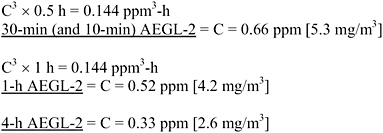
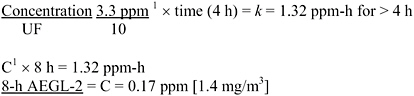
Key study: Kinkead et al. (1977). Male Sprague-Dawley CFE rats (10/concentration) were exposed for 4 h and observed for 2 weeks. The exposure concentrations and [death rates] were: 23 ppm [10/10]; 21 ppm [10/10]; 19 ppm [6/10], 18 ppm [3/10]; 15 ppm [3/10]; 10 ppm [0/10]. The rats were lethargic, had a noticeably slowed rate and depth of respiration, nose and eye irritation, and weight loss. The severity of toxicity increased with exposure concentration. Rats that died prematurely had moderate to severe lung congestion and hemorrhage; rats surviving the 2 weeks had mild lung congestion. Because 10 ppm is a lethality NOEL in this study and is near the point of departure for AEGL-3, a modifying factor of 3 was applied to 10 ppm obtain a concentration (3.3 ppm) that would cause only mild reversible lung irritation.
Toxicity end point: Mild reversible lung irritation from a 4-h exposure to 3.3 ppm.
Scaling: Cn × t = k (ten Berge et al. 1986); no data were available to derive n empirically for TNM, so used n = 3 and n = 1 to extrapolate to <4 h and >4 h, respectively, except adopted 30-min value as 10-min value to protect human health (see Section 4.4.3.).
Uncertainty factors: Total Uncertainty Factor: 10
Interspecies: 3: Key study tested most sensitive species.
Intraspecies: 3: Mild reversible lung irritation from a gas with a steep dose-response is not likely to vary greatly among humans.
Calculations:

Calculations:
AEGL-3
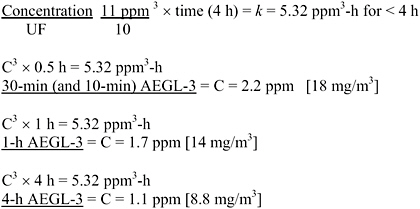
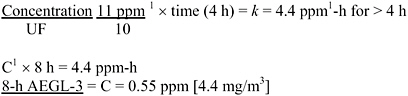
Key study: Kinkead et al. (1977). Male Sprague-Dawley CFE rats (10/concentration) were exposed for 4 h and observed for 2 weeks. The exposure concentrations and [death rates] were: 23 ppm [10/10]; 21 ppm [10/10]; 19 ppm [6/10], 18 ppm [3/10]; 15 ppm [3/10]; 10 ppm [0/10]. The rats were lethargic, had a noticeably slowed rate and depth of respiration, nose and eye irritation, and weight loss. The severity of toxicity increased with exposure concentration. Rats that died prematurely had moderate to severe lung congestion and hemorrhage; rats surviving the 2 weeks had mild lung congestion. A BMDL05 of 11 ppm was calculated using the log/probit model from EPA’s Benchmark Dose Software, Version 1.3.2. with the Kinkead et al. (1977) lethality data.
Toxicity end point: NOEL for lethality (from extreme lung irritation), based on the calculated lethality BMDL05 of 11 ppm.
Scaling: Cn × t = k (ten Berge et al. 1986); no data were available to derive n empirically for TNM, so used n = 3 and n = 1 to extrapolate to <4 h and >4 h, respectively, except adopted 30 min value as 10-min value to protect human health (see Section 4.4.3.).
Uncertainty factors: Total Uncertainty Factor: 10
Interspecies: 3: Key study tested most sensitive species
APPENDIX B
CANCER ASSESSMENT
A preliminary cancer assessment of tetranitromethane (TNM) was performed using the NTP (1990) study, in which male and female mice were exposed to 0, 0.5, or 2 ppm TNM and male and female rats were exposed to 0, 2, or 5 ppm TNM for 6 h/day, 5 days/week, for 103 weeks. All TNM exposures caused alveolar/bronchiolar adenoma or carcinoma, and 5 ppm rats also had squamous cell carcinoma. The highest tumor incidence was alveolar/bronchiolar adenoma or carcinoma in female mice (4/49, 24/50, 49/50 for 0, 0.5, and 2 ppm TNM), which was used to generate the inhalation unit risk after adjusting for discontinuous exposure (6 h/day, 5 day/week), converting to mg/m3, and extrapolating to a human equivalent concentration (HEC) using the relationship below (EPA 1994, pp. 44 and 50), where MV = min volume and SA = lung alveolar plus bronchiolar surface area, M = mouse, and H = human:

The resulting HEC of 1.95 mg/m3 and 7.82 mg/m3 (for 0.5 and 2 ppm, respectively) were used to calculate the BMDL10 of 0.255 mg/m3 using EPA’s Benchmark Dose Software, Version 1.3.2. and the multistage model (EPA 1999). The inhalation unit risk (or slope factor, i.e. q1*) of 0.392 per (mg/m3) was obtained by dividing 0.10 (i.e., 10% risk) by the BMDL10.
For a lifetime cancer risk of 10-4, air concentration is
10-4/0.392 (mg/m3)-1 = 2.55 × 10⁻⁴ mg/m3. For 10-4 risk from lifetime (24-h/day) exposure, total TNM exposure would be:

An additional adjustment factor of 6 is applied to allow for uncertainties in assessing potential cancer risks under short term exposures with the multistage model (Crump and Howe 1984):
6.53 mg/m3 ÷ 6 = 1.09 mg/m3 or 0.14 ppm for 24 h exposure
For exposures less than 24 h, the fractional exposure (f) becomes 1/f 24 h (NRC 1985) (extrapolation to 10 min was not performed due to unacceptably large inherent uncertainty):
|
Exposure Duration |
AEGL-2 Values (ppm) Based on Toxicity End Points |
TNM Exposure Conc. (ppm) with an Excess Cancer Risk of |
||
|
10-4 |
10-5 |
10-6 |
||
|
0.5 h |
0.66 |
6.72 |
0.67 |
0.067 |
|
1 h |
0.52 |
3.36 |
0.34 |
0.0336 |
|
4 h |
0.33 |
0.84 |
0.084 |
0.0084 |
|
8 h |
0.17 |
0.42 |
0.042 |
0.0042 |
Because animal doses were converted to an air concentration that results in an equivalent human inhaled dose for the derivation of the cancer slope factor, no reduction of exposure levels is applied to account for interspecies variability.
TNM concentrations associated with a 10-4 excess cancer risk for a single 30 to 480 min exposure were 2.5 to 10-fold greater than the toxicity-based AEGL-2 values for 30 to 480 min. The noncarcinogenic end points were considered to be more appropriate for AEGL-2 derivation because AEGL values are applicable to rare events or single, once-in-a-lifetime exposures, and the data indicate that TNM neoplasms resulted from chronic exposure. A direct comparison of estimated TNM cancer risk and AEGL values is not appropriate due to large differences in methodology used to obtain these numbers (the TNM concentration with a 10-4 excess cancer risk was estimated by linearly extrapolating from lifetime exposure [25,600 days] to 0.5-8 h, whereas the AEGL-2 values were based on results from a single exposure for 10 min to 4 h).
APPENDIX C
ACUTE EXPOSURE GUIDELINES FOR TETRANITROMETHANE (CAS Reg. No. 107-15-3)
DERIVATION SUMMARY
|
AEGL-1 VALUES |
||||
|
10 min |
30 min |
1 h |
4 h |
8 h |
|
Not recommended due to insufficient data. |
||||
|
Reference: |
||||
|
Test Species/Strain/Number: |
||||
|
Exposure Route/Concentrations/Durations: |
||||
|
Effects: |
||||
|
End point/Concentration/Rationale: |
||||
|
Uncertainty Factors/Rationale: Total uncertainty factor: Interspecies: Intraspecies: |
||||
|
Modifying Factor: |
||||
|
Animal to Human Dosimetric Adjustment: |
||||
|
Time Scaling: |
||||
|
Data Adequacy: |
||||
|
AEGL-2 VALUES |
||||
|
10 min |
30 min |
1 h |
4 h |
8 h |
|
0.66 ppm |
0.66 ppm |
0.52 ppm |
0.33 ppm |
0.17 ppm |
|
Reference: Kinkead, E.R., J.D. MacEwen, C.C. Haun, et al. 1977. Toxic hazards evaluation of five atmospheric pollutants from Army ammunition plants. Wright-Patterson Air Force Base, OH: Air Force Systems Command, Aerospace Medical Division, Aerospace Medical Research Laboratory Technical Report AMRL-TR-77-25. |
||||
|
Test Species/Strain/Number: Male Sprague-Dawley CFE rats (10/concentration). |
||||
|
Exposure Route/Concentrations/Durations: Inhalation of 10, 15, 18, 19, 21, or 23 ppm for 4 h. |
||||
|
Effects: Mortality: 23 ppm [10/10]; 21 ppm [10/10]; 19 ppm [6/10], 18 ppm [3/10]; 15 ppm [3/10]; 10 ppm [0/10]. The rats were lethargic, had slowed rate and depth of respiration, and had nose and eye irritation. |
||||
|
All groups had weight loss, which was reversible only at 10 ppm. Rats that died prematurely had moderate to severe lung congestion and hemorrhage; rats surviving the 2 weeks had mild lung congestion. The severity of toxicity increased with exposure concentration. Because 10 ppm is a lethality NOEL in this study and is near the point of departure for AEGL-3, a modifying factor of 3 was applied to 10 ppm obtain a concentration (3.3 ppm) that would cause only mild reversible lung irritation. |
||||
|
End point/Concentration/Rationale: Mild reversible lung irritation from exposure to 3.3 ppm for 4 h. |
||||
|
Uncertainty Factors/Rationale: Total uncertainty factor: 10 Interspecies: 3—Key study tested most sensitive species Intraspecies: 3—Mild reversible lung irritation from a gas with a steep dose-response is not likely to vary greatly among humans. |
||||
|
Modifying Factor: 3—applied to 10 ppm to obtain a concentration (3.3 ppm) causing only mild reversible lung irritation. |
||||
|
Animal to Human Dosimetric Adjustment: Not performed. |
||||
|
Time Scaling: Cn × t = k (ten Berge et al. 1986); no data were available to derive n empirically for TNM, so used n = 3 and n = 1 to extrapolate to <4 h and >4 h, respectively, except adopted 30-min value as 10 min value to be protective of human health (see section 4.4.3.). |
||||
|
Data Adequacy: The relevant data set was small but contained two mutually supportive and well-conducted studies (Kinkead et al. 1977 and NTP 1990). Use of 3.3 ppm as the Point of departure was supported by the repeat-exposure study with rats and mice (6 h/day for 14 days; NTP 1990) in which 2 ppm caused no effects in either species and 5 ppm caused no effects in rats and only decreased body weights in mice (no histopath at 2 ppm and only for 1/5 animals/sex at 5 ppm, however). |
|
AEGL-3 VALUES |
||||
|
10 min |
30 min |
1 h |
4 h |
8 h |
|
2.2 ppm |
2.2 ppm |
1.7 ppm |
1.1 ppm |
0.55 ppm |
|
Reference: Kinkead, E.R., J.D. MacEwen, C.C. Haun, et al. 1977. Toxic ammunition plants. Wright-Patterson Air Force Base, OH: Air Force Systems Command, Aerospace Medical Division, Aerospace Medical Research Laboratory Technical Report AMRL-TR-77-25. |
||||
|
Test Species/Strain/Number: Male Sprague-Dawley CFE rats (10/concentration). |
||||
|
Exposure Route/Concentrations/Durations: Inhalation of 10, 15, 18, 19, 21, or 23 ppm for 4 h. |
||||
|
Effects: Mortality: 23 ppm [10/10]; 21 ppm [10/10]; 19 ppm [6/10], 18 ppm [3/10]; 15 ppm [3/10]; 10 ppm [0/10]. The rats were lethargic, had slowed rate and depth of respiration, and had nose and eye irritation. All groups had weight loss, which was reversible only at 10 ppm. Rats that died prematurely had moderate to severe lung congestion and hemorrhage; rats surviving the 2 weeks had mild lung congestion. The severity of toxicity increased with exposure concentration. |
||||
|
End point/Concentration/Rationale: The calculated lethality BMDL05 of 11 ppm was the NOEL for lethality (from extreme lung irritation). |
||||
|
Uncertainty Factors/Rationale: Uncertainty factors: Total Uncertainty Factor: 10 Interspecies: 3—Key study tested most sensitive species. Intraspecies: 3—NOEL for lethality from extreme lung irritation from a gas with a steep dose-response is not likely to vary greatly among humans. |
||||
|
Modifying Factor: None. |
||||
|
Animal to Human Dosimetric Adjustment: Not performed. |
||||
|
Time Scaling: Cn × t = k (ten Berge et al. 1986); no data were available to derive n empirically for TNM, so used n = 3 and n = 1 to extrapolate to <4 h and >4 h, respectively, except adopted 30-min value as 10-min value to be protective of human health (see section 4.4.3.). |
||||
|
Data Adequacy: The relevant data set was small but contained two mutually supportive and well-conducted studies (Kinkead et al. 1977 and NTP 1990). Use of the calculated lethality BMDL05 of 11 ppm as the Point of departure was supported by the empirical lethality NOEL of 10 ppm in the key study and in a repeat-exposure study with rats and mice (6 h/day for 14 days; NTP 1990). |
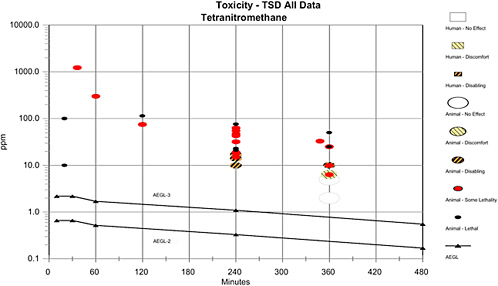
FIGURE D-1 Chemical toxicity—TSD all data, tetranitromethane. Note that the above plot includes several multiple-exposure (6 h/day, 5 days/week) studies for which a single 6 h/day exposure was input into the table (the NTP [1990] 2-week rat and mouse studies, and the Horn [1954] 6-month rat and dog studies).


