
1
Darwin’s Greatest Discovery: Design Without Designer
FRANCISCO J. AYALA
Darwin’s greatest contribution to science is that he completed the Copernican Revolution by drawing out for biology the notion of nature as a system of matter in motion governed by natural laws. With Darwin’s discovery of natural selection, the origin and adaptations of organisms were brought into the realm of science. The adaptive features of organisms could now be explained, like the phenomena of the inanimate world, as the result of natural processes, without recourse to an Intelligent Designer. The Copernican and the Darwinian Revolutions may be seen as the two stages of the one Scientific Revolution. They jointly ushered in the beginning of science in the modern sense of the word: explanation through natural laws. Darwin’s theory of natural selection accounts for the “design” of organisms, and for their wondrous diversity, as the result of natural processes, the gradual accumulation of spontaneously arisen variations (mutations) sorted out by natural selection. Which characteristics will be selected depends on which variations happen to be present at a given time in a given place. This in turn depends on the random process of mutation as well as on the previous history of the organisms. Mutation and selection have jointly driven the marvelous process that, starting from microscopic organisms, has yielded orchids, birds, and humans. The theory of evolution conveys chance and
Department of Ecology and Evolutionary Biology, University of California, 321 Steinhaus Hall, Irvine, CA 92697.
necessity, randomness and determinism, jointly enmeshed in the stuff of life. This was Darwin’s fundamental discovery, that there is a process that is creative, although not conscious.
There is a version of the history of the ideas that sees a parallel between the Copernican and the Darwinian revolutions. In this view, the Copernican Revolution consisted in displacing the Earth from its previously accepted locus as the center of the universe and moving it to a subordinate place as just one more planet revolving around the sun. In congruous manner, the Darwinian Revolution is viewed as consisting of the displacement of humans from their exalted position as the center of life on earth, with all other species created for the service of humankind. According to this version of intellectual history, Copernicus had accomplished his revolution with the heliocentric theory of the solar system. Darwin’s achievement emerged from his theory of organic evolution.
What this version of the two revolutions says is correct but inadequate, because it misses what is most important about these two intellectual revolutions, namely that they ushered in the beginning of science in the modern sense of the word. These two revolutions may jointly be seen as the one Scientific Revolution, with two stages, the Copernican and the Darwinian.
The Copernican Revolution was launched with the publication in 1543, the year of Nicolaus Copernicus’ death, of his De revolutionibus orbium celestium (On the Revolutions of the Celestial Spheres), and bloomed with the publication in 1687 of Isaac Newton’s Philosophiae naturalis principia mathematica (The Mathematical Principles of Natural Philosophy). The discoveries by Copernicus, Kepler, Galileo, Newton, and others, in the 16th and 17th centuries, had gradually ushered in a conception of the universe as matter in motion governed by natural laws. It was shown that Earth is not the center of the universe but a small planet rotating around an average star; that the universe is immense in space and in time; and that the motions of the planets around the sun can be explained by the same simple laws that account for the motion of physical objects on our planet, laws such as f = m × a (force = mass × acceleration) or the inverse-square law of attraction, f = g(m1m2)/r2 (the force of attraction between two bodies is directly proportional to their masses, but inversely related to the square of the distance between them).
These and other discoveries greatly expanded human knowledge. The conceptual revolution they brought about was more fundamental yet: a commitment to the postulate that the universe obeys immanent laws that account for natural phenomena. The workings of the universe were brought into the realm of science: explanation through natural laws. All
physical phenomena could be accounted for as long as the causes were adequately known.
The advances of physical science brought about by the Copernican Revolution had driven mankind’s conception of the universe to a split-personality state of affairs, which persisted well into the mid-19th century. Scientific explanations, derived from natural laws, dominated the world of nonliving matter, on the Earth as well as in the heavens. However, supernatural explanations, which depended on the unfathomable deeds of the Creator, were accepted as explanations of the origin and configuration of living creatures. Authors, such as William Paley, argued that the complex design of organisms could not have come about by chance or by the mechanical laws of physics, chemistry, and astronomy but was rather accomplished by an Intelligent Designer, just as the complexity of a watch, designed to tell time, was accomplished by an intelligent watchmaker.
It was Darwin’s genius to resolve this conceptual schizophrenia. Darwin completed the Copernican Revolution by drawing out for biology the notion of nature as a lawful system of matter in motion that human reason can explain without recourse to supernatural agencies. The conundrum faced by Darwin can hardly be overestimated. The strength of the argument from design to demonstrate the role of the Creator had been forcefully set forth by philosophers and theologians. Wherever there is function or design, we look for its author. It was Darwin’s greatest accomplishment to show that the complex organization and functionality of living beings can be explained as the result of a natural process—natural selection—without any need to resort to a Creator or other external agent. The origin and adaptations of organisms in their profusion and wondrous variations were thus brought into the realm of science.
Darwin accepted that organisms are “designed” for certain purposes, that is, they are functionally organized. Organisms are adapted to certain ways of life and their parts are adapted to perform certain functions. Fish are adapted to live in water, kidneys are designed to regulate the composition of blood, and the human hand is made for grasping. But Darwin went on to provide a natural explanation of the design. The seemingly purposeful aspects of living beings could now be explained, like the phenomena of the inanimate world, by the methods of science, as the result of natural laws manifested in natural processes.
Darwin occupies an exalted place in the history of Western thought, deservedly receiving credit for the theory of evolution. In The Origin of Species, published in 1859, he laid out the evidence demonstrating the evolution of organisms. Darwin did not use the term “evolution,” which did not have its current meaning, but referred to the evolution of organisms by the phrase “common descent with modification” and similar expres-
sions. However, Darwin accomplished something much more important for intellectual history than demonstrating evolution. Indeed, accumulating evidence for common descent with diversification may very well have been a subsidiary objective of Darwin’s masterpiece. Darwin’s Origin of Species is, first and foremost, a sustained effort to solve the problem of how to account scientifically for the design of organisms. Darwin seeks to explain the design of organisms, their complexity, diversity, and marvelous contrivances, as the result of natural processes. Darwin brings about the evidence for evolution because evolution is a necessary consequence of his theory of design.
INTELLIGENT DESIGN: THE ORIGINAL VERSION
William Paley (1743–1805), one of the most influential English authors of his time, argued forcefully in his Natural Theology (1802a) that the complex and precise design of organisms and their parts could be accounted for only as the deed of an Intelligent and Omnipotent “Designer.” The design of organisms, he argued, was incontrovertible evidence of the existence of the Creator.
Paley was an English clergyman intensely committed to the abolition of the slave trade. By the 1780s, Paley had become a much sought-after public speaker against slavery. Paley was also an influential writer of works on Christian philosophy, ethics, and theology. The Principles of Moral and Political Philosophy (1785) and A View of the Evidences of Christianity (1794) earned him prestige and well-endowed ecclesiastical benefices, which allowed him a comfortable life. In 1800, Paley gave up his public speaking career for reasons of health, providing him ample time to study science, particularly biology, and to write Natural Theology; or, Evidences of the Existence and Attributes of the Deity (1802a), the book by which he has become best known to posterity and which would greatly influence Darwin. With Natural Theology, Paley sought to update the work of another English clergyman, John Ray’s Wisdom of God Manifested in the Works of the Creation (1691). But Paley could now go much beyond Ray by taking advantage of one century of additional biological knowledge. Paley’s keystone claim is that “There cannot be design without a designer; contrivance, without a contriver; order, without choice; … means suitable to an end, and executing their office in accomplishing that end, without the end ever having been contemplated” (1802a, pp. 15–16).
Natural Theology is a sustained argument for the existence of God based on the obvious design of humans and their organs, as well as the design of all sorts of organisms, considered by themselves, as well as in their relations to one another and to their environment. The argument has two parts: first, that organisms give evidence of being designed; second,
that only an omnipotent God could account for the perfection, multitude, and diversity of the designs.
There are chapters dedicated to the complex design of the human eye; to the human frame, which displays a precise mechanical arrangement of bones, cartilage, and joints; to the circulation of the blood and the disposition of blood vessels; to the comparative anatomy of humans and animals; to the digestive tract, kidneys, urethras, and bladder; to the wings of birds and the fins of fish; and much more. For 352 pages, Natural Theology conveys Paley’s expertise: extensive and accurate biological knowledge, as detailed and precise as was available in the year 1802. After detailing the precise organization and exquisite functionality of each biological entity, relationship, or process, Paley draws again and again the same conclusion, that only an omniscient and omnipotent Deity could account for these marvels of mechanical perfection, purpose, and functionality and for the enormous diversity of inventions that they entail.
Paley’s first model example in Natural Theology is the human eye. Early in chapter 3, Paley points out that the eye and the telescope “are made upon the same principles; both being adjusted to the laws by which the transmission and refraction of rays of light are regulated” (1802a, p. 20). Specifically, there is a precise resemblance between the lenses of a telescope and “the humors of the eye” in their figure, their position, and the ability of converging the rays of light at a precise distance from the lens—on the retina in the case of the eye.
Paley makes two remarkable observations, which enhance the complex and precise design of the eye. The first observation is that rays of light should be refracted by a more convex surface when transmitted through water than when passing out of air into the eye. Accordingly, “the eye of a fish, in that part of it called the crystalline lens, is much rounder than the eye of terrestrial animals. What plainer manifestation of design can there be than this difference? What could a mathematical instrument maker have done more to show his knowledge of this principle …?” (Paley, 1802a, p. 20).
The second remarkable observation made by Paley that supports his argument is dioptric distortion: “Pencils of light, in passing through glass lenses, are separated into different colors, thereby tinging the object, especially the edges of it, as if it were viewed through a prism. To correct this inconvenience has been long a desideratum in the art. At last it came into the mind of a sagacious optician, to inquire how this matter was managed in the eye, in which there was exactly the same difficulty to contend with as in the telescope. His observation taught him that in the eye the evil was cured by combining lenses composed of different substances, that is, of substances which possessed different refracting powers” (Paley, 1802a, pp. 22–23). The telescope maker accordingly corrected the dioptic distor-
tion “by imitating, in glasses made from different materials, the effects of the different humors through which the rays of light pass before they reach the bottom of the eye. Could this be in the eye without purpose, which suggested to the optician the only effectual means of attaining that purpose?” (Paley, 1802a, p. 23).
ARGUMENT AGAINST CHANCE
Paley summarizes his argument by stating the complex functional anatomy of the eye. The eye consists “first, of a series of transparent lenses—very different, by the by, even in their substance, from the opaque materials of which the rest of the body is, in general at least, composed” (Paley, 1802a, p. 48). Second, the eye has the retina, which as Paley points out is the only membrane in the body that is black, spread out behind the lenses, so as to receive the image formed by pencils of light transmitted through them, and “placed at the precise geometrical distance at which, and at which alone, a distinct image could be formed, namely, at the concourse of the refracted rays” (1802a, p. 48). Third, he writes, the eye possesses “a large nerve communicating between this membrane [the retina] and the brain; without which, the action of light upon the membrane, however modified by the organ, would be lost to the purposes of sensation” (1802a, p. 48).
Could the eye have come about without design or preconceived purpose, as a result of chance? Paley had set the argument against chance in the very first paragraph of Natural Theology (1802a, p. 1), reasoning rhetorically by analogy: “In crossing a heath, suppose I pitched my foot against a stone, and were asked how the stone came to be there, I might possibly answer, that for any thing I knew to the contrary it had lain there for ever; nor would it, perhaps, be very easy to show the absurdity of this answer. But suppose I had found a watch upon the ground, and it should be inquired how the watch happened to be in that place, I should hardly think of the answer which I had before given, that for any thing I knew the watch might have always been there. Yet why should not this answer serve for the watch as well as for the stone; why is it not as admissible in the second case as in the first? For this reason, and for no other, namely, that when we come to inspect the watch, we perceive—what we could not discover in the stone—that its several parts are framed and put together for a purpose, e.g., that they are so formed and adjusted as to produce motion, and that motion so regulated as to point out the hour of the day; that if the different parts had been differently shaped from what they are, or placed after any other manner or in any other order than that in which they are placed, either no motion at all would have been carried on in the machine, or none which would have answered the use that is now served
by it.” In other words, the watch’s mechanism is so complicated it could not have arisen by chance.
PALEY’S IRREDUCIBLE COMPLEXITY
The strength of the argument against chance derives, Paley tells us, from what he names “relation,” a notion akin to what some contemporary authors have named “irreducible complexity” (Behe, 1996). This is how Paley formulates the argument for irreducible complexity: “When several different parts contribute to one effect, or, which is the same thing, when an effect is produced by the joint action of different instruments, the fitness of such parts or instruments to one another for the purpose of producing, by their united action, the effect, is what I call relation; and wherever this is observed in the works of nature or of man, it appears to me to carry along with it decisive evidence of understanding, intention, art” (Paley, 1802a, pp. 175–176). The outcomes of chance do not exhibit relation among the parts or, as we might say, they do not display organized complexity. He writes that “a wen, a wart, a mole, a pimple” could come about by chance, but never an eye; “a clod, a pebble, a liquid drop might be,” but never a watch or a telescope.
Paley notices the “relation” not only among the component parts of an organ, such as the eye, the kidney, or the bladder, but also among the different parts, limbs, and organs that collectively make up an animal and adapt it to its distinctive way of life: “In the swan, the web-foot, the spoon bill, the long neck, the thick down, the graminivorous stomach, bear all a relation to one another…. The feet of the mole are made for digging; the neck, nose, eyes, ears, and skin, are peculiarly adapted to an under-ground life. [In a word,] this is what I call relation” (Paley, 1802a, pp. 180, 183).
Throughout Natural Theology, Paley displays extensive and profound biological knowledge. He discusses the fish’s air bladder, the viper’s fang, the heron’s claw, the camel’s stomach, the woodpecker’s tongue, the elephant’s proboscis, the bat’s wing hook, the spider’s web, insects’ compound eyes and metamorphosis, the glowworm, univalve and bivalve mollusks, seed dispersal, and on and on, with accuracy and as much detail as known to the best biologists of his time. The organized complexity and purposeful function reveal, in each case, an intelligent designer, and the diversity, richness, and pervasiveness of the designs show that only the omnipotent Creator could be this Intelligent Designer.
Paley was not the only proponent of the argument from design in the first half of the 19th century. In Britain, a few years after the publication of Natural Theology, the eighth Earl of Bridgewater endowed the publication of treatises that would set forth “the Power, Wisdom and Goodness of God as manifested in the Creation.” Eight treatises were published dur-
ing 1833–1840, several of which artfully incorporate the best science of the time and had considerable influence on the public and among scientists. One of the treatises, The Hand, Its Mechanisms and Vital Endowments as Evincing Design (1833), was written by Sir Charles Bell, a distinguished anatomist and surgeon, famous for his neurological discoveries, who became professor of surgery in 1836 at the University of Edinburgh. Bell follows Paley’s manner of argument, examining in considerable detail the wondrously useful design of the human hand but also the perfection of design of the forelimb used for different purposes in different animals, serving in each case the particular needs and habits of its owner: the human’s arm for handling objects, the dog’s leg for running, and the bird’s wing for flying. “Nothing less than the Power, which originally created, is equal to the effecting of those changes on animals, which are to adapt them to their conditions.”
Paley and Bell are typical representatives of the intellectual milieu prevailing in the first half of the 19th century in Britain as well as on the Continent. Darwin, while he was an undergraduate student at the University of Cambridge between 1827 and 1831, read Paley’s Natural Theology, which was part of the university’s canon for nearly half a century after Paley’s death. Darwin writes in his Autobiography of the “much delight” and profit that he derived from reading Paley: “To pass the B.A. examination, it was also necessary to get up Paley’s Evidences of Christianity, and his Moral Philosophy…. The logic of … his Natural Theology gave me as much delight as did Euclid…. I did not at that time trouble myself about Paley’s premises; and taking these on trust, I was charmed and convinced by the long line of argumentation” (Darwin, 1887a).
Later, however, after he returned from his 5-year voyage around the world in the HMS Beagle, Darwin would discover a scientific explanation for the design of organisms. Science, thereby, made a quantum leap.
DARWIN’S “MY THEORY”
Darwin considered natural selection, rather than his demonstration of evolution, his most important discovery and designated it as “my theory,” a designation he never used when referring to the evolution of organisms. The discovery of natural selection, Darwin’s awareness that it was a greatly significant discovery because it was science’s answer to Paley’s argument from design, and Darwin’s designation of natural selection as “my theory” can be traced in Darwin’s “Red Notebook” and “Transmutation Notebooks B to E,” which he started in March 1837, not long after returning (on October 2, 1836) from his 5-year voyage on the Beagle, and completed in late 1839 (see Eldredge, 2005).
The evolution of organisms was commonly accepted by naturalists in the middle decades of the 19th century. The distribution of exotic species in South America, in the Galápagos Islands, and elsewhere and the discovery of fossil remains of long-extinguished animals confirmed the reality of evolution in Darwin’s mind. The intellectual challenge was to explain the origin of distinct species of organisms, how new ones adapted to their environments, that “mystery of mysteries,” as it had been labeled by Darwin’s older contemporary, the prominent scientist and philosopher Sir John Herschel (1792–1871).
Early in the Notebooks of 1837 to 1839, Darwin registers his discovery of natural selection and repeatedly refers to it as “my theory.” From then until his death in 1882, Darwin’s life would be dedicated to substantiating natural selection and its companion postulates, mainly the pervasiveness of hereditary variation and the enormous fertility of organisms, which much surpassed the capacity of available resources. Natural selection became for Darwin “a theory by which to work.” He relentlessly pursued observations and performed experiments to test the theory and resolve presumptive objections.
WALLACE: A DISTINCTION WITH A DIFFERENCE
Alfred Russel Wallace (1823–1913) is famously given credit for discovering, independently of Darwin, natural selection as the process accounting for the evolution of species. On June 18, 1858, Darwin wrote to Charles Lyell that he had received by mail a short essay from Wallace such that “if Wallace had my [manuscript] sketch written in [1844] he could not have made a better abstract.” Darwin was thunderstruck.
Darwin and Wallace had started occasional correspondence in late 1855. At the time Wallace was in the Malay Archipelago collecting biological specimens. In his letters, Darwin would offer sympathy and encouragement to the occasionally dispirited Wallace for his “laborious undertaking.” In 1858, Wallace came upon the idea of natural selection as the explanation for evolutionary change and he wanted to know Darwin’s opinion about this hypothesis, because Wallace, as well as many others, knew that Darwin had been working on the subject for years, had shared his ideas with other scientists, and was considered by them as the eminent expert on issues concerning biological evolution.
Darwin was uncertain how to proceed about Wallace’s letter. He wanted to credit Wallace’s discovery of natural selection, but he did not want altogether to give up his own earlier independent discovery. Eventually, Sir Charles Lyell and Joseph Hooker proposed, with Darwin’s consent, that Wallace’s letter and two of Darwin’s earlier writings would be presented at a meeting of the Linnean Society of London. On July 1, 1858,
three papers were read by the society’s undersecretary, George Busk, in the order of their date of composition: Darwin’s abbreviated abstract of his 230-page essay from 1844; an “abstract of abstract” that Darwin had written to the American botanist Asa Gray on September 5, 1857; and Wallace’s essay, “On the Tendency of Varieties to Depart Indefinitely from Original Type; Instability of Varieties Supposed to Prove the Permanent Distinctness of Species” (Wallace, 1858).
The meeting was attended by some 30 people, who did not include Darwin or Wallace. The papers generated little response and virtually no discussion, their significance apparently lost to those in attendance. Nor was it noticed by the president of the Linnean Society, Thomas Bell, who, in his annual address the following May, blandly stated that the past year had not been enlivened by “any of those striking discoveries which at once revolutionize” a branch of science.
Wallace’s independent discovery of natural selection is remarkable. But the lesser credit given to Wallace than to Darwin for this discovery may not be misplaced. Wallace was not interested in explaining design but rather in accounting for the evolution of species, as indicated in his paper’s title: “On the Tendency of Varieties to Depart Indefinitely from the Original Type.” Wallace thought that evolution proceeds indefinitely and is progressive. Wallace (1858) writes: “We believe that there is a tendency in nature to the continued progression of certain classes of varieties further and further from the original type—a progression to which there appears no reason to assign any definite limits. This progression, by minute steps, in various directions ….”
Darwin, on the contrary, did not accept that evolution would necessarily represent progress or advancement, nor did he believe that evolution would always result in morphological change over time; rather, he knew of the existence of “living fossils,” organisms that had remained unchanged for millions of years. For example, “some of the most ancient Silurian animals, as the Nautilus, Lingula, etc., do not differ much from living species” (Darwin, 1859b, p. 306). In 1858, Darwin was at work on a multivolume treatise, intended to be titled “On Natural Selection.” Wallace’s paper stimulated Darwin to write The Origin, which would be published the following year. Darwin saw The Origin as an abbreviated version of the much longer book he had planned to write.
DARWIN’S EXPLANATION OF DESIGN
Darwin’s focus in The Origin was the explanation of design, with evolution playing the subsidiary role of supporting evidence. The Introduction and chapters I–VIII of The Origin explain how natural selection accounts for the adaptations and behaviors of organisms, their “design.”
The extended argument starts in chapter I, where Darwin describes the successful selection of domestic plants and animals and, with considerable detail, the success of pigeon fanciers seeking exotic “sports.” The success of plant and animal breeders manifests how much selection can accomplish by taking advantage of spontaneous variations that occur in organisms but happen to fit the breeders’ objectives. A sport (mutation) that first appears in an individual can be multiplied by selective breeding so that after a few generations, that sport becomes fixed in a breed, or “race.” The familiar breeds of dogs, cattle, chickens, and food plants have been obtained by this process of selection practiced by people with particular objectives.
The ensuing chapters (II–VIII) of The Origin extend the argument to variations propagated by natural selection for the benefit of the organisms themselves rather than by artificial selection of traits desired by humans. As a consequence of natural selection, organisms exhibit design, that is, exhibit adaptive organs and functions. The design of organisms as they exist in nature, however, is not “intelligent design,” imposed by God as a Supreme Engineer or by humans; rather, it is the result of a natural process of selection, promoting the adaptation of organisms to their environments. This is how natural selection works: Individuals that have beneficial variations, that is, variations that improve their probability of survival and reproduction, leave more descendants than individuals of the same species that have less beneficial variations. The beneficial variations will consequently increase in frequency over the generations; less beneficial or harmful variations will be eliminated from the species. Eventually, all individuals of the species will have the beneficial features; new features will arise over eons of time.
Organisms exhibit complex design, but it is not, in current language, “irreducible complexity,” emerging all of a sudden in full bloom. Rather, according to Darwin’s theory of natural selection, the design has arisen gradually and cumulatively, step by step, promoted by the reproductive success of individuals with incrementally more adaptive elaborations.
It follows from Darwin’s explanation of adaptation that evolution must necessarily occur as a consequence of organisms becoming adapted to different environments in different localities and to the ever-changing conditions of the environment over time, and as hereditary variations become available at a particular time that improve, in that place and at that time, the organisms’ chances of survival and reproduction. The Origin’s evidence for biological evolution is central to Darwin’s explanation of design, because this explanation implies that biological evolution occurs, which Darwin therefore seeks to demonstrate in most of the remainder of the book (Darwin, 1859b, chapters IX–XIII).
In the concluding chapter XIV of The Origin, Darwin returns to the dominant theme of adaptation and design. In an eloquent final paragraph, Darwin asserts the “grandeur” of his vision:
It is interesting to contemplate an entangled bank, clothed with many plants of many kinds, with birds singing on the bushes, with various insects flitting about, and with worms crawling through the damp earth, and to reflect that these elaborately constructed forms, so different from each other, and dependent on each other in so complex a manner, have all been produced by laws acting around us…. Thus, from the war of nature, from famine and death, the most exalted object which we are capable of conceiving, namely, the production of the higher animals, directly follows. There is grandeur in this view of life, with its several powers, having been originally breathed into a few forms or into one; and that, whilst this planet has gone cycling on according to the fixed law of gravity, from so simple a beginning endless forms most beautiful and most wonderful have been, and are being, evolved (Darwin, 1859b, pp. 489–490; emphasis added).
Darwin’s Origin addresses the same issue as Paley: how to account for the adaptive configuration of organisms and their parts, which are so obviously designed to fulfill certain functions. Darwin argues that hereditary adaptive variations (“variations useful in some way to each being”) occasionally appear, and that these are likely to increase the reproductive chances of their carriers. The success of pigeon fanciers and animal breeders clearly shows the occasional occurrence of useful hereditary variations. In nature, over the generations, Darwin’s argument continues, favorable variations will be preserved, multiplied, and conjoined; injurious ones will be eliminated. In one place, Darwin avers: “I can see no limit to this power [natural selection] in slowly and beautifully adapting each form to the most complex relations of life” (Darwin, 1859b, p. 469).
In his Autobiography, Darwin wrote, “The old argument of design in nature, as given by Paley, which formerly seemed to me so conclusive, falls, now that the law of natural selection has been discovered. We can no longer argue that, for instance, the beautiful hinge of a bivalve shell must have been made by an intelligent being, like the hinge of a door by a man” (Barlow, 1958).
Natural selection was proposed by Darwin primarily to account for the adaptive organization, or design, of living beings; it is a process that preserves and promotes adaptation. Evolutionary change through time and evolutionary diversification (multiplication of species) often ensue as by-products of natural selection fostering the adaptation of organisms to their milieu. Evolutionary change is not directly promoted by natural selection, however, and therefore it is not its necessary consequence.
Indeed, some species may remain unchanged for long periods of time, as Darwin noted. Nautilus, Lingula, and other so-called “living fossils” are Darwin’s examples of organisms that have remained unchanged in their appearance for millions of years.
MUTATION AND NATURAL SELECTION
Evolution affects all aspects of an organism’s life: morphology (form and structure), physiology (function), behavior, and ecology (interaction with the environment). Underlying these changes are changes in the hereditary materials. Hence, in genetic terms, evolution consists of changes in the organisms’ hereditary makeup.
Evolution can be seen as a two-step process. First, hereditary variation arises by mutation; second, selection occurs by which useful variations increase in frequency and those that are less useful or injurious are eliminated over the generations. “Useful” and “injurious” are terms used by Darwin in his definition of natural selection. The significant point is that individuals having useful variations “would have the best chance of surviving and procreating their kind” (Darwin, 1859b, p. 81). As a consequence, useful variations increase in frequency over the generations, at the expense of those that are less useful or injurious.
The process of mutation provides each generation with many new genetic variations, in addition to those carried over from previous generations. Thus, it is not surprising to see that, when new environmental challenges arise, species are able to adapt to them. More than 200 insect and rodent species, for example, developed resistance to DDT, Warfarin, and other pesticides in places where spraying was intense. Although these animals had never before encountered these synthetic compounds, mutations allowed some individuals to survive in their presence. These individuals reproduced and, thus, the mutations providing resistance increased in frequency over the generations, so that eventually the population was no longer susceptible to the pesticide. The adaptation had come about by the combined processes of mutation and natural selection.
The resistance of disease-causing bacteria and parasites to antibiotics and other drugs is a consequence of the same process. When an individual receives an antibiotic that specifically kills the bacteria causing a disease—say, tuberculosis—the immense majority of the bacteria die, but one in several million may have a mutation that provides resistance to the antibiotic. These resistant bacteria survive, multiply, and spread from individual to individual. Eventually, the antibiotic no longer cures the disease in most or all people because the bacteria are resistant. This is why modern medicine treats bacterial diseases with cocktails of antibiotics. If the incidence of a mutation conferring resistance to a given antibiotic is
one in a million, the probability of one bacterium carrying three mutations, each conferring resistance to one of three antibiotics, is one in a quintillion (one in a million million million). Even at the peak of infection, when billions or trillions of bacteria exist in a sick person, it is not likely, if not altogether impossible, that any bacteria resistant to all three antibiotics will occur in any infected individual.
Natural selection is much more than a “purifying” process, for it is able to generate novelty by increasing the probability of otherwise extremely improbable genetic combinations. Natural selection in combination with mutation becomes, in this respect, a creative process. Moreover, it is a process that has been occurring for many millions of years in many different evolutionary lineages and a multitude of species, each consisting of a large number of individuals. Evolution by mutation and natural selection has produced the enormous diversity of the living world with its wondrous adaptations.
Several hundred million generations separate modern animals from the early animals of the Cambrian geological period (542 million years ago). The number of mutations that can be tested, and those eventually selected, in millions of individual animals over millions of generations is difficult for a human mind to fathom, but we can readily understand that the accumulation of millions of small, functionally advantageous changes could yield remarkably complex and adaptive organs, such as the eye.
Natural selection is an incremental process, operating over time and yielding organisms better able to survive and reproduce than others. Individuals of a given species differ from one another at any one time only in small ways; for example, the difference between bacteria that have or lack an enzyme able to synthesize the sugar lactose or between moths that have light or dark wings. These differences typically involve one or only a few genes, but they can make the difference between survival or death, as in the resistance to DDT or to antibiotics. Consider a different sort of example. Some pocket mice (Chaetodipus intermedius) live in rocky outcrops in Arizona. Light, sandy-colored mice are found in light-colored habitats, whereas dark (melanic) mice prevail in dark rocks formed from ancient flows of basaltic lava. The match between background and fur color protects the mice from avian and mammal predators that hunt guided largely by vision. Mutations in one single gene (coding for the melanocortin-1-receptor, represented as MC1R) account for the difference between light and dark pelage (Nachman et al., 2003).
Adaptations that involve complex structures, functions, or behaviors involve numerous genes. Many familiar mammals, but not marsupials, have a placenta. Marsupials include the familiar kangaroo and other mammals native primarily to Australia and South America. Dogs, cats, mice, donkeys, and primates are placental. The placenta makes it pos-
sible to extend the time the developing embryo is kept inside the mother and thus make the newborn better prepared for independent survival. However, the placenta requires complex adaptations, such as the suppression of harmful immune interactions between mother and embryo, delivery of suitable nutrients and oxygen to the embryo, and the disposal of embryonic wastes. The mammalian placenta evolved more than 100 million years ago and proved a successful adaptation, contributing to the explosive diversification of placental mammals in the Old World and North America.
The placenta also has evolved in some fish groups, such as Poeciliopsis. Some Poeciliopsis species hatch eggs. The females supply the yolk in the egg, which furnishes nutrients to the developing embryo (as in chicken). Other Poeciliopsis species, however, have evolved a placenta through which the mother provides nutrients to the developing embryo. Molecular biology has made possible the reconstruction of the evolutionary history of Poeciliopsis species. A surprising result is that the placenta evolved independently three times in this fish group. The required complex adaptations accumulated in each case in <750,000 years (Reznick et al., 2002; Avise, 2006).
Natural selection produces combinations of genes that would seem highly improbable because natural selection proceeds stepwise over long periods of time. Consider the evolution of the eye in humans and other vertebrates. Perception of light, and later vision, were important for the survival and reproductive success of their ancestors, because sunlight is a predominant feature of the environment. Accordingly, natural selection favored genes and gene combinations that increased the functional efficiency of the eye. Such mutations gradually accumulated, eventually leading to the highly complex and efficient vertebrate eye.
How complex organs, such as the human eye, may arise stepwise from a very simple structure can be observed in living mollusks (Fig. 1.1). The mollusks (squids, clams, and snails) are a very ancient group of organisms, older than the vertebrates. Marine organisms have variable visual needs, depending on their lifestyle. Limpets have the simplest imaginable eye; just an eye spot consisting of a few pigmented cells with nerve fibers attached to them. Slit-shell mollusks have a slightly more advanced organ, consisting of some pigmented cells shaped as a cup, which allow these mollusks some perception of the direction of light. Nautilus, a group of open ocean mollusks that have remained virtually unchanged for millions of years, have an extended and nearly closed cup, with a pinhole opening but without a lens. Murex, a group of marine snails, have eyes with a primitive refractive lens protected by a layer of skin cells serving as cornea. Octopuses and squids have eyes just as complex as the human eye, with cornea, iris, refractive lens, retina, vitreous internal substance, optic nerve, and muscle.
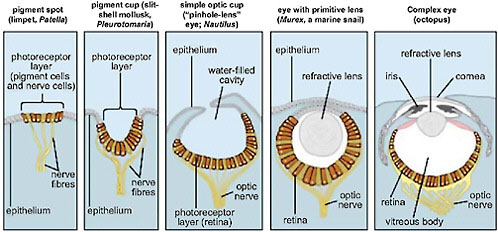
FIGURE 1.1 Steps in the evolution of eye complexity in living mollusks. The simplest eye is found in limpets, consisting of only a few pigmented cells, slightly modified from typical epithelial (skin) cells. Slit-shell molluskshave a slightly more advanced organ, consisting of some pigmented cells shaped as a cup. The octopus eye is quite complex, with components similar to those of the human eye such as cornea, iris, refractive lens, and retina. (Adapted from “Evolution, The Theory of.” By courtesy of Encyclopaedia Britannica, Inc.)
DESIGN WITHOUT DESIGNER
Natural selection sorting out spontaneously arising mutations is a creative process because it causes favorable mutations to combine and accumulate, yielding a great diversity of organisms over eons of time. But there are important features that distinguish the kind of “design” achieved by natural selection, namely the adaptations of organisms, from the kind of design produced by an intelligent designer, an engineer.
An engineer has a preconception of what the design is supposed to achieve and will select suitable materials and arrange them in a preconceived manner so that it fulfills the intended function. On the contrary, natural selection does not operate according to some preordained plan. It is a purely natural process resulting from the interacting properties of physicochemical and biological entities. Natural selection is simply a consequence of the differential survival and reproduction of living beings. It has some appearance of purposefulness because it is conditioned by the environment: which organisms survive and reproduce more effectively depends on which variations they happen to possess that are useful or beneficial to them in the place and at the time where they live.
Natural selection does not have foresight; it does not anticipate the environments of the future. Drastic environmental changes may introduce obstacles that are insuperable to organisms that were previously thriving. In fact, species extinction is a common outcome of the evolutionary process. The species existing today represent the balance between the origin of new species and their eventual extinction. The available inventory of living species describes nearly 2 million species, although at least 10 million are estimated to exist. But we know that perhaps more than 99% of all species that have ever lived on Earth have become extinct.
Increased complexity is not a necessary consequence of natural selection, but it does emerge occasionally, when mutations that increase complexity are favored over mutations that do not. That complexity-increasing mutations do not necessarily accumulate over time is apparent in many evolutionary lineages. For example, the longest living organisms on Earth are the microscopic bacteria, which have existed continuously on our planet for ≈3.5 billion years. Yet, modern bacterial species appear to exhibit no greater complexity than their ancient ancestors. More complex organisms came about much later, without the elimination of their simpler relatives. Nevertheless, over the eons, multitudes of complex organisms have arisen on Earth. Some groups of complex organisms came into existence only recently (on the evolutionary scale). The primates appeared on Earth only 50 million years ago; our species, Homo sapiens, less than 200,000 years ago.
In evolution, there is no entity or person who is selecting adaptive combinations. These combinations select themselves because the organisms possessing them reproduce more effectively than those with less adaptive variations. Therefore, natural selection does not strive to produce predetermined kinds of organisms but only organisms that are adapted to their present environments. As pointed out, which characteristics will be selected depends on which variations happen to be present at a given time in a given place. This, in turn, depends on the random process of mutation as well as on the previous history of the organisms (that is, on the genetic makeup they have as a consequence of their previous evolution). Natural selection is an opportunistic process. The variables determining the direction in which natural selection will proceed are the environment, the preexisting constitution of the organisms, and the randomly arising mutations.
Thus, adaptation to a given habitat may occur in a variety of different ways. For example, many plants have adapted to a desert climate. Their fundamental adaptation is to the condition of dryness, which holds the danger of desiccation. During most of the year, and sometimes for several years in succession, there is no rain. Plants have adapted to the scarcity of water in different ways. Cacti have transformed their leaves into spines
and thus avoid the evaporation that occurs in the leaves; photosynthesis is performed on the surface of the stem instead. In addition, their stems have evolved into barrel-like structures that store a reserve of water. A second mode of adaptation occurs in desert plants that have no leaves during the dry season, but after it rains, they burst into leaves and flowers and quickly produce seeds. A third mode of adaptation is that of desert ephemeral plants, which germinate from seeds, grow, flower, and produce seeds, all within the few weeks of the year when rainwater is available; at other times, the seeds lie quiescent in the soil.
CHANCE AND NECESSITY: NATURAL SELECTION AS A CREATIVE PROCESS
The fossil record shows that life has evolved in a haphazard fashion. The radiations of some groups of organisms, the numerical and territorial expansions of other groups, the replacement of some kinds of organisms by other kinds, the occasional but irregular occurrence of trends toward increased size or other sorts of change, and the ever-present extinctions are best explained by natural selection of organisms subject to the vagaries of genetic mutation, environmental challenge, and past history. The scientific account of these events does not necessitate recourse to a preordained plan, whether imprinted from the beginning or through successive interventions by an omniscient and almighty Designer. Biological evolution differs from a painting or an artifact in that it is not the outcome of preconceived design. The design of organisms is not intelligent but imperfect and, at times, outright dysfunctional.
Natural selection accounts for the “design” of organisms because adaptive variations tend to increase the probability of survival and reproduction of their carriers at the expense of maladaptive, or less adaptive, variations. The arguments of intelligent design proponents that state the incredible improbability of chance events, such as mutation, to account for the adaptations of organisms are irrelevant because evolution is not governed by random mutations. Rather, there is a natural process (namely, natural selection) that is not random but oriented and able to generate order or “create.” The traits that organisms acquire in their evolutionary histories are not fortuitous but rather determined by their functional utility to the organisms, designed, as it were, to serve their life needs.
Chance is, nevertheless, an integral part of the evolutionary process. The mutations that yield the hereditary variations available to natural selection arise at random. Mutations are random or chance events because (i) they are rare exceptions to the fidelity of the process of DNA replication and because (ii) there is no way of knowing which gene will mutate in a particular cell or in a particular individual. However, the meaning
of “random” that is most significant for understanding the evolutionary process is (iii) that mutations are unoriented with respect to adaptation; they occur independently of whether or not they are beneficial or harmful to the organisms. Some are beneficial, most are not, and only the beneficial ones become incorporated in the organisms through natural selection.
The adaptive randomness of the mutation process (as well as the vagaries of other processes that come to play in the great theater of life) is counteracted by natural selection, which preserves what is useful and eliminates what is harmful. Without hereditary mutations, evolution could not happen because there would be no variations that could be differentially conveyed from one to another generation. But without natural selection, the mutation process would yield disorganization and extinction because most mutations are disadvantageous. Mutation and selection have jointly driven the marvelous process that, starting from microscopic organisms, has yielded orchids, birds, and humans.
The theory of evolution conveys chance and necessity jointly enmeshed in the stuff of life; randomness and determinism interlocked in a natural process that has spurted the most complex, diverse, and beautiful entities that we know of in the universe: the organisms that populate the Earth, including humans who think and love, endowed with free will and creative powers, and able to analyze the process of evolution itself that brought them into existence. This is Darwin’s fundamental discovery, that there is a process that is creative although not conscious. And this is the conceptual revolution that Darwin completed: the idea that the design of living organisms can be accounted for as the result of natural processes governed by natural laws. This is nothing if not a fundamental vision that has forever changed how mankind perceives itself and its place in the universe.


