
K
Commissioned Simulation Modeling of Smoking Prevalence as an Outcome of Selected Tobacco Control Measures
David Mendez
University of Michigan
School of Public Health
Kenneth E. Warner
University of Michigan
School of Public Health
The statement of work requested by the committee can be divided into three tasks:
-
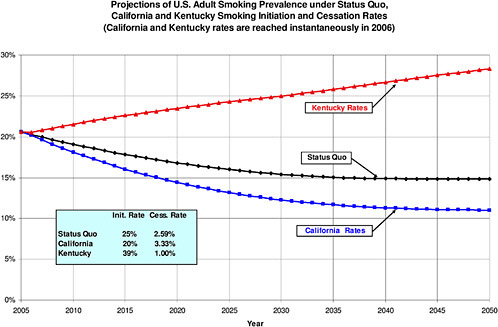
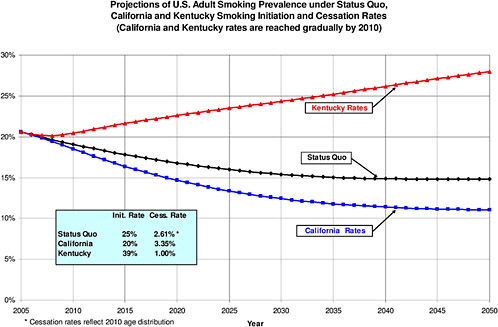
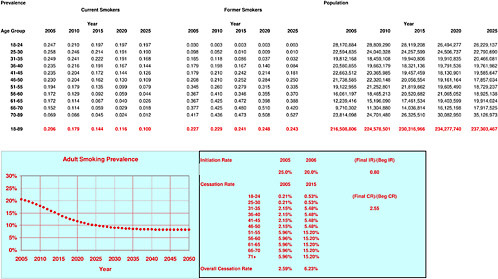
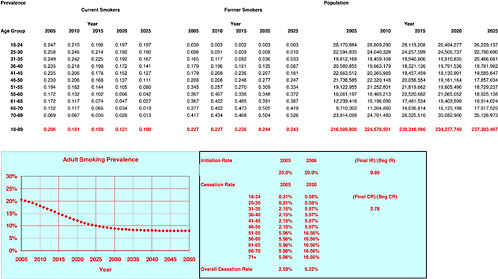
An analysis of future U.S. smoking prevalence under “status quo,” “best-case” and “worst-case” scenarios. The best-case scenario was defined by the committee as the United States achieving the State of California’s current smoking initiation and cessation rates. The worst case scenario was defined by the committee as the United States achieving the State of Kentucky’s current initiation and cessation rates.
-
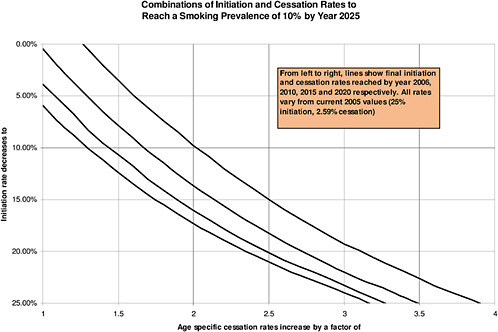
An analysis of different combinations of initiation and cessation rates that would achieve an adult smoking prevalence of 10 percent by the year 2025.
-
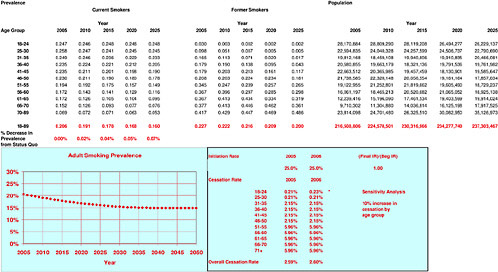
An analysis of the impact on smoking prevalence of increases in specific age group cessation rates.
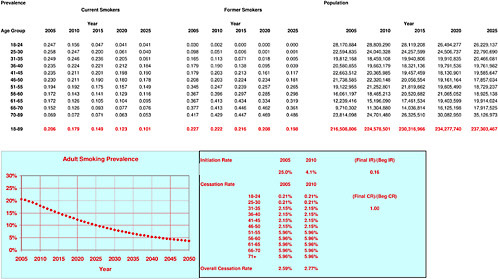
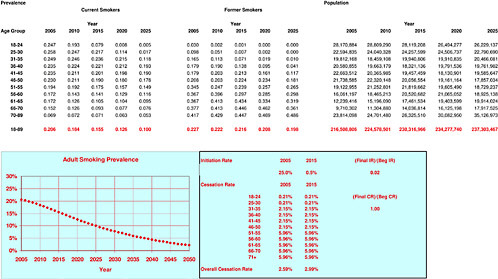
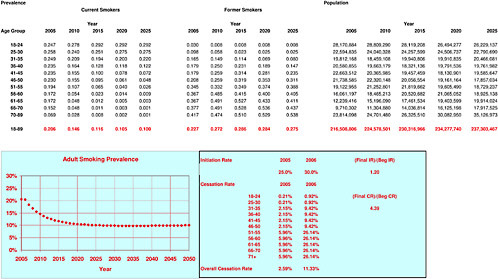
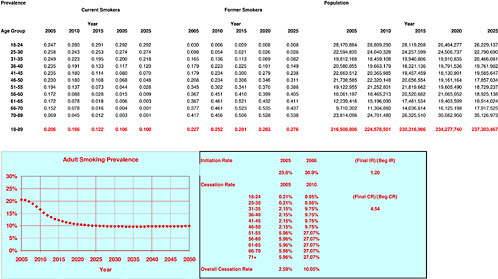
For all three analysis tasks, the committee requested reports of current, former, and neversmokers’ prevalence by age group and year. Current smokers are defined as individuals who have smoked more than 100 cigarettes during their entire lives and who smoke now every day or some days.
To carry out the analysis we used the model of U.S. smoking prevalence that we developed, which has been described elsewhere (Mendez et al. 1998). We introduced the following modifications to the model:
-
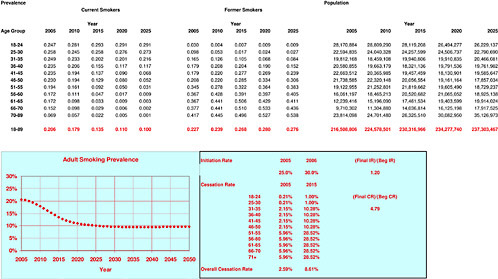
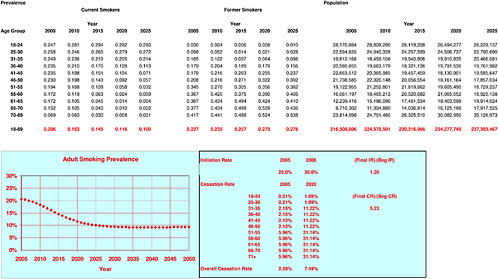
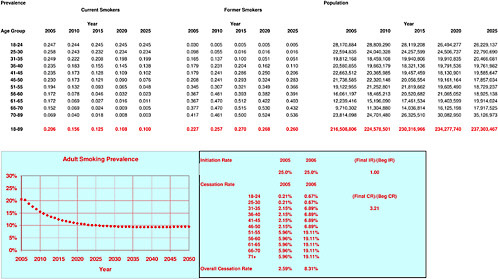
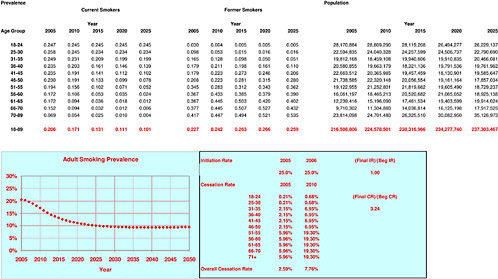
Age-specific population figures were updated using the 2000 U.S. Census.
-
Death rates were updated with year 2000 figures (from the Statistical Abstract of the United States).
-
Overall adult prevalence for the year 2005 was fixed at 20.6 percent. This figure is a projection, because the year 2005 smoking prevalence figure is not known yet. For reference, the Center for Disease Control and Prevention’s (CDC) preliminary estimate (from National Health Interview Survey [NHIS] data) of the adult smoking prevalence in 2004 is 20.9 percent.
-
Output was modified to conform to the committee’s specification.
DESCRIPTION OF ANALYSES
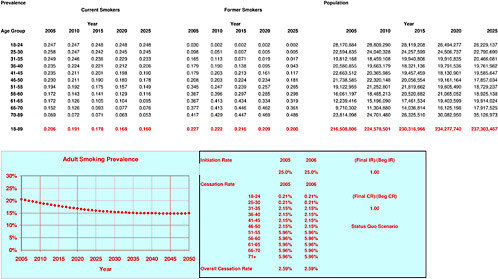
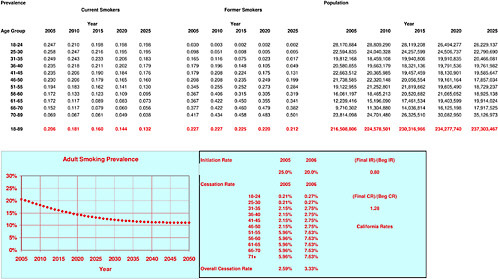
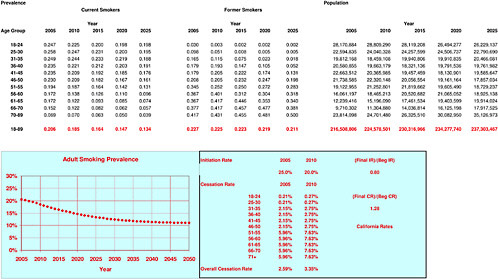
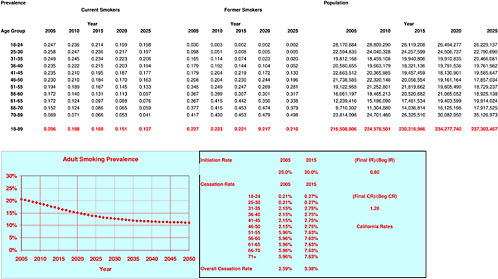
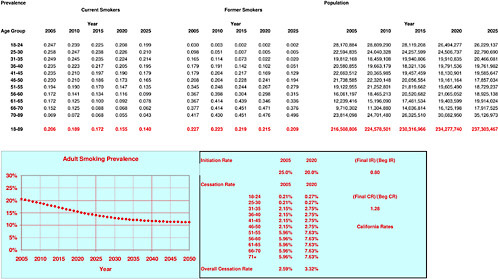
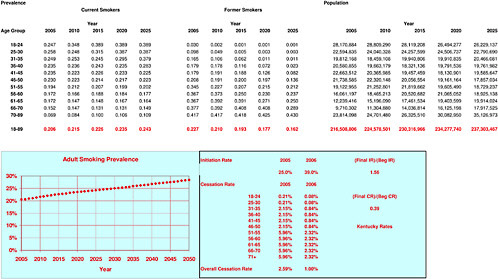
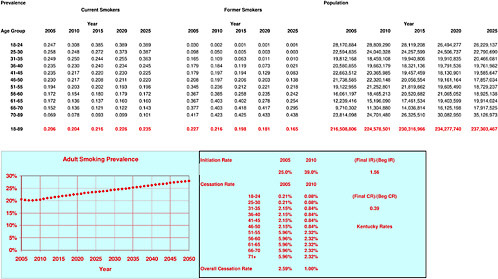
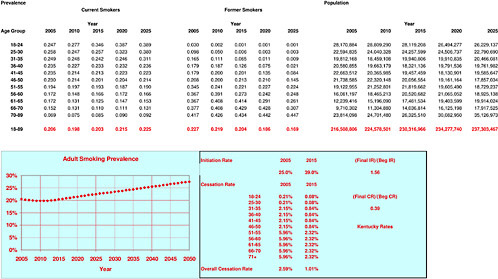
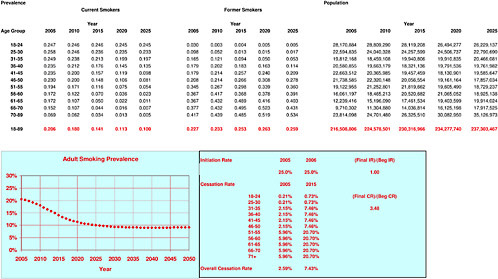
Pages 1 through 11 in the Results section show the outcomes from the model when subject to status quo as well as California and Kentucky’s initiation and cessation rates.
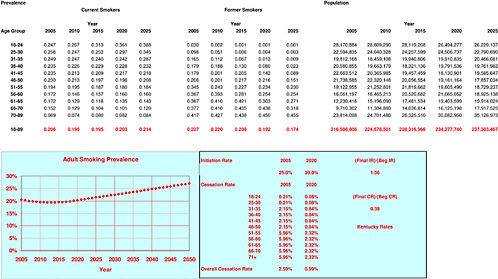
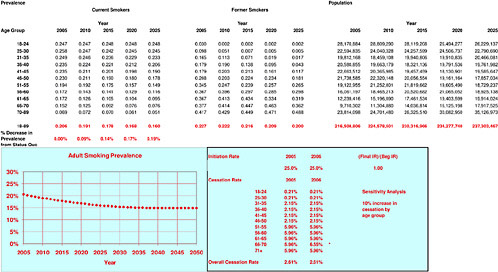
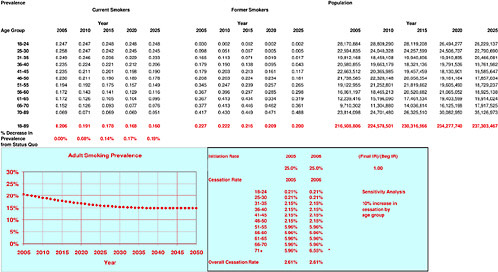
Status quo initiation rate was taken to be 25 percent, consistent with the prevalence for the 18–24 age group observed in 2003 (CDC 2005). Cessation rates for the status quo scenario were taken to be the ones estimated by Mendez and colleagues (1998): 0.21 percent for the 18–30 age group; 2.15 percent for the 31–50 age group; and 5.97 percent for individuals aged 51 and older. By using these age group-specific cessation rates we obtained an estimated 2.59 percent overall cessation rate in 2005 for the United States.
California and Kentucky rates were estimated with data from the Behavioral Risk Factor Surveillance System (BRFSS) from recent years (2000–2003). California’s initiation rate was estimated to be 20 percent, an average of the 18–24 age group prevalence from 2000 to 2003. Kentucky’s smoking initiation rate was estimated to be 39 percent.
Cessation rates for California and Kentucky were estimated in the following way: first, we obtained from BRFSS adult smoking prevalence by age group for each state from 2000 to 2003. We also obtained, from the Statistical Abstract of the United States, population size by age for each of the two states for the year 2000. We aged the population from 2000 to 2003 according to age-specific death rates and, for every year, computed the adult smoking prevalence assuming a single cessation rate for the population. We estimated the single cessation rate as the value that matched the calculated overall adult smoking prevalence with the prevalence reported from BRFSS for a specific year. These years, 2001 for Kentucky and 2002 for California, were chosen to highlight the high cessation in California and the low cessation in Kentucky. This procedure yielded an estimated cessation rate of 3.33 percent for California and 1.00 percent for Kentucky. We should note that this is a crude estimation procedure that ignores the effect of migration into and out of the states. The procedure is aimed to produce a rough estimate of the cessation rates in the states.
To obtain national age-specific cessation rates consistent with the aggregate quit rates obtained for California and Kentucky, we multiplied the status quo age-specific cessation rates by the ratio of the estimated cessation rates for California and Kentucky to the overall U.S. cessation rate: that is, 3.33/2.59 for California and 1.00/2.59 for Kentucky.
Page 1 in Results presents the status quo scenario. Pages 2 through 11 show scenarios in which the United States attains California and Kentucky rates at different times: almost instantaneously (in 2006) and gradually (linearly), by 2010, 2015, and 2020.
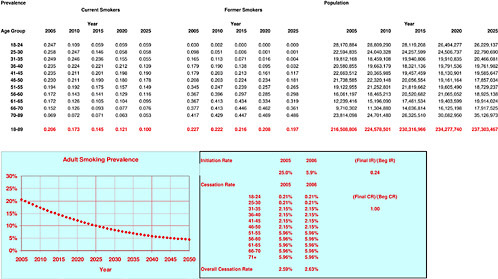
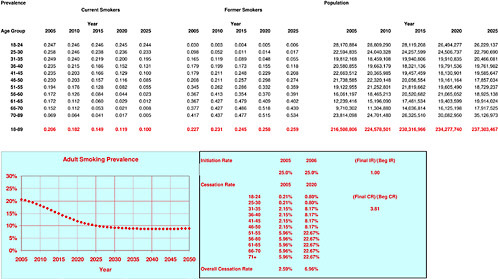
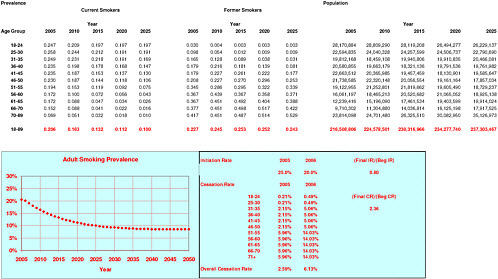
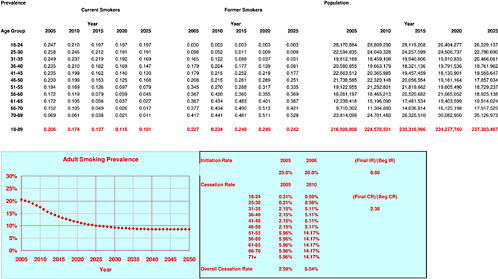
Pages 12 through 26 in Results describe different scenarios in which the country will move from a current adult smoking prevalence of 20.6 percent in 2005 to a 10 percent adult smoking prevalence in 2025. These scenarios describe necessary changes in initiation and/or cessation rates to achieve the 2025 10 percent target prevalence. These changes in initiation and cessation rates are assumed to happen instantaneously by 2006 or gradually (linearly) by 2010, 2015, and 2020. Once target cessation and initiation rates are reached, they are kept constant at the target levels for the remainder of the analysis period.
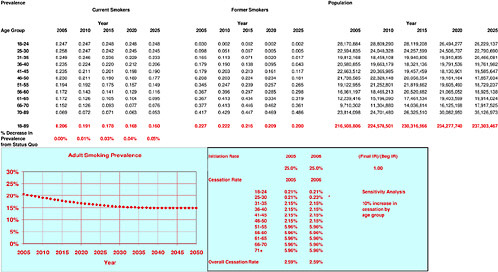
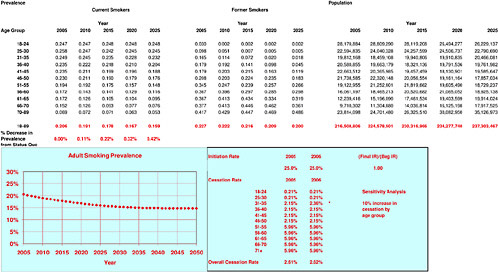
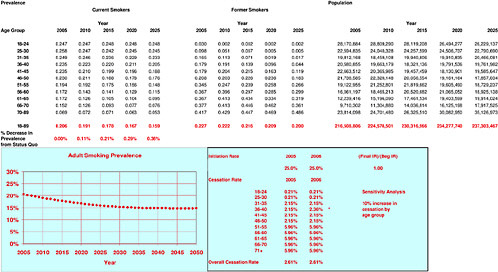
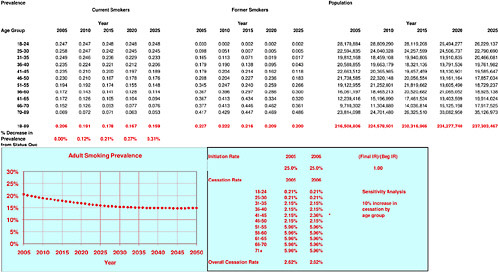
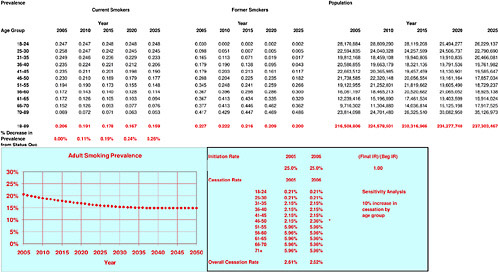
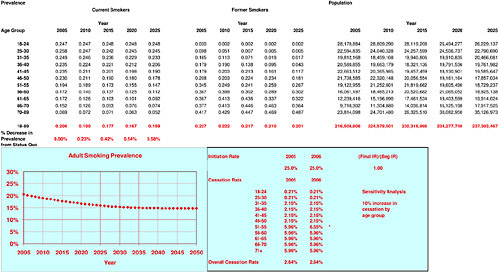
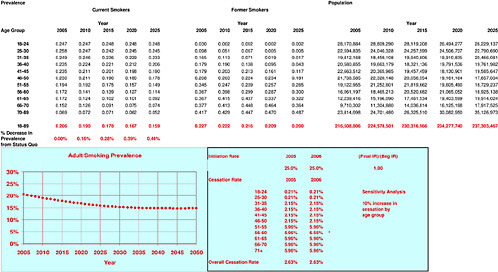
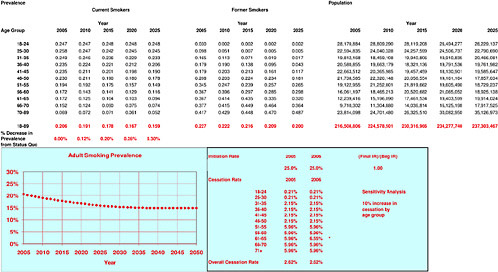
Finally, pages 27 through 38 present the percentage decrease in adult smoking prevalence (from the status quo) due to a 10 percent increase in cessation for each of the age groups reported in the analysis.
|
Page |
Description |
|
4 |
Status Quo Scenario |
|
5 |
Country moves from Status Quo rates to California rates – California rates are reached by 2006 |
|
6 |
California rates are reached by 2010 |
|
7 |
California rates are reached by 2015 |
|
8 |
California rates are reached by 2020 |
|
9 |
Country moves from Base Case rates to Kentucky rates – Kentucky rates are reached by 2006 |
|
10 |
Kentucky rates are reached by 2010 |
|
11 |
Kentucky rates are reached by 2015 |
|
12 |
Kentucky rates are reached by 2020 |
|
13 |
Smoking prevalence under California, Kentucky and Base Case rates – Rates are reached by 2006 |
|
14 |
Smoking prevalence under California, Kentucky and Base Case rates – Rates are reached by 2010 |
|
15 |
If initiation drops to 5.9% by 2006, prevalence will drop to 10% by 2025 |
|
16 |
If initiation drops to 4.1% by 2010, prevalence will drop to 10% by 2025 |
|
17 |
If initiation drops to 0.5% by 2015, prevalence will drop to 10% by 2025 |
|
18 |
If initiation is fixed at 30% in 2006 and cessation increases 4.39-fold by 2006, prevalence will drop to 10% by 2025 |
|
19 |
If initiation is fixed at 30% in 2006 and cessation increases 4.54-fold by 2010, prevalence will drop to 10% by 2025 |
|
20 |
If initiation is fixed at 30% in 2006 and cessation increases 4.79-fold by 2015, prevalence will drop to 10% by 2025 |
|
21 |
If initiation is fixed at 30% in 2006 and cessation increases 5.23-fold by 2020, prevalence will drop to 10% by 2025 |
|
22 |
If initiation is fixed at 25% in 2006 and cessation increases 3.21-fold by 2006, prevalence will drop to 10% by 2025 |
|
23 |
If initiation is fixed at 25% in 2006 and cessation increases 3.24-fold by 2010, prevalence will drop to 10% by 2025 |
|
24 |
If initiation is fixed at 25% in 2006 and cessation increases 3.48-fold by 2015, prevalence will drop to 10% by 2025 |
|
25 |
If initiation is fixed at 25% in 2006 and cessation increases 3.81-fold by 2020, prevalence will drop to 10% by 2025 |
|
26 |
If initiation is fixed at 20% in 2006 and cessation increases 2.36-fold by 2006, prevalence will drop to 10% by 2025 |
|
27 |
If initiation is fixed at 20% in 2006 and cessation increases 2.38-fold by 2010, prevalence will drop to 10% by 2025 |
|
28 |
If initiation is fixed at 20% in 2006 and cessation increases 2.55-fold by 2015, prevalence will drop to 10% by 2025 |
|
29 |
If initiation is fixed at 20% in 2006 and cessation increases 2.78-fold by 2020, prevalence will drop to 10% by 2025 |
|
30 |
Combinations of initiation and cessation rates to reach 10% prevalence by 2025 |
|
31 |
Sensitivity analysis – 10% increase in cessation rate for the 18-24 group in 2005 |
|
32 |
Sensitivity analysis – 10% increase in cessation rate for the 25-30 group in 2005 |
|
33 |
Sensitivity analysis – 10% increase in cessation rate for the 31-35 group in 2005 |
|
34 |
Sensitivity analysis – 10% increase in cessation rate for the 36-40 group in 2005 |
|
35 |
Sensitivity analysis – 10% increase in cessation rate for the 41-45 group in 2005 |
|
36 |
Sensitivity analysis – 10% increase in cessation rate for the 46-50 group in 2005 |
|
37 |
Sensitivity analysis – 10% increase in cessation rate for the 51-55 group in 2005 |
|
38 |
Sensitivity analysis – 10% increase in cessation rate for the 56-60 group in 2005 |
|
39 |
Sensitivity analysis – 10% increase in cessation rate for the 61-65 group in 2005 |
|
40 |
Sensitivity analysis – 10% increase in cessation rate for the 66-70 group in 2005 |
|
41 |
Sensitivity analysis – 10% increase in cessation rate for the 71+ group in 2005 |
REFERENCES
CDC (Centers for Disease Control and Prevention). 2005. Cigarette smoking among adults—United States, 2003. Morbidity and Mortality Weekly Report 54(20):509-528.
Mendez D, Warner KE, Courant PN. 1998. Has smoking cessation ceased? Expected trends in the prevalence of smoking in the United States. American Journal of Epidemiology 148(3):249-258.


