
3
Rare-Isotope Beams in the United States and Abroad
Chapters 1 and 2 have presented the background and scientific opportunities associated with the research at a rare-isotope facility. This chapter presents the existing and near-term capabilities in three regions of the world—North America, Europe, and Asia. The existing facilities in the United States and Canada are described in some detail, followed by a description of major facilities to come online in Japan, Germany, and France (see Appendix C for a broader survey of global activity). The role of these facilities in addressing the science drivers presented in Chapter 2 is described. This information frames the background for the discussion of the projected U.S. Facility for Rare-Isotope Beams (U.S. FRIB), its origins, and the associated technical developments that make such a facility possible.
EXISTING RARE-ISOTOPE FACILITIES IN NORTH AMERICA
United States: Selected Facilities
At present the United States has world-leading capabilities in the study of exotic nuclei and an active research community currently performing experiments with exotic beams here and elsewhere in the world. Appendix C presents a tabular listing of most of the operating and planned rare-isotope beam facilities in the world.
There are two major U.S. facilities running dedicated user programs primarily in exotic beams:
-
The National Superconducting Cyclotron Laboratory (NSCL) located at Michigan State University (MSU), and
-
The Holifield Radioactive Ion Beam Facility (HRIBF) located at the Oak Ridge National Laboratory (ORNL), Tennessee.
Other laboratories have capabilities to provide exotic beams: the Argonne Tandem Linear Accelerator System (ATLAS) at the Argonne National Laboratory (ANL), the Cyclotron Institute at Texas A&M University, the 88-inch Cyclotron at the Lawrence Berkeley National Laboratory (LBNL), and the TwinSol facility at the University of Notre Dame. The ATLAS facility and the Texas A&M laboratory are planning major upgrades of their exotic-beam capabilities, as described below. The current U.S. program is world leading, with the highest-intensity fast exotic beams available at the NSCL and a unique set of beams from actinide targets at HRIBF. The approximate size of the U.S. rare-isotope science community is 600 researchers and 150 graduate students. In addition, about 100 users from the international community come to the United States each year to conduct experiments at these facilities.
The NSCL at MSU provides approximately 4,000 hours of exotic fast-beam experiments per year. The facility is currently able to produce the most-intense fast beams of exotic isotopes worldwide through the use of two coupled superconducting cyclotrons and the A1900 fragment separator. Beams of between 20 and 200 MeV/A are available for experiments. During the laboratory’s first few years of operation, more than 100 different secondary beams have been used for experiments. Key experimental equipment includes the superconducting high-resolving power, large solid angle S800 magnetic spectrograph. This device is used in approximately 60 percent of all experiments. Other equipment includes the highly segmented germanium array (SeGA), a sweeper magnet plus neutron wall system for measuring neutron unbound states, a high-resolution array (HiRA) made of silicon, and a gas-stopping and Penning trap system for precision measurements of short-lived nuclei. Near-term upgrades include the addition of a radio-frequency (RF) separator for the purification of proton-rich nuclei, gamma-ray tracking using the SeGA array, and an improved gas-stopping system based on a cyclical system. In the medium term, plans are being developed to add postacceleration and to develop a modest program of reaccelerated beams. Ion beam intensities of up to 108 particles per second will be possible for many species.
HRIBF at ORNL employs the Isotope Separator On-Line (ISOL) method to produce radioactive ion beams using the Oak Ridge Isochronous Cyclotron
(ORIC) as the production accelerator and a 25 MV tandem Van de Graaff as the postaccelerator. From 2003 through 2005, HRIBF, operating on a 5-day per week schedule, provided an average of 1,600 hours of rare-isotope beams per year. A facility upgrade project that will be completed in mid-2009 will expand the exotic-beam capacity by more than 50 percent. HRIBF has demonstrated the ability to accelerate approximately 175 radioactive isotopes, including 140 neutron-rich species; more than 50 of these, including 132Sn, are available at intensities of 106 particles per second or greater. The facility’s postaccelerated neutron-rich beams are unique worldwide. The tandem postaccelerator produces high-quality beams with energies up to 10 MeV/A at A ~ 40 and 5 MeV/A at A ~ 130. Experimental equipment at HRIBF includes the Recoil Mass Separator, which is used primarily for nuclear structure studies and is equipped at the target position with the Clover Array for Radioactive Ion Beams Ge detector array, near full-coverage, charged-particle arrays, and neutron detectors, along with a variety of specialized detector systems at the focal plane for decay studies. The astrophysics end station is based on the Daresbury Recoil Separator, which is optimized for very asymmetric capture reactions and is equipped with highly segmented charged-particle arrays and high-density gas targets.
Other equipment at HRIBF includes a novel setup for very-low-rate evaporation residue and fission reaction studies, a split-pole spectrograph, and a facility for unaccelerated beam studies. A 3-year project, the Injector for Radioactive Ion Species 2 (IRIS2), begun in 2006, will incorporate the newly completed High Power Target Laboratory into HRIBF as a second ISOL production station, with functionality substantially exceeding that of the present facility (IRIS1). IRIS2 will provide critical redundancy in ISOL production, substantially improving the efficiency and reliability of HRIBF. A program of improvements of the capability and reliability of ORIC is also under way, including the installation of an axial injection system to replace the existing internal ion source.
Roughly 1,000 hours per year (15 to 20 percent) of the beam time available at ATLAS at ANL involve the use of a radioactive beam. At the facility, exotic beams can be produced with two distinct approaches: the two-accelerator method and the in-flight technique. Examples of beams produced with the two-accelerator method are long-lived 44Ti and 56Ni, which have been provided to experiments with intensities of 5 × 10⁵ to 6 × 10⁶ ions per second and beam energies up to 15 MeV/A. With the in-flight technique, the desired radioactive isotope is usually characterized by a much shorter half-life. It is produced by sending a primary, stable beam through a gas cell in which the secondary beam is produced through a direct nuclear reaction. Thus far, a number of short-lived beams have been used in experiments. Examples include 6He, 8B, 12B, 11C, 20Na, and 37K. In the near future,
further purification of the secondary beam will occur through the addition of an RF beam sweeper.
The ATLAS facility is equipped with state-of-the-art instrumentation, including two Penning traps, an atom trap, a split-pole spectrograph, and a Fragment Mass Analyzer. ATLAS is also the current home of Gammasphere, the national gamma-ray facility. A major advance in rare-isotope capabilities at ANL will be the Californium Rare Isotope Breeder Upgrade (CARIBU), at which a new source will be installed to provide beams of short-lived neutron-rich isotopes. The technique follows the gas catcher concept developed for the Rare Isotope Accelerator (RIA); it will provide accelerated neutron-rich beams with intensities up to 7 × 10⁵ particles per second. Specifically, CARIBU will provide beams of a few hundred nuclei between Z = 34 (Se) and Z = 64 (Gd), many of which cannot be extracted readily from ISOL-type sources. In addition, it will make available reaccelerated beams at energies up to about 12 MeV/A, which are difficult to reach at other facilities.
The in-flight technique described in Chapter 1 was developed early at the University of Notre Dame’s Nuclear Structure Laboratory, where it continues to be used extensively. In this case, primary beams from the FN tandem accelerator are used to produce the rare isotopes of interest through nuclear reactions. These isotopes are subsequently focused onto a target by TwinSol, a set of two superconducting solenoids. Thus far, beams of 6He, 7Be, 8Li, 8B, 12B, 10Be, 12N, 18Ne, and 18F have been produced at energies typically on the order of 2 to 5 MeV/A and intensities of 105 to 107 ions per second.
The Cyclotron Institute at Texas A&M University has, for some time, employed heavy-ion beams from the K500 cyclotron along with the Momentum Achromat Recoil Separator to produce exotic beams using the in-flight method. A project is now under way to add a versatile, reaccelerated exotic-beam capability. A key element of the project is the reactivation of the mothballed K150 cyclotron for use as a production accelerator. Radioactive species produced by beams from the K150 will be stopped as 1+ ions in He gas cells, formed into a beam by RF ion guides, transported to a charge-breeding Electron Cyclotron Resonance ion source, and finally postaccelerated in the K500. Several gas-stopping ion guide configurations are planned, with layout and geometry tailored to the production reaction. Initial effort will center on production by light-ion (p, d, α) reactions and will employ a configuration based on the existing Ion Guide Isotope Separator OnLine system at Jyväskylä, Finland. The first reaccelerated beam is expected in 2009. A broader range of rare isotopes, including neutron-rich species, will be available once a second configuration appropriate for use with various heavy-ion production reactions is operational (in about 2011). This configuration will include a large-bore superconducting solenoid as a first-stage collector and a gas cell based on the ANL design. Beam intensities up to ~5 × 10⁵ particles per second are
expected in favorable cases, and reaccelerated beams with energies in the range 2 to 70 MeV/A will be available.
Complementary to these efforts using exotic beams, a number of facilities for stable beams (including a major portion of the ATLAS program at ANL, as well as LBNL, Florida State University, the University of Notre Dame, the Triangle Universities Nuclear Laboratory, the University of Washington, and Yale University) operate extensive programs in nuclear structure and astrophysics. Naturally, beam intensities at these facilities are, in general, much larger than intensities with exotic beams, allowing a more detailed investigation of the nuclei available for study. The technique of inverse kinematics, developed out of necessity for exotic-beam experiments, has been found to have many advantages in some stable-beam experiments as well. The interplay between exotic- and stable-beam research runs deep, and questions raised with one approach are often further addressed in the other. Maintaining these complementary capabilities is very desirable.
Canada: Isotope Separator and Accelerator at TRIUMF
TRIUMF, located in Vancouver, British Columbia, is Canada’s national laboratory for accelerator-based science. Traditionally it has provided a sizable contingent of U.S. scientists an opportunity to carry out research. The epicenter of the TRIUMF facility is a high-intensity 500 MeV negatively charged hydrogen ion cyclotron—a proven reliable source of simultaneously extracted, high-intensity, proton beams. The Isotope Separator and Accelerator (ISAC) user community numbers a few hundred; about 20 percent of the researchers come from the United States.
ISAC, an advanced ISOL-type facility, is one of the major facilities receiving beam from the cyclotron (see Figure 3.1). The target area is shielded to permit delivery of a 100 µA, 500 MeV (50 kW) proton beam onto an ISOL target. All isotopes with an A/q ≤ 30 can be accelerated in a continuous-wave, radio-frequency quadrupole linac from 2 keV/A, at injection, to 150 keV/A at exit. A subsequent drift tube linac allows the energy of the ion beam to be continuously varied from the initial 0.15 MeV/A to 2 MeV/A and transported to any one of the three experimental stations in ISAC-I (the first phase of ISAC). With the installation of a charge-state booster in 2007, essentially all exotic isotopes ionized in ISAC could be accelerated. In 2006, a superconducting linac was commissioned, bringing the beam to a new experimental hall (ISAC-II). Initially the ISAC accelerator will begin operation at an energy of 4.3 MeV/A (6.1 MeV/A, 12C, A/q = 4, has been commissioned). Additional accelerating structures are being built that will increase the final energy up to a nominal 6.5 MeV/A for A ≤ 150 by 2010.
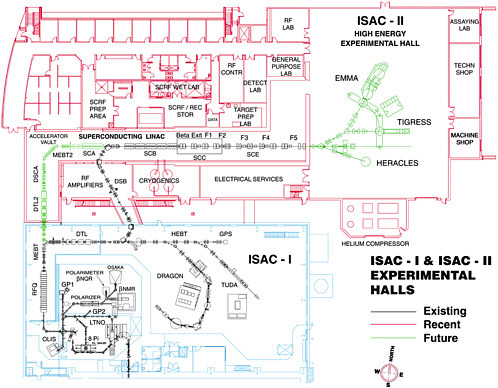
FIGURE 3.1 Layout of the accelerators and experimental stations in the Isotope Separator and Accelerator (ISAC) facility at TRIUMF in Canada. See text for additional detail.
A proposal has been developed to take advantage of the unique capabilities of the cyclotron to independently provide simultaneous high-current beams for multiple beam lines. In this proposal, a second high-intensity proton beam line would be constructed to bring a second beam to ISAC. This proposed facility would then provide a unique testing facility for high-power targets and ion sources. This concept potentially also permits the simultaneous acceleration of different isotopes from separate targets for experiments.
In addition to a complement of general-purpose experimental equipment, some of the specialized experimental equipment associated with the different beams at ISAC is listed below.
-
For the low-energy unaccelerated beams (≤60 keV):
-
TRINAT (TRIUMF Neutral Atom Trap), a magneto-optical atom trap for electroweak precision tests of the Standard Model.
-
TITAN (TRIUMF Ion Trap Facility for Atomic and Nuclear Science), a facility optimized for high-precision mass measurements of short-lived nuclei scheduled to begin operation in the fall of 2006.
-
-
For the accelerated beams in the ISAC-I experimental hall:
-
DRAGON (Detector of Recoils and Gammas of Nuclear Reactions), a recoil mass separator and associated windowless gas target built to measure the rates of proton- and alpha-radiative-capture reactions.
-
TUDA (TRIUMF UK Detector Array), an array of double-sided silicon strip detectors located in a general reaction chamber designed to study resonant reactions complementary to those from DRAGON and transfer reactions associated with explosive hydrogen and helium burning.
-
A general-purpose experimental location.
-
-
For accelerated beams in the ISAC-II experimental hall:
-
A versatile, high-efficiency gamma-ray detector array, TIGRESS (TRIUMF-ISAC Gamma-Ray Escape Suppressed Spectrometer), consisting of 12 “clover-type,” segmented, hyperpure germanium detectors.
-
EMMA (ElectroMagnetic Mass Analyzer), a recoil mass spectrometer to detect the following: (1) the exotic heavy products of fusion-evaporation reactions, (2) elastic and inelastic scattering, and (3) transfer reactions in inverse kinematics. This facility should be available for experiments in 2010.
-
A general-purpose facility that will first be used in 2006 with the Multi-Angle Gamma Apparatus detector (on loan from Grand Accélérateur National d’Ions Lourds [GANIL]) with an accelerated 11Li beam.
-
RARE-ISOTOPE FACILITIES COMING ONLINE IN ASIA AND EUROPE
There is global interest in the science of rare isotopes. In addition to continued significant investments in Japan, Germany, and France, countries including Belgium, Brazil, China, Finland, Italy, India, Russia, and Switzerland are pursuing beam-based facilities for rare-isotope research (see Appendix C for selected details). The three emerging facilities in Japan, Germany, and France—the Rare-Isotope Beam Factory (RIBF) at RIKEN in Japan, the Facility for Antiproton and Ion Research (FAIR) at Gesellschaft für Schwerionenforschung (GSI) in Germany, and the Système de Production d’Ions Radioactifs en Ligne (SPIRAL) 2 facility at GANIL—are described in some detail, as they represent the standard with which a
U.S. FRIB must be compared if it is to have a world-leading role in rare-isotope physics research. The considerable scope of these two facilities represents the view of the international scientific community of the opportunities of enhanced capability in rare-isotope science. Layout diagrams of these facilities are presented so that their ambitious scope can be fully appreciated.
Japan: Rare-Isotope Beam Factory at RIKEN
Construction of the Rare-Isotope Beam Factory is divided into two phases. Phase 1, which is already funded, consists of (1) a high-power heavy-ion accelerator with 238U beams at 100 kW, (2) a fragment separator, and (3) a multifunction beam line spectrometer at zero degrees. The RIBF accelerator consists of three cyclotrons with K = 570 MeV, 980 MeV, and 2500 MeV, respectively. Expected beam energies will be up to 440 MeV/A for light ions and 350 MeV/A for 238U. The goal for the intensity of the driver is 6 × 10¹² ions per second. As of this writing, the first beam from the entire accelerator system is expected in December 2006. A diagram of the facility is shown in Figure 3.2.
Typically, rare-isotope (RI) beams at ~250 MeV/A will be used either via projectile fragmentation of stable ions or via in-flight fission of uranium ions through the fragment separator. The fragment separator consists of dipole (normal conducting) and quadrupole magnets (superconducting) for the production of fission fragments with a large acceptance. The zero-degree spectrometer is a multifunction beam transport line composed with many magnets, the structure of which is similar to that of the fragment separator. With this spectrometer, inclusive and/or semi-exclusive spectra in the reactions will be measured with particle identification by the zero-degree spectrometer. In Phase 1, the scientific agenda will include a search for halo nuclei via a transmission method, a search for any loss or birth of magic numbers via in-beam spectroscopy and beta-spectroscopy, and other searches.
In Phase 2 (2007-2010), many additional experimental systems will be installed. Studies of nuclear structure as well as astrophysics, as described in Chapter 2, will be the main focus at this RIBF facility. In addition, with the installation of a new storage ring, a high-precision mass measurement with Δm/m = 10–6 is planned. Production of polarized RI beams is planned with a novel method. Also, there are plans for measurements of electron-RI scatterings, with the construction of an electron storage ring with an electron energy of 300 MeV. In addition, a new linac injector is proposed for the gas-filled recoil separator in order to enhance the efficiency of a superheavy element search. At present, the expected user community for RIBF numbers about 450 researchers, with some room for additional growth.
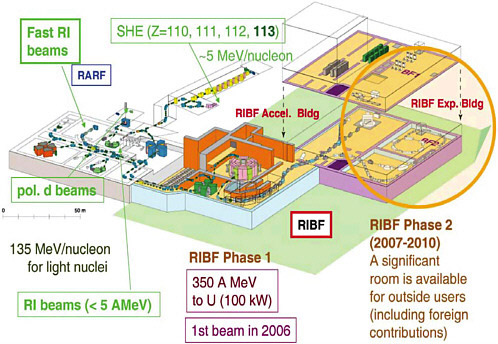
FIGURE 3.2 Present RIKEN Accelerator Research Facility (RARF) and the new, high-power Rare-Isotope Beam Factory (RIBF). The latter is under construction and is expected to begin operation in December 2006.
Germany: Facility for Antiproton and Ion Research at GSI
The central part of the Facility for Antiproton and Ion Research consists of two large superconducting synchrotrons and a complex system of storage rings that will deliver high-intensity ion beams up to 35 GeV per nucleon for experiments with primary beams of ions up to uranium, as well as secondary (radioactive) ion beams and antiprotons. A system of storage and cooler rings is foreseen in order to increase the phase-space density of the beams of rare isotopes and anti-protons. Figure 3.3 presents a schematic layout of the present and future facilities at GSI. FAIR will open up unique opportunities for a broad spectrum of research. There are to be five major programs: quantum chromodynamics studies with cooled beams of antiprotons, nucleus-nucleus collisions at the highest baryon densities, nuclear structure and nuclear astrophysics investigations with nuclei far off stability, high-density plasma physics, and atomic and materials science studies, radiobiological investigations, and other interdisciplinary studies.
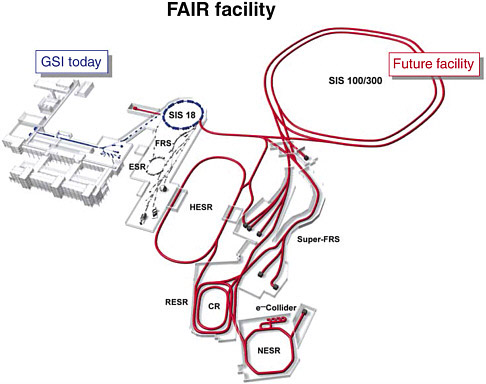
FIGURE 3.3 Layout of the present and future facilities at Gesellschaft für Schwerionenforschung (GSI). The new Facility for Antiproton and Ion Research’s (FAIR’s) accelerators and buildings (indicated in color on the right of the site map) are located east of the existing GSI facilities (indicated in gray). NOTE: SIS—Heavy-Ion Synchrotron; FRS—fragment separator; ESR—experimental storage ring; HESR—high-energy storage ring; RESR—accumulator/decelerator ring; CR—collector ring; NESR—new experimental storage ring. Image courtesy of H. Geissel, GSI.
The concept and design of the FAIR accelerator facility have been adapted to the requirements of the planned scientific programs. These requirements are as follows:
-
Beams of all ion species. With FAIR, beams of all kinds of ions, from hydrogen to uranium, as well as antiprotons with a large energy range (from nearly at rest up to some 10 GeV per nucleon), will be provided.
-
Highest beam intensities. The intensities of the primary beams are increased by a factor of one up to several hundred for the heaviest ion species relative to any existing facility. For the production of radioactive secondary beams
-
and also for the generation of high-power pulses for plasma research, these high-intensity beams with up to 5 × 10¹¹ ions circulating in the SIS 100-synchrotron can be compressed to short bunches of 50 to 100 ns duration. The increases in primary intensity translate into an even higher gain factor of 1,000 up to 10,000 for radioactive secondary beam intensities, owing to the higher acceptance of the subsequent separators and storage rings.
-
Increase in beam energy. For antiproton production, intense proton beams with an energy of around 30 GeV are needed. In order to achieve the highest baryon densities and allow for charm production in nucleus-nucleus collisions, beam energies of up to 35 GeV per nucleon for uranium 92+ are to be provided.
-
High-quality beams. By exploiting beam manipulation methods such as stochastic cooling and electron cooling, the momentum spread and transverse emittance of primary and secondary beams can be reduced by several orders of magnitude. These cooled beams will allow novel precision experiments on the structure of matter and the fundamental interactions and symmetries on which it is based.
-
Running of parallel programs. By special coordination of the time sequence of acceleration and transfer between the various synchrotrons and storage rings, all five major scientific programs will be running in a highly parallel mode.
The FAIR project is funded at a total cost of 1,187 million euros (M€) (1,001 M€ in investments, 186 M€ in personnel). Construction is projected to start in the fall of 2007. FAIR will be constructed in three phases until 2014. The full performance with parallel operation of all experimental programs is planned for 2015. FAIR will serve a user community of about 2,500 researchers, about 25 percent of whom are primarily interested in the rare-isotope beam capabilities of the facility.
France: SPIRAL 2 Facility at GANIL
In 2005, the Nuclear Physics European Collaboration Committee (NuPECC) —an advisory committee of the European Science Foundation—prepared a roadmap for the construction of nuclear physics research infrastructure in Europe. The committee recommended the construction of two next-generation rare-isotope beam facilities that were under discussion in the region: FAIR at GSI, using in-flight fragmentation, and the GANIL/SPIRAL 2 radioactive-beam facility employing ISOL techniques. The document acknowledged the interest of the scientific community in pursuing an “ultimate” ISOL facility for Europe, termed EURISOL—European Isotope Separator On-Line. This facility is not envisioned
to begin for at least another 10 years, however. Because of the timeline for this project, NuPECC recommended the construction of an intermediate-generation facility that would continue research and development efforts and provide much-needed rare-isotope beams to the user community of about 700 physicists. Among the intermediate facilities that have been proposed, SPIRAL 2 met all of the criteria that NuPECC supplied (scientific agenda, site evaluation, and level of investment).
In March 2005, the European Strategy Forum on Research Infrastructure published its “List of Opportunities.” FAIR and SPIRAL 2 were among the selected projects. In May 2005, the French Ministry of Research announced its intention to build SPIRAL 2. Its construction cost, estimated to be 130 M€ (including personnel and contingency), will be shared by the French funding agencies, the authorities of the locality of Basse Normandie, and other European partners. The construction will last about 5 years, with full operations planned for 2012. The facility will serve a community of about 700 users.
SPIRAL 2 is an upgrade planned for the SPIRAL facility at the French laboratory GANIL in Caen, France. The SPIRAL 2 project is based on a multibeam driver in order to allow both ISOL and low-energy in-flight techniques to produce rare-isotope beams (see Figure 3.4). A superconducting light-/heavy-ion linac with an acceleration potential of about 40 MV capable of accelerating 5 mA deuterons up to 40 MeV and 1 mA heavy ions up to 14.5 MeV/A will be used to bombard both thick and thin targets. These beams could be used for the production of intense beams by several reaction mechanisms (fusion, fission, transfer, and so on) and technical methods. The production of high-intensity beams of neutron-rich nuclei will be based on fission of a uranium target induced by neutrons, obtained from a deuteron beam impinging on a graphite converter (up to 1014 fissions per second) or by a direct irradiation with a deuteron, 3He, or 4He beam. The postacceleration of beams in the SPIRAL 2 project would be obtained using an existing cyclotron. An important aspect of this project is that it will allow GANIL to provide beams in parallel to up to five different experiments.
A review of the scientific agenda for SPIRAL 2 shows that several domains of research in nuclear physics at the limits of stability will be covered by this project, including the study of the rapid-neutron-capture-process (r-process) and rapid-proton-capture-process nuclei, and shell closure in the vicinity of magic numbers, as well as the investigation of very heavy elements. The high-intensity stable and radio-active heavy-ion beams will also be available for interdisciplinary research in atomic physics and materials science. An intense flux of fast neutrons produced by SPIRAL 2 might find additional important applications, such as in a program for studies of the astrophysical slow-neutron process. Within this niche, SPIRAL 2 will be a very attractive facility.
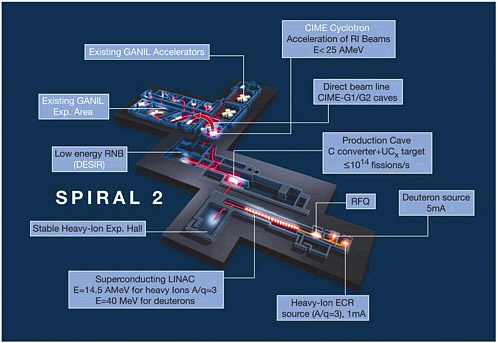
FIGURE 3.4 Conceptual overview of the proposed Système de Production d’Ions Radioactifs en Ligne (SPIRAL) 2 radioactive-beam facility at GANIL in France. NOTE: GANIL—Grand Accélérateur National d’Ions Lourds; CIME—Cyclotron pour Ions de Moyenne Energie; RI—rare-isotope; RNB—radioactive nuclear beam; DESIR— low-energy RNB; RFQ—radio-frequency quadrupole; LINAC—linear accelerator; ECR—Electron Cyclotron Resonance. Image courtesy of GANIL/APRIM.
INTERNATIONAL COMPARISONS
First-generation rare-isotope beam facilities have been operating in the three regions of the world where nuclear physics is most actively pursued, Europe, North America, and Asia, and several laboratories have undertaken significant upgrades to prepare second-generation facilities (GSI, TRIUMF, RIKEN, and the SPIRAL facility at GANIL in France). These facilities continue to produce important results, and ambitious experiments are planned with them in the next few years. However, major breakthroughs toward the ultimate scientific goal of a comprehensive understanding of atomic nuclei will only be achieved by the next generation of rare-isotope facilities.
In order to better understand the capability and advantages of facilities that
would be sharing the world stage with a future U.S. facility, the Department of Energy/National Science Foundation (DOE/NSF) Nuclear Science Advisory Committee (NSAC) established a subcommittee in 2003 to compare the relative capabilities of FAIR at GSI and the then-proposed facility concept RIA. The subcommittee generated a detailed, 45-page report examining all aspects of the issue.1
The NSAC subcommittee compared the energies, intensities, rarity, and quality of the rare-isotope beams projected to be achieved at both FAIR and RIA. Since the time of the subcommittee’s report, U.S. plans have been revised. The reduction in scope and budget from RIA to a potential FRIB is estimated2 to result in a rare-isotope beam intensity that ranges from being 0 to 20 percent reduced for ions near the valley of stability to being more than 90 percent reduced for certain elements nearer the neutron drip line compared to what could have been achieved with a 400 MeV/A driver. Larger reductions are offset by retaining the same beam power at 200 MeV/A energy and hence having twice the beam current. On the basis of these estimates, the committee conducted some approximate comparisons among a potential implementation of a FRIB, GSI’s FAIR, and RIKEN’s RIBF. Rather than repeating the NSAC’s detailed flux comparisons for RIA and GSI, this committee provides an evaluation relative to the science questions identified in Chapter 2. Thus, this committee reviewed several of the key comparisons of RIA and GSI made in the NSAC report and comments on the applicability to a FRIB.
For instance, in the area of nuclear structure research, the NSAC subcommittee found the following with respect to the relative strengths of GSI and RIA:
-
RIA strength: RIA’s generally higher intensity of unstable nuclei, especially at the limits of existence, will provide it with across the board advantages even in the capabilities it shares with GSI. The flexibility of the RIA concept allows the choice of production methods to be optimized for particular rare-isotope species that will, for example, have a major impact on studies of very heavy elements. The re-accelerated beam capability at RIA, which is unique to that facility, will enable the application of a wide range of classical nuclear structure studies to nuclei with extreme N/Z ratios that will be a focus of the nuclear structure program.
-
GSI strength: GSI has unique capabilities of stored and cooled unstable beams that make possible broad-range measurements of large numbers of masses at moderate precision (~50 keV).* Colliding-beam eA studies of nuclear charge distributions will also be possible for species produced at relatively high inten-
-
sity (>106 ions/s). The availability of thin internal targets of hydrogen and helium isotopes will facilitate hadron scattering studies of the radial distributions of mass in nuclei, and may allow an extension of knowledge of isoscalar giant modes into the regime of neutron-rich unstable nuclei.3
|
* |
Note recently that masses with A~200 have been measured with an accuracy of 30 keV, e.g., Nucl. Phys. A756, 3 (2005). |
The most interesting masses are those farthest from the valley of stability, and they will be much less abundantly produced. The present committee heard testimony that mass resolutions of ~100 keV would be achieved in these instances— still an impressive and useful feat.
With respect to the projected impact on addressing the nuclear physics aspects of the r-process, the NSAC subcommittee concluded as follows:
-
RIA strength: The higher intensities allow more sensitive and higher quality structure and life-time measurements, identification and study of halo effects, and shell quenching signatures. In particular, determinations of half-life and the probability for β-delayed neutron emission are very intensity dependent. RIA also provides deeper access (on average by 2-3 neutrons compared to GSI) into the neutron rich regions of the nuclide chart. The proposed (d,p) transfer studies to probe (n,β) reaction rates can also be performed without major difficulty over a wide energy range. Because of the fast beam option, (γ,n) Coulomb break-up experiments are also possible, but face similar uncertainties as at GSI.
-
GSI strength: The storage ring allows global mass measurement for many masses at the same time. This is a good technique for testing mass models and promises to provide mass information with uncertainties less than 100 keV/c2. The fast beam capability allows measurements of Coulomb break-up, but the method may only be useful for light isotope systems because of the complexity in structure and gamma-decay pattern of the resonance states.4
These comparisons, 10 in all, by the NSAC subommittee show unique advantages for both facilities in addressing a set of scientific issues rather similar to those listed in Chapter 2 of the present report. Moreover, FAIR will be a facility focusing on a broader set of issues than rare-isotope science, as it has relativistic stable ion beams, kaon beams, and antiproton beams, as well as rare-isotope beams.
Thus, not to belabor the issue further but to quote from the conclusion of the NSAC subcommittee:
There have been numerous previous studies that have made a strong science case associated with the study of rare-isotopes and we reaffirm those findings. The RIA and GSI facilities are largely quite distinct in their strengths and are indeed, as the proponents claim, complementary. RIA clearly has a much larger reach as a rare-isotope facility, and hence the better facility to address the science associated with rare-isotopes. The existence of an upgraded GSI facility does not, by itself, constitute justification for de-scoping the rare-isotope capability of RIA as there is only modest overlap in their rare-isotope capabilities. However, the rare-isotope capability at the future GSI facility is only one part of a remarkably versatile and multifaceted accelerator complex. We expect the U.S. research community to have a strong interest in several of the GSI capabilities.5
The present Rare-Isotope Science Assessment Committee is in accord with the findings of this NSAC subcommittee and further notes that since FAIR will be pursuing a broad program of which rare-isotope beams are only a part, significant annual operations would make a FRIB quite competitive. That is, beam-time availability for exotic species would be a key determining factor in the success of a FRIB over FAIR.
No such complete study exists comparing the capabilities of RIA to RIKEN’s RIBF, let alone for a U.S. FRIB. However, the following observations can be made. RIKEN is currently designed as a heavy-ion-fragmentation facility. It aims for a heavy-ion driver power of somewhat less than 100 kW for a 350 MeV/A 238U beam. The suite of experimental systems planned for installation in the second phase of construction is impressive. The planned storage ring (with a mass resolution Δm/m = 10−6) will be an important capability for measurements of masses approaching the neutron drip line. The addition of a 300 MeV electron storage ring to investigate the charge distribution of radioactive ion species will be a unique capability unmatched at any other facility.
There are no plans for a light-ion ISOL capability. The goal for the RIBF primary accelerator requires a tenfold improvement in the performance of the cyclotron-ion source and proof of performance for the stripper foil technology at these intensities. With the considerable investments being made and the sharp focus on physics with rare ions, RIKEN’s RIBF will be the leading facility in the region and a major facility in the world with several unique features.


