
14
The Arctic Ocean and Post-Jurassic Paleoclimatology
DAVID L.CLARK
University of Wisconsin
INTRODUCTION
To what extent has the Arctic Ocean been a factor for pre-Pleistocene world climates? This paper examines the idea by asking three questions: (1) What is the role of the existing Arctic ice cover in modern climate? (2) What models are available for an ice-free Arctic Ocean, and what do these models suggest about the effect of an ice-free ocean on world climates? (3) What does the sediment record say about conditions of the Arctic Ocean in the post-Jurassic world?
Answers to these questions suggest a significant role for the Arctic Ocean in post-Jurassic paleoclimatology and, equally important, point to possible future dramatic climate changes if the Arctic Ocean environment is altered.
MODERN ARCTIC OCEAN AND EFFECT ON WORLD CLIMATE
The central Arctic Ocean (approximately 66° N latitude) differs most strikingly from other oceans because most of it is ice covered throughout the year. This includes the area above 70° N latitude, from 105° E to 135° W longitude. The area of the Greenland-Norwegian-Barents-Kara Seas has considerably more open water during summer months but only in the area south of 80° N (Figure 14.1).
Because atmospheric circulation largely is generated by the gradients resulting from heat gain at low latitudes and heat loss at high latitudes, the approximate 6×10⁶ km2 perennial ice cover of the Arctic Ocean has a profound effect on modern world climate. Flohn (1978) described details of this pattern for polar regions. Because it is more than twice as large, the Antarctic is a more significant climate modifier. In both areas, the ice cover restricts heat exchange between the atmosphere and the ocean. Heat loss by the ocean is suppressed in winter as is heat gain in summer. This results in at least three times as much atmospheric cooling with the ice as there would be without it (Fletcher and Kelley, 1978).
In addition to affecting general atmospheric circulation, short-term weather modifications caused by changes in extent of the ice cover illustrate direct effects. A decrease in area of Arctic ice correlates with a northward shift of storm tracks and a shift of mid-latitude rainfall patterns eastward (Fletcher, 1972; Fletcher and Kelley, 1978). A dramatic example of
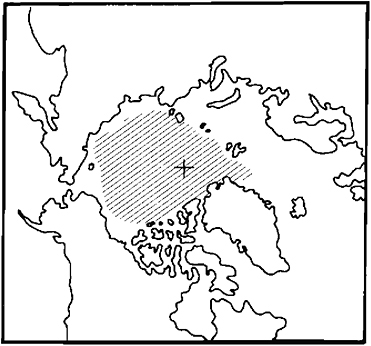
FIGURE 14.1 Approximate limits of year-round Arctic Ocean ice cover.
weather modification is based on satellite data that showed that the ice cover was 12 percent greater in 1971 than in 1970. This produced a surface-heat-exchange deficit for the Arctic that was correlated with anomalous weather patterns in lower latitudes during 1972 and 1973 (Kukla and Kukla, 1974).
Some of the effects are more complex. Other data show that the Arctic region (Greenland, in this example) and northern Europe are out of phase in terms of severity of winter temperatures. This has been described as the “seesaw effect.” Colder Arctic (Greenland) winters commonly correlate with mild northern European winters and vice versa (van Loon and Rogers, 1978). The temperature anomaly is correlated with anomalous weather effects over wide areas including the southern Mediterranean, the Middle East, Central America, western North America, and Alaska. Explanations for this temperature anomaly are related to pressure anomalies as well as to general atmospheric circulation.
An interesting model of world climate and its relationship to astronomical theories of ice ages includes cooling and heating parameters; heat transport; seasonal variation in Arctic ice cover; and a variety of Earth obliquity, eccentricity, and precession factors (Pollard, 1978). A number of conclusions derived from the still imperfect model include the observations that variation in extent of ice cover would have a profound effect on world climate. Nonetheless, the totality of cryospheric processes including feedback mechanisms for the Arctic Ocean and the relationship to world climate is only partially understood (Polar Group, 1980).
However, both observations and models furnish suggestive data regarding the effect of the Arctic ice cover on world climates.
WORLD CLIMATE AND AN ICE-FREE ARCTIC OCEAN
Polar ice covers are basic to the generation of atmospheric circulation. Removal of the ice covers would reduce the thermal gradient and change circulation. The extent of the change that would be produced has not been quantitatively described, in fact “… a realistic model of the entire planetary circulation under the assumption of an ice-free Arctic Ocean is not yet available…” (Fletcher and Kelley, 1978, p. 103). Nonetheless, there are data suggesting how the absence of an Arctic ice cover would greatly modify world climates. For example, during the summer, an ice-free Arctic Ocean would absorb 90 percent of solar radiation reaching its surface in contrast to the present figure of 30 to 40 percent (Fletcher and Kelley, 1978). Such a change would affect the Earth’s heat budget.
There is disagreement on the actual heat balance of an ice-free Arctic. One argument is that under ice-free conditions the Arctic Ocean would gain approximately 40 kcal/cm2 in summer but lose a similar amount in the winter for a balance (Fletcher and Kelley, 1978). Others argue that there would be a smaller heat loss in the winter, resulting in a yearly net increase in ocean temperatures (Donn and Shaw, 1966).
Year-round open water in the Arctic would be a source for increased atmospheric moisture. The surface temperature of an ice-free Arctic would be critical in determining how much. At 0–5°C surface temperature, the Arctic would give only a fifth to a sixth as much moisture to the atmosphere as water at 25–30°C, under similar wind conditions (Lamb, 1974). Nonetheless, an ice-free Arctic Ocean would contribute to warmer atmospheric conditions that could produce an increase in precipitation for Canada, India, the Middle East, and China and a sharp decrease in precipitation for most of the United States, Eurasia, and much of northern Africa (Wigley et al., 1980).
Such conclusions would be more impressive if framed in quantitative terms, but in the absence of complete modeling of these conditions, it may be safe to conclude that change in precipitation patterns in addition to other changes in atmospheric gradients produced by an ice-free Arctic would be a factor in amelioration of northern hemisphere climate.
DEVELOPMENT OF THE ARCTIC OCEAN
Having examined questions related to the effect of an ice-covered. and ice-free Arctic Ocean on world climate, it is necessary to discuss the geologic development of the Arctic. What is known about the absence or presence of ice cover during the development of the Arctic Ocean? The size and position of the Arctic Ocean have changed as crustal plates have adjusted, By the Cretaceous, the present position of the Arctic Ocean was approached (Firstbrook et al., 1972; Smith and Briden, 1977), but the ocean was only one half as large as it is at present. As the North Atlantic opened, spreading along the Nansen Ridge doubled the size of the Cretaceous Arctic Ocean (Figure 14.2) to its present dimensions (Clark, 1977a, 1977b, 1981); in this setting, sea ice was to form, but not quickly.
Pre-Cretaceous Conditions
Details of the pre-Cretaceous Arctic Ocean are unknown. Paleozoic and pre-Cretaceous Mesozoic rocks from the continents adjacent to the Arctic Ocean have yielded data that have been combined with geophysical surveys of the Arctic Ocean basin to give hints. The interpretation of all this information suggests “that the Arctic has been a center of marine sedimentation and an avenue for polar migration of faunas since at least the early Paleozoic” (Churkin, 1973, p. 497). Faunal elements from folded sedimentary rocks that apparently pass into the modern Arctic Ocean are similar to faunas from Eurasia and support the idea of a Paleozoic trans-Arctic connection. No profound ecologic differences have been suggested for these faunas. The pre-Cretaceous Arctic Ocean apparently may not have been a critical element in world climates. Paleogeographic reconstructions for the pre-Cretaceous Arctic are not known in sufficient detail to be of much help.
Late Cretaceous-Early Cenozoic Arctic Ocean
Maestrichtian and Paleocene deep-sea cores from the Alpha Cordillera of the central Arctic Ocean consist of opaline sediments representing biogenic silica accumulations and document periods of high primary productivity and intensified upwelling (Kitchell and Clark, in press). The sediment, originally defined as tuffaceous (Clark, 1974), has been more accurately calculated on a bulk-sediment basis to include from 43 to 78 percent biogenic silica (Kitchell and Clark, in press). There are no significant terrigenous nor carbonate components. The sediment is laminated, lacks burrowing, and most likely represents deposition in a deep basin.
Currently, the deep Pacific is the reservoir supplying silica through upwelling to the Bering Sea and the Seas of Okhotsk and Japan. The Late Cretaceous-Paleocene Arctic may have had a deep connection with the north Pacific, although the geography of the paleocirculation is unknown (Clark, 1977a, 1977b; Kitchell and Clark, in press).
Fossils in the biogenic sediment include diatoms, silicoflagellates, ebridians, and archaeomonads. They average 100× 106 to 400×106 specimens/gram of bulk sediment. Modern density analogs include accumulations in the Gulf of California, on the southwest coast of Africa, and in the Antarctic Ocean, associated with strong upwelling conditions. The Cretaceous Arctic phytoplankton have affinities with known normal marine species in California, Russia, and the South Pacific and Indian Oceans (Clark and Kitchell, 1979a).
The oxygen isotope data suggest worldwide surface-water temperatures averaging around 20°C for at least part of the Cretaceous-Paleocene (Shackleton and Kennett, 1975). The
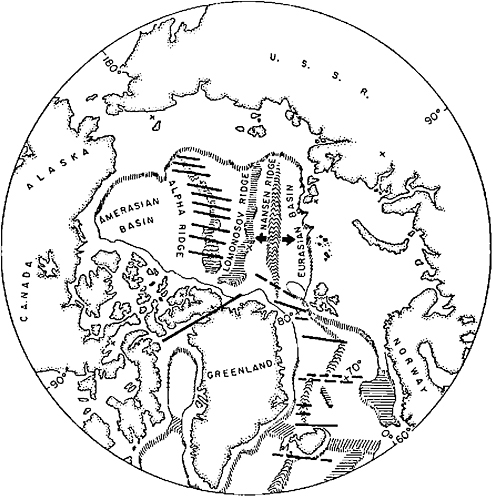
FIGURE 14.2 Tectonic setting for the Central Arctic Ocean. Nansen Ridge has been site of Cenozoic spreading in the Arctic, separating Lomonosov Ridge from the Barents Continental Shelf. Origin of Alpha Ridge is uncertain. Modified from Ostenso and Wold (1973).
similarity of the Arctic floral elements to those in the Pacific and Indian Oceans suggests a similar temperature for all of these areas.
These considerations are strong evidence for an open water, ice-free Arctic Ocean with ecologic conditions similar to those in lower latitudes. The uniformity of world climates during this time interval has been widely reported (e.g., Wolfe, 1975; Berggren and Hollister, 1977; Frakes, 1979). The question becomes one of whether the Cretaceous-Paleocene Arctic Ocean was a passive participant or a significant contributor to the worldwide temperature climate of the time. Theoretical considerations of an ice-free Arctic Ocean, discussed earlier, strongly suggest the latter, that is, the worldwide temperate climates of the Cretaceous-Paleocene may have been dependent, at least in part, on ice-free conditions of the Arctic Ocean. Atmospheric gradients generated by heat exchange from high latitudes to lower latitudes would be significantly less during ice-free Arctic conditions. A lower atmospheric gradient along with the general “commotion in the ocean” of the time (Berggren and Hollister, 1977) may be sufficient to explain the temperate Cretaceous-Early Cenozoic world climates.
Recently, considerable attention has been given to “injection events” in the world’s oceans (e.g., Gartner and Keaney, 1978; Thierstein and Berger, 1978; Clark and Kitchell, 1979a, 1979b; Gartner and McGuirk, 1979; Clark and Kitchell, 1981). One model, the Arctic Spillover Model, suggests that restriction of Arctic circulation with lower-latitude oceans may have produced a “freshwater” mass eventually draining into the lower-latitude seas, forming a low-salinity surface layer that may have been a factor in extinction of certain pelagic organisms and even affecting terrestrial life. Although imaginative in concept, lack of data for a freshwater Cretaceous Arctic make the model highly speculative. In fact, the only data available for the Late Cretaceous Arctic Ocean indicate that water of normal salinity and high productivity was present close to the time a volume of freshwater is needed for the spillover.
Middle Cenozoic Arctic Ocean
No Middle Cenozoic sediment has been identified from the Arctic Ocean. This includes the interval extending from the late Paleocene-Eocene through most of the Miocene. This was a critical time for world climates. Glaciation apparently was initiated in Antarctica. The polar cooling profoundly altered atmospheric circulation, and a strong thermal gradient, similar to that of the present, was established. Evidence for the mid-Cenozoic climate deterioration is based on development from polar glaciation as well as oxygen-carbon isotopes studies (Figure 14.3).
The Arctic Ocean ice cover possibly many have developed during this time. However, the evidence is circumstantial and includes recognition of general lowering of worldwide ocean-water temperature as well as knowledge that in the central Arctic the middle Cenozoic interval is bounded by older Paleocene, ice-free conditions and younger Miocene conditions that included glacial ice rafting as the dominant sedimentation process.
The central Arctic during the middle Cenozoic was approaching a land-locked condition with restrictive Pacific con
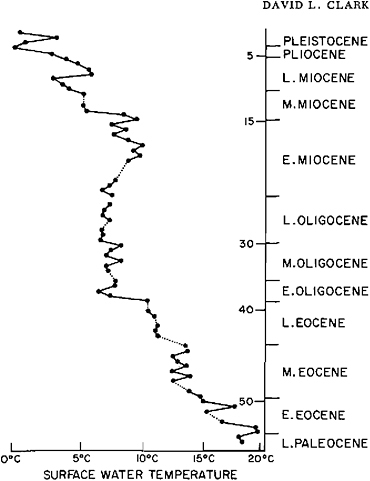
FIGURE 14.3 Surface-water temperatures for the Cenozoic determined from oxygen isotope data from planktonic foraminifera. Modified from Shackleton and Kennett (1975). Vertical numbers are in million years.
nections. There may have been a short period during this critical interval that Pacific circulation was sufficiently restricted to prevent effective exchange of water, Also, perhaps the growing Eurasian Basin connection with the Atlantic was not yet sufficient to allow more than surficial exchange. If this preceded Pliocene uplift of the straits of Panama, no warm Gulf Stream boundary current was available to the North Atlantic (Berggren and Hollister, 1975). This coupled with Eurasian freshwater river flow into the Arctic may have led to development of a salinity stratification as discussed by Aagaard and Coachman (1975), which permitted the first winter ice to form. Nonetheless, any surface freshening and freezing during the Middle Cenozoic probably did not affect deeper water of the Arctic as indicated by the presence of benthic foraminifera in sediment of probable late Miocene age (O’Neill, 1981).
ARCTIC OCEAN AND LATER CENOZOIC CLIMATES
The role of the Arctic Ocean for the immediate pre-Pleistocene world climate is fairly well understood. Probably, the Arctic Ocean became ice covered in the middle Cenozoic and together with the Antarctic icecap provided significant areas of
net heat loss to propel the atmospheric circulation that has led to modern climates.
The Arctic Ocean sediment record for the past approximate 5 million years has been studied in detail. Some 13 lithostratigraphic units have been defined for the late Miocene to Holocene (Clark et al., 1980) (Figure 14.4). These sedimentary units, correlatable over 400,000 km2, show variations on a single theme, ice rafting. The 13 lithostratigraphic units indicate alternating times of more and less ice rafting but no significant deviation from this mode of sedimentation. Whether times of greater ice rafting correlate with thinner or thicker ice cover has not been answered definitely (Clark, 1971).
Recently, a few coccoliths have been reported from late Pliocene and Pleistocene central Arctic sediment (Worsley and Herman, 1980). Although this is interpreted to indicate episodic ice-free conditions for the central Arctic, the occurrence of ice-rafted debris with the sparse coccoliths is more easily interpreted to represent transportation of coccoliths from ice-free continental seas marginal to the central Arctic. The sediment record as well as theoretical considerations make strong argument against alternating ice-covered and ice-free condi
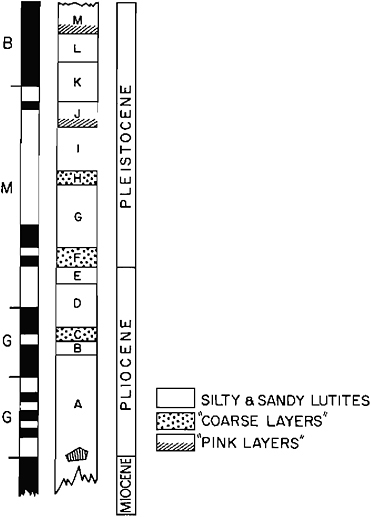
FIGURE 14.4 Lithostratigraphy of the central Arctic Ocean. Units A-M consist of glacial-marine sediment, suggesting alternating times of relatively rapid and slow rates of deposition. Magnetic stratigraphy correlation indicated. Modified from Clark (1977a).
tions (Donn and Shaw, 1966; Clark et al., 1980). Although the time of development of the pack ice for the central Arctic Ocean is unknown, to date there is no evidence that precludes a Miocene origin.
Geologically significant invertebrate faunas developed in this glacial-marine environment. This includes a predominantly arenaceous (textularid) biofacies in the late Miocene to Pliocene and a calcareous biofacies (milioids and rotalids) in the Pliocene and Pleistocene (O’Neill, 1981). There is no evidence for other than normal salinity Arctic bottom water since the late Miocene.
Productivity of Arctic water, as measured by foraminifera abundance, has increased to the present condition, and at no time during the Late Cenozoic was productivity any greater than that of the present (Clark, 1971). Reported high-bottom-water productivity during the late Miocene is grossly overstated (Margolis and Herman, 1980). Modern productivity is not measured by the standard of other oceans. Nonetheless, it is high compared with productivity for any other part of the Late Cenozoic for which there is a record. Modern productivity has been achieved under year-round ice-covered conditions.
Correlation of pre-Pleistocene climate events of lower latitudes with that of the central Arctic is difficult. For example, waxing and waning of continental glaciers occurred while the Arctic ice-cover remained relatively constant. Perhaps, thickening and thinning of ice may have been the only central Arctic response to glacial and interglacial climates in lower latitudes. The Ewing-Donn (1956) theory suggested that the Arctic Ocean played a central role in northern hemisphere glaciation, with an ice-free Arctic producing glaciation and an ice-covered Arctic (such as that of the present) producing interglacial times. The evidence available no longer supports this model. Rather, Late Cenozoic glacial and interglacial stages developed with a constant, central Arctic ice cover. It appears that the Arctic ice cover, while responsible in part for Pleistocene atmospheric circulation patterns, was only a participant in the drama of the recent ice ages; certainly it did not play the leading role.
SUMMARY
The conclusion, that the Arctic Ocean had an important role in pre-Pleistocene climates appears justified. The open-water Late Cretaceous-Paleocene Arctic was one of the factors contributing to worldwide climate uniformity. The probable Middle Cenozoic development of an ice cover, accompanied by Antarctic ice development and a late shift of the Gulf Stream to its present position, were important events that led to the development of modern climates.
The record suggests that altering the present ice cover would have profound effects on future climates. The technology is available to melt the Arctic Ocean ice cover (e.g., Arnold, 1961). In addition, there have been proposals by the Soviets to divert major rivers from their normal courses toward the Arctic Ocean, which would significantly alter the Arctic Ocean water-mass density structure. A change in the Arctic water budget could affect the ice cover. Yearly ice-free conditions could develop because of more vertical convection and release
of increased amount of heat to the atmosphere (Aagaard and Coachman, 1975). Is the world ready for new temperature and precipitation patterns? Execution of any of these proposals would seriously affect the Earth’s climate, a fact made clear by the record of the Arctic Ocean’s ice cover.
REFERENCES
Aagaard, K. and L.K.Coachman, (1975). Towards an ice-free Arctic Ocean, EOS Trans. Am. Geophys. Union 56, 484–486.
Arnold, K.C. (1961). An investigation into methods of accelerating the melting of ice and snow by artificial dusting, in Geology of the Arctic, G.O.Raasch, ed., U. of Toronto Press, Toronto, pp. 989–1013.
Berggren, W.A., and W.A.Hollister (1977). Plate tectonics and paleo-circulation—commotion in the ocean, Tectonophysics 38, 11–48.
Churkin, M. (1973). Geologic concepts of Arctic Ocean Basin, in Arctic Geology, M.G.Pitcher, ed., Am. Assoc. Petrol. Geol. Mem. 19, pp. 485–499.
Clark, D.L. (1971). Arctic Ocean ice cover and its Late Cenozoic history, Geol. Soc. Am. Bull. 82, 3313–3324.
Clark, D.L. (1974). Late Mesozoic and early Cenozoic sediment cores from the Arctic Ocean, Geology 2, 41–44.
Clark, D.L. (1977a). Paleontologic response to post-Jurassic crustal plate movements in the Arctic Ocean, in Paleontology and Plate Tectonics, R.M.West, ed., Milwaukee Pub. Museum Spec. Pap. Biol. Geol., no. 2, pp. 55–76.
Clark, D.L. (1977b). Climatic factors of the Late Mesozoic and Cenozoic Arctic Ocean, in Polar Oceans, M. J. Dunbar, ed., Arctic Inst. of North America, Calgary, pp. 603–615.
Clark, D.L., (1981). Geology and geophysics of the American Basin, in The Ocean Basins and Margins 5, A.E.M.Nairn, M.Churkin, Jr., and F.G.Stehli, eds., Plenum, New York, pp. 599–634.
Clark, D.L., and J.A.Kitchell (1979a). Injection events in ocean history, Nature 278, 669.
Clark, D.L., and J.A.Kitchell (1979b). The terminal Cretaceous events: A geologic problem with an oceanographic solution (comment), Geology 7, 228.
Clark, D.L., and J.A.Kitchell (1981). Terminal Cretaceous extinctions and the Arctic spillover model, Science 212, 577.
Clark, D.L., R.R.Whitmann, K.A.Morgan, and S.D.Mackey (1980). Stratigraphy and glacial-marine sediments of the Amerasian Basin, Central Arctic Ocean, Geol. Soc. Am. Spec. Pap. 181, 57 pp.
Donn, W.L., and D.M.Shaw (1966). The stability of an ice free Arctic Ocean, J. Geophy. Res. 71, 1086–1096.
Ewing, M., and W.L.Donn (1956). A theory of ice-ages, Science 128, 1061–1066.
Firstbrook, P.L., B.M.Funnell, A.M.Harley, and A.G.Smith (1972). Paleo-oceanic Reconstructions, 160–0 Ma, National Science Foundation, National Ocean Sediment Coring Program, Scripps Inst. Oceanogr.
Fletcher, J.O. (1972). Ice on the ocean and world climate, in Beneficial Modifications of the Marine Environment, National Academy of Sciences, Washington, D.C., pp. 4–49.
Fletcher, J.O., and J.J.Kelley (1978). The role of the polar regions in global climate change, in Polar Research, M.A.McWhinnie, ed., AAAS Selected Symposium Series, Westview Press, Boulder, Colo., pp. 97–116.
Flohn, H. (1978). Comparison of Antarctic and Arctic climate and its relevance to climate evolution, in Antarctic Glacial History and World Palaeoenvironments, E.M.van Zinderen Bakker, ed., A.A. Balkeman, Rotterdam, pp. 3–13.
Frakes, L.A. (1979). Climates Throughout Geologic Time, Elsevier, Amsterdam, 310 pp.
Gartner, S., and J.Keaney (1978). The terminal Cretaceous event: A geologic problem with an oceanographic solution, Geologie 81, 708–812.
Gartner, S., and J.P.McGuirk (1979). Terminal Cretaceous extinction, scenario for a catastrophe, Science 206, 1272–1276.
Kitchell, J.A., and D.L.Clark (in press). Late Cretaceous-Paleocene paleogeography and paleocirculation: Evidence of North Polar upwelling, Paleogeogr. Paleoclimatol. Palaeoecol.
Kukla, G.L., and H.J.Kukla (1974). Increased surface albedo in the northern hemisphere, Science 183, 709–714.
Lamb, H.H. (1974). Atmospheric circulation during the onset and maximum development of the Wisconsin/Wurn Ice Age, in Marine Geology and Oceanography of the Arctic Seas, Heiman, ed., Springer-Verlag, New York, pp. 349–358.
Margolis, S.V., and Y.Herman (1980). Northern hemisphere sea-ice and glacial development in the late Cenozoic, Nature 286, 145–149.
O’Neill, B.J. (1981). Pliocene and Pleistocene benthic foraminifera from the central Arctic Ocean, J. Paleontol. 55.
Ostenso, N.A., and R.J.Wold (1973). Aeromagnetic evidence for origin of the Arctic Ocean Basin, in Arctic Geology, M.G.Pitcher, ed., Am. Assoc. Petrol. Geol. Mem. 19, pp. 506–516.
Polar Group (1980). Polar atmosphere-ice-ocean processes: A review of polar problems in climate research, Rev. Geophys. Space Phys. 18, 525–543.
Pollard, D. (1978). An investigation of the astronomical theory of the ice ages using a simple climate-ice sheet model, Nature 272, 233–235.
Shackleton, N.J., and J.P.Kennett (1975). Paleotemperature history of the Cenozoic and the initiation of Antarctic glaciation: Oxygen and carbon isotope analysis in DSDP sites 277, 279 and 281, in Initial Report of the Deep Sea Drilling Project 29, U.S. Government Printing Office, Washington, D.C., pp. 743–755.
Smith, A.G., and J.C.Briden (1977). Mesozoic and Cenozoic Paleocontinental Maps, Cambridge U. Press, Cambridge.
Thierstein, H.R., and W.H.Berger (1978). Injection events in ocean history, Nature 276, 461–466.
van Loon, H., and J.C.Rogers (1978). The seesaw in winter temperatures between Greenland and Northern Europe, Part I: General description, Mon. Weather Rev. 106, 296–310.
Wigley, T.M.L., P.D.Jones, and P.M.Kelly (1980). Scenario for a warm, high CO2 world, Nature 283, 17–21.
Wolfe, J.A. (1975). An interpretation of Tertiary climates in the northern hemisphere, Geoscience and Man 11, 160–161.
Worsley, T.R., and Y.Herman (1980). Episodic ice-free Arctic Ocean in Pliocene and Pleistocene time: Calcareous nannofossil evidence, Science 210, 323–325.


