
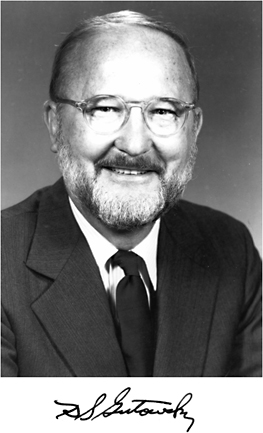
HERBERT SANDER GUTOWSKY
NOVEMBER 8, 1919–JANUARY 13, 2000
BY JIRI JONAS AND CHARLES P. SLICHTER
HERBERT SANDER GUTOWSKY and his students and collaborators made fundamental, pioneering discoveries in nuclear magnetic resonance (NMR). Their discoveries firmly established NMR as a major experimental tool in chemistry. Furthermore, Herb Gutowsky realized as early as 1950 that NMR would have a major impact in solving a wide range of structural and dynamics problems in chemistry, biochemistry, and material science. Indeed, many of the subfields of modern NMR spectroscopy can be traced to the original work by Gutowsky and coworkers.
Four areas of investigation of seminal importance for the development of NMR characterize Gutowsky’s early work: (1) application of NMR to the study of the structure and motion in solids; (2) elucidation of the origin of chemical shifts; (3) observation of spin-spin couplings between nuclei in molecular liquids; and (4) use of NMR to study chemical exchange and molecular conformational changes.
In particular, the discovery of chemical shifts and spin-spin splitting, established the foundations of the vast field of high-resolution NMR spectroscopy, which developed into an indispensable tool for the determination of chemical, biochemical, and biological molecular structures. Early studies
by Gutowsky showed that NMR spectra are modified when nuclei are involved in various types of chemical exchange. This provided chemists and biochemists with an important new technique to measure chemical exchange rates and to determine the nature of exchange processes.
PERSONAL HISTORY
Herbert Sander Gutowsky was born on November 8, 1919, in Bridgman, Michigan. He was one of seven children: six boys and one girl. They all lived on the family farm and helped with the farm work. Herb spent his summer “vacations” on their farm, working in the fields 10 hours a day, six to seven days a week. Evidently, farm life and work instilled a strong work ethic that influenced Herb’s entire life. While on the farm, Herb attended a one-room elementary school. Later, after his mother died, during the tough years of the Great Depression, the family sold the farm and moved to Hammond, Indiana, where Herb attended Hammond High School.
As a 16-year-old, Herb got a job distributing newspapers to help support the family. In spite of the economic hardships Herb wanted to get a university education. He borrowed money from one of his older brothers and attended Indiana University, where he graduated Phi Beta Kappa with a degree in chemistry with concentration in mathematics, physics, and astronomy. In fact, at one point Herb considered becoming an astronomer. He joined the Army Reserve Officers Training Corps at Indiana University and particularly enjoyed being a member of the precision drill team.
After receiving his A.B. in chemistry, Herb entered graduate school at the University of California, Berkeley, where he spent one year before volunteering for active duty in the military. He joined the Army several months before Pearl Harbor and became an officer for materials procurement
in the Chemical Warfare Service. At the end of his service Herb was discharged with the rank of captain and returned to Berkeley. While in the Army, Herb was diagnosed with diabetes, a condition that did not impede his scientific career but eventually led to his death. Herb received his M.S. degree working with Ken Pitzer and entered Harvard in the fall of 1945 to start Ph.D. graduate work with George Kistiakowsky.
In 1948, immediately after completion of his Ph.D., Herb joined the Department of Chemistry and Chemical Engineering at the University of Illinois at Urbana-Champaign planning to dedicate his scientific career to applications of nuclear magnetic resonance to chemistry. After his initial appointment as an instructor in 1948, he was rapidly promoted to assistant professor in 1951, associate professor in 1955, and professor of physical chemistry in 1956. In addition to his outstanding research work, Herb Gutowsky was involved in administration; he was head of the Physical Chemistry Division from 1956 to 1962, head of the Department of Chemistry and Chemical Engineering from 1967 to 1970, and director of the School of Chemical Sciences from 1970 to 1983. In 1983 he returned full-time to research and teaching as a research professor of chemistry and professor at the Center for Advanced Study, and remained active until his death in 2000.
Before the overview of Gutowsky’s major scientific accomplishments, a few remarks about his personal life and hobbies are appropriate. Herb’s intense work habits left some time for his hobbies of bird watching and cycling. For many years Herb and his sons participated in “century rides,” bicycle rides of 100 miles in a single day. Herb was also a devoted fan of the Fighting Illini and a longtime holder of season tickets for basketball and football games at the University of Illinois.
In 1949 Herb Gutowsky married Barbara Stuart, with whom he had three sons, one of them now deceased. This marriage ended in divorce in 1981. Herb married Virginia Warner in 1982. Herb died in his Urbana home in January 2000 at the age of 80. He is survived by his first wife, Barbara Stuart Gutowsky, and their two sons, Robb E. Gutowsky and Christopher C. Gutowsky; his second wife, Virginia Warner Gutowsky; three grandchildren; and sister Esther R. Enyart.
RESEARCH HISTORY
What were the circumstances that introduced Gutowsky to NMR and determined his career path? He entered Harvard in the fall of 1945 and received his Ph.D. working with George Kistiakowsky. Most of Gutowsky’s Ph.D. thesis was on infrared investigations. However, as a result of a lunch discussion Kistiakowsky had with the physicist Edward Purcell, whose student George Pake had just discovered structure on the proton nuclear magnetic resonance spectrum of water hydration in gypsum, Gutowsky and Kistiakowsky decided to add a section to Gutowsky’s thesis employing NMR to determine the structure of the molecule diborane. Together with George Pake, who had finished his thesis research but not yet taken the final exam, Herb tackled this problem. The initial results proved inconclusive, but they motivated Gutowsky and Pake to work intensively during the winter and spring of 1948, using Pake’s apparatus in the basement of the Lyman physics lab at Harvard. Their research produced a famous set of papers showing how nuclear magnetic resonance made possible the study of the structure and motion of molecules in solids. They studied the proton-proton distances of hydrogens bonded to carbons or nitrogens in a number of rigid lattices, inferring the bond angles in these molecular crystals. Gutowsky and
Pake demonstrated that nuclear magnetic resonance could reveal the existence of hindered rotation in solids of groups of atoms containing hydrogen. Then, as a brand new Ph.D. with virtually no knowledge of electronics, Gutowsky went to the University of Illinois as an instructor and decided to commit his scientific career to the applications of magnetic resonance to chemistry. The early discoveries by Gutowsky and his students led to the enthusiastic acceptance of NMR by chemists and to the later phenomenal growth of the NMR field.
The following section is an excerpt from an address given by Gutowsky1 after the presentation in Bombay of the 1974 award of the International Society of Magnetic Resonance; it describes in his own words the excitement of his early work and discoveries.
The magnet was delivered in early October 1949 and on October 20 we saw our first proton resonance in a water sample. However, my original plans to continue to study the motional narrowing of the broad resonances in solids ran into two snags. Our electronics, especially the lock-in amplifier and preamplifier just after the RF bridge we were using, did not have the sensitivity needed. Moreover, my initial efforts at designing and building an all-metal cryostat were not very successful in spite of having a 2-inch gap in which to place it. Fortunately, Knight’s report of resonance shifts in metals appeared at that time, and it included the observation of 31P shifts in several compounds. Also, in early 1950 Proctor and Yu reported chemical shifts between the 14N resonances in the NH4+, CN-, and NO3- ions, and Dickinson found shifts for fluorine in several compounds. So we turned our interest to chemical shifts in liquids, which we could readily observe for 19F.
At first we looked at whatever compounds we could lay our hands on. Then we began to see if we could resolve the fluorine resonances from structurally nonequivalent nuclei in the same molecule and on April 26, 1950, we looked at the fluorine resonance in a benzene derivative with a CF3 group and three fluorines on the ring and we were able to resolve them. This
encouraged us greatly and led me to think about how the shifts might be related to molecular structure. Chemists learn very early to look for periodicities in the chemical and physical properties of compounds, or they don’t stay in chemistry very long. We deal with such a large number and wide variety of systems that we have to oversimplify their diversity to be able to remember them. Moreover, in my senior year at Indiana University I was exposed to Linus Pauling’s book “The Nature of the Chemical Bond,” which is a masterpiece of such oversimplifications. In any case, it seemed to me that the chemical shift, as an electronic phenomenon should be related in some way to the nature of the chemical bonds. This in turn depends upon the nature of the atoms bonded together, so I chose to study the simple binary fluorides, which was a very happy choice.
I was encouraged in this approach because at about that time, I acquired my first graduate student, Charles Hoffman, who had a strong interest in inorganic chemistry. He undertook to synthesize the fluorides needed for the study, many of which were very difficult, and measured their fluorine shifts. At this juncture, in May of 1950, good fortune favored me again, I found exceptionally able help with our electronics problems from R. E. McClure, a senior in Electrical Engineering, who worked part-time with my group while he finished his bachelor’s and master’s degrees.
Bob was an immediate help, not only in maintaining, designing and constructing our apparatus, but in running many of the early experiments. With his able help, we set out to see if we could find shifts in proton resonances. We convinced ourselves of them in June 30, 1950, when Bob found small but reproducible shifts, several time larger than experimental error, between the protons in benzene, mineral oil, and aqueous solutions of strong acids. At this stage, we started a major effort on improving the homogeneity of the magnetic field by plotting it and hand polishing the pole tips in those areas where the magnetic field was high. And later, we broadened the shift study to include the simple hydrides. The shifts for the fluorides showed a strong correlation with electronegativity of the atom bonded to fluorine, which subsequently led Appolo Saika and Charlie Slichter to their elegant paper attributing it to the second-order paramagnetic term of Ramsay’s theory and its dependence upon the p-electron bonding orbital of fluorine.
The discovery and characterization of the multiplets, or the indirect, scalar internuclear coupling as the phenomenon is often called, is a very interesting and often exciting story. In my lab, the first observation of the effect was by Charlie Hoffman on September 8, 1950. He observed a double line in the fluorine resonance of the small sample of PF3, which he had synthesized as part of his fluorine shift study. However, in making the sample he fluorinated PCl3, so we interpreted the double line as due to PClF2 and/or PCl2F impurities in his sample. It’s an excellent example of something new not being recognized as real and different, but being attributed to a conventional, more plausible cause. Nonetheless, Hoffman repurified the sample, and the second line would not go away. Another sample was synthesized by a different route, and the same double resonance obtained. PF5 was synthesized and the fluorine resonance in it was found to be a double line, this time attributed to a chemical shift between the three equatorial and two apex fluorines in the trigonal pyramid structure. It was not until March 1951 that it became completely clear that we were really seeing something entirely new. At that time, I encouraged a beginning graduate student, Dave McCall, to look at phosphorus shifts in several fluoro-chloro phosphorus compounds of known purity. When the 31P resonance in the POCl2F compound exhibited a 1-1 doublet structure, it finally dawned on me that we had been observing a new type of internuclear interaction related to the spin states of the two nuclei. It was a great thrill to Dave and me when shortly thereafter, we first saw a 31P resonance such as that for CH3OPF2, a 1-2-1 triplet as I had predicted.
In our subsequent characterization during 1951 of this scalar or indirect coupling of nuclear spins, we were able to show that the “slow beats” observed by Erwin Hahn in proton spin echoes originate from the multiplets we had found in steady-state fluorine spectra. Furthermore, we turned up some anomalies which clued us in on the importance of chemical exchange in determining the observability of such splittings. The best case was that of aqueous HBF4, in which the proton and fluorine resonances were instrumentally determined, at about 0.01 gauss, while that of 11B may have been somewhat larger. 11B has a large g-value, so we expected to resolve a splitting of the fluorine resonance as we found in aqueous HPF6. After a great deal of debate, we attributed the absence to chemical exchange of fluorines among the BF4− ions, which led C. P. Slichter to develop a mathematical treatment of the effect based upon Bloch equations.
There is an interesting quote from David McCall (personal communication, May, 2001) about his experiences as a graduate student at Illinois:
Illinois was a great place to be in the early ‘50s and Gutowsky’s group got to participate in very exiting projects. Herb was with us round the clock and always supportive. He let us think that we had some of the best ideas, but on reflection we knew where they came from. The interaction with physics was great. We profited enormously from the enthusiasm and approachability of Charlie Slichter and his students. We also enjoyed occasional meetings with George Pake’s group at Washington University, just down the road in St. Louis.
In view of the extensive scope of Gutowsky’s subsequent work (total of 298 publications), we have been quite selective in our discussion of his accomplishments, and have decided to mention only several key studies.
In their paper on multiplets Gutowsky, McCall, and Slichter worked out the mathematical theory of a resonance multiplet arising from a nucleus that could precess at either of two rates and whose precession frequency could jump from one to the other as a result, or example, of chemical exchange or some relaxation process. They showed how the multiplet collapsed as the exchange or relaxation became more rapid. Their formulation based on Bloch equations, described the case of spin-spin splittings in liquids and other situations in which the two lines were themselves narrow, a case that had not been worked out by Bloembergen, Purcell, and Pound.
Gutowsky and Saika recognized that these rate equations could be used as the basis for the investigation of chemical exchange. In their classic paper Gutowsky and Saika investigated the association and exchange of protons in aqueous solutions of electrolytes. They extended the theory working out the process with exchange among more than two sites and calculated and displayed in figures the details
of the multiplet structure collapse, as the rate of exchange increased. While they predicted the collapse of the multiplet structure, none of the cases they dealt with had an exchange rate that passed through the region in which the collapse occurs.
Gutowsky and Holm, simultaneously with Arnold, succeeded in following the details of multiplet collapse. Gutowsky and Holm studied several amides and determined the barriers to internal rotation among several conformations. This technique enabled them to observe the existence of energy barriers even in the liquid state and opened a whole new area of chemical study. In the Science Citation Index 13 years later this paper was still being cited over 50 times in a year. Gutowsky’s group continued to work in the area of chemical exchange, utilizing the spin- echo technique to extend greatly the range of rates that could be studied by NMR.
Herb Gutowsky also realized very early that NMR would have many applications in studies of complex biochemical and biological systems. His collaborative work with Eric Oldfield in the area of protein-lipid interactions in membranes and with Govindjee on photosynthetic systems represents pioneering applications of NMR in these fields.
In 1983 Herb left administration to devote full-time to research and teaching. At this time there was a major change in his research interests. He began the study of weakly bound (van der Waals) clusters of atoms and molecules, using high-resolution Fourier transform microwave spectrometry. Gutowsky and his group continued the development of the Flygare-Balle pulsed-beam Fourier transform spectrometer by significantly improving the sensitivity and capability of the spectrometer. This allowed Gutowsky and his collaborators to extend the study from dimers to more complex systems, such as trimers, tetramers, small clusters of atoms,
and polyatomic molecules. It is impressive that within a few years Gutowsky and his group were able to make major contributions to our understanding of weakly bonded clusters. Even in this field Gutowsky’s research was prolific and resulted in about 50 papers devoted to a wide range of problems on weakly bonded clusters. Most of the theoretical interpretations were performed in collaboration with Clifford Dykstra of Indiana University-Purdue University, Indianapolis.
Herb Gutowsky received many honors and awards for his seminal work in nuclear magnetic resonance. He was elected to the National Academy of Sciences in 1960, American Academy of Arts and Sciences in 1969, and the American Philosophical Society in 1982. Herb also held various offices in the American Chemical Society, American Physical Society, National Academy of Sciences, American Academy of Arts and Sciences, and the National Science Foundation.
WE WOULD LIKE TO acknowledge Robb E. Gutowsky for his comments on the personal life of Herb Gutowsky and Virginia Warner Gutowsky for the photograph. We also thank Clifford E. Dykstra for his helpful comments.
PRINCIPAL AWARDS AND HONORS
|
1954 |
Guggenheim fellow |
|
1960 |
Member of the National Academy of Science |
|
1964 |
Krug Lecturer, University of Illinois |
|
1966 |
Fellow of the American Academy of Arts and Sciences Irving Langmuir Award in Chemical Physics, American Chemical Society |
|
1974 |
Award of the International Society of Magnetic Resonance |
|
1975 |
Peter Debye Award in Physical Chemistry, American Chemical Society |
|
1976 |
G. N. Lewis memorial lecturer, University of California, Berkeley |
|
1977 |
National Medal of Science |
|
1978 |
Honorary member, Phi Lambda Upsilon |
|
1979 |
Honorary member, Society for Applied Spectroscopy |
|
1980 |
G. B. Kistiakowsky Lectureship, Harvard University |
|
1981 |
D.Sc. Indiana University |
|
1982 |
Member of the American Philosophical Society |
|
1984 |
Wolff Prize in Chemistry |
|
1991 |
Chemical Pioneer Award, American Institute of Chemists |
|
1992 |
Pittsburgh Spectroscopy Award, Spectroscopy Society of Pittsburgh |
NOTES
SELECTED BIBLIOGRAPHY
1949 With G. B. Kistiakowsky, G. E. Pake, and E. M. Purcell. Structural investigations by means of nuclear magnetism. I. Rigid crystal lattices. J. Chem. Phys. 17:972-981.
1950 With G. E. Pake. Structural investigations by means of nuclear magnetism. II. Hindered rotation in solids. J. Chem. Phys. 18:162-170.
1951 With C. J. Hoffman. Nuclear magnetic shielding in fluorine and hydrogen compounds. J. Chem. Phys. 19:1259-1267.
1953 With D. W. McCall and C. P. Slichter. Nuclear magnetic resonance multiplets in liquids. J. Chem. Phys. 21:279-292.
With A. Saika. The proton magnetic resonance in aqueous electrolytes. J. Chem. Phys. 21:1688-1694.
1954 With D. W. McCall. Electron distribution in molecules. IV. Phosphorus magnetic resonance shifts. J. Chem. Phys. 22:162-164.
1956 With C. H. Holm. Rate processes and nuclear magnetic resonance spectra. II. Hindered internal rotation of amides. J. Chem. Phys. 25:1228-1234.
1957 With C. H. Holm, A. Saika, and G. A. Williams. Electron coupling of nuclear spins. I. Proton and fluorine magnetic resonance spectra of some substituted benzenes. J. Am. Chem. Soc. 79:4596-4605.
1959 With M. Karplus and D. M. Grant. Angular dependence of electron-coupled interactions in CH2 Groups. J. Chem. Phys. 31:1278-1289.
1961 With I. J. Lawrenson and K. Shimomura. Nuclear magnetic spin-lattice relaxation by spin-rotational interactions. Phys. Rev. Lett. 6:349-351.
1962 With G. G. Belford and P. E. McMahon. NMR studies of conformational equilibria in substituted ethanes. J. Chem. Phys. 36:3353-3368.
1963 With R. J. C. Brown and K. Shimomura. Nuclear spin relaxation in liquid CHFCl2. J. Chem. Phys. 38:76-86.
1964 With A. Allerhand. Spin-echo NMR studies of chemical exchange. I. Some general aspects. J. Chem. Phys. 41:2115-2126.
1966 With A. Allerhand, J. Jonas, and R. A. Meinzer. Nuclear magnetic resonance methods for determining chemical-exchange rates. J. Am. Chem. Soc. 88:3185-3194.
1969 With C. J. Jameson. Systematic trends in the coupling constants of directly bonded nuclei. J. Chem. Phys. 51:2790-2803.
1976 With T. Wydrzynski, N. Zumbulaidis, P. G. Schmidt, and Govindjee. Proton relaxation and charge accumulation during oxygen evolution in photosynthesis. Proc. Natl. Acad. Sci. U. S. A. 73:1196-1198.
1978 With E. Oldfield, R. Gilmore, M. Glaser, J. C. Hsung, S. Y. Kang, T. E. King, M. Meadows, and D. Rice. Deuterium nuclear magnetic resonance investigation of the effects of proteins and polypeptides on hydrocarbon chain order in model membrane systems. Proc. Natl. Acad. Sci. U. S. A. 75:4657-4660.
1979 With S. Y. Kang, J. C. Hsung, R. Jacobs, T. E. King, D. Rice, and E. Oldfield. NMR investigation of the cytochrome oxidase-phospho-lipid interaction: A new model for boundary lipid. Biochemistry 18:3257-3267.
1985 With C. Chuang, J. D. Keen, T. D. Klots, and T. Emilsson. Microwave rotational spectra, hyperfine interactions, and structure of hydrogen fluoride dimers. J. Chem. Phys. 83:2070-2077.
1987 With T. D. Klots, C. Chuang, J. D. Keen, C. A. Schmuttemaer, and T. Emilsson. Rotational spectra and structures of small clusters Ar3-HF and Ar3-DF. J. Am. Chem. Soc. 109:5633-5638.
With C. J. Coleman and Govindjee.35Cl-NMR measurement of chloride binding to the oxygen-evolving complex of spinach photosystem. II. Biochim. Biophys. Acta 894:443-452.
1990 With T. D. Klots and C. E. Dykstra. Rotational spectrum and potential surface for Ar2-HCN: A T-shaped cluster with internal rotation. J. Chem. Phys. 93:6216-6224.
1992 With T. D. Klots and T. Emilsson. Rotational spectra, structure, Kr-83 nuclear quadrupole coupling constant, and the dipole moment of the Kr-benzene dimer. J. Chem. Phys. 97:5335-5340.
1993 With J. D. Keen, T. C. Germann, T. Emilsson, J. D. Augspurger, and C. E. Dykstra. Rotational spectrum and structure of the Ne-HCN dimer. J. Chem. Phys. 98:6801-6809.
1996 With E. Arunan, T. Emilsson, S. L. Tschopp, and C. E. Dykstra. Rotational spectra, structures, and dynamics of small Arm-(H2O)n clusters: The Ar2-H2O trimer. J. Chem. Phys.105:8495-8501.


