
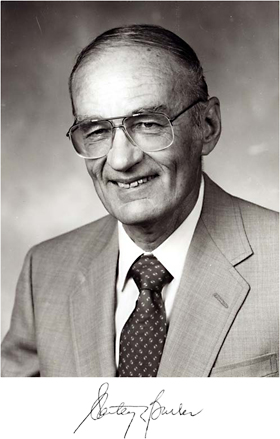
STANLEY ARTHUR BARBER
March 29, 1921—December 12, 2002
BY W. R. GARDNER AND WILLIAM MCFEE
STANLEY A. BARBER, J. B. Petersen Distinguished Professor of Agronomy, was born on March 29, 1921, in Wolesey, Saskatchewan. He grew up on a wheat and dairy farm in that western part of rural Canada. As a youth he attended a one-room school that had an attendance ranging from 20 to 25 students. After passing the first three years of high school by correspondence, Barber skipped a year to help with the family farm. He completed his high school studies by driving 20 miles each day to a school that had only three teachers for the four grades—assisting with the family farm all the while. After graduation he remained at home for two more years before following in the footsteps of his two older brothers and enrolling at the University of Sasakatchewan. During his time at Saskatchewan, which coincied with World War II, his schedule alternated farming in the summer with studying and training with the University Officer Training Corps during the winter. Barber majored in agriculture, taking the most advanced courses offered. He took, for example, Physics II from Gerhard Hersberg, a German who had immigrated to Canada and who was later to receive a Nobel Prize. Barber received his B.S. degree with J. W. T. Spinks, later the president of the university, who had returned from his war effort eager to
use the radioactive tracers to which he had been introduced while in the military. To our knowledge Barber conducted the first field studies with radioactive tracers as part of his M.S. studies. After completing the M.S. in 1947, Barber applied for a two-year research fellowship and, upon its receipt, elected to study with C. E. Marshall of the University of Missouri. Professor Marshall, known as a rigorous mentor, was one of the best known and most accomplished soil chemists in the United States. By coming to the United States, Barber followed in the footsteps of many Canadians—such as Philip Low—who chose to study agriculture in the USA, thus enriching the lives of his colleagues in the United States. He completed studies for his Ph.D. and was immediately (in 1949) hired by Prof. J. B. Peterson, also a well-known soil physicist and chemist, who had left Iowa State University to become department head at Purdue. From the most humble of beginnings Barber rose to become one of the best known and respected soil scientists in the world.
At Purdue, Barber was given wide latitude in the choice of specialty to follow. With his strong background in physics and chemistry he elected to study the uptake of nutrients by plants. Until this time, plant nutrition had been studied in nutrient solutions and through field trials that were analyzed statistically. The introduction of statistics by Fisher and others provided agricultural science with a powerful tool, but a tool that had its limitations. In studying plant nutrition by combining knowledge of plant physiology, chemistry, physics, and mathematics, Barber pursued a line of research that was to go far beyond statistical techniques. With the aid of some 55 graduate students and 30 visiting scientists he pushed the empirical understandings further and further aside and replaced them with an increasingly theoretical understanding of the mechanisms of nutrient uptake by plants. Barber created an elegant and
sophisticated mathematical model for determining the rate of any nutrient’s uptake by any plant in any type of soil.
THEORY
Barber’s achievements can most easily be explained by considering the theory and the experiments separately, but it must be pointed out that every theoretical advance was both preceded and followed by experiments designed to revise and improve the theory. He started first with phosphorous (P) and potassium (K), which are found in almost any commercial fertilizer. Furthermore, soils around the world are often deficient in these nutrients. There is a second and important reason for the selection of these two nutrients. Potassium is relatively mobile and can move with water as it moves toward the plant roots in response to plant transpiration. Phosphorous, on the other hand, is strongly adsorbed by the clay minerals in the soil and can move only a short distance, much of it by diffusion. This means that a great deal of phosphorous can be held in a relatively small volume and can be available to the plant roots if they can find and proliferate through the zones of this adsorbed or “fixed” phosphorous. In soils there might be one, two, or as many as three different sites, each with a different binding energy.
Barber began by dividing the system of plant root uptake into three parts. The first is the amount of nutrients in the soil and how quickly they reached the soil surface. This was the soil surface phase. The second part is the group of forces that move the nutrient ions (electrically charged atoms or molecules) from the soil-water solution surrounding the plant root into the root themselves. This he called the “plant uptake kinetics.” The third component of the system was the root diameter, length, and growth rate (which
measures the way the root system changes in size and arrangement with time).
A soil system always surrounds soil particles (unless they are dry). Some nutrient ions are in that soil solution. The nutrients get from place to place by moving with the soil water. It has been shown that nutrients of this type, if applied in the spring, are not taken up until the water in which they reside is taken up by the roots and transpired by the plant leaves. The water that is pulled up through the soil by transpiration is replaced by water farther away from the roots. Nutrients close to the roots move by mass-flow with the water to the root surfaces. When nutrients, such as calcium and magnesium, are abundant in the soil solution they may often move faster than the plant can take them up, and they actually pile up in the soil surrounding the roots.
Other nutrients, especially those in short supply in the soil, move through the soil by diffusion or a random movement into regions where they are in lesser concentration. Next to the roots the concentration is reduced by ion or nutrient uptake and these are in turn replaced by this diffusion process. Nutrient ions move through the soil at different rates depending upon the geometry of the soil particles, so the diffusion coefficient is characterized by the soil water content and the soil texture.
Certain nutrient ions are adsorbed by the soil particles, as mentioned above. These adsorbing soil particles act like a storehouse for the ions thus adsorbed. The ability of the soil to give up stored quantities to replace those that are removed by the uptake by the plants is called the “buffering power” of the soil and is given a quantitative numerical value, b, in Barber’s equations.
Next, Barber examined uptake by the plant roots themselves. He started with the simplest explanation to describe
how this process is related to the concentration of the uptake of such ions as P and K. Plants take these ions in at special sites on the root surface. When nutrients are sufficiently numerous to fill all the uptake sites, they are said to saturate the mechanism, and the roots are taking in ions at their maximum rate. This fastest rate is labeled Imax in the model, which is now beginning to take shape. It will become the mathematical model that was the long-range goal of Barber’s research. He assigned the symbol, Cmin, to the ion concentration at the root surface, which drops below the concentration that can be taken up by diffusion.
A third concentration is required in order to describe the uptake process. This process is like an adsorption process and another concentration term, Km, the nutrient concentration at which the plant exhibits the maximum uptake results. These parameters completely describe the uptake mechanism insofar as the root controls it.
The final part of Barber’s model describes the roots themselves. Root diameter, length, and growth rate define the amount of root surface area available for nutrient uptake and increase as a plant grows. Barber calculated total root surface by measuring root radius and length to calculate the area of the roots, as though they were a long cylinder for which one could calculate the surface area by multiplying the circumference by the length. Fine roots take up ions faster than larger roots because they are better supplied by nutrients. This is caused by interference between adjacent roots so that the uptake by large roots tends to be more nearly one dimensional than small roots, which tend to be three dimensional. This competition is more serious with ions that are more mobile (such as nitrates) than ions that are adsorbed and less mobile (phosphorous). Generally, a longer root means more nutrient uptake because the number of sites for uptake tends to increase with increas-
ing length. To account for this property Barber included a measurement not only of root length and radius but also how long a root is at the beginning of an experiment, by adding one more measurement, k, to describe how fast or how much a root grows with time.
Barber then had all the measurable parameters he needed to write two basic equations. The first—a second-order differential equation—described the change of concentration with time, which combined a term for diffusion and a term for mass-flow. This equation described the change of nutrient concentration in the soil at the root surface as a function of time. A second equation incorporated the plant properties and gave the uptake per unit length of root and gave the rate of uptake per unit rate of length.

(1)

(2)
In the equations the subscript, 0, refers to the initial condition, C is the concentration of the ion in question, Km, characterizes the adsorption isotherm, and De is the effective or average diffusion coefficient and b is the buffer capacity. To account for the competition between roots, Barber used an iterative process starting with one section of root at the start of a plant growth. The equations must be solved simultaneously, and then this result must be used with the knowledge of the plant’s growth rate to calculate the total uptake of the growing plant.
At that time, solving the equations Barber had developed was as difficult as their derivation. The task required
the use of Purdue University’s large mainframe computer, and it was difficult for anyone at another location to test or otherwise make use of the equations. It was the eventual development of newer and faster computers that finally made the equations accessible to anyone on any IBM-compatible microcomputer.
Other scientists had developed equations equivalent to individual components of Barber’s equations, such as the flow of an ion or the diffusion to an individual root. It was Barber’s almost daring combination of all the roots of a plant during growth while keeping in mind the movement in the soil that made his equation complete; however, it remained to test each component in turn and all of them together. This required a long series of experiments in the laboratory, greenhouse, and field.
EXPERIMENTS
Given the number of nutrients, both major and minor, and the wide range of adsorption sites and the permeabilities of the different types of soils, the testing of the model was no small chore. With ever more severe tests, this task occupied Barber’s career for much of the rest of his time at Purdue. He was one of the first to use P32 to understand the uptake of fertilizer. He studied the potassium-calcium relationships in montromillonite group clays and in attapulgite. His next significant publication was a field study of the dependence of the effect upon the initial amount of soil phosphorous of an application of phosphorus placed in the plant row. This and similar studies began to explain the uptake of P by the plant and helped him begin the first states of his eventual model. By 1961 and 1962 Barber had published two papers that contributed to this understanding of the uptake of ions by plant roots followed by a concept of movement of ions to the plant root combing diffu-
sion and mass-flow. This was followed immediately by papers in 1963 and 1966 of studies in situ that confirmed his ideas about diffusion and mass-flow. He expanded his confidence through two papers that compared the uptake of different cations by soy beans. These studies provided a critical test of the movement of cations and showed how these mechanisms, coupled with root interception, explained their limiting effect upon ion uptake from soils.
Having satisfied himself as to the quantitative measures of diffusion and mass-flow upon uptake, Barber then turned to studies aimed at exploring the effect of the plant roots themselves upon the uptake process. He produced a number of papers investigating this process, resulting in publication in 1970 of the physiological effectiveness of root systems followed by a comparison of root systems by the use of autoradiographic techniques. Soon after, he included the effect of pH changes that are induced by the plant at its root surface comparing ammonium, nitrate, and phosphorous uptake.
During the ensuing years Barber studied such variables as ammonium and nitrate uptake as influenced by the NH4+/ NO3 ratio, the uptake per unit of corn roots, and a method for characterizing the relation between nutrient concentration, the development of corn roots, and the effect of this development upon uptake.
By this time Barber had studied the uptake process from soil to the soil-root interface, and on into the plant itself. He was sufficiently confident that he had considered and quantified the major component of the uptake process that he began setting ever more severe tests of the model, such as those that he presented in a significant paper (1977). His confidence in this model was now so sufficient that he had branched out beyond nutrient uptake to the uptake of other ions and molecules, such as metals and, in general,
almost any molecule. He capped his many years of study on ion uptake by publishing the definitive book on the subject in 1995.
Barber would be the first to agree that many details of his model are as yet not fully understood and require future study. Especially where the uptake mechanisms are concerned, it is very complex, but Barber gave a very good approximation. Barber’s model is more that just a first approximation: it will be the scaffold upon which future advances will depend.
By any measure Barber’s work reflects a prodigious effort maintained over a full career. To understand the significance of Barber’s model one only need consider that though 11 parameters are involved, they are all measurable. Barber’s model eliminates the need for conducting a large number of field experiments and can be used to predict the uptake of any nutrient by any plant. His sensitivity analyses of the model showed that root morphology and initial nutrient concentration in the soil solution had the greatest effects on nutrient uptake. The value of each parameter incorporates temperature, if necessary, which may have a significant effect upon water uptake. The basis for the model is firmly grounded in chemistry and physics and their interaction means that the experimentalist can focus on the parameters that are most essential.
By comparing the model predictions with six different species of plants having a wide variance in phosphate uptake with actual experiments, Barber showed excellent agreement between the two. Using the model, one can predict everything from the effect of a given root morphology, to soil properties, and to proper fertilizer placement.
HONORS AND AWARDS
Stanley Barber was a self-effacing scientist who pursued his field of science with an almost uncanny sense of the next experiment that needed to be done or the next term that needed to be included in a comprehensive model of ion uptake. He was appropriately the recipient of many awards and honors. These culminated in his receipt in 1986 of the Alexander von Humboldt Award in Hamburg, Germany, and election to the National Academy of Sciences in 1987. He served as the associate editor of five journals and was elected to the boards of the American Society of Agronomy, the Soil Science Society of America, and the International Soil Science Society. His honors also included election as a fellow of the Soil Science Society of America and the American Society of Agronomy, both in 1964. He was made an honorary member of the National Society by the National Fertilizer Solutions Association in 1978, and the University of Missouri honored him with its Alumni Citation of Merit Award in 1981. In 1983 Purdue gave him its Sigma Xi Research Award. In 1983 and 1984, respectively, the American Society of Agronomy gave him its Agronomic Research Award and the Agronomic Achievement Award. This was followed by the Bouyoucos Soil Science Distinguished Career Award in 1985. These are the most prestigious awards given by either society. He was given the Herbert Newby McCoy Award by Purdue University and an honorary doctor of laws degree and the Distinguished Graduate in Agriculture Award by the University of Saskatchewan, all in 1986. In 1987 he was awarded the Certificate of Distinction by the Purdue Alumni Association and the Gamma Sigma Delta International Award for Distinguished Service to Agriculture, and was the Canadian Industries Ltd. Distin-
guished Visiting Lecturer. He was also a fellow of the Indiana Academy of Sciences.
INFLUENCE ON THE FIELD OF SOIL SCIENCE
Stanley Barber’s influence on soil science and its related fields, such as ecology and plant breeding, to name just two, is unparalleled by any of his peers. Barber provided a theory-based understanding of all the processes involved in nutrient uptake, while rendering superfluous the conduction of the uptake by plants from every soil and in every climate, as was heretofore the practice. His life’s work taken as a whole is not only remarkable in its influence but is also especially courageous considering that understanding just one component of his model would be considered a major achievement. He was a scientist who was capable of working on the basic chemistry, physics, and mathematics while seeing the practical application for every parameter in his model. This enabled him to predict the outcome of experiments and explain why native plants were distributed as they were, based on differences in the nutrient availability of the soil material upon which they grew. Barber’s work will be supplanted eventually by other scientists, but it is safe to say his work will always be recognized as a landmark in the progress of soil science and his name will be remembered and his work cited for generations to come.
Professor Barber was also a devoted family man, who with his wife, Marion, had two daughters and three grandchildren. His first love was his family, followed by his science and his many colleagues and friends. He was a gracious and kind man to all who met him, whether longtime friend or chance acquaintance. He loved doing puppetry, and enjoyed the traveling that his profession provided. His wife’s death followed his by just over three months.
SELECTED BIBLIOGRAPHY
1946 With J. W. Spinks. Study of fertilizer uptake by using P32. J. Am. Chem. Soc. 68:2748.
1951 With C. E. Marshall. Ionization of soils and soils colloids. Soil Sci. 72:373-385.
1958 Relation of fertilizer placement to nutrient and crop yield. Interaction of row phosphate and the soil level of phosphorous. Agron. J. 50:535-539.
1961 With J. M. Walker. Ion uptake by living plant roots. Science 133:881-882.
A diffusion and mass-flow concept of soil nutrient availability. Soil Sci. 93:39-49.
1963 With J. M. Walker and E. H. Vasey. Mechanisms for the movement of plant nutrients from the soil and fertilizer to the plant root. J. Agr. Food Chem. 11:204-207.
1966 With S. Oliver. An evaluation of the mechanisms governing the supply of Ca, Mg, K, and Na to soybean roots. Soil Sci. Soc. Am. Proc. 30:82-86.
The roles of root interception, mass-flow, and diffusion in regulating the uptake of ions by plants from soil. In Limiting Steps in Ion Uptake by Plants from Soil. International Atomic Energy Agency Technical Report No. 65, pp. 39-45. Vienna: IAEA.
1970 With C. D. Raper Jr. Rooting systems of soybeans. II. Physiological effectiveness as nutrient absorption surfaces. Agron. J. 62:585-588.
With P. G. Ozanne. Autoradiographic evidence for the differential effect of four plant species in altering the Ca content of the photosphere of soil. Soil Sci. Soc. Am. Proc. 34:635-637.
With D. Riley. Effect of ammonium and nitrate fertilization on phosphorous fertilization on phosphorous uptake as related to root induced pH changes at the root-soil interface. Soil Sci. Soc. Am. Proc. 35:301-306.
Effect of tillage practice on corn (Zea mays L.) root distribution and morphology. Agron. J. 63:724-726.
1973 With D. D. Warncke. Ammonium and nitrate uptake corn (Zea mays L.) as influenced by nitrate concentration and NH4+/NO3 ratio. Agron. J. 65:950-953.
1974 With D. B. Mengel. Rate of nutrient uptake per unit of corn root under field conditions. Agron. J. 66:399-402.
With N. Claassen. A method for characterizing the relation between nutrient concentration and flux into roots of intact plants. Plant Phys. 54:564-568.
With D. B. Mengel. Development and distribution of the corn root system under field conditions. Agron. J. 66:341-344.
1977 A mathematical model to simulate metal uptake by plants growing in soil. In Symposium Proceedings, 15th Hanford Life Sciences Symposium on Biological Implications of Metals in the Environment (Hanford, QA, Sept. 29-Oct. 1, 1975), ed. Mary N. Hill, pp. 358-364. Springfield, Va.: USERDA, National Technical Information Service.
1978 Growth and nutrient uptake of soybeans under field conditions. Agron. J. 70:457-461
1979 With M. K. Schenk. Phosphate uptake by corn as affected by soil characteristics and root morphology. Soil Sci. Soc. Am. J. 43:880-883.
1980 With I. Anghinoni. Predicting the most efficient phosphate placement for corn. Soil Sci. Soc. Am. J. 44:1016-1020.
1981 With J. H. Cushman. Nitrogen uptake model for agronomic crops. In Modeling Wastewater Renovation-Land Treatments, ed. I. K. Iskander, pp. 382-409. New York: Wiley-Interscience.
1983 With M. Silberbush. Prediction of phosphorous and potassium by soybeans with a mechanistic mathematical model. Soil Sci. Soc. Am. J. 47:262-265.
With S. Itoh. Phosphorous uptake by six plant species as related to root hairs. Agron. J. 75:457-461.
1984 With M. C. Drew, L. R. Staker, and W. Jenkins. Changes in the kinetics of phosphate and potassium absorption in nutrient-deficient barley roots measured by depletion technique. Planta 160:490-499.
1992 With J. M. Kelly. Modeling magnesium, phosphorous, and potassium uptake by loblolly pine seedlings using a Barber-Cushman approach. Plant Soil 139:209-218.
1995 Soil Nutrient Availability: A Mechanistic Approach. 2nd ed. New York: Wiley.


