
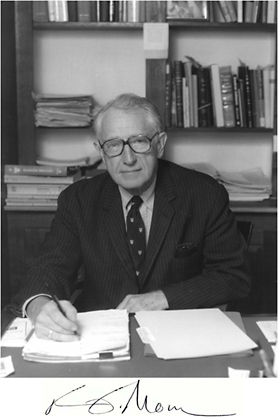
FRANCIS DANIELS MOORE
August 17, 1913–November 24, 2001
BY JUDAH FOLKMAN
FRANCIS DANIELS MOORE, one of the world’s great surgeon-scientists, died on November 24, 2001, at the age of 88. He was born in Evanston, Illinois, and graduated from the North Shore Country Day School. He graduated from Harvard College with the A.B. degree cum laude in anthropology. He entered Harvard Medical School and received the M.D. degree cum laude. Soon after he had completed his years of surgical training at the Massachusetts General Hospital in Boston and had become its chief resident in surgery in 1942, he began his pioneering work on the metabolic response to surgery. He became a postgraduate National Research Council fellow in isotope physics and its applications (under Joseph C. Aub). This new field would become his life’s work. He would continue to pursue it at the Peter Bent Brigham Hospital, where he arrived in 1948 to become its Surgeon-in-Chief. At the age of 34 he was Harvard Medical School’s Moseley Professor of Surgery, the youngest chairman of surgery in Harvard’s history.
Francis Moore’s studies, carried out between the physiology laboratory and the patient’s bedside, culminated in two classic books: Metabolic Response to Surgery with M. Ball (1949) and Metabolic Care of the Surgical Patient (1959). These masterpieces changed the thinking of surgeons
throughout the world and reduced suffering and mortality of their patients. Before Moore, surgeons concentrated on improving their craft to effect the local anatomic changes necessary to treat disease, but they remained perplexed by the body’s physiologic response to the trauma of surgery. Surgeons of the day did not understand how to optimize the physiological status of their patients before surgery. A perfect anatomical operation could be followed by disastrous complications or death from a low level of circulating sodium chloride or magnesium, or a high level of potassium chloride, or an undetected loss of plasma or water.
Moore developed methods to quantify the concentration of ions in the blood by flame photometry. He was among the first clinicians to inject radioisotopes into laboratory animals, and then into volunteers and patients in order to measure total body water and body composition. These studies paved the way for the development of nuclear medicine. His publications codified the syndromes generated by altered physiologic states of electrolyte imbalance, or endocrine abnormalities, or body fluid deficits. By these studies Moore armed his fellow physicians and surgeons so that they could recognize potential trouble before or after surgery. Thousands of lives were saved every year. He introduced new methods to the hospital laboratory from his research laboratory so that these syndromes of metabolic imbalance could be quantified in all hospitals. Francis Moore’s contributions to the improvement of the metabolic care of surgical patients, especially those with severe burns, provided a scientific basis for modern intensive care units and rank with the great leaps in the history of progress in surgery brought about by the introduction of anesthesia, the development of aseptic technique, and the transfusion of blood.
Francis Moore’s early unshakable confidence that improvements in medicine could come from animal and human experimentation seems to have been set off by a searing experience on the night of November 28, 1942, when he was a 29-year-old surgical resident working in the emergency ward at the Massachusetts General Hospital. He was one of the few surgical residents left in Boston who had not been drafted to serve in World War II, because of his chronic asthma. That night more than 100 severely burned patients arrived on stretchers from a huge fire at the Cocoanut Grove night club in Boston. The conventional treatment for severe burns at that time was to soak the patient in tannic acid to toughen the skin in order to prevent the inevitable infection that would eventually kill the patient. It was a painful and toxic treatment and required several doctors and nurses for each patient. Oliver Cope, a senior staff surgeon, believed that tannic acid was more harmful than effective and decided to try an experiment. Cope insisted that the burned patients be wrapped in sterile gauze coated with petroleum jelly, because in his laboratory animals, blisters covered with this type of dressing did not appear to become infected. Moore followed Cope’s orders. A month later none of the initial survivors at the Massachusetts General Hospital had died, in contrast with a 30 percent mortality among initial survivors treated with tannic acid at the Boston City Hospital. Over the next five years Dr. Moore began clinical research on burns, body fluids, and burn shock.
In 1948 when Dr. Moore arrived at the Peter Bent Brigham Hospital as the new Surgeon-in-Chief, Dr. George Thorn, the hospital’s Physician-in-Chief, was just beginning a program that would eventually treat renal failure by dialysis, using an external artificial kidney donated by a Dutch physician, Willem Kolff. (Kidney transplants in dogs were
being carried out in the laboratory by two young surgeons, Charles Hufnagel and David Hume). Moore and Thorn began a long and productive collaboration. They put together a team led by David Hume. By 1953, 10 patients with terminal renal failure had received a kidney transplant from a recently deceased individual, but these kidneys soon underwent immune rejection and all patients died within weeks except for one whose kidney worked for five months. Despite these early failures, Moore persevered. In 1953 he persuaded Joseph Murray to take over the kidney transplant program, after Hume was called to active duty in the Navy. Moore had appointed Murray to the surgical staff to develop plastic surgery at the Brigham. By December 1954 Dr. Murray had carried out the world’s first successful kidney transplant between identical twins.
However, it would be eight more years before Murray was able to perform the world’s first successful transplantation of an organ from an unrelated donor, in April 1962, because the immunosuppressive drug, azathioprine, had become available. As more effective immunosuppressive drugs were developed, kidney transplantation became a safer surgical therapy in major medical centers. In May 1963 Francis Moore was on the cover of Time magazine and in 1990 Joe Murray received the Nobel Prize. In his acceptance speech Dr. Murray credited Dr. Moore with providing the leadership, creativity, courage, and unselfishness that led to the success of transplantation. Moore continued to drive progress in organ transplantation, and in 1963 both he and Thomas Starzl, a surgeon at the University of Colorado, performed their first human liver transplants within months of each other in a handful of patients. But there were no long-term survivors. Both men called a temporary halt to the procedure. A year later only Starzl in the United States and Roy Calne in the United Kingdom resumed development of liver
transplantation and continued for many years until it eventually became successful. Meanwhile, Dr. Moore had persuaded Dr. Dwight Harken to develop intracardiac surgery at the Brigham, beginning with surgery of the mitral valve, and provided encouragement during the early days of this endeavor.
Francis Moore was one of Harvard Medical School’s most inspiring teachers, and its most eloquent public speaker. I entered Harvard Medical School in 1953 and I can still recall every one of his lectures to the medical students. He held Saturday morning “clinics” during which he presented a patient to a packed amphitheatre. We first-year students were concerned that perhaps the patient felt he or she was being exploited as a teaching case in front of all of these students. Dr. Moore immediately reassured us. He told us that after a successful operation, he had asked the patient if she could help him teach a class of Harvard Medical students how to make an accurate diagnosis of the type of illness from which she was recovering. Then he would pretend to whisper to the patient, “Now don’t tell them all the answers right away. Let them figure things out.” The patient would invariably smile, pleased to be playing the transient role of a member of the Harvard Medical faculty. As Dr. Moore then unfolded the patient’s history before us, we entered the patient’s life. In fact, we became the patient, almost as if we were in the play Our Town. Dr. Moore mesmerized not only the class but the patient as well. In fact, he was so charismatic that patients were elated to be presented by him to students or faculty, and they never forgot the experience. To us students the professor and his patient appeared to be two longtime friends. We learned by Dr. Moore’s example that each patient must be accorded the highest respect and treated with the greatest compassion. His message came through to all of us: Take meticu-
lous care of your patient, check on things yourself, and always make sure that the working diagnosis is still working.
He often employed a keen sense of humor to emphasize a teaching point. At a surgical grand rounds he was discussing a patient with gallstones. He had turned the wheelchair with the patient’s back to the audience ostensibly so that the patient could see the X rays. It wasn’t until the end of the discussion that the audience realized that the patient was Mrs. Moore.
Francis Moore’s remarkable showmanship had already surfaced during his college years at Harvard College, where he was president of the Harvard Lampoon and of the Hasty Pudding Society. Nicholas Tilney, one of Dr. Moore’s surgical residents at the Peter Bent Brigham Hospital and now professor of surgery there, describes Francis Moore’s maturing expertise in writing prose and playing music while at Harvard.
As President of the Harvard Lampoon in his junior year, Franny and his friends became famous (infamous) for purloining the Sacred Codfish from the State House, and as a sequel the following year, for removing the Yale Bulldog from New Haven to Cambridge. Indeed Handsome Dan II appeared on the cover of the March 1934 issue of the Lampoon, appropriately licking the foot of the statue of John Harvard. Franny’s musical career burgeoned at the Hasty Pudding Club, to which he was also elected President. In 1934, he and a colleague wrote a famous show entitled “Hades! The Ladies!” After a successful local run, he and his co-author, Alistair Cooke, took the production on a prolonged road trip. Their adventures included tea in the East Room of the White House with Eleanor and Franklin Roosevelt, himself a member of a Hasty Pudding chorus.
Dr. Tilney wrote that during his years as Surgeon-in-Chief, “Franny Moore was a man of many interests.” He was invited to numerous visiting professorships throughout his career and he traveled widely. Tilney was “one of three who accompanied Dr. Moore to lecture in China during the
early 1980s, five years after the end of the Cultural Revolution. Franny’s energy and enthusiasm for new sights, sounds, smells, and for everyone he met were all pervasive. It was like following Charlemagne. Dr. Moore was also an expert sailor who piloted his yawl, Angelique, in a Bermuda race and several Halifax races.”
For many years Francis Moore was also active in Boston’s locally famous Tavern Club. According to Dr. Tilney’s brief memorial of Dr. Moore for the Tavern Club,
Dr. Moore wrote and orchestrated several plays, including “Futures and Sutures,” in 1968 and “A Wreath for a Wraith” in 1979. The lyrics for both were by the poet David McCord, who also provided the title Give and Take for Franny’s 1964 book on the development of organ transplantation. In his final play, “Moonglow” in 1990, he was the writer, director, and with David Pickman the composer. With high-tech props, the moon even exploded. He drove his cast single-mindedly to a thespian triumph, but still felt short-changed that he could not act in the production as well.
After I had come to Boston Children’s Hospital in 1967 as Surgeon-in-Chief, Dr. Moore was very helpful to me, offering sage advice about the art of being a department chairman. His surgical residents all rotated through our pediatric surgery service, and we could see their professor’s strong influence in their clear thinking about a diagnostic dilemma or a problem at the operating table. Such is the long-lasting impact of a great clinical teacher. It continues on like the ripples from a pebble dropped in a pond. I recall asking Dr. Moore to be a discusser of a paper I was presenting to the American Surgical Association. His discussion was so insightful, and so thought provoking, and he had done so much homework on angiogenesis research that his discussion was better than my paper. I learned that many colleagues had this experience. One said, “If you really want to understand your own work, ask Franny to be your discussor.”
Later in his career Dr. Moore became concerned about uneven access to surgical care in the United States. From 1970 to 1975 he chaired a joint committee formed by the American College of Surgeons and the American Surgical Association to do a national study of the distribution, educational needs, and economics of medical and surgical care in our country. This effort led to the 1975 publication of Study of Surgical Services for the United States, which provided guidelines for surgical care and for training of surgeons for the next several decades.
Dr. Moore also served on the Board of Regents of the Uniformed Services University of the Health Sciences from 1976 to 1983. He was for many years a consultant to the surgeon general of the U.S. Army, concerning care of the severely wounded. This continued his lifelong scholarly interest in the physiological response to trauma. Earlier in his career, during the Korean War, he had helped to solve the problem of potassium toxicity in wounded soldiers, which turned out to be a result of transfusions with outdated blood. Dr. Moore was also a consultant to the National Aeronautics and Space Administration and to the National Institutes of Health.
Even after Dr. Moore had retired as Surgeon-in-Chief from the Brigham in 1976, he continued to be active on the Brigham staff. Later he moved his office to Harvard Medical School’s Countway Library to become a part-time editor of the New England Journal of Medicine. He became a consultant in surgical oncology at the Dana-Farber Cancer Institute, thus reflecting his earlier pioneering work (with Richard Wilson) in demonstrating that removal of the ovaries could prevent progression of metastatic breast cancer, a finding that was the forerunner of tamoxifen. He continued to be an active voice at Harvard, as well as in national and international surgery and medicine.
Francis Moore’s monumental contributions to the science of surgery brought numerous awards and honorary degrees from around the world. He was elected to the National Academy of Sciences in 1981, and he was a member of the American Philosophical Society. But he would likely be most proud of the honors received by his trainees. Recently, three of his former residents have been so recognized. Dr. Murray Brennan, New York Memorial Hospital, was named president of the American Surgical Association; Dr. Robert Bartlett, University of Michigan, Ann Arbor, received the American Surgical Association’s Medallion for Scientific Achievement; and Dr. Steven Rosenberg also received the American Surgical Association’s Medallion for Scientific Achievement.
Dr. Moore was married in June 1935 to Laura Benton Bartlett. They raised five children, all highly successful. Their long and happy marriage has been recalled by many Brigham surgical residents who were entertained by the professor and his wife in their home or at hospital Christmas parties. Following Laura’s death in 1988 in a tragic automobile accident, Dr. Moore married Katharyn Watson Saltonstall in May 1990. He is survived by five children, seventeen grandchildren, and four great-grandchildren.
In presenting a moving In Memoriam to the Harvard Medical School faculty in December 2003, Joseph Murray said of Francis Moore,
In his autobiography, A Miracle and a Privilege, Franny reflects back 60 years to his first year medical student days in anatomy. He nostalgically recalls that anatomy professor, Bobby Green taught us not to say “I am a body, I have a soul,” but rather, “I am a soul, I live in a body.” In this book he continues, “This places human anatomy where it belongs, as a structure and serves as a dwelling place … Injury and disease can so destroy that warm dwelling place that it is no longer habitable and the dweller—energy, mind and soul—had best be permitted to depart.”
When he felt his own body was no longer habitable, he decided to end his life. Death by his own hand did not come as a surprise to many of his friends. He had not been well and was having increasing difficulty in following the orders of his physicians. He had never been a good follower—if he could not be in control, he chose to end his life. We were immensely sad, but reluctantly accepted what we understood to be his wishes.
Dr. Francis D. Moore will always be remembered and will be sorely missed by patients throughout the world who were helped by his research, by students who were taught by him, and by his colleagues who were also his friends and to whom he was a magnificent role model.
SELECTED BIBLIOGRAPHY
1944 With O. Cope. A study of capillary permeability in experimental burns and burn shock: Using radioactive dyes in blood and lymph. J. Clin. Invest. 23:241.
1946 Determination of total body water and solids with isotopes. Science 104:157.
1949 With M. R. Ball. The Metabolic Response to Surgery. Springfield, Ill.: Charles C. Thomas.
1952 With I. S. Edelman, J. M. Olney, A. H. James, and L. Brooks. Body composition. Studies in the human being by the dilution principle. Science 115:447.
1955 With E. A. Boling, H. B. Ditmore Jr., A. Sicular, J. E. Teterick, A. E. Ellison, S. J. Hoye, and M. R. Ball. Body sodium and potassium. V. The relationship of alkalosis, potassium deficiency and surgical stress to acute hypokalemia in man; experiments and review of the literature. Metabolism 4(5):379-402.
1956 With A. G. Jessiman. Carcinoma of the breast; the study and treatment of the patient. New Engl. J. Med. 254(20):846.
1958 With N. I. Gold, E. Singleton, and D. A. MacFarlane. Quantitative determination of the urinary cortisol metabolites, tetrahydro F, allo-tetrahydro F and tetrahydro E: Effects of adrenocorticotropin and complex trauma in the human. J. Clin. Invest. 37(6):813-823.
1959 Metabolic Care of the Surgical Patient. Philadelphia: W. B. Saunders.
1960 With B. Lown and H. Black. Digitalis, electrolytes and the surgical patient. Am. J. Cardiol. 6:309-337.
1962 With L. L. Smith. Refractory hypotension in man—Is this irreversible shock? New Engl. J. Med. 267:733-742.
1963 With K. H. Olesen, J. D. McMurrey, H. B. Parker, M. R. Ball, and C. M. Boyden. The Body Cell Mass and Its Supporting Environment. Body Composition in Health and Disease. Philadelphia: W. B. Saunders.
1964 New problems for surgery, drugs that act on the cell nucleus affect the surgeon’s work on cancer and on transplantation. Science 144:388-392.
Give and Take: The Development of Tissue Transplantation. Philadelphia: W. B. Saunders.
1967 With S. I. Woodrow, M. A. Aliapoulious, and R. E. Wilson. Carcinoma of the Breast. Boston: Little, Brown.
1968 With J. Lister, D. M. Boyden, M. R. Ball, N. Sullivan, and F. J. Dagher. The skeleton as a feature of body composition: Values predicted by isotope dilution and observed by cadaver dissection in an adult female. Hum. Biol. 40:135.
1970 Therapeutic innovation: Ethical boundaries in the initial clinical trials of new drugs and surgical procedures. CA-Cancer J. Clin. 20(4):212-227.
1972 Transplant. The Give and Take of Tissue Transplantation. New York: Simon and Schuster.
The normal state and brief history of intravenous nutrition. In Intravenous Hyperalimentation. (Conference on Intravenous Hyperalimentation, U.S. Army Institute of Surgical Research, San Antonio, Texas, 1970.) Eds., G. S. M. Cowan and W. L. Scheetz, pp. 17-19. Philadelphia: Lea and Febiger.
1973 Systemic indicators of the low flow state: Biochemistry and metabolism during tissue hypoperfusion. In The Microcirculation in Clinical Medicine, ed. R. Wells, pp. 195-212. New York: Academic Press.
1975 Report on the Manpower Subcommittee, Study of Surgical Services for the United States. Ann Surg. 182(4):526-530.
1977 With R. J. Nickerson, T. Colton, S. Harvey, R. H. Egdahl, W. B. Babson Jr., W. V. McDermott, and W. G. Austen. National surgical work patterns as a basis for residency training plans. The response of a panel of surgeons. Arch. Surg. 112(2):125-147.
Homeostasis: Bodily changes in trauma and surgery. The response to injury in man as the basis for clinical management. In Davis-Christopher Textbook of Surgery. The Biological Basis of Modern Surgical Practice, 11th ed., ed. D. C. Sabiston, pp. 27-64. Philadelphia: W. B. Saunders.
1982 Surgical manpower: Past and present reality. Estimates for 2000. Surg. Clin. N. Am. 62:579-602.
1983 With L. D. Berrizbeitia. Periodicity in protein metabolism: Time patterns of substrate interaction and utilization. J. Parenter. Enter. Nutr. 7:398-409.


