
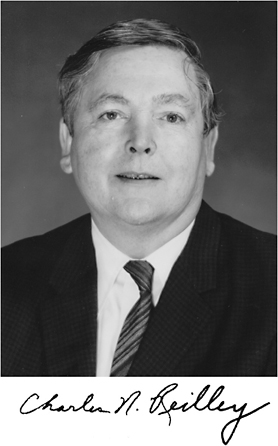
CHARLES NORWOOD REILLEY
March 2, 1925–December 31, 1981
BY ROYCE W. MURRAY
CHARLES N. REILLEY WAS BORN in 1925 in Charlotte, North Carolina. His mother, a public school teacher, was widowed when Charles was young; her husband died from an illness. Charles was fascinated with radio and electrical things while still a grammar school child. His older brother Eugene said that when Charlie (everyone called him Charlie except his mother—there it was Charles) got to high school and found out about science, its beauty so attracted him that he never could turn his eyes away again. Reilley went on to become an outstanding scholar in the field of analytical chemistry, with a fundamentally-oriented approach that strongly influenced the character and reputation of that discipline in the 1950s and 1960s. He was elected to the National Academy of Sciences in 1977.
Charlie Reilley had enviable personal qualities. He was a soft-spoken, modest person whose conversations revealed a deep intellect and the soul of a teacher. His love for teaching almost certainly was nurtured by his mother, to whom Charlie was a devoted bachelor son until his death. A salute from his colleagues after his death stated: “Charlie Reilley was the friend, teacher, student, and colleague of almost everyone who worked with him. He was a scientist of unlimited imagination. Most of all he was a generous hu-
man being who believed in always giving more than he took.” This author of this memoir—on whose professional life Reilley had great positive influence—deeply agrees with this analysis.
HIS EDUCATION
After graduating from Central High School in Charlotte in 1943, Charles Reilley enrolled at the University of North Carolina and graduated with a B.S. in chemistry in 1947. He was a capable student and was honored with Phi Beta Kappa, Alpha Chi Sigma undergraduate chemistry awards for three years (1945-1947), and the Archibald Henderson Medal in Mathematics in 1946. He returned to Charlotte and taught chemistry there at Queen’s College for two years, and then returned to school to earn his M.A. (in 1951) and Ph.D. (in 1952) in chemistry at Princeton University under Professor Nathaniel Howard Furman, who at that time had made his institution an international center of analytical chemistry. As a graduate student Reilley was recognized with an ACS Division of Analytical Chemistry Graduate Fellowship in 1951. While at Princeton, Reilley was a colleague in Furman’s laboratory of W. Donald Cooke and Ralph N. Adams, who respectively went on to distinguished careers in analytical chemistry at Cornell University and the University of Kansas. Furman’s letter recommending him for a faculty position at UNC noted: “The other graduate students find him a very useful man to talk to” and “I believe that he will make a first-class teacher and research worker.” Furman also noted that he had in hand “an offer to remain here.”
After leaving Princeton, Reilley returned to Chapel Hill as an instructor and rose through the ranks to become an assistant professor in 1953, associate professor in 1956, professor in 1961 and Kenan Professor in 1963. The Kenan
chair is a prestigious one at the University of North Carolina, linking the names of Venable and Morehead with Kenan in a saga in which the origins of the company Union Carbide can be found.
HIS RESEARCH CONTRIBUTIONS
Charles N. Reilley was among the first modern analytical chemists of the mid-twentieth century. His interests were both fundamental and broad—a “man for all seasons.” Charlie made seminal contributions to all of the major legs of analytical chemistry: electroanalysis, optical spectroscopy, magnetic resonance spectroscopy, chemical separations, data analysis, instrumentation, and surface analysis. His research was based on fundamentals yet retained an eye to significant applications in analytical measurements. However, the signature of his research—in contrast to previous decades of the analytical chemistry subdiscipline that had weakened its stature in the eye of many—was that in it he declined empiricism and instead sought and demanded a more basic understanding of measurements and detection schemes that had evolved in analytical chemistry. Reilley recognized that measuring things was at the heart of modern chemistry, that everyone relied upon analytical measurements, and that it was the responsibility of the analytical chemist to outline their fundamental character. Today the analytical chemistry subdiscipline is a vibrant and respected science, in part owing to the leadership of Charles Reilley decades ago.
Many of Reilley’s early important contributions centered on the understanding of methods for detection of chemical reactions as they reached stoichiometric completion. These stoichiometrically exact reactions are commonly called titrations and are crucial in numerous quantitative analytical measurements. Reilley’s thesis research broached the first example of his talent in this direction. Others at
that time had found that the equivalence points of titrations could be detected by imposing potential or current biases between two detecting electrodes, but the understanding of such detection was quite incomplete. Reilley’s 1951 paper with Cooke and Furman elucidated the basic mechanism of current-polarized detecting electrodes and set a definitive stamp on this field.
Reilley’s interest in detecting the completion of exact stoichiometric reactions led to a series of further works on detection of coulometric titration equivalence points. Because of the accuracy of controlling current for electrogeneration of reagents in quantitative reactions, coulometry was one of the earliest successful instrumental methods. Reilley introduced the exact electrogeneration of cerium (IV) as an oxidative titrant reactant. This reaction retained a consistent usefulness in analysis for many decades. Reilley extended coulometric titration themes into a succession of trace analytical measurements, and in reflection of his capacities in electronic circuitry, designed instruments (before the solid-state transistor) for more accurate and conveniently controlled currents in coulometric reactions. Reilley was also interested (presumably from his childhood examinations of how radios work) in using high-frequency potentials for electrochemical detection, and while still a graduate student published an independent paper (1953) on high frequency titrimetry. This paper set out ideas that were fundamental and correct, but not much used until later in their rediscovery in the modern (in the 2000s) field of contactless ionic conductivity detectors.
Work continued on instrumental detection of the completion of stoichiometric reactions on Reilley’s arrival in Chapel Hill. One of his first publications at UNC (1954) involved detecting acid-base reactions in nonaqueous media using spectrophotometry, which at that time was a rela-
tively new subject. (One must remember that quantitative optical absorbance measurements were a mid-twentieth-century development.) He also continued research for several years aimed at developing constant current coulometric analysis, and during these studies became interested in a vital chemical aspect of analysis, that of using metal complexes as a means to generate reaction selectivity. (Selectivity even now is a continuously sought goal in modern chemical analyses.) He demonstrated (1956) how to coulometrically release the multidentate chelating ligand ethylenediaminetetraacetic acid (EDTA), and described a number of trace metal analyses using it. His postdoctoral associate R. W. Schmid was one of the first in his laboratory to explore multidentate metal complexation as a means of selectivity in quantitative reactions, and to investigate ways to measure metal chelate complex formation constants in that context. Schmid and Reilley recognized that a basic understanding of complexation equilibria was central to predictive design of metal-complexation-based analysis. Reilley’s interest in metal complexes (“chelons” was the term used) led him into a long series of metal chelate studies—their equilibria, complexation kinetics, and application, using measurements based on electrochemistry, nuclear magnetic resonance, and spectrophotometry. He appreciated that ligands that bound a metal with multiple binding sites would enjoy an entropic advantage in forming stable complexes. An important, and still employed method (1956) for measuring metal complex equilibria and detecting reaction completion involved using the extremely stable mercury EDTA complex and a Hg potentiometric electrode as an indicator of competition for the EDTA by an analyte metal ion. This principle was subsequently combined with coulometric titration methodology in 1958. Reilley fully appreciated and exploited the relationship between metal chelate stability and the redox
potential of the involved metal ion’s electron transfer reactions.
Reilley’s research interests thereafter retained a continuing probing of metal complexation equilibria and how to measure such equilibria. He exploited Beer’s law principles in assessing the effectiveness of colored indicator complexes in titrations. With Schmid he mathematically defined (1959) the qualities of equivalence points in relation to equilibrium parameters. His 1959 publication contained a periodic table in which more than one-half of the elements could be analytically measured using metal chelons. Using potentiometric data, he showed that diagrams equivalent to phase diagrams could be employed to show what titrations should be possible and which ones not.
Reilley’s electrochemical research using constant currents at electrodes enabled him to quickly recognize the potential importance of a report by Paul Delahay (Louisiana State University) about behavior of electrodes under constant currents when the electrode reactant supply was controlled strictly by diffusion only. Reilley carried out the first quantitative analytical study of this experiment, which was called chronopotentiometry according to the measurement of electrode potential as a function of time. A great deal of attention was subsequently paid by others to the chronopotentiometry experiment, owing to the relative simplicity—due to Reilley—of circuits to control constant currents at electrodes.
In the 1960s Reilley became interested in thin-layer electrochemistry, an experiment introduced by Fred Anson in about 1962, in which the electrochemical cell was a thin layer of solution bounded by a working electrode. Reilley introduced in 1965 the notion of using two, facing, working electrodes in thin-layer cells—along with a mechanism for varying the important interelectrode distance. Reilley
also provided an operational amplifier-based principle of controlling the potentials of both electrodes against a reference electrode and thereby contributed an important form of electrochemical generation-collection in a closed system. Reilley and his postdoctoral associate L. B. Anderson stated the theoretical principles for generation-collection, and showed how the thin-layer experiment could be used for study of chemical reaction kinetics.
In 1962 Reilley—in collaboration with faculty (Daniel Okun) in the School of Public Health at UNC—described an electrode useful for field determinations of the oxygen concentration in natural waters. The importance of this measurement—from an environmental viewpoint—was just beginning to be appreciated, and this electrode was patented and commercialized for measuring dissolved oxygen in lakes and streams. The electrode design, importantly, required no applied voltage, since it relied on a spontaneous (galvanic) reaction within the electrochemical cell. A second important innovation, key for field usefulness, was a oxygen-permeable membrane film that encapsulated the operating galvanic cell. Graduate student K. H. Mancy, who went on to a distinguished career in environmental chemistry, discovered in early versions that the latex membranes of condoms were good candidates for the encapsulation.
The coordination chemistry of metal chelates continued as a major theme throughout Reilley’s research career. He developed new chelate reagents and in 1965 calorimetrically assessed the thermodynamic principles underlying the “chelate effect” and their relevance to analytical measurements. This was one of the first studies that paid attention to the relation between chelon structure and the ensuing stability constant with a metal complex. Reilley’s interest in metal chelates also led him to nuclear magnetic resonance, at an early phase of use of NMR by chemists to study chemi-
cal equilibria and other phenomena. His were among the first publications that emphasized the proton NMR of the ligands of metal complexes—as opposed to small organic molecules. Starting in 1965 his students exploited NMR to investigate ligand conformations and exchange kinetics, microscopic protonation schemes in polyacidic bases, hydration of the counterions of ion exchange resins, and contact shifts of paramagnetic complexes. His 1964 introduction of proton NMR for measuring microscopic protonation patterns in polyprotic acids and bases established that method as the gold standard—continuing today—for microscopic equilibria studies. He introduced carbon(13) NMR for the same purpose in the 1970s. Reilley’s corpus of work, with varied methodologies and always with an eye to fundamental understanding, did much to foster fruition of the existing appreciation of chelate structure and reactivity.
Reilley made important contributions in the 1960s to gas liquid partition chromatography and prepared a classical and much-cited chapter on differential kinetic analysis that set the stage for years of further development of kinetic analysis as a field. In the early 1970s Reilley and his student Richard Van Duyne published three landmark papers that firmly established the power of lowered temperatures for detection and quantitative kinetic elucidation of chemical reactions accompanying electrochemical transformations. Reilley was active in early designs of data acquisition systems and computer-interfaced analytical instruments, and in the birth of the field of chemometrics, entered a collaboration with Thomas Isenhour through studies on computerized learning machines (e.g., pattern recognition and artificial intelligence). These endeavors were published in 1969 and 1970, and dealt with mass spectrometric and vibrational spectral data.
Reilley’s interests in the later 1970s turned to include polymer surface analysis, through collaboration with H. Yasuda of the Research Triangle Institute. The themes were the surfaces of plasma-polymerized films and the application of X-ray photoelectron spectroscopy (then called ESCA) to polymer surfaces. This line of research was unfortunately terminated by Reilley’s death in 1981. Reilley’s work published in 1981 with his student Dennis Everhart was—as typical of his entire career—an early entry into the literature of polymer surface functional group analysis by derivatization tagging.
HIS TEACHING, SERVICE, AND HONORS
Charles Reilley’s research scholarship and leadership in fundamental science soon brought him to the national attention of other chemists, including analytical chemists, of course, but also a wider circle of disciplines. Reilley was elected as secretary-treasurer of the American Chemical Society Division of Analytical Chemistry for 1958-1959 and subsequently as its chairman in 1961. He was afterward elected as an ACS councilor from the North Carolina Section and then was chosen as a member of the ACS Council Policy Committee. He chaired the Gordon Research Conference on Analytical Chemistry in 1960.
Reilley was recognized for his research accomplishments with a Guggenheim Fellowship in 1962, the ACS Award in Analytical Chemistry (also known as the Fisher Award) in 1965, the Herty Medal in 1968, the Stone Award in 1971, the national ANACHEM Award in Analytical Chemistry of the Association of Analytical Chemists in 1972, and the Manufacturing Chemist’s Association College Chemistry Teaching Award in 1975.
Reilley contributed to his department at Chapel Hill in innumerable ways, by example of his own high scholarship
and by design of a farsighted undergraduate curriculum for the modern chemistry student. He advocated a more quantitative laboratory experience for freshmen chemists, and a drastic revision of what he called a “seriously out of touch” sophomore introduction of analytical chemistry. Noting that “the pressure of new knowledge continually forces basic concepts into earlier stages of the curriculum,” he advocated an “adiabatic transition from the traditional course.” Reilley recognized the importance and revolutionizing impact that instrumental methods of measurement in chemistry were exerting in the late 1950s and the 1960s, and in effect proposed that they be taught beginning at the sophomore level in analytical chemistry courses. Making sophomore analytical chemistry into an introductory instrumental analysis course helped propel his department’s program nationally into one of the most successful centers granting undergraduate degrees in chemistry.
Reilley brought the above ideas into the national scene by proposing them publicly in his introductory remarks upon receiving the Fisher Award in 1965. They set off a national discussion of the teaching of analytical chemistry (Anal. Chem. 38[1966]:35A-57A) and had a subsequent, profoundly healthy effect on that part of the undergraduate chemistry curriculum.
Reilley was widely sought after as a research lecturer, the Baker Lectures at Cornell University in 1979 and the Reilly Lectures at Notre Dame in 1966 being examples. He was the editor of the series “Advances in Analytical Chemistry and Instrumentation” and was on numerous journal editorial boards, including Analytical Chemistry and Accounts of Chemical Research. He served on the National Science Foundation Chemistry Advisory Panel during 1958-1960.
Charlie Reilley is central in the history of the Society for Electroanalytical Chemistry, taking part in the prede-
cessor San Clemente, California, CVs-on-the-sand meeting of about 15 electroanalytical chemists in 1963. That enormously stimulating gathering of young Turks and experienced wise heads like Reilley and Ralph Adams led to initiation of the Gordon Conference on Electrochemistry. Perhaps equally important in this inaugural meeting was the spirit of trust and intellectual fellowship engendered by the open conversations, there and subsequently, that have persisted in the science of electroanalytical chemistry to this day.
The level of respect for and admiration of Reilley following his death on the last day of 1981 was reflected in the actions of his friends, former students, and colleagues in steps that led ultimately to the formation of the Society of Electroanalytical Chemistry as a vehicle for managing an award in electroanalytical chemistry, called the Charles N. Reilley Award. The financial sponsorship for the award was provided by former Reilley student Peter Kissinger, who following a postdoctoral study with Ralph Adams and a successful academic career at Purdue University, founded the company Bioanalytical Systems. The award was established in conjunction with the Pittcon Conference and was first awarded in 1984. The distinction of this award can be measured by the fact that four awardees subsequently became members of the National Academy of Sciences (1984, Allen J. Bard; 1986, Fred C. Anson; 1988, Royce W. Murray; and 1990, Jean-Michel Saveant).
Following his death a memorial fund established in 1982 in his name, funded by donations from friends and former students, provided fellowships (Reilley fellows) to outstanding entering graduate students at the Chemistry Department at the University of North Carolina. There are now numerous successful chemists in all areas of the disci-
pline whose resumés acknowledge this support from Reilley’s friends and in his memory.
Reilley’s own intellectual contributions and leadership were recognized by election to the National Academy of Sciences in 1977. He was the first analytical chemist to be so selected after the also legendary I. M. Kolthoff, 19 years before.
In writing about Charlie Reilley, who became prominent both by scholarship and a love for teaching, it is difficult to completely express his dedication to teaching. It was not just in formal classes that Charlie taught. When you had a scientific conversation with Charlie, it was a stimulating experience. He was a teacher and a student at the same time; your questions to him always prompted questions in return. It was said that “he has the knack of leading the horse to water and patiently waiting for him to drink (or be traded in).”
I WAS A CLOSE PERSONAL friend of Charles Reilley, and shared an office suite. I had the sad task of cleaning his office, and came into possession of numerous files and records, from which I drew the information for this memoir.
SELECTED BIBLIOGRAPHY
1951 With N. H. Furman and W. D. Cooke. Coulometric titrations with electrically generated ceric ion. Anal. Chem. 23:945.
1953 With W. H. McCurdy Jr. Principles of high-frequency titrimetry. Anal. Chem. 24:86.
1954 With G. W. Everett. Coulometric titrations with photometric end point. Anal. Chem. 26:1750.
1955 With G. W. Everett and R. H. Johns. Voltammetry at constant current. Experimental evaluation. Anal. Chem. 27:483.
1956 With R. W. Schmid. A simple, rapid method for determination of metal chelate stability constants. J. Am. Chem. Soc. 78:2910.
With R. W. Schmid. A rapid electrochemical method for the determination of metal chelate stability constants. J. Am. Chem. Soc. 78:5513.
1958 With R. W. Schmid. Chelometric titrations with potentiometric end point detection: Mercury as pM indicator electrode. Anal. Chem. 30:947.
1959 With R. W. Schmid. Principles of end point detection in chelometric titrations using metallochromic indicators. Characterization of end point sharpness. Anal. Chem. 31:887.
1962 With L. J. Papa. Analysis of binary mixtures by second order kinetics using equal concentrations of reactants. Anal. Chem. 34:801.
1962 With K. H. Mancy and D. A. Okun. A galvanic cell oxygen analyzer. J. Electroanal. Chem. 4:65.
1964 With R. J. Day. Nuclear magnetic resonance studies of metal aminopolycarboxylate complexes. Liability of individual metal ligand bonds in (ethylenedinitrilo)tetraacetate complexes. Anal. Chem. 36:1073.
With J. L. Sudmeier. Nuclear magnetic resonance studies of protonation of polyamine and aminocarboxylate compounds in aqueous solution. Anal. Chem. 36:1698.
1965 With N. E. Rigler, S. P. Bag, D. E. Leyden, and J. L. Sudmeier. Determination of a protonation scheme of tetracylcine using nuclear magnetic resonance. Anal. Chem. 37:872.
1965 With D. L. Wright and J. H. Holloway. Heats and entropies of formation of metal chelates of polyamine and polyaminocarboxylate ligands. Anal. Chem. 37:884.
With L. B. Anderson. Thin-layer electrochemistry: Steady-state methods of studying rate processes. J. Electroanal. Chem. 10:295.
With L. B. Anderson. Thin-layer electrochemistry: Use of twin working electrodes for the study of chemical kinetics. J. Electroanal. Chem. 10:538.
1969 With P. C. Jurs, B. R. Kowalski, and T. L. Isenhour. Computerized learning machines applied to chemical problems: Investigation of convergence rate and predictive ability of adaptive binary pattern classifiers. Anal. Chem. 41:690.
With P. C. Jurs, B. R. Kowalski, and T. L. Isenhour. An investigation of combined patterns from diverse analytical data using computerized learning machines. Anal. Chem. 41:1949.
With B. R. Kowalski, P. C. Jurs, and T. L Isenhour. Computerized learning machines applied to chemical problems: Multicategory pattern classification by least squares. Anal. Chem. 41:695.
With B. R. Kowalski, P. C. Jurs, and T. L Isenhour. Computerized learning machines applied to chemical problems: Interpretation of infrared spectrometry data. Anal. Chem. 41:1945.
1970 With P. C. Jurs, B. R. Kowalski, and T. L. Isenhour. Computerized learning machines applied to chemical problems. Molecular structure parameters from low resolution mass spectrometry. Anal. Chem. 42:1387.
1971 With R. F. Evilia and D. C. Young. Contact shift studies of nickel-butylenediamine complexes. Inorg. Chem. 10:433.
1972 With R. P. Van Duyne. Low-temperature electrochemistry. I. Characteristics of electrode reactions in the absence of coupled chemical kinetics. Anal. Chem. 44:142.
With R. P. Van Duyne. Low-temperature electrochemistry. II. Evaluation of rate constants and activation parameters for homogenous chemical reactions coupled to charge transfer. Anal. Chem. 44:153.
With R. P. Van Duyne. Low-temperature electrochemistry. III. Application to the study of radical ion decay mechanisms. Anal. Chem. 44:158.
1977 With H. Yasuda, H. C. Marsh, and E. S. Brandt. ESCA study of polymer surfaces treated by plasma. J. Appl. Polym. Sci. 15:1977.
1979 With H. Yasuda, N. Morosoff, and E. S. Brandt. Plasma polymerization of tetrafluoroethylene. I. Inductively coupled radio frequency discharge. J. Appl. Polym. Sci. 23:1003.
With H. Yasuda, N. Morosoff, and E. S. Brandt. Plasma polymerization of tetrafluoroethylene. III. Capacitive audio frequency (10 kHz) and AC discharge. J. Appl. Polym. Sci., 23:3471-3488.
1980 With H. L. Surprenant, J. E. Sarneski, R. R. Key, and J. T. Byrd. Carbon-13 NMR studies of amino acids: Chemical shifts, protonation shifts, microscopic protonation behavior. J. Magn. Res. 40:231.
1981 With D. S. Everhart. Chemical derivatization in electron spectroscopy for chemical analysis of surface functional groups introduced on low-density polyethylene film. Anal. Chem. 53:665.


