
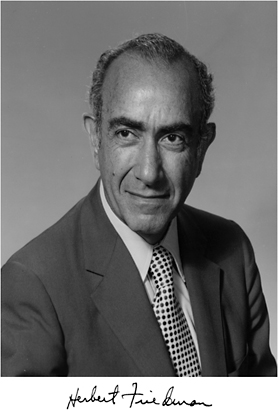
HERBERT FRIEDMAN
June 21, 1916–September 9, 2000
BY HERBERT GURSKY
“IF I WERE RICH, I would pay for the privilege of doing it,” Gertrude Friedman quoted her husband as saying of the decades of research he had carried out. She was reminiscing of their life together in their home of 50 years in Arlington, Virginia. The house is well known to friends of the Friedmans, where each spring they hosted a Sunday brunch when the azaleas that overflowed their front yard were at peak bloom. Friedman died there of cancer on September 9, 2000, at the age of 84.
Herbert Friedman spent nearly his entire professional career at the Naval Research Laboratory in Washington, D.C., after arriving there in 1940 upon completion of his graduate work at Johns Hopkins University. At the NRL he had a very successful career applying X-ray analysis to the study of materials. He then pioneered the application of sounding rockets to solar physics, aeronomy, and astronomy. Later in his life he served as a statesman and public advocate for science. Friedman retired from the Naval Research Laboratory in 1980 but maintained an active association with the laboratory and the scientific community until his death. In 1996, on the occasion of his eightieth birthday, he received the NRL Lifetime Achievement Award and was
named Chief Scientist Emeritus of the Hulburt Center. The Friedman Room at NRL remains as a memory of his career and stature as a scientist.
Friedman was born in Brooklyn on June 21, 1916, the second of three children of Samuel and Rebecca Friedman. His father ran a successful art-framing store on Ninth Street in Manhattan. An Orthodox Jew who closed his business on Saturday, Samuel Friedman was born in Evansville, Indiana, in 1877 and moved to New York City as a young man. Rebecca was born in Eastern Europe. Herbert grew up as an aspiring artist and developed sufficient skill as a young man to earn pocket money from the sale of his sketches. He entered Brooklyn College in 1932 as an art major but finished with a degree in physics.
Gertrude Friedman recalls no special interest in science in the Friedman family. The family environment was focused on the humanities, especially art and music. In an autobiographical note, as an example of an interest in science, Friedman mentions only having traveled to upper Manhattan in 1925 when he was nine years old to observe a total eclipse of the sun, although he did admit an interest in mathematics. No one else in the Friedman family developed any special skills as an artist, even though Samuel Friedman developed close associations with artists as part of his business. So it was something special about Friedman, developed at an early age, that led him to focus his energy so successfully, first on art, then on science.
After completing his undergraduate education, Friedman had no thought of continuing his studies, but it was still the depression and jobs were scarce. The best he might expect was teaching in a secondary school, but such positions were highly competitive. He did manage to find work as a commercial artist for five dollars a week. With such dim prospects he decided to go on to graduate school. His
Brooklyn College mentor, Bernhardt Kurrelmeyer, helped him obtain a scholarship to Johns Hopkins University, where he was given an instructor’s position for $40 a month.
When Friedman began his graduate studies in 1936, science in the United States was in the midst of an explosion in basic physics research. Compton in Chicago and Millikan in Berkeley were studying the very energetic particles comprising cosmic rays; Anderson in Pasadena had discovered the positive electron, confirming one of the more bizarre predictions of quantum mechanics, and Lawrence in Berkeley was building cyclotrons for smashing atoms. Hubble in Pasadena had discovered the recession of galaxies, leading to the concept of the expanding universe. However, the bread and butter of physics was materials research. Discoveries early in the century by Rutherford and Bohr led to the modern concept of the atom. Quantum mechanics, combined with powerful new diagnostic techniques, such as the development of X-ray technology and X-ray diffraction, led to a whole industry dedicated to understanding the structure of materials, picking up where the chemists had left off.
At Johns Hopkins, Friedman conducted his thesis research under the direction of J. A. Bearden, an expert in the exploitation of X rays to study material. Bearden, a master experimenter, had built a new instrument for studying X rays using their Bragg reflection characteristics. To detect the X rays, Bearden used an ionization chamber. Friedman developed a Geiger counter as the instrument’s detector, which greatly improved its sensitivity. The device had been invented only in 1928 and was just coming into general use. There is a fundamental difference between an ionization chamber and a Geiger counter, even though they are close cousins. With an ionization chamber, the exceedingly small current resulting from the interactions of X rays
is recorded. In a Geiger counter the charge resulting from each X-ray photon is amplified in the gas, collected as a pulse, and counted as a single event, allowing for long measurement periods. Friedman used this instrument for his thesis work and wrote three papers studying X-ray interactions with materials, mostly metals.
Friedman was unable to find a position when he finished at Hopkins in 1939, so he remained at the university for a year as an instructor. In 1940 he was offered a position in the Metallurgy Department at NRL, but only after the intercession of the Hopkins Physics Department chair, who was apparently outraged that a Hopkins graduate would have difficulty finding a job.
NRL was still a small place, not yet swelled by wartime activities. The institution comprised no more than about 100 scientists and engineers, spread over seven research departments. The titles of his papers during the 1940s reveal the applied nature of his work and included “Lead Marking of Radiographic Films and Its Prevention,” “Thickness Measurements of Thin Coatings by X-Ray Absorption,” and “Determination of Tetraethyl Lead in Gasoline by X-Ray Absorption.” During this time he also applied for his first of eventually 50 patents, “A Parallel Arrangement of GM (Geiger-Mueller) Counters.” In 1942, because of dissatisfaction with changes in management of his research area, he verged on accepting a position at the National Bureau of Standards. Learning of this, E. O. Hulburt offered Friedman a position in his own Optics Division at NRL as the head of a newly formed section dedicated to exploiting electron microscopy and X-ray diffraction analysis. Friedman was still only 26 years old.
During this time Friedman married Gertrude Miller. She was also from Brooklyn; in fact, the two had attended Brooklyn College at the same time without ever meeting.
Herbert’s sister, who was Gertrude’s close friend, introduced the two in 1938. The Friedman children, Paul and Jon, were born in 1944 and 1947, respectively, and the family moved into their Arlington home in 1950.
In 1945 Friedman received the Navy’s Distinguished Civilian Service Award for his wartime development of a technique for cutting and tuning RF crystals for radios by using their Bragg reflection characteristics. Up until Friedman’s development, crystals were examined visually in order to find the correct orientation for installation in radio circuits. But the Japanese had bought all the good crystals on the world market in building up their armed forces. All that remained were low-quality crystals not suitable for visual examination. So Friedman took what was available and demonstrated how they could be “visualized” with X rays and converted to use in radios. The award citation stated that 50 million man-hours of effort had been saved with Friedman’s technique.
Friedman also became involved in a major project of national importance, the search for airborne radioactive material as an indicator of nuclear explosions. The standard technique for the analysis of airborne particulates was then, as it still is, in situ collection on filter paper. Collecting debris from nuclear explosions required aircraft flights to carry the sampling apparatus. Friedman recognized that rainfall had the property of scouring the air of such material, which acted as nucleation centers for creating raindrops. Why go to the trouble of going up into the stratosphere to collect when nature will bring it down in the form of rain, reasoned Friedman. Combined with chemical techniques for extracting and condensing heavy elements from rainwater, this simple idea turned into a powerful means of detecting small amounts of atmospheric inclusions. The highly secret NRL project, called Project Rain Barrel, re-
sulted in detecting the Soviet Union’s first nuclear explosion in 1949. Around this time, Friedman, with his colleague LaVerne Birks, also developed the use of X-ray fluorescence as a standard tool by the materials analysis community.
These important achievements had already established Friedman as an unusually gifted scientist. But by 1949, with the encouragement of his department director E. O. Hulbert he was already shifting his primary interest to the conduct of scientific experiments from sounding rockets in order to study the sun and the upper atmosphere. Hulburt’s own research had begun in the 1920s with the study of long-distance radio propagation, but by the 1930s it encompassed the physics of the upper atmosphere. Even then Hulburt recognized the potential of rockets for probing the atmosphere and resolving questions related to the ionosphere. Fortuitously Ernest Krause, an NRL physicist who had specialized in aircraft electronics, was one of the many scientists sent to Europe near the end of World War II to assess German military technology. Krause came away with an intense interest in the V-2 rockets and was instrumental in having NRL take significant responsibility for their utilization following the end of the war. With the actual opportunity to make observations from rocket altitudes, Hulburt encouraged NRL scientists to develop experiments to exploit this new capability. V-2 rockets with science payloads began flying from the White Sands Missile Range in 1946. Friedman’s first rocket experiment in 1949 was designed to observe solar X-ray and ultraviolet radiation using Geiger counters. At that time fewer than half the launch attempts were successful, but with beginner’s luck Friedman’s rocket performed satisfactorily and he was able to obtain results up to an altitude of 150 km. The abstract to his 1951 paper published in Physical Review describing the results reads as follows: “Data telemetered continuously from photon counters
in a V-2 rocket, which rose to 150 km at 10:00 AM on September 29, 1949, showed solar 8A x-rays above 87 km, and ultraviolet light around 1200A and 1500A above 70 km and 95 km, respectively. The results indicated that solar soft x-rays are important in E layer ionization, that Lyman a-radiation of hydrogen penetrates well below E layer, and that molecular oxygen is rapidly changed to atomic form above 100 km.”
By the time of his 1949 flight, other scientists from NRL, using film and fluorescing powders, had already gathered evidence of X-ray emission from the sun. Furthermore there had been evidence from the 1930s, culminating with Edlen’s identification of lines from highly ionized atoms in the 1940s, indicating that the sun had a million-degree corona. The scientific issue in 1949, as it had been for several decades, was how the structure of the upper atmosphere was created. It was Friedman’s intention to understand that structure, especially the E layer, based on the ionization produced by solar radiation. Friedman’s measurement was clean and quantitative, and he convinced the community that it could be used as a basis for developing a full understanding of the upper atmospheric regions. The discovery of solar X rays is widely attributed to Friedman based on this early rocket experiment.
The switch from laboratory X-ray analysis to rocket atmospheric science was not as great as might appear. The key to Friedman’s rocket instrument was the small rugged gas detectors that he developed for his laboratory work, along with the associated electronics. The basic science involved in the rocket investigations, the production of X rays and their interaction with matter, were subjects he had been studying since his graduate student days.
During the next decade Friedman arranged for campaigns of shipboard rocket launches, including a series of
launches from near the Pacific island of Puka Puka during the 1958 solar eclipse. He obtained the first X-ray image of the sun with a pinhole camera, flew the first Bragg spectrometer for measuring hard X rays, and developed and flew the first satellite, SOLRAD, for long-term monitoring of the sun. The observation of the 1958 solar eclipse was remarkable in showing that the solar X-ray emission extended far beyond the region of the visible sun, but was also concentrated in small regions on the surface associated with sunspots.
Around this time Friedman suffered the first episode of a life-threatening intestinal bleeding that was to plague him for the rest of his life. He went on to expand his research to stellar astronomy in 1955 with a rocket flight using collimated Geiger counters sensitive in the mid-ultraviolet that revealed significant emission associated with the Milky Way. The work represented a more general transition to astronomical observations, especially to X-ray astronomy. As a follow-up to his 1955 rocket flight, his group began a program of ultraviolet photometry of hot stars and obtained a startling observation of an apparent associated ultraviolet halo. Meanwhile part of the group that had worked with Friedman, including Albert Boggess and James Kupperian, left for NASA’s Goddard Space Flight Center, where they pursued their own program of rocket astronomy, although neither the NRL nor the Goddard group were able to confirm the observation of the haloes. Friedman subsequently referred to this period of time as having held him back from pursuing the observation of X rays from stellar objects, in which he was much more interested.
Following the report of the discovery of cosmic X-ray sources in 1962, Friedman responded with a rocket flight in early 1963 that unambiguously confirmed the presence of discrete sources of X rays and of a diffuse X-ray back-
ground. In 1964 he conducted an observation of the Crab Nebula as it was occulted by the moon. But the result, although a landmark in the history of scientific rocketry, was a great disappointment to him. By 1964 a renewed interest had emerged in neutron stars, whose existence was postulated during the 1930s. These objects had been conjectured to be one of the final stages of a star, possibly born during a supernova explosion, and composed entirely of neutrons. They would be of such great density that an object the mass of our sun would only be about 10 km in diameter. If the X-ray source in the Crab Nebula had been a neutron star, its X-ray emission would have disappeared abruptly when the moon passed in front of it. Instead the X-ray emission disappeared gradually, indicating that the emission was emerging from the nebula as a whole and not from a single, small object. After the 1968 discovery of the optical and radio pulsars, Friedman finally detected the X-ray pulsations from the neutron star in the Crab Nebula. Friedman’s group continued rocket observations of X-ray sources for another decade. He was also responsible for the large area proportional counter on the High Energy Astronomical Observatory, HEAO-1, that was launched by NASA in 1977.
Even though some of Friedman’s most heralded scientific accomplishments occurred during the 1960s, his career went through a marked change at the beginning of that decade. NASA was created in 1958 in response to the launch of Sputnik by the Soviet Union. The action created turmoil at NRL because whole sections of the laboratory transferred to the new organization, including several scientists working directly for Friedman. Friedman himself was offered a senior position at the Goddard Space Flight Center, but he declined. Another effect was that NASA provided support for a broad range of programs; indeed, one
of its principal initial focus areas was ultraviolet astronomy, which created competing groups.
A new division was created at NRL in 1958, with Friedman as its head and space science as its focus, combining elements of the Optics Division that Friedman had been part of and of the Rocket Sonde Division, which had lost much of its staff, including its director, Homer Newell, to NASA. Initially the new division was named Astronomy and Astrophysics, a misnomer since its activities included atmospheric science. Since 1963 it has been known as the Space Science Division.
In 1962 Friedman proposed that the National Science Foundation fund an institute to be created at NRL, the E. O. Hulburt Center for Space Research, principally dedicated to the mentoring of young scientists in space research, following which they would go out to other research laboratories and to universities. Friedman argued that “there can be little doubt that major advances in astrophysics can be achieved in the immediate future through the use of observatories in space, yet in spite of substantial funding by NASA for space science in the universities, the opportunities to enter directly into rocket and satellite astronomy programs are very limited.” He further noted that the principal focus of NASA, satellite projects such as the Orbiting Solar Observatory and the Orbiting Astronomical Observatory, “are inappropriate for graduate students and in any case are too inflexible as testing grounds for unconventional and radically new ideas.” He argued that because of its history of excellence in space science, by then into its second decade and the breadth of laboratory support services, the Naval Research Laboratory was uniquely situated for training scientists to participate in space research and technology. Friedman was aware of discussions that had been taking place at the President’s Science Advisory Committee
of the need for strengthening university research activities by taking advantage of national and Defense Department laboratories. His proposal was supported by then director of the National Science Foundation Alan T. Waterman, who had previously been the first director of the Office of Naval Research, NRL’s parent organization in the Navy.
Funding of $800,000 was provided in 1963 for the creation of the center and included the purchase of rockets and the necessary staff support. At this time the NSF was dealing with the issue of balance between supporting the large national centers such as the National Radio Astronomy Observatory in Green Bank, West Virginia, and support for individual investigators. After Waterman left NSF in 1963, funding for the E. O. Hulburt Center declined, although Friedman was able to continue support for the center with NASA funding until around 1980. The center, which still exists, left a notable legacy. In its first years, support was provided to Edward Ney at the University of Minnesota, Martin Harwitt at Cornell University, and many others. Indeed, many of the current leaders in space science at the Naval Research Laboratory started their careers as Hulburt fellows.
Friedman’s emergence as a space scientist was a chance event. His first choice when he left graduate school was an industrial position, applying the experience of his thesis work. But the period 1939-1940 was still the depression, and he was a physicist competing for a position in a discipline dominated by chemists. Had it been a year later and preparations for war further along, he would probably have been successful in obtaining such a position. And because he had been befriended by E. O. Hulburt, he did not leave NRL for a position at the National Bureau of Standards. Finally, it was only because the Naval Research Laboratory took the incentive for conducting science with captured V-2
rockets, that the opportunity for his space research arose at all.
His genius as a scientist lay in devising simple experiments that resolved important problems. It is hard to find other individuals with his string of success over such a broad range of scientific activities. He had little interest in large NASA-sponsored missions, even though early in his career he had been involved with and directed major enterprises, such as the campaigns to launch rockets from naval ships, and later his group built one of the instruments for the HEAO-1 X-ray satellite, which he used to survey the sky for X-ray sources and to study X-ray variability.
In the 1970s Friedman turned to writing for the general public, with the publication of his book The Amazing Universe in 1975, followed by The Sun and Earth in 1985 and The Astronomer’s Universe in 1990. Of the latter, Publishers Weekly wrote, “Friedman here writes one of the most engaging popular science introductions to astronomy to come along in memory… A superb book.”
In 1973 Friedman wrote an article, “Undirected Research,” for an internal NRL publication in which he noted that when he joined NRL in 1940, he “discovered a world of problems that had never penetrated my academic consciousness.” In the article he went on to describe his work on converting quartz crystals into precise crystal oscillators, the detection of Soviet nuclear bomb explosions, and his other applied activities. Never once did he mention any of the scientific results for which he is known outside of NRL. He may have been writing for his Navy sponsors, but clearly he enjoyed applying his ability as a physicist to solving difficult problems of high interest, whether it was the nature of the cosmic X-ray sources or the thickness of layer of tin on steel.
Starting in 1959, Friedman began to take an increased interest and participation in a wide range of national advisory committees, organizations, and editorial boards, starting with his membership on the Geophysical Monograph Board of the American Geophysical Union. By 1962 Friedman was also involved in four editorial positions, membership on the panel of the International Year of the Quiet Sun, was president of the Inter-Union Committee on Solar-Terrestrial Relations, and was a director of the American Rocket Society. As a recognized leader in the space sciences, Friedman was sought after by NASA as it established an advisory structure. Furthermore, his contributions to applied research and their relation to national defense programs made him a natural choice for other groups. By 1970 he was concurrently involved in 17 outside roles, an astonishing number, since active scientists rarely become involved in more than a handful of such activities simultaneously. He was always soft-spoken, but exerted his influence through the sheer strength of character and wisdom. As Frank Press said at a memorial ceremony at the American Philosophical Society, “When Herb spoke, everyone listened.” Friedman also took increasing interest in helping scientists from countries with closed bordersa, especially from the former Soviet Union. He was a close friend of the Russian astrophysicist Joseph Shklovsky and arranged for translation into English of Shklovsky’s autobiographical essays “Five Billion Vodka Bottles to the Moon.”
Friedman was a great friend of the geophysics community and played a major role in the formation of the International Geosphere-Biosphere Program, a term that he coined. Richard Goody had chaired a NASA-sponsored workshop in the summer of 1982 to discuss a major new space initiative in the area of “global habitability.” The next summer, following the solicitation of opinions of interest from
various groups, Friedman organized a workshop under the auspices of the National Academy of Sciences to “begin a more systematic, detailed discussion of the composition of the International Geosphere/Biosphere Program.” The workshop resulted in a report presented to the International Council of Scientific Unions that August, leading in turn to its Council issuing “A Proposal for an International Geosphere-Biosphere Programme—A Study of Global Change,” that was endorsed at the IGU General Assembly in 1984. A parallel effort was begun in the United States by the National Research Council with the formation of the Committee for an International Geosphere-Biosphere Program. The net result has been an astonishing number of programs and even an act of Congress, the Global Change Research Act of 1990. Richard Goody has been called the grandfather of the IGBP, but Friedman is generally regarded as its principal architect.
Friedman was elected to the National Academy of Sciences in 1960. During his long association with the National Academies, he served on 21 different National Research Council panels, committees, boards, and commissions, including the Space Studies Board, the NRC Governing Board and the Report Review Committee, and as chair of the Commission on Physical Sciences, Mathematics, and Applications. Friedman also served numerous other national and international organizations, giving generously of his time. He was a member of President Nixon’s Science Advisory Committee and was appointed to the General Advisory Committee of the Atomic Energy Commission by President Johnson. Friedman was also a member of the American Academy of Arts and Sciences, the International Academy of Astronautics, and an honorary fellow of the American Institute of Aeronautics and Astronautics. In 1964 he was elected to the American Philosophical Society, where he served on a num-
ber of committees, and shortly before his death he organized a Philosophical Society Symposium called “Ballistic Missile Defense, Space and the Danger of Nuclear War.”
Over his long career Friedman authored or coauthored over 300 scientific papers. His achievements were widely recognized throughout the world and included honorary degrees from the University of Michigan and the University of Tubingen (Germany). He received many awards and prizes. Among these were the President’s Distinguished Federal Civilian award, the National Medal of Science, the Wolf Foundation Prize in Physics, the Eddington Medal of the Royal Astronomical Society, and the Bowie Medal of the American Geophysical Union.
Friedman’s principal scientific contributions, having to do with his observations of solar and cosmic X rays, were highlighted in the 2002 Nobel Prize in physics awarded to Riccardo Giacconi for his pioneering role in the development of X-ray astronomy. In a background paper the Royal Swedish Academy of Sciences noted that X-ray astronomy began with Friedman’s 1949 pioneering discovery of X rays from the sun, and commented, “The most important leading persons through the first three decades of x-ray astronomy were, independently, Friedman and Giacconi and [Bruno] Rossi. These three persons contributed crucially to the development of methods and instrumentation, but also to the application of these methods to scientific work, leading to a very rich host of important discoveries.”
SELECTED BIBLIOGRAPHY
1940 With J. A. Bearden. The X ray Kb emission lines and K absorption limits of Cu-Zn alloys. Phys. Rev. 58:387-395.
1946 With L. S. Birks. Thickness measurements of thin coatings. Rev. Sci. Instrum. 17:99-101.
1949 Geiger counter tubes. Proc. I. R. E. 37:791-808.
1951 With S. W. Lichtman and E. T. Byram. Photon counter measurements of solar X-rays and extreme UV light. Phys. Rev. 83:1025-1030.
1957 With T. A. Chubb. Solar X-ray emission and the height of D-layer during radio fadeout. In Report of the Physical Society Conference on the Physics of the Ionosphere, pp. 58-62: London: The Physical Society.
With T. A. Chubb, R. Kreplin, and J. E. Kupperian. Rocket observation of X-ray emission in a solar flare. Nature 179:861-862.
With E. T. Byram, T. A. Chubb, and J. Kupperian. Far ultra-violet radiation in the night sky. In The Threshold of Space, ed. M. Zelikoff, pp. 203-210. New York: Pergamon Press.
1962 With R. W. Kreplin and T. A. Chubb. X-ray and Lyman-alpha emission from the sun as measured from the NRL SR-1 satellite. J. Geophys. Res. 67:2231-2253.
1963 With R. L. Blake, T. A. Chubb, and A. E. Unzicker. Interpretation of X-ray photograph of the sun. Astrophys. J. 137:3-15.
1964 With S. Bowyer, E. T. Byram, and T. A. Chubb. X-ray sources in the Galaxy. Nature 201:1307-1308.
With S. Bowyer, E. T. Byram, and T. A. Chubb. Lunar occultation of X-ray emission from the Crab Nebula. Science 146:912-917.
1966 With T. A. Chubb and R. W. Kreplin. Observations of hard X-ray emission from solar flares. J. Geophys. Res. 71:3611-3622.
1967 With E. T. Byram and T. A. Chubb. Distribution and variability of cosmic X-ray sources. Science 156:374-378.
1969 With G. Fritz, R. C. Henry, J. F. Meekins, and T. A. Chubb. X-ray pulsar in the Crab Nebula. Science 164:709-712.
1971 With J. F. Meekins, G. Fritz, and T. A. Chubb. X-rays from the Coma Cluster of Galaxies. Nature 231:107-108.
With S. Shulman, G. Fritz, J. F. Meekins, and M. Meidav. X-ray intensity fluctuations in Cygnus XR-1. Astrophys. J. 168:L49-L51.
1987 Sun and Earth. New York: W. H. Freeman.
1990 The Astronomers Universe: Stars, Galaxies, and Cosmos. New York: W. W. Norton.


