
2
The Anatomy of Crashes Involving Young Drivers
An understanding of how the number of teen crashes might be reduced begins with an understanding of how they happen. Many of the speakers presented data that shed light not only on the strikingly large scope of the problem, but also on what goes wrong when teenagers have crashes.
THE GRAVEST PUBLIC HEALTH PROBLEM FOR YOUNG DRIVERS
Driving is dangerous, and especially so for new drivers. Motor vehicle crashes are the leading cause of mortality and serious morbidity for all young people ages 4 through 34, and the rates are highest during new drivers’ first few months of driving on their own. In fact, during their first six months of solo driving, newly licensed drivers are about eight times more likely to be involved in fatal crashes than are more experienced drivers (Insurance Institute for Highway Safety, 2004). Even after more than six months licensed to drive alone, teens are two to three times more likely to be in a fatal crash than are the most experienced drivers. The overall numbers are alarming— by one analysis, more than 100,000 young people (ages 16 to 24) will die in vehicle crashes between 2003 and 2012 if the crash rates do not change, as shown in Table 2-1.
Crash rates are significantly higher for male than female drivers, but while overall rates are increasing, young women are catching up with young
TABLE 2-1 Cumulative Total Deaths from Motor Vehicle Crashes Involving Teen Drivers, 2003 to 2012
men. Moreover, the proportionate mortality rates—that is, the number of vehicle crash deaths divided by the number of all deaths among 16- to 19-year-olds—are 36.5 percent for young men and 46.5 percent for young women (D’Angelo, 2006). The high mortality rates for young drivers (ages 15 to 20) have persisted over the past decade, with an increase of 5 percent between 1994 and 2004. During this same time period, driver fatalities rose by 1 percent among young male drivers, compared with a 15 percent increase for young women, according to data presented by Richard Compton (National Highway Traffic Safety Administration, 2006a).
Injuries are another significant component of the problem—303,000 young people ages 15 to 20 were injured in crashes in 2004, many of them very seriously (National Highway Traffic Safety Administration, 2006a). Moreover, these numbers do not include deaths or injuries of thousands of other nonteenage drivers, passengers, or pedestrians that occur as a result of crashes caused by teenage drivers (American Automobile Association, 2006).
From a public health perspective, motor vehicle crashes are among the most serious problems facing teenagers. Studies by the AAA Foundation for Traffic Safety indicate that teen drivers are overrepresented in road crashes, with a higher per-mile collision rate than older drivers (American Automobile Association, 2006). From an economic perspective, these crashes also impose an enormous cost to society. It is estimated by the Centers for Disease Control and Prevention that the 2002 cost of crashes involving drivers ages 15 to 20 was $40.8 billion (National Center for Injury Prevention and Control, 2006). This information can provide a useful
context for discussions of the costs of measures designed to reduce the number of teen crashes.
RISK FACTORS
Just what is it about teenagers that makes them prone to motor vehicle crashes? Jim Hedlund provided a framework for the wealth of data on risk factors for teens by describing five critical elements teens need to drive safely:
-
skills—which include the capacity to operate the vehicle and to recognize hazards, as well as the capacity to react appropriately to the unexpected;
-
knowledge—of traffic rules and operating procedures, as well as understanding of risks and their potential consequences;
-
experience—including both sufficient practice, as well as the familiarity with the consequences of bad judgment that fosters good judgment;
-
maturity—or developed capacity for reasoning, judgment, and decision making; and
-
environment—or safe surroundings in which to learn to drive.
Whether or not these elements are all in place, teens are eager to drive, and their crash risk is particularly high in the first few months they are on the road, as well as when they travel at night, when teenage passengers are in the car, when they are driving too fast for conditions, and when they have consumed alcohol. Parents often believe that if they could be sure their teenagers would never drink and drive, or ride with someone else who had been drinking, their children would be safe on the road, but, as David Preusser noted, the biggest risk factor for teens is possession of a driver’s license. The key reasons why are discussed below.
Youth
Young drivers are at significantly higher risk than older drivers, as we have seen, and there is a learning curve for all new drivers, regardless of the age at which they begin driving.1 Table 2-2 shows the steep decline in crash
TABLE 2-2 Crash Rates for Novice Drivers per Cumulative Miles Driven After Licensure
rates for both male and female newly licensed drivers as they accumulate miles of practice. Other research provides even more detail, showing that crash rates are highest during the first 250 miles of driving (3.2 crashes per 10,000 miles) and the second 250 miles (2.0 per 10,000 miles). After this introductory period, the crash rates decline sharply (McCartt et al., 2003).
Since few people in the United States learn to drive after their teen years, data are not available in this country to allow comparison of the experiences of younger and older novice drivers. Countries in which waiting past the teen years to begin driving is more common, such as Canada and New Zealand, have found that older novice drivers also have higher
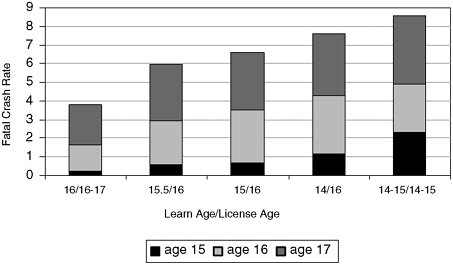
FIGURE 2-1 Driver fatal crash involvement rates (per 100,000 population, 1989-1993).
NOTE: Each column represents different groups of states, classified by the variations in ages at which practice driving (learn age) and licensure occurs, as catalogued by Williams et al., 1995.
SOURCE: Preusser (2006). Data drawn from Preusser (1995).
crash rates during their initial years of driving than do their peers with more driving experience. Nevertheless, there is evidence that even slight age differences in the adolescent years may have some effect. Figure 2-1 shows data suggesting that fatal crash rates are higher the younger the driver.
Possible reasons why waiting even 12 to 18 months beyond the once-standard 16th birthday target for licensure may be beneficial are explored in Chapter 3. However, the data on crash rates for young novice drivers are sufficiently compelling that many states have adopted graduated driver licensure (GDL) programs, which both prolong the time it takes to become fully licensed and provide for more training and supervised practice driving during the learning period. Whether the benefits come from the licensing of older adolescents, the delay itself (and consequent limitations on younger, inexperienced drivers’ hours behind the wheel), or from the nature of the experiences young drivers have during the longer waiting period, these programs, which are discussed in greater detail in Chapter 4, have shown significant benefits. One study, for example, has reported an average 11 percent reduction in fatal crashes among 16-year-olds who obtained their licenses through GDL (Baker, Chen, and Guohua, 2006).
Inexperience
The newly licensed driver faces less favorable odds than does the more experienced driver, and, as Don Fisher explained, a variety of studies support the conclusion that it is newly licensed drivers’ lack of experience that is the most significant problem, even considering that the youngest drivers fare the worst. For example, one analysis of police reports of almost 2,000 crashes in which newly licensed drivers were involved pointed to inexperience as the major contributor (McKnight and McKnight, 2003). These findings are consistent with those of an earlier study (Treat et al., 1979) in which ineffective visual search (scanning for hazards), speed adjustment, and attention, in that order, were implicated as causes of newly licensed driver crashes. Similarly, Gregersen (1996) estimated that some 70 percent of novice driver errors were attributable to inexperience. The errors that are typical of inexperienced drivers are discussed below.
Alcohol
Teens are especially vulnerable to the risks of drinking and driving. Younger, newly licensed drivers, as a group, have comparatively few alcohol-related crashes, while older, more experienced teen and young adult drivers have more such crashes than do adults. Nevertheless, alcohol significantly impairs driving capacity among all teenagers—and at lower blood levels than typically affect adults. As Figure 2-2 shows, the risk of crashing rises dramatically with blood alcohol content (BAC) at any age, and the effects are more marked for drivers ages 16 to 20 than for those ages 35 to 49. While peaks in substance use typically occur slightly later in the teen years (around ages 18 to 20) than driving usually begins, younger teens certainly use alcohol. Moreover, some evidence suggests that adolescents’ physiological responses to alcohol may be different from those of adults, and specifically that teens may be less sensitive to signals that they are impaired (National Research Council and Institute of Medicine, 2004, 2006).
The availability of alcohol clearly poses a risk to all teen drivers.2 A total of 24 percent of drivers ages 15 to 20 who were involved in fatal
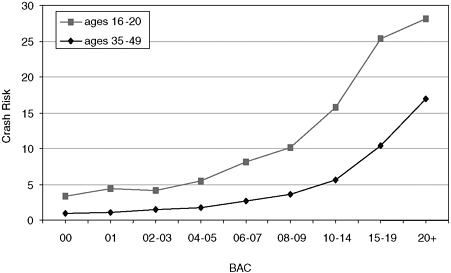
FIGURE 2-2 Crash risk by blood alcohol content (BAC).
SOURCE: Preusser (2006). Data drawn from Preusser (2002).
crashes in 2004 had a BAC of 0.08 or higher, and the percentage increased from 17 percent for 15-year-olds to 34 percent for 20-year-olds (National Highway Traffic Safety Administration, 2006b). Alcohol is much more likely to play a role in fatal crashes involving young men (26 percent) than young women (12 percent) in this age group. Crashes in which alcohol is involved tend to be more severe, and persons involved in alcohol-related crashes are less likely to be wearing seat belts. The National Highway Traffic Safety Administration (NHTSA) reports that raising the minimum legal age for drinking, which is now 21 in all states and the District of Columbia, has saved many lives—906 just in 2004. These laws are discussed more fully in Chapter 4.
Passengers
The risk of crashing is significantly elevated for teen drivers who have teenage passengers, particularly male passengers, in the car, as Anne McCartt and others made clear. Table 2-3 shows the association of passengers and the already elevated crash risk for teen drivers—the figures for 16-
TABLE 2-3 Crash Risk by Driving Alone or with Passengers, by Age of Driver
|
Driver Age |
Alone |
Passenger(s) |
|
16 |
2.28 |
4.72 |
|
17 |
1.77 |
3.52 |
|
18 |
1.77 |
3.66 |
|
19 |
1.61 |
3.23 |
|
20-24 |
1.50 |
2.54 |
|
25-29 |
1.28 |
1.69 |
|
30-59 |
1.00 |
1.00 |
|
SOURCE: Reprinted, with permission, from Preusser et al. (1998). Copyright 2003 by Elsevier. |
||
year-olds are particularly striking, showing a risk of 2.28 for drivers alone and 4.72 for drivers with any passengers, compared with 1.00 for drivers ages 30 to 59, with or without passengers. Additional data presented by McCartt (Table 2-4) demonstrate how the presence of multiple passengers seems to magnify the risk of crashes, whether they are caused by driver error, speeding, or alcohol consumption.
Bruce Simons-Morton offered support for the proposition that male teen passengers have a significantly larger impact on risky driving behaviors than do female passengers, although the reasons for this discrepancy are not clearly understood. Data from a study of teen driver behavior show how drivers with male passengers are likely to increase their speed and leave less distance between their own and other vehicles. Conversely, this same study indicates that the presence of female passengers frequently confers a protective effect for young drivers, both male and female.
Driving at Night
Although the majority of teen driver crashes occur during daylight hours (when teens are more likely to be on the road), fatal crash rates per miles driven are higher for teens driving at night than during the day. Nighttime conditions present significant challenges for all drivers, but the safety gap between night and day narrows significantly between age 16 and ages 30 to 40.
TABLE 2-4 Fatal Crash Characteristics, 16-Year-Old Driver Alone or with Teen Passengers (percentage)
|
|
Driver Alone |
1 Teen Passenger |
2 Teen Passengers |
3+ Teen Passengers |
|
Driver error |
72a |
82 |
83 |
90 |
|
Speeding |
30 |
45 |
50 |
59 |
|
Single vehicle |
36 |
51 |
59 |
72 |
|
0.08+ blood alcohol level |
9 |
8 |
10 |
12 |
|
aTotals may exceed 100% because crashes may involve more than one characteristic. SOURCE: Insurance Institute for Highway Safety. Unpublished analysis of 2004 data from the Fatality Analysis Reporting System, National Highway Traffic Safety Administration. |
||||
Fatigue
Teen drivers who lack adequate sleep are also at higher risk of crashing. Fatigue can interact with other risk factors (such as speed, alcohol, and inexperience), and its role is underreported in crash data because it is not readily apparent to investigators. As a result, its relative contribution is difficult to study. Sleep deprivation may also play a role in nighttime crashes, as discussed in Chapter 3.
COMMON TEEN DRIVING ERRORS
A look at the more immediate causes of young driver crashes, among both newly licensed and more experienced drivers, provided another perspective on what can go wrong. James McKnight distinguished between the physical skills involved in operating a vehicle, which are relatively easily mastered, and the more complex capacities that are also necessary for safe driving. Recognizing and correcting for errors and detecting hazards in the roadway are key elements of driving safely, for example, and acquiring these skills takes much longer than learning the mechanics of driving. Some of the principal errors that teenagers make while driving include failure to:
-
maintain attention and avoid distractions, including electronic devices in the car;
-
search ahead, such as before left turns;
-
search to the side, such as when yielding the right of way at an intersection;
-
search to the rear, such as when changing lanes;
-
adjust speed in response to traffic or road conditions;
-
maintain space between their own and other vehicles, such as correct following distance;
-
respond correctly to emergencies, such as recovering from a skid or sudden swerve;
-
maintain basic control of the vehicle, such as keeping within a lane, braking, and turning smoothly;
-
respond to traffic controls, such as traffic lights or guidance about lane use; and
-
avoid driving while impaired by alcohol or sleepiness or driving a vehicle that needs repair.
McKnight offered a simplified summary of what teens need to learn to become successful drivers: knowledge of the rules of the road, safe operating procedures, and the consequences of not adhering to them; understanding that what they know and do will affect their safety; and the skill to control the car, handle an emergency, and recognize potential hazards in time to avoid them. As the conversation turned to intervention strategies, participants repeatedly stressed that remedies need to address these three elements in realistic ways. However, the information about risk factors and teen driver error goes only so far in explaining teen crashes—it does not address the reasons why teens often lack the critical elements. Thus, the workshop also explored the nature of adolescents and the developmental processes that they experience—with an eye to identifying ways in which this deeper knowledge could be applied to the development of more effective educational programs and prevention strategies for teen drivers.


