
1
Earth Science: Scientific Discovery and Societal Applications
ENVISIONING WHAT IS POSSIBLE
Understanding the complex, changing planet on which we live, how it supports life, and how human activities affect its ability to do so in the future is one of the greatest intellectual challenges facing humanity. It is also one of the most important challenges for society as it seeks to achieve prosperity, health, and sustainability.
These declarations, first made in the interim report of the Committee on Earth Science and Applications from Space: A Community Assessment and Strategy for the Future (NRC, 2005, p. 1), are the foundation of the committee’s vision of a decadal program of Earth science research and applications in support of society—a vision that includes advances in fundamental understanding of Earth and increased application of this understanding to serve the nation and the people of the world. The declarations call for a renewal of the national commitment to a program of Earth observations from space in which attention to securing practical benefits for humankind plays an equal role with the quest to acquire new knowledge about Earth.
The interim report described how satellite observations have been critical to scientific efforts to understand Earth as a system of connected components, including the land, oceans, atmosphere, biosphere, and solid Earth. It also gave examples of how these observations have served the nation, helping to save lives and protect property, strengthening national security, and contributing to the growth of the economy1 through the provision of timely environmental information. However, the interim report also identified a substantial risk to the continued availability of these observations, warning that the nation’s system of environmental satellites was “at risk of collapse” (p. 2). Since the publication of the interim report, budgetary constraints and programmatic difficulties at NASA and NOAA have greatly exacerbated this risk (see the Preface). At a time of unprecedented need, the nation’s Earth observation satellite programs, once the envy of the world, are in disarray.
The precipitous decline in the nation’s present and planned research and operational Earth observation satellite programs has implications that extend from the vitality of the research and engineering pipeline to many aspects of the U.S. economy. Indeed, a greater scientific understanding of the coupled Earth system, and the translation of such understanding into useful information and predictions, are essential to protecting human society (Box 1.1) as well as to sustaining stewardship of the natural resources that are vital to economic growth and improved environmental quality. In a 2006 World Bank study, the authors argued that in addition to tracking physical and human capital as traditional sources of wealth, so, too, should exhaustible and renewable natural resources be measured, accounted for, and stewarded as a large and important source of a nation’s wealth (World Bank, 2006). That analysis showed that effective management of natural resources confers a quantitative economic edge—indeed making nations demonstratively wealthier.
The investments in Earth science and applications that are recommended in this report are needed to restore important capabilities that have been lost and to build the capacity for an Earth information system that will be increasingly important in the decades to come. Fundamental improvement is needed in the structure and function of the nation’s observation and information systems to inform policy choices about the economy and security, protect human health and property, and judiciously manage the resources of the planet. It is essential that such systems be viewed as important elements of a linked system, extending from Earth observations to provision of services at the federal, state, and local level, and in the private sector, to communities that have come to trust that such a system will be developed based on the best available scientific understanding and will provide critical information in a timely manner.
To achieve its vision of a decadal program of Earth science research and applications in support of society, the committee makes the following overarching recommendation:
Recommendation: The U.S. government, working in concert with the private sector, academe, the public, and its international partners, should renew its investment in Earth-observing systems and restore its leadership in Earth science and applications.
The objectives of these partnerships would be to facilitate needed improvements in the structure, connectivity, and effectiveness of Earth-observing capabilities, research, and associated information and application systems—not only to answer profound scientific questions, but also to apply new knowledge effectively in the pursuit of societal benefits.
In concert with these actions, the nation should execute a strong, intellectually driven Earth sciences program and an integrated in situ and space-based observing system. Improved understanding of the coupled Earth system and global observations of Earth are linked components that are the foundation of an effective Earth information system. Developing such a system will require an expanded observing system, which in turn is tied to a larger global observing system of the kind envisioned in the Global Earth Observation System of Systems (GEOSS), a program initiated by the United States.2 It will also require tools—such as computer models to assimilate the observations, extract useful information, and make predictions—and information technology to disseminate data to user communities. The mission component of the observation system is the primary focus of this report and is summarized in Chapter 2 and detailed in Part II.
|
2 |
More than 60 countries, the European Commission, and more than 40 international organizations are supporting a U.S.-led effort to develop a global Earth observation system. See, “47 Countries, European Commission Agree to Take Pulse of the Planet: Milestone Summit Launches Plan to Revolutionize Understanding of How Earth Works,” available at http://www.noaanews.noaa.gov/stories2004/s2214.htm. |
|
BOX 1.1 LESSONS LEARNED FROM KATRINA The earthquake and tsunami that devastated large swaths of coastal southern and eastern Asia on December 26, 2004, and the hurricanes that struck the Gulf Coast of the United States in 2005 are stark examples of the vulnerability of human society to natural disasters and of the importance of observations and warning systems. Hurricane Katrina, which resulted in the deaths of more than 2,000 people and is estimated to have caused some $125 billion in damage,1 was one of the worst disasters in U.S. history (Figure 1.1.1). Further, the financial costs of Katrina do not account for other costs to society, including the impacts on the families of survivors and the likely permanent loss of large swaths of New Orleans. The impact of natural disasters, and the need for observations that can improve predictions and warnings, will only grow as society becomes more complex and as populations and economic infrastructure increase in vulnerable geographical and ecological areas. Several important lessons are evident from the Katrina disaster. The committee notes that forecasts 3 days in advance of Hurricane Katrina’s landfall in the Gulf, which were based on mathematical models using space-and aircraft-based observations, proved highly accurate.The forecasts were heeded by most people in affected areas and likely saved thousands of lives. The accuracy of predictions of Katrina’s track demonstrates the power of using a large number of different observations of the Earth system in computer models to make accurate and life-saving forecasts. However, although the forecasts of the hurricane track were unusually accurate, forecasts of the magnitude and location of the storm surge were less so and indicate the need for enhanced research and better observations (NSB, 2006). Like the tsunami of December 2004, the tragic aftermath of Katrina illustrates the importance of having a response system in place to take full advantage of disaster warnings (Morin, 2005). 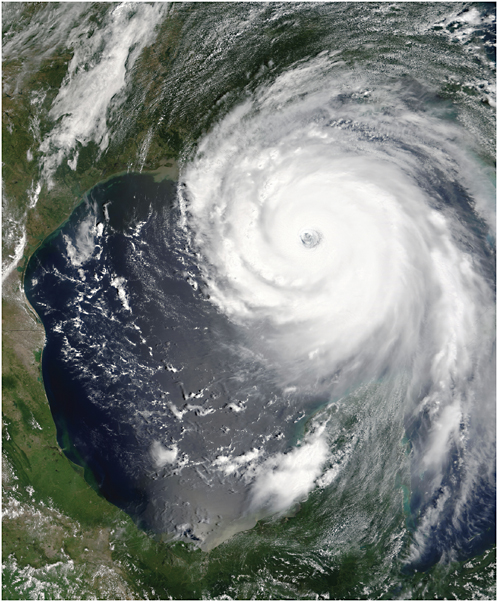
FIGURE 1.1.1 Hurricane Katrina at 1700 U.T.C., Sunday, August 28, 2006. Image from MODIS on NASA’s Terra spacecraft. SOURCE: NOAA, “Billion Dollar U.S. Weather Disasters,” available at http://www.ncdc.noaa.gov/oa/reports/billionz.html.
|
EARTH SYSTEM SCIENCE AND APPLICATIONS—BUILDING ON A SUCCESSFUL PARADIGM
We live today in what may appropriately be called the “Anthropocene”—a new geologic epoch in which humankind has emerged as a globally significant—and potentially intelligent—force capable of reshaping the face of the planet
—P.T. Crutzen
The development of Earth system science recognizes that changes in Earth result from complex interactions among its components—the atmosphere, hydrosphere, biosphere, and lithosphere—and human activities (Crutzen, 2002). Understanding the linkages, dependencies, and interactions among the components requires a systems approach3 to which the unique capabilities of space-based observations are proving essential. From these observations and understanding flow applications; for example, the demonstrated and substantial improvements in weather prediction are largely attributable to improved scientific understanding derived from the interpretation of satellite observations and their use in weather prediction models (Hollingsworth et al., 2005). Likewise, satellite observations have played a key role in:
-
The discovery, understanding, and monitoring of the depletion of stratospheric ozone;
-
Understanding the transport of air pollution between countries and continents;
-
Determining the rates of glacial and sea ice retreat;
-
Monitoring land-use change due to both human and natural causes;
-
Monitoring and understanding changing weather patterns due to land-use change and aerosols;
-
Determining changes in strain and stress through the earthquake cycle;
-
Understanding the global-scale effects of El Niño and La Niña on weather patterns and ocean productivity;
-
Forecasting the development of and tracking hurricanes, typhoons, and other severe storms; and
-
Assessing damage from natural disasters and targeting relief efforts.
Today the world is facing unprecedented environmental challenges: shortages of clean and accessible freshwater, degradation of terrestrial and aquatic ecosystems, increases in soil erosion, changes in the chemistry of the atmosphere, declines in fisheries, and the likelihood of significant changes in climate. These changes are occurring over and above the stresses imposed by the natural variability of a dynamic planet, as well as the effects of past and existing patterns of conflict, poverty, disease, and malnutrition. Further, these changes interact with each other and with natural variability in complex ways that cascade through the environment across local, regional, and global scales. Addressing the environmental challenges will not be possible without increased collaboration between Earth scientists and researchers in other disciplines—including the social, behavioral, and economic sciences—and policy experts.
It is necessary now to build on the paradigm of Earth system science and strengthen its dual role— science and applications. This duality has always been an element of Earth science, but it must be leveraged more effectively than in the past. Efforts to date have focused on building an understanding of how Earth functions as a system, and the benefits have been clear (Box 1.2). Today, however, only a limited portion of that knowledge is applied directly in the service of society.
|
3 |
The Earth system science concept emphasizes the study of Earth as an integrated system of atmosphere, ocean, and land, while bridging the traditional disciplines of physics, chemistry, and biology. The field of Earth science has matured from the point of understanding processes in ocean, land, and atmosphere components treated separately to studying their connections at global scales. See http://eospso.gsfc.nasa.gov/eos_homepage/for_educators/eos_edu_pack/p01.php and references therein. See also, “What Is Earth System Science?,” available at http://www.usra.edu/esse/essonline/whatis.html. |
|
BOX 1.2 ESTABLISHING THE GROUNDWORK FOR TODAY Beginning with the work of Lyell1 on the slow time scales of geologic change and continuing with the theories of Wegener2 and Hess3 on continental drift and seafloor spreading, Earth scientists have uncovered many of the mysteries of plate tectonics. De Bort’s4 discovery of a layered atmosphere and the calculations of Arrhenius5 and Milankovitch6 concerning CO2-induced warming and ice age cooling have made possible understanding of the basic workings of the atmosphere and mechanisms that determine Earth’s climate. These advances have enabled society to build the early foundation of understanding that has resulted in the ability to evaluate and plan for earthquake and volcanic hazards, forecast the weather, explain much about past climates, and begin to predict future climate change.
|
Understanding Earth as a living planet and applying that understanding to ensure society’s health, prosperity, safety, and sustainability will depend on establishing a robust, integrated, and flexible system of observations and models yielding information that can be applied to pressing short- and long-term needs. As the complexity and vulnerability of society increase, the value of Earth observations and information becomes greater than ever (Box 1.3). The pressing imperative for sustaining, strengthening, and extending current observational capabilities and other vital aspects of the Earth information system to meet growing socioeconomic needs and realize opportunities constitutes the motivation for this report and the rationale for its conclusions.
A fundamental challenge for the coming decade is to ensure that established societal needs help to guide scientific priorities more effectively and that emerging scientific knowledge is actively applied to obtain societal benefits. New observations and analyses, enhanced understanding and increasingly accurate predictive models, broadened community participation, and improved means for dissemination and use of information are all required. By taking up and meeting this challenge, society will begin to realize the full economic and security benefits that Earth science can help make possible. But wise actions will require information and understanding.
The new and needed Earth observations essential to that understanding are the subject of the next chapter.
|
BOX 1.3 AN ABUNDANCE OF CHALLENGES Improving Weather Forecasts Testing and systematically improving forecasts of weather with respect to meteorological, chemical, and radiative change places unprecedented demands on technical innovation, computational capacity, and developments in assimilation and modeling that are required for effective and timely decision and response structures. Weather forecasting has set in place the clearest and most effective example of the operational structure required, but future progress depends on a renewed emphasis on innovation and strategic investment in weather forecasting in its broader context. The United States has lost leadership to the Europeans in the international arena in an array of pivotal capabilities, such as medium-range weather forecasting. Without leadership in these and other forecasting capabilities, the United States stands to lose economic competitiveness. Protecting Against Solid-Earth Hazards Whether hazards such as earthquakes and tsunamis, volcanic eruptions, and landslides have consequences that are serious or are truly catastrophic depends on whether they have been anticipated and whether preparations have been made to mitigate their effects. Mitigation is expensive, available resources are limited, and decisions must be made about how to set priorities among these expenditures. At present, the solid-Earth science required for decision making is hampered by a lack of data—a situation perhaps analogous to trying to make reliable weather forecasts before global observations were available. Scientists know the total rates of deformation across fault systems but lack the information to determine reliably which faults are most likely to rupture, let alone when these ruptures will occur. Volcanic eruptions and landslides often have precursors, but the ability to detect and interpret these precursors is severely limited by a lack of observations. Ensuring Water Resources The nation’s water supply is of paramount importance to public health, stability, and security in the industrial and agricultural sectors and to prosperity in vast reaches of rural America. Yet the ability to obtain key observations, to test forecasts of intermediate and long-term change, and to establish a coherent protocol for adaptation to large variations that are intrinsic to the hydrologic cycle is inadequate. The western United States is the most rapidly developing region of the country and is also the most vulnerable in terms of water supply. According to statistics compiled by the USDA/NOAA-sponsored Drought Monitor, the past decade, the driest since the 1950s, has had the greatest impacts in Oklahoma, New Mexico, Texas, and Colorado. In addition, in early 2005, Lake Powell was at its lowest level since the reservoir was constructed in the 1960s. Why the drought has occurred, how long it will continue, and how future droughts might be affected by a warming climate are questions whose answers will have profound implications for both the United States and the world. Maintaining Healthy and Productive Oceans A warming ocean raises sea level, alters precipitation patterns, may cause stronger storms, and may accelerate the melting of sea ice and glaciers. The increased acidity of Earth’s oceans due to rising CO2 levels portends dramatic adverse impacts for ocean biological productivity. These changes will be critical for all, but for none more than those living in coastal regions. Over the last few decades a concerted effort to develop satellite measurements of the ocean has revolutionized understanding of ocean circulation, air-sea interaction, and ocean productivity. Just at the point that capabilities have been realized to make major contributions to climate predictions on times scales of seasons to decades and to monitor the changes in the ocean’s health, we are in danger of losing many ocean satellite observations because of programmatic failures or a lack of will to sustain the measurements. |
|
Mitigating Adverse Impacts of Climate Change It is now well understood that changes in the physical climate system over the last century have been driven in large part by human activities and that the human influence on climate is increasing. Future climate changes may be much more dramatic and dangerous. For example, rising sea levels will increase coastal flooding during storms, which may become more intense. Effective mitigation of dangerous future climate change and adaptation to changes that are certain to occur even with mitigation efforts require knowledge of how the climate is changing and why. But there is no well-developed climate-monitoring system, and fundamental changes are needed in the U.S. climate observing program. The United States does not have, nor are there clear plans to develop, a long-term global benchmark record of critical climate variables that are accurate over very long time periods, can be tested for systematic errors by future generations, are unaffected by interruption, and are pinned to international standards. Difficult climate research questions also remain, for example, the cloud-water feedback in climate models. Another example concerns the geographic distribution of the land and ocean sources and sinks of carbon dioxide, which do not simply map with geography, but rather display complex patterns and interactions. As nations seek to develop strategies to manage their carbon emissions and sequestration, the capacity to quantify the present-day regional carbon sources and sinks does not exist. Protecting Ecosystems Nearly half of the land surface has been transformed by direct human action, with significant consequences for biodiversity, nutrient cycling, soil structure and biology, and climate. The beneficial effects of these transformations—additions to the food supply, improved quality of human habitat and in some cases ecosystem management, large-scale transportation networks, and increases in the efficiency of movement of goods and services—have also been accompanied by deleterious effects. Morethan one-fifth of terrestrial ecosystems have been converted into permanent croplands, more than one-quarter of the world’s forests have been cleared, wetlands have shrunk by one-half, and most of the temperate old-growth forest has been cut. More nitrogen is now fixed synthetically and applied as fertilizers in agriculture than is fixed naturally in all terrestrial ecosystems, and far too much of this nitrogen runs off the ground and ends up in the coastal zone. Coastal habitats are also being dramatically altered; for example, 50 percent of the world’s mangrove forests, important tropical coastal habitats at the interface between land and sea, and coastal buffers of wave action, have been removed (Granek, 2005). That the world’s marine fisheries are either overexploited or, for some fish, already depleted is well known; one recent study even suggests the potential for their total collapse by the middle of this century (Worm et al., 2006). And yet there are no adequate spatially resolved estimates of the planet’s biomass and primary production, and it is not known how they are changing and interacting with climate variability and change. Improving Human Health Environmental factors have strong influences on a broad array of human health effects,including infectious diseases, skin cancers, or chronic and acute illnesses resulting from contamination of air, food, and water. Public health decision making has benefited from the continued availability of satellite-derived data on land use, land cover, oceans, weather, climate, and atmospheric pollutants. However, the stresses of global environmental change and growing rates of resource consumption now spur greater demands for collection and analyses of data that describe how environmental factors are related to patterns of morbidity and mortality. Further improvements in the application of remote sensing technologies will allow better understanding of disease risk and prediction of disease outbreaks, more rapid detection of environmental changes that affect human health, identification of spatial variability in environmental health risk, targeted interventions to reduce vulnerability to health risks, and enhanced knowledge of human health-environment interactions. |
REFERENCES
Crutzen, P.J. 2002. The Anthropocene: Geology of mankind. Nature 415:23.
Granek, E. 2005. Effects of mangrove removal on algal growth: Biotic and abiotic changes with potential implications for adjacent coral patch reefs. Abstract, Contributed Oral Session 83: Human Impacts on Coastal Areas, 90th Annual Meeting of the Ecological Society of America (ESA), August 7–12, 2005, Montreal, Canada. ESA, Washington, D.C.
Hollingsworth, A., S. Uppala, E.Klinker, D.Burridge, F.Vitart, J.Onvlee, J.W.De Vries, A.De Roo, and C.Pfrang. 2005. The transformation of Earth-system observations into information of socio-economic value in GEOSS. Q.J.R. Meteorol. Soc. 131:3493–3512.
Morin, P. 2005. Remote sensing and Hurricane Katrina relief efforts. EOS 86(40):367.
NRC (National Research Council). 2003. Satellite Observations of the Earth’s Environment: Accelerating the Transition of Research to Operations. The National Academies Press, Washington, D.C.
NRC. 2005. Earth Science and Applications from Space: Urgent Needs and Opportunities to Serve the Nation. The National Academies Press, Washington, D.C.
NSB (National Science Board). 2006. Hurricane Warning: The Critical Need for a National Hurricane Research Initiative. NSB-06– 104. National Science Foundation, Arlington, Va. Sept. 29.
World Bank. 2006. Where Is the Wealth of Nations? Measuring Capital for the 21st Century. The World Bank, Washington, D.C. Available at http://www.usra.edu/esse/essonline/whatis.html.
Worm, B., E.B.Barbier, N.Beaumont, J.E.Duffy, C.Folke, B.S.Halpern, J.B.C.Jackson, H.K.Lotze, F.Micheli, S.R.Palumbi, E.Sala, K.A.Selkoe, J.J.Stachowicz, and R.Watson. 2006. Impacts of biodiversity loss on ocean ecosystem services. Science 314(3):787–790.


