
Part II
Mission Summaries
In Chapter 2, the committee describes the observational portion of a strategy for obtaining an integrated set of space-based measurements in the decade 2010-2020. The 171 missions listed in Tables 11.1 and II.2 form the centerpiece of this strategy. In Part II—Chapter 4—the committee summarizes in alphabetical order the 17 recommended missions, providing a more detailed discussion of each. Each mission summary also contains references to the particular sections in the panel reports in Part III (Chapters 5-11) in which the missions are discussed, as well as index numbers that point to related responses to the committee's request for information.2
|
1 |
Note that CLARREO is listed twice because its instruments are recommended for support by both NASA and NOAA. |
|
2 |
The request for information is reprinted in Appendix D. A complete index to the responses is provided in Appendix E. Full-text versions of the responses are included on the compact disk that contains this report. |
TABLE II.1 Launch, Orbit, and Instrument Specifications for Missions Recommended to NOAA
|
Decadal Survey Mission |
Mission Description |
Orbita |
Instruments |
Rough Cost Estimate (FY 06 $million) |
|
2010–2013 |
|
|
|
|
|
CLARREO (instrument reflight components) |
Solar and Earth radiation characteristics for understanding climate forcing |
LEO, SSO |
Broadband radiometer |
65 |
|
GPSRO |
High-accuracy, all-weather temperature, water vapor, and electron density profiles for weather, climate,and space weather |
LEO |
GPS receiver |
150 |
|
2013–2016 |
|
|
|
|
|
XOVWM |
Sea-surface wind vectors for weather and ocean ecosystems |
LEO, SSO |
Backscatter radar |
350 |
|
NOTE: Missions are listed by cost. Colors denote mission cost categories as estimated by the committee. Green and blue shading indicates medium-cost ($300 million to $600 million) and small-cost (<$300 million) missions, respectively. The missions are described in detail in Part II, and Part III provides the foundation for selection. aLEO, low Earth orbit; SSO, Sun-synchronous orbit. |
||||
TABLE II.2 Launch, Orbit, and Instrument Specifications for Missions Recommended to NASA
|
Decadal Survey Mission |
Mission Description |
Orbita |
Instruments |
Rough Cost Estimate (FY 06 $million) |
|
2010–2013 |
|
|
|
|
|
CLARREO (NASA portion) |
Solar and Earth radiation; spectrally resolved forcing and response of the climate system |
LEO, Precessing |
Absolute, spectrally resolved interferometer |
200 |
|
SMAP |
Soil moisture and freeze-thaw for weather and water cycle processes |
LEO, SSO |
L-band radar L-band radiometer |
300 |
|
ICESat-II |
Ice sheet height changes for climate change diagnosis |
LEO, Non-SSO |
Laser altimeter |
300 |
|
DESDynl |
Surface and ice sheet deformation for understanding natural hazards and climate; vegetation structure for ecosystem health |
LEO, SSO |
L-band InSAR Laser altimeter |
700 |
|
2013–2016 |
|
|
|
|
|
HyspIRI |
Land surface composition for agriculture and mineral characterization; vegetation types for ecosystem health |
LEO, SSO |
Hyperspectral spectrometer |
300 |
|
ASCENDS |
Day/night, all-latitude, all-season CO2 column integrals for climate emissions |
LEO, SSO |
Multifrequency laser |
400 |
|
SWOT |
Ocean, lake, and river water levels for ocean and inland water dynamics |
LEO, SSO |
Ka- or Ku-band radar Ku-band altimeter Microwave radiometer |
450 |
|
GEO-CAPE |
Atmospheric gas columns for air quality forecasts;ocean color for coastal ecosystem health and climate emissions |
GEO |
High-spatial-resolution hyperspectral spectrometer Low-spatial-resolution imaging spectrometer IR correlation radiometer |
550 |
|
ACE |
Aerosol and cloud profiles for climate and water cycle; ocean color for open ocean biogeochemistry |
LEO, SSO |
Backscatter lidar Multiangle polarimeter Doppler radar |
800 |
|
2016–2020 |
|
|
|
|
|
LIST |
Land surface topography for landslide hazards and water runoff |
LEO, SSO |
Laser altimeter |
300 |
|
PATH |
High-frequency, all-weather temperature and humidity soundings for weather forecasting and sea-surface temperatureb |
GEO |
Microwave array spectrometer |
450 |
|
GRACE-II |
High-temporal-resolution gravity fields for tracking large-scale water movement |
LEO, SSO |
Microwave or laser ranging system |
450 |
|
SCLP |
Snow accumulation for freshwater availability |
LEO, SSO |
Ku- and X-band radars K- and Ka-band radiometers |
500 |
|
GACM |
Ozone and related gases for intercontinental air quality and stratospheric ozone layer prediction |
LEO, SSO |
UV spectrometer IR spectrometer Microwave limb sounder |
600 |
|
3D-Winds (Demo) |
Tropospheric winds for weather forecasting and pollution transport |
LEO, SSO |
Doppler lidar |
650 |
|
NOTE: Missions are listed by cost. Colors denote mission cost categories as estimated by the committee. Pink, green, and blue shading indicates large-cost ($600 million to $900 million), medium-cost ($300 million to $600 million), and small-cost (<$300 million) missions, respectively. Detailed descriptions of the missions are given in Part II, and Part III provides the foundation for their selection. aLEO, low Earth orbit; SSO, Sun-synchronous orbit; GEO, geostationary Earth orbit. bCloud-independent, high-temporal-resolution, lower-accuracy sea-surface temperature measurement to complement, not replace, global operational high-accuracy sea-surface temperature measurement. |
||||
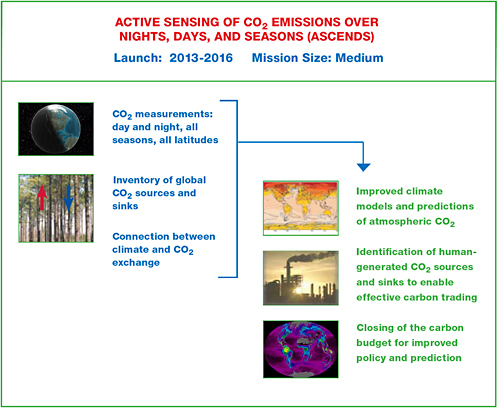
ACTIVE SENSING OF CO2EMISSIONS OVER NIGHTS, DAYS, AND SEASONS (ASCENDS) MISSION
The primary human activities contributing to the nearly 40 percent rise in atmospheric CO2 since the middle of the 20th century are fossil-fuel combustion and land-use change, primarily the clearing of forests for agricultural land. More than 50 percent of the CO2 from fossil-fuel combustion and land-use change has remained in the atmosphere; land and oceans have sequestered the nonairborne fraction in roughly equal proportions. However, the balance between land and oceans varies in time and space. The current state of the science cannot account with confidence for the growth rate and interannual variations of atmospheric CO2. The variability in the rate of increase in the concentration of CO2 in the atmosphere cannot be explained by the variability in fossil-fuel use; rather, it appears to reflect primarily changes in terrestrial ecosystems that are connected with large-scale weather and climate modes. The overall pattern is important and is not understood. The geographic distribution of the land and ocean sources and sinks of CO2 has likewise remained elusive, an uncertainty that is also important. As nations seek to develop
strategies to manage their carbon emissions and sequestration, the capacity to quantify current regional carbon sources and sinks and to understand the underlying mechanisms is central to prediction of future levels of CO2 and therefore to informed policy decisions, sequestration monitoring, and carbon trading (Dilling et al., 2003; IGBP, 2003; CCSP, 2003, 2004).
Background: Direct oceanic and terrestrial measurements of carbon and of the flux of CO2 are important but are resource-intensive and hence sparse and are difficult to extrapolate in space and time. Space-based measurements of primary production and biomass are valuable and needed, and the problem of source-sink determination of CO2 will be aided greatly by such measurements and studies, but it will not be resolved by this approach. There is, however, a different complementary approach. The atmosphere is a fast but incomplete mixer and integrator of spatially and temporally varying surface fluxes, and so the geographic distribution (such as spatial gradient) and temporal evolution of CO2 in the atmosphere can be used to quantify surface fluxes (Tans et al., 1990; Plummer et al., 2005). The current set of direct in situ atmospheric observations is far too sparse for this determination; however, long-term accurate measurements of atmospheric CO2 columns with global coverage would allow the determination and localization of CO2 fluxes in time and space (Baker et al., 2006; Crisp et al., 2004). What is needed for space-based measurements is a highly precise global data set for atmospheric CO2-column measurements without seasonal, latitudinal, or diurnal bias, and it is possible with current technology to acquire such a data set with a sensor that uses multiwavelength laser-absorption spectroscopy.
The first step in inferring ecosystem processes from atmospheric data is to separate photosynthesis and respiration; this requires diurnal sampling to observe nighttime concentrations resulting from respiration. Analyses of flux data show that there is a vast difference in the process information obtained from one measurement per day versus two (i.e., one measurement per day plus one per night), with a much smaller gain attributable to many observations per day (Sacks et al., 2007). It is also essential to separate physiological fluxes from biomass burning and fossil-fuel use, a distinction that requires simultaneous measurement of an additional tracer, ideally carbon monoxide (CO).
A laser-based CO2 mission—the logical next step after the launch of NASA’s Orbiting Carbon Observatory (OCO),1 which uses reflected sunlight—will benefit directly from the data-assimilation procedures and calibration and validation infrastructure that will handle OCO data. In addition, because it will be important to overlap the new measurements with those made by OCO, the ASCENDS mission should be launched in the 2013–2016 time frame at the latest.
Science Objectives: The goal of the ASCENDS mission is to enhance understanding of the role of CO2 in the global carbon cycle. The three science objectives are to (1) quantify global spatial distribution of atmospheric CO2 on scales of weather models in the 2010–2020 era, (2) quantify current global spatial distribution of terrestrial and oceanic sources and sinks of CO2 on 1-degree grids at weekly resolution; and (3) provide a scientific basis for future projections of CO2 sources and sinks through data-driven enhancements of Earth-system process modeling.
Mission and Payload: The ASCENDS mission consists of simultaneous laser remote sensing of CO2 and O2, which is needed to convert CO2 concentrations to mixing ratios. The mixing ratio needs to be measured to a precision of 0.5 percent of background (slightly less than 2 ppm) at 100-km horizontal length scale over land and at 200-km scale over open oceans. Such a mission can provide full seasonal sampling to
|
1 |
The Orbiting Carbon Observatory (OCO) is a NASA Earth System Science Pathfinder (ESSP) project mission designed to make precise, time-dependent global measurements of atmospheric CO2 from an Earth-orbiting satellite. OCO should begin operations in 2009. See description at http://oco.jpl.nasa.gov/. |
high latitudes, day-night sampling, and some ability to resolve (or weight) the altitude distribution of the CO2-column measurement, particularly across the middle to lower troposphere. CO2 lines are available in the 1.57- and 2.06-µm bands, which minimize the effects of temperature errors. Lines near 1.57 µm are identified as potential candidates because of their relative insensitivity to temperature errors, relative freedom from interfering water-vapor bands, good weighting functions for column measurements across the lower troposphere, and the high technology readiness of lasers. To further reduce residual temperature errors in the CO2 measurement, a concurrent passive measurement of temperature along the satellite ground track with an accuracy of better than 2 K is required. Atmospheric pressure and density effects on deriving the mixing ratio of CO2 columns can be addressed with a combination of simultaneous CO2 and O2 column density measurements at the surface or cloud tops, or possibly with surface-cloud-top altimetry measurements from a lidar in conjunction with advanced meteorological analysis for determining the atmospheric-pressure profile across the measured CO2 density column. The concurrent on-board O2 measurements are preferred and can be based on measurements that use an O2 absorption line in the 0.76- or 1.27-µm band. The mission requires a Sun-synchronous polar orbit at an altitude of about 450 km and with a lifetime of at least 3 years. The mission does not have strict requirements for specific temporal revisit or map revisit times, because the data will be assimilated on each pass and the large-scale nature of the surface sources and sinks will emerge from the geographic gradients of the column integrals. The important coverage is day and night measurements at nearly all latitudes and surfaces to separate the effects of photosynthesis and respiration. The maximal power required would be about 500 W, with a 100 percent duty cycle. Swath size would be about 200 m.
Ideally, a CO sensor should complement the lidar CO2 measurement. The two measurements are highly synergistic and should be coordinated for time and space sampling, with the minimal requirement that the two experiments be launched close together in time to sample the same area.
Cost: About $400 million.
Schedule: ASCENDS should be launched to overlap with OCO and hence in the 2013–2016 (the middle) time frame. Technology development must include extensive aircraft flights demonstrating not only the CO2 measurement in a variety of surface and atmospheric conditions but also the O2-based pressure measurement.
Further Discussion: See in Chapter 7 the section “Carbon Budget Mission (CO2 and CO).”
Related Responses to Committee’s RFI: 4 and 20.
References:
Baker, D.F., S.Doney, and D.S.Schimel. 2006. Variational data assimilation for atmospheric CO2. Tellus B 58(5):359–365.
CCSP (Climate Change Science Program). 2003. Strategic Plan for the U.S. Climate Change Science Program. Final report by the Climate Change Science Program and the Subcommittee on Global Change Research, Washington, D.C., July, 202 pp., available at http://www.climatescience.gov/Library/stratplan2003/final/ccspstratplan2003.
CCSP. 2004. Our Changing Planet: The U.S. Climate Change Science Program for Fiscal Years 2004 and 2005. A Supplement to the President’s Fiscal Year 2004 and 2005 Budgets, Washington, D.C., August, available at http://www.usgcrp.gov/usgcrp/Library/ocp2004–5/ocp2004–5.pdf.
Crisp, D., R.M.Atlas, F.M.Breon, L.R.Brown, J.P.Burrows, P.Ciais, B.J.Connor, S.C.Doney, I.Y.Fung, D.J.Jacob, C.E.Miller, D.O’Brien, S.Pawson, J.T.Randerson, P.Rayner, R.J.Salawitch, S.P.Sander, B.Sen, G.L.Stephens, P.P.Tans, G.C.Toon, P.O.Wennberg, S.C.Wofsy, Y.L.Yung, Z.Kuang, B.Chudasama, G.Sprague, B.Weiss, R.Pollock, D.Kenyon, and S.Schroll. 2004. The Orbiting Carbon Observatory (OCO) Mission. Adv. Space Res. 34(4):700–709.
Dilling L., S.C.Doney, J.Edmonds, K.R.Gurney, R.Harriss, D.Schimel, B.Stephens, and G.Stokes. 2003. The role of carbon cycle observations and knowledge in carbon management. Annu. Rev. Env. Resour. 28:521–558.
IGBP (International Geosphere-Biosphere Programme). 2003. Integrated Global Carbon Observation Theme: A Strategy to Realize a Coordinated System of Integrated Global Carbon Cycle Observations. Integrated Global Carbon Observing Strategy (IGOS) Carbon Theme Report. Available at http://www.igospartners.org/Carbon.htm.
Plummer, S., P.Rayner, M.Raupach, P.Ciais, and R.Dargaville. 2005. Monitoring carbon from space. EOS Trans. AGU 86(41):384– 385.
Sacks, W., D.Schimel, and R.Monson. 2007. Coupling between carbon cycling and climate in a high-elevation, subalpine forest: A model-data fusion analysis. Oecologia 151(1):54–68, doi:10.1007/s00442–006–0565–2.
Tans, P.P., I.Y.Fung, and T.Takahashi. 1990. Observational constraints on the global atmospheric CO2 budget. Science 247(4949):1431–1438.
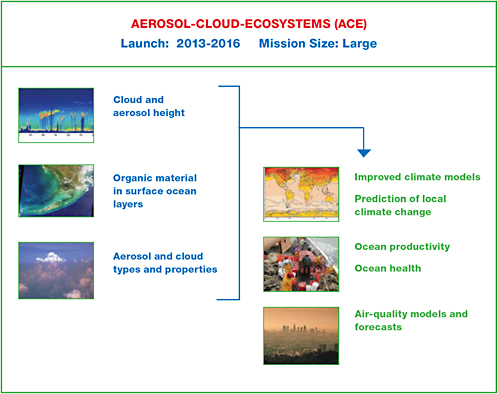
AEROSOL-CLOUD-ECOSYSTEMS (ACE) MISSION
The primary goal of the Aerosol-Cloud-Ecosystems (ACE) mission is to reduce uncertainty about climate forcing in aerosol-cloud interactions and ocean ecosystem carbon dioxide (CO2) uptake. Aerosol-cloud interaction is the largest uncertainty in current climate models. Aerosols can make clouds brighter and affect their formation. Aerosols can also affect cloud precipitation and have been linked to decreased rainfall in the Mediterranean. Results from the ACE mission would narrow the uncertainty in climate predictions and improve the capability of models to provide more precise predictions of local climate change, including changes in rainfall. ACE aerosol measurements could also be assimilated into air-quality models to improve air-quality forecasts. Ocean ecosystem measurements would provide information on uptake of CO2 by phytoplankton and improve estimates of the ocean CO2 sink. As CO2 increases, the oceans will acidify, and this will affect the whole food chain, including coral-reef formation. The ACE mission could assess changes in the productivity of pelagic fishing zones and provide for early detection of harmful algal blooms. Benefits of the mission would include enabling the development of strategies for adaptation to climate change, evaluation of the consequences of increases in greenhouse gases, enabling of improved
public health through early warning of pollution events, and evaluation of effects of climate change on ocean ecosystems and food production.
Background: The largest uncertainties in global climate change prediction involve the role of aerosols and clouds in Earth’s radiation budget and the effect of aerosols on the hydrological cycle. Aerosol climate forcing is similar in magnitude to CO2 forcing, but the uncertainty is five times larger—an assessment that has not changed from those in earlier Intergovernmental Panel on Climate Change reports. Among the reasons for the uncertainty are that aerosols have a short lifetime in the atmosphere and not all aerosols are alike. Aerosols also have a large effect on cloud formation (the indirect effect) and brightness, and this amplifies their importance in the climate system. Aerosols and the clouds they affect tend to increase reflected solar radiation. Aerosols have probably masked some of the temperature rise associated with global warming. Both the NASA A-Train mission set and the planned ESA EarthCARE mission will provide early information on this problem. ACE is expected to provide many more data and data of much higher quality than those predecessor missions. Higher-quality data are needed to reduce uncertainty about cloud-aerosol interaction among the various types of aerosols and thus improve climate prediction models. ACE aerosol measurements would be NASA’s specific contribution to an overall integrated aerosol-measurement plan as envisioned in PARAGON (Diner et al., 2004). The need for an advanced aerosol-cloud mission has also been identified in a series of community workshops conducted by NASA during 2005 and 2006.
ACE would also be able to make next-generation pelagic ocean ecosystem measurements with the same set of instruments. The ocean is a rapid processor of carbon and poses a major uncertainty in global carbon flux. The estimated carbon uptake through the ocean ecosystem is about as large as the total uncertainty in the carbon budget, and recent estimates from O2:N2 flux ratios suggest that the current estimates may be much more uncertain than previously believed. Carbon uptake by the ocean is influenced by climate change through changes in wind stress and salinity that produce a concomitant response in zones of upwelling, mixed-layer depth, aeolian fertilization, marine ecosystems, and the export of carbon to marine depths.2 Still uncertain is the global effect of ocean acidification as dissolved CO2 content in ocean water continues to increase.
Science Objectives: The scientific goal of the ACE mission is to reduce the uncertainty in climate forcing through the two distinct processes described above. The first objective is to better constrain aerosol-cloud interaction by simultaneous measurement of aerosol and cloud properties with radar, lidar, a polarimeter, and a multiwavelength imager. This multi-instrument payload is needed because aerosols can either enhance or suppress cloud formation, depending on the aerosol type, and aerosol loading can reduce precipitation over continent-wide areas. Because aerosols can be transported over long distances, space-based assessment combined with ground-based measurement is the most scientifically sound and cost-effective approach to quantitatively estimating the effect of aerosols on clouds. The second objective is to estimate carbon uptake by ocean ecosystems through global measurements of organic material in the surface ocean layers. The oceans are an important sink for atmospheric CO2 and are acidifying as a result of CO2 uptake. Better estimation of the uptake of carbon and the change in the ocean food chain requires improved measurements of organic carbon with multispectral measurement of “ocean color.” The ocean is a dark surface (except at the sun-glint), and aerosols that reflect solar radiation interfere with ocean-color measurement, so it is appropriate to measure aerosols simultaneously with ocean color. The two objectives of aerosol and ocean-color measurements are thus highly synergistic.
Mission and Payload: To avoid the sun-glint but take maximal advantage of the reflected solar radiation, ACE would fly in a low-Earth, Sun-synchronous, early-afternoon orbit. The orbit altitude of 500–650 km will allow sufficient orbit lifetime but is close enough to the surface that active-sensor power requirements are not so high as to limit mission lifetime. The notional mission consists of four instruments: a multibeam cross-track dual-wavelength lidar for measurement of cloud and aerosol heights and layer thickness; a cross-track scanning cloud radar with channels at 94 GHz and possibly 34 GHz for measurement of cloud droplet size, glaciation height, and cloud height; a highly accurate multiangle, multiwavelength polarimeter that would measure cloud and aerosol properties, and that, unlike the aerosol polarimetry sensor on Glory, would have a cross-track and along-track swath with a pixel size of about 1 km; and a multiband cross-track visible-UV spectrometer with a pixel size of about 1 km, which would include Aqua MODIS, NPOESS Preparatory Project (NPP) VIIRS, and Aura OMI aerosol-retrieval bands and additional bands for ocean color and dissolved organic matter. Additional use of the lidar for canopy height should be studied.
The core aerosol sensors—the polarimeter and the lidar—provide data on aerosol properties and height. Additional information on aerosols comes from the UV channels of the multiband spectrometer. To determine effects on clouds, the cloud radar would measure droplet size, altitude of glaciation, and estimated total cloud water. The radar, lidar, and polarimeter are the primary cloud sensors; the polarimeter can also determine cloud droplet size. The primary ocean-color sensor is the multiband spectrometer, which has channels sensitive for chlorophyll absorption and dissolved organic matter. The UV bands in the spectrometer can also be used to determine aerosol type and allow for aerosol retrieval over bright surfaces. Aerosol information needed for ocean-color retrieval is derived from the polarimeter and lidar.
Mission Cost: About $800 million.
Schedule: All the instruments have some space heritage. Incremental technology development in lidar, radar, and polarimetry is needed to extend the capabilities for multibeam and cross-track measurements. Technology development is expected to support this mission by 2015–2016 or earlier.
Further Discussion: See in Chapter 9 the sections “Climate Mission 1: Clouds, Aerosols, and Ice Mission (with Proposed Carbon Cycle Augmentation),” “Trace Gases and Aerosols,” and “Stratosphere-Troposphere Exchange (STE)”; in Chapter 10 the sections “A Cross-disciplinary Aerosol-Cloud Discovery Mission,” “Comprehensive Tropospheric Aerosol Characterization Mission,” and Table 10.2; and in Chapter 7 the section “Global Ocean Productivity Mission.”
Related Responses to Committee’s RFI: 7, 21, 45, 66, 81, 86, 88, 97, 102, and 110.
Reference:
Diner, D.J., T.P.Ackerman, T.L.Anderson, J.Bosenberg, A.J.Braverman, R.J.Charlson, W.D.Collins, R.Davies, B.N.Holben, C.A.Hostetler, R.A.Kahn, J.V.Martonchik, R.T.Menzies, M.A.Miller, J.A.Ogren, J.E.Penner, P.J.Rasch, S.E.Schwartz, J.H. Seinfeld, G.L.Stephens, O.Torres, L.D.Travis, B.A.Wielicki, and B.Yu. 2004. PARAGON: An integrated approach for characterizing aerosol climate impacts and environmental interactions. Bull. Amer. Meteorol. Soc. 85:1491–1501, doi:10.1175/ BAMS-85–10–1491.
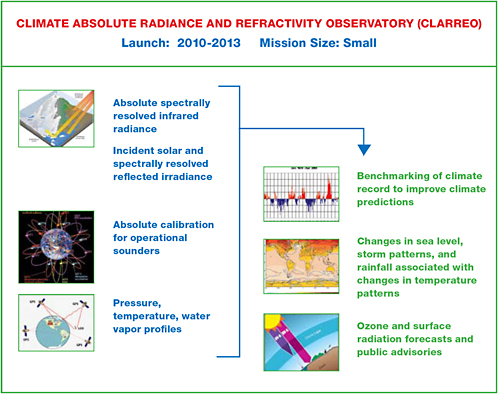
CLIMATE ABSOLUTE RADIANCE AND REFRACTIVITY OBSERVATORY (CLARREO) MISSION
Decision support for vital choices regarding water resources, human health, natural resources, energy management, ozone depletion, civilian and military communication, insurance infrastructure, fisheries, and international negotiations is necessarily linked to an understanding of climate. Effectively addressing each of these societal concerns depends on accurate climate records and credible long-term climate forecasts. Development of climate forecasts that are tested and trusted requires a chain of strategic decisions to establish fundamentally improved climate observations that are suitable for the direct testing and systematic improvement of long-term forecasts. That strategy sets the foundation of CLARREO.
CLARREO addresses three key societal objectives: (1) provision of a benchmark climate record that is global, accurate in perpetuity, tested against independent strategies that reveal systematic errors, and pinned to international standards; (2) development of a trusted, tested operational climate forecast through a disciplined strategy using state-of-the-art observations with mathematically rigorous techniques to establish credibility; and (3) disciplined decision structures that assimilate accurate data and forecasts into intelligible and specific products that promote international commerce and societal stability and security.
Background: Climate is affected by the long-term balance between the solar irradiance absorbed by the Earth-ocean-atmosphere system and the IR radiation exchanged within that system and emitted to space. Thus, key observations include incident and reflected solar irradiance and the spectrally resolved IR radiance emitted to space that carries the spectral signature of IR climate forcing and the resulting response of that climate system. Given the recognized imperative to develop long-term, high-accuracy time series with global coverage of critical climate variables, CLARREO addresses the objective of establishing global, highly accurate, long-term climate records that are tied to international standards maintained in the United States by the National Institute of Standards and Technology (NIST). In addition, to achieve societal objectives that require a long-term climate record, it is essential that the accuracy of the core benchmark observations be verified against absolute standards on-orbit by fundamentally independent methods.
Science Objectives: Four elements constitute the CLARREO science strategy:
-
Absolute spectrally resolved IR radiance is measured with high accuracy (0.1 K 3σ brightness temperature) by downward-directed spectrometers in Earth orbit. Both the radiative forcing of the atmosphere resulting from greenhouse-gas emissions and aerosols and the response of the atmospheric variables are clearly observable in the spectrally resolved signal of the outgoing radiance. Similarly, large differences among model projections of temperature, water vapor, and cloud distributions imply, for each model, different predicted changes in absolute, spectrally resolved radiation. The spectrum of IR radiance, if observed accurately and over the full thermal band, carries decisive diagnostic signatures in frequency, spatial distribution, and time.
-
Solar radiation, reflected from the Earth-atmosphere system back to space, constitutes a powerful and highly variable forcing of the climate system through changes in snow cover, sea ice, land use, and aerosol and cloud properties. Systematic, spatially resolved observations of the time series of the absolute spectrally resolved flux of near-ultraviolet, visible, and near-IR radiation returned to space by the Earth system tied to NIST standards in perpetuity underpin a credible climate record of the changing Earth system. In combination with establishment of the absolute spectrally resolved solar irradiance reflected from the Earth-atmosphere system to space, it is essential to continue the long-term, high-accuracy time series of incident solar irradiance.
-
Global Navigation Satellite System (GNSS) radio occultation offers an ideal method for benchmarking the climate system because much of the infrastructure for this active limb-sounding technique already exists, or soon will, in the form of the U.S. Global Positioning System (GPS) and the European Galileo satellites; because orbiting GNSS receivers are comparatively inexpensive; and because the technique is a measurement of frequency shift against a time standard and is thus directly traceable to international standards. GNSS radio occultation profiles the refractive properties of the atmosphere by observing the timing delay of GNSS signals induced by the atmosphere as the ray descends into the atmosphere in a limb-sounding geometry. The index of refraction is directly related to pressure, temperature, and watervapor concentration in such a way that the refractive index can be easily simulated from model output. Moreover, both GNSS and absolute, spectrally resolved radiance in the thermal IR are accurate to 0.1 K traceable to SI (Systeme Internationale) standards on-orbit and therefore represent independent, absolute records that, for the first time, allow the determination of systematic error in the climate record.
-
CLARREO would serve as a high-accuracy calibration standard for use by the broadband CERES instruments on-orbit. In addition, the suite of IR operational sounders launched on NPP and NPOESS could use CLARREO to establish SI-traceable accuracy on-orbit, establish an independent analysis of time-dependent bias in calibrated radiance, and form a basis for intercomparison of all operational sounders now and in the future.
Mission and Payload: CLARREO requires three small satellites, each of which requires a specific orbit and includes an occultation GNSS receiver. In the first category of climate benchmark radiance measurements, two of the satellites contain redundant interferometers that have a spectral resolution of 1 cm−1 and encompass the thermal infrared from 200 to 2,000 cm−1, are in true 90° polar orbits to provide a full scan of the diurnal harmonics and high-latitude coverage from low Earth orbit (750 km), and have an internal scene selection that includes redundant blackbodies with programmable temperatures and an external scene selection that includes deep-space viewing for radiance zeroing and nadir viewing with a 100-km footprint for Earth observations. Each satellite is gravity-gradient stabilized without additional pointing and has a separation of 60° in orbital planes. This mission requires an SI-traceable standard for absolute radiance. Each of the interferometers carries, on-orbit, phase-transition cells for absolute temperature, high-aspect-ratio blackbodies with direct surface-emissivity measurements in the blackbodies, detector linearity, polarization and stray light diagnostics, and so on, such that the key climate observations are obtained globally from space with SI traceability to absolute standards on-orbit.
In the second category of benchmark radiance measurements, the third satellite carries the IR benchmark instruments deployed in the first category but with the addition of redundant interferometers that have a spectral resolution of 15 nm, and it encompasses the near UV, visible, and near IR from 300 to 2,000 nm. The satellite is in a true 90° polar, low Earth orbit with an orbital plane 60° from that of the first two IR satellites. The mission also requires an SI-traceable standard for absolute radiance—but in the near UV, visible, and near IR—and uses continuing work at NIST that has substantially improved the accuracy (absolute) of radiance measurements in the visible and near IR through the use of detector-based technology with helium-cooled bolometers in combination with the Spectral Irradiance and Radiance Responsivity Calibrations with Uniform Sources (SIRCUS) approach that provides accuracies to 3 parts per 1,000 in the visible and near IR. Those standards can be used, in a series of independent observations, to directly determine lunar irradiance that in turn will provide an evolving absolute benchmark for high-accuracy (absolute) small satellites in Earth orbit. The redundant interferometers in the visible have scene selection that includes simultaneous forward-backward viewing angles about the nadir, deep space observations, and episodic lunar observations to pin the absolute calibration in perpetuity. Incident solar irradiance measurements have an extended history of development and require follow-on missions. Broadband CERES instruments measuring outgoing radiation in both the short-wave and long-wave spectral regions will be flown on both NPP and NPOESS as follow-on missions, and the orbit selection is such that a direct intercomparison between the NPP and NPOESS instruments can be executed against the benchmark observations on CLARREO.
CLARREO has two components. The first consists of three small satellites—two to obtain absolute, spectrally resolved radiance in the thermal IR and a third to continue the IR absolute spectrally resolved radiance measurements, but with the addition of benchmark observations to obtain the reflected solar irradiance. Each of the satellites would also include a GPS receiver. The second component is the reflight of the incident solar-irradiance and CERES broadband instruments on NPP and NPOESS.
Cost: About $65 million (NOAA, for the TSIS and CERES broadband instruments) plus about $200 million (NASA).
Schedule: Technology readiness for the absolute spectrally resolved IR-radiance small-satellite component of CLARREO is consistent with a 2008 new start, including the GPS receiver. Technology readiness for the absolute spectrally resolved visible-radiance small-satellite component is consistent with a 2010 new start, including the GPS receiver. Both the CERES and incident solar-irradiance components of CLARREO have a complete flight heritage and are ready as the NPP and NPOESS schedules demand.
Further Discussion: See in Chapter 9 the sections “Current Status of Multi-Decadal Records” and “Radiance Calibration and Time Reference Observatory.”
Related Responses to Committee’s RFI: 16 and 18.
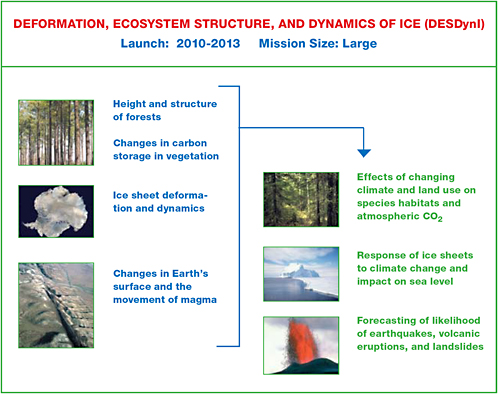
DEFORMATION, ECOSYSTEM STRUCTURE, AND DYNAMICS OF ICE (DESDynl) MISSION
Surface deformation is linked directly to earthquakes, volcanic eruptions, and landslides. Observations of surface deformation are used to forecast the likelihood of earthquakes as a function of location and to predict the places and times of volcanic eruptions and landslides. Advances in earthquake science leading to improved time-dependent probabilities would be facilitated by global observations of surface deformation and could result in increases in the health and safety of the public because of decreased exposure to tectonic hazards. Monitoring surface deformation is also important for improving the safety and efficiency of extraction of hydrocarbons, for managing groundwater resources, and, in the future, for providing information for managing CO2 sequestration.
Radar and lidar measurements will probably help to understand responses of terrestrial biomass, which stores a large pool of carbon, to changing climate and land management. Benefits would include the potential for development of more effective land-use management, especially as climate-driven effects become more pronounced.
The poorly understood dynamic response of the ice sheets to climate change is one of the major sources of uncertainty in forecasts of global sea-level rise. DESDynl’s InSAR measurements of the variations in ice-flow patterns and velocities provide important constraints on their dynamic response to climate change. Such knowledge will help to determine how fast society must adapt to sea-level changes and is crucial in planning the allocation of scarce resources.
Background: Earth’s surface and vegetation cover change on a wide range of time scales. Measuring the changes globally from satellites would enable breakthrough science with important applications to society. Fluid extraction or injection into subterranean reservoirs results in deformation of Earth’s surface. Monitoring the deformation from space provides information important for managing hydrocarbons, CO2, and water resources. Natural hazards—earthquakes, volcanos, and landslides—cause thousands of deaths and the loss of billions of dollars each year. They leave a signature surface-deformation signal; measuring the deformation before and after the events leads to better risk management and understanding of the underlying processes. Climate change affects and is affected by changes in the carbon inventories of forests and other vegetation types. Changes in those land-cover inventories can be measured globally. Socioeconomic risks are related to the dynamics of the great polar ice sheets, which affect ocean circulation and the water cycle and drive sea-level rise and fall. Those processes are quantifiable globally, often uniquely, through space-based observations of changes of the surface and overlying biomass cover.
Science Objectives: Surface-deformation data provide the primary means of recording aseismic processes, provide constraints on interseismic strain accumulation released in large and damaging earthquakes, characterize the migration of large volumes of magma from deep within Earth to its surface (volcanos), and can be used to quantify the kinematics of active landslides. Earthquakes result from the accumulation of stress in Earth; because the crust behaves as an elastic material, the strain changes observable via InSAR can be used to determine stress changes and can lead to improved earthquake forecasts. Subterranean magma movement results in surface deformation. Observations of surface deformation via InSAR, particularly when combined with seismic observations, make volcanos among the natural hazards that can be predicted most reliably. Exploitation of hydrocarbon reservoirs also results in surface deformation, typically as the result of fluid withdrawal but also as the result of injection of fluids to stimulate production. It is often difficult to predict the trajectories of injected fluids, but observations of surface deformation can provide the needed constraints to improve the predictions. Observations of surface deformation also can be used to monitor the integrity of CO2-sequestration wells.
The horizontal and vertical structure of ecosystems is a key feature that enables quantification of carbon storage, the effects of such disturbances as fire, and species habitats. Above-ground woody biomass and its associated below-ground biomass store a large pool of terrestrial carbon. Quantifying changes in the size of the pool, its horizontal distribution, and its vertical structure resulting from natural and human-induced perturbations, such as deforestation and fire, and the recovery processes is critical for measuring ecosystem change.
The dynamics of ice sheets are still poorly understood because their strength depends heavily on their temperature, their water content, conditions at their base, and even their history of deformation. Direct observations of how ice sheets deform in response to changes in temperature, precipitation, and so on, are crucial for understanding these important drivers of global sea-level change.
Mission and Payload: The DESDynl mission combines two sensors that together provide observations important for solid Earth (surface deformation), ecosystems (terrestrial vegetation structure), and climate (ice dynamics). The sensors are (1) an L-band synthetic aperture radar (SAR) system with multiple polarization
operated as a repeat-pass interferometer (InSAR), and (2) a multiple-beam lidar operating in the infrared (about 1,064 nm) with about 25-m spatial resolution and canopy-height accuracy of 1 m. The mission using InSAR to meet the science measurement objectives for surface deformation, ice sheet dynamics, and ecosystem structure has been studied extensively. The mission studied has a satellite in Sun-synchronous orbit at an altitude of 700–800 km in order to maximize available power from the solar arrays. An 8-day revisit frequency balances temporal decorrelation with required coverage. On-board GPS achieves centimeter-level orbit and baseline knowledge to improve calibration. The mission should have a 5-year lifetime to capture time-variable processes and achieve measurement accuracy.
For ecosystem structure, L-Band InSAR measurements allow estimating forest height with meters accuracy; interferometry allows estimation of three-dimensional forest structure. The sensitivity of backscatter measurements at different wave polarizations to woody components and their density makes radar sensors suitable for direct measurements of live above-ground woody biomass (carbon stock) and structural attributes such as volume and basal area. The multibeam laser altimeter (lidar) system would accurately measure the distance between the canopy top and bottom elevation, the vertical distribution of intercepted surfaces, and the size distribution of vegetation components within the vertical distribution. Multiple beams measure different size components of vegetation. Although this measurement is the most direct estimate of the height and the vertical structure of forests, the lidar measurement samples Earth’s surface at discrete points, rather than imaging the entire surface. DESDynl combines the two approaches, taking advantage of the precision and directness of the lidar to calibrate and validate the polarimetric SAR and InSAR measurements, especially in ecosystem types where field campaigns have not occurred.
The radar and lidar measurements do not need to be made simultaneously but could be separated by up to a few weeks because ecosystem structure typically does not evolve substantially on shorter time scales. Whether both instruments are flown on the same platform or separate platforms should be determined by a more thorough study. For example, it might be possible to upgrade the ICESat-II mission to include multibeam performance to meet the ecosystem requirements as long as the two missions are launched within the same time frame and take measurements within a few weeks of each other.
The SAR instrument consists of an L-band (1.2-GHz) radar that can be operated in several modes: single or dual-polarization strip-mapping mode, full-polarization strip-mapping mode, and single or dual-polarization ScanSAR mode with extended swath. The L-band wavelength, as well as the short repeat period, minimizes temporal decorrelation in regions of appreciable ground cover. Because the orbital geometry is tightly controlled, data acquired in all modes will provide excellent InSAR capability. Two subbands separated by 70 MHz allow correction of ionospheric effects. The viewable swath width must be larger than 340 km to obtain complete global access. Other characteristics include ground resolution better than 35 m to characterize fault geometries, noise equivalent σ° less than −24 dB to map radar-dark regions, electronic-beam steering to minimize spacecraft interactions for acquisition and allow ScanSAR operation, and a data rate of at least 140 Mbps. Multiple polarization is required for the canopy-density profiles needed for ecosystem structure. As noted above, the lidar in DESDynl is a multibeam laser ranger operating in the IR.
Cost: About $700 million.
Schedule: The technology readiness of all components is consistent with a new start now. Past studies and proposals to NASA show that all technologies required for both the InSAR and the lidar have been demonstrated in space by U.S. or international satellites.
Further Discussion: See in Chapter 8 the section “Mission to Monitor Deformation of Earth’s Surface,” in Chapter 9 the section “Climate Mission 3: Ice Dynamics,” and in Chapter 7 the section “Information Requirements for Understanding and Managing Ecosystems.”
Related Responses to Committee’s RFI: 44, 57, 72, 73, and 83.
Related Reading:
NASA (National Aeronautics and Space Administration). 2002. Living on a Restless Planet. Solid Earth Science Working Group Report. Jet Propulsion Laboratory, Pasadena, Calif. Available at http://solidearth.jpl.nasa.gov/seswg.html.
NRC (National Research Council). 2001. Review of EarthScope Integrated Science. National Academy Press, Washington, D.C.
NRC. 2003. Living on an Active Earth: Perspectives on Earthquake Science. The National Academies Press, Washington, D.C.
NRC. 2004. Review of NASA’s Solid-Earth Science Strategy. The National Academies Press, Washington, D.C.
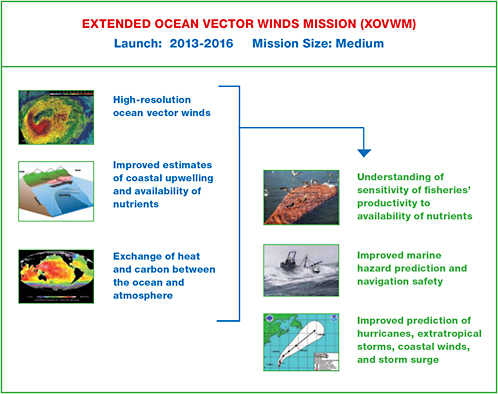
EXTENDED OCEAN VECTOR WINDS MISSION (XOVWM)
The scatterometer has been shown to be critical in improving marine warnings and hurricane forecasts. In fact, the National Centers for Environmental Prediction (NCEP) Ocean Prediction Center has added a higher level of warning for ships (“hurricane-force winds”) for the mid-latitude ocean on the basis of improved wind measurements from QuikSCAT. The NCEP Tropical Prediction Center has found QuikSCAT to be critical for accurate hurricane forecasts and warnings (Chang and Jelenak, 2006). Because the NPOESS sensor that would have measured ocean-vector winds—the Conical-Scanning Microwave Imager/Sounder (CMIS)—has been canceled,3 XOVWM would be a key U.S. contribution to weather forecasting. In data-assimilation studies and at the European Centre for Medium-Range Weather Forecasts, scatterometer data have been demonstrated to improve predictions of storm-center locations and intensity. High-resolution
observations of winds in the coastal region will also allow improved estimates of upwelling and the associated increases in nutrients for fisheries management. Use of data on winds to force coastal-circulation models will improve estimates of currents for such activities as search and rescue, shipping, and monitoring of oil-platform safety and oil spills and thus will contribute greatly to increases in the safety and economic efficiency of these activities.
Coordination between the SWOT mission, which will provide high-resolution sea-level measurements from a wide-swath altimeter, and XOVWM will give the observations needed to improve understanding and modeling of air-sea interaction and ocean circulation, particularly in coastal regions. Higher-spatial-resolution observations of winds and sea level are needed to understand and predict the effects of warm ocean regions on hurricane intensification.
Background: XOVWM will address science and applications questions related to air-sea interaction; coastal circulation and biological productivity; improved forecasts of hurricanes; extratropical storms, coastal winds, and storm surge; exchange of heat and carbon between the atmosphere and the ocean; and forcing of large-scale ocean circulation.
XOVWM is derived from weather-related requirements for measurement of horizontal winds and climate-related requirements for sustained measurements over the ocean and has high priority for both the oceans community (Chelton and Freilich, 2006) and the NCEP forecast centers (Chang and Jelenak, 2006), particularly in light of the cancellation and planned recompete of CMIS on NPOESS. XOVWM would also address the need to better understand coastal ecosystems and the desire for improved measurements of air-sea fluxes to support studies of climate, water resources, and the global hydrologic cycle.
XOVWM will measure wind speed and direction (vectors) over the global oceans at high spatial resolution with a dual-frequency scatterometer. Past scatterometers have revealed the existence of energetic small-scale wind structures associated with ocean-temperature fronts and currents and with coastal topography and are used in operational weather forecasting and marine-hazard predictions. By increasing further the spatial resolution of winds, XOVWM would extend the benefits of scatterometry to coastal regions where winds force coastal currents and where better forecasts of winds would improve navigation safety. XOVWM would extend the coverage of vector winds into the rainy centers of hurricanes and storms and would provide the twice-daily vector winds needed for weather forecasts.
Upper-ocean circulation is wind-driven, so that to the extent that XOVWM overlaps the SWOT mission, the two missions together would allow a simultaneous study of the variability in winds and ocean currents, for example, to forecast the increases in intensity as hurricanes pass over warm ocean eddies or to understand the complex interactions between fisheries and circulation in highly productive regions, such as the California Current. That synergy could well lead to advances in the representation of upper ocean processes and atmosphere-ocean coupling in climate and forecast models.
Science Objectives: XOVWM has both operational and scientific objectives. The report from a NOAA workshop that included participants from NOAA, NASA, DOD, universities, and the private sector provides a detailed assessment of currently operating ocean-vector wind sensors and gives new requirements for weather forecasting needs (Chang and Jelenak, 2006). Although the workshop’s goal was to document how observations of ocean-vector winds are used currently and to consider NOAA’s future needs, the report was responsive to concerns expressed in the committee’s interim report about evaluating the “costs and benefits of launching the Ocean Vector Winds mission prior to or independently of the launch of CMIS on NPOESS” (NRC, 2005, p. 5). (The elimination of the CMIS instrument and plans to recompete the instrument were announced in June 2006, approximately a year after the release of the interim report.) The workshop found that the data from NASA’s research mission QuikSCAT are fully integrated into routine operations
of the forecast centers and that several measurable improvements have been made, including tracking of tropical-cyclone center locations and sizes and improvement in coastal winds and storm surge forecasts. Desired improvements in wind measurements, relative to the QuikSCAT baseline, include improved wind vector accuracy in rain, higher spatial resolution, better coverage in coastal regions, and more frequent wind measurements (Chang and Jelenak, 2006). Comparisons of existing and proposed measurement technology show that a next-generation scatterometer could best meet proposed new requirements, and that is the prototype for XOVWM. One aspect of the new requirements that cannot be met by a single mission is the 6-hour revisit time. Meeting that requirement will require multiple coordinated platforms, including the ESA’s operational scatterometer, ASCAT on the MetOp series, which gives one wind vector per day (at mid-latitudes) with a maximal resolution of 25 km.
The science objectives are to extend the high-resolution wind fields into the coastal region, to extend the climate measurement begun by previous sensors, and to provide observations to continue to examine the air-sea interaction associated with the small-scale wind features observable only by satellite sensors. QuikSCAT wind measurements have revealed persistent small-scale wind structure that is coincident with temperature fronts and narrow ocean currents, and with topography of nearby islands and coastal mountain ranges (Chelton et al., 2004). The extent to which those features contribute to the exchange of heat and carbon between atmosphere and ocean is not yet understood. High-resolution wind data provide a basis for stimulating and assessing improvements in boundary-layer parameterizations used in weather-prediction and climate models. High-resolution wind measurements also improve air-sea flux estimates even without improving resolution in other atmospheric variables. Coastal currents and the coastal winds that force them have intrinsically small scales. Coastal phenomena are not mapped by scatterometer or altimeter, owing to low spatial resolution and contamination of the radar signal by nearby land. Increasing the spatial resolution of both sensors will reveal relationships between ocean eddies and winds (such as those between hurricanes and the warm eddies of the Loop Current). With increased resolution, the numerous scientific gains from these sensors can be extended to forcing and verifying the coastal circulation models that are essential to fisheries and coastal management.
The measurement objective is to obtain ocean-vector winds at a spatial resolution of 1–5 km over a broad region (revisit time, about 18 hours), with measurements of direction and speed at least as accurate as those obtained by the SeaWinds scatterometer on QuikSCAT and with improved coverage of coastal regions. Improvements in the accuracy of wind measurements in rainy conditions is needed for such applications as hurricane prediction or improving prediction of ENSO, which depends on winds in the rainy Intertropical Convergence Zone.
Mission and Payload: The concept for XOVWM, which is based in part on simulations for a next-generation OVWM performed at the Jet Propulsion Laboratory, includes both active and passive sensors (Chang and Jelenak, 2006). The dual-frequency scatterometer includes a Ku-band scatterometer that uses unfocused SAR processing to attain a spatial resolution of 1–5 km, compared with the 12.5-km resolution of QuikSCAT. The Ku-band sensor would require a moderate-size (2.5-m reflector) antenna. The mission would also include a C-band real-aperture scatterometer, such as that currently used on the ESA scatterometers, to minimize the effect of rain and for better accuracy at high wind speeds. XOVWM also includes a multifrequency passive radiometer with channels (SRAD as part of the scatterometer, K-band, and X-band) to improve wind vector retrieval and correction and estimation of rain. Wind-accuracy specifications would include directional accuracy of less than 24° at 2-km resolution (or less than 6° at 12.5 km) for wind speeds of 5–83 m/sec. The swath width would be about 1,800 km. The nominal 800-km-altitude orbit allows the possibility of sharing a platform with other missions, subject to power constraints. Because of the importance of XOVWM to weather forecasting and the importance of minimizing data latency, close
coordination is needed between research and operational aspects of the mission, particularly with respect to ground operations and data flow.
Cost: About $350 million.
Schedule: The scatterometer’s critical contribution to weather forecasting suggests an early launch to replace the aging QuikSCAT scatterometer. However, for studies of air-sea interaction, the scatterometer mission needs to be concurrent with the wide-swath altimeter mission (SWOT) for at least 2 years. That suggests a launch in about 2014. Local overpass times should be coordinated with other proposed ocean-vector wind missions, such as ASCAT, to minimize revisit times.
Further Discussion: See in Chapter 9 the section “Climate Mission 4: Measuring Ocean Circulation, Ocean Heat Storage, and Ocean Climate Forcing,” and in Chapter 10 the section “Other Near-term Opportunities for Wind Measurement from Space.”
Related Responses to Committee’s RFI: 56, 79, 91, 98, and 108.
Supporting Documents:
CEOS (Committee on Earth Observation Satellites). 2006. Satellite Observation of the Climate System: The Committee on Earth Observation Satellites (CEOS) Response to the Global Climate Observing System (GCOS) Implementation Plan (IP). September. Available at http://www.ceos.org/CEOS%20Response%20to%20the%20GCOS%20IP.pdf.
Chang, P., and Z. Jelenak, eds. 2006. NOAA Operational Satellite Ocean Surface Vector Winds Requirements Workshop Report. National Hurricane Center, Miami, Fla., June 5–7, 2006. Available at http://cioss.coas.oregonstate.edu/CIOSS/Documents/SVW_workshop_report_final.pdf.
Chelton, D., and M. Freilich, eds. 2006. Oceans Community Letter, to Dr. Richard Anthes and Prof. Berrien Moore, Co-Chairs of the NRC Earth Sciences Decadal Survey, from Concerned Members of the Oceans Community (753 signatories), dated April 6, 2006. Available at http://cioss.coas.oregonstate.edu/CIOSS/letter.html.
Chelton, D.B., M.G.Schlax, M.H.Freilich, and R.F.Milliff. 2004. Satellite measurements reveal persistent small-scale features in ocean winds. Science 303(5660):978–983.
NRC (National Research Council). 2005. Earth Science and Applications from Space: Urgent Needs and Opportunities to Serve the Nation. The National Academies Press, Washington, D.C.
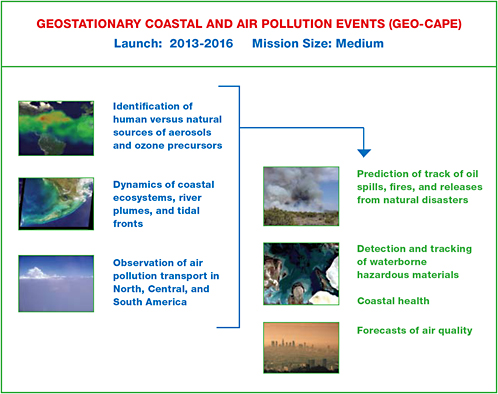
GEOSTATIONARY COASTAL AND AIR POLLUTION EVENTS (GEO-CAPE) MISSION
The concentration of people living near coasts is causing enormous pressure on coastal ecosystems. The effects are visible in declining fisheries, harmful algal blooms, and eutrophication such as the “dead zone” in the Mississippi delta and more than 20 other persistent dead zones around the world. Climate change combined with the continuing growth of populations in coastal areas creates an imperative to monitor changes in coastal oceans. Key needs include the ability to forecast combined effects of harvesting, coastal land management, climate change, and extreme weather events on economically important seafood species. The GEO-CAPE mission would provide observations of aerosols, organic matter, phytoplankton, and other constituents of the upper coastal ocean at multiple times in the day to develop capabilities for modeling ecological and biogeochemical processes in coastal ecosystems.
The mission would be of considerable value in improving the ability to observe and understand air quality on continental scales and thus in guiding the design of air-quality policy. Air pollutants (O3 and aerosols) are increasingly recognized as major causes of cardiovascular and respiratory diseases. Based on networks of surface sites, the current system for observation of air quality is patently inadequate to
monitor population exposure and to relate pollutant concentrations to their sources or transport. Continuous observation from a geostationary platform will provide the necessary data for improving air-quality forecasts through assimilation of chemical data, monitoring pollutant emissions and accidental releases, and understanding pollution transport on regional to intercontinental scales.
Background: The GEO-CAPE mission advances science in relation to coastal ecosystems and air quality. If both types of measurements are made from the same platform, aerosol information derived from the air-quality measurements can be used to improve the ocean ecosystem measurements.
Coastal ocean ecosystems are under enormous pressure from human activities, both from harvesting and from materials entering the coastal ocean from the land and the atmosphere. Compared with the open ocean, these regions contain greatly enhanced amounts of chlorophyll and dissolved organic matter, but the coastal ocean is not simply a region of enhanced primary productivity; it also plays an important role in mediating the land-ocean interface and global biogeochemistry. The high productivity of the coastal ocean supports a complex food web and leads to a disproportionate harvesting of the world’s seafood from the coastal ocean regions. Persistent hypoxic events or regions associated with riverine discharge of nutrients in the Gulf of Mexico, the increasing frequency of harmful algal blooms in the coastal waters of the United States, and extensive closures of coastal fisheries are just a few of the issues confronting the coastal areas. Both short-term and long-term forecasts of the coastal ocean require better understanding of critical processes and sustained observing systems. Characterizing and understanding the short-term dynamics of coastal ecosystems are essential for the development of robust, predictive models of the effects of climate change and human activity on coastal ocean ecosystem structure and function. The scales of variability in the coastal region require measurements at high temporal and spatial resolution that can be obtained only from continuous observation, such as is possible from geosynchronous Earth orbit.
Air-quality measurements are urgently needed to understand the complex consequences of increasing anthropogenic pollutant emissions both regionally and globally. The current observation system for air quality is inadequate to monitor population exposure and develop effective emission-control strategies. O3 and aerosol formation depends in complex and nonlinear ways on the concentrations of precursors, for which few data are available. Management decisions for air quality require emission inventories for precursors, which are often uncertain by a factor of two or more. The emissions and chemical transformations interact strongly with weather and sunlight, including the rapidly varying planetary boundary layer and continental-scale transport of pollution. Again, the scales of variability of these processes require continuous, high-spatial-resolution and high-temporal-resolution measurements possible only from geosynchronous Earth orbit.
Science Objectives: The GEO-CAPE mission satisfies science objectives for studies of both coastal ocean biophysics and atmospheric-pollution chemistry. It also has important direct societal applications in each domain. Compatibility with objectives of the terrestrial biophysical sciences should also be explored.
The ocean objectives are to quantify the response of marine ecosystems to short-term physical events, such as the passage of storms and tidal mixing; to assess the importance of high temporal variability in coupled biological-physical coastal-ecosystem models; to monitor biotic and abiotic material in transient surface features, such as river plumes and tidal fronts; to detect, track, and predict the location of sources of hazardous materials, such as oil spills, waste disposal, and harmful algal blooms; and to detect floods from various sources, including river overflows.
The air-quality objective is to satisfy basic research and operational needs related to air-quality assessment and forecasting to support air-program management and public health; emission of O3 and aerosol precursors, including human and natural sources; pollutant transport into, across, and out of North, Central,
and South America; and large puff releases from environmental disasters. Measurements of aerosols from the air-quality instrument can be used to correct aerosol contamination of the high-resolution coastal-ocean imager.
Mission and Payload: GEO-CAPE consists of three instruments in geosynchronous Earth orbit near 80°W longitude: a UV-visible-near-IR wide-area imaging spectrometer (7-km nadir pixel) capable of mapping North and South America from 45°S to 50°N at about hourly intervals, a steerable high-spatial-resolution (250 m) event-imaging spectrometer with a 300-km field of view, and an IR correlation radiometer for CO mapping over a field consistent with the wide-area spectrometer. The solar backscatter data from the UV to the near-IR will provide aerosol optical depth information for assimilation into aerosol models and downscaling to surface concentrations. The same data will provide high-quality information on NO2 and formaldehyde tropospheric columns from which emissions of NOx and volatile organic compounds, precursors of both O3 and aerosols, can be characterized. Combination of the near-IR and thermal-IR data will describe vertical CO, an excellent tracer of long-range transport of pollution. The high-resolution event imager would serve as a multidisciplinary programmable scientific observatory and an immediate-response sensor for possible disaster mitigation. The data from the high-resolution event-imaging spectrometer would be coupled to the data generated by the wide-area spectrometer through on-board processing to target specific events (such as forest fires, releases of pollutants, and industrial accidents) where high-spatial-resolution analysis would provide benefits. A substantial fraction of its time would be made available for direct support of selected aircraft and ground-based campaigns or special observing opportunities.
Mission Cost: About $550 million.
Schedule: All the instruments have a low-Earth-orbit space heritage and are at a high level of technology readiness, and so launch would be feasible by 2015.
Further Discussion: See in Chapter 10 the section “A Cross-disciplinary Aerosol-Cloud Discovery Mission,” and in Chapter 7 the section “Coastal Ecosystem Dynamics Mission.”
Related Responses to Committee’s RFI: 21, 30, 52, 60, and 105.
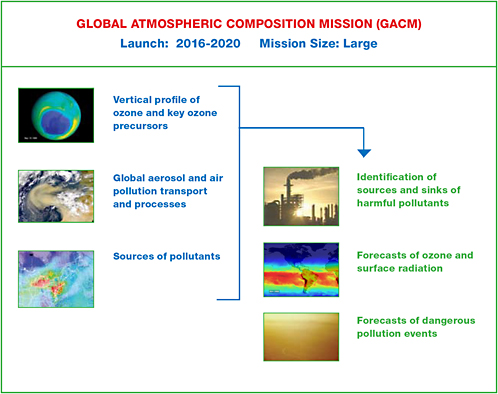
GLOBAL ATMOSPHERIC COMPOSITION MISSION (GACM)
Anthropogenic and natural processes are modifying the composition, chemistry, and dynamics of the global atmosphere, and there is an urgent need to observe, model, and forecast the consequences of the changes to be able to determine the best course of action to mitigate them. High-resolution global measurements and modeling of chemistry and dynamics across the lower atmosphere directly affect forecasts of chemical weather, air quality, and surface UV radiation and provide information on global trends important to all segments of society. Potential benefits could include greater protection of public health, the development of better public policy to avoid or reverse adverse atmospheric changes, and the possibility of averting substantial ecological damage.
Background: Understanding and modeling the chemistry and dynamics of the lower atmosphere on regional to global scales requires a combination of measurements of O3, O3 precursors, and other pollutant gases and aerosols with sufficient vertical resolution to detect the presence, transport, and chemical transformation of atmospheric layers from the surface to the lower stratosphere. This is critical because the fate
of pollutants, and their ability to produce (or destroy) ozone, depends critically on height owing to the strong vertical dependence of photochemical reaction rates and dynamical transport rates. Current satellite instruments are providing initial critical observations with low resolution across the troposphere, but a new generation of instruments and observational scenarios is required to capture the full range of needed measurements. GACM was identified as a high-priority mission by the Panel on Weather Science and Applications to address global chemical-weather objectives and by the Panel on Human Health and Security to support applications related to air pollution and exposure to UV radiation.
Science Objectives: The specific objectives of GACM are to contribute to transformational improvements in the understanding of chemical-weather processes on regional to global scales and to make a revolutionary improvement in the ability to model and forecast global atmospheric chemistry, air pollution, and surface UV radiation. Achieving those objectives requires measurement of the global distribution of tropospheric O3 at sufficient vertical resolution to understand tropospheric chemistry and dynamic processes in tropical, mid-latitude, and high-latitude regions and the measurement of key trace gases (CO, NO2, CH2O, and SO2) and aerosols that either are related to photochemical production of O3 or can be used as tracers of tropospheric pollution and dynamics. GACM will provide data to aid in the development and validation of chemical-transport models under a wide array of atmospheric and pollution conditions from the tropics to the polar regions. The global measurements will also be used to connect to the more regional- and continental-scale measurements, such as those made from geosynchronous Earth orbit (GEO), and provide more detailed vertical information than that supplied by GEO passive instruments. GACM is complementary to the GEO air-pollution mission advocated by the Panel on Weather and the Panel on Human Health and Security in that it provides needed observations outside the GEO field of view that are required to characterize up-wind boundary conditions for the continental-scale GEO domain and to understand the fate of air leaving the GEO domain. To understand the dynamics associated with stratosphere-troposphere exchange and to determine changes in the stratosphere that affect UV radiation budgets at the surface, measurements of O3, N2O, temperature, water vapor, and aerosols are required from the upper troposphere into the lower stratosphere.
Mission and Payload: The objectives of GACM require a unique combination of passive and active remote sensing instruments in low Earth orbit (LEO). Passive nadir measurements of CO, O3, NO2, SO2, CH2O, and aerosols can be made globally from a Sun-synchronous orbit, which is the implementation recommended here. The instruments required include an ultraviolet-visible (UV-VIS) spectrometer for daytime measurements of O3, NO2, SO2, CH2O, and aerosols and a short-wave infrared-infrared (SWIR/IR) spectrometer for daytime column measurements of CO in SWIR at 2.4 µm and day-night CO measurements in the middle troposphere in IR at 4.6 µm. Emphasis must be given to obtaining O3 and CO-column measurements with enhanced sensitivity into the Planetary Boundary Layer (PBL). Limb-viewing measurements of O3, N2O, temperature, water vapor, CO, HNO3, CIO, and volcanic SO2 in the upper troposphere and lower stratosphere need to be made with an advanced microwave spectrometer.
To achieve the desired high-vertical-resolution O3 measurements to better than 2 km across the middle to lower troposphere with concurrent profiles of aerosols and atmospheric structure to better than 150 m, an active system operating in a polar LEO is required. The measurements can be made with a differential-absorption lidar (DIAL) system operating in the UV (305–320 nm) for O3 and in the visible (500–650 nm) for aerosols. The space-based O3 DIAL requires substantial technological development during the next decade, and so a phased implementation of this mission is recommended.
Because it is imperative that the GEO-CAPE air-pollution mission be complemented by a global tropospheric-composition mission and that a follow-on tropospheric-stratospheric mission extend the
accomplishments of the Aura satellite instruments, the passive portion of this mission should be launched into a LEO in the middle of the next decade while all the components of the more complex O3 DIAL LEO mission are being developed and tested by NASA for launch early in the following decade. NASA has already begun the initial funding of several key components of the O3 DIAL mission as part of the Instrument Incubator Program. The active portion of this mission has high potential payoff for future chemical-weather and air-pollution applications, and so the associated technology needs to be aggressively developed during the next decade.
Cost: About $600 million.
Schedule: Most of the sensors for the passive portion of GACM have an extensive heritage in existing satellite instruments (such as OMI, SCIAMACHY, MOPITT, GOME, and MLS); however, some optimization is required for enhanced performance in the lower troposphere for O3 and CO. The phase 1 passive LEO mission could be launched as early as 2017. With focused technology investment in the O3 DIAL over the next decade, the phase 2 O3 DIAL LEO mission could be launched as early as 2022.
Further Discussion: See in Chapter 10 the section “Comprehensive Tropospheric Ozone Mission,” and in Chapter 9 the sections “Trace Gases and Aerosols” and “Stratosphere-Troposphere Exchange.”
Related Responses to Committee’s RFI: 3, 5, 9, and 61.
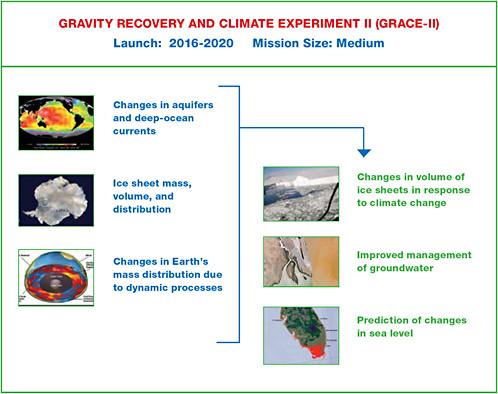
GRAVITY RECOVERY AND CLIMATE EXPERIMENT II (GRACE-II) MISSION
The Gravity Recovery and Climate Experiment (GRACE) gives a globally consistent measurement of Earth’s mass distribution and its variability in time and space. This mass variability is primarily due to water motion. Thus, the measurement provides an integral constraint on many geophysical processes related to land, ocean, atmosphere, and glaciological subsystems. A record of time variations in Earth’s gravity field reflects the redistribution and exchange of mass within and between these reservoirs. More than one-fourth of the world’s population relies on groundwater as its principal source of drinking water. Yet global observations of this critical resource are highly variable in density; most in situ observations are made in heavily exploited groundwater basins in the developed world, and few are made elsewhere.
GRACE-II would provide information about variations in groundwater storage at spatial resolutions sufficient to help to improve resource characterization and management in portions of the world (which include most underdeveloped countries) where groundwater is not actively managed. A more indirect benefit will be improved characterization of water storage in the subsurface, which affects weather and climate model estimates of water recycling to the atmosphere and hence precipitation prediction on both
weather and climate time scales. At present, the dynamics of water storage in surface soils versus deeper storage as groundwater are not discriminated in land-surface models, because there is little observational basis for doing so. Hence, essentially all variations in subsurface storage are attributed to soil moisture, and the lower-frequency variations associated with groundwater are ignored. GRACE-II data would help to foster a new generation of land-surface models, which would better represent subsurface moisture variations and, in turn, the recycling of moisture to the atmosphere.
Background: A number of dynamic processes of the Earth system result in variations in mass with time and position. In March 2002, GRACE was launched to monitor the variations. GRACE consists of twin satellites separated by about 200 km along-track in a circular 450-km-altitude near-polar orbit. A dual-frequency K-band ranging system provides accurate estimates of the range change between the two satellites, accelerometers provide measurements of the nongravitational forces acting on the satellites, and dual-frequency GPS receivers provide the satellite positions. The change in the distance between the satellites is related to the gravitational signal associated with Earth’s mass distribution. By repeating the measurements at monthly intervals, the change in mass distribution can be determined. At seasonal periods, the mass change has a strong component related to water movement. The GRACE mission, which was developed with an expected 5-year lifetime, is likely to end by 2013.4
GRACE has demonstrated the ability to monitor variations in water mass stored on the continents, variations in global ocean mass associated with eustatic sea-level change, and variations in the mass of the Greenland and Antarctic ice sheets, with a spatial resolution of 400–500 km. The GRACE gravity measurements over the ocean allow global measurements of pressure differences associated with surface and deep ocean currents and provide constraints on models for the general ocean circulation. The somewhat-improved spatial resolution of a proposed GRACE follow-on mission (denoted here as GRACE-II), and the continuation of the observation record would provide invaluable observations of the long-term climate-related changes in mass of the Antarctic and Greenland ice sheets, as well as the Arctic ice caps.
Science Objectives: Measuring temporal variations in Earth’s gravity field provides fundamental constraints on understanding of an exceptional number of interlinked components of the Earth system. Those components include processes that affect the hydrologic cycle and climate such as large-scale evapotranspiration, soil-moisture inventory, and depletion of large aquifers. Changes in deep ocean currents result in dynamic pressures that cause regional sea-level changes that affect the gravity field. Measuring the gravitational signal from the oceans, when combined with satellite altimetry, provides constraints on the cause of the eustatic component of sea-level rise, allowing ocean thermal expansion to be separated from an increase in ocean mass due to the addition of freshwater from the continents. Gravity monitoring allows the determination of changes in the mass and spatial distribution of ice in Antarctica, Greenland, and continental glacier systems and changes in mass associated with melting of permafrost. Gravity variations also result from the viscoelastic response of Earth as it reacts to changes in ice loads, which constrains the strength of Earth’s interior. Even changes in the flow in Earth’s core associated with temporal variations in the geomagnetic field result in mass redistributions that lead to variations in the gravity field that are observable from space.
Mission and Payload: GRACE-II will improve on the GRACE mission by enabling more accurate measurement of intersatellite distance using either a laser satellite-to-satellite interferometer (SSI) or an improved version of the current GRACE microwave ranging system, improved accommodation of the surface force effects by either improved accelerometers or by drag-free satellite operation and direct ranging to the proof-
masses to reduce accelerometer errors, and possibly lower-altitude orbits for better sensitivity to the short wavelengths of the gravity field.
The effectiveness of the dual satellite ranging measurement has been demonstrated by the current GRACE mission. The microwave ranging system on the current GRACE satellites has been demonstrated to be a mature system with high accuracy and robust operation. Although there has been no flight demonstration, the technology readiness of the higher-accuracy SSI drag-free concept has been demonstrated, under an ongoing technology development effort. In addition to the need for improved sensitivity to the short-wavelength components of the gravity field, mission lifetime to maximize the measurement time series should be a concern. Mission design should improve the accuracy of both the spatial and temporal resolution.
Cost: About $450 million.
Schedule: The committee notes that the technology readiness for the microwave version of the mission is mature; however, modest development effort for the ranging system and the satellite would be required to achieve improved performance. The laser SSI, with more accurate intersatellite ranging capability, is at a high level of technology readiness. GRACE-II is recommended for launch in the 2016–2020 time frame.
Further Discussion: See in Chapter 8 the section “Mission to Monitor Temporal Variations in Earth’s Gravity Field,” in Chapter 9 the section “Ice Sheet and Sea Ice Volume,” and in Chapter 11, the section “Groundwater Storage, Ice Sheet Mass Balance, and Ocean Mass.”11
Related Responses to Committee’s RFI: 42 and 96.
Supporting Documents:
NASA (National Aeronautics and Space Administration). 2002. Living on a Restless Planet. Solid Earth Science Working Group Report. Jet Propulsion Laboratory, Pasadena, Calif. Available at http://solidearth.jpl.nasa.gov/seswg.html.
NRC (National Research Council). 1997. Satellite Gravity and the Geosphere: Contributions to the Study of the Solid Earth and Its Fluid Envelopes. National Academy Press, Washington, D.C.
NRC. 2004. Review of NASA’s Solid-Earth Science Strategy. The National Academies Press, Washington, D.C.
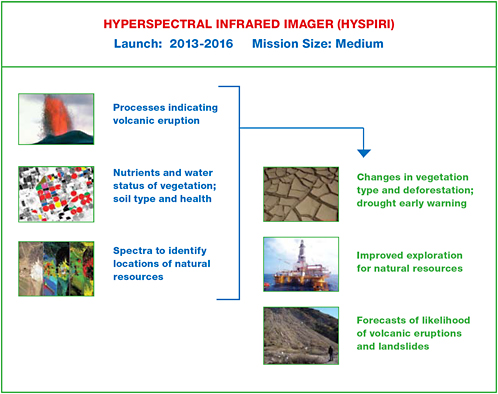
HYPERSPECTRAL INFRARED IMAGER (HyspIRI) MISSION
Ecosystems respond to changes in land management and climate through altered nutrient and water status in vegetation and changes in species composition. A capability to detect such changes provides possibilities for early warning of detrimental ecosystem changes, such as drought, reduced agricultural yields, invasive species, reduced biodiversity, fire susceptibility, altered habitats of disease vectors, and changes in the health and extent of coral reefs. Through timely, spatially explicit information, the observing capability can provide input into decisions about management of agriculture and other ecosystems to mitigate negative effects. The observations would also underpin improved scientific understanding of ecosystem responses to climate change and management, which ultimately supports modeling and forecasting capabilities for ecosystems. Those, in turn, feed back into the understanding, prediction, and mitigation of factors that drive climate change.
Volcanos are a growing hazard to large populations. Key to an ability to make sensible decisions about preparation and evacuation is detection of the volcanic unrest that may precede eruptions, which is marked by noticeable changes in the visible and IR centered on craters. Assessment of soil type is an
important component of predicting susceptibility to landslides. Remote sensing provides information critical for exploration for minerals and energy sources. In addition, such environmental problems as mine-waste drainage and unsuitability of soils for habitation, soil degradation, poorly known petroleum reservoir status, and oil-pipeline leakage in remote areas can be detected and analyzed with modern hyperspectral reflective and multispectral thermal sensors.
Background: Global observations of multiple surface attributes are important for a wide array of Earth-system studies. Requirements for ecosystem studies include information on canopy water content, vegetation stress and nutrient content, primary productivity, ecosystem type, invasive species, fire fuel load and moisture content, and such disturbances as fire and insect damage. In coastal areas, measurements of the extent and health of coral reefs are important. Observations of surface characteristics are crucial to exploration for natural resources and for managing the environmental effects of their production and distribution. Forecasting of natural hazards, such as volcanic eruptions and landslides, is facilitated by observations of surface properties.
Science Objectives: The HyspIRI mission aims to detect responses of ecosystems to human land management and climate change and variability. For example, drought initially affects the magnitude and timing of water and carbon fluxes, causing plant water stress and death and possibly wildfires and changes in species composition. Disturbances and changes in the chemical climate, such as O3 and acid deposition, cause changes in leaf chemistry and the possibility of vulnerability to invasive species. The HyspIRI mission can detect early signs of ecosystem change through altered physiology, including agricultural systems. Observations can also detect changes in the health and extent of coral reefs, a bellwether of climate change. Those capabilities have been demonstrated in space-borne imaging spectrometer observations but have not been possible globally with existing multispectral sensors.
Variations in mineralogical composition result in variations in the optical reflectance spectrum of the surface that indicate the distribution of geologic materials and the condition and types of vegetation on the surface. Gases from within Earth, such as CO2 and SO2, are sensitive indicators of volcanic hazards. They also have distinctive spectra in both the optical and near-IR regions. The HyspIRI mission would yield maps of surface rock and soil composition that in many cases provide equivalent information to what can be derived from laboratory x-ray diffraction analysis. The hyperspectral images would be a valuable aid in detecting the surface expression of buried mineral and petroleum deposits. In addition, environmental disturbances accompanying past and current resource exploitation would be mapped mineralogically to provide direction for economical remediation. Detection of surface alterations and changes in surface temperature are important precursors of volcanic eruptions and will provide information on volcanic hazards over areas of Earth that are not yet instrumented with seismometers. Variations in soil properties are also linked to landslide susceptibility.
Mission and Payload: The HyspIRI mission uses imaging spectroscopy (optical hyperspectral imaging at 400–2500 nm and multispectral IR at 8–12 µm) of the global land and coastal surface. The mission would obtain global coverage from LEO with a repeat frequency of 30 days at 45-m spatial resolution. A pointing capability is required for frequent and high-resolution imaging of critical events, such as volcanos, wildfires, and droughts.
The payload consists of a hyperspectral imager with a thermal multispectral scanner, both on the same platform and both pointable. Given recent advances in detectors, optics, and electronics, it is now feasible to acquire pushbroom images with 620 pixels cross-track and 210 spectral bands in the 400- to 2,500-nm region. If three spectrometers are used with the same telescope, a 90-km swath results when Earth’s cur-
vature is taken into account. A multispectral imager similar to ASTER is required in the thermal IR region. For the thermal channels (five bands in the 8- to 12-µm region), the requirements for volcano-eruption prediction are high thermal sensitivity of about 0.1 K and a pixel size of less than 90 m. An optomechanical scanner, as opposed to a pushbroom scanner, would provide a wide swath of as much as 400 km at the required sensitivity and pixel size.
The HyspIRI mission has its heritage in the imaging spectrometer Hyperion on EO-1 launched in 2000 and in ASTER, the Japanese multispectral SWIR and thermal IR instrument flown on Terra. The hyperspectral imager’s design is the same as the design used by JPL for the Moon Mineralogy Mapper (M3) instrument on the Indian Moon-orbiting mission, Chandrayaan-1, and so will be a proven technology.
Cost: About $300 million.
Schedule: Mid-2015. Both sensors, the hyperspectral imager and the thermal-IR multispectral scanner, have direct heritage from the M3 and ASTER instruments, respectively. The technology is currently available, and so a 2015 launch is feasible.
Further Discussion: See in Chapter 7 the section “Ecosystem Function,” and in Chapter 8 the section “Mission to Observe Surface Composition and Thermal Properties.”
Related Responses to Committee’s RFI: 6, 81, 89, and 97.
Supporting Documents:
NASA (National Aeronautics and Space Administration). 2002. Living on a Restless Planet. Solid Earth Science Working Group Report. Jet Propulsion Laboratory, Pasadena, Calif. Available at http://solidearth.jpl.nasa.gov/seswg.html.
NRC (National Research Council). 2004. Review of NASA’s Solid-Earth Science Strategy. The National Academies Press, Washington, D.C.
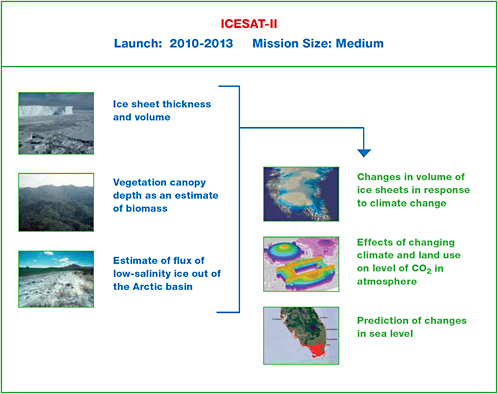
ICESat-II MISSION
Sea-level rise is governed by three factors: melting of permanent snow cover and mountain glaciers, the thermal expansion component of sea level, and decreases in the size of permanent ice sheets, the last of which is the least well constrained. The measurements proposed for ICESat-II directly address the contribution of changing terrestrial ice cover to global sea level. Thus, they are key to projecting the effects of sea-level change on growing populations and infrastructure along almost all coastal regions.
Canopy-depth measurements made from ICESat-II will address changes in terrestrial biomass, which stores a substantial amount of carbon. Many factors influence the character of the vegetation, including climate, land-use, and fertilization by increased CO2. Measurement of the vegetation-canopy depth will contribute to the ability to assess those influences and therefore better understand the carbon balance and future climate change.
Background: Space-borne lidar is a demonstrated technology for obtaining highly accurate topographic measurements of glaciers, ice sheets, and sea ice. Repeated observations of the polar ice caps by NASA’s
ICESat system are documenting decreases in ice sheet volume. Data acquired over sea ice is proving sufficiently accurate to allow making the first basinwide estimates of sea ice thickness. The technology as demonstrated so far on aircraft also can be used to measure vegetation canopy depth, which can be used as an estimator of biomass. ICESat-II is designed as a follow-on to the successful ICESat mission and would carry a highly accurate lidar instrument for repeat topographic mapping.
Science Objectives: The mass balance of Earth’s great ice sheets and their contributions to sea level are key issues in climate variability and change. The relationships between sea level and climate have been identified as critical subjects of study in the Intergovernmental Panel on Climate Change assessments, the Climate Change Science Program strategy, and the U.S. International Earth Observing System. Because much of the behavior of ice sheets is manifested in their shape, accurate observations of ice elevation changes are essential for understanding ice sheets’ current and likely contributions to sea-level rise. ICESat-II, with high altimetric fidelity, will provide high-quality topographic measurements that allow estimates of ice sheet volume change. High-accuracy altimetry will also prove valuable for making long-sought repeat estimates of sea ice freeboard and hence sea ice thickness change, which is used to estimate the flux of low-salinity ice out of the Arctic basin and into the marginal seas. Altimetry is the best (and perhaps only) technique for making this measurement on basin scales and with seasonal repeats. That is particularly important for climate-change studies because sea ice areas and extents have been well observed from space since the 1970s and significant trends have been shown, but there is no such record for sea ice thicknesses. As climate change proceeds, continuous measurements of both land-ice and sea-ice volume will be needed to observe trends, update assessments, and test climate models. The altimetric measurement made with the proposed lidar, along with a higher-precision gravity measurement (such as on GRACE-II), would optimally characterize changes in ice sheet volume and mass and directly enhance understanding of the ice sheet contribution to sea-level rise. Coupled with the interferometric synthetic aperture radar in the DESDynl mission, the instrumentation would provide a comprehensive data set for predicting changes in Earth’s ice sheets and sea ice.
In addition to studies of ice, the proposed instrument could be used to study changes in the large pool of carbon stored in terrestrial biomass. In particular, the proposed lidar could be used to measure canopy depth and thus estimate land carbon storage to aid in understanding the responses of biomass to changing climate and land management.
Mission and Payload: The proposed ICESat-II mission would deploy an ICESat follow-on satellite to continue the assessment of polar ice changes and to complement studies of vegetation canopy. The satellite would fly in a low-Earth, non-Sun-synchronous orbit. The payload would include a single-channel lidar with GPS navigation and pointing capabilities sufficient for acquiring high-accuracy repeat elevation data over ice and vegetation. The proposed ICESat-II mission would address technical issues uncovered during the ICESat mission. Limitations of the lasers on ICESat are understood and will be readily corrected for ICESat-II.
Cost: About $300 million.
Schedule: NASA’s successful demonstration of space-borne lidar technology for ice applications suggests that it is feasible to deploy a new lidar instrument by 2010 and within the timeframe of planned studies after the International Polar Year.
Further Discussion: See in Chapter 9 the section “Ice Sheet and Sea Ice Volume,” and in Chapter 11 the section “Sea Ice Thickness, Glacier Surface Elevation, and Glacier Velocity.”
Related Response to Committee’s RFI: 111.
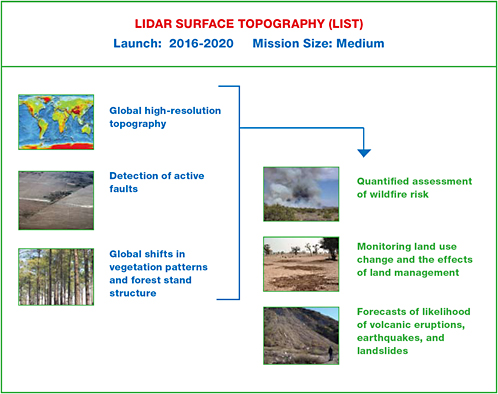
LIDAR SURFACE TOPOGRAPHY (LIST) MISSION
Predicting the location and timing of landslides, floods, tsunami runup, pyroclastic flows, and mud-flows depends on precise topographic data. Global topographic data are available at a resolution of only 30–90 m and a precision of only about 10 m in the vertical, which is inadequate for these purposes. The proposed 5-m global topographic survey at decimeter precision would permit mapping of landslide and flood hazards on a scale small enough to be useful for site-specific land-use decisions. High-resolution topographic data would also advance the science on which such risk assessments are based. Precise topographic measurements would aid in finding active faults (including “blind” faults) and thus contribute to better earthquake hazard assessments. Time series of high-precision topographic data would aid in mapping the loss of topsoil worldwide; in detecting incipient hazards from volcanic eruptions, pyroclastic flows, and mudflows; and in determining the slip distribution in large earthquakes. The proposed lidar mapping mission would also yield global data on forest-stand structure and thus allow quantitative assessment of wildfire risk to an unprecedented level.
Background: Earth’s surface is dynamic in the literal sense: it is continually being shaped by the interplay of uplift, erosion, and deposition as modulated by hydrological and biological processes. Surface topography influences air currents and precipitation patterns and controls how water and soil are distributed across the landscape. As a result, topography regulates the spatial patterns of soil depth, soil moisture, and vegetation. And it influences how natural hazards—such as landslides, floods, and earthquakes—are distributed across the landscape. High-resolution topographic data can be analyzed to understand the tectonic forces shaping Earth’s surface and the geologic structures through which the forces are expressed. Time series of high-precision topography can be used to observe the reshaping of Earth’s surface by landslides, flooding, erosion, large earthquakes, and tsunamis. Until recently, the coarse resolution of topographic mapping has been a major impediment to understanding the forces and dynamic processes that shape Earth’s surface.
Small areas can be surveyed at high resolution by using airborne lidar, but airborne surveys of large areas are impractical. Space-based global coverage at 5-m resolution would facilitate comprehensive studies of Earth’s surface across diverse tectonic, climatic, and biotic settings, even in areas that are otherwise inaccessible for geographic, economic, or political reasons. Lidar can also be used to measure the height of vegetation, enabling global studies of forest-stand structure and land-cover dynamics. Periodic repeat surveys (on time scales of months to years) would permit large-scale measurements of erosion and deposition fluxes. More frequent repeat surveys could be targeted where topography is changing rapidly (because of, for example, storms, volcanic eruptions, or earthquakes) or where topographic time series would be particularly helpful in detecting incipient natural hazards.
Science Objectives: High-resolution topographic data and high-precision measurements of topographic change are needed to understand the coupling between climate, tectonics, erosion, and topography; to estimate the geomorphic transport laws that shape Earth’s surface; to calibrate and test models of landform evolution; to predict and detect erosional response to climate change; to quantify global shifts in vegetation patterns and forest-stand structure in response to climate shifts and human land-use; to infer changes in groundwater aquifers; to measure changes in volumes of glaciers and ice sheets; to quantitatively map top-soil losses; and to assess the risk of landslides, floods, tsunami runup, volcanic eruptions, and earthquakes. At present, global coverage is at a horizontal resolution of, at best, 30 m and a vertical precision of 10 m. The threshold for major advances is at about 5-m horizontal resolution and 10-cm vertical precision.
Mission and Payload: Earlier-generation space-borne laser systems (such as the shuttle laser altimeters and ICESat) were generally single-beam systems that collected profiles of the surface along the spacecraft ground track, but emerging technology will enable spatial elevation mapping. Three approaches could enable spatial mapping of Earth’s surface from an orbital platform. The first uses a single laser beam and a scanning mechanism with kilohertz ranging rates to spatially map the surface, as demonstrated by the Goddard Space Flight Center airborne Laser Vegetation Imaging Sensor. The second uses a single laser and splits the beam into numerous parts with a diffractive optical element; separate detectors are used to measure elevation in each backscattered beam. That approach is being implemented in the design of the lunar orbiter laser altimeter to be flown on the Lunar Reconnaissance Orbiter to be launched in 2008. The third approach uses a single laser beam to illuminate a broad swath of surface and a pixilated detector in which each pixel makes a time-of-flight measurement. An example that uses that approach is the Lincoln Laboratory JIGSAW airborne system; analysis has shown that 5-m mapping of the Moon could be achieved in 2 years with an adaptation of this system. Further study will be required to determine the optimal technological approach for the LIST mission. In any case, megabit to gigabit data rates will need to be managed during mapping operations.
Cloud cover will limit the coverage available in each pass, so multiple passes will be required for complete coverage. A relatively long mission lifetime may be needed to achieve the desired spatial density and coverage, and repeated measurements over several years would facilitate detecting surface changes, such as topsoil losses to erosion.
The mission will obtain global coverage from LEO. Global repeat coverage will be achieved on scales of months to years, with more frequent repeat coverage of areas of special interest.
Cost: About $300 million.
Schedule: 2017–2019.
Further Discussion: See in Chapter 8 the section “Mission to Measure High-Resolution (5-m) Topography of the Land Surface,” in Chapter 9 the section “Ice Sheet and Sea Ice Volume,” and in Chapter 11 the section “Sea Ice Thickness, Glacier Surface Elevation, and Glacier Velocity.”
Related Responses to Committee’s RFI: 57 and 111.
Supporting Documents:
NASA (National Aeronautics and Space Administration). 2002. Living on a Restless Planet. Solid Earth Science Working Group Report. Jet Propulsion Laboratory, Pasadena, Calif. Available at http://solidearth.jpl.nasa.gov/seswg.html.
NRC (National Research Council). 2003. Living on an Active Earth: Perspectives on Earthquake Science. The National Academies Press, Washington, D.C.
NRC. 2004. Review of NASA’s Solid-Earth Science Strategy. The National Academies Press, Washington, D.C.
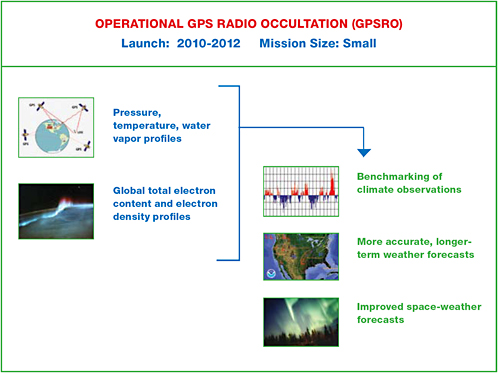
OPERATIONAL GPS RADIO OCCULTATION (GPSRO) MISSION
The radio-occultation (RO) sounding technique produces independent information on the vertical structure of electron density in the ionosphere, temperature in the stratosphere, and temperature and water vapor in the troposphere. The ionospheric electron-density profiles enable global analyses of electron density that will be useful for space-weather analyses and forecasts, which in turn are important for mitigating a number of issues that affect society in important ways. Among the issues are satellite damage and difficulties, including drag, degraded solar panels, lost satellites, and phantom commands; radiation dangers to astronauts and airline passengers; communication blackouts and radio interference; flow of currents in pipelines and increased corrosion of pipes; and electrical-power problems, such as blackouts, power grid disruptions, and transformer failures.
Measurements made in the stratosphere and troposphere can contribute to two major societal benefits: monitoring climate, climate variability, and climate change with improved accuracy and precision; and improving operational weather prediction. For climate, the accuracy, precision, and stability of RO soundings make them ideal benchmark climate observations. For weather prediction, RO observations
can improve the accuracy of temperature and water-vapor analyses and contribute to enhanced quality of weather forecasts on time scales of hours to many days, and so are of great immediate value to society.
Background: RO observations are becoming widely recognized for their unique, broad, and extremely low cost contributions to atmospheric and hydrologic sciences and to climate and weather forecasting. The RO technique produces precise, accurate, and high-vertical-resolution soundings of atmospheric refractivity, which is a function of electron density in the ionosphere, temperature in the stratosphere and upper troposphere, and temperature and water vapor in the lower troposphere. Several proof-of-concept single-satellite research missions have demonstrated the powerful characteristics of RO observations, and an operational demonstration mission consisting of a constellation of six satellites called the Constellation Observing System for Meteorology Ionosphere and Climate (COSMIC) was launched in April 2006 (see www.cosmic.ucar.edu/).
Science Objectives: Accurate, precise, all-weather, high-temporal-resolution, and high-spatial-resolution global profiles of temperature and water vapor are basic requirements of a sustained global observing system to support the understanding and prediction of virtually all aspects of weather, including such high-impact phenomena as hurricanes and heavy precipitation events. They are also key to understanding and monitoring climate variability and change, the hydrologic cycle, and atmospheric processes, such as stratosphere-troposphere exchange. In the ionosphere, global observations of total electron content and electron-density profiles at unprecedented vertical and temporal resolution and horizontal sampling density are needed for research and operational space-weather prediction. With the reduction in the once-planned capabilities of NPOESS to produce vertical profiles of electron density and stratospheric and tropospheric temperatures and water vapor and recent threats to the GOES-R hyperspectral sounder, the GPSRO mission is even more important to meeting the scientific and operational objectives of an Earth-observing system.
Mission and Payload: The proposed GPSRO mission would maintain a constellation of about six small satellites in low Earth orbit indefinitely to support operational weather and space-weather prediction as well as research in weather, climate, and ionospheric processes. Operational means long-term (sustained and continuous), systematic, reliable, robust, and available in real time for a variety of applications and scientific research uses. Additional GPS receivers should be placed on all other suitable LEO satellites if possible. Plans would be developed for an operational processing facility, and research to use RO observations effectively would continue with COSMIC and other GPS missions. The payload would be advanced RO receivers that could receive GPS, GLONASS, and Galileo radio signals. The advanced receivers might be obtained commercially.
Cost: About $150 million.5
Schedule: The technology has been demonstrated with the proof-of-concept GPS-MET experiment and follow-on radio occultation missions CHAMP, SAC-C, and COSMIC. Plans for an operational constellation should begin now, with launch at the end of the COSMIC mission (about 2012).
Further Discussion: See in Chapter 10 the sections “Operational Radio Occultation System” and “Comprehensive Tropospheric Aerosol Characterization Mission,” and in Chapter 9 the section “Climate Mission 2: Radiance Calibration and Time Reference Observatory and Continuation of Earth Radiation Budget Measurements.”
Related Responses to Committee’s RFI: 16 and 92.
Supporting Recommendations: The GPS radio occultation technique is a relatively new technology, but the value of the observations has been recognized by the international community (e.g., GCOS, 2003, 2004). GCOS (2006a) recommended that “GPS RO measurements should be made available in real time, incorporated into operational data streams, and sustained over the long term. Protocols need to be developed for exchange and distribution of data” (p. 67). GCOS (2006b) stated, “Action A-2: CEOS will strive to ensure continuation of GPS RO measurements with, at a minimum, the spatial and temporal coverage established by COSMIC by 2011” (pp. 5–7).
References:
GCOS (Global Climate Observing System). 2003. The Second Report on the Adequacy of the Global Observing Systems for Climate in Support of the UNFCCC. GCOS-82 (WMO/TD 1143). World Meteorological Organization (WMO), Geneva, Switzerland.
GCOS. 2004. Implementation Plan for the Global Observing System for Climate in Support of the UNFCC. GCOS-92 (WMO/TD 1219). WMO, Geneva, Switzerland.
GCOS. 2006a. Systematic Observation Requirements for Satellite-based Products for Climate—Supplemental Details to the GCOS Implementation Plan. GCOS-107 (WMO/TD 1338), pp. 15–17. WMO, Geneva, Switzerland.
GCOS. 2006b. CEOS response to the GCOS Implementation Plan September 2006. Doc. 17 in Satellite Observations of the Climate System. GCOS-109 (WMO/TD 1363). WMO, Geneva, Switzerland.
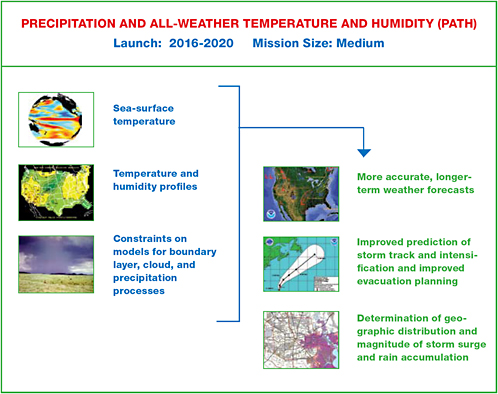
PRECIPITATION AND ALL-WEATHER TEMPERATURE AND HUMIDITY (PATH) MISSION
The need for early identification and reliable forecasting of the track and intensity of tropical cyclones and of the geographic distribution and magnitude of storm surge and rain accumulation during and after landfall is underscored by the unprecedented extent of the 2005 hurricane season in the United States. More accurate, more reliable, and longer-term forecasts, driven by improved observations from space, could have had a direct effect on evacuation planning and execution, distribution of emergency response resources, and, ultimately, mitigation of loss of life and human suffering. Critical observations that would enable transformational improvements in forecasting skills include observations of three-dimensional atmospheric temperature and water vapor, as well as sea-surface temperature and precipitation fields under all weather (both clear and cloudy) conditions, with temporal refreshing every 15–30 minutes. The PATH mission would provide these measurements.
Background: Operational NOAA and DOD LEO satellites have for many years carried microwave spectrometers for atmospheric sounding of temperature, water vapor, and cloud liquid water. The LEO platforms
also carry infrared sounders, and the performance of each is substantially enhanced by the presence of the other, especially in cloudy conditions. IR sounders are also carried on operational NOAA GEO platforms, but to date no microwave sounder has flown in GEO because of the limitations of available technology. The value of the current GEO soundings, based solely on IR observations, to numerical weather prediction models is significantly limited in regions of clouds and precipitation. Recent developments in microwave imaging technology have focused on this problem, and GEO microwave sounders are now possible.
Science Objectives: It is widely recognized that current numerical weather prediction models inadequately represent the processes of cloud formation, evolution, and precipitation. The models rely on simplistic parameterization schemes and an incomplete understanding of the underlying cloud microphysics to represent the most rapidly changing weather features. Time-continuous all-weather observations will impose powerful new constraints on, and lead to greatly improved models for, boundary-layer, cloud, and precipitation processes. The availability of continuous observations will also mitigate the requirements of those models by making frequent reinitialization possible. The observations will enable major scientific advances in understanding of El Niño, monsoons, and the flow of tropical moisture to the United States. The ocean, which covers 70 percent of Earth, is the lower boundary for much of the atmosphere, and sea-surface temperature controls the latent and sensible heat flux and moisture flux from the ocean to the atmosphere; the strength and track of hurricanes and the cyclogenesis in tropical oceans depend on those fluxes.6
Mission and Payload: Temporal resolution from LEO cannot begin to approach 15–30 min without an impractically large constellation of platforms. Only a medium-Earth-orbit (MEO) mission or a GEO mission can reasonably deliver the required time resolution. Accommodation of an all-weather sensor suite on future GOES GEO platforms is the most promising option in the next 10 years. Placement on MEO platforms is a second option. However, although the lower-altitude MEO would improve spatial resolution relative to that obtained with GEO, there is very little flight heritage for scientific instruments in MEO. As a result, the timescale of technology developments required for a MEO mission would be considerably longer.
All-weather retrievals of air temperature and absolute humidity profiles require spectrometric observations of microwave emission along rotational transition lines of oxygen and water vapor. The lower energy transitions, in particular in the 50- to 70- and 118-GHz oxygen complex and the single 183-GHz line for water vapor, are best suited for penetration into clouds. The retrieval of surface rain rate has been demonstrated with passive microwave observations by the Special Sensor Microwave/Imager (SSM/I) and the Advanced Microwave Sounding Unit; this method requires the same microwave spectrometer observations as does the retrieval of temperature and humidity profiles. The radiometer receiver and spectrometer technologies required for tropospheric sounding are mature, and thus are considered low risk.
Cost: About $450 million.
Schedule: The technology readiness of critical microwave antenna, receiver, and back-end electronics for a GEO mission is consistent with a new start in about 2010–2015. For integration on a GOES platform, the schedule must also comply with future NOAA GOES opportunities. Technology readiness is less advanced for a MEO mission owing to a lack of heritage design references. A new start for a MEO mission in about 2020 could be targeted.
Further Discussion: See in Chapter 10 the section “All-Weather Temperature and Humidity Profiles.”
Related Response to Committee’s RFI: 48.
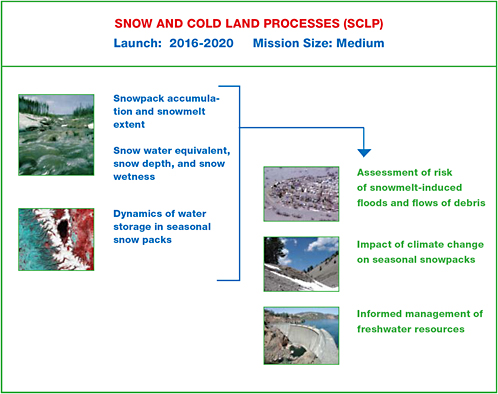
SNOW AND COLD LAND PROCESSES (SCLP) MISSION
One-sixth of the world’s population and more than one-fourth of the global gross domestic product rely on water supplies derived in part from seasonal snowpacks and glaciers. Freshwater derived from snow is often the principal source of potable water, and snow is a major source of water for irrigation, energy production, transportation, and recreation. In the western United States, over 70 percent of stream flow is derived from snowmelt. Hence, understanding the dynamics of water storage in seasonal snowpacks is critical for the effective management of water resources both in the United States and globally. Furthermore, properties of snow influence surface water and energy fluxes and other processes important to weather and climate over much of the globe, in addition to biogeochemical fluxes, ecosystem dynamics, and even some solid-Earth hazards and dynamics. Better understanding of those interactions in snow-dominated regions is important for a number of scientific and practical reasons, including prediction of the effects of high-latitude lakes and wetlands on the global carbon cycle and the management of freshwater resources. Climate change seriously threatens the abundance of snow globally and is changing the dynamics of snow accumulation and melt (in the western United States, peak spring snowmelt runoff has advanced several
weeks over the last half-century). Characterizing the interactions of changing climate with snow accumulation and melt dynamics will require better observations of snowpack extent and water storage. Snow can also pose a hazard. Eight of the most damaging U.S. floods in the 20th century were associated with snowmelt, including the devastating Grand Forks flood of 1997, which caused damage costing over $4 billion. SCLP will provide critical information for water resources management, as well as natural-hazard mitigation.
Background: Seasonal snowpacks are a dynamic freshwater reservoir that stores precipitation and delays runoff and in so doing plays a major role in the terrestrial water cycle of much of Earth’s land surface. One-sixth of the world’s population depends on snow-covered glaciers and seasonal snow for water supplies, which may be at risk from a warming climate. Snow is often the principal source of freshwater for drinking, food production, energy production, transportation, and recreation, especially in mountain regions and the surrounding lowlands. Snow covers up to 50 million square kilometers (34 percent) of the global land area seasonally and affects atmospheric circulation and climate from local to regional and global scales. SCLP will fill a critical gap in the current global water-cycle observing system by measuring snow water equivalent (SWE), snow depth, and snow wetness over land and ice sheets.
Science Objectives: Scientists and managers need to know the spatial extent of snow cover and, perhaps more important, how much water is in the snowpack and how fast it is melting. Globally, the dynamics of snowpacks can vary greatly. By one classification scheme, there are in fact seven characteristic snow domains, from maritime (such as the mountains of the northwestern United States) to cold high-latitude tundra areas. The hydrologic characteristics of the snow in the different domain types depend on the extent of the snow cover and its water content. The extensive shallow snowpacks found in high-latitude regions require high-accuracy (2-cm root mean square error) measurement, whereas the requirement for deep snowpacks, such as in mountainous areas, is less stringent (10 percent root mean square error). Topography controls the distribution and dynamics of snow cover, which dictates spatial resolution on the order of that required for hillslope processes—typically a few hundred meters at most. In the temporal domain, intraseasonal and synoptic-scale snow accumulation and ablation processes need to be resolved. On the intraseasonal timescale, observations of around 15 days are required. To resolve the effects of individual weather events, a shorter repeat interval, 3–6 days, is needed.
Mission and Payload: A mission consisting of a dual-mode high-frequency (X-, Ku-band, with VV- and VH-polarization) synthetic aperture radar (SAR) and a high-frequency (K-, Ka-band with H-polarization) passive microwave radiometer in LEO would meet the scientific objectives. Microwave sensors are best suited for the measurement objectives. A combination of active and passive microwave instruments will provide the needed spatial resolution and heritage for key climate data records. The two high-frequency SAR channels are sensitive to volumetric scattering in snow but sample a range of depths and so are capable of characterizing both deep and shallow snowpacks. The X-band SAR would also be used to create a reference image and thereby account for substrate emissivity. The dual-polarization-mode SAR enables discrimination of the radar backscatter into volume and surface components. The dual-frequency passive microwave radiometer would provide additional information to aid radar retrieval and would also provide a link to snow measurements from previous, recent, and planned passive microwave sensors. A multiresolution configuration would provide spatial resolution of around 50–100 m for spatial variability on the hillslope scale. However, it is not essential to have this level of resolution everywhere all the time. Subkilometer spatial resolution would often be sufficient if 50- to 100-m observations were regularly available to link to finer-resolution observations of local and hillslope-scale processes. Dual temporal resolution
is also proposed with 15-day temporal resolution to capture intraseasonal variability and a shorter repeat interval of 3–6 days to resolve the effects of synoptic weather events.
Cost: About $500 million.
Schedule: The SCLP concept has heritage from QuickSCAT, the Shuttle Radar Topography Mission (SRTM), and SSM/I. A similar mission, the Cold Regions Hydrology High-resolution Observatory (CoReH2O), is under consideration by ESA and is in the risk-reduction phase. An assessment of measurement requirements and technology has been conducted by NASA’s Earth Science and Technology Office. Given the uncertainty regarding the replacement for the CMIS instrument on the NPOESS platform, the passive microwave component in the SCLP mission concept could provide some interim capability. Launch in about 2016–2020 is recommended, but given the proposed mission’s heritage, need, and international momentum, an earlier launch is feasible.
Further Discussion: See in Chapter 11 the section “Snow and Cold Land Processes.”
Related Response to Committee’s RFI: 19.
Supporting Documents:
Barnett, T.P., J.C.Adam, and D.P.Lettenmaier. 2005. Potential impacts of a warming climate on water availability in snow-dominated regions. Nature 438(17):303–309, doi:10.1038/nature04141.
Nghiem, S., and W.Tsai. 2001. Global snow cover monitoring with spaceborne Ku-band scatterometer. IEEE Trans. Geosci. Remote Sens. 39(10):2118–2134.
Shi, J., and J.Dozier. 2000. Estimation of snow water equivalence using SIR-C/X-SAR, Part 1: Inferring snow density and subsurface properties. IEEE Trans. Geosci. Remote Sens. 38(6):2465–2474.
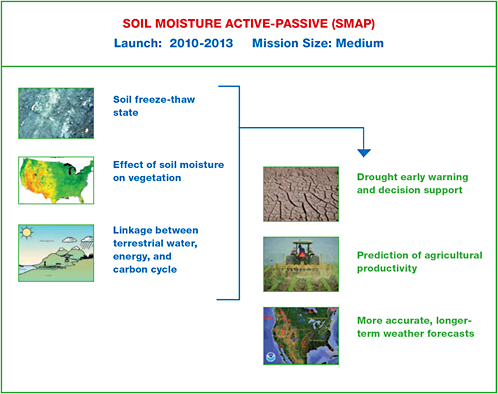
SOIL MOISTURE ACTIVE-PASSIVE (SMAP) MISSION
Soil moisture is a key control on evaporation and transpiration at the land-atmosphere boundary. Large amounts of energy are required to vaporize water, and so soil control on evaporation and transpiration also influences surface energy fluxes. Hence, variations in soil moisture affect the evolution of weather and climate over continental regions. Initialization of numerical weather prediction (NWP) models and seasonal climate models with correct information on soil moisture enhances their prediction skill and extends their lead times. Soil moisture strongly affects plant growth and therefore agricultural productivity, especially during conditions of water shortage, the most severe of which is drought. There is no global in situ network for measuring soil moisture, and global estimates of soil moisture, and, in turn, plant water stress, must be derived from models. The model predictions (and hence drought monitoring) could be greatly enhanced through assimilation of soil-moisture observations. Soil moisture and its freeze-thaw state are also key determinants of the global carbon cycle. Carbon uptake and release in boreal landscapes are a major source of uncertainty in assessing the carbon budget of the Earth system (the so-called missing carbon sink). Soil moisture also is a key variable in water-related natural hazards, such as floods and landslides. High-
resolution observations of soil moisture would help to improve flood forecasts, especially for intermediate to large watersheds, where most flood damage occurs, and thus improve the capability to protect downstream resources. Soil moisture in mountainous areas is one of the most important determinants of landslides, a hazard that could be better predicted with consistent observations, which are currently lacking.
Background: Global mapping of soil moisture and its freeze-thaw state at high resolution has long been of interest because these variables link the terrestrial water, energy, and carbon cycle. Such measurements also have important applications in predicting natural hazards, such as severe rainfall, floods, and droughts. The spatial variations in soil-moisture fields are determined by precipitation and radiation forcing, vegetation distribution, soil-texture heterogeneity, and topographic redistribution processes. The spatial variations lead to the need for high-resolution soil-moisture mapping (Entekhabi et al., 1999). Numerous airborne and tower-based field experiments have shown that low-frequency L-band microwave measurements are reliable indicators of soil-moisture changes across the landscape. Only by combining high-resolution active radar and high-accuracy passive radiometer L-band measurements is it possible to produce data that meet the science and application requirements. The proposed SMAP mission builds on the risk-reduction performed for the AO-3 ESSP called the Hydrosphere State (Hydros) mission (Entekhabi et al., 2004). The SMAP radar makes overlapping measurements, which can be processed to yield resolution enhancement and 1- to 3-km resolution mapped data. The SMAP radar and radiometer share a large deployable light-weight mesh reflector that is spun to make conical scans across a wide (1,000-km) swath. This measurement approach allows global mapping at 3- to 10-km resolution with 2- to 3-day revisit.
Science Objectives: Soil moisture and its freeze-thaw state are primary controls on the exchange fluxes of water, energy and carbon at the land-atmosphere interface. More important, those variables are what link the water, energy, and carbon cycles over land. The availability of soil-moisture data will remove existing stovepiping in the water, energy, and biogeochemistry communities by directly characterizing the link between the cycles over land regions. The data will also enable the Earth system science community to address the question of how perturbations in one cycle (radiative forcing) affect the rates of the other cycles. The spatial variability that is due to the influences of intermittent precipitation, patchy cloudiness, soil and vegetation heterogeneity, and topographic factors leads to the requirement for high-resolution mapping of soil moisture and its freeze-thaw state. Currently there are no in situ networks to support the data needs of Earth system scientists. Forthcoming satellite missions do not have the active-sensor and passive-sensor combination needed to meet the resolution requirements to characterize the heterogeneous fields.
Soil moisture serves as the memory at the land surface in the same way as sea-surface temperature does at the ocean surface. The use of sea-surface temperature observations to initialize and constrain coupled ocean-atmosphere models has led to important advances in long-range weather and seasonal prediction. In the same way, high-resolution soil-moisture mapping will have transformative effects on Earth system science and applications (Entekhabi et al., 1999; Leese et al., 2001). As the ocean and atmosphere community synergies have led to substantial advances in Earth system understanding and improved prediction services, the availability of high-resolution mapping of surface soil moisture will be the link between the hydrology and atmospheric communities that share interest in the land interface. The availability of such observations will enable the emergence of a new generation of hydrologic models for applications in Earth system understanding and operational severe-weather and flood forecasting.
Mission and Payload: The SMAP mission, based on one flight system in a low-Earth, Sun-synchronous orbit, includes a capability for active radar and passive radiometer measurements. The two sensors share a single feedhorn and mesh reflector to form a beam offset from nadir with the surface of 39°. This beam is rotated
conically about the nadir axis to make a wide-swath measurement. The reflector is composed of lightweight mesh material that can be stowed for launch. The feed and reflector components shared between the two sensors lead to cost savings. The SMAP hardware is derived from the Hydros design and has therefore been subject to substantial study and risk reduction. Similarly, the spacecraft dynamics, ground data system, and science algorithms have been tested to a great extent. Field experiments have been used to validate the science algorithms, and scale models have been constructed to test the antenna performance. As a result of the Hydros risk-reduction investments and activities, all the components of the proposed SMAP are at technology readiness level 7 and higher.
Cost: About $300 million.
Schedule: As a pathfinder, SMAP is conceptualized as being built on the foundations of the earlier AO-3 concept (Hydros) that has undergone risk reduction marked by rigorous reviews. As a result, SMAP is ready to move on a fast-track toward launch as early as 2012, when there are few scheduled Earth missions. SMAP’s readiness also gives a capability for gap-filling observations to meet key NPOESS community needs; soil moisture is the key parameter (see Section 4.1.6.1.6 in Joint Requirements Oversight Council, 2002). In addition, SMAP will yield continuity measurements for the Aquarius mission community.
Further Discussion: See in Chapter 11 the section “Soil Moisture and Freeze-Thaw State.”
Related Responses to Committee’s RFI: Similar to those of the Hydros mission proposed for ESSP.
References:
Entekhabi, D., G.R.Asrar, A.K.Betts, K.J.Beven, R.L.Bras, C.J.Duffy, T.Dunne, R.D.Koster, D.P.Lettenmaier, D.B.McLaughlin, W.J.Shuttleworth, M.T.van Genuchten, M.-Y.Wei, and E.F.Wood. 1999. An agenda for land-surface hydrology research and a call for the second International Hydrological Decade. Bull. Am. Meteorol. Soc. 80(10):2043–2058.
Entekhabi, D., E.Njoku, P.Houser, M.Spencer, T.Doiron, J.Smith, R.Girard, S.Belair, W.Crow, T.Jackson, Y.Kerr, J.Kimball, R.Koster, K.McDonald, P.O’Neill, T.Pultz, S.Running, J.C.Shi, E.Wood, and J.van Zyl. 2004. The Hydrosphere State (HYDROS) mission concept: An Earth system pathfinder for global mapping of soil moisture and land freeze/thaw. IEEE Trans. Geosci. Remote Sens. 42(10):2184–2195.
Joint Requirements Oversight Council. 2002. Joint DOD-NOAA-NASA Integrated Operational Requirements Document II (IORD-II). Available at http://www.osd.noaa.gov/rpsi/IORDII_011402.pdf.
Leese, J., T.Jackson, A.Pitman, and P.Dirmeyer. 2001. GEWEX/BAHC international workshop on soil moisture monitoring, analysis, and prediction for hydrometeorological and hydroclimatological applications. Bull. Am. Meteorol. Soc. 82:1423–1430.
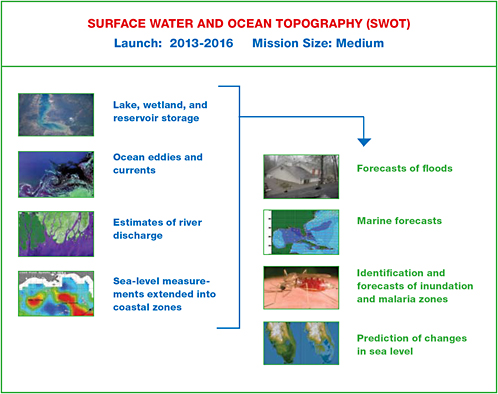
SURFACE WATER AND OCEAN TOPOGRAPHY (SWOT) MISSION
More than 75 percent of the world’s population depends on surface water as its primary source of drinking water, but there is no coordinated global observing system for surface water. Furthermore, in the case of transboundary rivers, information is often not freely available about water storage, discharge, and diversions in one country that affect the availability of water in its downstream neighbors. For rivers, the surface stage, or water level, is the most critical observation that allows estimation of river discharge, but the global network of in situ river discharge observations is extremely nonuniform; generally, the observation density is much higher in the densely populated portions of developed countries than in the developing world. The SWOT mission would produce swath (image) altimetry of water surfaces over both the lands and oceans globally at much higher spatial resolution than is now available. That information would extend the successes of ocean altimeters to inland and coastal waters and would provide a basis for directly measuring the storage of water in lakes, reservoirs, and wetlands globally. River discharge would be estimated as a derived variable. River discharge is a key variable not only for water management but also for flood forecasting, which is the main tool for mitigation of property damage and loss of life related
to one of the most devastating natural hazards. Moreover, major health issues, such as malaria, are linked to freshwater storage and discharge.
In addition to providing information about the distribution of surface water and its movement over land, the SWOT swath altimeter would also provide precision measurements to continue a climate record of sea level and to extend the record to coastal regions (including estuaries), where continued population growth and development pressures threaten marine resources. Bathymetry from a swath altimeter would improve navigation and marine rescue operations, planning for resource management, prediction of tsunami heights, and mixing rates in the deep ocean. The swath altimeter would help to improve climate and weather forecasts as well by providing essential information on changes in ocean circulation and the contributions of ocean eddies to the changes. Changes in ocean circulation are related in large part to changes in wind forcing such that the coordination of sea-level measurements with improvements in the observations of ocean-vector winds will greatly enhance the measurements of either mission. Coastal ecosystems are greatly affected by changes in wind-forced coastal circulation, and high resolution in both measurements will contribute to improved fisheries management. Hurricanes in the Gulf of Mexico have been shown to intensify over the warm Loop Current and its eddies, a system not well resolved by the current nadir altimeters. A similar issue of insufficient measurement detail confronts ocean-climate models. Improving such models could result in improved forecasts and, in turn, mitigation of storm effects on health and property.
Background: SWOT will address science and applications questions related to the storage and movement of inland waters, the circulation of the oceans and coastal waters, and the fine-scale bathymetry and roughness of the ocean floor. SWOT will consist of a swath altimeter that will produce measurements of water-surface elevations over inland waters, as well as near-coastal regions and the open ocean. Over land, it will provide observations of water stored in rivers, lakes, reservoirs, and wetlands, with river discharge estimated as a derived variable. Surface-water storage change and river discharge are major terms in the terrestrial water balance that are now observed only at points with highly varied density. Spatial mapping of water-surface elevations will capture the dynamics of wetlands and flooding rivers, which exert important controls on the fluxes of biogeochemical and trace gases between the land, atmosphere, and oceans. Over the ocean, the scientific value of past altimetry missions is well documented for ocean circulation, tides, waves, sea-level change, geodesy, and marine geophysics. However, spatial-resolution issues have precluded the use of ocean altimeters in near-coastal waters. With the much higher spatial resolution that is facilitated by swath altimetry, SWOT is expected to produce information about bathymetry, tidal variations, and currents in near-coastal and estuarine areas.
Science Objectives: The wide-swath altimeter will measure spatial fields of surface elevations for both inland waters and the ocean. Those will lead to new information about the dynamics of water stored at the land surface (in lakes, reservoirs, wetlands, and river channels) and improved estimates of deep-ocean and near-coastal marine circulation. These observations will provide the basis for estimation of the dynamics of water-storage and river-discharge variations. The SWOT altimeter will have a vertical precision of a few centimeters (averaged over areas of less than 1 km2) and the ability to estimate surface water slopes to a precision of 1 microradian over areas of less than 1 km2. The latter will lead to an improvement in the spatial resolution of global estimates of ocean bathymetry by a factor of 20, which is expected to result in the mapping of ~50,000 additional seamounts. The altimeter requires a precise (non-Sun-synchronous) orbit for measurement accuracy, with a likely repeat cycle of about 21 days (combining ascending and descending orbits results in a revisit of about 10.5 days) and coverage to latitudes up to 78°. For rivers, the goal is to recover channel cross-sectional profiles to within 1-m accuracy at low water, which will allow estimation
of the discharge of about 100-m-wide rivers via assimilation into hydrodynamic models. The resulting discharge estimates will constitute fundamentally new measurements for many parts of the globe where there is no in situ stream-gauge network or where the network is too sparse to estimate surface-water dynamics at large scales. For the ocean, the mission will map sea level with a precision of a few centimeters and a spatial resolution of less than 1 km2, extending the sea-level measurements to the ocean-eddy field and into the coastal zones. With a nadir-looking altimeter, a non-Sun-synchronous orbit, and precise tracking, the mission can extend the climate record of sea level beyond the current Jason series of altimeters.
Mission and Payload: A suite of instruments will be flown on the same platform: a Ku-band near-nadir SAR interferometer; a 3-frequency microwave radiometer; a nadir-looking Ku-band radar altimeter;7 and a GPS receiver. The Ku-band SAR interferometer draws heavily from the heritage of the Wide Swath Ocean Altimeter (WSOA) and the Shuttle Radar Topography Mission (SRTM). The Ku-band synthetic aperture interferometer would provide vertical precision of a few centimeters over areas of less than 1 km2 with a swath of 120 km (including a nadir gap). The nadir gap would be filled with a Ku-band nadir altimeter similar to the Jason-1 altimeter, with the capability of doing synthetic aperture processing to improve the along-track spatial resolution. Because the open ocean lacks fixed elevation points, a microwave radiometer will be used to estimate the tropospheric water-vapor range delay and the GPS receiver for a precise orbit. A potential side benefit is that the GPS receiver could in principle also be used to provide radio-occultation soundings. Orbit selection is a compromise between the need for high temporal sampling for surface-water applications, near-global coverage, and the swath capabilities of the Ku-band interferometer. A swath instrument is essential for surface-water applications because a nadir instrument would miss most of even the largest global rivers and lakes. To achieve the required precision over water, a few changes will be incorporated into the SRTM design. The major one would be reduction of the maximal look angle to about 4.3°, which would reduce the outer swath error by a factor of about 14 compared with SRTM. A key aspect of the data-acquisition strategy is reduction of height noise by averaging neighboring image pixels, which requires an increase in the intrinsic range resolution of the instrument. A 200-MHz bandwidth system (0.75-m range resolution) would be used to achieve ground resolutions varying from about 10 m in the far swath to about 70 m in the near swath. A resolution of about 5 m (after onboard data reduction) in the along-track direction can be achieved with synthetic aperture processing. To achieve the required vertical and spatial resolution, SAR processing must be performed. Raw data would be stored on board (after being passed through an averaging filter) and downlinked to the ground. The data-downlink requirements (for both ocean and inland waters) can be met with eight 300-Mbps X-band stations globally.
Cost: About $450 million.
Schedule: As a practical matter, the scheduling of SWOT may be dictated by the need for continuing ocean altimeter observations. SWOT could satisfy the operational requirements of the Jason series (meaning that SWOT would essentially become Jason-3). Depending on the longevity of Jason-2 (currently scheduled for launch in mid-2008), this would suggest a SWOT launch date in the 2013–2015 range. Given the heritage of SWOT in WSOA and SRTM, the technology is sufficiently mature that such a schedule should be feasible. An overlap with XOVWM to measure winds is highly desirable for ocean applications.
Further Discussion: See in Chapter 11 the section “Surface Water and Ocean Topography.”
|
7 |
The assumption is that the swath altimeter would use the Ku band. However, as discussed in Chapter 11 (in the section “Surface Water and Ocean Topography”), studies of tradeoffs will be required to decide between the Ka and the Ku band, the primary tradeoff being precision (higher for the shorter Ka wavelength) and data loss rates during precipitation (lower for the Ku band). |
Related Responses to Committee’s RFI: 79 and 108.
Supporting Documents:
Alsdorf, D.E., and D.P.Lettenmaier, 2003. Tracking fresh water from space. Science 301:1491–1494.
Alsdorf, D., D.Lettenmaier, and C.Vörösmarty. 2003. The need for global, satellite-based observations of terrestrial surface waters. EOS Trans. AGU 84(29):275–276.
Alsdorf, D., E.Rodriguez, and D.P.Lettemaier. 2007. Measuring surface water from space. Rev. Geophys. 45:RG2002, doi:10.1029/ 2006RG000197.
Fu, L.-L, and A.Cazenave, eds. 2001. Satellite Altimetry and the Earth Sciences: A Handbook of Techniques and Applications. Academic Press, San Diego, Calif.
Fu, L.-L, and E.Rodriguez. 2004. High-resolution measurement of ocean surface topography by radar interferometry for oceanographic and geophysical applications. Pp. 209–224 in State of the Planet: Frontiers and Challenges (R.S.J.Sparks and C.J.Hawkesworth, eds.). AGU Geophysical Monograph 150, IUGG Vol. 19. American Geophysical Union, Washington, D.C.
Goni, G., and J.Trinanes. 2003. Ocean thermal structure monitoring could aid in the intensity forecast of tropical cyclones. EOS Trans. AGU 84:573–580.
Smith, W.H.F., ed. 2004. Special issue: Bathymetry from space. Oceanography 17(1):6–82. Available at http://www.los.org/oceanography/issues/issue_archive/1 7_1 .html.
Smith, W.H.F., R.K.Raney, and the ABYSS team. 2003. Altimetric Bathymetry from Surface Slopes (ABYSS): Seafloor geophysics from space for ocean climate. Proceedings of the Weikko A. Heiskanen Symposium in Geodesy (C. Jekeli, ed.). Ohio State University, October 1–5, 2002, Columbus, Ohio. Available at http://www.ceegs.ohio-state.edu/~cjekeli/Proc_PC.pdf
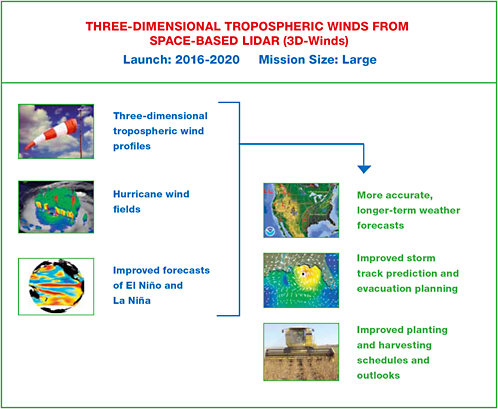
THREE-DIMENSIONAL TROPOSPHERIC WINDS FROM SPACE-BASED LIDAR (3D-WINDS) MISSION
More accurate, more reliable, and longer-term weather forecasts, driven by fundamentally improved tropospheric wind observations from space, would have direct and measurable societal and economic effects. Tropospheric winds are the number-one unmet measurement objective for improving weather forecasts. Improved forecasts of extreme-weather events would also benefit public safety through disaster mitigation. Hurricanes, for example, are generally steered by tropospheric winds whose vertical shear is often responsible for increasing a hurricane’s intensity. Public confidence in hurricane warnings will increase as forecasts get better, and a superior description of hurricane wind fields should result in substantial numbers of lives saved. Similar benefits of improved three-dimensional tropospheric wind observations from space should accrue with improved predictions of severe weather outbreaks, tornadic storms, floods, and coastal high-wind events.
Background: The proper specification and analysis of tropospheric winds are important prerequisites of accurate numerical weather prediction (NWP). Even with the recent advances in the assimilation of radiances, wind is still a critical parameter for data assimilation and NWP because of its unique role in specifying the initial potential vorticity, required for accurate forecasting. Scientific applications are severely limited by the lack of directly measured three-dimensional wind information over the oceans, the tropics, the polar regions, and the Southern Hemisphere, where other meteorological observations are scarce. Large analysis uncertainties remain over wide areas of the globe, especially for the three-dimensional tropospheric wind field.
Science Objectives: The space-based 3D-Winds mission is designed to characterize three-dimensional tropospheric winds on a global scale under a variety of aerosol loading conditions. Because wind is ultimately related to the transport of all atmospheric constituents, its measurement is crucial for understanding sources and sinks of constituents, such as atmospheric water. The transport of water vapor is essential to closing regional hydrologic cycles, and its measurement should enable scientific advances in understanding El Niño, monsoons, and the flow of tropical moisture to the United States. Reliable global analyses of three-dimensional tropospheric winds are needed to improve the depiction of atmospheric dynamics, the transport of air pollution, and climate processes. Finally, the value of accurate wind measurements in day-to-day weather forecasting is well-known; for example, the tracks of tropical cyclones are modulated by environmental wind fields that will be better analyzed and forecasted with the assimilation of newly available wind profiles.
Mission and Payload: A hybrid Doppler wind lidar (HDWL) in LEO could have a transforming effect on global tropospheric-wind analyses. The HDWL is a combination of two DWL systems (coherent and noncoherent) operating in different wavelength ranges that have distinctly different but complementary measurement advantages and disadvantages. One DWL system would be based on a coherent Doppler lidar using a 2-µm laser transmitter and a coherent detection system, a type of system used extensively in ground-based Doppler lidars and more recently in a few airborne lidar systems. Because the operational wavelength of the system is in the near-infrared, it is particularly sensitive to wind in the presence of aerosols, such as in the planetary boundary layer or in aerosol-rich layers in the free troposphere resulting from biomass-burning plumes or clouds. It has low sensitivity in regions with low aerosol loading frequently found in the free troposphere and above the tropopause. The second type of DWL that would be part of the HDWL operates at ultraviolet wavelengths and uses the noncoherent detection of molecular Doppler shifts to enable wind measurements in the “clean” air regions. Combining the two DWL systems into an HDWL would allow measurements of wind across most tropospheric and stratospheric conditions.
Because of the complexity of the technology associated with an HDWL, an aggressive program is needed early on to address the high-risk components of the instrument package and then to design, build, aircraft-test, and ultimately conduct space-based flights of a prototype HDWL. The program should also complement and, when possible, leverage the work being performed by the European Space Agency (ESA) with a noncoherent lidar system. Phased development of the 3D-Winds mission would proceed as follows: Stage 1 would be the design, development, and demonstration of a prototype HDWL system capable of global wind measurements to meet demonstration requirements that are somewhat reduced from operational threshold requirements. All the critical laser, receiver, detector, and control technologies would be tested in the demonstration HDWL mission. Stage II would entail the launch of an HDWL system that would meet fully operational threshold tropospheric wind measurement requirements. The 3D-Winds mission would transform how global wind data are obtained for assimilation into the latest NWP models.
Cost: About $650 million (Stage I demonstration HDWL mission).
Schedule: Stage I, space demonstration of a prototype HDWL in LEO, could take place as early as 2016. Stage II, launch of a fully operational HDWL system, could take place as early as 2022.
Further Discussion: See in Chapter 10 the section “Space-based Measurements of Tropospheric Winds.”
Related Responses to Committee’s RFI: 28, 29, and 78.


