2
Basic Operation of Systems and Phenomenology
While the parts of the millimeter-wave region of the electromagnetic spectrum have been extensively investigated since Bose in the 1800s,1 the region above 100 GHz is one of the least-explored ranges of the electromagnetic spectrum. Until relatively recently, it was difficult to generate and detect terahertz radiation efficiently. Recent advances in both electro-optic and radio-frequency (RF) techniques have enabled the undertaking of new investigations. These investigations have been directed toward two applications of importance to aviation security. The first is to produce imagery of
passengers and baggage that takes advantage of the ability to penetrate clothing and other nonmetallic coverings. This application is intended to find objects such as knives, guns, and explosives by detecting their shapes through the concealment. A second, more advanced application is intended to be able to classify materials, which also may be concealed, by observing their differential absorption or reflectance of radiation—in effect, spectroscopy. Recent data have shown that solid explosives do exhibit some repeatable spectroscopic features in the spectrum above 800 GHz that may be used to differentiate them from other solids.
This chapter describes passive and active imaging technologies, fundamental characteristics and technical limitations of these technologies, and spectroscopic technologies.
IMAGING TECHNOLOGIES
Imaging detection techniques rely on the contrast between warmer and colder objects or on the contrast between objects that have high and low emissivity of radiation or, equivalently, low and high reflectivity of radiation. For example, these technologies are being used to detect guns concealed underneath clothing by the detection of the contrast between the warmer human body and the apparently cooler metal weapon.2 Imaging technologies can be either passive or active. Passive systems are not designed to generate or emit radiation but use natural background radiation for the illumination of the detection space. Active-illumination systems generate and emit radiation that is used to illuminate the detection space.
Passive Imaging
Every object generates electromagnetic emissions at all wavelengths with intensity proportional to the product of its physical temperature and its emissivity in accordance with Planck’s radiation law. Objects also reflect the radiation emanating from the environment to a degree of reflectivity which is the complement of their emissivity; the sum of the emissivity and the reflectivity is 1. Thus, an object that reflects 90 percent of the radiation striking it will have an emissivity of 10 percent. These values are generally a function of wavelength, so what might be reflecting at long wavelengths in the radio-frequency region may appear to be emissive in the infrared region. An example of this would be a metal mirror with a coating of dull black paint. An infrared sensor would sense an emissivity close to 1 and would respond to the temperature of the coating, while an RF sensor would sense the reflecting surface as the mirror, since the coating is readily penetrated by the long wavelengths.
The human body has an emissivity of about 65 percent at 100 GHz, increasing to about 95 percent at 600 GHz (Table 2-1). This would make a human body appear warm relative to a metal object, which would have a low emissivity and would thus reflect the
generally cooler temperatures in the environment around the body. Plastics and ceramics have emissivities higher than those of metal but lower than those of human flesh, so they would also contrast against the body, though to a lesser extent.
Figure 1-2 in Chapter 1 has a curve labeled “300 K Blackbody Curve” that shows the amount of radiation versus wavelength for a perfectly emissive body at 300 kelvin (K), approximately room temperature. Both the amplitude and the wavelength of the radiation peak are dependent on the temperature of the object. The higher the temperature of the body, the shorter the wavelength of radiation where the peak of the curve occurs.
TABLE 2-1 Examples of Object Emissivity
|
Object Emissivity |
(%) |
|
Human skin |
65 to 95 |
|
Plastics |
30 to 70, depending on type |
|
Paper |
30 to 70, depending on moisture content |
|
Ceramics |
30 to 70 |
|
Water |
50 |
|
Metal |
~0 |
Passive imaging systems require that there be an apparent temperature difference, either positive or negative, between the body and its surroundings. While the surrounding environment is generally cooler than the human body, some passive imaging systems use noncoherent sources that surround the body to enhance contrast by making reflective objects appear warmer than the body. These detection systems require the ability to differentiate between the temperatures of adjacent areas within the target area. The operation of a passive millimeter-wave imager can be compared with the operation of a camera. The equivalent of light for a millimeter-wave imager is the millimeter-wave energy, and the equivalent of film in a camera is the detector array in a millimeter-wave imager.
There are various millimeter-wave imagers being developed for concealed-weapon-detection applications. The difference in these devices is in the implementation of the detection hardware. These devices are at present in the development stage, and none has been deployed or tested in actual use. Several of these devices are described in Chapter 4, “Systems Concepts.”
Active Imaging
Active millimeter-wave imaging technologies operate as short-range radar systems that project a beam of millimeter-wavelength energy against a target and detect the reflected rays. The beam may illuminate the entire body or may scan over the body to produce an image of the subject. The U.S. Department of Energy’s Pacific Northwest National Laboratory has developed a system for screening people based on active millimeter-wave technology that sequentially scans both the transmitter and receiver over the body and uses a technique called computed tomography to form an image. This imaging technique, similar to that used in medical computerized axial tomography scans, involves illuminating the subject with millimeter-wave radiation. Since the power levels are low and the radiation only penetrates to skin depth, no adverse health effects occur.
However, the popular perception of the dangers of microwave radiation may cause public concern over this imaging technique.
Until recently, most terahertz sources were either low-brightness emitters, such as thermal sources, or cumbersome, single-frequency molecular vapor lasers. Detection usually relied on bolometric methods, which required cryogenic operation, or Golay cells, which have little dynamic range. Recently, however, a revolution has occurred in terahertz technology as a number of newly discovered or rediscovered generation and detection schemes have revitalized the field. These techniques rely either on frequency conversion using nonlinear optics or on quantum cascade lasers, which depend on devices formed from superlattices of semiconductors. They are often simpler, more reliable, and potentially much less expensive than the more traditional approaches. Chapter 3 presents a general description of these devices.
The promise is that terahertz imaging will provide an orthogonal detection capability that will allow the identification of explosive materials concealed on a person’s body or in nonmetallic carry-on luggage. In simple terms, the terahertz waves can penetrate materials such as clothing and leather with enough residual energy to excite molecular vibrations, rotations, and phonon-band resonances in solid materials. This excitation can be detected using spectroscopy techniques and the substance identified by an analysis of the unique signatures from different molecules. While spectroscopy will provide additional capability, it is expected that the transmissivity of explosives to x-rays is different from their transmissivity to millimeter-wavelength/terahertz technology.
The technology challenge for active imaging rests on the development of components that operate in the millimeter-wavelength/terahertz region. Poor performance and high cost have historically limited research and development efforts at millimeter-wave/terahertz wavelengths. New techniques for wave generation and detection that are unique to the terahertz spectrum are being developed in research laboratories worldwide. A literature search will yield hundreds of recent citations covering all aspects of terahertz research.
In order to form a terahertz image using time domain spectroscopy, the terahertz beam is brought to an intermediate focus using a pair of lenses or parabolic reflectors, which are inserted into the region where the terahertz beam is collimated. An object is placed at the focus of the terahertz beam, and then the amplitude and delay of the wave that has traversed through the object is measured. By translating the object and measuring the transmitted terahertz waveform for each position of the object, one can build an image pixel by pixel.
An imaging system in which the terahertz beam is reflected from the sample rather than being transmitted through it can be used for tomographic imaging. If the sample consists of several separate dielectric layers, the interface between each pair of layers reflects a portion of the terahertz beam. The reflected waveform therefore consists of a series of isolated pulses. Each pulse in this pulse train contains information about each of the layers through which it propagated, as well as about the interface from which it originated. With this information, a tomographic image may be constructed.
Resolution Versus Antenna Size
Another issue facing the application of RF techniques is that of resolution versus antenna size. When imaging in the far field of a circular aperture, the resolution R, in angle can be approximated by:

where R is the angular resolution in radians, c is the speed of light, F is the frequency of operation in hertz, and D is the diameter of the aperture of the imaging system.
Since resolution is inversely proportional to the frequency of the radiation, an imaging system would be desirable at as high a frequency as possible, given limitations in components and atmospheric propagation. Figure 2-1 shows the change in resolution across frequency for an imaging system with a 2 meter (m) diameter antenna or optical system. This linear curve shows the resolution for a passive imaging system. Passive system images are lower resolution because they are incoherent and have poor signal to noise at moderate scanning rates. Resolution can be increased by a factor of two by using an illuminator transmitting through the same aperture and thus focusing the transmitted resolution on the spot being imaged, a so-called confocal system.
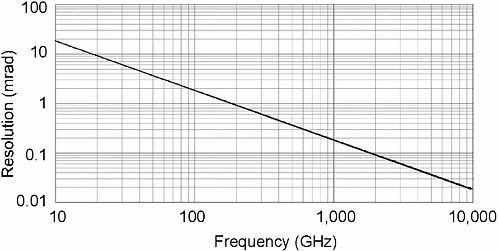
FIGURE 2-1 Antenna resolution for an imaging system with a 2 meter aperture.
While a 2 m diameter antenna seems inordinately large, to achieve “eyeball” resolution—about 1 foot at 1 kilometer—an antenna at 100 GHz would have to be approximately 14 m in diameter. While it should be understood that eyeball resolution is not necessary for the detection of concealed objects or the identification of explosives, it is a convenient metric for examining relative aperture sizes of millimeter-wavelength/
terahertz sensors versus optical sensors. Figure 2-2 shows the diameter of an antenna required to achieve the resolution of the human eye versus frequency.
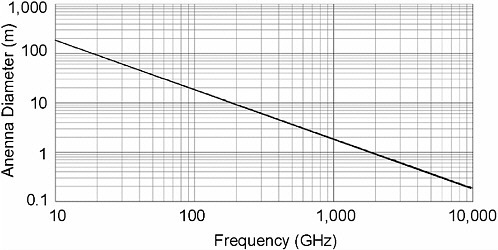
FIGURE 2-2 Antenna diameter required for an imaging system to achieve the resolution of the human eye.
Atmospheric Propagation
The atmosphere attenuates millimeter-wave radiation at frequencies determined by molecular absorption by water vapor, oxygen, and other atmospheric molecules. The atmospheric attenuation characteristics must be accounted for in any system design.
Figure 2-3 shows the atmospheric attenuation under various environmental conditions from 10 GHz to 10,000 GHz. The conditions are typical for what may be experienced outdoors in various locations. The “clear” condition, which represents the U.S. standard atmosphere, is typical for a climate like that of the mid-Atlantic states in the springtime, while the curve labeled “humid” represents what would be expected in the same region in August (hazy, hot, and humid) when the atmosphere may contain up to five times the water vapor contained by the standard atmosphere. This is an example of a worst-case condition. The data labeled “dust” are predicted on the basis of a dust model3 that has been validated at 10 GHz and represent the attenuation from a storm that has a visibility of 10 m.
The minima in Figure 2-3 clearly show the atmospheric windows that are used to define the normal frequencies of operation for these systems. While systems tend to operate around specific frequencies, both for historical reasons and because of requirements of the Federal Communications Commission, the minima where the attenuations are lower are somewhat broad. In the millimeter-wave region they are typically 26 to 40 GHz, 70 to 110 GHz, 140 GHz, and 220 GHz. In the submillimeter-
wavelength region they are 340, 410, 650, and 850 GHz. Above 1 THz, the primary window of interest is centered at 1.5 THz.
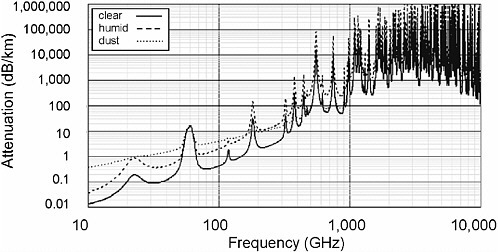
FIGURE 2-3 Atmospheric attenuation under various environmental conditions from 10 GHz to 10,000 GHz.
If an imaging or spectroscopic system were to be employed in an air-conditioned facility such as an air terminal, the curve for the clear air would be appropriate. Figure 2-3 clearly shows that lower frequencies transmit through the atmosphere with less attenuation than higher frequencies for all three conditions shown.
While atmospheric attenuation by itself is not a measure of possible performance, it does give insight into the difficulty of performing imaging and spectroscopy at various distances. As the attenuation increases, contrast will be reduced for a given distance. In a passive system that relies on natural illumination or emissions from objects, attenuation exceeding 20 decibels (dB) (100:1) will reduce contrast of typical natural scenes to the point of being indecipherable. The decibel is a means of describing relative power. It is defined as:

where P1 and P2 are two power levels that are being compared. So 10 dB is equivalent to a 10:1 ratio, 20 dB is equivalent to a 100:1 ratio, and so forth. With active systems, if transmitter power could be increased an unlimited amount, contrast could still be maintained, assuming the atmosphere does not contain particulate matter that also might reflect energy. To a first order, it can be stated that as the atmospheric attenuation increases, the range at which good image quality can be maintained will decrease.
CHARACTERISTICS OF MATERIALS
The utility of these millimeter-wavelength/terahertz systems lies primarily in their ability to penetrate materials that might shield concealed weapons or explosives from detection. Typically these materials may be normal clothing, but they could also include luggage. For the Terahertz Imaging Focal Plane Array Technology (TIFT) program of the Defense Advanced Research Projects Agency (DARPA), Ohio State University (OSU) and the University of California at Santa Barbara (UCSB) have characterized numerous articles of clothing (Figure 2-4). The OSU data were collected on clothing provided by the U.S. Army from southwest Asia, while the data measured by UCSB were from clothing provided by university students and staff. Without making an attempt to characterize the particular articles of clothing in a parametric sense, these sets of measurements indicate that transmission through clothing is generally better than 80 percent (−1.0 dB) at frequencies below 300 GHz but decreases as the frequency of operation increases. It is also apparent that transmissivity varies greatly with different types of clothing.
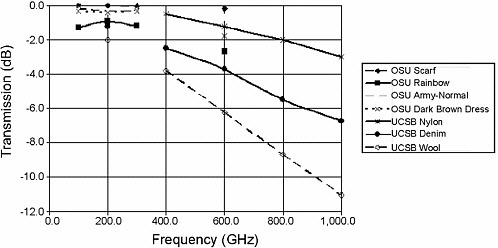
FIGURE 2-4 Transmission measurements through various clothing materials. SOURCE: Data courtesy of Ohio State University (OSU) and University of California, Santa Barbara (UCSB).
The data collected by UCSB generally appear to have reduced transmissivity when compared with OSU data. The difference may be in the clothing from southwest Asia being of a lighter material than that examined at UCSB, where the climate is generally cooler. Any system that would be required to image through clothing would be expected to operate through at least two layers of clothing, perhaps a cotton shirt and a wool sweater. The one-way transmissivity through the combination could thus be less than 50 percent at 300 GHz and 25 percent at 600 GHz. Whether the system is active or passive, the worst-case transmission, for the purpose of discerning concealed items,
would be the square of this, or 6.25 percent at 600 GHz, because the attenuation would affect the illuminating radiation from either the environment or the active illuminator.
It has also become commonplace to ascribe to millimeter-wavelength/terahertz systems the ability to image objects through walls and buildings. Figure 2-5 shows measurements made by OSU of the transmission through common building materials of signals from 100 GHz to 600 GHz. Some measurements made with millimeter-wave imagers at 95 GHz have been published, but these are through drywall or dry plywood which, as can be seen in Figure 2-5, have little effect. For materials of a structural nature such as oak or pine, the attenuation is severe.
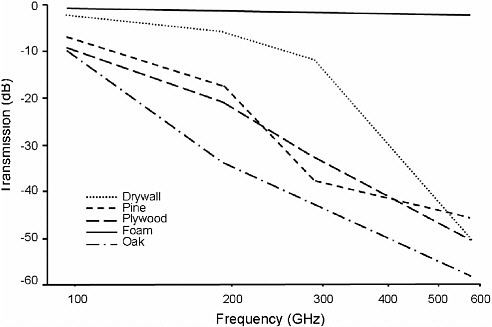
FIGURE 2-5 Measurements made with millimeter-wavelength/terahertz imaging systems of transmission through various building materials. SOURCE: Data courtesy of Ohio State University.
SPECTROSCOPY OF MATERIALS
Terahertz time domain spectroscopy (TTDS) is a new technique that has offered the promise of detection and identification of concealed explosives. The system uses a short-pulse laser and a pair of specially designed transducers as transmitters and receivers. By gating these transducers with ultrafast optical pulses, one can generate subpicosecond bursts of electromagnetic radiation, and subsequently detect them with high signal to noise using gated detectors. These transients consist of only one or two cycles of the electromagnetic field, and they consequently span a very broad bandwidth. Bandwidths extending from 100 GHz to 2 or 3 THz are routine, although the power generated is concentrated more in the lower frequencies of the emission band. Although the average intensity of the radiation is quite low, the high spatial coherence produces a brightness that exceeds that of conventional thermal sources. The gated detection is
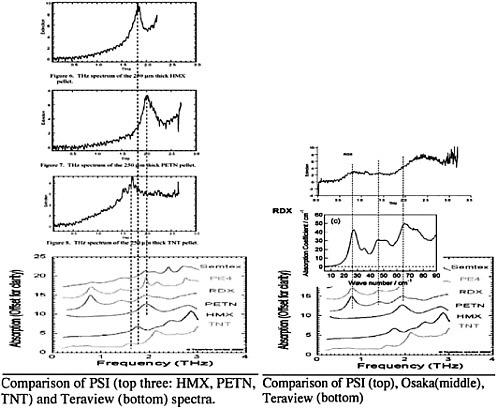
orders of magnitude more sensitive than typical bolometric detection, and it requires no cooling or shielding of any kind. Because TTDS does not require any cryogenics or shielding for the detector, it has the potential to be the first millimeter-wavelength/ terahertz chemical sensor that is portable, compact, and reliable enough for practical application in real-world environments. Note that TTDS by itself is not an imaging technique. Research conducted at Physical Sciences, Inc., has suggested that TTDS is able to distinguish, by resonances attributed to phonon bands, among the following explosives: cyclotetramethylene-tetranitramine4 (HMX), cyclotrimethylene-trinitramine5 (RDX), pentaerythritol tetranitrate (PETN), and trinitrotoluene (TNT).
Figure 2-6, compiled by Ohio State University, shows some of the spectral features of energetic materials as a function of frequency. The data from various sources differ in quality, but it is apparent that there are consistent features in the range above 1 THz, while below that only the plastic explosive (PE4) and RDX exhibit any feature. The detection of explosive features will therefore depend on the development of equipment that works well at frequencies greater than 600 GHz.
The compiled spectroscopic data should be contrasted with the spectra from gaseous materials and, specifically, the atmospheric gases. Spectra from gaseous materials are well defined under different pressures and temperatures and can be used to readily identify disparate materials. The published data for the explosive materials are less well defined.
An additional point is that there are few data available on materials such as cheese or thick liquids that might be confused, using other techniques such as x-ray, with explosives. Significant effort needs to be placed on characterizing confusing materials to ensure that there is sufficient information available in the spectra for distinguishing explosives. While there is some information to show that some materials may exhibit “colors,” there is little evidence to support an analysis of broadband versus narrowband techniques. Any investigation of materials properties needs to examine emissivities across the broad bandwidth, not just at single frequencies. As many terrorist organizations may use nonconventional or improvised explosive formulas that contain no nitrogen, research into the ability of the technology to detect these materials is needed. These confusing materials must also include human body and any other background materials that may be present in the same field of regard as the material to be detected.
One final concern that must be addressed is to distinguish the spectra of the materials when examined at a distance from which the spectra of the atmosphere itself will act to change the spectral intensity. As shown previously (see Figure 1-2 in Chapter 1), the atmosphere in the 1 THz to 10 THz region, where the bulk of the explosives features reside, is very complex, with transmission and absorption lines that further compound the problem of detecting spectral features. This problem may lead to the conclusion that the use of millimeter-wavelength/terahertz techniques for identifying explosives will be limited to very short range (<1 m), perhaps for baggage scanning or as an adjunct to a portal system.