
4
Improving Community Health Globally1
The lack of institutional capacity and sound governance contributes to many of our global community health concerns. As soon as we begin to examine community health on a global scale, we encounter the issue of poverty, noted Garrick Louis, associate professor of systems and information engineering at the University of Virginia. Poor countries often lack basic services such as water, sanitation, transportation systems, and energy. For example, currently two billion people in the world do not have access to commercial energy. Without these services, it is difficult, if not impossible, to provide access to basic public health systems. A developing country’s energy capacity is one important step to enhance a community’s access to economic, social, and health resources, said Brian Flannery of ExxonMobil. Capacity building is therefore a necessary step toward improving community health.
Energy companies such as ExxonMobil Corporation have the potential to develop local capacity and, consequently, alleviate poverty as a mainstream activity in doing business. Issues of global community health can be examined from a number of perspectives including environmental management systems (EMSs), policy implementation, and corporate social responsibility. The principles of community health management can be illustrated by the ExxonMobil Chad-Cameroon oil pipeline project. This project involved the construction of an oil pipeline from ExxonMobil’s oil production facility in Chad through neighboring Cameroon to the African coast. This large-scale project had to address numerous environmental, health, and economic impacts. The strategies for managing these impacts were sometimes cited as examples of successful implementation. How-
ever, outside analysis identified weaknesses and suggested methods for filling in the health gaps left by ExxonMobil’s pipeline project.
Addressing issues of capacity building and poverty is a difficult challenge for global corporations. Appropriate plans or management systems are necessary to ensure that an organization’s public interest goals are identified, managed, and incorporated into the organizational culture. ExxonMobil Corporation offers one such example of a management system that was established to ensure that their safety, health, and environmental goals policies and goals are effectively implemented.
As soon as we begin to examine community health on a global scale, we encounter the issue of poverty.
—Garrick Louis
EXXONMOBIL: ENVIRONMENTAL HEALTH PERFORMANCE DRIVEN BY MANAGEMENT SYSTEMS
The key goal of ExxonMobil Corporation is to provide reliable sources of quality energy products at a reasonable cost to meet an individual’s needs in both developed and developing countries, said Flannery. But at the same time, ExxonMobil must be aware of, and able to manage, the substantial environmental and health risks that are inherent in the business of oil production. ExxonMobil must therefore demonstrate the organization’s commitment to the environment, health, and social responsibility while also staying attuned to changing societal expectations.
In an effort to address emerging safety, health, and environmental questions such as these, ExxonMobil established a safety, health, and environment (SHE) management system. The SHE management system incorporates ExxonMobil’s goals by offering a structured management plan to protect safety, health, and the environment. The model for this management system includes five steps:
-
Identify the scope and objective.
-
Set procedures.
-
Identify the resources necessary for implementation.
-
Establish a verification and measurement process.
-
Create a system to receive and respond to feedback.
For the SHE management system to be effective, ExxonMobil needed to establish a widespread organizational commitment to the implementation of this management system model. Without management, leadership, commitment, and accountability, Flannery said, one does not have a management system. An organization must therefore integrate its management plan by incorporating its
goals into the business culture and identity. One method of internal integration involves aligning the SHE management system with ExxonMobil’s other management plans. By coordinating the goals, procedures, and expectations of all of ExxonMobil’s management plans, the company’s entire management system portfolio has the potential to work in harmony. The SHE management system, for example, is designed to work closely with other systems such as ExxonMobil’s Global Management System and Environmental Business Planning to ensure that goals and procedures among the management plans are uniform. This maintains operational and procedural consistency within the organization, said Flannery.
In addition to internal integration, ExxonMobil’s management plans are also externally integrated through extensive global partnerships. ExxonMobil, for example, has recently led an effort to establish the International Petroleum Industry Environmental Conservation Association. This organization works to create effective global environmental operational standards for the petroleum industry.
Additionally, ExxonMobil has made many significant safety, health, and environmental strides. The global energy management system and its predecessors, for example, have resulted in approximately 35 percent energy efficiency improvements since the 1970s and 10 percent in the 1990s (ExxonMobil Perspectives, 2002). In addition, ExxonMobil leads the industry in many safety indicators, and their safety performance continues to improve at a rate of 22 percent annually (ExxonMobil, 2002). Many of these improvements can be attributed to effective management plans such as the SHE management system. Research, technology, and their deployment will provide the answers, not just public policy mandates, concluded Flannery. At the end of the day, things have to change either people’s behavior or the systems by which we manufacture and use goods, services, and products. Multinational companies with strategic emphasis on research and development play an essential role in the development and global deployment of advanced technologies to address the sustainability challenge. Energy is critical to development. Without appropriate enabling infrastructure, capacity, and governance, we will not be able to address the needs and aspirations of two billion people without access to energy today.
HEALTH AND ENVIRONMENT IN PRACTICE: BUILDING OF EXXONMOBIL’S CHAD-CAMEROON PROJECT
Chad is located in the heart of central Africa and is one of the poorest countries in the world (Figure 4-1). According to a 1998 World Bank report, the per-capita gross national product in Chad was $180 compared to $490 in other sub-Saharan countries (World Bank PovertyNet, 2004). In addition, a 1995 survey found that 64 percent of Chad’s population fell below the national poverty line (World Bank Group, 2004). In the 1990s, ExxonMobil began to develop a program to extract one billion barrels of oil per day from southern Chad and to build
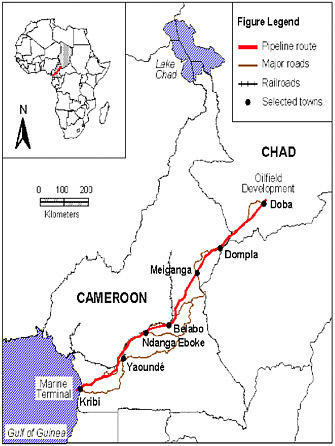
FIGURE 4-1 Map of ExxonMobil’s oil pipeline route. This pipeline stretched over 1000 kilometers from ExxonMobil’s oil field development in Doba Chad, through Cameroon, ending at Kribi, a port city on the west coast of Africa. SOURCE: Utzinger et al., 2005.
an oil pipeline through both Chad and Cameroon to transport oil to the African coast. Before construction could begin, ExxonMobil had to develop a strategy to address the social, economic, community, and structural challenges that such a large-scale project would pose, said Andre Madec of ExxonMobil.
The first challenge was the countries’ governance structure and history of political instability. Not only did ExxonMobil work within the governments of Chad and Cameroon, they also facilitated close cooperation between the two politically disconnected countries. Secondly, ExxonMobil needed to address the countries’ lack of capacity and basic infrastructure. Thirdly, they needed to respond to concerns from international nongovernmental organizations (NGOs) as well as local community members in Chad and Cameroon who wanted to ensure that the health and well-being of local residents were not negatively affected.
Finally, they needed to address significant local health concerns regarding diseases such as human immunodeficiency virus (HIV)/acquired immunodeficiency syndrome (AIDS) and malaria. After identifying these challenges, ExxonMobil developed and implemented individualized strategies for mitigation.
The Role of Local Government in the Implementation of the Safety, Health, and Environment Management System
It is necessary for a company such as ExxonMobil to work with and empower the local administration, community groups, and aid organizations. It is this empowerment that builds the country’s ultimate capacity to succeed, said Madec. To ensure that revenues from oil production in Chad were dedicated to local development and not dissipated through corrupt programs and individuals, ExxonMobil worked with the Chad government and the World Bank to develop a binding agreement called the revenue management plan. This plan outlined specific strategies for the use of oil production revenues. Seventy-two percent of all oil revenues were dedicated to identify priority areas including health, education, infrastructure, agriculture, the environment, and water resources. Five percent was devoted to community development and 10 percent was set aside in a savings program for future generations. Only 13 percent of the total oil revenues were allocated to the general government budget. Through this agreement, ExxonMobil hoped to ensure that oil production would continue to benefit the communities in Chad and Cameroon for years to come. This revenue management plan relied greatly on the involvement of local community groups, governments, and NGOs.
Lack of Capacity and Basic Infrastructure
To transport production equipment and materials necessary for the construction of the Chad-Cameroon oil pipeline, over 500 kilometers of roads needed to be built. However, with this new development came new issues of induced access and environmental degradation, noted Madec. Although the newly constructed roads provided villagers access to other towns, opening opportunities for trade and access to medical care, at the same time, they provided poachers and loggers easy access into formerly protected, inaccessible land, potentially threatening the environmental resources of Chad and Cameroon. ExxonMobil, therefore, had to work closely with governments and community groups to ensure that both the environment and community welfare were protected. In some situations, ExxonMobil determined that the removal of constructed roads was necessary to limit access to valuable natural habitats. But ExxonMobil also identified and maintained roads or bridges that acted as important transportation routes between towns, providing potential for trade and increased connectivity.
Individual and Community Compensation
The primary concern among community members within the oil pipeline path was displacement or loss of income during pipeline construction. ExxonMobil, therefore, established a compensation system to reimburse the impacted villages for temporary displacement and lost farming time. Unfortunately, official land compensation rates in Cameroon had not been updated in over 25 years. ExxonMobil, therefore, had to create its own compensation plan that took into account lost farming productivity during periods of pipeline construction. The compensation plan per farmer for three months of lost farming time was approximately $1,000; this sum is significantly higher than the average annual farming income of $180. ExxonMobil also offered systems to distribute this money effectively. In areas where purchasing goods was difficult, ExxonMobil created an in-kind compensation plan. Farmers received catalogues with products such as roofing materials, farming equipment, and bicycles that could be purchased with the compensation money. In addition, where possible, ExxonMobil set up savings accounts in local banks to encourage farmers to save their compensation funds, noted Madec.
Establishing effective community compensation strategies required a lot of communication with individuals, community leaders, and government. In fact, the most important tool when working with community groups is the ability to communicate, emphasized Madec. An example of the importance of communication in developing compensation plans is the Pygmy community in Cameroon. After speaking with community members, it became clear that the most valued public health service among Pygmy villagers was not standard medical supplies, food, or doctors; it was government identification cards which would allow the Pygmies access to government medical services and support. This example illustrates that individual or group needs cannot be assessed by outside parties with little or no understanding of the community structure, social dynamic, or history. It is only through on-site communication and direct contact that individual or community needs can be assessed.
Local Employment and Business Opportunities
When beginning the Chad-Cameroon oil pipeline project, ExxonMobil had the initial goal of employing 50 percent of their total workforce with local workers. However, it was apparent that the company needed to implement programs early on to train local workers in the necessary skills such as masonry, carpentry, and electrical engineering. The program was successful and by the end of the project more than 85 percent of the total workforce—80 percent in Chad and 90 percent in Cameroon—were local people.
In addition to providing work opportunities, ExxonMobil made a decision to contract with local suppliers for raw materials. Eight hundred million dollars of the $4 billion project costs were contracted to local suppliers of goods and ser-
vices. This investment in local economies required a conscious effort on the part of ExxonMobil Corporation. As individual contractors did not have the capacity to supply ExxonMobil’s total production orders, the company had to break up tasks into more manageable pieces in order to give local business the opportunity to compete for contracts. The total number of contracted local businesses was more than 2,200 contracts, concluded Madec.
PUBLIC HEALTH LESSONS LEARNED FROM THE EXXONMOBIL CHAD-CAMEROON PIPELINE PROJECT
Community Health Outreach Program
In both Chad and Cameroon, ExxonMobil created health management plans to protect the health of pipeline workers and communities neighboring the pipeline. One of the major public health initiatives established by ExxonMobil during oil pipeline construction was the Community Health Outreach Program (CHOP), noted Burton Singer of Princeton University. The general objective of CHOP was to target selected health issues in communities potentially affected by the oil pipeline project while specifically focusing on locations in the vicinity of permanently staffed project field facilities. Strategies for the implementation of CHOP included (1) focusing on specific diseases and public health conditions most likely to affect the oil pipeline workforce or the larger community affected by the project; (2) initiating the program during construction and operation phases; (3) adapting support projects to varying sociocultural settings; and (4) targeting education and other preventive and curative project-related health issues.
ExxonMobil’s CHOP program made great public health strides in Chad and Cameroon, noted Singer. By the end of 2002, local NGOs were working with 141 villages in Chad. These NGOs successfully ran 370 malaria education sessions and distributed 37,000 insecticide-treated bed nets, reaching over 122,000 people with their medical outreach programs (ExxonMobil’s Chad Cameroon Development Project, 2004). The HIV/AIDS prevention and education campaign also reached over 140 villages by March 2003 (ExxonMobil’s Chad Cameroon Development Project, 2004). Finally, the CHOP program recruited and trained 30 new nurses, increasing the total nursing population in Chad by approximately 20 percent, noted Singer (ExxonMobil’s Chad Cameroon Development Project, 2004).
But although CHOP made great strides, ExxonMobil’s program did have room for improvement, observed Singer. The lack of both environmental and health information in Chad and Cameroon and an incomplete assessment makes it difficult to address long-term issues of global community health, said Singer. One of the weaknesses of the CHOP program was that it was designed to focus on worker and community health within the narrowly defined pipeline project area, while the remaining region was, for the most part, ignored. The program did not establish any regional health plan to address the greater surrounding com-
munities’ health. Additionally, it had no provision for infrastructure development such as the expansion of water and sanitation systems. Also, insufficient attention was devoted to tuberculosis prevention and treatment, and no cumulative impact assessments were performed, said Singer. He asserted that without a cumulative impact assessment, there is no way to determine the long-term impacts of a project.
CHOP’s successful programs have application potential throughout Chad and Cameroon. By collecting health and environmental data on ExxonMobil’s programs, regional health plans can be developed to incorporate CHOP’s successful techniques. Extending this concept further, by collecting data, performing cumulative impact assessments, and referencing successful community health models, an effective national public health plan can be created, said Singer. A malaria prevention program, the Ifakara Center in Tanzania, and a demographic surveillance system (DSS) are three examples of how data collection and community health program models can be used in Chad to establish an effective long-term public health system.
Malaria Prevention Program
CHOP successfully implemented a malaria prevention program among ExxonMobil employees by distributing chemoprophylactic drugs to workers in high risk areas. The program helped reduce malaria rates among contractors and ExxonMobil employees from 2 percent at its peak to .03 percent at the end of the program, as shown in Figure 4-2 (Swiss Tropical Institute, unpublished). Similar programs could be used throughout high-risk malaria regions, noted Singer. Additionally, one of the techniques with potential malaria prevention applications is satellite imaging that provides data on soil moisture. It can be used to identify anopheles breeding sites and help governments identify high risk areas that can be targeted for malaria prophylactic programs, noted Singer.
Ifakara Center
A second possible model for Chad’s public health system was the Ifakara Center in the Kilombero District of Tanzania. The Ifakara Center was first established in 1957 by the Swiss Tropical Institute. The purpose of this program was not only to conduct public health field studies, but also to begin a process of training local people—health workers, health practitioners, and researchers—in order to build Tanzania’s health system capacity. Ultimately, the responsibility for funding and operating the center was transferred from the Swiss Tropical Institute to the Tanzanian government. This transfer of responsibility was successful and today, the center is run, staffed, and funded by the Tanzanian government and is integrated into the national public health system. This project has potential applications in Chad as a model for a successful community health center, noted Singer.
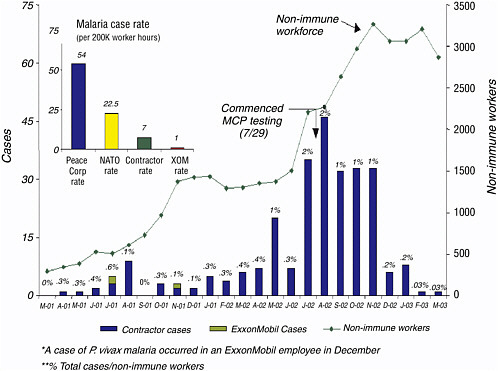
FIGURE 4-2 Graph of the confirmed non-immune falciparum malaria cases of ExxonMobil employees and contractors in Chad and Cameroon. After MCCP testing began on July 29, 2002, rates of malaria cases decreased from 2% in August 2002 to .03% in May 2003. This represents a case rate of 1 case per 200,000 worker hours for ExxonMobil employees and 7 cases per 200,000 worker hours for contractors. The ExxonMobil malaria case rate is less than the case rate for Peace Corps and NATO which record a rate of 54 and 22.5 cases per 200,000 worker hours respectively. SOURCE: Don deSavigny, Swiss Tropical Institute, unpublished.
Demographic Surveillance System
A final model proposed for Chad’s public health system is the DSS. The DSS involves collecting data on births, deaths, causes of death, immigration, and emigration for a large dynamic cohort of individuals. Such extensive population data provides a powerful information platform for understanding health conditions, not only at a point in time, but also longitudinally, noted Singer. The DSS requires a significant investment of resources including software systems that maintain a record of demographic events, trained fieldworkers, transportation systems, data managers, and scientists, and has an estimated annual cost of approximately $130,000. But this investment is arguably worth the cost, argued Singer. With the information collected by the DSS, a government can assess the share of mortality burden for diseases such as HIV/AIDS, malaria, and tuberculosis. A government’s public health budget can then be allocated according to the actual health threats of various diseases in order to ensure that monies are spent in the most effective manner possible. This system has been demonstrated to be effective in some African communities. The mortality rate for children under 5 years of age in areas where the DSS has been implemented is declining at roughly 14 percent per year in comparison to a mortality rate of 5 percent in conventional planning districts (Figure 4-3).
Methods of Managing Corporate Social Responsibility
Although ExxonMobil’s community health program does have weaknesses that could be managed through program expansion, it is not necessarily ExxonMobil’s responsibility to implement these programs, argued Singer. Rather, the question of corporate social responsibility is a complicated one that raises a number of difficult questions. In particular, what is the domain of responsibility for a company like ExxonMobil in looking after the health of communities that are proximal to where it does business? And who is responsible for project funding in the long run? ExxonMobil is in the oil business, not in the health business, but the question remainswhat happens in not only the communities affected by the oil pipeline project but also communities throughout the entire country of Chad?
A potential method of managing questions of corporate social responsibility is to empower local governments to support and manage their own public health systems.
—Burton Singer
A potential method of managing questions of corporate social responsibility is to empower local governments to support and manage their own public health systems, said Singer. The revenue management plan created by ExxonMobil and the Chad government, and previously discussed in the chapter,
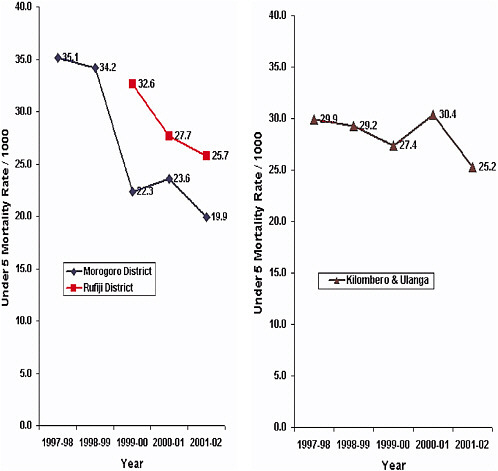
FIGURE 4-3 The two graphs show the under-five mortality rate per 1,000 individuals for two districts in Tanzania. The first graph depicts change in mortality rate for two districts, the Morogoro and Rufiji, that implemented evidence-based planning based on a demographic surveillance system, while the second graph depicts the change in mortality in conventional planning districts. The evidence-based planning district recorded a 14 percent decline in mortality rates while the conventional planning district recorded a 5 percent decline. SOURCE: Steven Phillips, ExxonMobil Corporation, unpublished.
offers an opportunity for Chad to manage their own system by providing guidance and direction for resource allocation. A revenue management plan that incorporates successful public health models will provide effective and reasonable solutions to Chad’s public health problems. The revenue management plan really can play an important long-term role by creating a stable financial foundation on which a public health system can be developed, concluded Singer.
STRATEGIC MANAGEMENT OF ENVIRONMENTAL HEALTH MANAGEMENT SYSTEMS
We are living in a fragile, complex, and dangerous world, said Djordjija Petkoski of the World Bank Institute, the capacity-building arm of the World Bank Group. Imbalances in the world have direct impact on environment and health; thus, they are of great concern to the World Bank. There are two major imbalances in the world: a wealth gap and a generational gap. Much of the decision-making process in the world is limited to a small group of people, which increases the danger of having the concentration of resources with a very small portion of the population. About half of the world’s population live in developing countries and are not party to of any such decision-making process. According to Petkoski, half of that population is younger than 25 years, one-third of global population is between 15–25 years old, and this trend is especially acute in the developing world; however, young people are rarely part of their government’s decision-making process because they do not have the capacity and opportunities to do so. When the World Bank or other international development institutions provide loans, the governments are required to repay these loans over a period of 15–35 years. It is a commitment made today that the next generation will have to repay tomorrow. If young people are not part of the decision-making process they will not feel empowered and responsible to keep the commitments of those who made the decision on their behalf, noted Petkoski.
Turning to the critical issue of poverty reduction, Petkoski noted that the average person in sub-Saharan Africa earns less than $1 per day; about half of the globe lives on less than $2 per day (Chem and Ravallion, 2004). At the same time, the World Bank estimates that wealthy nations spend more than $300 billion on agricultural subsidies. Poverty has a substantial impact on the environment because the poor have less access to employment information and services; less formal or nonrelevant education is associated with risk behaviors, especially by youth. For example, economic need forces poor women and migrants into work environments that pose high risks, such as of contracting communicable diseases, including HIV/AIDS and severe acute respiratory syndrome (SARS). Furthermore, poor neighborhoods tend to have fewer doctors and pharmacies, inadequate transportation and recreation facilities, and lower availability of healthy food and clean water. According to Petkoski, more than 1 billion people in the world do not have access to clean water.
The environment is one of the major determinants of human health and well-being. It also impacts the economic welfare of the society. To improve our health through a better environment, the world needs a new framework for people from different sectors, including a corporate sector, to understand each other. The World Bank believes it is important to engage the corporate sector to be more actively involved in reducing the imbalances in the world. Issues such as air pollution, heavy metals, global climate change, and the built environment are greatly influenced by the private sector’s decision making. The importance of investments
in public and environmental health is undeniable, and when we look at the flow of capital in developing world, it is evident that the flow of capital coming from coming from the private sector, said Petkoski. Therefore, the corporate sector need to lookbeyond short-term profit making and develop a sustainable bottom line that addresses issues related to corporate social responsibility. One of the market-based solutions for the private sector is building broader social capacity, creating sustainable markets, and supporting environmental sustainability. The social legitimacy of sustainable markets, including capturing new market opportunities, depends on how efficiently social causes are addressed, said Petkoski. He further noted that there is a very limited role for the private sector in environmental health without sustainable markets. Developing a common language and shared understanding of the main challenges is probably the toughest problem, said Petkoski. The private sector is typically more flexible and responsive in making and implementing decisions; governments cannot possibly match their pace. Therefore, the private sector has the potential to help address governance gaps and compensate for its failures. Of course, communities also play a critical role in the decision-making process. They need to embrace a broader view of environmental health and be more engaged in the decision-making process, and that requires a lot of additional work in capacity building.
Health challenges and their interdependence with economic, environmental, and social issues are becoming too complex. The resources and competence needed for addressing them are too dispersed for one sector to have all the solutions.
—Djordjija Petkoski
Health challenges and their interdependence with economic, environmental, and social issues are becoming too complex, and the resources and competences necessary to address them are too dispersed for any one sector to have all the solutions, said Petkoski. Therefore, it is essential that organizations, such as the World Bank, foster effective multisectorial partnerships for capacity development. Such partnerships will allow for more meaningful dialogue and facilitate greater collaboration between social groups, governments, and the private sector, leading to greater impact on the ground, concluded Petkoski.


