
2
Selection of Candidates
DETERMINING FACTORS
Based on the factors discussed in Chapter 1, the study identified four criteria for initially down-selecting certain large nonfighter aircraft from the full range of Air Force large nonfighter aircraft: (1) fleet size, (2) fuel consumption, (3) aircraft utilization rate, and (4) maintenance and support costs. In addition, the committee considered (5) the fuel efficiency improvement that is plausible for a given aircraft type and (6) additional operational benefits that could result from re-engining. Each criterion is described in more detail below.
Fleet Size
It is generally much easier to make the case that a proposed modification is worth the cost when sufficiently large inventories of a particular mission-design-series (MDS) designator—as an example, for the C-130H aircraft, the mission is C (cargo), the design is 130, and the series is H—are available to defray the nonrecurring research, development, testing, and evaluation costs. There are some noteworthy exceptions. In some cases, a particular modification might be applicable to several MDSs, so that a modification that appears very unattractive when evaluated for a single MDS with only a few airplanes might look considerably more attractive when all applicable MDSs are grouped together. In other cases—for example, the Joint Surveillance and Target Attack Radar System (JSTARS)—the operational benefits and potential cost savings from reduced maintenance and spares might make a compelling case, even for a small number of aircraft, that quite overshadows the benefits of the fuel savings. Nevertheless, number of aircraft in the inventory was a very strong factor, in both the first-order analysis used to focus committee efforts on a reduced number of MDSs and then on the return on investment (ROI) calculations performed on the subset.
Length of Service in Inventory
The length of the payback period over which the initial investment is spread clearly has a large impact on the attractiveness of a proposed modification. If the payback period is very short, say 5 years,
very few modifications would make the cut if the only considerations were economic. If the payback period is long, measures providing only modest cost savings—say, through fuel savings—can become economically attractive. Unfortunately, the length of time a particular MDS will remain in the inventory from today is not predictable with much confidence.
The Air Force has a planned retirement schedule for all MDSs based on a number of important factors, only one of which is the estimated airframe life in hours. Other factors include such things as the vintage of the component technology, which affects reliability, the availability of spares, the viability of the vendor base, and other factors that in turn affect not only the estimates of future support costs but also, in some cases, the operational suitability of the aircraft for modern conflict. Aircraft of the class examined by this study typically have long airframe lives, about 30,000-50,000 hours. Considering that a typical utilization rate for these aircraft might be ~500 hours per year, they could be around for 60 to 100 years, if and only if estimated airframe life were the only consideration, which it is not. The other considerations typically lead to the much earlier planned retirement of a particular MDS. These plans become very volatile, however, as budgetary pressures preclude replacement of the MDS with more modern airframes.
Table 2-1 shows the inventory of various MDSs and illustrates the above points by estimating the remaining life assuming 30,000 hours airframe life for those aircraft with very stressful missions and
TABLE 2-1 Inventory and Estimated Retirement Dates Based on Assumed Airframe Lives and Flight Hours Shown
|
Aircraft Type |
Total Active Inventory |
Annual Flight Time for an Aircraft (hr) |
Assumed Service Life (hr) |
Remaining Life (hr) |
Estimated Year of Retirementa |
||
|
Minimum |
Maximum |
Start |
Complete |
||||
|
B-1B |
65 |
273 |
30,000 |
23,072 |
27,007 |
2089 |
2103 |
|
B-2A |
21 |
275 |
30,000 |
25,088 |
28,378 |
2095 |
2107 |
|
B-52H |
76 |
316 |
30,000 |
8,964 |
17,080 |
2032 |
2058 |
|
C-130E |
151 |
502 |
30,000 |
−5,727 |
14,604 |
1993 |
2033 |
|
C-130E other variants |
16 |
483 |
30,000 |
−4,737 |
11,757 |
1994 |
2028 |
|
C-130H |
272 |
433 |
30,000 |
9,219 |
27,221 |
2025 |
2067 |
|
C-130H other variants |
130 |
428 |
30,000 |
8,016 |
26,574 |
2023 |
2066 |
|
C-130J |
37 |
352 |
30,000 |
27,475 |
29,970 |
2082 |
2089 |
|
C-130J other variants |
16 |
246 |
30,000 |
27,659 |
29,916 |
2116 |
2125 |
|
C-135 other variants |
32 |
414 |
40,000 |
−7,608 |
26,007 |
1986 |
2067 |
|
C-17A |
154 |
1108 |
40,000 |
28,247 |
39,947 |
2030 |
2040 |
|
C-5A/B/C |
111 |
367 |
40,000 |
16,194 |
26,819 |
2048 |
2077 |
|
E-3B/C |
32 |
537 |
40,000 |
16,886 |
22,575 |
2035 |
2046 |
|
E-4B |
4 |
309 |
40,000 |
26,219 |
28,077 |
2089 |
2095 |
|
E-8C |
19 |
512 |
40,000 |
Refurbishedb |
Refurbishedb |
2035 |
2045 |
|
KC-10A |
59 |
783 |
40,000 |
18,607 |
25,701 |
2028 |
2037 |
|
KC-135D/Ec |
115/65 |
306 |
40,000 |
13,338 |
23,907 |
2048 |
2082 |
|
KC-135R/T |
420 |
366 |
40,000 |
9,460 |
26,963 |
2030 |
2078 |
|
Other |
151 |
538 |
40,000 |
23,850 |
39,922 |
2048 |
2078 |
|
aIllustrative start retirement date is [2004 + (assumed service life − minimum time remaining (hr))/annual flight time per aircraft], where 2004 is the year the data in the table were collected. The illustrative end retirement date is similar but substitutes maximum time remaining. bWhile the Boeing 707 was near the end of its commercial life when purchased by the Air Force, the refurbishment was so extensive it might be reclassified as a remanufactured aircraft when put into Air Force service. cThe Air Force is currently withdrawing the KC-135D/E from the active inventory. Of the 115 total aircraft, 65 KC-135D/E are carried in the active inventory in 2006. SOURCE: United States Air Force, Program Data System database. |
|||||||
40,000 hours for all others. Some of the C-130E and C-135 variants have already exceeded the assumed airframe life (remaining life is negative; these are shaded in the table). These MDSs are now being retired, along with the KC-135E. The remaining aircraft have substantial airframe life remaining.
The committee dealt with this uncertainty in two ways corresponding to the needs of the study at two different points:
-
The initial stage, where the entire ensemble of large nonfighter aircraft was reduced to the smaller set to be examined in detail. In this case, the only MDSs that were eliminated were already being taken out of the inventory, mainly because they were approaching the end of their service life for other reasons as noted above (C-130E, KC-135E).
-
The more detailed evaluation of the smaller set of MDSs. At this point, the ROIs were calculated such that the discounted cash flows were based on a continuous timeline so that any particular criterion for payback could be easily considered (planned retirements, airframe life, congressionally mandated payback period of 25 years.)
Fuel Consumption Rate
The usual practice in figuring fuel consumption, particularly when a new system is acquired, is to specify a spectrum of mission profiles and meticulously calculate the fuel consumption rate averaged over that spectrum. For new system acquisition, there is little alternative to this procedure since there is no experience base for aircraft that do not exist yet. For all aircraft under consideration in this study, the committee has a very substantial experience base from which the fuel consumption rates (pounds or gallons per hour) may be derived. These fuel consumption rates are the average over the mix of mission profiles actually experienced. The general principle the committee followed is that these average fuel consumption rates represent the best information available absent compelling evidence to the contrary. The only compelling evidence found by the committee that required special consideration was associated with the cases where engine enhancements allowed reaching altitude sooner and higher cruise altitudes, both of which would presumably be exploited if the capability were available. The incremental fuel savings were estimated for these cases.
Aircraft Utilization Rate
To make a business case for action that attempts to save fuel, one must know how many hours an aircraft might expect to fly in a year. The higher the use rate, the easier it is to make a good business case for even small improvements in fuel efficiency. In evaluating Air Force aircraft, it is very important to realize just how low the use rate is for these aircraft, how different it is from commercial practice. Whereas a commercial airliner might fly 3,000 to 4,000 hours per year, an Air Force aircraft of similar size might fly 300 to 900 hours per year, 5 to 10 times less.
The reason for the striking difference is very straightforward. In commercial practice, an idle airplane means lost revenue and zero ROI. In contrast, the military must prepare for war and hope that it never comes. This means that the military must be equipped with the right kinds and numbers of equipment to prevail in wartime, yet good stewardship demands that in peacetime, the equipment be used just enough to maintain an adequate level of training for personnel.
This 5- to 10-fold difference between military and commercial practice explains why, absent considerations of force structure and alternative innovative approaches to financing, it is so much more difficult to make a good business case for large, expensive modifications of Air Force aircraft. The primary consideration is money saved as a result of a modification that decreases fuel consumption.
Maintenance and Support Costs
Total engine repair cost includes four operating and support (O&S) cost elements: maintenance personnel, consumables, depot-level reparables (DLRs), and engine overhaul. The Cost Analysis Improvement Group (CAIG) of the Office of the Secretary of Defense (OSD) defines the elements as follows:
-
The maintenance personnel cost element reflects the pay and allowances of military and civilian personnel who support and perform maintenance on the engine. Depending on the maintenance concept and organizational structure, this element will include maintenance personnel at the organizational level and possibly the intermediate level.
-
Consumables are materials and bits-and-pieces repair parts that are used up, or consumed, during maintenance.
-
A DLR is the unit-level cost of reimbursing the stock fund for purchases of DLR spares (also referred to as exchangeables) used to replace initial stocks. DLRs may include repairable individual parts, assemblies, or subassemblies that are required on a recurring basis for the repair of major end items of equipment.
-
Engine overhaul is typically the most complex work and requires expertise or equipment not available at the organizational or intermediate levels.
Figure 2-1 breaks down the Air Force’s total aircraft O&S costs first into total engine O&S costs and then by the cost elements described above. As can be seen, the cost of engine O&S in FY05 was about 20 percent of total aircraft O&S costs.
Figure 2-2 shows engine O&S costs trends since 1999 for all Air Force nonfighter aircraft. Interestingly, the overall cost has declined since 2003.
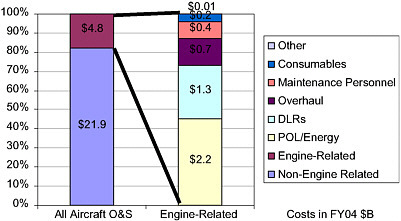
FIGURE 2-1 Total aircraft O&S costs and engine-related costs in FY05. POL, petroleum, oil, lubricants. SOURCE: AFTOC (2006).
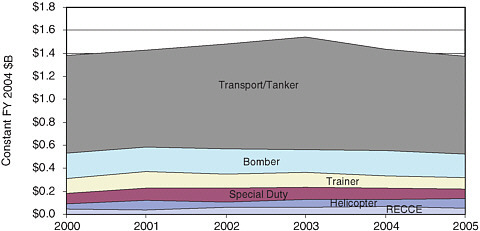
FIGURE 2-2 Air Force nonfighter engine O&S costs. SOURCE: AFTOC (2006).
Plausibility of Significant Improvements
As is to be expected in any business case, the total cost (how much you spend), the prorated benefits (how much you get back each hour of operation), and the remaining operational life (number of hours for which you can reap the benefits) are the key factors that determine whether to re-engine an airframe. With this in mind, it is important to understand the range of values that these parameters can take on, and thereby understand why certain re-engining programs are viable while others are not.
The cost to re-engine an aircraft can vary significantly. If there is a commercial engine that can fit within the housing of the existing engine with only minor modifications, the per-engine cost will be close to that of the engine itself. If significant aerodynamic, electrical, hydraulic, and structural modifications are required, and/or a totally new engine is required, the cost can be very high.
The benefits can also vary significantly, depending on the type of re-engining program that is conducted. For example, a relatively inexpensive re-engining program might provide only modest benefits, while a more expensive program might provide more significant benefits. Thus, depending on the cost/ benefit relationship, the best option might be a more expensive option.
The benefits might also be limited by the constraints of the mission. For example, a low-observable aircraft might not be able to accept a certain engine even though the engine would consume much less fuel, because the higher exhaust temperature or larger cross-section would compromise its observables.
The time over which the cost to re-engine can be recovered is the third key factor in determining the net benefit of a new engine. For example, if an aircraft is near the end of its operational life, the benefits would have to be dramatic to be able to recover the costs before the airframe is retired; even in this case, however, the engines might have significant residual value, which could affect the outcome of the cost/benefit analysis.
Even though this is a constrained optimization problem requiring in-depth analysis of the manufacture, installation, and operation of all the components, a first-principles analysis based on the results of previous in-depth studies and data made available to the committee, such as will be described later, provides ample basis for excluding certain aircraft from consideration. For example, a full-scale re-engining program for the C-17 would require changes to the airframe (aerodynamic and structural) that outweigh the modest improvements in performance that could be achieved given the relatively modern high-bypass engine. However, an engine model derivative program (EMDP), wherein components of the existing engine are improved as new technology that can be retrofitted becomes available, could be a cost-effective means of achieving improvements at low to moderate cost. Similarly, any new engine for the B-2 would need to meet all the low-observable requirements for the aircraft. The only engines that have inherently low-observable characteristics incorporated into the front and back frames that would meet or exceed the radar cross section (RCS) requirements are the F119, F135, and F136. Given the constraints of the mission and the number of aircraft to be considered, a B-2 re-engine option would therefore seem to be too expensive and was eliminated from consideration in this study.
Treatment of Additional Operational Benefits
Lower fuel consumption is not the only benefit of new engines. The introduction of new engines to an existing airframe can result in improved operation capabilities that are just as valuable to the Air Force. For example, in a press release dated July 7, 2006, regarding the re-engining program for the C-5 (GE Aviation, 2006), GE says “The CF6-80C2 will provide the C-5M with a 22 percent increase in thrust, a 30 percent shorter takeoff roll, 58 percent faster climb rate and will allow significantly more cargo to be carried over longer distances.”
Lower fuel consumption and operating and maintenance costs and higher aircraft availability can easily be valued in terms of dollars and cents. For example, one might assume that each percentage point reduction in the fuel consumption of an aircraft will result in an equal percentage point reduction in the total fuel bill for that aircraft, and each extra hour that an aircraft can be operated between maintenance events reduces the cost of maintenance. On the other hand, such a valuation would be conservative as it does not consider the potential for reducing the number of aircraft and the number of people required to conduct the missions. If this type of follow-on savings were taken into consideration, the business case for re-engining would certainly look more promising. Nevertheless, such considerations as rebalancing the force structure among the major elements (fighters, tankers, intertheater airlift, etc.) are well beyond the charter of the committee and would require a significant effort that the Air Force undertakes as a matter of course. The greater capabilities of the force elements considered in this report should be an input to those efforts.
LIST OF CANDIDATE AIRCRAFT AND METHODOLOGY FOR SELECTION
One of the first tasks faced by the committee was to establish a methodology for selecting which aircraft and engines it would analyze. Although the Air Force is a significant consumer of petroleum products, on a national scale it is relatively unimportant, accounting for only 1.0 percent of the total U.S. demand in the most recent year for which data are available (2005). Thus, if major savings in fuel consumption are to be achieved, only those aircraft that are large consumers of fuel need to be considered.

FIGURE 2-3 Potential fuel savings by aircraft type (based on a fuel price of $2.14 per gallon). SOURCE: Committee generated.
From a list of candidate aircraft provided by the Air Force and arranged in order of quantity of fuel consumed, the first step was to weed out some of them. Accordingly, the following considerations were applied to the lists to achieve down-selection to 10 aircraft types:
-
Aircraft such as the C-17, which has relatively modern engines that are not likely to realize major improvements in fuel economy, were not studied in any detail.
-
Aircraft with common engines (such as the TF33) were treated as a group.
-
The most attention was paid to the groups of aircraft with the largest total fuel consumption.
-
Aircraft such as the C5-A/B, which have already been selected for re-engine programs, were included in the study but not analyzed in depth.
As a first cut, a plot was constructed that mapped potential fuel savings (based on 2005 fuel consumption as reported in AFTOC, 2006) for each group of aircraft against the remaining life, as provided by the Air Force. This plot is shown in Figure 2-3. The diameters of the bubbles are proportional to the number of that type of aircraft in the Air Force fleet. Also, the aircraft of greatest interest are those that lie closest to the upper right-hand corner of the plot.
The committee also believed there might be other reasons for including a particular aircraft in the study, such as serious performance or operational issues (in the case of the E-8, for example) or serious reliability and maintainability issues.
TABLE 2-2 Candidates for Further Analysis
|
MDS Designator |
Re-engining |
Engine Modifications |
Aerodynamics Modifications |
|
C-130H |
X |
X |
X |
|
B-1 |
X |
X |
|
|
KC-135R/T |
|
X |
X |
|
C-5 |
X |
|
|
|
KC-10 |
|
X |
|
|
E-3a |
X |
|
X |
|
E-8a |
X |
|
X |
|
KC-135D/Ea |
X |
|
X |
|
B-52a |
X |
|
|
|
aThese aircraft should be considered as a group with a view toward eliminating TF33 from the Air Force engine inventory. |
|||
SUMMARY CANDIDATES FOR STUDY
The analysis to this point, combined with the engineering judgments of the committee members about the plausibility of achieving significant improvement, allowed selecting the aircraft shown in Table 2-2 for more detailed consideration and further analysis in the remainder of the report.
REFERENCES
AFTOC. 2006. Aircraft usage and fuel consumption. Air Force Total Ownership Cost Database. May 15.
General Electric Aviation. 2006. CF6 engines power historic first flight of Lockheed Martin C-5M Super Galaxy. Press release. Cincinnati, Ohio: General Electric Aviation. July 7. Available online at http://www.asd-network.com/press_detail_B.asp?ID=8500.
Miller, B., and J.-P. Clarke. 2005. Real options and strategic guidance in the development of new aircraft programs. 9th International Conference on Real Options. Paris, France, June 22-25.


