
1
Background and Overview
INTRODUCTION
As discussed in the Summary, airlines and aircraft manufacturers have been particularly keen on reducing fuel consumption given increasing fuel prices and today’s competitive markets. However, the fuel economy of military aircraft has become an increasing concern as well. The fuel consumed by the U.S. Air Force is in excess of 3 billion gallons per year, which is over 8 million gallons per day.1 Aviation fuel accounts for much of this total, and the aircraft used by the Air Force for airlift, aerial refueling, and intelligence, surveillance, and reconnaissance (ISR)—which are the aircraft covered in this study—account for over half of all aviation fuel.2 The stated Air Force policy is now to “make energy a consideration in all Air Force actions” and to “promote a culture in which airmen conserve energy.”3 More generally, reduced energy consumption and reduced dependence on foreign oil have become strategic goals of the U.S. Department of Defense (DOD).4
Broadly speaking, the fuel economy of an aircraft can be thought of as having three components: the efficiency of the engines, the aerodynamic
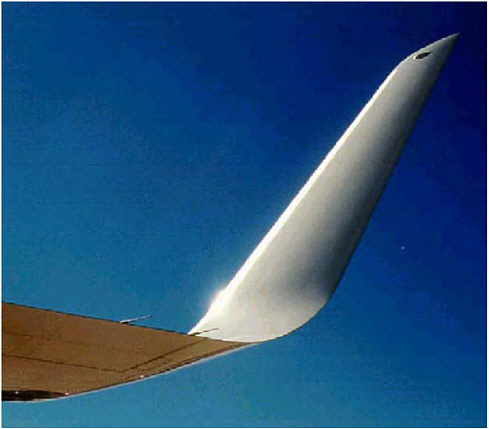
FIGURE 1-1 A common wingtip modification is the “winglet.” SOURCE: Aviation Partners Boeing (APB).
performance, and the weight efficiency. In a recent report, the National Research Council (NRC) examined the potential for improving engine performance in military aircraft and briefly discussed various aerodynamic improvements.5 This report examines potential aerodynamic improvements in large military tanker and transport aircraft in greater detail, in particular the potential for the modification of the wingtips to reduce aerodynamic drag. An example of such a wingtip modification is the “winglet” now seen on many commercial jet aircraft and some military aircraft, shown in Figure 1-1; however, many other aerodynamic improvements are possible.
The concept of winglets was originally developed in the late 1800s by British aerodynamicist F.W. Lancaster, who patented the idea that a verti-
cal surface at the wingtip would reduce drag.6 The idea was refined in the late 1970s at the National Aeronautics and Space Administration (NASA) Langley Research Center by Richard Whitcomb, who designed a winglet using advanced airfoil concepts integrated into a swept, tapered planform that would interact with the wingtip airflow and circulation to reduce drag. Dr. Whitcomb proved the efficacy of winglets in wind tunnel and computer studies.7
The first commercial aircraft to use winglets were corporate-size Learjets in 1977, and the first big jetliner to feature winglets was the Boeing 747-400, followed by the MD-11.8 Winglets and wingtip modifications are now standard equipment on many business jets and jetliners (e.g., Airbus A320/330/340/380; Boeing 747-400). In addition, winglet options are now offered on Boeing 737 aircraft. Winglets are also original equipment on the C-17 military transport. Winglet retrofit kits and services are available for the modification of older aircraft.9
Besides improved fuel economy—which tests suggest may be as high as 5 percent (this may be traded off to obtain increased range)—aircraft manufacturers and winglet retrofit companies have reported that winglets also offer higher operating altitudes, improved aircraft roll rates, shorter time-to-climb rates, lower takeoff speeds, and less takeoff noise. In the commercial world, winglets have not only reduced fuel costs but have also increased operational flexibility by, for example, bringing new international destinations within range and increasing payload capability at airports at high altitudes or with shorter runways.
The payback time for wingtip modification investments in large military tankers and transport aircraft is likely to be longer than the time for the corresponding commercial aircraft, since on average these military aircraft fly many fewer hours per year than do commercial jetliners. However, in combination with fuel savings, the ancillary operational flexibility offered by winglets may make a winglet retrofit a good idea for certain types of military aircraft. This is the issue examined in this report.
|
6 |
Joseph R. Chambers, 2003, Concept to Reality: Contributions of the Langley Research Center to U.S. Civil Aircraft of the 1990s, NASA SP-2003-4529. Available online at http://oea.larc.nasa.gov/PAIS/Concept2Reality. Last accessed on February 26, 2007. |
|
7 |
Ibid. |
|
8 |
Ibid. |
|
9 |
Aviation Partners Boeing. |
STATEMENT OF TASK
As noted in the preface, this report follows up on an earlier NRC study requested by the U.S. Air Force dealing with the re-engining of military aircraft. The following four tasks are addressed in this report:
-
Examine the feasibility of modifying Air Force airlift, aerial refueling, and intelligence, surveillance, and reconnaissance (ISR) aircraft with winglets, to include a cost-effectiveness analysis of the feasible winglet modifications in net present value (NPV) terms.
-
Determine the market price of aviation fuel at which incorporating winglets would be beneficial for each platform.
-
Consider impacts to aircraft maintenance and flight operations (including ground operations).
-
Offer investment strategies the Air Force could implement with commercial partners to minimize Air Force capital investment and maximize investment return.
SCOPE AND COMMITTEE APPROACH
Although the statement of task (SOT) specifically uses the term “winglet,” which typically refers to a nearly vertical surface located at the wingtip, the committee chose to broaden the scope of its deliberations slightly to include a variety of possible modifications to the wingtip (e.g., wingtip span extensions) that can have a similar impact on fuel economy and aerodynamic performance. Thus, in this report, winglet denotes the traditional, nearly vertical wingtip design, while “wingtip modifications” will be used to refer to the more general set of wingtip designs, including winglets and wingtip extensions, aimed at reducing aerodynamic drag. In addition, given the SOT’s emphasis on fuel economy, the committee also considered a variety of possible aerodynamic modifications and operational changes to the aircraft (e.g., improved pressure seals, improved control systems) that would be expected to be relatively simple and inexpensive to implement and that, taken together, might provide fuel economy benefits comparable to those provided by wingtip modifications. Since they were outside its charter, the committee did not examine these other methods in detail, nor did it examine the extent to which the Air Force might already be using some of these methods. Likewise, it did not make any formal recommendations concerning them. However, the committee suggests this is
an area that should be considered as potentially providing significant fuel savings to the Air Force.
The committee also recognized that some of the other reported benefits of wingtip modifications, such as increased range and endurance, ability to utilize shorter runways, increased payload, and decreased time to climb, might be particularly valuable for certain Air Force missions, and that wingtip modifications might therefore be justified for reasons other than fuel cost savings.10 While it was not possible to quantify these benefits exactly, the committee sought to consider them qualitatively in its assessment.
In tackling Task 1, the committee first generated a list of all Air Force aircraft that would be candidates for retrofit wingtip modifications. The committee assessed the missions and typical flight profiles of those that do not currently have wingtip modifications to identify the most promising subset of aircraft to subject to a more detailed analysis. Based on the testimony of representatives of aircraft manufacturers and on information provided by the Air Force, the committee sought to determine qualitatively the cost—including the cost of engineering analysis, structural modification to the wing, and so forth—of retrofitting each system compared to the fuel savings predicted to accrue. For aircraft that already have wingtip modifications, the committee assessed whether further aerodynamic improvements for even more fuel efficiency were warranted.
Task 2 seeks to determine a price for aviation fuel at which the cost of wingtip modification retrofits is justified by fuel cost savings alone. For the most promising subset of aircraft identified in Task 1, the committee estimated the cost of wingtip modification retrofit based on the estimated cost of retrofitting comparable commercial aircraft. By also estimating the potential fuel savings and the number of these aircraft, the committee performed preliminary NPV calculations to calculate whether wingtip modifications for selected military aircraft would pay for themselves well before the aircraft are due to be retired. Recognizing that the cost of fuel delivered to the location where it is used may be many times higher for military aircraft than for commercial aircraft,11 the committee treated fuel cost as a parameter that could be varied over a large range.
As required by Task 3, the committee considered the impact of wingtip modifications on maintenance (depot and field) and flight operations (including hangars, runways, taxiways, and mission requirements), basing its analysis on experience with comparable commercial aircraft.
For those Air Force aircraft that the committee judged were the most promising candidates for wingtip modifications, the committee suggests investment strategies, as called for by Task 4.
STRUCTURE OF THIS REPORT
Chapter 2 discusses how wingtip modifications work, including how they affect aerodynamic performance. It identifies the various benefits and potential negative impacts of wingtip modifications. Chapter 3 summarizes the commercial and military experience with wingtip modifications, as well as lessons drawn from past studies and experience. In Chapter 4, the committee identifies the Air Force aircraft it found to be the best candidates for wingtip modifications. This is followed by a qualitative analysis of the relative costs and benefits of retrofitting wingtip modifications on these aircraft, as well as a discussion of appropriate strategies the Air Force should use to maximize its fuel economy investments. Additional methods that might be considered by the Air Force to improve fuel economy, such as other aerodynamic changes, improving maintenance and operations, and reducing unnecessary weight, are discussed in Appendix B.


