
2
Wingtip Modifications
HISTORY OF WINGTIP DEVICES
Within a few years of the first heavier-than-air flight, the idea of beneficial wingtip devices was introduced. Lanchester patented the concept of a wing end plate in 1897 and suggested that it would reduce wing drag at low speeds. Theoretical studies of end plates by Munk in 19211 were followed by studies of von Karman and Burgers2 and Mangler3 in the 1930s, a patent on nonplanar wings was granted to Cone in 1962,4 and a paper on the topic was published by Lundry and Lissaman in 1968.5 This work was paralleled by many experimental studies (see, for example, National Advisory Committee for Aeronautics (NACA) work from 19286 to 19507), most of which
did not attain the potential savings suggested by the theory. This was partly due to simplistic design, which often included low-aspect-ratio, untwisted, flat-plate airfoils. Recognition of the importance of winglet location, twist, and aspect ratio was clear in the patent of Vogt in 19518 and in a variety of other nonplanar wingtip geometries studied and patented by Cone.9 In the early 1970s, Whitcomb10 of the National Aeronautics and Space Administration (NASA) defined and tested high-aspect-ratio, carefully designed nonplanar wingtips, termed “winglets,” which were soon to appear on numerous aircraft, including Rutan’s VariEze in 1975 and the Learjet 28/29 in 1977. The winglet of the Boeing 747-400 has a much lower dihedral angle than the Whitcomb winglet, and since that time, numerous vertical, canted, and horizontal wingtip extensions have been put into commercial and military service, as shown in Figure 2-1.
INTRODUCTION TO WINGTIP AERODYNAMICS
Much of the drag of an aircraft is related to the lift generated by its wing. To create this lift, the wing pushes downward on the air it encounters and leaves behind a wake with a complex field of velocities. This air behind the wing moves downward then outward, while the air outboard of the wing tips moves upward, then inward, forming two large vortices, as shown in Figure 2-2.
The energy required to create this wake is reflected in the airplane’s “induced” or “vortex” drag. For most aircraft, induced drag constitutes a large fraction, typically 40 percent, of cruise drag. During takeoff, induced drag is even more significant, typically accounting for 80-90 percent of the aircraft’s climb drag. And while takeoff constitutes only a short portion of the flight, changes in aircraft performance at these conditions influence the overall design and so have an indirect, but powerful, effect on the aircraft’s cruise performance. Consequently, concepts that reduce induced drag can have significant effects on fuel consumption.11
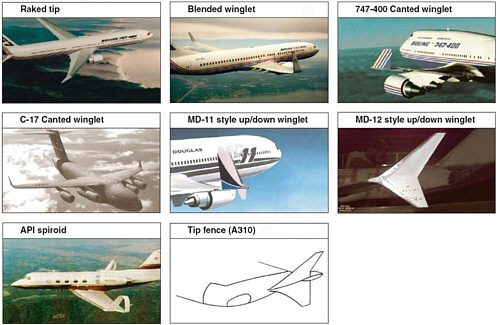
FIGURE 2-1 Wingtip modifications with a variety of geometries have been tested and deployed on both commercial and military aircraft. SOURCE: Courtesy of Doug McLean, “Wingtip devices: What they do and how they do it,” Presentation at the Boeing Performance and Flight Operations Engineering Conference, September 2005.

FIGURE 2-2 The vortex wake behind lifting wings descending through a thin cloud layer. SOURCE: Airliners.net. Photo courtesy of S.C. Morris.
Note that the wake flow pattern illustrated in Figure 2-2 is a gross feature of the wing lift generation, not a localized phenomenon associated with wingtip geometry, so that reduction of the induced drag requires more than a small “device” at the tip. The basic method by which the vortex drag may be reduced is to increase the horizontal or vertical extent of the wing: By increasing the wing dimensions, a larger mass of air can be affected by a smaller amount to produce a given lift, and this leads to less energy in the wake and lower induced drag. So, perhaps the simplest means to reduce induced drag is to increase wingspan through horizontal wingtip extensions. However, in some cases this modification may not be appropriate because of explicit geometric constraints such as hangar width; in others it may not be desirable because of the increased structural weight of the wing, which must be designed to carry greater bending loads. On the other hand, adding vertical wing extensions creates many of the same effects as increasing the wing span (although one must add a bit more than twice the length of wing vertically to achieve the same savings as a horizontal extension). Vertical wing extensions (e.g., winglets) increase the effective span of the wing, lowering induced drag but increasing wing bending moments. They
impose different and sometimes more acceptable challenges than horizontal wingtip extensions.
DESIGN OF WINGTIP DEVICES
Winglets are a visible sign of an improvement that is often perceived as high technology, and this apparently appeals to a segment of the commercial customer community. But from an aerodynamicist’s point of view, the motivation behind most wingtip devices is to reduce induced drag. Beyond that, as Whitcomb showed, the designer’s job is to configure the device so as to minimize the offsetting penalties, resulting in a net performance improvement. There are also aerodynamic and structural aspects that must be considered in the design of the wingtip device. The performance improvement for any particular wingtip device can be measured relative to the performance of the same airplane with no tip device.
Aerodynamic factors potentially offsetting these induced drag savings include an increase in the profile drag due to increased wetted area and junction flows, high sectional loadings, and so on and an increase in the trim drag resulting from increased outboard loading. The amount of trim drag increase is dependent on the specific aircraft and the ability to control the cruise center-of-gravity location (e.g., via fuel management). Increased outboard loading also increases the deflection of the wing at cruise, reducing the drag benefit relative to using a tip device on a theoretical rigid wing. Thus, the benefit associated with the tip device will depend on the specific aircraft and the structural margins of the wing. Finally, the wingtip device adds weight that comes not only from the device itself and its attachment fitting but also from any structural modifications to the existing wing to allow it to handle the additional static loads and to meet flutter and fatigue requirements.
Optimal Wingspan
As stated earlier, induced drag can usually be reduced by simply increasing wingspan, with a resulting reduction in total fuel consumption. Why, then, do aircraft have the limited spans they do if larger spans almost always reduce drag? There are two principal reasons for this:
-
Aircraft are often span-constrained due to infrastructure and operational considerations such as hangar, gate, or taxiway dimensions.
-
For instance, the A380 was limited to a 262.5-ft span to be compatible with large airport infrastructures. Naval aircraft are often span-constrained by aircraft carrier elevator dimensions and deck limitations.
-
Larger spans generally entail larger structural loads on the wings and therefore increased material and manufacturing costs. Eventually, the increased structural weight offsets the drag advantage of larger spans, but simple scaling laws suggest that this does not occur until the wings weigh about one-third as much as the total airplane. Nonetheless, the increased weight and cost of larger span wings leads to diminishing returns as span is increased. This, combined with the geometric issues noted above, determines the optimal span.
Many aircraft in the Air Force inventory were designed at a time when fuel costs were far lower than they are today—especially when the fully burdened cost of delivered fuel is considered. However, as fuel costs increase, the optimal span increases, since the ratio of fuel cost to manufacturing costs becomes larger. This means that if these same aircraft were being designed today, their spans would likely be larger than those of the aircraft in the current fleet.
To improve fuel economy, several options are possible. One could, for example, buy new aircraft designed for current and future fuel costs; redesign the wings of the most widely used aircraft and re-wing the existing airframes; or modify just a portion of the existing wings (by installing a retrofit device) to achieve a portion of the potential fuel savings. Retrofitting existing wings may be the lowest cost option in the near term. This option is especially attractive for aircraft having substantial structural margins.
Wing Retrofits
Several approaches to wing retrofits, which increase the effective aerodynamic span, are possible. The addition of winglets is perhaps the most obvious approach—obvious because of the recent success of winglet retrofits for the Boeing 737s and 757s and because the effective span may be increased without changes to the geometric span. Simple wingtip span extensions are also viable alternatives for reducing fuel consumption. Rather than adding winglets with a height of 10 ft, one could add 5-ft horizontal span extensions to each wingtip and achieve similar drag savings. Span extensions have been added to many commercial aircraft such as the DC-9,
the DC-10, and the Boeing 767. They are less obvious than winglets but can also reduce fuel consumption and, depending on the details of the original design, may be more effective. Some aircraft growth versions have included both tip extensions and root plugs (DC-9 Series 50 to MD-80).12 This approach involves more substantial modification of the wing but can produce greater fuel savings than simple tip modifications, adding wing area and permitting higher root bending loads than would be possible with tip changes alone.
Whether a specific existing wing is best modified by adding winglets or wingtip span extensions depends on many factors. If an aircraft is span constrained, a well-designed winglet can provide a significant reduction in drag. However, if an aircraft is not span constrained, whether to use winglets or tip extensions is less clear. Both winglets and tip extensions add bending loads, subsequently increasing the wing weight. In one study allowing for identical increases in root bending moments, winglets produced better results than tip extensions.13 However, in another study in which integrated bending moments were constrained, winglets and tip extension produced the same results.14 Both of these studies employed highly simplified models of the wing structure. In practice, the existing structure and load distribution must be considered. If, for example, substantial structural margins are available on the outer portion of a wing (e.g., due to minimum gauge constraints) but little is available at the root, a winglet might be added more easily than a span extension.
The geometry of the best wing extension or winglet retrofit also depends on other critical structural constraints. If flutter is critical, the reduced torsional frequencies created by winglets may lead to the choice of a smaller horizontal extension. Similarly, if large sideslips at high dynamic pressure are required for military operation, winglet loads could exceed loads of conventional span extensions. These various constraints make it difficult to generalize about winglets versus tip extensions. Also, stability and control changes can often be accommodated with either modification,
but as with structural considerations, they must be treated in detail on a case-by-case basis.
BENEFITS OF WINGTIP MODIFICATIONS
A net aerodynamic performance improvement made possible by wingtip modifications is satisfying to an engineer, but for an airplane manufacturer or operator the objective is to realize the kind of bottom-line benefits that translate into real savings as measured by cost, noise, engine exhaust emissions, operational flexibility, etc. The potential bottom-line benefits of wingtip devices are reduced fuel burn, increased capability, and improved performance, described below in order of importance.
Reduced Fuel Burn
By reducing drag, wingtip devices help the aircraft operate more efficiently and, in turn, reduce fuel burn. The fuel savings benefits of wingtip modifications depend on the mission flight profile, particularly the range and time spent at cruise speed. Commercial experience with winglet retrofits on the Boeing 737-300/700/800 indicate a 1.5 percent block fuel savings for trips of 250 nautical miles (nmi), increasing to 4 percent for trips of 2,000 nmi.15 For the Boeing 757-200 and 767-300, block fuel savings were 2 percent for 500 nmi trips and 6 percent for 6,000 nmi. On an annual basis, winglets were projected to result in savings to commercial operators of up to 130,000 gallons of fuel per aircraft on the 737-800 and up to 300,000 gallons per aircraft on the 757-200.16 Reduced fuel consumption translates directly into a reduction in operating cost.
Increased Payload-Range Capability
If less fuel is required to accomplish a particular mission at a specific takeoff weight, then that credit can be realized in more than one way. For example, the aircraft can carry more weight (more payload) the same distance or it can carry the same payload farther (greater range). Figure 2-3 shows the increase in payload-range capability made possible by winglets on
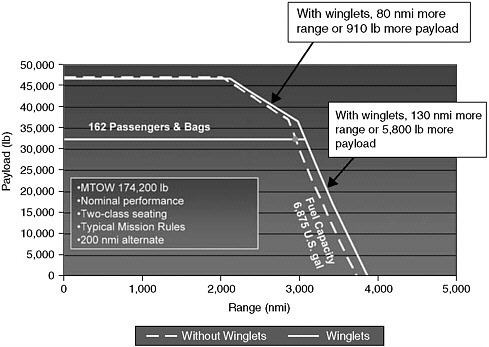
FIGURE 2-3 Winglets increase payload-range capability of the Boeing 737-800.
SOURCE: Aviation Partners Boeing, Presentation to the Committee on Analysis of Air Force Engine Efficiency Improvement Options for Large Non-fighter Aircraft on June 14, 2006.
one commercial aircraft, the Boeing 737-800. The benefits begin to become apparent for ranges beyond 2,000 nmi. Between the 2,000 and 3,000 nmi range, winglets enable 80 nmi more range or 910 lb more payload. Beyond the 3,000 nmi range, winglets allow for 130 nmi more range or 5,800 lb more payload.17 In the commercial world, this capability translates into operational flexibility—for example, it offers a greater choice of aircraft along certain routes or the opening up of new routes and destinations that were not previously within range.
The increased payload-range capability is valued in military aircraft applications just as it is in commercial aircraft applications. Carrying more payload to the same distance could mean fewer sorties to accomplish a specific goal, or it could allow servicing more customers with the same number of operational aircraft.
Improved Takeoff Performance
The reduced drag associated with wingtip modifications reduces the thrust levels required for takeoff (reducing community noise at the same time) and enables faster second-segment climb. This increased climb rate allows the use of airports having shorter runways and allows for operations from airports located at higher altitudes and in hotter climates. Alternatively, these advantages may be traded for carrying higher payloads or a combination of both.
Critical performance constraints for military aircraft can be dictated by either airfield constraints or a combat situation. For example, at an airfield in hostile territory, a steep climb out may be desired to reduce the time an aircraft is vulnerable to surface-to-air threat systems around the airfield. Another example would be takeoff and landing constraints at a commercial airport where military tankers, airlift, or ISR platforms may also have to operate.
CHALLENGES ASSOCIATED WITH WINGTIP MODIFICATIONS
The potential benefits of wingtip modifications do not come without a price. Offsetting factors include the cost of the modification, added weight, added span and height, and potential interference with other wing equipment. These offsetting considerations are discussed below.
Cost
The costs of a wingtip modification retrofit include the nonrecurring costs for engineering, for modification of the wing itself, and for tip device design, manufacturing, and installation. To determine if a wingtip modification is cost-effective, the extent and cost of the nonrecurring engineering and of modifying the existing wing must be calculated. The wing modification costs depend on specific wing characteristics, including structural margins and loadings, as well the strength remaining in light of structural fatigue and corrosion. The wing modifications required to accommodate a tip device could be extensive.
Currently, a winglet retrofit kit for a suitable narrow-body commercial jetliner like the Boeing 737 costs from $500,000 to $1 million per aircraft. For a wide-body like the Boeing 767, the costs are between $1 million and
$1.5 million. For a jumbo-sized aircraft like the Boeing 747, the costs would probably be higher.18
A military aircraft having a close commercial analogue that has been evaluated or fitted with tip devices could have substantially lower non-recurring engineering costs because of this existing knowledge. For example, the C-32 is based on the Boeing 757-200, which has already been modified with winglets; therefore, that experience can inform the decisions regarding the C-32.19 Similarly, in the 1980s the suitability of winglets on the KC-135 was studied.20 This previous work could help to inform a winglet retrofit decision today. However, the KC-135s are now more than 20 years older, and the current condition of their wings would need to be evaluated.
Winglets may have a smaller nonrecurring statement of work than other means of achieving similar improvements. For example, a re-engine program can also improve fuel burn, operational flexibility, and takeoff performance. If the magnitude of the needed improvements is similar, the winglet solution would almost certainly be less costly.
Added Weight
There are two components of added weight: (1) any modifications to the wing that might add weight (e.g., stiffening of the wing to satisfy static and dynamic requirements) and (2) the weight of the winglets themselves. As examples, commercial designs have yielded total modification weights (winglet plus wing modification) of 340 lb for the 737-700 and 1,358 lb for the 757-200ER.21
Added Span and Height
The height of a winglet varies but can be as great as 10-20 ft. A winglet can also increase the wingspan by several feet. These dimensions impact airfield operations such as parking, taxiing, and maneuvering the aircraft on
the ground. If space is critical, a few additional feet of span per aircraft could limit the number that can be on an airfield at any given time, also known as “maximum on ground.” This could constrain throughput for cargo and tanker aircraft, in particular. Winglet height could be an issue if there are obstacles that the winglet would hit when parking or taxiing, damaging both the winglet and obstacle.
However, winglets may be more compatible with existing infrastructure than, say, wingtip extensions. For the same aerodynamic improvement, winglets typically add less span to the airplane than a wingtip extension and might enable the continued use of existing ramp space, gates, hangars, etc.
Interference with Other Wing Equipment
Wingtip modifications might also impact other wing requirements. For example, a winglet might interfere with antennas or sensor equipment on military airplanes. Wingtip modifications might also impact airplane lighting solutions, anti-icing system requirements, and lightning strike dissipation solutions. Winglets can be efficient ice collectors and raise ice protection issues. Such problems should be thoroughly assessed before committing to any wingtip modification solution. Also, wingtip modifications may alter the effectiveness of high lift or control devices by changing their aerodynamic loading either favorably or adversely. Wings with outboard lateral control devices (ailerons, spoilers, and the like) may be particularly susceptible to changes resulting from the addition of a wingtip device such as a winglet or a wingtip extension.
GENERAL OBSERVATIONS
In summary, there are many questions that have to be answered and trade-offs that have to be evaluated in determining whether or not to invest in wingtip modifications. Do wingtip devices require that the wing be strengthened in order, for example, to deal with added moments that might be introduced by wingtip modifications? What is the work package that needs to be developed to assess the extent of the modification, the cost of the modification, and the time an aircraft is out of service? What is the remaining life of the aircraft over which the costs will be amortized? All of these factors will determine the overall costs, which can then be compared with the overall benefits in order to decide whether to go forward. One cannot simply say that because wingtip modifications save fuel on commercial
aircraft, the Air Force should embark on putting wingtip modifications on its mobility aircraft. Investigating the viability/efficacy of such modifications is of value, and a lot can be learned from the extensive work that has already been done on commercial aircraft. But one should not assume a priori that such an investigation will result in a decision to proceed. Both engineering and operational analyses must be done to inform an investment decision.


